Energy-Efficient Management of
Virtual Machines in Data Centers for
Cloud Computing
Anton Beloglazov
Submitted in total fulfilment of the requirements of the degree of
Doctor of Philosophy
February 2013
Department of Computing and Information Systems THEUNIVERSITY OFMELBOURNE
All rights reserved. No part of the publication may be reproduced in any form by print, photoprint, microfilm or any other means without written permission from the author except as permitted by law.
Data Centers for Cloud Computing
Anton BeloglazovSupervisor: Prof. Rajkumar Buyya
Abstract
Cloud computing has revolutionized the information technology industry by enabling elastic on-demand provisioning of computing resources. The proliferation of Cloud com-puting has resulted in the establishment of large-scale data centers around the world containing thousands of compute nodes. However, Cloud data centers consume enor-mous amounts of electrical energy resulting in high operating costs and carbon dioxide emissions. In 2010, energy consumption by data centers worldwide was estimated to be between 1.1% and 1.5% of the global electricity use and is expected to grow further.
This thesis presents novel techniques, models, algorithms, and software for distributed dynamic consolidation of Virtual Machines (VMs) in Cloud data centers. The goal is to improve the utilization of computing resources and reduce energy consumption under workload independent quality of service constraints. Dynamic VM consolidation lever-ages fine-grained fluctuations in the application workloads and continuously reallocates VMs using live migration to minimize the number of active physical nodes. Energy consumption is reduced by dynamically deactivating and reactivating physical nodes to meet the current resource demand. The proposed approach is distributed, scalable, and efficient in managing the energy-performance trade-off. The key contributions are:
1. Competitive analysis of dynamic VM consolidation algorithms and proofs of the competitive ratios of optimal online deterministic algorithms for the formulated single VM migration and dynamic VM consolidation problems.
2. A distributed approach to energy-efficient dynamic VM consolidation and several novel heuristics following the proposed approach, which lead to a significant re-duction in energy consumption with a limited performance impact, as evaluated by a simulation study using real workload traces.
3. An optimal offline algorithm for the host overload detection problem, as well as a novel Markov chain model that allows a derivation of an optimal randomized control policy under an explicitly specified QoS goal for any known stationary workload and a given state configuration in the online setting.
4. A heuristically adapted host overload detection algorithm for handling unknown non-stationary workloads. The algorithm leads to approximately 88% of the mean inter-migration time produced by the optimal offline algorithm.
5. An open source implementation of a software framework for distributed dynamic VM consolidation called OpenStack Neat. The framework can be applied in both further research on dynamic VM consolidation, and real OpenStack Cloud deploy-ments to improve the utilization of resources and reduce energy consumption.
Declaration
This is to certify that
1. the thesis comprises only my original work towards the PhD,
2. due acknowledgement has been made in the text to all other material used, 3. the thesis is less than 100,000 words in length, exclusive of tables, maps,
bibliogra-phies and appendices.
Anton Beloglazov, 27 February 2013
Acknowledgements
PhD is a once-in-a-lifetime opportunity and experience. It is tough at times and may feel like an eternity, but it teaches you a lot, and I am truly happy that I have had a chance to complete it. It would not have happened without all those people who helped me along the way. First of all, I would like to thank my supervisor, Professor Rajkumar Buyya, who has given me the opportunity to undertake a PhD and provided with invaluable guidance and advice throughout my PhD candidature.
I would like to express my gratitude to the PhD committee members, Professor Chris Leckie, Dr. Saurabh Garg, and Dr. Rodrigo Calheiros, for their constrictive comments and suggestions on improving my work. I would also like to thank all the past and cur-rent members of the CLOUDS Laboratory, at the University of Melbourne. In particular, I thank Mukaddim Pathan, Marco Netto, Christian Vecchiola, Suraj Pandey, Marcos dias de Assunao, Kyong Hoon Kim, Srikumar Venugopal, Charity Lourdes, Mustafizur Rah-man, Chee Shin Yeo, Xingchen Chu, Rajiv Ranjan, Alexandre di Costanzo, James Broberg, William Voorsluys, Mohsen Amini, Amir Vahid, Dileban Karunamoorthy, Nithiapidary Muthuvelu, Michael Mattess, Adam Barker, Jessie Yi Wei, Javadi Bahman, Linlin Wu, Adel Toosi, Sivaram Yoganathan, Deepak Poola, Mohammed Alrokayan, Atefeh Khos-ravi, Nikolay Grozev, Sareh Fotuhi, and Yaser Mansouri for their friendship and help dur-ing my PhD. I have had a great time with them and my other friends from the CSSE/CIS department – Andrey Kan, Jubaer Arif, Andreas Schutt, Archana Sathivelu, Jason Lee, Sergey Demyanov, Simone Romano, and Goce Ristanoski to name a few. I also thank my other friends in Australia, USA, France, and back in Russia.
I thank my previous supervisors, Dr. Sergey Piskunov and Dr. Valery Mishchenko, for their guidance and help during the work on my Master’s and Bachelor’s theses. I also thank my collaborators, Prof. Albert Zomaya, Prof. Jemal Abawajy, and Dr. Young Choon Lee. I acknowledge the University of Melbourne and Australian Federal Gov-ernment for providing me with scholarships to pursue my doctoral studies. I thank the external examiners for their excellent reviews and suggestions on improving this thesis.
I am heartily thankful to my parents and sister for their support and encouragement at all times. Finally, I thank my wife Kseniya for her love, inspiration, patience, and for making my life filled with joy and happiness.
Anton Beloglazov Melbourne, Australia 27 February 2013
Contents
1 Introduction 1
1.1 Energy-Efficient Dynamic Consolidation of Virtual Machines. . . 2
1.2 Research Problems and Objectives . . . 6
1.3 Methodology . . . 7
1.4 Contributions . . . 9
1.5 Thesis Organization. . . 11
2 A Taxonomy and Survey of Energy-Efficient Computing Systems 13 2.1 Introduction . . . 13
2.2 Power and Energy Models . . . 16
2.2.1 Static and Dynamic Power Consumption . . . 17
2.2.2 Sources of Power Consumption. . . 18
2.2.3 Modeling Power Consumption . . . 20
2.3 Problems of High Power and Energy Consumption . . . 23
2.3.1 High Power Consumption. . . 24
2.3.2 High Energy Consumption . . . 26
2.4 The State of the Art in Energy-Efficient Computing Systems . . . 27
2.4.1 Hardware and Firmware Level . . . 29
2.4.2 Operating System Level . . . 35
2.4.3 Virtualization Level . . . 44
2.4.4 Data Center Level. . . 49
2.5 Thesis Scope and Positioning . . . 72
2.6 Conclusions . . . 74
3 Competitive Analysis of Online Algorithms for Dynamic VM Consolidation 77 3.1 Introduction . . . 77
3.2 Background on Competitive Analysis . . . 79
3.3 The Single VM Migration Problem . . . 80
3.3.1 The Cost Function . . . 81
3.3.2 The Cost of an Optimal Offline Algorithm . . . 82
3.3.3 An Optimal Online Deterministic Algorithm . . . 84
3.4 The Dynamic VM Consolidation Problem . . . 85
3.4.1 An Optimal Online Deterministic Algorithm . . . 86
3.5 Conclusions . . . 88
4.2 The System Model . . . 93
4.2.1 Multi-Core CPU Architectures . . . 95
4.2.2 The Power Model . . . 95
4.2.3 The Cost of VM Live Migration . . . 96
4.2.4 SLA Violation Metrics . . . 97
4.3 Heuristics for Distributed Dynamic VM Consolidation . . . 98
4.3.1 Host Underload Detection. . . 98
4.3.2 Host Overload Detection . . . 99
4.3.3 VM Selection . . . 103 4.3.4 VM Placement . . . 105 4.4 Performance Evaluation . . . 106 4.4.1 Experiment Setup. . . 106 4.4.2 Performance Metrics . . . 108 4.4.3 Workload Data . . . 108
4.4.4 Simulation Results and Analysis . . . 109
4.5 Conclusions . . . 113
5 The Markov Host Overload Detection Algorithm 115 5.1 Introduction . . . 115
5.2 Related Work . . . 117
5.3 The Objective of a Host Overload Detection Algorithm . . . 120
5.4 A Workload Independent QoS Metric . . . 122
5.5 An Optimal Offline Algorithm . . . 124
5.6 A Markov Chain Model for Host Overload Detection . . . 125
5.6.1 Background on Markov Chain . . . 125
5.6.2 The Host Model . . . 127
5.6.3 The QoS Constraint. . . 129
5.6.4 The Optimization Problem . . . 130
5.6.5 Modeling Assumptions . . . 131
5.7 Non-Stationary Workloads . . . 132
5.7.1 Multisize Sliding Window Workload Estimation . . . 134
5.8 The Control Algorithm . . . 136
5.9 The CPU model . . . 137
5.10 Performance Evaluation . . . 138
5.10.1 Importance of Precise Workload Estimation. . . 138
5.10.2 Evaluation Using PlanetLab Workload Traces . . . 140
5.11 Conclusions . . . 146
6 OpenStack Neat: A Framework for Distributed Dynamic VM Consolidation 149 6.1 Introduction . . . 149
6.2 Related Work . . . 152
6.3 System Design . . . 154
6.3.1 Requirements and Assumptions . . . 155
6.3.2 Integration with OpenStack . . . 155
6.3.3 System Components . . . 156
6.3.5 The Local Manager . . . 162
6.3.6 The Data Collector . . . 163
6.3.7 Data Stores . . . 165
6.3.8 Configuration . . . 167
6.3.9 Extensibility of the Framework . . . 169
6.3.10 Deployment . . . 172
6.4 VM Consolidation Algorithms . . . 173
6.4.1 Host Underload Detection . . . 173
6.4.2 Host Overload Detection . . . 174
6.4.3 VM Selection . . . 175 6.4.4 VM Placement . . . 176 6.5 Implementation . . . 178 6.6 A Benchmark Suite . . . 180 6.6.1 Workload Traces . . . 182 6.6.2 Performance Metrics . . . 183
6.6.3 Performance Evaluation Methodology . . . 184
6.7 Performance Evaluation . . . 186
6.7.1 Experimental Testbed . . . 186
6.7.2 Experimental Setup and Algorithm Parameters . . . 187
6.7.3 Experimental Results and Analysis. . . 188
6.7.4 Scalability Remarks. . . 191
6.8 Conclusions . . . 192
7 Conclusions and Future Directions 195 7.1 Conclusions and Discussion . . . 195
7.2 Future Research Directions. . . 198
7.2.1 Advanced Distributed VM Placement Algorithms . . . 198
7.2.2 VM Network Topologies. . . 198
7.2.3 Exploiting VM Resource Usage Patterns . . . 199
7.2.4 Thermal-Aware Dynamic VM Consolidation . . . 200
7.2.5 Dynamic and Heterogeneous SLAs . . . 200
7.2.6 Power Capping . . . 201
7.2.7 Competitive Analysis of Dynamic VM Consolidation Algorithms . 201 7.2.8 Replicated Global Managers . . . 202
7.3 Final Remarks . . . 203
List of Figures
1.1 The worldwide data center energy consumption 2000-2010 [70] . . . 2
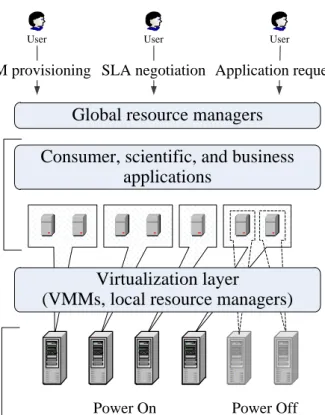
1.2 The high-level system view . . . 4
1.3 The thesis organization . . . 11
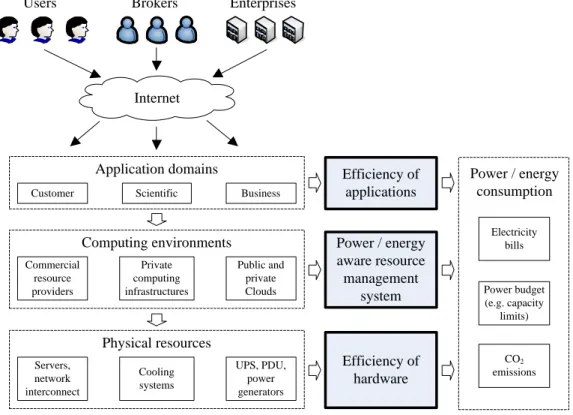
2.1 Energy consumption at different levels in computing systems . . . 15
2.2 Power consumption by server components [83] . . . 19
2.3 The relation between power consumption and CPU utilization of a server [44] 22 2.4 The CPU utilization from the PlanetLab nodes over a period of 10 days . . 25
2.5 A high-level taxonomy of power and energy management . . . 28
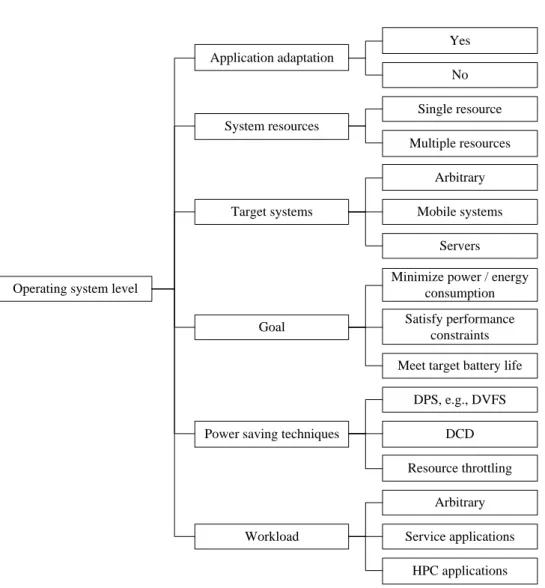
2.6 The operating system level taxonomy . . . 36
2.7 The data center level taxonomy . . . 52
4.1 The system model . . . 94
4.2 Algorithm comparison in regard to the ESV, SLAV, OTF, and PDM metrics, as well as energy consumption, and the number of VM migrations . . . . 110
5.1 The Multisize Sliding Window workload estimation . . . 134
5.2 The estimatedpb00compared top00 . . . 139
5.3 The resulting OTF value and time until a migration produced by the MHOD and benchmark algorithms . . . 142
5.4 Comparison of MHOD with LRR . . . 144
5.5 Comparison of OTFT, OTFTM and MHOD . . . 145
6.1 The combined deployment of OpenStack and OpenStack Neat . . . 150
6.2 The deployment diagram . . . 157
6.3 The global manager: a sequence diagram of handling an underload request 158 6.4 The global manager: a sequence diagram of handling an overload request 159 6.5 The local manager: an activity diagram . . . 163
6.6 The experimental results . . . 194
List of Tables
2.1 Estimated average consumption per server class (W/U) 2000–2006 [69] . . 14
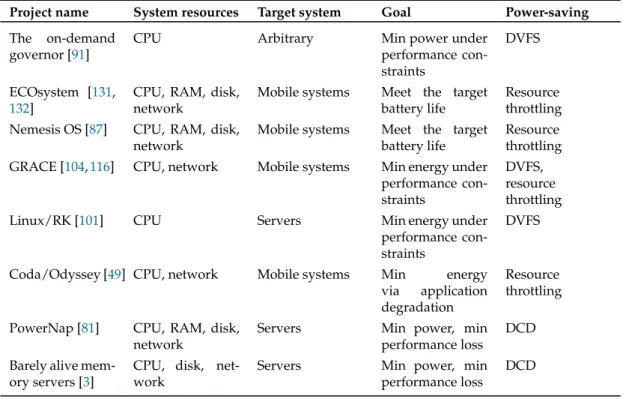
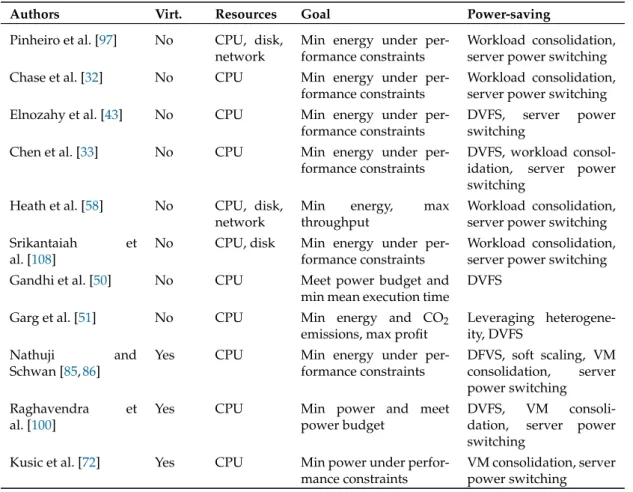
2.2 Operating system level research. . . 37
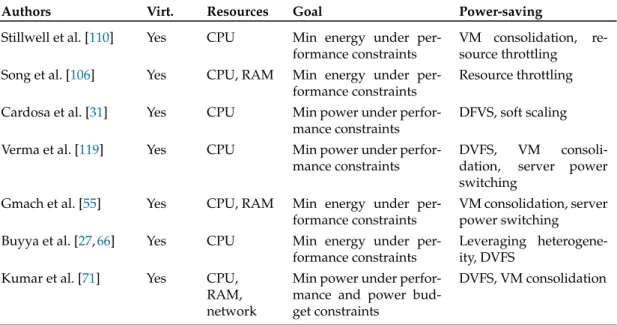
2.3 Data center level research . . . 50
2.3 Data center level research (continued) . . . 51
2.4 The thesis scope . . . 73
4.1 Power consumption by the selected servers at different load levels in Watts 96 4.2 Characteristics of the workload data (CPU utilization) . . . 108
4.3 Comparison of VM selection policies using paired T-tests . . . 109
4.4 Tukey’s pairwise comparisons using the transformed ESV. Values that do not share a letter are significantly different. . . 111
4.5 Simulation results of the best algorithm combinations and benchmark al-gorithms (median values) . . . 113
5.1 An artificial non-stationary workload . . . 138
5.2 Comparison of MHOD, MHOD-OPT and OPT . . . 139
5.3 Paired T-tests with 95% CIs for comparing the time until a migration pro-duced by MHOD, LR and LRR . . . 143
5.4 SLA violations by OTFT, OTFTM and MHOD. . . 146
5.5 Paired T-tests for comparing MHOD with OPT . . . 147
6.1 The database schema . . . 166
6.2 OpenStack Neat’s configuration options . . . 167
6.2 OpenStack Neat’s configuration options (continued) . . . 168
6.2 OpenStack Neat’s configuration options (continued) . . . 169
6.3 Interfaces of VM consolidation algorithms and their factory functions. . . 170
6.4 Arguments of VM consolidation algorithms and their factory functions . . 171
6.5 The OpenStack Neat codebase summary. . . 180
6.6 Open source libraries used by OpenStack Neat . . . 181
6.7 The experimental results (mean values with 95% CIs) . . . 188
6.8 Energy consumption estimates . . . 190 6.9 The execution time of components in seconds (mean values with 95% CIs) 191
Introduction
C
LOUD computing has revolutionized the Information and Communication Tech-nology (ICT) industry by enabling on-demand provisioning of elastic computing resources on a pay-as-you-go basis. An organization can either outsource its computa-tional needs to the Cloud avoiding high up-front investments in a private computing in-frastructure and consequent costs of maintenance and upgrades, or build a private Cloud data center to improve the resource management and provisioning processes.The proliferation of Cloud computing has resulted in the establishment of large-scale data centers around the world containing thousands of compute nodes. However, Cloud data centers consume huge amounts of electrical energy resulting in high operating costs and carbon dioxide (CO2) emissions to the environment. As shown in Figure 1.1, en-ergy consumption by data centers worldwide has risen by 56% from 2005 to 2010, and in 2010 is accounted to be between 1.1% and 1.5% of the total electricity use [70]. Further-more, carbon dioxide emissions of the ICT industry are currently estimated to be 2% of the global emissions, which is equivalent to the emissions of the aviation industry [52] and significantly contributes to the greenhouse effect. As projected by Koomey [69], en-ergy consumption in data centers will continue to grow rapidly unless advanced enen-ergy- energy-efficient resource management solutions are developed and applied.
To address the problem of high energy use, it is necessary to eliminate inefficiencies and waste in the way electricity is delivered to computing resources, and in the way these resources are utilized to serve application workloads. This can be done by im-proving both the physical infrastructure of data centers, and the resource allocation and management algorithms. Recent advancement in the data center design have resulted in a significant increase of the infrastructure efficiency. As reported by the Open Compute
2010 2005 2000 300 250 200 150 100 50 0
Year
B
il
li
o
n
k
W
h
/y
ea
r
Figure 1.1: The worldwide data center energy consumption 2000-2010 [70]
project, Facebook’s Oregon data center achieved a Power Usage Effectiveness (PUE) of 1.08 [89], which means that approximately 91% of the data center’s energy consumption is consumed by the computing resources.
A source of energy waste lies in the inefficient usage of computing resources. Data col-lected from more than 5000 production servers over a six-month period have shown that although servers are usually not idle, the utilization rarely approaches 100% [13]. Most of the time servers operate at 10-50% of their full capacity, leading to extra expenses on over-provisioning, and thus extra Total Cost of Acquisition (TCA) [13]. Moreover, man-aging and maintaining over-provisioned resources results in the increased Total Cost of Ownership (TCO). In addition, the problem of low server utilization is exacerbated by narrow dynamic power ranges of servers: even completely idle servers still consume up to 70% of their peak power [44]. Therefore, keeping servers underutilized is highly inef-ficient from the energy consumption perspective. This thesis focuses on the problem of energy-efficient resource management in Cloud data centers, i.e., ensuring that comput-ing resources are efficiently utilized to serve application workloads to minimize energy consumption, while maintaining the required Quality of Service (QoS).
1.1
Energy-Efficient Dynamic Consolidation of Virtual Machines
An ideal way of addressing the energy inefficiency problem is implementing an energy-proportional computing system, where energy consumption of the computing resources
is proportional to the application workload [13]. This approach is partially implemented through the widely adopted Dynamic Voltage and Frequency Scaling (DVFS) technique. DVFS allows the dynamic adjustment of the voltage and frequency of the CPU based on the current resource demand. As a result, current desktop and server CPUs can con-sume less than 30% of their peak power in low-activity modes, leading to dynamic power ranges of more than 70% [13].
In contrast, dynamic power ranges of all the other server components are much nar-rower: less than 50% for Dynamic Random Access Memory (DRAM), 25% for disk drives, 15% for network switches, and negligible for other components [44]. The reason is that only the CPU supports active low-power modes, whereas other components can only be completely or partially switched off. However, the performance overhead of a transition between the active and inactive modes is substantial. For example, a disk drive in the deep-sleep mode consumes negligible power, but a transition to the active mode incurs a latency 1000 times higher than the regular access latency. Power inefficiency of the server components in the idle state leads to a narrow overall dynamic power range of a server on the order of 30%. This means that even if a server is completely idle, it still consumes up to 70% of its peak power.
One method to improve the utilization of resources and reduce energy consump-tion, which has been shown to be efficient is dynamic consolidation of Virtual Machines (VMs) [59,72,86,100,119] enabled by the virtualization technology. Virtualization allows Cloud providers to create multiple VM instances on a single physical server, thus im-proving the utilization of resources and increasing the Return On Investment (ROI). The reduction in energy consumption can be achieved by switching idle nodes to low-power modes (i.e., sleep, hibernation), thus eliminating the idle power consumption (Figure1.2).
Another capability provided by virtualization islive migration, which is the ability to transfer a VM between physical servers (referred to as hosts, or nodes) with a close to zero downtime. Using live migration [35] VMs can bedynamicallyconsolidated to lever-age fine-grained fluctuations in the workload and keep the number of active physical servers at the minimum at all times. Dynamic VM consolidation consists of two basic processes: migrating VMs from underutilized hosts to minimize the number of active hosts; and offloading VMs from hosts when those become overloaded to avoid
perfor-Power On Power Off
Physical
compute
nodes
Virtualization layer
(VMMs, local resource managers)
Consumer, scientific, and business
applications
Global resource managers
User User User
VM provisioning SLA negotiation Application requests
Virtual
machines
and user
applications
Figure 1.2: The high-level system view
mance degradation experienced by the VMs, which could lead to a violation of the QoS requirements. Idle hosts are automatically switched to a low-power mode to eliminate the static power and reduce the overall energy consumption by the system. When re-quired, hosts are reactivated to accommodate new VMs or VMs being migrated.
However, dynamic VM consolidation in Clouds is not trivial since modern service applications often experience highly variable workloads causing dynamic resource usage patterns. Therefore, unconstrained VM consolidation may lead to performance degrada-tion when an applicadegrada-tion encounters an increasing demand resulting in an unexpected rise of the resource usage. If the resource requirements of an application are not ful-filled, the application may face increased response times, time-outs or failures. Ensuring QoS defined via Service Level Agreements (SLAs) established between Cloud providers and their customers is essential for Cloud computing environments. Therefore, Cloud providers have to deal with the energy-performance trade-off – minimizing energy con-sumption, while meeting QoS requirements.
The scope of this thesis is energy-efficient dynamic VM consolidation in Infrastruc-ture as a Service (IaaS) Cloud data centers under QoS constraints. The focus on IaaS
en-vironments, e.g., Amazon Elastic Compute Cloud (EC2)1, imposes several requirements stipulated by the properties of the environment. Addressing them distinguishes the ap-proach presented in this thesis from the related work, as discussed in Chapter2.
In particular, it is necessary to handle mixed heterogeneous workloads since multi-ple independent users dynamically provision VMs and deploy various types of applica-tions on shared physical resources. This means that the resource provider is unaware of the application types deployed in the system; therefore, the system must be application-agnostic, i.e., able to efficiently handle unknown mixed workloads. Another require-ment is providing QoS guarantees specified in the SLAs negotiated between the Cloud provider and consumers. Since multiple different applications can coexist in the system, it is necessary to apply a workload independent QoS metric to quantify the performance delivered to the applications. Such a QoS metric can be used to specify system-wide workload independent QoS requirements.
Another aspect distinguishing the work presented in this thesis from the related re-search is the distributed architecture of the VM management system. A distributed VM management system architecture is essential for large-scale Cloud providers, as it enables the natural scaling of the system to thousands of compute nodes. An illustration of the importance of scalability of a VM management system is the fact that Rackspace2, a well-known IaaS provider, currently manages tens of thousands of servers. Moreover, the number of servers continuously grows: Rackspace has increased the total server count in the second quarter of 2012 to 84,978 up from 82,438 servers at the end of the first quarter [99]. Another benefit of making the VM management system distributed is the improved fault tolerance by eliminating single points of failure: even if a compute or controller node fails, it would not render the whole system inoperable.
This thesis presents a complete solution to energy-efficient distributed dynamic VM consolidation under QoS constraints. It is evaluated by simulations using workload traces from more than a thousand PlanetLab VMs3, as well as real experiments on a multi-node testbed using OpenStack Neat4– a prototype system implemented as a transparent add-on to the OpenStack Cloud platform.
1Amazon EC2.http://aws.amazon.com/ec2/
2The Rackspace Cloud.http://www.rackspace.com/
3The PlanetLab platform.http://www.planet-lab.org/
1.2
Research Problems and Objectives
This thesis tackles the research challenges in relation to energy-efficient distributed dy-namic VM consolidation in IaaS environments under QoS constraints. In particular, the following research problems are investigated:
• How to define workload-independent QoS requirements. Since multiple appli-cations of various types can coexist in an IaaS environment and share physical re-sources, it is necessary to derive a workload independent QoS metric that can be used to define system-wide QoS constraints.
• When to migrate VMs.Dynamic VM consolidation comprises two basic processes: (1) migrating VMs from overloaded servers to avoid performance degradation; and (2) migrating VMs from underloaded servers to improve the utilization of resources and minimize energy consumption. A crucial decision that must be made in both situations is determining the best time to migrate VMs to minimize energy con-sumption, while satisfying the defined QoS constraints.
• Which VMs to migrate. Once a decision to migrate VMs from a server is made, it is required to select one or more VMs from the full set of VMs allocated to the server, which must be reallocated to other servers. The problem consists in de-termining the best subset of VMs to migrate that will provide the most beneficial system reconfiguration.
• Where to migrate the VMs selected for migration. Determining the best place-ment of new VMs or the VMs selected for migration to other servers is another essential aspect that influences the quality of VM consolidation and energy con-sumption by the system.
• When and which physical nodes to switch on/off. To save energy, VM consoli-dation should be combined with dynamic switching of the power states of nodes, which addresses the problem of narrow power ranges of servers by eliminating power consumption in the idle state. To optimize energy consumption by the sys-tem and avoid violations of the QoS requirements, it is necessary to efficiently de-termine when and which physical nodes should be deactivated to save energy, or reactivated to handle increases in the demand for resources.
scalability and eliminate single points of failure, it is necessary to design dynamic VM consolidation algorithms in a distributed manner. The problem is that tradi-tionally global resources management algorithms are centralized. Therefore, a new approach is required to make the dynamic VM consolidation system distributed.
To deal with the challenges associated with the above research problems, the follow-ing objectives have been delineated:
• Explore, analyze, and classify the research in the area of energy-efficient computing to gain a systematic understanding of the existing techniques and approaches.
• Conduct competitive analysis of algorithms for dynamic VM consolidation to ob-tain theoretical performance estimates and insights into the design of online algo-rithms for dynamic VM consolidation.
• Propose a workload independent QoS metric that can be used in defining system-wide QoS constraints in IaaS environments.
• Propose an approach to designing a dynamic VM consolidation system in a dis-tributed manner.
• Develop online algorithms for energy-efficient distributed dynamic VM consolida-tion for IaaS environments satisfying workload-independent QoS constraints.
• Design and implement a distributed dynamic VM consolidation system that can be used to evaluate the proposed algorithms on a multi-node IaaS testbed.
1.3
Methodology
The research methodology followed in this thesis consists of several consecutive steps summarized below:
1. Conduct theoretical analysis of dynamic VM consolidation algorithms to obtain theoretical performance estimates and insights into designing such algorithms. Since dynamic VM consolidation algorithms are online, the framework of com-petitive analysis has been applied. In this framework, the theoretical performance of an online algorithm is evaluated in comparison with the performance of an op-timal offline algorithm designed for the same problem.
from the conducted competitive analysis and derived system model. Since the problem of dynamic VM consolidation involves a set of algorithms as discussed in the following chapters, multiple algorithms have been developed based on prior work on approximation algorithms for the bin packing problem, statistical analy-sis of historical data, and Markov chain modeling.
3. Evaluate the proposed algorithms through discrete-event simulation using the CloudSim simulation toolkit5extended to support power and energy-aware sim-ulations. As the target system is an IaaS, a Cloud computing environment that is intended to create a view of infinite computing resources to the users, it is essen-tial to evaluate the proposed algorithms on a large-scale virtualized data center infrastructure. However, conducting repeatable large-scale experiments on a real infrastructure is extremely difficult. Therefore, to ensure the repeatability and re-producibility of experiments, as well as carry out large-scale experiments, discrete-event simulation has been chosen as the initial way to evaluate the performance of the proposed algorithms.
4. Simulate application workloads using real-world workload traces from the Plan-etLab platform. The CPU utilization of the VMs has been simulated based on the data provided as a part of the CoMon project, a monitoring infrastructure for Plan-etLab [92]. The project provides data collected every 5 minutes from more than a thousand VMs instantiated in more than 500 locations around the world. The workload from PlanetLab VMs is representative of an IaaS Cloud environment, such as Amazon EC2, as the VMs are created and managed by multiple indepen-dent users, and the infrastructure provider is not aware of application workloads in the VMs. Furthermore, the overall system workload is composed of multiple independent heterogeneous applications, which also corresponds to an IaaS envi-ronment. The difference from a public Cloud provider, such as Amazon EC2, is that PlanetLab is an infrastructure mainly used for research purposes; therefore, the applications are potentially closer to the HPC type, which are typically CPU-intensive with lower dynamics in the resource utilization compared with web ser-vices. HPC workload is easier to handle for a VM consolidation system due to
infrequent variation in the resource utilization. Therefore, to stress the system, the original workload traces are filtered to select the ones that exhibit high variability. 5. Implement a system prototype as an add-on to an open source Cloud platform, which has been chosen to be OpenStack6. Apart from simulations, it is impor-tant to evaluate the proposed algorithms on a real infrastructure. A prototype dis-tributed dynamic VM consolidation system has been implemented and used to ex-perimentally evaluate the proposed algorithms on a real multi-node IaaS testbed.
1.4
Contributions
The contributions of this thesis can be broadly divided into 4 categories: classification and analysis of the area, competitive analysis of dynamic VM consolidation algorithms, novel algorithms for distributed dynamic VM consolidation, and implementation of a framework for distributed dynamic VM consolidation. Thekey contributionsare:
1. A taxonomy and survey of the state-of-the-art in energy-efficient computing.
2. Competitive analysis of dynamic VM consolidation algorithms:
• Formal definitions of the single VM migration and dynamic VM consolida-tion problems.
• A proof of the cost incurred by an optimal offline algorithm for the single VM migration problem.
• Competitive analysis and proofs of the competitive ratios of optimal online deterministic algorithms for the single VM migration and dynamic VM con-solidation problems.
3. Novel algorithms for distributed dynamic VM consolidation:
• The introduction of a distributed approach to energy and performance effi-cient dynamic VM consolidation.
• Novel heuristics for the problem of energy and performance efficient dy-namic VM consolidation following the introduced distributed approach.
• A simulation-based evaluation and performance analysis of the algorithms.
• An analytical model showing that to improve the quality of VM consolida-tion, it is necessary to maximize the mean time between VM migrations ini-tiated by the host overload detection algorithm.
• An optimal offline algorithm for the host overload detection problem, and proof of its optimality.
• A novel Markov chain model that allows a derivation of a randomized con-trol policy that optimally solves the problem of maximizing the mean time between VM migrations under an explicitly specified QoS goal for any known stationary workload and a given state configuration in the online setting.
• A heuristically adapted algorithm for handling unknown non-stationary work-loads using the Multisize Sliding Window workload estimation approach [80], which leads to comparable to the best benchmark algorithm performance in terms of the inter-migration time, while providing the advantage of explicit specification of a QoS goal. The adapted algorithm leads to approximately 88% of the mean inter-migration time produced by the optimal offline algo-rithm for the input workload traces used in the experiments.
4. Software implementation of OpenStack Neat7, a framework for distributed dy-namic VM consolidation as an add-on to the OpenStack Cloud platform:
• An architecture of an extensible software framework for dynamic VM con-solidation designed to transparently integrate with OpenStack installations and allowing configuration-based substitution of multiple implementations of algorithms for each of the sub-problems of dynamic VM consolidation.
• An open source software implementation of the framework in Python re-leased under the Apache 2.0 license and publicly available online.
• An implementation of several algorithms for dynamic VM consolidation pro-posed and evaluated by simulations in the previous chapters.
• An initial version of a benchmark suite comprising the software framework, workload traces, performance metrics, and methodology for evaluating and comparing distributed dynamic VM consolidation solutions.
• Experimental evaluation of the framework on a 5-node OpenStack
A p p ro ac h
Chapter 2 Chapter 3 Chapter 4 Chapter 5 Chapter 6
C o n tr ib u ti o n Literature review Theoretical analysis Novel algorithms, simulation System prototype Taxonomy and survey Competitive analysis Statistics, bin packing Markov chains OpenStack add-on
Figure 1.3: The thesis organization
ment using real-world application workload traces collected from more than a thousand PlanetLab VMs [92]. The experiments have shown that dynamic VM consolidation is able to reduce energy consumption by the compute nodes by up to 30% with a limited performance impact.
1.5
Thesis Organization
The core chapters of this thesis are structured as shown in Figure 1.3 and are derived from several journal papers published during the PhD candidature. The remainder of the thesis is organized as follows:
• Chapter 2 presents a taxonomy and survey of energy-efficient computing systems, as well as the scope of this thesis and its positioning in the area. This chapter is derived from [18]:
– Anton Beloglazov, Rajkumar Buyya, Young Choon Lee, and Albert Zomaya, “A Taxonomy and Survey of Energy-Efficient Data Centers and Cloud Com-puting Systems,”Advances in Computers, Marvin V. Zelkowitz (editor), Volume 82, Pages: 47-111, Academic Press, USA, 2011.
• Chapter 3 presents competitive analysis of dynamic VM consolidation algorithms. This chapter is derived from [16]:
– Anton Beloglazovand Rajkumar Buyya, “Optimal Online Deterministic Al-gorithms and Adaptive Heuristics for Energy and Performance Efficient
Dy-namic Consolidation of Virtual Machines in Cloud Data Centers,”Concurrency and Computation: Practice and Experience (CCPE), Volume 24, Issue 13, Pages: 1397-1420, John Wiley & Sons, Ltd, USA, 2012.
• Chapter 4 proposes novel algorithms for distributed dynamic VM consolidation. This chapter is derived from [15,16]:
– Anton Beloglazov, Jemal Abawajy, and Rajkumar Buyya, “Energy-Aware Re-source Allocation Heuristics for Efficient Management of Data Centers for Cloud Computing,” Future Generation Computer Systems (FGCS), Volume 28, Issue 5, Pages: 755-768, Elsevier Science, The Netherlands, 2012.
– Anton Beloglazovand Rajkumar Buyya, “Optimal Online Deterministic Al-gorithms and Adaptive Heuristics for Energy and Performance Efficient Dy-namic Consolidation of Virtual Machines in Cloud Data Centers,”Concurrency and Computation: Practice and Experience (CCPE), Volume 24, Issue 13, Pages: 1397-1420, John Wiley & Sons, Ltd, USA, 2012.
• Chapter 5 proposes a novel host overload detection algorithm based on a Markov chain model. This chapter is derived from [17]:
– Anton Beloglazov and Rajkumar Buyya, “Managing Overloaded Hosts for Dynamic Consolidation of Virtual Machines in Cloud Data Centers Under Quality of Service Constraints,” IEEE Transactions on Parallel and Distributed Systems (TPDS), Volume 24, Issue 7, Pages: 1366-1379, IEEE CS Press, USA, 2013.
• Chapter 6 describes the architecture and implementation of OpenStack Neat, a framework for distributed dynamic VM consolidation in OpenStack Clouds. This chapter is derived from:
– Anton Beloglazovand Rajkumar Buyya, “OpenStack Neat: A Framework for Dynamic Consolidation of Virtual Machines in OpenStack Clouds,”Software: Practice and Experience (SPE), John Wiley & Sons, Ltd, USA, 2013 (in review).
• Chapter 7 concludes the thesis with a summary of the main findings, discussion of future research directions, and final remarks.
A Taxonomy and Survey of
Energy-Efficient Computing Systems
Traditionally, the development of computing systems has been focused on performance improve-ments driven by the demand of applications from consumer, scientific, and business domains. How-ever, the ever-increasing energy consumption of computing systems has started to limit further per-formance growth due to overwhelming electricity bills and carbon dioxide footprints. Therefore, the goal of the computer system design has been shifted to power and energy efficiency. To identify open challenges in the area and facilitate further advancements, it is essential to synthesize and classify the research on power- and energy-efficient design conducted to date. This chapter discusses the causes and problems of high power / energy consumption, and presents a taxonomy of energy-efficient design of computing systems covering the hardware, operating system, virtualization, and data center levels. The key works in the area are surveyed and mapped onto the taxonomy to guide future design and development efforts. This chapter concludes with a discussion of the scope of the current thesis and its positioning within the research area.
2.1
Introduction
T
HE primary focus of designers of computing systems and the industry has been on the improvement of the system performance. According to this objective, the performance has been steadily growing driven by more efficient system design and in-creasing density of the components described by Moore’s law [84]. Although the perfor-mance per watt ratio has been constantly rising, the total power drawn by computing systems has hardly decreased. Oppositely, it has been increasing every year that can be illustrated by the estimated average power use across three classes of servers presented in Table2.1[69]. If this trend continues, the cost of energy consumed by a server during its lifetime will exceed the hardware cost [12]. The problem is even worse for large-scaleTable 2.1: Estimated average consumption per server class (W/U) 2000–2006 [69]
Server class 2000 2001 2002 2003 2004 2005 2006
Volume 186 193 200 207 213 219 225
Mid-range 424 457 491 524 574 625 675
High-end 5,534 5,832 6,130 6,428 6,973 7,651 8,163
compute infrastructures, such as clusters and data centers. It was estimated that energy consumption by IT infrastructures has risen by 56% from 2005 to 2010, and in 2010 ac-counted to be between 1.1% and 1.5% of the global electricity use [70]. Apart from high operating costs, this results in substantial carbon dioxide (CO2) emissions, which were estimated to be 2% of the global emissions [52].
Energy consumption is not only determined by hardware efficiency, but also by the resource management system deployed on the infrastructure and the efficiency of appli-cations running in the system. The interdependence of different levels of computing sys-tems in regard to energy consumption is shown in Figure2.1. Energy efficiency impacts end-users in terms of resource usage costs, which are typically determined by the Total Cost of Ownership (TCO) incurred by the resource provider. Higher power consump-tion results not only in boosted electricity bills but also in addiconsump-tional requirements to the cooling system and power delivery infrastructure, i.e., Uninterruptible Power Supplies (UPS), Power Distribution Units (PDU), and so on.
With the growth of the density of computer components, the cooling problem be-comes crucial, as more heat has to be dissipated for a square meter. The problem is especially important for 1U and blade servers. These types of servers are the most dif-ficult to cool because of the high density of components, and thus, the lack of space for the air flow. Blade servers bring the advantage of higher computational power in less rack space. For example, 60 blade servers can be installed into a standard 42U rack [83]. However, such a system requires more than 4000 W to supply the resources and cooling system. This is significantly higher compared with the same rack filled by 1U servers con-suming 2500 W. Moreover, peak power consumption tends to limit further performance improvements due to constraints of the power distribution facilities. For example, to power a server rack in a typical data center, it is necessary to provide about 60 A [102]. Even if the cooling problem can be addressed in future systems, it is likely that delivering
Customer
Users Brokers Enterprises
Internet Scientific Business Application domains Commercial resource providers Private computing infrastructures Public and private Clouds Computing environments Servers, network interconnect Cooling systems UPS, PDU, power generators Physical resources Power / energy aware resource management system Electricity bills Power budget (e.g. capacity limits) CO2 emissions Power / energy consumption Efficiency of applications Efficiency of hardware
Figure 2.1: Energy consumption at different levels in computing systems
current in such data centers will reach the power delivery limits.
Apart from the overwhelming operating costs and the total cost of acquisition (TCA), another rising concern is the environmental impact in terms of carbon dioxide (CO2) emissions caused by high energy consumption. Therefore, the reduction of power and energy consumption has become a first-order objective in the design of modern comput-ing systems. The roots of energy-efficient computcomput-ing, or Green IT, practices can be traced back to 1992, when the U.S. Environmental Protection Agency launched Energy Star, a voluntary labeling program designed to identify and promote energy-efficient products to reduce the greenhouse gas emissions. Computers and monitors were the first labeled products. This led to the widespread adoption of the sleep mode in electronic devices.
At that time, the term “green computing” was introduced to refer to energy-efficient personal computers [103]. At the same time, the Swedish confederation of professional employees has developed the TCO certification program – a series of end-user and en-vironmental requirements for IT equipment including video adapters, monitors, key-boards, computers, peripherals, IT systems, and even mobile phones. Later, this pro-gram has been extended to include requirements on ergonomics, magnetic and electrical
field emission levels, energy consumption, noise level, and use of hazardous compounds in hardware. The Energy Star program was revised in October 2006 to include stricter efficiency requirements for computer equipment a tiered ranking system.
There are a number of industry initiatives aiming at the development of standardized methods and techniques for the reduction of energy consumption and carbon dioxide emissions in computing environments. They include Climate Savers Computing Ini-tiative (CSCI), Green Computing Impact Organization, Inc. (GCIO), Green Electronics Council, The Green Grid, FIT4Green, ECO2Clouds, Eco4Cloud, International Profes-sional Practice Partnership (IP3), with the membership of large companies, such as AMD, Dell, HP, IBM, Intel, Microsoft, Sun Microsystems, and VMware.
Energy-efficient resource management has been first introduced in the context of battery-powered mobile devices, where energy consumption has to be reduced to im-prove the battery lifetime. Although techniques developed for mobile devices can be applied or adapted for servers and data centers, this kind of systems requires specific methods. This chapter discusses various ways of reducing power and energy consump-tion in computing systems, as well as recent research that deals with power and energy efficiency at the hardware and firmware, Operating System (OS), virtualization, and data center levels. The objectives of this chapter is to give an overview of the recent research advancements in energy-efficient computing, classify the approaches, discuss open re-search challenges, and position the current thesis within the rere-search area.
The reminder of this chapter is organized as follows. In the next section, power and energy models are introduced. Section 2.3 discusses problems caused by high power and energy consumption. Sections 2.4.1-2.4.4present the taxonomy and survey of the research in energy-efficient design of computing systems. The chapter is concluded with the positioning of the current thesis within the research area in Section2.5, followed by a summary and directions for future work in Section2.6.
2.2
Power and Energy Models
To understand power and energy management mechanisms, it is essential to clarify the terminology. Electric current is the flow of electric charge measured in amperes.
Am-peres define the amount of electric charge transferred by a circuit per second. Power and energy can be defined in terms of work that a system performs. Power is the rate at which the system performs the work, while energy is the total amount of work performed over a period of time. Power and energy are measured in watts (W) and watt-hour (Wh), re-spectively. Work is done at the rate of 1 W when 1 A is transferred through a potential difference of 1 V. A kilowatt-hour (kWh) is the amount of energy equivalent to a power of 1 kW (1000 W) being applied for one hour. Formally, power and energy can be defined as shown in (2.1).
P= W
T, E=PT,
(2.1)
wherePis power,Tis a period of time,W is the total work performed during that period of time, and E is energy. The difference between power and energy is very important since a reduction of power consumption does not always reduce the consumed energy. For example, power consumption can be decreased by lowering the CPU performance. However, in this case, a program may take longer to complete its execution consuming the same amount of energy. On one hand, a reduction of peak power consumption results in decreased costs of the infrastructure provisioning, such as costs associated with capac-ities of UPS, PDU, power generators, cooling system, and power distribution equipment. On the other hand, decreased energy consumption reduces the electricity bills.
Energy consumption can be reduced temporarily via Dynamic Power Management (DPM) techniques, or permanently applying Static Power Management (SPM). DPM uti-lizes the knowledge of the real-time resource usage and application workloads to opti-mize energy consumption. However, it does not necessarily decrease peak power con-sumption. In contrast, SPM prescribes the usage of highly efficient hardware compo-nents, such as CPUs, disk storage, network devices, UPS, and power supplies. These structural changes usually reduce both energy and peak power consumption.
2.2.1 Static and Dynamic Power Consumption
The major part of power consumption in complementary metal-oxide-semiconductor (CMOS) circuits comprises static and dynamic power. Static power consumption, or
leakage power, is caused by leakage currents that are present in any active circuit, in-dependently of clock rates and usage scenarios. This static power is mainly determined by the type of transistors and process technology. The reduction of static power requires improvements of the low-level system design; therefore, it is not within the scope of this chapter. More details regarding possible ways to improve energy efficiency at this level can be found in the survey by Venkatachalam and Franz [117].
Dynamic power consumption is created by circuit activity (i.e., transistor switches, changes of values in registers, etc.) and depends mainly on a specific usage scenario, clock rates, and I/O activity. The sources of dynamic power consumption are the short-circuit current and switched capacitance. Short-short-circuit current causes only 10-15% of the total power consumption and so far no way has been found to reduce this value without compromising the performance. Switched capacitance is the primary source of dynamic power consumption; therefore, dynamic power consumption can be defined as (2.2).
Pd =aCV2f, (2.2)
where ais the switching activity, Cis the physical capacitance,V is the supply voltage, and f is the clock frequency. The values of switching activity and capacitance are deter-mined by the low-level system design. The combined reduction of the supply voltage and clock frequency lies in the roots of the widely adopted DPM technique called Dynamic Voltage and Frequency Scaling (DVFS). The main idea of this technique is to intentionally scale down the CPU performance, when it is not fully utilized, by decreasing the voltage and frequency of the CPU. In the ideal case, this should result in a cubic reduction of dy-namic power consumption. DVFS is supported by most modern CPUs including mobile, desktop, and server systems. This technique is discussed in detail in Section2.4.1.
2.2.2 Sources of Power Consumption
According to data provided by Intel Labs [83], the main part of power consumed by a server is accounted for the CPU, followed by the memory and losses due to the power supply inefficiency (Figure2.2). The data show that the CPU no longer dominates power consumption by a server. This resulted from the continuous improvements of the CPU power efficiency combined with power-saving techniques (e.g., DVFS) that enable active
CPU quadcore Memory (8W x 8) PSU Efficiency Loss Disk (12W x 1) PCI Slots (25W x 2) Motherboard Fan (10W x 1) NIC (4W x 1)
Figure 2.2: Power consumption by server components [83]
low-power modes. In these modes, a CPU consumes a fraction of the total power, while preserving the ability to execute programs. As a result, current desktop and server CPUs can consume less than 30% of their peak power in low-activity modes, leading to dynamic power ranges of more than 70% of the peak power [13].
In contrast, dynamic power ranges of all the other server components are much nar-rower: less than 50% for Dynamic Random Access Memory (DRAM), 25% for disk drives, 15% for network switches, and negligible for other components [44]. The reason is that only the CPU supports active low-power modes, whereas other components can only be completely or partially switched off. However, the performance overhead of a transition between the active and inactive modes is substantial. For example, a disk drive in the deep-sleep mode consumes almost no power, but a transition to the active mode incurs a latency 1000 times higher than the regular access latency. Power inefficiency of the server components in the idle state leads to a narrow overall dynamic power range of 30%: even if a server is completely idle, it still consumes more than 70% of its peak power.
Another reason for the reduction of the fraction of power consumed by the CPU rel-atively to the whole system is the adoption of multi-core architectures. Multi-core pro-cessors are substantially more efficient than conventional single-core propro-cessors. For ex-ample, servers built with recent Quad-core Intel Xeon processor can deliver 1.8 teraflops at the peak performance, using less than 10 kW of power. To compare with, Pentium processors in 1998 would consume about 800 kW to achieve the same performance [83].
data-intensive applications resulted in the growing amount of memory in servers. In con-trast to the CPU, DRAM has a narrower dynamic power range, and power consumption by memory chips is increasing. Memory is packaged in dual in-line memory modules (DIMMs), and power consumption by these modules varies from 5 to 21 W per DIMM for the DDR3 and fully buffered DIMM (FB-DIMM) memory technologies [83]. Power consumption by a server with eight 1 GB DIMMs is about 80 W. Modern large servers currently use 32 or 64 DIMMs, which leads to power consumption by the memory be-ing higher than by the CPUs. Most of power management techniques are focused on the CPU; however, the constantly increasing frequency and capacity of memory chips in addition to the problem of high energy consumption raise the cooling requirements. These facts make memory one of the most important server components that has to be efficiently managed.
Power supplies transform alternating current (AC) into direct current (DC) to feed the server components. This transformation leads to significant power losses due to the inefficiency of the current technology. The efficiency of power supplies depends on their load. They achieve the highest efficiency at loads within the range of 50-75%. However, most data centers normally create a load of 10-15% wasting the majority of the consumed electricity and leading to the average power losses of 60-80%. As a result, power supplies consume at least 2% of the US electricity production [83]. More efficient power supply design can save more than a half of energy consumption.
The problem of the low average utilization also applies to disk storage, especially when disks are attached to servers in a data center. However, this can be addressed by moving the disks to an external centralized storage array. Nevertheless, intelligent poli-cies are required to efficiently manage a storage system containing thousands of disks.
2.2.3 Modeling Power Consumption
To develop new policies for DPM and understand their impact, it is necessary to create a model of dynamic power consumption. Such a model should be able to predict the actual value of power consumption by a system based on some run-time system characteristics. One of the ways to accomplish this is to utilize power monitoring capabilities that are built into modern computer servers. These capabilities allow the monitoring of power
consumption by a server in real-time and collecting accurate statistics of the power usage. Based on the data, it is possible to derive a power consumption model for a particular system. However, this approach requires collecting data for every target system.
Fan et al. [44] found a strong relationship between the CPU utilization and total power consumption by a server. The idea behind the proposed model is that power consump-tion by a server grows linearly with the growth of the CPU utilizaconsump-tion from the value of power consumption in the idle state up to the power consumed when the server is fully utilized. This relationship can be expressed as shown in (2.3).
P(u) =Pidle+ (Pbusy−Pidle)u, (2.3)
where P is the estimated power consumption, Pidle is power consumption by an idle
server,Pbusy is the power consumed by the server when it is fully utilized, anduis the
current CPU utilization. The authors have also proposed an empirical nonlinear model given in (2.4):
P(u) = Pidle+ (Pbusy−Pidle)(2u−ur), (2.4)
whereris a calibration parameter that minimizes the square error and has to be obtained experimentally. For each class of machines of interest, a set of calibration experiments must be performed to fine tune the model.
Extensive experiments on several thousand nodes under different types of workloads (Figure2.3) showed that the derived models accurately predict power consumption by server systems with the error below 5% for the linear model and 1% for the empirical model. The calibration parameterrwas set to 1.4 to obtain the presented results. These precise results can be explained by the fact that the CPU is the main power consumer in servers and, in contrast to the CPU, other system components (e.g., I/O, memory) have narrow dynamic power ranges or their activities correlate with the CPU activity. For example, current server processors can reduce power consumption up to 70% by switching to low-power-performance modes [13]. However, dynamic power ranges of other components are much narrower: <50% for DRAM, 25% for disk drives, and 15% for network switches.
Figure 2.3: The relation between power consumption and CPU utilization of a server [44]
The presented accurate and simple power models enable easy prediction of power consumption by a server supplied with the CPU utilization data and power consump-tion values at the idle and maximum CPU utilizaconsump-tion states. Therefore, it is especially important that the increasing number of server manufactures publish actual power con-sumption figures for their systems at different utilization levels [22]. This is driven by the adoption of the ASHRAE Thermal Guideline [7] that recommends providing power ratings for the minimum, typical and full CPU utilization.
Dhiman et al. [41] found that although regression models based on just the CPU uti-lization are able to provide reasonable prediction accuracy for CPU-intensive workloads, they tend to be considerably inaccurate for prediction of power consumption caused by I/O- and memory-intensive applications. The authors proposed a power modeling methodology based on Gaussian mixture models that predicts power consumption by a physical machine running multiple virtual machine (VM) instances. To perform predic-tions, in addition to the CPU utilization, the model relies on run-time workload charac-teristics such as the number of instructions per cycle (IPC) and the number of memory accesses per cycle (MPC).
The proposed approach requires a training phase to perceive the relationship between the workload metrics and power consumption. The authors evaluated the proposed model via experimental studies involving different workload types. The obtained exper-imental results showed that the model predicts power consumption with high accuracy (<10% prediction error), which is consistent for all the tested workloads. The proposed model outperforms regression models by a factor of 5 for specific workload types. This proves the importance of architectural metrics like IPC and MPC as compliments to the CPU utilization for power consumption prediction.
2.3
Problems of High Power and Energy Consumption
Energy consumption by computing facilities raises various monetary, environmental, and system performance concerns. A recent study on power consumption of server farms [69] showed that in 2005 the electricity use by servers worldwide – including their associated cooling and auxiliary equipment – cost 7.2 billion dollars. The study also indicates that the electricity consumption in that year had doubled compared to the con-sumption in 2000. Clearly, there are environmental issues with the generation of electric-ity. The number of transistors integrated into today’s Intel Itanium 2 processor reaches nearly 1 billion. If the transistor density continues to growth, the heat (per cm2) pro-duced by future processors would exceed that of the surface of the Sun [68]. The scope of energy-efficient design is not limited to main computing components (e.g., processors, storage devices, and visualization facilities), but can expand into a much larger range of resources associated with computing facilities including auxiliary equipment, water used for cooling, and even the floor space occupied by the resources.
While recent advances in hardware technologies including low-power processors, solid state drives, and energy-efficient monitors have alleviated the energy consumption issue to a certain degree, a series of software approaches have significantly contributed to the improvement of energy efficiency. These two approaches (hardware and software) should be seen as complementary rather than competitive. User awareness is another non-negligible factor that should be taken into account when discussing Green IT. User awareness and behavior in general considerably affect computing workload and resource
usage patterns. This, in turn, has a direct relationship with energy consumption of not only core computing resources but also auxiliary equipment, such as cooling/air con-ditioning systems. For example, a computer program developed without paying much attention to its energy efficiency may lead to excessive energy consumption and may con-tribute to higher heat emission resulting in increases in the energy consumed for cooling. Traditionally, power- and energy-efficient resource management techniques were ap-plied to mobile devices. It was dictated by the fact that such devices are usually battery-powered, and it is essential to apply power and energy management to improve their lifetime. However, due to the continuous growth of power and energy consumption by servers and data centers, the focus of power and energy management techniques has been switched to such systems. Even though the problems caused by high power and energy consumption are interconnected, they have their specifics and have to be consid-ered separately. The difference is that peak power consumption determines the cost of the infrastructure required to maintain the system operation, whereas energy consumption accounts for electricity bills. These two issues are discussed in detail in the next sections.
2.3.1 High Power Consumption
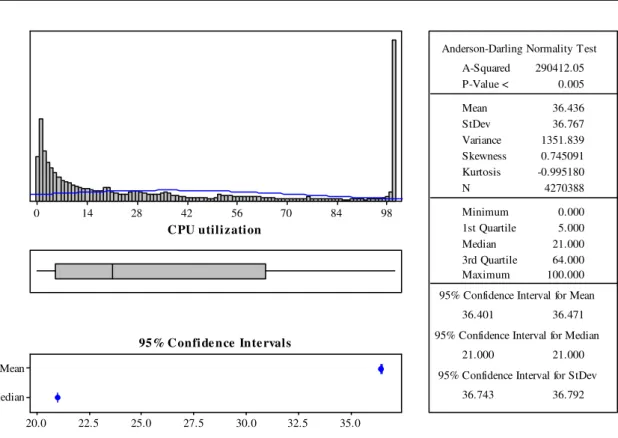
The main reason of power inefficiency in data centers is the low average utilization of re-sources. To show this, the workload trace data provided as a part of the CoMon project1,
a monitoring infrastructure for PlanetLab2, were analyzed. The data on the CPU utiliza-tion by more than a thousand servers located at more than 500 places around the world were used in the analysis. The data were collected in 5 minute intervals during the period from 10 to 19 May 2010. The distribution of the CPU utilization data over 10 days along with the characteristics of the distribution are presented in Figure2.4.
The data confirm the observation made by Barroso and Holzle [13]: the average CPU utilization is below 50%. The mean value of the CPU utilization is 36.44% with 95% con-fidence interval from 36.40% to 36.47%. The main run-time reasons of under-utilization in data centers are variability of the workload and statistical effects. Modern service applications cannot be kept on fully utilized servers, as even non-significant workload
1The CoMon project.http://comon.cs.princeton.edu/
98 84 70 56 42 28 14 0 C PU u ti l i z ati on Median Mean 35.0 32.5 30.0 27.5 25.0 22.5 20.0 1st Quartile 5.000 Median 21.000 3rd Quartile 64.000 Maximum 100.000 36.401 36.471 21.000 21.000 36.743 36.792 A-Squared 290412.05 P-Value < 0.005 Mean 36.436 StDev 36.767 Variance 1351.839 Skewness 0.745091 Kurtosis -0.995180 N 4270388 Minimum 0.000 Anderson-Darling Normality Test
95% Confidence Interval for Mean
95% Confidence Interval for Median
95% Confidence Interval for StDev 95% C on fi de n ce In te rval s
Figure 2.4: The CPU utilization from the PlanetLab nodes over a period of 10 days
fluctuation would lead to performance degradation and failing to provide the expected Quality of Service (QoS). However, servers in a non-virtualized data center are unlikely to be completely idle because of background tasks (e.g., incremental backups), or dis-tributed data bases / file systems. Data distribution helps to tackle load-balancing prob-lems and improves fault tolerance. Furthermore, despite the fact that the resources have to be provisioned to handle theoretical peak loads, it is very unlikely that all the servers of a large-scale data centers will be fully utilized simultaneously.
Systems where the average utilization of resources is less than 50% represent huge inefficiency, as most of the time only a half of the resources are actually in use. Although the resources on average are utilized by less than 50%, the infrastructure has to be built to handle the potential peak load, which rarely occurs in practice. In such systems, the cost of the over-provisioned capacity is very significant and includes expenses on the extra capacity of cooling systems, PDU, generators, power delivery facilities, UPS, and so on. The lower the average resource utilization in a data center, the more expensive the data center becomes as a part of the TCO, as it has to support peak loads and meet the
require-ments of handling peak power consumption [44]. Moreover, peak power consumption can constrain the further growth of power density, as power requirements already reach 60 A for a server rack [102]. If this tendency continues, further performance improve-ments can be bounded by the power delivery capabilities.
Another problem of high power consumption and increasing density of server com-ponents (i.e., 1U, blade servers) is the heat dissipation. Much of the electrical power con-sumed by computing resources gets turned into heat. The amount of heat produced by an integrated circuit depends on how efficient the component design is, and the voltage and frequency at which the component operates. The heat generated by the resources has to be dissipated to keep them within their safe thermal state. Overheating of the components can lead to a decrease of their lifetime and high error-proneness.
Moreover, power is required to feed the cooling system operation. Although mod-ern cooling systems are more efficient, just a few years ago for each watt of power con-sumed by computing resources, an additional 0.5-1 W was required for the cooling sys-tem [102]. For example, in 2004 to dissipate 1 W consumed by a high-performance com-puting (HPC) system at the Lawrence Livermore National Laboratory (LLNL), 0.7 W of additional power is needed for the cooling system [95]. Moreover, modern high-density servers, such as 1U and blade servers, further complicate cooling because of the lack of space for airflow within the packages. These facts illustrate the concerns about the effi-ciency and real-time adaptation of the cooling system operation.
2.3.2 High Energy Consumption
A way to address high power consumption is the minimization of the peak power re-quired to feed a completely utilized system. In contrast, energy consumption is defined by the average power consumption over a period of time. Therefore, the actual energy consumption by a data center does not directly determine the cost of the infrastructure. However, it is reflected in the cost of electricity consumed by the system, which is the main component of data center operating costs. Furthermore, in most data centers, 50% of the consumed energy never reaches the computing resources: it is consumed by the cooling facilities or dissipated in conversions within the UPS and PDU systems. With the current tendency of the continuously growing energy consumption and costs associated
with it, the point when operating costs exceed the cost of computing resources them-selves in few years can be reached soon. Therefore, it is crucial to develop and apply energy-efficient resource management strategies in data centers.
In addition to high operating costs, another problem caused by the growing energy consumption is high CO2emissions, which contribute to the global warming. According to Gartner [52] in 2007, the Information and Communications Technology (ICT) industry was responsible for about 2% of global CO2 emissions, which is equivalent to the avia-tion industry. According to the estimaavia-tion by the U.S. Environmental Protecavia-tion Agency (EPA), the current efficiency trends led to the increase of annual CO2emissions from 42.8 million metric tons (MMTCO2) in 2007 to 67.9 MMTCO2 in 2011. Intense media cover-age has raised the awareness of people around the climate change and greenhouse effect. More and more customers start to consider the “green” aspect in selecting products and services. Besides the environmental concern, companies have begun to face business risks caused by being non-environment friendly. The reduction of CO2footprints is an important problem that has to be addressed in order to facilitate further advancements and proliferation of computing systems.
2.4
The State of the Art in Energy-Efficient Computing Systems
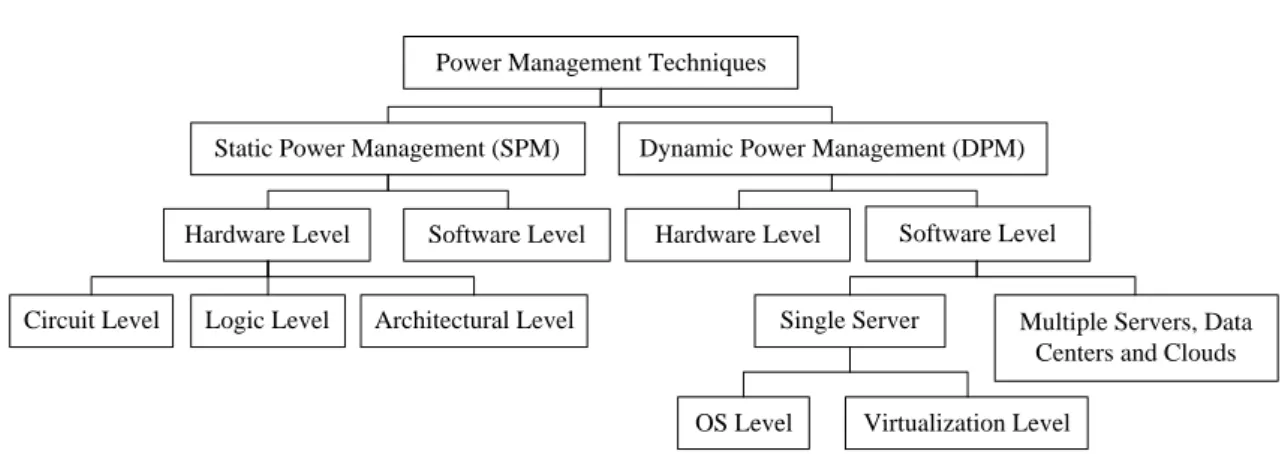
A large volume of research has been done in the area of power and energy-efficient re-source management in computing systems. As power and energy management tech-niques are closely connected, in this chapter they are referred to as power management. As shown in Figure2.5, at the high-level, power management techniques can be divided into static and dynamic. From the hardware point of view, SPM contains all the opti-mization methods that are applied at the design time at the circuit, logic, architectural, and system levels [40,117]. The Circuit level optimization is focused on the reduction of the switching activity power of individual logic gates and transistor level combinational circuits by the application of complex gate design and transistor sizing. The optimization at the logic level is aimed at the switching activity power of logic-level combinational and sequential circuits. Architecture level methods include the analysis of system design and subsequent incorporation of power optimization techniques into it. In other words, this
Power Management Techniques
Static Power Management (SPM) Dynamic Power Management (DPM)
Hardware Level Software Level
Circuit Level Logic Level Architectural Level
Hardware Level Software Level
Single Server Multiple Servers, Data
Centers and Clouds
OS Level Virtualization Level
Figure 2.5: A high-level taxonomy of power and energy management
kind of optimization refers to the process of efficient mapping of a high-level problem specification onto a register-transfer level design.
Apart from the optimization of the hardware-level system design, it is extremely im-portant to carefully consider the implementation of programs that are to be executed on the system. Even with perfectly designed hardware, poor software design can lead to dramatic performance and power losses. However, it is impractical or impossible to ana-lyze power consumption caused by large programs at the operator level, as not only the processes of code generation and compilation, but also the order of instructions can have an impact on power consumption [53,113,114]. Therefore, indirect estimation methods can be applied. For example, it has been shown that faster
![Figure 1.1: The worldwide data center energy consumption 2000-2010 [70]](https://thumb-us.123doks.com/thumbv2/123dok_us/698151.2586127/18.892.219.635.155.425/figure-worldwide-data-center-energy-consumption.webp)
![Figure 2.3: The relation between power consumption and CPU utilization of a server [44]](https://thumb-us.123doks.com/thumbv2/123dok_us/698151.2586127/38.892.143.703.132.541/figure-relation-power-consumption-cpu-utilization-server.webp)