Oracle
r
Call Center
Technology Technical
Reference Manual
RELEASE 11i
Oracler Call Center Technology Technical Reference Manual Release 11i
To order this book, ask for Part No. A83703–01
Copyright E 2000. Oracle Corporation. All rights reserved. Major Contributors:
Contributors:
This Technical Reference Manual (TRM) in any form, software or printed matter, contains proprietary information of Oracle Corporation; it is provided under an Oracle Corporation agreement containing restrictions on use and disclosure and is also protected by copyright, patent, and other intellectual property law. Restrictions applicable to this TRM include, but are not limited to: (a) exercising either the same degree of care to safeguard the confidentiality of this TRM as you exercise to safeguard the confidentiality of your own most important Confidential Information or a reasonable degree of care, whichever is greater; (b) maintaining agreements with your employees and agents that protect the Confidential Information of third parties such as Oracle Corporation and instructing such employees and agents of these requirements for this TRM; (c) restricting disclosure of this TRM to those of your employees who have a ”need to know” consistent with the purposes for which this TRM was disclosed to you; (d) maintaining this TRM at all times on your premises; (e) not removing or destroying any proprietary or confidential legends or markings placed upon this TRM in whatever form, software or printed matter; and (f) not reproducing or transmitting this TRM in any form or by any means, electronic or mechanical, for any purpose, without the express written permission of Oracle Corporation. You should not use this TRM in any form, software or printed matter, to create software that performs the same or similar functions as any Oracle Corporation products. The information in this TRM is subject to change without notice. If you find any problems in the TRM in any form, software or printed matter, please report them to us in writing. Oracle Corporation does not warrant that this TRM is error–free. This TRM is provided to customer ”as–is” with no warranty of any kind. This TRM does not constitute Documentation as that term is defined in Oracle’s agreements.
Reverse engineering of the Programs (software and documentation) associated with this TRM are prohibited. The Programs associated with this TRM are not intended for use in any nuclear, aviation, mass transit, medical, or other inherently dangerous applications. It shall be licensee’s responsibility to take all appropriate fail–safe, back–up, redundancy and other measures to ensure the safe use of such applications if the Programs are used for such purposes, and Oracle disclaims liability for any damages caused by such use of the Programs.
Program Documentation is licensed for use solely to support the deployment of the Programs and not for any other purpose. Restricted Rights Legend
This TRM and the Programs associated with this TRM delivered subject to the DOD FAR Supplement are ’commercial computer software’ and use, duplication and disclosure of the TRM and the Programs associated with this TRM shall be subject to the licensing restrictions set forth in the applicable Oracle license agreement. Otherwise, this TRM and the Programs associated with this TRM delivered subject to the Federal Acquisition Regulations are ’restricted computer software’ and use, duplication and disclosure of the TRM and the Programs associated with this TRM shall be subject to the restrictions in FAR 52.227–14, Rights in Data –– General, including Alternate III (June 1987). Oracle Corporation, 500 Oracle Parkway, Redwood City, CA 94065.
Oracle is a registered trademark, and Oracle Call Center Technology, CASE*Exchange, Enabling the Information Age, Hyper*SQL, NLS*Work-bench, Oracle7, Oracle8, Oracle 8i, Oracle Access, Oracle Application Object Library, Oracle Discoverer, Oracle Financials, Oracle Quality, Oracle Web Customers, Oracle Web Employees, Oracle Work in Process, Oracle Workflow, PL/SQL, Pro*Ada, Pro*C, Pro*COBOL, Pro*FORTRAN, Pro*Pascal, Pro*PL/I, SmartClient, SQL*Connect, SQL*Forms, SQL*Loader, SQL*Menu, SQL*Net, SQL*Plus, and SQL*Report are trademarks or registered trademarks of Oracle Corporation. Other names may be trademarks of their respective owners.
T
CAUTION
his Technical Reference Manual in any form –– software or printed matter –– contains proprietary, confidential information that is the exclusive property of Oracle Corporation. If you do not have a valid contract with Oracle for the use of this Technical Reference Manual or have not signed a non–disclosure agreement with Oracle covering this Technical Reference Manual, then you received this document in an unauthorized manner and are not legally entitled to possess or read it.
Use, duplication, and disclosure are subject to restrictions stated in your contract with Oracle Corporation.
i Contents
Oracle Proprietary, Confidential Information––Use Restricted by Contract
Contents
Chapter 1 Introduction . . . 1 – 1
Chapter 2 High–Level Design . . . 2 – 1
Overview of High–Level Design . . . 2 – 2 Database Diagrams . . . 2 – 9 Public Table List . . . 2 – 11 Public View List . . . 2 – 13 Module List . . . 2 – 14
Chapter 3 Detailed Design. . . 3 – 1
Overview of Detailed Design . . . 3 – 2 Table and View Definitions . . . 3 – 3
C H A P T E R
1
T
1 – 1 Introduction
Oracle Proprietary, Confidential Information––Use Restricted by Contract
Introduction
he Oracle Call Center Technology Technical Reference Manual
provides the information you need to understand the underlying structure of Oracle Call Center Technology. After reading this manual, you should be able to convert your existing applications data, integrate your existing applications with Oracle Call Center Technology, and write custom reports for Oracle Call Center Technology, as well as read data that you need to perform other tasks.
This chapter introduces you to the Oracle Call Center Technology Technical Reference Manual, and explains how to use it.
Introduction
At Oracle, we design and build applications using Oracle Designer, our systems design technology that provides a complete environment to support developers through all stages of a systems life cycle. Because we use a repository–based design toolset, all the information regarding the underlying structure and processing of our applications is available to us online. Using Oracle Designer, we can present this information to you in the form of a technical reference manual.
This Oracle Call Center Technology Technical Reference Manual contains detailed, up–to–date information about the underlying structure of Oracle Call Center Technology. As we design and build new releases of Oracle Call Center Technology, we update our Oracle Designer
repository to reflect our enhancements. As a result, we can always provide you with an Oracle Call Center Technology Technical Reference Manual that contains the latest technical information as of the publication date. Note that after the publication date we may have added new indexesto Oracle Call Center Technologyto improve performance.
About this Manual
This manual describes the Oracle Customer Relationship Management (CRM) Applications Release 11i data model, as used by Oracle Call Center Technology; it discusses the database we include with a fresh install of Oracle CRM Release 11i. If you have not yet upgraded to Release 11i, your database may differ from the database we document in this book.
You can contact your Oracle representative to confirm that you have the latest technical information for Oracle Call Center Technology. You can also use OracleMetaLink which is accessible through Oracle’s Support Web Center (http://www.oracle.com/support/elec_sup).
Finding the Latest Information
The Oracle Call Center Technology Technical Reference Manual contains the latest information as of the publication date. For the latest information we encourage you to use OracleMetaLink which is accessible through Oracle’s Support Web Center (http://www.oracle.com/support/elec_sup).
1 – 3 Introduction
Oracle Proprietary, Confidential Information––Use Restricted by Contract
Audience
The Oracle Call Center Technology Technical Reference Manual provides useful guidance and assistance to:
• Technical End Users • Consultants
• Systems Analysts
• System Administrators
• Other MIS professionals
This manual assumes that you have a basic understanding of structured analysis and design, and of relational databases. It also assumes that you are familiar with Oracle Application Object Library and Oracle Call Center Technology. If you are not familiar with the above products, we suggest that you attend one or more of the training classes available through Oracle Education (see: Other Information Sources: page 1 – 7).
How This Manual is Organized
This manual contains two major sections, High–Level Design and Detailed Design.
High–Level Design
This section, Chapter 2, contains database diagrams and lists each database table and view that Oracle Call Center Technology uses. This chapter also has a list of modules.
Detailed Design
This section, Chapter 3, contains a detailed description of the Oracle Call Center Technology database design, including information about each database table and view you might need for your custom reporting or other data requirements.
How to Use This Manual
The Oracle Call Center Technology Technical Reference Manual is a single, centralized source for all the information you need to know about the underlying structure and processing of Oracle Call Center Technology. For example, you can use this manual when you need to:
• Convert existing application data
• Integrate your Oracle Call Center Technology application with your other applications systems
• Write custom reports
• Define alerts against Oracle Applications tables • Configure your Oracle Self–Service Web Applications • Create views for decision support queries using query tools • Create business views for Oracle Discoverer
You need not read this manual cover to cover. Use the table of contents and index to quickly locate the information you need.
How Not To Use This Manual
Do not use this manual to plan modifications
You should not use this manual to plan modifications to Oracle Call Center Technology. Modifying Oracle Call Center Technology limits your ability to upgrade to future releases of your Oracle Call Center Technology application. In addition, it interferes with our ability to give you the high–quality support you deserve.
We have constructed Oracle Call Center Technology so that you can customize it to fit your needs without programming, and you can integrate it with your existing applications through interface tables. However, should you require program modifications, you should contact our support team (see: Other Information Sources: page 1 – 7). They can put you in touch with Oracle Services, the professional consulting organization of Oracle. Their team of experienced
applications professionals can make the modifications you need while ensuring upward compatibility with future product releases.
1 – 5 Introduction
Oracle Proprietary, Confidential Information––Use Restricted by Contract Do not write data into non–interface tables
Oracle reserves the right to change the structure of Oracle Applications tables, and to change the meaning of, add, or delete lookup codes and data in future releases. Do not write data directly into or change data in non–interface tables using SQL*Plus or other programming tools because you risk corrupting your database and interfering with our ability to support you.
Moreover, this version of the Oracle Call Center Technology Technical Reference Manual does not contain complete information about the dependencies between Oracle Call Center Technology applications tables. Therefore, you should write data into only those tables we identify as interface tables. If you write data into other non–interface tables, you risk violating your data integrity since you might not fulfill all the data dependencies in your Oracle Call Center Technology application.
You are responsible for the support and upgrade of the logic within the procedures that you write, which may be affected by changes between releases of Oracle Applications.
Do not rely on upward compatibility of the data model
Oracle reserves the right to change the structure of Oracle Call Center Technology tables, and to change the meaning of, add, or delete lookup codes and other data in future releases. We do not guarantee the upward compatibility of the Oracle Call Center Technology data model. For example, if you write a report that identifies concurrent requests that end in Error status by selecting directly from Oracle Application Object Library tables, we do not guarantee that your report will work properly after an upgrade.
About Oracle Application Object Library
The Oracle Call Center Technology Technical Reference Manual may contain references to tables that belong to Oracle Application Object Library. Oracle Application Object Library is a collection of pre–built
application components and facilities for building Oracle Applications and extensions to Oracle Applications. Oracle Application Coding Standards use the Oracle Application Object Library and contains shared components including but not limited to –– forms, subroutines, concurrent programs and reports, database tables and objects,
☞
Attention: Oracle does not support any customization of Oracle Application Object Library tables or modules, not even by Oracle consultants. (Oracle Application Object Library tables generally have names beginning with FND_%.)Accordingly, this manual does not contain detailed information about most Oracle Application Object Library tables used by Oracle Call Center Technology.
A Few Words About Terminology
The following list provides you with definitions for terms that we use throughout this manual:
Relationship
A relationship describes any significant way in which two tables may be associated. For example, rows in the Journal Headers table may have a one–to–many relationship with rows in the Journal Lines table. Database Diagram
A database diagram is a graphic representation of application tables and the relationships between them.
Module
A module is a program or procedure that implements one or more business functions, or parts of a business function, within an
application. Modules include forms, concurrent programs and reports, and subroutines.
Application Building Block
An application building block is a set of tables and modules (forms, reports, and concurrent programs) that implement closely–related database objects and their associated processing. Said another way, an application building block is a logical unit of an application.
QuickCodes
QuickCodes let you define general purpose, static lists of values for window fields. QuickCodes allow you to base your program logic on lookup codes while displaying user–friendly names in a list of values
1 – 7 Introduction
Oracle Proprietary, Confidential Information––Use Restricted by Contract
window. QuickCodes simplify name and language changes by letting you change the names your end users see, while the codes in your underlying programs remain the same.
Form
A form is a module comprised of closely related windows that are used together to perform a task. For example, the Enter Journals form in Oracle General Ledger includes the Enter Journals window, the Batch window, and the More Actions window among others. The Enter Journals window is the main window, and from it, you can use buttons to navigate to other windows in the form. The form name usually corresponds to the main window in the form, and is frequently a window you open directly from the Navigator.
Other Information Sources
Installation and System Administration Training
Oracle Education offers a complete set of training courses to help you and your staff master Oracle CRM Applications. We can help you develop a training plan that provides thorough training for both your project team and your end users. We will work with you to organize courses appropriate to your job or area of responsibility.
Training professionals can show you how to plan your training throughout the implementation process so that the right amount of information is delivered to key people when they need it the most. You can attend courses at any one of our many Educational Centers, or you can arrange for our trainers to teach at your facility. In addition, we can tailor standard courses or develop custom courses to meet your needs.
Support
From on–site support to central support, our team of experienced professionals provides the help and information you need to keep Oracle Call Center Technology working for you. This team includes your Technical Representative, Account Manager, and Oracle’s large staff of consultants and support specialists with expertise in your
business area, managing an Oracleserver, and your hardware and software environment.
1 – 9 Introduction
Oracle Proprietary, Confidential Information––Use Restricted by Contract
About Oracle
Oracle Corporation develops and markets an integrated line of software products for database management, applications development, decision support, and office automation, as well as Oracle Applications, an integrated suite of more than 75 software modules for financial management, supply chain management, manufacturing, project systems, human resources, and sales and service management.
Oracle products are available for mainframes, minicomputers, personal computers,network computers, and personal digital assistants,
allowing organizations to integrate different computers, different operating systems, different networks, and even different database management systems, into a single, unified computing and information resource.
Oracle is the world’s leading supplier of software for information management, and the world’s second largest software company. Oracle offers its database, tools, and applications products, along with related consulting, education, and support services, in over 145 countries around the world.
Thank You
Thanks for using Oracle Call Center Technology and this technical reference manual!
We appreciate your comments and feedback. After the Table of Contents of this manual is a Reader’s Comment Form that you can use to explain what you like or dislike about Oracle Call Center Technology or this technical reference manual. Mail your comments to the
following address or call us directly at (650) 506–7000.
Oracle CRM Applications Content Development Manager Oracle Corporation
500 Oracle Parkway
Redwood Shores, California 94065 U.S.A.
C H A P T E R
2
T
2 – 1 High–Level Design
Oracle Proprietary, Confidential Information––Use Restricted by Contract
High–Level Design
his chapter presents a high–level design for Oracle Call Center Technology that satisfies the business needs we specify during Strategy and Analysis. It contains database diagrams for Oracle Call Center Technology application building blocks, lists of database tables and views, and a list of modules.
Overview of High–Level Design
During High–Level Design, we define the application components (tables, views, and modules) we need to build our application. We specify what application components should do without specifying the details of how they should do it.
You can refer to this High–Level Design chapter to quickly acquaint yourself with the tables, views, and modules that comprise Oracle Call Center Technology applications. And, you can prepare yourself to understand the detailed design and implementation of Oracle Call Center Technology.
Summary Database Diagram
The Summary Database Diagram section graphically represents the most important application tables and the relationships between them. It omits tables and relationships that contribute little to the
understanding of the application data model. Typically, a summary database diagram shows tables that contain key reference and transaction data.
We prepare a summary database diagram to describe, at a conceptual level, the key information on which our business depends. Later, we refine this summary database diagram, breaking it into multiple database diagrams (generally, one per application building block) to represent all the tables and relationships we need to implement our application in the database.
Review the Summary Database Diagram section to see at a glance the major tables and relationships on which your Oracle Call Center Technology application depends.
Database Diagrams
The Database Diagrams section graphically represents all Oracle Call Center Technology applications tables and the relationships between them, organized by building block.
Use this section to quickly learn what tables each Oracle Call Center Technology application building block uses, and how those tables interrelate. Then, you can refer to the Table and View Definitions
2 – 3 High–Level Design
Oracle Proprietary, Confidential Information––Use Restricted by Contract
sections of Chapter 3 for more detailed information about each of those tables.
Table Lists
The Table List sections list the Oracle Call Center Technology
applications tables. Because a product might not include at least one table for each type, this Technical Reference Manual might not include each of the following sections.
Public Tables
Use the Public Table List section to quickly identify the tables you are most interested in. Then, you can refer to the Table and View
Definitions sections of Chapter 3 for more detailed information about those tables.
In addition, this manual may contain full documentation for one or more of the following Application Object Library tables: FND_DUAL, FND_CURRENCIES, and FND_COMMON_LOOKUPS.
Internal Tables
This section includes a list of private, internal tables used by Oracle Call Center Technology; we do not provide additional documentation for these tables.
View Lists
The View List sections list the Oracle Call Center Technology views, with one section for each type of view. Because a product might not include at least one view for each type, this Technical Reference Manual might not include each of the following sections.
Use this section to quickly identify the views you are most interested in. Then, you can refer to the Table and View Definitions sections of Chapter 3 for more detailed information about those views.
Public Views
This section lists views that may be useful for your custom reporting or other data requirements. The list includes a description of the view,
and the page in Chapter 3 that gives detailed information about the public view.
Web Views
This section lists views that you may need to configure your Self–Service Web applications. The list includes a description of the view, and the page in Chapter 3 that gives detailed information about the web view.
Forms and Table Views
This section lists supplementary views that are not essential to the Release 11idata model, but simplify coding or improve performance for Oracle Developer.
Internal Views
This section includes each private, internal view that Oracle Call Center Technology uses.
Single–Organization Views
This section lists the Oracle Call Center Technology views that we added to take the place of various tables that are now partitioned by operating unit, to support multiple sets of books within a single installation of Oracle Call Center Technology.
Multiple Reporting Currency Views
This list includes views that were created to support the Multiple Reporting Currencies feature.
MultiLingual Views
This section lists views that were created to allow certain seed data to be available in multiple national languages simultaneously.
Module List
The Module List section briefly describes each of the Oracle Call Center Technology applications modules. This section lists forms, reports, and concurrent programs.
2 – 5 High–Level Design
Oracle Proprietary, Confidential Information––Use Restricted by Contract
A form is a module comprised of closely related windows that are used together to perform a task. For example, the Enter Journals form in Oracle General Ledger includes the Enter Journals window, the Batch window, and the More Actions window. The Enter Journals window is the main window, and from it, you can use buttons to navigate to other windows in the form. The form name usually corresponds to the main window in the form, and is frequently a window you can open directly from the Navigator.
The Reports and Concurrent Programs lists include processes you can submit from the Submit Requests window or other windows, as well as processes that are submitted automatically by Oracle Call Center Technology. Use your user’s guide to learn more about reports and concurrent processes.
Database Diagramming Conventions
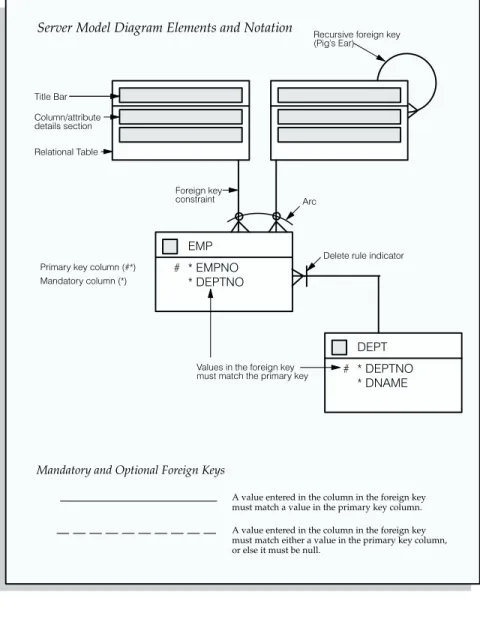
We use the following notational conventions in our database diagrams:
Figure 2 – 1 Database Diagram Conventions
Mandatory and Optional Foreign Keys
A value entered in the column in the foreign key must match a value in the primary key column.
EMP * EMPNO * DEPTNO # DEPT * DEPTNO * DNAME # Title Bar Column/attribute Relational Table
Recursive foreign key
Arc (Pig's Ear)
details section
Delete rule indicator Foreign key
constraint
Values in the foreign key must match the primary key Primary key column (#*)
Mandatory column (*)
Server Model Diagram Elements and Notation
A value entered in the column in the foreign key must match either a value in the primary key column, or else it must be null.
2 – 7 High–Level Design
Oracle Proprietary, Confidential Information––Use Restricted by Contract
Tables – are the basic unit of storage in the database. A hand symbol preceding the title in the table’s title bar indicates that the table is not owned by this application but shared with another.
Foreign key constraint – is a type of referential integrity constraint for checking the integrity of data entered in a specific column or set of columns. This specified column or set of columns is known as the foreign key.
Delete rule indicator – determines the action to be taken when an attempt is made to delete a related row in a join table. A line through the foreign key constraint, as shown on the above diagram, indicates that this action is restricted.
Arcs – specify that, for any given row in a table, a value must be entered in one of the arc columns. The remaining columns within the arc must be null.
2 – 9 High–Level Design
Oracle Proprietary, Confidential Information––Use Restricted by Contract
Database Diagrams
This section graphically represents most of the significant Oracle Call Center Technology tables and the relationships between them, organized by building block. Use this section to quickly learn what tables each Oracle Call Center Technology application building block uses, and how these tables interrelate. Then, you can refer to the Table and View Definitions sections of Chapter 3 for more detailed
information about each of those tables.
This section contains a database diagram for each of the following Oracle Call Center Technology application building blocks:
• Diagram 1: AO
Some tables, especially important reference tables, appear in more than one database diagram. When several building blocks use a table, we show that table in each appropriate database diagram.
2 – 11 High–Level Design
Oracle Proprietary, Confidential Information––Use Restricted by Contract
Public Table List
This section lists each public database table that Call Center Technology uses and provides a brief description of each of those tables. The page reference is to the table description in Chapter 3.
Note that ”public” tables are not necessarily intended for write access by custom code; Oracle Corporation supports write access using only standard Oracle Applications forms, reports, and programs, or any SQL write access to tables explicitly documented as API tables. For more information, see the How Not To Use This Manual section of this book’s Introduction.
Call Center Technology uses the following Public tables:
Table Name Description
AMS_LIST_HEADERS_ALL Defines List information. (See page 3 – 8)
FND_LOOKUP_VALUES QuickCode values (See page NO TAG)
IEO_ALGORITHMS_ALL Advanced outbound algorithms table (See page 3 – 11)
IEO_ALGORITHM_NAMES_ALL Name for Advanced outbound Calendar and Recycle
algorithms (See page 3 – 12)
IEO_CP_PHONETYPE_MSG_XRS_ALL Phone Type and Message ID cross reference table (See page
3 – 13)
IEO_CP_STOP_LIST People who should not be called (See page 3 – 14)
IEO_LIST_CAMP_XRS_ALL List and Campaign Cross Refreence Table (See page 3 – 15)
IEO_SVR_COMPS Server Components. (See page 3 – 16)
IEO_SVR_COMP_DEFS Server Component Definitions. (See page 3 – 17)
IEO_SVR_GROUPS Server Groups. (See page 3 – 18)
IEO_SVR_PARAMS Server Parameters. (See page 3 – 19)
IEO_SVR_PROTOCOL_MAP Server Protocol Maps. (See page 3 – 20)
IEO_SVR_RT_INFO Real time information about servers. (See page 3 – 21)
IEO_SVR_SERVERS Servers. (See page 3 – 22)
IEO_SVR_TYPES_B Server Types (base table). (See page 3 – 23)
IEO_SVR_VALUES Server Values. (See page 3 – 25)
JTF_OBJECTS_B This table stores the details of objects(modules). (See page
2 – 13 High–Level Design
Oracle Proprietary, Confidential Information––Use Restricted by Contract
Public View List
This section lists each public database view that Oracle Call Center Technology uses and provides a brief description of each of those views. These views may be useful for your custom reporting or other data requirements. The page reference is to the detailed view description in Chapter 3.
Oracle Call Center Technology uses the following public views:
View Name Description
IEO_LOOKUPS View on FND_LOOKUPS and used by Advanced
Module List
This section lists each form, report and concurrent program comprising Call Center Technology.
C H A P T E R
3
T
3 – 1 Detailed Design
Oracle Proprietary, Confidential Information––Use Restricted by Contract
Detailed Design
his chapter presents a detailed design for implementing Oracle Call Center Technology. It contains detailed definitions of tables and views that you may need to reference to write custom reports or use for other data extraction.
Overview of Detailed Design
During Detailed Design, we specify in detail how each applications component should work. We prepare detailed definitions of tables and views.
You can refer to this Detailed Design chapter to gain a detailed understanding of the underlying structure and processing of Oracle Call Center Technology that enables you to:
• Convert existing application data
• Integrate your Oracle Call Center Technology application with your other applications systems
• Write custom reports
• Define alerts against Oracle Applications tables
• Create views for decision support queries using query tools • Configure your Oracle Self–Service Web Applications
Table and View Definitions
The Table and View Definitions section contains a detailed definition of Oracle Call Center Technology applications tables. For each table, it provides information about primary keys, foreign keys, QuickCodes, indexes, triggers, and sequences. It also gives you a detailed
description of each column and its characteristics. In addition, it provides the SQL statement that defines each view. Review this section to get a detailed understanding of what tables your Oracle Call Center Technology application contains, and how it uses them to hold and access the information it needs.
3 – 3 Detailed Design
Oracle Proprietary, Confidential Information––Use Restricted by Contract
Table and View Definitions
This section contains a detailed description of each Oracle Call Center Technology table and view that you may need to reference. For each table, it presents detailed information about:
• Primary keys • Foreign keys • Column descriptions • Indexes • Oracle sequences • Triggers • View derivations
Because Oracle does not support customization of Oracle Application Object Library tables, we do not provide you with detailed information about them. Consequently, this section does not document all the FND_% tables Oracle Call Center Technology uses.
The following sections appear in each table or view description:
Foreign Keys
To help you understand the relationships between tables, we list each foreign key contained in a table. For each foreign key in a table, we list the primary key table name (the table to which a foreign key refers), its corresponding primary key columns, and the foreign key columns that refer to those primary key columns.
When the primary key table has a composite primary key, we list each column of the composite key sequentially.
If a table contains two or more distinct foreign keys that refer to the same primary key table, we repeat the primary key table name and list each of the distinct foreign keys separately.
QuickCodes Columns
When a database column contains a QuickCodes value, which we implement using a foreign key to FND_LOOKUPS, MFG_LOOKUPS, or to some other lookup table, we list the QuickCodes type (lookup
type) to which the QuickCodes value must belong and a complete list of QuickCodes values and meanings. Some QuickCodes can be defined by you in the application. These values are designated as User–defined.
Column Descriptions
We list the important characteristics of each column in a table or view. These characteristics include whether the column is part of the table’s primary key, whether Oracle8i requires a value for this column, and the data type of the column. We also give you a brief description of how Oracle Call Center Technology uses the column.
When a column is part of a table’s primary key, we append the notation (PK) to the name of that column.
To help you understand which columns Oracle Call Center Technology uses and which columns it does not use, we alert you to any unused column. When no module uses a database column, we show one of the following legends in the Description column:
Oracle Call Center Technology does not use this column, although the column might be used in a future release.
Oracle Call Center Technology no longer uses this column. AutoInstall installs this column.
Subsequent versions of Oracle Call Center Technology might not include this column. Oracle Call Center Technology no longer uses this column. If you upgraded your software from an earlier version, you may still have this column, depending upon whether you chose to delete it during an upgrade process. If you install Oracle Call Center Technology, you do not have this column.
Standard Who Columns
Most Oracle Call Center Technology tables contain standard columns to
support \ Row Who. When your program or SQL*Plus command
selects a row from a table, use these columns to determine who last updated the row. If your program or SQL*Plus command updates or Not currently
used
No longer used
No longer installed
3 – 5 Detailed Design
Oracle Proprietary, Confidential Information––Use Restricted by Contract
inserts a row in an interface table, you must populate each of the five standard Who columns:
Date when a user last updated this row User who last updated this row (foreign key to FND_USER.USER_ID)
Date when this row was created
User who created this row (foreign key to FND_USER.USER_ID)
Operating system login of user who last updated this row (foreign key to
FND_LOGINS.LOGIN_ID). You should set this to NULL, or to 0 if NULL is not allowed
Since every table containing Who columns has several foreign keys to the tables FND_USER and FND_LOGINS, we do not include the foreign key columns LAST_UPDATED_BY, CREATED_BY, or LAST_UPDATE_LOGIN in a table’s list of foreign keys. Additional Who Columns for Concurrent Programs
Some Oracle Call Center Technology tables also contain several additional Who columns to distinguish between changes a user makes with a form and changes a concurrent program makes. When a concurrent program updates or inserts a row in a table, the concurrent program populates the following additional Who columns:
Concurrent request ID of program that last updated this row (foreign key to
FND_CONCURRENT_REQUESTS.RE-QUEST_ID)
Application ID of program that last updated this row (foreign key to
FND_APPLICATION.APPLICATION_ID) Program ID of program that last updated this row (foreign key to FND_CONCUR- RENT_PROGRAM.CONCURRENT_PRO-GRAM_ID)
Date when a program last updated this row LAST_UPDATE_DATE LAST_UPDATED_BY CREATION_DATE CREATED_BY LAST_UPDATE_LOGIN REQUEST_ID PROGRAM_APPLICATION_ID PROGRAM_ID PROGRAM_UPDATE_DATE
Since every table containing these additional Who columns has several foreign keys to the tables FND_CONCURRENT_REQUESTS,
FND_APPLICATION, and FND_CONCURRENT_PROGRAM, we do not include the foreign key columns REQUEST_ID,
PROGRAM_APPLICATION_ID, or PROGRAM_ID in a table’s list of foreign keys.
Columns Reserved for Country–Specific Localizations
Some tables have GLOBAL_ATTRIBUTE columns which support additional features added to Oracle Call Center Technology to meet statutory requirements and common business practices in your country or region. For details on these columns, refer to the Appendix in Oracle Financials Regional Technical Reference Manual. To read more about the features that these columns support, look for a User Guide appropriate to your country; for example, see the Oracle Financials for the Czech Republic User Guide.
Indexes
If an Oracle Call Center Technology table uses an Oracle8i index, we list the database columns that comprise that index, in sequential order.
Note: The indexes we document in this manual correspond to unique keys we specified during product development and testing. In some cases, we may add additional indexes during the porting process to fine–tune performance on specific platforms; therefore, there may be minor differences between the indexes documented in this book and the indexes for production versions of Oracle Call Center Technology.
Sequences
Oracle Call Center Technology uses Oracle8i sequence generators to generate unique integers. If any table column gets its value from an Oracle8i sequence generator, we list the name of the corresponding sequence generator and the name of the column that stores the unique integer.
3 – 7 Detailed Design
Oracle Proprietary, Confidential Information––Use Restricted by Contract
Database Triggers
If a table has one or more active database triggers, we provide a brief explanation of each database trigger and when it fires.
View Derivation
For each Oracle Call Center Technology view you may need to
reference, we include important elements from the SQL statement that defines or creates a view. By studying this view definition, you can understand exactly how a view derives its contents.
AMS_LIST_HEADERS_ALL
AMS_LIST_HEADERS_ALL defines List information. Direct marketing promotions have one or more prospect customer lists generated for mailshots and telemarketing. The table contain all information needed by the List Generation Build process to build a list. That is, is there a min or max amount of rows, should rows be selected randomly etc.
Foreign Keys
Primary Key Table Primary Key Column Foreign Key Column AMS_CAMPAIGN_SCHEDULES CAMPAIGN_SCHEDULE_ID LIST_USED_BY_ID AMS_EVENT_HEADERS_ALL_B EVENT_HEADER_ID LIST_USED_BY_ID AMS_EVENT_OFFERS_ALL_B EVENT_OFFER_ID LIST_USED_BY_ID
FND_USER USER_ID LAST_DEDUPED_BY_USER_ID FND_USER USER_ID OWNER_USER_ID
Column Descriptions
Name Null? Type Description LIST_HEADER_ID NOT NULL NUMBER UNIQUE IDENTIFIER LAST_UPDATE_DATE NOT NULL DATE Standard WHO Column LAST_UPDATED_BY NOT NULL NUMBER(15) Standard WHO Column CREATION_DATE NOT NULL DATE Standard WHO Column CREATED_BY NOT NULL NUMBER(15) Standard WHO Column LAST_UPDATE_LOGIN NULL NUMBER(15) Standard WHO Column
OBJECT_VERSION_NUMBER NULL NUMBER(9) This column is used for locking purposes
REQUEST_ID NULL NUMBER(15) Request identifier of last concurrent program to update this record
PROGRAM_ID NULL NUMBER(15) Program identifier of last concurrent program to update this record
PROGRAM_APPLICATION_ID NULL NUMBER(15) Application identifier of last concurrent program to update this record
PROGRAM_UPDATE_DATE NULL DATE Last update date of this record by a concurrent program
VIEW_APPLICATION_ID NULL NUMBER Application Id of Oracle Product that created the list. LIST_NAME NOT NULL VARCHAR2(240) The Name of the List.
LIST_USED_BY_ID NOT NULL NUMBER Foreign key to marketing activity associated with the list.
ARC_LIST_USED_BY NOT NULL VARCHAR2(30) Qualifier to marketing activity associated with the list. LIST_TYPE NOT NULL VARCHAR2(30) Type of list either Target or
Template.
STATUS_CODE NOT NULL VARCHAR2(30) Status of the list, either New or Pending or Available or Reserved or Locked or Archived. STATUS_DATE NOT NULL DATE The Date on which The Status
was set.
GENERATION_TYPE NOT NULL VARCHAR2(30) Generation Type of the List, either Standard or Incremental or Repeating.
3 – 9 Detailed Design
Oracle Proprietary, Confidential Information––Use Restricted by Contract
ROW_SELECTION_TYPE NOT NULL VARCHAR2(30) Selection type of a row in the list either Standard or N th or Random.
OWNER_USER_ID NOT NULL NUMBER(15) Owner of the list.
ACCESS_LEVEL NOT NULL VARCHAR2(30) Access level of the list either User or Group.
ENABLE_LOG_FLAG NOT NULL VARCHAR2(1) Flag to enable log during list generation.
ENABLE_WORD_REPLACEMENT_FLAG NOT NULL VARCHAR2(1) Flag to enable word replacement during deduplication.
ENABLE_PARALLEL_DML_FLAG NOT NULL VARCHAR2(1) not implemented. DEDUPE_DURING_GENERATION_FLAG NOT NULL VARCHAR2(1) Flag to determine if
deduplication to be done during generation.
GENERATE_CONTROL_GROUP_FLAG NOT NULL VARCHAR2(1) not implemented.
LAST_GENERATION_SUCCESS_FLAG NOT NULL VARCHAR2(1) Flag to indicate sucess or failure of last generation. FORECASTED_START_DATE NOT NULL DATE The Date on which The List is
estimated to start.
FORECASTED_END_DATE NULL DATE The Date on which The List is estimated to expire.
ACTUAL_END_DATE NULL DATE The Date on which this list will expire.
SENT_OUT_DATE NULL DATE The date on which the list is assigned for processing. DEDUPE_START_DATE NULL DATE The deduplication start date of
the list.
LAST_DEDUPE_DATE NULL DATE The last deduplication date of the list.
LAST_DEDUPED_BY_USER_ID NULL NUMBER(15) User identifier who last deduplicated the list. WORKFLOW_ITEM_KEY NULL NUMBER(15) not implemented.
NO_OF_ROWS_DUPLICATES NULL NUMBER(15) number of duplicate rows in the list.
NO_OF_ROWS_MIN_REQUESTED NULL NUMBER(15) minimum number of rows in the list to be generated.
NO_OF_ROWS_MAX_REQUESTED NULL NUMBER(15) maximum number of rows in the list to be generated.
NO_OF_ROWS_IN_LIST NULL NUMBER(15) total number of rows in the list.
NO_OF_ROWS_IN_CTRL_GROUP NULL NUMBER(15) not implemented. NO_OF_ROWS_ACTIVE NULL NUMBER(15) for OSM upgrade. NO_OF_ROWS_INACTIVE NULL NUMBER For OSM upgrade NO_OF_ROWS_MANUALLY_ENTERED NULL NUMBER(15) For OSM upgrade
NO_OF_ROWS_DO_NOT_CALL NULL NUMBER(15) number of rows in the list to not call.
NO_OF_ROWS_DO_NOT_MAIL NULL NUMBER(15) number of rows in the list to not mail.
NO_OF_ROWS_RANDOM NULL NUMBER(15) For OSM upgrade
ORG_ID NULL NUMBER(32) Operating unit which performed this transaction.
MAIN_GEN_START_TIME NULL DATE Time the list started generation.
MAIN_GEN_END_TIME NULL DATE Time the list ended generation. MAIN_RANDOM_NTH_ROW_SELECTION NULL NUMBER(15) Number of random rows to be
selected.
MAIN_RANDOM_PCT_ROW_SELECTION NULL NUMBER(15) Percent of random rows to be selected.
CTRL_RANDOM_NTH_ROW_SELECTION NULL NUMBER(15) not implemented. CTRL_RANDOM_PCT_ROW_SELECTION NULL NUMBER(15) not implemented. REPEAT_SOURCE_LIST_HEADER_ID NULL VARCHAR2(4000) Identifier of parent of
RESULT_TEXT NULL VARCHAR2(4000) Text for list generation processing information. KEYWORDS NULL VARCHAR2(4000) words used to categorize the
list.
DESCRIPTION NULL VARCHAR2(4000) A Description of the intended usage for the list.
LIST_PRIORITY NULL NUMBER(15) For OSM upgrade only ASSIGN_PERSON_ID NULL NUMBER For OSM upgrade only LIST_SOURCE NULL VARCHAR2(240) For OSM upgrade only LIST_SOURCE_TYPE NULL VARCHAR2(30) For OSM upgrade only LIST_ONLINE_FLAG NULL VARCHAR2(1) For OSM upgrade only RANDOM_LIST_ID NULL NUMBER For OSM upgrade only ENABLED_FLAG NULL VARCHAR2(1) For OSM upgrade only ASSIGNED_TO NULL NUMBER For OSM upgrade only QUERY_ID NULL NUMBER(15) For OSM upgrade only OWNER_PERSON_ID NULL NUMBER For OSM upgrade only ARCHIVED_BY NULL NUMBER(15) The User who performed The
Archive.
ARCHIVED_DATE NULL DATE The Date on which The List Entries were Archived.
ATTRIBUTE_CATEGORY NULL VARCHAR2(30) Descriptive flexfield structure defining column.
ATTRIBUTE1 NULL VARCHAR2(150) Descriptive flexfield segment. ATTRIBUTE2 NULL VARCHAR2(150) Descriptive flexfield segment. ATTRIBUTE3 NULL VARCHAR2(150) Descriptive flexfield segment. ATTRIBUTE4 NULL VARCHAR2(150) Descriptive flexfield segment. ATTRIBUTE5 NULL VARCHAR2(150) Descriptive flexfield segment. ATTRIBUTE6 NULL VARCHAR2(150) Descriptive flexfield segment. ATTRIBUTE7 NULL VARCHAR2(150) Descriptive flexfield segment. ATTRIBUTE8 NULL VARCHAR2(150) Descriptive flexfield segment. ATTRIBUTE9 NULL VARCHAR2(150) Descriptive flexfield segment. ATTRIBUTE10 NULL VARCHAR2(150) Descriptive flexfield segment. ATTRIBUTE11 NULL VARCHAR2(150) Descriptive flexfield segment. ATTRIBUTE12 NULL VARCHAR2(150) Descriptive flexfield segment. ATTRIBUTE13 NULL VARCHAR2(150) Descriptive flexfield segment. ATTRIBUTE14 NULL VARCHAR2(150) Descriptive flexfield segment. ATTRIBUTE15 NULL VARCHAR2(150) Descriptive flexfield segment.
Indexes
Index Name Index Type Sequence Column Name AMS_LIST_HEADERS_ALL_N1 NOT UNIQUE 5 LIST_USED_BY_ID
7 ARC_LIST_USED_BY AMS_LIST_HEADERS_ALL_N2 NOT UNIQUE 5 STATUS_CODE
AMS_LIST_HEADERS_ALL_N3 NOT UNIQUE 5 LAST_DEDUPED_BY_USER_ID AMS_LIST_HEADERS_ALL_N4 NOT UNIQUE 5 OWNER_USER_ID
AMS_LIST_HEADERS_ALL_N5 NOT UNIQUE 5 LIST_TYPE AMS_LIST_HEADERS_ALL_N6 NOT UNIQUE 5 ACCESS_LEVEL AMS_LIST_HEADERS_ALL_N8 NOT UNIQUE 5 ORG_ID
AMS_LIST_HEADERS_ALL_U1 UNIQUE 5 LIST_HEADER_ID AMS_LIST_HEADERS_ALL_U2 UNIQUE 2 VIEW_APPLICATION_ID
5 LIST_NAME
Sequences
Sequence Derived Column AMS_LIST_HEADERS_ALL_S LIST_HEADER_ID
3 – 11 Detailed Design
Oracle Proprietary, Confidential Information––Use Restricted by Contract
IEO_ALGORITHMS_ALL
Foreign Keys
Primary Key Table Primary Key Column Foreign Key Column IEO_ALGORITHM_NAMES_ALL NAME NAME
TYPE TYPE
Column Descriptions
Name Null? Type Description ALGORITHM_ID (PK) NOT NULL NUMBER(15) Algorithms ID CREATED_BY NOT NULL NUMBER(15) Standard WHO column CREATION_DATE NOT NULL DATE Standard WHO column LAST_UPDATED_BY NOT NULL NUMBER(15) Standard WHO column LAST_UPDATE_DATE NOT NULL DATE Standard WHO column LAST_UPDATE_LOGIN NULL NUMBER(15) Standard WHO column NAME NOT NULL VARCHAR2(128) algorithm name TYPE NOT NULL VARCHAR2(10) algorithm type LINE_NUMBER NOT NULL NUMBER(15) line number LINE_TEXT NOT NULL VARCHAR2(256) line text
ORG_ID NOT NULL NUMBER(15) multi–org support
Sequences
Sequence Derived Column IEO_ALGORITHMS_ALL_S1 ALGORITHM_ID
IEO_ALGORITHM_NAMES_ALL
Column Descriptions
Name Null? Type Description ALGORITHM_NAME_ID (PK) NOT NULL NUMBER(15) algorithm name id CREATED_BY NOT NULL NUMBER(15) standard WHO column CREATION_DATE NOT NULL DATE standard WHO column LAST_UPDATED_BY NOT NULL NUMBER(15) standard WHO column LAST_UPDATE_DATE NOT NULL DATE standard WHO column LAST_UPDATE_LOGIN NULL NUMBER(15) standard WHO column NAME NOT NULL VARCHAR2(128) algorithm name TYPE NOT NULL VARCHAR2(10) algorithm type
Sequences
Sequence Derived Column IEO_ALGORITHM_NAMES_ALL_S1 ALGORITHM_NAME_ID
3 – 13 Detailed Design
Oracle Proprietary, Confidential Information––Use Restricted by Contract
IEO_CP_PHONETYPE_MSG_XRS_ALL
Foreign Keys
Primary Key Table Primary Key Column Foreign Key Column IEO_CP_SERVICES_ALL LIST_SRV_NAME LIST_SRV_NAME
IEO_VOICE_MSGS_ALL VOICE_MSG_ID MESSAGEID_ANS_MACHINE IEO_VOICE_MSGS_ALL VOICE_MSG_ID MESSAGEID_FRONT_HOLD
Column Descriptions
Name Null? Type Description
LAST_UPDATE_LOGIN NULL NUMBER(15) Standard WHO column CREATION_DATE NOT NULL DATE Standard WHO column CREATED_BY NOT NULL NUMBER(15) Standard WHO column LAST_UPDATED_BY NOT NULL NUMBER(15) Standard WHO column LAST_UPDATE_DATE NOT NULL DATE Standard WHO column
PHONE_TYPE NOT NULL VARCHAR2(30) Phone type – ’Home’ or ’Work’ etc.
CP_PHONETYPE_MSG_ID (PK) NOT NULL NUMBER(15) Primary key column LIST_SRV_NAME NOT NULL VARCHAR2(30) Campaign Plus server name SREF_TYPE NOT NULL VARCHAR2(5) ”S”
MESSAGEID_ANS_MACHINE NULL NUMBER(10) Answering Machine Message ID associated with the phone type MESSAGEID_FRONT_HOLD NULL NUMBER(10) Frond Hold Message ID
associated with the phone type ORG_ID NOT NULL NUMBER(15) Multi–org support
Sequences
Sequence Derived Column IEO_CP_PHONETYPE_XRS_ALL_S1 CP_PHONETYPE_MSG_ID
IEO_CP_STOP_LIST
Column Descriptions
Name Null? Type Description
CP_STOP_LIST_ID (PK) NOT NULL NUMBER(15) Identifies the column that acts as the key to this table STOP_EXPIRES_DATE NULL DATE Specifies the date the ’stop’
expires for the customer ID STOP_LIST_CODE NULL VARCHAR2(5) The code associated with this
stop list
TELEPHONE_NUMBER NULL VARCHAR2(24) Telephone number of the customer
CUSTOMER_ID NULL VARCHAR2(20) Customer ID
TIME_ZONE NULL VARCHAR2(2) Time zone of the telephone number
CAMPAIGN NULL VARCHAR2(30) Campaign name CREATED_BY NOT NULL NUMBER(15) Standard who column CREATION_DATE NOT NULL DATE Standard who column LAST_UPDATED_BY NOT NULL NUMBER(15) Standard who column LAST_UPDATE_DATE NOT NULL DATE Standard who column LAST_UPDATE_LOGIN NULL NUMBER(15) Standard who column
CP_STOP_LIST_KEY NOT NULL VARCHAR2(60) Key used by CP to find this record. Typically configured either as customer ID or phone number but can be something else (e.g. a combination of both of those).
Sequences
Sequence Derived Column IEO_CP_STOP_LIST_S1 CP_STOP_LIST_ID
3 – 15 Detailed Design
Oracle Proprietary, Confidential Information––Use Restricted by Contract
IEO_LIST_CAMP_XRS_ALL
Foreign Keys
Primary Key Table Primary Key Column Foreign Key Column IEO_CAMPAIGNS_ALL REF_NAME REF_NAME
REF_TYPE REF_TYPE
IEO_CP_SVC_LISTS_ALL CP_SVC_LIST_ID IL_CP_SVC_LIST_ID IEO_CP_SVC_LISTS_ALL LIST_NAME LIST_NAME
LIST_SRV_NAME LIST_SRV_NAME SREF_TYPE SREF_TYPE
Column Descriptions
Name Null? Type Description LIST_CAMP_XR_ID (PK) NOT NULL NUMBER(15) Primary key column
LIST_SRV_NAME NOT NULL VARCHAR2(30) List service in which this list is defined
SREF_TYPE NOT NULL VARCHAR2(5) ”S” LIST_NAME NOT NULL VARCHAR2(30) List name REF_NAME NOT NULL VARCHAR2(30) Campaign name
REF_TYPE NOT NULL VARCHAR2(5) ’C’ for campaigns and ’G’ for list groups
LIST_TYPE NULL VARCHAR2(30) Obsolete MEMBER_TYPE NULL VARCHAR2(1) Obsolete
CREATED_BY NOT NULL NUMBER(15) Standard WHO column CREATION_DATE NOT NULL DATE Standard WHO column LAST_UPDATED_BY NOT NULL NUMBER(15) Standard WHO column LAST_UPDATE_DATE NOT NULL DATE Standard WHO column LAST_UPDATE_LOGIN NULL NUMBER(15) Standard WHO column ORG_ID NOT NULL NUMBER(15) Multi–org support IL_CAMPAIGN_ID NULL NUMBER(10) Unused
IL_CP_SVC_LIST_ID NULL NUMBER Unused IL_CP_SVC_LIST_ID2 NULL NUMBER Unused
Sequences
Sequence Derived Column IEO_LIST_CAMP_XRS_ALL_S1 LIST_CAMP_XR_ID
IEO_SVR_COMPS
Server Components. This table is written to at run–time by the servers to publish components (object instances) that are available. This is the object publication mechanism. No WHO columns here... this is run–time data used for publication mechanism.
Foreign Keys
Primary Key Table Primary Key Column Foreign Key Column IEO_SVR_COMP_DEFS COMP_DEF_ID COMP_DEF_ID IEO_SVR_SERVERS SERVER_ID SERVER_ID
Column Descriptions
Name Null? Type Description COMP_ID (PK) NOT NULL NUMBER(15) UID for row. SERVER_ID NOT NULL NUMBER(15) FK to Server UID.
COMP_DEF_ID NOT NULL NUMBER(15) FK to Component Definition UID. COMP_NAME NOT NULL VARCHAR2(1996) Publication name of the object.
Indexes
Index Name Index Type Sequence Column Name IEO_SVR_COMPS_U1 UNIQUE 5 COMP_ID IEO_SVR_COMPS_U2 UNIQUE 3 SERVER_ID
4 COMP_DEF_ID 5 COMP_NAME
Sequences
Sequence Derived Column IEO_SVR_COMPS_S1 COMP_ID
IEO_SVR_SERVERS_S1 SERVER_ID IEO_SVR_COMP_DEFS_S1 COMP_DEF_ID
3 – 17 Detailed Design
Oracle Proprietary, Confidential Information––Use Restricted by Contract
IEO_SVR_COMP_DEFS
Server Component Definitions. This table is SEEDED to define the types of objects servers can publish. This acts as a simple interface repository.
Foreign Keys
Primary Key Table Primary Key Column Foreign Key Column IEO_SVR_TYPES_B TYPE_ID SERVER_TYPE_ID
Column Descriptions
Name Null? Type Description COMP_DEF_ID (PK) NOT NULL NUMBER(15) UID of row.
CREATED_BY NOT NULL NUMBER(15) Standard WHO column. CREATION_DATE NOT NULL DATE Standard WHO column. LAST_UPDATED_BY NOT NULL NUMBER(15) Standard WHO column. LAST_UPDATE_DATE NOT NULL DATE Standard WHO column. LAST_UPDATE_LOGIN NULL NUMBER(15) Standard WHO column. SERVER_TYPE_ID NOT NULL NUMBER(15) FK to server type.
COMP_DEF_NAME NOT NULL VARCHAR2(1996) Component definition name. COMP_DEF_VERSION NOT NULL NUMBER(10) Component definintion version. IMPLEMENTATION NOT NULL VARCHAR2(1996) Implmentation type.
Indexes
Index Name Index Type Sequence Column Name IEO_SVR_COMP_DEFS_U1 UNIQUE 5 COMP_DEF_ID IEO_SVR_COMP_DEFS_U2 UNIQUE 4 COMP_DEF_NAME
IEO_SVR_GROUPS
Server Groups group servers or other server groups. Server groups are used to associate users with a group of servers (i.e. in a call center) or to associate other entities in a similar manner.
Foreign Keys
Primary Key Table Primary Key Column Foreign Key Column IEO_SVR_GROUPS SERVER_GROUP_ID GROUP_GROUP_ID
Column Descriptions
Name Null? Type Description
SERVER_GROUP_ID (PK) NOT NULL NUMBER(15) UID of a server group. CREATED_BY NOT NULL NUMBER(15) Standard WHO column. CREATION_DATE NOT NULL DATE Standard WHO column. LAST_UPDATED_BY NOT NULL NUMBER(15) Standard WHO column. LAST_UPDATE_DATE NOT NULL DATE Standard WHO column. LAST_UPDATE_LOGIN NULL NUMBER(15) Standard WHO column. GROUP_NAME NOT NULL VARCHAR2(256) User specified name of the
server group.
GROUP_GROUP_ID NULL NUMBER(15) Grouping of server groups. LOCATION NULL VARCHAR2(500) User specified location
description.
DESCRIPTION NULL VARCHAR2(1996) User specified description of group.
Indexes
Index Name Index Type Sequence Column Name IEO_SVR_GROUPS_U1 UNIQUE 5 SERVER_GROUP_ID IEO_SVR_GROUPS_U2 UNIQUE 5 GROUP_NAME
Sequences
Sequence Derived Column IEO_SVR_GROUPS_S1 SERVER_GROUP_ID
3 – 19 Detailed Design
Oracle Proprietary, Confidential Information––Use Restricted by Contract
IEO_SVR_PARAMS
Server Parameters identify parameters that can be associated with a particular type of server. This is technique provides the opportunity to have a more distributed way to administer server parameters, settings, etc.
Foreign Keys
Primary Key Table Primary Key Column Foreign Key Column IEO_SVR_TYPES_B TYPE_ID TYPE_ID
JTF_OBJECTS_B OBJECT_CODE OBJECT_CODE
Column Descriptions
Name Null? Type Description
PARAM_ID (PK) NOT NULL NUMBER(15) UID of a parameter. CREATED_BY NOT NULL NUMBER(15) Standard WHO column. CREATION_DATE NOT NULL DATE Standard WHO column. LAST_UPDATED_BY NOT NULL NUMBER(15) Standard WHO column. LAST_UPDATE_DATE NOT NULL DATE Standard WHO column. LAST_UPDATE_LOGIN NULL NUMBER(15) Standard WHO column. TYPE_ID NOT NULL NUMBER(15) FK to server type. PARAM_NAME NOT NULL VARCHAR2(32) Name of the parameter. DATA_TYPE NULL VARCHAR2(32) Type of data the parameter
represents.
DATA_LENGTH NULL VARCHAR2(32) Length of the data that the parameter represents. LOOKUP_TYPE NULL VARCHAR2(30) Optional FND_LOOKUP type. OBJECT_CODE NULL VARCHAR2(30) Optional JTF_OBJECT code.
Indexes
Index Name Index Type Sequence Column Name IEO_SVR_PARAMS_U1 UNIQUE 5 PARAM_ID IEO_SVR_PARAMS_U2 UNIQUE 4 TYPE_ID
5 PARAM_NAME
Sequences
Sequence Derived Column IEO_SVR_PARAMS_S1 PARAM_ID
IEO_SVR_PROTOCOL_MAP
Server Protocol Maps identify protocols that are supported by certain components.
Foreign Keys
Primary Key Table Primary Key Column Foreign Key Column IEO_SVR_COMPS COMP_ID COMP_ID
Column Descriptions
Name Null? Type Description COMP_ID (PK) NOT NULL NUMBER(15) FK to component. WIRE_PROTOCOL (PK) NOT NULL VARCHAR2(32) Protocol identifier. CREATED_BY NOT NULL NUMBER(15) Standard WHO column. CREATION_DATE NOT NULL DATE Standard WHO column. LAST_UPDATED_BY NOT NULL NUMBER(15) Standard WHO column. LAST_UPDATE_DATE NOT NULL DATE Standard WHO column. LAST_UPDATE_LOGIN NULL NUMBER(15) Standard WHO column.
PORT NULL NUMBER(5) Port protocol is registered on. (optional)
EXTRA NULL VARCHAR2(1996) Extra Protocol Configuration or Options. (optional)
Indexes
Index Name Index Type Sequence Column Name IEO_SVR_PROTOCOL_MAP_U1 UNIQUE 4 COMP_ID
5 WIRE_PROTOCOL
Sequences
Sequence Derived Column IEO_SVR_COMPS_S1 COMP_ID
3 – 21 Detailed Design
Oracle Proprietary, Confidential Information––Use Restricted by Contract
IEO_SVR_RT_INFO
Real–time information about servers is used for load–balancing, reconnection logic, etc. It includes server status (i.e., running or not), load factors, etc. No WHO columns here... this is real–time data used only by the servers.
Foreign Keys
Primary Key Table Primary Key Column Foreign Key Column IEO_SVR_SERVERS SERVER_ID SERVER_ID
Column Descriptions
Name Null? Type Description SERVER_ID (PK) NOT NULL NUMBER(15) FK to server.
STATUS NOT NULL NUMBER(10) Status of server. (best effort) LAST_UPDATE_DATE NOT NULL DATE When the information was last
updated. (not a WHO column) MAJOR_LOAD_FACTOR NULL NUMBER(15) Server interpretation of major
load factor.
MINOR_LOAD_FACTOR NULL NUMBER(15) Server interpretation of minor factor.
EXTRA NULL VARCHAR2(1996) Server interpretation of extra data.
Indexes
Index Name Index Type Sequence Column Name IEO_SVR_RT_INFO_U1 UNIQUE 5 SERVER_ID
Sequences
Sequence Derived Column IEO_SVR_SERVERS_S1 SERVER_ID
IEO_SVR_SERVERS
Servers identify an instance of a particular type of server, and can be associated with a server groups.
Foreign Keys
Primary Key Table Primary Key Column Foreign Key Column IEO_SVR_GROUPS SERVER_GROUP_ID MEMBER_SVR_GROUP_ID IEO_SVR_GROUPS SERVER_GROUP_ID USING_SVR_GROUP_ID IEO_SVR_TYPES_B TYPE_ID TYPE_ID
Column Descriptions
Name Null? Type Description
SERVER_ID (PK) NOT NULL NUMBER(15) Unique ID for a server. CREATED_BY NOT NULL NUMBER(15) Standard WHO column. CREATION_DATE NOT NULL DATE Standard WHO column. LAST_UPDATED_BY NOT NULL NUMBER(15) Standard WHO column. LAST_UPDATE_DATE NOT NULL DATE Standard WHO column. LAST_UPDATE_LOGIN NULL NUMBER(15) Standard WHO column. TYPE_ID NOT NULL NUMBER(15) FK to server type. SERVER_NAME NOT NULL VARCHAR2(1996) Server instance name.
MEMBER_SVR_GROUP_ID NULL NUMBER(15) Server group that this server is a member of.
USING_SVR_GROUP_ID NULL NUMBER(15) Server group that this server is using.
DNS_NAME NULL VARCHAR2(256) Host name that identifies the server.
IP_ADDRESS NULL VARCHAR2(64) IP address that identifies the server.
USER_ADDRESS NULL VARCHAR2(256) User specified address (IP or DNS).
LOCATION NULL VARCHAR2(500) User specified location description.
DESCRIPTION NULL VARCHAR2(1996) User specified description of group.
Indexes
Index Name Index Type Sequence Column Name IEO_SVR_SERVERS_U1 UNIQUE 5 SERVER_ID IEO_SVR_SERVERS_U2 UNIQUE 4 TYPE_ID
5 SERVER_NAME
Sequences
Sequence Derived Column IEO_SVR_SERVERS_S1 SERVER_ID
3 – 23 Detailed Design
Oracle Proprietary, Confidential Information––Use Restricted by Contract
IEO_SVR_TYPES_B
A server type classifies a particular type of server. The base table contains the basic information about a server type entity.
Column Descriptions
Name Null? Type Description
TYPE_ID (PK) NOT NULL NUMBER(15) UID of a type, for key linkage, faster referencing.
CREATED_BY NOT NULL NUMBER(15) Standard WHO column. CREATION_DATE NOT NULL DATE Standard WHO column. LAST_UPDATED_BY NOT NULL NUMBER(15) Standard WHO column. LAST_UPDATE_DATE NOT NULL DATE Standard WHO column. LAST_UPDATE_LOGIN NULL NUMBER(15) Standard WHO column.
TYPE_UUID NOT NULL VARCHAR2(40) UUID of a server, universally unique, identifying server. RT_REFRESH_RATE NULL NUMBER(5) Rate at which real–time data
should be refreshed.
MAX_MAJOR_LOAD_FACTOR NULL NUMBER(15) Server interpretation of major load factor.
MAX_MINOR_LOAD_FACTOR NULL NUMBER(15) Server interpretation of minor factor.
IEO_SVR_TYPES NULL VARCHAR2(30) Parameter lookup types.
Indexes
Index Name Index Type Sequence Column Name IEO_SVR_TYPES_B_U1 UNIQUE 5 TYPE_ID IEO_SVR_TYPES_B_U2 UNIQUE 5 TYPE_UUID
Sequences
Sequence Derived Column IEO_SVR_TYPES_B_S1 TYPE_ID
IEO_SVR_TYPES_TL
A server type classifies a particular type of server. The translation table contains the translated information about a server type entity.
Foreign Keys
Primary Key Table Primary Key Column Foreign Key Column IEO_SVR_TYPES_B TYPE_ID TYPE_ID
Column Descriptions
Name Null? Type Description
TYPE_ID (PK) NOT NULL NUMBER(15) FK to base table TYPE_ID. LANGUAGE (PK) NOT NULL VARCHAR2(4) Standard columns for _TL table. CREATED_BY NOT NULL NUMBER(15) Standard WHO column.
CREATION_DATE NOT NULL DATE Standard WHO column. LAST_UPDATED_BY NOT NULL NUMBER(15) Standard WHO column. LAST_UPDATE_DATE NOT NULL DATE Standard WHO column. LAST_UPDATE_LOGIN NULL NUMBER(15) Standard WHO column.
TYPE_NAME NOT NULL VARCHAR2(1996) User displayable server type. SOURCE_LANG NULL VARCHAR2(4) Standard columns for _TL table. TYPE_DESCRIPTION NULL VARCHAR2(1996) Server type description.
(optional)
TYPE_EXTRA NULL VARCHAR2(1996) Extra information about this type of server.
Indexes
Index Name Index Type Sequence Column Name IEO_SVR_TYPES_TL_U1 UNIQUE 4 TYPE_ID
5 LANGUAGE IEO_SVR_TYPES_TL_U2 UNIQUE 4 LANGUAGE 5 TYPE_NAME
3 – 25 Detailed Design
Oracle Proprietary, Confidential Information––Use Restricted by Contract
IEO_SVR_VALUES
Server Values contains the actual values for a particular instance of a server. The parameters identify thepossible set of parameters for a particular server type, and the values represent the values of those parameters for a particular instnce of a server.
Foreign Keys
Primary Key Table Primary Key Column Foreign Key Column IEO_SVR_PARAMS PARAM_ID PARAM_ID
IEO_SVR_SERVERS SERVER_ID SERVER_ID
Column Descriptions
Name Null? Type Description VALUE_ID (PK) NOT NULL NUMBER(15) UID of a value. CREATED_BY NOT NULL NUMBER(15) Standard WHO column. CREATION_DATE NOT NULL DATE Standard WHO column. LAST_UPDATED_BY NOT NULL NUMBER(15) Standard WHO column. LAST_UPDATE_DATE NOT NULL DATE Standard WHO column. LAST_UPDATE_LOGIN NULL NUMBER(15) Standard WHO column.
VALUE_INDEX NOT NULL NUMBER(3) Used for params that can have list (i.e., strings).
PARAM_ID NOT NULL NUMBER(15) FK to param which the value belongs to.
SERVER_ID NOT NULL NUMBER(15) FK to server the value belongs to.
VALUE NULL VARCHAR2(1996) Value of parameter.
Indexes
Index Name Index Type Sequence Column Name IEO_SVR_VALUES_U1 UNIQUE 5 VALUE_ID IEO_SVR_VALUES_U2 UNIQUE 3 VALUE_INDEX
4 PARAM_ID 5 SERVER_ID
Sequences
Sequence Derived Column IEO_SVR_VALUES_S1 VALUE_ID
IEO_SVR_PARAMS_S1 PARAM_ID IEO_SVR_SERVERS_S1 SERVER_ID
JTF_OBJECTS_B
This table stores the details of objects(modules).
Column Descriptions
Name Null? Type Description OBJECT_CODE NOT NULL VARCHAR2(30) Object Code
CREATED_BY NOT NULL NUMBER(15) Standard Who column – with the user id from FND_USER
CREATION_DATE NOT NULL DATE Standard Who column
LAST_UPDATED_BY NOT NULL NUMBER(15) Standard Who column – with the user id from FND_USER
LAST_UPDATE_DATE NOT NULL DATE Standard Who column LAST_UPDATE_LOGIN NULL NUMBER(15) Standard Who column OBJECT_VERSION_NUMBER NOT NULL NUMBER Sequential number used for
database locking control when using HTML as a user interface OBJECT_FUNCTION NULL VARCHAR2(30) Oracle Applications internal
function name of a form OBJECT_PARAMETERS NULL VARCHAR2(2000) Any optional parameters SELECT_ID NULL VARCHAR2(200) Column name of object ID in
select statement
SELECT_NAME NULL VARCHAR2(200) Column name of object name in select statement
SELECT_DETAILS NULL VARCHAR2(2000) Other optional columns in concatenated format
FROM_TABLE NULL VARCHAR2(200) The table name of the object WHERE_CLAUSE NULL VARCHAR2(2000) Where clause
ORDER_BY_CLAUSE NULL VARCHAR2(200) Order by clause ENTER_FROM_TASK NULL VARCHAR2(1) Task entered from FORM
START_DATE_ACTIVE NULL DATE Date this object become active, it limited
END_DATE_ACTIVE NULL DATE Date this object type becomes inactive, if limited
SEEDED_FLAG NULL VARCHAR2(1) Flag indicating pre–defined object type.
URL NULL VARCHAR2(2000) Url
ATTRIBUTE1 NULL VARCHAR2(150) Descriptive flexfield segment column
ATTRIBUTE2 NULL VARCHAR2(150) Descriptive flexfield segment column
ATTRIBUTE3 NULL VARCHAR2(150) Descriptive flexfield segment column
ATTRIBUTE4 NULL VARCHAR2(150) Descriptive flexfield segment column
ATTRIBUTE5 NULL VARCHAR2(150) Descriptive flexfield segment column
ATTRIBUTE6 NULL VARCHAR2(150) Descriptive flexfield segment column
ATTRIBUTE7 NULL VARCHAR2(150) Descriptive flexfield segment column
ATTRIBUTE8 NULL VARCHAR2(150) Descriptive flexfield segment column
ATTRIBUTE9 NULL VARCHAR2(150) Descriptive flexfield segment column
ATTRIBUTE10 NULL VARCHAR2(150) Descriptive flexfield segment column
ATTRIBUTE11 NULL VARCHAR2(150) Descriptive flexfield segment column
3 – 27 Detailed Design
Oracle Proprietary, Confidential Information––Use Restricted by Contract
ATTRIBUTE12 NULL VARCHAR2(150) Descriptive flexfield segment column
ATTRIBUTE13 NULL VARCHAR2(150) Descriptive flexfield segment column
ATTRIBUTE14 NULL VARCHAR2(150) Descriptive flexfield segment column
ATTRIBUTE15 NULL VARCHAR2(150) Descriptive flexfield segment column
ATTRIBUTE_CATEGORY NULL VARCHAR2(30) Descriptive flexfield structure defining column
Indexes
Index Name Index Type Sequence Column Name JTF_OBJECTS_B_U1 UNIQUE 5 OBJECT_CODE
Index – 1
Index
A
Application Building Block, 1 – 6
C
Column descriptions, 3 – 4 Columns, Who, 3 – 4
Concurrent Program List. See Concurrent Program Definitions
country–specific localizations, 3 – 6
D
Database Diagram, 1 – 6 Database Diagrams, AO, 2 – 9
database diagrams, conventions, 2 – 6 Database triggers, 3 – 7
F
Foreign keys, 3 – 3 Form, 1 – 7
Form List. See Form Definitions
G
GLOBAL_ATTRIBUTE columns, 3 – 6
I
Indexes, 3 – 6
important note about, 3 – 6
L
Lookup types. See QuickCodes
M
Module List, 2 – 14
See also Module Definitions
Modules, 1 – 6
O