Abstracted /indexed in Index Copernicus, Director of Open Access Journal, HINARI Index Medicus for South East Asia Region, Google Scholar, 12OR, infobse index, Open J gate, Cite factor, Scientific indexing services
pISSN-1983-1213; e-ISSN-2219-7508
Article
Article information: Received: 7th February 2020 Accepted: 17th September 2020 DOI: https://doi.org/10.3329/jbsp.v15i2.50919 Corresponding author:Fatema Johora, Department of Anatomy, Sir Salimullah Medical College, Dhaka. Cell Phone: +8801552306547, Email: fatemajohora1973 @gmail.com
Cite this article:
Johora F, Nurunnabi ASM, Siddiqua D, Hena H, Ara S. Morphometric study of the size of the postmortem human kidney.
J Bngladesh Soc Physiol 2020;15(2): 61-67
This article is open access licensed under CC BY NC SA which allows readers copy, distribute, display, and perform the work and make derivative works based on it only for noncommercial purposes.
Morphometric study of the size of the
postmortem human kidney
Fatema Johora1, Abu Sadat Mohammad Nurunnabi2,
Dilruba Siddiqua3, Hasna Hena4, Shamim Ara5
1. Department of Anatomy, Sir Salimullah Medical College, Dhaka 2. OSD, Department of Anatomy, Directorate General of Health Services
(DGHS), Dhaka.
3. Department of Anatomy, Ibn Sina Medical College, Dhaka. 4. Department of Anatomy, East-West Medical College, Dhaka.
5. Department of Anatomy, Holy Family Red Crescent Medical College, Dhaka.
Abstract
Background: Changes in the size of the kidney are evident in humans, as age progresses. Objective: To see the age-related changes in the morphological dimensions of the kidney in a sample of the Bangladeshi population. Methods: This cross-sectional study was done in the Department of Anatomy, Dhaka Medical College, Dhaka, from July 2008 to June 2009, based on a collection of 140 postmortem human kidneys collected from 70 unclaimed dead bodies from the morgue of the same institution. All the samples of kidney were divided into three age groups, including A (10-19 years), B (20-39 years) and C (40-59 years). The length, breadth and thickness of all the kidneys were measured by using a slide calipers and recorded. Data were expressed as mean±SD. For statistical analysis, independent sample t test and one way ANOVA was used. Results: The length of the right and left kidneys found were 8.72±0.25 cm and 9.28±0.12 cm; 9.73±0.35 cm and 10.31±0.41 cm; 9.68±0.21 cm and 10.24±0.06 cm in group A, B and C respectively. The breadth of the right and left kidneys found were 4.32±0.09 cm and 4.22±0.11 cm; 4.74±0.29 cm and 4.55±0.28 cm; 4.61±0.21 cm and 4.44±0.21 cm in group A, B and C respectively. The thickness of the right and left kidneys found were 2.84±0.10 cm and 2.64±0.05 cm; 3.31±0.16 cm and 3.11±0.10 cm; 3.17±0.07 cm and 3.11±0.10 cm in group A, B and C respectively. The mean length of the left kidneys was found significantly greater than that of the right , whereas the mean breadth and the thickness of the right kidneys were found greater than that of the left kidney
Introduction in various clinical conditions of the kidney.9 It has
also been observed by various researchers that the dimensions of different organs in Bangladeshi population have got variations from those of the western population.10 Therefore, the present study
was designed to see the variations in dimensions i.e. length, breadth and thickness of human kidney in a Bangladeshi population and to compare with previous local and foreign findings.
Methods
This cross-sectional, study was done in the Department of Anatomy, Dhaka Medical College, Dhaka, from July 2008 to June 2009. The present study protocol was approved by the Ethical Review Committee of Dhaka Medical College, Dhaka, Bangladesh.
For this study, 140 post mortem human kidney samples were collected by purposive sampling technique from 70 unclaimed male and female dead bodies in the morgue under examination in the Department of Forensic Medicine, Dhaka Medical College, Dhaka. All the samples were taken from medicolegal cases but excluded cases of poisoning, any cutting or crushing injury to the kidneys, kidney found in one side or grossly abnormal in shape/size. For a convenient description of the changes of the morphological dimensions of the kidney in relation to age2, the
collected samples were divided intothree age groups: A (10-19 years), B (20-39 years) and C (40-59 years) (Table I).
when compared between group A & B and A & C. Conclusion: This study results concluded that the length of the left kidney was greater than that of the right, but the breadth and the thickness of the right kidney were greater than that of the left one in all age groups. In addition, age related changes in all dimensions (i.e. length, breadth and thickness) of the kidneys were evident in middle age versus young adult and older adult versus young adult.
Key words: Morphometry, human kidney, length, breadth, thickness.
geing is a biologic process from which no life being exempt, and universal effect of ageing is evident by the gradual loss of functioning cells among many organs and tissues. Evidence shows that progressive deterioration of renal function and structure is in place, as age progresses1. Studies found that renal mass declines
along with its dimensions in older adults.2-4 The
study of the morphological changes with age and the effects that they may have on renal morbidity have become research interest both for its scientific and clinical consequences.5 For example, kidneys
with length less than 8 cm are regarded as a contraindication for the intervention of renal arterial disease.6 In some other evidence showed that renal
size increases up to a certain age, and renal enlargement eventually occurs in 100% of patients with Autosomal Dominant Polycystic Kidney Disease (ADPKD).7-8 Sometimes, such massive
renal enlargement can lead to compression of local structures, resulting in such complications as inferior vena cava compression and digestive symptoms.7
Most of the manifestations are directly related to the development and enlargement of renal cysts.8
Therefore, measurement of kidney size is the most sensitive and specific noninvasive test to establish the chronicity of renal disease.8 Exact knowledge
of the normal morphometry e.g. the length, breadth and thickness of the kidney, facilitates the urologists, nephrologists, pathologists and sonologists to diagnose and adopt appropriate plan for treatment
Table I: Age ranges of the samples of the present study (n=140)
Age Age limit Number of samples group in years Right kidney Left kidney
A 10-19 12 12
B 20-39 43 43
C 40-59 15 15
After removing the kidneys from the cadavers, their outer surface was dried with blotting paper. Then the length, breadth and thickness of all the kidney samples were measured by using a slide calipers and recorded. The length was measured at maximum distance from upper pole to lower pole, while the breadth was measured at the maximum transverse diameter in the middle portion of the kidney at the level of its hilum and the thickness was measured at the region of its maximum anterior-posterior diameter near its midpoint.11
The collected data were processed and statistical analyses were done by using SPSS version 13.0. Data were expressed as mean±SD. The comparison between the right and the left kidney was done by using independent sample ‘t’ test and in between different groups were done by One-way ANOVA post hoc test.
Results
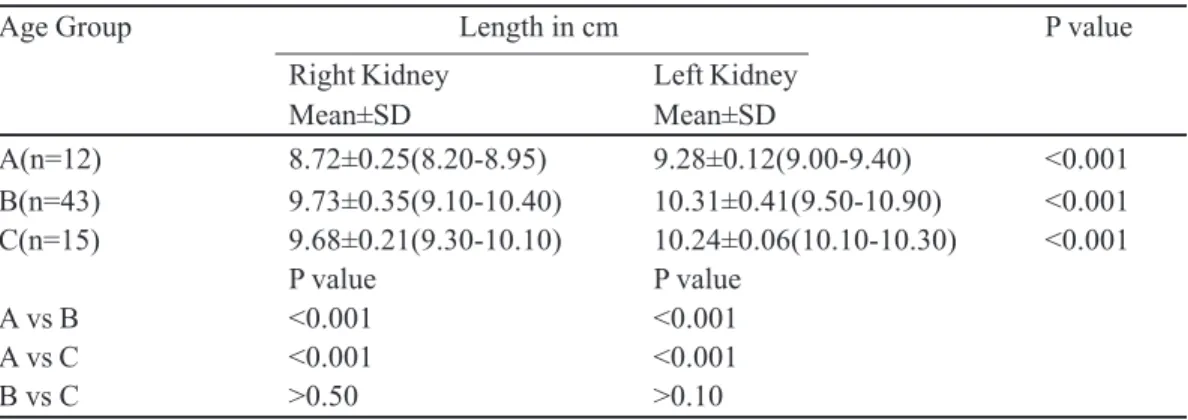
In this study, the length of the right and left kidneys found were 8.72±0.25 cm and 9.28±0.12 cm; 9.73±0.35 cm and 10.31±0.41 cm; 9.68±0.21 cm and 10.24±0.06 cm in group A, B and C respectively (Table II). The breadth of the right and left kidneys found were 4.32±0.09 cm and 4.22±0.11 cm; 4.74±0.29 cm and 4.55±0.28 cm; 4.61±0.21 cm and 4.44±0.21 cm in group A, B and C respectively (Table III). The mean thickness of the right and left kidneys found were 2.84±0.10 cm and 2.64±0.05 cm; 3.31±0.16 cm and 3.11±0.10 cm; 3.17±0.07 cm and 3.11±0.10 cm in group A, B and C respectively (Table IV). The mean length of the left kidneys was found significantly greater than of the right (Table II), while the mean breadth and the thickness of the right kidneys were found greater than that of the left kidneys (Table III & IV) in all age groups. In addition, the mean values depicting the size of the kidney samples considering all dimensions (length, breadth and thickness) of the kidney were found significantly greater in group B compared to A and also in C compared to A (Table II, III & IV). There was no significant difference in kidney size when compared between group B and group C.
Table II: Length of right and left kidney in different age group
Age Group Length in cm P value
Right Kidney Left Kidney
Mean±SD Mean±SD A(n=12) 8.72±0.25(8.20-8.95) 9.28±0.12(9.00-9.40) <0.001 B(n=43) 9.73±0.35(9.10-10.40) 10.31±0.41(9.50-10.90) <0.001 C(n=15) 9.68±0.21(9.30-10.10) 10.24±0.06(10.10-10.30) <0.001 P value P value A vs B <0.001 <0.001 A vs C <0.001 <0.001 B vs C >0.50 >0.10
Figures in the parentheses indicate range. Comparison between right and left side done by independent sample ‘t’ test and comparison between different age groups done by One-way ANOVA (PostHoc),. Group A- 10-19 years, Group B-20-39 years Group C-40-59 years
Right Kidney Left Kidney Mean±SD Mean±SD A(n=12) 4.32±0.09(4.10-4.40) 4.22±0.11(4.00-4.38) <0.05 B(n=43) 4.74±0.29(4.20-5.28) 4.55±0.28(4.10-5.00) <0.01 C(n=15) 4.61±0.21(4.19-4.80) 4.44±0.21(4.10-4.60) <0.05 P value P value A vs B <0.001 <0.001 A vs C <0.01 <0.05 B vs C >0.50 >0.10
Figures in the parentheses indicate range. Comparison between right and left side done by independent sample ‘t’ test and comparison between different age groups done by One-way ANOVA (PostHoc),. Group A- 10-19 years, Group B-20-39 years Group C-40-59 years
Table IV: Thickness of right and left kidney in different age group
Age Group Thickness in cm P value
Right Kidney Left Kidney
Mean±SD Mean±SD A 2.84±0.10 2.64±0.05 <0.001 (n=12) (2.60-2.98) (2.60-2.70) B 3.31±0.16 3.11±0.10 <0.001 (n=43) (2.90-3.26) (2.70-3.25) C(n=15) 3.17±0.07 3.11±0.10 <0.05 (3.10-3.26) (3.00-3.23) P value P value A vs B <0.001 <0.001 A vs C <0.001 <0.001 B vs C <0.01 >0.50
Figures in the parentheses indicate ranges. Comparison between right and left side done by independent sample ‘t’ test and comparison between different age groups done by One-way ANOVA (PostHoc),. Group A- 10-19 years, Group B-20-39 years Group C-40-59 years.
Discussion
Mullick9 first observed the average
measurements of kidney sample in Bangladeshi people are 9.9 cm in length, 4.6 cm in breadth and 3.7 cm in thickness. Sultana10 also examined
40 human kidneys and found the average length, breadth and thickness 8.00±0.44 cm, 4.40±0.15 cm and 2.68±0.40 cm in male and 7.10±0.36 cm, 4.60±0.15 cm and 1.90±0.25 cm in female in group A (10-20 years) respectively, while
10.06±0.23 cm, 5.42±0.18 cm and 2.66±0.18 cm in male and 9.23±0.14 cm, 6.20±0.15 cm and 2.26±0.24 cm in female in group B (21-40 years) respectively, and 9.26±0.22 cm, 5.28±0.24 cm and 2.48±0.31 cm in male and 8.35±0.05 cm, 5.35±0.05 cm and 2.35±0.05 cm in female in group C (41-65 years) respectively. Alam11 studied on 60 postmortem kidneys and found the average length of kidney 7.29 cm in group A (5-15 years), 9.38 cm in group B (16-35 years) and 8.82 cm in group C (36-60 years), while the average breadth were 3.80 cm, 4.78 cm and 4.30 cm and the average thickness were 2.96 cm, 3.37 cm and 3.63 cm in group A, B and C respectively. Nahar et al.12 studied 120 cadaveric kidneys of age ranging from 12 to 65 years and found the length of the right and left kidneys were 7.44±0.89 cm and 7.49±0.84 cm in group A (12-20 years), 9.92±1.23 cm and 9.88±1.27 cm in group B (21-40 years), 8.79±0.59 cm and 8.76±0.58 cm in group C (41-65 years). The breadth of the right and left kidneys found were 4.45±0.32 cm and 4.48±0.27 cm; 5.36±0.56 cm and 5.35±0.53 cm; 4.76±0.26 cm and 4.73±0.18 cm in group A, B and C respectively. The thickness of the right and left kidneys found were 2.70±0.17 cm and 2.71±0.16 cm; 3.38±0.19 cm and 3.37±0.20 cm; 3.31±0.09 cm and 3.31±0.12 cm in group A, B and C respectively. All the parameters showed age related differences except for thickness between B & C. Banik et al.13 examined 49 human kidneys and found the length of the right and left kidneys were 7.62±0.86 cm and 7.87±0.93 cm in group A (6-20 years), 8.82±1.08 cm and 8.94±1.02 cm in group B (21-36 years) and 8.99±0.68 cm and 9.05±0.65 cm in group C (37-65 years) respectively. The breadth of the right and left kidneys found were 3.70±0.43 cm and 3.88±0.36 cm; 4.44±0.52 cm and 4.43±0.54 cm; 4.30±0.48 cm and 4.16±0.43 cm in group A, B and C respectively. The thickness of the right and left kidneys were found 3.04±0.36 cm and 3.08±0.26 cm; 3.62±0.77 cm and 3.65±0.76 cm; 3.40±0.35 cm and 3.48±0.42 cm in group A, B and C
respectively. Khatun et al.14 studied 50 human subjects, aged from 11-80 years, and found the length 8.12 cm, 9.12 cm and 8.73 cm; the breadth 4.46 cm, 4.31 cm and 3.58 cm; the thickness 1.72 cm, 2.19 cm and 1.48 cm in group A (11-25 years), B (26-40 years) and C (41-80 years) respectively.
There are several evidences of the kidney measurement in western populations. According to Gardner, Gray & O’Rahilly15 and Grant, Basmajian & Slonecker16, the kidneys are about
11 to 13 cm long; the left one is somewhat longer and larger than the right. Emamian et al.17
examined 665 kidneys and found average length 10.9 cm and 11.2 cm in right and left kidney respectively, while average width were 5.7 cm and 5.8 cm respectively. Fawcett & Jensh18 stated that kidneys are 10-12 cm in length, 5-6 cm in width and 3-4 cm in thickness. Healy19 reported that each kidney is about 11 cm in length, 6 cm in breadth and 3 cm in anterior posterior dimension. The left kidney may be 1.5 cm longer than the right one. Ellis & Mahadevan20 reported that the kidney measures about 11 cm in length, 6 cm in width and 4 cm in thickness. Sinnatamby21 stated that the normal kidney
measures about 12 cm × 6 cm × 3 cm, while Ross & Pawlina22 reported that each kidney measures
approximately 10 cm long × 6.5 cm wide (from concave to convex border) × 3 cm thick. However, according to Moore, Dalley & Agur23, the kidney measures approximately 10 cm in length, 5 cm in width and 2.5 cm in thickness. Apart from few exceptions, the results of the present study are similar to that of previous records. Smaller size in some kidney specimens may attribute to racial variation and somewhat shrinkage resulting from fixation with formalin12.
The minimal variations of kidney’s dimension between Bangladeshi and Western people might result from higher body weight as well as greater body surface area of the Western population.14
found greater than that of the right, while the breadth and the thickness of the right kidney were found greater than that of the left one in all age groups. Besides, age related changes were also evident in all dimensions (length, breadth and thickness) of the kidney among selective age groups. The results of the present study can be used as a standard reference for the kidneys of Bangladeshi people and may help to determine the abnormal evidences in forensic and pathological cases. However, further studies with larger samples and comparison between sexes are recommended.
Ethical Consideration This study was approved by Institutional Review Board of BSMMU, Dhaka
Conflict of interest: There is no conflict of interest relevant to this paper to disclose.
Acknowledgement
We would like to express our gratitude to the authority of Health, Nutrition & Population Sector Programme (HNPSP) of Directorate General of Health Services (DGHS) of the Government of the People’s Republic of Bangladesh, and Principal, Dhaka Medical College, Dhaka, for the research grant to support this study.
References
1. Anderson S, Brenner BM. Effects of aging on renal glomerulus. Am J Med 1986;80(3):435-42. 2. Darmady EM, Offer J, Woodhouse MA. The
parameters of the ageing kidney. J Pathol 1973;109(3):195-207.
3. Nyengaard JR, Bendtsen TF. Glomerular number and size in relation to age, kidney weight, and body surface in normal man. Anat Rec 1992;232(2):194-201. 4. Hughson M, Farris AB, Douglus DR, Denten R, Hoy
WE, Bertran JF. Glomerular number and size in autopsy kidney: the relationship to birth weight. Kidney Int 2003;63(3):2113-22.
6. Sylve’n M, Boyd M. Renal artery intervention – an invasive radiologist’s approach. Saudi J Kidney Dis Transpl 2005;16(2):181-92.
7. Torres VE, Harris PC. Autosomal dominant polycystic kidney disease. In: Floege J, Johnson RJ, Feehally J. eds. Comprehensive clinical nephrology. 4th ed. Philadelphia: Saunders Elsevier; 2010: p.529-42. 8. Clarkson MR, Magee CN, Brenner BM. Clinical
assessment of the patient with kidney disease. In: Pocket companion to Brenner and Rector’s the Kidney. 8th ed. Philadelphia: Saunders Elsevier; 2011: p.3-20. 9. Mullick MH. The arterial pattern of human kidney. J
Pak Med Assoc 1970;20:77-83.
10. Sultana Z. An Anatomical study of human postmortem kidney in Bangladeshi people [thesis]. Dhaka: IPGMR, University of Dhaka; 1991.
11. Alam MZ. Gross morphological and histological features of kidneys in Bangladeshi people [thesis]. Dhaka: IPGMR, University of Dhaka; 1994. 12. Nahar A, Hussain MA, Ara S, Begum J, Chowdhury
AHMMM. Morphological study of postmortem human kidney. Bangladesh J Anat 2007;5(1):10-4. 13. Banik S, Shefyetullah KM, Naushaba H, Begum S,
Khatun M, Rahman M. Gross dimension of postmortem kidney of Bangladeshi people in different age. J Dhaka Natl Med Coll Hosp 2007;12(2):9-13. 14. Khatun H, Sultana Z, Islam NAF, Kibria GM,
Chowdhury TE. Morphological study of the kidney in relation to age. Bangladesh J Anat 2009;7(1):19-21. 15. Gardner E, Gray DJ, O’Rahilly R. Anatomy: a regional
study of human structure. 5th ed. Philadelphia: WB Saunders; 1986.
16. Grant JCB, Basmajian JV, Slonecker CE. Grant’s method of anatomy: a clinical problem-solving approach. 11th ed. Baltimore: Lippincott Williams & Wilkins; 1989.
17. Emamian SA, Nielsen MB, Pedersen JF, Ytte L. kidney dimensions at sonography: correlation with age, sex and habitus in 665 adult volunteers. Am J Roentgenol 1993;160:83-6.
18. Fawcett DW, Jensh RP. Bloom and Fawcett’s concise histology. 2nd ed. London: Arnold; 2002: p.237-9.
19. Healy JC. Kidney and ureter. In: Standring S, Borley NR, Collins P, Crossman AR, Gatzoulis MA, Healy JC, et al. eds. Gray’s anatomy: the anatomical basis of clinical practice. 40th ed. Edinburgh: Elsevier Churchill Livingstone; 2008: p.1225-38.
20. Ellis H, Mahadevan V. The urinary tract. Clinical anatomy: applied anatomy for students and junior doctors. 12th ed. Oxford: Wiley-Blackwell; 2010: p.112-5.
21. Sinnatamby CS. Kidneys, ureters and suprarenal glands. In: Last’s anatomy: regional and applied. 12th
ed. Edinburgh: Elsevier Churchill Livingstone; 2011: p.283-7.
22. Ross MH, Pawlina W. Histology: a text and atlas with correlated cell and molecular biology. 6th ed. Baltimore: Lippincott Williams & Wilkins; 2011: p.698-714.
23. Moore KL, Dalley AF, Agur AMR. Kidneys, ureters, and suprarenal glands. In: Clinically oriented anatomy. 7th ed. B altimore: Lippincott Williams & Wilkins; 2014: p.290-300.