A
lthough this article was orig-inally written for teachers, the information presented may be of help to those who are working with persons making the transition from welfare to work.To understand and work with stu-dents and adults from generational poverty, a framework is needed. This analytical framework is shaped around these basic ideas:
◆ Each individual has eight resources which greatly influence achievement; money is only one.
◆ Poverty is the extent to which an individual is without these eight resources.
◆ The hidden rules of the middle class govern schools and work; stu-dents from generational poverty come with a completely different set of hidden rules and do not know middle-class hidden rules.
◆ Language issues and the story structure of casual register cause many students from generational poverty to be unmediated, and there-fore, the cognitive structures needed inside the mind to learn at the levels required by state tests have not been fully developed.
◆ Teaching is what happens outside the head; learning is what happens inside the head. For these students to learn, direct teaching must occur to build these cognitive structures.
◆ Relationships are the key motiva-tors for learning for students from generational poverty.
Key points
Here are some key points that need to be addressed before discussing the framework:
Poverty is relative. If everyone around you has similar circumstances, the notion of poverty and wealth is vague. Poverty or wealth only exists in relationship to the known quantities or expectation.
Poverty occurs among people of all ethnic backgrounds and in all countries. The notion of a middle class as a large segment of society is a phe-nomenon of this century. The percent-age of the population that is poor is subject to definition and circumstance.
Economic class is a continuous line, not a clear-cut distinction. Individuals move and are stationed all along the continuum of income. Generational poverty and situa-tional poverty are different. Generational poverty is defined as being in poverty for two generations or longer. Situational poverty exists for a shorter time is caused by circum-stances like death, illness, or divorce. This framework is based on pat-terns. All patterns have exceptions.
An individual bring with them the hidden rules of the class in
which they were raised. Even though the income of the individual may rise significantly, many patterns of thought, social interaction, cogni-tive strategies, and so on remain with the individual.
School and businesses operate from middle-class norms and use the hidden rules of the middle class. These norms and hidden rules are never directly taught in schools or in businesses.
We must understand our students' hidden rules and teach them the hidden middle-class rules that will make them successful at school and work. We can neither excuse them nor scold them for not know-ing; we must teach them and provide support, insistence, and expectations. To move from poverty to middle class or from middle class to wealth, an individual must give up relationships for achievement. Resources
Poverty is defined as the "extent to which an individual does without resources. These are the resources that influence achievement:
Financial: the money to purchase goods and services.
Individuals who made it out of poverty
usually cite an individual
who made a significant difference for them.
Understanding and Working with
Students and Adults from Poverty
By Ruby K. Payne, Ph.D.
Founder and President of aha! Process, Inc.
aha!
aha!
a
aha!
aha!
ah
aha!
aha!
a
a
ha!
aha!
aha
aha!
aha!
a
aha!
aha!
aha
aha!
aha!
a
articles
aha!
aha!a!
articles articlesarticles
articles
articles
articles
articles
aha!
aha!
ah
articles
aha!
aha!
a
articles
Ruby K. Payne, Ph.D.
Poverty Series ◆ Part IEmotional: the ability to choose and control emotional responses, par-ticularly to negative situations, with-out engaging in self-destructive behavior. This is an internal resource and shows itself through stamina, perseverance, and choices.
Mental: the necessary intellectual ability and acquired skills, such as reading, writing, and computing, to deal with everyday life.
Spiritual: a belief in divine pur-pose and guidance.
Physical: health and mobility. Support systems: friends, family, backup resources and knowledge bases one can rely on in times of need. These are external resources.
Role models: frequent access to adults who are appropriate and nur-turing to the child, and who do not engage in self-destructive behavior.
Knowledge of hidden rules: knowing the unspoken cues and habits of a group.
Language and story structure
To understand students and adults who come from a background of gen-erational poverty, it's helpful be acquainted with the five registers of language. These are frozen, formal, consultative, casual, and intimate. Formal register is standard business and educational language. Formal register is characterized by complete sentences and specific word choice. Casual register is characterized by a 400- to 500-word vocabulary, broken sentences, and many non-verbal assists.
Maria Montano-Harmon, a California researcher, has found that many low-income students know only casual register. Many discipline referrals occur because the student has spoken in casual register. When individuals have no access to the structure and specificity of formal register, their achievement lags. This is complicated by the story structure used in casual register.
In formal register, the story struc-ture focuses on plot, has a beginning and end, and weaves sequence, cause and effect, characters, and consequences into the plot. In casual register, the focus of the story is characterization.
Typically, the story starts at the end (Joey busted his nose), proceeds with short vignettes interspersed with participatory comments from the audience (He hit him hard. BAM-BAM. You shouda' seen the blood on him), and finishes with a comment about the character. (To see this in action, watch a TV talk show where many of the participants use this structure.) The story elements that are included are those with emotional significance for the teller. This is an episodic, random approach with many omissions. It does not include sequence, cause and effect, or consequence.
Cognitive issues
The cognitive research indicates that early memory is linked to the pre-dominant story structure that an indi-vidual knows. Furthermore, stories are retained in the mind longer than many other memory patterns for adults. Consequently, if a person has not had access to a story structure with cause and effect, consequence, and
sequence, and lives in an environ-ment where routine and structure are not available, he or she cannot plan. According to Reuven Feuerstein, an Israeli educator:
◆ Individuals who cannot plan, cannot predict.
◆ If they cannot predict, they cannot identify cause and effect.
◆ If they cannot identify cause and
effect, they cannot identify consequence. ◆ If they cannot identify consequence, they cannot control impulsivity.
◆ If they cannot control impulsivity, they have an inclination to criminal behavior.
Mediation
Feuerstein refers to these students as "unmediated." Simply explained mediation happens when an adult makes a deliberate intervention and does three things:
◆ points out the stimulus (what needs to be paid attention to)
◆ gives the stimulus meaning ◆ provides a strategy to deal with the stimulus.
For example: Don't cross the street without looking (stimulus). You could be killed (meaning). Look twice both ways before crossing (strategy).
Mediation builds cognitive strategies for the mind. The strategies are anal-ogous to the infrastructure of house, that is, the plumbing, electrical and heating systems. When cognitive strategies are only partially in place, the mind can only partially accept the teaching. According to Feuerstein, unmediated students may miss as much as 50 percent of text on a page.
Why are so many students unmediated? Poverty forces one's time to be spent on survival. Many students from poverty live in single-parent families. When there is only one parent, he or she do not have time and energy to both mediate the children and work to put food on the table. And if the parent is nonmediated, his or her ability to mediate the chil-dren will be significantly lessened. aha!
articlesaha!articlesaha!articlesaha!articlesaha!articlesaha!articlesaha!articlesaha!articlesaha!articlesaha!articlesaha!articlesaha!articlesaha!articlesaha!articlesaha!articlesaha!articlesaha!articlesaha!articlesaha!articles
Ruby K. Payne, Ph.D. ◆ Poverty Series ◆ Part I
The hidden rules of the middle class
must be taught
so students can choose to follow them
if they wish.
aha!
articlesaha!articlesaha!articlesaha!articlesaha!articlesaha!articlesaha!articlesaha!articlesaha!articlesaha!articlesaha!articlesaha!articlesaha!articlesaha!articlesaha!articlesaha!articlesaha!articlesaha!articlesaha!articles
Ruby K. Payne, Ph.D. ◆ Poverty Series ◆ Part I
Hidden Class Rules
Generational Poverty Middle Class Wealth
The driving forces for decision-making The driving forces for decision-making The driving forces for decision-making are survival, relationships, and are work and achievement. are social, financial, and political
entertainment connections.
People are possessions. It is worse Things are possessions. If material Legacies, one-of-a-kind objects, and to steal someone's girlfriend than a security is threatened, often the pedigrees are possessions.
thing. A relationship is valued relationship is broken. over achievement. That's why you
must defend your child no matter what he or she has done. Too much education is feared because the individual might leave.
The "world" is defined in local terms. The "world" is defined in national The "world" is defined in
terms. international terms.
Physical fighting is how conflict is Fighting is done verbally. Physical Fighting is done through social resolved. If you only know casual fighting is viewed with distaste. inclusion/exclusion and through
register, you don't have the words lawyers.
to negotiate a resolution. Respect is accorded to those who can physically defend themselves.
Food is valued for its quantity. Food is valued for its quality. Food is valued for its presentation.
◆ You laugh when you are disci-plined; it is a way to save face. ◆ The noise level is higher, non-verbal information is more impor-tant than verbal. Emotions are openly displayed, and the value of personality to the group is your ability to entertain.
◆ Destiny and fate govern. The notion of having choices is foreign. Discipline is about penance and forgiveness, not change.
◆ Tools are often not available. Therefore, the concepts of repair and fixing may not be present.
◆ Formal register is always used in an interview and is often an expected part of social interaction.
◆ Work is a daily part of life. ◆ Discipline is about changing behavior. To stay in the middle class, one must be self-governing and self-supporting.
◆ A reprimand is taken seriously (at least the pretense is there), without smiling and with some deference to authority.
◆ Choice is a key concept in the lifestyle. The future is very impor-tant. Formal education is seen as crucial for future success.
◆ The artistic and aesthetic are key to the lifestyle and included clothing, art, interior design, seasonal decorat-ing, food, music, social activities, etc. ◆ For reasons of security and safety, virtually all contacts dependent on connection and introductions. ◆ Education is for the purpose of social, financial and political connections, as well as to enhance the artistic and aesthetic.
* One of the key differences between the well-to-do and the wealthy is that the wealthy almost always are patrons to the arts and often have an individual artist(s) to whom they are patrons as well.
To help students learn when they are only partially mediated, four structures must be built as part of direct teaching:
◆ the structure of the discipline, ◆ cognitive strategies,
◆ conceptual frameworks, and ◆ models for sorting out what is
important from what is unimportant in text.
Hidden rules
One key resource for success in school and at work is an understand-ing of the hidden rules. Hidden rules are the unspoken cueing system that individuals use to indicate member-ship in a group. One of the most important middle-class rules is that work and achievement tend to be the driving forces in decision-making. In generational poverty, the driving forces are survival, entertainment, and relationships. This is why a student may have a $30 Halloween costume but an unpaid book bill.
Hidden rules shape what happens at school. For example, if the rule a students brings to school is to laugh when disciplined and he does so, the teacher is probably going to be offended. Yet for the student, this is the appropriate way to deal with the situation. The recommended approach is simply to teach the student that he needs a set of rules that brings success in school and at work and a different set that brings success outside of school. So, for example, if an employee laughs at a boss when being disciplined, he will probably be fired.
Many of the greatest frustrations teachers and administrators have with students from poverty is related to knowledge of the hidden rules. These students simply do not know middle-class hidden rules nor do most educa-tors know the hidden rules of genera-tional poverty.
To be successful, students must be given the opportunity to learn these rules. If they choose not to use them, that is their choice. But how can they
make the choice if they don't know the rules exist?
Relationships are key
When individuals who made it out of poverty are interviewed, virtually all cite an individual who made a signif-icant difference for them. Not only must the relationship be present, but tasks need to be referenced in terms of relationships.
For example, rather than talk about going to college, the conversation needs to be about how the learning will impact relationships. One teacher had this conversation with a 17-year-old student who didn't do his math homework on positive and neg-ative numbers.
"Well," she said, "I guess it will be all right with you when your friends cheat you at cards. You won't know whether they're cheating you or not because you don't know positive and negative numbers, and they aren't going to let you keep score, either." He then used a deck of cards to show her that he know how to keep score. So she told him, "Then you know positive and negative numbers. I expect you to do your homework."
From that time on, he did his homework and kept an A average. The teacher simply couched the importance of the task according to the student's relationships.
Conclusion
Students from generational poverty need direct teaching to build cognitive structures necessary for learning. The relationships that will motivate them need to be established. The hidden rules must be taught so they can choose the appropriate responses if they desire. Students from poverty are no less capable or intelligent. They simply have not been mediated in the strate-gies or hidden rules that contribute to success in school and at work.
References
Feuerstein, Reuven, et al. (1980),
Instrumental Enrichment: An Intervention Program for Cognitive Modifiability.
Glenview, IL: Scott, Foresman.
Joos, Martin. (1967) The Styles of the Five Clocks. Language and Cultural Diversity in
American Education, 1972. Abrahams, R. D.
and Troike, R. C., Eds. Englewood Cliffs, NJ: Prentice-Hall.
Making Schools Work for Children in Poverty: A New Framework Prepared by the Commission on Chapter 1, (1992).
Washington, DC: AASA, December. Montano-Harmon, Maria Rosario (1991). Discourse Features of Written Mexican Spanish: Current Research in Contrastive Rhetoric and Its Implications. Hispania, Vol. 74, No. 2, May 417-425. Montano-Harmon, Maria Rosario (1994). Presentation given to Harris County Department of Education on the topic of her research findings. Wheatley, Margaret J. (1992). Leadership and
the New Science. San Francisco, CA:
Berrett-Koehler Publishers.
Previously printed in Instructional Leader and Focus magazines.
Ruby K. Payne, Ph.D., founder and president of aha! Process, Inc. (1994), with more than 30 years experience as a professional educator, has been sharing her insights about the impact of poverty – and how to help educators and other professionals work effectively with indi-viduals from poverty – in more than a thousand workshop settings through North America, Canada, and Australia.
More information on her book, A Framework
for Understanding Poverty, can be found on
her website, www.ahaprocess.com.
aha!
articlesaha!articlesaha!articlesaha!articlesaha!articlesaha!articlesaha!articlesaha!articlesaha!articlesaha!articlesaha!articlesaha!articlesaha!articlesaha!articlesaha!articlesaha!articlesaha!articlesaha!articlesaha!articles
Ruby K. Payne, Ph.D. ◆ Poverty Series ◆ Part I
Editor's note: Ruby K. Payne presents
A Framework for Understanding Poverty,
a two-day workshop, on her U.S. National Tour each year and also has produced accompanying materials. Both are available on her website, www.ahaprocess.com. Also opt-in to aha!'s e-mail newslist for the latest poverty and income statistics [free] and other updates. aha!Process, Inc.
(800) 424-9484 (281) 426-5300 fax: (281) 426-5600 www.ahaprocess.com
Actual phone conversations: "Ruby, we got our TAAS data back. I cried and cried. I don't know what else to do. I did everything I know how to do. What is wrong with me? With my teaching? Maybe I should just quit and do something else." "I know we are going to get our 'bub-ble kids' through the TAAS. But as the subpopulation score requirements climb, what are we going to do with the others? Those students that are two and three years behind?
T
eaching is outside the head; learning is inside the head.Every individual has a brain but not everyone has a devel-oped mind. The work of Feuerstein, an Israeli educator who successfully worked for nearly 50 years with stu-dents whose mental development was delayed, developed mental prowess through a process of mediation. Mediation involves three things: pointing out the stimuli (what the indi-vidual is to give attention to), giving it meaning, and providing a strategy.
Mediation occurs through lan-guage and direct teaching. Mediation builds learning structures in the head, which allow the learner to accept and process the information. A teacher can teach a perfect lesson, but if the student does not have the structures for accepting and using the informa-tion, a great deal of the lesson is lost. Through direct instruction, the
unde-veloped and under-deunde-veloped parts of the learning structure can be built.
There are four parts of the structure that must be inside a head before a learner can accept the information. To simply represent these four structures, Figure 1 (on page two) will be used.
Quite simply, these four structures are 1) a structure for data and a struc-ture for the discipline; 2) cognitive strategies or processes; 3) conceptual frameworks (schema); and 4) sorting mechanisms.
The First Structure
The first structure is an organized mechanism for data. In an analogy to a house, it is the studs and foundation – the very things that hold the struc-ture intact and make it a strucstruc-ture. In an analogy to a computer, it is the hardware itself. It is the organ of the brain that accepts data and structures it. Everything in the universe has structure and is to a certain extent, defined by that structure. The mind is, to some extent, defined by the brain.
In addition, a student needs a structure for each discipline. Structures in disciplines tend to be underlying principles. For example, the key underlying principle in math is to assign order and value to the universe. In chemistry, the key under-lying principle is bonding; in algebra, it is solving for the unknown. When the key underlying principle is under-stood, then the whole discipline has a structure or a way to place data.
The Second Structure: Cognitive Strategies
The second learning structure is cog-nitive strategies. Feuerstein identi-fied several strategies or processes that an individual must successfully have in order to deal with any piece of data. Feuerstein found that stu-dents missed much of the original data (up to 50 percent) when the cognitive strategies were not fully or only partially developed.
These strategies are analogous to the infrastructure of a house – the plumbing system, heating system, electrical system, sewage system, etc. In a house, it is when the systems are not working that we realize our reliance upon them. In a computer, these strategies are analogous to the software. Any individual who has worked with a malfunctioning soft-ware package knows the importance of this part of the structure.
Feuerstein identified student char-acteristics when these strategies are missing. The strategies have been restated in the positive, i.e., what stu-dents can do when these strategies are present. In the mind, these cogni-tive strategies are the following:
Input Strategies
Input is defined as the "quantity and quality of the data gathered."
1. Use planning behaviors. 2. Focus perception on a specific
stimulus. 3. Control impulsivity.
aha!
aha!
a
aha!
aha!
ah
aha!
aha!
a
a
ha!
aha!
aha
aha!
aha!
a
aha!
aha!
aha
aha!
aha!
a
articles
aha!
aha!a!
articles articlesarticles
articles
articles
articles
articles
aha!
aha!
ah
articles
aha!
aha!
a
articles
Ruby K. Payne, Ph.D.
Poverty Series ◆ Part IIUnderstanding and Working With Students and Adults from Poverty
Building Learning Structures
Inside the Head
By Ruby K. Payne, Ph.D.
4. Explore data systematically. 5. Use appropriate and accurate
labels.
6. Organize space with stable systems of reference. 7. Orient data in time.
8. Identify constancies across variations.
9. Gather precise and accurate data. 10. Consider two sources of
information at once.
11. Organize data (parts of a whole). 12. Visually transport data.
Elaboration Strategies
Elaboration strategies are defined as the "use of the data."
1. Identify and define the problem. 2. Select relevant cues.
3. Compare data.
4. Select appropriate categories of time.
5. Summarize data.
6. Project relationships of data. 7. Use logical data.
8. Test hypothesis. 9. Build inferences.
10. Make a plan using the data. 11. Use appropriate labels. 12. Use data systematically.
Output Strategies
Output is defined as the "communi-cation of the data."
1. Communicate clearly the labels and process.
2. Visually transport data correctly. 3. Use precise and accurate
language.
4. Control impulsive behavior. What do these strategies mean? Mediation builds these strategies. When these strategies are not present, they can be built. Typically in school, we begin teaching at the elaboration level, i.e., the use of the data. When students do not understand, we reteach these strategies but do not revisit the quality and quantity of the data gathered.
In order to better understand input strategies, each is explained in more detail. Typically, input strategies are not directly taught, because we do not know to teach them. However, for unmediated students, these strate-gies must be taught directly.
Input strategies
(quantity and quality of data) Using planning behaviors includes
goal setting, identifying the procedures in the task, identifying the parts of the task, assigning time to the task(s), and identifying the quality of the work necessary to complete the task.
Focusing perception on a specific stimulus is the strategy of seeing every detail on the page or in the environ-ment. It is the strategy of identifying everything noticed by the five senses.
Controlling impulsivity is the strat-egy of stopping action until thinking about the task is done. There is a direct correlation with impulsivity control and improved behavior and achievement.
Exploring data systematically means that a strategy is employed to procedurally and systematically go through every piece of data.
Numbering is a way to go systemati-cally through data. Highlighting each piece of data can be another method.
Using appropriate and accurate labels is the use of precise words and vocabulary to identify and explain. If a student does not have specific words to use, then his or her ability to retrieve and use information is severely limited. It is not enough that a student can do a task, he/she must also be able to label the procedures, tasks and processes so that the task can be successfully repeated each time and analyzed at a metacognitive level. Metacognition is the ability to think about one's thinking. To do labels must be attached. Only when labels are attached can the task be evaluated and therefore improved.
Organizing space with stable sys-tems of reference is crucial to success in math. It means that up, down, right, left, across, horizontal, vertical, diag-onal, etc. are understood. It means that an individual can identify what the position of an item is with labels. It means that an individual can organ-ize space. For example, if an individ-ual does not have this strategy, then it is virtually impossible to tell a "p", "b" and "d" apart. The only differen-aha!
articlesaha!articlesaha!articlesaha!articlesaha!articlesaha!articlesaha!articlesaha!articlesaha!articlesaha!articlesaha!articlesaha!articlesaha!articlesaha!articlesaha!articlesaha!articlesaha!articlesaha!articlesaha!articles
Ruby K. Payne, Ph.D. ◆ Poverty Series ◆ Part II
Learning
Structures
KEY
1) Structure 2) Cognitive Strategies (processes) 3) Conceptual frameworks 4) Sorting mechanisms— important from unimportant1
3
4
Figure 12
Infrastructuretiation is the orientation in space. Orienting data in time is the strate-gy of assigning abstract values to time and the measurement of time. This strategy is crucial for identifying cause and effect, for determining sequence, and for predicting consequences.
Identifying constancies across variations is the strategy of knowing what always remains the same and what changes. For example, if you do not know what always makes a square a square, you cannot identify constancies. It allows one to define things, to recognize a person or an object, and to compare and contrast. This strategy allows cursive writing to be read with all of its variations. I asked a group of fifth-grade students I was working with this question: "If you saw me tomorrow, what about me would be the same and what would be different?" Many of the stu-dents had difficulty with that strategy.
Gathering precise and accurate data is the strategy of using accu-rate labels, identifying the orienta-tion in time and in space, knowing the constancies, and exploring the data systematically.
Considering two sources of infor-mation at once is the strategy of visu-ally transporting data accurately,
identifying the constancies and varia-tions, and exploring the data system-atically. When that is done, then pre-cise and accurate labels need to be assigned.
Organizing data (parts of a whole) involves exploring data sys-tematically, organizing space, identi-fying constancies and variations, and labeling the parts and the whole with precise words.
Visually transporting data is when the eye picks up the data, carries it accurately to the brain, examines it for constancies and variations, and labels the parts and whole. If a stu-dent cannot visually transport, then he often cannot read, has difficulty with basic identification of anything, and cannot copy.
Elaboration and output strategies tend to be fairly well understood in schools, because that is where the teaching tends to occur. Feuerstein developed well over 100 instru-ments to use to build these strategies in the brain.
The Third Structure: Conceptual Frameworks
Conceptual frameworks are the part of the structure that stores and retrieves data. In the house, it is
anal-ogous to the rooms. In most houses, rooms are identified by function – the bedroom, the living room, the kitchen, the bathroom, etc.
In a computer, the analogy is to the files. In an oversimplification of conceptual frameworks, they might look something like Figure 2.
These frameworks need the gener-al or abstract words so that categories can be made for information, like the files in a computer or the rooms in a house. Development goes from the specific and concrete to the abstract and general.
At least two quick ways are avail-able to diagnose the development and accessibility of conceptual frame-works. First, if a student gives an example rather than a definition, you know that the concrete part of the framework is available, but the abstract part is not. To store much information, abstract words are nec-essary to assign and label the cate-gories. Casual register has very little abstract terminology, so students who do not have access to formal register have difficulty with assigning things to categories.
The second way to diagnose con-ceptual frameworks is whether a stu-dent can ask a question syntactically. For example, the student will ask, "Don't you have any more?" If a stu-dent makes a statement but tonally infers it is a question, e.g. "You don't have any more?" then a high proba-bility exists that the student has a low reading comprehension score
(Palinscar), and the student is unable to access the stored information with any repeated success. If you have a student who cannot answer the test questions unless they are exactly the same as the review questions, then you have a student who cannot access their conceptual frameworks or "files."
Quite simply, if a student cannot ask questions syntactically, his ability to learn is significantly reduced aha!
articlesaha!articlesaha!articlesaha!articlesaha!articlesaha!articlesaha!articlesaha!articlesaha!articlesaha!articlesaha!articlesaha!articlesaha!articlesaha!articlesaha!articlesaha!articlesaha!articlesaha!articlesaha!articles
Ruby K. Payne, Ph.D. ◆ Poverty Series ◆ Part II
Abstract
Concrete
because he cannot identify what he does not know nor can he systemati-cally access what he does know.
There are several ways to build in conceptual frameworks, but one of the most successful methods is recip-rocal teaching by Anne Palinscar. Another successful method is to make students write their own multi-ple choice questions using question stems. Vocabulary development is yet another. Tactics for Thinking
(Marzano) has several activities that assist in this development.
The Fourth Structure: Models for Sorting
Before any data can be stored so that it can be found, some method for sorting the data must exist. Sorting the data simply means identifying what is important and what is not important. Sorting the data is analo-gous to the door on the room. It is what allows the entrance and exit to the file. On the computer, it is the click of the cursor on the file or the pathway.
Students have difficulty sorting information, particularly nonfiction text, because we do not teach how to sort important from unimportant, except as a summary skill. Furthermore, if the student uses a random, episodic story structure, memory is often assigned on the basis of what has emotional signifi-cance. Because many students do not have a method for sorting informa-tion, they try to remember as much as possible, which is very ineffective.
Skilled learners sort text by the organizational pattern or structure of the text. For example, if an article is about the causes and effects of the Civil War, then the reader would sort for causes and effects. If the text compares and contrasts a given topic, then the reader would want to remember what was alike and what was different. We have given stu-dents graphic ways to organize their
writing, but we have not given them the models to sort text. Basically, the majority of text that students see in schools can be represented by one of five models. Students are simply
taught how to identify the five models and sort text with the five models.
In addition, other teaching techniques are available to assist with sorting. Project Read has several good ideas. aha!
articlesaha!articlesaha!articlesaha!articlesaha!articlesaha!articlesaha!articlesaha!articlesaha!articlesaha!articlesaha!articlesaha!articlesaha!articlesaha!articlesaha!articlesaha!articlesaha!articlesaha!articlesaha!articles
Ruby K. Payne, Ph.D. ◆ Poverty Series ◆ Part II
Figure 3
Figure 4
Fiction Story Structure
Middle Beginning Characters Problem Goal End Setting
Five Models To Use For Sorting
Hand
Topical or Descriptive OrganizationCar
Fiction Story StructureLadder
Narrative, How-toCross
Pro/Con Advantages, Disadvantages, Cause and EffectThe Five Models to Use For Sorting
In order to remember, the mind must sort through information and store what is important and discard what is not important. In order to remember the important parts of text, the mind needs to sort against the structure of the text. We have traditionally used graphic organizers to help students write text. Being able to sort the important from the unimportant during reading is the flip side of that coin. Using models to help students sort text gives them a way to remember organizational pat-terns and to identify what is impor-tant. The graphic organizers need to be simple so they are easy to remem-ber. The five symbols in Figure 3 can be used. Any five can be used. Most text that students see in school fits one of these patterns.
How does a teacher use these with students? Give students a piece of text to read and one of the five models. Initially, choose the model that fits the organizational pattern of the text. Put students into pairs. Have them select the most important information and write it into an outline of the model. When finished, use a transparency and help students identify the most impor-tant information. Each student should add to his or her written model the information that has been missed.
Because the TAAS test has so much nonfiction text, students have difficulty because they want to sort using the fiction story structure (see Figure 4) and so remember the
char-acters, setting and plot. By directly teaching them to sort, students can better select the important information.
Conclusion
The less mediated the student is, the more need the student has for direct instruction in these structures. For several of the reasons I cited in Part 1 of this article, many students from poverty do not have these structures sufficiently in place to do well on the TAAS.
All that means is that we must pro-vide direct instruction to build these in their minds. It means that we trade out some of the activities we use that do not have a great amount of payoff in achievement for those that have a higher payoff. For example, rather than having students answer questions at the end of the chapter, they can compose questions. When a student does not have orientation in space, we embed that as a part of the instruction.
Direct instruction to build these strategies is imperative because of the issue of time. Historically, the reason individuals hired teachers or tutors was to provide the learning more effi-ciently than the individual could with-out assistance. Trial and error, as well as experience, can be valuable teach-ers, but they take more time.
It will be from our interventions with the learning structures that greater strides in student achievement will come. Students who have been traditionally successful in school came to school with learning struc-tures; we built our traditional instruc-tional design around the notion that these would be in place.
But these structures can be built. Someone built them in the minds of students who come to school ready to learn. At school, Feuerstein built them successfully into students who at 12 and 13 years old did not have them. As we reframe our instruction to include their construction, student achievement will increase.
References
Feuerstein, Reuven, et al. (1980).
Instrumental Enrichment: An Intervention Program for Cognitive Modifiability. Scott,
Foresman and Co. Glenview, IL. Idol, Lorna and Jones, B.F. (1991).
Educational Values and cognitive Instruction: Implications for Reform. Lawrence Eribaum
Associates. Hillsdale, NJ.
Marzano, Robert J. and Arrendondo, Daisy. (1986). Tactics for Thinking. MCREL. Aurora, CO.
Palinscar, A.S. and Brown, A.L. (1984). "The reciprocal teaching of comprehension-fostering and comprehension-monitoring activities."
Cognition and Instruction. 1. (2), 117-125.
Previously printed in Instructional Leader magazine.
Ruby K. Payne, Ph.D., founder and president of aha! Process, Inc. (1994), with more than 30 years experience as a professional educator, has been sharing her insights about the impact of poverty – and how to help educators and other professionals work effectively with individuals from poverty – in more than a thousand workshop settings through North America, Canada, and Australia.
More information regarding her book, A
Framework for Understanding Poverty, can
be found on her website, www.ahaprocess.com.
aha!
articlesaha!articlesaha!articlesaha!articlesaha!articlesaha!articlesaha!articlesaha!articlesaha!articlesaha!articlesaha!articlesaha!articlesaha!articlesaha!articlesaha!articlesaha!articlesaha!articlesaha!articlesaha!articles
Ruby K. Payne, Ph.D. ◆ Poverty Series ◆ Part II
Editor's note: Ruby K. Payne wrote
Understanding Learning, and its
accom-panying workbook, Learning Structures, which include numerous strategies to help students learn vital content while building cognitive capacity.
Dr. Payne also presents these ideas in depth in A Framework for Understanding
Poverty, a two-day workshop, on her U.S.
National Tour each year. These books and National Tour dates are available on her website, www.ahaprocess.com.
We invite you to opt-in to aha!'s e-mail newslist for the latest poverty and income statistics [free] and other updates. aha!Process, Inc.
(800) 424-9484 (281) 426-5300 fax: (281) 426-5600 www.ahaprocess.com Many students from poverty do not have the learning structures sufficiently in place to do well on the TAAS.
I
n poverty, discipline is often about penance and forgiveness.Because love is unconditional and because the time frame is the pres-ent, the notion that discipline should be instructive and change behavior is not a part of the culture in generational poverty. In matriarchal, generational poverty, the mother is the most power-ful position and is in some ways "keeper of the soul," so she dispenses the judgments, determines the amount and price of penance, and gives for-giveness. When forgiveness is grant-ed, behaviors and activities return to the way they were before the incident.
It is important to note that the approach is to teach a separate set of behaviors. Many of the behaviors students bring to school help them survive outside of school. Students learn and use many different rules depending on the video game they are playing. Likewise, they need to learn to use different rules to be successful in the setting they are in. If poor students do not know how to fight physically, they are going to be in danger on the streets. But if that is their only method for resolving a problem, then they cannot be successful in school.
The culture of poverty does not provide for success in the middle class, because the middle class to a large extent requires the self-gover-nance of behavior. To be successful in work and in school requires the self-governance of behavior. What then do schools need to do to teach appropriate behavior?
Structure and Choice
The two anchors of any effective dis-cipline program that moves students to self-governance are structure and choice. The program must clearly outline the expected behaviors and the consequences of not choosing those behaviors. The program must also emphasize that the individual always has choice – to follow or not to follow the expected behaviors. With each choice then comes consequence – either desirable or not desirable. Many discipline workshops use this approach and are available to schools.
When the focus is, "I'll tell you what to do and when," the student can never move from dependence to independence. He or she is always at the level of dependence.
Behavior Analysis
Mentally or in writing, teachers or administrators must first examine the behavior analysis:
1. Decide what behaviors the child needs to have to be successful. 2. Does the child have the resources
to develop those behaviors? 3. Will it help to contact a parent? Are resources available through them? What resources are available through the school district?
4. How will behaviors be taught? 5. What are other choices the child
could make?
6. What will help the child repeat the successful behavior?
When these questions are completed, they provide answers to the strategies that will most help the student. The chart on the next page indicates pos-sible explanations of behaviors and possible interventions.
Participation of the Student
While the teacher or administrator is analyzing, the student must analyze as well. To help students do so, give them this four-part questionnaire. This has been used with students as young as second semester, first grade. Students have the most difficulty with question number three. Basically, they see no other choices available than the one they have made.
In going over the sheet with the student, it is important to discuss other choices that could have been made. Students often do not have
The culture of poverty does not provide
for success in the middle class,
because the middle class to a large extent
requires the self-governance of behavior.
aha!
aha!
a
aha!
aha!
ah
aha!
aha!
a
a
ha!
aha!
aha
aha!
aha!
a
aha!
aha!
aha
aha!
aha!
a
articles
aha!
aha!a!
articles articlesarticles
articles
articles
articles
articles
aha!
aha!
ah
articles
aha!
aha!
a
articles
Ruby K. Payne, Ph.D.
Poverty Series ◆ Part IIIWorking With Students
From Poverty: Discipline
By Ruby K. Payne, Ph.D.
Founder and President of aha! Process, Inc.
?
Name:1. What did you do? 2. Why did you do that? 3. List four other things you
could have done.
aha!
articlesaha!articlesaha!articlesaha!articlesaha!articlesaha!articlesaha!articlesaha!articlesaha!articlesaha!articlesaha!articlesaha!articlesaha!articlesaha!articlesaha!articlesaha!articlesaha!articlesaha!articlesaha!articles
Ruby K. Payne, Ph.D. ◆ Poverty Series ◆ Part III
Intervention
Understand the reason for the behavior. Tell the student three or four other behaviors that would be more appropriate. Don't argue with the student. Have them complete the four-part questionnaire on page 1. Model respect for students.
Respond in the adult voice. When the student cools down, discuss other responses that could be used. Make students generate or teach students other phrases that could be used to say the same thing.
Stress that fighting is unacceptable in school. Examine other options the student could live with at school. One option is not to settle the business at school.
Allow them to draw or doodle. Have them hold their hands behind their backs when in line or standing. Give them as much to do with their hands as possible in a constructive way.
Write steps on the board. Have them write at the top of the paper the steps needed to finish the task. Have them practice procedural self-talk.
Teach a simple color-coded method of organization in the classroom. Use the five-finger method for memory at the end of the day. Make students give a plan for their own organization.
Write on the board all the parts of the task. Make students check off each part when finished.
Tell students that approach is not a choice. Identify for students the correct voice tone and word choice that is acceptable. Make them practice.
Tell the students that approach is not a choice. Have the students generate other options. Give students alter-native verbal phrases.
Use metaphor story to find the reason or need the cheating and stealing met. Address the reason or need. Stress that the behavior is illegal and not a choice at school.
Make students write all questions and responses on a note card two days a week. Tell students they get five comments a day. Build participatory activities into the lesson.
Behavior Related to Poverty
Laughs when disciplined. A way to save face in matriarchal poverty.
Argues loudly with the teacher. Poverty is participatory, and the culture has a distrust of authority. Sees the system as inherently dishonest and unfair.
Angry response. Anger is based on fear. The question is what the fear is – loss of face?
Inappropriate or vulgar comments. They rely on casual register, may not know formal register.
Physically fights. Necessary to survive in poverty. Only knows the language of survival. Does not have language or belief system to use conflict resolution. Sees himself as less than a man if does not fight.
Hands always on someone else. Poverty has a heavy reliance on nonverbal data and touch.
Cannot follow directions. Little procedural memory used in poverty. Sequence not used or valued.
Extremely disorganized. Lack of planning, scheduling or prioritizing skills. Not taught in poverty. Also, probably does not have a place to put things at home so they can be found.
Only completed part of a task. No procedural self talk. Does not "see" the whole task.
Disrespectful to teacher. Has lack of respect for authority and the system. May not know any adults worthy of respect.
Harms other students, verbally or physically. This may be a way of life. Probably a way to buy space or distance. May have become a habitual response. Poverty tends to address issues in the negative. Cheats or steals. Indicative of weak support system, weak role models/emotional resources. May indicate extreme financial need. May indicate no instruction/ guidance during formative years.
access to another way to deal with the situation. For example, if I slam my finger in the car door, I can cry, cuss, hit the car, be silent, kick the tire, laugh, stoically open the car door, groan, etc.
The Language of Negotiation
One of the bigger issues with students from poverty is that many of them are their own parents. They parent them-selves and others – often younger sib-lings. In many instances, they are the parent to the adult in the household.
Inside everyone's head are internal voices that guide the individual. These three voices are referred to as the child voice, the adult voice and the parent voice. It has been my observation that individuals who have become their own parent quite young do not have an internal adult voice. They have a child voice and a parent voice, but not an adult voice.
What an internal adult voice does is allow for negotiation. This voice provides the language of negotiation and allows the issues to be examined in a non-threatening way.
Educators tend to speak to stu-dents in a parent voice, particularly in discipline situations. To the student who is already functioning as a par-ent, this is unbearable, and almost immediately, the incident is exacer-bated beyond the original happening. The tendency is for educators to also use the parent voice with poor par-ents because the assumption is that a lack of resources must indicate a lack of intelligence. Poor parents are extremely offended by this as well.
When the parent voice is used with a student who is already a par-ent in many ways, the outcome is anger. The student is angry because anger is based on fear. What the par-ent voice forces the studpar-ent to do is either use the child voice or use the parent voice. If the student uses the parent voice, the student will get in trouble. If the student uses the child
voice, he or she will feel helpless and therefore at the mercy of the adult. Many students choose to use the par-ent voice in return because it is less frightening than the memories con-nected with being helpless.
Part of the reality of poverty is the language of survival. There are sim-ply not enough resources to engage in a discussion of them. For example, if there are five hot dogs and five people, the distribution of the food is fairly clear. The condiments for the hot dogs are going to be limited so the discussion will be fairly limited as well. So the ability to see options and to negotiate among those options is not well developed. Contrast that, for example, with a middle class household where the discussion will be about how many hot dogs, what should go on the hot dog, etc.
To teach students to use the "lan-guage of negotiation," one must first teach them the phrases they can use. Especially, beginning in grade four, have them use the "adult" voice in discussions. Direct teach the notion of an adult voice and give them phrases to use. Make them tally each time they use a phrase from the "adult" voice. There will be laughter. However, over time, if teachers also model that voice in their interactions with stu-dents, they will hear more of those kinds of questions and statements.
In addition to this, several staff development programs are available to teach peer negotiation as well. It is important that as a part of the negoti-ation, the culture of origin is not
denigrated, but rather the ability to negotiate is seen as a survival skill for the work and school setting. CHILD VOICE
Defensive, victimized, emotional, whining, lose mentality, strong nega-tive non-verbal.
Quit picking on me. You don't love me. You want me to leave. Nobody likes (loves) me. I hate you. You are ugly. You make me sick. It's your fault. Don't blame me. She (he) did it. You make me mad. You made me do it.
The child voice is also playful, spontaneous, curious, etc. The phrases listed occur in conflict or manipulative situations and impede resolution. ADULT VOICE
Non-judgmental, free of negative non-verbal, factual, often in question format, attitude of win-win.
In what ways could this be resolved? What criteria will be used to determine the effectiveness and quality of … I would like to recom-mend … What are the choices in this situation? I am comfortable (uncom-fortable) with … Options that could be considered are … For me to be comfortable. I need the following things to occur … These are the con-sequences of that choice or action … We agree to disagree.
PARENT VOICE
Authoritative, directive, judgmental, evaluative, win-lose mentality, advis-ing, (sometimes threatenadvis-ing, demand-ing, punitive).
aha!
articlesaha!articlesaha!articlesaha!articlesaha!articlesaha!articlesaha!articlesaha!articlesaha!articlesaha!articlesaha!articlesaha!articlesaha!articlesaha!articlesaha!articlesaha!articlesaha!articlesaha!articlesaha!articles
Ruby K. Payne, Ph.D. ◆ Poverty Series ◆ Part III
Educators tend to speak to students in a parent voice,
particularly in discipline situations.
To the student who is already functioning as a parent,
this is unbearable, and
almost immediately, the incident
You should not (should) do that. It is wrong (right) to do that. I would advise you to … That's stupid, imma-ture, out of line, ridiculous. Life's not fair. Get busy. You are good, bad, worthless, beautiful (any judgmental, evaluative comment). You do as I say. If you weren't so …, this wouldn't happen to you.
The parent voice can also be very loving and supportive. These phrases listed occur during conflict and impede resolution. The internal par-ent voice can create shame and guilt.
Using Metaphor Stories
Another technique for working with students and adults is to use a metaphor story. A metaphor story will help an individual voice issues that affect their actions.
A metaphor story does not have any proper names in it. For example, a student keeps going to the nurse's office two or three times a week. There is nothing wrong with her, yet she keeps going.
Adult to Jennifer, the girl: "Jennifer, I am going to tell a story and I need you to help me. It is about a fourth-grade girl much like your-self. I need you to help me tell the story because I am not in the fourth grade. Once upon a time, there was a girl who went to the nurse's office. Why did the girl go to the nurse's office? (Because she thought there was something wrong with her.) So the girl went to the nurse's office because she thought there was some-thing wrong with her. Did the nurse find anything wrong with her. (No, the nurse did not.) So the nurse did not find anything wrong with her, yet the girl kept going to the nurse. Why
did the girl keep going to the nurse? (Because she thought there was something wrong with her.) So the girl thought something was wrong with her. Why did the girl think there was something wrong with her? (She saw a TV show … )"
The story continues until the rea-son for the behavior is found and then the story needs to end on a posi-tive note. "So, she went to the doctor, and he gave her tests and found that she was OK."
This is an actual case. What came out in the story was that Jennifer had seen a TV show in which a girl her age had died suddenly and had never known she was ill. Jennifer's parents took her to the doctor. He ran tests and told her she was fine. She did not go to the nurse's office anymore.
A metaphor story is to be used one-on-one when there is a need to understand the behavior and what is needed is to move the student to the appropriate behavior.
Teaching Hidden Rules
For example, if a student from poverty laughs when he is disciplined, the teacher needs to say, " Do you use the same rules to play all video games: No, you don't because you would lose. The same is true at school. There are street rules and there are school rules. Each set of rules helps you be successful where you are. So, at school, laughing when disciplined is not a choice. It does not help you to be successful. It only buys you more trouble. Keep a straight face and look contrite, even if you aren't."
That is an example of teaching a hidden rule. It can even be more
straight forward with older students. "Look, there are hidden rules on the street and hidden rules at school. What are they?" And then after the discussion, detail the rules that make the student successful where they are.
What Does This Information Mean in the School or Work Setting?
◆ Students from poverty need to have at least two sets of behaviors from which to choose – one set for the streets, and one set for school and work.
◆ The purpose of discipline should be to promote successful behaviors at school.
◆ Teaching students to use the adult voice, i.e. the language of nego-tiation, is important for their success in and out of school and can become an alternative to physical aggression. ◆ Structure and choice need to be a part of the discipline approach.
◆ Discipline should be a form of instruction.
Previously printed in Instructional Leader magazine.
Ruby K. Payne, Ph.D., founder and president of aha! Process, Inc. (1994), with more than 30 years
experience as a professional educator, has been shar-ing her insights about the impact of poverty – and how to help educators and other professionals work effectively with individuals from poverty – in more than a thousand workshop settings through North America, Canada, and Australia.
More information on her book, A Framework
for Understanding Poverty, can be found on her
website, www.ahaprocess.com.
aha!
articlesaha!articlesaha!articlesaha!articlesaha!articlesaha!articlesaha!articlesaha!articlesaha!articlesaha!articlesaha!articlesaha!articlesaha!articlesaha!articlesaha!articlesaha!articlesaha!articlesaha!articlesaha!articles
Ruby K. Payne, Ph.D. ◆ Poverty Series ◆ Part III
Students from poverty need to have at least
two sets of behaviors from which to choose—
one set for the streets,
and one set for school and work.
Editor's note: Dr. Ruby Payne produced
Preventing School Violence by Creating Emotional Safety, a 5-part video series and manual
which is often used as part of teacher orientation. Dr. Payne also presents these ideas in depth in
A Framework for Understanding Poverty, a
two-day workshop, on her U.S. National Tour each year. This video series and National Tour dates are available on her website, www.ahaprocess.com. We invite you to opt-in to aha!'s e-mail newslist for the latest poverty and income statistics [free] and other updates.
aha!Process, Inc.
(800) 424-9484 (281) 426-5300 fax: (281) 426-5600 www.ahaprocess.com
M
any of our models for staff development and curriculum development do not address realities pressuring schools today. Some of these realities are:◆ The critical mass needed to impact student achievement.
Example: Ninety percent of teachers are doing a particular intervention or strategy versus 10 percent doing it.
◆ The growing knowledge base required of teachers and administrators. Example: Educators are to know about sexual harassment, inclusion, cooperative learning, reading strategies, ADHD, modifications, gifted/ talented strategies, legal guidelines, ESL, strategies, etc.
◆ The time frames in which student achievement is to occur and be measured. Example: State and norm-referenced tests are designed for annual measures of learning.
◆ The accountability criteria that schools must meet. Example: In Texas, AEIS data and TAAS data are used to determine accreditation status.
◆ The lack of money and time for extensive training for teachers. Example: Most districts and campus-es have five days or lcampus-ess of staff development, which limits the length and/or depth of the training.
◆ The increased numbers of stu-dents who come from poverty and/or who lack support systems at home.
Example: Educated parents, when the school system does not address their children's needs, tend to provide assistance, pay for a tutor, or request a teacher. In poverty, the student only gets interventions through school.
◆ The increased number of new teachers spurred by the increase in the school-age population. Example: The school-age population in America will increase by 25 percent in the next decade.
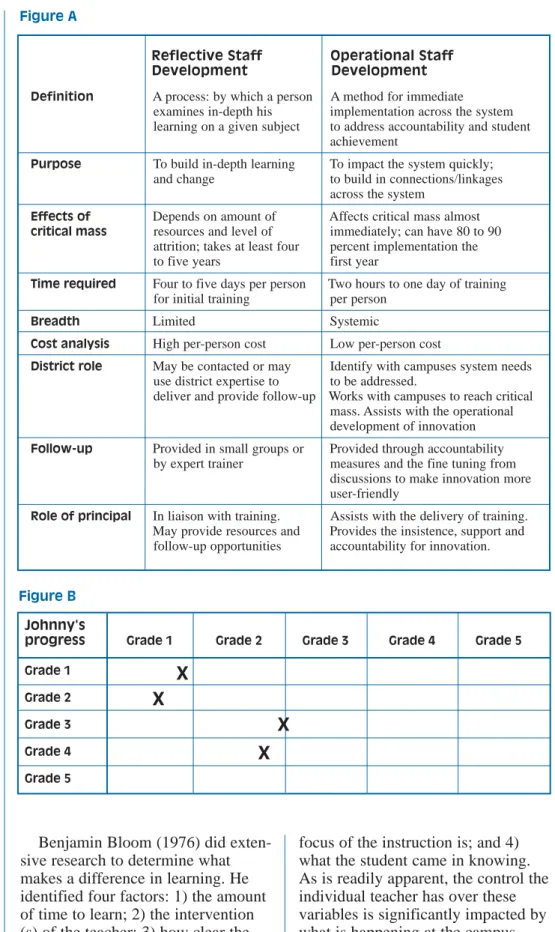
Processes and models are available to address these needs. But to do so, an additional model for staff develop-ment and curriculum developdevelop-ment must be used. This model basically trades in depth learning for critical mass by using a simpler approach. Fullan talks about the importance of critical mass as well as the main cri-teria teachers use to determine how "user-friendly" the curriculum and training are, i.e., how operational they are. (Fullan, 1991; Fullan, 1996)
In these models, which I have used for several years, the amount of time spent in training is decreased, the model is less complex and totally operational, and 100 percent of the staff is trained. We still need reflec-tive staff development; we just need an additional model to help address some of the issues above.
Figure A outlines some of the basic differences.
What does this information mean
"With simpler models of staff development that are
operational and involve 100 percent of the staff,
the roller coaster ride that students take through school
can be significantly lessened."
Campuswide Interventions
That Improve Student Achievement
By Ruby K. Payne, Ph.D.
Founder and President of aha! Process, Inc.
aha!
aha!
a
aha!
aha!
ah
aha!
aha!
a
a
ha!
aha!
aha
aha!
aha!
a
aha!
aha!
aha
aha!
aha!
a
articles
aha!
aha!a!
articles articlesarticles
articles
articles
articles
articles
aha!
aha!
ah
articles
aha!
aha!
a
articles
Ruby K. Payne, Ph.D.
Poverty Series ◆ Part IVConversation between a principal new to the building and a supervisor: Supervisor: "That campus cannot be low-performing again. I do not have any extra money to give you. With the Title 1 money you have at your campus, your school will need to find a way to raise your achievement significantly."
Principal (to herself as she walks to the car): "And just how would that happen? I have 1,100 students, 80 percent low income, 12 new teachers, a mobility rate of 40 percent. I know it can be done, but in a year?"
in practice? With simpler models that are operational and involve 100 per-cent of the staff, the roller coaster ride that students take through school can be significantly lessened. One of the reasons that middle-class students do better in school is that their par-ents intervene to lessen the impact of the roller coaster. (These parents do so by paying for tutoring, requesting teachers and providing assistance and instruction at home.)
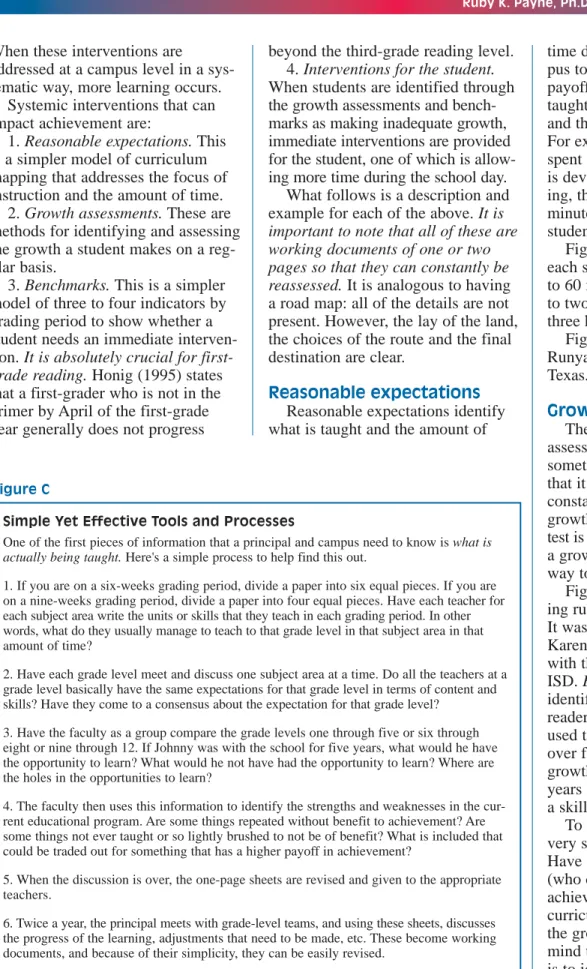
As you can see in Figure B, the X represents Johnny and his journey through five years of school. In first grade, he had a wonderful teacher who willingly went to every kind of training available. Johnny had a great year and made the expected progress.
In second grade, his teacher was having many health problems and missed quite a few days of school. In addition, Johnny's parents divorced so he was shuttled between homes. In the second grade, Johnny actually regressed. In the third grade, he had a begin-ning teacher. She loved the students but did not have the experience or the guidelines to provide the instruction that the other third-grade teacher did. Most of the educated parents had asked for the other teacher because of her excellent reputation. Johnny made progress.
In the fourth grade, Johnny had a teacher who did not participate in staff development. As far as she was concerned, it was a waste of time. Her students tended to do poorly on the state test, but her husband was on the school board. Once again, given her reputation, the educated parents had requested that their children be placed in the other fourth-grade classroom.
In the fifth grade, it was deter-mined that Johnny was now two-and-a-half grade levels behind and should
How can we address this problem? With systemic interventions that can impact achievement through simple yet effective tools and processes.
Benjamin Bloom (1976) did exten-sive research to determine what makes a difference in learning. He identified four factors: 1) the amount of time to learn; 2) the intervention (s) of the teacher; 3) how clear the
focus of the instruction is; and 4) what the student came in knowing. As is readily apparent, the control the individual teacher has over these variables is significantly impacted by what is happening at the campus.
Johnny's
progress Grade 1 Grade 2 Grade 3 Grade 4 Grade 5 Grade 1
Grade 2
Grade 3
Grade 4
Grade 5
Reflective Staff Operational Staff Development Development
Definition A process: by which a person A method for immediate
examines in-depth his implementation across the system learning on a given subject to address accountability and student
achievement
Purpose To build in-depth learning To impact the system quickly; and change to build in connections/linkages
across the system
Effects of Depends on amount of Affects critical mass almost
critical mass resources and level of immediately; can have 80 to 90 attrition; takes at least four percent implementation the to five years first year
Time required Four to five days per person Two hours to one day of training for initial training per person
Breadth Limited Systemic
Cost analysis High per-person cost Low per-person cost
District role May be contacted or may Identify with campuses system needs use district expertise to to be addressed.
deliver and provide follow-up Works with campuses to reach critical mass. Assists with the operational development of innovation
Follow-up Provided in small groups or Provided through accountability by expert trainer measures and the fine tuning from
discussions to make innovation more user-friendly
Role of principal In liaison with training. Assists with the delivery of training. May provide resources and Provides the insistence, support and follow-up opportunities accountability for innovation.
Figure B Figure A aha!
articlesaha!articlesaha!articlesaha!articlesaha!articlesaha!articlesaha!articlesaha!articlesaha!articlesaha!articlesaha!articlesaha!articlesaha!articlesaha!articlesaha!articlesaha!articlesaha!articlesaha!articlesaha!articles
Ruby K. Payne, Ph.D. ◆ Poverty Series ◆ Part IV
X
X
X
X
When these interventions are
addressed at a campus level in a sys-tematic way, more learning occurs.
Systemic interventions that can impact achievement are:
1. Reasonable expectations. This is a simpler model of curriculum mapping that addresses the focus of instruction and the amount of time.
2. Growth assessments. These are methods for identifying and assessing the growth a student makes on a reg-ular basis.
3. Benchmarks. This is a simpler model of three to four indicators by grading period to show whether a student needs an immediate interven-tion. It is absolutely crucial for first-grade reading. Honig (1995) states that a first-grader who is not in the primer by April of the first-grade year generally does not progress
beyond the third-grade reading level. 4. Interventions for the student. When students are identified through the growth assessments and bench-marks as making inadequate growth, immediate interventions are provided for the student, one of which is allow-ing more time durallow-ing the school day.
What follows is a description and example for each of the above. It is important to note that all of these are working documents of one or two pages so that they can constantly be reassessed. It is analogous to having a road map: all of the details are not present. However, the lay of the land, the choices of the route and the final destination are clear.
Reasonable expectations
Reasonable expectations identify what is taught and the amount of
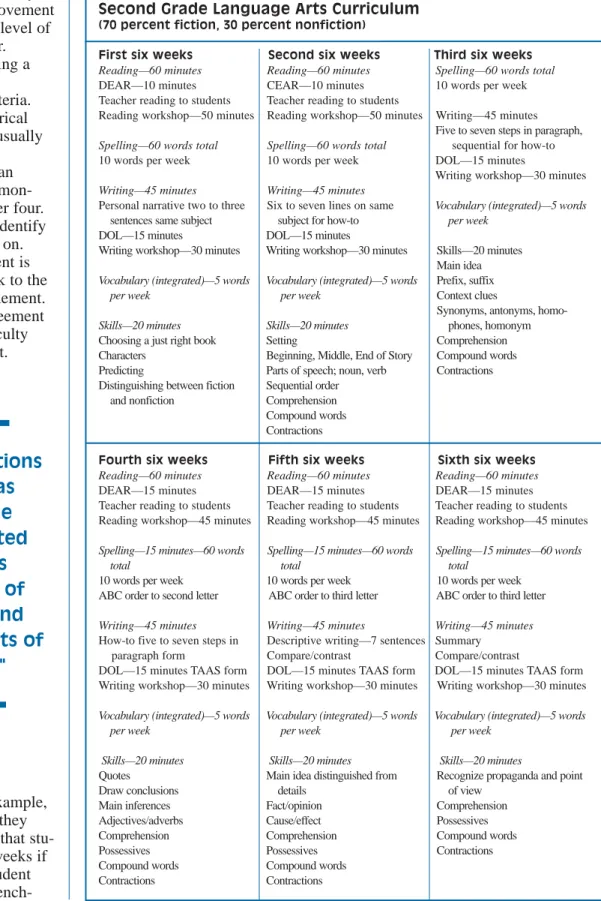
time devoted to it. This allows a cam-pus to "data mine." i.e., determine the payoff between what actually gets taught, the amount of time given to it and the corresponding test results. For example, if two hours a day are spent on reading but only 15 minutes is devoted to students actually read-ing, the payoff will be less than if 45 minutes of that time is devoted to students actually reading.
Figure C is the process used. For each subject area, it requires about 30 to 60 minutes of individual time, one to two hours of grade-level time and three hours of total faculty time.
Figure D is an example from Runyan Elementary in Conroe, Texas. The principal is Nancy Harris.
Growth assessments
There are any number of growth assessments available. What makes something a growth assessment is that it identifies movement against a constant set of criteria. What makes a growth assessment different from a test is that the criteria do not change in a growth assessment. Rubrics are one way to measure and identify growth.
Figure E is an example of a read-ing rubric to measure student growth. It was developed by Sandra Duree, Karen Coffey and me in conjunction with the teachers of Goose Creek ISD. Becoming a Nation of Readers identified characteristics of skilled readers, so those characteristics were used to measure growth as a constant over five years. We identified what growth would look like over five years if a student were progressing as a skilled reader.
To develop a growth assessment, a very simple process can be used. Have the teachers in your building (who consistently get the highest achievement, understand the district curriculum and TAAS specs) develop the growth assessment. Keep in mind these guidelines: 1) the purpose is to identify the desired level of
Simple Yet Effective Tools and Processes
One of the first pieces of information that a principal and campus need to know is what is
actually being taught. Here's a simple process to help find this out.
1. If you are on a six-weeks grading period, divide a paper into six equal pieces. If you are on a nine-weeks grading period, divide a paper into four equal pieces. Have each teacher for each subject area write the units or skills that they teach in each grading period. In other words, what do they usually manage to teach to that grade level in that subject area in that amount of time?
2. Have each grade level meet and discuss one subject area at a time. Do all the teachers at a grade level basically have the same expectations for that grade level in terms of content and skills? Have they come to a consensus about the expectation for that grade level?
3. Have the faculty as a group compare the grade levels one through five or six through eight or nine through 12. If Johnny was with the school for five years, what would he have the opportunity to learn? What would he not have had the opportunity to learn? Where are the holes in the opportunities to learn?
4. The faculty then uses this information to identify the strengths and weaknesses in the cur-rent educational program. Are some things repeated without benefit to achievement? Are some things not ever taught or so lightly brushed to not be of benefit? What is included that could be traded out for something that has a higher payoff in achievement?
5. When the discussion is over, the one-page sheets are revised and given to the appropriate teachers.
6. Twice a year, the principal meets with grade-level teams, and using these sheets, discusses the progress of the learning, adjustments that need to be made, etc. These become working documents, and because of their simplicity, they can be easily revised.
Figure C aha!
articlesaha!articlesaha!articlesaha!articlesaha!articlesaha!articlesaha!articlesaha!articlesaha!articlesaha!articlesaha!articlesaha!articlesaha!articlesaha!articlesaha!articlesaha!articlesaha!articlesaha!articlesaha!articles
achievement. 2) the growth assess-ment needs to be simple and easily understood; and 3) student movement or growth toward the desired level of achievement needs to be clear.
These are the steps to creating a growth assessment:
1. Identify three to five criteria. 2. Set up a grid with numerical values. (One through four is usually enough.)
3. Identify what would be an excellent piece of work or demon-stration. That becomes number four.
4. Work backwards. Next identify what would be a three and so on.
When the growth assessment is developed, it needs to go back to the faculty for feedback and refinement. When there is substantial agreement and 80 percent buy-in, the faculty needs to move forward with it.
Benchmarks
Figure F is one example.
As you can see from the example, benchmarks are very simple. they identify the critical