Department of Economics
Simulating copula-based
distributions and estimating
tail probabilities by means of
Adaptive Importance Sampling
Marco Bee
n.
Simulating copula-based distributions and estimating
tail probabilities by means of Adaptive Importance
Sampling
Marco BeeDepartment of Economics, University of Trento, via Inama 5, 38100 Trento - Italy. Phone: +39-0461-282296, Fax: +39-0461-282222.
E-mail: [email protected]
Abstract
Copulas are an essential tool for the construction of non-standard multivariate probability distributions. In the actuarial and financial field they are partic-ularly important because of their relationship with non-linear dependence and multivariate extreme value theory. In this paper we use a recently proposed gen-eralization of Importance Sampling, called Adaptive Importance Sampling, for simulating copula-based distributions and computing tail probabilities. Unlike existing methods for copula simulation, this algorithm is general, in the sense that it can be used for any copula whose margins have an unbounded support. After working out the details for Archimedean copulas, we develop an extension, based on an appropriate transformation of the marginal distributions, for sam-pling extreme value copulas. Extensive Monte Carlo experiments show that the method works well and its implementation is simple. An example with equity data illustrates the potential of the algorithm for practical applications. Keywords: Adaptive Importance Sampling, Copula, Multivariate Extreme Value Theory, Tail probability.
1. Introduction
The dependence structure of financial assets is well-known to be an ex-tremely important issue in non-life insurance and quantitative finance, both for risk management and for pricing. In the pioneering works about portfolio theory (Markowitz, 1952) and capital markets (Capital Asset Pricing Model: Sharpe, 1964; Lintner, 1965; Mossin, 1966), the multivariate normal distribution has played a key role. Although it is still a convenient model in standard cases, in recent years, with the increased degree of sophistication of markets and securi-ties, its inadequacy as a general model has become clear. Difficulties are mostly related to either fat tails in the marginal distributions or non-linearity of the dependence structure.
Examples of these problems can be found in different areas. The standard approach to market risk measurement is based on the assumption of joint nor-mality of risk factors, so that it mainly consists in estimating large covariance matrices. However, according to some well-known stylized facts concerning fi-nancial time series, such as jumps, heavy tails and volatility clustering (see Cont, 2001, for a review), the normality assumption is seldom justified, and non-standard distributions have to be used. Commonly adopted methodologies include Extreme Value Theory (EVT), GARCH and stochastic volatility. In the univariate case, estimating the parameters of the resulting distributions is usually feasible, but the extension to a multivariate setup is difficult both theo-retically and computationally. Given that the complications are mostly related to the large number of parameters, it may be convenient to proceed in two steps. First, choosing a univariate model for the marginal distributions and estimat-ing its parameters; second, studyestimat-ing the dependence structure and estimatestimat-ing the joint distribution. The latter task is typically accomplished by means of copulas. In particular, Extreme Value (EV) copulas are important when one is interested in the joint probability of rare events, as is frequently the case in insurance.
In credit risk management, the modelling of joint default probabilities is a crucial topic: in this field the distributions are “far from standard”, and for the important class of threshold models the multivariate distributions are often obtained (explicitly or implicitly) by means of copulas; see McNeilet al. (2005, sect. 8.3). Furthermore, copulas are widely employed for pricing basket credit derivatives and CDO structures; see McNeilet al. (2005, sect. 9.7) or Bluhm
et al. (2002, chap. 7).
Copulas are a powerful tool for the construction of multivariate probabil-ity distributions. Although the main result concerning copulas dates back to more than fifty years ago (Sklar, 1959), recently there has been a spectacular advance both in theory and applications, especially in the financial industry. Given 𝑝marginal distribution functions 𝐹1, . . . , 𝐹𝑝, copulas allow to construct
a multivariate distribution with a given dependence structure and marginals 𝐹1, . . . , 𝐹𝑝. Thus, this procedure of building a multidimensional distribution
separates the marginal distributions and the dependence structure. The ad-vantage is twofold: first, it guarantees a high degree of flexibility in the model building process; second, it allows to estimate separately the parameters of the marginal distributions and of the copula. From the computational point of view, this is usually a significant advantage: 𝑝+ 1 “simple” optimizations are in general more feasible than a single “complicated” optimization.
Sampling copulas is an issue of primary importance, because analytical re-sults are seldom available for copula-based distributions. The existing rere-sults can be grouped in three categories. As forelliptical copulas, simulation is easy, as it is based on the simulation of the multivariate Gaussian or Student-𝑡 distri-bution. In the case ofArchimedean copulas, specific algorithms have been de-veloped for the so-called LT-Archimedean copulas (McNeilet al., 2005, p. 224). However, different algorithms are necessary for each copula. Moreover, they are sometimes involved, requiring the simulation of logarithmic series and/or stable random variables: see McNeil et al. (2005), Whelan (2004), Wu et al. (2006) and Hofert (2008). When the LT does not exist in closed form, and for non-Archimedean copulas, it is possible to use the inverse of the conditional distribution function of a variable given the remaining ones. However, this procedure is complicated and computationally cumbersome, because it requires high-order derivatives and a root-finding procedure.
In this paper we propose to use Adaptive Importance Sampling (IS) to gen-erate an approximate sample from a given copula. The procedure only requires that the density of the copula be known in closed form. Moreover, it is general, because the algorithm is the same for any copula-based distribution, and can be employed for the simulation of non-Archimedean copulas, which are difficult to sample by means of other methods. Finally, it works well for any dimension. Adaptive IS was first introduced by Capp´eet al.(2004). Capp´eet al.(2008)
extend it to general mixture classes, and Wraithet al. (2009) propose an inter-esting application. The method is an extension of standard IS because, at each iteration, a sample is simulated from the instrumental density and used to im-prove the IS density itself. So, ‘adaptivity’ means that the instrumental density sequentially provides a progressively better approximation of the target density. The method is also appealing because it rigorously formalizes the well-known fact that mixtures can be a very good approximation of most distributions.
The paper is organized as follows. Section 2 introduces the statistical meth-ods used in the paper, namely standard Importance Sampling and Adaptive Im-portance Sampling. Section 3 reviews copulas and existing sampling algorithms. Section 4 develops Adaptive IS in the setup of copulas. Section 5 presents the results of the simulation experiments as well as a real-data application. Finally, Section 6 concludes.
2. Methodology
2.1. Preliminaries: Importance Sampling
Importance Sampling (Hammersley and Handscomb, 1964; see Casella and Robert, 2004, Sect. 3.3 or Glasserman, 2003, Sect. 4.6 for reviews) is a variance reduction technique. Unlike crude Monte Carlo (MC), IS does not simulate observations from the distribution of interest𝑓, but from an instrumental dis-tribution 𝑔 that assigns “more weight” to the event of interest. The features of𝑔 are crucial, as they can result in either large efficiency gains or poor qual-ity estimators. IS is one of the most effective variance reduction techniques, but there is no readily available procedure for finding the optimal instrumental density. Some tools, mainly based on tilted densities (Ross, 2006), are available when working with light-tailed distributions. For heavy-tailed distributions, the problem has to be solved differently, mostly on a case-by-case basis.
In order to formalize the setup, consider that most problems in statistics consist in evaluating the integral:
𝜇=𝐸𝑓(ℎ(𝑋)) =
∫
𝒳
ℎ(𝑥)𝑓(𝑥)𝑑𝑥, (1)
whereℎis a real-valued function. If𝑔is another density and supp(𝑔)⊃supp(𝑓), (1) has the following alternative representation:
𝜇=𝐸𝑓(ℎ(𝑋)) =
∫
𝒳
ℎ(𝑥)𝑓(𝑥)
According to (2), instead of simulating from𝑓 as in standard MC, one can use the following algorithm.
Algorithm 1. (Importance Sampling)
∙ Simulate𝑥1, . . . , 𝑥𝑁 independently from 𝑔;
∙ Compute ˆ 𝜇𝐼𝑆 = 1 𝑁 𝑁 ∑ 𝑖=1 ℎ(𝑥𝑖)𝑓(𝑥𝑖) 𝑔(𝑥𝑖) . (3)
The estimator ˆ𝜇𝐼𝑆 is called animportance sampling estimatorof𝜇, and𝑔is the importance sampling density. The ratio 𝑤(𝑥) = 𝑓(𝑥)/𝑔(𝑥) can be interpreted as a weight, so that (3) is a weighted mean. Unbiasedness, consistency and asymptotic normality of the estimator ˆ𝜇𝐼𝑆 follow from the asymptotic theory of
standard MC, under relatively mild regularity conditions (Casella and Robert, 2004, sect. 3.3).
Unlike the classical IS approach described so far, where 𝑔 is chosen in ad-vance and remains fixed, Adaptive IS updates the instrumental density as the simulation goes on. Thus, even though the initial instrumental density is not optimal, the algorithm eventually provides the ‘best’ (in a sense to be made more precise later) IS density.
2.2. Adaptive Importance Sampling
Adaptive Importance Sampling (or Population Monte Carlo) is a sampling algorithm first proposed in a Bayesian setup by Capp´eet al. (2004). The basic idea is that, instead of using a fixed 𝐼𝑆 density 𝑔, one can use a sequence of importance densities 𝑔(𝑡) (𝑡 = 1, . . . , 𝑇), aimed at approximating the target
density𝑓. The general formulation of the algorithm is as follows:
1. Simulate a first sample 𝒙𝑛 = (𝑥1, . . . , 𝑥𝑛)′ ∼ 𝑔(1) by means of standard
𝐼𝑆; compute the𝐼𝑆 weights𝑤(1)𝑗 =𝑓(𝑥 (1)
𝑗 )/𝑔(1)(𝑥 (1)
𝑗 ) (𝑗= 1, . . . , 𝑛).
2. Use this sample to approximate the moments of𝑓 and construct the up-dated importance function𝑔(2).
3. Measure the goodness of the approximation by means of the relative en-tropy (or Kullback-Leibler divergence; see Rubinstein and Kroese, 2004, sect. 3.3) from the target:
𝐾(𝑓∣∣𝑔(2)) = ∫ log ( 𝑓(𝑥) 𝑔(2)(𝑥) ) 𝑓(𝑥)𝑑𝑥. (4)
4. ‘Adjust’ the density𝑔(2) so that 𝐾(𝑓∣∣𝑔(2))≤𝐾(𝑓∣∣𝑔(1)). More formally,
compute min𝜽𝐾(𝑓∣∣𝑔(2)), where𝜽 is the vector of parameters of𝑔(2).
5. Repeat the preceding steps until some convergence criterion is met. The first important issue is the choice of the functional form of 𝑔: it should be flexible enough to allow for a close match of the target and such that the minimization of (4) is feasible. According to Capp´e et al. (2004, 2008), a convenient choice is a finite mixture of Normal distributions, namely
𝑔(𝑡)(𝑥) =𝑔(𝑥;𝝅(𝑡),𝜽(𝑡)) = 𝐷 ∑ 𝑑=1 𝜋𝑑(𝑡)𝜙𝑑(𝑥;𝜽(𝑑𝑡)), (5) where𝝅(𝑡)= (𝜋(𝑡) 1 , . . . , 𝜋 (𝑡)
𝐷)′ is the vector of weights of the𝐷 mixture
compo-nents and𝜽(𝑡)is a 𝐷×2 matrix whose𝑖-th row contains the parameters of the 𝑖-th normal density, i.e. 𝜽(𝑖𝑡) = (𝜇𝑖(𝑡), 𝜎𝑖(𝑡)2). If the target density is 𝑝-variate (𝑝 ≥ 2), (5) is a 𝑝-variate Normal mixture and the dimensions of 𝜽 change accordingly.
Notice that all parameters of (5) areadaptable, that is, they are supposed to be updated at each iteration of the algorithm. There is no reason that keeps us from using mixtures of different densities: Capp´eet al. (2004, 2008) actually work out the details of the algorithm also for a mixture of Student-𝑡 densities, which are supposed to be a better option if the target is heavy-tailed.
According to these remarks, we are now in a position to give a more detailed description of the algorithm.
Algorithm 2. (Adaptive Importance Sampling) 1. For 𝑡= 1:
∙ Choose an importance function𝑔(1);
∙ Simulate𝑥(1)1 , . . . , 𝑥 (1)
𝑛 independently from 𝑔(1);
∙ Compute the importance weights𝑤(1)1 , . . . , 𝑤 (1) 𝑛 .
2. For 𝑡 >1:
∙ Update the importance function to𝑔(𝑡+1), using the previous weighted sample (𝑥(1𝑡), 𝑤 (𝑡) 1 ),. . .,(𝑥 (𝑡) 𝑛 , 𝑤(𝑛𝑡)). ∙ Simulate𝑥(1𝑡+1), . . . , 𝑥 (𝑡+1) 𝑛 independently from𝑔(𝑡+1);
∙ Compute the importance weights𝑤(1𝑡+1), . . . , 𝑤 (𝑡+1)
For the present application, the most interesting result is that an approxi-mate sample from the target density can be obtained by sampling with replace-ment from𝑔(𝑡)and weighting the observations by means of the vector𝒘(𝑡).
From the theoretical point of view, it can be shown (Wraith et al., 2009, Appendix A) that, on average, the algorithm monotonically decreases the cross-entropy (4). This is indeed an EM-type algorithm, and this result parallels the theorem stating that the EM algorithm for likelihood maximization increases the likelihood at each iteration. Given the strict relationship between likelihood and entropy (Asmussenet al., 2005, p. 62), this result is not surprising.
The analogy with the EM algorithm can be made more precise. The Adap-tive IS algorithm is based on Monte Carlo simulation, similarly to the Monte Carlo EM (MCEM) introduced by Wei and Tanner (1990). Whereas standard EM is monotone, MCEM is not. Analogously, in the present setup, for finite sample size there is no guarantee that𝐾(𝑓∣∣𝑔𝑡+1)≤𝐾(𝑓∣∣𝑔𝑡)). However, this
property is valid as𝑛→ ∞; in other words, up to the variability introduced by the simulation performed at each iteration, the algorithm decreases the Cross-Entropy at each iteration. For finite 𝑛, we can also say that the algorithm is monotone on average.
In order to determine a stopping criterion, the goodness of the approximation must be evaluated at each iteration. It is convenient, and consistent with the entropy-based methodology used for developing the algorithm, to compute a measure directly related to the relative entropy (4). Thus, an approximate diagnostic is the so-called normalized perplexity perp𝑛 = exp(𝐻𝑛)/𝑛, where
𝐻𝑛 =−∑𝑛𝑗=1𝜔¯𝑗log(¯𝜔𝑗) is the Shannon entropy of the normalized weights ¯𝜔𝑗.
It can be shown (Capp´eet al., 2008, sect. 2.1) that perp𝑛 is an estimator of exp(𝐾(𝑓∣∣𝑔(2)) and that is included in the interval [0,1]. It seems therefore
reasonable to stop the algorithm when the normalized perplexity cannot be further increased (so that the entropy cannot be further decreased). Thus, a possible stopping rule consists in monitoring the perplexity over some (say 5) successive iterations and stopping the algorithm when the normalized perplexity does not change significantly or a predefined ‘large’ number of iterations𝑀 is reached.
2.3. The algorithm in the Gaussian case
From the technical point of view, the fundamental issue is the update of the importance function𝑔 at each iteration. Therefore, we now detail how the
parameters of𝑔 are updated when it is a multivariate Normal mixture.
At iteration𝑡, the importance weights associated with the sample (𝒙(1𝑡), . . . ,𝒙(𝑛𝑡))
are given by 𝑤(𝑗𝑡)= 𝑓(𝒙(𝑗𝑡)) ∑𝐷 𝑑=1𝜋 (𝑡) 𝑑 𝜙(𝒙 (𝑡) 𝑗 ;𝝁 (𝑡) 𝑑 ,Σ (𝑡) 𝑑 ) , 𝑗= 1, . . . , 𝑛,
and the normalized weights are ¯𝑤𝑗(𝑡)=𝑤 (𝑡) 𝑗 /
∑𝑛
𝑗=1𝑤 (𝑡)
𝑗 . When the instrumental
density is a 𝑝-dimensional normal density, Capp´eet al. (2004) show that the update is performed iterating, for any𝑖= 1, . . . , 𝐷, the following equations:
𝜋(𝑖𝑡+1)= 𝑛 ∑ 𝑗=1 ¯ 𝑤(𝑗𝑡)𝜏𝑖(𝒙𝑗(𝑡);𝜋(𝑡),𝝁(𝑡),Σ (𝑡)), (6) 𝝁(𝑖𝑡+1)= ∑𝑛 𝑗=1𝑤¯ (𝑡) 𝑗 𝒙 (𝑡) 𝑗 𝜏𝑖(𝒙(𝑗𝑡);𝜋(𝑡),𝝁(𝑡),Σ (𝑡)) 𝜋𝑖(𝑡+1) , (7) Σ(𝑖𝑡+1)= ∑𝑛 𝑗=1𝑤¯ (𝑡) 𝑗 (𝒙 (𝑡) 𝑗 −𝝁 (𝑡+1) 𝑖 )(𝒙 (𝑡) 𝑛 −𝝁(𝑖𝑡+1))′𝜏𝑖(𝒙𝑗(𝑡);𝜋(𝑡),𝝁(𝑡),Σ (𝑡)) 𝜋(𝑖𝑡+1) , (8) where 𝜏𝑖(𝒙;𝜋,𝝁,Σ) = 𝜋𝑖𝜙( 𝒙;𝝁𝑖,Σ𝑖) ∑𝐷 𝑑=1𝜋𝑑𝜙(𝒙;𝝁𝑑,Σ𝑑) . (9)
As pointed out above, these equations closely resemble the EM algorithm for likelihood maximization: in particular, (6), (7) and (8) correspond to the M step, and (9) to the E step.
3. Copula families and simulation methods 3.1. Copula families
A copula is a multivariate distribution function whose univariate margins have a uniform distribution on (0,1). The importance of copulas is mostly related to Sklar’s (1959) theorem. If𝑿 is a continuous𝑝-variate random vector whose distribution function is𝐹(𝑥1, . . . , 𝑥𝑝;𝜽) with𝑗-th margin𝐹𝑗(𝑥𝑗;𝜃𝑗), the
theorem says that there is a unique distribution function𝐶: [0,1]𝑝→[0,1] that
satisfies
𝐹(𝑥1, . . . , 𝑥𝑝;𝜽) =𝐶(𝐹1(𝑥1;𝜃1), . . . , 𝐹𝑝(𝑥𝑝;𝜃𝑝);𝜶). (10)
𝐶(𝑢1, . . . , 𝑢𝑝;𝜶) is called the copula associated to𝐹 and 𝜶is the vector of its
It is worth stressing that, given 𝐶: [0,1]𝑝→[0,1], there is a unique
distri-bution function𝐹 such that (10) holds. Thus, for any choice of the univariate distribution functions𝐹𝑗(𝑥), even though the copula remains the same, we
ob-tain a different multivariate distribution.
Several copulas are commonly used in practice: see Joe (1997, chap. 5). Among the most important ones, we mention here: (i) Gaussian and Student-𝑡, known as elliptical copulas; (ii) Frank, Gumbel and Clayton, members of the family of Archimedean copulas; (iii) Galambos and H¨usler-Reiss, examples of Extreme Value copulas.
3.1.1. Extreme Value copulas
For the purposes of actuarial and financial modelling and for risk measure-ment, the family of Extreme Value (EV) copulas is quite important. These copulas arise naturally in the context of Multivariate Extreme Value (MEV) theory. Without entering into details here (see McNeilet al., 2005, sect. 7.5, and the references therein), the building blocks are as follows.
If the normalized univariate maxima of a random vector𝑿converge to some multivariate distribution function𝐻, 𝐻 is referred to as a MEV distribution. It can be shown that:
(i) According to univariate EV theory, the margins of𝐻 follow a Generalized Extreme Value Distribution (GEV);
(ii) From Sklar’s theorem,𝐻 has a unique copula;
(iii) This kind of copula must satisfy the scaling condition𝐶(𝒖𝑡) =𝐶𝑡(𝒖) for 𝒖∈[0,1]𝑝 and for any𝑡 >0 (McNeilet al., 2005, Theorem 7.44).
Among the most common copulas, those that satisfy (iii) are the Gumbel, Galambos, H¨usler-Reiss and 𝑡-EV copulas, which are the most important EV copulas.
Given a multivariate distribution𝐹, we would like to know which EV copula ‘corresponds’ to𝐹. Similarly to univariate EV theory, any multivariate distri-bution𝐹 is in the domain of attraction of some EV copula𝐶𝐸𝑉, so that there is
a correct EV copula to be used in practical applications, according to the depen-dence structure of𝐹, as measured by the copula𝐶of𝐹. However, determining 𝐶𝐸𝑉 requires the knowledge of𝐶, which is typically unknown. Fortunately, all
EV copulas are very similar to each other, so that in practice any EV copula with GEV margins approximately gives the same results.
3.2. Simulating copulas
Stochastic simulation of multivariate probability distributions is, in general, a difficult task. One reason is that the the univariate inversion method cannot be extended to the multivariate case. Moreover, the performance of other stan-dard techniques deteriorates quickly as the dimension of the problem increases (Devroye, 1986, p. 554).
As for copulas, one can in principle use the following result (Joe, 1997, p. 146), reported here for simplicity for the bivariate case. Let𝐶be a bivariate cop-ula, and define𝐶2∣1to be the conditional distribution function𝐶2∣1(𝑢2∣𝑢1). If𝑈1
and 𝑄are independent 𝑈(0,1) random variables, (𝑈1, 𝑈2) = (𝑈1, 𝐶2−∣11(𝑄∣𝑈1))
has distribution𝐶. This technique, sometimes known asconditional distribution approachoriterative conditioning, is appealing because only univariate simula-tions are required. Unfortunately, for most copulas the function𝐶2−∣11 does not exist in closed form. In this case, after sampling𝑢1, to obtain𝑢2one has to use
a root-finding routine to solve for 𝑢2 the equation𝑞 =𝐶2∣1(𝑢2∣𝑢1). This may
not work even in the bivariate case and becomes essentially intractable when the dimension of the problem is larger.
The common way of simulating copulas is thus based on specific techniques for various classes of copulas. Broadly speaking, one can consider three different families of copulas.
∙ Elliptical copulas (Gaussian and Student-𝑡copulas). For this family, sim-ulation is easy, because it basically amounts to simulating the Gaussian and Student-𝑡 multivariate densities. For example, observations from the 𝑝-variate Gaussian copula with marginals𝐹𝑖 can be generated as follows:
(1𝑎) Simulate a random vectorx = (𝑥1, . . . , 𝑥𝑝)′ from the𝑁𝑝(0,𝑹)
dis-tribution;
(1𝑏) Evaluate𝑢𝑘= Φ(𝑥𝑘), for any𝑘= 1, . . . , 𝑝;
(2) Compute 𝑦𝑘=𝐹𝑘−1(𝑢𝑘;𝜽𝑘) for any𝑘= 1, . . . , 𝑝;
(3) Repeat steps (1)-(2) a large number of times𝐵.
∙ LT-Archimedean copulas (McNeilet al., 2005, sect. 5.4.2). They have the property that the Laplace Transform (LT) of the inverse of the generator
exists in closed form. A general procedure for simulating such copulas is based on a technique given in McNeil et al. (2005, p. 223); see also Yan (2007, sect. 3.2). The approach is based on some results first obtained by Marshall and Olkin (1988) and requires generating random numbers from some positive random variable 𝐾, often called frailty: in particular, for the simulation of Clayton, Frank, and Gumbel copulas 𝐾 is respectively gamma, log-series, and positive stable. Whereas the first case is straight-forward, the last two cases are not completely trivial. Moreover, the fact that𝐾is different for each copula makes this way of proceeding somewhat impractical.
∙ For the remaining copulas, essentially no method is available except the conditional distribution approach, which is complicated because 𝐶2−∣11 is usually unknown.
4. Simulation of copulas by means of Adaptive IS
The implementation of Adaptive IS for the simulation of copulas requires to choose the class of the importance function and derive the so-called updat-ing equations, i.e. the equations resultupdat-ing from the minimization of the cross-entropy (4). For the Gaussian case and a generic target 𝑓, the details of the algorithm have been given in sect. 2.3. When turning to copulas,𝑓 is the den-sity of the copula and the Adaptive IS algorithm based on Gaussian mixtures works as follows.
1. Choose the instrumental density 𝑔(1) = ∑𝐷
𝑑=1𝜋𝑑𝜙(𝝁𝑑,Σ𝑑), i.e. the
pa-rameters𝐷,𝝅,𝝁𝑖,Σ𝑖(𝑖= 1, . . . , 𝐷).
2. Simulate𝒙(1)1 , . . . ,𝒙(1)𝑛 independently from𝑔(1).
3. Compute the importance weights𝑤(1)𝑗 =𝑓(𝑥 (1) 1𝑗, . . . , 𝑥 (1) 𝑝𝑗)/𝑔(𝑥 (1) 1𝑗 , . . . , 𝑥 (1) 𝑝𝑗)
(𝑗= 1, . . . , 𝑛). Notice that𝑓 is the density function𝑐(𝒙1, . . . ,𝒙𝑛;𝜽,𝜶) =
𝑐(𝐹1−1(𝒙1;𝜃1), . . . , 𝐹𝑝−1(𝒙𝑝;𝜃𝑝);𝜶)𝑓1(𝒙1;𝜃1), . . . , 𝑓𝑝(𝒙𝑝;𝜃𝑝), namely the
tar-get density expressed in terms of the copula density𝑐, the marginal dis-tribution functions𝐹𝑘 and the marginal densities𝑓𝑘 (𝑘= 1, . . . , 𝑝).
For𝑡≥1:
4. Update the importance function to𝑔(𝑡+1) using equations (6) to (9) and
the previous weighted sample (𝒙(1𝑡), 𝑤 (𝑡) 1 ),. . ., (𝒙 (𝑡) 𝑁, 𝑤 (𝑡) 𝑁 ).
5. Simulate𝒙(1𝑡+1), . . . ,𝒙𝑁(𝑡+1)independently from𝑔(𝑡+1);
6. Compute the importance weights𝑤(1)𝑗 (𝑗= 1, . . . , 𝑛);
7. Go back to step 4.
In the Student-𝑡 case the preceding steps remain unchanged, but the Gaus-sian density must be replaced by the Student-𝑡density and equations (6) to (9) in step 4. are different. We do not write explicitly the analogues of (6) to (9) for a Student-𝑡mixture (the interested reader is referred to Capp´eet al., 2008, sect. 4). However, it is worth adding that, in the Student-𝑡setup, the number of degrees of freedom cannot be estimated, so that the IS density is not completely adaptable.
The choice of the mixture parameters 𝐷, 𝝅, 𝝁𝑖 and Σ𝑖 (𝑖 = 1, . . . , 𝐷), of
the sample size 𝑛, and of the maximum number of iterations 𝑀 depends on several factors. Some rules of thumbs are valid in any setup, but more precise evaluations cannot abstract from specific properties of the target density and are therefore delayed to the next section.
As concerns𝐷, a larger value produces a more precise approximation. Roughly speaking, in general it can be said that the farther away from ellipticity is the target density, the larger is the number of components necessary to achieve a good approximation. Capp´eet al. (2008) mostly employ 3 or 4 components. A useful strategy consists in starting with a ‘large’ value of𝐷 an discard compo-nents with a too small weight, such as<0.002. The value of 𝐷 is also related to the choice of 𝑛. If both numbers are small, adaptation may take a long time and/or fail to produce a reasonable approximation of the target density. It follows that the maximum number of iterations should also be set accord-ing to 𝑛 and 𝐷: typically, the perplexity reaches relatively large values (how large depends on the target density) in few iterations, but further improvements take many iterations, so that, for a precise approximation, a much larger𝑀 is needed. In our experience, even a very small improvement of a relatively large perplexity may be important, in particular when the target density is heavy-tailed; in such a case the bulk of the density is quickly well matched (therefore producing a large perplexity) but, if the number of iterations is too small, the tails may be underestimated.
Wraithet al. (2009) use, for their application, 5≤𝐷≤10 and 7500≤𝑛≤ 10 000. Concerning the problem at hand, the experiments in the next section are devoted to the assessment of the impact of the numerical values of these
parameters for various copula-based distributions.
As for𝝅,𝝁𝑖andΣ𝑖, a good choice of the initial instrumental density speeds
up the convergence of the algorithm. For adaptation to be effective, the in-strumental density should visit all the regions of the target density; thus, it is particularly important that the tails of the target are explored by the instru-mental density. The main implication is that one has to use the ‘right’ family of instrumental densities: for example, for an heavy-tailed target, a Student-𝑡 mixture with a small number of degrees of freedom should be preferable. Having chosen an instrumental density that, for some parameter configuration, provides a close approximation to the target, the next step consists in selecting the initial values of the parameters. When no or little information is available about the target, a starting guess may be obtained by means of the maximum likelihood estimators of the parameters. If, as in the present application, the shape of the target density is known, it is also possible to choose the parameters so that the shape of the instrumental density resembles the target. Similarly to the standard EM algorithm, a bad initialization may considerably slow down the algorithm, but typically does not prevent it from converging.
4.1. Simulation of Extreme Value Copulas
The simulation of extreme value copulas is less straightforward and requires an appropriate transformation of the marginals. To formalize the procedure, some preliminary review of the GEV distribution (see Kotz and Nadarajah, 2000, for details) is needed. The three parameters of the GEV distribution are usually denoted by𝜇(location),𝜎(scale) and 𝜉(shape); its density function is given by 𝑓𝐺𝐸𝑉(𝑥) = 1 𝜎𝑡(𝑥) 𝜉+1exp(−𝑡(𝑥)), where 𝑡(𝑥) = ⎧ ⎨ ⎩ (1 +𝜉(𝑥−𝜇)/𝜎)−1/𝜉 𝜉∕= 0; exp(−(𝑥−𝜇)/𝜎) 𝜉= 0.
The support is [𝜇−𝜎/𝜉,+∞) when𝜉 >0, (−∞,+∞) when𝜉= 0 and (−∞, 𝜇− 𝜎/𝜉] when 𝜉 <0. The distribution is generalized because it corresponds to the Gumbel distribution (or type 1 GEV) when 𝜉 = 0, to the Fr´echet (or type 2 GEV) when𝜉 >0, and to the Weibull (or type 3 GEV) when𝜉 <0,
When trying to use Adaptive IS for simulating an EV copula, there is a difficulty because its support is not ℝ𝑝 but the 𝑝-dimensional interval [𝜇1 −
𝜎1/𝜉1,+∞)× ⋅ ⋅ ⋅ ×[𝜇𝑝 −𝜎𝑝/𝜉𝑝,+∞). On the other hand, the support of a
𝑝-dimensional Gaussian or Student-𝑡mixture isℝ𝑝. Although Adaptive IS only requires the support of the instrumental density to include the support of the target density, it is clear that, at each iteration, all the observations sampled from the mixture with at least one component smaller than the corresponding lower bound are wasted (their weight is equal to zero) and this makes the method quite inefficient.
There is, however, a way around this problem. It is based on the following two results.
Proposition 1. Let 𝑋 ∼Fr(𝜇, 𝜎, 𝜉)and𝑌 = 1 +𝜉(𝑋−𝜇)/𝜎. Thenlog(𝑌)∼ Gumb(0, 𝜉).
Proof. Immediate using basic tools for transformations of random variables. The random variable 𝑌 introduced in Proposition 1 is a standard ‘Translated Fr´echet’ (TFr) with location 0, scale 1, shape𝜉and support [0,+∞) (Embrechts et al., 1997, sect. 3.4).
Proposition 2. Let (𝑋1, . . . , 𝑋𝑝)′ be a random vector with continuous mar-gins and copula 𝐶, and let 𝑇1, . . . , 𝑇𝑝 be strictly increasing functions. Then
(𝑇1(𝑋1), . . . , 𝑇𝑝(𝑋𝑝))′ also has copula𝐶.
Proof. See McNeilet al. (2005), Proposition 5.6.
Using propositions 1 and 2 we obtain Algorithm 3 for sampling EV copulas.
Algorithm 3. Consider simulating an EV copula with density𝑐𝐸𝑉, parameter
𝛿 and Fr´echet margins 𝑋1𝑖 with parameters 𝜇𝑖, 𝜎𝑖 and 𝜉𝑖 >0 (𝑖 = 1, . . . , 𝑝). One can proceed as follows.
1. Let 𝑋2𝑖= 1 +𝜉𝑖(𝑋1𝑖−𝜇𝑖)/𝜎𝑖. Then𝑋2𝑖∼TFr(0,1, 𝜉𝑖).
2. Let 𝑌𝑖= log(𝑋2𝑖). According to Proposition 1,𝑌𝑖∼Gumb(0, 𝜉𝑖).
3. Use Adaptive IS to simulate the EV copula 𝑐𝐸𝑉 with Gumbel margins
𝑌1, . . . , 𝑌𝑝.
4. Let 𝑉1𝑖 = exp(𝑌𝑖). Using again Proposition 1, 𝑉1𝑖 ∼TFr(0,1, 𝜉𝑖).
5. Let 𝑉2𝑖 =𝜇𝑖+𝜎𝑖/𝜉1(𝑉1𝑖−1). Clearly, 𝑉2𝑖 ∼Fr(𝜇𝑖, 𝜎𝑖, 𝜉𝑖). Proposition 2 implies that 𝑉2𝑖 (𝑖 = 1, . . . , 𝑝) are observations from the EV copula 𝑐𝐸𝑉 with Fr´echet marginals.
5. Simulation and application 5.1. Simulation
In this section we perform some simulations to assess the performance of the algorithm and evaluate the impact on the output of the choices of the initial parameters.
In the experiments we always use a Gaussian mixture as IS density. Student-𝑡 mixtures were tested but always gave worse results. In particular, for all copu-las, the Student-𝑡mixture gives overdispersed simulated marginal distributions, namely it is ‘too leptokurtic’. Moreover, the excess kurtosis of the simulated data seems to decrease monotonically and the perplexity to increase monoton-ically as the number of degrees of freedom tends to infinity, that is, as the population densities tend to the Normal.
For all copulas, we put𝑛= 1000; the algorithm stops after a number of itera-tions equal to min{20, 𝑡∗), where𝑡∗>5 is such that max
𝑖,𝑗∈{𝑡∗,𝑡∗−1,...,𝑡∗−5}∣perp𝑖−
perp𝑗∣< 𝜖, with 𝜖= 0.001. The results are quite good with𝐷 equal to four or
five; however, the increase in computational burden caused by the addition of more components is negligible, so that we set𝐷 = 7. The instrumental den-sity actually used for the simulation is the mixture corresponding to the largest perplexity. We repeat the simulation𝐵= 500 times. We tried several starting values and, as expected, their role turned out to be essentially irrelevant: in case of bad initializations, just the first two or three iterations are affected, in the sense that the perplexity is low. In the next iterations, the perplexity quickly increases, reaching the same levels of the cases when initialization is better (see also Fig. 2). For all copulas, we employ the following starting values:
𝝅= ⎛ ⎜ ⎜ ⎜ ⎜ ⎜ ⎜ ⎜ ⎜ ⎜ ⎜ ⎜ ⎜ ⎝ 1/7 1/7 1/7 1/7 1/7 1/7 1/7 ⎞ ⎟ ⎟ ⎟ ⎟ ⎟ ⎟ ⎟ ⎟ ⎟ ⎟ ⎟ ⎟ ⎠ , 𝝁= ⎛ ⎜ ⎜ ⎜ ⎜ ⎜ ⎜ ⎜ ⎜ ⎜ ⎜ ⎜ ⎜ ⎝ −0.5 −0.5 −0.3 −0.3 −0.2 −0.2 0 0 0.4 0.4 0.5 0.5 0.6 0.6 ⎞ ⎟ ⎟ ⎟ ⎟ ⎟ ⎟ ⎟ ⎟ ⎟ ⎟ ⎟ ⎟ ⎠ , Σ1=Σ2=Σ3=𝑰2, Σ4=Σ5=Σ6= ( 1 0.1 0.1 1 ) Σ7= ( 1 0.8 0.8 1 ) .
The experiments simulate the Gumbel copula with𝛿= 2, the Frank copula with𝛼 = 5.7, the Galambos copula with 𝛿= 1.5 and the H¨usler-Reiss copula with𝛿= 1.5. In the first two cases, the marginals are standard Normal, whereas in the last two cases the marginals are Fr(0,1,0.5).
Fig. 1(a) and 1(b) respectively show the contour plot of the Gumbel and Frank copula density and of the instrumental density. The latter is the best
(a) −3 −2 −1 0 1 2 3 −3 −2 −1 0 1 2 3 (b) −3 −2 −1 0 1 2 3 −3 −2 −1 0 1 2 3
Figure 1: Contours of Gumbel (a) and Frank (b) copulas with standard Normal margins and best fitting Gaussian mixture.
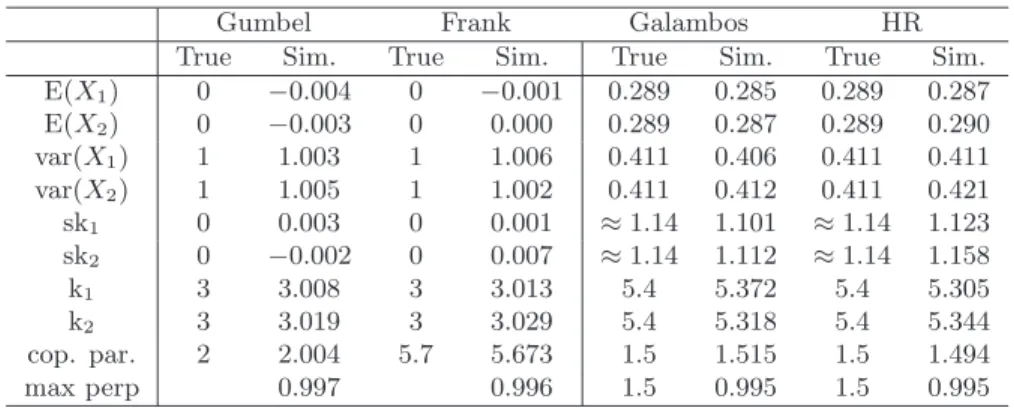
bivariate normal mixture, obtained by means of the Adaptive IS procedure. Some sample measures concerning the simulated distributions are reported in Table 1. The figures in the table are the MC estimates of the expected value, the variance, the skewness and the kurtosis of the marginal distributions, as well as of the copula parameter; ‘max perp’ is the average of the largest perplexities obtained at each replication. Similarly to Joe (1997, p. 146), at each replication of the experiment the value of the copula parameter is estimated by first com-puting numerically the Kendall’s correlation coefficient 𝜏 using the simulated data, and then finding the corresponding value of𝛿. Both the marginal distri-butions (for which an assessment of precision can be based on the comparison of sample mean, variance, skewness and kurtosis and of their theoretical counter-parts) and the dependence structure (measured by the coefficient of the copula)
are very well approximated. Note that, in the Galambos and H¨usler-Reiss cases, we compute the sample moments of the𝑌𝑖s (step 3 of Algorithm 3), which are
supposed to follow a Gumbel distribution, and compare them to their theoreti-cal counterparts, reported in the sixth and eighth column of the table. This is of course equivalent to analysing the𝑉𝑖s (step 5 of Algorithm 3), because they
are obtained from the𝑌𝑖s by means of a deterministic transformation that does
not alter the statistical properties of the simulated data.
Gumbel Frank Galambos HR
True Sim. True Sim. True Sim. True Sim.
E(𝑋1) 0 −0.004 0 −0.001 0.289 0.285 0.289 0.287 E(𝑋2) 0 −0.003 0 0.000 0.289 0.287 0.289 0.290 var(𝑋1) 1 1.003 1 1.006 0.411 0.406 0.411 0.411 var(𝑋2) 1 1.005 1 1.002 0.411 0.412 0.411 0.421 sk1 0 0.003 0 0.001 ≈1.14 1.101 ≈1.14 1.123 sk2 0 −0.002 0 0.007 ≈1.14 1.112 ≈1.14 1.158 k1 3 3.008 3 3.013 5.4 5.372 5.4 5.305 k2 3 3.019 3 3.029 5.4 5.318 5.4 5.344 cop. par. 2 2.004 5.7 5.673 1.5 1.515 1.5 1.494 max perp 0.997 0.996 1.5 0.995 1.5 0.995
Table 1. Results of the simulation experiments. The numbers in the columns labelled ‘True’ are the expected value, variance, skewness and kurtosis of the marginal distribu-tions, namely standard Normal for the Gumbel and Frank copulas and Gumbel(0,0.5) for the Galambos and H¨usler-Reiss (HR) copulas.
Further experiments with different numerical values of the parameters (in particular, different𝜎when the marginals are Gaussian and different𝜉when the marginals are GEV) did not show any difference with respect to the standard cases considered above and are therefore not reported here.
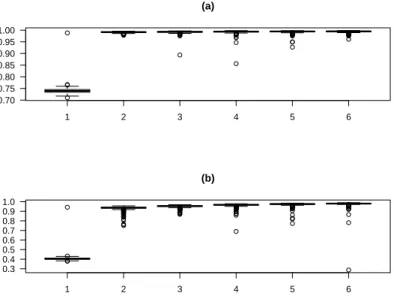
Figure 2 displays the boxplots of the perplexities over the first 6 iterations of the algorithm for the Gumbel and the Galambos cases: it can be seen that adaptation is very quick.
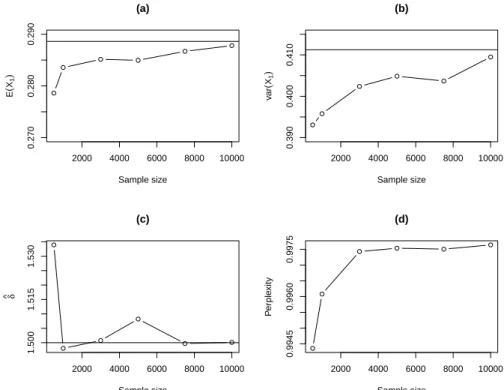
Before turning to real data, we report the results of a further experiment aimed at assessing the speed of convergence. For the Galambos copula with GEV(0,1,0.5) marginals, we repeated 𝐵 = 50 times the simulation for each 𝑛 = (500,1000,3000,5000,7500,10000). Fig. 3 displays the estimates of the expected value (a) and the variance (b) of the first Gumbel marginal, of the copula parameter𝛿(c), and of the perplexity (d). The approximation is
accept-1 2 3 4 5 6 0.70 0.75 0.80 0.85 0.90 0.95 1.00 (a) 1 2 3 4 5 6 0.3 0.4 0.5 0.6 0.7 0.8 0.9 1.0 (b)
Figure 2: Normalized perplexity estimates in the first 6 iterations of the algorithm for the Gumbel copula with standard Normal margins (a) and the Galambos copula with Gumbel (0,0.5) marginals (b).
2000 4000 6000 8000 10000 0.270 0.280 0.290 (a) Sample size E ( X1 ) 2000 4000 6000 8000 10000 0.390 0.400 0.410 (b) Sample size v ar ( X1 ) 2000 4000 6000 8000 10000 1.500 1.515 1.530 (c) Sample size δ ^ 2000 4000 6000 8000 10000 0.9945 0.9960 0.9975 (d) Sample size P er ple xity
Figure 3: Estimates of the expected value (a) and the variance (b) of the first Gumbel marginal, of the copula parameter𝛿(c), and of the perplexity (d) as a function of the sample size. The horizontal line represents the reference value.
able with 𝑛 = 500 and quite satisfactory for 𝑛 ≥1000. With 𝑛= 10 000 the level of precision is very high.
5.2. Application
In this section we perform an empirical analysis concerning the joint distri-bution of the maxima of the time series of the closing prices 𝑆1 and𝑆2 of the
Microsoft and Sun Microsystems stocks. The time horizon is January 1, 2001, to December 31, 2009. We are ultimately interested in the joint tail probability of 𝑆1 and 𝑆2, defined as 𝑝12 = 𝑃(𝑆1 > 𝑐1, 𝑆2 > 𝑐2) for some ‘large’ values 𝑐1
and𝑐2.
The first step consists in estimating the parameters of the two GEV univari-ate distributions. According to the Block Maxima approach, we compute the
monthly maxima of each series, obtaining a sample of 108 observations, ranging respectively in [19.31,73.68] and [3.09,33.56]. Maximum likelihood estimates of the parameters are shown in Table 2; standard errors are based on a numerical approximation of the observed information matrix (see Smith, 1985, for details).
𝑆1 𝑆2 ˆ 𝜇 27.77 (0.70) 5.02 (0.19) ˆ 𝜎 6.58 (0.64) 1.78 (0.21) ˆ 𝜉 0.42 (0.08) 0.67 (0.10)
Table 2. Estimates of the parameters of the marginal GEV distributions.
Thus, both marginal distributions are Fr´echet. As anticipated above, the functional forms of common EV copulas are very similar to each other, so that the choice of the EV copula to be used in practice is not relevant. We tried to implement both the Gumbel and the Galambos copula, and the difference was negligible. Here we show the results obtained with the Galambos copula.
The Maximum Pseudo-Likelihood estimate of the copula parameter𝛿is ˆ𝛿= 0.605 with a standard error equal to 0.122. Considering that the Galambos copula has upper tail dependence1(McNeilet al., 2005, sect. 7.5.1), an estimate ˆ
𝛿significantly different from zero empirically confirms that the joint distribution of𝑆1and𝑆2has tail dependence. Given that the two stocks belong to the same
sector, it is not surprising that their extreme values are dependent. Being able to model this type of dependence is a considerable added value with respect to, for example, the multivariate Normal distribution, which does not have upper tail dependence.
Following the procedure outlined in Section 4.1 with𝑛= 10 000,𝑀 = 80 and 𝜖= 10−5 we get the results in Fig. 4 and Table 3. Fig. 4(a) shows the contour
plot of the estimated distribution and of the approximating mixture. Fig. 4(b) displays a simulated sample of size 𝑛 = 1000. Fig. 4(c) and (d) display the simulated marginal distributions and the theoretical Gumbel densities. Finally, Table 3 gives the values of the means, the variances and the copula parameter𝛿 estimated from the real data (‘True’) and from the simulated data (‘Simulated’). From Fig. 4 and Table 3 the quality of the simulated data is very good.
1Roughly speaking, this means that positive large values are ‘strongly dependent’; see
(a) −1.0 −0.5 0.0 0.5 1.0 1.5 2.0 2.5 −2 −1 0 1 2 3 4 Target Instrumental −1 0 1 2 3 −1 0 1 2 3 4 (b) (c) Density −1 0 1 2 3 0.0 0.2 0.4 0.6 0.8 1.0 (d) Density −2 0 2 4 6 0.0 0.2 0.4 0.6
Figure 4: (a) Contours of the estimated Galambos copula and best fitting Gaussian mixture; (b) a simulated sample of size𝑛= 1000; (c) simulated and estimated marginal distribution of
E(𝑆1) var(𝑆1) E(𝑆2) var(𝑆2) 𝛿
True 0.241 0.288 0.388 0.745 0.605
Simulated 0.238 0.287 0.387 0.748 0.619
Table 3. Estimates of the expected values, the variances and the copula parameter obtained from the observed data (first line) and from the simulated data (second line). Finally, we would like to estimate the joint probability𝑝12for large𝑐1and𝑐2.
As pointed out by McNeilet al. (2005, Example 7.52), in an analytical approach based on the marginals and/or the joint distribution functions, it would only be possible to compute the probabilities 𝑝1 = 𝑃(𝑆1 > 𝑐1), 𝑝2 = 𝑃(𝑆2 > 𝑐2)
and𝑝1∪2 =𝑃(𝑆1 > 𝑐1∪𝑆2 > 𝑐2). In a simulation approach, this difficulty is
overcome. Table 4 shows the results obtained for various thresholds.
(𝑐1, 𝑐2) (73,33) (73,38) (80,33) (80,38) (85,38) (90,40) (100,50)
𝑝12 0.0093 0.0080 0.0086 0.0073 0.0065 0.0057 0.0043
Table 4. Estimates of the joint tail probability𝑃(𝑆1> 𝑐1, 𝑆2> 𝑐2) for various values
of𝑐1 and𝑐2.
It can be seen that 𝑝12 remains positive for all the values of the thresholds
considered. The possibility of estimating tail probabilities well beyond the max-imum of the data is one of the most important advantages of univariate EVT, preserved also in multivariate EVT.
6. Conclusions
This paper uses a generalization of Importance Sampling, called Adaptive Importance Sampling, for sampling copula-based probability distributions and computing tail risk measures. The algorithm works for any copula-based distri-bution, thus overcoming the difficulties encountered in simulating non-elliptical and non-Archimedean copulas. We first simulate two classical Archimedean copulas (Gumbel and Frank) with Normal margins and then, using the link between the Gumbel and the Fr´echet distribution, two EV copulas, namely the Galambos and H¨usler-Reiss copulas with Fr´echet marginals. The simulation analysis and a real-data application confirm the excellent performance of the procedure.
Adaptive IS allows to solve one of the main problems of classical IS, namely the use of a single, fixed instrumental density. Moreover, it is intuitively appeal-ing because it exploits the ability of mixtures of distributions at approximatappeal-ing other distributions. Given the strict relationship between likelihood maximiza-tion and cross-entropy minimizamaximiza-tion, the updating equamaximiza-tions turn out to be very similar to those of the EM algorithm.
In the application presented in this paper, the strength of this approach consists mainly in its generality. This is a considerable advantage over existing simulation procedures, which use, when available, different algorithms. More-over, the experiments show that the sensitivity to the starting values of the parameters is low, and even a bad initialization does not prevent the algorithm from converging. Finally, monitoring the ‘convergence’ of the algorithm is sim-ple, as the typically used diagnostic, called normalized perplexity, is easy both to compute and to interpret.
The algorithm can be used for the simulation of other non-standard mul-tivariate distributions for which the density function is known in closed form, and further research is underway to apply the algorithm to the simulation of the Generalized Hyperbolic Distribution.
References
Asmussen, S. Kroese, D.P. Rubinstein, R.Y. (2005). Heavy tails, importance sampling and cross-entropy. Stochastic Models, 21, 57-76.
Bluhm, C., Overbeck, L., Wagner, C. (2002). An Introduction to Credit Risk Modeling. Chapman & Hall, London.
Capp´e, O., Guillin, A., Marin, J., Robert, C.P. (2004). Population Monte Carlo. Journal of Computational and Graphical Statistics, 13, 907-929.
Capp´e, O., Douc, R., Guillin, A., Robert, C.P. (2008). Adaptive Importance Sampling in General Mixture Classes. Statistics and Computing, 18, 447-459. Casella, G., Robert, C.P. (2004). Monte Carlo Statistical Methods, second edi-tion. New York: Springer.
Cont, R. (2001). Empirical properties of asset returns: stylized facts and sta-tistical issues. Quantitative Finance. 1, 223-236.
Devroye, L. (1986). Non-Uniform Random Variate Generation. New York: Springer.
Embrechts, P., Kl¨uppelberg, C., Mikosch, T. (1997). Modelling Extremal Events. New York: Springer.
Glasserman, P. (2003). Monte Carlo Methods in Financial Engineering. New York: Springer.
Hammersley, J.M., Handscomb, D.C. (1964). Monte Carlo Methods. London: Methuen.
Hofert, M. (2008). Sampling Archimedean Copulas. Computational Statistics and Data Analysis, 52, 5163-5174.
Kotz, S., Nadarajah, S. (2000). Extreme Value Distributions. Theory and Ap-plications. London, Imperial College Press.
Joe, H. (1997). Multivariate Models and Dependence Concepts. Chapman and Hall, London.
Lintner, J. (1965). The Valuation of Risk Assets and the Selection of Risky Investments in Stock Portfolios and Capital Budgets. Review of Economics and Statistics, 41, 13-37.
Markowitz, H. (1952). Portfolio Selection. Journal of Finance, 7, 77-91. Marshall, A.W., Olkin, I. (1988). Families of multivariate distributions. Journal of the American Statistical Association, 83, 834-841.
Mossin, J. (1966). Equilibrium in Capital Asset Market, Econometrica, 35, 768-783.
McNeil, A.J., Frey, R. and Embrechts, P. (2005). Quantitative risk management: concepts, techniques, tools. Princeton: Princeton University Press.
Ross, S.M., 2006. Simulation, fourth edition. San Diego: Academic Press. Rubinstein, R.Y. Kroese, D.P. (2004). The Cross-Entropy Method. New York: Springer.
Rubinstein, R.Y. Kroese, D.P. (2008). Simulation and the Monte Carlo Method, second edition. New York: Wiley.
Sharpe, W. (1964). Capital Asset Prices: a Theory of Market Equilibrium under Conditions of Risk. Journal of Finance, 19, 425-442.
Sklar, A. (1959) Fonctions de Repartition ´a 𝑛 Dimensions et leurs Marges. Publications de l’Institut de Statistique de l’Universit´e de Paris 8: 229-231. Smith, R.L. (1985). Maximum likelihood estimation in a class of non-regular cases. Biometrika, 72, 67-90.
Yan, J. (2007). Enjoy the Joy of Copulas: with a Package copula. Journal of Statistical Software, 21, 1-21.
Whelan, N. (2004). Sampling from Archimedean copulas. Quantitative Finance, 4, 339-352.
Wu, F., Valdez, E.A., Sherris, M. (2006). Simulating exchangeable multivariate Archimedean copulas and its applications. Communications in Statistics -Simulation and Computation, 36, 1019-1034.
Wei, G.C.G., Tanner, M.A. (1990). A Monte Carlo Implementation of the EM Algorithm and the Poor Man’s Data Augmentation Algorithm. Journal of the American Statistical Association, 85, 699-704.
Wraith, D., Kilbinger, M., Benabed, K., Capp´e, O., Cardoso, J.-F., Fort, G., Prunet, S., Robert, C.P. (2009). Estimation of cosmological parameters using adaptive importance sampling. Physical Review D, 80, 023502.
Elenco dei papers del Dipartimento di Economia pubblicati negli ultimi due anni
2008.1 A Monte Carlo EM Algorithm for the Estimation of a Logistic
Auto-logistic Model with Missing Data, by Marco Bee and Giuseppe Espa.
2008.2 Adaptive microfoundations for emergent macroeconomics, Edoardo Gaffeo, Domenico Delli Gatti, Saul Desiderio, Mauro Gallegati
.
2008.3 A look at the relationship between industrial dynamics and aggregate
fluctuations, Domenico Delli Gatti, Edoardo Gaffeo, Mauro Gallegati.
2008.4 Demand Distribution Dynamics in Creative Industries: the Market
for Books in Italy, Edoardo Gaffeo, Antonello E. Scorcu, Laura Vici.
2008.5 On the mean/variance relationship of the firm size distribution:
evidence and some theory, Edoardo Gaffeo, Corrado di Guilmi, Mauro
Gallegati, Alberto Russo.
2008.6 Uncomputability and Undecidability in Economic Theory, K. Vela Velupillai.
2008.7 The Mathematization of Macroeconomics: A Recursive Revolution,
K. Vela Velupillai.
2008.8 Natural disturbances and natural hazards in mountain forests: a
framework for the economic valuation, Sandra Notaro, Alessandro Paletto
2008.9 Does forest damage have an economic impact? A case study from the
Italian Alps, Sandra Notaro, Alessandro Paletto, Roberta Raffaelli.
2008.10 Compliance by believing: an experimental exploration on social
norms and impartial agreements, Marco Faillo, Stefania Ottone, Lorenzo
Sacconi.
2008.11 You Won the Battle. What about the War? A Model of Competition
between Proprietary and Open Source Software, Riccardo Leoncini,
Francesco Rentocchini, Giuseppe Vittucci Marzetti.
2008.12 Minsky’s Upward Instability: the Not-Too-Keynesian Optimism of
a Financial Cassandra, Elisabetta De Antoni.
2008.13 A theoretical analysis of the relationship between social capital and
corporate social responsibility: concepts and definitions, Lorenzo Sacconi,
Giacomo Degli Antoni.
2008.14 Conformity, Reciprocity and the Sense of Justice. How Social Contract-based Preferences and Beliefs Explain Norm Compliance: the
2008.15 The macroeconomics of imperfect capital markets. Whither
saving-investment imbalances? Roberto Tamborini
2008.16 Financial Constraints and Firm Export Behavior, Flora Bellone, Patrick Musso, Lionel Nesta and Stefano Schiavo
2008.17 Why do frms invest abroad? An analysis of the motives underlying Foreign Direct Investments Financial Constraints and Firm Export
Behavior, Chiara Franco, Francesco Rentocchini and Giuseppe Vittucci
Marzetti
2008.18 CSR as Contractarian Model of Multi-Stakeholder Corporate
Governance and the Game-Theory of its Implementation, Lorenzo Sacconi
2008.19 Managing Agricultural Price Risk in Developing Countries, Julie Dana and Christopher L. Gilbert
2008.20 Commodity Speculation and Commodity Investment, Christopher L. Gilbert
2008.21 Inspection games with long-run inspectors, Luciano Andreozzi 2008.22 Property Rights and Investments: An Evolutionary Approach, Luciano Andreozzi
2008.23 How to Understand High Food Price, Christopher L. Gilbert 2008.24 Trade-imbalances networks and exchange rate adjustments: The
paradox of a new Plaza, Andrea Fracasso and Stefano Schiavo
2008.25 The process of Convergence Towards the Euro for the VISEGRAD
– 4 Countries, Giuliana Passamani
2009.1 Income Shocks, Coping Strategies, and Consumption Smoothing. An
Application to Indonesian Data, Gabriella Berloffa and Francesca
Modena
2009.2 Clusters of firms in space and time, Giuseppe Arbia, Giuseppe Espa, Diego Giuliani e Andrea Mazzitelli
2009.3 A note on maximum likelihood estimation of a Pareto mixture, Marco Bee, Roberto Benedetti e Giuseppe Espa
2009.4 Job performance and job satisfaction: an integrated survey, Maurizio Pugno e Sara Depedri
2009.5 The evolution of the Sino-American co-dependency: modeling a
regime switch in a growth setting, Luigi Bonatti e Andrea Fracasso
2009.6 The Two Triangles: What did Wicksell and Keynes know about
2009.7 Mobility Systems and Economic Growth: a Theoretical Analysis of
the Long-Term Effects of Alternative Transportation Policies,Luigi Bonatti
e Emanuele Campiglio
2009.8 Money and finance: The heterodox views of R. Clower, A.
Leijonhufvud and H. Minsky,Elisabetta de Antoni
2009.9 Development and economic growth: the effectiveness of traditional
policies,Gabriella Berloffa, Giuseppe Folloni e Ilaria Schnyder
2009.10 Management of hail risk: insurance or anti-hail nets?, Luciano Pilati, Vasco Boatto
2010.1 Monetary policy through the "credit-cost channel". Italy and
Germany pre- and post-EMU,Giuliana Passamani, Roberto Tamborini
2010.2 Has food price volatility risen?Chrisopher L. Gilbert and C. Wyn Morgan
2010.3 Simulating copula-based distributions and estimating tail