R E S E A R C H R E P O R T S E R IE
S
I Z A Research Report No. 45
Eldercare Services –
Lessons from a European Comparison
Annette Angermann (OBS)
Werner Eichhorst (IZA)
Annette Angermann (OBS) / Werner Eichhorst (IZA)
Eldercare Services -
Lessons from a
European Comparison
Working Paper No. 6 of the Observatory for Sociopolitical
Developments in Europe /
IZA Research Report No. 45
EDITORIAL INFORMATION
Published by:
Deutscher Verein für öffentliche und private Fürsorge e.V. German Association for Public and Private Welfare (DV) Michaelkirchstraße 17/18, 10179 Berlin - Germany Phone: +49 30-62980-0
Fax: +49 30-62980-140
Internet: http://www.deutscher-verein.de
This is a publication of the “Observatory for Sociopolitical Developments in Europe” (OBS) and the Institute for the Study of Labor (IZA). This publication does not necessarily reflect the opinions of the German federal government. The publisher and/or the authors of individual articles bear responsibility for its content.
All rights reserved. Reprints or comparable use, including of extracts, are permissible only with prior written authorization.
The Observatory is a project funded by the German Federal Ministry for Family Affairs, Senior Citizens, Women and Youth (BMFSFJ), D-11018 Berlin.
The Observatory’s website: http://www.sociopolitical-observatory.eu
The institutions operating the Observatory are:
Deutscher Verein für öffentliche und private Fürsorge e.V. German Association for Public and Private Welfare (DV) Michaelkirchstraße 17/18, 10179 Berlin - Germany Phone: +49 30-62980-0
Fax: +49 30-62980-140
Internet: http://www.deutscher-verein.de
Institut für Sozialarbeit und Sozialpädagogik e.V. - Institute for Social Work and Social Education (ISS)
Office address: Zeilweg 42, 60439 Frankfurt a. M. - Germany Postal address: Postfach 50 01 51, D-60391 Frankfurt a. M. Phone: +49 (0)69 - 95 78 9-0
Fax: +49 (0)69 - 95 789 190 Internet: http://www.iss-ffm.de
Authors:
Annette Angermann ([email protected]) Werner Eichhorst ([email protected])
Graphic Design:
www.avitamin.de
Circulation:
This publication is available only as a PDF file from http://www.sociopolitical-observatory.eu.
Date of Publication:
Table of Contents
1 Introduction – The relevance of eldercare services for the future ... 3
2 A European comparison of eldercare services ... 6
3 Eldercare service arrangements ... 13
3.1 Organisation and provision of eldercare services ….……….. 13
3.2 The quality of eldercare services……….………….……….. 17
3.3 Qualification and professionalization……..……….……….. 21
3.4 Funding……….……….. 25
4 Conclusion and outlook – learning from a European comparison ... 32
Abstract
The demographic change is increasing the demand for eldercare services in Europe. At the same time, this sector shows an enormous growth potential in terms of employment. The major challenge European countries face in this context is to provide the elderly with high-quality need-based supportive services. This can only be achieved successfully if the basic structural conditions are set in the right way. If the bulk of these services is to be provided by the formal sector, more jobs can be created and, at the same time, more households can be relieved of informal services. This paper therefore focuses upon the efforts to professionalise eldercare services in the formal sector, which requires effective organisational structures, qualification and quality standards and a proper financing.
1
Introduction –
The relevance of eldercare services in the future
We all will, at one point, require personal support. Help and care are therefore very usual, matters of course. Although there are quite a few advantages of an ageing society and the demographic change provides ample opportunities – e.g. living a longer and healthier life than only a few decades back – this massive societal change also poses major challenges. For one thing, the elderly and their relatives face direct challenges. For another, there are economic and social challenges. After all, the growing number of elderly people can no longer sufficiently be supported by a declining number of younger people. According to the projections at hand, this applies to Germany in particular, which in Europe will go through one of the most pronounced ageing processes, as can be seen in the figure below.
Figure 1: Projected shares of the 65+ and 80+ until 2050 in per cent
Source: OECD Labour Force and Demographics Database, Colombo et al. 2011.
The subject matter of this paper is the provision of eldercare services (cf. Angermann 2011). The primary focus is upon the elderly who are in need of support and their relatives, but we also address the situation of the employees in the eldercare services sector, that is, the people who actually provide these services.
Meanwhile, quite a number of stakeholders at the national and European level are dealing with care services for families and the elderly. As the support systems in the individual EU Member States are mostly very fragmented, we herein try to combine the various sub-segments of supporting services and to provide an overview of the current European situation based upon selected European examples and by referring to initiatives at the European level.
Against the backdrop of the ageing societies in all EU Member States, the topic of eldercare services does also increasingly register at the European level, where several policy initiatives are being discussed. The European Commission’s demographic reports1
, the respective national demographic reports2 and the huge number of available national demographic strategies show how important eldercare services are. In the German demographic strategy dated April 2012, for example, it is being announced that shortly there will be a benchmark paper on eldercare services (BMI 2012: 13). Until mid-July 2012, the European Commission (Directorate General for Employment, Social Affairs and Inclusion) is organising an open consultation on the use of the potential of personal and household services (European Commission 2012a). At the same time, the health workforce (European Commission 2012b) and the employment potential provided by Information and Communication Technologies (European Commission 2012c) are also receiving more and more attention.
The experiences gained over the past few years show that supporting services are a repeatedly discussed topic that has a huge potential to be utilised by both the users of the services and their providers. In Germany, in particular household services are discussed on a regular basis and considered as an area of potential job creation, provided that it is possible to make the services affordable and to reduce the labour costs in the formal sector. However, there has not yet been any systematic overall concept for the creation of a formal market, but mostly only temporarily financed pilot projects organised by local or regional service agencies. Therefore, the following questions regarding access to and availability of eldercare services do still require an answer: How can the quality of eldercare services be improved? How can these be universally organised and offered at affordable prices, that is, for all citizens and for all needs and fields of activity?
European countries go very separate ways when assigning the responsibility for eldercare services to the government, the market, the family or other players, welfare organisations and churches in particular. A very important point is the distinction between formal and
1
The European Commission’s third demographic report deals with the latest demographic patterns (fertility, life expectancy, migration) and gives an overview of the population structure by age and family patterns. The report shows that the Europeans’ life expectancy is on the increase (European Commission 2011).
2
informal services. Formal services are rendered by external people having a formal contract of employment. Informal services are provided by members of the household, relatives3 (also called family carers) or illicit workers. So, eldercare services can either be bought by households in the (regular or irregular) market or be rendered by the relatives themselves for free (‚make or buy‘). Thus, the organisation of eldercare services in the formal sector is the central political and institutional challenge. Two different constellations may arise: If in the formal sector a higher employment rate is indeed attained, the employment rate of the care-recipients' relatives can also rise, since the households are relieved of their informal care work. Both sides – users and/or their relatives and the service providers – are, on aggregate, paid more for their work, so both taxes revenues and social contributions will also increase. If, however, the employment rate in the formal sector is low, the caregiving relatives are also less frequently to be found in gainful employment, since they render eldercare services in the informal sector without receiving any such pay. The advantage of a higher employment rate on both sides – employment with service providers and higher employment or longer working time of those relieved from informal services - more formal services also provide more opportunities for qualification and professionalisation. Rendering formal eldercare services does not least depend upon if and in how far services can be made affordable to users and attractive in terms of working conditions for those who render them. A public (co-) financing would be one way, but this requires tax- and social-contribution-based funds. In flexible labour markets with high wage differentials eldercare services can be provided at comparatively low pay. But then again, the working conditions in such markets are less attractive, which, in turn, entails less professionalism and a rather low quality.
In research and in the political arena, one often differentiates between personal care services on the one hand and household services on the other. From a systematic point of view, this is problematic and from the service recipients’ perspective it does not make too much sense. In this paper, we therefore rather deliberately use a ‘broader’ definition of eldercare services to consider the entire range of services the elderly receive. Hence, we define as eldercare services all personal and household services provided to the elderly. The objective is to put people who need such support first, not to follow the respective service system’s logic. The types of services described herein are the institutionalised form of services that in the past were rendered privately in the households: in form of care for the elderly (medical and nursing care) on the one hand and in form of household activities on the other. These services do not fully intersect, but have to be considered together. After all, for the users and their relatives a mix of both types is simply part of their lives. There are various terms for the
3
The Interlinks project defines informal care as follows: mostly given by (close) relatives, friends or neighbours, with caregivers sometimes having received some training but not being skilled; they receive no pay and no
services mentioned herein. Given their various overlaps and intersections, these terms are not absolutely precise. We therefore define eldercare services as a combination of personal services and household services. The term “eldercare services” is thus generic and therefore has to be understood as the sum of the respective services. The German situation is compared with selected European countries4 that have different structures for the rendering and use of eldercare services. These structural differences can be put down to the respective structure of the labour market and the welfare state and depend upon the primary institutional assignment of eldercare services to the market, the government, families or welfare organisations and the third sector in particular. The different arrangements in the EU Member States illustrate – realistically implementable – options of how to shape them politically.
2 A European comparison of eldercare services
In European terms, the provision of eldercare services is very heterogeneous. This allows us to show opportunities, provided that quality and quantity of eldercare services can be explained by major institutional factors, which, therefore, can be influenced by political decisions. An international overview can reveal what types of eldercare services can be realised in various European countries and what basic conditions this would require. Although we want to include all types of eldercare services in terms of our broad definition, we should note that, given a clearer statistical demarcation line and categorisation, the available comparative literature and data on personal care services are much better than those on household services used by elderly people. Overall, the statistical data are characterised by major problems with the classification of employees in accordance with the segments and sectors considered herein.
Regarding the types of eldercare services, these services can generally be rendered within the household and family (informal care / care by relatives) or by external staff (formal, regular or illicit workers). While for eldercare services all countries do indeed use the entire range, we can still discern some clear distinguishing patterns. It is especially the share and importance of formal or informal care that show major disparities (Pommer/Van Gameren/Stevens 2007), which can also be explained by the stronger or weaker institutional support of these sectors in the various European countries.
entitlement to benefits. Formal care is characterised by contracted services being rendered by qualified and skilled workers under (governmental) supervision (Interlinks 2010: 11).
4
Provision of formal eldercare services
From the point of view of the people who use personal care and household services, access and availability are decisive. Regarding the use of formal long-term care Germany, with a share of 1.8% of the overall population, shows a slightly above-average use when compared with the OECD (Organisation for Economic Co-operation and Development). Home care has a higher share than institutional care. Formal care is predominantly used by the older population. Approximately one out of two care-recipients is older than 80. Women are more often care-recipients than men of the same age bracket. The older the people in need of care, the larger the need for care and the higher the share of institutional care (Colombo et al. 2011).
Figure 2: Home care and institutional care in the OECD in 2008
Source: Colombo et al. 2011 (OECD Health Data).
In all countries, informal home care by relatives is an important and central branch. Although there are no sufficient or sufficiently precise data, we can assume that in the OECD countries between two thirds and 90 per cent of the people rendering personal services for the elderly are informal caregivers (Fujisawa/Colombo 2009). Most of them are women, usually wives,
Southern Europe; and Polandas an Eastern European example; as well as s the United Kingdom as an Anglo-Saxon country example.
daughters and daughters-in-law.
Gainful employment in eldercare services
Formal employment in the long-term care sector is a central indicator for the provision of work-intensive and personal services for the elderly by people who are not part of the household or family. However, a statistical allocation of the employment in that field is difficult, especially on an international basis (Simonazzi 2010). If we use the pertinent OECD figures, we see that in Germany at the end of the 2000s 1.1 per cent of the working-age population worked in the long-term care sector (predominantly in personal services) or 0.8 per cent in full time equivalents, which is a rather modest employment rate (Figure 3). In the Scandinavian countries, the formal care employment rate stood at between 2 and 3.5 per cent. In all countries, employment in the long-term care sector is seeing a stronger growth than overall employment (Colombo et al. 2011).
Figure 3: Employment in long-term care in 2008 or the latest available year
Source: Colombo et al. 2011 (OECD Health Data). Note: LTC = long-term care; FTE = full-time
Considering employment, measured as a headcount or in full time equivalents, in relation to the potentially care-receiving population (older than 80 years of age), we find huge differences. Germany at 15 employees or eleven full time equivalents for every 100 people aged over 80 years has one of the lowest employment rates in formal care (Figure 4, cf. Geerts 2011). Formal institutional care is much more staff-intensive than home care (Colombo et al. 2011). At the same time, in all the countries used for our comparison there are large shares of informal caregivers (Figure 5). In countries with little public services the share of people who render more intensive informal personal care services, however, is especially large. But in countries where there is much formal employment in the long-term care sector we still find much informal care, too. This makes for a percentage of informal caregivers of about 70 to 90 per cent of the caregiver total in most countries. In countries with a strong formal care sector, however, personal care is not so much concentrated upon informally caregiving relatives.
Figure 4: Long-term care workers per 100 people over 80 years old, in 2008 or the latest available year
Figure 5: Informal caregivers in % of the population, mid-2000s (personal care services and home care)
Panel A: Percentage of the population reporting to be informal carers providing help with ADL
Panel B: Percentage of the population reporting to be informal carers providing help with_IADL
Source: Colombo et al. 2011.
Note: ADL = personal care (‘activities of daily living‘), IADL = Instrumental activities of daily living (‘instrumental activities of daily living‘).
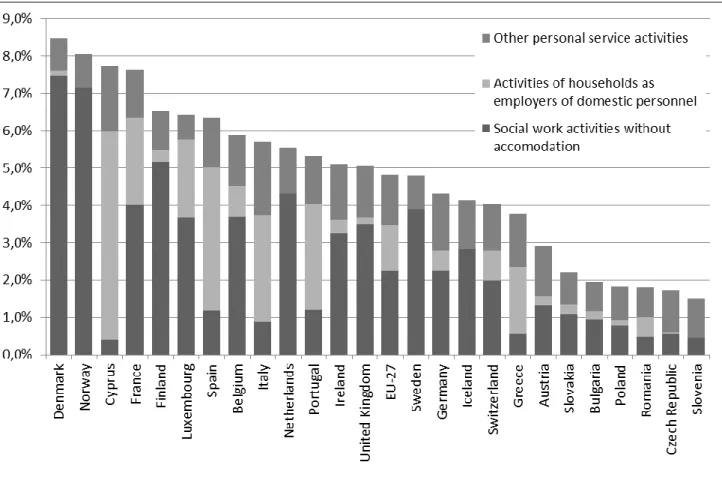
If we consider a different definition of employment in the care sector (not only for the elderly) and apply Eurostat data, we find huge differences in the share of personal and household services between the EU Member States. As noted above, however, we should bear in mind the problem of statistical demarcation. In some new Member States, less than two per cent of all employees work in these segments, while in the Scandinavian countries in particular and in France, too, these are more than seven per cent. While in central and western and northern Europe with up to seven per cent “social work activities” predominate, in southern Europe the share of domestic staff is very high (e.g. in Spain, Italy, Portugal and Greece). In all countries, other, mostly personal services make up about one to two per cent of the entire workforce.
Figure 6: Employment in personal and household services in % of the total workforce, 2011
Source: Eurostat Online Database, own calculations. Demarcation according to NACE Rev. 2: Social work activities without accommodation (88), other personal service activities (96) and activities of households as employers of domestic personnel (97).
Acceptance and satisfaction
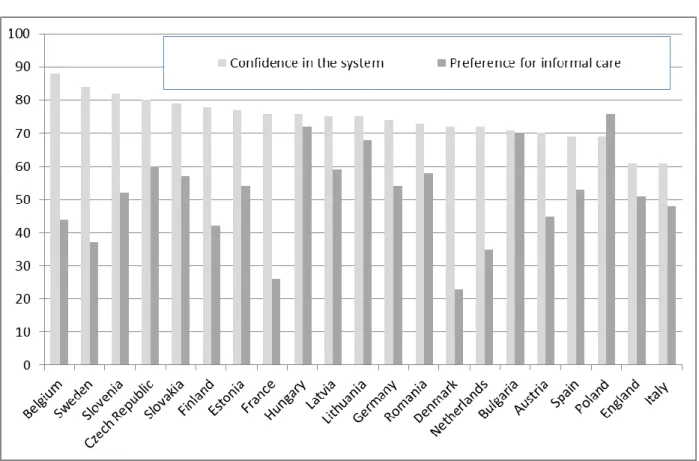
Employment opportunities in the formal sector aside, the satisfaction of caregivers and the people potentially or currently in need of care is a major criterion for the acceptance and quality of a care system. Generally speaking, the existing care systems’ acceptance, when measured against the expectation of an appropriate care if the need arises, is comparatively high (Kraus et al. 2010). Germany obtains a middle position, with a relatively strong acceptance of informal care. Studies based upon surveys reveal that when the amount spent on formal care rises the share of those who think informal care places too much of a burden on relatives declines (Tjadens/Colombo 2011).
Figure 7: Care adequacy and preference of informal care
Source: Kraus et al. 2010.
Germany’s position in a comparative perspective
The international comparison allows us to discern both shared and unique problems and to see an opportunity to increase employment on the one hand and to provide people with high-quality (from the user’s point of view) services on the other. All in all, we can say that in terms of expenditure for old-age care Germany works relatively economically. This does particularly apply to public financing, but we have to consider that in the relatively large share of private expenditure on care the mandatory private health insurance benefits are included.5 While the German system in terms of benefits is deemed comparatively patient-friendly and financially effective and generous (Kraus et al. 2010), it is striking that it only supports a comparatively small employment segment when compared with Sweden or Denmark. This reflects the still very large importance of informal care, in part financed with the care allowance (Pflegegeld). In other words: we have relatively little expenditure and relatively few formal jobs in the long-term care sector. The system thus depends upon the (more economical) informal care given by relatives and the irregularly employed care helps. And in the care sector, there are many challenges regarding quality, working conditions and availability, also and especially in view of the fact that in Germany we have a relatively large number of elderly people suffering from
health problems (Colombo et al. 2011). This does not only apply with regard to quality and jobs in the eldercare sector, but also and particularly to eldercare services outside nursing care. Here, we still have a huge potential, which (in the formal sector) has not yet been fully utilised.
3
Eldercare service arrangements
Cross-country differences in the eldercare services can, at their core, be explained by underlying institutional factors. The international comparison can thus point to a sustainable development strategy for eldercare services, from personal to household services. This also holds for components for a sustainable strategy for the development of high-quality services. This requires a study of the basic conditions for rendering eldercare services in order to develop strategies that will indeed fit into the respective national context.
Basically, services can be rendered in two ways: they are either rendered by the households or bought on markets. Services rendered in the market, however, can be provided either formally (that is, in the regular market- legally) or informally (that is, in the irregular market – illegally). This kind of ‘informal’ services, though, should not be confused with informal care (care given by relatives).
In the following chapter, we will explain various factors that have an influence upon eldercare services, primarily in the formal sector. First, we will present the organisation and structure of the providers (3.1). We will then shed light upon quality assurance and quality standards and their practical implementation (3.2). This is followed by a discussion of the service providers’ qualification and professionalisation (3.3) and the financing structure and its scope (3.4).
3.1 Organisation and provision of eldercare services
The services’ rendering is mainly determined by the providers’ organisation and structure. We will therefore now take a look at the services’ organisation and thus the form of rendering them.
What levels and stakeholders are responsible for rendering the eldercare services, do organise and finance them, depends upon long-term structural determinations within the respective welfare state. These have an influence upon the role of public, non-profit or private providers in the formal sector and the significance of informal care or relatives’ own household and personal care work.
Eldercare services can be provided publicly, i.e. by the government both directly and by non-profit organisations. Further, services can also be offered by private organisations and
service providers either formally or informally (shadow economy).6 We should not ignore the fact that there is a huge number of migrants illicitly working in either the household segment or in personal services. This is an important fact in Germany, Austria and Italy in particular, but in other EU Member States such as France care migration is also a problem (cf. Colombo et al. 2011). This is of great importance as a cross-border recruitment of caregivers7 means that the service problems see a sort of international shift when the workers are then no longer available in their own country.
And then there is the possibility to render the care in the personal environment, mostly in form of caregiving relatives. Advantages like personal closeness and low costs aside, there is also a negative impact like, for example, a reduction or loss of the caregiving relatives’ income (who thus jeopardise their own financial security and are severely disadvantaged in the social security system (Bäcker 2003: 132)) and the physical and emotional stress suffered by the caregiver8. From the care recipients’ point of view, there is also the matter of the service’s either good or poor quality.
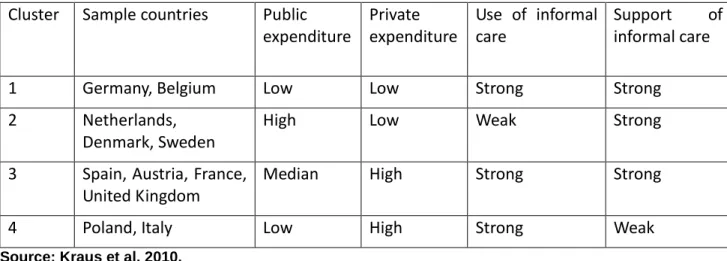
In personal services or nursing, the European welfare states have seen long-term structural assignments of who is to render eldercare services. To what extent nursing or other eldercare services are integrated in the formal market and what providers predominantly render these services – public, non-profit or private providers – depends upon these basic conditions. There are such determinations regarding the financing level and structure (public vs. private), making the formal market either weaker or stronger and let it show certain characteristics, although in reality the services will always be mixed. So we sometimes have rather complex constellations. Long-term care system typologies differ by the characteristics they focus upon (Kraus et al. 2010, Simonazzi 2009). Kraus et al.’s comprehensive typology, for example, puts Germany, Belgium, France, the Netherlands, Sweden and Denmark in a cluster of much financial generosity (measured by public expenditure and a restricted necessity of out-of-pocket payments) on the one hand and of an organisational development regarding legal standardisation and basic entitlement, availability of in-kind and cash benefits and quality assurance on the other. In other countries, these two dimensions are less developed. But Germany – and also Belgium – differs from Denmark, the Netherlands and Sweden by its overall rather small welfare expenditure on care and a stronger use of informal care by relatives, which is also stressed by other typologies (Simonazzi 2009). In Sweden, Denmark and also the Netherlands, formal services rendered by public providers dominate.
6
Another break down of formal eldercare services is a) cash benefits, earmarked or not, and b) in-kind benefits. 7
These can also be called the systems that are most geared to the actual needs (Schulz 2010, Fukushima/Adami/Palme 2010). All in all, Germany has a mixed system of informal and formal care, while Sweden, Denmark, France, the United Kingdom and others predominantly use formal structures. The Mediterranean EU Member States focus upon informal care given by relatives. In France, for example, formal services are bought with earmarked cash benefits and are to a very large extent publicly co-financed. In the United Kingdom, however, with rather restricted public services, private providers predominate. Non-earmarked cash benefits we find in Germany, Austria and countries in southern Europe, which goes hand-in-hand with rather informal or mixed service structures and a stronger familial responsibility (Simonazzi 2009, 2010, Pommer et al. 2007, Kraus et al. 2010). Colombo et al. pool the structural characteristics of care services in three main categories of countries. A universal, integrated system financed by taxes or social insurance contributions we find in Sweden, Denmark, Germany and the Netherlands. In Austria, France and Italy, however, care is embedded in other social security systems. It is thus of a rather fragmented character. Another universal system is found in the United Kingdom. In this system, means testing plays an important role, which rather limits the universality of the system (Colombo et al. 2011). Given the different contexts in the respective Member States, there are long-term structural differences to be found in the eldercare services. However, shifts and changes have occurred once reforms had been implemented. In many countries, privatisation and outsourcing trends and an introduction of voucher systems have led to more freedom of choice among users on the one hand and more competition between providers on the other. If there are no quality and labour standards, this may entail problematic working conditions and a poor quality. These patterns cannot only be seen in rather market-dominated systems like the United Kingdom, but also in previously state-dominated systems like Sweden.9
9
The Act on Free Choice Systems (2009) has opened up social services to non-public providers, at least in those municipalities in which the Act has been implemented. The Free Choice Act can be seen a step towards more choice for care users and as an attempt to let more competition improve the service quality (cf. Angermann 2011: 192 and http://www.deutscher-verein.de/03-events/2011/gruppe6/pdf/W_618_11_Programm.pdf).
Table 1: Long-term care regimes
Cluster
Sample countries
Public
expenditure
Private
expenditure
Use of informal
care
Support
of
informal care
1
Germany, Belgium
Low
Low
Strong
Strong
2
Netherlands,
Denmark, Sweden
High
Low
Weak
Strong
3
Spain, Austria, France,
United Kingdom
Median
High
Strong
Strong
4
Poland, Italy
Low
High
Strong
Weak
Source: Kraus et al. 2010.
In the following, we will briefly present two examples of organisational and provider structures in eldercare services: vouchers and the role played by informal care.
Vouchers as a governance mechanism
Eldercare services can be rendered and organised in various forms. Regarding a formalisation of eldercare services, including the household-related segment, over the past few years publicly co-financed earmarked voucher models have come to the fore, since in some countries these are much in use. In France and Belgium, for example, voucher models play an important role in a strategy of organising, governing and clearing eldercare services that by means of major tax deductibility are supposed to be shifted to the formal sector. Both systems have national agencies to control the provision of eldercare services, with private companies serving as clearing centres for the voucher model (Sansoni 2009):
The Belgian “titres-services“ are restricted to household services (e.g. cleaning, washing and ironing, cooking, shopping, transportation) and expressly exclude care services. The titres-services are offered by companies specialising on vouchers both as hard copies and in electronic form. They can be redeemed at state-approved service providers (commercial or non-profit). The services are rendered by these state-approved service providers’ employees, not by people employed in the private households.
In France, the “Chèque Emploi Service Universel“ (CESU) has been in existence since 2006 and is a voucher model that differs much from its Belgian counterpart. The French CESU was introduced in order to establish a formal market for household
to pay caregivers, child carers and domestic helps and tradesmen (CESU bancaire). It also regulates the registration in the event of a direct employment in the private household and settles the employers’ social contributions. Alternatively, external service providers can also be paid. The CESU is also a possible way of processing eldercare services within the framework of the French “Allocation Personalisée d’Autonomie“ (APA). This variant of the “CESU social“ is provided by local and regional authorities (municipalities, départments) or the social insurance funds, e.g. for the disabled or people in need of care. There is also the option of companies handing out pre-paid cheques to their staff (CESU préfinancé HR). These vouchers are issued and processed by specialised companies.
The role of informal care
In Europe, we currently see a shift from institutional care to home care. This helps contain the huge costs of institutional facilities and contributes to a postponement of institutional care to a later age or defers its costs (Simonazzi 2009). Such home care provided by informal carers makes it particularly important that the users and their relatives can access central contact points or service provider networks. Even though this paper focuses upon a broad use of eldercare services, it is still important to provide suitable strategies for the caregiving relatives’ qualification and support and thus also their recognition. These may include, for example, flexible working hours or paid or unpaid care leave. Furthermore, there are day care centres, short-term care options (Kohler/Döhner n.d.: 108ff.), care leave and training arrangements for informal caregivers that could be provided for. A financial support of caregiving relatives, however, could lead to a reduction in employment and thus to a further shift of services to the informal and/or irregular sector (Colombo et al. 2011). If the stress is huge, though, caregiving relatives do also need professional support.
3.2 The quality of eldercare services
Eldercare services are rendered by people for people. They are thus subject to human factors and their quality and the assessment of their quality can be heterogeneous and show disparate results. This sub-chapter will present the various quality aspects in personal and household services and explain the pertinent quality terminology.
How can we measure the quality of eldercare services? Given the interpersonal aspects, this is difficult. It is a service whose technical quality can be measured by employing verifiable criteria. It is also a service that can be assessed and evaluated against its recipients’ satisfaction (and quality of life).
For personal care services, an objective measuring of the care result can be measured against the care recipient’s condition. A subjective assessment is based upon the care recipient’s physical, emotional and social well-being. Although the primary focus is upon the well-being of the elderly and their relatives, the well-being of the eldercare workers is also very important. If they can work under good conditions, this also tends to increase service quality (Colombo et al. 2011: 14, 201). Measuring household services’ quality is even more difficult, since for that segment there are hardly any binding quality standards. Written minimum requirements on household services like those issued by the German consumer associations (Verbraucherzentralen), for example, can be helpful. In case of regular services, for example, the customer’s satisfaction is surveyed after the first time. The consumer association serves as an ombudscentre and arbitration panel.10 Both in personal and household services, other service quality criteria are also used, e.g. if the service staff is polite, competent, credible, communicative, understanding, dependable etc. (cf. the various dimensions of the range of services in European Commission (2012a: 16)).
“Quality” has a threefold approach: the quality of the structure, the process quality and the quality of outcome. The quality of the structure deals with the basic conditions under which eldercare services are rendered, e.g. organisational form, materials, formal qualification and the staff’s further education and advanced training plus the respective organisation’s quantitative and qualitative staffing of the personnel11. Process quality refers to the actual working of service provision processes in day-to-day practice. Common tools to ensure process quality are specifications on the type and scope of services provided including guidelines on the implementation and specific professional standards12. Quality of outcome
measures how the service is rendered, focusing upon both the users’ satisfaction and cost efficiency (cf. Schaarschuch 2002, Holzer/Maucher 2002, Leimeister 2011). An appropriate quality of the structure can control processes and thus make good results possible. We should bear in mind that the structure has an impact upon the process and the result and that both the result and the process impact the structure.
Quality is assured through both internal and external quality inspection processes. While the internal quality inspection is usually done by the organisation’s quality representative whose job it is to introduce, implement and develop the internal quality management system, external quality assurance is the responsibility of independent institutions and thus external supervisors.
10
Minimum requirements placed upon household services for the elderly and families with children and youths in North Rhine–Westphalia from the users’ point of view (http://www.vz-nrw.de/mediabig/54981A.pdf, retrieved on 08.06.2012; cf. also Angermann 2011: 134ff.)
It is necessary and important that eldercare services are of high quality. From the users’ point of view it is clear that no one wants to receive a poor service anyway. Comparability of the service providers based upon the service’s quality does not only make the sector transparent, but such quality assurance then also increases the users’ acceptance and confidence. The quality of eldercare services can only be checked in the formal sector and in competitive conditions and then convey a feeling of dependability to the users. We therefore need quality standards. These could also contribute to pressing ahead with both the staff’s and the pertinent associations’ professionalization. This could not only provide the staff with better working conditions and career opportunities and define them, but also strengthen their professional position and social recognition (Social Platform 2011).
Quality is a key indicator for services. Quality assurance and the attendant quality inspections develop in the European Member States. Given the lack of data on household services in particular, it is hard to give a proper overview. In (state) systems, quality inspections are easier to implement, since the eldercare services are rendered formally or there are voucher systems. In such systems, both the staff and the service are better traceable than in the shadow economy. Still, in the “voucher countries” Belgium and France, quality assurance is a problem, especially when the caregivers are directly employed in the private households, where an implementation of quality standards is much more difficult (Sansoni 2009: 32).
In many of the European countries covered by our study, a personal care service quality assurance is mandatory. For both institutional and home care, this applies to Belgium, Denmark, France, Germany, Italy, the Netherlands, Spain and Sweden.13 In Poland and Austria, it is not mandatory, but nonetheless common. (Riedel/Kraus 2011: 6) The quality systems are based upon various policies. The German, French, Dutch and British systems assure quality by “output-orientated” indicators and related guidelines. Austria, Spain and Sweden, however, are more “input-orientated” and focus upon monitoring the quality processes. In some of these countries, there are also policies regarding the quality of informal care. The Polish system does not provide for any quality indicators and/or assurance. In Italy, however, we have quality assurance in the formal sector and also quality guidelines, but there is no real response to the needs of the patient. (Dandi 2012: 3)
Policies worth mentioning are the Danish quality reform (2007), the French solidarity strategy (2007-2010) and Alzheimer plan (2008-2012) and the Dutch Act on Social Support (2007) (Colombo et al. 2011: 55). Regarding quality assurance in Germany, it should be noted that with the introduction of public Long-term Care Insurance (1995), the Quality Assurance Act
12
To which a care activity refers, e.g. care planning, documentation, control and the development of topical care standards.
(2001) and especially the Act on the Further Development of Long-term Care (2008) measures have been taken to make the quality of care services more transparent and controllable. There are, for example, the annual quality reports issued by the health insurance funds’ medical service.14
As mentioned at the beginning of this chapter, there are hardly any binding quality standards for household services regarding the service quality as such. The French voucher system, for example, stipulates that service agencies have to submit their data and a report that includes both quantitative and qualitative evaluations of their work to the authorities (Sansoni 2009: 24). In general, the empirical data – also in the French and Belgian voucher systems – available regarding the quality of the working conditions like the part-time employment rate, staff’s pay etc. is better than information on the quality of the service provided. These data provide information on the working conditions which are more or less conducive to the delivery of high-quality services. This, in turn, has an influence upon the quality of the eldercare service, but it can hardly be called a systematic assessment of the quality of services provided (Sansoni 2009: 31ff.; cf. also Defourny 2009). One should therefore develop quality assurance structures through, for example, an expansion of certification systems, thus making it more transparent for the users, too.
The quality of eldercare services is an often discussed topic, but how can eldercare services be rendered in such a manner that a good or high quality can indeed be systematically attained? This requires not only qualified employees and an adequate financing, which we will deal with shortly, but also binding quality standards and the service providers employing a quality management system. There should also be external evaluations. And the European Commission’s open consultation paper also shows that quality management is an on-going process that is getting ever more important. Within the paper of the European Commission’s consultation concerning personal and household services, it refers, for example, to the voluntary European Quality Framework for social services as a “useful tool to promote child care and long term care quality” and calls the development of quality tools (standards and indicators) at the national or local level possibly appropriate (European Commission 2012a: 13).
13
3.3
Qualification and professionalisation
High-quality services do not only require quality standards for the services as such, but also a qualified staff. This means that vocational and academic training at various qualification and job levels is as important as the working and employment conditions that determine the attractiveness of a career in eldercare services. The competition between various providers of supporting services can contribute to an adequate and cost-efficient provision of services. This, however, requires quality standards and regulated employment relationships.
The data available on employment relationships in the care sector shows many gaps and is, in part, not really comparable (cf. Fujisawa/Colombo 2009, Colombo et al. 2011, Geerts 2011, Simonazzi 2009, 2010). It can be noted that the bulk of eldercare workers, both in personal care and household services, are women, in many EU Member States disproportionately working on a part-time basis. There are also many other atypical forms of employment. Further, institutional care is much more characterised by full-time work and scale salaries and wages than home care and household services, where firms are predominantly small. In Germany, the number of part-time workers has risen as much as has the share of formal caregivers with more than one job and the employment of migrants. Compared with other occupations, the pay is below-average and there are many low-wage workers. This corresponds to a large share of migrants, both in personal and household services. And even in more formalised personal and household service markets like France and Belgium, opportunities for advancement are rather limited, while in flexible labour markets like in the United Kingdom the eldercare staff’s pay and job security are problematic (Simonazzi 2010, 2009). Another phenomenon found in many European countries to whatever extent is a huge staff turnover, which can entail a recruitment bottleneck and a shortage of skilled staff. This does also apply to Germany, where formal caregivers often give up their job in the care sector. Besides, the stressful work impairs caregivers’ health and there is a higher sickness absence rate than, for example, with hospital nurses (cf. for Germany Goesmann/Nölle 2009).
The basically stressful and, by comparison with other healthcare vocations, often less attractive working conditions make a recruitment of skilled caregivers difficult and often mean that this once chosen vocation is given up rather soon. In the Scandinavian countries, however, the care sector shows relatively good working conditions and a better qualification structure, because in these mainly tax-financed systems with predominantly public providers the employment relationships are regulated, subject to scale salaries. They are not as much characterised by atypical employment relationships and low wages as in other EU Member States. According to older studies, in Denmark qualified full-time caregivers at 93 per cent almost receive the average pay, in contrast to other countries. Domestic helpers earn about
three quarters of the average wage (Fujisawa/Colombo 2009). At the same time, employees in the Danish or Swedish care sector have a very high qualification level, and employment is characterised by a higher share of skilled workers. Austria and Germany have rather segmented labour markets concerning care. The working conditions differ significantly between fully qualified caregivers and care assistants with more elementary training. All in all, compared with other sectors, also in healthcare, the pay is rather modest in these two countries (Simonazzi 2009, Colombo et al. 2011). In the Mediterranean countries, France and the United Kingdom, the qualification requirements and structures are rather rudimentary. In the United Kingdom, caregivers often do not earn much more than the minimum wage, sometimes two thirds of the average income. The private sector in France is characterised by caregivers working for the minimum wage; public employers tend to pay more (Fujisawa/Colombo 2009, Colombo et al. 2011).
In many European countries, we can also see a shifting of partial activities to less inexpensive forms of services by staff who, as a rule, has received only limited training at an assistant level and whose working conditions are worse than others’. This can, in part, be put down to the cost pressure that prevails in the public long-term care systems. In many countries, low-skilled workers’ working conditions have recently become worse in terms of pay or flexibility (temporary employment, temping, self-employment, multiple jobs). In Germany, this applies to nursing assistants with a shorter training period, whose pay is the sector’s minimum scale salary. But we also find such outsourcing tendencies in Scandinavia and other countries (Simonazzi 2009, Colombo et al. 2011).
Unattractive working conditions and a lack of career opportunities make the competition for skilled workers much harsher and aggravate labour shortages. Skilled caregivers and other long-term care staff can only be recruited and retained if the conditions are attractive. This requires labour standards and qualification standards plus financing standards. After all, the demand for formal caregivers is going to increase, while the available workforce will shrink unless reforms are finally implemented (Colombo et al. 2011). According to OECD estimates, by 2050 Germany will have seen an annual increase in the demand for caregivers of about 2 per cent (full time equivalents). Attempts to see a better qualification and to recruit skilled workers are counteracted by a stronger involvement of low-skilled staff with unattractive working conditions, also for cost reasons. Both trends taken together are a rather mixed blessing.
The additional staffing requirements in eldercare services to a certain extent can be cushioned by trying to achieve a higher productivity and by using technical innovations. Technical aids can also help to reduce the stress suffered by caregivers and to support the elderly directly. Technology can then be used as an innovative tool to increase the range and
recipient staying in touch with caregivers via a webcam, cognitive simulations like mnemonic trainings or by “reducing” distances in rural areas through information and communication technologies (Angermann 2011: 13).
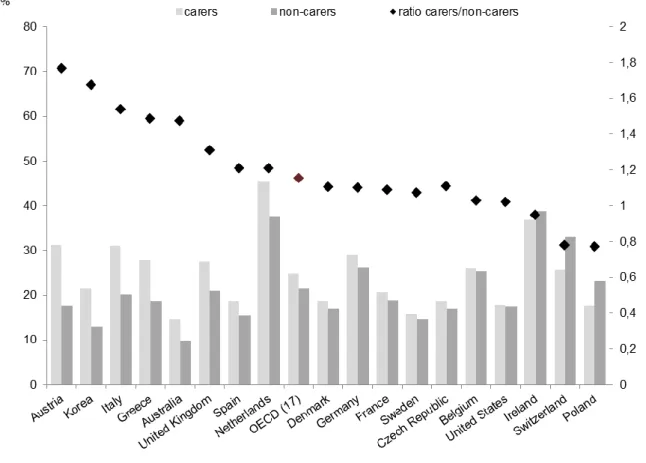
Informal care means more stress for the relatives and limits their own gainful employment, even though informal care is mostly only given in less intensive areas and in fewer hours (Colombo et al. 2011). From a welfare state point of view, informal care is “less expensive” than comprehensive formal care, but the individual and societal costs are incurred in other areas. These include the massive emotional, mental and physical stress suffered by caregivers and the fact that, all their training notwithstanding, relatives cannot respond to such a situation in the same professional way, providing the same quality, as the formal sector. And caregiving relatives of a working age, up to 65 years of age, reduce their employment volume significantly, that is, work part-time or give up their job entirely (on a temporary basis, perhaps), especially if much care has to be given. The majority of these caregivers are women (Colombo et al. 2011). When giving care to their parents, children reduce their working hours or stop working altogether. How large this effect is depends upon the respective institutional basic conditions (Bolin/Lindgren/Lundberg 2008). To give or support informal care, then, incurs considerable costs in terms of lost employment. Informal care can only replace or complement formal care in less intensive, simple care situations that do not require any special qualification (Bonsang 2009). The opportunities provided by care given within the family should not be overestimated, neither now nor in future. After all, the demographic change also means that fewer potential caregivers are available within the families. And the higher retirement age and larger share of employed women also limits the potential of informal care, as does the larger geographical mobility of employees.
Figure 8: Part-time work among caregivers and non-caregivers aged 50 to 65, mid-2000s
Source: Colombo et al. 2011.
Similarly ambivalent trends can also be discerned in household services. In many EU Member States, these services are traditionally rendered by low-skilled workers in the informal (irregular) market. In some countries with the objective of strategically pursuing increased formal employment, it is being tried to professionalise this segment, although these jobs are often taken when the qualification is low or obsolete and sometimes after long periods of inactivity or unemployment. External service providers’ employment relationships are more standardised, qualification-based and characterised by more attractive conditions than a direct employment in the household.
The Belgian and French voucher models make for a better inclusion in regular employment relationships than mini-jobs in private households in Germany (Gerard/Valsamis/Van der Beken 2011, Sansoni 2009). This can be explained by to the larger role of formal service
advancement opportunities or higher pay scales. In the Belgian system, the bulk of employees are women working part-time; about half of the employees were previously unemployed. The qualification level is below average, the average wage stands at about Euro 10.25 an hour. Evaluations show a remarkable employment stability among employees with mostly permanent contracts of employment, which may be attributed to the limited opportunities for an advancement to other jobs. Since 2007, the Belgian “titres-services“ arrangement includes a training fund partially compensating employers for the costs incurred for the in-house or external training and advanced training they provide for their staff. This fund is co-financed by the government. In 2009, almost 28,000 staff were qualified, i.e. a quarter of all employees in that segment (Gerard/Valsamis/Van der Beken 2011, Sansoni 2009). In the French system, the vocational qualification is not co-financed by a national fund, but is based upon the efforts shown by the association responsible for that segment. Any acquired qualification can be certified. Given the predominance of a direct employment in private households, not too much is known about French domestic help’s working conditions. We can assume, however, that the CESU segment’s employees receive the minimum wage or only slightly more (Sansoni 2009).
3.4
Funding
The shift of eldercare services from the informal to the formal sector, the availability of formal services, their quantity and quality, but also the working conditions of eldercare staff are strongly influenced by to what extent an adequate and sustainable funding is provided. Data on the financing aspect are, again, mainly available for the long-term care sector only. As with employment, there are categorisation and demarcation problems when it comes to the different social security segments, between long-term care and healthcare in particular. Regarding household services - either for the elderly or for all - we only have data for a few countries. There are huge differences between the countries when it comes to expenditures on personal care services. With 1.3 per cent of its GDP (Gross Domestic Product), Germany, at the end of the 2000s, was below the OECD average. And at 0.9 per cent of its GDP, its public financing rate, from taxes and social contributions, is remarkably low. The Dutch or Swedish rate stands at 3.5 per cent of GDP, in France the number is 1.7 per cent. These ratios also apply to long-term care expenditures per capita.
Figure 9: Long-term care expenditure in % of GDP, in 2008 or the latest available year
Source: Colombo et al. 2011 (OECD Health Data).
In an international comparison, it is not only the expenditure levels that vary, but also the structure of funding. While in almost all countries there is a mixed financing, we can still discern some distinct patterns. In most countries, taxes and, in part, social insurance funds finance almost all care activities, in other countries private households play an important role, either by having taken out private insurance policies or by out-of-pocket payments. According to OECD data (Figure 11), Germany is to be found among the countries with the highest share of private financing (including private long-term care insurance). Regarding public financing, there is a difference between countries with a more or less tax-financed system (Austria, Denmark, Sweden, Spain and others) and those with a huge share of social insurance funds (e.g. Germany, Poland, Belgium, Netherlands).
Figure 10: Long-term care funding by sources in %, 2007
Source: Colombo et al. 2011 (OECD Health System Accounts).
Funding arrangements can also set incentives for using eldercare services, since they more or less promote and facilitate the delivery of formal services (and jobs). In general, the expenditure level is closely tied to the formal employment level, as can be seen in Figure 11. Public funding is thus an important factor for mobilising the formal labour market’s employment potential. Long-term care systems with lower expenditure mean more dependence upon informal care capacities, which also often attract some public support. But the employment structure is also determined by the type of the predominant care services. Rendering in-kind services means a large number of formal employees, while non-earmarked cash benefits (e.g. the German nursing allowance) favours informal care and, in part, irregular employment relationships. Cash benefits earmarked for eldercare services in the formal sector increase the competition among service providers, but they also stimulate the creation of formal jobs.
Figure 11: LTC expenditure and employment, in 2008 or the latest available year
Source: Colombo et al. 2011 (OECD Health Data).
All European countries face huge challenges regarding the sustainable funding of eldercare services. The familial care potential, less expensive for the welfare state when compared to the formal sector, is going to decline, given the demographic change and a more pronounced employment integration of women. At the same time, the share of the elderly is increasing. All in all, formal personal and household services for the elderly will require more resources over the coming years and decades. According to available projections, the share of those activities in the GDP will rise considerably (Colombo et al. 2011).
Eldercare services also provide more employment opportunities because according to all projections the share of caregivers in the workforce will increase. However, the growth potential of the market for eldercare services and job creation can only be realised if funding is based on sustainable structures and necessary reforms are implemented. If not, and bearing in mind the increasing demand for eldercare services, all the financing bottlenecks or compulsory savings so typical of ageing societies will be very detrimental to the availability and quality of (formal) eldercare services. A sustainable public financing of personal care services and also of the promoted forms of household services has become a central political issue in most countries.
try to save funds or make their use more efficient. In many countries, including Sweden (Fukushima/Adami/Palme 2010) and Denmark (Schulz 2010), there is a clear trend towards home care, overall less expensive than institutional care. And in systems with predominantly public services, like the Scandinavian countries, informal care and services by alternative - including private - providers are promoted and the share of private financing is increased. This means more competition in social services, which may have an effect upon both the quality and the working conditions. We should also mention strategies to increase productivity and to reduce the staffing requirements.
But there are also reforms supposed to yield more revenues for the eldercare sector and entail a broader public funding, but above all more private co-financing in form of private supplementary insurances or out-of-pocket payments.
Eldercare services excluding nursing care depend upon institutional basic conditions as well. In labour markets that are characterised by high social contributions and tax burdens there is strong competition between formal services on the one hand and family work or shadow economy activities on the other. In such a situation, household services will only be rendered mostly in the formal sector if, either through a targeted reduction of taxes and social contributions or through subsidies, the wedge between gross labour costs and net earnings is reduced to an extent that makes formal services (when compared with illicit employment) affordable for potential users and, at the same time, attractive in terms of pay for those delivering them. That is why in many countries household services are, to a certain extent, tax deductible. Germany aside, this is the case in Denmark and Sweden, where 50 per cent of the annual expenditure on household services falling below a certain threshold are tax-deductible.
While voucher systems with no specific funding, like the one in Austria, are not used very much, since they do not reduce the cost differential between formal eldercare services and illicit employment to any sufficient extent, the funding models in France and Belgium are more effective (IWAK 2011).
In order to create a formal market for eldercare services, fight illicit employment and improve the opportunities of the long-term unemployed and low-skilled workers, since 2004 Belgium has operated a multi-level programme of government grants called “titres-services“. This provides for the annual purchase of a maximum of 750 service cheques worth EUR 20.80 for one working hour at a price of EUR 7.50 (2,000 vouchers p.a. for households that include children, for the elderly or disabled). Approximately two thirds of each voucher is therefore subsidised. Registered user households can also deduct up to 30 per cent of their expenditure on vouchers below a threshold of EUR 2,510 from their income tax. This means that one working hour costs users no more than EUR 5.25. In 2010, the system had 760,000
users, which amounts to about 8 per cent of the Belgian population (about 9 per cent of pensioner households). The average redemption rate stood at 124 vouchers p.a., which is a bit more than two hours a week. In 2010, about 2,600 companies with almost 140,000 employees operated in that segment. One should bear in mind, though, that the Belgian model does not provide for a direct employment in private households and only external service providers can be employers. About 650 vouchers per member of staff were charged. The Belgian model is based upon government grants of about EUR 1.4bn p.a.. The revenues from additional taxes and social contributions generated stand at EUR 360mn and savings in social security benefits amount to EUR 260mn, which makes for net costs of about EUR 800mn (adjusted for companies’ earnings: about EUR 730mn). Taking account further economic effects such as more employment on the part of the users, the estimated net costs stand at EUR 260mn to 380mn, which is about a quarter of the gross costs. Surveys among the user households show that this funding model has indeed played a part in the shift away from the informal sector. The bulk of the users is also quite content with the services’ quality (Gerard/Valsamis/Van der Beken 2011, Sansoni 2009).
In France, the expenditure on service vouchers (CESU) for gainfully employed people (not for pensioners) are 50 per cent tax-deductible, up to a threshold of EUR 12,000 p.a. Another EUR 1,500 can be deducted per child and elderly person, up to a maximum of EUR 15,000. The threshold for disabled people stands at EUR 20,000 p.a.. Low-wage workers can receive a tax credit of EUR 1,500 at maximum. If external service providers are used, a reduced VAT (value added tax) rate of 5.5 per cent is applied; direct employment in the household leads to a reduction in the employer’s social contributions or, for the disabled or elderly (of more than 60 year of age), they are dispensed with in their entirety. For companies, these expenditures are exempted from social contributions up to EUR 1,830 p.a. and member of staff. Further, a maximum of 25 per cent of the expenditures of up to EUR 500,000 p.a. can be claimed as tax-exempt. In 2008, the government expenditures on the CESU sector are said to have stood at EUR 510mn (Sansoni 2009). Currently, the CESU is used by about 1.5mn households in France (660,000 thereof use CESU social). About 500,000 service providers operate in this market, predominantly as employees in private households, followed by private companies’ employees. They are thus also integrated in the social security system and entitled to paid leave. Approximately 17,000 sponsors issue pre-paid service cheques. The French system also needs large subsidies. But it has indeed formalised the market for household services, at least in part. This includes the establishment of wage agreements and training and advanced training structures, so important for a professionalisation of this sector. There is also some evidence of a decline in illicit employment. Older studies, of the programme’s predecessor, found a reduction in illicit employment from 50per cent in 1996 to
the subsidisation (Williams/Windebank 2009).
The French and Belgian examples show that there is a huge potential for formal household services (outside nursing care), which can be utilised provided that government grants cut down labour costs to such a level that makes these services affordable. Both models are based upon a general and permanent subsidisation and a very simplified registration and settlement procedure. It is also striking that both in France and in Belgium external service providers are strongly involved and that therefore this is not about direct employment in private households alone. In contrast to Belgium, the French model includes external sponsors like employers in the co-financing; on a voluntary basis, to be sure, but supported by tax incentives. This reduces the direct government grants required.
By having established a formal market with companies providing eldercare services (household services in particular), both countries differ from Germany. While the German household cheque procedure also provides for a simplified registration of domestic helps, these are employed as mini-jobbers by the private household. The tax break worth 20 per cent of the expenditures of up to a maximum of EUR 510 p.a. basically means that the state does without the social contributions. If there are employment relationships subject to social insurance contributions, 20 per cent of up to a maximum of EUR 4,000 can be claimed as tax-exempt. The German model is also fragmented. A direct employment in the private household as the prime objective aside, home services (skilled manual work, but also nursing and child care) can be claimed as tax-exempt at 20 per cent of the payroll costs of up to a maximum of EUR 4,000 and renovations by tradesmen at 20 per cent of up to a maximum of EUR 1.200 p.a. But this subsidisation is much smaller than that in France and Belgium. This explains the overall very low number of about 240,000 mini-jobs in private households (at about 40,000 employment relationships that are subject to social insurance contributions). This has not reduced illicit employment (estimates provide for a number of 95 per cent of all households using household services) to any appreciable extent. The French and Belgian examples show that a targeted funding policy can indeed mobilise otherwise untappable employment potentials, even for previous recipients of benefits and low-skilled workers. In Germany, we also have such potentials, whose size can be derived from a comparison with countries of a higher job density in that area (Enste/Hülskamp/Schäfer 2009, Eichhorst/Tobsch 2007, Reinecke et al. 2011).
4
Conclusion and outlook
– learning from a European
comparison
This European comparison of eldercare services shows a huge variety in how these services are rendered. Germany is characterised by an overall rather comprehensive and universal long-term care system with appropriate quality assurance standards. This forms the right basis for eldercare services delivered in accordance with the individual needs. At the same time, it should be noted that in Germany the number of jobs in the formal sector of personal and household services for the elderly is comparatively small when measured against the demographically determined demand. The financing volume in the care sector is also rather limited. And the field of formal household services is structurally underdeveloped. When we look at other European countries we see that when implementing suitable institutional reforms one can improve the provision of formal services in both personal and household services and better utilise the existing employment potential. This has a positive impact upon caregiving relatives in particular, who are then, in part, relieved of that burden. And against the backdrop of an increasing cost pressure in the public long-term care systems we can also find reforms that can dampen costs: a shift from institutional care to home c