econ
stor
Der Open-Access-Publikationsserver der ZBW – Leibniz-Informationszentrum Wirtschaft The Open Access Publication Server of the ZBW – Leibniz Information Centre for Economics
Nutzungsbedingungen:
Die ZBW räumt Ihnen als Nutzerin/Nutzer das unentgeltliche, räumlich unbeschränkte und zeitlich auf die Dauer des Schutzrechts beschränkte einfache Recht ein, das ausgewählte Werk im Rahmen der unter
→ http://www.econstor.eu/dspace/Nutzungsbedingungen nachzulesenden vollständigen Nutzungsbedingungen zu vervielfältigen, mit denen die Nutzerin/der Nutzer sich durch die erste Nutzung einverstanden erklärt.
Terms of use:
The ZBW grants you, the user, the non-exclusive right to use the selected work free of charge, territorially unrestricted and within the time limit of the term of the property rights according to the terms specified at
→ http://www.econstor.eu/dspace/Nutzungsbedingungen By the first use of the selected work the user agrees and declares to comply with these terms of use.
zbw
Leibniz-Informationszentrum Wirtschaft Leibniz Information Centre for EconomicsDreher, Axel; Gassebner, Martin
Conference Paper
Do IMF and World Bank programs
induce government crises An empirical
analysis
Proceedings of the German Development Economics Conference, Zürich 2008, No. 13
Provided in cooperation with:
Verein für Socialpolitik
Suggested citation: Dreher, Axel; Gassebner, Martin (2008) : Do IMF and World Bank programs induce government crises An empirical analysis, Proceedings of the German Development Economics Conference, Zürich 2008, No. 13, http://hdl.handle.net/10419/39913
An empirical analysis
Axel Drehera Martin Gassebnerb
Preliminary version – Do not quote January 2008
Abstract
We examine whether and under which circumstances World Bank projects and IMF programs affect the likelihood of major government crises. Using a sample of more than 90 developing countries over the period 1970-2002, we find that crises are on average more likely in the presence of Bank and Fund involvement. While the effect of the IMF to some extent depends on the model specification, the impact of the World Bank is shown to be robust to the choice of control variables and method of estimation. We also find that governments face an increasing risk to enter a crisis when they remain under IFI programs when the economy performs better. The (economic) conditions present when a new IFI program is initiated, however, do not play a major role for crisis probability. Finally, only programs concluded by the current government affect crises, while those inherited by preceding governments do not.
Keywords: Political Crisis, International Financial Institutions
JEL classifications: D72, F34, P48
Acknowledgements: We thank seminar participants at Yale University for helpful comments and Richard Jong-A-Pin for valuable input to an earlier version of this paper.
a
ETH Zurich, KOF Swiss Economic Institute, Weinbergstrasse 35, CH-8092 Zurich, Switzerland and CESifo, Germany. E-mail: [email protected].
b
ETH Zurich, KOF Swiss Economic Institute, Weinbergstrasse 35, CH-8092 Zurich, Switzerland. E-mail: [email protected].
There is substantial anecdotal evidence that structural adjustment programs by the World Bank and, even more so, the International Monetary Fund (IMF) face severe resistance by those groups in society fearing to be among the losers of these programs’ consequences.1 In some cases IMF and World Bank involvement led to government crises, cabinet changes, or the replacement of entire governments.2 However, there are also countries in which adjustment programs did not end up in major political turmoil (Nelson 1992).
What are the circumstances under which IMF and World Bank involvement harms the governments of the program countries and when is it that the International Financial Institutions (IFIs) do not lead to government crises? While several studies report empirical evidence that concluding IMF programs affects survival rates of political leaders (Smith and Vreeland 2003) as well as the re-election probability of incumbent governments (Killick 1995, Dreher 2004), this question has so far not been investigated. Arguably, this is an important omission. Answering this question gives guidance to governments on the verge of concluding Fund and Bank programs. It might also help the IFIs designing their programs in a way so as not to hurt program countries’ governments. To some extent, knowing the circumstances leading to government crises also sheds light on the IFIs’ “scapegoat” function (Vreeland 1999). Can governments blame the IFIs for unpopular policies and thereby reduce the risk of crises? Or do citizens blame their government for the IFIs’ presence and respond with riots and demonstrations, leading to government crises?
We continue as follows. The next section develops our hypotheses. Section 3 presents our data and method of estimation. We first examine whether the implementation of IMF and World Bank programs on average induces government crises.3 In a second step, we investigate the circumstances which yield negative outcomes and separate those from cases in which IMF and World Bank did not hurt the governments. The results are presented in Section 4. To anticipate the main results, we find that IMF and World Bank programs significantly increase crisis probability. We also find that governments face an increasing risk to enter a crisis when they remain under IFI programs when the economy performs better. The (economic) conditions present when a new IFI program is initiated, however, do not play a major role for crisis probability. Finally, only programs concluded by the current government
1
Among the more prominent examples are the general strikes against the IMF’s austerity policy in Argentina in 1992 and 1994.
2
As one example, the Marcos government in the Philippines in 1985 followed the IMF’s austerity policy in spite of severe domestic resistance (Montes 1987). Marcos was finally overthrown by the military. See Dreher (2002) for further anecdotal evidence.
3
To the best of our knowledge, the only existing study that also focuses on IFI involvement and political instability is Sidell (1988). However, Sidell only presents simple correlations for the IMF.
affect crises, while those inherited by preceding governments do not. Finally, Section 5 concludes.
2. The Hypotheses
The record of IMF and Bank involvement can not be considered to be fully successful.4 Although the transmission channel is still unclear, recent empirical studies universally report a negative influence of IMF programs on (short-term) economic growth (e.g., Przeworski and Vreeland 2000, Barro and Lee 2005, Atoyan and Conway 2006, Dreher 2006). Furthermore, according to Easterly (2005), neither Bank nor Fund significantly reduced macroeconomic distortions in program countries. Finally, structural adjustment programs have increased inequality (Pastor 1987, Garuda 2000, Vreeland 2002) and did not reduce poverty in program countries (Hajro and Joyce 2008). It is, therefore, no surprise that the political costs to negotiate IMF and World Bank programs are sometimes substantial. This is clearly documented by Vreeland (1999) who finds that governments expect IMF programs – on average – to reduce their standing with its citizens.
Fund and Bank conditionality sometimes substantially interferes with domestic politics. Apart from the macroeconomic consequences of the IFIs’ involvement, political power constellations are changed. This is likely to be true both within the government and with respect to parties among the parliament more generally. Within the government, it is well documented that the position of the ministers of finance and economy is strengthened vis-à-vis the spending ministries (Buira 2002). Both regarding other ministers or government parties and the (parliamentary and non-parliamentary) opposition, the IFIs can be used as scapegoats for unpopular policies (see Vreeland 1999, Smith and Vreeland 2003). By tying their hands to the IMF program, politicians can overcome domestic opposition and, hence, reduce the probability of a political crisis.
Another channel through which the IFIs are likely to affect political crises is the funds associated with their programs. It is well documented that IMF and World Bank loans are sometimes abused by national governments to secure their power (e.g., Dreher and Vaubel 2004). Governments can use the funds paid out by the IFIs directly for this purpose. Support gained with the help of IFI credit could outweigh the loss of support due to the implementation of the program, which will also reduce the likelihood of a government crisis.
4
For recent surveys on the role and operations of the IMF see Joyce (2004), Vreeland (2006), Bird (2007), and Steinwand and Stone (2008).
Fund and Bank conditionality, on the other hand is frequently accused to follow market-oriented policy prescriptions. Even when the majority of government endorses the program and is willing to implement the policies, other parts of government might refuse the IFIs’ conditionality, giving rise to dissent among the government. Parties of the government coalition might threaten to leave the government, inducing a crisis.
Based on these considerations, the direction of IMF and World Bank involvement on the probability of crises is not a priori obvious and we can only measure the net-effect of the IFIs’ involvement. We hypothesize:
Hypothesis 1: IMF and World Bank involvement affect the probability of crises in the recipient countries.
Arguably, the effect of Fund and Bank involvement on government crises is likely to depend on the success of the program and the development of the economy. For our purposes, it does not matter whether and to what extent the IFIs caused such development. An increase in economic growth, e.g., might be attributed to the IFIs’ programs whether or not these programs actually caused growth. However, when the economy performs well, the scapegoat function of the IFIs looses its value. The threat of terminating the projects is not as binding for opposing views in the government as in harder times. When the economy performs badly, to the contrary, the opponents to the current policy stance are more likely to accept the policy conditions of the IFIs, reducing the probability of government crises. Overall, while the direction of the potential effect is not obvious, we hypothesize:
Hypothesis 2: The effect of IMF and World Bank involvement on crisis probability depends on how the economy evolves over the course of the program.
The analyses in Dreher (2004) and Smith and Vreeland (2003) suggest that the effect of the IFIs involvement is likely to depend on the circumstances under which a program came into effect. Under certain circumstances the IFIs’ programs can help citizens to derive the ‘type’ of their government. If the economy performs moderately, competent politicians do not have to turn to the Fund. They signal their competence by borrowing from the market or other countries. Incompetent politicians, to the contrary, have to turn to the IMF, signalling their incompetence. Clearly, domestic support is likely to suffer, potentially giving rise to government crises. In particular, Dreher shows that governments concluding IMF arrangements prior to a national election generally increase their re-election probability. This
increased probability of getting re-elected after program conclusions decreases, however, with rising GDP growth. The likelihood of losing an election is also higher when other countries in the same region experience higher GDP growth. IMF programs might thus imply a signal about the incumbent’s quality: When growth rates are low, voters accept the necessity to involve the Fund. In a good economic environment, however, only incompetent governments need Fund assistance – and consequently lose office in the next election. According to the empirical analysis in Smith and Vreeland (2003), government survival positively depends on whether the program has been into existence before the current government came into power. In this case, citizens do not blame their government for the existence of the program. The incumbent government can abuse the IFIs as a scapegoat – consequently, instability decreases. We derive two hypotheses from this discussion:
Hypothesis 3: The effect of IMF and World Bank involvement on crisis probability depends on the state of the economy, i.e., economic growth, monetary expansion, inflation, current account balance and international reserves, at the time the program is initiated.
Hypothesis 4: The effect of IMF and World Bank involvement on crisis probability depends on whether the current government turned to the IFIs itself or inherited the program.
3. Method and Data
The regression is a pooled time-series cross-section analysis (panel data). Our annual data cover the years 1970-2002 and extend to more than 90 developing countries.5 Since some of the data are not available for all countries or years, the panel data are unbalanced and the number of observations depends on the choice of explanatory variables.6 Our dependent variable is a dummy taking the value of one in case of at least one major government crisis and zero otherwise. This variable is taken from the Databanks International (2005) Cross-National Time-Series Data Archive. A major government crisis is defined as “any rapidly developing situation that threatens to bring the downfall of the present regime, excluding situations of revolt aimed at such overthrow.”7
As our explanatory variables of main interest we employ two variables indicating Fund and Bank involvement in a country. First, we use a dummy variable that is one if an
5
We omit industrialized countries that never received IMF or World Bank loans. 6
All variables, their precise definitions, data sources and summary statistics are listed in Appendices A and B. 7
The judgment whether this criterion is met is usually coded using information from major international newspapers such as The New York Times. This is common practice in the coding of political event variables. The variable’s definition is adopted from Rummel (1963).
IMF program has been in effect for at least five months in a certain year, and zero otherwise (taken from Dreher 2006). The dummy includes programs under the Funds’ Structural Adjustment Facility and Poverty Reduction and Growth Facility. Second, we use a similar variable for the World Bank, counting the number of loans given for structural adjustment in effect for at least five months in a certain year, according to the definition from the World Bank’s webpage. While countries can only have one IMF program at the time under the facilities covered here, the maximum number of World Bank structural adjustment projects among the countries in our sample is seven (Bangladesh in 1989 and Argentina in 1998 and 1999).
To estimate the impact of Bank and Fund involvement on the probability of major government crises, we resort to a panel discrete choice regression model. We test for the appropriate panel data model using the Hausman test, testing the null-hypothesis that all country fixed effects equal zero by comparing the estimates of a conditional fixed effects logit model (see Chamberlain 1980) and the unrestricted (pooled) logit model. The null-hypothesis of no country specific effects is rejected at conventional levels of significance for all model specifications. Hence, conditional fixed effects are used.
We want to ensure that our findings are not biased by temporal dependence in the data. Therefore, we employ Beck et al.’s (1998) remedy to test and correct for temporal dependence. Beck et al. (1998) show that panel logit data are identical to grouped duration data and suggest dealing with this problem by adding a series of dummy variables to the model marking the number of years since the previous occurrence of an “event.” Cubic splines, along with a count variable for the number of years since the last major government crisis, approximate a Cox regression, which allows for non-parametric estimation of duration dependence. The approach is equivalent to including a series of dummy variables that “count” the number of non-crisis years. Thus, there is a dummy variable coded one for country-years without major crisis for exactly one year and 0 otherwise; another dummy coded one for country-years without crises for exactly two years and 0 otherwise, another for three years without crisis, etc. Note that with a long time-series like ours, the dummy variable approach would entail over 30 additional variables. The splines serve to approximate the same controls with fewer variables by essentially grouping similar types of observations. We follow Beck et al. (1998), who suggest three splines to be sufficient. The empirical test for the relevance of temporal dependence is a F-test on the three cubic splines and the years since the last crisis. For our sample the four temporal dependence variables are jointly significant at the one
percent level in all estimations. For more details on the method, we refer readers to Beck et al. (1998).
As one potential problem, IMF and World Bank programs might be triggered by the same set of underlying factors also triggering a government crisis. When we fail to explicitly control for these factors, our results might reflect some common cause interdependency and would as such be spurious. In order to address the potential endogeneity problem, we replicate the analysis using the dynamic panel GMM approach developed by Arellano and Bond (1991), Arellano and Bover (1995), as well as Blundell and Bond (1998). Clearly, assuming a linear probability for the existence of an IMF program is no perfect solution. However, as Janvry et al. (2006) and Hyslop (1999) argue, such linear probability models are more tractable and flexible in the handling of unobserved heterogeneity than linear probability models are. Still, in the GMM estimations we use the number of crises per year and country rather than the dummies for the occurrence of any crisis as dependent variable. We use the two-step estimator implemented by Roodman (2006) in Stata, including Windmeijer’s (2005) finite sample correction, introducing the lagged dependent variable and dummies for each year.8 We treat the lagged dependent variable and the two IFI variables as endogenous and the additional covariates as strictly exogenous. We report results of the Sargan-Hansen test on the validity of the instruments used (amounting to a test for the exogeneity of the covariates), and the Arellano-Bond test of first and second order autocorrelation. While autocorrelation of first order prevails by definition, second-order autocorrelation must be absent in order for the estimator to be consistent. As a way to minimize the number of instruments in the regressions we collapse the matrix of instruments as suggested in Roodman (2006).9 As a consequence, the number of instruments amounts to 122 for our basic setup.
As preliminary test for the exogeneity of the IFI’s involvement in a country, we also follow a second strategy: We compare the (unconditional) probability of a major government crisis before and after the first involvement of either IFI. For the World Bank the probability of a government crisis is 9.1 percent before the first time the World Bank is first involved and 14.8 percent afterwards. According to a Chi-squared test this difference is significant at the 1 percent level. In case of the IMF the probabilities are 10.9 percent before the first involvement and 13.3 percent afterwards. The p-value for the corresponding Chi-squared test is 0.055. Both non-parametric tests support that causality runs indeed from IFI involvement to an
8
The lagged dependent variable and the time dummies allow at least to some extent to take the temporal dependence into account in the GMM estimations. Moreover, Roodman (2006) suggests to include time dummies as the inclusion prevents contemporaneous correlation of the error term.
9
As demonstrated by Bowsher (2002) this is necessary as the power of the Sargan-Hansen test is weak if the number of instruments is large.
increased probability of a major government crises. The next section presents the estimation results.
4. Empirical Results
Using the conditional fixed effects approach with time-dependency we first replicate the findings of Gassebner and Jong-A-Pin (2007). Using a general-to-specific approach and Extreme Bounds Analysis (see Sala-i-Martin 1997) they examine which variables are robustly related to major government crises. These robust variables are: the type of political regime and its duration, several variables proxying for political violence (guerilla warfare, assassinations and purges) and several variables that proxy for mass civil protest (demonstrations, riots and general strikes).10
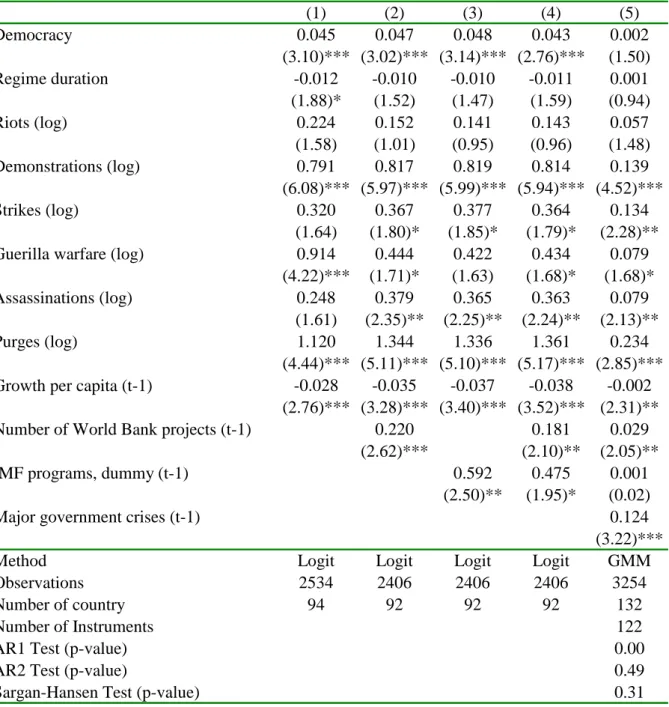
Column 1 of Table 1 shows our base model.11 The results suggest that major government crises are more likely in more democratic political systems. As one explanation, parties in such systems can easily express their opinion on controversial policies and events. If opinions differ widely, this may ultimately trigger a crisis. In autocratic systems there is likely more pressure from above to prevent such chain of events from the beginning.
The significantly negative coefficient of the regime duration variable reflects that new political regimes face more political turmoil than long lasting regimes. This result can be explained by the fact that newly established (democratic) regimes do not have much experience with political consensus. In newly established regimes there is often a transition phase in which new institutions are built. As the stakes are high, partisan political parties will not be inclined to give in on issues related to the formation of these institutions, with government crisis as ultimate consequence. Furthermore, we find crises to be significantly more likely with mass civil protest and political violence, represented by the significant coefficients of demonstrations, guerilla warfare, and purges.12 Finally, the results show that economic growth in the previous year reduces the likelihood of a government crisis. In a nutshell, prosperous times have an conciliatory effect.
In turn, we examine whether Fund and Bank involvement does affect the probability of a major government crisis. In specifications 2-4, we add our variables of main interest. According to the results, the probability of government crises is strongly affected by World
10
Arguably, some of these variables might also be affected by the presence of Fund and Bank. When omitting the proxies for political violence and civil protests, however, most of the results reported below remain unchanged.
11
Note that duration dependence is strong in our data. Countries are likely to experience several government crises closely after each other.
12
To minimize the potential influence of extreme observations we use the logarithm of all these count variables (and added one to all values to avoid missing observations).
Bank programs. At the one percent-level of significance, Bank involvement increases crisis probability. The corresponding marginal effect implies that each World Bank structural loan received in the previous year increases the probability of a major government crisis by 5.4 percent.13 The effect of IMF programs seems to be even bigger. The estimated coefficient is significant at the five percent-level, while the corresponding marginal effect suggests that the involvement of the IMF in the previous year increases the probability of a major government crisis by 14.70 percent. Column 4 shows that these findings prevail when we include the IMF and World Bank variables at the same time. The corresponding marginal effects change to a probability increase of 4.46 percent for a lagged World Bank project and 11.82 percent for an IMF program.14
Column 5 reports results employing the GMM estimator. One drawback of this setup is that the resulting coefficients can no longer be interpreted as probabilities. Regarding our variables of main interest the results show that crises are still more likely with the number of World Bank projects, at the five percent-level of significance. The IMF program dummy, however, is no longer significant at conventional levels.
In order to test our second hypothesis, we replicate the analysis including proxies for the contemporaneous state of the economy. We thereby assume that people judge the role of the IFIs according to recent economic developments. We use the following variables: economic growth per capita, consumer price index, monetary expansion, current account balance, and foreign reserves in months of imports, all taken from the World Bank’s (2006) World Development Indicators. In addition to including the variables itself, we add their interaction with the IFIs programs (both lagged by one year). Note, however, that interpreting the interaction effect in non-linear models (such as conditional fixed effect Logit) is not analogous to linear models. A simple t-test on the coefficient of the interaction term is not sufficient to see whether the interaction is significant. As demonstrated by Ai and Norton (2003), the interaction effect takes the following form:
), 2 1 )( 1 ( ) )( ( ) 1 ( 1 12 2 2 12 1 12 2 1 2 F F F x x F F x x F − − + + + − = ∂ ∂ ∂ β β β β β (1) with ( ) 1 1 β X e F − +
= and being the two variables forming the interaction and the interacted variable, respectively. The
12 2
1,x ,x
x
β’s are the corresponding coefficients indexed accordingly. If one of the interacted variables is a dummy (as in our case the IMF variable),
13
All marginal effects are estimated at the mean of all explanatory variables and setting the fixed effects to zero. 14
Note that we also tested for the impact of official development aid (in percent of GDP) and GDP per capita. While the resulting coefficients are completely insignificant, our results are not changed by their inclusion.
however, we instead have to calculate the discrete difference with respect to the dummy variable of the single derivative (with respect to the continuous variable). In contrast to linear models, the significance of the interaction term depends on all variables included in the model.
Table 2 shows the GMM estimates, where we include the proxies for the state of the economy and their interaction with World Bank projects to the base model of Table 1.15 As the t-statistics of the interaction terms are meaningless in the Logit regressions, we do not report the results in the table. Instead we show the graphical representation of the magnitude of the interaction effects and their confidence bounds for significant interaction terms.
According to the results of the Logit estimations, the interaction of World Bank projects with most of our proxies is not significant at conventional levels. The exception is international reserves. Figure 1a depicts the magnitude of the interaction effect of World Bank loans and international reserves. As documented in the equation above, the value of each variable for each observation influences the respective interaction effect. We thus calculate the effect for each observation in our sample. Additionally we calculate the 90 percent-confidence interval for each interaction effect. As can be seen in the figure, the interaction effect is significant from large share of the observations. We thus conclude that the interaction between World Bank loans and international reserves affects the probability of government crises. However, we are not interested in the interaction effect as such but in the marginal effect of a World Bank project. The marginal effect amounts to
), 1 ( ) ( 2 12 1 2 F F x x F − + = ∂ ∂ β β (2) where F and theβ’s are defined as above and are World Bank projects. Again, all values
of all variables influence the marginal effect and this effect is conditional on the level of international reserves ( ). We show the result in Figure 1b. As can be seen, for very low levels of reserves the effect of the World Bank is not statitically different from zero. Accordingly, in bad economic situations World Bank projects do not increase the probability of a government crisis. This is likely to reflect the scapegoat function of the Bank. If countries need the support of the Bank, unpopular policies can be attributed to the Bank, increasing cohesion among the government, and reducing the risk of a crisis. If reserves are above a certain threshold (in our case approx. 2.9 months of imports), an additional World Bank project increases the probability of a crisis at the ten percent level at least. The largest
2 x 1 x 15
We treat the lagged dependent variable, the IFI variable and the interaction variable of the IFI and the proxy for the state of the economy as endogenous.
marginal effect is an increase by almost 20 percent, while the average significant effect is around 6 percent. Consequently, the scapegoat function seems to loose its value when reserves are sufficiently high and World Bank support is less desperately needed.
Note, that the GMM results shown in column 5 of Table 2 support this interpretation. At the ten percent level of significance, World Bank projects increase the risk of a crisis when reserves are high, while international reserves as such decrease the probability of a crisis at the five percent level of significance. To calculate the marginal effect of an additional project, we again have to take account of both the conditioning variable (international reserves) and the interaction term. This is not only true for the magnitude of the effect but also for the significance level (see Friedrich, 1982). We therefore show the total marginal effect conditional on reserves graphically. On the y-axis we show the marginal effect of an additional World Bank project and on the x-axis the level of reserves at which the marginal effect is evaluated. Moreover, we include the 90 percent-confidence interval in the graph. As can be seen in Figure 2a, in line with our results of the conditional fixed effects setup an additional World Bank project increases the probability of a crisis (at the ten percent level at least) if international reserves are greater than 2.9 months of imports. In the GMM setup the magnitude of this effect is much larger which is due to the fact that it does not represent a probability.
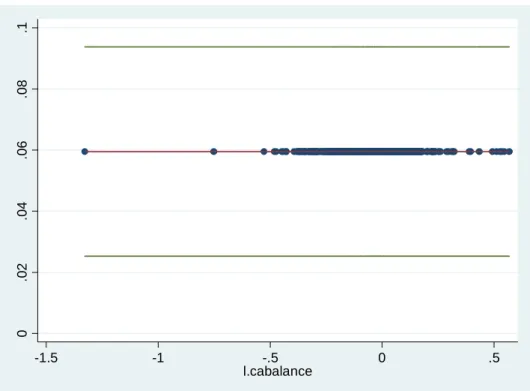
The GMM estimates of Table 2 show that the result for international reserves does hold for the current account balance also. At the one percent level of significance, the interaction of World Bank projects and the current account balance increases the probability of government crises, while the current account balance itself is not significant at conventional levels. We show the marginal effect of an additional World Bank project conditional on the current account balance in Figure 2b. While the interaction term is statistically highly significant the coefficient is so small that the marginal effect is virtually constant.
Table 3 replicates the analysis for the IMF. Note that all interaction terms are not significant at conventional levels of significance according to the Logit estimates. As can be seen in column 3 of Table 3, however, the interaction of inflation and IMF programs is significant at the ten percent level in the GMM setup, with a negative coefficient (while inflation itself is not significant at conventional levels). Figure 3 reports the corresponding marginal effect of IMF programs conditional on the rate of inflation. The result supports our hypothesis that the scapegoat function of the IMF is more valuable at rough times. With rising inflation, government crises are less likely to arise as a consequence of IMF programs.
In summary, there is some evidence in favour of Hypothesis 2. The state of the economy does matter for the effect of the IFIs programs. However, rather than being able to profit from potentially successful programs, governments face an increasing risk to enter a crisis when they remain under an IFI program when the economy performs better.
Tables 4 and 5 add our proxies for the state of the economy in the year a new program is initiated. Table 4 reports the GMM results for the World Bank. As can be seen, the conclusion of a World Bank program as such does not induce a government crisis. More importantly, the conditions when a new program is started also do not seem to matter. The same is true in the conditional fixed effects setup. All interaction terms are not statistically different from zero. We thus suppress the graphical output.
Table 5 replicates the analysis for the IMF. The results mirror those obtained for the World Bank. Hence, there is no emprical support for Hypothesis 3. The (economic) conditions which are present when a new IFI program is initiated do not seem to play a major role.
Finally, we investigate whether and to what extent governments can blame their predecessors for the IFIs’ involvement, thereby avoiding the increasing risk of crises as a consequence of this involvement (Hypothesis 4). We therefore separate our IFI variables in two groups of programs. The first group of programs has been negotiated by the preceding government, so that the current government can not be blamed for their existence. The second group contains programs that the government itself agreed to, and is thus responsible for.
The results of Table 6 support our hypothesis. Only programs concluded by the current government affect crisis probability. This is true for World Bank projects according to all specifications, at least at the five percent level of significance, and for IMF programs according to the Logit estimates when the World Bank variables are excluded. IMF and World Bank programs negotiated by preceding governments do not affect crisis probability in any specification. The corresponding meginal effect (again evaluated at the mean of all explanatory variables and the fixed effects set to zero) are 8.44 percent and 7.55 percent for the World Bank and 17.03 percent for the IMF.
5. Conclusions
In this paper we examined whether and under which circumstances IMF and World Bank projects induce major government crises in borrowing countries. In addition to testing whether the IFIs’ involvement per se affects crisis probability, we also investigated how the effect of the IFIs depends on the current economic situation in the borrowing country.
Moreover, we argued that the economic situation at the time the project is concluded affects crisis probability. Finally, we hypothesize that projects should be less harmful to the government when inherited from preceding governments.
According to our results, structural adjustment projects significantly increase crisis probability. For the Bank, this central finding persists after a wide array of robustness tests, while the impact of the IMF is not entirely robust to the method of estimation. We also find that governments face an increasing risk to enter a crisis when they remain under IFI programs when the economy performs better. The (economic) conditions present when a new IFI program is initiated, however, do not play a major role for crisis probability. Finally, only programs concluded by the current government affect crises, while those inherited by preceding governments do not.
Our results bear important policy implications. Arguably, while countries do on average increase the risk of entering a crisis after turning to the IMF and the World Bank, the extent of the crisis depends on how the economy evolves over the IFIs’ involvement. This insight might help governments choosing the right time to exit their programs.
References
Ai, C. and E. C. Norton, 2003, Interaction Terms in logit and probit Models, Economics Letters 80, 1:123-129.
Arellano, M. and S. Bond, 1991, Some Tests for Specification for Panel Data: Monte Carlo Evidence and an Application to Employment Equations, Review of Economic Studies
58, 2: 277-297.
Arellano, M. and O. Bover, 1995, Another Look at the Instrumental Variable Estimation of Error-components Models, Journal of Econometrics 68, 1, 29-51.
Atoyan, R. and P. Conway, 2006, Evaluating the Impact of IMF Programs: A Comparison of Matching and Instrumental-Variable Estimators, Review of International Organizations 1, 2: 99-124.
Barro, R. J. and J.-W. Lee, 2005, IMF-Programs: Who Is Chosen and What are the Effects?
Journal of Monetary Economics 52, 7: 1245–1269.
Beck, N., J. N. Katz and R. Tucker, 1998, Taking Time Seriously: Time-Series-Cross-Section Analysis with a Binary Dependent Variable, American Journal of Political Science, 42, 4: 1260-1288.
Bird, G., 2007, The IMF: A Bird’s Eye View on Its Role and Operations, Journal of Economic Surveys 21, 4: 683-745.
Blundell, R. and S. Bond, 1998, Initial Conditions and Moment Restrictions in Dynamic Panel Data Models, Journal of Econometrics 87, 1: 115-143.
Bowsher, C. G., 2002, On Testing Overidentifying Restrictions in Dynamic Panel Data Models, Economics Letters 77, 2: 211-220.
Buira, A., 2002, An Analysis of IMF Conditionality, University of Oxford, Department of Economics Working Paper 104.
Chamberlain, G., 1980, Analysis of Covariance with Qualitative Data, Review of Economic Studies 47, 1: 225-238.
Databanks International, 2005, Cross-National Time-Series Data Archive, 1815-2003, Binghamton, NY.
Dreher, A., 2002, Die Kreditvergabe von IWF und Weltbank: Ursachen und Wirkungen aus politisch-ökonomischer Sicht, unpublished Ph.D. dissertation, Mannheim University. Dreher, A., 2004, The Influence of IMF Programs on the Re-election of Debtor Governments,
Economics & Politics 16, 1: 53-76.
Dreher, A., 2006, IMF and Economic Growth: The Effects of Programs, Loans, and Compliance with Conditionality, World Development 34, 5: 769-788.
Dreher, A. and R. Vaubel, 2004, Do IMF and IBRD Cause Moral Hazard and Political Business Cycles? Evidence from Panel Data, Open Economies Review 15, 1: 5-22. Easterly, W., 2005, What did Structural Adjustment Adjust? The Association of Policies and
Growth with Repeated IMF and World Bank Adjustment Loans, Journal of Development Economics 76, 1: 1-22.
Friedrich, R. J., 1982, In Defense of Multiplicative Terms in Multiple Regression Equations,
American Journal of Poltical Science 26, 4: 797-833.
Garuda, G., 2000, The Distributional Effects of IMF Programs: A Cross-Country Analysis,
World Development 28, 6: 1031-1051.
Gassebner, M. and R. Jong-A-Pin, 2007, Determinants of Government Crisis, mimeo.
Hajro, Z. and J. Joyce, 2008, A True Test: Do IMF Programs Hurt the Poor? Applied Economics, forthcoming.
Hyslop, D., 1999, State Dependence, Serial Correlation, and Heterogeneity in Intertemporal Labor Force Participation of Married Women, Econometrica 67, 6: 1255-1294.
Janvry, A., Finan, F., Sadoulet, E. and R. Vakis, 2006, Can conditional cash transfer programs serve as safety nets in keeping children at school and from working when exposed to shocks? Journal of Development Economics 79, 2: 349-373.
Joyce, J.P., 2004, The Adoption, Implementation and Impact of IMF Programs: A Review of the Issues and Evidence, Comparative Economics Studies 46, 3: 451-467.
Killick, T., 1995, IMF Programmes in Developing Countries - Design and Impact
(Routledge, London).
Marshall, M. G. and K. Jaggers, 2002, Polity IV Project: Political Regime Characteristics and Transitions, 1800-2000, http://www.cidcm.umd.edu/inscr/polity/.
Montes, M., 1987, Macroeconomic Adjustment in the Philippines, 1983-85, Philippine Institute for Development Studies, Working Paper Series 8701.
Nelson, J. M., 1992, Poverty, Equity, and the Politics of Adjustment, in: S. Haggard and R. R. Kaufman, eds., The Politics of Economic Adjustment: International Constraints, Distributive Conflicts, and the State (Princeton University Press, Princeton, N.J.) 221-269.
Pastor, Jr., M., 1987, The Effects of IMF Programs in the Third World: Debate and Evidence from Latin America, World Development 15, 2: 365-391.
Przeworski, A. and J. R. Vreeland, 2000, The Effect of IMF Programs on Economic Growth,
Roodman, D., 2006, How to Do xtabond2: An Introduction to “Difference” and “System” GMM in Stata, Center for Global Development Working Paper 103.
Rummel, R. J., 1963, Dimensions of conflict behavior within and between nations, General Systems: Yearbook of the Society for General Systems 8, 1-50.
Sala-i-Martin, X., 1997, I just ran two million regressions, American Economic Review 87, 2: 178-183.
Sidell, S. R. (1988), The IMF and Third World Instability: Is there a Connection?
(MacMillan, Basingstoke).
Smith, A. and J. R. Vreeland, 2003, The Survival of Political Leaders and IMF Programs: Testing the Scapegoat Hypothesis, in: G. Ranis, J. R. Vreeland and S. Kosack, eds.,
Globalization and the Nation State: The Impact of the IMF and the World Bank
(Routledge, New York) 263-289.
Steinwand, M. and R. Stone, 2008, The International Monetary Fund: A Review of the Recent Evidence, Review of International Organizations, forthcoming.
Vreeland, J. R., 1999, The IMF: Lender of Last Resort or Scapegoat?, Yale University. Vreeland, J. R., 2002, The Effect of IMF Programs on Labor, World Development 30, 1:
121-139.
Vreeland, J.R., 2006, IMF program compliance: Aggregate index versus policy specific research strategies, Review of International Organizations 1, 4: 359-378.
Windmeijer, F., 2005, A Finite Sample Correction for the Variance of Linear Efficient Two-step GMM Estimators, Journal of Econometrics 126, 1: 25-51.
Table 1: Hypothesis 1 – Government Crisis and IFI involvement (1) (2) (3) (4) (5) Democracy 0.045 0.047 0.048 0.043 0.002 (3.10)*** (3.02)*** (3.14)*** (2.76)*** (1.50) Regime duration -0.012 -0.010 -0.010 -0.011 0.001 (1.88)* (1.52) (1.47) (1.59) (0.94) Riots (log) 0.224 0.152 0.141 0.143 0.057 (1.58) (1.01) (0.95) (0.96) (1.48) Demonstrations (log) 0.791 0.817 0.819 0.814 0.139 (6.08)*** (5.97)*** (5.99)*** (5.94)*** (4.52)*** Strikes (log) 0.320 0.367 0.377 0.364 0.134 (1.64) (1.80)* (1.85)* (1.79)* (2.28)**
Guerilla warfare (log) 0.914 0.444 0.422 0.434 0.079
(4.22)*** (1.71)* (1.63) (1.68)* (1.68)*
Assassinations (log) 0.248 0.379 0.365 0.363 0.079
(1.61) (2.35)** (2.25)** (2.24)** (2.13)**
Purges (log) 1.120 1.344 1.336 1.361 0.234
(4.44)*** (5.11)*** (5.10)*** (5.17)*** (2.85)***
Growth per capita (t-1) -0.028 -0.035 -0.037 -0.038 -0.002
(2.76)*** (3.28)*** (3.40)*** (3.52)*** (2.31)**
Number of World Bank projects (t-1) 0.220 0.181 0.029
(2.62)*** (2.10)** (2.05)**
IMF programs, dummy (t-1) 0.592 0.475 0.001
(2.50)** (1.95)* (0.02)
Major government crises (t-1) 0.124
(3.22)***
Method Logit Logit Logit Logit GMM
Observations 2534 2406 2406 2406 3254
Number of country 94 92 92 92 132
Number of Instruments 122
AR1 Test (p-value) 0.00
AR2 Test (p-value) 0.49
Sargan-Hansen Test (p-value) 0.31
Notes: Columns (1)-(4) show the results of conditional fixed effects Logit regressions controlling for temporal dependence. The dependent variable is 1 if there was at least one major government crisis in a given country and year. Column (5) represents the result of dynamic panel GMM estimation including time fixed effects. The dependent variable in column (5) is the number of major government crises in a given country and year.
The absolute value of the z statistics is given in parenthesis. */**/*** indicates significance at the 10/5/1- percent significance level.
(1) (2) (3) (4) (5) Democracy 0.003 0.004 0.003 0.004 0.012 (1.71)* (1.82)* (1.84)* (1.86)* (1.78)* Regime duration 0.000 0.002 0.001 0.000 0.005 (0.17) (1.38) (0.83) (0.40) (1.54) Riots (log) 0.049 0.059 0.038 0.043 0.050 (1.50) (1.55) (0.97) (1.21) (1.29) Demonstrations (log) 0.129 0.137 0.142 0.138 0.149 (4.52)*** (5.31)*** (4.66)*** (4.61)*** (4.41)*** Strikes (log) 0.134 0.120 0.154 0.139 0.115 (2.47)** (2.32)** (2.91)*** (2.48)** (2.00)** Guerilla warfare (log) 0.072 0.061 0.069 0.086 0.068
(1.33) (1.13) (1.24) (1.60) (0.90) Assassinations (log) 0.081 0.038 0.070 0.060 0.053 (2.14)** (0.85) (1.75)* (1.53) (1.40) Purges (log) 0.202 0.198 0.207 0.176 0.178 (2.46)** (1.79)* (1.97)* (1.99)** (1.78)* Growth per capita (t-1) -0.002 -0.002 -0.003 -0.004 0.001
(1.47) (1.04) (1.93)* (2.04)** (0.24) Number of World Bank projects (t-1) 0.028 0.060 0.040 0.036 -0.066 (2.02)** (2.86)*** (1.77)* (1.45) (1.08) WB projects (t-1) • growth p.c. (t-1) -0.003
(0.84)
Current account balance (% of GDP), (t-1) -0.747 (0.62) WB projects (t-1) · current account (t-1) 8.23E-12
(3.08)***
Inflation (t-1) -5.38E-05 (0.63) WB projects (t-1) · inflation (t-1) -2.35E-06
(0.03)
Monetary expansion (t-1) -1.94E-04 (1.09) WB projects (t-1) · monetary expansion (t-1) 1.07E-04
(0.79)
International reserves (in months of imports), (t-1) -0.140 (2.22)** WB projects (t-1) · reserves (t-1) 0.033
(1.79)* Major government crises (t-1) 0.126 0.149 0.139 0.119 0.146
(3.08)*** (2.69)*** (3.27)*** (2.86)*** (2.67)*** Constant 0.077 0.019 0.066 0.084 0.563 (2.27)** (0.41) (1.91)* (2.24)** (2.10)** GMM GMM GMM GMM GMM Observations 3254 2504 2709 3027 2433 Number of group(wdi) 132 124 120 127 125 Number of Instruments 136.00 135.00 136.00 136.00 135.00 AR1 Test (p-value) 0.00 0.00 0.00 0.00 0.00 AR2 Test (p-value) 0.49 0.38 0.70 0.62 0.23 Sargan-Hansen Test (p-value) 0.66 0.74 0.89 0.30 0.64
Notes: Shows the results of dynamic panel GMM estimations including time fixed effects, where the dependent variable is the number of major government crises in a given country and year.
The absolute value of the z statistics is given in parenthesis. */**/*** indicates significance at the 10/5/1- percent significance level.
Table 3: Hypothesis 2 – Government Crisis, IMF, and current state of economy (1) (2) (3) (4) (5) Democracy 0.002 0.003 0.002 0.002 0.006 (1.13) (1.44) (1.36) (1.49) (1.50) Regime duration -0.000 0.000 0.000 -0.000 0.002 (0.15) (0.28) (0.23) (0.17) (0.81) Riots (log) 0.050 0.057 0.046 0.040 0.061 (1.54) (1.53) (1.15) (1.15) (1.57) Demonstrations (log) 0.101 0.129 0.122 0.113 0.118 (3.83)*** (3.94)*** (3.98)*** (3.56)*** (3.55)*** Strikes (log) 0.170 0.133 0.148 0.165 0.128 (3.67)*** (2.42)** (2.91)*** (3.22)*** (2.26)** Guerilla warfare (log) 0.019 0.044 0.026 0.033 0.035
(0.39) (0.77) (0.49) (0.59) (0.60) Assassinations (log) 0.114 0.059 0.107 0.102 0.061 (3.83)*** (1.43) (2.68)*** (2.69)*** (1.56) Purges (log) 0.221 0.205 0.163 0.160 0.128 (3.43)*** (2.17)** (1.90)* (1.99)** (1.20) Growth per capita (t-1) -0.003 -0.002 -0.004 -0.004 -0.001 (2.76)*** (1.08) (2.75)*** (3.04)*** (0.49) IMF programs, dummy (t-1) 0.008 0.023 0.022 0.000 -0.039 (0.28) (0.60) (0.76) (0.01) (0.34) IMF dummy (t-1) · growth p.c. (t-1) -0.005
(1.24)
Current account balance (% of GDP, t-1) -0.454 (0.52) IMF dummy (t-1) · current account (t-1) 7.14E-11
(0.82)
Inflation (t-1) -4.53E-06 (0.10) IMF dummy (t-1) · inflation (t-1) -0.001 (1.98)*
Monetary expansion (t-1) -2.19E-04 (1.05) IMF dummy (t-1) · monetary expansion (t-1) -1.97E-04
(0.47)
International reserves (in months of imports, t-1) -0.040 (0.71) IMF dummy (t-1) · reserves (t-1) 0.021 (0.55) Major government crises (t-1) 0.112 0.133 0.140 0.117 0.152 (3.26)*** (2.16)** (3.20)*** (2.99)*** (2.73)*** Constant 0.087 0.082 0.075 0.086 0.210 (3.55)*** (1.63) (1.87)* (2.36)** (1.11) Method GMM GMM GMM GMM GMM Observations 3254 2504 2709 3027 2433 Number of group(wdi) 132 124 120 127 125 Number of Instruments 103 103 103 103 103 AR1 Test (p-value) 0.00 0.00 0.00 0.00 0.00 AR2 Test (p-value) 0.53 0.36 0.74 0.56 0.25 Sargan-Hansen Test (p-value) 0.89 0.43 0.71 0.57 0.48
Notes: Shows the results of dynamic panel GMM estimations including time fixed effects, where the dependent variable is the number of major government crises in a given country and year.
The absolute value of the z statistics is given in parenthesis. */**/*** indicates significance at the 10/5/1- percent significance level.
Table 4: Hypothesis 3 – Government Crisis, state of economy at new World Bank loan (1) (2) (3) (4) (5) Democracy 0.004 0.004 0.004 0.003 0.007 (2.06)** (1.93)* (2.08)** (1.75)* (1.56) Regime duration 0.000 0.000 -0.000 0.001 0.002 (0.36) (0.15) (0.19) (0.65) (0.77) Riots (log) 0.040 0.034 0.039 0.030 0.024 (1.32) (0.90) (0.98) (0.84) (0.63) Demonstrations (log) 0.147 0.135 0.139 0.142 0.135 (5.38)*** (4.84)*** (4.40)*** (4.50)*** (4.28)*** Strikes (log) 0.114 0.153 0.160 0.112 0.134 (2.36)** (2.80)*** (3.19)*** (2.10)** (3.08)*** Guerilla warfare (log) 0.069 0.045 0.070 0.065 0.060
(1.40) (0.83) (1.49) (1.25) (1.04) Assassinations (log) 0.081 0.057 0.055 0.061 0.054 (1.96)* (1.36) (1.44) (1.43) (1.37) Purges (log) 0.221 0.168 0.162 0.311 0.301 (2.75)*** (1.87)* (1.45) (2.89)*** (2.46)** Growth per capita -0.007 -0.008 -0.008 -0.006 -0.007
(4.01)*** (4.33)*** (3.61)*** (2.42)** (3.45)*** New of World Bank projects -0.026 -0.037 -0.003 0.012 -0.014
(0.95) (0.48) (0.04) (0.16) (0.11) New WB projects · growth p.c. -0.002
(0.62)
Current account balance (% of GDP) -9.1E-05 (1.14) New WB projects · current account 1.69E-05
(0.27)
Inflation -1.52E-04 (1.26) New WB projects · inflation -8.32E-05
(0.58)
Monetary expansion -0.370 (0.53) New WB projects · monetary expansion 0.153 (0.37)
International reserves (in months of imports) -0.060 (1.43) New WB projects · reserves -0.009 (0.31) Major government crises (t-1) 0.119 0.156 0.143 0.152 0.151 (3.11)*** (3.52)*** (3.24)*** (2.67)*** (3.08)*** Constant 0.103 0.107 0.122 0.075 0.343 (2.54)** (1.90)* (2.48)** (1.35) (1.78)* Method GMM GMM GMM GMM GMM Observations 3279 2764 3077 2594 2526 Number of group(wdi) 133 121 128 125 126 Number of Instruments 138 137 137 136 136 AR1 Test (p-value) 0.00 0.00 0.00 0.00 0.00 AR2 Test (p-value) 0.53 0.54 0.52 0.77 0.83 Sargan-Hansen Test (p-value) 0.37 0.76 0.29 0.50 0.87
Notes: Shows the results of dynamic panel GMM estimations including time fixed effects, where the dependent variable is the number of major government crises in a given country and year.
The absolute value of the z statistics is given in parenthesis. */**/*** indicates significance at the 10/5/1- percent significance level.
Table 5: Hypothesis 3 – Government Crisis, state of economy at new IMF program (1) (2) (3) (4) (5) Democracy 0.003 0.003 0.003 0.005 0.003 (1.94)* (2.05)** (1.70)* (1.34) (1.64) Regime duration 0.000 -0.000 -0.000 0.001 -0.000 (0.00) (0.42) (0.40) (0.22) (0.03) Riots (log) 0.024 0.026 0.028 0.008 0.018 (0.79) (0.84) (0.84) (0.25) (0.56) Demonstrations (log) 0.124 0.123 0.115 0.117 0.131 (4.73)*** (4.81)*** (4.08)*** (4.15)*** (4.88)*** Strikes (log) 0.126 0.143 0.139 0.124 0.131 (2.79)*** (2.65)*** (2.67)*** (2.49)** (2.54)** Guerilla warfare (log) 0.056 0.050 0.052 0.030 0.035
(1.11) (0.75) (0.90) (0.52) (0.72) Assassinations (log) 0.102 0.084 0.097 0.062 0.068 (2.98)*** (2.50)** (2.94)*** (1.69)* (2.02)** Purges (log) 0.164 0.127 0.125 0.315 0.247
(2.59)** (1.60) (1.77)* (2.78)*** (2.54)** Growth per capita -0.006 -0.006 -0.005 -0.005 -0.006
(4.05)*** (3.52)*** (3.06)*** (2.61)** (3.61)*** New IMF programs, dummy -0.031 -0.021 -0.069 0.037 -0.293
(1.31) (0.24) (1.32) (0.14) (1.54) New IMF dummy · growth p.c. 0.004
(0.96)
Current account balance (% of GDP) -0.0000577 (0.67) New IMF dummy · current account -1.12E-04
(0.13)
Inflation -8.59E-05 (0.57) New IMF dummy · inflation 0.000138
(0.73)
Monetary expansion -0.023 (0.70) New IMF dummy · monetary expansion -0.022 (0.33)
International reserves (in months of imports) -0.208 (0.42) New IMF dummy · reserves -1.715 (1.40) Major government crises (t-1) 0.122 0.127 0.130 0.133 0.141 (3.67)*** (2.50)** (2.92)*** (2.52)** (2.65)*** Constant 0.086 0.096 0.098 0.195 0.102 (2.56)** (1.72)* (3.03)*** (1.39) (2.01)** Method GMM GMM GMM GMM GMM Observations 3279 2764 3077 2526 2594 Number of group(wdi) 133 121 128 126 125 Number of Instruments 107 106 106 106 106 AR1 Test (p-value) 0.00 0.00 0.00 0.00 0.00 AR2 Test (p-value) 0.50 0.77 0.67 0.86 0.72 Sargan-Hansen Test (p-value) 0.76 0.95 0.76 0.59 0.77
Notes: Shows the results of dynamic panel GMM estimations including time fixed effects, where the dependent variable is the number of major government crises in a given country and year.
The absolute value of the z statistics is given in parenthesis. */**/*** indicates significance at the 10/5/1- percent significance level.
Table 6: Hypothesis 4 – Government Crisis and inherited IFIs (1) (2) (3) (4) (5) Democracy 0.050 0.049 0.046 0.002 0.002 (3.19)*** (3.17)*** (2.90)*** (1.40) (1.61) Regime duration -0.011 -0.010 -0.011 0.000 0.000 (1.54) (1.48) (1.58) (0.20) (0.13) Riots (log) 0.157 0.077 0.113 0.070 0.029 (1.02) (0.50) (0.73) (1.98)* (0.93) Demonstrations (log) 0.819 0.844 0.835 0.136 0.120 (5.89)*** (6.10)*** (5.97)*** (3.88)*** (4.23)*** Strikes (log) 0.432 0.394 0.429 0.118 0.156 (2.09)** (1.92)* (2.07)** (2.00)** (3.34)***
Guerilla warfare (log) 0.398 0.349 0.341 0.056 0.037
(1.51) (1.33) (1.28) (1.10) (0.73)
Assassinations (log) 0.352 0.379 0.359 0.085 0.112
(2.16)** (2.32)** (2.19)** (2.04)** (3.35)***
Purges (log) 1.353 1.365 1.377 0.193 0.233
(5.06)*** (5.16)*** (5.12)*** (2.34)** (3.57)***
Growth per capita (t-1) -0.040 -0.039 -0.043 -0.002 -0.003
(3.60)*** (3.53)*** (3.80)*** (1.90)* (3.40)*** Number of World Bank projects (t-1), current government 0.344 0.306 0.048
(3.62)*** (3.12)*** (2.55)** Number of World Bank projects (t-1), previous government -0.014 0.005 0.108
(0.09) (0.03) (1.32)
IMF programs, dummy (t-1), current government 0.688 0.425 0.016
(2.45)** (1.45) (0.43)
IMF programs, dummy (t-1), previous government -0.081 -0.121 0.012
(0.19) (0.29) (0.09)
Major government crises (t-1) 0.109 0.122
(2.66)*** (3.28)***
Constant 0.051 0.066
(1.52) (2.50)**
Method Logit Logit Logit GMM GMM
Observations 2314 2355 2289 3127 3215
Number of country 91 90 90 132 132
Number of Instruments 103 88
AR1 Test (p-value) 0.00 0.00
AR2 Test (p-value) 0.94 0.48
Sargan-Hansen Test (p-value) 0.79 0.68
Notes: “Logit” show the results of conditional fixed effects Logit regressions accounting for temporal dependence. The dependent variable is 1 if there was at least one major government crisis in a given country and year. “GMM” represents the results of dynamic panel GMM estimations including time fixed effects, where the dependent variable is the number of major government crises in a given country and year.
The absolute value of the z statistics is given in parenthesis. */**/*** indicates significance at the 10/5/1- percent significance level.
Figure 1: Hypothesis 2 – Government Crisis, World Bank, and current state of economy
Figure 1a: Marginal effects of the interaction term World Bank · international reserves (logit)
-. 0 1 0 .0 1 .0 2 .0 3 .0 4 0 .2 .4 .6 .8 1 Pr(crisesadj|fixed effect is 0)
Notes: The figure depicts the marginal effect of the interaction term between the World Bank loans and the international reserves for the conditional fixed effects Logit regression. Each dot represents the marginal effect for one observation. Also shown is the 90 percent-confidence interval for each marginal effect. Country fixed effects are set to zero.
Figure 1a: Marginal effects of World Bank loans conditional on international reserves (logit)
-. 1 0 .1 .2 .3 0 5 10 15 l.reserves_i
Notes: The figure depicts the marginal effect of World Bank loans conditional on international reserves for the conditional fixed effects Logit regression. Each dot represents the marginal effect for one observation. Also shown is the 90 percent-confidence interval for each marginal effect. Country fixed effects are set to zero.
Figure 2: Hypothesis 2 – Government Crisis, World Bank, and current state of economy
Figure 2a: Marginal Effect of World Bank loan conditional on international reserves (GMM)
0 .5 1 1. 5 0 10 20 30 l.reserves_i
Notes: The figure depicts the marginal effect of World Bank loans conditional on lagged international reserves for the GMM estimations. Each dot represents the marginal effect for one observation. Also shown is the 90 percent-confidence interval for each marginal effect.
Figure 2b: Marginal Effect of World Bank loan conditional on current account (GMM)
0 .0 2 .0 4 .0 6 .0 8 .1 -1.5 -1 -.5 0 .5 l.cabalance
Notes: The figure depicts the marginal effect of World Bank loans conditional on lagged current account balance for the GMM estimations. Each dot represents the marginal effect for one observation. Also shown is the 90 percent-confidence interval for each marginal effect.
Figure 3: Hypothesis 2 – Government Crisis, IMF, and current state of economy -4 0 -3 0 -2 0 -1 0 0 0 5000 10000 15000 20000 25000 l.infl_CPI
Notes: The figure depicts the marginal effect of the IMF dummy conditional on lagged inflation for the GMM estimations. Each dot represents the marginal effect for one observation. Also shown is the 90 percent-confidence interval for each marginal effect.
Appendix A. List of variables, definitions and sources
Variable Definition Source
Major government crises
Any rapidly developing situation that threatens to bring the downfall of the present regime, excluding situations of revolt aimed at such overthrow
Databanks International (2005) IMF programs Dummy variable that is one if an IMF program has been in
effect for at least five months in a certain year, and zero otherwise. Includes programs under the Structural Adjustment Facility and Poverty Reduction and Growth Facility.
Dreher (2006)
World Bank projects
Variable counting the number of World Bank projects in effect for at least five months in a certain year. Includes projects given for structural adjustment, according to the definition from the World Bank’s webpage.
www.world bank.org
Democracy Polity2 score, represents the difference between a countries democracy and autocracy score. Ranges from -10 to 10 with high numbers indicating higher levels of democracy.
Marshall and Jaggers (2002) Regime duration The number of years that a political regime is in place. Marshall and
Jaggers (2002) Riots Any violent demonstration or clash of more than 100 citizens
involving the use of physical force
Databanks International (2005) Demonstrations Any peaceful public gathering of at least 100 people for the
primary purpose of displaying or voicing their opposition to government policies or authority, excluding demonstrations of a distinctly anti-foreign nature
Databanks International (2005) Strikes Any strike of 1,000 or more industrial or service workers that
involves more than one employer and that is aimed at national government policies or authority.
Databanks International (2005) Guerilla warfare Any armed activity, sabotage, or bombings carried on by
independent bands of citizens or irregular forces and aimed at the overthrow of the present regime.
Databanks International (2005) Assassinations Any politically motivated murder or attempted murder of a
high government official or politician
Databanks International (2005) Purges Number of systematic repressions (or eliminations) by jailing
or execution of political opposition within the rank of the regime or the opposition
Databanks International (2005) Economic growth
per capita
real GDP growth per capita in constant (2000) US$ World Bank (2006)
Inflation Inflation, consumer prices (annual percent) World Bank
(2006) International
reserves
International reserves in month of imports World Bank
(2006)
Money growth Money and quasi money growth (annual percent) World Bank
(2006) Current account
balance (percent of GDP)
(Current account balance, Balance of Payments in current US$) / (GDP in current US $)
World Bank (2006)
Appendix B: Summary Statistics
Variable Obs Mean Std. Dev. Min Max
Major government crises 5861 0.16 0.50 0 7
Crisis dummy 5861 0.12 0.32 0 1
World Bank projects 5565 0.29 0.73 0 7
IMF program dummy 5565 0.10 0.30 0 1
Democracy 5017 0.05 7.56 -10 10
Regime duration 4897 22.06 28.00 0 193
Riots (log) 5861 0.15 0.43 0 3.89
Demonstrations (log) 5861 0.22 0.51 0 3.64
Strikes (log) 5861 0.08 0.26 0 2.64
Guerilla warfare (log) 5861 0.11 0.29 0 3.56
Assassinations (log) 5861 0.09 0.33 0 3.26
Purges (log) 5861 0.04 0.20 0 3.56
Economic growth per capita 5680 1.68 6.34 -50.49 89.83
Inflation 3542 56.77 562.24 -21.67 23773
International reserves 3365 3.47 3.05 -0.09 27.08
Money growth 3918 46.83 339.62 -81.70 12513
Current account balance (percent