Smart Content
in the Enterprise
How Next Generation
XML Applications Deliver
New Value to Multiple
Stakeholders
August 2010
by Geoffrey Bock, Dale Waldt, and Mary Laplante
the sponsors of the research informing this report. This work would not have been possible without them. Please see the Sponsor Acknowledgement section for descriptions of providers.
2010 Gilbane Group, a Division of Outsell, Inc. ii
Gilbane Group
A Division of Outsell, Inc. 763 Massachusetts Avenue Cambridge, MA 02139 USA Tel: 617.497.9443 Fax: 617.497.5256
Executive Summary ... iv
Study Highlights... 2
Why “Smart” Content? ... 3
Using This Report ... 4
New Value Propositions for Content ... 6
Connecting Content with Business Levers ... 6
Characterizing Smart Content ... 8
The Business Value of “Smart” ... 9
Focusing on the Customer Experience ...10
Smart Content in Action ... 12
Designing Smart Content ... 12
Enriching Content with Tags and Metadata ... 14
Smart Content Application Landscape ... 17
Smart Content Capabilities ... 18
A Functional View of Smart Content Applications ... 19
Social Publishing Processes ... 21
Conclusion and Gilbane Perspectives ... 23
Evolving Content Capabilities ... 23
Managing the Organizational Change ... 26
Business Prospects for Smart Content ... 27
Appendix A: Developing a Roadmap to Smart Content ... 28
Defining Content Components ... 28
A Little Bit of Semantics Goes a Long Way ... 29
Distributed Authoring and Collaboration ... 30
New Roles and Enhanced Governance ... 31
Appendix B: A Guide to Smart Content Concepts ... 33
Componentization... 33
Content Enrichment ... 36
Enrichment Through Crowd Sourcing ... 40
Dynamic Publishing ... 41
Smart Content In Practice ... 44
Optimizing the Customer Experience: Facing the Challenge of the Web ... 46
Documenting Semiconductor Devices at IBM: Addressing Design Complexity . 50 Towards Smart Publishing at IBM: Facing the Challenges of Technical Documentation ... 56
Single Source Publishing at NetApp: Adopting an Infrastructure for Content Reuse ... 63
Symitar Solutions for Credit Union Management: Documenting Software Modules ... 69
The Warrior Gateway and the Power of Social Publishing: Supporting the Military Community ... 74
List of Figures and Tables
Figure 1. Evolutionary capabilities for content ... 8
Table 1. Design activities for smart content scenarios………. 14
Figure 2. Enrichment activities as integral to the publishing process ... 16
Figure 3. Technology landscape for smart content ... 18
Figure 4. Shared repositories as the functional model ... 20
Figure 5. A functional view of social content processes ... 22
Table 2. Core capabilities for different content technologies ... 24
Figure 6. Component reuse for different views ... 35
Figure 7. Sample of descriptive tag names ... 38
Figure 8. Sample metadata element ... 39
Figure 9. Assigning metadata explicitly ... 40
Figure 10. Content variables and versions ... 43
Figure 11. IBM FileNet P8 as shared repository ... 52
Figure 12. IDCMS with FileNet P8 as a shared respository for DITA content... 59
XML applications have long proven their significant value — reducing costs, growing revenue, expediting business processes, mitigating risk, improving customer service, and increasing customer satisfaction. XML-based solutions driven by reusable, componentized content have brought true innovation to production processes, partnership enablement, and customer interactions.
For all the benefits, however, managers of successful XML implementations have struggled with attempts to bring XML content and applications out of their
documentation departments and into their larger enterprises. Even the most articulate champions find it challenging to communicate XML value propositions to broader audiences. Yet at the same time, companies are beginning to understand how to capture metrics to make business cases, such as cost savings from reuse. Technologies for XML content processes have matured and are widely available at a variety of price points and delivery models. Service providers have developed knowledge and process expertise that can offload much of the work that distracts enterprise users from focusing on their core businesses.
But for all this market readiness, so much XML content value remains untapped. Why is this so? Why do XML applications that have performed well at the departmental level fail to be adopted in other areas of the organization where they can also deliver business benefits? What does it take to break out of the XML application silo? What is the magic formula for an enterprise business case that captures and keeps the attention of senior management?
To answer these fundamental questions and issues related to them, analysts in the XML practice at the Gilbane Group (a division of Outsell, Inc.) set out to investigate the current and emerging landscape of XML applications, looking for insights into where the true obstacles to broader enterprise adoption are rooted. The primary objective of our research was to find out where the common points of failure have been, and why. More importantly, where there have been successes with moving beyond an initial application, we wanted to know why, how, and to what benefit. Finally, we wanted to understand how that experience could be abstracted and universalized so that other companies could learn from it and start mining the value of XML content and applications throughout the enterprise.
Our primary research comprised extended conversations with business and technology leaders within organizations that have deployed at least one XML application in new and innovative ways. Through a series of open-ended questions, we discussed business objectives, development activities, and outcomes. (We are publishing the results of these conversations as a series of case studies that accompany this report.) We combined the knowledge and insight from this research with our industry and implementation expertise as well as our deep knowledge of the XML markets and technologies, drawing on our roles as industry analysts.
The results of our inquiry are reported in this study on Smart Content in the Enterprise: How the Next Generation XML Applications Deliver New Value to Multiple Stakeholders.
The research and analysis led us to make the case for thinking about XML content in a new and fundamentally different way, giving rise to the need for the next generation of XML applications, capabilities, and competencies. Organizations that begin to
understand this will be at the forefront of leveraging content to deliver new value to new stakeholders, including customers.
We cannot thank our study participants enough for the time and effort they contributed to our research. They represent the very best of XML application leadership—talented, passionate, and dedicated to improving practices in their areas of expertise. We are grateful that they chose to share their stories with us and, more importantly, with our readers. We also extend sincere appreciation to our sponsors, who made this important market education possible.
Study Highlights
Drawing on our research, analysis, and experience, this study finds:
A shift from an inward- to outward-facing view of content practices and infrastructures. Key drivers for broader deployments lie in outward-facing customer impact rather than inward-outward-facing operational efficiencies and cost reductions. The connection between content, customers, and business goals and objectives is being articulated in compelling ways by theorganizations that are leading the way.
An emphasis on content utility. The shift to customer impact gives rise to keen attention to the usefulness of content to the user at a specific point in performing a task, first identified as content utility by Gilbane Group’s 2009 study on global product content.1
Delivery as the starting point of application design. Recognizing the value of content utility turns the traditional view of the content life cycle on its head. In the past, we planned and viewed our content processes from creation through delivery. Leading organizations now start by considering the best possible experience with consuming that content and working backwards, building their content management and authoring processes to support the end-goal instead of the other way around.
Enrichment as the new content competency. The emphasis on content utility creates new demand for tools, processes, and skills for enriching content with embedded metadata, represented as XML tags and tag sets, throughout the content life cycle, not just at the point of creation. Developing capabilities1Multilingual Product Content: Transforming Traditional Practices into Global Content Value Chains, July 2009.
in content enrichment will create competitive advantage for companies who do it well.
Social content and computing within content ecosystems. Content development is no longer “owned” by a single organization. Collaboration around enriched content is the defining characteristic of applications that have successfully jumped departmental walls and flowed into the enterprise. As a result, social content and computing are becoming part of the landscape for the next generation of XML applications.
Big impact from modest content enrichment. Flowing XML content into the broader enterprise does not always require a major initiative. Enriching information with just a small amount of metadata can deliver compelling benefits. As initial experiments begin to pay off, leading practitioners are learning to walk the line between under- and over-investing in content resources.Why “Smart” Content?
In our earliest interviews, we noted that when companies succeeded with XML
deployment beyond a single application, adoption was very often driven by the content itself. The remainder of our research supported this observation. The pattern was intriguing. Companies have been creating tagged, structured content for decades. Why was this class of XML content succeeding in attracting broader attention within the enterprise? Clearly there was something fundamentally different about it.
Conventional XML market wisdom has largely held that broader enterprise adoption would typically be imposed, or driven as a “push” force based on an initial success in a department. That there are obstacles on this path from department to enterprise was, in fact, a central premise of this very research. What we discovered, however, is that in many cases, adoption is not a push from an initial success in a department, but a pull based on content value. Customers are rapidly coming to expect accessing just the essential information that answers questions and solves their problems.
The XML content that is driving contemporary enterprise applications is
Granular at the appropriate level
Semantically rich
Useful across applications
Meaningful for collaborative interactionIn this study, we have opted to use the term “smart content” to define this class of content. Smart content is a natural evolution of XML structured content, delivering richer, value-added functionality (as illustrated and discussed later in the section on New Value Propositions for Content).
In our research, we see that when companies invest in making their content smart, the value of the content begins to speak for and prove itself. Barriers to adoption outside of the initial application begin to erode, or at least decline to the point where they become more manageable. Considering how content may be used for multiple purposes, as well
as designing a data model and creation and enrichment processes to meet these goals, is key to creating smart content. This opens the door to thinking about XML content in new and innovative ways, spurring adoption throughout the enterprise.
A Word About DITA
The Darwin Information Typing Architecture (DITA), the OASIS standard2
Within the context of this report, readers are encouraged to think about smart content in its broader sense, and DITA as one instance of that class. In the coming years, other XML standards may capture other aspects of the enterprise market as DITA has. In fact, several industry groups and other organizations have created standards for their stakeholder communities that embrace these smart content concepts, though these may not be as widely adopted or understood as DITA. Building content practices grounded in the principles of smart content, as described in this study, will create a path to competitive advantage, no matter which XML application-level standard suits the business needs of the organization.
for XML architecture for designing, writing, managing and publishing information, figures prominently in the research conducted for this report. Readers will it find referenced throughout, particularly in the customer case studies. DITA is perhaps the most common example of smart content as it is being deployed today, although it is not the only XML schema for creating content that is useful throughout the enterprise.
Using This Report
Smart Content in the Enterprise is designed for two primary audiences:
For managers of XML applications who see a broader opportunity for XML within their organizations. The study will help them learn from the success of others, communicate value, build business cases, and constitute cross-functional teams. The report will also be useful for managers who are in the process of implementing XML and want to ensure that they are designing and building their applications to align squarely with contemporary user and content requirements. We refer to this audience as “operational champions,” a term we coined in Gilbane’s 2008 content globalization research.
For suppliers of technologies and services. The study is meant to help them develop offerings that alleviate pain points and address issues and challenges, and to market and position their products in ways to make their value propositions clear to buyers. We refer to this audience as “product champions.”Our report comprises an analysis of the research, supplemented by a collection of case studies supporting it. The report is organized five sections:
This executive summary
New Value Propositions for Content
Smart Content in Action
Smart Content Technology Landscape
Conclusions and Gilbane PerspectivesFollowing the analysis are two appendices: Developing a Smart Content Roadmap and A Guide to Smart Content Concepts. These supplemental materials present the action-oriented fundamentals and are meant as educational background for readers who are not currently XML practitioners, and operational or product champions. The report concludes with a series of profiles of organizations whose experiences illustrate the real and potential benefits of smart content when it is more broadly deployed within the enterprise.
We realize that operational and product champions (who have designed, implemented, and managed XML and SGML applications over many years) may be familiar with some of the insights presented in this report. But we also appreciate their frustration that executives and managers in other functional areas have not recognized the XML content opportunity.
This research and Gilbane’s experience working with global enterprises clearly show that attitudes towards and appreciation for content are finally changing, opening windows of opportunity for XML-savvy champions to play a role in moving their applications and experience beyond their existing implementations. We hope that this report and the success stories included therein will help drive conversations that accelerate the adoption of smart content applications and the realization of benefits that go with them.
New Value Propositions for Content
Investments in any new technology or practice only deliver value when they are aligned with the larger business goals and objectives of the organization. Our study on smart content therefore starts with a business perspective. What external factors are having impact today on XML-aware content strategies, practices, and infrastructures? Our research surfaced three common influences:
1. The enterprise as network. Global businesses are now completely network-based. In less than two decades, the web has fundamentally transformed business operations, from internal process management to transactions with customers and communications with internal and external stakeholders. 2.Demand for immediacy and interactivity. Instant and always-on
connectivity is not only an expectation but also a requirement for maintaining competitive advantage. Connectivity is clearly related to the second influence on content practices: an expectation of immediate or near-immediate response and high-levels of interactivity in the engagement.
3.Pervasive emphasis on global customer satisfaction. Customer satisfaction, the third significant influence, has always been a primary lever of business success. Since the economic downturn of 2009, however, Gilbane has seen unprecedented executive and operational commitment to delivering customer satisfaction through positive experience. When new revenues are hard to come by, companies put renewed efforts into keeping current customers.
This attitude towards and focus on customer satisfaction is now becoming institutionalized — and so is having a profound impact across all enterprise functions. Customer satisfaction through positive experience is no longer limited to the managers and staff in customer support organizations. It extends to all the ways that companies touch and engage with their customers.
It is at the nexus of these influences — connectivity, immediacy and interactivity, and customer satisfaction and experience — that new value propositions for content take shape.
Connecting Content with Business Levers
Content is a fundamental opportunity to engage customers, deliver satisfying
experiences, and drive revenues. This insight will not surprise operational champions who have long recognized the value of XML or the product champions who are driving technology innovations. Its significance lies in the window of opportunity that it opens and in its implications for enterprise content practices — primary topics of this report. Within forward-thinking companies, we finally see that executives and managers are beginning to understand the business prospects. Content is turning the corner from cost center to profit contribution. And in this way, new value is delivered to new
stakeholders throughout the business ecosystem, including partners, customers, prospects, and global workforces.
As organizations begin to understand how content can deliver new value to new stakeholders, they are shifting their perspectives on their content practices and infrastructures from an inward- to an outward-facing view. It is no longer enough to focus only on internal needs and operational efficiencies. The usefulness of content to its ultimate end-consumer is becoming the primary consideration for investments in practices and infrastructure (people, process, and technology). It is about what happens out there rather than in here that matters most today.
These trends are distilled in two key findings of our research:
At the operational level, a shift from an inward-facing view of content practices and infrastructures to an outward-facing view. Organizations are realizing that their content applications must be driven by external requirements rather than (or at least in addition to) internal needs.
At the content level, an emphasis on content utility. If customer satisfaction is a primary goal, then content must enable satisfying interactions. Organizations recognize this and are building practices and infrastructures based on content utility — the delivery content that is useful at specific points in a business process.To make these assertions less theory and more practical, consider the content-centric business applications implemented within organizations profiled in this report:
Search optimization
Partner management
Customer self-service
Community-based content development and support
Mission-based marketing
Public policy development and communicationIn each case, a need or desire for content utility drives the organization to approach the content application from an external perspective. How will the end-consumers of the content use the information provided to accomplish a business task? How does the organization go about publishing that content and the delivering the experience that goes with it? What are the implications for the content itself?
By looking across our research and our experience working with enterprise users, we can identify a particular set of characteristics associated with the content that drives these applications. That content is:
Granular for flexible use
Rich in descriptive information about the individual components
Useful across multiple applicationsThe first three are defining characteristics of all XML applications; we find, however, that granularity, metadata, and application interoperability take on new meaning for content that is designed with content utility first and foremost in mind. The fourth defining characteristic of smart content is emerging based on social use and value of XML content, which figures prominently in the next generation of XML applications. The rise of collaborative interaction around XML content is another key finding of our research and an important milestone in the evolution of XML applications, as explored later in this report.
Characterizing Smart Content
We believe that these four characteristics come together in the next phase in the evolution of XML content — what we call smart content. When we tag content with extensive semantic and/or formatting information, we make it “smart” enough for applications and systems to use the content in interesting, innovative, and often unexpected ways. Defining various uses of content leads to robust data models and enrichment processes that support multiple purposes for the content, allowing it to meet a broader range of business objectives. Organizing, searching, processing, discovery, and presentation are greatly improved, which in turn increases the underlying value of the information customers access and use.
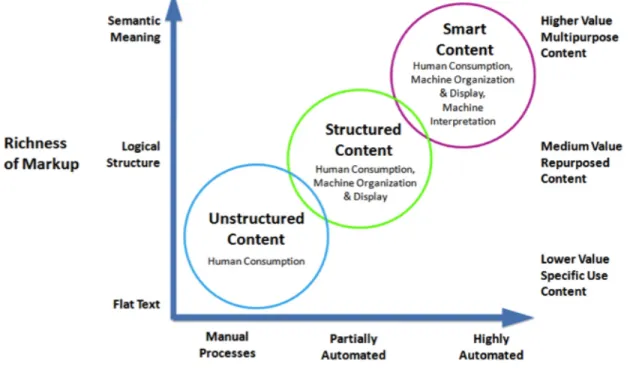
Figure 1 charts the industry’s progression from unstructured content to structured content, and finally to smart content, in terms of automated processes, business value, and the resulting customer experience.
Figure 1 illustrates the range of properties and capabilities of content managed with various tagging strategies, indicating a steady progression of markup richness, process scalability, and content value. Richness of markup is an important technology driver and a key to making content ever more “intelligent.”
Smart content extends the core capabilities of structured content in important and innovative directions. It includes a set of semantic tags and metadata that describe the meaning and relationships among the underlying information resources. Defined by XML, these tags encapsulate a variety of factors such as metadata and attributes
applied to structured elements, semantically named elements that reference predefined taxonomies, and/or presentation elements for high-fidelity rendering.
However the information is enriched and tagged, the results are available to both humans and applications to process. Smart content enables highly reusable content components and automated dynamic document assembly. Smart content enhances precision and recall for information retrieval by tagging content with detailed clues about what it is all about, where it comes from, and how it is related to other content components. In short, smart content helps to develop robust and valuable content ecosystems with highly reprocessable information.
The Business Value of “Smart”
Beyond a Fixed Structure
Many currently deployed XML applications fall into the middle circle in Figure 1 above. Structured content includes well-formed XML documents, compliant to a schema, or even the content managed within relational databases (RDBMs). There is limited intelligence embedded in the content, such as boundaries of elements (or fields) being clearly demarcated, and element names (or metadata) that mean something to both humans and systems that consume the information. Automatic processing of structured content includes reorganizing content, generating navigation aids and tables of
contents, segmenting content into components, rendering it for print or online display, and other predefined processes streamlined by the structured content data models in use. Systems can augment human capabilities and help with the processing within predefined domains.
Structured content is designed to produce predefined results within a defined context. For example, content initially designed to be published as a printed or electronic document can be repurposed for additional formats including viewing in a laptop web browser or on a mobile device. Smart content, by comparison and by design, contains additional intelligence to support multiple purposes to produce results in multiple contexts, often enabled by mash-ups or other automated processes — as directory listings, for example, that are automatically organized by locations and geospatial codes.
From Repurposing to Multipurposing Content
Many organizations have deployed single source structured publishing solutions to achieve efficiencies in their production processes, to repurpose content for new delivery channels, and to address new market opportunities. So why is structured publishing and content repurposing not adequate to meet the needs of organizations developing smart content solutions?
When we repurpose content, we reorganize or reformat it for a use other than the original purpose it was design to satisfy, such as transforming a book (published as a linear document) into a collection of standalone web articles. In a smart content solution, we consider the customer experience and the business value for the content upfront, and build a data model and content production process that meet these multiple purposes from the onset.
Multi-purposing can provide significant advantages over repurposing. Many of the organizations we researched recognize that they can tie their content development process to other business processes more effectively with the right granularity and enrichment. Multi-purposed content can be used for more than documentation by organizing it for both publication and, for example, loading into systems to configure manufacturing equipment. Training material can be more easily used to guide a user through a complex task such as troubleshooting software or hardware. Directory content can be integrated with geospatial information to produce location specific lists of services. In short, multipurpose content is more versatile, flexible, and interoperable that classic structured content designed to be repurposed.
Focusing on the Customer Experience
As our research shows, smart content opens the door to using information in innovative ways throughout an enterprise. Successful organizations that deploy XML content beyond an initial application recognize the need to recast and redefine their content processes to focus on the overall customer experience. They are no longer repurposing content, as a way of transforming information from one use to another, but rather multi-purposing content for multiple business solutions, right from the start.
While many organizations see the value of XML content in their broader enterprise and are even willing to invest in smart content, they fail to recognize that most
departmental XML applications are built on a legacy of linear publishing and self-contained documents. This model no longer delivers sufficient value and, in the digital age, is not sustainable.
We are now seeing the emergence of the next generation of XML applications, based on sets of content components. Successful organizations invest the time and resources to define and maintain their core content components, and apply them to multiple business applications. These organizations are able to manage content components on their own, as discrete objects, rather than as parts of linear publishing processes. Successful organizations are able to focus on identifying the content customers want and expect—and then determine how to organize, store, manage, and deliver it.
The new business proposition for content is all about delivering the information that at minimum meets — and wherever possible exceeds — customer expectations. To make content smart, it is essential to optimize the business value of content components by investing in the information architectural activities required to add relevant metadata. We need to recognize the power of enrichment, together with the capabilities of content component management.
Smart Content in Action
Our research confirms that smart content is current practice, driving familiar business functions like customer support and partner management. The scenarios that follow are hardly hypothetical examples about the application of content components. Rather, they are derived from interviews that we conducted as part of the research for this report and are composite examples of situations based on our case studies.
Search optimization. A software company wants to make sure that essential support information is easily findable by search engines over the web. Lengthy technical manuals with detailed tables of contents made this impossible. The company decomposed the information into discrete content components, the pithy snippets that customers find useful. These components are tagged using an extensive set of support-related index terms, designed to enhancefindability by third-party search engines. Instead of searching sequentially within individual documents, customers seeking support information can search across entire libraries, and even narrow their search using topics and metadata to improve the precision of their results.
Partner management. A semiconductor design organization needs to manage the flow of complex technical information to multiple supply chain partners. Rather than publishing a series of predefined manuals on various topics, the organization tags content by the detailed attributes of various technologies, and then dynamically assembles unique publications for each partner, containing just the information each needs. The organization automatically creates slightly different versions for each recipient without a lot of manual reworking of the content.
Customer self-service. With customers expecting ever more detailed technical support information, a computer manufacturer needs to expand the scope of content produced for its rapidly growing family of products. The company adopts a modular approach to its technical documentation rather than publishing manuals for each product. The firm proceeds to identify discrete content components on a wide range of technical topics, tags components by product attributes, solutions, and other customer-centric capabilities, and then dynamically delivers them as needed to address customer concerns.In each example, the outcomes entail content utility enabled by just-in-time
information delivery – ensuring that customers, business partners, employees, and other stakeholders can easily find the information they need, just at the point when they are going to make a decision or take action. The information is sometimes
assembled and rendered as dynamic documents, and in other cases is simply delivered over the web or to a mobile application as part of an interactive experience.
Designing Smart Content
We believe that these examples highlight a design model for smart content. Too often organizations create and publish content, without considering how customers are going to use the information to meet their business objectives. The emphasis on content
utility—ensuring positive customer experience with content that is useful to the user at a specific point in performing a task — demands that we turn the traditional view of the content lifecycle on its head.
Rather than taking an inward-facing approach and simply focusing on authoring and publishing information, leading practitioners are starting from an outward-facing perspective. Tagging is based on predefined criteria for delivery and consumption, rather than for purposes of internal efficiencies. Content is not only created and managed, but also enriched to optimize the customer experience.
Here are the basic steps for designing smart content.
First, we need to understand all the ways the content is going to be consumed – what customers want and expect, and what they need to know, the limits and capabilities of each delivery channel. Along the way, it is important to capture the business drivers – how content adds value to the organization that is making the investment, and enhances the quality of the customer experience.
Next, we need to plan for enrichment. We need to identify the categories and attributes that capture the model, and define the criteria for segmenting content into its component parts. Often we incorporate the indexing criteria and tags from a predefined taxonomy, a schema, or other externally defined sets of categories. Sometimes we can enrich content in context, by capturing predefined states when the content is created, modified, assembled, or displayed.
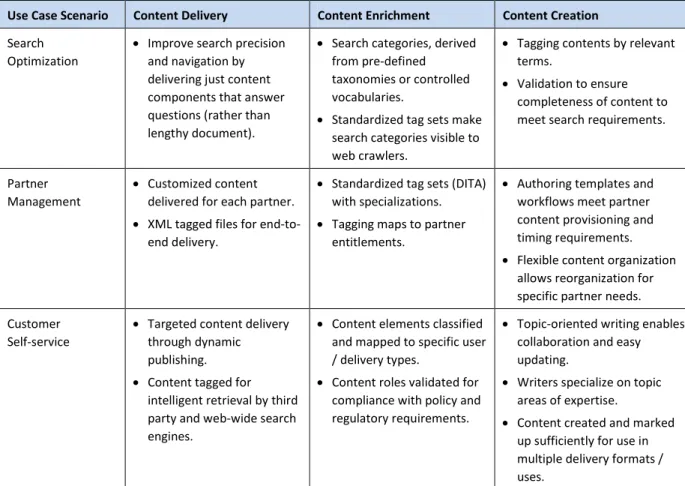
At the point of content creation, we need to embed tags and associate metadata within the content components. In some cases, we need to provide content creators with the tools to tag and organize information, using predefined categories and metadata. Sometimes we tag and categorize content by inferring the context in which it is created and managed. Along the way, we transform authoring, editing, and production processes. Authors and editors are able to develop and publish content in entirely new ways, and expand their reach to meet the needs of new audiences.Table 1 summarizes the design activities for our three application examples. With appropriately defined tags and tag sets, we can enrich the content to enhance the quality of the end-user experience.
Use Case Scenario Content Delivery Content Enrichment Content Creation Search
Optimization
• Improve search precision and navigation by delivering just content components that answer questions (rather than lengthy document).
• Search categories, derived from pre-defined taxonomies or controlled vocabularies.
• Standardized tag sets make search categories visible to web crawlers.
• Tagging contents by relevant terms.
• Validation to ensure completeness of content to meet search requirements.
Partner Management
• Customized content delivered for each partner. • XML tagged files for
end-to-end delivery.
• Standardized tag sets (DITA) with specializations. • Tagging maps to partner
entitlements.
• Authoring templates and workflows meet partner content provisioning and timing requirements. • Flexible content organization
allows reorganization for specific partner needs. Customer
Self-service
• Targeted content delivery through dynamic publishing. • Content tagged for
intelligent retrieval by third party and web-wide search engines.
• Content elements classified and mapped to specific user / delivery types.
• Content roles validated for compliance with policy and regulatory requirements.
• Topic-oriented writing enables collaboration and easy updating.
• Writers specialize on topic areas of expertise.
• Content created and marked up sufficiently for use in multiple delivery formats / uses.
Table 1: Design activities for smart content scenarios
Enriching Content with Tags and Metadata
There is a common thread running through these three examples. All three organizations encounter problems with their conventional (or linear) publishing processes when delivering electronic information that meets their customers’
expectations. Tried and true procedures that initially made sense for print-based linear documents no longer work effectively when delivering interactive content over the web. All three organizations proceed to develop tools, techniques, policies, and procedures for enriching content and making it useful. All three are proceeding to break through the confines of single-use information silos, and make the information widely accessible across networked environments.
Steps for Enriching Content
In fact, all three organizations are in the midst of transforming their publishing
processes in significant ways. These organizations are transitioning from conventional linear process to newer approaches that enable innovative enrichment and delivery capabilities. Each organization is focusing on developing an environment with a high level of content granularity, and where contributors can enrich content by adding tags and metadata to the information as they create and revise it.
Sometimes the enrichment is explicit. For instance, when contributors complete the fields of a form or file content in a content management system, database, or file system, they need to add the subject matter, product related information or other descriptive categories. Sometimes the enrichment is implicit – and is derived from the context in which contributors are operating. For example, contributors may use a predefined template that functions as a style sheet within an editor. This template automatically componentizes and embeds both formatting and semantic tags as part of an editing activity.
When publishing smart content, these organizations perform several important steps where they are able to enrich content in depth.
Enrichment begins with componentizing the information and defining the granular content components.
Next these organizations define the content categories. These are the tags and tag sets that define how the content is used, and how components are related to one another. Wherever possible, leveraging industry standard tag sets (such as DITA) helps to accelerate the design process, and also to generalize the categories beyond single applications.
Then each organization develops its own processes to assign the metadata and tags to the components.We further describe the underlying technical concepts for structuring smart content in Appendix B, "A Guide to Smart Content Concepts."
The end result, however, is a large set of granular content components that are enriched based on a predefined XML schema. Keeping track of all these components is often a chore. Thus, with increasing frequency, organizations are beginning to rely on the capabilities of a component content management system to manage the content
components within the repository, and to structure the organization and application of relevant metadata.
Enriching Content for Smart Publishing
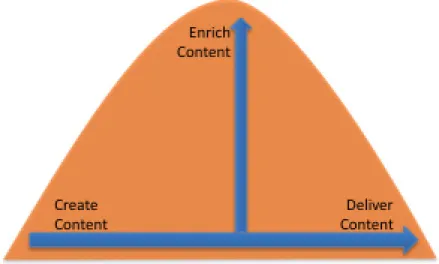
How can we capture the lessons learned from these three organizations? When we produce smart content, there is still a publishing process. But, our capability to enrich content takes on an added significance. No longer are we focusing simply on a linear publishing process where we are first creating and then delivering content.
There is a third dimension, as shown in Figure 2. Organizations must come to terms with how they enrich content as they create and deliver content. We need to take these additional editorial activities to take into account.
Figure 2. Enrichment activities as integral to the publishing process
Of course, content enrichment does not occur in a vacuum. A publishing process is still required to create and manage content. It is essential to model content delivery by how customers utilize the information to solve business problems.
Enrichment is our challenge. Thus it is important to make the transition:
From conventional approaches to publishing, where there are limited opportunities for enrichment
To smart content publishing, where we are producing componentized content with extensively defined tag sets and automatically embedded semantics There is an additional factor to consider – the contributor’s experience. To themaximum extent possible, it is essential to hide the complexity of content enrichment from the contributors who author and edit content on a day-to-day basis. Let’s now turn to the range of technologies available to facilitate enrichment -- what we term the smart content application landscape.
Smart Content Application Landscape
As with all business applications, an opportunity for a smart content solution often starts with conversations and the business case — conversations among thestakeholders with a vested interest in content utility, and the business case to secure funding for related investments in practice and infrastructure. Developing a shared understanding of where the organization is today and where it needs to go is essential to these processes. A very useful approach is to map current capabilities and future requirements on a technology landscape — a high-level view of the various technologies that are relevant to a specific class of business applications.
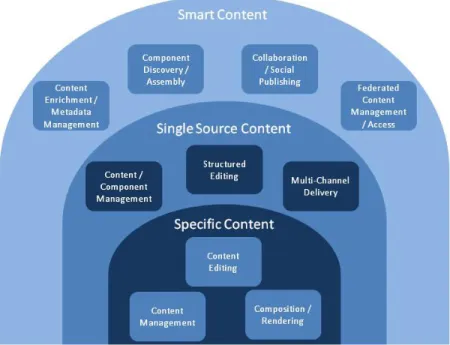
Figure 3 illustrates the technology landscape for smart content. It reflects the evolutionary nature of XML applications, as described throughout this report.
At the center are fundamental XML technologies for creating modular content, managing it as discrete chunks (with or without a formal content management system), and publishing it in an organized fashion. These are the basictechnologies for “one source, one output” applications.
In the middle ring are the technologies that enable single-sourcing—the reuse of content components for multiple outputs. They include true componentcontent management, multi-channel delivery, and structured editing for casual contributors and workflow approval.
The outermost ring includes the technologies for smart content applications, as described below.
Figure 3. Technology landscape for smart content
Operational champions can create a customized view of the smart content landscape by identifying the XML technologies already in place and those that will be required for a smart content application. Such high-level gap analysis can be extremely useful as a means of engaging stakeholders (particularly those in IT) and laying the groundwork for the business case. Creating a visual picture of current state and the requirements for greater content utility (and the related business benefits) makes the opportunity less theoretical, more practical.
Smart Content Capabilities
Smart content solutions rely on structured editing, component management, and multi-channel delivery as foundational capabilities, augmented with content enrichment, topic component assembly, and social publishing capabilities across a distributed network. What capabilities do these enabling technologies bring to smart content applications? It is important to identify how content components are defined, as well as how they are tagged and enriched by predefined sets of metadata.
Content Enrichment / Metadata Management. Once a descriptive metadata taxonomy is created or adopted, its use for content enrichment will depend on tools for analyzing and/or applying the metadata. These can be manual dialogs, automated scripts and crawlers, or a combination of approaches. Automated scripts can be created to interrogate the content to determine what it is about and to extract key information for use as metadata. Automated tools are efficient and scalable, but generally do not apply metadata with the same accuracy as manual processes. Manual processes, while ensuring better enrichment, are labor intensive and not scalable for large volumes of content. A combination of manual and automated processes and tools is the most likely approach in a smart content environment. Taxonomies may be extensible over time and can require administrative tools for editorial control and term management.
Component Discovery / Assembly. Once data has been enriched, tools for searching and selecting content based on the enrichment criteria will enable more precise discovery and access. Search mechanisms can use metadata to improve search results compared to full text searching. Information architects and organizers of
content can use smart searching to discover what content exists, and what still needs to be developed to proactively manage and curate the content. These same discovery and searching capabilities can be used to automatically create delivery maps and
dynamically assemble content organized using them.
Distributed Collaboration / Social Publishing. Componentized information lends itself to a more granular update and maintenance process, enabling several users to simultaneously access topics that may appear in a single deliverable form. Subject matter experts, both remote and local, may be included in review and content creation processes at key steps. Users of the information may want to "self-organize" the content of greatest interest to them, and even augment or comment upon specific topics. A distributed social publishing capability will enable a wide range of contributors to participate in the creation, review and updating of content in new ways.
Federated Content Management / Access. Smart content solutions can integrate content without duplicating it in multiple places, rather accessing it across the network in the original storage repository. This federated content approach requires the
repositories to have integration capabilities to access content stored on remote systems, platforms, and environments. A federated system architecture will rely on
interoperability standards (such as CMIS), system agnostic expressions of data models (such as XML Schemas), and a global network infrastructure (such as the Internet). These capabilities address a broad range of business activities and, therefore, fulfill more business requirements than single-source content solutions.
A Functional View of Smart Content Applications
How do the capabilities in the landscape fit together in a functional application view? Managing content as components remains the defining characteristic of all XML applications, from first generation to today’s emerging smart content applications. An emerging best practice is the implementation of a purpose-built component content management system – a content management system specifically developed to manage large numbers of content components as discrete elements. But it is certainly the case that many organizations begin by managing components with other tools and
technologies, from file sharing to source code control systems.
Regardless of technology, the fundamentals of XML content management stay the same – robust validation and management of content in a generic format suitable for
transformation to a variety of delivery formats. In smart content applications, these enabling technologies are not replaced. Deep experience with them has evolved into additional significant organizational value by allowing them to be used in new ways. It is the new tools for smart content that extend these applications to deliver new content value to an every growing range of stakeholders.
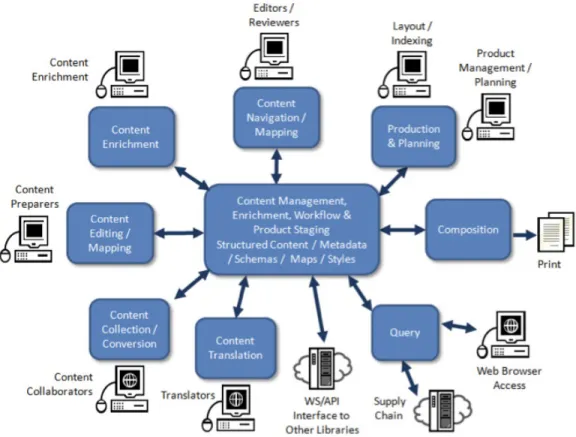
As shown in Figure 4, a shared repository is at the core of smart content applications. This enables multiple contributors with different skills and expertise to easily
collaborate on writing and tagging content as well as managing tag sets. The
environment supports dynamic content delivery in print, over the web, and directly to various applications. Content components are enriched with both structure and semantic tags.
Figure 4. Shared repositories as the functional model
Content contributors can have several different roles. In some cases, these participants may be new to content-centric processes; they might not have served as content
reviewers in the past, for example. The shared repository manages access rights and permissions. It contains all the content components, schemas, style-sheets, document maps, metadata, and other descriptive information used to publish information in multiple output formats and make it widely accessible to external applications over the web.
Content preparation may require people and processes beyond the scope of a
conventional documentation department, such as translation capabilities for producing multilingual content. Also, the shared repository can enable controlled access by
members of an extended enterprise – third party contributors and information supply chain partners -- through a web browser or API.
A variety of different tools can be used to access and edit content.
Documentation specialists may use robust XML structured editors to create and update content.
Casual users may use a browser-based simple editing tool to review content and make quick updates.
External users may access content through queries or dynamic assemblymechanisms that deliver the most current information or a controlled subset of the content based on their rights.
Outside contractors for indexing or other tasks may be given controlled access as well.In short, access to the shared repository, and the tools that support it, can be configured to provide the appropriate functionality for each processing step.
In addition, smart content publishing can leverage the capabilities of a shared
repository to include core workflow capabilities. Workflow processes can be designed to support a distributed team in the creation, review, enrichment, and publishing of content. Some customers and stakeholders for this system may work remotely, while others are part of an internal documentation or editorial team. Work may progress along a set of steps, each of which may spawn automated conversion, transformation, rendering, or other processes.
Social Publishing Processes
Smart content development does not rely exclusively on end-to-end publishing
processes – where authors and editors produce content for delivery to customers. Some very interesting applications are evolving that use innovative content aggregation and crowd sourcing techniques to involve groups of content contributors to publish
information on the web on specific topics. These social publishing processes aggregate content from disparate sources while also providing a framework for groups of editors to curate the content and organize it for dynamic delivery over the web. While one of the leading examples of social publishing is Wikipedia, there are many others across the web.
In our research we explored a content aggregation site that collects and organizes information from government agencies, commercial businesses, and a wide variety of third-party resources. As the information is collected, content creators use tools to add classification information to create enriched content and deliver it to targeted
customers. Social publishing borrows from crowd sourcing, allowing targeted
customers and other stakeholders to add to this content, in the form of comments about the services delivered and recommendations about how to accomplish tasks. The site owners retain the editorial control to reorganize and curate the contributed content. The information collection grows and is refined over time.
Social publishing can be applied to traditionally published content delivered via the web as well as to content aggregations, mash ups, and other types of content delivered on the Internet. For example, a software vendor may rely on its customers for practical trouble-shooting tips. Similarly, customers and fans can enrich restaurant listings and hotel information with reviews and ratings.
Figure 5. A functional view of social content processes
The overview illustrated in Figure 5 shows how smart content might be delivered to other consumption platforms through syndication. In an interesting twist, the original creators of the information, such as a government agency, can actually be consumers of the enriched version of the content they originally provided. The figure also shows how third-party content sources can be incorporated into a real time query/ response process to enrich and integrate content on the fly at request time. For instance, once a request for certain information is received, the server could incorporate additional content (such as geographical coordinates) and use the combined result set to formulate the response back to the requestor.
In short, with the technical infrastructure to support social publishing in place, content contributors can easily maintain content as modular topics that are accessed across a distributed environment. Crowd sourcing is emerging as a powerful addition to the overall publishing process for organizations that want to leverage content, developed by experts, customers, and other stakeholders, to collaboratively solve business problems. Crowd sourcing exploits the capabilities of richly defined metadata, which in turn enable next generation XML applications to deliver added value to multiple stakeholders.
Conclusion and Gilbane Perspectives
Evolving Content Capabilities
How can organizations implement business applications that make content smart? What is it going to take to embed added intelligence into information that enterprises distribute over the web? As described in our case studies, there is a steady evolution of content development capabilities.
Smart content requires granular content components and tagging – innovative capabilities that leading organizations are in the midst of incorporating into their content environments. But equally important is the evolution, rather than the
revolution, of content development. Smart content leverages the capabilities of single source content, which in turn exploits core capabilities of specific content.
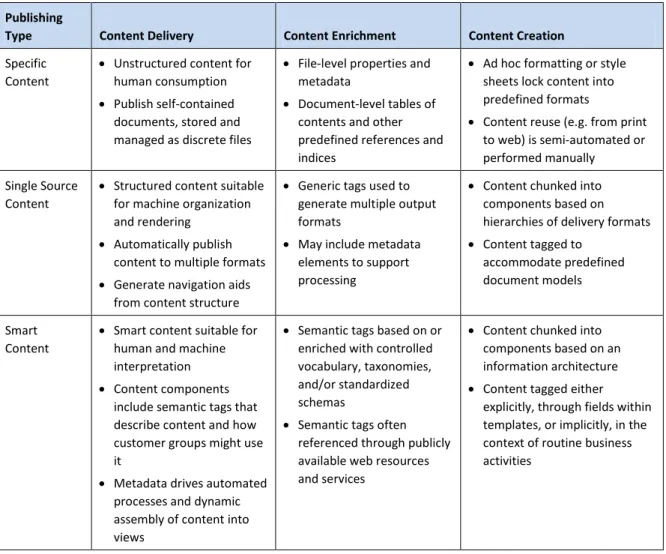
Table 2 characterizes key elements of this evolution, focusing on content delivery, content enrichment, and content creation. It is important to be able to identify how things change.
Publishing
Type Content Delivery Content Enrichment Content Creation
Specific Content
• Unstructured content for human consumption • Publish self-contained
documents, stored and managed as discrete files
• File-level properties and metadata
• Document-level tables of contents and other predefined references and indices
• Ad hoc formatting or style sheets lock content into predefined formats
• Content reuse (e.g. from print to web) is semi-automated or performed manually Single Source
Content
• Structured content suitable for machine organization and rendering
• Automatically publish content to multiple formats • Generate navigation aids
from content structure
• Generic tags used to generate multiple output formats
• May include metadata elements to support processing
• Content chunked into components based on hierarchies of delivery formats • Content tagged to
accommodate predefined document models
Smart Content
• Smart content suitable for human and machine interpretation • Content components
include semantic tags that describe content and how customer groups might use it
• Metadata drives automated processes and dynamic assembly of content into views
• Semantic tags based on or enriched with controlled vocabulary, taxonomies, and/or standardized schemas
• Semantic tags often referenced through publicly available web resources and services
• Content chunked into components based on an information architecture • Content tagged either
explicitly, through fields within templates, or implicitly, in the context of routine business activities
Table 2. Core capabilities of different content technologies
As highlighted in many of our case studies, organizations leverage existing investments in terms of managing documents, content components, tag sets, and metadata. Once they have identified the components, they can further define the metadata over time and in light of experience, to continually make the content smarter and more applicable to different business situations.
More useful content is more valuable content for business operations. It is important to focus on four factors—content granularity, content enrichment, content
interoperability, and content collaboration.
Content Granularity
Content needs to be just granular enough to capture customer expectations.
Organizations need to componentize their content to a level that their target audience will find appropriate and useful. It is essential to identify and tag the atomic elements of a content collection.
Design insight and human judgment are required to determine the elemental
components. In fact, designing for smart content publishing is not unlike book design skills in an earlier era, required for publishing physical artifacts. Excessive granularity creates more effort and complexity to reassemble into deliverables than is justified by the business requirements. Inadequate granularity requires special purpose application development, often coupled with manual efforts, to repurpose the content to meet the business drivers.
Content Enrichment
Enrichment should be just smart enough to meet business needs. Certainly there are many technical ways to enriching content. Organizations need to be able to describe and model how components are interrelated to one another. They need to be able to define tag names and values in a systematic fashion.
Along the way, many organizations will rely on externally defined authoritative resources. For content enrichment to succeed, it is going to become increasingly important to exploit and leverage relevant industry standards. Excessive enrichment requires more effort to maintain than is justified by the business drivers. Inadequate enrichment leaves ambiguities in the content that may require human intervention to overcome.
Content Interoperability
Richly tagged content becomes increasingly interoperable content, useful for
automatically exchanging information among various applications over a network. For instance, directory listings can be combined with geospatial information to produce maps showing services in a specific area. Parameters published in the technical documentation may also be loaded directly into automated manufacturing and production systems to configure them.
Organizations should consider requirements for increasing the interoperability of their content. Any complexity or detail in the data model should be designed to meet a specific business requirement to justify the additional effort to add that detail. With XML tag sets accessible to third parties in standardized formats, smart content may be used in surprising and new ways by external applications in mash-ups, aggregation sites, and other situations.
Content Collaboration
With smart content, there is an ever increasing role for distributed collaboration tools. Organizations can capture the insights from a broad range of content contributors across their information supply chain. Enabling customers and stakeholders beyond core documentation teams to collaborate in the creation, updating, and maintenance of content can improve quality and timeliness.
Tools for collaboration are evolving and can work within client editors or across the network in a thin client browser, enabling both local and remote contributors to participate in content preparation. Collaboration requires some thoughtful governance
with policies and configuration settings to incorporate these stakeholders into the process. In short, smart content and collaboration tools expand the publishing process throughout the enterprise by putting the right content in the right hands for a particular task.
Managing the Organizational Change
The Role for an Information Architect
Moving toward a smart content creation and management environment can be done all at once or gradually in phases. Deciding to migrate slowly through a sequential and deliberative process, or making a radical break from prior activities, requires an understanding the organization’s business drivers and its capacity for managing change. We find both approaches in use in our case studies, as operational champions move beyond departmental-level implementation of XML applications to those that have broad appeal within an enterprise environment.
These champions focus on understanding their organizations’ business requirements and constraints. They proceed with a deliberate plan, based on an information architecture as well as the capability to exploit XML tag sets and metadata.
Time and again we have encountered a new type of content development professional working within an organization – an information architect who focuses on producing the customer experience and who develops the management and delivery plans for enhancing content utility. This person has a deep understanding of what customers need and expect, and has the task of organizing content for satisfying experiences. The information architect engages other stakeholders within the documentation team and across the organization, to chart the end-to-end processes for content development and distribution.
Evolutionary or Radical Change
Whether to promote evolutionary or radical change, there are two schools of thought. The success, of course, depends on the overall management environment and insights into organizational culture.
Many organizations evolve gradually, first adopting XML and related tools to gain the benefits of single source publishing. Then, once an organization is familiar with managing XML tagged content components, teams can further enrich content around semantic topics, adopt powerful end-user oriented editing tools, and add the processes and systems for multi-purposed content delivery. We can identify the roadmap for technology evolution – beginning with specific content technologies, then adopting single-source content capabilities, and finally smart content tools and environments.
Other organization decide to adopt smart content capabilities with a new delivery system, often as an effort to make a radical break from the past or to “leap frog” into a future environment. These organizations begin with an understanding of content componentization and an approach to enrichingcontent. Their approach to component content management is often linked to business value – focusing on delivering a new type of customer experience. It is important to note that enriching content and making it ‘smart’ does not always have to be done immediately, when creating and editing the information. In fact, a phased strategy, starting simple and enriching further in light of business activities, may front load benefits while allowing the organization to manage the cost and
complexity of enhancing content as time allows. Validation and other quality assurance tools can also be added to provide feedback to the author and allows richly tagged data to be created quickly and accurately.
The bottom line is that moving content to a robust XML data model creates a foundation for subsequent streamlining. It also provides useful information and "hooks" into data to support further enhancements such as componentization,
enriching the data, and automating processes. In short, a foundation of XML data is the first step toward a smart content solution.
Business Prospects for Smart Content
Smart content, in short, is tagged with metadata where the information can be
dynamically delivered through interactive environments to mold customer experiences. Smart content is delivered from the “outside in,” based on an understanding of the content utility -- the ways in which multiple stakeholders use the information to solve business problems. Smart content augments customer insights through ongoing enrichment, continuously capturing metadata about how the content is applied and used.
Smart content is an emerging trend over the web today. Our case studies snapshot how different organizations are leveraging current XML capabilities and are also
prospecting for future business opportunities. We anticipate that on the horizon are extensive pools of content components, readily identified by their XML tag sets and able to be dynamically accessed and delivered to solve business problems. The future depends on applications and frameworks being able to manage these semantics (defined as XML tag sets that embed concepts as metadata) at an enterprise scale. To get started, organizations need to become familiar with managing XML tagged content. As a first step, it is important to componentized content and launch a content enrichment initiative. Along the way, an organization needs to adopt the relevant tools and technologies – ones that make sense in terms of its technology infrastructure. From a business perspective, the appropriate level of investment in managing content at a component level goes a long way towards delivering an intuitive, smart, and satisfying customer experience.
Appendix A: Developing a Roadmap to
Smart Content
Creating smart content requires new approaches, processes, and tools. Understanding the requirements for content delivery helps clarify the content creation and enrichment requirements. And by understanding all three, you can gauge your readiness to begin producing smart content.
To assess your organizational readiness for smart content, you need to evaluate your current capabilities and begin to plan for improvements. Here is a checklist of general questions to consider.
Have you identified business drivers where smart content will provide benefits and advantages? Have you defined the challenges for migrating toward a smart content solution? Have you identified the resources and steps needed todevelop a smart content solution?
Do you have a data model in use, or planned, that will support contentmodularization, enrichment, and assembly? Do you have the skills and tools needed to enrich content? Can you provide the tags and metadata necessary for optimizing search and navigation, assembling content components on the fly, or reorganizing content for diverse audiences?
How do you categorize your content? Have you established a taxonomy (or taxonomies) of key categories that are important to your customers and stakeholders? Do you have access to one or more standardized taxonomies – often produced by industry and/or professional groups -- that organize terms in a way that your customers will readily understand?
Do your processes and deadlines support the additional content enrichment steps needed to provide the semantics necessary to support your delivery requirements? Are there automated methods or external audiences that can augment your resources to enrich your content?These questions are designed to help you establish an overall baseline for your organizational readiness. You then need to focus on issues in five areas -- defining content components, managing semantics, distributed authoring and collaboration, information governance, and expanding beyond an initial implementation. Let us consider how each area contributes to your overall roadmap.
Defining Content Components
Content that is managed as stand-alone components can be easily assembled into a variety of deliverable forms. Traditional content is more difficult to reorganize in this way. Components can also have lower-level portions identified as variable content that can be turned on and off for different delivery needs (e.g., DITA uses CONREFs
(content references) for this type of variable content). It is essential to componentize content around business needs and to develop a formal data model that describes the schema for your content components. You will also need to implement the appropriate tools and processes to work with this schema.
Content components can be enriched with specific classification and property metadata in greater detail than traditional document or document-oriented content. While it may require more sophisticated processing tools, this powerful component paradigm gives organizations much more flexibility and efficiency in managing their information. Management of content in modules increases the number of objects being managed. It helps to rely on a content management system and workflow tools to improve the overall management and storage of content components. Structured editing tools (such as DITA-aware editors for DITA-tagged content) can simplify the creation and update of content components. Content management, assembly, and rendering tools are also needed to collect and transform components into page displays and published
documents. These tools may need to work automatically to assemble deliverable products on the fly for timeliness and custom delivery as well.
Unlike the sequential activities required to produce lengthy documents,
componentization also allows authoring and editing to be broken up and performed in parallel. Of course, components will require someone to develop the build lists and maps needed for assembling the information into deliverables, but this also provides an opportunity to create more meaningfully organized assembled deliverables, even to curate the information with more control.
How does your content lend itself to componentization?
Will your authors and editors have to extensively re-write and/or restructure your existing information resources to define stand-alone contentcomponents? Who will do the work?
Does your organization need the type of flexibility that components andvariable content provide to streamline processes for custom delivery, audience-specific organization, and reuse that components can deliver?
Does your business case justify the investment in migrating to a smart content solution all at once, or should you plan on a more gradual evolutionaryapproach to upgrade your systems, data, and processes?
Do you have the content management and workflow management tools and skills to manage your information as components? How robust are your content and workflow management requirements if you move toward componentization?
Can your content development team benefit from parallel work processes?
Can your content use a more flexible and meaningful organization, better targeting of metadata, and curating topics to improve its usefulness and resulting customer satisfaction?A Little Bit of Semantics Goes a Long Way
As we have seen in the discussion above and the related case studies, enriching content with even a small amount of descriptive information can enable streamlined processes and powerful delivery options. A single element or field used to capture classification values can transform