Barriers to Implementing New AEC Project Delivery
Methods within Owner Organizations: Development of a
Process Training Tool
Brian C. Lines, M.S. and Kenneth T. Sullivan, PhD, MBA
Arizona State University Tempe, Arizona
Successful implementation of new business practices is extremely difficult to accomplish within an organizational setting; in fact, the literature suggests that more than half of all organizational change efforts fail to accomplish their original intended goal. Much research has shown that change efforts frequently do not progress past initial implementation efforts before barriers impede success. During this stage of change management, technical barriers typically arise among change recipients, including natural reactions of uncertainty, confusion, and discomfort in how to actually accomplish day-to-day work functions within a new business process as well as a lack of time and clarity for training in how individual technical tasks fit into the holistic change effort. Research efforts to implement value-based procurement and risk management techniques for architectural, engineering, and construction (AEC) projects within large public and private owners have also been observed to encounter these same technical barriers. Within this context, the objective of this research is to develop a training tool to help overcome technical barriers via the Delphi method which iteratively gathered and structured feedback from two expert groups of professionals who had considerable prior experience in change implementation efforts. Following tool development, the research objective was to identify the resultant beneficial impact of this tool on organizational change efforts. Future research is recommended to track the impact of the training tool over multiple longitudinal case studies.
Key Words: Organizational Change, Process Management, Implementation Barriers, Project Delivery
Introduction
As global market competition continues to become more disruptive, organizations in the construction industry are increasingly impacted by an accelerated pace of change including the implementation of new delivery systems, contractual arrangements, risk management techniques, and project planning techniques (Hallencreutz & Turner, 2011).Yet successful implementation of new business practices is difficult for organizations to accomplish. Many literature sources suggest that more than half of all organizational change efforts fail to accomplish their original intended goal (Balogun & Hope Haley, 2004; Maurer, 1996; Pascale et al., 1997).
While it is generally accepted that no single, universal change process can be applied to every organizational change effort, much research has been conducted towards specific implementation actions that can be taken to increase the likelihood of success. A review of influential process models of organizational change revealed that the change management lifecycle can be divided into four general phases: (1) recognizing the need and planning for change, (2) initial implementation to engage frontline employees, (3) expansion of the effort towards the fully intended scale, and (4) institutionalization to make the change “stick” as a normal part of doing business (Armenakis et al., 1999; Burnes, 1992; Galpin, 1996; Hunsucker & Loos, 1989; Judson, 1991; Kanter et al., 1992; Kotter, 1995; and Luecke, 2003). The change process as a whole is extremely complex, with each of individual phase presenting a new set of challenges to those who are leading and managing the change effort as well as those who are on the frontlines of the implementation effort (Judson, 1991). For this reason, the scope of this research was strictly limited to overcoming barriers encountered by change managers during initial implementation. As observed by Kotter (1995), a recognized authority on leadership and organizational change, change management efforts rarely progress to an expansion and institutionalization stage because they typically fail during initiation, planning, and early implementation. The
objective of this research was to (1) define commonly encountered barriers or resistors to change that manifest themselves during initial implementation efforts, (2) develop a training tool to help overcome these barriers within the specific context of implementing value-based procurement and risk management techniques for construction projects, and (3) assess the impact of the developed training tool in assisting organizations via case study
application. The Delphi Method was selected as the methodology to develop the training tool due to its propensity to solicit and combine feedback from multiple groups of expert professionals.
Literature Review: Barriers to Initial Change Implementation
When implementing a new business process, organizations may flounder during initial implementation due to a variety of barriers. One barrier is that change managers struggle with how to best spread the change message and provide the training support necessary to educate frontline employees about how to perform their work functions according to the new system (Kanter et al, 1992). Self and Schraeder (2009) note that it is the responsibility of change managers to provide organizational members with the training and education needed to successfully enact specific tasks within a change initiative, yet change managers have limited time and resources to provide this support.
Additional barriers exist for the frontline employees who are charged with enacting the changes on the day-to-day level of an individual construction project. Jick (1996) stated the first reaction people have to change is often that of shock, because they are unsure of potential outcomes and therefore feel unsafe, which can result in timid reactions and lower levels of productivity. Armenakis et al. (2007) classify this barrier as an issue of efficacy, where
individual employees may perceive that they do not possess the ability to implement the change initiative. Research by Bandura and Locke (2003) showed that individuals commonly avoid activities that they are unsure of or perceive to be above their capabilities; conversely, individuals will undertake those tasks that they deem themselves capable to perform. Also included among initial barriers to change implementation is the perceived lack of time to learn and adopt the change, and unclear perceptions of how the change will result in positive outcomes for both the employees themselves as well as the organization as a whole (Luecke, 2001). Tichy and Ulrich (1984) classified these reactions as “Technical System Resistance,” wherein employees have developed habits within the status quo operations of the organization and are more comfortable doing things “the old way.” Their research showed that employees may be naturally uncertain about how to accomplish day-today tasks within the setting of a new business process, and require training and continuous support to assist their accomplishment of new tasks. These barriers identified in the literature are summarized in Table 1 and are notated as Barrier #1 (B1) through Barrier #6 (B6).
Table 1
Literature: Technical Barriers to Initial Change Implementation
Barrier Description
B1 Change managers possess limited time and resources to provide training to frontline employees about how to accomplish day-to-day tasks
B2 Uncertainty and confusion among frontline employees about how to accomplish new tasks (“how do I do this specific task?”)
B3 Efficacy considerations regarding discomfort and fear of the unknown (“Can I be successful in this unfamiliar process?”)
B4 Lack of clarity with how individual tasks or steps fit within the overall sequence of change efforts (“what do I do next?”)
B5 Lack of clarity with how individual technical tasks align with the overall strategic goal (“what does this task accomplish?”)
B6 Amount of time required for education and training (“learning the new process takes too much time”)
Research Context and Problem
The authors have observed similar barriers in their research efforts to help organizations implement a value-based procurement process and risk management system for delivering their AEC contracts. This system, known as the Best Value Business Model (BVBM), has been tested on more than 900 individual procurements of construction and design services with a total value of more than $2.7 billion. The BVBM has been implemented by more than 80 organizations, generally representing large buyers of construction services in the public and private sectors, including the U.S. Army Medical Command, Arizona State University, State of Oklahoma, University of Alberta, State of Idaho, University of Minnesota, General Dynamics, Harvard University, and Rochester Public Schools. When implementing the Best Value Business Model, organizations undergo several key changes in their procurement and project management processes: (1) a value component is added to the traditional procurement process wherein proposing AEC firms are asked to submit risks they identify to delivering a successful project and provide their proactive risk mitigation solutions; (2) a formal, risk-based pre-planning process is conducted with the highest-rated proposer in order to clarify the plan for project delivery prior to entering into a contract; and (3) a performance measurement system is utilized to track risk against the original contract plan for the duration of project management and delivery.
The traditional method by which organizations implement BVBM is as follows: (1) partner with process managers who are experts who act as Process Managers for BVBM implementation, (2) identify an upcoming procurement of AEC services to function as an initial pilot test of BVBM, (3) select a procurement officer (Owner PO) and project manager (Owner PM) who will run the project with training support by the process manager, (4) implement BVBM on this pilot project with additional testing on subsequent pilot projects with other owner PO’s and PM’s, (5) analyze results, (6) expand to a full BVBM program on the organizational level by tying together multiple individual projects, (7) solidify BVBM as one of the traditional methodologies used by the organization to procure and manage construction contracts. Holistically, the organizational effort to implement BVBM is twofold: first, on the level of individual projects as Owner PO’s and PM’s learn how to use the process on a day-to-day basis to delivery AEC projects, and second, on the level of the overall organizational adoption of the new business process as a part of traditional procurement and contract management methodology for capital construction projects.
The traditional roles within the change implementation effort are shown below. The Process Manager acts as the change manager to train the others, while the Owner PO and Owner PM are both change recipients who participate in hands-on learning to apply the new business process on an individual construction contract.
Process Manager: external researchers who are experts in BVBM and its application to individual projects and organizations. Their function is to act as change managers who educate Owner PO’s and PM’s on the process, while also assisting the selected Contractor PM’s integrate with the process.
Owner Procurement Officer (owner PO): change recipient in charge of the actual procurement of a specific construction contract for the owner organization.
Owner Project Manager (owner PM): change recipient in charge of preplanning and managing a specific construction contract for the owner organization.
In following this change management methodology, the researchers often encountered barriers to success during the first initial pilot projects implemented with a new organization. The barriers observed in the field were similar to the technical barriers identified in the literature, including: change managers were highly constrained on time as they delivered repetitive and basic training to individuals participating on different projects (B1). At the same time, Owner PO’s and PM’s expressed uncertainty with how to accomplish specific tasks within BVBM during their first projects (B2), were uncomfortable with carrying out new tasks and were unsure whether they were being successful (B3), constantly asked “what comes next” after a task was completed (B4), were unclear about what each individual
task was meant to accomplish (B5), and felt rushed to accomplish tasks or were constrained in scheduling training sessions (B6).
Research Objective
The authors’ field observations of implementation barriers over hundreds of BVBM projects confirmed the technical barriers identified in the literature. This lead to the research objective to develop a training tool that would improve the managerial efficiency of Process Managers and simultaneously ease the concerns of Owner PO’s and PM’s who were receiving the training. The intent behind creating such a tool was that, as noted in the literature, change managers are responsible for providing adequate training yet possess limited time and resources. As such, a supplemental training tool to address specific basic and repetitive training aspects for implementing a new business process may be beneficial in increasing the managerial efficiency of Process Managers. Simultaneously, the training tool may reduce the technical barriers observed by change recipients may be reduced by providing additional “how to” training of procedural details on the level of individual construction projects. The scope of this tool was intended to be limited to the second general stage of the change process – initial implementation – to assist in overcoming technical barriers encountered by frontline employees on a day-to-day basis. The developed tool, therefore, does not necessarily reduce major barriers to subsequent change phases of expansion and institutionalization. However, if the objective of improving the success of initial implementation of change is achieved, the benefits may flow
downstream to increase the probability of success in subsequent phases of organizational change.
Research Methodology
The Delphi method was selected develop the content, layout, and platform of the supplemental training tool because it is noted as a structured process that collects feedback from groups of experts over multiple iterative rounds of review and analysis (Skulmoski & Hartman, 2002). Since this particular research problem was impacted by a number of different personnel roles, the Delphi method was seen as being an ideal method to develop a solution due to its widely acknowledged flexibility and propensity to integrate multiple perspectives by structuring group communication to facilitate problem solving (Linstone & Turloff, 1995).
Two professional groups were selected to participate in the Delphi process to develop the training tool. The first group of experts consisted of Process Managers. This group was selected due to their experience in training more than 50 different organizations how to implement BVBM and their experience on hundreds of individual
construction projects utilizing BVBM. The second group consisted of Owner PO’s and PM’s who had direct past experience as Change Recipients who had implemented BVBM on multiple construction projects within their respective organizations. These two groups of expert professionals were also selected due to the fact that they represented both perspectives within the change process: the change managers responsible for conducting training and the change recipients who received the training.
While the number of rounds in a Delphi process is variable and dependent upon the purpose of the research, Delbecq, Van de Ven, and Gustafson (1975) suggested that a two or three iteration Delphi is sufficient for most research. In this study, both expert groups participated in a four round Delphi process, which exceeded the minimum suggested number of rounds in the literature. A total of four rounds were utilized due to the particular nature of the research aims to not only develop the specific training content to be included within the tool, but also to develop the optimal structure, format, and layout of the delivery platform. The four round Delphi process is shown in Figure 1 along with the roles of both participant groups throughout each iteration.
Delphi Round One began with the researchers’ observation that technical barriers appeared have a significant contribution in the historically high rate of abandonment rate of organizational implementation of the BVBM, despite high performance documented on an individual project basis. The proposal to develop a technical education tool was extended to both expert groups – Change Recipients and Process Managers – to confirm their perception of how useful such a tool would be. The response was 97% favorable in rating the needs for and importance of
Delphi Round Two consisted of open-ended interviews with both expert groups to obtain their feedback on what specific content should be included within the education tool. Emergent content categories were identified, showing the major concern areas where the expert groups felt better educational and training support could be provided to assist actual change implementation efforts. This content was organized into the first draft of the tool.
Delphi Round Three began by having both the Process Managers review the educational content as subject-matter experts with vast experience in training organizational personnel in implementing the BVBM. A second, more refined draft of the educational content was developed and incorporated into the actual delivery platform for the tool: a web-site with interactive capabilities that could be accessed at any time by Process Managers and Change Recipients alike. This was then distributed to the both groups for review via individual interviews. Feedback was then utilized to refine the tool further into a third draft, which was functional enough to be released as a Pilot Tool. Delphi Round Four consisted of pilot testing the training tool on its web-based delivery platform. Both expert groups were asked to review the pilot tool and then answered a survey questionnaire regarding the type of impact they felt the tool would have in minimizing barriers to technical implementation of the BVBM. One Change Recipient organization also opted to pilot test the training tool on 7 separate projects. The efficiency of the
educational collaboration between Change Recipients and Process Managers was tracked for these pilot projects and then compared against baseline control group of projects that had not utilized the training tool. Results were found to be favorable, and the additional collected feedback was incorporated to create the final version of the training tool.
Figure 1: Four Round Delphi Process for Development of a Change Implementation Training Tool
Results: The Fully Developed Training Tool
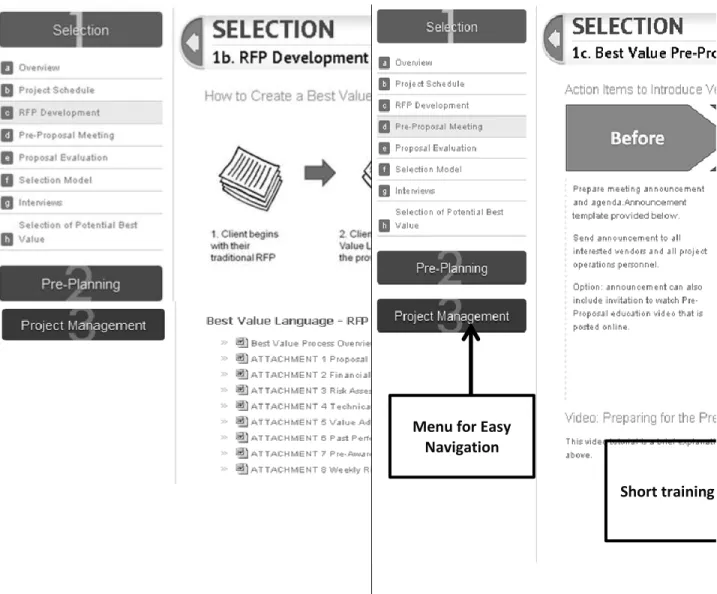
A main goal of the multi-stage, iterative review process of the Delphi Method was to combine feedback from the two groups of expert professionals to drive the development of the training tool’s content, layout, format, and delivery platform. Screenshots of the resultant training tool are shown in Figure 2. Based on the feedback from the two expert groups, the characteristics of the tool are fashioned to address the key technical barriers to initial change implementation that were identified in the literature.
Initial Observation
Confirm Problem Statement
Owner PO’s & PM’s (Change Recipients) Process Managers (Change Managers) Draft 1 Draft 2 D3: Pilot Tool Final Tool
Owner PO’s & PM’s (Change Recipients) Process Managers (Change Managers) Minimize Technical Barriers Process Managers (Change Managers)
Owner PO’s & PM’s (Change Recipients) Delp h i R1 Delp h i R2 Delp h i R3 Delp h i R4 Problem Statement: Technical Barriers Hinder Initial Change Implementation
B1: Change managers possess limited time and resources to provide training to frontline employees about how to accomplish day-to-day tasks. The content of the training tool contains basic process implementation details. When provided to change agents, this content aims to reduce the need for the change managers to provide repetitive training about basic process mechanics, which then increases their ability to address more in-depth and project-specific training.
B2: Uncertainty and confusion among frontline employees about how to accomplish new tasks (“how do I do this specific task?”). The content of the training tool contains basic process implementation details in the form of “how to” guides, short instructional videos, and answers to frequently asked questions for each individual step within the BVBM as applied to an individual project from the perspective of Owner PO’s and PM’s.
B3: Efficacy considerations regarding natural discomfort and fear of the unknown (“Can I be successful in this unfamiliar process?”). The training tool’s content points out common problems that have been encountered by previous users of BVBM. By providing step-by-step guides and addressing common concerns, the tool is intended to address negative efficacy beliefs of change recipients.
B4: Lack of clarity with how individual tasks or steps fit within the overall sequence of change efforts (“what do I do next?”). As can be seen in Figure 2, the training tool has a full menu on the left side which lays out each individual step that must be completed in order to apply BVBM to an individual construction project. Change recipients are therefore enabled to use this as a roadmap to look ahead to see what comes next.
B5: Lack of clarity with how individual technical tasks align with the overall strategic goal (“what does this task accomplish?”). Each step in the training tool contains “how to guides,” and each guide contains a section that discusses the purpose of the individual task being performed and relates the step back to the overall purpose.
B6: Amount of time required for education and training (“learning the new process takes too much time”). The Delphi process developed a web-based training tool. By using an online delivery platform, the training content has continuous availability for change recipients to access and review. This enables them to access the content on their own time, which helps to minimize time constraints.
Figure 2: Two Screenshots of the Web-Based Technical Implementation Tool
Discussion: Impact of Tool Application
Pilot testing of the training tool has seen positive feedback from Change Recipients and Process Managers. The pilot version of the training tool was distributed for review and initial implementation by Change Recipient Owner PO’s and PM’s in 9 separate organizations as well as 5 highly experienced Process Managers. Both groups were surveyed to determine the impact they expect the tool to have based upon their extensive previous experience in implementing the BVBM without the tool. When considering change implementation from a technical standpoint, Change Leaders and Change Agents agreed that the training tool would have a favorable impact on the initial ease of implementation as well as their ability to train new personnel who had not yet been exposed to the change. This is evidenced by their average rating of 9.0 out of 10, which indicated a strong that the training tool would have a strong positive impact on this factor (see Table 2). They also agreed that the training tool would significantly improve Change Recipients’ level of comfort when carrying out technical tasks in accordance with the change effort (8.5 out of 10).
Templates and
documents available
for download
Explanatory
Graphics
Short training videos
Menu for Easy
Table 2
Survey Feedback: Impact of the Training Tool
Survey Question Process
Managers
Change Recipients
Ease of initially implementing the technical aspects of the BVBM
within a project setting 8.0 8.3
Comfort level and ability to become self-sufficient with
implementation of technical aspects of the change 8.5 8.6 Ability to educate internal personnel who have not yet been
exposed to the technical changes 8.8 9.1
1 – 10 Rating Scale, where “1” = strong negative impact; “5” = no impact; “10” = strong positive impact
Conclusion
The research objective was to develop a training tool to support organizational implementation of a new business process – the Best Value Business Model – into their procurement and contract management efforts for AEC projects. The intent of the tool was to help reduce technical barriers to organizational change that are experienced by change managers and change recipients. The literature identified technical barriers as being especially prevalent during initial stages of change implementation when change managers are tasked with assisting change recipients who are first implementing the new process into their day-to-day operations. The researchers have observed these barriers firsthand during field testing of BVBM implementation, providing further confirmation of the existing literature.
The training tool was developed via the Delphi method, which obtained four rounds of iterative feedback from two groups of expert professionals. These experts were selected based upon their experience with past change
implementation with BVBM as well as their differing roles within the change process as Process Managers and Change Recipients. Feedback gathered from both of these groups indicates their belief that the training tool will have a strongly beneficial impact for future organizations that implement BVBM by increasing the comfort level of change recipients during their first exposure to the new business process. Further testing of the final version of the training tool is currently underway.
Future research is planned to consist of longitudinal case studies with separate organizations who aim to integrate BVBM into their traditional business processes. This offers a unique research opportunity to observe and track the progress of multiple different organizations that are implementing identical business models. The success and longevity of these organizational change efforts will be documented via longitudinal case studies. Their success rates can then be compared to historical success rates of organizations who did not utilize the recently developed training tool to minimize technical barriers. If use of the developed training tool continues to reduce the amount of effort and time spent addressing technical, day-to-day tasks, the resultant impact may even further increase the strategic focus during the change effort to improve implementation and long-term sustainability.
References
Armenakis, A., Harris, S., Feild, H. (1999). Making Change Permanent: A Model for Institutionalizing Change Interventions. Research in Organizational Change and Development, Vol. 12, 97-128.
Armenakis, A., Bernerth, J., Pitts, J., Walker, J. (2007). Organizational Change Recipients' Beliefs Scale: Development of an Assessment Instrument. The Journal of Applied Behavioral Science, Vol. 43, pp. 481-505.
Bandura, A., and Locke, E. (2003). Negative self-efficacy and goal effects revisited. Journal of Applied Psychology,Vol. 88, pp. 87-99.
Balogun, J., Hope Hailey, V. (2004). Exploring Strategic Change, 2nd Edition. London, UK: Prentice Hall.
Burnes, B. (2004). Managing Change in Organizations, 4th Edition. Harlow: Prentice Hall.
Delbeq, A., Van de Ven, A., & Gustafson, D. H. (1975). Group techniques for program planning: A guide to nominal group and Delphi processes. Glenview, USA: Scott, Foresman and Company.
Galpin, T. (1996). The Human Side of Change: A Practical Guide to Organization Redesign. San Francisco, CA: Jossey-Bass.
Hunsucker, J., Loos, D. (1989). Transition Management: An Analysis of Strategic Considerations for Effective Implementation. Engineering Management International, Vol. 5, 167-178
Jick, T. (1996). Note on Recipients of Change. Harvard Business School Background Note. (Revised from original November 1990 version).
Judson, A. (1991). Changing Behavior in Organizations: Minimizing Resistance to Change. Cambridge, MA: Basil Blackwell.
Kanter, R., Stein, B., Jick, T. (1992). The Challenge of Organizational Change: How Companies Experience It and Leaders Guide It. New York, NY: Free Press.
Kotter, J. (1995). Leading change: Why transformation efforts fail. Harvard Business Review, Vol. 52, 59-67.
Linstone, H., Turloff, M. (1975). The Delphi method: Techniques and applications. London, UK: Addison Wesley.
Luecke, R. (2003). Managing Change and Transition. Boston, MA: Harvard Business School Press.
Maurer, R. (1996). Beyond the Wall of Resistance: Unconventional Strategies that Build Support for Change. Ausin, TX: Bard Books, Inc.
Pascale, R., Millemann, M., Vakolar, M. (1997). Changing the way we change. Harvard Business Review, Vol. 75, No. 6, 127-39.
Self, D., Schraeder, M. (2009). Enhancing the Success of Organizational Change: Matching Readiness Strategies with Sources of Resistance. Leadership & Organization Development, Vol. 30, No. 2, 167-182.
Skulmoski, G. & Hartman, F. (2002). The Delphi method: Researching what does not exist (yet). Proceedings of the International Research Network on Organization by Projects, IRNOP V Conference, Renesse, The
Netherlands.
Sullivan, K., Kashiwagi, D., Chong, N. (2009). The influence of an information environment on a construction organization’s culture: A case study. Adv. Civ. Eng., 1-10.