1
Susan J. Slaughter, Avocet Solutions
SAS is a great career. It can sometimes be hard to get that first job, but once you have the first couple of years under your belt you will never be without a job.
–Molly Meade Hall
ABSTRACT
In today’s competitive job market, SAS certification can set you apart from the crowd. Designed in tracks – programming, analytics, BI, data management, and platform administration – each SAS certification requires the successful completion of one or more exams. Many people are entering the field of “Big Data”. Earning the only globally-recognized credential endorsed by SAS can validate your knowledge level in this growing area. This paper will provide information about the ‘why’ and ‘how’ of certification.
INTRODUCTION
In writing this paper, we have drawn upon our personal experiences, the remarks shared by new and longtime SAS users we interviewed, and material from our conversation with the Manager of SAS Global Certification and a Certification Developer at the SAS Institute. We have tried to present a variety of viewpoints, and the factors to consider in determining whether SAS certification is an appropriate goal for you. All information was accurate as of August 2014.
OVERVIEW OF CERTIFICATION
Over 67,000 SAS certification credentials have been awarded, 11,908 in 2013 alone. Currently, 46% of credentials have been awarded to test takers in the U.S., and 54% to those taking exams outside the U.S. The volume of certification tests taken and credentials awarded has doubled in the past 3 years.
This is a global program with complete portability. The same certification exams are available everywhere, but training options may vary. The online options (practice exams and elearning opportunities) are the same in all countries, but instructor-based classes may differ in the frequency with which they are offered. All development of training materials and classes is done in the US, and then is customized for other countries.
HISTORY OF CERTIFICATION
The certification program was launched in 1999 in response to customer requests for a benchmark that could be used to validate the skill level of SAS programmers. The first exam was called SAS Professional and it approximated the current SAS Base Programmer exam.
Originally, SAS credentials expired after just three years and people had to retake exams to maintain certification. In 2006, SAS moved to a system where credentials no longer expire, but instead are tied to a particular version of SAS. This means that while credentials never expire, they can become obsolete. For example, the Base SAS certification for version 8 is no longer current. Individuals must decide whether they want to recertify. About 20% of version 8 Base Programmer credential holders have recertified to version 9.
Over the years, the certification program has changed to reflect current needs and interests. For example, the Data Warehousing certification was dropped as the need for it diminished. Additional certifications, such as BI and Platform Administration, have been added as needs have been identified. The Clinical Trials Programmer and Statistical Analyst certifications are the newest exams.
CERTIFICATION TRACK & EXAM OVERVIEW
Currently eight exams are offered, and they are divided into five tracks: SAS Foundation
SAS Certified Base Programmer for SAS 9 SAS Certified Advanced Programmer for SAS 9 SAS Certified Clinical Trials Programmer Using SAS 9
2 SAS Advanced Analytics
SAS Certified Predictive Modeler Using SAS Enterprise Miner 7
SAS Certified Statistical Business Analyst Using SAS 9: Regression and Modeling SAS Business Intelligence
SAS Certified BI Content Developer for SAS 9 SAS Data Management
SAS Certified Data Integration Developer for SAS 9 SAS Administration
SAS Certified Platform Administrator for SAS 9
The Base Programming credential is a prerequisite to the Advanced Programmer certification exam.
There are two versions of the Clinical Trials Programmer exam. One is an advanced test requiring Base Programmer certification. It focuses on skills specific to clinical trials programming. The other version does not require the Base Programmer certification and instead includes testing on that skillset as well as the skills specific to clinical
programming.
While SAS Institute tracks the rate of success on each exam and the average number of times exams are retaken before success – no doubt with a SAS program – they declined to share that information. They do indicate, though, that the pass rate is similar to rates for certification exams offered by other IT companies. Terry Barham (Manager of SAS Global Certification) stressed that the main factor in success is preparation. Well-qualified candidates usually pass, unqualified candidates usually do not, and minimally qualified candidates straddle the pass/fail bar.
Surprisingly, the Advanced SAS Programmer exam has a better success rate than the Base Programmer exam. Advanced SAS is actually easier than Base SAS for most, as its topics are more focused: reporting, SQL, macros and performance. However, you must have passed Base SAS beforehand.
–Phil Holland, SAS consultant at Holland Numerics
WHY DO IT
It is difficult to quantify the return on investment of certification for an individual. The benefits will vary depending on the person’s level of work experience and current level of recognition. Possible reasons to pursue certification include:
• Demonstration of mastery
• Development of new skills and knowledge • Personal satisfaction
• Enhanced credibility • Improved job security
• Increased compensation possibilities
SAS users have varying views about certification. When certification was first introduced, many experienced programmers felt they didn’t need it:
When I started using SAS, they didn’t exist. When they were introduced, I felt myself beyond that. –Erik Tilanus, SAS consultant at Synchrona
Others were big supporters:
I had previously worked on a number of projects where big consultancies had sent "SAS
consultants" to the client, who were, at best, trainees. They added little to project, but a lot to the client's costs. With SAS certification these consultancies could be asked to provide SAS consultants that had some sort of proof that they could actively contribute to a project.
3
Unfortunately, certification is not always a reliable indicator of ability:
We had a completely incompetent employee at one organization who was sent to get SAS certified. He passed a couple of the exams and I don’t know how because he was as incompetent as ever. We wanted to fire him but we were told “Well, he’s SAS certified, he must be competent.” We never did figure that one out.
–AnnMaria De Mars, SAS consultant at The Julia Group
The recent dramatic growth of SAS programming, and the strong desire to get a "SAS job", which pays good money, has resulted in the prevalence of certification question dumps being sold, or even candidates paying for someone else to take the exam for them. This has meant the exams have become more of a test of memory, not a test of competence. I know [the people at] SAS have been trying to clamp down on this practice. However, employers should still be extremely wary of any job candidates with SAS certification, but no SAS experience.
–Phil Holland, SAS consultant at Holland Numerics Some people take the exam once, but then don’t bother to recertify:
I took the Base exam a long time ago, since then the content has not changed very much. I could take it again but I feel that I don't need to because I am very familiar with the content through my teaching.
–Rebecca Ottesen, Instructor at California Polytechnic University San Luis Obispo Many people feel that certification is useful for students or other people who are new to SAS:
To establish credentials if the resume is otherwise sparse.
–Art Carpenter, SAS consultant and trainer at California Occidental Consultants
I think for students coming right out of school a certification speaks to their ability to work with and understand SAS programming. It is a nice addition to their resume. It would be the same for people switching into a career that involves SAS.
–Rebecca Ottesen, Instructor at California Polytechnic University San Luis Obispo
The only reasons I can think of are if they have no experience and a degree in a non-technical field a SAS certification is probably cheaper and faster than getting a degree.
–AnnMaria De Mars, SAS consultant at The Julia Group
There is some evidence that certification can help with finding jobs, but it is no guarantee:
I don't know if I would have gotten the interview in the first place if I had not had the certification. –Matthew Slaughter, recent university graduate
I have heard mixed things. Some of my students get interviews and their foot in the door because the certification is listed on their resume. However I have heard from others that the certification doesn't really mean anything to them.
–Rebecca Ottesen, Instructor at California Polytechnic University San Luis Obispo
Employers don’t usually ask for SAS certification, per se, but it doesn’t hurt. Recent graduates or candidates that don’t have as many years of experience can definitely benefit from having the SAS certification, but most companies come to me for Sr. Programmers or Principal Programmers. Companies have to pay me a fee for finding them talent, so they typically look to me to find “heavy hitters.” This doesn’t mean that they aren’t hiring less experienced candidates, but it means that I don’t come across these types of openings very often.
–Molly Mead Hall, IT placement professional at Synchrony Solutions
Many people feel that certification could be helpful as a marketing tool for a consulting business that is new or seeking to expand its client base, but not everyone agrees:
I have NEVER had a client that was interested in certifications of any kind. Most clients have never heard of them.
4
However, some people find the process of studying for the exam rewarding in itself:
If their employer paid for it and they had spare time, I know even very experienced people who take the certification say it fills in some gaps in their knowledge.
–AnnMaria De Mars, SAS consultant at The Julia Group
I actually learned a few things and found the process of preparing enjoyable, especially with the online course.
–Miriam Cisternas, SAS consultant
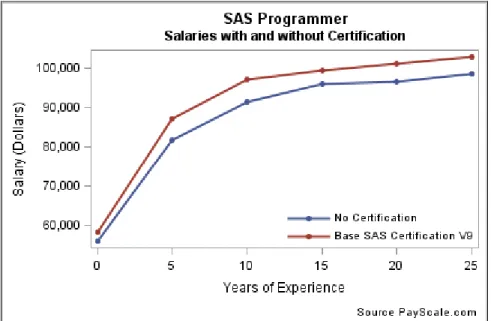
According to the website PayScale.com, SAS programmers who are certified earn somewhat more than those who are not. See Figure 1. Over a lifetime, his increase could make a substantial difference in total compensation. Of course, correlation is not causation: It is possible that people who earn more are more likely to pursue certification in the first place.
Figure 1. Salaries in dollars for SAS programmers with and without certification.
TIPS ON PREPARING FOR AN EXAM
SAS Institute offers many ways to prepare for exams. Some of these methods cost thousands of dollars, but others are inexpensive or even free. Here are ways to prepare with their approximate costs:
$1,300-2,000 Instructor-based “Classroom” and “Live Web” classes
$1,100 SAS Certification Review: Base Programming for SAS 9 (both “Classroom” and “Live Web”) $750-1,250 Online self-paced “e-Learning” classes
$150 Certification Prep Guides, Base and Advanced $55 Online practice exam (good for six months)
$50-75 Other books recommended on support.sas.com (See Appendix 1.) FREE SAS Programming 1: Essentials online self-paced “e-Learning” course FREE List of exam topics on support.sas.com (See Appendix 2.)
FREE Sample questions on support.sas.com FREE Blogs and third party online courses
Be aware that while the certification prep guides are a good way to find out what type of questions are on the exam and to practice answering questions, they are not the best way to learn new material. Also, the prep guides do not cover every topic that is on the exam, and some people have reported that they found typos in the prep guides.
5
What works best depends on the individual person. People who have taken the exams shared these recommendations:
Check the online outlines. They do a good job of telling you the things you will need to know. Work on the things that you are uncomfortable with on the exam. You will not get the same questions, but the topics will be similar.
–Art Carpenter, SAS consultant and trainer at California Occidental Consultants
Pick up a certification guide. Try to work with practice problems or incorporate techniques into your work. Reading the book is one thing, but really understanding how SAS deals with syntax and data is another.
–Rebecca Ottesen, Instructor at California Polytechnic University San Luis Obispo I found the online review course offered by SAS to be very helpful.
–Matthew Slaughter, recent university graduate Either buy a book or take the online course through SAS.
–Miriam Cisternas, SAS consultant
I highly recommend the SAS Certification Review: Base Programming live web class. It’s extremely expensive, but may be offered free or at a discount in association with conferences. Second best: Take the online practice exam. Third best: Study the certification review books sold by SAS. Fourth best: Study books such as The Little SAS Book which covers the majority of material on the Base exam and some of the material on the Advanced exam.
–Susan Slaughter, SAS consultant at Avocet Solutions
Everyone agreed that the most important thing is to study the material on the exam.
Study. Distributed practice –in other words, don’t cram for it, study regularly over a period of time. –AnnMaria De Mars, SAS consultant at The Julia Group
Practice, practice, practice.
–Phil Holland, SAS consultant at Holland Numerics Re-read, practice, practice, practice.
–Rebecca Ottesen, Instructor at California Polytechnic University San Luis Obispo One final piece of advice
If you have been putting off taking an exam, schedule your exam to force yourself to focus and get it done.
–Mark Stevens, SAS Certification Developer for SAS Institute
TIPS ON REGISTERING
You can register to take certification exams at a Pearson VUE testing location, or sometimes on-site just before conferences (SAS Global Forum and PharmaSUG in the spring, and regional users groups in the fall).
Registration with Pearson VUE can be done online (http://www.pearsonvue.com/sas/) or by phone. If you are taking the exam at a Pearson VUE test site, then you may have a choice of locations. For example, a search for locations near San Jose showed 5 locations, and for Sacramento 5 locations also.
If you choose to take an exam at a Pearson VUE testing site, you should realize that some locations may be better than others:
I highly recommend that you visit the location of your choice before the day of the exam, and if possible even before you sign up for the exam. When I took the exam, it turned out to be a nightmare. I signed up to take the exam at the nearest location about 30 min. from my home at a small airport. When I arrived at the address, I found an industrial park, but I couldn’t find the airport. I parked and walked around until I found someone working there, but it turned out that they had no idea where the airport was!! I was forced to drive around randomly looking for the site. Fortunately, I did find it in time, but the entrance to the test site turned out to be on a totally different street than the one in the address. And then it got worse. The computer equipment at the
6
test site was so bad that the screen was hard to read. By the time the test was over, I had a spectacular migraine from staring at that horrible screen for so long. Fortunately, I somehow managed to pass the test.
–Susan Slaughter, SAS consultant at Avocet Solutions
Discounts on exam registration are sometimes offered in conjunction with SAS conferences. In some cases, these discounts may be available even if you are not attending the conference. There may also be free or discounted training associated with taking an exam at that time. SAS UK offers particularly generous certification programs at conferences:
Most of my recent certification exams have been at the SAS Forum UK and SAS Professionals Convention, where the exam fees are included in the conference fees. Training webinars prior to the conference are also included. These exam days have broken records each year for the most concurrent exam takers and the most exams passed.
–Phil Holland, SAS consultant at Holland Numerics However,
It is so easy to take the exam at a testing facility. I personally think time spent at a conference should be focusing on the content at the conference, and not mixed up with last minute studying for the certification test. If there is a discount in taking the test at the conference that might help certain people.
–Rebecca Ottesen, Instructor at California Polytechnic University San Luis Obispo
Currently, the cost of the Base SAS Programming exam is $180 in North America. To hold down your costs, consider all of the possible discounts available. In addition to academic discounts and possible discounts at conferences, SAS offers discounts to veterans and employers.
If you are a student or academic professional planning on using an academic discount get the voucher ahead of time. SAS needs a few days to process your request, then you can register for the test with the voucher.
–Rebecca Ottesen, Instructor at California Polytechnic University San Luis Obispo
TIPS FOR THE DAY OF THE EXAM
On the day of the exam, arrive 15 minutes early. Be sure to bring two forms of ID including one with a photo such as a driver’s license or passport. Both forms must show your signature. You are not allowed to bring any reference materials, backpacks or electronic devices. Test takers are given writing materials, but any notes you make during the exam will be collected at the end. You are not allowed to remove anything from the test site.
Be prepared for the unexpected.
Recently, a friend went to her certification test appointment at the Pearson Vue test site only to be told that her exam time had actually been scheduled for another person (who was not there). Multiple phone calls by the proctor to Pearson Vue yielded the information that the person supposedly scheduled for that slot had a later time she had actually scheduled. Pearson Vue had no explanation for how my friend’s appointment had been assigned to someone else, or how someone could have two exam slots for the same test. Unfortunately, Pearson Vue could only tell her to reschedule for another time.
–Andra Northup, SAS consultant at Advanced Analytic Designs
When I arrived to take the exam, the proctor typed a code into the computer but there was some problem. The proctor had to call another test site to get a new code, but that didn’t work either. So the proctor called for a third code which fortunately worked and I was able to take the exam.
–Matthew Slaughter, recent university graduate
If you have found any particular approach to test-taking helpful in the past, use it! Drink OJ that morning (a professional test tutor told me this once).
–Rebecca Ottesen, Instructor at California Polytechnic University San Luis Obispo Relax and don’t stress.
7
During the exam, you can go backward and forward at any time. In addition, you can mark questions for review. Then at the end of the exam, you will be automatically prompted to return to those questions.
If you are not sure of an answer, sometimes you can use the exam to help you figure it out:
While taking the exam you may find that one question reveals or suggests the answer to another question.
–Matthew Slaughter, recent university graduate
Here is an example of how one problem can help you answer another:
1. There are 500 observations in the data set company.usa. What is the result of submitting the following program?
data work.usa;
obsnum=_n_;
set company.usa (keep=manager department);
stop;
run;
a. an error
b. an empty data set
c. a data set with 500 observations d. a data set with one observation
The correct answer is b, an empty data set. But suppose that you cannot remember what a STOP statement does. Then this question might help you to answer the first question:
2. Usually SAS writes each observation to a data set at the end of the DATA step. What statement would you use to stop executing a DATA step without writing any
observations?
a. a DATA _NULL_ statement b. an OUTPUT statement c. a STOP statement
d. You cannot override this behavior
If you can eliminate the other answers (a DATA _NULL_ does not stop a DATA step, an OUTPUT statement writes observations, and you’re pretty sure that it IS possible to override this behavior), then the answer must be c, a STOP statement. Now you know what a STOP statement does and you can answer the first question.
Remember that you are taking a test! It is not enough to know the material. Be on guard for sleight of hand questions where it appears the question is about a particular piece of content, when in fact it is testing whether you catch something completely different. Multiple choice questions can be tricky: There may be more than one answer with some truth in it. You are looking for the best answer, the one that is more true than the others.
If it has been a while since you have been in a test-taking situation, practice your allocation of time by taking practice tests. Bear in mind that test-taking is a separate skillset, distinct from analyzing problems and coding efficient solutions in the real world.
You will receive your score immediately after finishing the test.
AFTER THE EXAM
After the exam, successful candidates are emailed a link to the certificate which they can print out. On the main certification webpage, when an individual enters the SAS Certification Records Management System, they are given a yes/no option whether they wish their name to be published in the Registry. Even if an individual opts not to have their name published, they can obtain a private 1-to-1 link to confirm their credential to a potential employer.
For some reason, I was never asked whether I wanted to be listed in the Public Registry of SAS Certified Professionals. When my name hadn’t shown up after a couple months, I logged into my account and changed the setting. Within minutes, my name was listed.
8
Unfortunately, not everyone passes the exam. Some people find that they were not adequately prepared. I know a man who did not pass the Base Programming exam. He is an expert SAS programmer with many years of experience, but did not study for the exam and was tripped up by things like PROC IMPORT. Even the most experienced SAS programmer needs to study because nobody uses all these features all the time.
–Susan Slaughter, SAS consultant at Avocet Solutions
They took too long between the course and taking the test. Some of them did not get enough practice on programming problems.
–Rebecca Ottesen, Instructor at California Polytechnic University San Luis Obispo
They assumed that they did not need to even check what was on the exam let alone prepare for it. –Art Carpenter, SAS consultant and trainer at California Occidental Consultants
Although preparation is the single most important factor in exam success, many other things can impact the outcome, such as illness, work demands, and family needs. If you are not successful, rethink certification in light of your current life situation. If it makes sense, try again. You must wait 2 weeks before retaking the exam.
COLLABORATION WITH EDUCATIONAL INSTITUTIONS
SAS Institute is working to increase their support for students and researchers through a number of different programs. SAS collaborates with universities and high schools to offer on-campus certification exams. About 40 different universities have worked with SAS Global Certification to conduct SAS exam sessions onsite at their campus.
We certify the professor as a SAS exam proctor and then they can administer an exam session on a pre-arranged date and time. We enable the necessary mechanisms (for the appointed time only) and monitor the session remotely.
–Terry Barham, Manager of SAS Global Certification
SAS also offers a joint the SAS Joint Certificate Program which is entirely different from the Global Certification Program. For the joint certificate, universities identify 12 semester units of courses (which may be new or existing courses) covering subjects such as data analysis, data mining, business analytics and statistical modeling. The course content is reviewed and approved by SAS Institute. The university verifies which students have completed the certificate requirements, and SAS Institute co-signs the certificates. About 55 Universities have a joint certificate program with SAS.
CONCLUSION
It is always good to grow your credentials. It also shows a certain amount of drive and follow through. It certainly doesn’t hurt.
–Molly Mead Hall, IT placement professional at Synchrony Solutions
SAS certification does not guarantee a job. However, it can be one more arrow in your quiver setting you apart in a competitive job market and demonstrating expertise with newer skills such as business intelligence or clinical trials. Good luck determining the right choice for your individual situation!
REFERENCES
Delwiche, L. D. Slaughter, S. J. (2012). The Little SAS Book: A Primer, Fifth Edition. SAS Institute, Cary, NC. SAS Institute (2011). SAS certification prep guide: Base Programming for SAS 9, Third edition. Cary, NC: Author. PayScale Salary Reports, (2014). Salary data collected July 1, 2014 using www.payscale.com/mypayscale.aspx.
9
ACKNOWLEDGMENTS
The authors are extremely grateful to the following people who agreed to be interviewed for this paper: Terry Barham Manager of SAS Global Cert., SAS Institute Cary NC support.sas.com Art Carpenter California Occidental Consultants, Anchorage, AK www.caloxy.com Miriam Cisternas MGC Data Services, Carlsbad, CA www.mgcdata.com AnnMaria De Mars The Julia Group, Santa Monica, CA www.thejuliagroup.com Philip Holland Holland Numerics Ltd, Royston, UK www.holandnumerics.com Molly Meade Hall Synchrony Solutions, Los Angeles, CA www.synchrony-solutions.com Rebecca Ottesen California Polytechnic University, San Luis Obispo, CA
Matthew Slaughter Davis, CA
Mark Stevens Certification Developer, SAS Institute, Cary, NC support.sas.com Erik Tilanus Synchrona, Netherlands
ABOUT THE AUTHORS
The authors welcome your comments and suggestions, and can be contacted at: Andra M. Northup [email protected]
Susan J. Slaughter [email protected]
SAS and all other SAS Institute Inc. product or service names are registered trademarks or trademarks of SAS Institute Inc. in the USA and other countries. ® indicates USA registration.
10
APPENDIX 1
Books Recommended by SAS Press for Certification Preparation
Base Programming Exam
Bailer, J. (2010). Statistical Programming in SAS. SAS Institute, Cary, NC. Cody, R. (2007). Learning SAS by Example. SAS Institute, Cary, NC.
Delwiche, L. D. Slaughter, S. J. (2012). The Little SAS Book: A Primer, Fifth Edition. SAS Institute, Cary, NC. SAS Institute (2013). Step-by-Step Programming with Base SAS 9.4. Cary, NC: Author.
SAS Institute (2011). SAS Certification Prep Guide: Base Programming for SAS 9, Third edition. Cary, NC: Author. Advanced Programming Exam
Burlew, M. (2014). SAS Macro Programming Made Easy, Third Edition. SAS Institute, Cary, NC.
Carpenter, A. (2012). Carpenter’s Complete Guide to Innovative SASTechniques. SAS Institute, Cary, NC. Carpenter, A. (2004). Carpenter’s Complete Guide to the SAS Macro Language, Second Edition. SAS Institute,
Cary, NC.
Lafler, K.P. (2013). PROC SQL: Beyond the Basics Using SAS, Second Edition. SAS Institute, Cary, NC. Prairie, K. (2005). The Essential PROC SQL Handbook for SAS Users. SAS Institute, Cary, NC.
SAS Institute (2011). SAS Certification Prep Guide: Advanced Programming for SAS 9, Third edition. Cary, NC: Author.
Shreier, H (2008). PROC SQL by Example: Using SQL within SAS. SAS Institute, Cary, NC.
11
APPENDIX 2
SAS Certified Base Programmer for SAS 9 Credential
64 multiple-choice and short-answer questions(must achieve score of 70% correct to pass)
110 minutes to complete exam
Exam topics include:
Accessing Data