The When, Why and Why Not of the BETA Programming Language
Bent Bruun KristensenUniversity of Southern Denmark Campusvej 55 DK-5230 Odense M, Denmark
+45 65 50 35 39 [email protected]
Ole Lehrmann Madsen University of Aarhus Åbogade 34 DK-8200 Århus N, Denmark +45 89 42 56 70 [email protected] Birger Møller-Pedersen University of Oslo Gaustadalleen 23 NO-0316 Oslo, Norway
+47 22 85 24 37 [email protected]
Abstract
This paper tells the story of the development of BETA: a programming language with just one abstraction mechanism, instead of one abstraction mechanism for each kind of program element (classes, types, procedures, functions, etc.). The paper explains how this single abstraction mechanism, the pattern, came about and how it was designed to be so powerful that it covered the other mechanisms.
In addition to describing the technical challenge of capturing all programming elements with just one abstraction mechanism, the paper also explains how the language was based upon a modeling approach, so that it could be used for analysis, design and implementation. It also illustrates how this modeling approach guided and settled the design of specific language concepts.
The paper compares the BETA programming language with other languages and explains how such a minimal language can still support modeling, even though it does not have some of the language mechanisms found in other object-oriented languages.
Finally, the paper tries to convey the organization, working conditions and social life around the BETA project, which turned out to be a lifelong activity for Kristen Nygaard, the authors of this paper, and many others.
Categories and subject descriptors: D.3.2
[PROGRAMMING LANGUAGES]: Language Classifications – BETA; D.3.3 [PROGRAMMING LANGUAGES]: Language Constructs and Features; K.2 [HISTORY OF COMPUTING] Software; D.1.5 [PROGRAMMING TECHNIQUES]: Object-oriented Programming; General Terms: Languages; Keywords:
programming languages, object-oriented programming, oriented analysis, oriented design, object-oriented modeling, history of programming.
1.
Introduction
This paper is a description of what BETA is, why it became what it is and why it lacks some of the language constructs found in other languages. In addition, it is a history of the design and implementation of BETA, its main uses and its main influences on later research and language efforts. BETA is a programming language that has only one abstraction mechanism, the pattern, covering abstractions like record types, classes with methods, types with operations, methods, and functions. Specialization applies to patterns in general, thus providing a class/subclass mechanism for class patterns, a subtype mechanism for type patterns, and a specialization mechanism for methods and functions. The latter implies that inheritance is supported for methods – another novel characteristic of BETA. A pattern may be virtual, providing virtual methods as in other object-oriented languages. Since a pattern may be used as a class, virtuality also supports virtual classes (and types).
This paper is also a contribution to the story of the late Kristen Nygaard, one the pioneers of computer science, or informatics as he preferred to call it. Nygaard started the BETA project as a continuation of his work on SIMULA and system description. This was the start of a 25-year period of working with the authors, not only on the design of the BETA language, but also on many other aspects of informatics.
The BETA project was started in 1976 and was originally supposed to be completed in a year or two. For many reasons, it evolved into an almost lifelong activity involving Nygaard, the authors of this paper and many others. The BETA project became an endeavor for discussing issues related to programming languages, programming and informatics in general.
The BETA project covers many different kinds of activities from 1976 until today. We originally tried to write this paper in historic sequence, and so that it can be read with little or no prior knowledge of BETA. We have not, however, organized the paper according to time periods, since the result included a messy mix of distinct types of
events and aspects, too much overlap, and too little focus on important aspects. The resulting paper is organized as follows:
Section 2 describes the background of the project.
Section 3 describes the course of the BETA project, including people, initial research ideas, project organization and the process as well as personal interactions.
Section 4 describes the motivation and development of the modeling aspects and the conceptual framework of BETA.
Section 5 describes parts of the rationale for the BETA language, the development of the language, and essential elements of BETA.
Section 6 describes the implementation of BETA. Section 7 describes the impact and further development of BETA.
Sections 3-6 form the actual story of BETA enclosed by background (section 2) and impact (section 7). Sections 3-6 describe distinct aspects of BETA. The story of the overall BETA project in section 3 forms the foundation/context for the following aspects. This is how it all happened. Modeling is essential for the design of BETA. This perspective on design of and programming in object-oriented languages is presented in section 4. Throughout the presentation of the various language elements in the following section the choices are discussed and motivated by the conceptual framework in section 4. Section 5 presents the major elements of BETA. Because BETA may be less known, a more comprehensive presentation is necessary in order to describe its characteristics. However, the presentation is still, and should be, far from a complete definition of the language. Finally, the implementation of BETA, historically mainly following after the language design, is outlined in section 6.
In order to give a sequential ordering of the various events and activities, a timeline for the whole project is shown in the appendix. In the text events shown in the timeline are printed in Tunga font. For example, text like: “… BETA Project start …” means that this is an event shown in the
time line.
2.
Background
This section describes the background and setting for the early history of BETA. It includes personal backgrounds and a description of the important projects leading to the BETA project.
2.1
People
The BETA project was started in 1976 at the Computer Science Department, Aarhus University (DAIMI). Bent Bruun Kristensen and Ole Lehrmann Madsen had been
students at DAIMI since 1969 – Birger Møller-Pedersen originally started at the University of Copenhagen, but moved to DAIMI in 1974. Nygaard was Research Director at the Norwegian Computing Centre (NCC), Oslo, where the SIMULA languages [32-34, 130] were developed in the sixties.
In the early seventies, the programming language scene was strongly influenced by Pascal [161] and structured programming. SIMULA was a respected language, but not in widespread use. Algol 60 [129] was used for teaching introductory programming at DAIMI. Kristensen and Madsen were supposed to be introduced to SIMULA as the second programming language in their studies. However, before that happened Pascal arrived on the scene in 1971, and most people were fascinated by its elegance and simplicity as compared to Algol. Pascal immediately replaced SIMULA as the second language and a few years later Pascal also replaced Algol as the introductory language for teaching at DAIMI. A few people, however, found SIMULA superior to Pascal: the Pascal record and variant record were poor substitutes for the SIMULA class and subclass.
Although SIMULA was not in widespread use, it had a strong influence on the notion of structured programming and abstract data types. The main features of SIMULA were described in the famous book by Dahl, Dijkstra and Hoare on structured programming [29]. Hoare’s groundbreaking paper Proof of Correctness of Data Representation [56] introduced the idea of defining abstract
data types using the SIMULA class construct and the notion of class invariant.
Kristen Nygaard visiting professor at DAIMI. Nygaard
became a guest lecturer at DAIMI in 1973; in 1974/75 he was a full-time visiting professor, and after that he continued as a guest lecturer for several years. Among other things, Nygaard worked with trade unions in Norway to build up expertise in informatics. At that time there was a strong interest among many students at DAIMI and other places in the social impact of computers. Nygaard’s work with trade unions was very inspiring for these students. During the ’70s and ’80s a number of similar projects were carried out in Scandinavia that eventually led to the formation of the research discipline of system development with users, later called participatory design. The current
research groups at DAIMI in object-oriented software systems and human computer interaction are a direct result of the cooperation with Nygaard. This is, however, another story that will not be told here. The design of BETA has been heavily influenced by Nygaard's overall perspective on informatics including social impact, system description with users, philosophy, and programming languages. For this reason the story of BETA cannot be told without relating it to Nygaard’s other activities.
Morten Kyng was one of the students at DAIMI who was interested in social aspects of computing. In 1973 he listened to a talk by Nygaard at the Institute of Psychology at Aarhus University. After the talk he told Nygaard that he was at the wrong place and invited him to repeat his talk at DAIMI. Kyng suggested to DAIMI that Nygaard be invited as a guest lecturer. The board of DAIMI decided to do so, since he was considered a good supplement to the many theoretical disciplines in the curriculum at DAIMI at that time. Madsen was a student representative on the board; he was mainly interested in compilers and was thrilled about Nygaard being a guest lecturer. He thought that DAIMI would then get a person that knew about the SIMULA compiler. This turned out not to be the case: compiler technology was not his field. This was our first indication that Nygaard had a quite different approach to informatics and language design from most other researchers.
2.2
The SIMULA languages
Since SIMULA had a major influence on BETA we briefly mention some of the highlights of SIMULA. A comprehensive history of the SIMULA languages may be found in the HOPL-I proceedings [35] and in [107]. SIMULA and object-oriented programming were developed by Ole-Johan Dahl and Nygaard. Nygaard’s original field was operations research and he realized early on that computer simulations would be a useful tool in this field. He then made an alliance with Dahl, who – as Nygaard writes in an obituary for Dahl [132] – had an exceptional talent for programming. This unique collaboration led to the first SIMULA language, SIMULA I, which was a simulation language. Dahl and Nygaard quickly realized that the concepts in SIMULA I could be applied to programming in general and as a result they designed SIMULA 67 – later on just called SIMULA. SIMULA is a general-purpose programming language that contains Algol as a subset.
Users of today’s object-oriented programming languages are often surprised that SIMULA contains many of the concepts that are now available in mainstream object-oriented languages:
Class and object: A class defines a template for creating objects.
Subclass: Classes may be organized in a classification hierarchy by means of subclasses.
Virtual methods: A class may define virtual methods that can be redefined (sometimes called overridden) in subclasses.
Active objects: An object in SIMULA is a coroutine and corresponds to a thread.
Action combination: SIMULA has an “inner” construct for combining the statement-parts of a class and a subclass.
Processes and schedulers: It is straightforward in SIMULA to write new concurrency abstractions including schedulers.
Frameworks: SIMULA provided the first object-oriented framework in form of class Simulation, which provided SIMULA I’s simulation features.
Automatic memory management, including garbage collection.
Most of the above concepts are now available in object-oriented languages such as C++ [148], Eiffel [125], Java [46], and C# [51]. An exception is the SIMULA notion of an active object with its own action sequence, which strangely enough has not been adopted by many other languages (one exception is UML). For Dahl and Nygaard it was essential to be able to model concurrent processes from the real world.
The ideas of SIMULA have been adopted over a long period. Before object orientation caught on, SIMULA was very influential on the development of abstract data types. Conversely, ideas from abstract data types later led to an extension of SIMULA with constructs like public, private
and protected – originally proposed by Jakob Palme [137].
2.3
The DELTA system description language
When Nygaard came to DAIMI, he was working on system description and the design of a new language for system description based on experience from SIMULA. It turned out that many users of SIMULA seemed to get more understanding of their problem domain by having to develop a model using SIMULA than from the actual simulation results. Nygaard together with Erik Holbæk-Hanssen and Petter Håndlykken had thus started a project on developing a successor to SIMULA with main focus on system description, rather than programming. This led to a language called DELTA [60].
DELTA means ‘participate’ in command form in Norwegian. The name indicates another main goal of the DELTA language. As mentioned, Nygaard had started to include users in the design of systems and DELTA was meant as a language that could also be used to communicate with users – DELTA (participate!) was meant as an encouragement for users to participate in the design process.
The goal of DELTA was to improve the SIMULA mechanisms for describing real-world systems. In the real world, activities take place concurrently, but real concurrency is not supported by SIMULA. To model concurrency SIMULA had support for so-called quasi-parallel systems. A simulation program is a so-called discrete event system where a simulation is driven by discrete events generated by the objects of the simulation. All state changes had to be described in a standard imperative way by remote procedure calls (message calls),
assignments and control structures. DELTA supports the description of true concurrent objects and uses predicates to express state changes and continuous changes over time. The use of predicates and continuous state changes implied that DELTA could not be executed, but as mentioned the emphasis was on system description.
DELTA may be characterized as a specification language, but the emphasis was quite different from most other specification languages at that time such as algebraic data types, VDL, etc. These other approaches had a mathematical focus in contrast to the system description (modeling) focus of DELTA.
DELTA had a goal similar to that of the object-oriented analysis and design (OOA/OOD) methodologies (like that of Coad and Yourdon [25]) that appeared subsequently in the mid-’80s. The intention was to develop languages and methodologies for modeling real-world phenomena and concepts based on object-oriented concepts. Since SIMULA, modeling has always been an inherent part of language design in the Scandinavian school of object orientation. The work on DELTA may be seen as an attempt to further develop the modeling capabilities of object-orientation.
The report describing DELTA is a comprehensive description of the language and issues related to system description. DELTA has been used in a few projects, but it is no longer being used or developed.
The system concept developed as part of the DELTA project had major influence on the modeling perspective of BETA – in Section 4.1 we describe the DELTA system concept as interpreted for BETA.
2.4
The Joint Language Project
BETA project start. The BETA project was started in 1976
as part of what was then called the Joint Language Project (JLP). The JLP was a joint project between researchers at DAIMI, The Regional Computing Center at the University of Aarhus (RECAU), the NCC and the University of Aalborg.
Joint Language Project start. The initiative for the JLP was
taken in the autumn of 1975 by the late Bjarner Svejgaard, director of RECAU. Svejgaard suggested to Nygaard that it would be a good idea to define a new programming language based on the best ideas from SIMULA and Pascal. Nygaard immediately liked the idea, but he was more interested in a successor to SIMULA based on the ideas from DELTA. In the BETA Language Development report from November 1976 [89] the initial purpose of the JLP was formulated as twofold:
1. To develop and implement a high-level programming language as a projection of the DELTA system
description language into the environment of computing equipment.
2. To provide a common central activity to which a number of research efforts in various fields of informatics and at various institutions could be related. The name GAMMA was used for this programming language.
JLP was a strange project: on the one hand there were many interesting discussions of language issues and problems, while on the other hand there was no direct outcome. At times we students on the project found it quite frustrating that there was no apparent progress. We imagine that this may have been frustrating for the other members of the project as well. In hindsight we believe that the reason for this may have been a combination of the very different backgrounds and interests of people in the team combined with Nygaard’s lack of interest in project management. Nygaard’s strengths were his ability to formulate and pursue ambitious research goals, and his approach to language design with emphasis on modeling was unique. Many issues were discussed within the JLP, mainly related to language implementation and some unresolved questions about the DELTA language. As a result six subprojects were defined:
Distribution and maintenance. This project was to
discuss issues regarding software being deployed to a large number of computer installations of many different types. This included questions such as distribution formats, standardized updating procedures, documentation, interfaces to operating systems, etc.
Value types. The distinction between object and value
was important in SIMULA and remained important in DELTA and BETA. For Nygaard classes were for defining objects and types for defining values. He found the use of the class concept for defining abstract data types a ‘doubtful approach, easily leading to conceptual confusion’ with regard to objects and values. In this paper we use the term value type1 when we refer to types defining values. The purpose of this subproject was to discuss the definition of value types. We return to value types in Sections 5.1.1 and 5.8.2.
Control structures within objects. The purpose of this
subproject was to develop the control structures for GAMMA.
Contexts. The term “system classes” was used in
SIMULA to denote classes defining a set of predefined concepts (classes) for a program. The classes SIMSET and SIMULATION are examples of such system classes.
1 In other contexts, we use the term
type, as is common within
Møller-Pedersen later revised and extended the notion of system classes and proposed the term “context”. In today’s terminology, class SIMSET was an example of a class library providing linked lists and class SIMULATION was an example of a class framework (or application framework).
Representative states. A major problem with concurrent
programs was (and still is) to ensure that interaction between components results only in meaningful states of variables – denoted representative states in JLP. At that time, there was much research in concurrent programming including synchronization, critical regions, monitors, and communication. This subproject was to develop a conceptual approach to this problem, based upon the concepts of DELTA and work by Lars Mathiassen and Morten Kyng.
Implementation language. In the early seventies, it was
common to distinguish between general programming languages and implementation languages. An implementation language was often defined as an extended subset of the corresponding programming language. The subset was supposed to contain the parts that could be efficiently implemented – an implementation language should be as efficient as possible to support the general language. The extended part contained low level features to access parts of the hardware that could not be programmed with the general programming language. It was decided to define an implementation language called BETA as the implementation language for GAMMA. The original team consisted of Nygaard, Kristensen and Madsen – Møller-Pedersen joined later in 1976.
As described in Section 3.1 below, the BETA project was based on an initial research idea. This implied that there was much more focus on the BETA project than on the other activities in JLP. For the GAMMA language there were no initial ideas except designing a new language as a successor of SIMULA based on experience with DELTA and some of the best ideas of Pascal. In retrospect, language projects, like most other projects, should be based on one or more good ideas – otherwise they easily end up as nothing more than discussion forums. JLP was a useful forum for discussion of language ideas, but only the BETA project survived.
2.5
The BETA name and language levels
The name BETA was derived from a classification of language levels introduced by Nygaard, introducing a number of levels among existing and new programming languages. The classification by such levels would support the understanding of the nature and purpose of individual languages. The classification also motivated the existence of important language levels.
The δ-level contains languages for system description and has the DELTA language as an example. A main characteristic of this level is that languages are non-executable.
The γ-level contains general-purpose programming languages. SIMULA, Algol, Pascal, etc. are all examples of such languages. The JLP project was supposed to develop a new language to be called GAMMA. Languages at this level are by nature executable.
The β-level contains implementation languages – and BETA was supposed to be a language at this level. The α-level contains assembly languages – it is seen as the basic “machine” level at which the actual translation takes place and at which the systems are run.
The level sequence defines the name of the BETA language, although the letter β was replaced by a spelling of the Greek letter β. Other names were proposed and discussed from time to time during the development of BETA. At some point the notion of beta-software became a standard term and this created a lot of confusion and jokes about the BETA language and motivated another name. For many years the name SCALA was a candidate for a new name – SCALA could mean SCAndinavian Language, and in Latin it means ladder and could be interpreted as meaning something ‘going up’. The name of a language is important in order to spread the news appropriately, but names somehow also appear out of the blue and tend to have lives of their own. BETA was furthermore well known at that time and it was decided that it did not make sense to reintroduce BETA under a new name.
3.
The BETA project
The original idea for BETA was that it should be an implementation language for a family of application languages at the GAMMA level. Quite early2 during the
development of BETA, however, it became apparent that there was no reason to consider BETA ‘just’ an implementation language. After the point when BETA was considered a general programming language, we considered it (instead of GAMMA) to be the successor of SIMULA. There were good reasons to consider a successor to SIMULA; SIMULA contains Algol as a subset, and there was a need to simplify parts of SIMULA in much the same way as Pascal is a simplification of Algol. In addition we thought that the new ideas arriving with BETA would justify a new language in the SIMULA style.
3.1
Research approach
The approach to language design used for BETA was naturally highly influenced by the SIMULA tradition. The
2 In late 1978 and early 1979.
SIMULA I language report of 1965 opens with these sentences:
“The two main objectives of the SIMULA language are: To provide a language for a precise and standardised description of a wide class of phenomena, belonging to what we may call “discrete event systems”.
To provide a programming language for an easy generation of simulation programs for “discrete event systems”.”
Thus, SIMULA I was considered as a language for system description as well as for programming. It was therefore obvious from the beginning that BETA should be used for system description as well as for programming.
In the ’70s the SIMULA/BETA communities used the term system description to correspond to the term model (analysis and design models) used in most methodologies. We have always found it difficult to distinguish analysis, design and implementation. This was because we saw programming as modeling and program executions as models of relevant parts of the application domain. We considered analysis, design and implementation as programming at different abstraction levels.
The original goal for JLP and the GAMMA subproject was to develop a general purpose programming language as a successor to SIMULA. From the point in time where BETA was no longer just considered to be an implementation language, the research goals for BETA were supplemented by those for GAMMA. All together, the research approach was based on the following assumptions and ideas:
BETA should be a modeling language.
BETA should be a programming language. The most important initial idea was to design a language based on one abstraction mechanism. In addition BETA should support concurrent programming based on the coroutine mechanisms of SIMULA.
BETA should have an efficient implementation.
3.1.1 Modeling and conceptual framework
Creating a model of part of an application domain is always based on certain conceptual means used by the modeler. In this way modeling defines the perspective of the programmer in the programming process. Object-oriented programming is seen as one perspective on programming identifying the underlying model of the language and executions of corresponding programs.
Although it was realized from the beginning of the SIMULA era (including the time when concepts for record handling were developed by Hoare [52-54]) that the class/subclass mechanism was useful for representing concepts including generalizations and specializations, there was no explicit formulation of a conceptual
framework for object-oriented programming. The term object-oriented programming was not in use at that time and neither were terms such as generalization and specialization. SIMULA was a programming language like Algol, Pascal and FORTRAN – it was considered superior in many aspects, but there was no formulation of an object-oriented perspective distinguishing SIMULA from procedural languages.
In the early seventies, the notion of functional programming arrived, motivated by the many problems with software development in traditional procedural languages. One of the strengths of functional programming was that it was based on a sound mathematical foundation (perspective). Later Prolog and other logic programming languages arrived, also based on a mathematical framework.
We did not see functional or logic programming as the solution: the whole idea of eliminating state from the program execution was contrary to our experience of the benefits of objects. We saw functional/logic programming and the development of object-oriented programming as two different attempts to remedy the problems with variables in traditional programming. In functional/logic programming mutable variables are eliminated – in object-oriented programming they are generalized into objects. We return to this issue in Section 4.2.
For object-oriented programming the problem was that there was no underlying sound perspective. It became a goal of the BETA project to formulate such a conceptual framework for object-oriented programming.
The modeling approach to designing a programming language provides overall criteria for the elements of the language. Often a programming language is designed as a layer on top of the computer; this implies that language mechanisms often are designed from technical criteria. BETA was to fulfill both kinds of criteria.
3.1.2 One abstraction mechanism
The original design idea for BETA was to develop a language with only one abstraction mechanism: the pattern. The idea was that patterns should unify abstraction mechanisms such as class, procedure, function, type, and record. Our ambition was to develop the ultimate abstraction mechanism that subsumed all other abstraction mechanisms. In the DELTA report, the term pattern is used as a common term for class, procedure, etc. According to Nygaard the term pattern was also used in the final stages of the SIMULA project. For SIMULA and DELTA there was, however, no attempt to define a language mechanism for pattern.
The reason for using the term pattern was the observation that e.g. class and procedure have some common aspects: they are templates that may be used to create instances. The
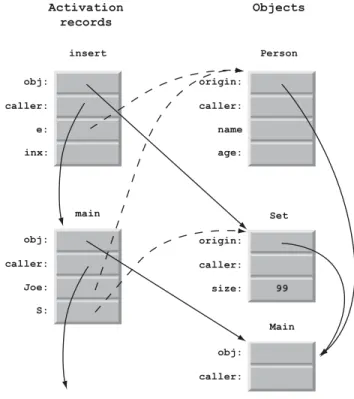
instances of a class are objects and the instances of procedures are activation records.
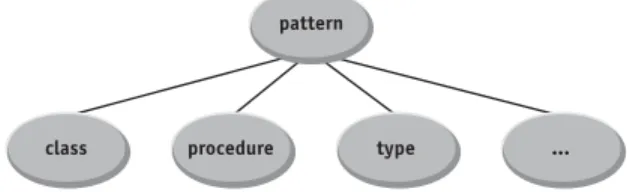
Figure 1 Classification of patterns
In the beginning it was assumed that BETA would provide other abstraction mechanisms as specializations (subpatterns) of the general pattern concept illustrated in Figure 1. In other words, BETA was initially envisaged as containing specialized patterns like class, procedure, type, etc. A subpattern of class as in
MyClass: class (# ... #)
would then correspond to a class definition in SIMULA. In a similar way a subpattern of procedure would then correspond to a procedure declaration. It should be possible to use a general pattern as a class, procedure, etc. As mentioned in Section 5.8.5, such specialized patterns were never introduced.
Given abstraction mechanisms like class, procedure, function, type and process type, the brute-force approach to unification would be to merge the elements of the syntax for all of these into a syntax describing a pattern. The danger with this approach might be that when a pattern is used e.g. as a class, only some parts of the syntactic elements might be meaningful. In addition, if the unification is no more than the union of class, procedure, etc., then very little has been gained.
The challenges of defining a general pattern mechanism may then be stated as follows:
The pattern mechanism should be the ultimate abstraction mechanism, subsuming all other known abstraction mechanisms.
The unification should be more than just the union of existing mechanisms.
All parts of a pattern should be meaningful, no matter how the pattern is applied.
The design of the pattern mechanism thus implied a heavy focus on abstraction mechanisms, unification, and orthogonality. Orthogonality and unification are closely associated, and sometimes they may be hard to distinguish.
3.1.3 Concurrency
It was from the beginning decided that BETA should be a concurrent programming language. As mentioned, SIMULA supported the notion of quasi-parallel system, which essentially defines a process concept and a cooperative scheduling mechanism. A SIMULA object is a
coroutine and a quasi-parallel process is defined as an abstraction (in the form of a class) on top of coroutines. The support for implementing hierarchical schedulers was one of the strengths of SIMULA; this was heavily used when writing simulation packages. Full concurrency was added to SIMULA in 1995 by the group at Lund University headed by Boris Magnusson [158].
Conceptually, the SIMULA coroutine mechanism appears simple and elegant, but certain technical details are quite complicated. For BETA, the SIMULA coroutine mechanism was an obvious platform to build upon. The ambition was to simplify the technical details of coroutines and add support for full concurrency including synchronization and communication. In addition it should be possible to write cooperative as well as pre-emptive schedulers.
3.1.4 Efficiency
Although SIMULA was used by many communities in research institutions and private businesses, it had a relatively small user community. However, it was big enough for a yearly conference for SIMULA users to take place.
One of the problems with making SIMULA more widely used was that it was considered very inefficient. This was mainly due to automatic memory management and garbage collection. Computers at that time were quite slow and had very little memory compared to computers of today. The DEC 10 at DAIMI had 128Kbyte of memory. This made efficient memory management quite challenging.
One implication of this was that object orientation was considered to be quite inefficient by nature. It was therefore an important issue for BETA to design a language that could be efficiently implemented. In fact, it was a goal that it should be possible to write BETA programs with a completely static memory layout.
Another requirement was that BETA should be usable for implementing embedded systems. Embedded systems experts found it provoking that Nygaard would engage in developing languages for embedded systems – they did not think he had the qualifications for this. He may not have had much experience in embedded systems, but he surely had something to contribute. This is an example of the controversies that often appeared around Nygaard.
As time has passed, static memory requirements have become less important. However, this issue may become important again, for example in pervasive computing based on small devices.
3.2
Project organization
The process, intention, and organization of the BETA project appeared to be different from those of many projects today. The project existed through an informal
cooperation between Nygaard and the authors. During the project we had obligations as students, professors or consultants. This implied that the time to be used on the project had to be found in between other activities.
As mentioned, Kristensen, Møller-Pedersen and Madsen were students at DAIMI, Århus. In 1974 Kristensen completed his Masters Thesis on error recovery for LR-parsers. He was employed as assistant professor at the University of Ålborg in 1976. Madsen graduated in 1975, having written a Master’s thesis on compiler-writing systems, and continued at DAIMI as assistant professor and later as a PhD student. Møller-Pedersen graduated in 1976 with a Master’s thesis on the notion of context, with Nygaard as a supervisor. He was then employed by the NCC, Oslo, in 1976 and joined the BETA project at the same time. Nygaard was a visiting professor at DAIMI in 1974-75 – after that he returned to the NCC and continued at DAIMI as a guest lecturer.
Most meetings took place in either Århus or Oslo, and therefore required a lot of traveling. At that time there was a ferry between Århus and Oslo. It sailed during the night and took 16 hours – we remember many pleasant trips on that ferry – and these trips were a great opportunity to discuss language issues without being disturbed. Later when the ferry was closed we had to use other kinds of transportation that were not as enjoyable.
Funding for traveling and meetings was limited. Research funding was often applied for, but with little success. Despite his great contributions to informatics through the development of the SIMULA languages, Nygaard always had difficulties in getting funding in Norway. The Mjølner project described in Section 3.4 is an exception, by providing major funding for BETA development – however, Nygaard was not directly involved in applying for this funding.
The project involved a mixture of heated discussions about the design of the BETA language and a relaxed, inspiring social life. It seemed that for Nygaard there was very little difference between professional work and leisure.
Meetings. The project consisted of a series of more or less
regular meetings with the purpose of discussing language constructs and modeling concepts. Meetings were planned in an ad hoc manner. The number of meetings varied over the years and very little was written or prepared in advance. Meetings officially took place at NCC or at our universities, but our private homes, trams/buses, restaurants, ferries, and taxies were also seen as natural environments in which the work and discussions could continue – in public places people had to listen to loud, hectic discussions about something that must have appeared as complete nonsense to them. But people were tolerant and seemed to accept this weird group.
In October 1977, Madsen and family decided to stay a month in Oslo to complete the project – Madsen’s wife, Marianne was on maternity leave – and they stayed with Møller-Pedersen and his family. This was an enjoyable stay, but very little progress was made with respect to completing BETA – in fact we saw very little of Nygaard during that month.
Discussions. A meeting would typically take place without
a predefined agenda and without any common view on what should or could be accomplished throughout the meeting. The meetings were a mixture of serious concentrated discussions of ideas, proposals, previous understanding and existing design and general stuff from the life of the participants.
State-of-the-art relevant research topics were rarely subjects for discussion. Nygaard did not consider this important – at least not for the ongoing discussions and elaboration of ideas. Such knowledge could be relevant later, in relation to publication, but was usually not taken seriously. In some sense Nygaard assumed that we would take care of this. Also established understanding, for example, on the background, motivations and the actual detailed contents of languages like Algol, SIMULA or DELTA was not considered important. It appeared to be much better to develop ideas and justify them without historical knowledge or relationships. The freedom was overwhelming and the possibilities were exhausting. The real strengths of Nygaard were his ability to discuss language issues at a conceptual level and focus on means for describing real-world systems. Most language designers come from a computer science background and their language design is heavily based on what a computer can do: A programming language is designed as a layer on top of the computer making it easier to program. Nygaard’s approach was more of a modeling approach and he was basically interested in means for describing systems. This was evident in the design of SIMULA, which was designed as a simulation language and therefore well suited for modeling real systems.
Plans. There was no clear management of the project, and
plans and explicit decisions did not really influence the project. We used a lot of time on planning, but most plans were never carried out. Deadlines were typically controlled by the evolution of the project itself and not by a carefully worked out project plan.
Preparation and writing were in most cases the result of an individual initiative and responsibility. Nygaard was active in writing only in the initial phase of the project. Later on Nygaard’s research portfolio mainly took the form of of huge stacks of related plastic slides, but typically their relation became clear only at Nygaard’s presentations. The
progress and revisions of his understanding of the research were simply captured on excellent slides.
At the beginning of the project it was decided that Kristensen and Madsen should do PhDs based on the project. As a consequence of the lack of project organization, it quickly became clear that this would not work.
The original plan for the BETA project was that ‘a firm and complete language definition’ should be ready at the end of
1977 [89]. An important deadline was February 1977 – at that time a first draft of a language definition should be available. In 1977 we were far from a complete language definition and Nygaard did not seem in a hurry to start writing a language definition report. However, two working notes were completed in 1976/77. In Section 3.3 and in Section 5.10, we describe the content of these working notes and other publications and actual events in the project.
Social life. Meetings typically lasted whole days including
evenings and nights. In connection with meetings the group often met in our private homes and had dinner together, with nice food and wine. The atmosphere was always very enjoyable but demanding, due to an early-morning start with meetings and late-evening end. Dinner conversation was often mixed with debate about current issues of language design. Our families found the experience interesting and inspiring, but also often weird. Nygaard often invited various guests from his network, typically without our knowing and often announced only in passing. Guests included Carl Hewitt, Bruce Moon, Larry Tesler, Jean Vaucher, Stein Krogdahl, Peter Jensen, and many more. They were all inspiring and the visits were learning experiences. In addition there were many enjoyable incidents as when passengers on a bus to the suburb where Madsen lived watched with surprise and a little fear as Nygaard (tall and insistent) and Hewitt (all dressed in red velour and just as insistent) loudly discussed not commonly understandable concepts on the rear platform of the bus. Nygaard was an excellent wine connoisseur and arranged wine-tasting parties on several occasions. We were “encouraged” to spend our precious travel money on various selected types of wines, and it was beyond doubt worth it. Often other guests were invited and had similar instructions about which wine to bring. At such parties we would be around 10 people in Nygaard’s flat, sitting around their big dinner table and talking about life in general. The wines would be studied in advance in Hugh Johnson’s “World Atlas of Wine” and some additional descriptions would be shared. The process was controlled and conducted by Nygaard at the head of the table.
Crises. The project meetings could be very frustrating since
Nygaard rarely delivered as agreed upon at previous
meetings. This often led to very heated discussions. This seemed to be something that we inherited from the SIMULA project. In one incident Kristensen and Madsen arrived in Oslo at the NCC and during the initial discussions became quite upset with Nygaard and decided to leave the project. They took a taxi to the harbor in order to enter the ferry to Århus. Nygaard, however, followed in another taxi and convinced them to join him for a beer in nearby bar – and he succeeded in convincing them to come back with him.
Crises and jokes were essential elements of meetings and social gatherings. Crises were often due to different expectations to the progress of the language development, unexpected people suddenly brought into the project meetings, and problems with planning of the meeting days. Crises were solved, but typically not with the result that the next similar situation would be tackled differently by Nygaard. Serious arguments about status and plans were often solved by a positive view on the situation together with promises for the future. Jokes formed an essential means of taking ‘revenge’ and thereby to overcome crises. Jokes were on Nygaard in order to expose his less appealing habits, as mentioned above, and were often simple and stupid, probably due to our irritation and desperation. Nygaard was an easy target for practical jokes, because he was always very serious about work, which was not something you joked about.3 On one occasion in
Nygaard’s office at Department of Informatics at University of Oslo, the telephone calls that Nygaard had to answer seemed to never end, even if we complained strongly about the situation. One time when Nygaard left the office, we taped the telephone receiver to the base by means of some transparent tape. When Nygaard returned, we arranged for a secretary to call him. As usual Nygaard quickly grabbed the telephone receiver, and he got completely furious because the whole telephone device was in his hand. He tried to wrench the telephone receiver off the base unit, but without success. Nygaard blamed us for the lost call (which could be very important as were the approximately 20 calls earlier this morning) and left the office running to the secretary in order to find out who had called. He returned disappointed and angry, but possibly also a bit more understanding of our complaints. At social events he was on the other hand very entertaining and had a large repertoire of jokes – however, practical jokes were not his forte.
3.3
Project events
In this section we mention important events related to the project process as a supplement to the description in the previous sections. Events related to the development of the
3 We never found out whether or not this was a characteristic of Nygaard or of Norwegians in general☺.
conceptual framework, the language and its implementation are described in the following sections.
Due to the lack of structure in the project organization, it is difficult to point to specific decisions during the project that influenced the design of BETA. The ambition for the project was to strive for the perfect language and it turned out that this was difficult to achieve through a strict working plan. Sometimes the design of a new programming language consists of selecting a set of known language constructs and the necessary glue for binding them together. For BETA the goal was to go beyond that. This implied that no matter what was decided on deadlines, no decisions were made as long as a satisfactory solution had not been found. In some situations we clearly were hit by the well known saying, ‘The best is the enemy of the good’. The start of the JLP and the start of the BETA project were clearly important events. There was no explicit decision to terminate the JLP – it just terminated.
As mentioned, two working notes were completed in 1976/1977. The first one was by Peter Jensen and Nygaard [66] and was mainly an argument why the NCC should establish cooperation with other partners in order to implement the BETA system programming language on microcomputers.
First language draft. The second working note was the first
publication describing the initial ideas of BETA, called
BETA Language Development – Survey Report, 1, November 1976 [89]. A revised version was published in
September 1977.
Draft Proposal of BETA. In 1978 a more complete language
description was presented in DRAFT PROPOSAL for Introduction to the BETA Programming Language as of 1st August 1978 [90] and a set of examples [91]. A grammar
was included. Here BETA was still mainly considered an implementation language. The following is stated in the report: “According to the conventional classification of programming languages BETA is meant to be a system programming language. Its intended use is for programming of operating systems, data base systems, communication systems and for implementing new and existing programming languages. … The reason for not calling it a system programming language is that it is intended to be more general than often associated with system programming languages. By general is here meant that it will contain as few as possible concepts underlying most programming concepts, but powerful enough to build up these. The BETA language will thus be a kernel of concepts upon which more application oriented languages may be implemented and we do not imagine the language as presented here used for anything but implementation of more suitable languages. This will, however, be straight forward to do by use of a compiler-generator. Using this,
sets of concepts may be defined in terms of BETA and imbedded in a language. Together with the BETA language it is the intention to propose and provide a ‘standard super BETA’.”
As mentioned, BETA developed without any explicit decision into a full-fledged general programming language. In this process it was realized that GAMMA and special-purpose languages could be implemented as class frameworks in BETA. With regard to class frameworks, SIMULA again provided the inspiration. SIMULA provided class Simulation – a class framework for writing simulation programs. Class Simulation was considered a definition of a special-purpose language for simulation – SIMULA actually has special syntax only meaningful when class Simulation is in use. For BETA it provided the inspiration for work on special-purpose languages. The idea was that a special-purpose language could be defined by means of a syntax definition (in BNF), a semantic definition in terms of a class framework, and a syntax-directed transformation from the syntax to a BETA program using the class framework. This is reflected in the 1978 working note.
First complete language definition. In February 1979 – and
revised in April 1979 – the report BETA Language Proposal [92] was published. It contained the first attempt
at a complete language definition. Here BETA was no longer considered just an implementation language: “BETA is a general block-structured language in the style of Algol, Simula and Pascal. … Most of the possibilities of Algol-like sequential languages are present”. BETA was, however,
still considered for use in defining application-oriented languages – corresponding to what are often called domain-specific languages today.
The fact that BETA was considered a successor to SIMULA created some problems at the NCC and the University of Oslo. The SIMULA communities considered SIMULA to be THE language, and with good reason. There were no languages at that time with the qualities of SIMULA and as of today, the SIMULA concepts are still in the core of mainstream languages such as C++, Java and C#.
Many people became angry with Nygaard that he seemed willing to give up on SIMULA. He did not look at it that way – he saw his mission as developing new languages and exploring new ideas. However, it did create difficulties in our relationship with the SIMULA community. SIMULA was at that time a commercial product of the NCC. When it became known that Nygaard was working on a successor for SIMULA, the NCC had to send out a message to its customers saying that the NCC had no intentions of stopping the support of SIMULA.
Around 1980 there was in fact an initiative by the NCC to launch BETA as a language project based on the model used for SIMULA. This included planning a call for a standardization meeting, although no such meeting ever took place. The plan was that BETA should be frozen by the end of 1980 and an implementation project should then be started by the NCC. However, none of this did happen.
A survey of the BETA Programming Language. In 1981 the
report ‘A Survey of the BETA Programming Language’ [93] formed the basis for the first implementation and the first published paper on BETA two years later [95]. As mentioned in Section 6.1, the first implementation was made in 1983.
Several working papers about defining special-purpose languages were written (e.g. [98]), but no real system was ever implemented. A related subject was that the grammar of BETA should be an integrated part of the language. This led to work on program algebras [96] and metaprogramming [120] that made it possible to manipulate BETA programs as data. Some of the inspiration for this work came during a one-year sabbatical that Madsen spent at The Center for Study of Languages and Information at Stanford University in 1984, working with Terry Winograd, Danny Bobrow and José Meseguer.
POPL paper: Abstraction Mechanisms in the BETA Programming Language. An important milestone for BETA
was the acceptance of a paper on BETA for POPL in 1983 [95]. We were absolutely thrilled and convinced that BETA would conquer the world. This did not really happen – we were quite disappointed with the relatively little interest the POPL paper created. At the same conference, Peter Wegner presented a paper called On the Unification of Data and
Program Abstractions in Ada [159]. Wegner’s main
message was that Ada contained a proliferation of abstraction mechanisms and there was no uniform treatment of abstraction mechanisms in Ada. Naturally we found Wegner’s paper to be quite in line with the intentions of BETA and this was the start of a long cooperation with Peter Wegner, who helped in promoting BETA.
Hawthorne Workshop. Peter Wegner and Bruce Shriver
(who happened to be a visiting professor at DAIMI at the same time as Nygaard) invited us to the Hawthorne workshop on object-oriented programming in 1986. This was one of the first occasions where researchers in OOP had the opportunity to meet and it was quite useful for us. It resulted in the book on Research Directions in Object-Oriented Programming [145] with two papers on BETA
[100, 111]. Peter Wegner and Bruce Shriver invited us to publish papers on BETA at the Hawaii International Conference on System Sciences in 1988.
Sequential parts stable. In late 1986/early 1987 the
sequential parts of the language were stable, and only minor changes have been made since then.
Multisequential parts stable. A final version of the
multisequential parts (coroutines and concurrency) was made in late 1990, early 1991.
BETA Book. Peter Wegner also urged us to write a book on
BETA and he was the editor of the BETA book published by Addison Wesley/ACM Press in 1993 [119].
For a number of years we gave BETA tutorials at OOPSLA, starting with OOPSLA’89 in New Orleans. Dave Thomas and others were quite helpful in getting this arranged – especially at OOPSLA’90/ECOOP’90 in Ottawa, he provided excellent support.
At OOPSLA’89 we met with Dave Unger and the Self group; although Self [156] is a prototype-based language and BETA is a class-based language, we have benefited from cooperation with the Self group since then. We believe that Self and BETA are both examples of languages that attempt to be based on simple ideas and principles. The Mjølner (Section 3.4) project (1986-1991) and the founding of Mjølner Informatics Ltd. (1988) were clearly important for the development of BETA.
Apple and Apollo contracts. During the Mjølner project we
got a contract with Apple Computer Europe, Paris, to implement BETA for the Macintosh – Larry Taylor was very helpful in getting this contract. A similar contract was made with Apollo Computer, coordinated by Søren Bry. In 1994, BETA was selected to be taught at the University of Dortmund. Wilfried Ruplin was the key person in making this happens. A German introduction to programming using BETA was written by Ernst-Erich Doberkat and Stefan Diβmann [38]. This was of great use for the further promotion of BETA as a teaching language.
Dahl & Nygaard receive ACM Turing Award. In 2001 Dahl
and Nygaard received the ACM Turing Award (“for their role in the invention of object-oriented programming, the most widely used programming model today”).
Dahl & Nygaard receive the IEEE von Neumann Medal. In
2002 they received the IEEE John von Neumann Medal (“for the introduction of the concepts underlying object-oriented programming through the design and implementation of SIMULA 67”). Dahl was seriously ill at that time so he was not able to attend formal presentations of these awards, including giving the usual Turing Award lecture. Dahl died on June 29, 2002. Nygaard was supposed to give his Turing Award lecture at OOPSLA 2002 in Vancouver, October 2002, but unfortunately he died on August 10, just a few weeks after Dahl. Life is full of strange coincidences. Madsen was invited to give a lecture
at OOPSLA 2002 instead of Nygaard. The overall theme for that talk was ‘To program is to understand’, which in
many ways summarizes Nygaard’s approach to programming. One of Nygaard’s latest public appearances was his after-dinner talk at ECOOP 2002 in Malaga, where he gave one of his usual entertaining talks that even the spouses enjoyed.
3.4
The Mjølner Project
Mjølner Project start. The Mjølner4 Project (1986-1991)
[76] was an important step in the development of BETA. The objective of the Mjølner project was to increase the productivity of high-quality software in industrial settings by designing and implementing object-oriented software development environments supporting specification, implementation and maintenance of large production programs. The project was carried out in cooperation between Nordic universities and industrial companies with participants from Denmark, Sweden, Norway and Finland. In the project three software development environments were developed:
Object-oriented SDL and tools: The development of
Object-oriented SDL is described in Section 7.3.
The Mjølner Orm System: a grammar-based
interactive, integrated, incremental environment for object-oriented languages. The main use of Orm was to develop an environment for SIMULA.
The Mjølner BETA System: a programming
environment for BETA.
Mjølner Book. The approach to programming environments
developed within the Mjølner Project is documented in the book Object-Oriented Environments – the Mjølner Approach [76], covering all these three developments.
The development of the Mjølner BETA System was in a Scandinavian context a large project. The project was a major reason for the success of BETA. During this project the language developed in the sense that many details were clarified. For example, the Ada-like rendezvous for communication and synchronization was abandoned in favor of semaphores, pattern variables were introduced, etc. It was also during the Mjølner project that the fragment system found its current form – cf. Section 5.8.4.
Most of the implementation techniques for BETA were developed during the Mjølner project, together with native compilers for Sun, Macintosh, etc. Section 6 contains a description of the implementation.
4 In the Nordic myths Mjølner is the name of Thor’s hammer; Thor is the Nordic god of thunder. Mjølner is the perfect tool: it grows with the task, always hits the target, and always returns safely to Thor's hand.
A complete programming environment for BETA was developed. In addition to compilers there was a large collection of libraries and application frameworks including a meta-programming system called Yggdrasil5, a persistent
object store with an object browser, and application frameworks for GUI programs built on top of Athena, Motif, Macintosh and Windows. A platform independent GUI framework with the look and feel of the actual platform was developed for Macintosh, Windows and UNIX/Motif.
The environment also included the MjølnerTool, which was an integration of the following tools: a source code browser called Ymer, an integrated text- and syntax-directed editor called Sif, a debugger called Valhalla, an interface builder called Frigg, and a CASE tool called Freja supporting a graphical syntax for BETA – see also Section 4.5.
Mjølner Informatics. The Mjølner BETA System led in
1988 to the founding of the company Mjølner Informatics Ltd., which for many years developed and marketed the Mjølner BETA System as a commercial product. Sales of the system never generated a high profit, but it gave Mjølner Informatics a good image as a business, and this attracted a lot of other customers. Today the Mjølner BETA System is no longer a commercial product, but free versions may be obtained from DAIMI.
It may seem strange from the outside that three environments were developed in the Mjølner Project. And it is indeed strange. SDL was, however, heavily used by the telecommunication industry, and there was no way to replace it by say BETA – the only way to introduce object orientation in that industry seemed to be by adding object orientation to SDL. Although SDL had a graphical syntax, it also had a textual syntax, and it had a well-defined execution semantics, so it was more or less a domain-specific programming language (the domain being telecommunications) and not a modeling language. Code generators were available for different (and at that time specialized) platforms. SDL is still used when code generation is needed, but for modeling purposes UML has taken over. UML2.0 includes most of the modeling mechanisms of SDL, but not the execution semantics. The BETA team did propose to the people in charge of the Mjølner Orm development – which focused on SIMULA – that they join the BETA team, and that we concentrate on developing an environment for BETA. BETA was designed as a successor of SIMULA, and we found that it would be better to just focus on BETA. However, the SIMULA people were not convinced; it is often said that SIMULA, like Algol 60, is one of the few languages that is better than
5 Most tools in the Mjølner System had names from Nordic mythology.
most of its successors – we are not the ones to judge about this with respect to BETA. The lesson here is perhaps that in a project like Mjølner more long-term goals would have been beneficial. If the project had decided to develop one language including a graphical notation that could replace SDL, then this language might have had a better chance to influence the industry than each of OSDL, SIMULA and BETA.
The motivation for modeling languages like SDL (and later UML) was that industries wanted to be independent of (changing) programming languages and run-time environments. A single language like BETA that claims to be both a programming language and a modeling language was therefore not understood. Even Java has not managed to get such a position. It is also interesting to note that while the Object Management Group advocates a single modeling language, covering many programming languages and platforms, Microsoft advocates a single programming language (or rather a common language run-time, CLR) on top of which they want to put whatever domain-specific modeling language the users in a specific domain require.
4.
Modeling and conceptual framework
We believe that the success of object-oriented programming can be traced back to its roots in simulation. SIMULA I was designed to describe (model) real-world systems and simulate these systems on a computer. This eventually led to the design of SIMULA 67 as a general programming language. Objects and classes are well suited for representing phenomena and concepts from the real world and for programming in general. Smalltalk further refined the object model and Alan Kay described object-oriented programming as a view on computation as simulation [68] (see also the formulation by Tim Budd
[22]). An important aspect of program development is to understand, describe and communicate about the application domain and BETA should be well suited for this. In the BETA book [119] (page 3) this is said in the following way:
To program is to understand: The development of an
information system is not just a matter of writing a program that does the job. It is of utmost importance that development of this program has revealed an in-depth understanding of the application domain; otherwise, the information system will probably not fit into the organization. During the development of such systems it is important that descriptions of the application domain are communicated between system specialists and the organization.
The term “To program is to understand” has been a leading
guideline for the BETA project. This implied that an essential part of the BETA project was the development of a conceptual framework for understanding and organizing
knowledge about the real world. The conceptual framework should define the object-oriented perspective on programming and provide a semantic foundation for BETA. Over the years perhaps more time was spent on discussing the conceptual framework than the actual language. Issues of this kind are highly philosophical and, not being philosophers, we could spend a large amount of time on this without progress.
Since BETA was intended for modeling as well as programming there was a rule that applied when discussing candidates for language constructs in BETA: a given language construct should be motivated from both the modeling and the programming point of view. We realized that many programmers did not care about modeling but were only interested in technical aspects of a given language – i.e. what you can actually express in the language. We thus determined that BETA should be usable as a ‘normal’ programming language without its capabilities as a modeling language. We were often in the situation that something seemed useful from a modeling point of view, but did not benefit the programming part of the language and vice versa.
We find the conceptual framework for BETA just as important as the language – in this paper we will not go into details, but instead refer to chapters 2 and 18 in the book on BETA [119]. Below we will describe part of the rationale and elements of the history of the conceptual framework. In Section 5, where the rationale for the BETA language is described, we will attempt to describe how the emphasis on modeling influenced the language.
4.1
Programming as modeling
As mentioned, DELTA was one of the starting points for the BETA project. For a detailed description of DELTA the reader is referred to the DELTA report [60]. Here we briefly summarize the concepts that turned out to be most important for BETA.
The system to be described was called the referent system.
A referent system exists in what today’s methodologies call application domain. A description of a system – the system description – is a text, a set of diagrams or a combination
describing the aspects of the system to be considered. Given a system description, a system generator may
generate a model system that simulates the considered
aspects of the referent system. These concepts were derived from the experience of people writing simulation programs (system descriptions) in SIMULA and running these simulations (model systems).
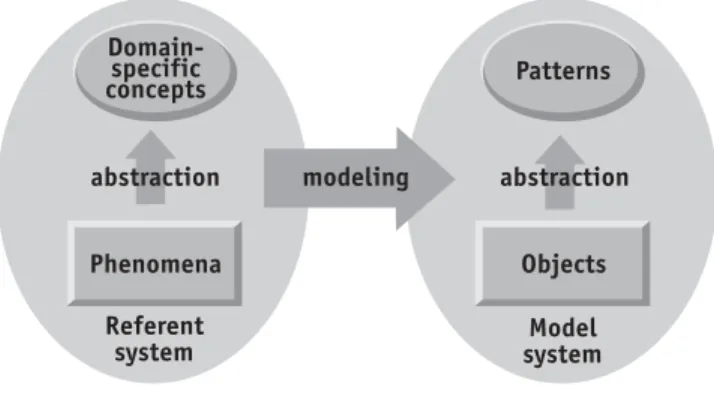
Programming was considered a special case of system description – a program was considered a system description and a program execution was considered a model system. Figure 2 illustrates the relationship between the referent system and the model system.
Figure 2 Modeling
As illustrated in Figure 2, phenomena and (domain-specific) concepts from the referent system are identified and represented as (realized) objects and concepts (in the form of patterns) in the model system (the program execution). The modeling activity of Figure 2 includes the making of a system description and having a system generator generate the model system according to this description.
4.2
Object-orientation as physical modeling
For BETA it has been essential to make a clear distinction between the program and the program execution (the model system). A program is a description in the form of a text, diagrams or a combination – the program execution is the dynamic process generated by the computer when executing the program. At the time when BETA was developed, many researchers in programming and programming languages were focusing on the program text. They worked on the assumption that properties of a program execution could (and should) be derived from analysis of the program text, including the use of assertions and invariants, formal proofs and formal semantics. Focusing on the (static) program text often made it difficult to explain the dynamics of a program execution. Especially for object-oriented programming, grasping the dynamic structure of objects is helped by considering the program execution. But considering the program execution is also important in order to understand mechanisms such as recursion and block structure.
The discussion of possible elements in the dynamic structure of a BETA program execution was central during the design of BETA. This included the structure of coroutines (as described in Section 5.7 below), stacks of activation records, nested objects, references between objects, etc. Many people often felt that we were discussing implementation, but for us it was the semantics of BETA. It did cover aspects that normally belonged to implementation, but the general approach was to identify elements of the program execution that could explain to the programmer how a BETA program was executing.
At that time, formal semantics of programming languages was an important issue and we were often confronted with the statement that we should concentrate on defining a formal semantics for BETA. Our answer to that was vague in the sense that we were perhaps uncertain whether or not they were right, but on the other hand we had no idea how to approach a formal semantics for a language we were currently designing. It seemed to us that the current semantic models just covered well known language constructs and we were attempting to identify new constructs. Also, our mathematical abilities were perhaps not adequate to mastering the mathematical models used at that time for defining formal semantics.
Many years later we realized that our approach to identifying elements of the program execution might be seen as an attempt to define the semantics of BETA – not in a formal way, but in a precise and conceptual way.
The focus on the program execution as a model eventually led to a definition of object-oriented programming based on the notion of physical model – first published at ECOOP in ’88 [116]:
Object-oriented programming. A program execution is
regarded as a physical model simulating the behavior of either a real or imaginary part of the world.
The notion of physical is essential here. We considered (and still do) objects as physical material used to construct models of the relevant part of the application domain. The analogy is the use of physical material to construct models made of cardboard, wood, plastic, wire, plaster, LEGO bricks or other substances. Work on object-oriented programming and computerized shared material by Pål Sørgaard [149] was an essential contribution here.
Webster defines a model in the following way: “In general a model refers to a small, abstract or actual representation of a planned or existing entity or system from a particular viewpoint” [1]. Mathematical models are examples of abstract representations whereas models of buildings and bridges made of physical material such as wood, plastic, and cartoon are examples of actual representations. Models may be made of existing (real) systems as in physics, chemistry and biology, or of planned (imaginary) systems like buildings, and bridges.
We consider object-oriented models6 to be actual (physical)
representations made from objects. An object-oriented model may be of an existing or planned system, or a
6 The term modeling is perhaps somehow misleading since the model eventually becomes the real thing – in contrast to models in science, engineering and architecture. We originally used the term description, in SIMULA and DELTA terminology, but
changed to modeling when OOA/OOD and UML became popular.