1
Introduction to Project Management
After reading this chapter, you will be able to:
1. Understand the growing need for better project management, especially for information technology projects
2. Explain what a project is, provide examples of information technology projects, list various attributes of projects, and describe the triple constraint of projects 3. Describe project management and discuss key elements of the project
man-agement framework, including project stakeholders, the project manman-agement knowledge areas, common tools and techniques, and project success factors 4. Understand the role of the project manager by describing what project
man-agers do, what skills they need, and what the career field is like for informa-tion technology project managers
5. Describe the project management profession, including its history, the role of professional organizations like the Project Management Institute, the importance of certification and ethics, and the growth of project manage-ment software
OPENING CASE
nne Roberts, the new Director of the Project Management Office for a large retail chain, stood in front of five hundred people in the large corporate auditorium to explain the company’s new strategies. She was also broadcasting to thousands of other employees, suppliers, and stockholders throughout the world via the Internet. The company had come a long way in implementing new information systems to improve inventory control, sell products using the Web, and streamline the sales and distribution processes.
A
However, the stock price was down, the nation’s economy was weak, and people were anxious to hear about the company’s new strategies.
Anne began to address the audience, “Good morning. As many of you know, our CEO promoted me to a new position as Director of the Project Management Office. Most of what we do in this depart-ment involves projects, and my role in this new position is to turn the company around by helping us effectively select and manage those projects. Our challenge is to develop a culture in which we all work together to provide high-quality goods and services to our con-sumers while earning a profit in this difficult market. To meet this challenge, we must collaborate to focus on finding solutions to com-plex problems. We must decide what projects will most benefit the company, how we can continue to leverage the power of information technology to support our business, and how we can exploit our human capital to successfully plan and execute those projects. If we succeed, we’ll become a world-class corporation.”
“And if we fail?” someone asked from the audience. “Let’s just say that failure is not an option,” Anne replied.
INTRODUCTION
Many people and organizations today have a new or renewed interest in proj-ect management. Until the 1980s, projproj-ect management primarily focused on providing schedule and resource data to top management in the military and construction industries. Today’s project management involves much more, and people in every industry and every country manage projects. New technologies have become a significant factor in many businesses. Computer hardware, soft-ware, networks, and the use of interdisciplinary and global work teams have radically changed the work environment. The statistics below demonstrate the significance of project management in today’s society, especially for projects involving information technology (IT):
■ A 2001 report showed that the U.S. spends $2.3 trillion on projects every year, an amount equal to one-quarter of the nation’s gross domestic prod-uct. The world as a whole spends nearly $10 trillion of its $40.7 trillion gross product on projects of all kinds. More than sixteen million people regard project management as their profession.1
1 Project Management Institute (PMI), The PMI Project Management Fact Book, Second
■ Worldwide IT spending is expected to grow by between 4 percent and 6 percent in the next few years. Forrester Research estimated that tech-nology spending in the United States would total $752 billion in 2004, an increase of 4.4 percent over 2003. Forrester also predicts that U.S. IT spending will grow by another 5.7 percent in 2005, to reach $795 billion.2
■ In 2003, the average senior project manager in the U.S. earned almost $90,000 per year. The average salary of a program manager was $103,464, just slightly less than the average Chief Information Officer (CIO) salary of $103,925. The average salary for a Project Management Office (PMO) Director was $118,633.3
■ In the U.S., the number-one reality television show in 2004, The
Apprentice, portrayed the important role project managers play in business.
Each week of the show, teams would select a project manager to lead them in accomplishing that week’s project. The project manager would be held partly responsible for the team’s success or failure. Whether you’re trying to make money by selling lemonade, running a golf tournament, or developing a new information system, project managers play a vital role in business success.
Today’s companies, governments, and non-profit organizations are recogniz-ing that to be successful, they need to be conversant with and use modern project management techniques. Individuals are realizing that to remain com-petitive, they must develop skills to become good project team members and project managers. They also realize that many of the concepts of project man-agement will help them in their everyday lives as they work with people and technology on a day-to-day basis.
In 1995, the Standish Group published an often-quoted study entitled “CHAOS”. This pres-tigious consulting firm surveyed 365 information technology executive managers in the United States who managed more than 8,380 information technology application projects. As the title of the study suggests, the projects were in a state of chaos. United States com-panies spent more than $250 billion each year in the early 1990s on approximately 175,000 information technology application development projects. Examples of these projects included creating a new database for a state department of motor vehicles, developing a new system for car rental and hotel reservations, and implementing a client-server architec-ture for the banking industry. The survey found that the average cost of an information technology application development project for a large company was more than $2.3 mil-lion; for a medium company, it was more than $1.3 milmil-lion; and for a small company, it was more than $434,000. Their study reported that the overall success rate of information tech-nology projects was only16.2 percent. The surveyors defined success as meeting project goals on time and on budget.
2Butler, Steve, IT Spending, Analyst Views, February 2004.
3Project Management Institute (PMI), Project Management Salary Survey, Third Edition, 2003.
The study also found that more than 31 percent of information technology projects were canceled before completion, costing U.S. companies and government agencies more than $81 billion. The authors of this study were adamant about the need for better project man-agement in the information technology industry. They explained, “Software development projects are in chaos, and we can no longer imitate the three monkeys—hear no failures, see no failures, speak no failures.”4
Many organizations claim that using project management provides advan-tages, such as:
■ Better control of financial, physical, and human resources ■ Improved customer relations
■ Shorter development times ■ Lower costs
■ Higher quality and increased reliability ■ Higher profit margins
■ Improved productivity ■ Better internal coordination ■ Higher worker morale
This chapter introduces projects and project management, discusses the role of the project manager, and provides important background information on this growing profession. Although project management applies to many differ-ent industries and types of projects, this textbook focuses on applying project management to information technology projects.
WHAT IS A PROJECT?
To discuss project management, it is important to understand the concept of a project. A project is “a temporary endeavor undertaken to create a unique prod-uct, service, or result.”5Operations, on the other hand, is work done in
organiza-tions to sustain the business. Projects are different from operaorganiza-tions in that they end when their objectives have been reached or the project has been terminated.
Examples of Information Technology Projects
Projects can be large or small and involve one person or thousands of people. They can be done in one day or take years to complete. Information technology
4The Standish Group, “The CHAOS Report” (www.standishgroup.com) (1995). Another reference
is Johnson, Jim, “CHAOS: The Dollar Drain of IT Project Failures,” Application Development Trends (January 1995).
5 Project Management Institute, Inc., A Guide to the Project Management Body of Knowledge
(PMBOK® Guide) (2004), p. 5. Note: Page numbers are based on the early release of the third
projects involve using hardware, software, and/or networks to create a product, service, or result. Examples of information technology projects include
the following:
■ A help desk or technical worker replaces laptops for a small department ■ A small software development team adds a new feature to an internal
software application
■ A college campus upgrades its technology infrastructure to provide wire-less Internet access
■ A cross-functional task force in a company decides what software to pur-chase and how it will be implemented
■ A company develops a new system to increase sales force productivity ■ A television network develops a system to allow viewers to vote for
con-testants and provide other feedback on programs
■ The automobile industry develops a Web site to streamline procurement ■ A government group develops a system to track child immunizations ■ A large group of volunteers from organizations throughout the world
develops standards for a new communications technology
Project Attributes
As you can see, projects come in all shapes and sizes. The following attributes help to define a project further:
■ A project has a unique purpose. Every project should have a well-defined
objective. For example, Anne Roberts, the Director of the Project Management Office in the opening case, might sponsor an information technology collaboration project to develop a list and initial analysis of potential information technology projects that might improve operations for the company. The unique purpose of this project would be to create a collaborative report with ideas from people throughout the company. The results would provide the basis for further discussions and projects. As in this example, projects result in a unique product, service, or result.
■ A project is temporary. A project has a definite beginning and a definite end.
In the information technology collaboration project, Anne might form a team of people to work immediately on the project, and then expect a report and an executive presentation of the results in one month.
■ A project is developed using progressive elaboration. Projects are often defined
broadly when they begin, and as time passes, the specific details of the project become more clear. Therefore, projects should be developed in increments. A project team should develop initial plans and then update them with more detail based on new information. For example, suppose a few people submitted ideas for the information technology collaboration project, but they did not clearly address how the ideas would support the
business strategy of improving operations. The project team might decide to prepare a questionnaire for people to fill in as they submit their ideas to improve the quality of the inputs.
■ A project requires resources, often from various areas. Resources include people,
hardware, software, or other assets. Many projects cross departmental or other boundaries to achieve their unique purposes. For the information technology collaboration project, people from information technology, marketing, sales, distribution, and other areas of the company would need to work together to develop ideas. The company might also hire outside consultants to provide input. Once the project team has selected key proj-ects for implementation, they will probably require additional hardware, software, and network resources. People from other companies—product suppliers and consulting companies—will become resources for meeting new project objectives. Resources, however, are limited. They must be used effectively to meet project and other corporate goals.
■ A project should have a primary customer or sponsor. Most projects have many
interested parties or stakeholders, but someone must take the primary role of sponsorship. The project sponsor usually provides the direction and funding for the project. In this case, Anne Roberts would be the spon-sor for the information technology collaboration project. Once further information technology projects are selected, however, the sponsors for those projects would be senior managers in charge of the main parts of the company affected by the projects. For example, if the vice president of sales initiates a project to improve direct product sales using the Internet, he or she might be the project sponsor. If several projects related to Internet technologies were undertaken, the organization might form a program. A program is “a group of related projects managed in a coordi-nated way to obtain benefits and control not available from managing them individually.”6A program manager provides leadership for the
proj-ect managers dirproj-ecting those projproj-ects, and the sponsors might come from several business areas.
■ A project involves uncertainty. Because every project is unique, it is
some-times difficult to define the project’s objectives clearly, estimate how long it will take to complete, or determine how much it will cost. External fac-tors also cause uncertainty, such as a supplier going out of business or a project team member needing unplanned time off. This uncertainty is one of the main reasons project management is so challenging, especially on projects involving new technologies.
A good project manager is crucial to a project’s success. Project managers work with the project sponsors, the project team, and the other people involved in a project to meet project goals.
The Triple Constraint
Every project is constrained in different ways by its scope, time, and cost goals. These limitations are sometimes referred to in project management as the
triple constraint. To create a successful project, a project manager must
con-sider scope, time, and cost and balance these three often-competing goals. He or she must consider the following:
■ Scope: What work will be done as part of the project? What unique product,
service, or result does the customer or sponsor expect from the project?
■ Time: How long should it take to complete the project? What is the
project’s schedule?
■ Cost: What should it cost to complete the project? What is the
project’s budget?
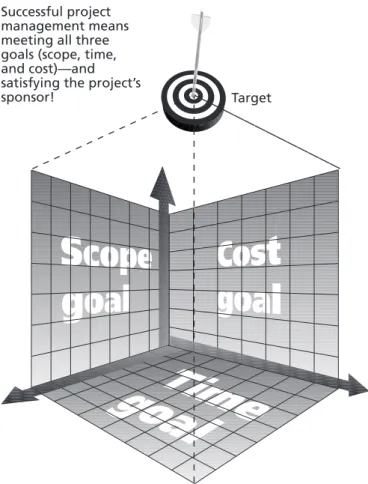
Figure 1-1 illustrates the three dimensions of the triple constraint. Each area—scope, time, and cost—has a target at the beginning of the project. For example, the information technology collaboration project might have an ini-tial scope of producing a forty- to fifty-page report and a one-hour presentation on thirty potential information technology projects. The project manager might further define project scope by providing a description of each potential project, an investigation of what other companies have implemented for similar proj-ects, a rough time and cost estimate, and assessments of the risk and potential payoff as high, medium, or low. The initial time estimate for this project might be one month, and the cost estimate might be $50,000. These expectations provide the targets for the scope, time, and cost dimensions of the project.
Managing the triple constraint involves making trade-offs between scope, time, and cost goals for a project. For example, you might need to increase the budget for a project to meet scope and time goals. Alternatively, you might have to reduce the scope of a project to meet time and cost goals. Because ects involve uncertainty and limited resources, it is rare to complete many proj-ects according to the exact scope, time, and cost plans originally predicted. Experienced project managers know that you must decide which aspect of the triple constraint is most important. If time is most important, you must often change the initial scope and/or cost goals to meet the schedule. If scope goals are most important, you may need to adjust time and/or cost goals.
For example, to generate project ideas, suppose the project manager for the information technology collaboration project sent an e-mail survey to all employees, as planned. The initial time and cost estimate may have been one week and $5,000 to collect ideas based on this e-mail survey. Now, suppose the e-mail survey generated only a few good project ideas, and the scope goal was to collect at least thirty good ideas. Should the project team use a different method like focus groups or interviews to collect ideas? Even though it was not in the initial scope, time, or cost estimates, it would really help the project.
Since good ideas are crucial to project success, it would make sense to inform the project sponsor that you want to make cost and/or schedule adjustments.
Figure 1-1. The Triple Constraint of Project Management
Although the triple constraint describes how the basic elements of a project— scope, time, and cost—interrelate, other elements can also play significant roles. Quality is often a key factor in projects, as is customer or sponsor satisfaction. Some people, in fact, refer to the “quadruple constraint” of project management, including quality along with scope, time, and cost. Others believe that quality considerations, including customer satisfaction, must be inherent in setting the scope, time, and cost goals of a project. A project team may meet scope, time, and cost goals but fail to meet quality standards or satisfy their sponsor, if they have not adequately addressed these concerns. For example, Anne Roberts may receive a fifty-page report describing thirty potential information technology projects and
Successful project management means meeting all three goals (scope, time, and cost)—and satisfying the project’s
hear a presentation on the findings of the report. The project team may have completed the work on time and within the cost constraint, but the quality may have been unacceptable. Anne’s view of an executive presentation may be very different from the project team’s view. The project manager should be communi-cating with the sponsor throughout the project to make sure the project meets his or her expectations.
How can you avoid the problems that occur when you meet scope, time, and cost goals, but lose sight of quality or customer satisfaction? The answer is
good project management, which includes more than meeting the triple constraint.
WHAT IS PROJECT MANAGEMENT?
Project management is “the application of knowledge, skills, tools and
tech-niques to project activities to meet project requirements.”7Project managers
must not only strive to meet specific scope, time, cost, and quality goals of proj-ects, they must also facilitate the entire process to meet the needs and expecta-tions of the people involved in or affected by project activities.
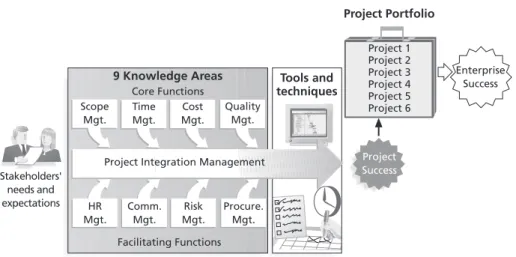
Figure 1-2 illustrates a framework to help you understand project manage-ment. Key elements of this framework include the project stakeholders, project management knowledge areas, project management tools and techniques, and the contribution of successful projects to the enterprise.
Figure 1-2. Project Management Framework
9 Knowledge Areas
Core Functions
Project Integration Management
Tools and techniques Stakeholders' needs and expectations Facilitating Functions Scope Mgt. Time Mgt. Cost Mgt. Quality Mgt. HR Mgt. Comm. Mgt. Risk Mgt. Procure. Mgt. Project Success Enterprise Success Project 1 Project 2 Project 3 Project 4 Project 5 Project 6 Project Portfolio 7Ibid, p. 8.
Project Stakeholders
Stakeholders are the people involved in or affected by project activities and
include the project sponsor, project team, support staff, customers, users, sup-pliers, and even opponents of the project. These stakeholders often have very different needs and expectations. For example, building a new house is a well-known example of a project. There are several stakeholders involved in a home construction project.
■ The project sponsors would be the potential new homeowners. They would be the people paying for the house and could be on a very tight budget, so they would expect the contractor to provide accurate estimates of the costs involved in building the house. They would also need a realistic idea of when they could move in and what type of home they could afford given their budget constraints. The new homeowners would have to make important decisions to keep the costs of the house within their budget. Can they afford to finish the basement right away? If they can afford to finish the basement, will it affect the projected move-in date? In this example, the project sponsors are also the customers and users for the product, which is the house.
■ The project manager in this example would normally be the general con-tractor responsible for building the house. He or she needs to work with all the project stakeholders to meet their needs and expectations. ■ The project team for building the house would include several
construc-tion workers, electricians, carpenters, and so on. These stakeholders would need to know exactly what work they must do and when they need to do it. They would need to know if the required materials and equipment will be at the construction site or if they are expected to pro-vide the materials and equipment. Their work would need to be coordi-nated since there are many interrelated factors involved. For example, the carpenter cannot put in kitchen cabinets until the walls are completed. ■ Support staff might include the buyers’ employers, the general
contrac-tor’s administrative assistant, and other people who support other stake-holders. The buyers’ employers might expect their employees to still complete their work but allow some flexibility so they can visit the build-ing site or take phone calls related to buildbuild-ing the house. The contractor’s administrative assistant would support the project by coordinating meet-ings between the buyers, the contractor, suppliers, and so on.
■ Building a house requires many suppliers. The suppliers would provide the wood, windows, flooring materials, appliances, and so on. Suppliers would expect exact details on what items they need to provide, where and when to deliver those items, and so on.
■ There may or may not be opponents of a project. In this example, there might be a neighbor who opposes the project because the workers are making so much noise that she cannot concentrate on her work at home,
or the noise might wake her sleeping children. She might interrupt the workers to voice her complaints or even file a formal complaint. Or the neighborhood might have association rules concerning new home design and construction. If the homeowners did not follow these rules, they might have to halt construction due to legal issues.
As you can see from this example, there are many different stakeholders on projects, and they all have different interests. Stakeholders’ needs and expecta-tions are important in the beginning and throughout the life of a project. Successful project managers develop good relationships with project stakehold-ers to undstakehold-erstand and meet their needs and expectations.
Project Management Knowledge Areas
Project management knowledge areas describe the key competencies that
project managers must develop. The center of Figure 1-2 shows the nine knowledge areas of project management. The four core knowledge areas of project management include project scope, time, cost, and quality manage-ment. These are core knowledge areas because they lead to specific project objectives. Brief descriptions of each core knowledge area are as follows:
■ Project scope management involves defining and managing all the work required to complete the project successfully.
■ Project time management includes estimating how long it will take to complete the work, developing an acceptable project schedule, and ensur-ing timely completion of the project.
■ Project cost management consists of preparing and managing the budget for the project.
■ Project quality management ensures that the project will satisfy the stated or implied needs for which it was undertaken.
The four facilitating knowledge areas of project management are human resource, communications, risk, and procurement management. These are called facilitating areas because they are the processes through which the proj-ect objproj-ectives are achieved. Brief descriptions of each facilitating knowledge area are as follows:
■ Project human resource management is concerned with making effective use of the people involved with the project.
■ Project communications management involves generating, collecting, dis-seminating, and storing project information.
■ Project risk management includes identifying, analyzing, and responding to risks related to the project.
■ Project procurement management involves acquiring or procuring goods and services for a project from outside the performing organization.
Project integration management, the ninth knowledge area, is an overarch-ing function that affects and is affected by all of the other knowledge areas. Project managers must have knowledge and skills in all nine of these areas. This text includes an entire chapter on each of these knowledge areas, as all of them are crucial to project success.
Project Management Tools and Techniques
Thomas Carlyle, a famous historian and author, stated, “Man is a tool-using ani-mal. Without tools he is nothing, with tools he is all.” As the world continues to become more complex, it is even more important for people to develop and use tools, especially for managing important projects. Project management tools
and techniques assist project managers and their teams in carrying out work in
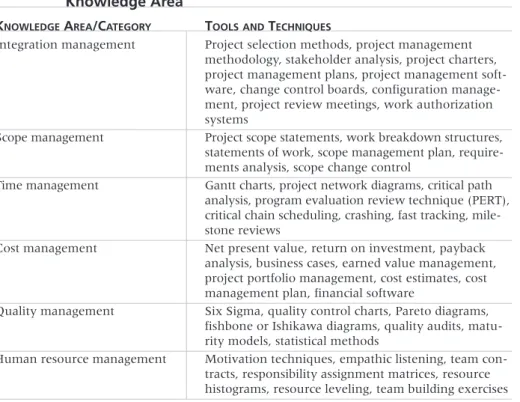
all nine knowledge areas. For example, some popular time-management tools and techniques include Gantt charts, project network diagrams, and critical path analysis. Table 1-1 lists some commonly used tools and techniques by knowledge area. You will learn more about these and other tools and techniques throughout this text.
Table 1-1: Common Project Management Tools and Techniques by Knowledge Area
KNOWLEDGEAREA/CATEGORY TOOLS ANDTECHNIQUES
Integration management Project selection methods, project management methodology, stakeholder analysis, project charters, project management plans, project management soft-ware, change control boards, configuration manage-ment, project review meetings, work authorization systems
Scope management Project scope statements, work breakdown structures, statements of work, scope management plan, require-ments analysis, scope change control
Time management Gantt charts, project network diagrams, critical path analysis, program evaluation review technique (PERT), critical chain scheduling, crashing, fast tracking, mile-stone reviews
Cost management Net present value, return on investment, payback analysis, business cases, earned value management, project portfolio management, cost estimates, cost management plan, financial software
Quality management Six Sigma, quality control charts, Pareto diagrams, fishbone or Ishikawa diagrams, quality audits, matu-rity models, statistical methods
Human resource management Motivation techniques, empathic listening, team con-tracts, responsibility assignment matrices, resource histograms, resource leveling, team building exercises
Project managers must work with key stakeholders to define what consti-tutes success for a particular project and strive to complete their projects successfully by applying appropriate tools and techniques. In many organi-zations, project managers also support an emerging business strategy of
project portfolio management, in which organizations group and
man-age projects as a portfolio of investments that contribute to the entire enter-prise’s success. You will learn more about project portfolio management in Chapter 7, Project Cost Management.
Table 1-1: Common Project Management Tools and Techniques by Knowledge Area (continued)
KNOWLEDGEAREA/CATEGORY TOOLS ANDTECHNIQUES
Communications management Communications management plan, conflict manage-ment, communications media selection, communica-tions infrastructure, status reports, virtual
communications, templates, project Web sites Procurement management Make-or-buy analysis, contracts, requests for proposals
or quotes, source selection, negotiating, e-procurement Risk management Risk management plan, probability/impact matrix,
risk ranking, Monte Carlo simulation, top-ten risk item tracking
Follow-up studies done by the Standish Group showed some improvement in the statistics for information technology projects in the past decade:
■ The number of successful IT projects has more than doubled, from 16 percent in 1994 to 34 percent in 2002.
■ The number of failed projects has been cut in half, from 31 percent in 1994 to 15 percent in 2002.
■ The U.S. spent about the same amount of money on IT projects in 1994 and 2002 ($250 billion and $255 billion, respectively), but the amount of money wasted on challenged and failed projects was down to $55 billion in 2002 compared to $140 billion in 1994.8
Even though there have been significant improvements in managing information technol-ogy projects, there is still much room for improvement. The best news is that project managers are learning how to succeed more often. “The reasons for the increase in successful projects vary. First, the average cost of a project has been more than cut in half. Better tools have been created to monitor and control progress and better skilled project managers with better man-agement processes are being used. The fact that there are processes is significant in itself.”9
8The Standish Group, “Latest Standish Group CHAOS Report Shows Project Success Rates
Have Improved by 50%,” (March 25, 2003).
9The Standish Group, “CHAOS 2001: A Recipe for Success” (2001).
Despite its advantages, project management is not a silver bullet that guar-antees success on all projects. Project management is a very broad, often com-plex discipline. What works on one project may not work on another, so it is essential for project managers to continue to develop their knowledge and skills in managing projects. It is also important to learn from the mistakes and successes of others.
Project Success Factors
Why do some projects succeed and others fail? Can organizations provide a better environment to help improve project success rates? There are no easy answers to any of these questions, but many people are contributing to our knowledge base to continue to improve the theory and practice of project management.
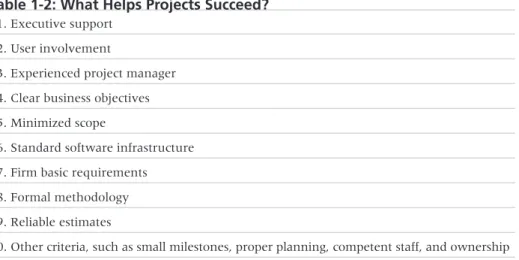
Table 1-2 summarizes the results of the 2001 Standish Group study describing, in order of importance, what factors contribute most to the success of information technology projects. Note that the study lists executive support as the most impor-tant factor, overtaking user involvement, which was most imporimpor-tant in the earlier studies. Also note that several other success factors can be strongly influenced by executives, such as encouraging user involvement, providing clear business objec-tives, assigning an experienced project manager, using a standard software infra-structure, and following a formal methodology. Other success factors are related to good project scope and time management, such as having a minimized scope, firm basic requirements, and reliable estimates. In fact, 97 percent of successful projects were
led by experienced project managers, who can often help influence all of these factors
to improve the probability of project success.
It is interesting to compare success factors for information technology proj-ects in the U.S. with those in other countries. A 2004 study summarizes results
Table 1-2: What Helps Projects Succeed?
1. Executive support 2. User involvement
3. Experienced project manager 4. Clear business objectives 5. Minimized scope
6. Standard software infrastructure 7. Firm basic requirements 8. Formal methodology 9. Reliable estimates
10. Other criteria, such as small milestones, proper planning, competent staff, and ownership The Standish Group, “Extreme CHAOS,” (2001).
of a survey of 247 information systems project practitioners in the Mainland of China. One of the study’s key findings is that relationship management is viewed as a top success factor for information systems in China, while it is not mentioned in U.S. studies. The study also suggested that having competent team members is less important in China than in the U.S. The Chinese, like the U.S., included top management support, user involvement, and a competent project manager as vital to project success.10
It is also important to look beyond individual project success rates and focus on how organizations as a whole can improve project performance. Research comparing companies that excel in project delivery (the “winners”) from those who do not found four significant best practices. The winners:
1. Use an integrated toolbox. Companies that consistently succeed in managing projects clearly define what needs to be done in a project, by whom, when, and how. They use an integrated toolbox, including project man-agement tools, methods, and techniques. They carefully select tools, align them with project and business goals, link them to metrics, and provide them to project managers to deliver positive results.
2. Grow project leaders. The winners know that strong project managers— referred to as project leaders—are crucial to project success. They also know that a good project leader needs to be a business leader as well, with strong interpersonal and intrapersonal skills. Companies that excel in project management often grow their project leaders internally, pro-viding them with career opportunities, training, and mentoring. 3. Develop a streamlined project delivery process. Winning companies have
examined every step in the project delivery process, analyzed fluctuations in workloads, searched for ways to reduce variation, and eliminated bot-tlenecks to create a repeatable delivery process. All projects go through clear stages and clearly define key milestones. All project leaders use a shared road map, focusing on key business aspects of their projects while integrating goals across all parts of the organization.
4. Measure project health using metrics. Companies that excel in project deliv-ery use performance metrics to quantify progress. They focus on a hand-ful of important measurements and apply them to all projects. Metrics often include customer satisfaction, return on investment, and percentage of schedule buffer consumed. You will learn how to use these metrics in later chapters.11
Project managers play an important role in making projects, and therefore organizations, successful.
10Dong, Chang, K.B. Chuah, and Li Zhai, “A Study of Critical Success Factor of Information
System Projects in China,” Proceedings of PMI Research Conference (2004).
11Milosevic, Dragan and And Ozbay, “Delivering Projects: What the Winners Do,” Proceedings
THE ROLE OF THE PROJECT MANAGER
You have already read that project managers must work closely with the other stakeholders on a project, especially the sponsor and project team. They have to be familiar with the nine project management knowledge areas and the var-ious tools and techniques related to project management. Experienced project managers help projects succeed. But what do project managers do, exactly? What skills do they really need to do a good job? The following section pro-vides brief answers to these questions, and the rest of this book gives more insight into the role of the project manager. Even if you never become a project manager, you will probably be part of a project team, and it is important for team members to help their project managers.
Project Manager Job Description
A project manager can have many different job descriptions, which can vary tremendously based on the organization and the project. For example,
Monster.com includes thousands of job listings for project managers. Below are a few edited postings from June 2004:
■ Project manager for a consulting firm: Plans, schedules, and controls activities to fulfill identified objectives applying technical, theoretical, and managerial skills to satisfy project requirements. Coordinates and inte-grates team and individual efforts and builds positive professional rela-tionships with clients and associates.
■ IT project manager for a financial services firm: Manages, prioritizes, develops, and implements information technology solutions to meet busi-ness needs. Prepares and executes project plans using project manage-ment software following a standard methodology. Establishes
cross-functional end-user teams defining and implementing projects on time and within budget. Acts as a liaison between third party service providers and end-users to develop and implement technology solutions. Participates in vendor contract development and budget management. Provides post implementation support.
■ IT project manager for a non-profit consulting firm: Responsibilities include business analysis, requirements gathering, project planning, bud-get estimating, development, testing, and implementation. Responsible for working with various resource providers to ensure development is com-pleted in a timely, high-quality, and cost-effective manner.
As you can see, the job description for a project manager can vary by indus-try and by organization, but there are similar tasks that most project managers perform regardless of these differences. A National Science Foundation study found that project management is a skill needed in every major information technology field, from database administrator to network specialist to technical
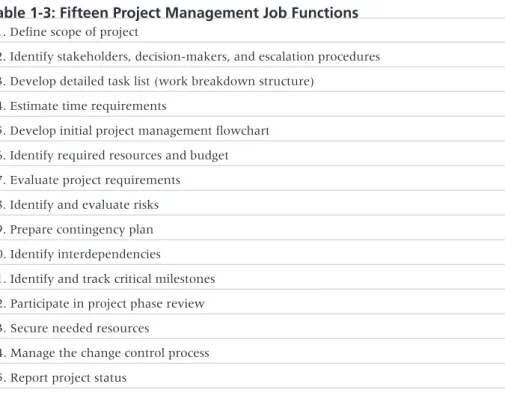
writer. Table 1-3 lists fifteen project management job functions that are essen-tial for good project management.
Each of the job functions listed in Table 1-3 requires different skills, as do the duties described in the different job descriptions. So what skills do project managers need? Can they all be learned, or are some innate? How technical do IT project managers need to be?
Suggested Skills for Project Managers
As you can imagine, good project managers should have many skills. The Project Management Body of Knowledge (PMBOK® Guide 2004) suggests that the project management team understand and use expertise in the following areas:
■ The project management body of knowledge
■ Application area knowledge, standards, and regulations ■ Project environment knowledge
■ General management knowledge and skills ■ Soft skills or human relations skills
Table 1-3: Fifteen Project Management Job Functions
1. Define scope of project
2. Identify stakeholders, decision-makers, and escalation procedures 3. Develop detailed task list (work breakdown structure)
4. Estimate time requirements
5. Develop initial project management flowchart 6. Identify required resources and budget 7. Evaluate project requirements 8. Identify and evaluate risks 9. Prepare contingency plan 10. Identify interdependencies
11. Identify and track critical milestones 12. Participate in project phase review 13. Secure needed resources
14. Manage the change control process 15. Report project status
“Building a Foundation for Tomorrow: Skills Standards for Information Technology, Millennium Edition,” Northwest Center for Emerging Technologies (NWCET), Belleview, WA, 1999.
The previous section introduced the nine project management knowledge areas, as well as some tools and techniques project managers use, in general. The following section focuses on the IT application area, including skills required in the project environment, general management, and soft skills.
The project environment differs from organization to organization and proj-ect to projproj-ect, but there are some skills that will help in most projproj-ect environ-ments. These skills include understanding change, and understanding how organizations work within their social, political, and physical environments. Project managers must be comfortable leading and handling change, since most projects introduce changes in organizations and involve changes within the projects themselves. Project managers need to understand the organizations they work in and how products are developed and services are provided. And they must also understand the social, physical, and political environment. It takes very different skills and behavior to manage a project for a Fortune 100 company in the United States than it does to manage a government project for a new business in Poland. Chapter 2, The Project Management and Information Technology Context, provides detailed information on these topics.
Project managers should also possess general management knowledge and skills. They should understand important topics related to financial management, accounting, procurement, sales, marketing, contracts, manufacturing, distribu-tion, logistics, the supply chain, strategic planning, tactical planning, operations management, organizational structures and behavior, personnel administration, compensation, benefits, career paths, and health and safety practices. On some projects, it will be critical for the project manager to have a lot of experience in one or several of these general management areas. On other projects, the project manager can delegate detailed responsibility for some of these areas to a team member, support staff, or even a supplier. Even so, the project manager must be intelligent and experienced enough to know which of these areas are most important and who is qualified to do the work. He or she must also make and/or take responsibility for all key project decisions.
Achieving high performance on projects requires soft skills or human relations skills. Some of these soft skills include effective communication, influencing the organization to get things done, leadership, motivation, negotiation, conflict man-agement, and problem solving. Why do project managers need good soft skills? One reason is that to understand, navigate, and meet stakeholders’ needs and expectations, project managers need to lead, communicate, negotiate, solve prob-lems, and influence the organization at large. They need to be able to listen actively to what others are saying, help develop new approaches for solving prob-lems, and then persuade others to work toward achieving project goals. Project managers must lead their project teams by providing vision, delegating work, cre-ating an energetic and positive environment, and setting an example of appropri-ate and effective behavior. Project managers must focus on teamwork skills in order to use their people effectively. They need to be able to motivate different types of people and develop esprit de corps within the project team and with other project stakeholders. Since most projects involve changes and trade-offs between
competing goals, it is important for project managers to have strong coping skills as well. It helps project managers maintain their sanity and reduce their stress lev-els if they cope with criticism and constant change. Project managers must be flexible, creative, and sometimes patient in working toward project goals; they must also be persistent in making project needs known. Lastly, project managers must be able to make effective use of technology as it relates to the specific proj-ect. Making effective use of technology often includes special product knowledge or experience with a particular industry. Project managers must make many deci-sions and deal with people in a wide variety of disciplines, so it helps tremen-dously to have a project manager who is confident in using the special tools or technologies that are the most effective in particular settings.
In 2004, millions of people watched the first season of the U.S. reality television show called
The Apprentice, in which contestants vied for a high-level position working for Donald Trump. Each week, Trump fired one contestant and told the contestants bluntly why they were fired or why they were spared. Trump’s reasons provide insight to improving project management skills, as follows:
1. Leadership and professionalism are crucial. No matter how smart you are (the first candidate fired had degrees in medicine and business), you must be professional in how you deal with people and display some leadership potential.
2. Know what your sponsor expects from the project, and learn from your mistakes. Jason, the second person and first project manager fired, decided not to take the time to meet with his project sponsors, causing his team to fail their assignment. Trump wanted everyone to remember that crucial mistake.
3. Trust your team and delegate decisions. Sam had several problems as a team member and project manager, but his lack of trust and respect for and from his teammates led to his downfall.
4. Know the business. Restaurants often have the highest profit margins on certain items, like drinks. Find out what’s most important to your business when running projects. One team focused on increasing bar sales and easily won the competition that week.
5. Stand up for yourself. When Trump fired Kristi over the other women he explained his decision by saying that Kristi didn’t fight for herself, while the other two did. 6. Be a team player. Tammy clearly did not get along with her team, and no one
sup-ported her in the boardroom when her team lost.
7. Don’t be overly emotional and stay organized. Erika had a difficult time leading her team in selling Trump Ice, and she became flustered when they didn’t get credit for sales because paperwork wasn’t done correctly. Her emotions were evident in the boardroom when she was fired.
8. Work on projects and for people you believe in. Kwame’s team selected an artist based on her profit potential, even though he and other teammates disliked her work. The other team picked an artist they liked, and they easily outsold Kwame’s team. 9. Think outside the box. Troy led his team in trying to make the most money selling
rickshaw rides. The other team brainstormed ideas and decided to sell advertising space on the rickshaws, which was a huge success.
10. There is some luck involved in project management, and you should always aim high. Nick and Amy were teamed against Bill, Troy, and Kwame to rent out a party room for the highest price. Troy’s team seemed very organized and did get a couple of good bids, but Nick and Amy didn’t seem to have any real prospects. They got lucky when one potential client came back at the last minute and agreed to a much higher than normal price.
Valuable Skills for IT Project Managers
What other skills do information technology project managers need to succeed in today’s competitive market? People in industry and academia often debate the answer to this question. In an interview with two CIOs, John Oliver of True North Communications, Inc. and George Nassef of Hotjobs.com, both men provided very different responses when asked what skills good information technology project managers need. They could not agree on which skills were more important, such as can-do optimism versus assume-the-worst realism, or detail-oriented versus visionary. However, both agree that the most important skills seem to depend on the uniqueness of the project and the people
involved.12Project managers need to have a wide variety of skills and be able
to decide which particular skills are more important in different situations. Some people believe that it is important for information technology project managers to understand the technologies they use on the projects they are managing. They do not normally have to be experts on any specific technology, but they have to know enough to build a strong team and ask the right ques-tions to keep things on track. On small projects, the project manager might be the manager on a part-time basis and also be expected to produce some of the work. For example, on a small Web development project, the project manager might lead the team and also create some of the site. Other people say it is more important for information technology project managers to have strong business and behavioral skills so they can lead a project team and deliver a solution that will meet business needs.
It would be very difficult for someone with little or no background in infor-mation technology to become the project manager for a large inforinfor-mation technology project. Not only would it be difficult to work with other managers and suppliers, it would also be difficult to earn the respect of the project team.
However, project managers for large information technology projects do not have to be experts in the field of information technology. They should have some working knowledge of various technologies, but more importantly, they should understand how the project they are managing would enhance the business. Many companies have found that a good business manager can be a very good information technology project manager because they focus on meeting business needs and rely on key project members to handle the tech-nical details. Although information technology project managers need to draw on their information technology expertise or the expertise of key team mem-bers, they must spend more time becoming better project managers and less time becoming information technology experts to lead their teams to success.
Lively debates continue on the differences between managing information technology projects and managing other types of projects. There are several dif-ferences, but there are even more similarities. Several articles and speakers joke about the differences between construction projects and software development projects. No, you cannot blow up an old information system like you can an old building and start from scratch. No, there are often no specific engineering prin-ciples and building codes that everyone knows and follows. Nevertheless, infor-mation technology project managers, like all project managers, still have the responsibility for working with their sponsors, project teams, and other stake-holders to achieve specific project and organizational goals. All project managers should continue to develop their knowledge and experience in project manage-ment, general managemanage-ment, and the industries they support.
Unfortunately, many people in information technology do not want to develop anything but their technical skills. They do not see how soft skills or business skills are going to improve their performance or help them earn higher salaries. Most managers disagree with that mindset because they see the need to improve communications between information technology profession-als and their customers. Business people are now more savvy with information technology, but few information technology professionals have spent the time developing their business savvy.13Individuals must be willing to develop more
than just their technical skills to be more productive team members and poten-tial project managers. Everyone, no matter how technical they are, can develop business and soft skills.
Importance of Leadership Skills
In a recent study, one hundred project managers listed the characteristics they believed were critical for effective project management and the characteristics that made project managers ineffective. Table 1-4 lists the results. The study found that effective project managers provide leadership by example, are
13Thomsen-Moore, Lauren, “No ‘soft skills’ for us, we’re techies,” Computerworld Today
visionary, technically competent, decisive, good communicators, and good motivators. They also stand up to top management when necessary, support team members, and encourage new ideas. The study also found that respon-dents believed positive leadership contributes the most to project success. The most important characteristics and behaviors of positive leaders include being a team builder and communicator, having high self-esteem, focusing on results, demonstrating trust and respect, and setting goals.
Leadership and management are terms often used interchangeably, although
there are differences. Generally, a leader focuses on long-term goals and big-picture objectives, while inspiring people to reach those goals. A manager often deals with the day-to-day details of meeting specific goals. Some people say that, “Managers do things right, and leaders do the right things.” “Leaders determine the vision, and managers achieve the vision.” “You lead people and manage things.”
However, project managers often take on the role of both leader and manager. Good project managers know that people make or break projects, so they must set a good example to lead their team to success. They are aware of the greater needs of their stakeholders and organizations, so they are visionary in guiding their current projects and in suggesting future ones. As mentioned earlier, com-panies that excel in project management grow project “leaders,” emphasizing development of business and communication skills. Yet good project managers must also focus on getting the job done by paying attention to the details and daily operations of each task. Instead of thinking of leaders and managers as spe-cific people, it is better to think of people as having leadership skills, such as being visionary and inspiring, and management skills, such as being organized
Table 1-4: Most Significant Characteristics of Effective and Ineffective Project Managers
EFFECTIVEPROJECTMANAGERS INEFFECTIVEPROJECTMANAGERS
Lead by example Set bad examples
Are visionaries Are not self-assured Are technically competent Lack technical expertise
Are decisive Are poor communicators
Are good communicators Are poor motivators Are good motivators
Stand up to top management when necessary Support team members
Encourage new ideas
Zimmerer, Thomas W. and Mahmoud M. Yasin, “A Leadership Profile of American Project Managers,” Project Management Journal (March 1998), 31-38.
and effective. Therefore, the best project managers have leadership and manage-ment characteristics; they are visionary yet focused on the bottom line. Above all else, good project managers focus on achieving positive results!
Careers for Information Technology Project Managers
Paul Ziv, a recruitment strategist at ComputerJobs.com, described why project management made the top-ten list of information technology skills in
demand in late 2002. He explained that information technology project man-agers are expected to do much more today. They have to understand the field and possess an executive skill set in order to lead teams in developing prod-ucts and services that improve the bottom line. Table 1-5 summarizes the top-ten information technology skills and average salaries based on job postings in 2002.
Many people recognize the need to fill these other information technology careers, but most are unaware of the need for project managers or do not really understand what project management is all about. Each of the positions listed above is carried out in conjunction with the role of project management as the specific technologies are deployed. For example, an SQL database analyst would be a team member on a project that requires development or support of SQL databases.
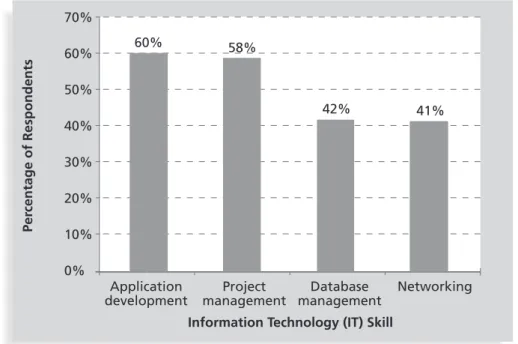
Recent articles also emphasize the need for good project managers in the infor-mation technology field. In a 2004 survey by CIO.com, IT executives listed the IT skills that were most in demand: application development, project management,
Table 1-5: Top Ten Most In Demand Information Technology Skills
RANK IT SKILL/JOB AVERAGEANNUALSALARY
1 SQL Database Analyst $80,664
2 Oracle Database Analyst $87,144
3 C/C++ Programmer $95,829
4 Visual Basic Programmer $76,903
5 E-commerce/Java Developer $89,163 6 Windows NT/2000 Expert $80,639 7 Windows/Java Developer $93,785 8 Security Architect $86,881 9 Project Manager $95,719 10 Network Engineer $82,906
Ziv, Paul “The Top 10 IT Skills in Demand,” Global Knowledge Webcast (www.globalknowledge.com) (11/20/2002).
database management, and networking. Figure 1-3 shows these results in graphi-cal format. Note that 58 percent of survey respondents included project manage-ment as a top IT skill in demand, the second most manage-mentioned skill. Even if you choose to stay in a technical role, you still need project management knowledge and skills to help your team and your organization succeed.
Figure 1-3. Top Information Technology Skills
Cosgrove, Lorraine, “January 2004 IT Staffing Update,” CIO Research Reports, (February 3, 2004).
THE PROJECT MANAGEMENT PROFESSION
The profession of project management is growing at a very rapid pace. To understand this line of work, it is helpful to briefly review the history of project management, introduce you to the Project Management Institute (PMI) and some of its services (such as certification), and discuss the growth in project management software. 50% 30% 20% 10% 0% Per centage of Respondents Application development Project management Database management 40% Networking 70% 60%
Information Technology (IT) Skill
60% 58%
History of Project Management
Some people might argue that building the Egyptian pyramids or building the Great Wall of China was a project. Most people agree, however, that the mod-ern concept of project management began with the Manhattan Project, which the U.S. military led to develop the atomic bomb. The Manhattan Project involved many people with different skills at several different locations. It also clearly separated the overall management of the project’s mission, schedule, and budget under General Leslie R. Groves and the technical management of the project under Dr. Robert Oppenheimer. The Manhattan Project lasted about three years and cost almost $2 billion in 1946.
In developing the project, the military realized that scientists and other techni-cal specialists often did not have the desire or the necessary skills to manage large projects. For example, after being asked several times for each team member’s responsibilities at the new Los Alamos laboratory in 1943, Dr. Oppenheimer threw a piece of paper with an organization chart on it at his director and said, “Here’s your damn organization chart.”14Project management was recognized as
a distinct discipline requiring people with special skills and, even more impor-tantly, the desire to lead project teams.
The military was the key industry behind the development of several project management techniques. In 1917, Henry Gantt developed the famous Gantt chart as a tool for scheduling work in factories. A Gantt chart is a standard format for displaying project schedule information by listing project activities and their corresponding start and finish dates in a calendar format. Managers drew Gantt charts by hand to show project tasks and schedule information, and this tool provided a standard format for planning and reviewing all the work on early military projects.
Today’s project managers still use the Gantt chart as the primary tool to communicate project schedule information, but with the aid of computers, it is no longer necessary to draw the charts by hand. Figure 1-4 displays a Gantt chart for developing an intranet. This version of the chart was created with Microsoft Project, the most widely used project management software today. You will learn more about using Project 2003, the most recent version of Microsoft Project, in Appendix A.
14 The Regents of the University of California, Manhattan Project History, “Here’s Your Damned
Figure 1-4. Sample Gantt Chart in Microsoft Project
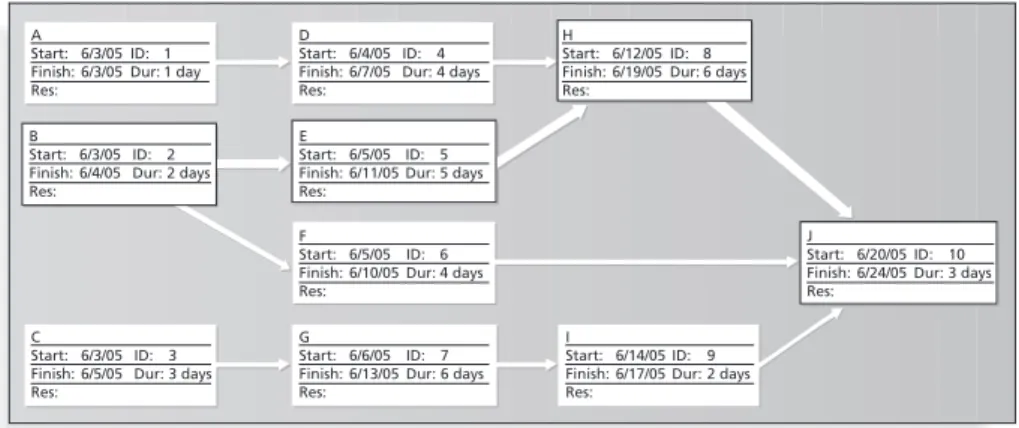
Members of the Navy Polaris missile/submarine project first used network diagrams in 1958. These diagrams helped managers model the relationships among project tasks, which allowed them to create schedules that were more realistic. Figure 1-5 displays a network diagram created using Microsoft Project. Note that the diagram includes arrows that show which tasks are related and the sequence in which team members must perform the tasks. The concept of determining relationships among tasks is essential in helping to improve proj-ect scheduling. This concept allows you to find and monitor the critical
path—the longest path through a network diagram that determines the
earli-est completion of a project. You will learn more about Gantt charts, network diagrams, critical path analysis, and other time management concepts in Chapter 6, Project Time Management.
Figure 1-5. Sample Network Diagram in Microsoft Project
B
Start: 6/3/05 ID: 2 Finish: 6/4/05 Dur: 2 days Res:
C
Start: 6/3/05 ID: 3 Finish: 6/5/05 Dur: 3 days Res:
D
Start: 6/4/05 ID: 4 Finish: 6/7/05 Dur: 4 days Res:
E
Start: 6/5/05 ID: 5 Finish: 6/11/05 Dur: 5 days Res:
F
Start: 6/5/05 ID: 6 Finish: 6/10/05 Dur: 4 days Res:
G
Start: 6/6/05 ID: 7 Finish: 6/13/05 Dur: 6 days Res:
H
Start: 6/12/05 ID: 8 Finish: 6/19/05 Dur: 6 days Res:
I
Start: 6/14/05 ID: 9 Finish: 6/17/05 Dur: 2 days Res:
J
Start: 6/20/05 ID: 10 Finish: 6/24/05 Dur: 3 days Res:
A
Start: 6/3/05 ID: 1 Finish: 6/3/05 Dur: 1 day Res:
By the 1970s, the military had begun to use software to help manage large projects. Early project management software products were very expensive and ran on mainframe computers. For example, Artemis was an early project man-agement software product that helped managers analyze complex schedules for designing aircraft. A full-time employee was often required to run the compli-cated software, and expensive pen plotters were used to draw network dia-grams and Gantt charts. As computer hardware became smaller and more affordable and software became graphical and easy to use, project management software became less expensive and more widely used. Today, many industries use project management software on all types and sizes of projects. New soft-ware makes basic tools, such as Gantt charts and network diagrams, inexpen-sive, easy to create, and available for anyone to update. See the section in this chapter on project management software for more information.
In the 1990s, many companies began creating project management offices to help them handle the increasing number and complexity of projects. A Project
Management Office (PMO) is an organizational group responsible for
coor-dinating the project management function throughout an organization. There are different ways to structure a PMO, and they can have various roles and responsibilities. Below are possible goals of a PMO:
■ Collect, organize, and integrate project data for the entire organization. ■ Develop and maintain templates for project documents.
■ Develop or coordinate training in various project management topics. ■ Develop and provide a formal career path for project managers. ■ Provide project management consulting services.
■ Provide a structure to house project managers while they are acting in those roles or between projects.
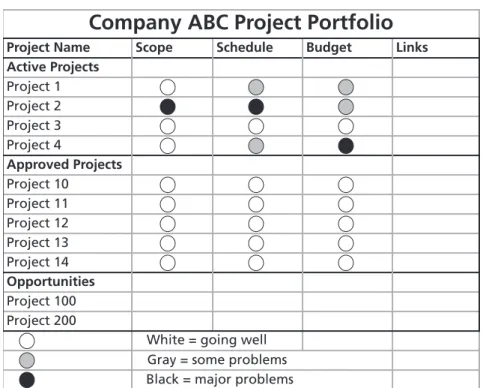
By the end of the twentieth century, people in virtually every industry around the globe began to investigate and apply different aspects of project management to their projects. The sophistication and effectiveness with which project manage-ment tools are being applied and used today is influencing the way companies do business, use resources, and respond to market requirements with speed and accu-racy. Web-based project management tools are now available to help organizations manage individual projects as well as portfolios of projects. Figure 1-6 provides a sample chart that could be displayed from an enterprise project management solu-tion. Enterprise project management software integrates information from multiple projects to show the status of active, approved, and future projects across an entire organization and provides links to more detailed information. Summary charts often show status as green to indicate things are going well, yellow to indi-cate that there are some problems, and red to indiindi-cate major problems. Appendix A provides more information on Microsoft’s Enterprise Project Management Solution, and the last section of this chapter describes recent advances in project management software.
Figure 1-6. Sample Enterprise Project Management Tool
Many colleges, universities, and companies now offer courses related to var-ious aspects of project management. You can even earn Bachelor’s, Master’s, and doctoral degrees in project management. The problems in managing proj-ects, the publicity about project management, and the belief that it really can make a difference continue to contribute to the growth of this field.
The Project Management Institute
Although many professional societies are suffering from declining memberships, the Project Management Institute (PMI), an international professional soci-ety for project managers founded in 1969, has continued to attract and retain members, reporting more than 133,000 members worldwide by May 2004. A large percentage of PMI members work in the information technology field and more than 15,000 pay additional dues to join the Information Systems Specific Interest Group. Because there are so many people working on projects in various industries, PMI has created Specific Interest Groups (SIGs) that enable members to share ideas about project management in their particular application areas, such as information systems. PMI also has SIGs for aerospace/defense, financial services, healthcare, hospitality management, manufacturing, new product development, retail, and urban development, to name a few. As a student, you
Company ABC Project Portfolio
Gray = some problems White = going well
Black = major problems Project 200 Project 100 Opportunities Project 14 Project 13 Project 12 Project 11 Project 10 Approved Projects Project 4 Project 3 Project 2 Project 1 Active Projects
can join PMI for a reduced fee. Consult PMI’s Web site (www.pmi.org) or the Information Systems SIG site (www.pmi-issig.org) for more information. You can also network with other students studying project management by joining the Students of Project Management SIG at www.studentsofpm.org.
Project Management Certification
Professional certification is an important factor in recognizing and ensuring quality in a profession. PMI provides certification as a Project Management
Professional (PMP)—someone who has documented sufficient project
experience, agreed to follow the PMI code of professional conduct, and demonstrated knowledge of the field of project management by passing a comprehensive examination. Appendix B provides more information on PMP certification as well as other certification programs, such as CompTIA’s Project+ certification.
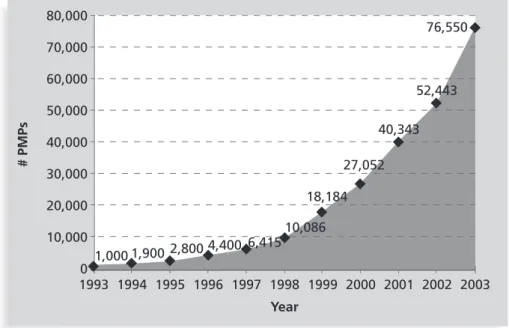
The number of people earning PMP certification continues to increase. In 1993, there were about 1,000 certified project management professionals. By the end of May 2004, there were 81,913 certified project management profes-sionals.15Figure 1-7 shows the rapid growth in the number of people earning
project management professional certification from 1993 to 2003.
Figure 1-7. Growth in PMP Certification, 1993–2003
60,000 Year 40,000 30,000 20,000 10,000 0 # PMPs 1993 1994 1995 1996 1997 1998 1999 2001 50,000 2003 2002 80,000 2000 70,000 1,000 1,9002,800 4,400 6,415 10,086 18,184 27,052 40,343 52,443 76,550
Several studies show that organizations supporting technical certification programs tend to operate in more complex information technology environ-ments and are more efficient than companies that do not support certification. Likewise, organizations that support PMP certification see the value of invest-ing in programs to improve their employees’ knowledge in project manage-ment. Many employers today require specific certifications to ensure their workers have current skills, and job seekers find that they often have an advantage when they earn and maintain marketable certifications.
As information technology projects become more complex and global in nature, the need for people with demonstrated knowledge and skills in project management will continue. Just as passing the CPA exam is a standard for accountants, passing the PMP exam is becoming a standard for project man-agers. Some companies are requiring that all project managers be PMP certi-fied. Project management certification is also enabling professionals in the field to share a common base of knowledge. For example, any person with PMP cer-tification can list, describe, and use the nine project management knowledge areas. Sharing a common base of knowledge is important because it helps advance the theory and practice of project management. See Appendix B of this text for detailed information on certification.
Ethics in Project Management
Ethics is an important part of all professions. Project managers often face ethi-cal dilemmas. For example, several projects involve different payment meth-ods. If a project manager can make more money by doing a job poorly, should he or she do the job poorly? If a project manager is personally opposed to the development of nuclear weapons, should he or she refuse to manage a project that helps produce them? It is important for project managers to make deci-sions in an ethical manner.
PMI developed a PMP code of professional conduct that all applicants must sign in order to become certified project management professionals (PMPs). PMI states that it is vital for all PMPs to conduct their work in an ethical man-ner. Conducting work in an ethical manner helps the profession earn the confi-dence of the public, employers, employees, and project team members. The PMP code of professional conduct lists responsibilities to the profession, such as compliance with all organizational rules and policies, professional practice, and advancement of the profession. It also lists responsibilities to customers and the public, such as qualifications, experience, and performance of professional ser-vices, as well as conflict-of-interest situations. For example, one of the respon-sibilities to customers and the public includes refraining “from offering or accepting inappropriate payments, gifts or other forms of compensation for