College
to Career
College
to Career
The Hispanic Scholarship Fund
Aligning Higher Education Outcomes to Workforce Demand
2012–2018
HIGH-DEMAND OCCUPATIONS:
Introduction
In 2012, the Hispanic Scholarship Fund (HSF) commissioned research addressing a critical issue facing corporate America in the upcoming decade: a dramatic shortage of college-educated workers who are adequately trained for high-demand occupations (HDOs). Our study analyzed data and projections behind that alarming trend for five
occupational groups (see box, next page) to explore ways to mitigate or reverse this future shortage of educated workers. Founded in 1975, HSF is the nation’s largest not-for-profit organization supporting Hispanic higher education.
We provide American families with the financial and educational resources they need to achieve a college education and help America be more competitive.
The Problem
Despite current economic challenges, including high unemployment rates, estimates indicate that by 2018 the nation’s employers will face a shortage of 3 million workers with college degrees.1 Why?
• For every 100 elementary school students, only 21 graduate from college.
• The U.S. is the only country where college attainment levels among those just entering the labor market (25- to 34-year-olds) are lower than those about to leave it (55- to 64-year-olds).2
• By 2018, as many as two-thirds of entry-level openings are projected to require a college degree, leading to a decline in less-skilled jobs.
Clearly, we need more college graduates to fill the job demands of the future. However, our research shows that the problem isn’t simply a shortage of college students; it’s a failure to match those degrees that are attained with the evolving needs of business. Many corporations are currently unprepared to handle this looming issue.
What the Data Tells Us
This report is an excerpt from HSF’s full-length College to Career analysis that profiles managerial and professional office (M&P) occupations. The analysis looked at recent college graduates’ chosen fields of study and how they relate to the career opportunities available in a range of M&P industries and occupations. This data was then compared to the projected number of entry-level job openings from 2012 to 2018 in the highest-demand occupations of this sector.3
Key Findings:
• The managerial and professional office occupations group accounted for 23.7 million total jobs in 2012, with the highest number of projected openings, 5.3 million through 2018. Nearly two-thirds (61%) of managerial and professional office occupations will likely require an associate’s or bachelor’s degree, second only to science, technology, engineering, and math (STEM) occupations.
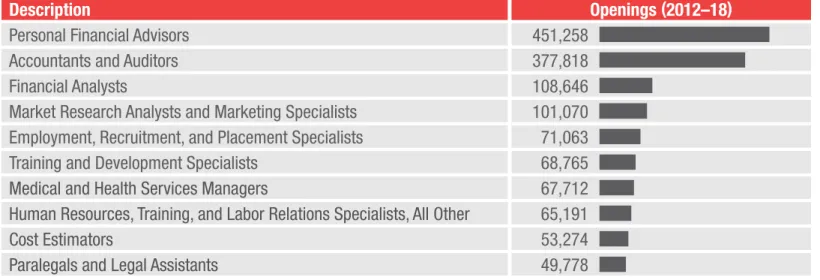
• Personal financial advisors will be most in demand, with more than 450,000 openings (2012–2018). The next two highest-demand occupations (also financial) are accountants and auditors (more than 375,000 projected openings) and financial analysts (nearly 110,000 openings).
• High-demand human resources occupations include employment, recruitment, and placement specialists; training and development specialists; and other human resources, training, and labor relations specialists. These three occupations are each expected to generate 65,000–70,000 openings during the study period.
• The 10 top HDOs in this sector impact diverse industries, including finance and investment, legal services, human resources, and real estate development.
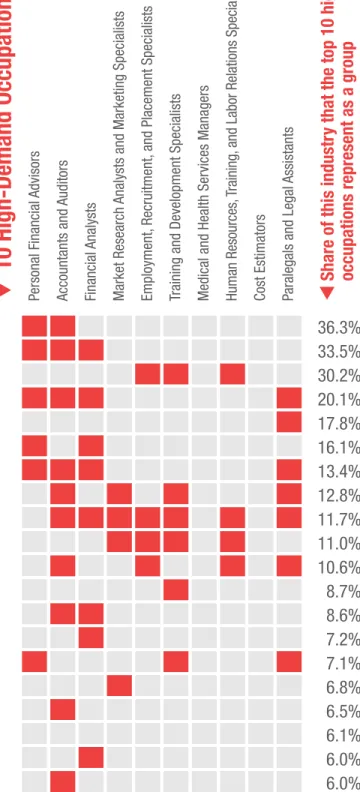
• While HDOs account for 30% or more of total employment in three industries — accounting, tax preparation, bookkeeping, and payroll services; other financial investment activities; and business, professional, labor, political, and similar organizations — each is reliant on just two or three occupations. Only one top 20 industry, management of companies and enterprises, employed seven separate high-demand occupations, accounting for 11.7% of the industry’s total workforce.
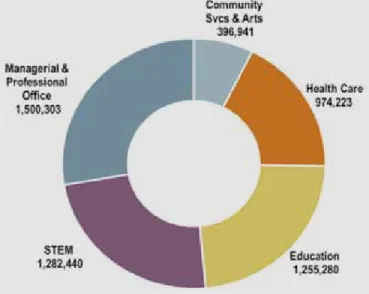
FIGURE 1.
ENTRY-LEVEL OPENINGS BY TARGET CATEGORY, 2012–2018Source: EMSI Complete Employment 2012.1, BLS Employment Projections Education & Training Requirements.
Note: Entry-level is defined as those jobs that require an associate’s or bachelor’s degree and less than one year of work experience to gain entry into the occupation.
Fields of Study with a Critical Shortage of Graduates for High-Demand Occupations
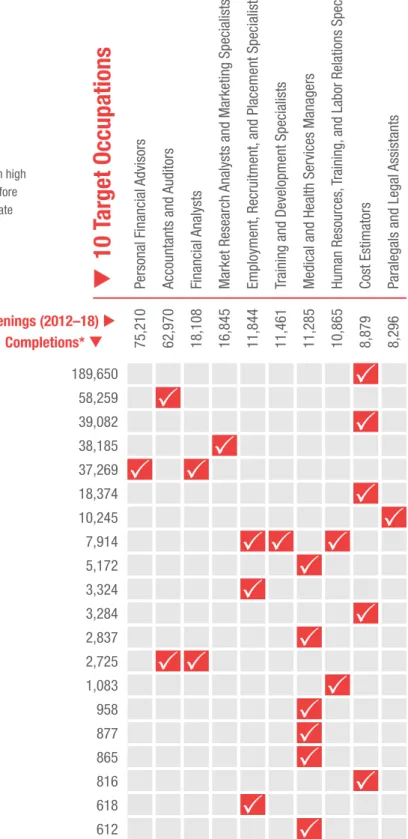
Business, accounting, and finance are the most popular fields of study that feed into the high-demand M&P occupations. The study of human resource management encompasses the most HDOs, relating to four of the top 10 occupations. (See Fig. 5 on page 7.)Human resource-related fields show a wide gap between annual openings and completions. While the top four human resource-related occupations account for 40,349 job openings annually, human resource programs graduate only about 13,000 annually on average.
Although there are an estimated average of 75,210 openings annually from 2012 to 2018 for personal financial advisors, the corresponding degree programs only graduate about 37,000 annually on average. However, because employers often do not require a specific field of study, the occupation draws workers from a range of degrees.
Implications for U.S. Business
Within this decade, nearly two-thirds of jobs created will require a post-secondary education. If America has any
chance of remaining competitive in the global economy, then we need not only more college graduates in our workforce; we need more students to earn associate’s or bachelor’s degrees that correspond to high-demand occupations in all sectors, particularly the five occupational categories in our report, including the management and professional
Top 10 High-Demand M&P Occupations
1. Computer Systems Analysts
2. Computer Software Engineers, Applications 3. Computer Software Engineers, Systems Software 4. Network and Computer Systems Administrators 5. Civil Engineers
6. Computer Programmers 7. Industrial Engineers 8. Mechanical Engineers
9. Computer Specialists, All Other 10. Engineers, All Other
Top 10 Most-Impacted M&P Industries
1. Computer Systems Design and Related Services 2. Software Publishers
3. Computer and Peripheral Equipment Manufacturing 4. Data Processing, Hosting, and Related Services 5. Architectural, Engineering, and Related Services 6. Navigational, Measuring, Electromedical, and Control Instruments Manufacturing
7. Other Information Services
8. Communications Equipment Manufacturing 9. Aerospace Produce and Parts Manufacturing 10. Scientific Research and Development Services
Strengthening and encouraging the link between students’ fields of study and the needs of business is of vital importance to:
• Achieve corporate recruitment goals;
• Ensure a pool of educated, qualified workers;
• Support ongoing talent development strategies for growth; • Decrease the unemployment rate;
• Reduce offshoring of domestic jobs;
• Keep top American industries competitive in the global marketplace; • Support the continued expansion of our nation’s economy.
HSF Is Part of the Solution
The Hispanic Scholarship Fund partners with American corporations and philanthropic organizations to align higher education outcomes with workforce demands by addressing the nation’s skills gap in the highest-demand occupations that require college degrees. Via its Generation 1st Degree initiative, HSF supports first-generation Hispanic college students with the interest and ability to meet future workforce needs through:
• Community outreach • Educational support • Employer engagement
To date, HSF and its growing coalition of companies and donors have awarded more than $360 million in scholarships to deserving students. For nearly 40 years, HSF has supported a broad range of outreach and education programs to help students and their families navigate collegiate life, from gaining admission and securing financial aid, to finding employment after graduation.
If you are concerned about finding qualified, college-educated talent to meet your company’s hiring needs in the next decade and beyond, we invite you to be a part of the solution by joining HSF’s Generation 1st Degree initiative.
For more information, visit www.hsf.net, call 1-877-HSF-INFO, or contact the Regional
ABOUT GENERATION 1ST DEGREE
Generation 1st Degree is the Hispanic Scholarship Fund’s initiative focused on closing the degree gap between Hispanic students and their peers by helping at least one person in each Hispanic household earn a college degree. The goal of the initiative is to add more than 14 million new Hispanic college graduates by 2025.
Managerial and Professional Office Occupations
FIGURE 2.
SECTOR DEFINITIONThe managerial and professional office (M&P) sector is composed of all management, business and financial operations, and legal occupations. (See Fig. 2.)
In 2012, this sector accounted for 23.7 million jobs and is expected to generate 5.3 million openings between 2012 and 2018, of which 3.3 million (61%) will require either an associate’s or bachelor’s degree.
The highest-demand entry-level M&P occupations for college graduates are personal financial advisors, and accountants and auditors. Others include human resource specialists of different types, financial analysts, market research analysts, cost estimators, medical and health services managers, and paralegals and legal assistants. These top 10 occupations, totaling 1,414,575 expected openings (60% of the M&P sector total), all require an associate’s or bachelor’s degree, less than one year of experience in a related field, and no on-the-job training. (See Fig. 3.)
FIGURE 3.
TOP 10 ENTRY-LEVEL OCCUPATIONS FOR ASSOCIATE’S AND BACHELOR’S DEGREE HOLDERSOpenings, 2012–2018
Source: EMSI Complete Employment 2012.1, BLS Employment Projections Education & Training Requirements.
Industries Most Impacted by High-Demand Occupations
Description
Top Executives
Advertising, Marketing, Promotions, Public Relations, and Sales Managers Operations Specialties Managers
Other Managment Occupations Business Operations Specialists Financial Specialists
Lawyers, Judges, and Related Workers Legal Support Workers
Description
Personal Financial Advisors Accountants and Auditors Financial Analysts
Market Research Analysts and Marketing Specialists Employment, Recruitment, and Placement Specialists Training and Development Specialists
Medical and Health Services Managers
Human Resources, Training, and Labor Relations Specialists, All Other Cost Estimators
Paralegals and Legal Assistants
Openings (2012–18) 451,258 377,818 108,646 101,070 71,063 68,765 67,712 65,191 53,274 49,778
FIGURE 4.
TOP 20 INDUSTRIES THAT USE HIGH-DEMAND OCCUPATIONSAccounting, Tax Preparation, Bookkeeping, and Payroll Services Other Financial Investment Activities
Business, Professional, Labor, Political, and Similar Organizations Other Investment Pools and Funds
Legal Services
Securities and Commodity Contracts Intermediation and Brokerage Insurance and Employee Benefit Funds
Lessors of Nonfinancial Intangible Assets (except Copyrighted Works) Management of Companies and Enterprises
Management, Scientific, and Technical Consulting Services Office Administrative Services
Business Schools and Computer and Management Training Monetary Authorities—Central Bank
Securities and Commodity Exchanges Insurance Carriers
Software Publishers Land Subdivisions
Grant Making and Giving Services
Computer and Peripheral Equipment Manufacturing
36.3% 33.5% 30.2% 20.1% 17.8% 16.1% 13.4% 12.8% 11.7% 11.0% 10.6% 8.7% 8.6% 7.2% 7.1% 6.8% 6.5% 6.1% 6.0%
q
10 High-Demand Occupations
Personal Financial Advisors Accountants and AuditorsFinancial Analysts Market Research
Analysts and Marketing Specialists
Emplo
yment,
Recruitment,
and Placement Specialists
Training and Development Specialists Medical and Health Ser
vices Mana
gers
Human Resources,
Training,
and Labor Rela
tions Specialists,
All Other
Cost Estima
tors
Paralegals and Legal
Assistants
t
Share of this industr
y that the top 10 high-demand
occupations represent as a group
= One of the Top 10 Industries for this Occupation
FIGURE 5.
TOP 20 FIELDS OF STUDY (BY NUMBER OF COMPLETIONS) THAT MATCH HIGH-DEMAND OCCUPATIONSBusiness Administration and Management, General Accounting
Business/Commerce, General
Marketing/Marketing Management, General Finance, General
Mechanical Engineering Legal Assistant/Paralegal
Human Resources Management/Personnel Administration, General Health/Health Care Administration/Management
Organizational Behavior Studies
Construction Engineering Technology/Technician
Hospital and Health Care Facilities Administration/Management Accounting and Business/Management
Labor and Industrial Relations
Health Information/Medical Records Administration/Administrator Health Services Administration
Community Health and Preventive Medicine
189,650 58,259 39,082 38,185 37,269 18,374 10,245 7,914 5,172 3,324 3,284 2,837 2,725 1,083 958 877 865 Personal Financial Advisors Accountants and Auditors
Financial Analysts Market Research
Analysts and Marketing Specialists
Emplo
yment,
Recruitment,
and Placement Specialists
Training and Development Specialists Medical and Health Ser
vices Mana
gers
Human Resources,
T
raining,
and Labor Rela
tions Specialists,
All Other
Cost Estima
tors
Paralegals and Legal
Assistants
q
10 T
arget Occupations
Completions* qq
Related Fields of Study
75,210 62,970 18,108 16,845 11,844 11,461 11,285 10,865 8,879 8,296P
P
P
P
P
P
P
P
P
P
P
P
P
P
P
P
P
P
P
P
P
* Completions data is the three-year average from 2008 to 2010, which includes only associate’s and bachelor’s degrees between July 1 and June 30 of each year from institutions eligible to participate in federal financial aid programs.
Note: Many of the fields of study listed here match to other occupations that are not in high demand and have completions that are not associate’s and bachelor’s degrees. Therefore a direct comparison of completions and openings figures on this table is not an accurate measure of the balance between supply and demand.
Annual Openings (2012–18) u
= One of the Top 10 Fields of Study for this Occupation
The College to Careers analysis identified five
occupational categories projected to have the highest demand for associate’s and bachelor’s degree holders: • Managerial and professional office
• Science, technology, engineering, and math (STEM) • Health care
• Education
• Community services and arts
HSF’s Generation 1st Degree initiative is focusing new scholarship funds on these categories, which will generate an estimated 5.4 millionopenings in occupations that require an associate’s or bachelor’s degree and less than one year of work experience in a related field, from 2012 to 2018.
These openings are spread across 122 specific occupations. Within each of the five categories, we identified which occupations will be in highest demand both nationally and in HSF’s primary markets: Atlanta, Chicago, Houston, Los Angeles, Miami, New York, and San Francisco.
Of the HDOs identified, six are in high demand nationally as well as across all seven major markets. Registered nurses rank number one, followed by personal financial advisors, accountants, and three education positions. Other HDOs were more likely to reflect the industry specialization of a given market, e.g., software engineers in San Francisco, financial analysts in Chicago and New York. With the exception of Houston’s strong demand for petroleum engineers, these market-specific HDOs were also expected to experience strong growth nationally.
About this Study and HSF Strategy
This document is excerpted from College to Career: Matching Scholars Programs to Workforce Demand 2012–2018, prepared by TIP Strategies for the Hispanic
Scholarship Fund. The full report 1) profiles occupations that will demand the most college graduates over the 2012–2018 period, 2) identifies the industries that will be most impacted by those occupations, and 3) catalogs the fields of study that most closely link to the high-demand occupations (HDOs).
Sources:
1 Carnevale, Anthony P. “Help Wanted: Projections of Jobs and Education Requirements Through 2018.”
2 Education at a Glance 2011, OECD Indicators.
3 Supply and demand for M&P occupations were gauged using “Completions” data compiled by the National Center for Education Statistics from detailed
information about degrees and certificates awarded for credit by institutions that participate in federal financial aid programs. Popular fields of study such as business administration, general business, and accounting generate a large number of completions annually, but include a significant number of students that are likely to pursue employment in other sectors.
Founded in 1975, the Hispanic Scholarship Fund is the nation’s leading organization working to address the barriers that keep many Latinos from earning a college degree. HSF envisions a future where every Latino household will have at least one college graduate, creating an enduring impact on the college outlook of Latino families nationwide, and strengthening the American economy for generations to