R E V I S I O N 0 F R A T E S A P P L I C A B L E T O A C L A S S O F P R O P E R T Y FIRE I N S U R A N C E 63 R E V I S I O N O F R A T E S A P P L I C A B L E T O A
C L A S S O F P R O P E R T Y F I R E I N S U R A N C E B Y
C. OTIS S H A V E R T H E OBJECTIVE A N D DEFINITION OF TERMS USED
M a n y volumes have been written covering the general subject of property insurance, with emphasis on underwriting, claims settlement, and contractual relationships, but little has been written on the proc- esses involved in rating fire insurance and the subsequent revision of these rates. For the most part only a relatively few informed people connected with insurance departments, rating bureaus, and statistical associations have been in a position to discuss the validity of the methods used in fire insurance rate making.
During the past few years, due to this lack of information, fire insurance rates have been the subject of controversy. The controversy has centered largely around the question of adequacy or inadequacy of the rates as affected by deviations from the prescribed bureau plans.
Ob]ective.--It is to be hoped that an analytical study of the processes
involved in a revision of the fire insurance rates for a given class of property will afford enough information from which those w h o are somewhat informed can d r a w reasonable conclusions as to the pro- priety of the principles involved, to the end that those having actuarial inclinations m a y be challenged to m a k e a deeper investigation into the field of fire rating than is being attempted in this particular study. It is to be noted that the procedure outlined in this study is that which is followed by the bureaus operating in certain midwestern states such as Ohio, Indiana, Michigan, and Kentucky and m a y differ to some degree from the methods used in the Eastern part of the country. N o attempt has been m a d e to cover any differences which m a y exist as between these different areas.
Since the main problem of ratemaking is the adequacy of the rates, this naturally leads to a discussion of the statistical basis and to questions of discrimination between various classes of risks.
Effective January, 1947, a revised Fire Statistical Plan w a s adopted. This Plan is generally k n o w n as the Standard Classification of Oc-
cupancy Hazards and has been approved by the National Association
of Insurance Commissioners. The Plan contains 115 occupancy classes, which in turn are collected into five major groupings of risks: residential, mercantile, non-manufacturing, manufacturing, and sprinklered.
For purposes of this study the three largest occupancy classes contained in Group I (Residential) of the Plan have been chosen. These classes are as follows :
Class No. 009--Household contents of Dwellings, w h e n contents are written on separate policy.
Class No. 019--Dwelling--Buildings and Contents, w h e n both written on same policy.
6 4 REYISION OF RATES APPLICABLE TO A CLASS OF PROPERTY FIRE I N S U R A N C E
Class No. 029mDwellings--Buildings only when w r i t t e n on sep- arate policy.
These three classes apply entirely to class rated risks, whereas most of the other classes in the Plan are for specifically rated risks. Fire loss experience is reported in accordance with this class which in t u r n forms the basis of adjustment by classes. Thus the classified data for the adjustment of the fire loss cost of insurance rates are provided. These fire loss experience data may be used in determining a statewide rate level as well as f o r classes of risks.
While such expressions as earned premiums, incurred losses, and expense ratio are generally familiar, there are certain expressions peculiar to fire insurance which should be mentioned.
Catastrophe Allowance.hA loading in the rate to compensate for the effects which a conflagration might have upon the normal or ex- pected loss experience.
Protection CIassification.--One of a series of categories established by the National Board of Fire Underwriters to identify certain types of risks by kinds of construction in combination with certain town gradings for statistical identification.
Occupancy Cla~s.--One of a series of categories established by the National Board of Fire U n d e r w r i t e r s to identify certain types of risks by kinds of occupancy for statistical identification.
The method followed in this study is one that is currently used by some of the midwestern fire rating bureaus in making class rate ad- justments and f o r the most p a r t reflects the effects of the loss ex- perience on the rates.
RATING METHODS
Fire Insurance Rates are separated into two main categories: Class Rates and Specific Rates.
Class Rates.--Class rates apply to risks t h a t are of substantially the same general character, and where minor differences in exposure can be ignored without any material increase in risk occurring. Such risks are classified as to construction, occupancy, and fire protection and include dwellings, small apartments, and sometimes churches, clubs, schools, farms, small mercantiles, and certain special risks. Dwellings are universally class rated and m a y make up f r o m 50 % to 80% of the number of insurable risks in a town or city. They are, however, mostly small risks and therefore m a y not produce more than 10% to 25% of the premium volume.
Specific R a t e s . n A specific rate applies to an individual risk that is not subject to class rates ; it is the rate for a particular building, or the rate for the contents of a certain tenant. The main difference in determining specific rates, as opposed to class rates, is the procedure involved. The determination of each specific rate requires an inspec- tion for hazards t h a t m a y create conditions favorable to fire damage. The deficiencies and hazards are evaluated in accordance with sets of standards, with allowances for protection devices, and a rate for a
REVISION OF RATES APPLICABLE TO A CLASS OF PROPERTY FIRE I N S U R A N C E 6 5
specific building and rates for each occupant of this building is formu- lated.
Statistical Accumulation.--The National Board of Fire Underwrit- ers collects fire insurance premium and loss statistics on a state by state basis from all stock companies and files consolidated reports of these statistics with state insurance departments and rating bureaus for their use in connection with making rate revisions.
In addition to the National Board there are two other statistical organizations which accumulate and report fire insurance statistics to the insurance departments, namely; the Mutual Insurance Advisory Association and the National Association of Independent Insurers. These statistics are not used for rating purposes.
Throughout the country there are several regional advisory organi- zations which co-ordinate the functions of the rating bureaus in their respective jurisdictions. These organizations afford advice in connec- tion with the development of new coverages, changes in coverages, and changes in rate levels.
Fire rates are made in most states by rating bureaus which have been established by the stock companies. State laws require that these bureaus furnish their services to any other companies desiring them. A few states have bureaus established by statute and all companies operating in such states are required to belong to them.
Rate Make-up.--Fire insurance rates are expressed in terms of the amount of dollars or cents charged for $100 valuation of property insurance for a period of one year. These rates should result in suf- ficient aggregate premiums to provide for (1) losses, (2) expenses of conducting business, (3) an allowance for catastrophe, and (4) a reasonable profit. Adjustment expense is included in the operating expenses and not as a p a r t of losses.
While fire insurance rates are promulgated on a statewide basis and follow the same basic pattern as to development, certain differ- ences exist between states as to the proportionment of the rate for losses, expenses, profit, and catastrophe as well as to the application of credits applicable to specifically rated risks. The following formula most nearly reflects the pattern which is in use in the State of New York and the midwestern states mentioned above :
Loss P a y m e n t .475
Underwriting Expense .465
Conflagration Allowance .010
Profit (Underwriting) .050
Underwriting profit as referred to in this formula shall be deter- mined with the use of direct earned premiums and incurred loss and incurred expense figures without regard to reinsurance.
This formula for the most part reflects the expense and loss experi- ence of the stock companies reporting to the National Board, and the profit factor (5% profit plus 1% catastrophe) follows the 1921 Profit Formula of the National Board as modified in the 1949 Subcommittee Report of the N.A.I.C. In connection with adjusting rates, it is as- sumed that no adjustment shall be made if the indicated profit is
6 6 REVISION OF RATES APPLICABLE TO A CLASS OF PROPERTY FIRE INSURANCE
within a tolerance zone of two percentage points above or below such 6% factor.
ACCUMULATION OF EXPERIENCE
In order to assure the accumulation of experience statistics, the Standard Classification requires that the companies furnish annually to the various statistical agencies premium and loss reports of writ- ten premiums by occupancy-construction classification and f u r t h e r di- vision by term of policy. These data for premiums written are classi- fied according to term of policy, to be converted to premiums earned for each class of risk and construction group through the application of specially computed fractions or factors.
Annual CaU.--This detailed report of loss experience is called the Annual Calendar Year Report and is furnished to the companies' sta- tistical agents. In this report, written premium and paid loss detail is shown by occupancy class and construction-protection class. Such a report would show the following information for one of the residen- tim classes :
Occupancy Construction- Written Paid
Class Protection Premium Losses
029 1 $554,250 $114,385
029 2 408,100 72,427
029 3 67,039 14,587
029 4 57,165 19,148
This is direct experience. (Gross of reinsurance.) To attempt to use loss experience accumulated on a net basis would present a r a t h e r unreal picture in instances where changes have occurred in the rein- surance p r o g r a m during the period covered due to the fact that rein- surance cannot be regulated and further, since the rates are intended to cover the full effects of the losses on the class of business to which they are applicable, it is only proper that direct experience be used.
Pro-rata Earned P r e m i u m . - - T o obtain the pro-rata earned pre- mium to be used for each class of business involved, requires t h a t each transaction be identified as to the policy t e r m and spread by year written and then factored on the basis of five year premium being e a r n e d - - I / 1 0 , 1/5, 1/5, 1/5, 1/5, and 1/10 each year. Three y e a r busi- n e s s - I / 6 , 1/3, 1/3, and 1/6 each year. One year b u s i n e s s - - i / 2 and 1/2 each year. This a r r a y applied in a given year would appear as f~)llows :
REVISION OF RATES APPLICABLE TO A CLASS OF PROPERTY FIRE INSURANCE 67 1955
Construction- Year of Written Earned
Class Protection Writing Term Premiun~ Factor Premiu~n
029 1 1950 5 $139,643 .1000 $13,964 029 1 1951 5 147,312 .2000 29,462 029 1 1952 5 121,137 .2000 24,227 029 1 1952 3 182,149 .1667 30,358 029 1 1953 5 139,800 .2000 27,960 029 1 1953 8 210,175 .3333 70,058 029 1 1954 5 138,849 .2000 27,770 029 1 1954 3 210,177 .3333 70,059 029 1 1954 1 63,110 .5000 31,555 029 1 1955 5 188,556 .1000 18,856 029 1 1955 3 275,518 .1667 45,919 029 1 1955 1 90,176 .5000 45,088 1955 E a r n e d Premium $435,276
Incurred L o s s e s . - - A s stated previously, incurred losses are to be used to measure the loss severity. U n d e r the National Board Plan incurred losses are available at present f o r four years, b u t most bureaus have used the usual formula, net losses paid for period cov- ered, plus outstanding losses at end of period, minus outstanding losses at beginning of period. E a r n e d p r e m i u m and incurred losses for a five year period m u s t be set up for each occupancy class subject to a d j u s t m e n t and separated by construction and protection group.
Construction- Earned Incurred Class Protection P r e m i u m Losses
029 1 $1,706,717 $425,989
029 2 1,351,309 329,181
029 3 202,033 53,819
029 4 193,501 51,503
A d j u s t m e n t of Earned P r e m i u m s . - - B e f o r e loss ratios are calcu- lated, earned p r e m i u m m u s t be adjusted to c u r r e n t rate levels. This requires t h a t an accurate record be maintained of all rate changes made during the period under study.
The following example will illustrate what is involved in m a k i n g these a d j u s t m e n t s :
A rate study is being u n d e r t a k e n based on the loss experience of the five year period, 1951-1955. F o r Class 029-frame protected dwellings (construction-protection group 1 ) - - a 3% rate increase was effective J a n u a r y 1, 1952 and a 4% rate increase was effec- tive October 1, 1955. All p r e m i u m w r i t t e n before October 1, 1955 m u s t be adjusted. The p r e m i u m written in 1951 would have to be adjusted for both rate increases. This results in a 7 ~ in- crease in w r i t t e n p r e m i u m for 1951, and a 4% increase f o r 1952, 1953, and 1954, and a 3% increase for 1955.,
68 REVI.SION O F R A T E S A P P L I C A B L E TO A C L A S S OF P R O P E R T Y FIRE I N S U R A N C E
The following table shows the appropriate adjustments to be made: Adjusted Construction- Written Percent of Written Year Class Protection Premium Adjustment Premium
1951 029 1 $275,720 7 $295,020
1952 029 1 319,138 4 331,904
1953 029 1 421,087 4 437,930
1954 029 1 412,136 4 428,621
1955 029 1 554,250 3 570,878
Five Year Total $1,982,331 $2,064,353
The relationship between the actual and the adjusted written pre- mium for the five years combined provides a factor to adjust the five y e a r earned premium to c u r r e n t rate levels. The following formula would apply:
(Adjusted Written P r e m i u m ) X Actual Earned Earned P r e m i u m ~---Adjusted to Current (Actual Written P r e m i u m ) P r e m i u m Rate Levels
Loss Ratio.--Finally then, loss ratios can be computed by dividing incurred losses by the adjusted earned premiums. These loss ratios are ready to be inserted into the rate formula:
Incurred Losses
-- Loss Ratio Adjusted E a r n e d P r e m i u m
Expenses.--Although the fire rate adjustment is not based on ex- penses, expenses nevertheless play a part in determining the allow- able loss ratio .475 as reflected in the formula r e f e r r e d to previously in this study. Some states use a 50% allowable loss ratio and some others a different one. This formula reflects for the most part the in- d u s t r y stock company loss and expense experience as reflected in the Loss and Expense Ratios as compiled from insurance expense exhibits as filed with the New York Insurance Department.
Some explanation of the t r e a t m e n t of expenses would seem in order at this time.
Because of the intrinsic part reinsurance plays in t h e fire insur- ance operation, net expenses are more indicative of operating costs. Whereas reinsurance recoveries for losses are unpredictable, expenses involved in reinsurance transactions are explicit enough to justify their inclusion.
Countrywide expenses for the most part are used for fire rating purposes. Some few states use taxes and commissions on a state basis and some states use state expenses which probably do not vary greatly f r o m countrywide expenses.
Although fire rates are based primarily on historical data, it is nonetheless important that the expense ratio be indicative of f u t u r e
EEVISION OF RATES APPLICABLE TO A C L A S S OF PROPERTY FIRE INSURANCE 6 9
expenses. It follows, then, that the most recent year's expenses would probably be more suitable than expenses over the last two, three, or more years period. Serious consideration should also be given to f u t u r e changes which would affect expenses. It would be misleading and perhaps even dangerous to attempt to say explicitly what tech- nique or period of time should be used to obtain the premium and expense data involved in calculating an expense ratio.
Rating bureaus, faced with the impossible situation of not being able to consider plans and anticipated expenses of their member com- panies, are forced to rely on expense data over the immediate past five years. This information is available f r o m the New York Insur- ance Department.
The logic and technique involved after the basic information is made available becomes more confining. For example, it is generally agreed that it is not practical to develop a statutory expense ratio where all expenses are related to earned premium. This exaggerated illustration will show w h y :
*A company beginning its property fire operation in 1955 writes $200,000 premium during its first year. However, only $50,000 premium is earned during the year. If a 25% commission is paid, the commission expense alone equals the earned premium. It is obvious f r o m this illustration that relating commission ex- pense to earned premium is misleading. While it is true that the dis- tortion has been magnified, nevertheless this same type distortion is a problem to m a n y fast-growing insurance companies. To establish an expense ratio suitable for the rate formula, therefore, it is neces- sary to consider each classification of expense individually and decide whether it should be related to written or earned premium.
Loss adjustment expenses incurred should be related to earned premium because losses are incurred during the term in which the premium is being earned.
As has been shown in the above illustration, (*), commission and
brokerage expenses incurred should be related to w r i t t e n premium. Other acquisition, field supervision, and collection expenses in- curred and general expenses incurred both contain elements t h a t are more appropriately related to written premium. On the other hand, the rest of the expenses in this category are more appropriately re- lated to earned premium. A more conservative approach for the ex- panding company would be to relate these expenses to earned pre- mium.
Taxes, licenses, and fees incurred are paid on the basis of written premium for the most part; thus these expenses are related to written premium.
Here is an example of how an expense ratio computed on this basis would appear:
7 0 REVISION OF RATES APPLICABLE TO A CLASS OF PROPERTY FIRE I N S U R A N C E Net Written Premium
Net Earned Premium
*Loss Adjustment Expenses Incurred **Commission and Brokerage Expenses
Incurred
*Other Acquisition, Field Supervision, and Collection Expenses Incurred *General Expenses Incurred
**Taxes, Licenses, and Fees Incurred Expense Ratio
*Ratio to Net Earned Premium **Ratio to Net Written Premium
$27,481,443 23,648,225 1,921,776 8.1%
(493,644)
(1.8%) 4,755,206 20.1% 5,260,898 22.2% 932,828 3.4%52.0%
In order to illustrate what has been covered so far in this portion of the study, a series of tables showing actual experience for the resi- dential Class 029 has been developed. To be more in line with present day rating bureau practices, expenses for the five year period, 1951- 1955, are shown. No attempt has been made to consider anticipated developments bearing on the expense picture.
TABLE I
Direct Written Premium and Paid Losses for Occupancy Class 029 Construction and Protection Groups I-~
Years 1951-1959 and Combined
C ~ e 029
1951 1952
Const.- Written Paid Written
Prof. Premium Losses Premium
1 $ 3 , 2 9 9 , 1 ~ $ 6 6 k , ~ 8 o $3,723,5~7 e 3 , a ~ 1 , 3 ~ 6 O l , 2 6 1 3,573,779 3 3h6;866 3~,613 ~11,3oo ~23,328 ~7,399 ~88,182 Total $7,3o6,670 $1,3MT,M~9 $8,196,808 C o n s t • - c..~,s Prot. 029 i 2 3 19~ Written Paid W r i t t e n
Premium Losses Premium
$~,,691,5o6 $1,052,~,93 $6,~6,690 ~,376,318 1,~86,595 5,2~7,732 9-3~,A~20 160,637 730,13~ 595,931 183,219 721,776 Total $10,198,179 $2,882,90M $12,9b6,332 1959 1953
Paid Wr i tten Paid
Losses Premium Losse__~s
$1,027,22~ $~,832,931 $1,011,0~ 799,536 ~,658,253 698,780 56,238 560,765 166,5~ 39,180 655,107 123,35~ $1,922,178 $1o,7o7,o96 $1,999,725 Combined Years
Paid Written Paid
L o s s e s Premium L o s s e s $1,281,378 $22,789,826 $5,036,28M 881,730 21,097,0~6 h,h67,90~ 159,131 2,583,~85 973,161 259,603 2,884,32h 652,751 $2,577,8~2 $49,355,Okl $1o,73o,o98
TABLE I reflects written premium and paid losses as contained in annual reports to a statistical agemt, coverlng a five year period, 1991 through 1955, for occupancy Class 029 (dvellings, and includes a portiere of Class O19 covering dwellings and contents)
:m 0 0 In o~ M- in 0 o C :m z ~a
TABLE II
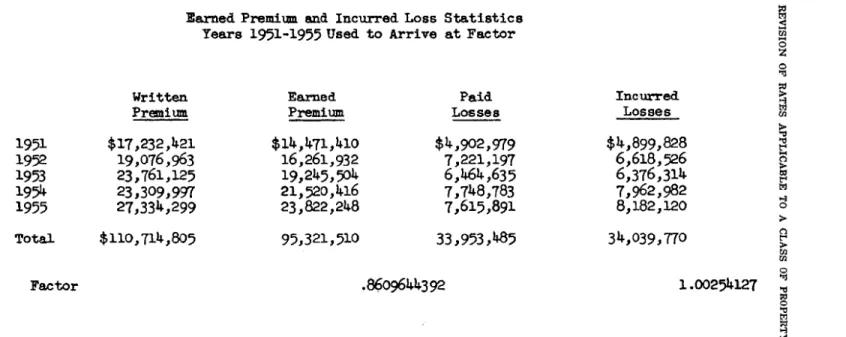
• arned Pres~lum and Incurred Loss Statistics Years 1951-1955 Used to Arrive at Factor
Written Earned Paid Incurred
Premium Premium Losses Losses
1951 $17,232,~21 $14,471,~i0
$~,902,979
$~,899,828
1952 19,076,963 16,261,932 7,221,197 6,618,526 1953 23,761,129 19,2~9,90~ 6,46~,635 6,376,31~ 1 9 ~ 23,309,997 21,520,~16 7,748,783 7,962,982 1955 27,33~,299 23,822,2~8 7,615,891 8,182,120 Total $110,711~,805 95,321,510 33,993,1~5 3~,039,770Factor .86o96~3 Se I.oo25~127
This table (II) indicates the relationship between written and earaed premium on a statewide basis for the five year period, 1951-1955. The relationship between paid and incurred losses for this period is also shown, since the beginning pending (12-31-50) is not available in the necessary detail.
The e~rned premium factor is arrived at by dividing the five year earned In~-~um by the five year written premium. The incurred loss factor is arrived at by divi~4.~ the five year incurred losses by the five year paid losses.
,-..3 N3 o o "a t~ o o ,-1/ II1 o N
REVISION OF RATES APPLICABLE TO A CLASS OF PROPERTY FIRE INSURANCE 7 3
T A B L E I I I
S T A T E W I D E D I R E C T E A R N E D P R E M I U M AND I N C U R R E D LOSSES FOR OCCUPANCY CLASS 029
CONSTRUCTION AND P R O T E C T I O N GROUPS 1-4 COMBINED YEARS 1951-1955
Class
029
Construction- Earned Losses Protection Premiums Incurred
1 $19,621,230 $5,049,083
2 18,164,116 4,479,256
3 2,224,289 574,618
4 2,483,300 654,410
Total $42,492,935 $10,757,367
This table (III) shows t h e earned p r e m i u m s and incurred losses for Class 029, for which rates are being adjusted. The experience re- flected in this table is the product of the earned p r e m i u m and in- curred loss factors shown in T A B L E II times t h e w r i t t e n p r e m i u m and paid losses shown in T A B L E I.
This completes the conversion of the w r i t t e n p r e m i u m and paid loss experience to an earned p r e m i u m and incurred loss basis.
T A B L E IV
R A T E CHANGES FOR CLASS 029 1951-1955
1. F r a m e protected rates increased average of 3% effective J a n u a r y 1, 1952.
2. Brick protected rates decreased average of 5 ~ effective July 1, 1953.
3. F r a m e unprotected rates increased average of 4•o effective J a n u a r y 1, 1954.
4. Brick unprotected rates decreased average of 3% effective July 1, 1954.
5. F r a m e protected rates increased 4% effective October 1, 1955.
This table (IV) reflects the percentage effects of hypothetical rate ad- j u s t m e n t s over the past five years. It is necessary to a d j u s t the earned p r e m i u m s to reflect c u r r e n t rate levels before calculating loss ratios.
TABL~ V
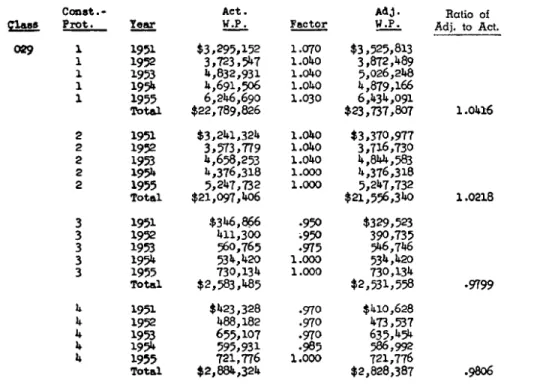
Ad~ue~aent o f A c t u a l W r i t t e n Premium t o C u r r e n t R a t e L e v e l s
~-ass
~ 9
C o l ~ s t . - A c t . A d j . Retie of
P r o t . Year W.P. F a c t o r W.P. Adj. to Act.
1 1951. $ 3 , 2 9 5 , 1 5 2 1 .o7o $ 3 , 9 2 5 , 8 1 3
x 1952 3,7e3,5~7 1.o~o 3,8T2,~89 1 1953 ~,832,931 1.0~0 5,026,2~8 1 195~ h,691,~06 l.OkO ~,879,166 1 1995 6,246,690 1.030 6,~34,091
Total $22,789,826 $23,737,8o7 i.o~16
2 1951 $3,241,324 1.0~0 $3,370,977 2 195~ 3,~73,779 1.0~0 3,716,730 e 1953 ~,658,~53 1.0~,o b, ,Sk-b,,.583 195~ ~,376,318 1.000 ~,376,318 2 1955 9,2~7,732 1.000 9,2~7,732 Total $21,097,~06 $21,596,340 1.0218 3 1951 $3h6,866 .950 $3~9,523 3 1952 ~iI,300 ~950 390,73~ 3 ]-953 .560,765 .975 ~6,7~6
3 199~ 53~,~2o 1.00o 53~,~2o
3 195~ 730,13 ~ 1.000 730,13 Total $~,~83,~89 $2,931,558 .9799 1951 $~23,3~8 .970 $ki0,628 1952 ~88,182 .97o ~73,537 1953 655,1o7 .97o 639,~5~ 199~ 595,931 .985 586,992 1955 721,776 1.000 721,776 Total $2,88~,32k $2,828,387 .9806
TABLE V shews t h e m a . ~ e r o f a d j u s t i n g w r i t t e n p r e ~ i ~ t o c u r r e n t r a t e l e v e l s a n d shows t h e r e l a t i o n s h i p o f a c t u a l w r i t t e n (TABLE I ) t o a d j u s t e d premium.
A d j u s t e d W r i t t e n Premium -~- Ratio of Adjusted to Actual
o z O > > o > > O O C > z
TABLE Vl
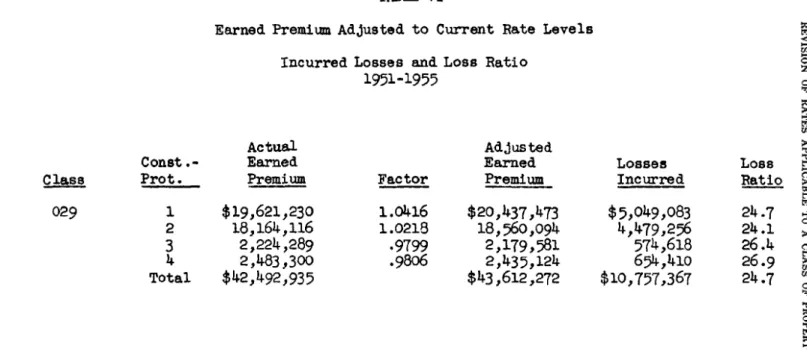
Earned Premiu~AdJusted to Current Rate Levels Incurred Losses and Loss Ratio
1991-1955
Class 029
Actual Adjusted
Const.- Earned Earned Losses Loss
Prot. Premium Factor Premium Incurred Ratio
1
$19,621,230
1.0416
$20,~37,473
$5,049,083
2~.7
2
18,164,116
1.0218
18,960,094
4,479,2~6
24 .i
3
2,224,289
. 9 7 9 9
2,179,981
574,618
26.4
4
2,483,300
. 9 8 0 6
2,439,124
694,410
26.9
Total
$42,492,935
843,612,272
$10,757,367
24.7
This table (Vl) shows the process by which the adjusted earned premium is obtained, that of multiplying the earned premium from TABLE llI by the factors shown in TABLE V.
O O O o o --I
7 6 REVISION OF RATES APPLICABLE TO A CLASS OF PROPERTY FIRE INSURANCE DETERMINATION OF NEED FOR REVISION
In the previous portion of this study, it was shown h o w the loss and expense ratios are established. It was necessary to determine the loss ratio for each statistical subdivision, i.e., each construction- protection group within the occupancy Class 029. Only one expense ratio w a s used.
These ratios, then, along with the conflagration allowance and profit percentage provide all that is needed for establishing the per- cent of change needed to bring the rate in line with the actual experi- ence.
Determination of Amount of Change.--The percent of the pre- mium dollar intended for conflagration allowance and profit are, of course, predetermined by industry practice or by individual com- panies, and a rate change would not affect these percentages. Similarly, the expense ratio will be only partially affected by a rate change since commissions and taxes are paid as a percentage of premium. Therefore, by adjusting the rate we are aiming at changing only the loss ratio.
According to the formula which is set forth in this paper, the al- lowable loss ratio is .475. It is obvious that any substantial deviation f r o m this ratio would necessitate a rate change but when the actual loss ratio differs only slightly f r o m the permissible it is necessary to apply some a r b i t r a r y rule to "draw the line." A common practice is to make a rate adjustment only if the actual loss ratio differs f r o m the permissible by two or more percentage points. Therefore, with a 47.5% permissible loss ratio, a rate adjustment would not be made unless the actual ratio is (1) 45.5% or less or (2) 49.5% or more.
TABLE VII
D E T E R M I N A T I O N OF N E E D FOR RATE CHANGE Permissible Actual
Const..- Loss Loss Rate
Class Prof. Ratio Ratio Change
029 1 45.5%-49.5% 24.7% Rate Decrease Indicated
029 2 45.5%-49.5% 24.1% Rate Decrease Indicated
029 3 45.5%-49.5% 26.4% Rate Decrease Indicated
029 4 45.5%-49.5% 26.9 % Rate Decrease Indicated
TABLE VII shows the actual loss ratios for Class 029 and indicates whether or not a rate change should be made.
CALCULATING AMOUNT OF CHANGE
To calculate the amount of adjustment to be made, it is only a m a t t e r of comparing the permissible loss ratio for each class and protection group combination to the actual loss ratio. This can be done by dividing the actual loss ratio by the permissible and apply-
REVISION OF R A T E S A P P L I C A B L E TO A C L A S S OF P R O P E R T Y FIRE I N S U R A N C E 77 ing the resulting factor to each rate involved in the particular classi- fication. If, for example, the experience indicates a 5 % increase for Class 029, construction-protection code i (Dwellings--Buildings only --frame protected,) it would be necessary to apply the 5 % increase to the rates for the following Class 029 combinations :
Occ. Const.- Class of Bldg. Town Class No. of Fam. Class Prof. Rate
F r a m e approved roof 1 to 4 1 to 2 029 1 .12 F r a m e approved roof 1 to 4 3 to 4 029 1 .14 F r a m e approved roof 5 and 6 1 to 2 029 1 .13 F r a m e approved roof 5 and 6 3 to 4 029 1 .15 F r a m e approved roof 7 and 8 1 to 2 029 1 .15 F r a m e approved roof 7 and 8 3 to 4 029 1 .17 F r a m e unapproved roof 1 to 4 1 to 2 029 1 .16 F r a m e unapproved roof 1 to 4 3 to 4 029 1 .18 F r a m e unapproved roof 5 and 6 1 to 2 029 1 .17 F r a m e unapproved roof 5 and 6 3 to 4 029 1 .19 F r a m e unapproved roof 7 and 8 1 to 2 029 1 .19
1 .21
F r a m e unapproved roof 7 and 8 3 to 4 029
Due to the fact that the rates consist of two digits only, the 5% in- crease m a y not actually change some of the rates. Moreover, the basic rating structure already in existence would normally not be disturbed. That is, the relationship between the rates for the various construction, protection, and number of family combinations is main- tained.
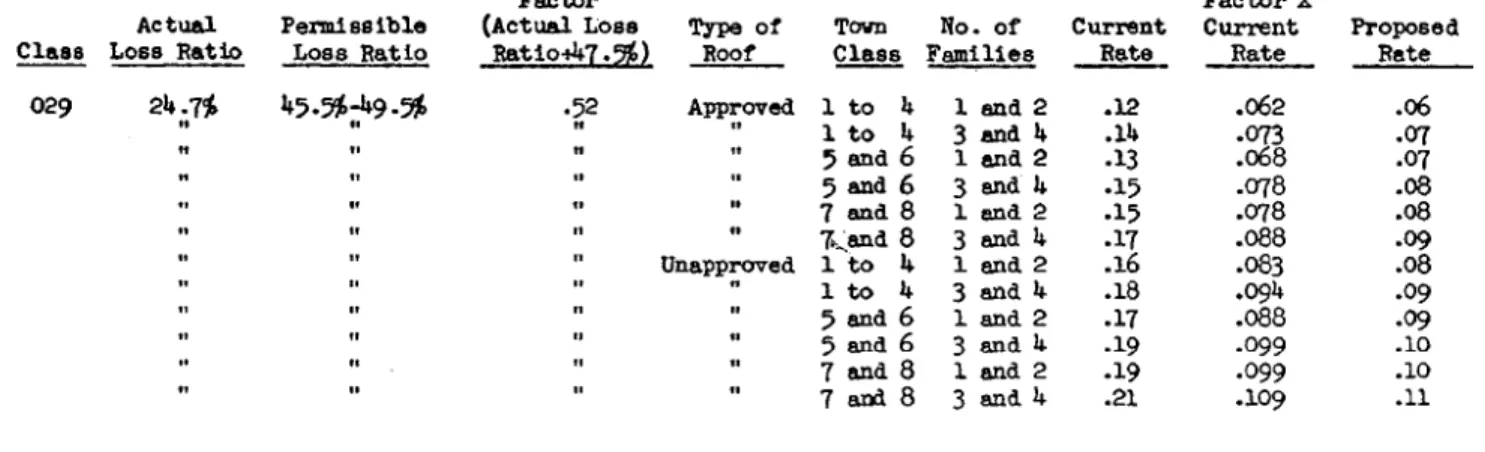
TABLES VIII, IX, X and XI which follow, show the adjustments made in the rates for each construction-protection group combina- tion. From these tables, it can be determined if there is a 2% plus or minus variance from the allowable loss ratio of 47.5% which would necessitate an adjustment.
The proposed rate for each group needing adjusting is developed by dividing the actual loss ratio by the permissible loss ratio of 47.5% and multiplying the result by the current rate.
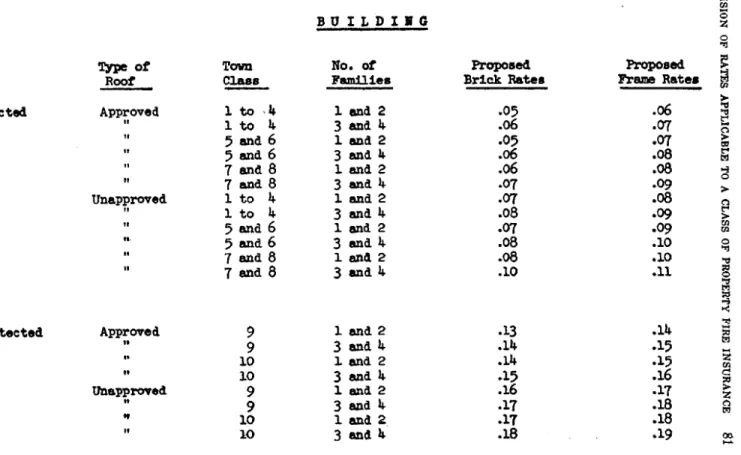
TABLE XII reflects an a r r a y of the proposed rate structures for all the Class 029 groups of business. The purpose of this table is to determine if the construction-protection relationship has been main- tained throughout. For instance, had the loss ratio for f r a m e build- ings been considerably lower than brick buildings, a lower rate for f r a m e buildings might have resulted which would be inconsistent with the policy of maintaining the basic rate structure.
o0
T A B L E VIII
Class 029 B r i c k Protected Approved and Unappreved Roof Business D i v i d e d b y Town Class and Number o~ Families
Showing Current Rates and Proposed Rates
Class Actual Permissible Loss Ratio L o s s R a t i o 2 6 : ~ ~ 5 . ~ : ~ 9 . ~ I i n n ml ~ u ,v , i Factor Factor X
(Actual Loss Type of Town No. of Current Current Proposed Ratio -~T.~J~) Roof Class Fsuni]~ie_s Rate Rate Rate
.56 Approved i to ~ i and 2 .08 .040 .09 . . . . i to 4 3 and 4 .i0 .056 .06 . . . . 5 and 6 i and 2 .09 .05o .o5
. . . . 5 a n d 6 3 and ~ .ll .O62 .O6
" " 7 and 8 1 anU 2 .ll .o62 .o6
. . . . 7 a n d 8 3 and ~ .13 .073 .O7
" Unapproved i to h 1 and 2 .12 .067 .07
. . . . i t o 4 3 and 4 .i~ .078 .08 . . . . ~ and 6 l and 2 .13 .073 .07
. . . . ~ and 6 3 and 4 . l ~ .o84 .o8
. . . . 7 and 8 I and 2 .15 .08~ .08 . . . . ? and 8 3 and 4 .17 .099 .I0
T h i ~ t a b l e ( I X ) i n d i c a t e s t h e p r o c e s s whereby t h e p r o p o s e d r a t e i s
~7-~% = Permissible L o s s Ratio
( A c t u a l Loss Ratio .---" P e n n i s s / b l e Loss Ratio) X Current Rate ---- Proposed Rate.
developed. o o > > > o > c) > o o
Class
029
TABLE IX
Class Oe9 Frame Protected Approved and Unapproved Roof Business Divided by Town Class and Number of Families
Showing C u r r e n t R a t e s a n d P r o p o s e d R a t e s
Factor
Actual Permissible (Actual Loss Type of Loss Ratio Loss Ratio R a t i o ~ 7 . ~ ) Roof
2~7~
~ . ~ 9 . ~
.52
Approved
~t v, . . ,, s, ,! ,| ., g, . . . . . U n a p p r ~ r e d . . . . Factor XTown No. of Current Current Proposed Class Families Rats Rate Rate 1 to 4 I and 2 .12 .062 .06 I to 4 3 and 4 .14 .O73 .07 5 and 6 I and 2 .13 .068 .07 5 an~ 6 3 a m a ~ .15 .078 .08 7 ana 8 1 ana 2 .15 .078 .08 7~and 8 3 and 4 .17 .088 .09 i %o 4 1 end 2 .16 .083 .08 i to 4 3 ana ~ .18 .o94 .09 5 and 6 1 and 2 .17 .088 .09 9 and 6 3 and 4 .19 .099 .i0 7 and 8 i and 2 .19 .099 .I0 7 and 8 3 an~ 4 .21 .109 .11
- q % 0
Actual Permissible ~lass Loss Ratio Loss Ratio
~:~
~ . . ~ . ~
T A B L E X
Cla~s 0~9 B r i c k U n p r o t e c t e d Approved and Unapproved Roof B u s i n e s s D i v i d e d By Town C l a s s and Number o f F a m i l i e s
Shoving Current Rates end Proposed Rates Factor (Actual L o s s • T y p e o f Ratio+~7 . ~ ) Roof .~7 Approved 9 i and 2 .22 ' " 9 3 and ~ . ~ " " IO I and 2 .2~ . . . . I0 ~ a n d I~ .~6 " Unappr~,~ed 9 1 and 2 .28 . . . . 9 ~ a n d ~ .30 " iO i and 2 .30 " " ~o 3 and ~ .3~ F~ctor X
Town No. of Current C u r r e n ~ c Proposed Class Families Rate Rate Rate
.125 .13 • 137 .l~ • 137 .1& .i~8 .15 .160 .16 .171 .17 .17z .X7 .182 .Z8 Clams ~ 9 Actual Loss Rat, io " 2~.1% N || w u TABLE XI
C l a s s 029 F r ~ e U n p r o t e c t e d Approved and Unapproved Roof B u s i n e s s D i v i d e d By Town C l a s s and Number o f F a m i l i e s
Showin E C u r r e n t l ~ t e s and P r o p o s e d R a t e s
P e r ~ s s i b l e L o s s R a t i o
B,
Factor
(Actual Losa Type of Town No. of Current R a t i o ' ~ 7 . ~ ) Roof Class Families Rate
F a c t o r X C u r r e n t P r o p o s e d Rate Rate • 51 Approved 9 I and 2 .28 " 9 3 and ~ .30 . . . . iO I and 2 .30 " " iO 3 and ~ .32 " Unapproved 9 1 and 2 .3~ " " 9 3 and ~ .36 . . . . IO I and 2 .36 " " 10 3 and ~ .38 • i~3 .ib • z53 .z5 .z63 .16 .173 .z? .18~ .18 .18~ .18 .19~ .z9 oo O O O o O ~s C o
TABLE XlI P r o t e c t e d Unprotected T~pe of Roof Approved i ! Unapproved Approved Un~pproved W T o w n Class i t o ,~ i t o 9 a n d 6 5 a n d 6 7 a n d 8 7 a n d 8 1 to 1 to 5 a n d 6 5 ~md6 7 a n d 8 7 e n d 8 9 9 i0 10 9 9 iO 10
Verlflcatlon of Proposed Rates
B U I L D I N G No. of F ~ l les l a n d 2 3 a n d 4 l a n d 2 3 andS, i a n d ~ 3 a n d ~ 1 a n d 2 3 a n d ~ l a n d 2 3 a n d ~ 1 a n d 2 3 and~, Proposed Brlck Rates .05 .06 .05 .06 .06 .07 .O7 .08 .07 .08 .08 .I0 .13 .i~ .14 .15 .16 .17 .17 .18 i a n d 2 3 a n ~ 1 and 2 3 a n d 4 l a n d 2 3 a n d 4 1 a n d 2 3 a n d ~ ~ s ~ Rstes .09 .10 .10 .11 .15 .16 .17 .18 .18 .19 O O Cn T' O O O O ~
82 REVISION OF RATES APPLICABLE TO A CLASS OF PROPERTY FIRE INSURANCE E F F E C T S O F R A T E R E V I S I O N S
The statistics which have been developed in this study indicate the need f o r a substantial reduction in rates for nearly all the class com- binations involved, and were it not for the consideration which must be given to certain factors relating to other classes, adjustments could be made as indicated.
Consideration must be given to the fact that there may be certain ;lasses of risks which do not have adequate rates and which because ~f certain credibility limitations cannot be adjusted on the basis of their own experience, to bring them in line. In order to guard against causing an unreasonable imbalance to occur, it is many times neces- sary to scale down what would otherwise be a sizeable reduction for a given class.
A fire rate m a k e r takes a good deal of liberty in applying judg- ment in connection with adjusting class rates, keeping in mind that it is his p r i m a r y aim to maintain the basic rate levels, and t h a t his adjusting is largely that of testing these levels so the approved rela- tionship existing in the basic levels will be maintained.
To determine the degree of adjustment which should be made, it is necessary to ascertain the percent of change required to produce a permissible loss ratio for the combined classes being considered for adjustment. This can be determined by combining the premiums and losses for the various classes involved and arriving at a loss ratio for the total.
As long as the total experience of the business being rated produces the permissible results, it is possible to establish individual rates with some degree of flexibility. Consequently the proposed rates should be checked to determine if the application of them to the busi- ness written will produce, in total, the desired results.
S U M M A R Y A N D C O N C L U S I O N S
F r o m the foregoing discourse, certain facts stand out, which should be mentioned in summarization and from which certain conclusions can be drawn.
Basis for Rates.--It is evident that fire rates do not stem from a purely statistical basis, but r a t h e r from arithmetical calculations based upon organized quantitative data compiled by either the com- panies or the National Board of Fire U n d e r w r i t e r s covering the volume of premiums written and losses paid to the end that a per- missible loss ratio can be established, which in t u r n becomes the yard- stick for determining the need for adjustment.
By following this principle and including the N.A.I.C. profit factor of 6%, a r a t h e r universal formula has been developed with which to determine the adequacy of fire rates.
It is apparent that the groundwork is being laid which will permit a closer approach to statistical rating, but it should be kept in mind that fire insurance rate making is not likely to become an exact sci- ence.
R E V I S I O N O F R A T E S A P P L I C A B L E T O A C L A S S O F P R O P E R T Y FIRE I N S U R A N C E 8 3 Classified experience statistics, no matter h o w applied, can only tell a story of what has occurred during the period covered by such experience, giving no clues as to what the future holds. However, to paraphrase the National Board statement of principles, by proper application of judgment which gives adequate consideration to eco- nomic trends, social conditions, n e w processes, and inventions, such data can be of great value in predicting what m a y occur in the im- mediate future from a loss experience standpoint.
Rate Adequacy.--It is trite, but nevertheless true to state that the
fire rate must produce enough premiums for companies to pay their losses and expenses of operations. The pattern followed in this study indicates that adjustments m a d e in keeping with this pattern will afford a rate level adequate to meet the above requirements, keeping in mind of course that this applies on the basis of average if it is the rating bureau which is making the adjustment and not a single company.
Rate Fairness.--Rate regulations in most states prohibit the use
of rates which are "unfairly" discriminatory between risks of essen- tially the same hazard. This restraint, in essence, affords the basis for the fire rate makers' adherence to the principle of maintaining the uniform relationship between classes of risks as indicated in the processes involved in this study.
Whatever else m a y be said for or against the fire rating system and the propriety of the base rate make-up, the system for the most part affords a fair degree of consistency as applied to maintaining the basic relationship between classes.
Credibility.--No consideration has been given to the credibility
factor in this study, the reason being that no acceptable measure of credibility for fire risks exists. S o m e rating bureaus take credibility into consideration, but this practice is not universal.
A s the "Standard Classification" gains wider usage and sufficient bodies of statistical data are accumulated, credibility factors can possibly be developed which would be satisfactory.
Expenses.--As
has been indicated, fire rating does not take into consideration expense costs by class of risk, which can be taken to indicate a degree of unfairness, at least in principle, and it will take a lot of work and study to establish a plan that will properly appor-tion such costs to the separate risks involved.
It is to be hoped that present efforts being made in this direction will bear fruit, and ultimately eliminate cause for complaint in this