T
echnical Inf
ormation
D
ATAS
HEETCatalyst 4840G Server Load-Balancing Switch Wire-Speed Firewall and Server
Load-Balancing, Layer-3 Switching
T
HEC
ATALYST®4840G
SWITCH IS A COMPACT,
HIGH-
PERFORMANCE,
SERVER LOAD-
BALANCING(SLB)
SWITCH FEATURING WIRE-
SPEED LOAD-
BALANCING BETWEENF
IREWALL ORW
EB SERVERS. P
ACKING AN INCREDIBLE9
MILLION PACKETS PER SECOND OF SYSTEM THROUGHPUT IN A COMPACT TWO RACK UNITS(RU),
THIS NEWC
ATALYST SWITCH PROVIDES THE HIGH PERFORMANCE THAT IS REQUIRED FOR ENTERPRISE ORI
NTERNETS
ERVICEP
ROVIDER(ISP)
SOLUTIONS SUCH AS SECURITY ORW
EB HOSTING. A
SI
NTERNET AND DATA-
CENTER TRAFFIC DOUBLES EVERY THREE-
TO-
FOUR MONTHS,
THEC
ATALYST4840G
HANDLES THE HEAVIEST TRAFFIC LOADS AND ENABLESF
IREWALL FARMS ANDW
EB SITE SERVER FARMS TO SCALE TO THEIR FULL POTENTIAL. W
ITH THEC
ATALYST4840G,
THE NETWORK IS NEVER THE PERFORMANCE BOTTLENECK.
As an integral part of the Cisco ContentFlow architecture, the Catalyst 4840G is optimized for firewall and server farm deployments. Catalyst 4840G features include:
• Best-in-class port density in a tight package—Dedicated 40 ports of 10/100-Mbps Ethernet and two ports of 1000BaseX Gigabit Ethernet with gigabit interface converter (GBIC) support for interface flexibility. All ports provide server load balancing and IP Layer 3 switching capability
• Best-in-class performance—Firewall and server load balancing and L-3 switching at more than 9 Mpps
• High system capacity—22-Gbps non-blocking switch fabric • Multi-processor architecture— Cisco IOS® software provides
rich SLB algorithms and services as well as L-3 switching support, hardware application-specific integrated circuits (ASICs) for switching
• Flexible network topology options—Dispatch and directed modes allow servers to be either L-2 directly connected or located behind additional L-3 hops
• Unmatched resiliency features deliver a non-stop network infrastructure—Support for switch generated Firewall health checks, Hypertext Transfer Protocol (HTTP) health checks, Dynamic Feedback Protocol (DFP), and stateful redundancy between Catalyst 4840Gs. Also supports Hot Standby Router Protocol (HSRP) for SLB and L-3 redundancy. Optional redundant external power supply.
• Quality of service (QoS)—Multiple queues with Weighted Round Robin (WRR) scheduling
• Comprehensive management tools based on CiscoWorks2000 Content Flow Monitor application
• Proven load-balancing algorithms—Several years ago, Cisco invented and pioneered this technology with Cisco IOS and the Local Director appliances. This experience and continuous innovation ensures that Cisco delivers the “latest and greatest” in load-balancing technology.
• Unmatched scalability—Provides non-blocking, server load-balancing for 1024 real servers and unlimited virtual servers; up to 40 firewalls.
Introducing the Catalyst 4840G SLB Switch
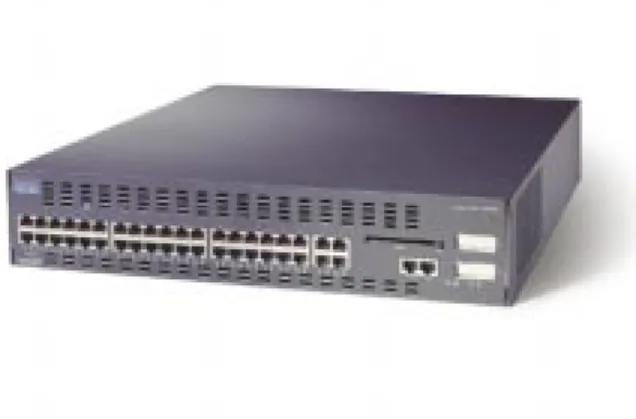
The Catalyst 4840G is a fixed-configuration SLB switch with 40 RJ-45 10/100 ports and two Gigabit Ethernet uplink ports utilizing modular GBIC interfaces. The switch is ideal for deployment in ISP, and enterprise sites that require wire-speed firewall load balancing (FWLB) or integrated SLB. The 4840G SLB switch provides a compact solution for designs that do not require the high port densities offered by the Catalyst 6000 family of switches. With the Catalyst 4840, Catalyst 6000, CSS 11000 and the LocalDirector appliance, Cisco offers a complete line of SLB products to meet the requirements of the smallest enterprise to the largest ISP.
Catalyst 4840G Overview
The Catalyst 4840G delivers the highest performance and port density in the smallest space. With only a 2-RU (1.75 inches high) chassis, the 4840G provides 40 10/100 ports and two-gigabit Ethernet ports. It is capable of switching traffic simultaneously through all ports at wire speed. The architecture consists of a 22-Gpbs non-blocking switch fabric, multiple high-performance Reduced Instruction Set Computer (RISC) processors for routing intelligence and advanced software features, and dedicated per-port ASICs for wire-speed performance.
The Catalyst 4840G is housed in a 2RU chassis and can be provisioned with an optional external redundant power supply. It supports a 22-Gbps shared-memory, fully non-blocking switch fabric, high-performance RISC processor that provides the SLB and routing intelligence, and individual port-based ASICs for wire-speed switching. The switch fabric is capable of supporting all 40 10/100 ports and two-gigabit uplinks simultaneously at wire speed. The Catalyst 4840G provides an aggregate throughput of more than 9 million packets per second (pps) for SLB and L-3 switching. While supporting a rich set of SLB algorithms and features with all the common L-3 routing protocols, the Catalyst 4840 also supports both dispatch and directed SLB modes at wire –speed, making it a truly flexible Web-hosting switch.
Catalyst 4840G Highlights: SLB at Millions of Packets per Second
The Catalyst 4840G provides a complete SLB solution without sacrificing any of the services that are required to build a scalable network. The Catalyst 4840G is a feature-rich switch with a full Cisco IOS SLB implementation that allows network managers to continue to administer and manage their networks as they do
today while scaling their server backbone to gigabit speeds. The Catalyst 4840G supports all the major SLB algorithms/feature sets used in Web sites today as well as all the major routing protocols. These include:
FWLB/SLB Features • Transparent Firewall support
• IP Addessable Firewall Support (PIX, Checkpoint) • Least Connections
• Weighted Least Connections • Round Robin
• Weighted Round Robin
High Availability Features • Dynamic Feedback Protocol
• SLB Stateless Redundancy over HSRP • SLB Stateful Redundancy (both over Ethernet) • HTTP probes
• Firewall probes
Additional SLB features supported by the Catalyst 4840G SLB switch include Port Bound Servers, Client Assigned Servers, Sticky Connections, Buddy Virtuals, Maximum Connections, Delayed Removal, Automatic Server Failure Detection, Auto Unfail, Slow Start, and SynGuard. In the future, additional features will be added to the Catalyst 4840 via simple Cisco IOS software upgrades.
L-3 Switching Features
• Interior Gateway Routing Protocol (IGRP) • Enhanced IGRP (EIGRP)
• Open Shortest Path First (OSPF)
• Routing Information Protocol (RIP) Versions 1 and 2 • Static routes and Route Redistribution
In addition to these L-3 switching features, the Catalyst 4840G supports all the additional protocols necessary to build scalable, reliable networks. These include but are not limited to the Network Time Protocol (NTP), Internet Group Management Protocol (IGMP) 1 and 2, Dynamic Host Configuration Protocol (DHCP) Relay, Cisco Group Management Protocol (CGMP), Internet Control Message Protocol (ICMP), Gateway Discovery Protocol (GDP), ICMP Router Discovery Protocol (IRDP), and Bootstrap Protocol (BOOTP) Relay.
Advanced Load Balancing
The Catalyst 4840G is a fixed-configuration SLB switch that is based on industry-standard Cisco IOS software and, therefore, gains all the features of this time-proven software. In addition, the Catalyst 4840G has some key advantages with respect to network uptime that is crucial to enterprises and ISP Web-hosting sites. These include but are not limited to:
Dynamic Feedback Protocol
The Dynamic Feedback Protocol (DFP) is a mechanism that allows servers to provide intelligent feedback to SLB devices such as the Catalyst 4840G, Catalyst 6000 or LocalDirector. It is used to ensure that SLB devices do not route traffic to over-utilized applications or servers and that traffic is sent to the correct server. Server-based agents can use DFP to communicate application health, availability and load to SLB devices. Advanced forms of these server agents can provide QoS functionality, and workload management capability. DFP is the first protocol that allows servers to provide feedback and input into the SLB load-balancing decision. The ability for multiple server agents to exist on a server platform allows the server to inform the SLB device whether a particular server is either over- or under-utilized, that it should not be used for a specified period of time, or that a particular application should take precedence over generic applications.
HTTP Probes
While DFP provides a comprehensive feedback mechanism between the server and the switch, often a simple poll of the application URL will be adequate for network managers to verify server availability. The Catalyst 4840G introduces this capability in a flexible manner via switched–based HTTP probes. In many cases, both mechanisms can be used; DFP to tune the SLB decision process based on the server’s operating parameters, and HTTP probes to verify server health and content accuracy. The HTTP probe is user-defined on the Catalyst 4840G and can be either an HTTP Get or Post, with an optional user name, user password and URL specified. The switch will make the request at a user-specified interval, compare the return status, and take the appropriate action. If required, the switch can take down the server and send Simple Network Management Protocol (SNMP) traps to the network manager while keeping statistics of the number of failures and the current and cumulative downtime of a particular server. This feature ensures the maximum uptime for servers and their hosted mission-critical applications.
SLB Redundancy
Cisco has been a leader for years in designing high-availability networks and continues to provide innovative solutions that meet the requirements of network managers. To provide a solution to the redundancy requirements in the data center for SLB devices, the Catalyst 4840 SLB switch will support both stateful and stateless automatic fail-over. Both of these schemes are built upon the HSRP that has been extended to provide services for SLB. As a configurable parameter the two Catalyst 4840G switches can be deployed in either a stateful or stateless mode. In stateless mode, the switches communicate only via HSRP hello messages, while in stateful mode the switches communicate via HSRP hello messages as well as providing each other with their status information. In the unlikely event of a switch failure, the secondary switch would be able to take over operation of the failed switches rebuilding the connection database. Since the communication between the switches is via a standard Ethernet, there are no distance limitations to this scheme and redundant switches can be in different areas of the data center or even in different buildings. Additionally, since the switches can have redundant routes to their neighbors-link redundancy is also included in this scheme—an industrial-strength, redundant design is provided for non-stop e-commerce operations.
Firewall Probes
To ensure the reliability of the security environment, the Catalyst 4840G uses ping or HTTP probes to verify firewall health. Probes detect firewall failures and act upon them (see HTTP probes).
Comprehensive SLB Network Management with CiscoWorks2000 and Content Flow Manager
The Catalyst 4840G series of products are easily managed by the powerful CiscoWorks2000 network management products. The Essentials product suite leverages the power of the intranet with browser-based access anywhere within the network. Network managers can walk up to any browser console, identify who they are via the access-control interface, and immediately begin checking on the uptime of each device, the active software versions that are running the Catalyst 4840G, and print a comprehensive report. For drill-down, real-time, device status information, network operations staff members can launch the Cisco award-winning CiscoView application from their fault-management station and at a glance check on the health of the power supplies, line cards, and operational status of each port. Monitoring server load-balancing networks, deploying the Catalyst
4840G, LocalDirector, or Catalyst 6000 switches, is crucial in delivering mission-critical applications and services. Content Flow Monitor takes a significant step forward to offer a complete real–time, performance-monitoring solution for Cisco server load-balancing networks. Its feature-rich, performance-reporting capabilities greatly satisfy the operational needs for monitoring and trouble-shooting content-delivery networks. Content Flow Monitor 1.1 is an essential tool to enable service providers and large enterprises to offer the value-added services by automatically extracting and exporting critical configuration and performance statistics.
Fast EtherChannel and Gigabit EtherChannel Technologies
The Catalyst 4840G supports both Fast EtherChannel®
and Gigabit EtherChannel technologies, allowing network managers to group up to four of the 10/100 ports into a channel as well as grouping the two-gigabit Ethernets into an uplink channel.
Quality of Service
The Catalyst 4840G incorporates a centralized, non-blocking, 22-gigabit, shared-memory, switching fabric. The rich QoS capabilities of the switching fabric enable network managers to protect mission-critical applications by supporting delay-sensitive traffic while managing bandwidth in the campus backbone. The switching fabric supports differentiated delay priorities using a WRR scheduler for delay-sensitive applications, and differentiated loss priorities for managing congestion as well as traffic policing and shaping. The fast packet memory embedded in the switching fabric is allocated dynamically on a per-queue (flow) basis. This dynamic allocation used in conjunction with user-defined queue thresholds and configurable queue scheduling weights ensures that time-sensitive traffic is handled properly with no packet loss. These thresholds and queuing weights can be dynamically adjusted with Cisco Assure Policy Networking, allowing an end-to-end QoS solution.
Summary
The Catalyst 4840G is a cost-effective, high-performance, feature-rich, SLB switch ideally suited for server farms that require wire-speed traffic balancing among many firewalls or servers. In addition to wire-speed FWLB or SLB, the Catalyst 4840 supports wire-speed routing and switching of IP across its interfaces. The Catalyst 4840G features a dedicated configuration of 40 10/100 Ethernet ports and 2 modular Gigabit Ethernet uplink ports. This new Catalyst has a non-blocking, 22-Gbps architecture that enables all ports to switch simultaneously at wire speed. The two-gigabit uplinks support standard GBIC technology, giving network managers the flexibility to quickly select and change gigabit interfaces in the Catalyst 4840G.
Technical Specifications Performance
• 22-Gbps switching fabric
• SLB - 73,000 connections per sec (3 packet) ; 56,000 connections per sec (6 packet)
Note: 56,000 connections per second represents the true performance of this product in TCP connection setup. However, using the test most commonly sited by other vendors, the 3 packet test, the performance of the C4840G has been tested at 73,000 connections per second.
• FWLB - 60,000 connections per second • 240,000 concurrent sessions
• More than 9 million pps wire-speed forwarding rate for 64-byte packets
• MIPs RISC CPU- R5000 CPU, 16MB Flash, 128MB DRAM • Route entries: 24,000 maximum
• 12 MB memory architecture shared by all ports • Packet-forwarding rate for 64-byte packets:
– 14,880 pps to 10-Mbps ports – 148,800 pps to 100BaseT ports – 1,488,000 pps to 1000BaseX ports
Management
• SNMP Management Information Base (MIB) II • Cisco Server Load-Balancing MIB
Standards
• IEEE 802.3x full duplex on 10BaseT, 100BaseTX, and 1000BaseX ports
• IEEE 802.1D Spanning-Tree Protocol • IEEE 802.1Q VLAN
• IEEE 802.3z 1000BaseX specification • 1000BaseX (GBIC)
• 1000BaseSX/LX/LH/ZX
• IEEE 802.3u 100BaseTX specification • IEEE 802.3 10BaseT specification
Y2K
• Y2K compliant
Connectors and Cabling
• 10BaseT ports—RJ-45 connectors; two-pair category 3, 4, or 5 unshielded twisted-pair (UTP) cabling
• 100BaseTX ports—RJ-45 connectors; two-pair Category 5 UTP cabling
• 1000BaseX GBIC ports—SC fiber connectors, single-mode or multimode fiber
• Console and auxiliary port—RJ-45 connectors, RS-232 serial cabling
Indicators
• Per-port status LEDs-link
Dimensions and Weight (H x W x D)
• 3.46 x 17.18 x 18.76 in (8.8 x 43.6 x 47.7 cm) • Two-rack unit (2RU)
• 22 lbs (9.9kg)
Environmental Conditions and Power Requirements • Operating temperature: 32 to 113 F (0 to 45 C) • Storage temperature: -4 to 149 F (-20 to 65 C) • Operating relative humidity: 10 to 85% noncondensing • Operating altitude: Up to 10,000 ft. (3000 m)
• Power consumption: 70W maximum; 239 BTU per hour • AC input voltage/frequency: 100 to 120/200 to 240 VAC
(autoranging) 50 to 60 Hz
• Meantime between failure (MTBF) 150,000 hours
Safety Certifications • UL 1950 • CSA 22.2 No. 950 • EN 60950 • IEC 950 • AS/NZS 3260, TS001 • CE
Electromagnetic Emissions Certifications • FCC Part 15 Class A
• EN 55022B Class A (CISPR 22 Class A) • VCCI Class A
• AS/NZS 3548 Class A
• BCIQ • CE Marking
Ordering Information
For More Information on Cisco Products, Contact: • U. S. and Canada: 800 553-NETS (6387)
• Europe: 32 2 778 4242 • Australia: 612 9935 4107 • Other: 408 526-7209
• World Wide Web URL: http://www.cisco.com
ProductNumber Description
WS-C4840G Catalyst 4840G Server Load Balancing Switch, fixed 40 10/100 FE, 2 1000BaseX (GBIC) Note: GBIC module needs to be ordered separately
MEM-C6K-FLC16M PCMCIA Flash Memory Card, 16MB Option
MEM-C6K-FLC24M PCMCIA Flash Memory Card, 24MB Option
WS-G5484 1000BaseSX GBIC module
WS-G5486 1000BaseLX/LH GBIC module
WS-G5487 1000BaseZX (extended reach) GBIC module
CAB-GELX-625 Gigabit Ethernet multimode conditioning cable
C4840G-PSRACK-PS =
Catalyst 4840 Redundant Power Supply Rack with 1 Power Supply
C4840G-PSRACK= Catalyst 4840 Redundant Power Supply Rack (No Power Supply)
C4840G-PS= Catalyst 4840 Redundant Power Supply (requires rack) CON-SNT-WS-C4840 G SMARTnet maintenance CON-SNTE-WS-C48 40G SMARTnet maintenance CON-SNTP-WS-C484 0G SMARTnet maintenance CON-OS-WS-C4840 G SMARTnet maintenance CON-OSE-WS-C4840 G SMARTnet maintenance CON-OSP-WS-C4840 G SMARTnet maintenance
Copyright © 2000, Cisco Systems, Inc. All rights reserved. Printed in the USA. SMARTnet is a trademark; and Catalyst, Cisco, Cisco IOS, Cisco Systems, the Cisco Systems logo, and EtherChannel are registered trademarks of Cisco Systems, Inc. or its affiliates in the U.S. and certain other countries. All other trademarks mentioned in this document are the property of their respective owners. The use of the word partner does not imply a partnership relationship between Cisco and any of its resellers. (9912R) 04/00 BW6106
Cisco Systems has more than 200 offices in the following countries. Addresses, phone numbers, and fax numbers are listed on the
C i s c o C o n n e c t i o n O n l i n e W e b s i t e a t h t t p : / / w w w . c i s c o . c o m / g o / o f f i c e s .
Argentina • Australia • Austria • Belgium • Brazil • Canada • Chile • China • Colombia • Costa Rica • Croatia • Czech Republic • Denmark • Dubai, UAE Finland • France • Germany • Greece • Hong Kong • Hungary • India • Indonesia • Ireland • Israel • Italy • Japan • Korea • Luxembourg • Malaysia Mexico • The Netherlands • New Zealand • Norway • Peru • Philippines • Poland • Portugal • Puerto Rico • Romania • Russia • Saudi Arabia • Singapore Slovakia • Slovenia • South Africa • Spain • Sweden • Switzerland • Taiwan • Thailand • Turkey • Ukraine • United Kingdom • United States • Venezuela
Corporate Headquarters
Cisco Systems, Inc. 170 West Tasman Drive San Jose, CA 95134-1706 USA http://www.cisco.com Tel: 408 526-4000 800 553-NETS (6387) Fax: 408 526-4100 European Headquarters
Cisco Systems Europe 11, Rue Camille Desmoulins 92782 Issy Les Moulineaux Cedex 9 France http://www-europe.cisco.com Tel: 33 1 58 04 60 00 Fax: 33 1 58 04 61 00 Americas Headquarters
Cisco Systems, Inc. 170 West Tasman Drive San Jose, CA 95134-1706 USA http://www.cisco.com Tel: 408 526-7660 Fax: 408 527-0883 Asia Headquarters
Nihon Cisco Systems K.K. Fuji Building, 9th Floor 3-2-3 Marunouchi Chiyoda-ku, Tokyo 100 Japan http://www.cisco.com Tel: 81 3 5219 6250 Fax: 81 3 5219 6001