guidelines of competence
development in the study
Vilnius 2012
guidelines of competence
development in the
study field of music
Rima Rimšaitė
Vida Umbrasienė
outcomes based study programme designguidelines of competence development in the study field of music
© Vilniaus universitetas, 2012
tABle of contents
introduction ...4
1. ARts And the higheR educAtion system ...7
1.1. Higher music education institutions in the Bologna Process ...7
1.2. Specific features of music education ...8
1.3. Typical qualification degrees in the field of music ...9
1.4. Typical degree programmes in music ...10
1.5. Degree programme profiles ...12
1.6. Descriptors of cycles of study in the field of music ...14
2. competences And leARning outcomes ...17
2.1. Higher music education competences and learning outcomes ...17
2.2. Generic competences ...18
2.3. Subject-specific competences ...19
2.4. ECTS credits and competence development ...20
3. higheR music educAtion student’s WoRKloAd And its cAlculAtion ...22
3.1. Competences and credits ...22
3.2. Recommendations for a modular and subject-specific degree programme structure ...23
4. methodology foR the development of A competence-BAsed degRee pRogRAmme ...25
4.1. Features of an effective degree programme ...25
4.2. Degree programme design principles ...26
4.3. Programme proportions and priorities ...29
5. teAching, leARning And Assessment ...31
6. degRee pRogRAmme updAting And impRovement ...34
final provisions ...35
References ...37
Annexes ...38
Annex 1. List of generic competences ...38
Annex 2. Distribution of generic competences according to their importance to the professional activities of a musician ...39
Annex 3. Distribution of subject-specific competences according to their importance to the professional activities of a musician ...41
Annex 4. Assessment of the importance of generic competences and skills to the professional activities of a musician ...43
Annex 5. Comparison of assessments of the importance of subject-specific competences and skills of employees who have completed Bachelor and Master degree programmes to professional activities ...44
Introduction
In the past decade, higher education institutions have gradually been involved in the
political, social and economic life of Lithuania. Higher education, which has become a mass
phenomenon, is expected to not only produce youth education results and research relevant to higher education institutions but also provide quality in higher education based on closer ties
with the public, labour market and student needs.
The concept of quality in higher education, the basis of Lithuania’s higher education reform, is primarily associated with requirements for quality management and the development of a culture of quality and is implemented by changing the concept of an academic credit. The European Credit Transfer and Accumulation System (ECTS) has been used in Lithuania since 1999–2000 for the implementation of the Erasmus student exchange programme. The ECTS was originally called the credit transfer system and was applied for the purpose of the recognition of part-time studies abroad. The main idea of ECTS credits is student workload accounting to achieve intended learning outcomes. Credits had been given only after successfully completing the tasks and assessing the relevant outcomes.
However, in practice, credits had usually been formal and little related to learning content and learning outcomes. Therefore, for the purpose of the implementation of the Law of the Republic of
Lithuania on Higher Education and Research1, one of the main goals is to implement a competence
and learning outcome-based credit system and switch to student-centred higher education.
Vilnius University has undertaken to achieve this goal by implementing the project “Development of the National Concept of the European Credit Transfer and Accumulation System (ECTS): Credit Harmonisation and Creation and Implementation of the Methodology for Learning Outcomes-Based Degree Programmes through Cooperation and Consensus” (hereinafter “the ECTS project”). The main idea of the ECTS project is related to the need to improve the study process, create preconditions for internationalisation at Lithuanian higher education institutions by developing and implementing the national concept of the European Credit Transfer and Accumulation System (ECTS) and applying the ECTS methodology
developed under the project Tuning Educational Structures in Europe2. The ECTS project is
aimed at developing a dualistic concept of an academic credit, which would lay the foundations for internal quality assurance. Based on this concept, a credit should reveal the relationship and harmony between the scope of learning and learning outcomes. One of the main tasks of the
ECTS project is to create a relevant methodology and recommendations that would help the
authors of degree programmes to prepare, update and improve student and learning
outcomes-oriented degree programmes.
“Guidelines of competence development in the study field of music” (hereinafter “the guidelines”) is designed for music art studies. The guidelines analyses the issues of competence development at a conservatoire. The concept of competences, their formulation and role in degree programmes is based on not only the general ideas and results of the Tuning project but also on documents of the European Association of Conservatoires (AEC), taking into account the laws of
Lithuania and higher music education traditions. The European Association of Conservatoires3
is a union embracing over 270 higher music education institutions (of 55 European countries), which cooperate in tackling key higher music education issues and contribute to the development of a common European Higher Education Area.
1 Law of the Republic of Lithuania on Higher Education and Research, Official Gazette Valstybės Žinios, 2009, No. 54-2140. 2http://tuning.unideusto.org/tuningeu/images/stories/template/General_Brochure_final_version.pdf
The guidelines consists of 6 chapters and 5 annexes containing material that may be useful to both young and experienced teachers and help to improve their didactic competence. The first chapter, “Arts in the higher education system”, describes the general characteristics of arts in the higher education system: the place of a conservatoire in the Bologna Process and specific features of the music field of study. It provides a brief overview of typical qualification degrees in the field of music, typical degree programmes, and requirements for a degree programme profile and Polifonia/Dublin descriptors, which summarise the main differences between the
music degrees awarded.
The second chapter, “Competences and learning outcomes”, provides the definitions of these terms. It discusses the results of sociological studies of the professional field of music, analyses generic and subject-specific competences, provides their maps, based on which the intended learning outcomes of music studies should be formulated and degree programmes should be developed. The new concept of a student and learning outcome-oriented credit is discussed at the end of the chapter.
The third chapter, “Student workload in higher music education and its calculation”, addresses the issues of the relationship between the competences developed and credits, and provides recommendations on the modular and subject-specific degree programme structure.
The fourth chapter, “Competence-based degree programme development methodology” specifies the characteristics of an effective degree programme and its development principles as
well as consistently explains the main competence-based degree programme development steps.
The fifth chapter, “Teaching, learning and assessment”, describes the assessment of competences acquired and analyses examples of criteria for the assessment of achieved learning outcomes.
The sixth chapter, “Degree programme updating and improvement”, provides long-term
degree programme development guidelines.
Annexes to the publication provide five tables showing the results of a sociological survey of employers and graduates of music programmes: generic competences (Annex 1), the distribution of generic and subject-specific competences according to their importance to the professional activities of graduates of music programmes (Annexes 2 and 3), assessment of the importance of generic and subject-specific abilities and skills to the professional activities of musicians (Annexes 4 and 5).
The main terms of the Tuning project used in this methodology4:
the european credit transfer and Accumulation system (ects) is a student-centred
credit transfer and accumulation system, the key attributes of which are very clear definitions of intended learning outcomes and learning processes and student workloads necessary to achieve them.
ects credit is a unit of measurement of the student workload required to master an established level of intended learning outcomes. Higher education institutions applying the ECTS have agreed that standard one-year full-time studies should correspond to 60 ECTS credits. Since national legal acts provide for 1,500–1,800 learning hours per academic year, the actual (national) value of 1 ECTS credit is equal to a 25–30 hour student workload. The Law of the Republic of Lithuania on Higher Education and Research defines that student workload during one year of study in Lithuania is 1,600 hours of study. It is proposed not to mechanically apply arithmetic calculation for the purpose of evaluation of the value of one course unit or module
or another in Lithuanian credits in accordance with the requirements laid down in the Law on
Higher Education and Research, and to follow the recommendation that one credit should be used to measure a 25–30 hour student workload instead. Thus, a specific number of hours for the scope of a specific course unit or module should be given in view of the optimal time needed to
4 Bulajeva T., Jakubė A., Lepaitė D., Teresevičienė M., Zuzevičiūtė V. Updating degree programmes: competence development and learning
achieve intended learning outcomes.
competence (or competency) is a dynamic combination of knowledge, skills, values and attitudes, which facilitates adequate performance of activities. The key components of competences acquired and developed during studies include:
• Knowledge of a certain subject and its understanding; • Abilities to apply existing knowledge in certain situations; • Values and attitudes.
Competence is an integral part of a qualification. A qualification typically consists of
several competences.
intended learning outcomes5are combinations of knowledge, skills, values and attitudes, which
should be acquired by a student after successfully completing a certain part of the process of study, i.e. a course unit, module and/or a whole degree programme. Intended learning outcomes define the level of competence aspired for by a student and are part of the description of a degree programme.
Achieved learning outcomes means an individual level of competence achieved by a
student, which is determined by assessing intended learning outcomes (of a programme, module or course unit).
student workload means time measured in hours that must be given to a statistical student to
enable the student to successfully carry out all the tasks of a course unit, module or a whole degree programme in the forms provided for in the degree programme (lectures, seminars, projects, practical work, individual work, examinations, etc.) in order to achieve the intended learning outcomes.
Degree programme profile is a description of the main characteristics, features and specific objectives of a degree programme, which defines the distinctiveness of a degree programme from other degree programmes.
degree programme structure means the arrangement of degree programme components in
view of the intended learning outcomes. The degree programme structure can be subject based or
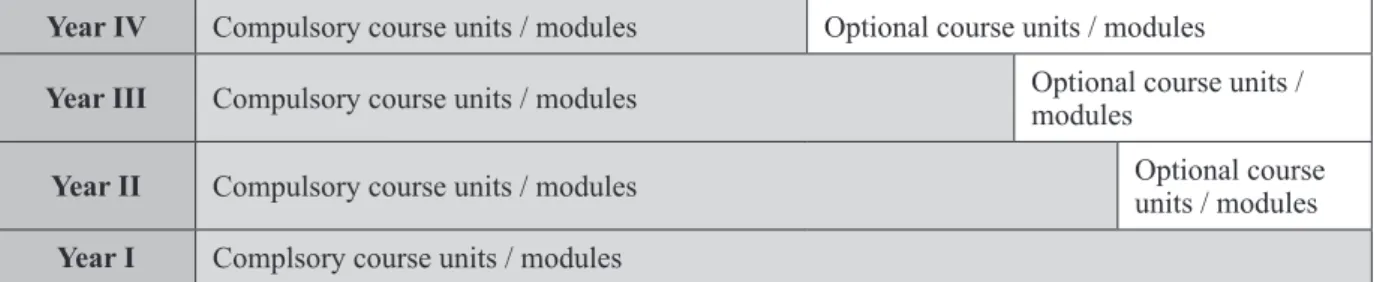
modular. An annual number of credits (60 ECTS credits) and a target number of credits per semester (30 ECTS credits) are established in both cases of the degree programme structure. A subject based degree programme consists of a sequence of individual course units of different lengths, in which intended learning outcomes and the final assessment of their achievement are determined for each course unit. A different number of credits can be given to each course unit in subject based degree programmes. A modular degree programme consists of a sequence of standard-sized modules, in which intended learning outcomes and the final assessment of their achievement are determined for each module. Both subject based and modular degree programmes can be implemented during terms or by simply establishing an annual number of credits.
module is a standard-sized part of a degree programme, which has a defined purpose,
intended learning outcomes and assessment criteria. A module is “a unit of a degree programme, the size of which in credits is always the same or the size of which is multiplied twice or three
times, i.e. the values of larger programme units – modules – are multiples”6. The volume of
each module can be either a well-defined value, e.g. 5 credits, or a multiple of that value, e.g. 10
credits, 15 credits, 20 credits, etc.
The authors express their gratitude to Dr. Jeremy Cox, an ECTS project consultant and arts
group expert (AEC, Netherlands), who gave invaluable comments and recommendations to the authors of these guidelines.
5 The term intended (expected) study results may be used in other sources.
6A Tuning Guide to Formulating Degree Programme Profiles Including Programme Competencies and Programme Learning Outcomes. Bilbao,
Groningen and the Hague: Publicaciones de la Universidad de Deusto, 2010. ISBN 978-84-9830-375-9. http://www2.archimedes.ee/enic/File/ Tuning_Guide_Publicada_CoRe.pdf
1. ARTS AND THE HIGHER EDUCATION SYSTEM
All over the world, art studies are recognised as a specific area of higher education. Music, dance, theatre, film, fine arts and other fields of art are associated not only with professional crafts but also with creative discoveries and a search for one’s own niche in the world of art, which is difficult to plan, foresee or predict its results. This is a much individualised activity aimed at continuous renewal and a search for undiscovered forms of art. Artists create by not only developing but also denying the traditional forms of art, thus often openly challenging or denying the tradition itself. Thus, art studies are everyday creative and intellectual challenges.
Dynamic and changing contemporary art education is part of the higher education system. However, due to the specific features of the nature of art and creation as well as field characteristics, art education should be rather flexible than strictly reglamented by the national higher education law. Therefore, when preparing requirements for the art fields of study, it is desirable not only to define the standards but also leave enough freedom to artists to adapt to the rapidly changing life, which is influenced by new science and technology development opportunities and the rapid development of creative industries. This would facilitate expansion of creative cooperation and promotion of the emergence of new forms of art while developing a common higher education area.
1.1. Higher music education institutions in the Bologna Process
Higher music education in Europe is usually provided by conservatoires, academies, higher
music education schools and music universities. As with all art studies, one of the most important goals of higher music education is development of the practical skills and creativity of students. In the course of the implementation of higher education reforms in the music field of study, it is very important to pay attention to the specific features and certain specific problems of music education. The music field of study is characterised by a specific structure of studies, specific teaching methods, assessment forms, employment indicators, traditional jobs, and requirements for the performance of higher education institutions. The main differences include:
1. Music education means development of artistic individuality. Therefore, the main form
of work of teachers at many institutions providing higher education in music and other fields of art is individual work with one student or small groups of 2–5 students. This is not a characteristic feature of other fields of study and requires a greater investment in professional training;
2. Music is a diverse area: creation, performance, interpretation, theory, criticism, etc.
The need to develop practical (artistic) skills and accumulate professional experience is essential. Therefore, the training of music professionals often combines formal and non-formal education, which is closely related to professional music practice;
3. The training of artists is not limited to the development of professional skills and
intellectual abilities. Artists grow as individuals, developing their inner potential as
musicians associated with innate musical talents. Therefore, the duration of university music education cannot be determined in view of the typical duration of the first cycle (3 years) indicated in the Bologna Declaration. The desirable duration of first-cycle music education at a higher education institution should be four years;
4. Higher education institutions perform academic activities, support and promote
scientific research of art and its phenomena, but also intensively develop artistic, creative and other innovative activities. Therefore, when assessing higher music education institutions, in addition to scientific activity criteria, it is desirable to formulate artistic
and creative activity assessment criteria, which show linkages between the mission of a higher education institution and the quality of higher education;
5. Graduates of music art often have no typical jobs underlying the employability indicators
which are important in the Bologna Declaration. They often are freelance artists or create their own unique workplaces. Therefore, the officially used labour market demand indicators for professionals related to employment in specific workplaces do not always reflect the real situation;
6. Persons who have already possessed professional skills in music at quite a high level
are admitted to higher music education schools. Candidates to higher music education
schools must take entrance examinations during which a panel of music professionals check their specific music abilities and select the best candidates. The main criteria for admission are always special abilities and the level of artistic abilities established by a higher education institution rather than general education indicators. Therefore, mass higher education features are not typical of higher music education;
7. Education of a professional musician based on dominant individual work of a teacher
and a student from the lowest to the highest education links is a global tradition. In order to maintain the level of professionalism and ensure a smooth transition from primary to top cycles, it is necessary to create comparable qualification requirements and the principles of student assessment during entrance examinations. This would
expand international cooperation and teacher and student mobility opportunities.
1.2. Specific features of music education
Seeking qualification by studying the chosen specialisation in the field of music means commitment to lifelong learning exploring an inexhaustible area, which is broad and rich, complex and challenging. Music is the art of sounds including the creation, performance and perception of music. Professional musicians must be able to link theoretical knowledge with practical skills, have a critical understanding of artistic phenomena, combine physical and intellectual abilities with developed emotional and other non-verbal communication skills. “For music is intrinsically interdisciplinary and multidisciplinary, international and multicultural; it fosters creativity and craftsmanship and practical skills; it provides a liberal education - historical, sociological, aesthetic and analytical - in an art that
answers a deep and enduring human need, both in Western civilisation and almost every civilisation
known to history; its links with mathematics, science and technology are profound and inescapable”7.
Music is both a creative and performance art encompassing various aspects of expression
such as artistic, technical, interpretative, reproductive, improvisatory, social, aesthetic and
philosophical. The multiculturalism and interdisciplinary nature of music education is confirmed by the study of the art of music in historical, chronological, geographical, sociological,
psychological, aesthetic and philosophical aspects.
The music field of study is very specific and complex, orientated towards the development of practical and artistic skills of students. The development of artistic skills and maturation of an artist (musician) takes longer than the training of the vast majority of professionals in other areas. Therefore, the workload of a music student is much larger than that of most students of other fields. Music art degree programmes can be conditionally divided into the groups of performance art, conducting, composition, musicology, music education and music technology. Performance
art and composition are typical degree programmes in the music field of study, which have several common specific features of the field of music already mentioned above:
1. Are usually orientated towards the training of practicing music professionals;
2. The main form of teaching in the most typical music degree programmes for a performer
or composer is individual studies (one teacher and one student in a classroom);
3. The main form of learning is individual independent practical studies (playing a
selected instrument, singing, conducting or creative work);
4. The specificity (complexity) of music and the scope of the field require students to
devote most of their time to the development of a chosen instrument (voice) playing technique and artistic skills, and the development of these skills should continue throughout the period of active performance of music, i.e. studying, work (concerts), usually including the holiday period;
5. There is interdisciplinary and multicultural music education.
1.3. Typical qualification degrees in the field of music
Music education belongs to the art study area, the field of music. As already mentioned
above, these studies have a long tradition in Europe, are easily recognisable and universally recognised.
In Lithuania, music professionals are trained at colleges, universities and the only specialised school, the Lithuanian Academy of Music and Theatre. Degree programmes in the field of music include three cycles: the first cycle is professional Bachelor of Music and Bachelor of Music degree studies, the second cycle is Master of Music degree studies and the third cycle is Doctor of Art degree studies. Successful graduates of the studies are awarded professional Bachelor of Music, Bachelor of Music, Master of Music and Doctor of Art degrees.
The higher education qualification degrees of professional Bachelor, Bachelor and Master are defined in the Lithuanian Law on Higher Education, national and European documents:
1. National descriptors for fields of study;
2. Descriptors for Lithuanian higher education cycles under preparation (2011);
3. Higher education cycles (3 cycles) are regulated by the Framework for Qualifications
of the European Higher Education Area8;
4. Qualification levels (8 levels) are regulated by the Lithuanian Qualifications Framework
(LQF9),
5. Dublin Descriptors describing the achieved learning outcomes of three study cycles,
which the Framework for Qualifications of the European Higher Education Area is based on;
6. the Polifonia/Dublin Descriptors of qualifications for three cycles of music field drawn
up by the working group of the European Association of Conservatories (AEC). Non-university higher education institutions (colleges) offer professional Bachelor degree studies in the field of music and award a professional Bachelor of Music qualification degree (3 years, 180 ECTS credits). The following degree programmes awarding a professional Bachelor qualification degree in the field of music were registered in the AIKOS information system of the Ministry of Education and Science of the Republic of Lithuania in 2010: popular music, entertainment music and folk music.
8 Framework for Qualifications of the European Higher Education Area, http://www.bologna-bergen2005.no/Docs/00-Main_doc/050218_QF_
EHEA.pdf [viewed on 26 October 2011].
9 Resolution No 535 of 4 May 2010 of the Government of the Republic of Lithuania approving the Lithuanian Qualifications Framework, Official
In Lithuania, typical university degree programmes in the field of music include performance art, composition, music theory and criticism (musicology in the field of art criticism in the humanities area of study), folk music (ethnomusicology in the field of art criticism in the humanities area of study). According to the new List of Areas and Fields of Study at Higher Education Institutions and the List of Qualification Degrees approved by the Government of
the Republic of Lithuania in 200910, sound directing and music technology are music field
programmes, the graduates of which are awarded a degree in music technology and industry (Bachelor or Master). These are generally first cycle (4 years, 240 ECTS credits) and second cycle (2 years, 120 ECTS credits) degree programmes. Those who successfully complete these university degree programmes and acquire competences required to acquire a qualification are awarded Bachelor of Music or Master of Music qualifications.
Music studies in the highest – third – cycle are only organised at university higher
education institutions. Since 2010, music studies in the third – Doctor of Art – cycle in Lithuania have been organised and the Doctor of Art degree has been successfully awarded to graduates by the only higher education institution, the Lithuanian Academy of Music and Theatre. All cycles of study completed at accredited Lithuanian and European higher education institutions are recognised where students aspire for a higher degree. The continuity of studies in a selected field and specialisation in higher cycles is theoretically ensured in this way. However, the artistic abilities and subject-specific competences of those aspiring for a higher degree are usually tested
during entrance examinations.
In addition to qualification-awarding degree programmes, higher education institutions can offer various non-degree programmes: continuous learning, preparatory studies, bridging studies, etc. For example, graduates who have acquired a professional Bachelor of Music degree in colleges, completed bridging studies, accumulated missing credits and successfully passed entrance examinations have an opportunity to continue Master degree studies of a chosen specialisation.
1.4. Typical degree programmes in music
All degree programmes in music can be grouped according to general areas of research: the study of the origin of musical texts (listening to music or recording of music); the study of the music repertoire and its cultural contexts; knowledge of the history of music and traditions of public performance of music; knowledge of musical processes – creation, performance, analysis and criticism; ability to express musical ideas in hearing, notation and verbal articulation; close interaction between music theory and practice and its perception; development of musical skills; development of creativity. The nature of music education is typically the study of a specialised field of music aimed at training music performers, composers and theorists meeting high artistic
standards.
One of the distinctive features of the field of music is the focus of performance studies on one of the main styles of music: classical and modern music, early music, jazz, pop, rock or folk music. Future artists of the highest qualification who play classical and early music as well as folk music usually study under the degree programmes of performance art at university level according to the selected branch (main instrument or singing) and acquire the qualification of a bachelor or master. Jazz musicians in Lithuania can choose between the branches of a professional bachelor, university bachelor and master degree programmes. Pop musicians in Lithuania usually study at colleges and acquire the qualification of a professional bachelor, while in other European countries the study of pop music (mostly the study of pop and jazz music
10 Government Resolution No. 1749 of 23 December 2009 approving the List of Areas and Fields of Study at Higher Education Institutions and
together) are also organised at universities.
In Lithuania, the Art of Perforance (LMTA, KU, VMU11) degree programme is the typical
programme for classical (including modern music), jazz and folk music which may cover as many branches as there are musical instruments/voices of singers and professional performers of a particular instrument/singing required. The specialisations of the degree programme in classical and contemporary music performance art have typical features according to the nature of performance of music (sound production) and could be grouped into specialisation groups: singing, keyboard, string instruments, wind instruments and percussion instruments, folk instruments and conducting (choir, symphonic music and military brass band). Such grouping of specialisations is useful when preparing surveys at typical workplaces of graduates.
In addition to universal musician’s skills (artistic, music performance and other skills), a graduate of jazz music studies should be able to improvise (maximally developed ability to spontaneously convey chosen jazz music material and the form of performance). In addition to the selected jazz specialisation in the main instrument (voice), students often acquire competences required for the profession of a music director (big band conductor). Teaching and learning forms in jazz studies differ from other performance art specialisations. Therefore, jazz music studies
could be organised as a separate degree programme.
Choir, symphonic music and opera conductors study under the performance art degree programme where conducting is one of the branches of the degree programme in the field of performance art. The following requirements, which are higher than those applied to students choosing instrument or singing branches, are set for those applying for symphonic music and opera conducting studies: those applying for first (Bachelor) cycle studies in conducting must already have a Bachelor of Music qualification in a chosen specialisation (preferably in choral conducting or any orchestral instrument), and the main intended learning outcomes are different. Therefore, conducting (specialisations: choral conducting, symphonic music conducting, military brass band conducting) could be also a separate degree programme.
Composition is a typical degree programme focused on the creation of music texts and musical ideas. It is difficult to determine a future typical workplace of a composition graduate (composer). A successful composer usually works as a freelance artist and his sources of income are author’s fees for creative work and income from reproduction/recording/distribution of created music or his portfolio based career which is usually multiple like a music performer’s, i.e. teacher of music (additionally acquired qualification of a teacher), music technology specialist, sound editor, event organiser, project author and various author’s works related to music arrangement, instrumentation, creation and reproduction as well as other works related to music or art industries. The concept of the degree programme in composition is usually formed by academic staff, taking into account the issue of employment of composition students. However, when formulating the main intended learning outcomes of the programme and competences acquired during the studies, it is advisable to check them by surveying graduates and other social stakeholders: associations and unions uniting composers and performers, professional musicians and their organisations,
as well as music industry representatives. Classical composition studies can be expanded by
alternative specialisations or new degree programmes, such as music technology, film, television
and multimedia composition, sound design, etc.
Each higher education institution decides how many quality degree programmes in the field of music and programme specialisations in line with the national culture and education strategy and market needs it can offer students. European (in particular United Kingdom) experience shows that due to simple economic calculations, higher education institutions offer as few degree
programmes in the field of music as possible: the objectives of degree programmes and the main intended learning outcomes are summarised as much as possible and a wide variety of courses is offered.
Typical degree programmes in the field of music do not provide the professional qualifications regulated by the state. Since 2010, the studies of music didactic and pedagogy have been provided in the area of social sciences, field of pedagogy. Graduates also receive
the professional qualification of a teacher regulated by the state in addition to the academic
qualification (bachelor of music pedagogy, master of music pedagogy).
The purpose of university music degree programmes is to train artists with a broader profile and provide them with appropriate theoretical knowledge (first cycle) and art research-based knowledge (second cycle) to enable them to apply their knowledge and skills in practice in a changing professional music market meeting public needs or to create jobs for themselves.
During university Bachelor degree music studies, performers are trained in a complex manner: artistic and music performance skills are developed by providing detailed theoretical and music history knowledge. This makes them different from professional Bachelor degree studies, which are more orientated towards the improvement of subject-specific skills through professional practice. Nevertheless, more and more professional Bachelor degree programmes are enriched with theoretical and historical knowledge, which is more typical of university studies, and professional practice has become an integral part of university studies.
1.5. Degree programme profiles
The parties to the Bologna Process have agreed to create a common European Higher
Education Area and implement transparent student-centred three-cyle (Bachelor, Master and Doctor) degree programmes. The ECTS has been created as a tool for measuring a typical student workload, facilitating student mobility and recognising learning outcomes. Student-centred programmes require a paradigm change as well as changes in the thinking of the academic community and administrative staff involved in the development and implementation of degree programmes. This has encouraged the emergence of Tuning Educational Structures in Europe, or simply Tuning, complementing the Bologna Process and developing the objectives of the process. A Tuning network and a Tuning process, which has an effect on the development of higher education in many countries, have been developed in the course of Tuning project activities. The main objective of this process is to transform the logical connections between the traditional cycles of study (Bachelor, Master and Doctor) highlighting the result, i.e. competences acquired,
rather than knowledge sought to be provided to students of a specific cycle of study12. Given a
change in the prevailing relationship between a teacher and a student, student activities, namely
learning, studying, acquisition of competences and qualifications, become the centre of attention. According to Tuning concept proponents, a student-centred degree programme facilitates better alignment of degree programmes with the changing labour market needs, international application of qualifications acquired, assessment and recognition of non-formal and informal
learning outcomes.
International Tuning process experts in association with ENIC and NARIC13 recognition
and accreditation experts of several European countries have prepared a typical model of a
degree programme descriptor, a descriptor preparation manual and a glossary. The descriptor has been tested by European universities, higher education experts and recognition institutions. It
12 A Tuning Guide to Formulating Degree Programme Profiles.
13 ENIC is a European network of academic mobility and qualification recognition information centres; NARIC means national academic
has been decided that the proposed descriptor model should contain the most important summary
information on a degree programme, which is understood by the authors of the programme,
students, employers and accreditation and recognition institutions.
According to the Tuning methodology, degree programme profiles are descriptions of the main programme competences and learning outcomes as well as the main features of degree programmes related to the objectives of the programme and showing how the programme relates
to the course units of a field of study and to the professional world14.
The recommended degree programme profile must provide concise information on the intended learning outcomes, methods and measures of a degree programme that would facilitate the achievement of the intended learning outcomes and demonstration of acquired competences. A degree programme profile must be linked with the descriptors of both the field of study and the qualification level awarded. The profile specifies the key generic competences and subject-specific knowledge, skills and competences necessary to acquire a qualification as well as
formulates the main intended learning outcomes of the degree programme15.
A degree programme profile is usually prepared by a programme committee, which generally consists of teachers, higher education administrators and students, and is approved in accordance with the internal degree programme regulation of a higher education institution. Each, particularly new, programme should be based on public needs. Therefore, it is necessary to analyse and define the linkages between the programme and the vision of a programme created by the academic community as well as the needs of students, employers and society.
A degree programme profile must reflect the interests of different groups, such as students, society, the professional sector and the academic sector. The main highlights of profiles of the same study field (branch) created by different higher education institutions – intended learning outcomes and/or distinctive features of a programme – may differ. For example, some higher education institutions may orientate themselves exclusively towards the training of music performers (artists) and demand that entrants have a relevant level (standard) of training, while others may train a more versatile professional or a specialist in several fields of music, such as a music engineer, music manager and music teacher. Therefore, requirements for entrants and the nature of degree programmes will differ. These differences and typical programme features must be specified in degree programme profiles. The authors of degree programmes in the field of music should seek to ensure a variety of degree programmes, cycles and profiles in this field
as well as a continuous programme updating process in order to ensure international quality
standards and adaptability to the changing needs of society and the professional music (art) world. Lithuanian national ECTS project strategic and horizontal group experts in association with international experts have adapted a degree programme profile model developed by Tuning process specialists and recommend it for use by all Lithuanian higher education institutions. The degree programme profile consists of the following main entries:
1. programme data: name of the degree programme, area of study and specialisation, state
code of the programme, name of higher education institution that has prepared and is implementing the programme, language(s) in which the programme taught, type of study (university, non-university), cycle of study, level qualification (according to the
LQF16), duration of study in years, scope of study in credits, total student workload in
hours, number of contact hours, number of individual work hours, area of study, field (branch) of study, a related field or branch (if any), qualification degree and professional
14Universities‘ contribution to the Bologna Process. An Introduction, 2nd Edition, 2008, 151.
15 Learning outcomes define the scope, level or standard of competences, including knowledge acquired (See A Tuning Guide to Formulating
Degree Programme Profiles).
qualification (if any) awarded, degree programme coordinator, contact details of the degree programme coordinator, the name of the institution accrediting the programme and the year of accreditation (the date until which the programme is accredited);
2. purpose of the programme: objectives defined in a few clear and logical sentences;
3. characteristics / programme profile: he main discipline(s) subject area(s); nature of
the degree programme – general or specialist focus, orientation (research, practice based, applied, ets.); distinctive features of the programme (e.g. programmes in the field of music are characterised by continuous competence development); admission requirements and opportunities for the recognition of previous learning;
4. further study opportunities;
5. career opportunities;
6. learning and teacing approaches, and assessment methods;
7. key competences of the degree progamme: generic and subject-specific;
8. complete list of programme learning outcomes: generic and subject-specific.
The degree profile of the programme should not be longer than a few pages. The basis of the profile is objective of the programme, competences and intended learning outcomes. There should be a maximum of 15–20 intended learning outcomes (generic and subject-specific). Important information describing the programme profile is nature of the programme (theoretical or applied), distinctive features of the programme (international, interdisciplinary studies, a joint programme, other important information on the distinctiveness of the degree programme), level of qualification (compliance with the Dublin Descriptors and Polifonia/Dublin Descriptors
(PDD), the Framework for Qualifications of the European Higher Education Area17 and the
Lithuanian Qualifications Framework), and career opportunities.
1.6. Descriptors of cycles of study in the field of music
(Polifonia/Dublin Descriptors)
The specific nature of studies in the field of music requires that the acquired competences and artistic skills are tested during transition from one study cycle to another (compulsory entrance examinations to test artistic skills and subject-specific competences). Therefore, academic and artistic standards of each cycle and their level are clearly defined and harmonised at European level. The descriptors of the European framework of qualifications for the higher education area are used to describe the qualifications of all three cycles in the field of music. These so-called Dublin Descriptors describe individual cycles of three-cycle higher education identifying knowledge and understanding, the application of knowledge and understanding, ability to make judgements, communication skills and ability to learn. The Polifonia Tuning working group of the European Association of Higher Education Institutions has drawn up a number of documents, including the descriptors of music qualifications, the so-called Polifonia/
Dublin Descriptors (PDD)18. The descriptors of music qualifications comply with the Dublin
descriptors and are supplemented by such attributes characteristic to the field of music as training
the artistic abilities and more attention to practical achievements. PDD descriptors are intended
for the authors of higher education degree programmes in the field of music.
17Framework for Qualifications of the European Higher Education Area
18Reference Points for the Design and Delivery of Degree Programmes in MUSIC. Bilbao:Publicaciones de la Universidad de Deusto, 2009.
table 1. dublin and polifonia/dublin descriptors
dublin descriptors polifonia/dublin descriptors
Qualification degrees that signify completion of the first cycle of higher education are awarded to students
who:
Qualification degrees that signify completion of the first cycle of higher education are awarded to students
who: 1) have demonstrated knowledge and understanding
in a field of study that builds upon their general
secondary education, and is typically at a level that,
whilst supported by advanced textbooks, includes some aspects that will be informed by knowledge of the forefront of their field of study;
1) have demonstrated skills, knowledge and artistic understanding in the area of music built during studies
above general education and are typically at a level that
is supported by professional knowledge and practice and includes some advanced aspects of understanding of music and creative interaction;
2) can apply their knowledge and understanding in a manner that indicates a professional approach to their work or vocation, and have competences typically
demonstrated through devising and sustaining
arguments and solving problems within their field of study;
2) can apply their skills, knowledge and artistic understanding in the area of music in a manner that indicates a professional approach to their work
or vocation, and have competences demonstrated
practically/creatively as well as through devising and
sustaining arguments and solving problems within
their area of study; 3) have the ability to gather and interpret relevant
data (usually within their field of study) to inform judgements that include reflection on relevant social, scientific or ethical issues;
3) have the ability to gather and interpret important information (usually in the area of music), make judgements related to practical/creative activity that includes reflection on artistic and, where relevant, social, scientific and ethical issues;
can communicate information, ideas, problems
and solutions to both specialist and non-specialist
audiences;
4) can express and communicate artistic understanding, ideas, information, problems and solutions to both specialist and non-specialist audiences;
5) have developed those learning skills that are necessary for them to continue to undertake further study with a high degree of autonomy.
5) have the learning and practical/creative skills to
allow them to continue to study in an autonomous manner.
Qualification degrees that signify completion of the
second cycle of higher education are awarded to
students who:
Qualification degrees that signify completion of the
second cycle of higher education are awarded to
students who: have demonstrated knowledge and understanding
that is founded upon and extends and/or enhances that typically associated with Bachelor’s level, and that provides a basis or opportunity for originality in developing and/or applying ideas, often within a research context;
1) have demonstrated skills, knowledge and artistic understanding in the field of music that are founded upon and extend and/or enhance those typically associated with first cycle level, and that provide a basis or opportunity for originality in developing and/or applying ideas, in the practical and/or creative sphere, often with a research dimension;
2) can apply their knowledge and understanding, and problem solving abilities in new or unfamiliar environments within broader (or multidisciplinary) contexts related to their field of study;
2) can apply their skills, knowledge, artistic
understanding and problem-solving abilities in
new or unfamiliar environments within broader (multidisciplinary) contexts related to the area of study; 3) have the ability to integrate knowledge and
handle complexity, and formulate judgements with incomplete or limited information, but that include reflecting on social and ethical responsibilities linked to the application of their knowledge and judgements;
3) have the ability to in the practical and/or creative sphere to integrate knowledge and handle complexity with incomplete or limited information, and to link these judgements to reflection on artistic and, where relevant, social and ethical responsibilities;
4) can communicate their conclusions, and the knowledge and rationale underpinning these, to
specialist and non-specialist audiences clearly and
unambiguously;
4) can clearly and unambiguously communicate their conclusions and/or artistic choices as well as communicate logical and knowledge-based conclusions to both specialist and non-specialist audiences; 5) have the learning skills to allow them to continue to
study in a manner that may be largely self-directed or
autonomous.
5) have the learning and practical/creative skills to allow them to continue to study in a largely
Qualification degrees that signify completion of
the third cycle of higher education are awarded to
students who:
Qualification degrees that signify completion of
the third cycle of higher education are awarded to
students who: 1) have demonstrated a systematic understanding of a
field of study and mastery of the skills and methods of research associated with that field;
1) have demonstrated a profound and systematic understanding of the area of musical study, together with mastery of artistic and other skills associated with that area and of relevant methods of research;
2) have demonstrated the ability to conceive, design, implement and adapt a substantial process of research with scholarly integrity;
2) have demonstrated the ability to conceive, design, implement and adapt a substantial process of research with artistic and scholarly integrity;
3) have made a contribution through original research that extends the frontier of knowledge by developing a substantial body of work, some of which merits national or international refereed publication;
3) have made an original contribution through research
and inquiry that extends the frontier of knowledge and
artistic understanding by developing a substantial body
of work, some of which merits national or international refereed publication;
4) are capable of critical analysis, evaluation and synthesis of new and complex ideas;
4) are capable of critical analysis, evaluation and synt
-hesis of new and complex ideas, artistic concepts and
processes;
5) can communicate with their peers, the larger schol -arly community and with society in general about their
areas of expertise;
5) can communicate with their peers, the larger artistic
and scholarly community and with society in general
about their areas of expertise; 6) can be expected to be able to promote, within
academic and professional contexts, technological, social or cultural advancement in a knowledge based
society.
6) can be expected to play a creative, proactive role
in the advancement of artistic understanding within a knowledge based society.
The entire area of music studies is constantly changing and searching for new forms so each higher education institution can discover its own profile of music studies and unconventional form of studies, e.g. studies in the field of music interacting with other higher education disciplines such as aesthetics, psychology, sociology, therapy, journalism, critique, technologies, etc.; new fields of music (e.g. electro-acoustic music); studies related to the field of music (e.g. music technology, sound direction (sound design), music management, etc.).
Higher education institutions should create possibilities for future music professionals to acquire additional knowledge and skills which the graduates will be able to use looking for new employment opportunities or creating them themselves. It is recommended to offer optional disciplines to music performers which would broaden the competences of music performers. Advisable knowledge can be acquired by studying the basics of management, improvisation, music technology and instrumentation (arrangement of works). Those seeking a teacher qualification are recommended to choose related educational studies.
2. COMPETENCES AND LEARNING OUTCOMES
The term “competences” used in these Guidelines is based on the conception set in the
Tuning project and acceptable to music studies as well19. Competences represent a dynamic set
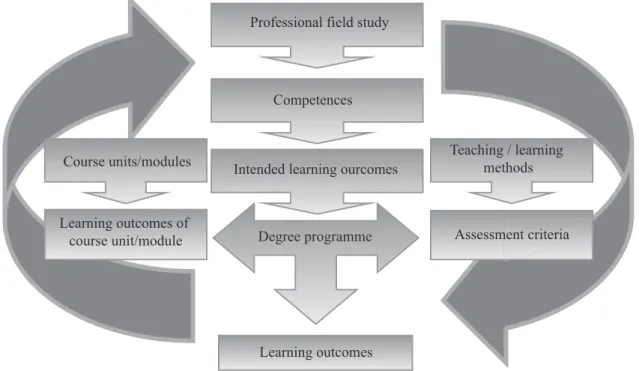
of human qualities necessary for good performance of a specific task. These are cognitive and metacognitive skills, demonstration of knowledge and understanding, interpersonal, intellectual and practical skills, and ethical values. Competences are developed in all course units and assessed at different stages of a programme. Some competences are specific to a field of study (subject-specific competences), while others are common to any degree programme (generic competences). It is normally the case that competence development proceeds in an integrated
and cyclical manner throughout the programme.
Intended learning outcomes are defined in each degree programme. According to the Tuning methodology, learning outcomes describe what a learner is expected to know, understand and be able to demonstrate after successful completion of a process of learning. Learning outcomes are statements of a specific level of competence that a student is expected to achieve. They are directly related to the descriptions of cycles of study and the qualifications framework. Thus, in the process of learning, learning outcomes defined by the level of competence are a certain indicator of a student’s readiness for a profession and life.
2.1. Higher music education competences and learning outcomes
Competences in higher music education are quite new phenomena. The working group of the European Association of Conservatories (AEC) thoroughly examined the impact of the Bologna Declaration on the training of music artists and decided that learning outcomes (i.e. competences) must cover three areas: practical skills, theoretical foundation and generic
competences20. In the context of the Tuning project, practical skills and theoretical foundation
are represented by subject-specific competences. They should be important for all degree programmes in the field of music.
On the basis of the recommendations of the European Association of Conservatoires, the ECTS project music working group drew up a list of subject-specific and generic performance art competences, which has been checked in a professional activity research of the field of music. The purpose of this research was to examine how much the competences traditionally formed at higher education institutions were recognisable and recognised in the labour market. Employees of cultural and educational institutions practicing their speciality (public and private music schools and gymnasiums, choirs, orchestras, ensembles, the Lithuanian Academy of Music and Theatre, etc) and freelance musicians who acquired Bachelor or Master of Music degrees at higher
education institutions in 2005–2009 were interviewed during the research. The research was
carried out amid employer and graduate surveys aimed at finding out the opinion of employers on the abilities and skills (i.e. subject-specific and generic competences) that, in their opinion, are really important for a successful professional career and perhaps forming qualification units which specific study modules could be based on.
During the survey, preliminary lists of subject-specific and generic competences were approved and revised, preparation of specialist for work was assessed, new capacities and skills acquired in the workplace were specified, missing skills and capacities were identified and proposals were made for the improvements of degree programmes. The research is valuable in
19 A Tuning Guide to Formulating Degree Programme Profiles
that it lends a new dimension to the development of competence-based degree programmes, i.e. the opinion of employers on the preparedness of music professionals for a particular job. This research should become a tool for implementing qualitative changes in the training of music professionals.
The research results today are a valuable source of information, which checks the viability of implicit competences in practice and facilitates the use of experience in the professional field of activity in updating and creating new degree programmes in the field of music.
2.2. Generic competences
The main mission of a higher education institution is to help students prepare for their profession. In addition to this objective, it is equally important to create the conditions for young
specialists to acquire capacities to live in a constantly changing world. This aimed is pursued at higher education institutions by developing generic competences. These competences are used at
higher education institutions to develop and foster the culture and capacity for lifelong learning, teach how to discover one’s niche on the labour market and survive there, develop awareness, public activity, civic and personal responsibility for one’s quality of life. They are also very important for the professional life of music performers.
The working groups of the ECTS project prepared a universal list for all fields of studies
comprising 32 generic competences on average presented in the Annex 1. This list has been
approved by the representatives of all fields of study participating in the project. This list was tested during the sociological survey and validated as suitable for all fields of studies participating
in the survey.
The groups of participants in the research in the field of music – employers and graduates of music studies – tend to believe that all the competences included in the said list are very important in professional activities. However, some of them doubt whether a higher education institution is capable of developing all the competences, as, in their opinion, they are more
related to personal qualities. Most graduates believe that the ability to motivate people to pursue
common goals or the ability to work independently named by employers as the most important is not the most important in a professional musician’s career.
A quantitative sociological survey has shown that, in the employers’ opinion, the following five competences are of utmost importance to the professional activities of musicians in all cycles of study:
1. ability to put knowledge into practice;
2. knowledge of the subject area and understanding of their profession;
3. ability to create new ideas (creativity);
4. ability to work in a group;
5. ability to learn.
Graduates of music studies named the following generic competences as the most important in their professional activities:
1. communication skills and team communication;
2. ability to communicate with people who are not experts in the professional area of an
employee;
3. ability to make decisions;
4. ability to work in an international environment (language skills, ability to interact with
representatives of other cultures);
6. ability to put knowledge into practice;
7. native language, ability to communicate in writing and write without mistakes;
8. ability to work in a group;
9. ability to learn;
10. awareness of safety and well-being.
See the list of generic competence breakdown according to their importance to the music performer’s professional activity (for graduates from bachelor and master degree programmes)
in the Annex 2.
2.3. Subject-specific competences
Subject-specific competences and learning outcomes in the field of music have been formulated on the basis of existing music professional training traditions in Lithuania, sociological survey results and the Tuning project experience of the European Association of Conservatoires. The initial list of 30 subject-specific competences was prepared for the sociological survey on the basis of the degree programme in Art of Performance of the Lithuanian Academy of Music and Theatre. Produced during the professional activity research, a rating of the importance of
these competences in Bachelor and Master degree studies is provided in Annex 2. It is important
to note that the opinions of employers and graduates on the presented list of competences and the importance of competences differed very little. In the opinion of both groups of respondents, competences associated with the performance technique and artistic expression skills are of
utmost importance.
Discussing the list of subject-specific competences of musicians and employer survey results, the opinions of the majority of music graduates coincided with the opinion of employers on the abilities and skills identified as the most important: ability to control artistic expression and performance technique skills, ability to professionally perform different styles, genres and forms of music, have knowledge of the traditions of interpretation of different styles, genres and forms of music, ability to analyse, critically evaluate and independently manage individual artistic skills, ability to publicly perform a repertoire in various cultural and social contexts, develop experience in public performances and knowledge of performance excellence standards, as well
as ability to convey a distinctive artistic concept. In addition, graduates were more inclined to
attach more importance than employers to the ability to cooperate with artists of other areas. Discussing the list of subject-specific competences, performing art graduates repeatedly said that all of the listed competences were important in the professional activities of musicians. Most of them believed they had acquired one or another level of the listed abilities or skills during their
studies.
The qualitative part of the sociological survey and the opinion of graduates of the music performance programme have revealed that the higher education institution could give more attention to the following skills:
1. Management (organisation of concerts);
2. Psychology knowledge and skills (preparation for the stage, stage fright management,
self-confidence, ability to concentrate);
3. Movement training (stage movement, dance, acting, stage speech and fencing);
4. Law basics (copyright agreements);
5. Information technology (computer music programmes, application of technologies in
the music industry);
7. Occupational safety (health sciences and sports);
8. Some specific subjects (jazz, electronic music, sound recording).
In addition to the abovementioned abilities, much attention during the discussions was given to the ability to create job opportunities, but doubts were also expressed as to whether this could
be developed during studies. In addition, some graduates said they saw lack of self-expression and freedom of interpretation while studying, but those objecting to this opinion said that first of all it was necessary to master the basics of a profession and only then to interpret. Discussing the
ability to control their body and emotions on stage, graduates said that examinations were not an
appropriate method of assessment. Some of them said that during performance art studies, more attention should be paid to the knowledge of psychology, which was particularly important to
those engaged in teaching.
Discussing the subject-specific competences of musicians, participants in the discussions
pointed out that human qualities, which could not be acquired during studies, communication
with other artists and the ability to look at yourself from a distance were important in their professional activities. A university cannot prepare an artist for all possible stress. Such situations cannot be created artificially and therefore much depends on the personal qualities and motivation of students.
See the list of subject-specific (music) competence breakdown according to their importance to the music performer’s professional activities (for graduates from bachelor and master degree programmes) in the Annex 3.
2.4. ECTS credits and competence development
The aim to create a single European Higher Education Area and harmonise the structures
of national education systems set in the Bologna Declaration (1999) encouraged the signatory countries to introduce the credit accumulation and transfer system ECTS at all higher education institutions. This commitment is also stipulated in the Law on Education and Studies (2009) of Lithuania. It says: „a study credit means a unit of the volume of studies, by which study results and student’s working time are measured. 1,600 hours of one academic year shall equal to 60
credits.“
Thus, credits are given in view of the time necessary for the study of a specific course unit or module, which is needed to acquire specific learning outcomes or subject-specific and generic competences of a planned level of study. In this regard, a credit in the modern context becomes a currency that shows the value of a competence related to the time needed to acquire it. A
higher education credit system helps to plan and conduct studies, assess learning outcomes and
cooperate in recognising and transferring competences acquired from one degree programme to
another.
The issue of competence development and implementation of learning outcomes becomes important in this context. It is important for not only completing a certain cycle of study and certifying a qualification acquired but also for assessing competences acquired at the end of each cycle of study (e.g. a course unit or module during studies). Learning outcomes assessments may take different content and form but the aim of every higher education institution should be the development of independence of a artist by constantly changing the forms of teaching which would make it possible to learn how to apply the capacities developed at the higher education institution in practice. For instance, teaching forms could be related to the improvement of the technique of artistic skills, studies of the facts of art and artistic concepts in the first academic year, mastering these skills, facts and concepts in the second and third years, synthesis of the
acquired capacities, their studies in the broader context and more diverse areas of art studies in the fourth year. One of the most important purposes of studies of the second cycle should be the creation of conditions for individuality and independence, encouragement to look for individual
artistic concepts.
The most rational way to determine whether intended learning outcomes have been
implemented is to define and identify certain features of a desired level of learning outcomes,
i.e. to determine its lowest level. However, music studies are distinctive in this respect as well,
as students admitted to higher education institutions stand out for different artistic maturity and different theoretical knowledge, i.e. a different level of existing competences, from the first
course. Since universities are primarily orientated towards an average student and it is very
difficult to describe an average student in the area of art, it is recommended to enable more talented and most motivated students to seek better results. Institutions of higher education in music should facilitate examination of existing or acquired skills and selection of the level of study in view of the skills and needs.