University of Coimbra
Ph.D. Thesis Proposal
Doctoral Program in Information Sciences and Technologies
Software Engineering
Predicting Software Complexity
by Means of
Evolutionary Testing
Ana Filipa Delgado Nogueira [email protected]
Supervisors:
M´ario Zenha-Rela ([email protected]) Jos´e C. B. Ribeiro ([email protected])
The proliferation of new methodologies and frameworks for software development, as well as the spreading use of open source repositories to publish software projects, highlighted the need of a specific set of tools and metrics. These tools should be able to provide information about how maintainable a system is and also about how it has evolved. One characteristic that impedes software from achieving good levels of maintainability is the increasing complexity of software. The reduction of software complexity can improve other characteristics, in which testability or maintainability are included.
Empirical observations have shown that typically, the more complex the software is, the bigger the test suite is. Thence, a relevant question, which originated the main research topic of our work, has raised: “Is there a way to correlate the complexity of the test cases utilized to test a software product with the complexity of the software under test?”. Therefore, this work presents a new approach to infer software complexity with basis on the characteristics of automatically generated test cases. From these characteristics, we expect to create a test case profile for a software product, which will then be correlated to the complexity, and as well as to other characteristics, of the software under test. We will focus on object-oriented software, more specifically software implemented in the Java programming language.
As an outcome of this research it is expected to provide developers and software architects with means to support and validate their decisions, by helping on answering several pertinent product life-cycle questions. For instance, questions such as the following will be considered: is it time for refactoring or is the product almost untestable? Is the latest software version ready for release? Are specific components, modules or COTS affecting the quality of the software product?. Moreover, it is expected that this work will provide a reliable way to observe the evolution of a software product during its life-cycle, allowing us to observe differences between different versions of the same software product. The test suite will be automatically generated through an emergent approach for cre-ating test data named as Evolutionary Testing. Even though other methodologies could be used to create the set of test cases, we have selected Evolutionary Testing because it makes
through a set of case studies, which represent real software projects, mostly open source projects. These will be used to test, evaluate and validate the applicability of our research.
Keywords: Complexity, Evolutionary Testing, Object-Oriented Software, Software Metrics
1 Introduction 1
2 State of the Art 5
2.1 Introduction . . . 5
2.2 Software Evolution and Maintenance . . . 7
2.2.1 Software Maintenance . . . 7
2.2.2 Software Release Management . . . 10
2.3 Software Testing . . . 12
2.3.1 Software Testing Fundamentals and Levels . . . 12
2.3.2 Testing techniques and Test Case Generation . . . 13
2.4 Evolutionary Testing . . . 15
2.4.1 Search-Based Software Testing . . . 16
2.4.2 Evolutionary Algorithms . . . 18
2.5 Software Metrics . . . 20
2.5.1 Software Attributes . . . 21
2.5.2 Software Complexity Measurement . . . 23
2.5.3 Traditional Software Metrics . . . 24
2.5.4 Object-Oriented Metrics . . . 27
2.5.5 Software Measurement Based on Test Cases Information . . . 34
2.6 Summary . . . 38
3 Research Objectives and Approach 41 3.1 Introduction . . . 41
3.2 Objectives . . . 42
3.3 Thesis Development Approach . . . 43
3.3.1 Phase 1 - Preparing the Evolutionary Testing tool . . . 43
3.3.2 Phase 2 - Case Study (Tomcat) - Test Data Generation . . . 47
3.3.3 Phase 3 - Definition of Test Program Profile . . . 48
3.4 Summary . . . 51
4 Current Work and Preliminary Results 53 5 Work Plan and Implications 55
5.1 Work plan . . . 55 5.2 Goals for Publications . . . 57 5.3 Implications of Research . . . 57
6 Conclusions and Future Work 61 A Bruntik and van Deursen’s metrics 75
List of Figures
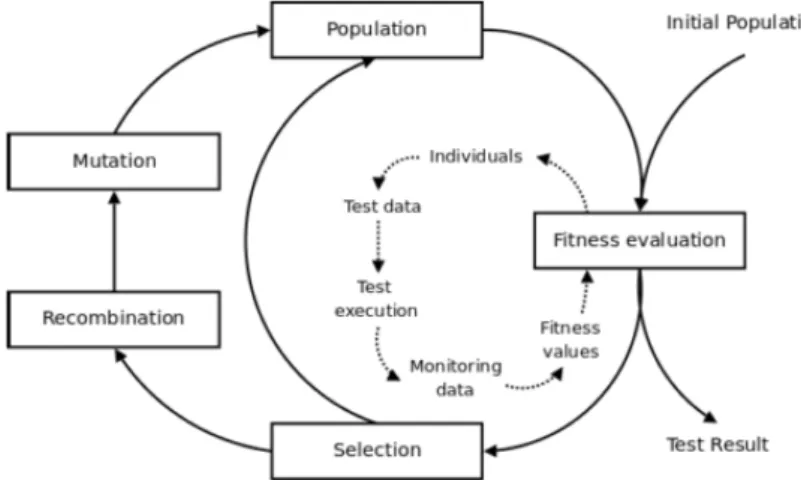
2.1 Evolutionary Testing Cycle. . . 19
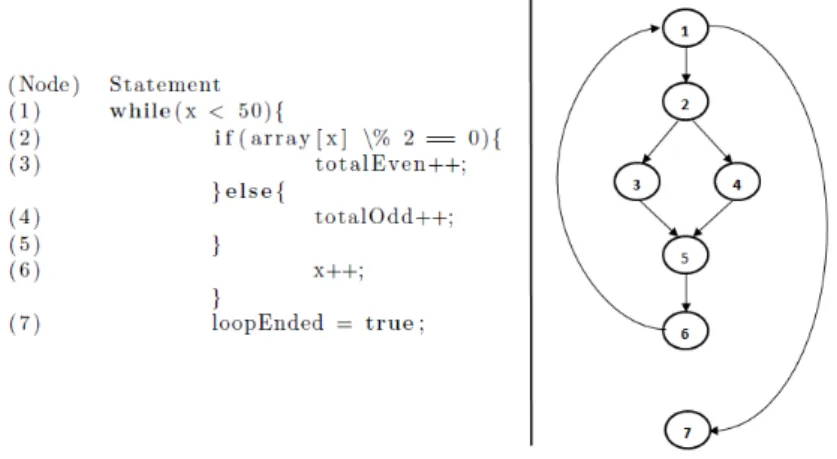
2.2 Fragment of source code and corresponding control-flow graph. . . 26
3.1 Overview of the Thesis Development Approach. . . 44
3.2 eCrash’s Context Diagram. . . 45
3.3 eCrash overall perspective. . . 47
3.4 Tomcat: Evolution of Cyclomatic Complexity. . . 48
3.5 eCrash Statistics for MathOperations. . . 50
3.6 Example of a test case profile. . . 51
4.1 Plug-in that extracts and exports data from the test cases. . . 53
List of Tables
2.1 Types of maintenance. . . 8
2.2 Examples of internal and external attributes. . . 22
2.3 CK Metrics suite. . . 30
2.4 MOOD and MOOD2 metrics. . . 32
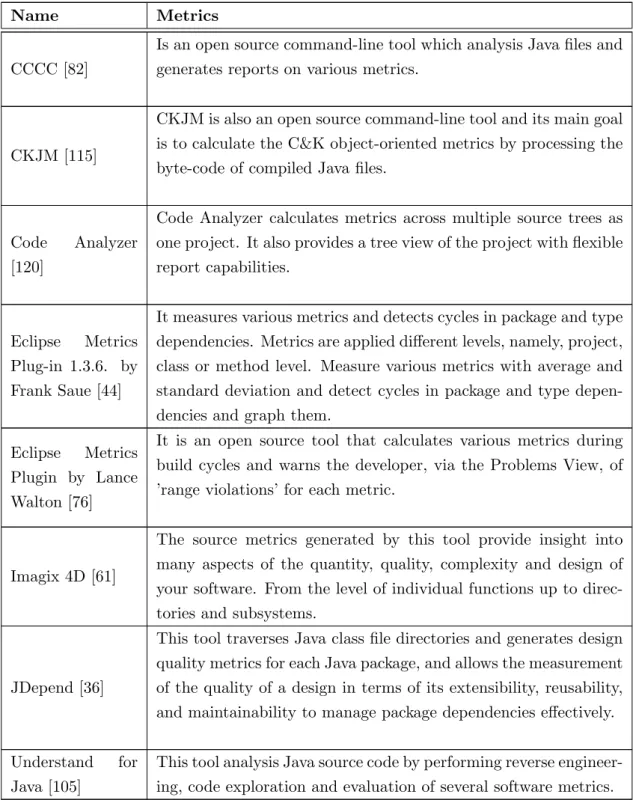
2.5 Software Metrics Tools. . . 32
2.5 Software Metrics Tools. . . 33
3.1 eCrash Components. . . 46
3.2 Information extracted from a test program. . . 50
5.1 Goals for Publication. . . 58
A.1 Bruntik and van Deursen’s metrics. . . 75
B.1 STREW metrics. . . 77
Listings
3.1 Method divide from class MathOperations. . . 49 3.2 Program which tests the methoddivide. . . 49
Introduction
In the past, the analysis of how a software product evolves and the assessment of its maintainability had performed a small role in the overall product development and opera-tion, when compared to the importance assigned to software construction. Nowadays, the maintenance of software artefacts began to have relevance mostly due to the fact that the Open Source paradigm made it possible to publish a software product allowing it to be maintained by the community.
Lehman has defined a set of laws for software evolution. One of his laws is the “In-creasing Complexity”, which is a natural consequence of software evolution. Lehman states that “As a program is evolved its complexity increases unless work is done to maintain or reduce it” [78]. Therefore, software maintenance performs a critical role because it is responsible for ensuring that the software product is still useful and respects its require-ments. Despite the fact that all software artefacts can be subject to maintenance, the source code is usually the one that suffers the major changes. There are projects with several releases in which the differences between each release is just the way the code is structured, i.e., a refactoring was made from one release to another. In these situations, the main goal is to reduce the software complexity.
Best practices on software development suggest that we should produce code that is simpler, more readable and easier to maintain and modify [1]. Thus, reducing the complexity of a software product is an objective that must taken into account whether we are programming a component, selecting an external component or simply, performing maintenance tasks. Complexity minimization is also critical to the process of verification and testing of software constructions, and helps reducing the software development costs [7].
Empirical observations have shown that typically, the more complex the software is, the bigger the test suite is. From there, the main research question of this work has raised: “Is
there a way to correlate the complexity of the test cases utilized to test a software product with the complexity of the software under test?”. In order to answer this question, we must perform the required studies to determine if it is possible to infer software complexity with basis on the characteristics of a set of automatically generated test cases. Therefore, this work will focus on inferring complexity of object-oriented software, mostly open source systems, and we will study how software properties are correlated to the corresponding set of test cases.
The evaluation of different software attributes can be achieved through Software Mea-surement. The results obtained for each software metric are useful to improve development and maintenance processes, increasing the quality of the software and supporting manage-ment tasks. In literature, several studies have proposed software metrics with the purpose of measure attributes of the software, in which complexity is included. In the early years, most of the software metrics were based on software complexity. With the advent of new types of paradigms for software development, new types of metrics appeared. The Object-Oriented paradigm became prominent and nowadays is widely used by projects with different characteristics. As a result, various suites of metrics specifically designed for object-oriented systems have emerged over the years, for example, the CK Metrics suite, developed by Chidamber and Kemerer [31] was the first one.
Likewise, software testing techniques have evolved, and the major goal of most of the researchers in this field is to fully automate the testing processes. Several approaches, which have been broadly accepted and have proved to be successful on the automation of the testing processes, include the use of Evolutionary Algorithms. These techniques are part of a specific type of testing approach called as Evolutionary Testing, which can be classified as a sub-field of Search-Based Software Testing (SBST) techniques. SBST techniques use meta-heuristic searches to achieve a good solution to the specific problem under evaluation.
One difficulty related to OO test cases generation is the fact that the class under test needs to be initialized and its fields must also be in the right state in order to achieve effec-tive testing. This fact contributes to the specificity of this type of test cases. Evolutionary Testing techniques are particularly suitable for performing unit testing on object-oriented software, because these techniques are able to generate large amounts of test data, travers-ing all the required states, as well as providtravers-ing good solutions.
A number of studies have described ways to evaluate complexity and correlate it with other software attributes, such as testability and maintainability. The focus of this work is the study of the possible relationship between the complexity of an object-oriented software product and the characteristics of the test cases created for it. The work of this research includes all the necessary effort to determine the best metrics to evaluate
the characteristics of the generated test data. From there, we will define the concept of test case profile, which may include one or more characteristics, such as the number of statements, number of method invocations or number of created instances. This concept will then be correlated to the complexity of the software under test.
The test suite will be automatically generated through the use of Evolutionary Testing techniques. Even though other methodologies could be used to create the set of test cases, we have selected Evolutionary Testing because it makes use of meta-heuristic techniques to guide the search, and allows obtaining optimal solutions with a reasonable amount of computational effort.
Real software projects will be included in the set of case studies that evaluate and validate the relationship between the test case profile and the complexity of the software. The selected projects must be completely implemented in Java, they should be available in open source repositories and in those repositories, several releases must be available. Thus, it is possible to analyse the complexity evolution over the several releases and to define a test case profile for each one. The Apache Tomcat software [2] is the first case study.
The contributions of this work go beyond predicting software complexity, since it is expected to contribute to the improvement of the design of software architectures. The identification of the most complex and problematic software modules is one of those contributions, because it provides information about the modules that require some type of improvement. Finally, an automated, consistent and reliable tool is expected as a result of this work. This tool must provide means for supporting management and architectural decisions, as well as validating past decisions and supporting future decisions. Important high-level decisions can be supported by answering several pertinent questions, such as: is it time for refactoring or is the product almost untestable? Is the latest software version ready for release? Are specific components, modules or COTS affecting the quality of the software product?.
The remaining chapters of this thesis proposal are organized as follows: Chapter 2 presents the state of art highlighting the key areas to better understand the research objectives of this work. Chapter 3 describes the objectives of this work, as well as the development approach that will be taken to achieve them. The current work is described in Chapter 4. In Chapter 5, the work plan and the implications of this research are presented. Finally, Chapter 6 ends this document by presenting the conclusions and future work.
State of the Art
In this chapter, the main concepts necessary to better understand the scope of this thesis proposal are going to be addressed. The state of the art investigates literature related to three main areas of Software Engineering, namely: Software Maintenance, Software Testing and Software Metrics; and evaluates the extent of the relationships between these areas. This study is required because in our work we will analyse information from software test cases in order to establish whether that information can be used as a means to infer the complexity of the software, and thence, how our work can support architectural decisions during the product’s life-cycle.
2.1
Introduction
The IEEE Computer Society [64] definesSoftware Engineering as:
(1) The application of a systematic, disciplined, quantifiable approach to the development, operation, and maintenance of software; that is, the application of engineering to software.
(2) The study of approaches as in (1).
In order to characterize the contents of the software engineering discipline, the Guide to the Software Engineering Body of Knowledge [1] has defined eleven Knowledge Areas. In this work, we will focus on concepts mostly from two of those areas, namely:
• Software Testing – consists of the dynamic verification of the behaviour of a program on a finite set of test cases, suitably selected from the usually infinite executions domain, against the expected behaviour.
• Software Maintenance – The maintenance phase of the life cycle commences upon delivery, but maintenance activities occur much earlier. The reasons for these
activities include anomalies that are uncovered, changes on operating environments, or new user requirements.
All those areas are closely related to the Software Construction Knowledge Area, which refers to the detailed creation of software through a combination of coding, verification, unit testing, integration testing, and debugging. One of the major goals in this knowledge area is to minimize complexity in every aspect of software construction process. We can achieve less complex code by emphasizing the creation of code that is simpler and more readable. During construction, many of its activities and resulting artefacts can be measured, including code developed, code complexity, code inspection statistics, fault-find rates, effort and scheduling.
We can split the coding creation process into two stages, the coding itself and the integration of separated components, which can be in-house components or Commercial off-the-shelf products (COTS). COTS refer to software products available for purchase and use without the need to conduct development activities [64]. Either way, assessing the complexity, quality and testability of a component before it is integrated is of major importance. Measurement is useful to improve the overall process, for instance to ensure quality or to support management tasks [8, 29]. Later in this document, in Section 2.5, an overview of software metrics will be presented.
Complexity minimization is also critical to the process of verification and testing of software constructions. Software construction is strongly linked to Software Testing due to the fact that during construction, software engineers perform intensive unit and integration testing. Software testing can also be used to ensure code quality. Section 2.3 presents an overview on important concepts related to Software Testing.
Software Evolution and Maintenance are very important fields of study because they provide the mechanisms which allow the software product to continue to be used. For instance, maintenance must be performed in order to correct faults, improve the design or implement enhancements.
In this work we analyse information from the software testing phase, more specifically, the characteristics of the test cases generated for an object-oriented software. Based on that information, we expect to be able to infer about the complexity of the software under test. Because software complexity is a major factor that influences the quality of software, with our work we expect to create a framework that by inferring about software complexity can support the decision-making in relation to development and maintenance phases.
The following sections will provide the user with the basic concepts so that he/she can understand the objectives of the work proposed in this document. Firstly, we will highlight the importance of software maintenance and its relationship with concepts such
as software complexity. Secondly, we will discuss software testing concepts emphasizing those related to Evolutionary Testing and its relationship with software attributes such as complexity and testability. Finally, we will present an overview of software metrics, including both traditional and object-oriented software metrics.
2.2
Software Evolution and Maintenance
According to Lehman [78], software systems must evolve or, otherwise they will became progressively less useful. Typically, source code is the artefact considered as the natural object of evolution and it should have the following characteristics: readability, maintain-ability and modifimaintain-ability, as well as it must be the least complex possible. Moreover, in order to develop high-quality source code, other artefacts are required and they should also co-evolve appropriately. Those artefacts include the requirements list, the test suite, among others [90]. Several studies have been performed to study the evolution of these artefacts. For instance, in [147], the authors studied the co-evolution between production code and test code.
Software maintenance and adaptation are undervalued in software processes, compar-atively to software development, leading to negative effects as software systems adapt to changes. Those negative effects are due to software aging [97], which makes software sys-tems unable to deal with changes and evolution, and hence, it makes them unnecessarily more complex and unreliable. However, attitudes began to change, and the relevance of the maintenance of software stand out, particularly due to two aspects: (i) the concerns about the Year 2000 (Y2K) problem1roll-over focused significant attention on the software maintenance phase, and (ii) the Open Source paradigm has brought further attention to the issue of maintaining software artefacts developed by others [1].
2.2.1 Software Maintenance
Software maintenance is defined in [64] as the totality of activities required to provide cost-effective support to a software system. It is part of a software life-cycle, concerning a set of activities, post-delivery activities, which start after a warranty period or post-implementation support delivery, including, software modification, training, and operat-ing or interfacoperat-ing to a help-desk. However, maintenance activities start earlier and may include planning for post-delivery operations, maintainability, supportability and logistics determination. These are referred aspre-delivery activities.
In more detailed terms, the IEEE Standard for Software Maintenance(IEEE 1219
1
Table 2.1: Types of maintenance (adapted from [64, 1]).
Type Purpose
Corrective maintenance
The reactive modification of a software product performed after delivery to correct discovered problems;
Adaptive maintenance
Modification of a software product, performed after delivery, to keep a software product usable in a changed or changing environment.
Perfective maintenance
Software maintenance performed to improve the perfor-mance, maintainability, or other attributes of a computer program.
Preventive maintenance
The modification of a software product after delivery to de-tect and correct latent faults in the software product before they become operational faults; or designing a software sys-tem that is easy to maintain.
[60]) defines Software Maintenance as the modification of a software product after delivery to correct faults, to improve performance or other attributes, or to adapt the product to a modified environment.
Briefly, software maintenance sustains throughout software operational life and is ap-plicable to software developed under any software life cycle model. Maintenance is needed to ensure that the software continues to satisfy user requirements. Therefore, modification requests are logged and tracked, the impact of proposed changes is determined, code and other software artefacts are modified, testing is conducted, and a new version of the soft-ware product is released. Moreover, complementary tasks are performed such as training and daily support.
According to [99], maintenance activities comprise four key characteristics:
• Maintaining control over the software’s day-to-day functions.
• Maintaining control over software modification, corrective and non-corrective.
• Perfecting existing functions.
• Preventing software performance from degrading to unacceptable levels.
There are several factors either technical or non-technical that can influence the main-tainability of a system. Pfleeger [99] considers that factors, such as application type, software novelty, software life-span, quality of software design, construction and testing, among others, influence software maintenance costs. Depending on the type of activities and the time when they occur, maintenance category varies. The Standard for Software Engineering-Software Maintenance, ISO/IEC 14764 [64, 1] defines four categories, which are listed in Table 2.1.
Techniques to perform in Software Maintenance
There are several accepted techniques used to perform software maintenance, including re-engineering and reverse engineering [1]. Re-engineering is defined as the examination and alteration of software to reconstitute it in a new form, and includes the subsequent implementation of the new form. It is often undertaken to replace aging legacy software, but does not intend to improve maintainability. Reverse engineering does not change the software or produce a new form of software, instead it is the process of analysing software to identify its components and their interrelationships, and to create representations of the software in another form or at higher levels of abstraction. Refactoring is a well-known form ofreverse engineering which consists in a program transformation which reorganizes a program without changing its behaviour and the aim is to improve the program structure [49].
Technical and Management Challenges in Software Maintenance
To perform maintenance, software engineers must deal with technical and management challenges that are unique. For instance, planning for a future release, while coding the next release and sending out emergency patches for the current one, represents a major challenge. Besides technical and management issues, software engineers have to deal with issues related to cost estimation and measures [99]. We are particularly interested in technical issues and measure issues.
Technical issues include the software engineer’s inability to understand where the change or correction should be made, if he/she is not the developer. Also, maintainers must have knowledge of the software’s structure and content in order to produce an impact analysis describing the impact of changes in existing software. Another important aspect is the cost required to re-test the software or component under maintenance which has proven to be a significant issue both in terms of time and money. Sometimes it is difficult to find the proper time to re-test, as well as to coordinate all the test activities which the software/component is subject. Furthermore, if the software is critical (e.g. software used by aeroplanes), it may be impossible to test it on-line because it can compromise the correct delivery of services of the system. One last technical aspect of software maintenance, as pointed out in [1], is maintainability.
Maintainability
Maintainability is defined in [64] as the “ease with which a software system or component can be modified to change or add capabilities, correct faults or defects, improve
perfor-mance or other attributes, or adapt to a changed environment”. Other definitions such as “the capability of the software product to be modified” and “speed and ease with which a program can be corrected or changed” are also presented.
According to [63],maintainability sub-characteristics are:
• Analyzability – Characterizes the ability to identify the root cause of a failure within the software.
• Changeability – Characterizes the amount of effort to change a system.
• Stability – Characterizes the sensitivity to change of a given system that is the negative impact that may be caused by system changes.
• Testability – Characterizes the effort needed to verify (test) a system change. In order to reduce maintenance costs and to improve maintainability, the above main-tainability sub-characteristic must be specified, reviewed, and controlled during the soft-ware development activities.
Maintainability Measurement
We can measure software maintenance by using either general or specific measures. The Software Engineering Institute (SEI) has identified four general software measures that are common to all endeavours, namely: size, effort, schedule and quality. Measures for each maintainability’s sub-characteristic can also be used, allowing us to measureAnalyzability (measures of the maintainer’s effort or resources expended in trying to diagnose deficiencies or causes of failure, or in identifying parts to be modified), Changeability (measures of the maintainer’s effort associated with implementing a specified modification), Stability (measures of the unexpected behaviour of software, including that encountered during testing) and Testability (measures of the maintainer’s and users’ effort in trying to test the modified software).
2.2.2 Software Release Management
One important technical issue related to software evolution and corresponding mainte-nance is the release management. Software release management is the management of the activities surrounding the release of one or more versions of software to one or more customers, including identifying, packaging, and delivering the elements of a product [64]. According to the IEEE standards [64], a release can be defined as: a delivered version of an application which may include all or part of an application. Other definitions such as “a software version that is made formally available to a wider community”, “particular version of a configuration item that is made available for a specific purpose” and “the formal notification and distribution of an approved version” are also provided in [129].
Types of Releases
Given that product changes can occur on a continuing basis, one concern for release management is determining when to issue a release. The severity of the problems addressed by the release and measurements done to prior releases affect this decision [113]. Three types of release where described in [91], namely:
• Development releases – aimed at developers interested in working on the project or experienced users who need cutting edge technology.
• Major user releases – based on a stabilized development tree. These releases deliver significant new features and functionality as well as bug fixes to end-users and are generally well– tested.
• Minor releases – updates to existing user releases, for example to address security issues or critical defects.
The Open Source Software paradigm
The Open Source paradigm had positive influence on release management practices, mostly due to the fact that Free and Open Source Software (FOSS) is characterized by a highly iterative development model in which new development releases are typically made avail-able very frequently [91]. Most projects follow a feature-based strategy as their release strategy. The premise of this strategy is to perform a new release when a specific set of criteria has been fulfilled and certain goals attained. For instance, reducing software’s complexity may be a goal for a particular software product.
Problems that commonly occur in release management of FOSS were identified in [91]. One of those problems is related tointerdependencies, mostly because the higher the complexity of software, the higher the levels of interdependence between software. For instance, when a piece of software uses libraries developed by others, a relation of depen-dency is created and problems may occur if one of those components is not ready because is either highly complex or unstable. Therefore, if we were able to reduce complexity of software by reducing the complexity of its components (in-house components or COTS), we will be able to produce better releases of that software product.
Studies that evaluate specific characteristics of Open Source projects have already been done. For instance, in [45], software metrics that evaluate the modularity level of a software project were proposed. These metrics were formulated with basis on information related to the size, complexity, cohesion, and coupling of the software systems analysed.
In the next section we will present some basic concepts related to Software Testing and how testing is related to other software’s properties and attributes including the complexity
of software.
2.3
Software Testing
Nowadays, software systems are a key part in almost every area, from medicine to aeronau-tics. The incorporation of software systems is such that testing those systems is becoming increasingly difficult. Therefore, the study and development of techniques and tools to better test those systems have become a very active field of research. Techniques include different approaches such as model-based testing or evolutionary testing, which typically differ how they select the test set, but ultimately all of them try to evaluate the product quality by detecting its faults (the cause of a malfunction) and problems. Later in this section, detailed information about those approaches will be provided. Firstly, we will describe some fundamentals and Software Testing activities.
2.3.1 Software Testing Fundamentals and Levels
Software testing can be performed at different levels during the software construction, and further during the software maintenance. The subject under test varies based on the level that occurs. Regardless the methodology used for software development, the Software Engineering Body of Knowledge [1] distinguishes three main test stages, namely, Unit Testing, Integration Testing and System Testing. Unit testing verifies the functioning in isolation of software pieces which are separately testable, such as individual sub-programs or a set of tightly related units that compose a larger component. On the other hand, Integration Testing verifies the interaction between software components. And finally, the main goal ofSystem Testing is to test the behaviour of a whole system.
Typically, unit testing occurs with access to the code being tested and with the support of debugging tools, and might involve the programmers who wrote the code. Integration testing is a continuous activity, at each stage of which software engineers must abstract away lower-level perspectives and concentrate on the perspectives of the level they are integrating. System testing usually encompasses testing tasks related to security, speed as well as comparing the system to the non-functional system requirements (e.g., accuracy or reliability). Also, external interfaces to other applications, utilities, hardware devices, or the operating environment are also evaluated at this level.
Similarly there are also different purposes for testing, which can verify different prop-erties, and those may also vary with the test target. The set of properties under test include both functional properties, namely the correctness of the implementation of the functional specifications, which is referred as conformance testing, correctness testing or
functional testing; as well as non-functional properties such as performance, reliability, usability, among others.
Many techniques for software testing have been developed; we will discuss some of them next.
2.3.2 Testing techniques and Test Case Generation
Nowadays, there are many different testing techniques, in which the property under evalu-ation and the object under test vary. Apart from the specific differences of each technique, all have the same underlying leading principle, which is to be as systematic as possible in identifying a representative set of program behaviours. In this section we present some types of testing categories, following the classification presented in [1]. However, we will focus on code-based techniques, describing these in more detail.
Testing techniques can be grouped in the following main categories:
• Techniques based on the software engineer’s intuition and experience – this category includes techniques in which tests are derived relying on the engineer’s skill, intuition and experience with similar programs (ad hoc testing) and techniques that include dynamic processes to create test cases which are dynamically designed, executed and modified.
• Specification-based techniques – this category include more formal techniques that are typically based on software specifications. The specification may contain details about software’s functionalities, performance, constraints and design.
• Code-based techniques– is the category of techniques that use code analysis tech-niques to build control and data paths and then generate test cases by transversing these paths.
• Fault-based techniques – these techniques have the specific aim of creating test cases that will try to reveal probable or predefined faults.
These techniques are not mutually exclusive, they can be combined in order to improve the software testing process. For instance, specification-based and code-based testing are complementary because they use different sources of information and provide different perspectives on software problems. The techniques presented above are general, meaning that they apply to all types of software.
Code-based techniques
In code-based testing techniques, the control structure of a program is graphically rep-resented using a flow-graph. A flow-graph is a directed graph in which nodes and arcs
correspond to program elements. For instance, nodes may represent statements or unin-terrupted sequences of statements, and arcs the transfer of control between nodes. This class of techniques includes:
• Control-flow-based criteria– Control-flow-based coverage criteria aims to cover all the statements or blocks of statements in a program, or specified combinations of them.
• Data-flow-based criteria – In this technique, the control flow-graph provides in-formation about how the program variables are defined, used and killed.
These techniques’ goal is to achieve some coverage criteria, for instance, achieve con-dition/decision coverage. The strongest of the control-flow-based criteria is path coverage, which aims to execute all entry-to-exit control-flow paths in the flow-graph. Since path coverage is generally not feasible because of loops, other less stringent criteria tend to be used in practice, such as statement coverage, branch coverage, and condition/decision coverage. The adequacy of such tests is measured in percentages; for example, when all branches have been executed at least once by the tests, 100 % branch coverage is said to have been achieved.
There are several strategies that can help on evaluation of the program under test. We can use program measures based on program size (e.g., lines of code) or on program structure (e.g., complexity) to guide the testing process. Other structural metrics can provide us information about the coupling between modules. The tests themselves can be evaluated based on different aspects. Later in this document we will discuss software metrics and their relationship with the test data. Next, we will describe some criterion used to evaluate how good a test suite is.
Evaluation of the test suite
In order to achieve reliable test results, it is important to evaluate the tests performed to the software under test. As with the testing techniques, the tests evaluation can be grouped in different categories, namely [1]:
• Coverage/thoroughness measures – Coverage or thoroughness of the executed tests can be evaluated by monitoring the elements covered, either they are elements in the program or in the specifications, to dynamically measure the ratio between covered elements and their total number. For example, it is possible to measure the percentage of covered branches in the program flow-graph, or that of the functional requirements exercised among those listed in the specifications document.
• Fault seeding – In those techniques in which faults are artificially introduced into the program (before test) with the purpose of revealing them as well as real latent
faults, one way to evaluate the effectiveness of testing is to establish a relationship between the artificial faults revealed and the genuine ones.
• Mutation score– To evaluate the effectiveness of mutation testing we can measure the ratio of killed mutants to the total number of generated mutants.
Test Case Generation
A core activity of the testing process is the test case generation, which is strongly related to the level of testing and to the particular testing technique that is used. Atest case is defined in IEEE Standards [64] as “a set of test inputs, execution conditions, and expected results developed for a particular objective, such as to exercise a particular program path or to verify compliance with a specific requirement”.
The ideal scenario in a test environment includes testing all possible input and output combinations in order to test every possible permutation of a program. However, creating test cases for all these combinations is not possible because even a simple program can have hundreds of possible combinations. If we consider a complex application, performing a complete testing would require several time and resources increasing the cost of testing. Automation is one proved solution that aims to reduce the time, resources and therefore the costs associated to test case generation. An approach for testing that is highly focused on test case/test data generation, and its automation, is Evolutionary Testing. In the next section we will describe how can Evolutionary Algorithms can be used to support testing activities.
2.4
Evolutionary Testing
In this work we are interested in the results of using Evolutionary Algorithms to perform some Software Testing activities, which is referred as Evolutionary Testing. Evolutionary Algorithms have been used to fully automate testing tasks, such as the derivation of test data [89]. More reliable test data can be achieved, and in a faster way, by using meta-heuristic searches, such as Evolutionary Algorithms. This is due to the fact that these techniques guide the search by scoring different points in the search space according to how good or suitable they are for solving the problem.
Evolutionary Testing is part of a broader category of techniques that use meta-heuristic searches to achieve their purpose, the Search-Based Software Testing (SBST). These tech-niques present very specific features, which we will briefly describe next.
2.4.1 Search-Based Software Testing
Factors such as the necessity of achieving near optimal solutions or at least a specified acceptance level make meta-heuristic search-based optimisation techniques as a natural solution to solve problems in various fields of software engineering, which includes problems related to software testing [53]. An advantage of meta-heuristic algorithms is that they are widely applicable to problems that are infeasible for analytic approaches.
In 1976, the first work in this field was published by Miller and Spooner [92], wherein they proposed a simple and innovator technique for generating test data consisting of floating-point inputs. The first work applying Genetic Algorithms was published in 1992 [144]. Since then, more work have been developed applying meta-heuristic techniques to test data generation, including algorithms such as Hill Climbing [93, 70], Simulated Annealing [112] and Evolutionary Algorithms [123, 132, 133, 104, 111]. Hill Climbing and Simulated Annealing are optimization algorithms that consider only one solution at a time, and the search is then restricted only to the local neighbourhood of those locations. As opposed to these solutions, which perform ’local’ searches, Evolutionary Algorithms are ’global’ search approaches due to the fact that they sample many points in the search space at once.
Characteristics of Search-Based Problems
In order to apply this type of techniques to software engineering scope, problems must be reformulated as search problems taking into account [89, 35]:
• A representation of the problem is critical to shape the nature of the problem allowing symbolic manipulation. Floating point numbers and binary code are the frequent forms of representation.
• A fitness function is the characterisation of what is considered a good solution. These compare and contrast solutions of the search with respect to overall search goal, directing the search into more promising areas of the search space. An ordinal scale of measurement for fitness values is enough to allow the selection of the best of two candidate solutions.
• A set of manipulation operators, which are dependent on the search technique used and will modify the representations. The mutation operator is considered as a minimum requirement, because it allows us to change an individual representation of a candidate solution to produce a different candidate solution.
A result of using search-based techniques is that the perception of the problem prob-ably will change to see it as a search problem. For instance, testing can be seen as a problem wherein, besides the testing tasks, we want to find test cases that satisfy some
test-adequacy criterion, e.g., derive all test cases that ensure 100% of structural coverage.
Applicability of meta-heuristic techniques to software testing
Several testing techniques are based on some notion of coverage either of the code or specification. Therefore, the coverage value can be measured and incorporated into a fitness function [35]. As means of supporting software testing, meta-heuristic techniques have been successfully applied to the following types of testing [88]:
• Structural testing– coverage of specific program structures, as part of a structural, or white-box testing strategy [104, 62].
• Specification-based testing– specific program features are exercised, as described by the software’s specification [135, 15].
• Fault-based testing – disproving properties about the operation of a piece of software, for example, stimulation of error conditions.
• Non-functional testing– verifies non-functional properties such as the worst-case execution time of a segment of code [138].
Structural testing has been the area of application that has attracted the most atten-tion in the Search-Based Software Testing field [89]. Structural, or white-box, techniques derive tests and determine the adequacy of a test set based on the internal structure of the code under test. Typically, these techniques measure the coverage of certain constructs of the source code that are executed during testing. Therefore, Structural Testing can be used to test the source code, as well as to determine the proportion of reachable program statements that were covered during testing – statement coverage; the proportion of feasible program branches that are covered during testing – branch coverage; and the proportion of the feasible paths that are covered during testing –path coverage. Usu-ally, to develop fitness functions to measure coverage, the program under test needs to be instrumented. Then, the program is executed with inputs suggested by the search and the path taken through the program is compared with some structure of interest for which coverage is sought.
In addition, literature shows that Search-Based Techniques (SBT) are suitable for other types of testing, namely, temporal testing [102, 140, 137] , integration testing [17], mutation testing [12, 65], regression testing [81, 146], stress testing [21], test case prior-itization [130], interaction testing [39], state machine testing [42] and exception testing [124].
2.4.2 Evolutionary Algorithms
The family of Evolutionary Algorithms have been widely used to automate the generation of test data that intends to meet a test adequacy criterion. These algorithms represent a class of adaptive search techniques, which use simulated evolution as a search strategy to evolve candidate solutions, using operators inspired by natural genetics and Darwin’s theory of evolution, specifically the concept of the ’survival of the fittest’ in natural evo-lution [51, 59]. The main idea of an Evoevo-lutionary Algorithm is that the fittest individuals survive over the time and in future generations their offspring will be fitter. There are four main categories of Evolutionary Algorithms: Evolution Strategies [13, 37], Evolution-ary Programming [48], Genetic Algorithms and Genetic Programming. The use of these algorithms for software testing is referred as Evolutionary Testing [88, 139, 54, 136, 89].
Iterations of an Evolutionary Algorithm
The following steps describe generally how an evolutionary algorithm iterates. Steps 2 to 7 are repeated until a test criterion is satisfied (e.g., a global optimum is reached) or another stop-condition is fulfilled (e.g., time of execution).
1. Population initialization of possible solutions to the problem (usually is a random process).
2. Evaluation of each individual by calculating its fitness via the fitness function. 3. Selection of pairs of individuals from the population for reproduction.
4. Recombination of selected individuals via a crossover operator (combination of each individual parent’ good parts).
5. Mutation of the resulting offspring individuals. 6. Evaluation of the offspring individuals.
7. Population update through a strategy of re-insertion strategy.
In step 1, by starting with a randomly initial population we create a very diversified set of individuals whose fitness values are spread in the search-space. During an iteration of the evolutionary algorithm, the individuals are subject to modification operators, such as crossover and mutation operators. As mentioned before, the crossover operation combines the good parts from each parent individual to form better offspring individuals, which is a process analogous to biological reproduction. On other hand, the mutation operator aims to introduce new information into the gene pool of a population. New information is ran-domly introduced and it is very important because prevents the process from stagnation. Both selection and re-insertion strategies have determinant impact on the process because the former is responsible for implementing the “survival of the fittest” concept, selecting the fittest individuals; and the latter defines how the new offspring will be introduced in
the population, usually the worst members of the current generation are replaced. Figure 2.4.2 depicts the typical evolutionary algorithm cycle when applied to Evolu-tionary Testing.
Figure 2.1: Evolutionary Testing Cycle [5].
Genetic Algorithms and Genetic Programming
A genetic algorithm (GA) [98, 51] is a model of machine learning which derives its be-haviour from a metaphor of the processes of evolution in nature. These algorithms are executed iteratively on a set of coded chromosomes, referred as population, wherein each member of the population is a chromosome (or individual) and its represented by a string. GAs use three basic genetic operators: selection,crossover andmutation. The primary op-erator is thecrossover. GAs use only the objective function information and probabilistic transition rules for genetic operations.
Genetic Programming (GP) [71, 72, 9] is the extension of the genetic model of learning into the space of programs, i.e., the objects that constitute the population are not fixed-length character strings that encode possible solutions to the problem at hand, they are programs that, when executed, are the candidate solutions to the problem. Genetic pro-gramming expresses these programs as parse trees instead of lines of code. For instance, the programa+b∗c would be represented as:
In Genetic Programming, the individuals (programs) in the population are composed of elements from the function set and the terminal set, which are fixed sets of symbols selected to be appropriate to the solution of problems in the domain of interest. GP uses the crossover operator, which is implemented by taking randomly selected sub-trees in the individuals and exchanging them. These sub-trees are selected according to their fitness values. Usually, Genetic Programming does not use any mutation operator.
Profile of a test program
Test case design is one of the most important activities of Software Testing, since the type, scope, and quality of the test are determined by selecting feasible test cases [74]. Existing test case design methods can be grouped in two major categories, black-box tests and white-box tests. In both cases, complete automation is a very difficult goal. Evolutionary testing has been a successful approach in test case design.
The purpose of using this type of testing to structure test case design is the generation of a huge quantity of test data which otherwise it could become impracticable. This amount of test data will allow the achievement of the best possible percentage of coverage, depending on the type of coverage under consideration. This method for generating test cases will provide us only with information regarding the input values, whilst the expecting values must be defined by the tester or provided by an oracle. Therefore theinput domain
of the object under test is the search-space that will be used in order to achieve the test goal.
A test in Evolutionary Testing is typically divided into test aims, each one representing a program structure that must be executed in order to achieve full coverage. For instance, a simple condition testing (if statement with two conditions) each program condition represents two test aims: evaluating the condition as true and as false. A test program will be composed by several test cases which together will represent full coverage.
In the next section we will present an overview of Software Metrics that are used to evaluate software’s properties and attributes including the complexity of software.
2.5
Software Metrics
In order to make software an engineerable product, people who are responsible for the design, development and maintenance, should be able to express its characteristics in objective and quantitative terms [67]. Therefore, the use of quantitative measures, also referred as metrics, have been widely accepted as means of evaluating software characteris-tics, in which a diversified set of aspects (e.g., performance, reliability, source code, among
others) can be the target of the measurements [47, 122]. According to [64], a metric
can be defined as a quantitative measure of the degree to which a system, component, or process possesses a given attribute.
Sommerville [114] defines a software metric as “ any type of measurement that relates to a software system, process or related documentation”. For example, the number of lines of code (LOC) in a program is a software metric that evaluates the software product. Software metrics allow us to express empirical work in a formal way and they may refer to the product itself or to the process that originates it.
Sommerville groups metrics into two major categories: the Control Metrics and the Predict Metrics. The former is related to the software process (e.g., the average effort and time required to repair reported defects) and the latter evaluates the software product (e.g., complexity of a module). Kafura [67] also makes the distinction between process and product metrics.
2.5.1 Software Attributes
In each metrics group, Fenton [47] distinguished between two types of attributes: internal and external. Internal attributes are those that can be measured by examining the prod-uct or process independently of its behaviour, whereas external attributes are measured based only on how the product or process relates to its environment, i.e., the behaviour is important rather than the product or process by itself. For example, considering a set of software modules, its size (e.g., lines of code), its complexity (e.g., number of decision points) and the dependencies among modules are examples of their internal attributes and they can be measured without actually executing the code. However, there are other attributes that only can be measured when the code is executed and hence they are consid-ered external attributes. Examples of external attributes include: the number of failures experienced by the end-user and the amount of time required to retrieve information from a database. Table 2.2 presents some examples of internal and external attributes for process and product metrics.
Internal attributes can help predicting several software characteristics. However, some-times a large set of internal attributes are dismissed, and considered as unimportant, because ultimately, the end-user is interested in a small set of attributes, such as func-tionality, quality and utility. The metric values obtained, for products or processes, can be used [47]: (i) to assess the quality, providing a way to quantify its attributes; (ii) to support decision-making, either by the programmers (low-level decisions) or by the soft-ware architects (high-level decisions); (iii) to predict characteristics of the softsoft-ware; and ultimately, (iv) to control the software development process.
Table 2.2: Examples of internal and external attributes (adapted from [47]).
Item Attributes
Product Internal External
Specifications
size, reuse, modularity, redun-dancy, functionality, syntactic correctness
comprehensibility, maintain-ability
Designs
size, reuse, modularity, cou-pling, cohesiveness, function-ality
quality, complexity, maintain-ability
Code
size, reuse, modularity, cou-pling, functionality, algorith-mic complexity, control-flow structuredness
reliability, usability, maintain-ability
Test data size, coverage level quality
Process Internal External
Constructing specification
time, effort, number of
re-quirements changes quality, cost, stability Detailed design time, effort, number of fault
specifications found cost, cost-effectiveness Testing time, effort, number of coding
faults found
cost, cost-effectiveness, stabil-ity
Our work intends to take advantage of test data information to predict properties of the software under test with the purpose of understanding and improving it. As shown in Table2.2, the test data of a software product has the size and the coverage level as its internal attributes, and the quality as an external attribute. In our work, we will analyse the generated test cases, which aim to achieve full structural coverage, as well as properties related to the size, such as the number of statements that are included in each test case. Our purpose is to infer the complexity of the software, and how it is related to other properties such as maintainability, which are closely associated with the software quality. Software product measurement encompasses the measurement of product size, prod-uct strprod-ucture and prodprod-uct quality [1]. Thesize of a software product is most often eval-uated by measuring the length (e.g., lines of code) or functionality (e.g., function points in a specification). In turn, structure measurement can be applied to both high and low-level design and code artefacts in order to reflect software’s control-flow, data-flow, nesting, control structures, modular structure and interaction. On the other hand, qual-itymeasurement is a multi-dimensional software’s attribute and therefore is more difficult to assess because it considers qualitative aspects as opposed to previous, which consider quantitative information.
analyse the complexity, the understandability and the level of maintenance of a software product. Several benefits of using software metrics, are described in the literature. One of the most important benefit is related to the fact that they may provide information to support quantitative managerial decision-making during the software life cycle [116]. Moreover, software metrics can also provide information that is useful during the product life cycle.
The purpose of this work is to infer the complexity of an object-oriented system with basis on the information extracted from its test cases. Although we intend to study and analyse several software product attributes, our major research efforts are related to the complexity of the software.
2.5.2 Software Complexity Measurement
Complexity measurements can be used to make decisions which can reduce the devel-opment cost, increase reliability and improve the overall quality of the software. Those vary from simple and comprehensible measurements, such as lines of code, to abstract measurements that are able to assess aspects like hierarchical complexity.
According to IEEE glossary [64], Complexitycan be defined as:
1. the degree to which a system’s design or code is difficult to understand because of numerous components or relationships among components.
2. pertaining to any of a set of structure-based metrics that measure the attribute in (1).
3. the degree to which a system or component has a design or implementation that is difficult to understand and verify.
Complexity metrics can be used to make quality evaluations of software, to monitor the development growth of software systems, and to estimate and predict several soft-ware attributes. Consequences of complex softsoft-ware include development costs, high-maintenance costs, and bad values associated to software attributes/properties. Monitor-ing complexity of a software system, durMonitor-ing design, development and maintenance, allows us to make the appropriate changes which can reduce complexity and ensure the system remains modifiable and modular [77].
The Software Engineering Body of Knowledge states that Complexity Analysis is one of the possible Software Quality Management Techniques, which is particularly useful for determining if the design or implementation is too complex to develop correctly, to test or to maintain. Software complexity analysis can provide diverse information on code structure, critical components, risk areas, testing deficiencies, and opportunities for improvement. Based on this information we can improve the quality and reliability of a
software system during all phases of the software life cycle [77]. The results of a complexity analysis are also a valuable source of information for creating the suitable test cases for a software program.
Next, we present an overview of complexity metrics. Although we do not present all existing metrics, we consider that the chosen metrics are a representative list of the work done in this field. Firstly, we introduce a set of metrics that we label as traditional software metrics, which were the first metrics to be widely used. Then, a more application-specific metrics will be presented, namely the object-oriented metrics. Due to object-oriented software characteristics will also discuss metrics that evaluate aspects such as cohesion and coupling.
2.5.3 Traditional Software Metrics
Despite many metrics were described and published during the last 40 years, only a few of them are really applied on the work developed either by the industry or by the academics. In this document, we will present an overview about the ones considered more relevant. Traditional Software Metrics is the term that we use to refer to the initial software metrics mostly used in the 70’s and 80’s before the appearance of the new software development paradigms, including the object-oriented paradigm. Several of these metrics are currently used, and some of them are the basis for calculation of other metrics. Traditional Software Metrics are mostly complexity-based metrics, because either they refer to software’s source code or to software’s design.
In [67] a set of general classes for product software metrics was proposed, defining:
• Structure metrics– based on an automated analysis of the system’s design struc-ture.
• code metrics – based on implementation details;
• hybrid metrics – combining both structure and code metrics).
Structure Metrics use features that emerged during the design phase, components and relationships between components in order to achieve a quantitative measure. On the other hand,Code Metricsrefer to measures that are defined in terms of features not visible until much of the coding of the system has been completed. The definition itself raises a drawback, because these metrics can only be used in a later phase of the development process, and therefore it is highly probable that some resilience may be demonstrated in order to change code when the system is already fully implemented. Finally, a Hybrid Metric is a metric that determines a measure for a component by weighting the structure measure for that component by a code measure. For instance, a measure that consists information-flow weighted by lines of code is an hybrid metric.
Next we will describe the Lines of Code metric and the McCabe’s Cyclomatic com-plexity.
Lines of Code - LOC
One of the most used metric, which is also considered the most basic and simple, is the Lines of Code2 measure. LOC metric has been used with different purposes, namely: as a measure of size; as a means for assess the effort and the programming productivity; as quality criteria and also as a parameter in cost estimation models. One common definition forline of codeis [77]: the line or lines between semicolons, where intrinsic semicolons are assumed at both the beginning and the end of the source file, including all lines containing program headers, declarations, executable and non-executable statements.
Other definitions include also comments and header information. Existing work have shown that LOC is very useful and can be a predictor of software characteristics such as, bug density, reliability and maintainability [109, 11, 143, 27].
LOC is easy to understand, fast to count and also independent of the programming language. However, using only the LOC metric to evaluate software can be misleading because programming languages are different. For instance, the characteristics/features of the assembly language are different from a high-level language, such as Java. LOC is widely used as a measure of complexity in spite of criticisms [4].
McCabe’s Cyclomatic Complexity - MCC
Other well-known and widely used is theMacCabe’s Cyclomatic complexity metric, pro-posed in 1976 by Thomas McCabe [87], and it is the most famous metric for complexity evaluation. The acceptance of McCabe’s metric is wide insomuch it has been used in sev-eral large software projects [134]. MCC has theoretical mathematical foundation, because it is derived from the graphs theory, using the definition of the cyclomatic number that cor-responds to the number of linearly independent paths in a program. Control-flow graphs describe the logic structure of software modules, illustrating graphically the decision paths and logic structure. Thereby, this metric performs a control-flow graph analysis, counting the number of possible decision points, and with basis on the number of possible paths, determines how complex is the software. If the program contains neither loop structures nor decision structures, then the metric has a value 1. On the other hand, for instance, if there is one if-else structure the metric will have the value 2, due to the fact that there are two possible paths for the program execution. A major advantage is that it aims to
2
Figure 2.2: Fragment of source code and corresponding control-flow graph.
be independent of the programming language and language format. MCC formulae is: V(G) =e−n+ 2p where V(G) - McCabe’s Cyclomatic Number
e - number of edges n - number of nodes and
p - number of discrete connected components .
Statements or expressions are represented by nodes, while the edges represent transfer of control between them. Each possible execution path of a software module has a cor-responding path from the entry to the exit node of the module’s control-flow graph. For example, consider the fragment of code and corresponding control-flow graph in Figure 2.2. MCC for the control-graph is 3, because 8-7+2=3.
With McCabe’s complexity metric is possible to compare two programs with basis on a single number, which is a indicator of each program module’s control-flow complexity. On the basis of empirical research, McCabe stated that the higher the value of his metric for a module, the higher the probability of it to be fault-prone or unmaintainable. However, there are programs that have a large number of decision points, and nevertheless they are easy to understand and maintain. Therefore, we should not assess a program complexity based only in a cyclomatic number because it can be misleading [47]. When appropriate we must consider metrics that evaluate other characteristics of software, such as, level of coupling and cohesion. Further in this document we will discuss some of those metrics.
McCabe also pointed this metric as in indicator of testability (how easily code could be tested) and can help determining the total number of test cases required to test a module, providing us with a measure of the size of the test case space.
1977, Myers proposed an extension to McCabe’s formulae, which distinguishes the com-plexity of cases involving single conditions from those which have multiple conditions.
LOC and McCabe’s Cyclomatic Complexity focus on the code analysis to determine the level of complexity, and can be classified as Program Complexity Metrics. Besides these, other complexity metrics have appeared during the last years, falling in the System Complexity Metrics category. These metrics are mainly applied to the system design or specifications. In [95] a survey of system complexity metrics is presented, in which two works were highlighted, the Henry and Kafura’s [58] metric and the Yin and Winchester’s metrics [145]. However, these metrics are beyond the scope of our work and therefore they are not described in this document.
The emergence of new paradigms and techniques for software development, such as the Object-Oriented paradigm, has led to the definition of new software metrics, which reflected the importance and usage of this new paradigms in order to create a software product. The next section will focus on software code metrics for Object-Oriented systems.
2.5.4 Object-Oriented Metrics
One of the most prominent approach to software development is the Object-Oriented (OO) paradigm, and due to its relevance, the development of specific software metrics have become an important field of research. Despite of the importance of traditional software metrics, they were target of criticism and it was claimed that they were not suitable for the OO paradigm. Reasons vary from the lack of theoretical basis to the lack of desirable measurement properties [128, 141, 131, 68]. Nevertheless, the main reason is the fact that they do not consider OO notions such as classes, inheritance, encapsulation, information hiding, and message passing [142, 31, 46].
Although OO software presents strong points, the increasing complexity due to the existence of many objects and inter-relationships is a weak point. In the scope of the procedure-oriented systems, coupling and cohesion were considered as primary attributes that would led to a system with quality. In the OO paradigm these properties perform a similar role, and they can be used to evaluate several software quality characteristics [43]. Therefore, for better understanding of object-oriented software metrics, we need to define two software design concepts, which are particularly important for classes conceptualiza-tion, namely, Cohesion and Coupling.
Cohesion and Coupling properties
The IEEE standard [64] defines Cohesionas: “(1) the manner and degree to which the tasks performed by a single software module are related to one another or (2) in software
design, a measure of the strength of association of the elements within a module”. In the OO paradigm, class cohesion, also referred as functional cohesion, is defined as the relatedness between members of a class. Classes that lack cohesion are poorly designed and they will be difficult to understand, to test and to maintain [6]. Steinet al. pointed that a lack of cohesion may be associated with high complexity [117]. Cohesion metrics are structural metrics because they use structural information extracted from the source code, and therefore, they can be useful to determine different characteristics of the software, including characteristics of its test cases. For example, Tsui and Iriele have studied the correlation between software code cohesion and the test case development complexity. Their work considered two cohesion metrics and, they found that one of these metrics can be an indicator of test complexity [125].
Also according to the IEEE standard [64], Coupling is “in software design, a mea-sure of the interdependence among modules in a computer program”. Coupling between two classes exists if one accesses or uses some elements of other class. According to the literature, coupling metrics proved to be good predictors of software quality [6]. Low cou-pling between classes is promoted as a good practice to facilitate comprehension, testing, maintenance and evolution. In [69], Khalid et al. established a relationship between dif-ferent object-oriented features, such as inheritance, coupling and encapsulation, and the degree of complexity and testability of a system. They concluded that the level of cou-pling between classes is directly proportional to complexity and consequently, the higher the coupling is, the more difficult it will be for testing the software.
OO analysis and design methods promote a modular design by creating classes with high cohesion and low coupling [100, 114, 43]. In [43], Eder et al. state that strong coupling makes methods and classes harder to understand, change or correct because they are highly correlated to other methods and classes. As regards the class cohesion, it is better to have high cohesion because it means that the class represents a single, semantically meaningful concept without containing methods which should be delegated to other classes and without hidden classes.
Current research and experimental work recognise the interdependent nature of cou-pling and cohesion, as well as the fact that these properties must be considered together when analysing the structural complexity of the software [41]. Thus, coupling and cohe-sion are considered as essential, and interrelated indicators of the underlying dimencohe-sions of structural complexity. In literature, we can find several frameworks that try to evaluate coupling and cohesion. For instance, Briand et al. have proposed two frameworks for measurement of object-oriented systems, one focusing on the coupling property and the other measuring the cohesion of a software system [19, 20]. In [6], the relationship between the lack of cohesion of OO classes and their coupling was empirically explored.
![Table 2.1: Types of maintenance (adapted from [64, 1]).](https://thumb-us.123doks.com/thumbv2/123dok_us/9528488.2436534/19.892.131.757.210.486/table-types-maintenance-adapted.webp)
![Table 2.2: Examples of internal and external attributes (adapted from [47]).](https://thumb-us.123doks.com/thumbv2/123dok_us/9528488.2436534/33.892.140.753.210.633/table-examples-internal-external-attributes-adapted.webp)
![Table 2.3: CK Metrics suite (adapted from [31]).](https://thumb-us.123doks.com/thumbv2/123dok_us/9528488.2436534/41.892.131.738.804.1109/table-ck-metrics-suite-adapted-from.webp)
![Table 2.4: MOOD and MOOD2 metrics (adapted from [22, 10]).](https://thumb-us.123doks.com/thumbv2/123dok_us/9528488.2436534/43.892.120.779.206.675/table-mood-mood-metrics-adapted.webp)