Data Integration with XML and Semantic Web
Technologies
A thesis presented
by
Rubén Tous
Submitted in partial fullment of the requeriments for the degree of Doctor of Philosophy
Doctorate in Computer Science and Digital Communication Department of Technologies
Advisor: Catedràtic d'Universitat Jaime Delgado Mercé
Universitat Pompeu Fabra
Barcelona, June 2006
Dipòsit legal: B.48973-2006
ISBN:
978-84-690-3512-2
c
2006 - Rubén Tous All rights reserved.
Thesis advisor Author Catedràtic d'Universitat Jaime Delgado Mercé Rubén Tous
Data Integration with XML and Semantic Web Technologies
Abstract
Accessing data from multiple heterogeneous databases entails dealing with dier-ent data models, dierdier-ent schemas and dierdier-ent query languages and interfaces. This thesis can be divided in two main parts, both related to dierent aspects of the design of modern data integration systems. The rst part is related to the problem of dealing with hetero-geneous data models and schemas. It is also divided in two dierent sub-parts. The rst one is focused in the semantic integration between XML and RDF (the Resource Descrip-tion Framework). We suggest a strategy based on the mapping of the XML model to RDF triples. Translating XML documents to RDF permits taking prot from the powerful tools of Description Logics allowing XML documents interoperate at the semantic level. This mapping has generated some interesting results, like a schema-aware and ontology-aware XPath processor that can be used for schema semantic integration or even for implicit query transcoding among dierent data models. The approach have been tested in the Digital Rights Management (DRM) domain, where some organizations are involved in standardiza-tion or adopstandardiza-tion of rights expression languages (REL).
In the second sub-part we suggest a vector space model for semantic similarity measurement and OWL ontologies alignment. A rigorous, ecient and scalable similarity measure is a pre-requisite of any ontology matching system. The presented model is based on a matrix representation of nodes from an RDF labelled directed graph. A concept is described with respect to how it relates to other concepts using n-dimensional vectors, being n the number of selected common predicates. We have successfully tested the model with the public testcases of the Ontology Alignment Evaluation Initiative 2005.
The second part of the work is related to the problem of dealing with heterogeneous query interfaces. We suggest a strategy that allows redistributing an expressive user query (expressed in a XML-based data query language) over a set of autonomous and heterogeneous databases accessed through web forms. The idea, that has recently been renamed by Thomas Kabisch [81] as "Query Tunneling", consists on the reprocessing of the initial user query over the results returned by the dierent sources, that must be a superset of the results that satisfy the initial query. We describe in this document the strategy and its limitations, and an implementation in the form of two Java APIs, the Java Simple API for Metasearch (JSAM), that has been used in the development of a spanish news metasearch engine, and the Java Simple API for Web Information Integration (SAWII), that oers high level tools to the development of articulated wrappers for complex web form-chains and result pages.
Contents
Title Page . . . i
Abstract . . . v
Table of Contents . . . vii
List of Figures . . . xii
List of Tables . . . xiv
Already Published Work . . . xv
Acknowledgments . . . xvii
Dedication . . . xix
1 Introduction 1 1.1 About this thesis . . . 1
1.2 Aims and Hypothesis . . . 1
1.3 Methodology . . . 2
1.3.1 Related to the rst contribution part 'Heterogeneous Data Models and Schemas: Semantic Integration' . . . 2
1.3.2 Related to the second contribution part 'Heterogeneous Query Inter-faces: Query Tunneling' . . . 3
1.4 Document outline . . . 4
1.4.1 Background Information . . . 4
1.4.2 State of the Art and Problem Statement . . . 4
1.4.3 Heterogeneous Data Models and Schemas: Semantic Integration . . . . 4
1.4.4 Heterogeneous Query Interfaces: Query Tunneling . . . 5
1.4.5 Relationship between thesis parts and chapters . . . 5
2 Background Information 7 2.1 Information vs. Data . . . 7
2.2 Metadata . . . 7
2.3 Information Retrieval vs. Data Retrieval . . . 8
2.4 Traditional Information Retrieval vs. Multimedia Information Retrieval . . . 8
2.5 Data Integration . . . 9
2.6 Distributed Information Retrieval vs. Data Integration . . . 9
2.7 Metasearch . . . 10
2.8 Datalog . . . 10
2.9 The Extensible Markup Language (XML) . . . 11
2.10 The Semantic Web . . . 12 vii
viii Contents
2.11 Querying the Semantic Web . . . 12
2.12 Semantic Integration . . . 13
2.13 Resource Description Framework (RDF) . . . 13
2.14 Ontology Web Language (OWL) . . . 14
2.15 OWL and Description Logics . . . 15
I State of the Art and Problem Statement 17 3 State of the Art in Data Integration 19 3.1 Historical Progress . . . 19
3.1.1 Mediated Schema (the modeling problem) . . . 20
3.1.2 Formalisation of the modelling problem . . . 20
3.1.3 Formalisation of global-as-view (GAV) approach . . . 21
3.1.4 Formalisation of local-as-view (LAV) approach . . . 22
4 Query reformulation algorithms (the querying problem) 24 4.1 Query reformulation in LAV and GAV (the querying problem) . . . 24
4.2 Answering queries using views . . . 25
4.2.1 Query containment . . . 25
4.2.2 Rewriting a query using views . . . 27
4.3 Parametrized views . . . 28
4.4 Query processing . . . 29
5 Data Integration and XML 30 5.1 Mapping the classic data integration problems to XML . . . 30
5.2 XML query languages and data integration . . . 31
5.2.1 XSL Transformations (XSLT) . . . 31
5.2.2 XML Query (XQuery) . . . 33
5.3 XML Data Integration Systems . . . 34
5.3.1 Tukwila . . . 34
5.3.2 Enosys . . . 34
5.3.3 XQuare Fusion . . . 34
6 Semantic Integration 36 6.1 Ontologies and Data Integration . . . 36
6.1.1 Semantic integration challenges . . . 37
6.2 Ontology Alignment . . . 37
6.2.1 Alignment Methods . . . 39
6.2.2 Similarity measures . . . 39
6.3 GMO. A structure-based semantic similarity algorithm . . . 41
6.3.1 Graph similarity calculation algorithm . . . 41
6.3.2 GMO adaptation of the graph similarity algorithm to OWL-DL . . . . 43
6.3.3 Concept of similarity in GMO . . . 45
Contents ix 6.4 Upper Ontologies . . . 48 6.4.1 IEEE SUMO . . . 48 6.4.2 DOLCE . . . 49 6.4.3 WordNet . . . 49 6.4.4 Cyc/OpenCyc . . . 49
7 Current Challenges in Data integration 50 7.1 Semantic Mappings Generation: Schema matching and Ontology Alignment . 50 7.2 Answering queries using ontology alignments . . . 51
7.2.1 Uncertain mappings . . . 51
7.3 XML-RDF semantic integration . . . 52
7.4 Querying highly volatile and restricted Web data sources . . . 52
7.5 Data integration in P2P . . . 53
8 Problem Statement 54 8.1 Problem addressed 1: Semantic integration . . . 54
8.2 Problem addressed 2: Heterogeneous query interfaces . . . 54
II Heterogeneous Data Models and Schemas: Semantic Integration 57 9 XML Semantic Integration: A Model Mapping Approach 59 9.1 Already published work . . . 59
9.2 Introduction . . . 60
9.3 Related work . . . 60
9.3.1 The query rewriting approach . . . 60
9.3.2 Other related work. Model-mapping vs. Structure-mapping . . . 61
9.4 Architecture of the semantic XPath processor . . . 61
9.4.1 Overview . . . 61
9.4.2 OWL. An ontology web language . . . 64
9.4.3 An OWL ontology for the XML model (XML/RDF Syntax) . . . 64
9.4.4 XPath . . . 66
9.4.5 XPath data model . . . 66
9.4.6 XPath syntax . . . 67
9.4.7 XPath Formal semantics . . . 68
9.4.8 RDQL A Query Language for RDF . . . 70
9.4.9 XPath translation to RDQL . . . 71
9.4.10 Example results . . . 72
9.5 Incorporating schema-awareness . . . 73
9.5.1 Mapping XML Schema to RDF . . . 73
9.5.2 A simple example of schema-aware XPath processing . . . 73
9.5.3 Complete XSD to OWL Mapping . . . 74
9.6 Implementation and performance . . . 76
9.6.1 Jena Inference Engine . . . 76
x Contents
9.7 Testing in the DRM Application Domain . . . 78
9.7.1 Application to ODRL license processing . . . 78
9.7.2 Application to the MPEG-21 authorization model . . . 79
9.8 Conclusions . . . 83
10 A Vector Space Model for Semantic Similarity Calculation and OWL On-tology Alignment 85 10.1 Already published work . . . 85
10.2 Introduction . . . 86
10.2.1 Motivation . . . 86
10.2.2 Ontology Alignment . . . 86
10.2.3 Semantic similarity measures . . . 86
10.2.4 Our approach . . . 87
10.3 Representing RDF labelled directed graphs with a vector space model (VSM) 87 10.4 Similarity of entities within the same ontology . . . 88
10.5 Applying the model to an ontology alignment process . . . 89
10.5.1 Computational cost and optimization . . . 91
10.5.2 Comparison against algoritms based on bipartite graphs . . . 91
10.5.3 An extended example . . . 93
10.6 Results . . . 96
10.7 Related Work . . . 97
10.8 Conclusions . . . 97
III Heterogeneous Query Interfaces: XML Query Tunneling 99 11 Facing Heterogeneous Query Interfaces: Query Tunneling 101 11.1 Already published work . . . 101
11.2 Introduction . . . 101
11.2.1 Web search engines . . . 102
11.2.2 Specialised search engines . . . 102
11.2.3 Metasearch engines . . . 103
11.2.4 Specialised Metasearch . . . 103
11.3 Our approach: Advanced metasearch . . . 103
11.4 XML Search Neutral Language (XSNL) . . . 105
11.5 A Practical Application: Advanced News Meta-search Engine . . . 106
11.6 Implementation . . . 107
11.6.1 Mapping the user query to target systems . . . 110
11.6.2 Metadata extraction ("Screen Scraping") . . . 111
11.6.3 Reprocessing the results . . . 112
11.7 Related work . . . 112
Contents xi 12 Waiting Policies for Distributed Information Retrieval on the Web 115
12.1 Motivation . . . 115
12.2 Distributed Search Engine Performance . . . 116
12.3 Waiting Policy . . . 117
12.4 Target Engines Behaviour . . . 118
12.5 Results vs. Time . . . 119
12.6 Source Discarding Policies . . . 121
12.7 Minimum Granted Results Policy . . . 122
12.8 Conclusions . . . 123
IV General Conclusions 125 13 Conclusions 127 13.1 Heterogeneous Data Models and Schemas: Semantic Integration . . . 127
13.2 Heterogeneous Query Interfaces: XML Query Tunneling . . . 128
13.3 A Final Comment . . . 128
List of Figures
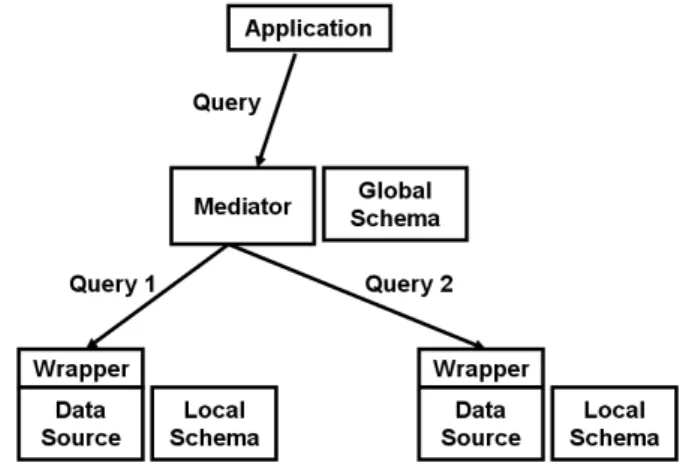
3.1 Architecture of a data integration system . . . 20
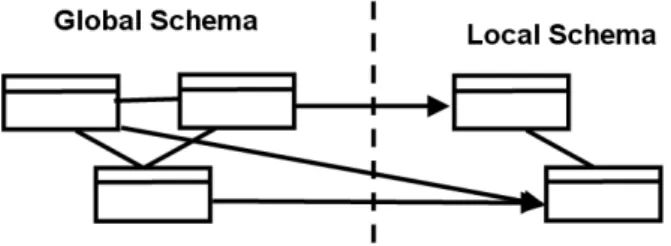
3.2 Global-as-view (GAV) approach . . . 21
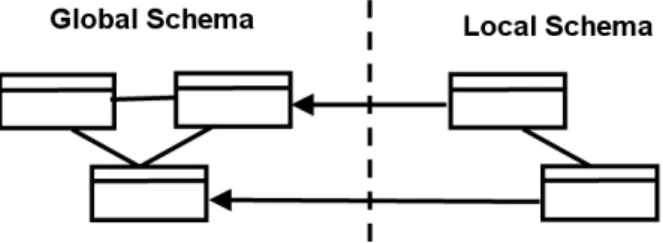
3.3 Local-as-view (LAV) approach . . . 22
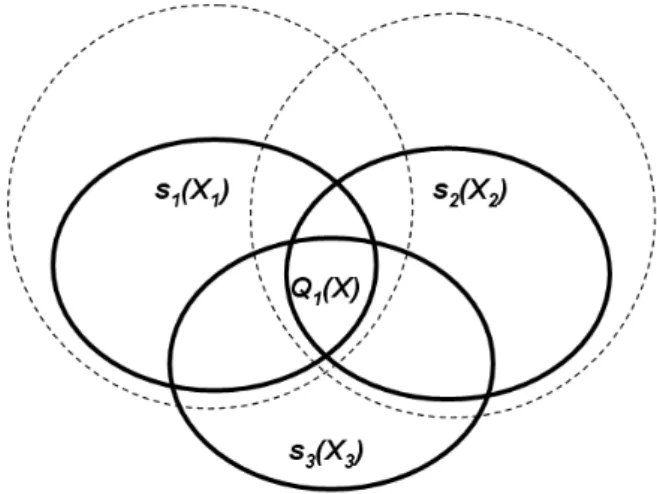
4.1 A conjunctive query Q2 with two subgoals . . . 26
4.2 A conjunctive query Q1 with three subgoals that is contained in Q2 . . . 26
6.1 The RDF graph of OA . . . 38
6.2 The RDF graph of OB . . . 38
6.3 GA (left) and GB (right) . . . 43
6.4 Comparison between an RDF graph (left) and its correspondant directed bipartite graph (right). . . 44
6.5 G0 A . . . 46 6.6 G0 B . . . 46 6.7 GA . . . 47 6.8 GB . . . 47
7.1 Workow of the query answering process . . . 51
9.1 Semantic XPath processor architecture overview . . . 62
9.2 XML simple example describing two movies . . . 65
9.3 RDF graph for movies example . . . 66
9.4 Jena hybrid execution model . . . 77
9.5 Some ODRL constraint elements dened as substitutionGroup of constrain-tElement . . . 79
9.6 MPEG-21 REL authorization model . . . 81
9.7 Example of resource elements . . . 81
9.8 Portion of the acts taxonomy in MPEG-21 RDD . . . 82
10.1 GA . . . 88
10.2 GA (left) and GB (right) . . . 89
10.3 Bipartite version of Figure 10.6 . . . 92
10.4 GA . . . 93
10.5 GB . . . 94
10.6 Bipartite version of GA . . . 94
List of Figures xiii
10.7 Bipartite version of GB . . . 95
11.1 Strategy Diagram . . . 105
11.2 DMAG's News Advanced Meta-search Engine user interface . . . 108
11.3 DMAG's News Advanced Meta-search Engine advanced user interface . . . . 109
11.4 Mapping XSNL to each engine with XML Query . . . 110
11.5 Screen Scraping with XML Query . . . 111
11.6 Reprocessing of the results with XML Query . . . 112
12.1 Three way trade-o in search engine performance [85] . . . 117
12.2 Waiting Policy . . . 117
12.3 Distribution of Engines Delay . . . 118
12.4 Results Evolution . . . 119
12.5 Results progression in hostile network conditions . . . 120
12.6 Timeout Policy Example . . . 120
12.7 Minimum-results Policy Example . . . 121
12.8 Source Discarding Policies Formula . . . 122
12.9 Minimum Granted Results Policy Formula . . . 122
List of Tables
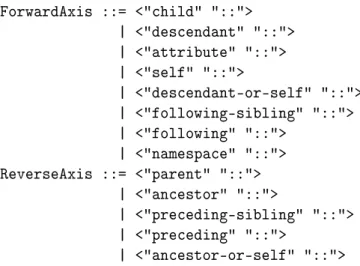
9.1 XPath axis . . . 69
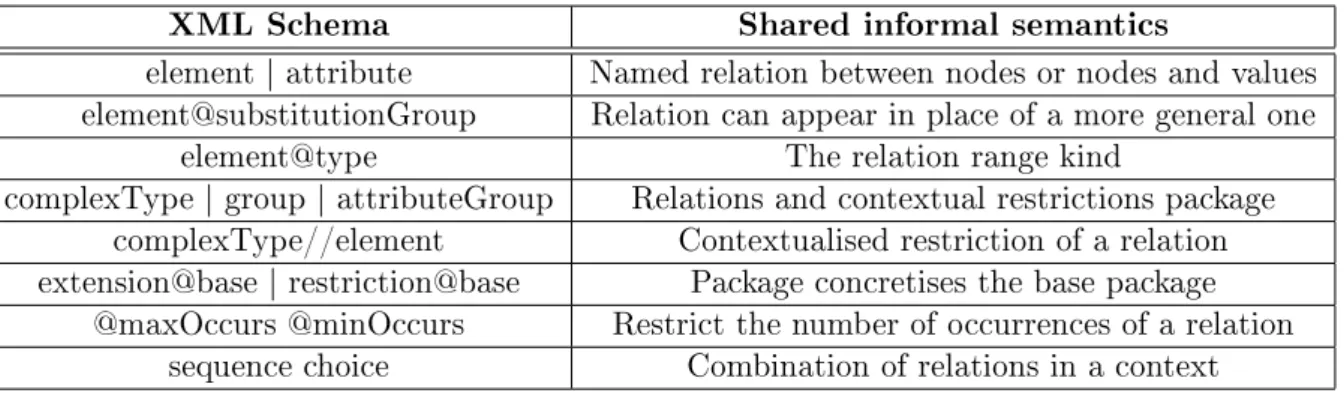
9.2 XML Schema informal semantics . . . 75
9.3 XSD2OWL translations for the XML Schema constructs . . . 75
9.4 OWL constructs supported by the Jena's OWL reasoner . . . 76
9.5 Performance for dierent document depth levels . . . 78
9.6 Number of named XML Schema primitives in ODRL and MPEG-21 REL . . 79 10.1 OAEI 2005 tests where our approach (vsm) obtains a dierent result than [64] 97
Already Published Work
Large portions of Chapter 9 have appeared in the following papers:
Tous R., García R., Rodríguez E., Delgado J. Architecture of a Semantic XPath Processor. Application to Digital Rights Management, 6th International Con-ference on Electronic Commerce and Web Technologies EC-Web 2005. August 2005 Copenhagen, Denmark. Lecture Notes in Computer Science, Vol. 3590 (2005), pp. 1-10. ISSN: 0302-9743
Tous R., Delgado J. A Semantic XPath processor. InterDB 2005 International Workshop on Database Interoperability. ELSEVIER's Electronic Notes in The-oretical Computer Science 2005
Tous R., Delgado J. RDF Databases for Querying XML. A Model-mapping Approach. DISWeb 2005 International Workshop Data Integration and the Se-mantic Web. Procedings of the CAiSE'05 Workshops. Faculdade de Engenharia da Universidade do Porto. ISBN 972-752-077-4 Pages: 363 - 377
Tous R., Delgado J. Using OWL for Querying an XML/RDF Syntax. WWW'05: Special interest tracks and posters of the 14th international conference on World Wide Web. Chiba, Japan. Pages: 1018 - 1019. ACM Press 2005. ISBN:1-59593-051-5. http://doi.acm.org/10.1145/1062745.1062847
Large portions of Chapter 10 have appeared in the following paper:
Tous R., Delgado J. A Vector Space Model for Semantic Similarity Calculation and OWL Ontology Alignment, 17th International Conference on Database and Expert Systems Applications (DEXA 2006), 4-8 September 2006. To be pub-lished in Lecture Notes in Computer Science.
Large portions of Chapters 11 and 12 have appeared in the following papers:
Gil R., Tous R., García R., Rodríguez E., Delgado J. Managing Intellectual Property Rights in the WWW: Patterns and Semantics. 1st International Con-ference on Automated Production of Cross Media Content for Multi-channel Distribution (AXMEDIS 2005), November 2005
Tous R., Delgado, J. Interoperability Adaptors for Distributed Information Search on the Web. Proceedings of the 7th ICCC/IFIP International Conference on Electronic Publishing 2003. http://elpub.scix.net/cgi-bin/works/Show?0341 Tous R., Delgado, J. Advanced Meta-Search of News in the Web, Proceedings of the 6th International ICCC/IFIP Conference on Electronic Publishing. Pub-lisher: VWF Berlin, 2002. ISBN 3-89700-357-0. 395 pages. http://elpub.scix.net/cgi-bin/works/Show?0234
Electronic preprints are available on the Internet at the following URL: http://dmag.upf.edu/rtous
Acknowledgments
This work has been supported by Agent Web, TIC 2002-01336 Spanish Adminis-tration project, and by VISNET, European Commission IST FP6 Network of Excellence. I would like also to express my gratitude to Jaime Delgado, my Advisor, without whom this thesis have never begin and what is worst, never end. I am also grateful to Miquel Oliver and Joan Vinyes for their support in dicult times. I thank Juan C. Sánchez for sharing with me so good and bad moments during the Doctorate Programme. I thank Ana Escudero for being such a patient deskmate and for her grammar wisdom. I thank Boris Bellalta for his sense of humour and sarcastic point of view. I thank Anna Sferopoulou for her uncon-ditional support and inspiration. I thank Mohammad Mobaseri for his quiet and meditated point of view. I thank Jaume Barceló for his impulsive and extreme point of view (that's a cross acknowledgment ;-)) I thank Roberto García for introducing me to the Semantic Web and for our breakfast brainstorms, undoubtfully one of my best sources of inspiration. I thank Eva Rodríguez for her practical opinions and her contributions in the DRM part. I thank Rosa Gil for her sincerity and sensibility. I thank Manel Guerrero for his comments and help with Linux. I'm in real debt with Ramon Martí for his help and partnership in my beginnings at UPF. I thank Jorge Infante for our neverending discussions where I never win but always learn. I thank Núria Garcia for her experienced counsel, and her human-ity. I thank Susanna 'Belén' Fernández, Iolanda Sabater and Carina Ortega for making my visits to the ESUP secretariat a pleasure. I thank Roser Clavero for being the nicest and most competent professional I ever met. I am also grateful to all my other friends from the Department of Technology (present and former). I am forever indebted to my parents, my brother and Elena for their understanding, endless patience and encouragement.
Chapter 1
Introduction
This introductory chapter serves to three purposes. In one hand to dene the scope of the work that is addressed by this document. In the other hand to facilitate the reading of the document by giving and overview of its structure. Finally, but the most important, to provide the necessary elements to enclose the work in the framework of a PhD thesis.
1.1 About this thesis
This document describes research work being done under the framework of the Dis-tributed Multimedia Applications Group (DMAG), and also in the context of the Doctorate in Computer Science and Digital Communication of the Department of Technology of the Universitat Pompeu Fabra. The work focuses on the dierent aspects related to the design of modern data integration systems in the context of the World Wide Web, combining an exploratory stage with others focused on the design of new strategies and models and the development of specic tools. The main scope of the work is the data integration problem, within the databases research discipline, but that also falls between other well-known disci-plines. On one hand Information Retrieval, since in most cases the purpose of storing and accessing data and metadata is not the metadata themselves but the support to information search and retrieval processes. On the other hand the Web discipline, and specially the Semantic Web Initiative, a promising and relatively new research line where metadata has a central role. Among all these sources I've tried to choose the elements that dene the context of this work, and the weaknesses and opportunities that justify the work itself.
1.2 Aims and Hypothesis
The general goal of this research project is to study solutions to the new problems arisen with respect to the querying of distributed and heterogeneous sources of data and metadata. This goal can be seen as a reformulation of some topics faced by the data inte-gration community, but now arisen again as databases become open and accessible through the Web, storing data and metadata in old and new formats that can be the basis of better ways of searching and retrieving digital contents. Within this ambitious and broad aim, the work has focused in two related but independent aspects, semantic integration and query
2 Chapter 1: Introduction interoperability. Within the semantic integration problem, we face the XML-RDF integra-tion from a novel approach, and also the ontology alignment problem. Within the query interoperability problem, we face the querying of restricted and heterogeneous web-based database interfaces with XML technologies.
A more tangible sub-goal of the work is the development of tools (in the form of APIs) to test the models and strategies suggested. For the rst part, related to semantic integration, the implementation of a Semantic XPath processor and its usage in the Digital Rights Management (DRM) domain will demonstrate the interest of our novel way to map XML and RDF. Related to ontology alignment, the implementation of our novel structure similarity measure and its results against the Ontology Evaluation Initiative 2005 testsuite will demonstrate the relevance of our approach. For the second part, related to query interoperability, two Java APIs - the Java Simple API for Metasearch (JSAM) and the Java Simple API for Web Information Integration (SAWII) - integrated inside an advanced spanish news metasearch engine will serve to prove the advantage of the Query Tunneling technique.
All the work is sustained over the presumption that the traditional data integration strategies still don't take prot from the potential of the new uses of metadata on the Web and some of its new directly or indirectly related technologies, like XML [151], XML Query [154], RDF [124] or OWL [112]. The success of standard syntaxes for metadata (XML and RDF), the dissemination of metadata related to multimedia contents (e.g. MPEG-7 [101]) or to the more broad framework of the Semantic Web, open new opportunities and challenges for distributed data retrieval and data integration.
For a more detailed description of the goals of the thesis please refer to the Problem Statement chapter.
1.3 Methodology
In order to avoid replication of work, and also to achieve the necessary background, the exploratory and analytical stage of the thesis has implied the identication and reading of relevant materials from a lot of dierent sources. Because the work falls between dierent research disciplines, that sometimes have dierent approaches to the same problems, I have tried to identify the most authoritative sources of each eld.
1.3.1 Related to the rst contribution part 'Heterogeneous Data Models and Schemas: Semantic Integration'
I acquired background of issues related to semantic integration in the works of A. Y. Halevy [54] et al. (the Piazza Infrastructure), I. Cruz et al. [65], B. Amann et al. [5], M.C.A.Klein, L.V.Lakshmanan and F.Sadri [87], P.F.Patel-Schneider and J.Simeon [117]. However, the spark that inspired the contribution of the rst sub-part (XML-RDF integration) came from the reading of a relatively old work of Yoshikawa et al. [97] that dierentiated between approaches that map the structure of some XML schema to a set of relational tables and works that map the XML model to a general relational schema respectively. I've also found a previous work from Lehti and Fankhauser [91] that also
Chapter 1: Introduction 3 pursues the target to achieve a semantic behaviour for XPath/XQuery. For the formalisation of the XML/RDF Syntax with description logics I've borrowed abundant material from Ian Horrocks and Ulrike Sattler, like [62], [60], [59], [63] and [61]. During the development of the inference-based XPath processor I've used the Jaxen Universal Java XPath Engine [75] for parsing XPath 2.0 expressions and the Jena API [76] and its OWL inference engine [77] for processing the queries. Among the diernt RDF query languages (rdfDB [125], SquishQL [139], RDQL [127], or the recent SPARQL [138]) I've chosen RDQL for its maturity and because it's supported by the Jena API. This stage has entailed also frequent visits to some unfriendly W3C specications like the XML Information Set [68], the XML Path Language (XPath) 2.0 [69], XQuery 1.0 [154], XQuery 1.0 and XPath 2.0 Data Model [152], XQuery 1.0 and XPath 2.0 Formal Semantics [153], RDF/XML Syntax Specication [147], OWL Web Ontology Language Overview [112] and XSL Transformations (XSLT) Version 2.0 [155].
For the second sub-part (a vector space model for sematic similarity calculation), I've found a good survey on schema alignment from Erhard Rahm and Philip A. Bernstein [122], and a more recent survey on ontology alignment from Natalya F. Noy [106]. I've also read abundant material about semantic similarity, like the old works of Philip Resnik [129], Dekang Lin [94] or J.J. Jiang and D.W. Conrath [79]; and also more recent ones like those of Francisco Azuaje and Olivier Bodenreider [8] or M. Bisson [19] among others. Here the key work where I've found inspiration has been the paper of Wei Hu et al. [64] from who I've also received personal support and patient clarications. The graph matching algorithm that I have used comes from the work of Vincent D. Blondel et al. [20].
1.3.2 Related to the second contribution part 'Heterogeneous Query In-terfaces: Query Tunneling'
For general concepts on the Information Retrieval area I've borrowed a lot of mate-rial from the work of Ricardo Baeza [9] and some of the references he uses. For more specic aspects on Web search, I've studied the works of Kobayashi and Takeda [85], Lawrence and Giles [88], Brin and Page [23][113] and others. It has been dicult to nd rigurous research works about metasearch, because is a popular topic among independent and sometimes volunteer-based communities, but I've found a good basis on the works of Dreilinger [33] and Selberg and Etzioni [135], among others.
For the study about the Semantic Web I've read materials by the people who are behind this initiative, like Tim Berners-Lee [11][15][12][14][13], James Hendler [17], Ora Lassila [17] or Dan Brickley [22], and I've had to assimilate the specication of RDF and other related technologies. I've also invested some time trying to understand and appreciate the added value of the RDF model against others (e.g. relational or XML), and I have found some good materials about this topics, like e.g. [25] or [13]. Searching for materials related to the Semantic Web activity, I've found some promising works, like the RDFWeb initiative and its FOAF ontology [39], the work of Guha and MacCool [120][49] or the Query by Example by Reynolds [130]. To make the analysis about digital libraries and general metadata issues I've spent some time studying the specications of the Dublin Core Element Set [28], the Z39.50 protocol [156], SRW [140] and the OAI-PMH protocol [109][110]. I've also found some works discussing issues about digital libraries and the Open Archives Initiative, like e.g. those by Lagoze and Sompel [86][137] or Baker [10]. These are just some of the materials
4 Chapter 1: Introduction reviewed, but serve to illustrate in some way the selection criteria.
For the development of the specialised metasearch application I've followed a tradi-tional software engineering approach. The requirements stage has consisted in innumerable meetings with my advisor, Jaime Delgado, to try to dene clearly the dierent aspects of the functionality. The analysis stage has involved the hard task of translating the natural language requirements to some formal model, I've used UML to do this but also some home-made diagrams. The design stage has consisted in weaving the objects architecture of the application, with an special emphasis in the multi-threading sub-parts. It has also involved the specication of test XML-based query language and the study of the critical parts of the system, as the mapping of the queries or the metadata extraction. I've studied to do this some existing XML-based Query Languages, like XCQL [150] or XML Query [154]. The implementation methodology has involved the study and selection of the tools (Java, Tomcat, XML, XML Query, Tidy) and the analysis of the performance, where I've invested an important time, specially in dening a good policy to discard targets that are suering of not ordinary delays. I'm going to talk more about the implementation methodology later.
1.4 Document outline
This document has four main parts, 'Background Information', 'State of the Art and Problem Statement', 'Heterogeneous Data Models and Schemas: Semantic Integration' and 'Heterogeneous Query Interfaces: Query Tunneling', and also other smaller sections like this introduction or the nal comments.
1.4.1 Background Information
The 'Background Information' part tries to compile in a coherent way some results of the exploratory stage that can help readers not familiar with databases, information retrieval or the semantic web. This implies to dene and describe the key concepts of these areas and related to the work, and also the dicult task to weave all the relationships between them. Readers familiar with these technologies will probably skip this part.
1.4.2 State of the Art and Problem Statement
The 'State of the Art and Problem Statement' part is a survey of the progresses being done in the data integration eld in general and the semantic integration research trend in particular in the last years. It begins enumerating some classical works and concepts of the area and ends analysing its current weaknesses and opportunities.
1.4.3 Heterogeneous Data Models and Schemas: Semantic Integration
After the State of the Art come two related but independent parts containing the main contributions of this work. Because of their particularities each one of them provides a complete internal structure, including an introduction, a related work section and conclusions.
Chapter 1: Introduction 5 The rst main contribution, 'Heterogeneous Data Models and Schemas: Semantic Integration' part includes two works related to the use of Semantic Web technologies to help solving the problem to work in domains where multiple schemas or ontologies exist. The rst sub-part, 'XML Semantic Integration: A Model Mapping Approach' , describes a model to face the problem of dealing with heterogeneous data models and schemas. It is focused in the semantic integration between XML and RDF (the Resource Description Framework). I suggest a strategy based on the mapping of the XML model to RDF triples. Translat-ing XML documents to RDF permits takTranslat-ing prot from the powerful tools of Description Logics allowing XML documents interoperate at the semantic level. This mapping has gen-erated some interesting results, like a schema-aware and ontology-aware XPath processor that can be used for schema semantic integration or even for implicit query transcoding among dierent data models.
The second sub-part, 'A Vector Space Model for Semantic Similarity Calculation and OWL Ontology Alignment', describes a novel semantic similarity measure based on a matrix representation of nodes from an RDF labelled directed graph. A concept is described with respect to how it relates to other concepts using n-dimensional vectors, being n the number of selected common predicates. It shows how adapting the graph matching algorithm in [20] to apply this idea to the alignment of two ontologies. It also includes the results of the testcases of the Ontology Alignment Evaluation Initiative 2005.
1.4.4 Heterogeneous Query Interfaces: Query Tunneling
The second main contribution, 'Heterogeneous Query Interfaces: Query Tunneling' describes a strategy to face the problem of dealing with heterogeneous query interfaces. I suggest a strategy that allows redistributing an expressive user query over a set of databases with heterogeneous Web-based query interfaces. The idea, that has recently been renamed by Thomas Kabisch [81] as "Query Tunneling", consists on the reprocessing of the initial user query over the results returned by the dierent sources, that must be a superset of the results that satisfy the initial query. I describe in this part the strategy and its limitations, and an implementation in the form of two Java APIs, the Java Simple API for Metasearch (JSAM), that has been used in the development of a spanish news metasearch engine, and the Java Simple API for Web Information Integration (SAWII), that oers high level tools to the development of articulated wrappers for complex web form-chains and result pages.
1.4.5 Relationship between thesis parts and chapters
The rst part, 'Heterogeneous Data Models and Schemas: Semantic Integration', refers to the problem of schema/ontology interoperability. This problem can be divided in two sub-problems, 1) How can we use a global (mediator) data schema/ontology to interoperate a set of heterogeneous schemas/ontologies? and 2) How can we automatically generate this global schema/ontology?
Chapter 9 faces the rst of these problems for the particular case of XML, suggest-ing a strategy to design a schema-aware and ontology-aware XPath processor, which process queries taking in consideration the relationships dened in one or more XML schemas or OWL/RDFS ontologies. This allows to write the queries in terms of one of the schemas/ontologies
6 Chapter 1: Introduction (acting as a global schema), whose relationships with the specic schemas have been pre-viously specied. How these relationships (mappings) are obtained is not the focus of this chapter, but of the next one.
Chapter 10 is independent from the previous one, but is related to the second problem (how the mappings between ontologies/schemas can be automatically generated). This is the reason why the two chapters have been placed in the same part.
The second part, 'Heterogeneous Query Interfaces: Query Tunneling', describes a practical approach to the design of a web-based data integration system using XML tech-nologies. It includes some chapters covering practical solutions, based on XML and XML Query, for real world scenarios. However, despite of it is strongly related to the previous chapters, the focus of this work is not the generation of schema mappings or the interac-tion with ontologies, but the problem of distributing the queries over restricted autonomous interfaces. This is the reason why the two contributions have been placed in separate parts.
Chapter 2
Background Information
Terms as 'information', 'data', 'metadata', 'information retrieval', 'data retrieval', 'data integration', 'Semantic Web' and others, are specially susceptible of being interpreted in very dierent ways. So, to avoid misunderstandings, in this section I'm going to clarify, or at least narrow, the semantics of some important concepts related to this work.
2.1 Information vs. Data
Despite of in some works the terms 'information' and 'data' are used indistinctly, here I'm going to specially strict in separating the two concepts. According to The Free On-line Dictionary of Computing [111], data are numbers, characters, images, or other method of recording, in a form which can be assessed by a human or (especially) input into a com-puter, stored and processed there, or transmitted on some digital channel. Computers nearly always represent data in binary. Data on its own has no meaning, only when interpreted by some kind of data processing system does it take on meaning and become information..
So, it is clear that is easier to dene data than information, which requires a higher eort of abstraction. Now we can take prot that we've already separated these two concepts to locate another one, knowledge. According to [21] We had two decades which focused solely on data processing, followed by two decades focusing on information technology, and now that has shifted to knowledge. There's a clear dierence between data, information, and knowledge. Information is about taking data and putting it into a meaningful pattern. Knowledge is the ability to use that information..
2.2 Metadata
In short, metadata is data about data. According to [9] metadata is informa-tion on the organizainforma-tion of the data, the various data domains, and the relainforma-tionship between them. Tim Berners-Lee gives a more Web-centric denition, Metadata is machine under-standable information about web resources or other things. We can dierence two kinds of metadata [100], Descriptive Metadata and Semantic Metadata. Descriptive Metadata is external to the meaning of the data it describes, and pertains more to how it was created. For example, the Dublin Core Metadata Element Set [28] proposes 15 elds to describe a
8 Chapter 2: Background Information document. Semantic Metadata features the subject matter that can be found within the data it is describing. An example of semantic metadata could be some MPEG-7 [101] de-scriptors, that allow to describe for example that a video includes a football match in a rainy day. There are a lot of dierent uses of metadata, like cataloguing, content rating, intellectual property rights, etc. but nowadays some point to more ambitious uses (overall of semantic metadata) like for example the Semantic Web initiative.
2.3 Information Retrieval vs. Data Retrieval
According to [9], information retrieval deals with the representation, storage, or-ganization of, and access to information items. The aim of an IR system is to facilitate the user access to the information in which he is interested. However, the user information need cannot be easily formalized, an it must be translated into a query processable by the retrieval system. Given the user query, the IR system aims to retrieve information which might be relevant to the user.
On the other hand, a data retrieval system aims to determine which objects of a collection satisfy clearly dened conditions as those in a relational algebra expression. For a data retrieval system, like a database, a single erroneous object among a thousands retrieved means a total failure. So, data retrieval deals with well dened data models, expressive query languages and performance issues, while information retrieval faces the problem of interpreting the contents of the information items to decide their relevance. The two concepts are not isolated, data retrieval is ever an important part of an IR system, and can be seen as a lower-level layer. Because this research work focuses in metadata, instead of on other traditional IR issues, it is in some way more related to data retrieval rather than to information retrieval. However, because the context keeps being IR systems for the Web, the references to IR aspects will be usual.
2.4 Traditional Information Retrieval vs. Multimedia
Infor-mation Retrieval
Traditional information retrieval only deals with unstructured textual data. Tra-ditional IR is an old discipline, with published books from even the last 70s like e.g. [131], and already classic conferences like ACM SIGIR (International Conference on Information Retrieval) or TREC (Text REtrieval Conference). Its research is based in solid and well char-acterized models, like the boolean model, the vector model or the probabilistic IR model.
The irruption of the Web and Web search engines has put IR at the center of the stage since the 90s. However the new context introduces new challenges for IR like the retrieval of heterogeneous multimedia contents. Multimedia data is rapidly growing in the Internet, and also metadata related to multimedia information objects, that of course include textual documents. Multimedia IR systems must support dierent kinds of media with very heterogeneous characteristics such as text, still and moving images, graphs and sound. This poses several interesting challenges, due to the heterogeneity of data and the fuzziness of information. Multimedia IR systems have an interesting feature for our concerns, they must
Chapter 2: Background Information 9 handle metadata, because it is crucial for data retrieval, whereas traditional IR systems do not have such requirement.
2.5 Data Integration
The Data integration (also named Information Integration) research discipline study mechanisms for a seamless access to autonomous and heterogeneous information sources. These sources can vary from legacy databases to Semantic Web or P2P appli-cations. Traditionally the target of a data integration system is to provide a mediation architecture in which a user poses a query to a mediator that retrieves data from underlying sources to answer the query. The constraints of the sources access, and their potentially dierent data models and schemas, are the challenges of a data integration system.
Data integration is the main topic of this thesis, and its evolution and current situation will be described in the State of the Art and Problem Statement Chapter.
2.6 Distributed Information Retrieval vs. Data Integration
Search engines for the Web or other information retrieval systems are usually based, according to [24], in a single database model of text retrieval, in which documents are copied to a centralized database, where they are indexed and made searchable (this model can be seen as the information retrieval version of data warehousing for data retrieval). How-ever, some information is not accessible under this model (it can be queried but cannot be copied to the centralized database) for dierent reasons (size, volalility, interface restric-tions). The alternative is a multi-database model, in which the central site (or any peer in a distributed peer-to-peer context), instead of storing copies of the documents, translates the user information need into queries to the dierent sources. This kind of model is studied by the Distributed Information Retrieval discipline, and has been also informally known as metasearch.
A distributed information retrieval system covers traditionally the following stages: Source description: The contents of each text database must be described
Source selection: Given the descriptors and the user information need, which sources must be queried.
Source querying: Map the information need to the selected sources and query them. Results merging: Merge the ranked lists returned by the dierent sources.
In some aspects data integration and distributed information retrieval are equiv-alent, and in some contexts the words are mixed. However, while distributed information retrieval targets to satisfy a user information need over unstructured data or semi-structured data sources, a data integration system aims to satisfy a query over also autonomous and heterogeneous, but structured data sources.
10 Chapter 2: Background Information
2.7 Metasearch
Metasearch is the informal name that refers to Web-based distributed information retrieval systems (see [33] or [135] for a more detailed denition). Because metasearch systems are supposed to solve some of the problems described in the previous section, and because they never have really gained the favour of Web users, some interesting conclusions can be extracted from their evolution.
In theory, the strength of a metasearch engine is its recall value, because it queries a set of conventional crawler-based search engines that cover certain subsets of the public indexable Web. However, some studies have demonstrated that these subsets, far from being disjoints, are highly overlapped [88]. Furthermore, recall is not precisely the main problem of conventional Web search systems, but precision. Another important drawback of metasearch systems is that their work often does neither rely over an agreement with their underlying sources nor over specic interchange protocols. This forces them to face the problem to manage query forms and results pages designed for human consumption and written in HTML. This is usually solved with hand-coded screen-scraping rules or similar things that reduce speed and dicult maintainability. Some metasearch defenders claim that these systems have an important advantage, the ability to access the hidden web, because they capture the results of the target sources on-the-y, that allows them to harvest dynamically generated content. However, this style of doing things, without considering legal issues1, is far from being elegant, remember the sentence of Tim Berners-Lee [14]:
"And so you have one program which is turning it from data into documents, and another program which is taking the document and trying to gure out where in that mass of glowing ashing things is the price of the book. It picks it out from the third row of the second column of the third table in the page. And then when something changes suddenly you get the ISBN number instead of the price of a book and you have a problem. This process is called 'screen scraping', and is clearly ridiculous."
2.8 Datalog
Chapters 3 and 4 make use of the Datalog language [43] in some examples related to initial data integration approaches. Datalog is an old (1978) database query language that syntactically is a subset of Prolog. Its logic basis made it popular in academic database research, but despite of its advantages over standard query languages like SQL it never succeeded in becoming part of commercial systems.
A Datalog query program consists of a nite set of Horn clauses C1; :::; Ck (the
rules of the Datalog program). Horn clauses express a subset of statements of rst-order logic with at most one positive literal:
L ( L1; :::; Ln
1Some conventional search engines explicitly forbid metasearch. In Google's terms of service page we can nd "You may not send automated queries of any sort to Google's system without express permission in advance from Google".
Chapter 2: Background Information 11 Equivalent to:
L _ :L1; :::; :Ln
In Datalog each literal corresponds to an atomic formula p(A1; A2; :::; An) where p is the
relation name and Ai are variables or constants (names that start with an upper case letter
are variables). Let's see a relation table written in Datalog: employees(name, dept, id)
Let's see an example query program with one Datalog rule: financeEmployees(X, Y) :- users(X, "finance", Y)
There are two types of relations: (1) base relations (physically stored in the database) and (2) derived relations (temporary relations that hold intermediate results). The general form of a rule is as follows:
p(x1; x2; :::; xn) : q1(x11; x12; :::; x1m); :::; qk(xk1; :::; xkp); e:
Where qi are base or derived relation names, e is an arithmetic predicate (any
number) and each xi appearing in p appears in at least one of the qi's. The Datalog rule
can be interpreted as:
p(:::) is true if q1(:::) and q2(:::) and ... qk(:::) and e is true.
In Datalog an answer to an atomic query is a set of constants that satisfy the query. Answers are computed by using top-down (or backward-chaining) or top-down algorithms.
2.9 The Extensible Markup Language (XML)
According to [9] Markup is dened as extra textual syntax that can be used to describe formatting, actions, structure information, text semantics, attributes, etc.. One example of markup can be the formatting commands of the popular text formatting software TeX.
In the late seventies was dened the Standard Generalized Markup Language (SGML), a metalanguage for tagging text developed by Charles F. Goldfarb and his group, and based on a previous work done at IBM. In 1996 the SGML Editorial Review Board became the XML Working Group under the auspices of the World Wide Web Consortium (W3C), chaired by Jon Bosak of Sun Microsystems and with the intermediation of Dan Connolly. This group developed The Extensible Markup Language [151] (XML), a subset of SGML which goal is to enable generic SGML to be served, received, and processed on the Web in the way that is now possible with HTML(also based on SGML). XML has been de-signed for ease of implementation and for interoperability with both SGML and HTML[151]. XML, the same as SGML, is not exactly a markup language, it is a metalanguage that can be used to dene specic markup languages (like XHTML, MathML, SVG, etc.). That means that XML allows users to dene new tags and structures for their own languages.
12 Chapter 2: Background Information For some reasons, some obvious and other that will remain a mystery, XML have reached an amazing success worldwide. In an interconnected and global society, the interchange of data over a standard syntax has become a key issue, and here is where XML ts perfectly.
2.10 The Semantic Web
The Semantic Web is a promising initiative lead by the W3C which aim is to provide a data model for the Web, allowing information to be understood and processed also by machines. The ocial denition of the W3C [142] says The Semantic Web is the representation of data on the World Wide Web. [....] It is based on the Resource Description Framework (RDF), which integrates a variety of applications using XML for syntax and URIs for naming.. So, it is clear that this initiative strongly relies on RDF, but what is the meaning of the representation of data? Often in this document we have referred to de diculties related to search and retrieve information on the Web. One of the main reasons is the fact that the most part of Web data, despite of being processed by machines, can be only understand by humans. This include natural language text, still/moving images, audio, etc.
Before we have discussed the dierence between information retrieval and data retrieval, saying that while data retrieval is appropriate for databases it is not appropriate (or not enough) for the Web. The reason is that the information on the Web, contrary to databases, does not have an underlying data model. So, the representation of data means two things, the development of a data model for the Web, and the dissemination of machine-understandable metadata (under the framework of the data model) linked in some way to the Web information. Another classic denition is that by Berners-Lee et al. [17] The Semantic Web is an extension of the current web in which information is given well-dened meaning, better enabling computers and people to work in cooperation..
2.11 Querying the Semantic Web
The Semantic Web initiative has opened a broad spectrum of opportunities for improving the search and retrieve of information on the Internet. Of course this is not casual, but one of the main targets of this new scenario as pointed in [15] or [12]. However, the consolidation of a standardised way to interchange semantic information is just another step in the race for interoperability. Other battles are being ght to rationalise the way this information is processed and search and retrieval are maybe the most important elements of the information feed chain. The challenge is to nd ecient and rational ways to exploit this new information that begins to be disseminated over the net, and that, despite of it is formalised in a standard way (RDF [22]), it can be stored in dierent ways (embedded on HTML pages, in a database, in specic knowledge repositories, etc.) and it remains highly heterogeneous (an innumerable an unrestricted number of ontologies, potentially overlapped, can co-live in the Semantic Web).
This two key issues, how to locate and access the information, and how to manage heterogeneity, are of relevance for our analysis and also very related with what we have said in the previous sections. Some research works reect special approaches to this, like the
Chapter 2: Background Information 13 Edutella project [102] that constitutes a distributed search network for educational resources and is based on P2P networking (its JXTA implementation [80]) and RDF. This interesting work uses the query exchange language family RDF-QEL-i (based on Datalog semantics and subsets) as standardised query exchange language format. Because Edutella peers are highly heterogeneous and have dierent kinds of local storage for RDF triples, as well as some kind of local query language (e.g., SQL) to enable them to participate in the network, wrappers are used to translate queries and results from the peer and vice versa.
Another work is Sesame [73], an extensible architecture implementing a persistent RDF store and a query engine capable to process RQL queries [3] [42]. Of special interest for us is TAP [49] a system that implements a general query interface called GetData, Semantic Negotiation and Web of Trust enabled registries. It introduces the concept of Semantic Search and describes an implemented system which uses the data from the Semantic Web to improve traditional search results. The GetData interface is a simple query interface to network accessible data presented as directed labelled graphs, in contrast to expressive query languages like SQL, RQL or DQL. This work defends deployability against query expressiveness.
Related to this project, and also with the query language of Edutella, is RDF-QBE [130], a mechanism for specifying RDF subgraphs, which they call 'Query by Example', that could allow a high performance standardised interface for retrieval of semantic information from remote servers. From all this study cases we can observe the latent necessity of dening a low-barrier mechanism that allow to harvest heterogeneous semantic information and how it generates a trade-o between deployability and expressiveness. Some of them (e.g. TAP) point the necessity to consider also other conventional or not-semantic search strategies, like crawler-based engines, when thinking in future applications.
2.12 Semantic Integration
The semantic integration research area is a joint eort between the people from databases and data integration, and the people from knowledge management and ontology research. It can be seen as a reformulation of some old problems like matching database schemas or answering queries using multiple sources. Ontologies can be the solution to some of these old challenges but also the source of new problems, like ontology alignment. This last topic tries to determine which concepts and properties represent similar notions between two ontologies and is one of the main goals in this area. Related to ontology alignment arise other questions, like how do we represent the mappings or what do we do with them. [106] presents a recent survey on semantic integration.
Semantic integration is one of the main topics of this thesis, and it will be discussed deeper in the State of the Art and Problem Statement Chapter.
2.13 Resource Description Framework (RDF)
According to [124] the Resource Description Framework (RDF) is a foundation for processing metadata; it provides interoperability between applications that exchange
machine-14 Chapter 2: Background Information understandable information on the Web. RDF is the main building block of the Semantic Web, a framework composed by some dierent but strongly related elements (a data model, a syntax and a subclassing language among other things). First RDF is a syntax-independent data model designed for representing named properties and property values. The basic model consists of three object types. On one hand Resources, as all things being described, like Web pages, images, videos or any other thing, even it is not digital (like a real-life book). The only requirement is that they have a name, and this name conforms to the URI [16] syntax. On the other hand we have Properties, as specic characteristics used to describe a resource. The value of a property (the object) can be another resource (specied by a URI) or it can be a literal (i.e. a simple string). Finally, a specic resource together with a named property plus the object (the value of the property for that resource) is a Statement, the third basic object type of the model.
RDF is being used in a variety of application areas, like in resource discovery, in cataloguing (for describing the content and content relationships of some information object), by intelligent software agents, in content rating, or in describing intellectual property rights for example. The combination of RDF with digital signatures aims to allow what is known as the "Web of Trust" [83]. The conceptual model of RDF is complemented with an XML interchange syntax. The syntax is needed to ensure the required interoperability when creating and exchanging metadata.
To complete the framework, RDF have a class system much like many object-oriented modelling systems. A collection of RDF classes is called a schema. A schema contains classes organised in a hierarchy, oering extensibility through subclass renement. RDF schemas allow reusability of metadata denitions. The schemas themselves may be written in RDF, with the RDF Schema language [126]. RDF schemas are being used nowa-days to serialise ontologies.
2.14 Ontology Web Language (OWL)
According to [112] the Ontology Web Language (OWL) is a language intended to be used when the information contained in documents needs to be processed by applications, as opposed to situations where the content only needs to be presented to humans. OWL can be used to explicitly represent the meaning of terms in vocabularies and the relationships between those terms. This representation of terms and their interrelationships is called an ontology "
OWL is a vocabulary for describing properties and classes of RDF resources, com-plementing the RDFS capabilities in providing semantics for generalization-hierarchies of such properties and classes. OWL enriches the RDFS vocabulary by adding, among others, relations between classes (e.g. disjointness), cardinality (e.g. "exactly one"), equality, richer typing of properties, characteristics of properties (e.g. symmetry), and enumerated classes. The language has three increasingly expressive sublanguages designed for dierent uses:
OWL Lite has the lowest formal complexity, and serves for simple classication hier-archies. It has some restrictions like e.g. permitting only cardinality values of 0 or 1.
Chapter 2: Background Information 15 OWL DL tries to oer the maximum expressiveness while retaining computational completeness (all conclusions are guaranteed to be computable) and decidability (all computations will nish in nite time). OWL DL is so named due to its correspondence with description logics.
OWL Full does not give any computational guarantee but oers the maximum expres-siveness and the syntactic freedom (e.g. a class can be treated simultaneously as a collection of individuals and as an individual).
In this work I will focus always in OWL DL, even when I do not mention it explicitly.
2.15 OWL and Description Logics
OWL has the inuence of more than 10 years of Description Logic research. It is supposed that this knowledge has served to choose the constructors and axioms supported carefully, balancing expressiveness and eciency. This balance was achieved by basing OWL on the SH family of Description Logics [63]. Members of the SH family include the SHIQ Description Logic [62] and the SHOQ Description Logic [61], that overcomes some limitations of SHIQ by taking the logic SHQ and extending it with individuals and concrete datatypes.
The OWL Lite and OWL DL species are syntactical variants of Description Logic languages. OWL Lite can be seen as a variant of the SHIF(D) description logic language, which is itself just SHOIN (D) without the oneOf constructor and with the atleast and atmost constructors limited to 0 and 1 [60].
OWL DL is a variant of the SHOIN (D) language, which is itself an extension of the SHOQ(D) (adding inverse roles and restricted to unqualied number restrictions) [59]. OWL Full extends both OWL DL and RDF(S) and thus cannot be translated into a Description Logic language. Entailment in OWL Full is undecidable in the general case, because it allows arbitrary roles in number restrictions, which makes the logic undecidable [62].
Part I
State of the Art and Problem
Statement
Chapter 3
State of the Art in Data Integration
The integration of data from multiple heterogeneous sources is an old and well-known research problem. It has been traditionally faced by the database and AI research communities, but the promise of integrating data on the WWW or Peer-to-Peer systems and its related technologies (XML, RDF, etc.) has attracted eorts from other disciplines. Below I explain the progress of this topic and what challenges lie ahead.
3.1 Historical Progress
The integration of multiple information sources aims at giving users and applica-tions the illusion of interacting with one single information system. There are two general approaches to this problem, materialized integration and virtual integration.
Materialized integration is strongly related to materialized views in databases, and consists on rst storing all data from all sources locally and then querying them. Data warehousing is a well-know example of materialized integration. It is suited for situations when data changes infrequently and a fast evaluation of complex queries is required. However it is not always possible or convenient to replicate and update all data from a set of sources. There are situations when the size or volatility of data (or the limitations imposed by the sources query interfaces) makes materialization impossible. This is the reason why virtual integration has become of increasing interest in recent years as it has matured.
Virtual integration aims to oer the same results without the constraint of having to store and update all data from all sources. In pure virtual integration the global schema is strictly a logical entity. Queries issued over it are dynamically rewritten at runtime and redirected to the underlying data sources. Resulting data is fetched from the sources through wrappers and merged. Here we are just interested in virtual integration, or simply data integration from now. There are several problems related to data integration, but the main ones are: 1) The ability to present an integrated (mediated) schema for the user to query, or the modelling problem, 2) The ability to reformulate the query to combine information from the dierent sources according to their relationships with the mediated schema, or the querying problem, and 3) The ability to eciently execute the query over the various local and remote data sources.
20 Chapter 3: State of the Art in Data Integration
Figure 3.1: Architecture of a data integration system
3.1.1 Mediated Schema (the modeling problem)
We talk about a mediated schema when a data integration system employs a logical schema in order for several autonomous sources to interoperate (see g. 3.1). This kind of schema is usually accompanied by the denition of semantic mappings (translations) between the mediated schema and the schemas of the dierent sources. This correspondence will determine how the queries posed to the system are answered.
The two classic approaches concerning mediated schemas and mappings mod-elling are the global-as-view and the local-as-view. The global-as-view approach or GAV [2](TSIMMIS)[26][50], consists on a mediated schema (the global schema) which is dened as a set of views over the data sources. This kind of mediation has the advantage that the user query can be simply merged with the view denitions (unfolded) obtaining a full query. The disadvantage of this approach is that the mediated schema is strongly coupled with the underlying source schemas and their changes, making it a bad solution for the Web context, where sources are autonomous and volatile.
The local-as-view approach or LAV [98][56][34] takes the inverse point-of-view and describes sources as views over the mediated schema. It has the advantage that changes on the underlying sources does not imply changes on the mediated schema. The disadvantage of this approach is the dicult to map the user query, referred to the mediated schema, to the dierent data sources. It's worth mention also the hybrid combination of GAV and LAV into the GLAV formalism [41].
3.1.2 Formalisation of the modelling problem
A formalisation of the modeling problem borrowed from [93] can be: Denition 3.1.1. A data integration system I is a triple <G, S, M> where:
G is the global schema (structure and constraints), S is the source schema (structures and constraints), and
Chapter 3: State of the Art in Data Integration 21
Figure 3.2: Global-as-view (GAV) approach M is the mapping between G and S.
To specify the semantics of I we have to start with a source database D (source data coherent with S). We call global database for I any database for G. A global database B for I is said to be legal with respect to D if:
B is legal with respect to G, i.e., B satises all the constraints of G; B satises the mapping M with respect to D
We can also specify the semantics of queries posed to a data integration system. If q is a query of arity n and DB is a database, we denote with qDB the set of tuples (of arity
n) in DB that satisfy q. Given a source database D for I, the answer qI;D to a query q in
I with respect to D, is the set of tuples t such that t 2 qB for every global database B that
is legal for I with respect to D. The set qI;D is called the set of certain answers to q in I
with respect to D.
3.1.3 Formalisation of global-as-view (GAV) approach
When modeling with GAV, the mapping M associates to each element g in G a query qS over S.
Denition 3.1.2. A GAV mapping is a set of assertions, one for each element g of G, of the form g qS
The idea is that each element g of the global schema should be characterized in terms of a view qS over the sources. The mapping is explicitly telling the system how to
retrieve data related to each element from the global schema. In this sense the GAV approach helps enormously the query processing design, but is just eective when the system is based on a set of sources that is stable.
Example 3.1.1. A data integration system over two sources of movies information could present the following global schema:
Global schema:
movie(Title, Year, Director) european(Director)
22 Chapter 3: State of the Art in Data Integration
Figure 3.3: Local-as-view (LAV) approach review(Title, Critique)
The two data sources could present the following local schemas: Source 1: r1(Title, Year, Director ) since 1960, european directors Source 2: r2(Title, Critique) since 1990
Each entity of the global schema has assotiated one or more views over the sources: movie(T ; Y; D) f(T ; Y; D)jr1(T ; Y; D)g
european(D) f(D)jr1(T ; Y; D)g
review(T ; R) f(T ; R)jr2(T ; R)g
3.1.4 Formalisation of local-as-view (LAV) approach
When modeling with LAV, the mapping M associates to each element s of the source schema S a query qG over G.
Denition 3.1.3. A LAV mapping is a set of assertions, one for each element s of S, of the form s qG
The idea is that each source s should be characterized in terms of a view qG over
the global schema. This means that adding a new source just implies adding a new assertion in the mapping. This favours the maintainability and extensibility of the data integration system.
Example 3.1.2. The movies example under the LAV approach: Global schema:
movie(Title, Year, Director ) european(Director)
review(Title, Critique)
Chapter 3: State of the Art in Data Integration 23 r1(T ; Y; D) f(T ; Y; D)jmovie(T ; Y; D) ^ european(D) ^ Y >= 1960g
Chapter 4
Query reformulation algorithms (the
querying problem)
4.1 Query reformulation in LAV and GAV (the querying
prob-lem)
Strongly related to the mediated schema we found the algorithms for answering the user query in a data integration system. A initial query, targeting the logical mediated schema, must be translated into queries over the dierent data sources. In the case of the Global-as-view (GAV) approach, this problem reduces to view unfolding (unnesting). In the Local-as-view (LAV) approach, it translates to the more complex problem of answering queries using views [51], with some good solutions like MiniCon [119] or the bucket [56] algorithms.
The following two examples illustrates the querying problem for GAV and LAV: Example 4.1.1. Querying the movies example under the GAV approach:
The query "Title and critique of movies in 1998" could be formalised (in respect to the global schema) as:
f(T ; R)jmovie(T ; 1998; D) ^ review(T ; R)g
Because in GAV we have views for each schema entity, the query is processed by means of view unfolding, i.e., by expanding the atoms according to their denitions:
movie(T ; 1998; D) ! r1(T ; 1998; D)
review(T ; R) ! r2(T ; R)
Example 4.1.2. Querying the movies example under the LAV approach:
Having the same query of the previous example ("Title and critique of movies in 1998") and its formalisation:
Chapter 4: Query reformulation algorithms (the querying problem) 25 f(T ; R)jmovie(T ; 1998; D) ^ review(T ; R)g
Because in LAV both the query and the mappings target the global schema, it is not trivial to determine how to map the query to the local sources. This process is performed by means of an inference mechanism that re-expresses atoms of the global schema in terms of atoms of the sources:
f(T ; R)jr2(T ; R) ^ r1(T ; 1998; D)g
While query reformulation looks easier in GAV, it is very complex (it needs reason-ing) in LAV. However, LAV appears to be a better solution when autonomous and hetero-geneous sources are present, like in the case of the Web. In such context we cannot rewrite the global schema and its mappings once and again, so we need a stable global schema and individual mappings that can be changed independently.
4.2 Answering queries using views
The rst goal of the data integration system is to reformulate a user query Q to refer to the data sources. In the LAV approach the data covered by each source can be abstracted by a view Vi over the global schema. The rst task of the system will be
determining which views should be queried to achieve the best possible answer.
The old research paper (1995) "Answering Queries Using Views" [55] by A. Halevy et al. is probably the oldest and best known work facing the problem of determining the combination of data sources (modelled as views) that must be used to answer a given query in a LAV approach. This work considers the problem of rewriting a conjunctive query using a set of conjunctive views in the presence of a large number of candidate views.
As most part of similar works of these initial approaches it uses Datalog1 to
for-malise the problem:
A conjunctive query Q has the form: q(X) :- e1(X1); :::; en(Xn)
where q and e1; :::; en are predicate names. The atom q(X) represents the answer
relation and is called the head of the query. The atoms e1(X1); :::; en(Xn) are the subgoals
of the query, where e1; :::; en are database relations from the global schema.
4.2.1 Query containment
The query rewriting problem is closely related to the concept of query containment. We say that a query Q1 is contained in the query Q2, denoted by Q1 v Q2, if the answer
to Q1 is a subset of the answer to Q2. To determine if a conjunctive query Q1 is contained
into another conjunctive query Q2 we must nd for each subgoal of Q2 a subgoal in Q1
26 Chapter 4: Query reformulation algorithms (the querying problem)
Figure 4.1: A conjunctive query Q2 with two subgoals
Figure 4.2: A conjunctive query Q1 with three subgoals that is contained in Q2
contained in it. Figures g. 4.1 and g. 4.2 shows graphically the concept of containment applied to conjunctive queries.
Example 4.2.1. A query Q2 that asks for people with blue eyes and blond hair contains a
query Q1 that asks for women with blue eyes and blond hair because for each subgoal of Q2
(blue eyes, blond hair) Q1 has a subgoal contained in it (plus some other goals, like being a
woman). In contrast, a query Q3 that asks for people with blue eyes is not contained in Q2
because it does not provide a subgoal contained in the subgoal "blond hair".
When all subgoals of a query contain subgoals of another query we call the set of containments a containment mapping. So we can say that a query Q2 contains Q1 if and