An Exploratory Study of Organizing Structures
for Post-Implementation ERP
Kevin P. Gallagher, Ph.D.
Business Informatics Dept.
College of Informatics
Northern Kentucky University
[email protected]
Vickie Coleman Gallagher, Ph.D.
Management Department
Haile/US Bank College of Business
Northern Kentucky University
[email protected]
Abstract
How to organize for post-implementation support of an ERP system is a key issue for research and practice. Specifically, what happens to subject matter experts (SME), who are invaluable contributors to the success of ERP installations? Their knowledge of business practices and system processes are critical to configuring enterprise systems. Once the system is installed, should they become permanent members of an ERP team, resulting in a more centralized post-implementation support organization? Or, should they be returned to their functional roles, but still assist in enhancements, thereby forming a decentralized or hybrid post-implementation support organization?
We frame these issues as a question of organizational structure, i.e. whether to centralize a functional support organization or to employ a distributed model with subject matter experts working on future ERP efforts from their roles in the various functional departments supported by the systems. In accordance with contingency theory, such choices should align with an organization’s goals and measures of success.
This research reports on the findings from survey research with 65 organizations concerning their post-implementation support decisions and prioritization of their goals and measures of success. The findings and questions for future research are discussed.
1.
Introduction
The implementation of an Enterprise Resource Planning (ERP) project is a difficult task riddled with high failure rates [1]. Nevertheless, the lure of the benefits of such systems has left the ERP market nearly saturated. In the past two decades, ERP systems such as SAP, PeopleSoft and Oracle have been implemented in 80% of the Fortune 500 companies to support human resources, manufacturing, financial systems, etc. [2]. While previous research has focused on successfully implementing ERP, organizations must
also consider longer-term issues regarding
post-implementation if they are to assimilate the technology
and achieve long-term benefits [3].
How best to organize the IT function is a long-standing question for researchers and practitioner alike [4, 5]. For ERP projects, and for post-implementation support, this issue is critically important, especially with regard to the use of subject matter experts [6].
Subject matter experts (SME) are invaluable contributors to the success of ERP installations, whose knowledge of business practices and system processes are critical to configuring enterprise systems [7]. As a result, project managers often plan carefully and petition strongly to secure the best and the brightest employees from each of the functional business units that will be impacted by an implementation project [8]. SMEs then become key members of the implementation team.
A key question for practice and research in the area of managing ERP as the project moves into the post-implementation phase is what happens to the SMEs once the project ends? In this research, we view this question as one of organizational structure, being either centralized, decentralized or a hybrid form. For example, the retention of SMEs in an ongoing support organization is a centralized form, while their working from various functional departments to support ongoing ERP efforts defines a distributed, or hybrid organizational form.
Given the critical role SMEs play as members of an implementation team and their potential ability to contribute to post-implementation efforts, we believe an important question is, should they become permanent members of a centralized post-implementation support organization or should they be returned to their functional roles, thereby becoming part of a distributed or hybrid form of organization? In either situation, SMEs could contribute to future efforts, but the resulting structure could offer differing advantages and disadvantages for both the organizations and the individuals.
For example, some suggest that returning SMEs to their original roles and responsibilities prior to the project, presumably in their original department, would be most favorable as it would facilitate knowledge transfer [7] (i.e., a decentralized or hybrid model). Alternatively, retaining SMEs in a formal capacity to work on ERP related projects would facilitate the coordination of efforts related to system enhancements and reengineering [6] (i.e., a centralized model).
To investigate these questions we undertook an exploratory study to investigate what organizational forms ERP support organizations undertook once they moved into the post-implementation phase. To understand what drove the choice of structures, we adopted a contingency theory approach [9]. Contingency theory would predict that answers to the questions posed above require understanding an organization’s goals and objectives [10]. For example, if organizations view the goals of ERP as simply an update to the technology, or alternatively as an opportunity for process improvements (or even business process reengineering), then those differing goals may yield different design choices with regard to the support organization.
This research reports on findings from survey research conducted with 65 organizations concerning their decisions regarding post-implementation support. We also investigate the implications that various pre- and post-implementation goals and tactics hold for creating a post-implementation structure.
The paper first provides some theoretical background on the role that organizational structure plays in the ongoing management and staffing of the information systems function and how we believe that can inform the question of how to position and engage SMEs in ongoing post-implementation efforts. Next, we outline the research method and sampling, followed by its findings, analysis and discussion. The conclusions, limitations and opportunities for future research are then discussed.
2.
Theoretical Background
Approaches to organizing differ in the IS literature, with some theorists ascribing to the role of structures [4, 9, 10], while others ascribe to more dynamic approaches that view the organization as more evolving and dynamic [11, 12]. While we agree that these dynamic approaches are very informative, as it helps us understand the limits that more static approaches to theorizing hold (and the dualism of opposing structural contingencies), we also see value in the use of a structural view of organizing and contingency theory. The structural view helps us
analyze and categorize the use of various approaches. Since the research we undertake is exploratory, as it seeks to understand what firms are doing, we chose to undertake an organizational structure approach in this research. This approach is well-established in the IT literature [4, 9, 13] and easily comprehended by IT practitioners for whom we hope to inform with this research [14].
In this study, we apply the concepts of structural contingency theory to understand how ERP organizations are structured in terms of their human resources, specifically SMEs. Thus, we build on a well-established organization theory in order to explore how support functions for ERP systems are organized once they move into a post-implementation phase. We also build on existing work in other functional areas, such as accounting [13] and preliminary work in this emerging research area [6].
The staffing of cross-functional activities, such as information systems implementations, often relies on personnel from various functional or operational departments who serve as SMEs and act as horizontal mechanisms in organizations [15, 16]. These arrangements commonly occur during the configuration and implementation of ERP systems [17] such that SMEs come together (either permanently or temporarily) to inform and guide the design of the system. That is, these and other information systems efforts rely on such structural mechanisms, such as cross-functional teams and liaisons, to support the multi-functional nature of the work processes they are automating [18]. This allows the implementation project to benefit from the knowledge and experience of personnel who both understand the existing design and function of the systems that the ERP software is intended to replace and can best inform the configuration of the new system being implemented.
Not surprisingly, many ERP efforts try to recruit the most knowledgeable and talented SMEs they can [6, 8]. Organizations also try to retain these personnel, sometime on a full time basis, for the duration of the project. Furthermore, projects often try to co-locate or centralize the personnel working on an implementation project, and may offer incentives to subject matter experts to work on the project. They also may provide funding to their functional departments to back-fill for the personnel on-loan so that work can be completed while the SME is committed to the ERP project [6]. As an ERP project concludes, and the question is raised as how to best structure the post-implementation organization, a new question of particular interest is how to position the ongoing role of the SMEs.
2.1 Organizing IT
The question of how best to organize the IS function is a well established area of research [4, 9, 14]. The question is motivated by the desire in organizations to align the IT function with the organization’s goals [9]. From a contingency theory approach, different ways of organizing promote different organizational capabilities [9, 15]. The organization of a department that manages and supports information systems will be better able to support the organization if it is structured in a way that aligns with its priorities [9].
Structural theories of organization identify three generally applied models; centralized, decentralized, and the hybrid design [9, 10]. Each of these hold forth both advantages and disadvantages for an IS function, or in this case, an ERP support organization.
The literature defines each of these structures according to the degree of control that each incorporates over the management of resources [12]. While in the centralized model an IT department controls all aspects of the system, the decentralized model generally allocates a significant amount of control over IT resources to different functional or operational units in a business. The hybrid approach tries to gain benefits of both models by sharing control of resources, for example allocating control of software functionality to various departments where needs may differ [9, 10].
For each of these structural models, we see an application to the reporting relationship and role of SMEs in a post-implementation support organization. In a centralized model we find the retention of personnel, including but not limited to SMEs, within a post-implementation organization. As contingency theory would predict, this option will offer the advantages of increased economies of scale [5], the ability to minimize conflicts between organizational and departmental goals [4], increased organizational learning [5], and the ability to establish and promote career paths for personnel [5].
Alternatively, a decentralized model would distribute both technical and subject matter personnel across their respective functional or operational departments. The advantages of a decentralized structure, from a contingency perspective, are that it puts decision-making authority directly in the hands of line managers [9], thereby aligning system design and departmental needs [5]. It also increases absorptive capacity, as those who work on ERP solutions continue to acquire and retain knowledge of their respective department’s requirements [12].
However, this decentralized structure undermines many benefits inherent in the centralized design of an ERP system [19]. It may also undermine the strong
sense of unity and identity developed during the implementation project that can foster productivity [8]. Thus, we would not expect to find the occurrence of the decentralized structure in many ERP organizations, with the exception of very large organizations that share a common system across multiple sites [18].
We would expect to find many organizations with hybrid structures. Such structures are found in ERP organizations when an organization retains only a small technical team of personnel, but then continues to depend on subject-matter experts who are positioned in various functional or operational departments of the business. The benefits of this structure are increased alignment of technology and business [9] and greater opportunities to exploit advantages of centralization without losing flexibility of decentralization [5].
The advantage of a hybrid or distributed model is that these structures generally place greater control and thus greater decision-making authority in the business units [12]. As a result, this model can help to align departmental needs with IT efforts. Working more closely with users in a functional department, SMEs in a distributed model can also promote IT-business innovation by providing feedback as to where new opportunities lie, and enable knowledge transfer from the initial implementation and subsequent enhancement projects back to the business units through both formal and informal mechanisms [3].
We assume that these post-implementation design decisions are made rationally with the expectation of achieving intended performance outcomes. Ultimately, we expect many of the benefits of the different structural models to also apply to the structures we define for post-implementation ERP organizations. Since this research is exploratory, we do not formulate hypothesis for the purpose of testing relationships, but instead examine the existence of relationships between organizational goals and organization design to understand if relationships exist and to explore how they may be related [9].
3.
Method
Two user group associations were utilized in order to recruit key decision makers to respond to the survey. The organizations in the user groups were from higher education organizations and health care organizations. Within the education user group, a total of the 544 invitations to participate were emailed to members designated as “key contacts”. The invitation was sent via the president and a link to the survey was provided to the main contacts from 520 member organizations. A total of 49 organizations participated from the higher
education user group (e.g., having complete data for purposes of this paper) for a response rate of 9.4%.
Among the health care user group members, all 2,785 individual members were emailed and invited by the president to participate. However, they were screened and asked to forward the survey link on to a “key decision maker”. A total of 17 responded with complete data out of the 184 member organizations, for a response rate of 9.2%. (Note that among the health care user group respondents, participants were asked to provide their contact information – so that we could screen for duplicate organizations. However, of the four cases that were missing this information, the data was sorted to determine if perhaps someone else from their organization had also answered the survey. None of the key demographics was similar and all four cases were retained.)
Respondents were involved at high levels within their organizations such that 9.7% were Project Executives or Sponsors of the ERP system, 72.6 % were project Directors or Managers, and 17.7% stated themselves as “Other” (e.g., business systems analysts, functional experts, specialists, etc.).
A mix of organizations responded. For example, 66% were public and 34% were private. By region, the largest representation was from the Northeast (22.6%) and the West (22.6%), followed by the Midwest (17.7%), the Southwest (12.9%), and the Southeast (9.7%). A small portion were international (6.5% Canada, 3.2% Africa, 3.2% Asia, and 1.6% Western Europe), actually representing nine out of the total number respondents who reported their institution’s primary location.
Respondents were also asked to report on the number of employees at their institution (as measured in full-time equivalents – FTEs). Again, our sample includes a mix, with 18.5% having fewer than 1,000 employees, 18.5% with 1,000 to 2,499 employees, 21.5% with 2,500 to 4,999, 20.0% with 5,000 to 9,999, and 21.5% with 10,000 or more employees.
System Status by Module
44 28 15 14 14 8 4 3 3 3 6 1 5 8 7 46 2 2 2 1 1 2 1 0 4 1 0 0 10 20 30 40 50 60 Fin anci al M gt. Hum an C apita l M gt. Cam pus Solu tions Supp ly C hain Mgt . Proc urem ent Ass et L ifecy cle M gt. Data War ehou se Cus tome r Rel . M gt. Proj ect M gt. Module # o f I n stitu tio n s Purchased In Implementation In Production (Live)
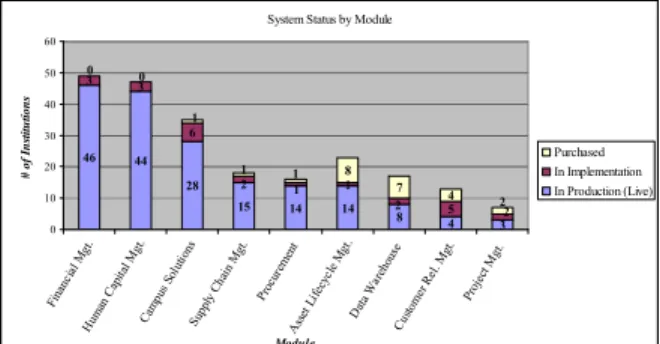
Figure 1. Status of ERP system models organizations.
Institutions were primarily using PeopleSoft (87.3%), yet a few others were using Oracle (4.8%),
SAP (4.8%) and Siebel (3.2%). As highlighted in Figure 1, the phases of their implementation were varied by module; however, the majority had gone live with their financial management modules (46 institutions) and their human capital management modules (44 institutions). (Note that campus solutions did not apply to health care institutions yet it has been implemented by a large part of our sample, which is, as noted above, skewed toward educational institutions).
4.
Findings
Our survey included questions regarding the structure and goals of each of the ERP post-implementation support organizations. We outline these questions and other findings in three subsections below. The first section discusses findings related to structure of the post-implementation organization. We analyze these findings and offer comparison by industry sector. We also analyze the findings to see if there are differences based on the executive responsibility for ERP. We also show findings from questions that asked respondents to identify the degree of centralization now and in their opinion, what degree of centralization would be ideal.
The next section examines the goals and measures of success for each project, both for its initial implementation project and its ongoing post-implementation support efforts. In the final section, we analyze the relationship between the various goals and measures of success relative to the structural forms they employ during post-implementation.
4.1
Structure of the Post-Implementation
Organization
We found that the post-implementation support structures fell primarily into two dominant forms: a centralized cross-functional team structure (27%) and a distributed ad hoc / hybrid structure (66%). Only 5% described their organization as primarily decentralized.
Table 1. Structure for post-implementation ERP
Organizational Structure N Percent
Centralized – application, development,
support controlled by ERP department 17 27.4%
Decentralized – application, development, support controlled by functional BU’s.
3 4.8% Hybrid – application, development, and
support controlled and shared by both the ERP dept. and functional BU’s.
41 66.1%
Other 1 1.6%
Specifically, we asked “How would you generally describe the organizational structure for Post-Implementation ERP?”. Our data included completed questions by 62 of our 65 respondents. (See Table 1.)
When analyzing organizational structure within industry, we find that educational institutions from our sample tend to be more centralized, whereas health care institutions tend to be more of a hybrid compared to education. Yet, the structure in both industry sectors tends to skew toward a Hybrid model. (See Table 2 for breakdown by industry sample.)
Table 2. Structure by industry sector Structure Healthcare (n=16) Education(n=46) Total(n=62) Centralized 12.5% 32.6% 27.4% Decentralized 6.3% 4.3% 4.8% Hybrid 81.3% 60.9% 66.1% Other 0.0% 2.2% 1.6% Total 100.0% 100.0% 100.0%
In addition, we analyzed organizational structure by the overall size of the organization. As shown in Table 3, company size does not appear to be related to organizational structure.
Table 3. Structure by company size Size of Organization by
Org. Structure (Centralized
vs. Hybrid) Centralized # Ctr l. Co. Hybr id # Hybr id Co. Under 500 5.9% 1 9.7% 4 400 – 999 17.7% 3 4.9% 2 1,000 – 2,499 11.8% 2 24.4% 10 2,500 – 4,999 23.5% 4 22.0% 9 5,000 – 9,999 17.6% 3 22.0% 9 10,000 – 19,999 11.8% 2 9.8% 4 20,000 – 29,999 11.8% 2 7.3% 3 Total 100.0% 17 100.0% 41
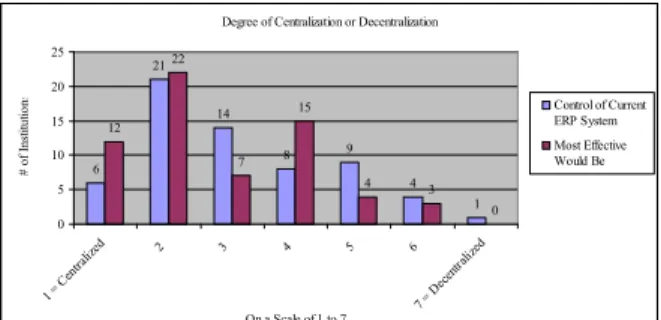
We also asked the question of structure in another way, using a scale of 1-centralized to 7-decentralized, intended to understand the degree of centralization. This format acknowledges that structure, especially in the hybrid form, is often viewed along a continuum between centralization and decentralization. Specifically, we asked, “In reference to your answer above, please indicate the degree to which control of ERP in your organization is centralized or decentralized”. In addition, we asked, “In your opinion, what would be the most effective Post-Implementation design for your organization?”. We call the later the respondent’s “most effective” or ideal structure versus their “current”. Figure 2 shows the
results from these two questions. Total results for each response are shown side by side.
Degree of Centralization or Decentralization
6 21 14 8 9 4 1 12 22 7 15 4 3 0 0 5 10 15 20 25 1 = C entra lized 2 3 4 5 6 7 = D ecentra lized On a Scale of 1 to 7 # o f I ns titu tio ns Control of Current ERP System Most Effective Would Be
Figure 2. Current versus most effective structure
In general, the results indicate that on average our respondents see a more centralized structure as ideal. However, there also appears to be a “grass is always greener” mentality. Although the general trend is towards preference for a more centralized model, there also appears to be a preference for less ambiguity in the middle of the 1-7 scale and a tendency to want more in terms of centralization if they skew centralized, and prefer more decentralized if they are only somewhat decentralized. Table 4 shows the breakdown of respondent’s current structure for each of the idealized structures chosen.
For example, of the 12 institutions that would prefer to be a 1 (centralized), 33% are currently a 1 but another 33.3% actually reported a 2 for their current structure (indicating that they would prefer to be more centralized than they currently are). Similarly, of those 22 institutions that would prefer to be a 2, 59% are currently a 2, but over 35% are currently more decentralized (e.g., a 3 or higher) also indicating that they would prefer to be more centralized than they are currently.
On the other hand, of the 15 institutions that would prefer to be a 4 (e.g., more towards the decentralized model), 33.3% are currently a 3, 13.3% are a 2, and 6.7% are a 1 at this time (indicating that quite a few would prefer to be more decentralized than they are at this time).
Finally, while the sample sizes are small for those preferring to be a 5 or a 6, it is interesting to note their switching in preferences. For example, 3 institutions would prefer to be a 6 and 66.7% are currently a 6, but 33.3% are currently a 5, indicating a preference to be more decentralized. Similarly, of the 5 that would prefer to be a 5, 75% are currently a 5, but 25% are a 3 at this time (e.g., they have a more centralized model and would prefer a more decentralized model).
Table 4. Breakdown by percentage of realized structure for each respondent choosing an ideal.
CURRENT STRUCTURE (1=Centr, 7=Decentr) in % N 1 2 3 4 5 6 7 Total IDE AL (1=Cnt 7=Decnt) 1 12 33.3 33.3 8.3 8.3 8.3 0.0 8.3 100 2 22 4.5 59.1 13.6 9.1 13.6 0.0 0.0 100 3 7 0.0 28.6 57.1 0.0 0.0 14.3 0.0 100 4 15 6.7 13.3 33.3 33.3 6.7 6.7 0.0 100 5 4 0.0 0.0 25.0 0.0 75.0 0.0 0.0 100 6 3 0.0 0.0 0.0 0.0 33.3 66.7 0.0 100 7 0 0.0 0.0 0.0 0.0 0.0 0.0 0.0 100
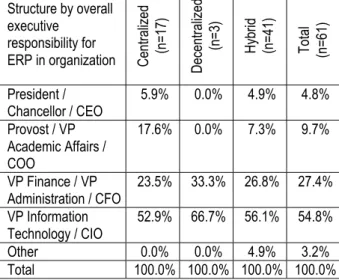
We also asked respondents to identify who had executive responsibility for the ERP project. Interestingly, when structure is cross-tabulated by titles of those with overall executive responsibility for the ERP project, even those describing their institution as a “hybrid” show that the VP of Information Technology or the CIO is primarily responsible (as shown in Table 5). This would seem to indicate that a hybrid model still relies primarily on control by IT management, despite its reliance on resources distributed across many other functional areas.
Table 5. Structure by overall executive responsibility for ERP in organization
Structure by overall executive
responsibility for
ERP in organization Centralized (n=17) Decentr
alize d (n=3) Hybr id (n=41) Total (n=61) President / Chancellor / CEO 5.9% 0.0% 4.9% 4.8% Provost / VP Academic Affairs / COO 17.6% 0.0% 7.3% 9.7% VP Finance / VP Administration / CFO 23.5% 33.3% 26.8% 27.4% VP Information Technology / CIO 52.9% 66.7% 56.1% 54.8% Other 0.0% 0.0% 4.9% 3.2% Total 100.0% 100.0% 100.0% 100.0%
4.2
Project Goals and Measures of Success
Respondents were asked to identify their original goals for the ERP project based on six pre-determined criteria, allowing room for “other” goals, if necessary. Specifically, they were asked, “Thinking about your original goals for the ERP project, please rate the
following with regard to importance”. Respondents used a scale of 1 to 7, with 1 representing “not at all important”, 7 representing “very important”, and 4 anchored as “neutral”. Mean calculations for the responses are shown in Table 6. Replacement of old technology was the most important original goal, followed by process improvement and business process reengineering. All three are reported with a mean of above 4 (a neutral response) on the 1 to 7 scale. Alternatively, cost and staff reduction, reorganization or change, and Y2K all averaged below the neutral point of 4 on the scale.
Table 6. Original goals for ERP project – during / pre-implementation
Original Goals for ERP Project N Mean Standard
Deviation
Replace old technology 63 6.17 1.144
Process Improvement 64 5.77 1.231
Business process reengineering 63 5.27 1.405
Cost reduction / Staff reduction 61 3.79 1.450
Structural reorganization / change (merger, acquisition, etc.)
62 3.03 1.967
Resolve Y2K 60 2.83 2.395
In addition, thinking about their original ERP project in the implementation phase, respondents were asked to rate six variables on a 1-7 scale with regard to importance to their project’s measurement of success. Specifically, we asked, “Please rate the following with regard to importance to your measurement of success in the original ERP project”. Mean scores are outlined in Table 7. In this question, all the items outlined below have mean scores above the neutral level on the scale.
Table 7. Measurement of success – during / pre-implementation
Measurement of Success N Mean Standard
Deviation
Complete within budget 64 6.09 1.137
Complete on-time 64 5.91 1.050
Maximize user satisfaction 64 5.42 1.257
Maximize quality assurance 64 5.31 1.489
Minimize customization 64 5.27 1.417
Automation of processes 63 5.25 1.379
Time, cost, quality and perceived performance (user satisfaction) are well-established measures of success in the IS literature [20]. Since many ERP projects focus on minimizing customization in order to keep projects on time and within budget, and to lower long-term maintenance costs, we also included this as an
option (i.e., often referred to “vanilla” in ERP). We also included automation of processes, since a new system would offer new opportunities for applying information technology. As shown in Table 7, completion within budget and on-time were rated the highest in importance on a 1-7 scale.
Next, we shifted focus slightly and asked respondents to consider their ongoing post-implementation support of the modules currently in production. A total of four variables were rated with regard to their current goals. Specifically, we asked, “Now thinking about those modules that are implemented, please rate the following in order of importance of current goals”. Respondents used a scale of 1 to 7, with 1 representing “not at all important” and 7 representing “very important” to their current goals. Process improvements had the highest mean. Means are outlined in Table 8.
Table 8. Current goals for the ERP project – post-implementation
Current Goals for the ERP
Project N Mean StandardDeviation
Process improvements 64 5.98 1.000
Improve reporting 64 5.78 1.201
Business process reengineering 64 5.16 1.405
Cost reduction 64 4.92 1.384
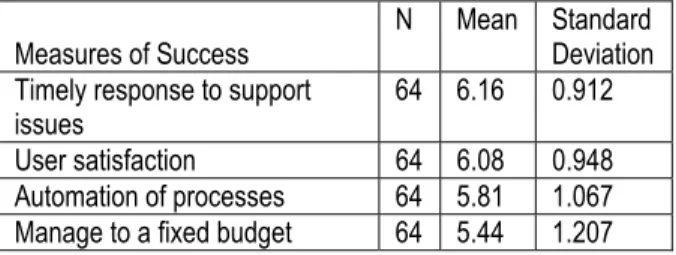
Next, we asked respondents to report about the measures of success and again rate them on a scale of 1 to 7, as reported in Table 9. Specifically, we asked, “Thinking about the Post Implementation project, please rate the following in order of importance with regard to measures of success of your ERP project”. In this question, timely response to support issues was the most important measure of success. Budgeting issues had the lowest mean score.
Table 9. Measures of success – post-implementation Measures of Success
N Mean Standard Deviation Timely response to support
issues 64 6.16 0.912
User satisfaction 64 6.08 0.948
Automation of processes 64 5.81 1.067
Manage to a fixed budget 64 5.44 1.207
The change in goals and measures of success are notable. Improvements in business processes and reporting become important goals as organizations enter a post-implementation phase (whereas completing on time and within budget were most important during implementation). In addition, user needs become more important measures for success in
post-implementation, while budget and customization issues become less important.
4.3
Structure by Project Goals and Measures
of Success
In addition, we conducted T-tests to determine if the importance of goals were different for those respondents who identified their organization as primarily centralized versus hybrid. Although the rank order of original goals are the same for centralized and hybrid organizations, it appears that Business Process Reengineering and Resolving Y2K were rated as somewhat more important in Hybrid organizations (e.g., see T-tests in Table 10).
Table 10. T-test – mean differences in original goals for ERP project – during / pre-implementation (centralized vs. hybrid)
Original Goals for ERP Project - During / Pre-Implementation
Centralized (n=16-17) Hybr
id
(n=39-40)
Replace old technology 6.29 6.18
Process Improvement 5.47 5.73
Business process reengineering 4.94* 5.42*
Cost reduction / Staff reduction 3.56 3.90
Structural reorganization / change
(merger, acquisition, etc.) 3.53 2.95
Resolve Y2K 2.25** 3.10**
* p < .05 ** p < .01
When considering current goals (post-implementation), process improvements are most important for both centralized and hybrid organizations. (Note that T-tests were conducted and there were no differences between means for hybrid versus centralized on the goals listed in Table 11.)
Table 11. Rank order – mean scores of current goals for the ERP project – post-implementation (centralized vs. hybrid)
Current Goals for the ERP Project –
Post-Implementation Centralized (n=17) Rank Order Hybr
id (n=41) Rank Order Process improvements 6.06 1 5.95 1 Improve reporting 5.88 2 5.71 2 Business process reengineering 5.06 3 5.27 3 Cost reduction 5.06 3 4.80 4
Mean scores of original (pre-implementation) measures of success (for those describing their company as centralized versus hybrid) are listed in Table 12. T-tests did not indicate significant differences between mean scores based on type of organizing structure. However, please note that the rank is very similar for both types of organizations.
Table 12. Rank order – means scores of original measurements of success – during / pre-implementation (centralized vs. hybrid)
Measurement of Success Project - During /
Pre-Implementation Centralized (n=16-17) Rank Order Hybr
id
(n=41)
Rank Order
Complete within budget 5.88 1 6.17 1
Complete on-time 5.71 2 6.05 2
Maximize user satisfaction 5.18 3 5.49 3
Maximize quality assurance 5.06 4 5.39 5
Minimize customization 4.88 5 5.41 4
Automation of processes 4.88 5 5.34 6
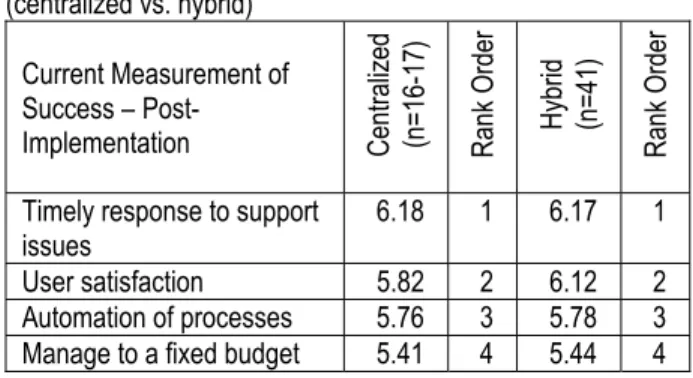
In addition, we examined mean scores of current (post-implementation) measures of success (by centralized versus hybrid organizations). T-tests did not indicate differences in means based on type of organization and the rank order of mean scores is virtually the same for both types of organizing structures (as highlighted in Table 13).
Table 13. Rank order – means scores of current measurements of success – post-implementation (centralized vs. hybrid)
Current Measurement of Success –
Post-Implementation Centralized (n=16-17) Rank Order Hybr
id
(n=41)
Rank Order
Timely response to support
issues 6.18 1 6.17 1
User satisfaction 5.82 2 6.12 2
Automation of processes 5.76 3 5.78 3
Manage to a fixed budget 5.41 4 5.44 4
5.
Analysis and Discussion
The objectives of this research were exploratory in nature. We set out to understand how post-implementation ERP support organizations are structured. We approached this topic applying guidance from prior IS literature and a well established theoretical framework of structural contingency. Using this framework, we asked respondents to identify the
original goals and measures of success for their organization’s ERP project, as well as their current goals and measures for success (now that they had moved into the post-implementation phase).
First we examined the question of structure by asking respondents to indicate if their support organization was centralized, decentralized, or a hybrid form. As expected, we found few instances of decentralization. Given the nature of ERP as a highly integrated system with a centralized database design, it would seem likely that we would only see a decentralized organizing form in the largest of organizations.
We found that the hybrid structure was utilized most often among the organizations in our sample. We did not presuppose any expectations, given that the only prior research we were aware of in this area revealed no dominant form, although that study sample was quite small [10]. Furthermore, the nature of ERP as a technology that integrates work processes across functional areas of the organization offers arguments for both the centralized and distributed forms as noted earlier in our literature review.
We believe that finding greater than 66% with hybrid structures emphasizes what we have already known for some time – that involvement of users and their knowledge of the business contributes greatly to the alignment of information systems with an organization’s objectives. However, once recruited onto an ERP project, retention of SMEs at the end of a project can also offer the ability to align goals, while simultaneously coordinating efforts to become more highly effective. Thus, the centralized form was found in 27% of organizations.
The results found some differences across the two industries, with healthcare organizations in our sample employing the hybrid form more often than educational institutions, although within both industries in our sample skewed toward the hybrid form. This finding demonstrates opportunities for future research to examine the relationship between industry and IT structures.
We found that organizations would ideally like to adopt different structural forms than their current design. On average, organizations in our sample would like to be more centralized, but a surprising number indicated they would also like to be more decentralized. This raises questions as to a general desire in ERP organizations to be structured differently, which may not be too surprising given the existing benefits of both forms and the inevitable compromise that either choice presents.
In our sample, the executive who was responsible for ERP had no relationship to the structural form adopted, although we did find that IT managers were in
control of the projects in decentralized organizations (i.e., took charge in these complex situations).
In examining how organizations prioritized goals, we found that goals did not change much as organizations moved from implementation into the post-implementation phase; however, the measures of success were reordered to emphasis responsiveness and user needs.
Specifically, with regard to goals, we found that process improvements ranked highest among original goals and cost reductions ranked lowest. Again, these findings did not change much from pre- to post-implementation.
We also examined the relationship between goals and structure and found that only “business process reengineering” and “resolving Y2K issues” showed statistically significant differences between those adopting different organizing forms. Those with the hybrid form gave a higher prioritization to these two issues.
On one hand, this finding is in line with what one might expect, such that resolving Y2K, for example is a temporary condition. Once this issue is resolved, SMEs can be returned to their functional roles or to that of a hybrid design rather than a centralized design. On the other hand, a reengineering effort would potentially benefit from creating a dedicated (centralized) organization to focus on continued efforts with process redesign, independent of the varying priorities of the different functional areas. However, our findings indicate that organizations still resulted in a hybrid even when reengineering was a priority.
When considering their original measures of success, we found that project management issues were at the top of the list in priorities (e.g., being on-time and within budget). User issues and quality assurance were not as high in importance. However, post-implementation success measures were somewhat different, such that responding to users and user satisfaction topped the list of success measures. The changes in success measures seemingly fits with the urgency in organizations to make sure the implementation is a success as measured in terms of time and cost. However, quality becomes the higher priority as the organization begins to utilize the system daily.
Perhaps of primary importance, particularly in light of contingency theory, is the fact that the organization’s original goals and measures of success did not seem to dictate the final organizational structure. We interpret this finding as an indication that the choice of structural form is not easily explained based on goals and objectives, as contingency theory might predict. We conjecture that devising a structural approach to supporting such a complex inter-functional
system such as ERP is one that requires solving many complex simultaneous organizational problems.
6.
Limitations, Conclusions and Future
Research
This research undertook an exploratory methodology to understand the objectives, structure and staffing of post-implementation ERP organizations. We surveyed key contacts in 65 organizations (contacted through the software user group). The sample represents two industry sectors, higher education and healthcare. We found that all three organizational forms exist, but that the hybrid form is more prevalent. The majority of the organizations we surveyed reported a hybrid structure, yet they idealized a more centralized structure on average. We also found that while goals did not change, the measures of success did change as organizations moved from the implementation phase of an ERP project to the post-implementation phase.
This study has several limitations. Only two industries were examined and the responses of just 65 organizations were reported on in this paper. This limitation affected our ability to apply more advanced statistical methods in our analysis, and perhaps our ability to find statistical significance in some of the methods we did apply.
The findings reported in this paper do, however, establish the basis for additional analysis and help to set an agenda for future research in this important area. The question of what does influence the choice of organizational structure in post-implementation remains open, as too does the question of what form offers the best performance, given the goals of the organization.
Based on the extant literature discussed above, each of the organizational design models discussed has inherent strengths and weaknesses for an ERP support organization. One would expect that the structure and staffing ultimately realized would align with the original goals of the organization. The centralized model retains functional SMEs as part of a permanent support structure. This approach provides permanent resources and retains key knowledge within the support function. By retaining key functional personnel, the centralized model leverages organizational knowledge developed during the implementation, improving the organization’s capabilities to undertake future initiatives, such as upgrades, business process improvements and other enhancements. This model can also aid perceptions of legitimacy of the ERP unit and provide enhanced access to organizational resources. One might have expected that original goals
of reengineering and reorganizing would lead to a more centralized; however, our data does not support this notion.
Alternatively, the distributed model returned functional SMEs to the home units after the implementation. However, the SMEs may still be expected to be involved in future initiatives on an ad hoc basis. This lower cost approach offers the advantage of designating a liaison between the ERP project and a functional unit, thus enhancing knowledge transfer. Additionally, this model ensures that business process knowledge remains current. It also provides functional units with a greater ability to influence future decisions in enhancements and process improvements.
While the majority of the organizations we surveyed described their post-implementation ERP support organization structure as hybrid, they were, when reported along a continuum, more centralized than decentralized. Furthermore, respondents reported on average that the ideal structure for their organization would be more centralized than the current structure.
We also found that the organizations we surveyed reported a shift in both goals and how they measure success as they moved from their implementation projects into the post-implementation phase. Further analysis will be required to see if a relationship exists between an organization’s response and support for user needs and automation of processes and the existence and desire for more centralized structures.
7.
References Cited
[1] Davenport, T. (1998). "Putting the enterprise into the enterprise system." Harvard Business Review, 76(4): 121-132.
[2] METAGroup (2004). Market Research: The state of ERP services (Executive Summary). Stamford, CT, META Group.
[3] Jones, M.C., R.W. Zmud, T.D. Clark Jr. (2008). ERP in Practice: A Snapshot of Post-Installation Perception and Behaviors. Communications of the Association of Information Systems, 23(25), 427-462.
[4] King, J. (1983) Centralized versus decentralized computing: Organizational considerations and management options," Computing Surveys, 15, 4, 319-349.
[5] von Simson, E. (1990). The 'centrally decentralized' IS organization. Harvard Business Review, July-August: 2-7.
[6] Worrell, J., K. Gallagher, R. Mason. (2006). Explaining the structure of post-implementation ERP teams. 12th Annual Americas Conference on Information Systems, Acapulco, MX
[7] Volkoff, O., Elmes, M., and Strong, D. (2004) Enterprise systems, knowledge transfer and power users, Journal of Strategic Information Systems, 13, 4, 279-304.
[8] Gallagher, V.C., K.P. Gallagher (2006). Employee Perceptions of Role Changes in ERP Projects, Annual Meeting of the Academy of Management, Atlanta, 2006 [9] Brown, C.V., and Magill, S.L. (1994) Alignment of the
IS functions with the enterprise: Toward a model of antecedents, MIS Quarterly, 18, 4, 371.
[10] Sambamurthy, V. and R. W. Zmud (1999). "Arrangements for Information Technology Governance: A Theory of Multiple Contingencies." MIS Quarterly 23(2): 261-291.
[11] Ciborra, C. (1996). "The platform organization: Recombining strategies, structures and surprises." Organization Science 7(2): 103-118.
[12] Sambamurthy, V. and R. Zmud (2000). "Research Commentary: The organizing logic for an enterprise's IT activities in the digital era- A prognosis of practice and a call for research." Information Systems Research 11(2): 105-114.
[13] Simon, H.A.; Kozmetsky, G.; Guetzkow, H.; Tyndall, G. Centralization vs. Decentralization in Organizing the Controller's Department. Scholars Book Co. Houston, Texas, 1954
[14] Boynton, A.C., B. Victor, J.B. Pine, (1993). New competitive strategies: Challenges to organizations and Information Technologies, IBM Systems Journal 32(1), 40-60.
[15] Galbraith, J. R. (1994). Competing with flexible lateral organizations. Reading, MA, Addison-Wesley Publishing Company.
[16] Brown, C. (1999). "Horizontal mechanisms under differing IS organization contexts." MIS Quarterly 23(3): 421-454.
[17] Brown, C., I. Vessey (2003). "Managing the next wave of enterprise systems: Leveraging lessons from ERP." MIS Quarterly Executive 2(1): 65-77.
[18] Markus, L.M., C. Tanis, P.C. van Fenema. (2000b). Multisite ERP Implementations. Communication of the ACM 43(4): 42-46.
[19] Markus, L.M., C. Tanis (2000). The Enterprise Systems Experience – From Adoption to Success, in R.W. Zmud, ed., Framing the Domains of IT Research: Glimpsing the Future Through the Past, Pinnaflex Educational Resources, Inc.: Cincinnati, OH, 173-207.
[20] Atkinson, R. (1999). Project Management: time, cost and quality, two best guesses and a phenomenon, its time to accept other success criteria, International Journal of Project Management, 17(6), 377-342.