Working Paper 9215
DO HOSTILE TAKEOVERS REDUCE EXTRAMARGINAL WAGE PAYMENTS?
by Jagadeesh Gokhale, Erica L. Groshen, and David Neumark
Jagadeesh Gokhale and Erica L. Groshen
are economists at the Federal Reserve Bank of Cleveland. David Neumark is an assistant professor of economics at the University of Pennsylvania and a faculty research fellow of the National Bureau of Economic Research. The authors are grateful to Steven Sharpe for
helpful discussions and to Colin Drozdowski and Edward Bryden for research assistance.
Working papers of the Federal Reserve Bank of Cleveland are preliminary materials circulated to stimulate discussion and critical comment. The views stated herein are those of the authors and not necessarily those of the Federal Reserve Bank of Cleveland or of the Board of Governors of the Federal Reserve System.
ABSTRACT
Hostile takeovers may have significant implications for long-term employment contracts if they facilitate the opportunistic expropriation of extramarginal wage payments. We test the expropriation hypothesis by studying the relationship between proxies for extramarginal wage payments and
subsequent hostile takeover activity. This paper improves on existing
research by using firm- and establishment-level data from a salary survey of employers. In addition, we observe characteristics of wage and employment structures both before and after the occurrence of a hostile takeover and hence can see whether the data are consistent with reductions in extramarginal wage payments following such takeovers. Results from this ex post experiment provide evidence consistent with the hypothesis that hostile takeovers result in reductions of extramarginal wage payments to more-tenured workers, mostly through cutbacks in senior positions at firms with relatively steep wage profiles.
I, Introduction
Hostile takeovers may have significant implications for long-term employment contracts. Shleifer and Summers (1988) argue that hostile
takeovers may facilitate opportunistic behavior at the expense of workers by making possible the removal of "entrenched" managers who would otherwise uphold implicit contracts with employees. Their argument is based not on the presence of reputation effects, but rather on the hypothesis that because of management loyalty--an ingredient necessary to make implicit contracts in the first place--a long-time manager tends to avoid breaking implicit contracts with employees even when doing so would benefit shareholders. Neumark and Sharpe (1992) contend that hostile takeovers may facilitate such opportunistic behavior even if there are reputation effects. The new management taking command after an unfriendly takeover breaks the implicit contracts of the previous managers and therefore may not suffer a damaged reputation. This is especially likely if the takeover is engineered by an individual or company that then resells the target firm.l
Neumark and Sharpe (1992) conduct an ex ante analysis of this question, studying the relationship between proxies for extramarginal wage payments and subsequent hostile takeover activity. They construct two types of proxies for extramarginal wage payments: differences in wage levels unattributable to measured human capital and other standard wage equation controls in the industries in which firms conduct business, and differences both in the steepness of age-earnings profiles and in the relative employment of older
l ~ h a ~ a t , Shleifer, and Vishny (1990) argue that because corporate raiders typically resell acquired assets to firms in similar industries, hostile
takeovers are largely an "industrial organization problem," resolving issues similar to those that trigger friendly mergers, and were perhaps spurred by lenient antitrust enforcement in the 1980s that released pent-up demand for acquisitions in related industries. The argument in Neumark and Sharpe, which emphasizes reputation effects, suggests another reason why other firms are interested in acquiring hostile takeover targets from raiders.
workers across the industries in which firms conduct business. They find some evidence, albeit weak, consistent with the view that hostile takeovers are used to expropriate extramarginal wages. Specifically, proxies for
extramarginal wage payments sometimes have predictive power for an eventual hostile takeover attempt, although this power tends to diminish as controls for firm financial characteristics are added. The results in that paper are interpreted as a joint test of two hypotheses: 1) that the characteristics of the wage structure captured in these proxies actually represent extramarginal wage payments and 2) that hostile takeovers target firms with relatively high extramarginal wage payments.
This paper improves on that empirical analysis in two important ways. First, Neumark and Sharpe use industry-level characteristics of the wage structure and then construct firm-level proxies for extramarginal wage
payments by assigning industry-level data to firms in Compustat based on the industry or industries in which these firms conduct business. In contrast, in this paper we use firm- and establishment-level data from a salary survey of employers, similar to that used in Groshen (1991~). These data should yield better proxies for extramarginal wages at the firm or establishment level, given evidence of firm-specific wage differentials within industries (Groshen
[1991a, 1991bl). Second, these data permit more than an ex ante experiment. Because we can observe characteristics of the establishment's wage and
employment structures both before and after the occurrence of a hostile takeover, we can see whether the data are consistent with firms in fact expropriating extramarginal wages following hostile takeovers, by examining changes in extramarginal wage payments. This analysis may reveal effects of hostile takeovers that are obscured by heterogeneity bias in the ex ante analysis. Furthermore, these data cover the same reporting unit (one or a number of establishments) before and after the takeover, so there is no
problem of attributing changes in wages or employment to the acquired entity, rather than to the new parent company.
11. Extramareinal Wages
A considerable amount of research in labor economics documents evidence that is consistent with extramarginal wages and attempts to provide related theoretical models. One focus of this research has been industry- and firm- specific wage premia. In wage regressions that control for variables that economic theory suggests ought to determine wages, substantial industry wage differentials persist (Krueger and Summers [1988]). Some explanations that have been considered and rejected are compensating differentials (Murphy and Tope1 [1987]), unobserved ability (Gibbons and Katz [1992], Blackburn and Neumark [1992]), demand or supply shifts (Helwege [1992]), and union threat effects (Newark and Wachter [1992]).
This evidence of industry-level wage differentials has been supplemented with evidence of persistent, unexplained wage differences at the firm and establishment level (Groshen [1991a]). Employer wage differentials within industry are about the same size as differences between industries, are linked to observable characteristics of the establishments (such as size, technology, product, and unionization), and appear to be long-lived (Groshen [1991b]).
Some researchers, such as Dickens and Katz (1987a, 1987b), have concluded that these industry-, firm-, and establishment-level wage
differentials reflect rents. Such rents arise in the gift-exchange model of Akerlof (1982), in which workers receive above-market-clearing wages (in some firms) in return for exerting more-than-minimal effort. They can also arise if firms base wages partly on ability to pay, perhaps out of equity concerns (see the review in Levine [1991]).
A second labor market model that leads to the payment of extramarginal wages, although only to more-tenured workers, is the incentive contract model
of Lazear (1979). In this model, firms can only imperfectly monitor workers, who therefore have some incentive to shirk on the job. To eliminate or reduce shirking, firms pay workers less than their marginal product when their tenure is low, and more than their marginal product when their tenure is high. In this deferred compensation scheme, employees essentially post a "bond" that is forfeited if they are caught shirking. They are willing to accept the
deferred-compensation implicit contract ex ante because it results in greater output, and hence a higher present value of earnings, relative to the spot market outcome.
Empirical research on Lazear contracts seeks to distinguish the deferred compensation explanation of rising wages from the general human capital
investment explanation. In particular, this research asks whether wages rise faster than marginal product, consistent with Lazear's model, or rise in concert with marginal product. Numerous researchers have found evidence consistent with wages rising faster than marginal product (Medoff and Abraham
[1981], Lazear and Moore [1984], Kotlikoff and Wise [1985], Kotlikoff and Gokhale [1991]), although others have argued to the contrary (Brown [1989]).
Based on these two avenues of research, we construct two measures of possible payments of extramarginal wages for our sample of firms. First, to
2 ~ n alternative hypothesis under which workers receive less than their marginal product when young, and more when old, is that workers prefer rising wage profiles as a forced-saving mechanism (Frank and Hutchens [1992],
Loewenstein and Sicherman [1991]). In this case, however, workers sacrifice their present value of earnings in order to receive deferred compensation. Nonetheless, older workers are still paid extramarginal wages. Neumark (1992) provides some evidence consistent with the forced-saving hypothesis. Neumark and Taubman (1992) exploit the different implications of alternative
explanations of wage growth for present values of earnings streams to distinguish among the explanations.
There is also a version of the human capital model (Carmichael [1983]) with the same empirical implications. In this paper, we do not distinguish between the Lazear model and these models; any evidence regarding the validity of one bears equally on the others. Thus, our research sheds light on the existence of extramarginal wage payments to older, more-tenured workers, but does not address the source of these payments.
study extramarginal wage payments captured in wage levels, we estimate the unexplained fixed establishment component of wages. Second, to examine
extramarginal payments to more-tenured workers, we construct estimates of the steepness of the wage profile at the firm level, as well as the relative employment of senior-level workers. The particular combination of steep
profiles plus high employment of more-tenured workers should be most consonant with this latter type of extramarginal wage payment.
111. Existine Research on Hostile Takeovers
A number of recent papers look at the consequences of alternative types of corporate restructurings for wages, pensions, and employment (for example, Lichtenberg and Siege1 [1989], Brown and Medoff [1988]); a subset of these focus on hostile takeovers. One obstacle to studying hostile takeovers explicitly is that it is difficult to attribute changes that occur for the acquiring firm to the acquired entity per se. Thus, studies of the
consequences of these takeovers have used unusual, specially constructed samples. Bhagat, Shleifer, and Vishny (1990) and Bhide (1989) study a small sample of firms that were hostile takeover targets, finding that substantial layoffs are frequently reported at target firms following such events,
although they conclude that layoffs explain only a fraction (11 to 26 percent) of the takeover premium for their firms. One problem with these studies is that they consider only hostile takeover targets; they are constrained to do this because they do not use standard data sources (such as Compustat) to attribute changes to the acquired entity.3 Thus, there is no "control group" of firms that fail to experience takeover bids. On the other hand, firms that did not experience such bids may have taken actions similar to those that
3~hagat, Shleifer, and Vishny do present some partial evidence, based on Wall Street Journal reports of industry and firm layoffs, that layoffs were higher in hostile target firms than in similar nontarget firms and that the higher layoffs followed the takeover (or attempt).
ensued at takeover targets to forestall the bids, in which case comparisons of
targets to nontargets would understate the effects of hostile takeovers.
In contrast, for a sample of union contracts matched to firms, Rosett
(1990) finds that hostile takeovers (identified as takeovers accompanied by
CEO changes) do not result in lower real wage growth than friendly takeovers
(in specifications excluding year and industry effects) and have no
discernible impact on real wage growth (in specifications including these
effects). One problem with this sample, however, is that the union contracts
apply to only a fraction of the firms' work forces, so it is difficult to
generalize to real wage changes for all employees.
None of these papers, however, addresses explicitly the question of the
expropriation of extramarginal wages or, in the language of Shleifer and
Summers (1988), breaches of implicit contracts. That is, none attempts to
identify components of wage levels that are in any sense extramarginal, and
none focuses on the steepness of the wage profile or on the relative
employment of more-tenured workers. As outlined in section 11, however, it is
these characteristics of wages and employment that may indicate the existence
of implicit contracts. Instead, the studies reviewed so far focus on wage or
employment cuts per se, which have nothing to do with reducing extramarginal
wage payments, and therefore may have nothing to do with the gains from
hostile
takeover^.^
These limitations of existing studies are imposed by the data, since none of the standard data sources (such as Compustat or the CensusBureau's Longitudinal Research Database) or the nonstandard sources used to
date (as in Bhagat, Shleifer, and Vishny [1990]) contains information on the
shape of the wage profile, on the relative employment of older workers, or on
4 ~ h i s point is recognized explicitly in Bhagat, Schleifer, and Vishny (1990), but the authors nonetheless estimate savings from layoffs as the wage bill previously paid to laid-off workers.
skill measures that could be used to estimate the portion of the firm's wage
level that is not attributable to worker productivity.
In contrast, the empirical analysis in Newark and Sharpe (1992), like
the analysis in this paper, attempts to construct measures of extramarginal
wage payments, or indicators of implicit contracts, and to study their
relationship to hostile takeover bids. They consider a number of proxies for
extramarginal wages: the overall wage level, the steepness of the age-earnings
profile, the relative employment of older workers, and the steepness of the
profile interacted with the relative employment of older workers. The study
is also different from others in the literature because it is ex ante in
nature, studying whether these extramarginal wage proxies, measured at a point
in time, are associated with later hostile takeover bids. Thus, the authors
can use standard data sources (such as Compustat) to compare hostile targets
and other firms, but still avoid the attribution problem referred to above.
Newark and Sharpe find that these proxies for extramarginal wage
payments are positively related to hostile takeover bids, in logit estimates
for the probability of hostile takeovers, although the effects are often
statistically insignificant once controls for financial and other
characteristics of firms are included; the results are strongest for the
interaction between the steepness of the age-earnings profile and the relative
employment of older workers. Given that they use industry-level proxies for
extramarginal wages, which are matched to firms based on the industry or
industries in which the firms conduct business, it is perhaps surprising that
much of a relationship is detected, even if the expropriation hypothesis is
correct. Also, they find that the effects of the extramarginal wage proxies
are generally strongest when comparing hostile takeover targets to other
corporate restructurings. They interpret this as providing stronger evidence
based only on those firms that underwent changes in control, and focuses on
the unique aspect of hostile takeovers--the change in management.
An alternative avenue, which focuses more explicitly on expropriation of
extramarginal compensation or breaches of implicit contracts, investigates
defined-benefit pension plan terminations and reversions of excess assets from
overfunded plans.5 Employees can lose out from a termination because the
explicit sponsor's obligation to current jobholders upon termination is based
only on wages at that date rather than on wages at retirement. Firms may be
tempted to terminate and revert because of the overfunding that results from
the requirement that they fund plans based on projected salaries at
retirement. This research finds some evidence (although not one-sided)
consistent with hostile takeovers leading to terminations and reversions as
breaches of implicit contracts (Pontiff, Shleifer, and Weisbach [1990],
Mittelstaedt [1991], Ippolito and James [1992]).
To summarize, most existing evidence on the effects of hostile takeovers
on wages and employment does not speak directly to whether such takeovers ar'e
a means of expropriating extramarginal wage payments or of breaching implicit
contracts. Evidence on pension plan terminations and reversions is more
relevant to the expropriation hypothesis and provides some (although not one-
sided) support. This paper extends the approach taken in Neumark and Sharpe
(1992), of looking at the relationship between hostile takeovers and
characteristics of the wage structure and employment that may indicate
extramarginal wage payments or implicit contracts. This paper is unique
5~etersen (1992) provides empirical evidence supporting the notion that reversions are breaches of implicit contracts of a Lazear nature.
%en a pension plan is terminated, the firm has the option of buying annuities with a value equal to the explicit pension obligations, based on current salaries, or replacing the plan with one of at least that value. In cases where the plan is overfunded, the firm can retain the assets left over.
because it studies this relationship based on characteristics of the wage and
employment structures at the firm or establishment level and because the
nature of the data set used permits both an ex ante and ex post analysis.
IV. The Data
A.
The Community Salary SurveyWe use data from 1980 through 1991, constructed from the annual
Community Salary Survey (CSS) conducted by the Federal Reserve Bank of
Cleveland (FRBC) personnel department. The survey, which covers employers in
Cleveland, Cincinnati, and Pittsburgh, assists in annual salary budgeting at
the Bank.7 In return for their participation, surveyed companies are issued
result books for their own use. Salary surveys such as the CSS currently
offer the only source of longitudinal wage data accompanied by both detailed
occupation and information on employers.'
The FRBC chooses participants in each city to be representative of large
employers in area.g Each one judges which establishments to include in the
7 ~ n general, Cleveland, Cincinnati, and Pittsburgh are more urban, have more cyclically sensitive employment, and have undergone more industrial restructuring than the nation as a whole. Prior to the 1980s, wages in these three cities were higher than the national average. Now, they are
approximately average for the country.
'see Hotchkiss (1990) for a summary of data sets with information on employers. For example, the microdata collected in Industry Wage Surveys and Area Wage Surveys by the Bureau of Labor Statistics have occupational detail, but lack any way to identify changes in ownership, are not easily linked over
time, and are not preserved for long periods. Unemployment Insurance ES-202 data, when available, report average employee earnings by employer, not individual wages, and lack occupational detail. The Longitudinal Research Database, maintained by the Center for Economic Studies, goes back to 1972, but covers only manufacturers and provides only mean establishment earnings for production and nonproduction workers, with no occupational detail.
9 ~ o check whether the wages paid by members of the CSS sample were unrepresentative of the areas' rates, wages in the survey were compared to Bureau of Labor Statistics' Area Wage Surveys (AWS) in the same cities for the late 1970s and early 1980s. The AWS also oversamples large employers.
Movements of mean wages for similar occupations were found to be highly
correlated across the two surveys, and levels were usually within 5 percent of each other.
survey, according to their internal organization. Some include all branches
in the metropolitan area, while others report wages for only a single
facility. We use the purposely vague term "employer" to mean the employing
firm, establishment, division, or collection of local establishments for which
the participant reports wages. lo
The industries included vary widely, although the emphasis is on
obtaining employers with many "matches," or employees in the occupations
surveyed. The number of companies participating on an ongoing basis in these
years averages about 93. Overall, 133 employers participated in the survey at
one time or another over these 12 years and had enough data for use in the
analysis. l1
The CSS covers 75 occupations each year; each employer reports wages for
an average of 28 of these. The surveyed occupations are almost exclusively
nonproduction jobs, since these positions are found in all industries.
Included are office, maintenance, technical, supervisory, and professional
personnel.
Many jobs are further divided into a number of grade levels, depending
on required responsibilities and experience. Job descriptions for each are at
/
least two paragraphs long. In consGltation with the FRBC personnel
department, we grouped 50 (two-thirds) of the surveyed occupations into 17 job "families." Each family comprises at least two, and up to as many as five,
levels. Appendix A presents a list of the job families and levels (with their
associated job titles) used in the analysis.
1°since'a participant's choice of the entities to include presumably
reflects those for which wage and personnel policies are actually administered jointly, the ambiguity here is not particularly troublesome.
"~welve companies had no employees in any of the job families used to estimate extramarginal wages. Thus, they had to be excluded from the
, analysis, although they were used to estimate overall establishment
Each observation in the original data set gives the salary of an
individual employed in a surveyed occupation by a surveyed employer. Cash
bonuses are included as salary, but fringe benefits are not.
B. Identification of Takeovers
Takeovers, whether hostile or not, were identified by a combination of
four methods. In 1989 and 1990, participants were asked if they had had a
change of ownership during the past five years and, if so, by whom they had
been acquired. We also looked up the CUSIP number of all publicly held firms
and took any change in number as an indication of a possible takeover. Then
Moodv's, the Harris Industrial Directory, and Mergers and Acauisitions
magazine were consulted in order to characterize the takeover. In a few
cases, the company contact for the CSS was also consulted to make a final
determination.
C. Ex Ante Observations vs. Ex Post Observations
We organize the data into ex ante and ex post observations. Ex ante
observations are taken for the first year the employer enters the sample and
are described in table 1A. In most cases, the year of entry is 1980, but 55
employers join the sample at some later date. In the first column, we see that
employers represent all industry groups, but are most heavily concentrated in
durable goods manufacturing and in finance, insurance, and real estate (FIRE).
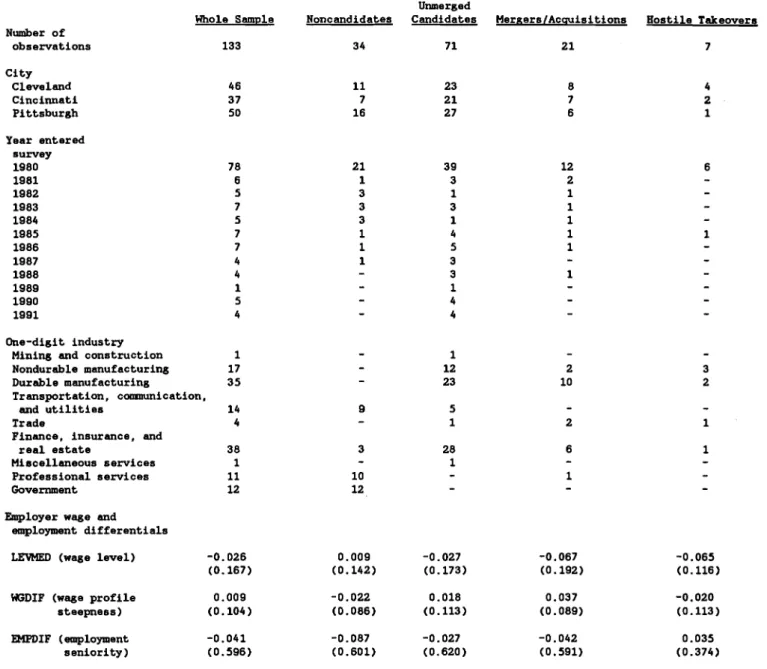
The other columns divide the sample into four categories: 34 employers that were not candidates for takeover (governmental agencies, public utilities, or
nonprofit organizations), 67 potential candidates that had no change of
ownership, 25 entities that were acquired in a (nonhostile) merger or acquisition, and 7 employers that underwent hostile takeovers.12
Table 1B reports sample characteristics for the 97 observations with
12For reasons of confidentiality
,
we cannot divulge the names of the companies from which the data were collected.complete data on unionization and employer size. Most of the observations
lost are unmerged candidates or employers that underwent friendly mergers.
Noncandidates have strikingly higher rates of unionization (UNION, defined as
at least 25 percent unionized) and average size (SIZE) than do candidates.
Among candidates, employers that did not undergo friendly mergers or hostile
takeovers are larger but less unionized than those that did.
Ex post observations are defined from the first year observed (usually
1980) until the last year observed (usually 1991). Table 2 reports sample
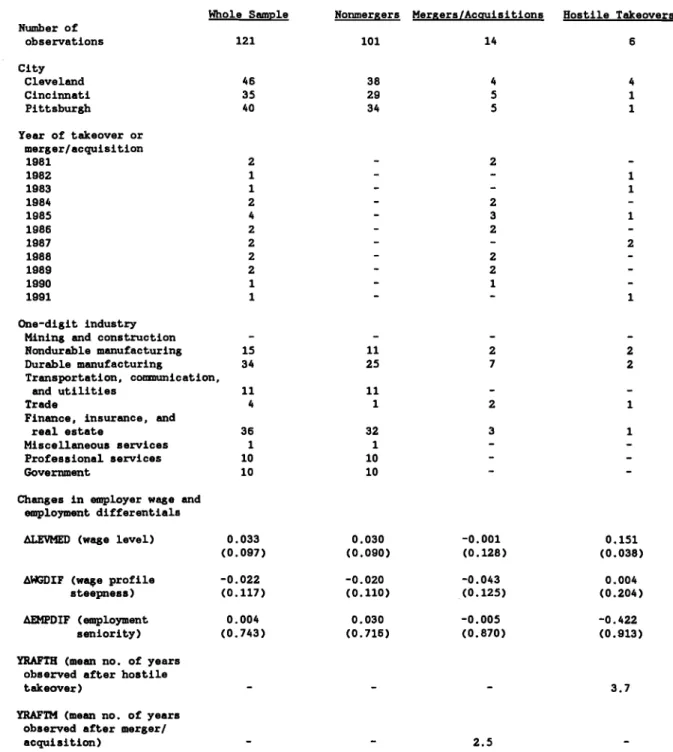
characteristics for this sample. It is smaller (121 observations) than the ex
ante data set because employers that participated only once in the CSS (mostly
in Pittsburgh), or for which an observation after a merger or takeover
occurred was unavailable, are excluded. l3 The industrial distribution
remains about the same. We divide the sample into three subgroups: 101
employers that were not merged (noncandidates plus intact candidates), 14
mergers and acquisitions, and 6 hostile takeovers. On average, our observations on the wage and employment structure occur 3.7 years after hostile takeovers, and 2.5 years after mergers and acquisitions.
The ex post analysis looks at changes in the variables describing the
wage and employment structures. Using the data in difference form controls
for all static differences among these employers. The more direct forms of
controlling for differences among employers, such as merging in data from
other sources (Compustat, for example), cannot be used for the ex post
analysis (the unique contribution of the paper) because financial data for
units within firms are not available.
here
were two observations with mergers/acquisitions for which the date of the merger occurred immediately before the first year the company was observed. These are included in the ex ante data set as nonmergers, but are excluded from the ex post data set because some effects of the earlier mergers may take a number of years to occur.Finally, we note that firms are free to refuse to participate in the survey. If this generates any selection bias, it seems to us most plausible that hostile takeover targets that experience particularly severe changes related to expropriation of extramarginal wages (such as large-scale firing of older workers) may be most likely to discontinue participation. This would bias the results against finding evidence consistent with the expropriation hypothesis.
D.
Measures of Extramarginal WagesWe use three conceptually distinct, employer-specific measures of the presence of extramarginal wages: overall wage differentials, wage profile slope differentials, and employment concentration in senior levels. We also interact the slope and concentration measures as a proxy for the size of the .seniority-related extramarginal wage bill.
Employer wage differentials (such as unexplained deviations from mean wages in a city) are estimated independently for each city and year, from an OLS regression of log median wages for each occupation in each employer, controlling for detailed occupation (following Groshen [1991aJ). Estimated coefficients on employer dummies (after standardizing the mean to zero for each city-year) are denoted LEVMED, and represent the average log wage differential across occupations paid by that employer in that year. l4
Similarly, employer slope differentials capture the extent to which the slope of an employer's wage profile deviates from its annual city mean. We base our estimates on the 17 job families that were found in the occupations surveyed in the CSS (see appendix A). Employer-specific steepness of
age-earnings profiles is estimated in the same nonparametric way as employer wage differentials. In every case where two occupations in a family are
14~og-point wage differentials can be interpreted as approximate percentage-point differences from the mean.
observed at a single employer, the difference in the mean of log wages between
the steps is used as a dependent variable for the regression of wage gaps on a
set of fully interacted family-step dummies and a set of employer dummies.
The estimated employer coefficients are labeled WGDIF and measure the average
seniority-wage slope difference (relative to the mean in the city and year)
paid by the employer in a particular year. A positive number for a company
reflects above-average wage differences between steps in these 17 job-family
ladders among their employees.
Finally, to measure the relative seniority of the work force, we
estimate what we call the "employment concentration" for each CSS participant. The log employment difference between steps in a job-family ladder is
regressed on the same set of dummy variables (for all possible family-step
combinations and for employers) used in the slope estimates. The estimated
employer coefficients are retained; a positive coefficient, labeled EMPDIF,
reflects an above-average concentration (within their city in that year) of
senior employees in these job ladders.
V. Results
A.
Ex Ante Tests: The Effects of Wage and Employment Structures on the Probability of Hostile TakeoversDescriptive statistics for the wage and employment structure variables
for the ex ante analysis are reported in the last rows of tables 1A and 1B.
As a group, the seven companies that underwent hostile takeovers had the
lowest average wages (LEVMED), relatively flat seniority profiles (WGDIF), and
the highest concentration of workers in senior job classifications (EMPDIF).
within groups. l5
We now turn to a more formal investigation of whether establishment-
level employment distributions and wage structures are related to the
probability of a hostile takeover. For each firm, the estimates of the
employer-specific log median wage differential (LEVMED), log inter-job-level
wage difference (WGDIF), and log inter-job-level employment difference
(EMPDIF) are used to predict the occurrence of a hostile takeover. For firms
that underwent a hostile takeover, we ensure that these estimates are for a
year prior to the year of the takeover.
To reiterate, WGDIF serves as a proxy for extramarginal wage premia paid
to more-tenured workers, and EMPDIF is an index of employment concentration in
upper-level jobs. But wage or employment differences alone need not reflect
high overall rent payouts to employees. Firms with high employment
concentration in upper-level jobs but with small wage differences across job
levels or, conversely, those with high wage slopes but with relatively low
employment in upper-level jobs, may not be attractive hostile-takeover targets
because both of these cases are unlikely to be associated with substantial
extramarginal wage payments to more-tenured workers. However, the joint
incidence of relatively high employment in senior job levels and high inter-
job-level wage slopes may represent high overall extramarginal payments that
could be susceptible to expropriation. Thus, the interaction variable WGXEM,
computed as the product of WGDIF and EMPDIF, provides the strongest test of
the expropriation hypothesis with respect to extramarginal wages paid to more-
tenured workers. LEVMED is used to explore whether overall wage-level
differences across firms affect the probability of hostile takeovers.
15The means for the whole sample are different from zero because the observations come from different years; only within a year is the average firm-specific differential equal to zero.
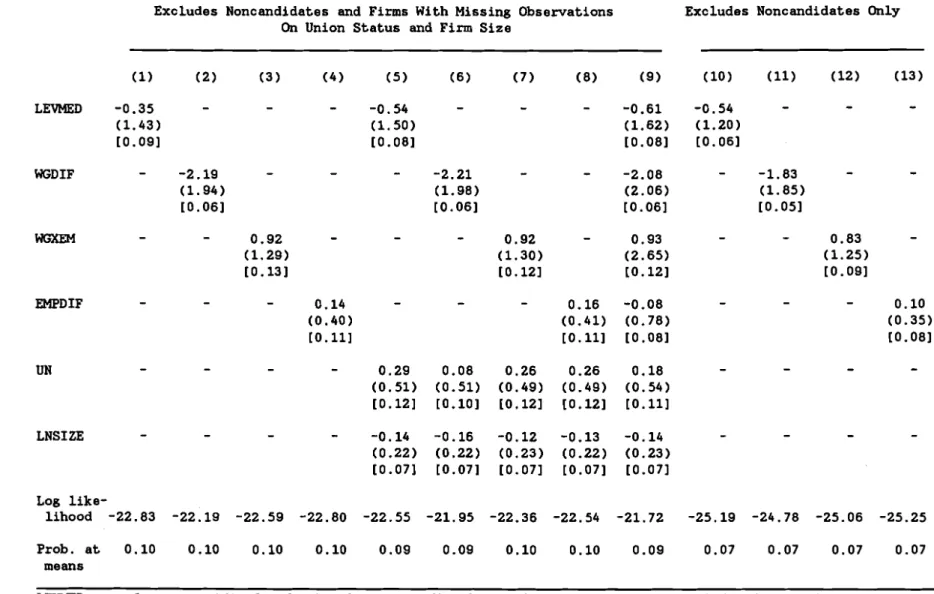
Table 3 reports these probit estimates for various specifications. The sample is restricted to firms that were candidates for a hostile takeover. The first nine columns show the regressions on a subsample with nonmissing data on union status, UN, and the log of firm size, LNSIZE. This subsample contains 7 firms that experienced a hostile takeover during the period spanned by the data, and 64 that did not. Table 4 reports results when the
noncandidates are included. The signs of the estimated coefficients of LEVMED and WGDIF are negative, reflecting the differentials in tables 1A and 1B. The estimated coefficients of WGXEM and EMPDIF are almost always positive. These signs are robust to the inclusion of UN and LNSIZE in the regressions (columns 5 through 9), to the inclusion in the sample of firms with missing data on UN and LNSIZE (columns 10 through 13), and to the inclusion of nontakeover
candidates in the regressions (table 4).
Results for all of these samples suggest that a more-senior work force (EMPDIF) is positively related to probability of hostile takeovers, except in regressions that control for LEVMED, WGDIF, and WGXEM (column 9 in tables 3 and 4). The probability of a hostile takeover based on a one-standard- deviation increase in each independent variable (holding the others at their means) is shown in brackets below each coefficient estimate; these can be compared to the probability at the means, in the last row of the table. l6
For example, in column
7
of table 3, increasing the interaction between seniority and profile steepness (WGXEM) by one standard deviation raises the probability of a hostile takeover from 0.10 to 0.12.While none of the estimated coefficients of the wage and employment structure variables is statistically significant, the signs of the estimated coefficients point to several conclusions. First, higher wage levels per se
l6J?or the probit model, in contrast to the logit model, the estimated probability at the means need not exactly equal the unconditional probability.
are not positively associated with hostile takeover probabilities. Second,
high wage differentials between job levels do not attract predators. Third,
the positive signs on the interaction variable, WGXEM, suggest that firms with
higher wage payouts to senior workers in conjunction with high employment
concentrations in senior-level jobs are more likely to experience a hostile
takeover. These results are consistent with Neumark and Sharpe's (1992)
findings in favor of the expropriation hypothesis that extramarginal wage
premia induce hostile takeovers, but, as in that paper, the evidence is not
statistically strong. In addition, presumably the inclusion of financial
controls would, as found by Neumark and Sharpe, further weaken these results.
Fourth, support is weak at best for the hypothesis that a higher employment
concentration in upper-level jobs, by itself, leads to a higher probability of
a hostile takeover.
B. Ex
Post Tests: The Effects of Hostile Takeovers on Wage and Employment StructuresAs shown in the last rows of table 2, in the ex post observations,
employer-specific wage differentials rose most rapidly for employers that
experienced a hostile takeover (ALEVMED). However, the concentration of
employees in senior positions drops dramatically following hostile takeovers
(AEMPDIF), while it rises after a merger. Wage profiles seem to be relatively
unaffected (AWGDIF).
The effects of hostile takeovers on firm wage and employment structures
are analyzed using data on the last year available for each firm. For firms
that underwent a hostile takeover, we ensure that this year is later than the
year of takeover. OLS regressions are estimated for differences in LEVMED,
WGDIF, WGXEM, and EMPDIF (denoted with A's) between the last and first years
of data availability, ensuring that for firms that were taken over, the change
explanatory variable, H , that indicates the occurrence of a takeover.
Table 5 reports results from two sets of regressions, the second set
containing an additional regressor, YRAFTH, indicating the span between the
year of takeover and the year to which the changes are computed. The
coefficients on H are negative in the AWGXEM and AEMPDIF regressions, but only
the coefficient on AWGXEM is significant (at the 10 percent level). The AWGDIF
regression produces a positive estimated coefficient that is not significant,
suggesting that inter-job wage differences remain substantially unchanged
after hostile takeovers.
The inclusion of YRAFTH in the regression preserves the negative signs
on both AWGXEM and AEMPDIF and renders the coefficient for AWGXEM more
strongly significant. These coefficient estimates indicate that hostile
takeovers are followed by relatively large reductions in employment
concentration in senior positions and in employment-weighted wage slopes. The
positive coefficients on YRAFTH in the AWGXEM and AEMPDIF regressions suggest
that the initial reductions in these variables after a hostile takeover are
partially reversed over time.
This apparent reversal could stem from at least two sources. In line
with the hypothesis advanced here, suppose hostile predators extract
extramarginal rents from more-senior workers at the time of takeover, but do
not change the Lazear-type bonding offered to continuing or new employees. If
Lazear contracts are efficient and the new parent's offer is credible (because
the company has been resold or the predator is expected to honor its own
implicit contracts), then wage profiles would be unchanged after the takeover,
and, for example, the drop in the seniority concentration of workers would
dissipate over time. The second possibility is related to the fact that the
changes in the wage and employment structures for the earliest takeovers in
nature of the hostile takeovers differed between the early and late 1980s. Under this interpretation, the positive coefficients on YRAFTH in the AWGXEM
and AEMPDIF regressions, and the stronger effects of hostile takeovers on these variables once YRAFTH is included, suggest that the reductions in extramarginal wage payments were larger in the later takeovers. This is consistent with evidence in Kaplan and Stein (1991), showing that going- private transactions had higher prices relative to cash flow in the latter half of the 1980s, which suggests that in order to service the debt incurred in these later transactions, reductions in the claims of other stakeholders (such as more-tenured workers) were more likely.
In the case of ALEVMED, the coefficient on H is positive and
significant. The sign and significance are preserved when YRAFTH is included in the regression. This positive effect on the post-hostile-takeover wage levels may reflect "house cleaning" by the new owners/managers as some of the less-efficient workers are fired. Or, it may reflect an attempt to retain the more-efficient workers in response to perceived increases in their job-
separation probabilities in light of the abrogation of implicit wage contracts with senior workers. However, if hostile takeovers do reduce extramarginal wage payments, then this result may imply that overall employer wage
differentials do not reflect extramarginal wages.17
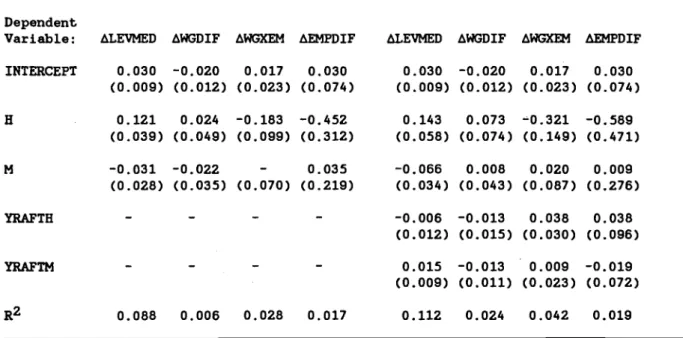
Table 6 shows the same set of regressions with additional controls for nonhostile mergers and akquisitions, M and YRAFTM. The addition of these variables does not substantially change the signs and standard errors on any of the coefficients on H and YRAFTH. More interesting is the fact that none
17~lternatively, it is possible that these extramarginal wage payments are not reduced following hostile takeovers, while those paid to more-tenured workers are decreased. Since the two types of extramarginal wage payments may have different sources, it is conceivable that only the expropriation of the
of the estimated coefficients of the dummy variable for nonhostile mergers is
significant and, in most cases, the signs are opposite those on
H.
Thus, thereductions in employment concentrations in senior positions and in employment-
weighted inter-job wage differences, and the increases in median wage levels
following hostile takeovers, stand in contrast to the movements in these
variables following mergers and acquisitions.
The preservation of the negative and significant coefficient on
H
in theAWGXEM regression is consistent with the hypothesis that post-hostile-takeover
restructuring results in an expropriation of extramarginal payments to the
more-tenured workers of firms. The results for AEMPDIF and AWGDIF suggest
that most of the reduction in extramarginal payments occurs not through
reductions in inter-job wage differentials, but through reductions in
employment concentrations in upper-level jobs.
VI. Discussion of Interviews
After obtaining a complete set of results, we contacted each hostile
takeover target in our sample, in order to add qualitative evidence to our
findings. We were able to speak with current personnel officers at five of
the seven targets.
After confirming the history of the takeover, we asked open-ended
questions about the adjustment process and ensuing changes in personnel
policy. In all cases, the respondents reported substantial employment
restructuring, continuing for as long as three years after the takeover. In
each case, most of the effort was directed at thinning out middle management.
Often, employees were encouraged to leave through early retirement plans or
"voluntary separation agreements" (including severance payments based on
seniority). In three cases, a substantial number of workers were laid off or
fired, after an evaluation of each person and hisher position.
were not usually redesigned by the new parent company. However, some benefit
packages and incentive programs underwent substantial change to bring them in
line with parent company policies. A number of respondents reported that pension plans proved hardest to redesign or replace, so the plans were usually
left intact. Finally, we note that four of the seven respondents have had
another change of ownership since the hostile takeover.
VII. Conclusion
The ex ante results do not provide evidence that extramarginal wages
paid to all workers in a firm, or to more-tenured workers, are associated with
subsequent hostile takeovers. However, the ex post results do provide
evidence consistent with the hypothesis that hostile takeovers result in
reduced extramarginal wage payments to more-tenured workers, mostly through
cutbacks in employment in senior positions. Furthermore, the signs of the
estimated coefficients from the ex ante analysis are consistent with the
targeting of such payments in hostile takeovers; the term for the interaction
between inter-job-level employment difference and the slope of the wage
profile is positively associated, ex ante, with hostile takeovers, even if the
results are not statistically significant. The evidence from the ex post
analysis is consistent with findings suggesting that pension plan terminations
and reversions of excess assets, entailing breaches of implicit Lazear-type
contracts, are more likely to follow hostile takeovers.
One implication of these findings is that an active market for corporate
control may weaken Lazear-type bonding solutions to the effort-extraction
problem in the labor market. If the prices at which hostile takeovers are
transacted reflect the costs and benefits of this bonding, then these findings
do not necessarily imply any inefficiency generated by the market for
corporate control. But if hostile takeover premia indicate short-term gains
reduction of this bonding activity, then hostile takeovers may ultimately prove destructive. Because employees in some companies may come to discount the value of their long-term implicit contracts as other companies abrogate theirs, the social costs of hostile takeovers may not be reflected in the prices at which firms trade.
References
Akerlof, George A. 1982. "Labor Contracts as Partial Gift Exchange." Quarterly Journ.al of Economics 91(4): 543-69.
Bhagat, Sanjai, Andrei Shleifer, and Robert W. Vishny. 1990. "Hostile Takeovers in the 1980s: The Return to Corporate Specialization." Brookings Papers: Microeconomics 1990, 1-72.
Bhide, Amar V. 1989. "The Causes and Consequences of Hostile Takeovers." The Continental Bank Journal of Applied Corporate Finance 2(2): 36-59.
Blackburn, McKinley and David Neumark. 1992. "Unobserved Ability, Efficiency Wages, and Interindustry Wage Differentials." Forthcoming in Quarterly Journal of Economics.
Brown, Charles and James L. Medoff. 1988. "The Impact of Firm Acquisitions on Labor." In A. Auerbach, Ed., Cor~orate Takeovers: Causes and Conseauences
(Chicago: University of Chicago Press), 9-25.
Brown, James N. 1989. "Why Do Wages Increase with Tenure?" American Economic Review 79(5): 971-92.
Carmichael, Lorne. 1983. "Firm-Specific Human Capital and Promotion Ladders."
Bell Journal of Economics 14(1): 251-8.
Dickens, William T. and Lawrence F. Katz. 1987a. "Inter-Industry Wage
Differences and Industry Characteristics." In K. Lang and J.S. Leonard, Eds. Unemplovment and the Structure of Labor Markets (New York: Basil Blackwell), 48-89.
.
1987b. "Inter-Industry Wage Differences and Theories of Wage Determination." NBER Working Paper No. 2271.Frank, Robert
H.
and Robert M. Hutchens. 1992. "Wages, Seniority, and the Demand for Rising Consumption Profiles." Mimeograph.Gibbons, Robert and Lawrence Katz. 1992. "Does Unmeasured Ability Explain Inter-Industry Wage Differentials?" Review of Economic Studies 59: 515-35. Groshen, Erica L. 1991a. "Sources of Intra-Industry Wage Dispersion: How Much Do Employers Matter?" Quarterly Journal of Economics 106(3): 869-84.
.
1991b. "Five Reasons Why Wages Vary among Employers." Industrial Relations 30(3): 350-81..
1991c. "Rising Inequality in a Salary Survey: Another Piece of the Puzzle." Federal Reserve Bank of Cleveland, Working Paper 9121.Helwege, Jean. 1992. "Sectoral Shocks and Interindustry Wage Differentials."
Journal of Labor Economics lO(1): 55-84.
Hotchkiss, Julie. 1990. "Compensation Policy and Firm Performance: An
Annotated Bibliography of Machine Readable Data Files." Industrial and Labor Relations Review 43(3): 274-89
Implicit Contracts." Journal of Finance 47 (1): 139-67.
Kaplan, Steven N. and Jeremy C. Stein. 1991. "The Evolution of Buyout Pricing and Financial Structure in the 1980s." Mimeograph.
Kotlikoff, Laurence J. and Jagadeesh Gokhale. "Estimating a Firm's Age-
Productivity Profile Using the Present Value of Workers' Earnings." Quarterly Journal of Economics 431(4): 1215-42.
Kotlikoff, Laurence J. and David Wise. 1985. "Labor Compensation and the Structure of Private Pension Plans: Evidence for Contractual versus Spot Labor Markets." In D. Wise, Ed. Pensions. Labor, and Individual Choice (Chicago: University of Chicago Press), 55-85.
Krueger, Alan B. and Lawrence H. Summers. 1988. "Efficiency Wages and the Inter-Industry Wage Structure." Econometrica 56(2): 259-94.
Lazear, Edward P. 1979. "Why Is There Mandatory Retirement?" Journal of Political Economy 87(6): 1261-84.
Lazear, Edward P. and Robert L. Moore. 1984. "Incentives, Productivity, and Labor Contracts." Quarterly Journal of Economics 99(2): 275-95.
Levine, David
I.
1991. "Fairness, Markets, and Ability to Pay: Evidence from Compensation Executives." University of California at Berkeley, Center for Research in Management, Organizational Behavior and Industrial Relations Working Paper No. 55.Lichtenberg, Frank R. and Donald Siegel. 1989. "The Effect of Takeovers on the Employment and Wages of Central-Office and Other Personnel." NBER Working Paper No. 2895.
Loewenstein, George and Nachum Sicherman. 1991. "Do Workers Prefer Increasing Wage Profiles?" Journal of Labor Economics 9(1): 67-84.
Medoff, James L. and Katharine G. Abraham. 1981. "Are Those Paid More Really More Productive? The Case of Experience." Journal of Human Resources 16(2): 186-216.
Mittelstaedt, H. Fred. 1991. "Takeovers, Asset Reversions, and Wealth Transfers." Mimeograph.
Murphy, Kevin M. and Robert H. Topel. 1987. "Unemployment, Risk, and Earnings: Testing for Equalizing Wage Differentials in the Labor Market." In K. Lang and J.S. Leonard, Eds., Unemplovment and the Structure of Labor Markets (New York: Basil Blackwell), 103-40.
Newark, David. 1992. "Are Rising Wage Profiles a Forced-Saving Mechanism?" Mimeograph.
Neumark, David and Steven A. Sharpe. 1992. "Hostile Takeovers and Expropriation of Extramarginal Wages: A Test." Mimeograph.
Newark, David and Paul Taubman. 1992. "Why Do Wages Rise with Experience: Tests of the Lazear, Human Capital, and Forced-Saving Hypotheses." Mimeograph.
Nonunion Industry Wage Differentials." NBER Working Paper No. 4046.
Petersen, Mitchell A. 1992. "Pension Reversions and Worker-Stockholder Wealth Transfers." Quarterly Journal of Economics CVII (2): 1033-56.
Pontiff, Jeffrey, Andrei Shleifer, and Michael S. Weisbach. 1990. "Reversions of Excess Pension Assets after Takeovers." Rand Journal of Economics 21(4): 600-13.
Rosett, Joshua. 1990. "Do Union Wealth Concessions Explain Takeover Premiums? The Evidence on Contract Wages." Journal of Financial Economics 27(1): 263-82. Shleifer, Andrei and Lawrence H. Summers. 1988. "Breach of Trust in Hostile Takeovers." In A. Auerbach, Ed., Corporate Takeovers: Causes and Consequences
Appendix A: Occupation Families in the CSS Familv Economists Administrators Secretaries Security EDP Audit Audit Analysts Programmer/ Analysts Computer Operators Programmers Mechanics Building Engineers Payroll Clerks Statistical Clerks Check Processors Accounting Benefits Data Processing Leve 1 Economist 1 Economic Advisor Admin. Assistant 1 Admin. Assistant 2 Admin. Assistant 3 Stenographer Secretary 1 Secretary 2 Secretary 3 Executive Secretary Security Guard 1 Guard Supervisor Protection Manager EDP Audit Analyst 1 EDP Audit Analyst 2 Internal Audit Manager Audit Analyst 1 Audit Analyst 2 Audit Analyst 3 Programmer/Analyst 1 Programmer/Analyst 2 Programmer/Analyst 3 Systems Analyst 1 Consulting Analyst Computer Operator 1 Computer Operator 2 Lead Operator Programmer 1 Programmer 2 Maintenance Mechanic 1 Maintenance Mechanic 2 Chief Maintenance Mechanic Building Engineer 1
Building Engineer 2 Chief Building Engineer Payroll Clerk 1
Payroll Clerk 2 Payroll Supervisor Statistical Clerk 1 Statistical Clerk 2 Check Processing Clerk 1 Check Processing Clerk 2 Check Processing Clerk 3 Accounting Supervisor Accounting Manager
Employee Benefits Counselor Benefits Administrator Data Processing Supervisor Data Processing Manager
Table 1A: Ex Ante Observations. Complete Sample Unmerged
Whole Sample Noncandidates Candidates Merners/Acsuisitions Hostile Takeovers Number of observations 133 34 71 21 7 City Cleveland Cincinnati Pittsburgh Year entered survey 1980 1981 1982 1983 1984 1985 1986 1987 1988 1989 1990 1991 One-digit industry Mining and construction Nondurable manufacturing Durable manufacturing
Transportation, comrmnication, and utilities
Trade
Finance, insurance, and real estate
Miscellaneous services Professional services Government
Employer wage and
employment differentials
LEVMF.D (wage level) -0.026 0.009 -0.027 -0.067 -0.065
(0.167) (0.142) (0.173) (0.192) (0.116)
WGDIF (wage profile 0.009 -0.022 0.018 0.037 -0.020
steepness) (0.104) (0.086) (0.113) (0.089) (0.113)
-IF (employment -0.041 -0.087 -0.027 -0.042 0.035
seniority) (0.596) (0.601) (0.620) (0.591) (0.374)
Cell counts are reported, except for employer wage and employment differentials, where means are reported, with atandarc deviations in parentheses.
Table 1B: Ex Ante Observations, Semple with Unionization and Employer Size Data Unmerged
Whole Sample Noncandidates Candidates Merners/Acauisitions Hostile Takeovers Number of observations 97 26 56 8 7 City Cleveland Cincinnati Pittsburgh Year entered Survey 1980 1981 1982 1983 1984 1985 1986 1987 1988 1989 1990 1991 One-digit industry Mining and construction Nondurable manufacturing Durable manufacturing
Transportation, comrmnication, and utilities
Trade
Finance, insurance, and real estate
Miscellaneous services Professional services Government
Employer wage and
employment differentials
LEVMED (wage level) -0.038 0.000 -0.043 -0.107 -0.065
(0.151) (0.145) (0.161) (0.101) (0.116)
KiDIF (wage profile steepness)
EMPDIF (employment -0.054 -0.112 -0.052 0.042 0.035
seniority) (0.588) (0.670 (0.607) (0.314) (0.374)
UNION (unionized) 0.37 0.73 0.23 0.25 0.29
SIZE (firm size) 2758 5900 1797 1009
(8826) (16363 ) (2744) (1158)
Cell counts are reported, except for employer wage and employment differentials, where means are reported, with standard deviations in parentheses.
Table 2: Ex Post Observations
Whole Sample Nomergers Merners/Accruisitions Hostile Takeovers
121 101 14 6 Number of observations City Cleveland Cincinnati Pittsburgh Year of takeover or merger/acquisition 1981 1982 1983 1984 1985 1986 1987 1988 1989 1990 1991 One-digit industry Mining and construction Nondurable manufacturing Durable manufacturing
Transportation, comrmnication, and utilities
Trade
Finance, insurance, and real estate
Miscellaneous services
Professional aervices Government
Changes in employer wage and employment differentials
ALEVMED (wage level) 0.033 (0.097) AWGDIP (wage profile -0.022
steepness) (0.117)
m D I F (employment 0.004 seniority ) (0.743) YRAFTH (mean no. of years
observed after hoatile
takeover)
-
YRAFTM (mean no. of years obaerved after merger/
acquisition)
-
Cell count8 are reported, except for changes in employer wage and employment differentials, where meana are reported, with standard deviations in parentheses.
Table 3: Probit Estimates of the Effects of Ex Ante Wage and Employment Structure on Hostile Takeovers
Excludes Noncandidates and Firms With Missing Observations Excludes Noncandidates Only On Union Status and Firm Size
WGDIF
-
-2.19-
-
-
-2.21-
-
-2.08-
-1.83-
-
(1.94) (1.98) (2.06) (1.85) 10.061 [0.061 [0.061 [O. 051 EMPDIF-
-
-
0.14-
-
-
0.16 -0.08-
-
-
0.10 (0.40) (0.41) (0.78) (0.35) [0.111 [0.111 [0.081 10. 081 LNSIZE-
-
-
-
-0.14 -0.16 -0.12 -0.13 -0.14-
-
-
-
(0.22) (0.22) (0.23) (0.22) (0.23) 10.071 10.071 [0.071 10.071 [0.071 Log like- lihood -22.83 -22.19 -22.59 -22.80 -22.55 -21.95 -22.36 -22.54 -21.72 -25.19 -24.78 -25.06 -25.25 Prob. at 0.10 0.10 0.10 0.10 0.09 0.09 0.10 0.10 0.09 0.07 0.07 0.07 0.07 meansLEVMED = employer-specific level of median wage; WGDIF = employer-specific inter-Job-level wage difference; WGXEM = interaction between WGDIF and PIDIF ; EMPDIF = employer-specif ic inter- job-level employment difference; UN = union status (=I if 25% unionized); LNSIZE = log of firm size. Standard errors are reported in parentheses. The intercepts are not reported. In columns (1)-(91, there are 7 hostile takeovers and 64 other observations. In columns (10)-(13); there are 7 hostile takeovers and 92 other observations. The last row reports the estimated probability of a hostile takeover at the sample means; the numbers in square brackets report the estimated probability following a one-standard-deviation increase in the variable in each row, holding the other variables at the sample means.
n n
C5 m m u
o m 0
. . .
I N d OTable 5: Effects of Hostile Takeovers on Firm Wage and Employment Structure
Dependent
Variable: ALEVMED AWGDIF AWGXEM AEMPDIF ALEVMED AWGDIF AWGXEM AEMPDIF INTERCEPT 0.025 - 0 . 0 2 1 0.013 0.015 0.025 -0.021 0.013 0.015
(0.009) (0.011) (0.022) (0.069) (0.009) (0.011) (0.022) (0.069)
YRAFTH
-
-
-
-
-0.006 -0.013 0.038 0.038(0.012) (0.015) (0.030) (0.095)
H = dummy variable indicating hostile takeover; YRAFTH = years elapsed after hostile takeover
(PO for other firms). See footnotes to table 3 for other variable definitions. Standard errors are reported in parentheses. There are 123 observations.
Table 6: Differential Effects of Hostile Takeovers and Mergers and Acquisitions On Firm Wage and Employment Structure
Dependent
Variable: ALEVMED AWGDIF AWGXEM AEMPDIF ALEVMED AWGDIF AWGXEM AEMPDIF INTERCEPT 0.030 -0.020 0.017 0.030 0.030 -0.020 0.017 0.030 (0.009) (0.012) (0.023) (0.074) (0.009) (0.012) (0.023) (0.074) YRAFTH
-
-
-
-
-0.006 -0.013 0.038 0.038 (0.012) (0.015) (0.030) (0.096) YRAFTM-
-
-
-
0.015 -0.013 0.009 -0.019 (0.009) (0.011) (0.023) (0.072)M = Durmny variable indicating nonhostile merger and acquisition; YRAFTM = Years elapsed after merger. See footnotes to tables 3 and 5 for other variable definitions. Standard errors are reported in parentheses. There are 121 observations.