58
INVESTIGATING THE LINK BETWEEN KNOWLEDGE SHARING AND INNOVATION CAPABILITY
Muliati Usman1 Norsiah Mat2 1, 2
School of Business Management
College of Business, Universiti Utara Malaysia Corresponding Author: Muliati Usman
ABSTRACT
Nowadays, knowledge sharing has been acknowledged as a fundamental concept to achieve competitiveness. Organizations are encouraged to promote knowledge sharing since this activity will improve an organization’s competitive advantage through innovation capability. The purpose of this paper is to investigate the roles of knowledge sharing, individual factor, and innovation capability. Mainly, individual is a critical factor that influences whether employees wish to conduct knowledge sharing practice or not. To cope with barriers in knowledge sharing practice, organization must create a supportive culture. This paper suggested that organizations need to develop knowledge sharing culture as it is a key driver for the success of knowledge sharing to stimulate innovation capability.
Key words: Knowledge Sharing, Individual Factor, Knowledge Sharing Barriers, Knowledge Sharing Culture, Innovation Capability
INTRODUCTION
The world has seen the emergence of the knowledge economy era over the past 20 years. In this era, knowledge has become the most important resource which is characterized as rare, non-substitutable and difficult to imitate. Organization develops knowledge resource from various techniques of knowledge management tools in order to enhance its competitiveness (Song et al., 2008; Bock & Kim, 2001; Lin, 2007a). To survive in today’s highly competitive environment, organizations are required to be more innovative (Song et al., 2008; Weerawardena & Coote, 2001). Notably, many researchers have revealed that knowledge sharing is crucial and the most significant action of knowledge management is to enhance innovation (Mat et al., 2016; Lin, 2007a; Sliat & Alnsour, 2013; Sáenz et al., 2012; Ofori et al., 2015). Thus, knowledge sharing will drive organization to be more innovative in maintaining a sustainable competitive advantage (Song et al., 2008).
Indeed, organization capacity in influencing knowledge depends on its community. Utilizing knowledge is just right when individuals can spread their knowledge and broaden the knowledge of others (Hong et al., 2011). Individual factor will promote or prevent knowledge sharing practice (Wang & Noe, 2010, Bock & Kim, 2001).
59
However, there is a scarcity of research, particularly in terms of individual knowledge sharing behavior (Wang & Noe, 2010; Bock & Kim, 2001; Connelly & Kelloway, 2003). In addition, eventhough knowledge sharing culture plays an important role in the knowledge sharing practice, organization culture is not a priority area for many organizations. It is not considered as an essential barrier on knowledge sharing practice (Long et al., 2012). Therefore, this conceptual paper tries to address the link between individual factor and cultural barrier to the success of knowledge sharing and in turn enhance innovation capability.
KNOWLEDGE SHARING PRACTICE
Knowledge sharing is the individual readiness to exchange knowledge with other organizational members that involve ideas, opinions or thoughts. Knowledge sharing also refers to a set of behaviors which is the practice of the creation of knowledge to others within an organization (Ofori et al., 2015; Connelly & Kelloway, 2003; Sáenz et al., 2012; Šajeva, 2014; Wang & Noe, 2010; Kawechur et al., 2013; Senduk, 2014). Therefore, knowledge sharing is a process for making individual knowledge into organizational knowledge where individuals generally trade both tacit and explicit knowledge and produce knowledge together (Rivera-Vazquez et al., 2009).
Knowledge sharing requires the ability of individuals taking an important role to support knowledge sharing practices (Christensen, 2005). Individual factor in the most part focused on the knowledge sharing practice (Liu & Philips (2011). Interaction between individuals (e.g. communities of practice, coaching, mentoring and employee functional rotation) is the key which could facilitate knowledge sharing practice (Sáenz et al., 2012).
Many researchers agree that knowledge sharing depends on the individual factors that involve experience, values, motivation and belief (Lin, 2007a). There are two aspects of individual factor that can be identified in knowledge sharing process. First there is enjoyment in helping others. This refers to the concept of altruism where individual considers that this activity is favorable which will boost them to donate and collect knowledge and second, knowledge self-efficacy where individual believes that sharing knowledge contributes to the organization performance. This assumption will obtain greater desire in contributing and receiving knowledge (Rahab et al., 2011; Lin, 2007a). Enjoyment in helping others is significantly influenced by the behavior of employee knowledge sharing. Managers must enhance the level of enjoyment on experience of employee in helping one another in knowledge sharing. Managers must also focus on enhancing the state that provides a positive climate within the individual through social exchange. In addition, managers must pay attention to providing feedback for improving the knowledge of self-efficacy. For example, self-efficacious levels of employees can be developed with recruiting and selecting proactive employees, who posses high cognitive aptitude and self-esteem, and who posses intrinsic motivation which employees run as activity due to they need satisfaction (Lin, 2007a).
60
In fact, individuals may hold for sharing knowledge due to paranoid or fear of missing power when knowledge sharing practice is performed (Wang & Noe, 2010). Therefore, management has to facilitate knowledge sharing practice between individuals (Ofori et al., 2015). Knowledge sharing as the exchange of knowledge occurs naturally, which is a part of management activity process (Sáenz et al., 2012). Reward is one of the factors that can be utilized to encourage knowledge sharing practice. However, it is not a very influential factor on the success of knowledge sharing (Bock & Kim, 2001; Lin, 2007a) due to the spread of knowledge cannot be pushed. It is the result of individual motivation to share together the values of the social interaction culture. This has become a very emergence on knowledge sharing (Connely & Kelloway, 2003; Van den Hooff & Huysman, 2009). A conducive organizational culture which is beneficial to social interaction will support organizational members to share their knowledge (Connely & Kelloway, 2003). Organization must precede to foster and motivate individual before asking to implement knowledge sharing (Bock & Kim, 2001; Lin, 2007a).
To sum, knowledge sharing activity comes naturally as a culture. From the individual perspective, it is not a compulsion but something right to do (McDermott & O'dell, 2001). Therefore, organization must find ways to involve individual in sharing knowledge because the level of involvement plays an important role in determining how much effort is applied to expand knowledge (Carneiro, 2000).
KNOWLEDGE SHARING BARRIERS
Organization should give considerations on knowledge sharing barriers (Riege, 2005). Knowledge sharing barriers occur as a result of the ineffectiveness perception to understand the new information. It is knowledge hindrance which cannot be interpreted by organization members (Paulin & Suneson, 2012). One of the barriers is organizational culture. Organization culture is vital in promoting knowledge sharing practices (Syed Ikhsan & Rowland, Amayah, 2013; Wang & Noe 2010; Taylor & Wright, 2004). The correct organizational culture is very important for an effective knowledge sharing practices. Organization has to adopt a culture of knowledge sharing and encourage their organizational member to create and cultivate knowledge sharing practice (Bureš, 2003). Knowledge sharing practice will fail if organizational culture does not supportknowledge sharing (Riege, 2005; McDermott & O'dell, 2001) since knowledge sharing is seen as a social interaction culture (Connely & Kelloway, 2003; Hoget et al., 2003).
Therefore, manager must build an organizational culture that generates individual commitments and motivation to share knowledge. Manager has to develop a harmonious atmosphere, thereby will develop harmony among individuals to work together (Lin, 2007b). A positive interaction culture is needed due to it is importance to create a positive knowledge sharing culture (Connelly & Kelloway, 2003). Organizations must instill a culture of knowledge sharing as a way of work. With knowledge sharing culture, organizations will be able to get a lot of benefits that are useful for specific business problem-solving solutions (McDermott & O'dell, 2001).
61
INNOVATION CAPABILITY
The rapid development of advanced technology, information and communication technologies has forced various organizations to find creative ideas to improve products, services, processes, methods and technologies. The results from the creation of creative ideas are called the innovation (Tan & Nusurdin, 2011; Ross, 2015; Lawson & Samson, 2001; Carneiro, 2000). An empirical study found that organizational innovation becomes a strong option in the domestic and global competitive strategies (Weerawardena & Coote, 2001). Therefore, innovation capability becomes a very important issue in measuring the definitive performance of the organization (Johnson, 2001).
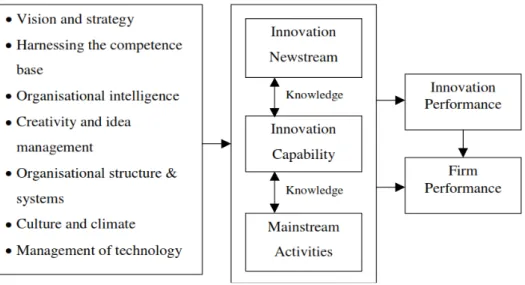
Key for organization’s survival depends on organizational innovation. Innovation capability is very important for the organization in order to obtain a superior innovation performance. High innovation performance will only be achieved by an organization that has a great innovation capability (Tamer Cavusgil et al., 2003). Lawson and Samson, (2001) defined innovation capability as the ability of organizations to transform knowledge and ideas into new products, processes and systems continuously. Furthermore, Lawson and Samson (2001) developed innovation capability model and innovation success. This model assumes that the organization's primary competitive strategy is to focus on innovation and innovation output. Innovation capability within the organization is a key mechanism to stimulate measure and strengthen innovation. There are seven main elements relevant to the innovation capability that is used to form the innovation capability as shown in Figure 1. They are; vision and strategy, harnessing the competence base, organizational intelligence, creativity and idea management, organizational structure and system, culture and climate, and management of technology.
62
When organizations innovate through new activities, it will provide the best value to customers. Innovation will drive organizations to sustain competitive advantage (Weerawardena & Coote, 2001). Thus, innovation is primarily the search for profitability and sustainable development to face global competitiveness (Cardeiro & Vieria (2012). Organization’s awareness to develop and invest explicitly in innovation capability aspects individually and collectively will create greater possibilities for organizations to obtain continuous innovation as a driver of organization performance (Lawson & Samson, 2001).
KNOWLEDGE SHARING IN INNOVATION CAPABILITY
The relationship between knowledge management and innovation capability provides a view of how an organization can keep their insights to improve their innovation capability (Mehrabani & Shajari, 2012). To create innovation in an organization is not an easy task. However, organizations who foster knowledge management practices will achieve the creation of innovation (Jiménez et al., 2014). In this term, knowledge sharing is inherent in knowledge management. It is the foundation of organizational renewal to obtain innovation capability. Many organizations recognize that knowledge sharing will be able to improve the performance of innovation to produce greater part of new ideas and opinions (Nisula & Kianto, 2013; Long et al., 2012). Knowledge sharing has been presumed as the practice which is the way to achieve innovation (Kamașak & Bulutlar, 2010; Wang and Noe, 2010; Hu and Randel, 2014; Hu et al., 2009; Rivera-Vazquez et al., 2009). Knowledge sharing as an organizational resource can generate innovation in the form of products, services, processes, technologies or business models which are the result of the addition of new knowledge (Sáenz et al., 2012). Thus, knowledge sharing is an activity for increasing new knowledge to improve innovation capability (Senduk, 2014, Yesil et al., 2013). It should be presumed that knowledge sharing practice within the organization will upgrade innovation performance through innovation capability (Yesil, et al., 2013). Communication between individual based knowledge sharing will enhance and extend the capabilities, capacity, knowledge and experience that fosters individual to find new ways to more innovative capacity in solving the problems (Sa'enz et al., 2012). Therefore, knowledge sharing can be helpful in the development of value and speed of innovation (Zohoori et al., 2013).
DISCUSSION AND CONCLUSION
Managing innovation aims to encourage the creation of new knowledge and convert the knowledge into a new form of processes, technologies and products (Brătianu, 2011). Individual factor becomes an important aspect due to it has a role to determine whether the practice of knowledge sharing will work or not. Therefore, to overcome knowledge sharing barriers in term of motivational problem, it is important to recognize what drives an inspiration, so that individual is willing to share knowledge (Christensen, 2005). Knowledge sharing practices will increase if the individual has a positive viewpoint and attitude towards sharing knowledge. Additionally, if
63
employees believe that their abilities can contribute to the improvement of organizational performance, individual will tend to practice knowledge sharing. Therefore, organizations should give attention to the condition that can trigger the positive attitude on knowledge sharing behavior (Bock & Kim, 2001).
When knowledge sharing is not part of an organizational culture, it can create barriers to the success of knowledge sharing (McDermott & O'dell, 2001; Bureš, 2003; Riege, 2005). Organizations that inculcate and enrich knowledge sharing culture will create organizational innovation (Long et al., 2012). In order to improve organizational performance, individual in the organization should be directed effectively to better identify and empower their knowledge. In this case, knowledge sharing enablers can be attributed to gaining an advantage through innovation capability. Therefore, managers can utilize the enablers to empower the behavior of individual for sharing knowledge (Sliat & Alnsour, 2013).
As a conclusion, knowledge sharing plays an important role in innovation capability. Innovation capability can be enhanced by sharing knowledge because it will renew the innovation performance. Individual factor becomes an important aspect due to it has a role to determine whether the practice of knowledge sharing will work or not. Besides that, the appropriate culture is very important to the success of knowledge sharing practices and in turn to organizational innovation. Therefore, to be successful in knowledge sharing practice, organization must have a strong culture of sharing knowledge. A strong culture can build individual motivation due to it will be able to overcome barriers in practice knowledge sharing. Therefore, knowledge sharing culture is crucial for organization innovation capability. When knowledge sharing culture can be cultivated, innovation capability will also be increased.
64
REFERENCES
Amayah, A. T. (2013). Determinants of knowledge sharing in a public sector organization. Journal of Knowledge Management, 17(3), 454-471.
Brătianu, C. (2011). Barriers in Innovation and Knowledge Management in the
Romanian. Management & Marketing, 6(4), 515–528.
Bock, G. W., & Kim, Y. G. (2001). Breaking the myths of rewards: An exploratory study of attitudes about knowledge sharing. Pacis 2001 proceedings, 78.
Bureš, V. (2003). Cultural barriers in knowledge sharing. E+M Economics and Management, 6, 57-62.
Carneiro, A. (2000). How does knowledge management influence innovation and competitiveness? Journal of Knowledge Management, 4(2), 87–98.
Cordeiro, A., & Vieira, F. (2012). Barriers to innovation amongst small and medium-sized enterprises (SMEs) in portugal. In Proceedings of the 7th European Conference on Innovation and Entrepreneurship: ECIE (p. 97). Academic Conferences Limited
Christensen, P. H. (2005). Facilitating knowledge sharing : A conceptual framework. Available at SSRN 982071.
Connelly, C. E & Kelloway, E. K. (2003). Predictors of employees’ perceptions of knowledge sharing cultures. Leadership and Organization Development Journal, 24(5/6): 294-301. Leadership and Organization Development Journal, 24(5/6): 294-301.
Hu, M. L. M., Horng, J. S., & Sun, Y. H. C. (2009). Hospitality teams: Knowledge sharing and service innovation performance. Tourism Management, 30(1), 41-50. Hu, L., & Randel, A. E. (2014). Knowledge sharing in teams: social capital, extrinsic incentives, and team innovation. Group & Organization Management, 39(2), 213–243.
Hoarau, H., & Kline, C. (2014). Science and industry: Sharing knowledge for innovation. Annals of Tourism Research, 46, 44-61.
Hoegl, M., Parboteeah, K. P., & Munson, C. L. (2003). Team‐level antecedents of individuals' knowledge networks. Decision Sciences, 34(4), 741-770.
Hong, D., Suh, E., & Koo, C. (2011). Developing strategies for overcoming barriers to knowledge sharing based on conversational knowledge management: A case study of a financial company. Expert Systems with Applications, 38(12), 14417– 14427.
65
Jiménez-Jiménez, D., Martínez-Costa, M., & Sanz-Valle, R. (2014). Knowledge management practices for innovation: a multinational corporation’s perspective. Journal of Knowledge Management, 18(5), 905–918.
Johnson, J. D. (2001). Success in innovation implementation. Journal of Communication Management, 5(4), 341–359.
Kaewchur, O., Anussornnitisarn, P., & Phusavat, K. (2013). Mediating role of knowledge sharing on information technology and innovation. In Proceedings of 2013 International Conference on Technology Innovation and Industrial Management (pp. 29-31).
Kamașak, R., & Bulutlar, F. (2010). The influence of knowledge sharing on
innovation. European Business Revies, 22(3).
Lawson, B., & Samson, D. (2001). Developing innovation capability in
organisations : a Dynamic Capabilities Approach. International Journal of
Innovation Management, 5(3), 377–400.
Lin, H. F. (2007a). Knowledge sharing and firm innovation capability: an empirical study. International Journal of manpower, 28(3/4), 315-332.
Lin, C. P. (2007b). To share or not to share: modeling knowledge sharing using exchange ideology as a moderator. Personnel Review, 36(3), 457-475.
Liu, Y., & Phillips, J. S. (2011). Examining the antecedents of knowledge sharing in facilitating team innovativeness from a multilevel perspective. International Journal of Information Management, 31(1), 44–52.
Long, C. S., Ghazali, N. I., Rasli., A., & Heng, L. H. (2012). The Relationship between Knowledge Sharing Culture and Innovation Capability: A Proposed Model. Journal of Basic and Applied Scientific Research, 2(9), 9558-9562. Mat, N., Yaacob, N.A., & Melhem, S.B. (2016). Knowledge sharing effect on HRM
practices and organisational innovation among Malaysia’s Four and Five Star Hotels, International Business Management, 10(16), 3580-3590.
Mehrabani, S. E., & Shajari, M. (2012). Knowledge management and innovation capacity. Journal of Management Research, 4(2), 164.
McDermott, R., & O'dell, C. (2001). Overcoming cultural barriers to sharing knowledge. Journal of knowledge management, 5(1), 76-85.
Nisula, A. M., & Kianto, A. (2013). Evaluating and developing innovation capabilities with a structured method. Interdisciplinary Journal of Information, Knowledge, and Management, 8, 59–82.
O’Connor, A., Roos, G., & Vickers-Willis, T. (2007). Evaluating an Australian public policy organization’s innovation capacity. European Journal of Innovation Management, 10(4), 532–558.
66
Ofori, D. (2015). Innovation and knowledge sharing: a new competitive advantage in the mobile telecommunication industry in Ghana. Science Journal of Business and Management, 3(5), 157.
Paulin, D., & Suneson, K. (2012). Knowledge Transfer, Knowledge Sharing and Knowledge Barriers – Three Blurry Terms in KM. Electronic Journal of Knowledge Management, 10(1), 81–91.
Rahab, Sulistyandari & Sudjono (2011), The development of innovation capability of small medium enterprises through knowledge sharing process: an empirical study of Indonesian creative industry. International Journal of Business and Social Science, 2(21), 112-123.
Riege, A. (2005). Three‐dozen knowledge‐sharing barriers managers must consider. Journal of Knowledge Management, 9(3), 18–35.
Rivera‐Vazquez, J. C., Ortiz‐Fournier, L. V., & Rogelio Flores, F. (2009). Overcoming cultural barriers for innovation and knowledge sharing. Journal of Knowledge Management, 13(5), 257–270.
Ross, A. (2015). Establishing a system for innovation in a professional services firm. Business Horizons.
Sáenz, J., Aramburu, N., & Blanco, C. E. (2012). Knowledge sharing and innovation in Spanish and Colombian high‐tech firms. Journal of Knowledge Management, 16(6), 919–933.
Šajeva, S. (2014). Encouraging knowledge sharing among employees: How reward matters. Procedia - Social and Behavioral Sciences, 156(April), 130–134.
Senduk, V. A. (2014). Does knowledge sharing not make effect to innovation capabilities ? International Journal of Business and Management Invention, 3(12), 18–25.
Sliat, R. K., & Alnsour, M. S. (2013). Business Innovation through Knowledge Sharing: An Applied Study on the Jordanian Mobile Telecommunications Sector'. European Journal of Business and Management, 5(18).
Song, Z. H., Fan, L. B., & Chen, S. (2008, September). Knowledge sharing and innovation capability: Does absorptive capacity function as a mediator?. In 2008 International Conference on Management Science and Engineering 15th Annual Conference Proceedings (971-976).
Syed-Ikhsan, S.O.S. & Rowland, F. (2004). Knowledge management in a public
organization: a study on the relationship between organizational elements and the performance of knowledge transfer. Journal of knowledge management, 8(2), 95-111.
Tan, C. L., & Nasurdin, A. M. (2011). Human Resource Management practices and organizational innovation: Assessing the mediating role of knowledge
67
management effectiveness. Electronic Journal of Knowledge Management, 9(2), 155–167.
Taylor, W. A., & Wright, G. H. (2004). Organizational readiness for successful knowledge sharing: Challenges for public sector managers. Information resources management journal, 17(2), 22.
Van den Hooff, B., & Huysman, M. (2009). Managing knowledge sharing: Emergent and engineering approaches. Information & Management, 46(1), 1–8. Wang, S., & Noe, R. A. (2010). Knowledge sharing: A review and directions for
future research. Human Resource Management Review, 20(2), 115–131.
Weerawardena, J., & Coote, L. (2001). An empirical investigation into entrepreneurship and organizational innovation-based competitive strategy. Journal of Research in Marketing & Entrepreneurship, 3(1), 51–70.
Yeşil, S., Koska, A., & Büyükbeşe, T. (2013). Knowledge sharing process, innovation
capability and innovation performance: an empirical study. Procedia - Social and Behavioral Sciences, 75, 217–225.
Zohoori, M., Mohseni, S., & Samadi, B. (2013). The Relationship between Knowledge Sharing and Innovation in Electronic Industry of Iran. Journal of Small Business and Entrepreneurship Development, 1(June), 26–33.