Version: Accepted Version
Article:
Van Aswegen, J., Hyatt, D. and Goodley, D. (2019) A critical discourse problematization framework for (disability) policy analysis: "good cop/bad cop" strategy. Qualitative Research Journal. ISSN 1443-9883
https://doi.org/10.1108/QRJ-12-2018-0004
© 2019 Emerald. This is an author-produced version of a paper subsequently published in Qualitative Research Journal. Uploaded in accordance with the publisher's self-archiving policy.
[email protected] https://eprints.whiterose.ac.uk/ Reuse
Items deposited in White Rose Research Online are protected by copyright, with all rights reserved unless indicated otherwise. They may be downloaded and/or printed for private study, or other acts as permitted by national copyright laws. The publisher or other rights holders may allow further reproduction and re-use of the full text version. This is indicated by the licence information on the White Rose Research Online record for the item.
Takedown
If you consider content in White Rose Research Online to be in breach of UK law, please notify us by
Qualitative Research Journal
A Critical Discourse Problematization Framework for(Disability) Policy Analysis: 'Good Cop/Bad Cop Strategy' Journal: Qualitative Research Journal
Manuscript ID QRJ-12-2018-0004.R1 Manuscript Type: Research Paper
Keywords: Qualitative Research Methods, Critical Discourse Analysis, Policy Problematisations, Critical Policy Analysis, Social Policy, Disability Policy
Qualitative Research Journal
Cop/Bad Cop Strategy'
--Manuscript Draft--Additional Information:Question Response
Purpose (word limit 100) This paper presents a composite framework for critical policy analysis drawing from discourse analysis and poststructuralist analysis. Drawing on an interpretive paradigm (Yanow, 2014), this paper provides a thick description (Geertz, 1973) of the processes involved in the application of these tools in a critical policy analysis project, focusing on disability policy within the Irish context. Methodologically, this is a resourceful cross-fertilization of analytical tools with which to interrogate policy, highlighting its potential within critical disability policy analysis.
Design/methodology/approach (limit 100
words) Merging a critical discourse analysis framework and a policy problematizationapproach, the combination of tools presented here, along with their associated processes, is referred to as the Critical Discourse Problematization Framework. Findings (limit 100 words) Potentially, the framework can also be employed across a number of cognate policy
fields including education, welfare, and social justice. Research implications/limitations (limit
100 words) (optional)
Practical implications (limit 100 words)
(optional) The value of this paper lies in its potential to be used within analytical practice in thefield of critical (disability) policy work by offering an evaluation of the analytical tools and theoretical framework deployed and modelled across an entire research process. Social implications (limit 100 words)
(optional) Potentially, the framework can also be employed across a number of cognate policyfields including education, welfare, and social justice Originality (limit 100 words) The analytical framework presented here is a methodically innovative approach to the
study of policy analysis, marrying two distinct analytical tools to form a composite framework for the study of policy text.
Please enter the Word Count of your
manuscript 5374
Please confirm that you are the sole author OR have listed all other co-authors and have their approval to submit this manuscript by checking the box below.
All co-authors have been listed and approve of this submission
Is this a submission for a special issue? No
Manuscript Number: QRJ-D-18-00022
Full Title: A Critical Discourse Problematization Framework for (Disability) Policy Analysis: 'Good Cop/Bad Cop Strategy'
Article Type: Research Paper
Section/Category: Research Paper Order of Authors Secondary Information:
3 4 5 6 7 8 9 10 11 12 13 14 15 16 17 18 19 20 21 22 23 24 25 26 27 28 29 30 31 32 33 34 35 36 37 38 39 40 41 42 43 44 45 46 47 48 49 50 51 52 53 54 55 56
Qualitative Research Journal
A Critical Discourse Problematization Framework for
(Disability) Policy Analysis: ‘Good Cop/Bad Cop Strategy’
3 4 5 6 7 8 9 10 11 12 13 14 15 16 17 18 19 20 21 22 23 24 25 26 27 28 29 30 31 32 33 34 35 36 37 38 39 40 41 42 43 44 45 46 47 48 49 50 51 52 53 54 55 56 57 58 59 2 3 4 5 6 7 8 9 10 11 12 13 14 15 16 17 18 19 20 21 22 23 24 25 26 27 28 29 30 31 32 33 34 35 36 37 38 39 40 41 42 43 44 45 46 47 48 49 50 51 52 53 54 55
Qualitative Research Journal
Abstract
This paper presents a composite framework for critical policy analysis drawing from discourse analysis and poststructuralist analysis. Merging a critical discourse analysis framework and a policy problematization approach, the combination of tools presented here, along with their associated processes, is referred to as the Critical Discourse Problematization Framework. The rationale for this paper is to advance analytical practice in the field of critical disability policy work by offering an evaluation of the analytical tools and theoretical framework deployed and modelled across an entire research process. Drawing on an interpretive paradigm (Yanow, 2014), this paper provides a thick description (Geertz, 1973) of the processes involved in the application of these tools in a critical policy analysis project, focusing on disability policy within the Irish context. Methodologically, this is a resourceful cross-fertilization of analytical tools with which to interrogate policy, highlighting its potential within critical disability policy analysis. Potentially, the framework can also be employed across a number of cognate policy fields including education, welfare, and social justice.
Keywords: Critical Discourse Analysis; Critical Policy Analysis; Policy Problematization; Disability Policy.
4 5 6 7 8 9 10 11 12 13 14 15 16 17 18 19 20 21 22 23 24 25 26 27 28 29 30 31 32 33 34 35 36 37 38 39 40 41 42 43 44 45 46 47 48 49 50 51 52 53 54 55 56 57 58 59 3 4 5 6 7 8 9 10 11 12 13 14 15 16 17 18 19 20 21 22 23 24 25 26 27 28 29 30 31 32 33 34 35 36 37 38 39 40 41 42 43 44 45 46 47 48 49 50 51 52 53 54 55
Qualitative Research Journal
Introduction
This paper proposes an innovative method for policy analysis, the Critical Discourse
Problematization Framework (CDPF), adding to the growing contribution of discursive and problematization approaches to the critical study of policy. Our interest in this area of study has been sparked by recent calls for innovation in qualitative research methodologies (Taylor & Coffey, 2009) and 'Author, (2013a), Details Withheld for Peer Review' concern at the dearth of practical approaches to assist those engaged in policy analysis.
Innovation in qualitative research has increasingly been seen as a valuable and necessary aspect of maintaining the sustainability of social science within global knowledge economies. Moreover, it is regarded as a matter of survival in terms of the capacity of future academic endeavors to (re)produce this knowledge (Taylor & Coffey, 2008). As we now inhabit a world characterised by new textual formations and technologies, emerging discourses and new forms of identity, contemporary critical discourse analysis (CDA) researchers must look to ‘new, hybrid blends of analytic techniques and social theories’ (Luke, 2002: 98).
Innovation in this sense is not necessarily limited to the creation of new methods, but can equally be applied to the adaption and hybridization of established research methods in the construction of new designs, concepts and approaches (Taylor & Coffey, 2008); in other words ‘selecting good ideas and exploiting their potential’ (Taylor & Coffey, 2009: 526). Following Taylor and Coffey’s proposal, the proposed heuristic toolkit in this paper is constructed through a combination of 'Author, (2013b) Details Withheld for Peer Review' Critical Higher Education
4 5 6 7 8 9 10 11 12 13 14 15 16 17 18 19 20 21 22 23 24 25 26 27 28 29 30 31 32 33 34 35 36 37 38 39 40 41 42 43 44 45 46 47 48 49 50 51 52 53 54 55 56 57 58 59 3 4 5 6 7 8 9 10 11 12 13 14 15 16 17 18 19 20 21 22 23 24 25 26 27 28 29 30 31 32 33 34 35 36 37 38 39 40 41 42 43 44 45 46 47 48 49 50 51 52 53 54 55
Qualitative Research Journal
Policy Discourse Analysis (CHEPDA) Framework and Bacchi’s (2009) What’s the Problem Represented to Be (WPR) approach.
'Author, (2013a) Details Withheld for Peer Review' identifies policy analysis as a key element of doctoral programmes and proposes a framework for CDA in response to concerns regarding a dearth of practical approaches to do so. Extending the CHEPDA Framework (2013b), this study has the potential to illuminate the policy analysis process through the practical application of an innovative approach to the study of policy text; the aim being to showcase CDPF at work in the interests of enhancing research capacity (Taylor and Coffey, 2009).
The marriage of CDA and a policy problematization approach is a particularly beneficial hybrid, bringing together complimentary approaches to policy analysis to achieve the dual objectives of policy analysis and critique. “Critique” from this perspective is understood from a Foucauldian perspective—not being concerned about evaluating whether a policy is good or bad—but on the type of assumptions, accepted norms and frameworks of thinking upon which the accepted policy practices are based (Bacchi, 2009: xv). While a policy problematization approach allows the analyst to identify and problematize policy constructions, discourse analysis adds other dimensions in terms of the social, the cultural and the cognitive. Likewise, CDA on its own does not address policy problematization. Thus the combined approach offers a
comprehensive, symbiotic framework through which to undertake the critical analysis of policy.
Critical Qualitative Inquiry Community
Denzin (2009:142) identifies at least four pedagogical stances within the critical qualitative inquiry community: (1) discipline-based qualitative research focused on accumulating
4 5 6 7 8 9 10 11 12 13 14 15 16 17 18 19 20 21 22 23 24 25 26 27 28 29 30 31 32 33 34 35 36 37 38 39 40 41 42 43 44 45 46 47 48 49 50 51 52 53 54 55 56 57 58 59 3 4 5 6 7 8 9 10 11 12 13 14 15 16 17 18 19 20 21 22 23 24 25 26 27 28 29 30 31 32 33 34 35 36 37 38 39 40 41 42 43 44 45 46 47 48 49 50 51 52 53 54 55
Qualitative Research Journal
fundamental knowledge about social processes and institutions; (2) qualitative policy research aimed at having an impact on current programs and practices; and (3) public intellectuals, public social scientists, and cultural critics who use qualitative inquiry and interpretive work to address current issues and crises in the public arena. The fourth stance, which is the focus of much poststructural analytical work, is that which this study is concerned with—critical qualitative approaches, which have as their core aim the disruption and destabilization of public policy and social discourses. In essence, poststructural policy analysis involves a process of interrogating the embedded assumptions within policies with the objective of challenging the conceptual premises in which they are grounded.
Central to the CDPF Framework proposed here is Ball’s conceptualization of policy as discourse (Ball, 2015: 1993). From this perspective, policy is not a fixed rational entity but instead ‘is a social process, a relational process, a temporal process, a discursive process. It’s a process invested with power relations, it’s a political process’ (Ball in Mainardes, 2015: 184). Government enjoys a privileged position, given that its understandings “stick”—that is, its version of problems (and solutions) are published and implemented, taking on ‘lives of their own…they exist in the real’ (Bacchi, 2009: 33).
Policy subjects, from this perspective are not considered individuals with fixed identities formed through self-directed agency; rather, they are understood as the effects of practices, which themselves are influenced by the effects of power and discourse. Power here is
understood as ‘the ability of actors (whether individual or collective) to “have an effect” upon the context which defines the range of possibilities of others’ (Hay, 2002: 185).
4 5 6 7 8 9 10 11 12 13 14 15 16 17 18 19 20 21 22 23 24 25 26 27 28 29 30 31 32 33 34 35 36 37 38 39 40 41 42 43 44 45 46 47 48 49 50 51 52 53 54 55 56 57 58 59 3 4 5 6 7 8 9 10 11 12 13 14 15 16 17 18 19 20 21 22 23 24 25 26 27 28 29 30 31 32 33 34 35 36 37 38 39 40 41 42 43 44 45 46 47 48 49 50 51 52 53 54 55
Qualitative Research Journal
Critical Discourse Analysis
CDA draws on systemic functional linguistics’ approach to language as a social semiotic and post-structural analyses of power to investigate the way language use affects the social and the cultural (Fairclough, 1992). Wodak & Meyer argue its aim is to uncloak 'opaque as
well 'opaque as well as transparent structural relationships of domination, discrimination, power and control as manifested in language' as transparent structural relationships of domination, discrimination, power and control as manifested in language' (Wodak & Meyer, 2009: 10).
Incorporating a multiplicity of methods, CDA is a problem-oriented, interdisciplinary, social science research approach, bringing together social theory and textual analysis (Author, 2013b) 'Details Withheld for Peer Review'. Focusing on discourse alone however, is not sufficient for critically examining policy; it must be accompanied by a consideration of how discourse
functions socially, politically, culturally within the policy context. The theoretical lens deployed in this study is a critical disabilities studies perspective ('Author, Details Withheld for Peer Review' 2014). It is through this perspective that the discourse within CES is viewed and interrogated.
CDA
and Policy Analysis
CDA recognises that the prioritisation and presentation of policy issues are the result of power relations, multiple contestations and conflicts—in other words, ‘what is real’ depends on what is ‘presented as real’ by those in positions of power (Bacchi, 2009; Author, 2013b 'Author, Details Withheld for Peer Review'). At its core, CDA seeks to engage in ways of criticising and de-stabilising prevailing and normative discourses as a means of questioning social, economic and political power. This, by its nature, is a political endeavour speaking to the ‘need to disrupt and
4 5 6 7 8 9 10 11 12 13 14 15 16 17 18 19 20 21 22 23 24 25 26 27 28 29 30 31 32 33 34 35 36 37 38 39 40 41 42 43 44 45 46 47 48 49 50 51 52 53 54 55 56 57 58 59 3 4 5 6 7 8 9 10 11 12 13 14 15 16 17 18 19 20 21 22 23 24 25 26 27 28 29 30 31 32 33 34 35 36 37 38 39 40 41 42 43 44 45 46 47 48 49 50 51 52 53 54 55
Qualitative Research Journal
denaturalize the workings of power and knowledge, and to query existing distributions of material and discourse resources among human communities’ (Luke, 2004: 150).
A CDA approach allows the researcher to undertake a detailed systematic examination of the relationship between language and other social processes and the role of language within power relations: ‘researchers can go beyond speculation and demonstrate how policy texts work’ (Taylor, 2004). As Gale and Molla (2015) observe, in the policy making process, policy makers use specific discursive constructions to portray their agendas, the seriousness of the problem and the urgency of the solutions proposed.
The appropriateness and potential of CDA for the critical study of policy text has been previously highlighted (Fairclough, 2013; Grue, 2011; Liasidou, 2011). Motivated by a Foucauldian (1972) approach towards power, language and society, these scholars attempt to expose power relations, ideology and social injustice in a variety of discourses of powerful political, economic and social institutions and illuminating the normative basis of their
arguments. In this regard, it is an explicitly critical approach, its central tenet being to reveal the normative discursive construction of power relations embedded within policy discourses and in its commitment to progressive social change (Taylor 2004); as Luke argues ‘it is this will
towards the normative that puts the “critical”in critical discourse analysis’(2004: 150).
Liasidou in particular has demonstrated the potential of this approach to the critique of disability policy (2008; 2011). Due to a climate of deepening neoliberal and economic imperatives which has seen the most vulnerable within Irish society bearing the burden of austerity cuts, coupled with Ireland’s delay in ratifying the United Nations Convention on the Rights of People with Disabilities, the rationale for undertaking a critical analysis of Ireland’s disability policy becomes increasingly urgent. Inspired by Liasidou’s contribution to the
4 5 6 7 8 9 10 11 12 13 14 15 16 17 18 19 20 21 22 23 24 25 26 27 28 29 30 31 32 33 34 35 36 37 38 39 40 41 42 43 44 45 46 47 48 49 50 51 52 53 54 55 56 57 58 59 3 4 5 6 7 8 9 10 11 12 13 14 15 16 17 18 19 20 21 22 23 24 25 26 27 28 29 30 31 32 33 34 35 36 37 38 39 40 41 42 43 44 45 46 47 48 49 50 51 52 53 54 55
Qualitative Research Journal
literature, this study’s focus is on the recently published Comprehensive Employment Strategy for People with Disabilities 2015 – 2014 Ireland (Government of Ireland, 2015).
Policy Problematization
Policy problematization offers a critical approach to the study of policy. Problematization is based upon the premise that rather than policies reacting to “problems” to be solved, they in fact play a significant role in shaping or constituting the "problem”. However, this does not suggest misrepresentation or malign intent, but rather, recognises that all policies by their nature, carry implicit representations of problems that bring with them implications for how people are treated within society, how we are conditioned to understand the social world and ourselves as citizens. Thus, the main goal of studying problematizations, ‘is to dismantle taken-for-granted fixed essences and show how they have come to be’ (Bacchi, 2012: 2).
Drawing, as Bacchi (2012) does, on a Foucauldian understanding of this concept, problematization here is understood as a strategy for developing a critical consciousness,
whereby taken for granted “truths” are questioned and challenged in order to unearth the thinking that constitutes policy problems. It involves of critical inquiry into the way policy issues are cast and framed as “problems” to be solved. Bacchi distinguishes between a problematization as a noun and to problematize as a verb. The former refers to the way in which an issue is
represented or put forward by policy makers as the “problem” to be addressed; the latter refers to the process of interrogating the “problem representations” themselves.
The CHEPDA
Framework
Although developed for the purpose of critical analysis of higher education policy, the CHEPDA Framework (2013b), is transdisciplinary in nature, offering a purposeful approach for engaging
4 5 6 7 8 9 10 11 12 13 14 15 16 17 18 19 20 21 22 23 24 25 26 27 28 29 30 31 32 33 34 35 36 37 38 39 40 41 42 43 44 45 46 47 48 49 50 51 52 53 54 55 56 57 58 59 3 4 5 6 7 8 9 10 11 12 13 14 15 16 17 18 19 20 21 22 23 24 25 26 27 28 29 30 31 32 33 34 35 36 37 38 39 40 41 42 43 44 45 46 47 48 49 50 51 52 53 54 55
Qualitative Research Journal
in critical policy study, regardless of the policy domain as this study demonstrates. Theoretically, the framework aligns with Fairclough’s (1995) critical discourse analysis approach focusing on the relationship of language to power. As Codd (1988:243) notes
The power that is exercised through discourse is a form of power which permeates the deepest recesses of civil society and provides the material conditions in which individuals are produced both as subjects and as objects.
The CHEPDA Framework does not purport to offer a prescriptive universal approach to policy analysis, nor is it intended to be a prescriptive tool. It invites researchers to take only those aspects of the frame which they find useful for their engagement with policy in accordance with their agenda and the context of the policy being examined. In this respect, the framework is particularly valuable to policy analysis that aims to bring about social transformation and change. The process of bringing about such transformations is discursive, ‘where discourses are viewed as socially and culturally formed’ ('Author, (2013a: 837), Details Withheld for Peer Review'. The framework’s utility is demonstrated by the fact that it has recently been deployed in a number of critical policy studies (Mooney Simmie, 2014; Lucas, 2014; Wiggan 2018). The CHEPDA Framework comprises two elements: contextualisation and deconstruction.
Contextualising CES
Linking the discourse of the broader social and political context, provides an insight into the processes of social and cultural change taking place through a synchronic context (at a specific moment in time) , and over the course of a diachronically relevant era (over time). Thus, the relationship between historical events and their and social contexts can be seen as an
‘unpredictable and fluid tangle requiring a critical analysis that delves beneath the chronology of policy as event’ (Peters, 2007: 100).
4 5 6 7 8 9 10 11 12 13 14 15 16 17 18 19 20 21 22 23 24 25 26 27 28 29 30 31 32 33 34 35 36 37 38 39 40 41 42 43 44 45 46 47 48 49 50 51 52 53 54 55 56 57 58 59 3 4 5 6 7 8 9 10 11 12 13 14 15 16 17 18 19 20 21 22 23 24 25 26 27 28 29 30 31 32 33 34 35 36 37 38 39 40 41 42 43 44 45 46 47 48 49 50 51 52 53 54 55
Qualitative Research Journal
Warrant
Of central importance to this analysis is the rhetorical structuring, which argumentation theory calls ‘the warrant’. Warrant is understood as ‘the justification, authority, or reasonable grounds …established for some act course of action statement or belief’ ('Author, 2013a: 50-51Details Withheld for Peer Review',). Drawing on Cochran-Smith and Fries (2001) three categories of warrant are identified: evidentiary, accountability and political. Evidentiary warrant refers to a justification on the basis of the perceived credibility and trustworthiness of evidence provided, often found in the form of statistics, figures, and forecasts, constructed in such a way as to position the arguments offered as uncontestable. Political warrant on the other hand, is justified by means of the state or public interest; paternalistic or charitable discourses frequently
accompany warrants of this nature, particularly in relation to issues of inclusion and social justice (Liasidou, 2016). A political warrant is often rhetorically linked to an accountability warrant, expressed through concern or pondered consideration for what ‘ought to be done’, sometimes inferring overtly or covertly potential negative outcomes of an alternative approach or indeed, lack thereof (Reyes, 2011).
Deconstruction
This element of the CHEPDA Framework engages directly with the policy text aiming to identity discursive strategies through number of analytical lenses and tools derived from CDA and
Critical Literacy Analysis. Of particular interest is the concept of strategies of legitimation. By Reyes (2011: 783) highlights how strategies of legitimation tend to be used by political leaders to ‘justify their political agenda to maintain or alter the direction of a whole nation’. The CHEPDA Framework, drawing on Van Leeuwen (2008), encompasses four modes of deconstruction
4 5 6 7 8 9 10 11 12 13 14 15 16 17 18 19 20 21 22 23 24 25 26 27 28 29 30 31 32 33 34 35 36 37 38 39 40 41 42 43 44 45 46 47 48 49 50 51 52 53 54 55 56 57 58 59 3 4 5 6 7 8 9 10 11 12 13 14 15 16 17 18 19 20 21 22 23 24 25 26 27 28 29 30 31 32 33 34 35 36 37 38 39 40 41 42 43 44 45 46 47 48 49 50 51 52 53 54 55
Qualitative Research Journal
through legitimation: authorisation; rationalisation; moral evaluation and mythopoesis, each of which can be seen at work throughout CES.
Bacchi’s WPR Approach
The WPR approach (Bacchi, 2009) can be described as a particular method for the critical study of policy. Two propositions underpin this approach: firstly, rather than evaluate policies for their ability to ‘solve’ problems, WPR encourages the study of how policies construct problems (Bacchi, 2009: ix-xvii). On this premise the WPR approach posits that by reading backwards from any policy solution offered, it is possible to capture what the ‘problem’ is represented—to be (Bacchi, 2009: x-xi). For Bacchi ‘every policy or policy proposal is a prescriptive text, setting out a practice that relies on a particular problematization’ (2012: 4). Her approach is based on the premise that proposed policy solutions can reveal how the problem has been constituted and hence the mental framework that informs the problematization formation. Put another way, ‘policy meanings, values and assumptions are constituted in texts and discourses’ (Gale & Molla, 2015: 811). Bacchi’s post-structuralist approach allows the policy analyst to examine how the use of language and the discourse surrounding a given problem representation affects the way in which the problem is understood, and what possible presuppositions and assumptions therein. The second key proposition is that problematizations are central to the practice of government— to governing (Bacchi 2009: ixxiii).
In contrast to evaluative approaches, the goal of WPR is to probe the premises on which the problem representations stem from demanding the analyst to think deeply about the
assumptions and presuppositions that lodge within and shape policy and the implications that flow from these premises. As Stevens argues: ‘to analyze how issues are framed, then, provides
4 5 6 7 8 9 10 11 12 13 14 15 16 17 18 19 20 21 22 23 24 25 26 27 28 29 30 31 32 33 34 35 36 37 38 39 40 41 42 43 44 45 46 47 48 49 50 51 52 53 54 55 56 57 58 59 3 4 5 6 7 8 9 10 11 12 13 14 15 16 17 18 19 20 21 22 23 24 25 26 27 28 29 30 31 32 33 34 35 36 37 38 39 40 41 42 43 44 45 46 47 48 49 50 51 52 53 54 55
Qualitative Research Journal
a more engaged and critical reading of the word and the world (Freire, 1970) than in cataloging which policies we like and which we don’t’ (2008: 71).WPR provides six guiding questions
which enable analysis at this level of investigating the construction of policy problems1 (Bacchi 2009: 2).
1. What is the problem represented to be in CES?
2. What presuppositions or assumptions underlie this representation of the problem? 3. How has this representation of the problem come about?
4. What is left unproblematic in this problem representation? Where are the silences? Can the problem be thought about differently?
5. What effects are produced by this representation of the problem?
6. Where or how has this representation of the problem been produced disseminated and defended? How could it be questioned, disrupted and replaced?
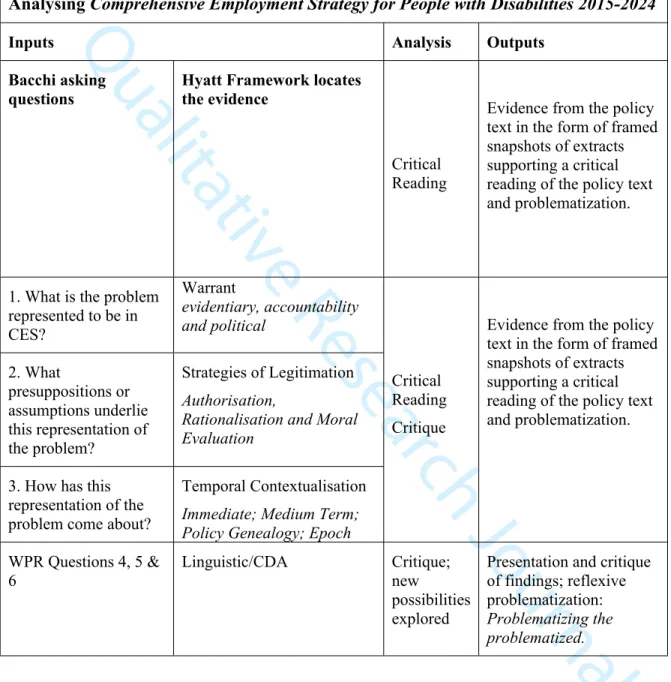
In essence, questions 1-3 provide for a critical reading of the policy problematization, while questions 4-6 allow the problematization to be problematized and challenged.
Applying CDPF
The Comprehensive Employment Strategy for People with Disabilities 2015-2024 (Government of Ireland, 2015; hereinafter called CES) was launched into the Irish disability policy landscape in October 2015. CES represents a significant policy event in Irish disability policy making, ‘affording the first opportunity in over a decade since the publication of the National Disability Strategy (Government of Ireland, 2004) and the Education of Persons with Special Educational Needs (EPSEN) Act (Oireachtas, 2004), within which to examine the State’s conceptualisation of ‘disability inclusion’’ ('Author, Details Withheld for Peer Review', 2016: 9). Following Bacchi, the aim here is not to assume that just because a policy has been published that this is to
4 5 6 7 8 9 10 11 12 13 14 15 16 17 18 19 20 21 22 23 24 25 26 27 28 29 30 31 32 33 34 35 36 37 38 39 40 41 42 43 44 45 46 47 48 49 50 51 52 53 54 55 56 57 58 59 3 4 5 6 7 8 9 10 11 12 13 14 15 16 17 18 19 20 21 22 23 24 25 26 27 28 29 30 31 32 33 34 35 36 37 38 39 40 41 42 43 44 45 46 47 48 49 50 51 52 53 54 55
Qualitative Research Journal
be accepted and adopted without critique. Therefore this study proposes to ‘conduct an interview’ with the policy on its journey towards implementation, using the CDPF.
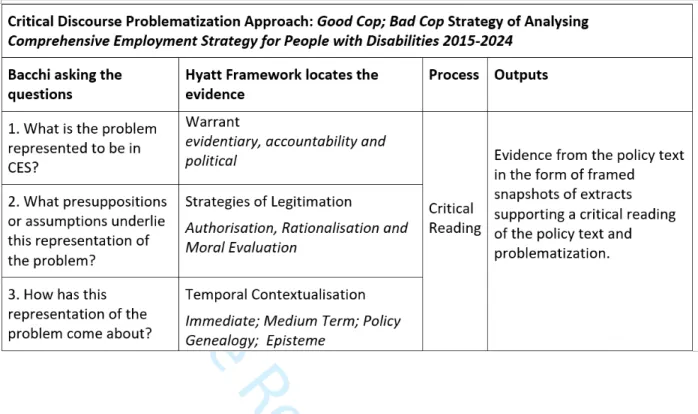
While a full analysis and critique of the policy is beyond the scope and aim of this paper, the CDPF presented here operates as a interrogatory device in examining and interviewing the policy under study using WPR questions 1-3 in conjunction with 'Author, (2013b), Details Withheld for Peer Review'warrant and strategies of legitimation. Bacchi’s WPR questions one to three are used to undertake a critical reading of the policy, while the CHEPDA Framework works in the background locating and presenting evidence in the form of a series of discursive
snapshots taken from the policy text itself.
The metaphor of snapshot provides a useful conceptualisation with which to present the evidence supporting the critical reading, allowing the researcher to capture moments of the policy event in the form of excerpts taken from the policy text itself, thus affording the opportunity to interrogate the language and discourse therein. Thus, while WPR provides the questions with which to interrogate the policy under study, the CHEPDA Framework affords the means with which to support a critical reading of the policy with documentary evidence. In a sense, the CHEPDA Framework takes the role of the silent partner, responding with evidence to the questions posed by Bacchi. Working as a team of interrogators to achieve the aim of the task of the analytical process, CDPF employs a good cop/ bad cop strategy of investigation: Bacchi asking the tough questions, Author (‘Details Withheld for Peer Review' ) doing the investigative work behind the scenes. Table 1 provides an illustration of how both tools work together in this regard. 4 5 6 7 8 9 10 11 12 13 14 15 16 17 18 19 20 21 22 23 24 25 26 27 28 29 30 31 32 33 34 35 36 37 38 39 40 41 42 43 44 45 46 47 48 49 50 51 52 53 54 55 56 57 58 59 3 4 5 6 7 8 9 10 11 12 13 14 15 16 17 18 19 20 21 22 23 24 25 26 27 28 29 30 31 32 33 34 35 36 37 38 39 40 41 42 43 44 45 46 47 48 49 50 51 52 53 54 55
Qualitative Research Journal
Table 1 The Critical Discourse Problematization Framework
Locating the Problematization through the CDPF
Bacchi’s WPR kick-starts the critical reading of this policy by posing the first question in the interview process: what’s the problem represented to be? Bacchi recommends starting with the policy proposals and working backwards to identify the policy problematization. However, drawing on the CHEPDA Framework with careful attention to the language of justification, it is possible to pinpoint CES’ problematization in the form of three categories of warrant.
4 5 6 7 8 9 10 11 12 13 14 15 16 17 18 19 20 21 22 23 24 25 26 27 28 29 30 31 32 33 34 35 36 37 38 39 40 41 42 43 44 45 46 47 48 49 50 51 52 53 54 55 56 57 58 59 3 4 5 6 7 8 9 10 11 12 13 14 15 16 17 18 19 20 21 22 23 24 25 26 27 28 29 30 31 32 33 34 35 36 37 38 39 40 41 42 43 44 45 46 47 48 49 50 51 52 53 54 55
Qualitative Research Journal
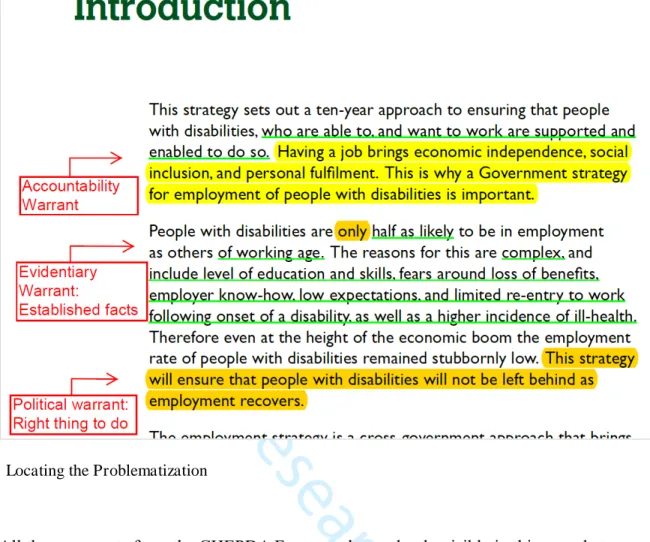
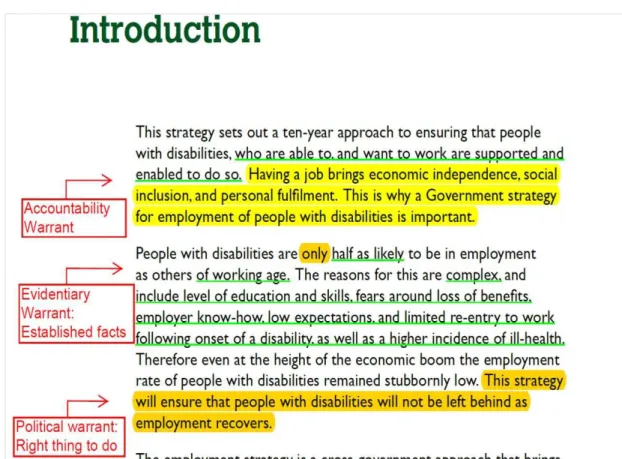
Figure 1 Locating the Problematization
All three warrants from the CHEPDA Framework are clearly visible in this snapshot (Figure 1) taken from the introduction chapter of CES (Government of Ireland, 2015: 5). The accountability warrant is upfront and cuts straight to the point: economic independence, social inclusion, and personal fulfilment are identified as the desirable outcomes justifying this policy’s key proposals. The evidentiary warrant following authoritatively establishes a single troubling fact relating to the participation rates of disabled persons in the workforce; the use of the
modifier ‘only’ here, serving to heighten the impact of the fact. Complex causes of the problem are then offered before the worthy political warrant is presented gallantly based on being the right thing to do: ‘people with disabilities will not be left behind, as the economy recovers’. The discourse of recovery here serves to frame the warrant in paternalistic tones of assurance and
4 5 6 7 8 9 10 11 12 13 14 15 16 17 18 19 20 21 22 23 24 25 26 27 28 29 30 31 32 33 34 35 36 37 38 39 40 41 42 43 44 45 46 47 48 49 50 51 52 53 54 55 56 57 58 59 3 4 5 6 7 8 9 10 11 12 13 14 15 16 17 18 19 20 21 22 23 24 25 26 27 28 29 30 31 32 33 34 35 36 37 38 39 40 41 42 43 44 45 46 47 48 49 50 51 52 53 54 55
Qualitative Research Journal
comfort, activating CES as a gallant and noble rescuer of disabled people. Taken together, the three warrants represent the ‘articulated warrant’ of CES.
Discursively, this is a clearly articulated problematization, framing the problem
effectively with all three warrants in a neat package of problem, evidence and moral obligation, each in turn justifying the proposals set out in the policy.
Question 2: Framing the Assumptions through the CHEPDA Framework
WPR question two requires consideration of the presuppositions or assumptions that underlie this problem representation, drawing on a form of Foucauldian archaeology. This aspect of the analysis looks for what is included, foregrounded, back-grounded and excluded with the aim of unearthing the conceptual logic operating behind the text; in other words the ‘meanings that must be in place in order for a particular problem representation to make sense’ (Bacchi, 2009:5). In the context of CES, question two seeks to interrogate the policy’s ‘linguistic
paraphernalia’ (Liasidou, 2008: 484) for indications and cues as to how disability is understood. The strategies of legitimation direct the study in locating the evidence required to address this question, by examining the ways in which the policy ideas are advanced and justified.
Authorisation and Rationalisation
The legitimising strategies of authorisation are often closely associated to the evidentiary warrant ('Author , 2013b Details Withheld for Peer Review'), both of which can be viewed
contemporaneously in Figure 2; the authorisation strategy building on the already established evidentiary warrant from the introduction chapter.
4 5 6 7 8 9 10 11 12 13 14 15 16 17 18 19 20 21 22 23 24 25 26 27 28 29 30 31 32 33 34 35 36 37 38 39 40 41 42 43 44 45 46 47 48 49 50 51 52 53 54 55 56 57 58 59 3 4 5 6 7 8 9 10 11 12 13 14 15 16 17 18 19 20 21 22 23 24 25 26 27 28 29 30 31 32 33 34 35 36 37 38 39 40 41 42 43 44 45 46 47 48 49 50 51 52 53 54 55
Qualitative Research Journal
Figure 2 Warrant and Strategies of Legitimation
No definition of disability is offered in CES; instead an array of tables, charts and graphs (Government of Ireland, 2015: 25-27) sorting disabled people into categories of impairment and classification of capacity and functionings—the ‘clinical–medical discourses on which the mechanics of the welfare state depend’ (Grue, 2011: 536). The tables and categories exemplify a rational legitimating strategy of ‘precision and exactness’ (Reyes, 2011: 787) mirroring
Foucault’s “bio-power” through the ‘increased ordering of all realms’ (Hook, 2010: 227) whilst assigning to each ‘his “true” name, his “true” place, his “true” body, his “true” disease’
(Foucault, 1977, cited in Graham and Slee, 2008: 285). A quartet of heavyweight disability experts lends an authoritative air to an extensive evidence base (35) supported by a bibliography of professional voices emphasizing health, sickness and chronic illness and claiming to ‘know what works for whom, and when’(66).
4 5 6 7 8 9 10 11 12 13 14 15 16 17 18 19 20 21 22 23 24 25 26 27 28 29 30 31 32 33 34 35 36 37 38 39 40 41 42 43 44 45 46 47 48 49 50 51 52 53 54 55 56 57 58 59 3 4 5 6 7 8 9 10 11 12 13 14 15 16 17 18 19 20 21 22 23 24 25 26 27 28 29 30 31 32 33 34 35 36 37 38 39 40 41 42 43 44 45 46 47 48 49 50 51 52 53 54 55
Qualitative Research Journal
Moral evaluation
The legitimating strategy of moral evaluation manifests itself in this policy by means of a
charitable and altruistic discourse heavily couched in a comforting paternalistic overtones. Moral evaluation as a mode of legitimation, works by way of an ‘appeal to a value system around what is good or desirable’ ('Author, Details Withheld for Peer Review', 2013a, p. 53). CES (Government of Ireland, 2015), having firmly positioned itself within a backdrop of inclusion, applauds itself as a ‘significant achievement’ requiring a ‘concerted effort’ ‘in bringing the strategy to fruition’(3) despite challenging times and the “stubborn” nature of disability employment ‘even at the height of the economic boom’(5); as Marston (2008) notes, globalised discourses invoked in the public domain, are frequently ‘characterised by a language where growing inequality and injustice are a result of “global” processes over which no one seems to have any control’ (364). This
legitimating strategy is closely linked to the political and accountability warrants and operates to influence the opinions of the audience, with regard to a sense of what is morally right or
justifiable.In CES, the portrayal of disabled people as pitiful objects of charity portrayed in the articulated warrant is relentlessly reinforced throughout the narrative by means of ‘linguistic veneers that legitimise binary perspectives of normality and abnormality’ (Liasidou, 2008: 484).
Question 3: How has this representation of the problem come about?
Question three requires a form of Foucauldian genealogy, focusing on the conditions that allow this particular representation to assume dominance within CES. Key to addressing this question is a heightened awareness of how power differentials operate in the construction of a problem representation. What is being examined here is not the concept of disability in itself, but rather, how it came to be and is actively constituted in this policy by a charitable discourse steeped in medicalised evidence and professional knowledge.Bacchi’s conceptualisation of
4 5 6 7 8 9 10 11 12 13 14 15 16 17 18 19 20 21 22 23 24 25 26 27 28 29 30 31 32 33 34 35 36 37 38 39 40 41 42 43 44 45 46 47 48 49 50 51 52 53 54 55 56 57 58 59 3 4 5 6 7 8 9 10 11 12 13 14 15 16 17 18 19 20 21 22 23 24 25 26 27 28 29 30 31 32 33 34 35 36 37 38 39 40 41 42 43 44 45 46 47 48 49 50 51 52 53 54 55
Qualitative Research Journal
policy as ‘travelling problem representations whose journey needs to be tracked’ (2009: 64), is a useful metaphor in reading this policy across time and space. While WPR does not offer a specific approach to undertaking this aspect of the analysis, the CHEPDA Framework (2013b) provides a structure with which to trace the genealogy of this policy allowing for the mapping of CES to the immediate, medium and wider socio-political context into which CES was born. The synchronic aspect of the temporal analysis allows a consideration of the discursive context of CES against the diachronic relevance of emerging discourses of the time and across time ('Author, Details Withheld for Peer Review', 2005). An analysis of the immediate context
considers related policy texts and media reports, in order to identify the common themes, discourses, accepted norms and concepts. An intertextual and interdiscursive approach brings a layer of consciousness to the relationship between the policy and the wider discursive practices of the episteme that it sits within.
Conclusion
As an approach to critical policy analysis, CDPF is not only valuable for researchers working in the field of disability policy but across a range of social policy domains. The application of the analytical framework and the thick description of the process offered here can equally be applied to any policy text through multiple theoretical lenses, and in a range of international contexts, depending on the aims of the study. In addition, CDPF is particularly useful for doctoral students or other researchers wishing to engage with policy who have little or no experience in the field of critical policy analysis. As such it offers a systematic tool with which to navigate this process. 4 5 6 7 8 9 10 11 12 13 14 15 16 17 18 19 20 21 22 23 24 25 26 27 28 29 30 31 32 33 34 35 36 37 38 39 40 41 42 43 44 45 46 47 48 49 50 51 52 53 54 55 56 57 58 59 3 4 5 6 7 8 9 10 11 12 13 14 15 16 17 18 19 20 21 22 23 24 25 26 27 28 29 30 31 32 33 34 35 36 37 38 39 40 41 42 43 44 45 46 47 48 49 50 51 52 53 54 55
Qualitative Research Journal
The innovation of this approach lies in the combination of two qualitative approaches to critical policy analysis in a symbiotic relationship. While the CHEPDA Framework offers a structural approach to addressing the WPR questions, Bacchi offers a focus to the CHEPDA Framework by directing hard questions to the policy text. The CHEPDA Framework offers contextualisation and deconstruction tools with which to read a policy text through Bacchi’s question one to three; WPR questions four to six offers a further layer to the CHEPDA Framework by extending the analysis to interrogate and challenge the assumptions therein.
These analytical tools work here in harmony with each other in capturing and presenting a snapshot of policy in time. This affords the researcher an opportunity to deconstruct, challenge and question this policy as it moves from the policy making space on its journey into
implementation: WPR up front, asking problematizing questions; CHEPDA working in the background producing the evidence.
Bibliography
Bacchi, C. (2009). Analysing policy: what s the problem represented to be? Frenchs Forest: Pearson Education.
Bacchi, C. (2010). Poststructuralism, discourse and problematization: implications for gender mainstreaming. Women Gender and Research, 4, 62-72 Accessed 22 November 2017 from https://tidsskrift.dk/KKF/article/view/28005/0.
Bacchi, C. (2012). Why study problematizations? making politics visible. Open Journal of Political Science, 2(1), 1-8.
Ball, S. (1993). What is policy? texts, trajectories and toolboxes. Discourse: Studies in the Cultural Pollitics of Education, 13(2), 10-17.
Ball, S. J. (2015). What is policy? 21 years later: reflections on the possibilities of policy research. Discourse: Studies in the Cultural Politics of Education, 36(3), 306-313.
Codd, J. (1988). The construction and deconstruction of educational policy documents. Journal of Education Policy, 3(3), 235-247. 4 5 6 7 8 9 10 11 12 13 14 15 16 17 18 19 20 21 22 23 24 25 26 27 28 29 30 31 32 33 34 35 36 37 38 39 40 41 42 43 44 45 46 47 48 49 50 51 52 53 54 55 56 57 58 59 3 4 5 6 7 8 9 10 11 12 13 14 15 16 17 18 19 20 21 22 23 24 25 26 27 28 29 30 31 32 33 34 35 36 37 38 39 40 41 42 43 44 45 46 47 48 49 50 51 52 53 54 55
Qualitative Research Journal
Denzin, N. (2009). The elephant in the living room: or extending the conversation about the politics of evidence. Qualitative Research, 9(2), 139–160.
Fairclough, N. (1992)Discourse and Social Change. Cambridge: Polity Press. Fairclough, N. (1995). Critical discourse analysis. Boston, MA: Addison Wesley.
Fairclough, N. (2013). Critical discourse analysis and critical policy studies. Critical Policy Studies, 7(2), 177–197,.
Gale, T., & Molla, T. (2015). Social justice intents in policy: an analysis of capability for and through education. Journal of Education Policy, 30(6), 810–830.
Geertz, C. (1973). Thick description: Toward an interpretive theory of culture. Boston: Basic Books.
'Author, Details Withheld for Peer Review' (2014).
Government of Ireland. (2015). Comprehensive employment strategy for people with disabilities 2015-2024. Dublin: The Stationary Office.
Graham, L., & Slee, R. (2008). An illusory interiority: interrogating discourse/s of inclusion. Educational Philospohy and Theory, 40(2), 277-292.
Grue, J. (2011). Discourse analysis and disability: some topics and issues. Discourse & Society, 22(5), 532-546.
Hay, C. (2002). Political Analysis: A Critical Introduction. Basingstoke: Plagrave Mac-Millan. Hook, D. (2010). Foucualt, psychology and the analytics of power. Basingstoke, New York: Plagrave Macmillan.
'Author, (2005) Details Withheld for Peer Review'. 'Author, (2013a) Details Withheld for Peer Review'. 'Author, (2013b)Details Withheld for Peer Review'.
Liasidou, A. (2008). Critical discourse analysis and inclusive educational politics: the power to exclude. Journal of Education Policy, 23(5), 483-500.
Liasidou, A. (2011). Unequal power relations and inclusive education policy making: a discursive analytical approach. Educational Policy, 25(6), 887-907.
Liasidou, A. (2016). Disabling discourses and human rights law: a case study based on the implementation of the UN Convention on the Rights of People with Disabilities. Discourse: Studies in the Cultural Politics of Education, 37(1), 149-162.
4 5 6 7 8 9 10 11 12 13 14 15 16 17 18 19 20 21 22 23 24 25 26 27 28 29 30 31 32 33 34 35 36 37 38 39 40 41 42 43 44 45 46 47 48 49 50 51 52 53 54 55 56 57 58 59 3 4 5 6 7 8 9 10 11 12 13 14 15 16 17 18 19 20 21 22 23 24 25 26 27 28 29 30 31 32 33 34 35 36 37 38 39 40 41 42 43 44 45 46 47 48 49 50 51 52 53 54 55
Qualitative Research Journal
Lucas, L. (2014). Academic resistance to quality assurance processes in higher education in the UK. Policy and Society(33), 215-224.
Luke, A. (2002). Beyond science and ideology critique: developments in critical discourse analysis,. Annual Review of Applied Linguistics, 22, 96–110.
Luke, A. (2004). Notes on the future of critical discourse studies. Critical Discourse Studies, 1(1), 149-157.
Mainardes, J. (2015). Interview with Professor Stephen J. Ball. Guarulhos, 3(2), 183-192. Accessed December 12, 2017 from: https://www.researchgate.net/publication/286923783. Marston, G. (2008). A war on the poor: Constructing welfare and work in the twenty-first century. Critical Discourse Studies, 5(4), 359-370.
Mooney Simmie, G. (2014). The Neo-liberal turn in understanding teacher's and school leaders' work practices in curriculum innovation and change: a critical discourse analysis of a newly proposed reform policy in lower secondary education in the Republic of Ireland. Citizenship, Social and Economics Education, 3, 185-198.
Oireachtas. (2004). Education of Persons with Special Educational Needs (EPSEN) Act . Dublin: The Stationary Office.
Peters, S. (2007). Education for all: a historical of international inclusive education policy and individual's with disabilities. Journal of disability policy studies, 18(2), 98-108.
Reyes, A. (2011). Strategies of legitimization in political discourse; from words to action. Discourse and Society, 22(6), 781-807.
Stevens, L. P. (2008). Adolescent Literacy Policy. Journal of Adolescent & Adult Literacy , 52(1), 70-73.
Taylor, A. (2012). Addressing ableism in schooling and society? The capabilities approach and students with disabilities. Philosophy of Education Archive, 113-121.
Taylor, C., & Coffey, A. (2008). Paper: 121 Innovation in qualitative research methods: challenges and opportunities. Cardiff: Cardiff School of Social SciencesWorking Paper 121. https://orca.cf.ac.uk/78184/1/wp121.pdf
Taylor, C., & Coffey, A. (2009). Editorial – Special issue: qualitative research and methodological innovation. Qualitative Research, 9(5), 523–526.
Taylor, S. (2004). Researching education policy and change in 'new times' using critical discourse analysis. Journal of Education Policy(19), 433-451.
'Author, Details Withheld for Peer Review' (2016).
4 5 6 7 8 9 10 11 12 13 14 15 16 17 18 19 20 21 22 23 24 25 26 27 28 29 30 31 32 33 34 35 36 37 38 39 40 41 42 43 44 45 46 47 48 49 50 51 52 53 54 55 56 57 58 59 3 4 5 6 7 8 9 10 11 12 13 14 15 16 17 18 19 20 21 22 23 24 25 26 27 28 29 30 31 32 33 34 35 36 37 38 39 40 41 42 43 44 45 46 47 48 49 50 51 52 53 54 55
Qualitative Research Journal
Van Leeuwen, T. (2008). Discourse and practice - new tools for critical discourse analysis. New York: Oxford University Press.
Wiggan, J. (2018) ‘Policy Boostering the Social Impact Investment Market in the UK’.Journal of Social Policy.https://doi.org/10.1017/S0047279418000089Published online:25 March 2018.
Wodak R. & Meyer M. (2009)Methods for Critical Discourse Analysis. London: Sage.
Yanow, D. (2014). Thinking interpretively: philosophical presuppositions and the human sciences. In D. Yanow, & P. Schwartz-Shea, Interpretation and method: interpretive research methods and the interpretive turn. second edition (pp. 5-26). Retrieved 16 March 2015 from:: https://www.dawsonera.com. 4 5 6 7 8 9 10 11 12 13 14 15 16 17 18 19 20 21 22 23 24 25 26 27 28 29 30 31 32 33 34 35 36 37 38 39 40 41 42 43 44 45 46 47 48 49 50 51 52 53 54 55 56 57 58 59 3 4 5 6 7 8 9 10 11 12 13 14 15 16 17 18 19 20 21 22 23 24 25 26 27 28 29 30 31 32 33 34 35 36 37 38 39 40 41 42 43 44 45 46 47 48 49 50 51 52 53 54 55
Qualitative Research Journal
A Critical Discourse Problematization Framework for
(Disability) Policy Analysis: ‘Good Cop/Bad Cop Strategy’
3 4 5 6 7 8 9 10 11 12 13 14 15 16 17 18 19 20 21 22 23 24 25 26 27 28 29 30 31 32 33 34 35 36 37 38 39 40 41 42 43 44 45 46 47 48 49 50 51 52 53 54 55Qualitative Research Journal
Abstract
This paper presents a composite framework for critical policy analysis drawing from discourse analysis and poststructuralist analysis. Merging a critical discourse analysis framework and a policy problematization approach, the combination of tools presented here, along with their associated processes, is referred to as the Critical Discourse Problematization Framework. The rationale for this paper is to advance analytical practice in the field of critical disability policy work by offering an evaluation of the analytical tools and theoretical framework deployed and modelled across an entire research process. Drawing on an interpretive paradigm, this paper provides a thick description of the processes involved in the application of these tools in a policy
document analysis project, focusing specifically on disability policy within the Irish context. Methodologically, this is a resourceful cross-fertilization of analytical tools with which to
interrogate policy, highlighting its potential within critical disability policy analysis and beyond. Potentially, the framework can also be employed across a number of cognate policy fields
including education, welfare, and social justice.
Keywords: Critical Discourse Analysis; Critical Policy Analysis; Policy Problematization;
Disability Policy. 3 4 5 6 7 8 9 10 11 12 13 14 15 16 17 18 19 20 21 22 23 24 25 26 27 28 29 30 31 32 33 34 35 36 37 38 39 40 41 42 43 44 45 46 47 48 49 50 51 52 53 54 55
Qualitative Research Journal
Introduction
This paper proposes an innovative method for policy analysis, the Critical Discourse
Problematization Framework (CDPF), adding to the growing contribution of discursive and
problematization approaches to the critical study of policy. Our interest in this area of study has
been sparked by recent calls for innovation in qualitative research methodologies (Taylor &
Coffey, 2009) and Hyatt’s (2013a) concern at the dearth of practical approaches to assist those
engaged in policy analysis.
Innovation in Qualitative Research
Innovation in qualitative research has increasingly been regarded as a valuable and necessary
aspect of maintaining the sustainability of social science within global knowledge economies.
Moreover, it is regarded as a matter of survival in terms of the capacity of future academic
endeavours to (re)produce this knowledge (Taylor & Coffey, 2008). As we inhabit a world
characterised by new textual formations and technologies, emerging discourses and new forms of
identity, contemporary policy researchers must look to ‘new, hybrid blends of analytic techniques
and social theories’ (Luke, 2002: 98).
However, innovation in this sense is not necessarily limited to the creation of new
methods, but can equally be applied to the adaption and hybridization of established research
methods in the construction of new designs, concepts and approaches (Taylor & Coffey, 2008); in
other words ‘selecting good ideas and exploiting their potential’ (Taylor & Coffey, 2009: 526).
Following Taylor and Coffey’s proposal, the proposed heuristic toolkit in this paper is constructed
through a combination of Hyatt’s Critical Higher Education Policy Discourse Analysis
(CHEPDA) Framework (2013b) and Bacchi’s (2009) What’s the Problem Represented to Be
(WPR) approach. 3 4 5 6 7 8 9 10 11 12 13 14 15 16 17 18 19 20 21 22 23 24 25 26 27 28 29 30 31 32 33 34 35 36 37 38 39 40 41 42 43 44 45 46 47 48 49 50 51 52 53 54 55
Qualitative Research Journal
Hyatt (2013a) identifies policy analysis as a key element of doctoral programmes and thus
proposes a framework for CDA in response to concerns regarding a dearth of practical approaches
to do so. Extending the CHEPDA Framework (2013b), this study has the potential to illuminate
the policy analysis process through the practical application of an innovative approach to the
study of policy text; the aim being to showcase CDPF at work in the interests of enhancing
research capacity (Taylor and Coffey, 2009).
The marriage of CDA and policy problematization approaches is a particularly beneficial
hybrid, bringing together complimentary approaches to policy analysis to achieve the dual
objectives of policy analysis and critique. “Critique” from this perspective is understood from a
Foucaultian perspective—not concerned whether a policy is good or bad—but on the type of
assumptions, accepted norms and frameworks of thinking upon which the accepted policy
practices are based (Bacchi, 2009: xv). While a policy problematization approach allows the
analyst to identify and problematize policy constructions, discourse analysis adds other
dimensions in terms of the social, the cultural and the cognitive. Likewise, CDA on its own does
not address policy problematization. But together, the combined approach offers a
comprehensive, symbiotic framework through which to undertake the critical analysis of policy.
Critical Qualitative Inquiry Community
Denzin (2009:142) identifies at least four pedagogical stances within the critical qualitative
inquiry community: (1) discipline-based qualitative research focused on accumulating
fundamental knowledge about social processes and institutions; (2) qualitative policy research
aimed at having an impact on current programs and practices; and (3) public intellectuals, public
social scientists, and cultural critics who use qualitative inquiry and interpretive work to address
3 4 5 6 7 8 9 10 11 12 13 14 15 16 17 18 19 20 21 22 23 24 25 26 27 28 29 30 31 32 33 34 35 36 37 38 39 40 41 42 43 44 45 46 47 48 49 50 51 52 53 54 55
Qualitative Research Journal
current issues and crises in the public arena. The fourth stance, which is the focus of much
poststructural analytical work, is that which this study is concerned with—critical qualitative
approaches, which have as their core aim the disruption and destabilization of public policy and
social discourses. In essence, poststructural policy analysis involves a process of interrogating the
embedded assumptions within policy with the objective of challenging the conceptual premises in
which they are grounded. Documentary analysis has come to play an important role in critical
policy analysis. Employed within qualitative research, this form of policy study requires that the
policy texts[s] be examined and interpreted in order to gain understanding and meaning, and
develop empirical knowledge (Corbin & Strauss, 2008).
Central to the CDPF Framework proposed here is Ball’s conceptualization of policy as
discourse (1993). Ball diverges from traditional rational approaches of understanding policy to
one of criticality. From a critical perspective, policy is not a fixed rational entity but ‘a discursive
process embedded within social, relational process, temporal contexts: It’s a process invested with
power relations, it’s a political process’ (Ball in Mainardes, 2015: 184). Added to this,
Government policy, Bacchi argues, ‘enjoys a privileged position, given that its understandings
“stick”—that is, its version of problems (and solutions) are published and implemented, taking on
‘lives of their own…they exist in the real’ (Bacchi, 2009: 33). Policy subjects, from this
perspective are not considered individuals with fixed identities formed through self-directed
agency; rather, they are understood as the effects of practices, which themselves are influenced by
the effects of power and discourse. Power here is understood as ‘the ability of actors (whether
individual or collective) to “have an effect” upon the context, which defines the range of
possibilities of others’ (Hay, 2002: 185). This is ultimately significant where matters of disability 3 4 5 6 7 8 9 10 11 12 13 14 15 16 17 18 19 20 21 22 23 24 25 26 27 28 29 30 31 32 33 34 35 36 37 38 39 40 41 42 43 44 45 46 47 48 49 50 51 52 53 54 55
Qualitative Research Journal
are concerned. Hence, this study is particularly concerned with the power of language to construct identities and the effects therein on disabled people lives.Critical Discourse Analysis
Critical Discourse Analysis (CDA) draws on systemic functional linguistics’ approach to language
as a social semiotic and poststructural analyses of power, to investigate the way language use
affects the social and the cultural. For Wodak & Meyer the aim of CDA is to uncloak 'opaque as
well as transparent structural relationships of domination, discrimination, power and control as manifested in language' as transparent structural relationships of domination, discrimination, power and control as manifested in language' (2001: 2). Incorporating a multiplicity of methods,
CDA is a problem-oriented, interdisciplinary, social science research approach, bringing together
social theory and textual analysis (Hyatt, 2013b). Focusing on discourse alone, however, is not
enough for critically examining policy; it must be accompanied by a consideration of how
discourse functions socially, politically, culturally within the policy context. The theoretical lens
deployed in this study is a critical disabilities studies perspective (see for example Goodley, 2014).
It is through this lens that the discourse of CES is processed and questioned.
CDA
and Policy Analysis
CDA recognises that the prioritisation and presentation of policy issues are the result of power
relations, multiple contestations and conflicts—in other words, ‘what is real’ depends on what is
‘presented as real’ by those in positions of power (Bacchi, 2009; Hyatt, 2013b). At its core, CDA
seeks to engage in ways of criticising and de-stabilising prevailing and normative discourses as a
means of questioning social, economic and political power. This, by its nature, is a political
3 4 5 6 7 8 9 10 11 12 13 14 15 16 17 18 19 20 21 22 23 24 25 26 27 28 29 30 31 32 33 34 35 36 37 38 39 40 41 42 43 44 45 46 47 48 49 50 51 52 53 54 55
Qualitative Research Journal
endeavour speaking to the ‘need to disrupt and denaturalize the workings of power and
knowledge, and to query existing distributions of material and discourse resources among human
communities’ (Luke, 2004: 150).
Thus, a CDA approach allows the researcher to undertake a detailed systematic
examination of the relationship between language and other social processes and the role of
language within power relations, ‘togo beyond speculation and demonstrate how policy texts
work’(Taylor, 2004). As Gale and Molla (2015) observe, in the policy making process, policy
makers use specific discursive constructions to portray their agendas, the seriousness of the
problem and the urgency of the solutions proposed.
The appropriateness and potential of CDA for the critical study of policy text has been
previously highlighted (Fairclough, 2013; Grue, 2011; Liasidou, 2011). Motivated by a
Foucaultian (1972) approach towards power, language and society, these scholars attempt to
expose power relations, ideology and social injustice in a variety of discourses of powerful
political, economic and social institutions, whilst illuminating the normative bases of their
arguments. In this regard, it is an explicitly critical approach, its central tenet being to reveal the
normative discursive construction of power relations embedded within policy discourses and in its
commitment to progressive social change (Taylor 2004); as Luke puts it, ‘it is this will towards
the normative that puts the “critical” in critical discourse analysis’ (2004: 150).
Liasidou in particular has demonstrated the potential of this approach to the critique of
disability policy focusing on document analysis (2008; 2011). Due to a climate of deepening
neoliberal and economic imperatives, which has seen the most vulnerable within Irish society
bearing the burden of austerity cuts, coupled with Ireland’s delay in ratifying the United Nations
Convention on the Rights of People with Disabilities (UNCRPD), the rationale for undertaking a
3 4 5 6 7 8 9 10 11 12 13 14 15 16 17 18 19 20 21 22 23 24 25 26 27 28 29 30 31 32 33 34 35 36 37 38 39 40 41 42 43 44 45 46 47 48 49 50 51 52 53 54 55
Qualitative Research Journal
critical analysis of Ireland’s disability policy becomes increasingly urgent. Inspired by Liasidou’s
contribution to the literature, this study’s focus is on the recently published Comprehensive
Employment Strategy for People with Disabilities 2015 – 2024 (CES) Ireland (Government of
Ireland, 2015).
Policy Problematization
Policy problematization offers a critical approach to the study of policy. Problematization is
based upon the premise that rather than policies reacting to “problems” to be solved, they in fact
play a significant role in shaping or framing the problem to be addressed. While not suggesting
misrepresentation or malign intent, this approach recognises that all policies by their nature, carry
implicit representations of problems that bring with them implications for how people are treated
within society, how we are conditioned to understand the social world and ourselves as citizens.
The main goal of studying problematizations therefore, ‘is to dismantle taken-for-granted fixed
essences and show how they have come to be’ (Bacchi, 2012: 2).
Drawing, as Bacchi (2012) does, on a Foucaultian understanding of this concept,
problematization here is understood as a strategy for developing a critical consciousness, whereby
taken for granted “truths” are questioned and challenged in order to unearth the thinking that
constitutes policy problems. It involves of critical inquiry into the way policy issues are cast and
framed as problems to be solved. Bacchi (2009) distinguishes between a problematization as a
noun and to problematize as a verb. The former refers to the way in which an issue is represented
or put forward by policy makers as the “problem” to be addressed; the latter refers to the process
of interrogating the “problem representations” themselves.
3 4 5 6 7 8 9 10 11 12 13 14 15 16 17 18 19 20 21 22 23 24 25 26 27 28 29 30 31 32 33 34 35 36 37 38 39 40 41 42 43 44 45 46 47 48 49 50 51 52 53 54 55
Qualitative Research Journal
The CHEPDA
Framework
Although developed for the purpose of critical analysis of higher education policy, the CHEPDA
Framework (Hyatt, 2013 a & b) is transdisciplinary, offering a purposeful approach for engaging
in critical policy study regardless of the policy domain, as this study elucidates. Theoretically, the
framework aligns with Fairclough’s (1995) critical discourse analysis approach focusing on the
relationship of language to power. As Codd (1988:243) notes
The power that is exercised through discourse is a form of power which permeates the deepest recesses of civil society and provides the material conditions in which individuals are produced both as subjects and as objects.
However, the CHEPDA Framework does not purport to offer a prescriptive universal
approach to policy analysis, nor is it intended as a prescriptive tool. It invites researchers to take
only those aspects of the frame which they find useful for their engagement with policy in
accordance with their agenda and the context of the policy being examined. In this respect, the
framework is particularly valuable to policy analysis that aims to bring about social
transformation and change. This is essentially a discursive endeavour, ‘where discourses are
viewed as socially and culturally formed’ (Hyatt, 2013a: 837). The framework’s utility is
demonstrated by the fact that it has recently been deployed in a number of critical policy studies
(Mooney Simmie, 2014; Lucas, 2014; Wiggan 2018). The CHEPDA Framework comprises two
elements: contextualisation and deconstruction.
Contextualising CES
Linking the discourse of the broader social and political context provides an insight into the
processes of social and cultural change taking place through a synchronic context (at a specific
moment in time), and over the course of a diachronically relevant era (over time). Thus, the
3 4 5 6 7 8 9 10 11 12 13 14 15 16 17 18 19 20 21 22 23 24 25 26 27 28 29 30 31 32 33 34 35 36 37 38 39 40 41 42 43 44 45 46 47 48 49 50 51 52 53 54 55
Qualitative Research Journal
relationship between historical events and their and social contexts can be seen as an
‘unpredictable and fluid tangle requiring a critical analysis that delves beneath the chronology of
policy as event’ (Peters, 2007: 100). Key to this stage of analysis is the concept of rhetorical
structuring, which argumentation theory calls ‘the warrant’.
Warrant
In this context, the policy warrant is understood as ‘the justification, authority, or reasonable
grounds …established for some act course of action statement or belief’ (Hyatt, 2013a: 50-51).
Drawing on Cochran-Smith and Fries (2001) the framework identifies three categories of warrant:
evidentiary, accountability and political. Evidentiary warrant refers to a justification on the basis
of the perceived credibility and trustworthiness of evidence provided, often presented as statistics,
figures, and forecasts and constructed in such a way as to position evidence incontestable. The
accountability warrant functions to influence the opinions of audience with regard to a sense of
what is morally right or justifiable. Closely linked to this, the political warrant seeks justification
by means of appeal on the bases of State or public interest. It can be observed through an
expressed concern or pondered consideration for what ‘ought to be done’, sometimes alluding
overtly or covertly, to potentially negative outcomes of an alternative approach, or indeed, lack
thereof (Reyes, 2011). Paternalistic or charitable discourses frequently accompany warrants of
this nature, particularly in relation to issues of inclusion and social justice (Liasidou, 2016).
Deconstruction
This element of the CHEPDA Framework engages directly with the policy text, aiming to identity
discursive strategies through a number of analytical lenses and tools derived from CDA and
Critical Literacy Analysis. Of particular interest in this study is the concept strategies of
3 4 5 6 7 8 9 10 11 12 13 14 15 16 17 18 19 20 21 22 23 24 25 26 27 28 29 30 31 32 33 34 35 36 37 38 39 40 41 42 43 44 45 46 47 48 49 50 51 52 53 54 55
Qualitative Research Journal
to ‘justify their political agenda or to maintain or alter the direction of a whole nation’ (2011:
783). The CHEPDA Framework, drawing on Van Leeuwen (2008), encompasses four modes of
deconstruction through legitimation: authorisation; rationalisation; moral evaluation and
mythopoesis, each of which can be seen at work throughout CES, as this study reveals.
WPR Approach
The WPR approach (Bacchi, 2009) can be described as a questioning method for the critical study
of policy; two propositions underpin the approach. Firstly, rather than evaluate policies for their
ability to ‘solve’ problems, WPR encourages the study of how policies construct problems
(Bacchi 2009: ix-xvii). On this premise, the WPR approach posits that by reading backwards
from any policy solution proposal, it is possible to capture what the ‘problem’ is represented—to
be (x-xi). For Bacchi every policy is a “prescriptive text” (2012: 4), setting out policy proposal(s)
that relies heavily on how a particular problem is constituted or framed. Examining policy
proposals or solutions can reveal how the problem has been problematized and hence, the mental
framework—the thinking that informs the problematization formation. To put it very simply,
‘policy meanings, values and assumptions are constituted in texts and discourses’ (Gale & Molla,
2015: 811). Bacchi’s poststructuralist approach allows the policy analyst to examine how the use
of language and the discourse surrounding a given problem representation affects the way in
which the problem is understood and examines what possible presuppositions and assumptions lie
therein. The second key proposition is that