COLLABORATORY
ukasz Maciejewski, Wojciech Myszka ŁInstitute of Materials Science and Applied Mechanics Wroc aw University of Technologył
ul. Smoluchowskiego 25, 50-370, Wroc awł
[email protected], [email protected]
Abstract. W.E. Wulf time from University of Virginia used the term collaboratory
at the beginning of 90 for the first. He merged two words collaboration and laboratory to express the idea of scientific environment which resources are shared by means of telecommunication technologies. Collaboratory system developed in the Institute of Materials Science and Applied Mechanics, shortly called VLab, will be introduced. It offers a unique chance to take a part in real mechanical experiments. The distance and the location are unimportant. Internet, database and teleconferencing technologies used to build the system will be described. The example of the VLab shows that the idea of collaboration in distributed scientific environment is possible. Indispensible part of the system is database. It should be designed to help conducting a multi-stage experiment in distributed environment. Internet programming technologies are required to establish and maintain communication with remote collaborator and a stand that he uses (in this case a hydraulic pulser). OpenSource teleconferencing software is used to streamline the communication between experimenters. Electronic whiteboards and chat applications are also involved.
1
Introduction
The idea of doing science on the Internet is as old as a history of the network itself. The most commonly utilized technologies (WWW, email) were developed in scientific environment and then were adopted in other domains of human activity. Rapid growth of communication technologies in the last decade of 20th century sped up.
In the middle of 90 W.A. Wulf [1] from Virginia University characterized a model of laboratory without walls. Shortly it was called collaboratory as a junction of two words a laboratory and to collaborate. So collaboratory = laboratory + collaborate.
A practical application of his theory is Environmental Molecular Sciences Laboratory available at http://www.emsl.pnl.gov:2080/docs/collab/. It provides all tools necessary to take part in the EMSL collaboratory in this case on the field of chemistry where expensive and not generally available instruments are used. Other working examples we have considered are Tokamaks, Earth and Space observation and remote surgical operation.
Keeping in mind brought up examples we stated a question if it's possible to create, by means of modern communication technologies, a system that enables scientific
collaboration between researchers gathered in a distributed environment. Here collaboration means not only exchange of news and information but also covers other aspects of scientific activity, like for example conducting experiments or sharing experimental data.
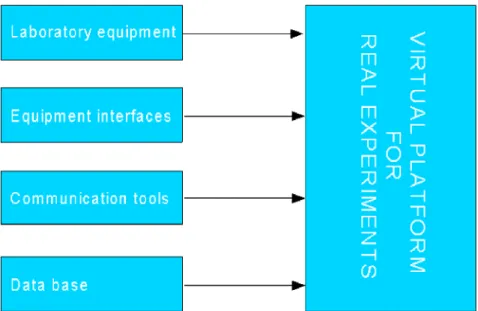
Making collaboration possible requires creation of a virtual platform. The platform provides communication tools, laboratory equipment interfaces, databases and makes selected equipment available for remote experimenters.
Figure 1: Virtual platform for scientific collaboration
2
A typical test stand
In Laboratory of Dynamics experiments are done with use of a hydraulic pulser (MTS-810). Experimental objects are bulk specimens made of metallic or non-metallic (i.e. composites) materials, complete constructions, mechanisms and their parts.
A typical test stand consists of a hydraulic pulser, it's controls called in this case MicroProfiler and a set of measuring devices like thermocouples, extensometers, etc. Devices and MicroProfiler are connected to a PC workstation equipped in measuring card and working under Windows NT operating system. Signals from measuring devices are acquired by this PC and processed by acquisition software written in HPVEE programming language. HPVEE environment speeds up development of measurement applications and it's easy to learn even for non-programmers. That's why it's the most likely used by experimenters in Laboratory of Dynamics.
A test stand organized this way lets conduct almost all mechanical experiments but it does not posses any capabilities of remote operation and sharing experimental data. Adding collaborative capabilities requires integration of various communication technologies to be done.
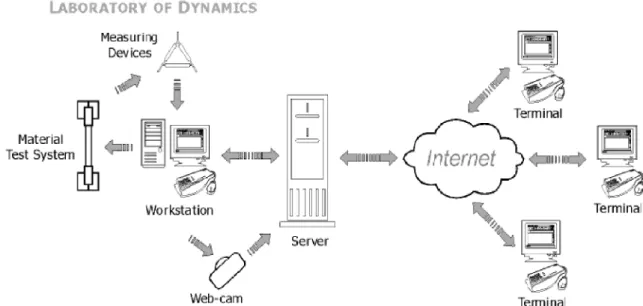
Figure 2: Functional scheme of collaboratory of mechanics
3
Application
The theory presented in previous sections was applied to develop collaboratory in the Institute of Materials Science and Applied Mechanics. Remote experimenters may use resources of the Laboratory of Dynamics. They may communicate with the laboratory presents functional scheme of our collaboratory. VLab's web interface is available at http://vlab.immt.pwr.wroc.pl.
How does it work? Measuring PC workstation with HPVEE software receives control commands from the server. Commands are written by server side script in ordinary ASCII text file. Byte written in another file tells HPVEE application whether it has to process command file or not. Instructions that have been read are being sent to the MTS controls via RS232 port. Last but not least functionality of HPVEE application is gathering sensor's data and transmits them to the server.
Command and control files as well as experimental results are stored in directory that's shared with server via SAMBA protocol. Shared results (plot images and raw data) are dynamically incorporated to the web site just as new one appears in directory. Large amount of data gathered during mechanical experiment are filtered on the workstation may choke a server script. That’s why results are presented as plot images. After completion of every experiment stage raw experimental data are available to download. The data may be stored in a database. Simple MySQL database that stores temperature measurements is tested.
The role of Linux server is to dynamically generate website for Internet clients, serve them sensor's data, give web interface for entering MTS control commands, serve streaming audio and video data, runs Java communication applet.
There is three-level privileges system applied. VLab user may take a part in an experiment in one of three roles:
• beholder - just observing results,
• experimenter with full access to communication applet and control forms.
Communication capabilities of VLab could be extended by additional software on the workstation and client device like MS Netmeeting or OpenSource MASH with Mbone (not tested yet) that provide talk, video and whiteboard functionalities.
Up till now VLab was used at several demonstration of mechanical construction examination at experts forums, conferences, workshops, experts consultations on-line, student's classes and exercises. Live video from the test stand could be transmited by web cam as streaming video. Darwin Streaming Server and MS Media Encoder were tested.
Remote clients may access VLab from a computer device with web browser installed. Netscape 4.xx, Mozilla and Internet Explorer 4.x or above are recommended but it's also possible to use text browser from UNIX terminal. Access devices like PC and Unix workstation, UNIX terminal, palmtop (HP Jornada 420) and handheld (Psion Revo) computer were positively tested at 100Mbps Ethernet, 56,6kbps and 9,6kbps dial-up network connections. Of course for the simpliest devices and lowest connections the most bandwidth consuming functionalities couldn't be achieved.
To summarize what kind of software tools were used? • HP VEE measuring application,
• Apache webserver,
• SAMBA file share between Linux and Windows systems, • MySQL database,
• PHP server side scripting language, • MS Netmeeting,
• MS Media Encoder, • Darwin Streaming Server.
4
Conclusions
It's possible to realize the idea of collaboratory of mechanics by means of existing communication infrastructure without additional investments. Regardless physical location group of people may take a part in a real experiment in a laboratory without walls and ,, Do science [almost] without barriers. There're several inconveniences dealing with MTS and mechanical experiments on the Internet:
• hydraulic pulser (MTS) needs human service,
• remote experiment control is limited to specified experiments, • remote experimenter can't change specimens, install sensors, etc.
References
[1] Kouzes, R. T., Myers, J. D., Wulf, W. A.: Collaboratories: Doing Science on the Internet, IEEE computer, 28(8) 1996.
[2] Myszka, W.: Wirtualne laboratorium mechaniki - czy warto? 19th Symposium on Experimental Mechanics of Solids, Institute of Aeronautics and Applied Mechanics of Warsaw University of Technology, Jachranka 2000, pp. 404-409.
[3] Chmielarczyk, P., Kaleta, J., Myszka, W.: Wirtualne sterowanie maszyn wytrzyma o ciow . V
Mi dzynarodowa konferencja Naukowa Komputerowe Wspomaganie Prac In ynierskich, Vol. 1,
[4] Maciejewski, .: System of Remote Access to the Dynamic Laboratory Resources over the Internet,Ł Systems, Vol. 6, No. 1-2, 2001, pp. 185-190.