Conflict Resilience
HALKIA Matina, THOMAKOS Dimitrios, FERRI Stefano, PAPAZOGLOU Michail, VAN DAMME Marie-Sophie
2020
This publication is a Technical report by the Joint Research Centre (JRC), the European Commission’s science and knowledge service. It aims to provide evidence-based scientific support to the European policymaking process. The scientific output expressed does not imply a policy position of the European Commission. Neither the European Commission nor any person acting on behalf of the Commission is responsible for the use that might be made of this publication. For information on the methodology and quality underlying the data used in this publication for which the source is neither Eurostat nor other Commission services, users should contact the referenced source. The designations employed and the presentation of material on the maps do not imply the expression of any opinion whatsoever on the part of the European Union concerning the legal status of any country, territory, city or area or of its authorities, or concerning the delimitation of its frontiers or boundaries.
Contact information Name: Matina HALKIA
Address: Joint Research Centre, via Enrico fermi 2749, TP267, 21027 ISPRA (VA), Italy Email: [email protected] Tel.: +39 0332786242 EU Science Hub https://ec.europa.eu/jrc JRC119383 EUR 30035 EN
PDF ISBN 978-92-76-14655-1 ISSN 1831-9424 doi:10.2760/152500
Luxembourg: Publications Office of the European Union, 2020 © European Union, 2020
The reuse policy of the European Commission is implemented by the Commission Decision 2011/833/EU of 12 December 2011 on the reuse of Commission documents (OJ L 330, 14.12.2011, p. 39). Except otherwise noted, the reuse of this document is authorised under the Creative Commons Attribution 4.0 International (CC BY 4.0) licence (https://creativecommons.org/licenses/by/4.0/). This means that reuse is allowed provided appropriate credit is given and any changes are indicated. For any use or reproduction of photos or other material that is not owned by the EU, permission must be sought directly from the copyright holders.
All images © European Union 2020
How to cite this report: Halkia, S., Thomakos, D., Ferri, S., Papazoglou, M. and Van Damme, M., Conflict Resilience, EUR 30035 EN, Publications Office of the European Union, Luxembourg, 2020, ISBN 978-92-76-14655-1 (online), doi:10.2760/152500 (online), JRC119383.
i
Contents
Abstract ... 3
1 Introduction ... 4
2 Conflict resilience ... 6
3 Data-driven approaches for detecting resilience to conflicts ... 7
3.1 Repression and intra-state conflict risk ... 7
3.2 Pre-conflict resilience... 8
3.3 Post-conflict resilience ... 10
4 Climate change and conflict ... 11
5 Conclusions... 13
Authors
HALKIA Matina1, THOMAKOS Dimitrios2, FERRI Stefano1, PAPAZOGLOU Michail3, VAN DAMME Marie-Sophie4
1 European Commission, Joint Research Centre (JRC), Ispra, Italy 2 Unisystems S.A, Rue Edward Steichen 26, Luxembourg, LU L-2540 3 Unisystems S.A, Via Michelangelo Buonarroti 39, 20145 Milano, Italy 4 Piksel Ltd Italian Branch, Via Breda 176, Milano (MI), Italy
Abstract
Although large-scale wars and interstate conflicts have almost disappeared, intrastate conflicts remain widespread and result in a high number of victims. During the last ten years, the number of fatalities was substantially higher than in the previous decade.
Though these conflicts take place outside the borders of the EU, they can generate important direct and indirect effects. Moreover, they are connected to climate change, can lead to various disasters, geopolitical effects, or material supply disruptions.
The concept of resilience has recently gained ground as a framework for addressing contemporary global threats. It has also become the key principle in the EU’s external action. One of its key building blocks is the modelling and monitoring of conflict risk to allow early action.
Conflict resilience refers to the capacity of a state to resist a drift towards violence contrary to the structural conditions prevailing (pre-conflict resilience). It also includes the response of a state in the presence of a conflict (post-conflict resilience).
Evaluating the pre-conflict resilience of states can provide insights into conflict aversion or enable a warning for the eruption of violence. On the other hand, the study of postconflict resilience may unveil the adaptive and transformative mechanisms that can be followed by other war-torn countries.
Climate change and conflicts are closely related. For example, climate change exacerbates current conflict drivers like food insecurity, competition for water and land resources, poverty and internal displacement of people. Adaptation and mitigation policies may lead to new regulations or infrastructures (like new hydropower reservoirs) which can generate tensions and eventually conflicts. Finally, conflict-torn countries are unable to invest in adaptation strategies, which makes them even more vulnerable to climate change effects.
1
Introduction
Although the large-scale wars of the first half of the 20th century remain a distant memory particularly for the
Western World and interstate conflicts have almost disappeared, intrastate conflicts remain widespread, resulting in a high number of victims. The last decades witnessed three genocides, one of them in one of the most developed countries of Eastern Europe (Yugoslavia).
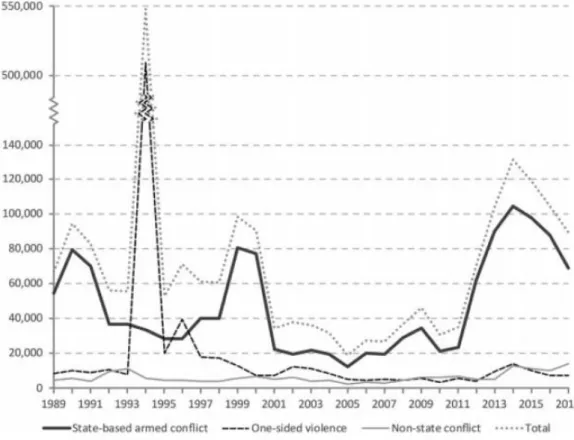
During the last ten years, the number of fatalities was substantially higher compared to the previous decade, despite the undergoing de-escalation of the Syrian War (Figure 1). Non-state actors are also increasingly resorting to violence in order to resolve their disputes.
Figure 1: Fatalities in organized violence by type, 1989-2017. Source: Pettersson and Eck (2018).
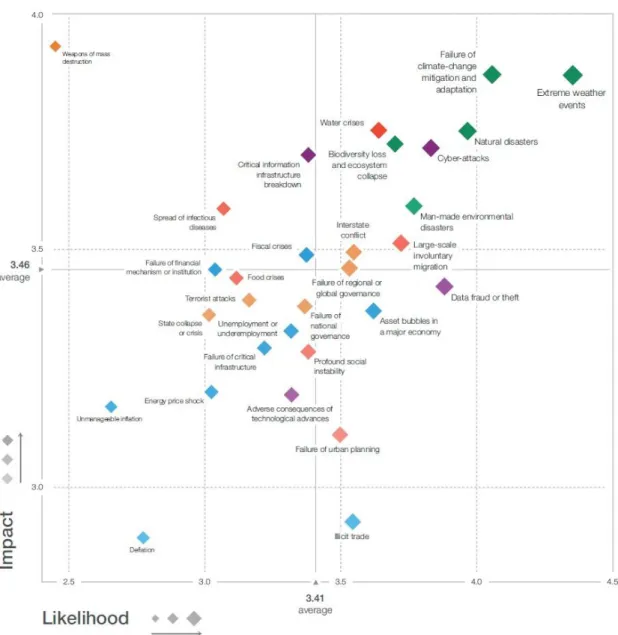
According to the 2019 Global Risks Report of the World Economic Forum, the adverse scenarios of large-scale involuntary migration, failure of national governance, profound social instability and water crises are very probable in the future. These global risks have been identified as potential conflict drivers. Furthermore, extreme weather events, failure of climate change mitigation and adaptation and natural disasters are at the top of the risk list in terms of likelihood (Figure 2). As it will be discussed in more details later in the chapter, although there is no evidence that the consequences of climate change can be the sole cause of a conflict, they may have significant security implications under the presence of certain socioeconomic conditions. Therefore, the risk of violent conflicts may increase significantly in the years to come.
All these developments and trends confirm the need for conflict risk modelling. Optimizing early warning systems will enable the European Union, EU Member States, and the international community in general to become more proactive. Apart from exploring the drivers of conflict and assessing conflict risk, it is also vital to investigate the resilience capacity of states and local communities that enables them to endure shocks, to avert the eruption of violence and to facilitate the peaceful resolution of disputes.
The concept of resilience has recently been incorporated into the discourse of peace and conflict studies. Consequently, the international community and peace organizations emphasize fostering the resilience of the
local social institutions of the conflict-torn countries in order to “sustain their own peace processes"5. For
instance, Interpeace6 in collaboration with other actors has developed its own framework that uncovers “the
endogenous assets, attributes, qualities, resources and actions embedded within communities and societies which can potentially serve to protect them from violent conflict”7. UNESCO promotes a culture of peace and
non-violence through education and other activities. Other organizations focus on sustainable development, institution building and other areas that reduce the risks of conflict eruption and violence.
Figure 2: The Global Risks Landscape 2019. Source: World Economic Forum, The Global Risks Report 2019.
Resilience has also been recognised as the key principle in the EU’s external action. The Joint Communication on “A Strategic Approach to Resilience in the EU’s External Action”8 argues for the “need to move from crisis
containment to a more structural, long-term approach to vulnerabilities, with an emphasis on anticipation, prevention and preparedness”. One of its key building blocks is the modelling and monitoring of external pressures to allow early action.
5 de Coning (2018), page 304.
6 Interpeace is an international organization established in 1994 by the UN to develop solutions to build peace. https://www.interpeace.org/
7 Harvard Humanitarian Initiative, CEPAD and the Platform for Dialogue and Peace (2016), page 11.
8 High Representative of the Union for Foreign Affairs and Security Policy. Joint Communication to the European Parliament and the Council: A Strategic Approach to Resilience in the EU’s external action. Brussels, 7.6.2017. [Available online at:
2
Conflict resilience
Resilience looks at the evolution of society around shocks. In the conflict context, it can refer to the dynamics of conflict eruption or avoidance (pre-conflict resilience), or a country’s response to the eruption of conflict (post-conflict resilience).
The emergence of internal conflict and violence has been associated with factors such as the lack of democracy, weak institutions, economic inequality, repression of minorities, poverty or a background of political violence among others. During a period of peace, the deterioration of these structural conditions usually leads to the eruption of conflicts. For instance, the rise of poverty due to an economic crisis or the breakout of a civil war at a neighbouring country may trigger a conflict in the short or long term.
However, there are countries that resist a drift towards violence, because of their endogenous characteristics (e.g. political tradition, social cohesion, value systems, cultural practices, strong civil society, etc.), foreign policy orientation or other parameters (e.g. policies or actions of political elites). These countries exhibit high pre-conflict resilience. Evaluating the pre-pre-conflict resilience of states is of great importance as this could provide insights into conflict prevention mechanisms or, in the opposite case, give a warning to the eruption of civil wars, mass political violence, even genocides.
Conflict prediction and prevention are not always feasible, given the limitations of ‘early warning’ systems and considering the endemic nature of conflicts, such as those in Africa. Thus, there is a growing interest in the international community on a country’s capacity to respond to the eruption of conflict and violence. This can be labelled as post-conflict resilience. Assessing the positive or negative structural response during a post-conflict time period can give valuable insights into their adaptive or transformative mechanisms. For example, as Fortna and Huang (2012) was phrasing, “some states emerging from internal conflict take significant strides toward democracy, while others do not”.
3
Data-driven approaches for detecting resilience to conflicts
3.1
Repression and intra-state conflict risk
The Global Conflict Risk Index (GCRI, developed by the JRC9) is an important starting point for measuring
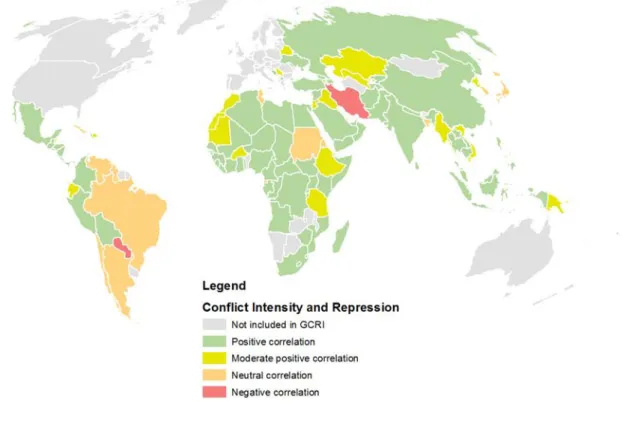
resilience. It reports the risk of violent conflicts in the next one to four years, using quantitative indicators from open sources. Based on this index, a recent JRC study (Halkia et al, 2017) has investigated the relationship between repression and conflict intensity, since the former has been associated in the literature with the onset of civil wars (Regan and Norton, 2005), (Young, 2013). The analysis found that the two variables are indeed highly correlated. Most countries demonstrate resilience up to a certain level of repression, after which conflict intensity grows steadily at increased levels of repression.
The degree of correlation differs among countries (Figure 3). For the majority of countries, repression is positively correlated with conflict intensity, while there are few outlier cases, where increased repression is associated with lower conflict intensity (negative correlation) or there is zero correlation.
The results of the analysis also demonstrate that high levels of repression – a typical feature of dictatorships and authoritarian regimes – are associated with high risk of a conflict. Strengthening democratic institutions and respect for human rights and fundamental freedoms should, therefore, lie at the heart of a coherent policy framework on conflict prevention.
Figure 3: Correlation between conflict intensity and repression. Source: JRC calculations based on Halkia et al.
(2017).
9 See De Groeve et al. (2014) for the initial description of the GCRI.
3.2
Pre-conflict resilience
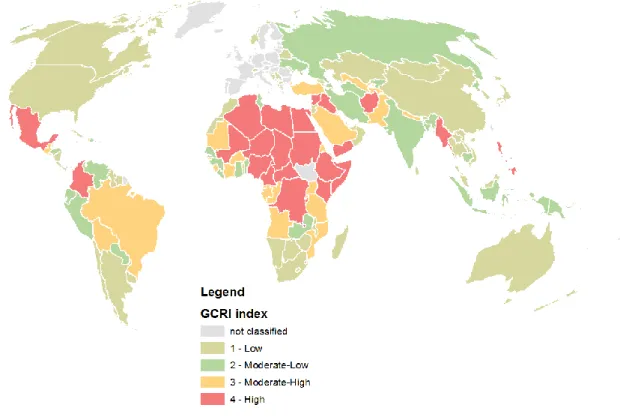
The risk classification of countries by the GCRI can also be utilised to analyse pre-conflict resilience. As a starting point, Figure 4 illustrates the conflict proneness of the countries in 2018 using four different risk classifications: low, moderate-low, moderate-high and high.
Figure 4: GCRI results for 2018. Source: JRC.
Pre-conflict resilience is then assessed by comparing the risk classification with the country’s conflict record. Countries in the low (or moderate low) risk classification, where a conflict was eventually recorded within a four years time frame, are considered as of low resilience. On the other hand, high resilient countries are those that although were classified at ‘high’ or ‘moderate-high’ risk categories, a conflict did not finally erupt.
The most interesting case of low resilient countries proved to be Tunisia and Egypt, before the outbreak of the Arab Spring events. Both countries were classified as low-risk during the four years before the events, but eventually, both countries suffered from violent conflicts.
One indicative high resilient case is Burkina Faso. The country is almost constantly under fragile conditions. This is reflected in the GCRI, where almost all indices relating to the economy (GDP per capita, economic openness, food security), and in addition many other security-related, social and geographical variables get very high values. Consequently, the GCRI estimated a moderate-high risk of violent conflict during the entire period since 1989 (Figure 5). Nevertheless, Burkina Faso, demonstrating a remarkable resilience to conflicts, has never descended into violence. To understand the determinants of such resilience is an important area of ongoing research.
3.3
Post-conflict resilience
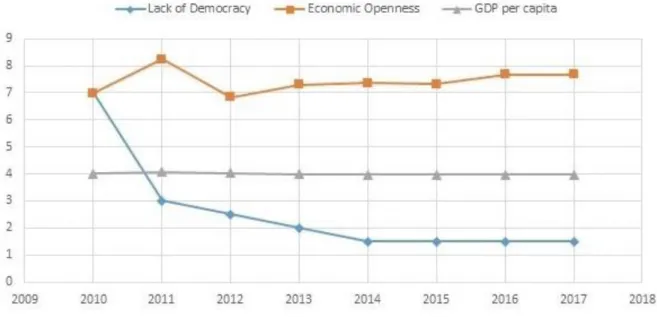
As it was discussed earlier, resilience has a strong temporal component, and also refers to a country’s response to the eruption of conflict. In this case, one has to examine the structural response during the post-conflict time period. Taking into account that variables such as corruption, infant mortality, water stress or the demographic structure cannot change in the short term, the analysis should be focused on those ones that do change and usually have an impact on the country’s future course. The variables from the GCRI model proposed here are the normalized values of GDP, regime type and economic openness. Figure 5 shows the evolution of such variables following the conflict events that took place in the context of the Arab Spring in Tunisia (2010-11).
Figure 5: Key indicators in Tunisia after the Arab Spring. Source: JRC calculations using the GCRI.
Note: Each variable is normalized into a scale of 1-10, with higher values representing worse outcomes (less economic openness, for example).
The graph shows that Tunisia recovered very fast regarding its economic openness in the aftermath of the Arab Spring events, attracting significant foreign direct investment inflows. However, this positive trend was not maintained in the long term. On the other hand, the country emerged from internal conflict taking significant strides towards democracy, demonstrating a remarkable transformative capacity. The GDP per capita remained stable, as the economy was not significantly affected by the events nor any significant structural change took place.
4
Climate change and conflict
Although the direct causal link between climate change and conflict is debated, conflict experts have identified pathways linking the adverse effects of climate change with the eruption of violence through a myriad of socio-economic drivers.
A first potential pathway is the aggravation of current conflict drivers by climate change. For example, food insecurity, competition for water and land resources, poverty and internal displacement of people are some of the current conflict drivers that climate change exacerbates. According to Fetzek and Mazo (2014), at least 40% of intra-state conflicts since the end of the Second World War were related to disputes over natural resources. Gleick (2014) and Kelley et al. (2015) have asserted that the severe drought of 2007-2010 contributed to the recent devastating Syrian Conflict by aggravating the socioeconomic stresses in the country10. Farmer-herder
conflicts that have been recorded in Africa on many instances may also be multiplied, taking into account the desertification trends combined with agricultural expansion into pastoral zones. The Darfur conflict is described by Jeffrey Mazo as essentially “a climate change conflict.” He emphasizes the land scarcity dimension of the dispute and the latent herder and farmer societal cleavage11. The latter view was largely espoused by the UN
Secretary-General Ban Ki-moon as well12.
In the same context, a local income shock due to exposure to climate variability can trigger a violent conflict in the presence of other intervening variables such as dependence from agricultural income, ethnic segregation or increased political marginalization13.
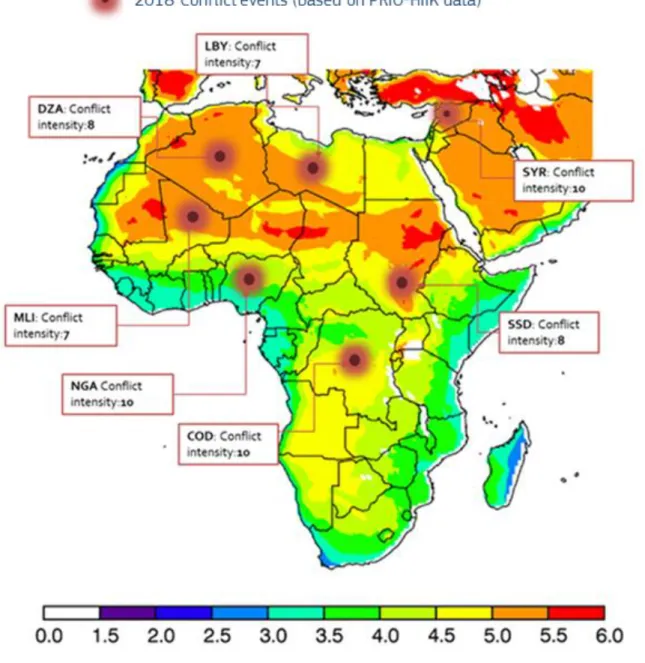
Other pathways to conflicts are related to scenarios that have not yet materialized. Examples include the flooding of coastal cities, the disappearance of entire islands due to the rise of sea level, competition over resources in polar regions or even the formation of new sovereign states (e.g. Greenland) due to the ice sheet decline, or the impacts of glaciers melting. Furthermore, adapting to or mitigating climate change can by itself contribute to the eruption of violent conflicts. For instance, banning fossil fuels exploitation in order to comply with new environmental regulations may produce grievances. Likewise, policies that intend to address the impact of climate change as it could be the development of renewable energy infrastructures such as hydropower dams or the increased mining of rare metals critical for batteries and electrical engines may potentially have conflict implications. A last and important link is the fact that war-torn countries are unable to invest in adaptation strategies, which makes them eventually even more vulnerable to climate change effects. The projected temperature increase for Africa and the Middle East (Figure 6) will aggravate the already fragile structural characteristics prevailing in this region, resulting most probably in the perpetuation of conflicts. Moreover, this violence will prohibit them to prepare and adapt for future climate change challenges.
10 This view has been challenged by Selby et al. (2017). 11 Mazo (2010), page 75.
12 A climate culprit in Darfur." Washington Post, 16 June 2007.
13 See Nina von Uexkull’s contribution in 4th Workshop on the EU Global Conflict Risk Index 2018, summarized
Figure 6: Forecasted temperature increase and conflicts in Africa
Source: Joint Research Centre (2017) Africa for the temperature change, and GCRI for the conflicts.
Note: Projected change in the average mean summer temperature by the end of the century under a high warming climate scenario, and the 2018 GCRI conflict events and their intensity (on an increasing scale from 0 to 10).
In this context, the Global Conflict Risk Index has been recently extended to include a new variable that incorporates the effects of drought on agriculture-dependent regions.
5
Conclusions
Building resilience has prevailed as a new policy framework for addressing global threats including conflicts that remain the biggest threat for global security. Theorizing resilience is therefore essential for effectively utilizing this new concept in policymaking. JRC has identified a strong temporal component associated with the definition of resilience. Thus, resilience refers to the capacity of a state to resist a drift towards violence contrary to the structural conditions prevailing (pre-conflict resilience); and also to the response of a state in the presence of a conflict (post-conflict resilience). Evaluating the pre-conflict resilience of states can provide insights into conflict prevention or enable a warning for the eruption of violence. Likewise, evaluating the ability of a country to adapt and quickly recover from a conflict could serve as a policy paradigm guiding the external action of the European Union or the work of peacebuilding actors. Finally, climate change and intrastate conflict are closely related as there are pathways linking the adverse effects of this phenomenon with the eruption of violence.
References
Ki-Moon, B. (2007). A climate culprit in Darfur. Washington Post, 16, A15.
Brassett, J., Croft, S., & Vaughan-Williams, N. (2013). Introduction: An agenda for resilience research in politics and international relations.
Breisinger, C., Ecker, O., Maystadt, J. F., Trinh Tan, J. F., Al-Riffai, P., Bouzar, K., ... & Abdelgadir, M. (2014). How to build resilience to conflict: the role of food security. Intl Food Policy Res Inst.
Meyer, M. (2017). Climate Change, Security Risks and Conflict Reduction in Africa: A Case Study of Farmer-Herder Conflicts over Natural Resources in Côte d'Ivoire, Ghana and Burkina Faso 1960–2000: Charlène Cabot (Berlin-Heidelberg: Springer-Verlag, 2017).
Carpenter, A. C. (2014). Community resilience to sectarian violence in Baghdad. New York: Springer. Chandler, D., & Coaffee, J. (2016). The Routledge handbook of international resilience. Routledge. Chandler, D. (2013). International statebuilding and the ideology of resilience. Politics, 33(4), 276-286. Collier, P., & Hoeffler, A. (2004). Greed and grievance in civil war. Oxford economic papers, 56(4), 563-595. De Coning, C. (2016). From peacebuilding to sustaining peace: Implications of complexity for resilience and sustainability. Resilience, 4(3), 166-181.
De Coning, C. (2018). Adaptive peacebuilding. International Affairs, 94(2), 301-317.
De Groeve, T., Vernaccini, L., & Hachemer, P. (2014). The global conflict risk index (GCRI): a quantitative model. Office of the European Union Nr. JRC92293, doi, 10, 184.
European Commission. High Representative of the Union for Foreign Affairs and Security Policy. Joint Communication to the European Parliament and the Council: A Strategic Approach to Resilience in the EU’s
external action. Brussels, 7.6.2017. [Available online at:
https://ec.europa.eu/europeaid/sites/devco/files/joint_communication_-a_strategic_approach_to_resilience_in_the_eus_external_action-2017.pdf]
Fetzek, S., & Mazo, J. (2014). Climate, scarcity and conflict. Survival, 56(5), 143-170.
Fortna, V. P., & Huang, R. (2012). Democratization after civil war: A brush-clearing exercise. International Studies Quarterly, 56(4), 801-808.
Gleick, P. H. (2014). Water, drought, climate change, and conflict in Syria. Weather, Climate, and Society, 6(3), 331-340.
Halkia, Matina, Stefano Ferri, and Francesca Saporiti. Modelling conflict resilience in the Global Conflict Index. The 2nd International Workshop on Modelling of Physical, Economic and Social Systems for Resilience Assessment, 14-16 December 2017, Ispra.
Halkia, Stamatia, Francesca Saporiti, Dimitrios Thomakos (2018). 4th Workshop on the EU Global Conflict Risk Index, JRC113180.
Harvard Humanitarian Initiative, CEPAD, AND THE Platform for Dialogue and PeaceCentre of Studies for Peace and Development (CEPAD) (2017). Assessing Resilience for Peace: A Guidance Note.. [Available online at: http://www.interpeace.org/wp-content/uploads/2016/06/2016-FAR-Guidace-note-Assesing-Resilience-for-Peace-v7.pdf]
JRC (2017). Science for the AU-EU Partnership: Building Knowledge fop sustainable development.
JRC (2018). The resilience of EU Member States to the financial and economic crisis. What are the characteristics of resilient behaviour?
Kalyvas, N. Stathis. (2007) “Civil Wars”. In The Oxford Handbook of Comparative Politics, edited by Carles Boix and Susan C. Stokes, 416-434. Oxford: Oxford University Press..
Kelley, C. P., Mohtadi, S., Cane, M. A., Seager, R., & Kushnir, Y. (2015). Climate change in the Fertile Crescent and implications of the recent Syrian drought. Proceedings of the National Academy of Sciences, 112(11), 3241-3246.
McCandless, Erin and Graeme Simpson, “Assessing Resilience for Peacebuilding,” Executive Summary of Discussion Document, Interpeace/SIDA 2015.
Milliken, J. (2013). Resilience: from metaphor to an action plan for use in the peacebuilding field (No. BOOK). The Graduate Institute of International and Development Studies, Geneva Peacebuilding Plateform.
Selby, J., Dahi, O. S., Fröhlich, C., & Hulme, M. (2017). Climate change and the Syrian civil war revisited. Political Geography, 60, 232-244.
Pettersson, T., & Eck, K. (2018). Organized violence, 1989–2017. Journal of Peace Research, 55(4), 535-547. Regan, P. M., & Norton, D. (2005). Greed, grievance, and mobilization in civil wars. Journal of Conflict Resolution, 49(3), 319-336.
GETTING IN TOUCH WITH THE EU In person
All over the European Union there are hundreds of Europe Direct information centres. You can find the address of the centre nearest you at: https://europa.eu/european-union/contact_en
On the phone or by email
Europe Direct is a service that answers your questions about the European Union. You can contact this service: - by freephone: 00 800 6 7 8 9 10 11 (certain operators may charge for these calls),
- at the following standard number: +32 22999696, or
- by electronic mail via: https://europa.eu/european-union/contact_en
FINDING INFORMATION ABOUT THE EU Online
Information about the European Union in all the official languages of the EU is available on the Europa website at:
https://europa.eu/european-union/index_en
EU publications
You can download or order free and priced EU publications from EU Bookshop at:
https://publications.europa.eu/en/publications. Multiple copies of free publications may be obtained by contacting Europe Direct or your local information centre (see https://europa.eu/european-union/contact_en).
doi:10.2760/152500 ISBN 978-92-76-14655-1 KJ -NA -30035 -EN -N