Chapter 2
Literature Review
Chapter Objective
This chapter presents literature review in the field of web quality specifically serving the purpose of factors identification. The literature analysis of research papers is done with a view to represent literature in a condensed and more informative manner.
2.1 Introduction
With the advancement in web technologies and its embracement by people, website has made a significant transition from simple and static websites to dynamic, multi-media rich websites, capable of interacting with visitors in a sophisticated way. Web development is an ever-changing phenomenon, highly sensitive to all the expectations and requirements of a modern web user.
Web development need to harmonize the purpose of the website as well as its structure and interface with the expectations of the users. User–centered design is the solution to meet the expectations of the target web users. User–centered design must consider visibility, satisfaction, legibility, and language while planning the design of website. For the purpose, web developers should consider target users profile, e.g. their age, location, gender, and their education level. Defining the audience of the website, which will be created, requires fulfilling the significant research in order to take the road of success. The notion of web design and development is too broad and versatile; hence, it is not an easy task to define some common features or trends favored by both web developers and users.
Managing web quality from the perspective of web developer requires understanding of the web server where site will be hosted, script language to be used at server and client end, browser compatibility issues at client end, web design and programming. Web quality from the perspective of web user is more tilted towards its usability, satisfaction and legibility. The content quality is again a major issue which prompts user to seek information from reputed websites.
2.2 Current Trend of Web Development
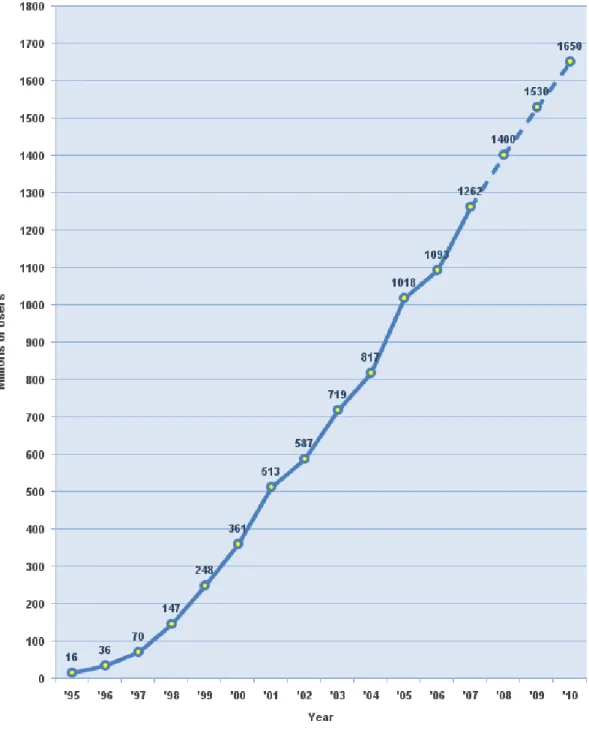
The development of web has been exponential. Growth of web users has been tremendous and instrumental in development of a totally new web industry. Figure 2.1 depicts the growth of web users.
Figure 2.1: Growth of World Wide Web users (source: www.internetworldstats.com) The growth in domain name registrations and website development has been multifold in last few years. One of the reasons of this growth is the availability of web development tools and platforms free of charge to aid in development. One of the most common example is the LAMP (Linux, Apache, MySQL, PHP) stack, which is
usually distributed free of charge. Another contributing factor towards growth of websites has been the rise of easy to use WYSIWYG (What You See Is What You Get) web development software, most prominently Adobe Dreamweaver, or Microsoft Expression Studio. Within no time, virtually anyone can develop a website using such software even without any knowledge of HTML (Hyper Text Markup Language).
Web is no longer about simple information provider in the form of text and images only. Streaming audio and video content is common today. Media contents are commonly used in Media blocks on websites for a variety of purposes. They make websites look more vibrant, natural and functional. Flash is widely used for animated graphic content of an absolutely different nature – supported with dynamic content, enriched with visual and sound effects. The only problem is its unfriendliness with search engines.
The advancement in computer technology has resulted in larger computer displays with higher resolution. Website layouts have accordingly incresead its width and height to accomodate larger displays. The layout has become simpler in order to provide more comfort for reading and navigating the site. Centered orientation is preferred over the previously popular left-site orientation of web pages.
Web development has moved to a new phase of internet communication. The most popular trend of communication on the internet seems to be social networking sites. Facebook and Twitter are two of the most popular social networking sites used to connect with people.
Web Content Management Systems are also widely popular to manage vast range of contents. Many of them are freely available like Joomla and Wordpress, with flexibility of moulding the site as per type of content.
The next generation of web development tools uses the strong growth in LAMP, Java Platform and Microsoft .NET technologies to provide the web as a way to run applications online. Web developers now help to deliver applications as web services which were traditionally only available as applications on a desk based computer. As the development of web advanced to a new level, the concept of web quality also changed to an extent with certain new factors emerging as its defining criteria. To assimilate the web quality factors reflecting the contemporary advancement in web development, literature review was done.
2.3 Literature Review of Web Quality Factors
Several approaches towards website evaluation has been enumerated in last decade, for instance, Ivory et al. (2000), Aladwani and Palvia (2002), Olsina and Rossi (2002), Moraga et al. (2004), Calero et al. (2005), Seffah et al. (2006), Abramowicz et al. (2008) and Olsina et al. (2009), etc.
Ivory et al. (2000) presents a methodology for evaluating information-centric websites. Five stages have been proposed in the methodology:
a) Identifying an exhaustive set of quantitative interface measures such as the amount of text on a page, colour usage, consistency, etc.
b) Computing measures for a large sample of rated interfaces c) Deriving statistical models from the measures and ratings d) Using the models to predict ratings for new interfaces e) Validating model prediction.
Aladwani and Palvia (2002) proposed 25-item instrument that captures key characteristics of website quality from the users’ perspective. The instrument was designed to measure four dimensions of web quality: specific content, content quality, appearance and technical adequacy.
Olsina and Rossi (2002) proposed the web quality evaluation method (WebQEM) to define an evaluation process in four technical phases:
a) Quality requirements definition and specification [specifying characteristics and attributes based on the ISO/IEC 9126-1 (2001) such as usability, functionality, reliability, and effectiveness and taking into account web audience’s needs] b) Elementary evaluation (applying metrics to quantify attributes)
c) Global evaluation (selecting aggregation criteria and a scoring model) d) Conclusion (giving recommendations).
Nevertheless, evaluations take place mainly when the application is completed.
Kahn et al. (2002) developed a model as the Product and Service Performance model for Information Quality (PSP/IQ). In this model a quadrant was formed wherein column headings represented two views of quality, viz. 'conforming to specifications', and 'meeting or exceeding consumer expectations' while rows headings represented 'product quality' and 'service quality'. The essential dimensions of IQ for delivering high quality information were identified as accessibility, appropriate amount of information, believability, completeness, concise representation, consistent
representation, ease of manipulation, free of error, interpretability, objectivity, relevancy, reputation, security, timeliness, understandability and value added. These dimensions were mapped into the PSP/IQ quadrants according to whether they can be achieved by conformance to specifications or by considering the changing expectations of consumers performing organizational tasks. A questionnaire was prepared and data collected through survey and mean value was calculated for all four quadrants of the model. This model considered only sixteen dimensions and their impact on performance related to information quality, the interdependencies not being taken into account.
Lee et al. (2002) developed a methodology called AIM quality (AIMQ) to form a basis for Information Quality (IQ) assessment and benchmarking. The methodology encompasses a model of IQ, a questionnaire to measure IQ, and analysis techniques for interpreting the IQ measures. PSP/IQ model formed basis for further development of the AIMQ methodology and hence was an improvement upon the PSP/IQ model. Data was collected through survey and was analysed using SPSS software for windows. The AIMQ methodology focussed on fifteen dimensions only.
Barnes and Vidgen (2002) used webqual (a method for assessing the quality of Websites) and further developed it for quantitative analysis and the production of e-commerce metrics such as the WebQual Index. WebQual Index was then further used for assessing an organization's e-commerce capability. Three Internet bookstores were evaluated on the basis of WebQual Index - Amazon, BOL, and the Internet Bookstore. This paper dealt with only one of the main factors i.e. quality attributes and that also on a specific domain of e-commerce.
Moraga et al. (2004) presented a Portal Quality Model towards portlet evaluation. Portal Quality Model was based on the SERVQUAL model proposed by (Parasuraman et al. 1998). A new dimension Data Quality (DQ) defined as "Quality of the data contained in the portal" was added along with Tangible, Reliability, Responsiveness, Assurance and Empathy dimension.
Calero et al. (2005) presented the Web Quality Model (WQM), which was intended to evaluate a web application according to three dimensions: Web Features (content, presentation, and navigation); Quality Characteristics based on the ISO/IEC 9126-1 (2001) (functionality, reliability, usability, efficiency, portability, and maintainability); and Lifecycle Processes (development, operation and maintenance) including organizational processes such as project management and reuse programme
management. WQM has been used to classify, according to these three dimensions, a total of 385 web metrics taken from the existing literature. An evaluation process can be defined by selecting the most useful set of metrics to construct a ‘total web quality’ expression that could be used to quantify the quality of a given web application. However, guidelines on how to define this process have not been provided.
Seffah et al. (2006) presented the Quality in Use Integrated Measurement (QUIM) as a consolidated model for usability measurement in web applications. QUIM combines existing models from ISO/IEC 9126-1 (2001), ISO/IEC 9241-11 (1998) and others. In this approach, usability is decomposed into factors, and then into criteria wherein a criterion can belong to different factors. Finally, these criteria are decomposed into specific metrics that can quantify the criteria.
Abramowicz et al. (2008) presented SQuaRE-based web services quality model consisting of three perspectives internal web service quality, external web service quality and web service quality in use.
Olsina et al. (2009) extended ISO/IEC 9126-1 (2001) model by including content quality as one of the major dimensions besides functionality, reliability, usability, efficiency, maintainability and portability.
Chiou et al. (2010) presented a web strategic framework for website evaluation. The framework was designed to be applied by a specific website in terms of its goals and objectives through a five-stage evaluation process. As such the framework was strategic oriented for specific website rather than an overall representative of general website evaluation.
Alkhattabi et al. (2010) focussed on information quality (IQ) of e-learning websites considering nineteen quality dimensions. This paper represents dimension related specifically to e-learning web environment.
2.4 Web Quality Factors Defined
Based on literature review on web quality following list of web quality factors were identified initially for further review. (In alphabetical order)
1 Accuracy – attributes of website that bear on the provision of right or agreed results or effects.
2 Adaptability – attributes of website that bear on the opportunity for its adaptation to different specified environments without applying other actions or means than those provided for this purpose for the website in question.
3 Analysability – attributes of website that bear on the effort needed for diagnosis of deficiencies or causes of failures, or for identification of parts to be modified. 4 Animation Complexity – attribute of website operation that bears on the
variation and duration of animation thereby increasing its complexity.
5 Architecture – ‘Architecture’ implies the degree to which information in a website is suitably structured so that users can easily access information they seek.
6 Assurance – ‘Assurance’ means the extent to which staffs of a website are knowledgeable about their operation and courteous in their responses and can convey trust and confidence to users.
7 Attractivity – attributes of website that bear on the satisfaction of latent user desires and preferences, through services, behaviour and presentation beyond actual demand.
8 Audience oriented guided tour – attribute of website operation that bears on the guided tour provided for easy navigability for the audience.
9 Availability – attributes of website that bear on the amount of time the product is available to the user at the time it is needed.
10 Broken Links – attribute of website navigation that bears on the broken links that leads nowhere.
11 Browser related Deficiencies – attribute of website presentation that bears on the features that are present actually but can't be viewed or viewed differently due to different browser than it was meant for.
12 Changeability – attributes of website that bear on the effort needed for modification, fault removal or for environmental change.
13 Clarity – attributes of website that bear on the clarity of making the user aware of the functions it can perform.
14 Client scripts – attribute of website maintenance that bears on the use of script codes that affects the front–end (client / browser relate working and functionality of the website).
15 Code reusability – attribute of website maintenance that bears on the reusability of script codes that affects the overall working and functionality of the website. 16 Coexistence – the capability of the website to coexist with other independent
17 Collaboration – Collaboration is the process of working jointly or in partnership for extracting useful information from each other.
18 Colours – attribute of website presentation that bears on the proper use of colours in web pages.
19 Communication – ‘Communication’ implies the degree to which a website educates and informs users in a language they can understand.
20 Company Information – attribute of website features that bears on the general information of the company.
21 Compatibility – is the degree to which a website can be accessible and usable in various sorts of user environment such as Web browsers or operating systems. 22 Completeness – ‘Completeness’ means the degree to which a website offers a
broad range of information which is relevant to users’ needs.
23 Comprehensibility – ‘Comprehensibility’ implies the degree to which
information a website exhibits is sufficiently understandable even to users who have little background knowledge.
24 Contact Information – attribute of website features that bears on the process of contacting the company using suitable means.
25 Customer Feedback Service – attribute of website features that bears on the feedback provided by customers related to company.
26 Customisability – attributes of website that enable contents and interface customized according to the user’s particular characteristics or needs to reduce the effort required for use and increase satisfaction.
27 Degradability – attributes of website that bear on the effort needed to re-establish the essential functionality after a breakdown.
28 Depth of Navigational Map – attribute of website navigation that bears on the maximum number of clicks required to reach desired webpage.
29 Details of Product or Service – attribute of website features that bears on the details of the company products or service.
30 Download time – attribute of website presentation that bears on the amount of time taken to download a complete web page.
31 Emotion – ‘Emotion’ denotes the extent to which a website evokes emotional reactions from users.
32 Empathy – ‘Empathy’ is the extent to which a website can provide caring and individualized attention to customers’ concerns and requests.
33 Explicitness – attributes of website that bear on the website product with regard to its status (progression bars, etc.).
34 Fault tolerance – attributes of website that bear on its ability to maintain a specified level of performance in cases of website faults or of infringements of its specified interface.
35 Global readability – attribute of website operation that bears on the easiness with which the site could be understood globally
36 Global style uniformity – attribute of website presentation that bears on the uniformity of style used on different pages of the website
37 Graphics Clarity – attribute of website presentation that bears on the clarity of graphics representing an idea or concept.
38 Graphics Use – attribute of website presentation that bears on the use of graphics within a web page.
39 Helpfulness – attributes of website that bear on the availability of instructions for the user on how to interact with it.
40 Incentive – ‘Incentive’ is a benefit given by a website that encourages users to visit it continuously and enhances users’ satisfaction and loyalty to the website. 41 Information building effort – attribute of website development effort that bears
on the process of providing information in a way deemed fit to be presentable and understandable by the audience of the website.
42 Installability – attributes of website that bear on the effort needed to install the website in a specified environment.
43 Interlinking Effort – attribute of website development effort that bears on the cross linking of internal related topics in the website.
44 Interoperability – attributes of website that bear on its ability to interact with specified systems.
45 Intimacy – ‘Intimacy’ implies the degree to which make users feel a close relationship with or affection to a website through interactive processes.
46 Learnability – attributes of website that bear on the users’ effort for learning its application (for example, control, input, and output).
47 Link Title with explanatory help – attribute of website navigation that bears on the links available with explanation about the link.
48 Links – attribute of website navigation that bears on the overall links available to reach anywhere in web.
49 Manageability – attributes of website that bear on the effort needed to (re)establish its running status.
50 Maturity – attributes of website that bear on the frequency of failure by faults in the website.
51 Media digitizing effort – attribute of website development effort that bears on the process of channeling media to be presented in digital format in the website. 52 Media Format – attribute of website features that bears on the way information
is presented on the website.
53 Menus consistency – attribute of website navigation that bears on the consistency of menus in different web pages.
54 Multi Language support – attribute of website features that bears on the Multi Language support for better understanding of details provided on website, by users who are more comfortable with foreign language.
55 Multimedia – attribute of website presentation that bears on the effective and efficient use of mutimedia techniques, clarity and use of the graphics within website.
56 Object Oriented Programming – attribute of website development that bears on
the Object Oriented Programming in the website.
57 Object Oriented Programming effort – attribute of website development effort that bears on the Object Oriented Programming effort in the website.
58 Operability – attributes of website that bear on the users’ effort for operation and operation control.
59 Page complexity – attribute of website operation that bears on the different types of add–ons in the web page thereby increasing its complexity.
60 Page Length – attribute of website presentation that bears on the proper length of the web page being viewed.
61 Playfulness– ‘Playfulness’ means the degree to which a website can amuse or entertain users.
62 Privacy Rules – attribute of website features that bears on the Privacy Rules towards the user information provided on the website.
63 Proximity – means the degree to which users can locate to reach a website either through search engines or easily remembered URL.
64 Quick Access Pages – attribute of website operation that bears on the direct links provided to quickly access the desired pages.
65 Recoverability – attributes of website that bear on the capability to re-establish its level of performance and recover the data directly affected in case of a failure, and on the time and effort needed for it.
66 Redundant Links – attribute of website navigation that bears on the links that no more exist.
67 Replaceability – attributes of website that bears on the opportunity and effort of using it in the place of specified other website or in the environment of that website.
68 Resource Behaviour – attributes of website that bear on the amount of resources used and the duration of such use in performing its function.
69 Responsiveness – ‘Responsiveness’ means the degree to which a website fulfills users’ requests or questions promptly.
70 Reusability – attributes of website that bear on its potential for complete or partial reuse in another website product.
71 Reusable Comments – attribute of website reusability that bears on the process of using comments again in the website.
72 Reusable Media – attribute of website reusability that bears on the process of using different media in its reuse in different pages in the website.
73 Reusable Program Codes – attribute of website reusability that bears on the program codes written in such a way as to use it again and again in the website. 74 Reusable Web Pages – attribute of website reusability that bears on the process
of providing web pages in such a way as to help in its reuse in other related pages in the website.
75 Screen Resolution Indicator – attribute of website presentation that bears on the ability to show size of screen used for web page design.
76 Search Capability – ‘Search capability’ means whether a website facilitates search function or engine and the degree to which search results are accurate and relevant to users’ intention.
77 Security – attributes of website that bears on its ability to prevent unauthorized access, whether accidental or deliberate, to programmes or data.
78 Server Scripts – attribute of website maintenance that bears on the use of script codes that affects the back–end (server relate working and functionality of the website).
79 Site Map – attribute of website navigation that bears on the sitemap used in website showing all links available within the website.
80 Stability – attributes of website that bear on the risk of unexpected effect of modifications.
81 Status – attributes of website development that bears on the importance and position with respect to other websites.
82 Style Sheet used – attribute of website presentation that bears on the style definition used externally or internally within the webpage.
83 Style Sheets reusability – attribute of website maintenance that bears on the reusability of styles that affects the visual appeal of the website.
84 Suitability – attribute of website that bears on the presence and appropriateness of a set of functions for specified tasks.
85 Suitable Information – attribute of website features that bears on the relevant, updated and accurate information suitable for the purpose of the core audience of website.
86 Support – ‘Support’ is the degree to which a website facilitates supportive information or learning tools which can contribute to enhancing users’ understanding to the website.
87 Terms and Conditions – attribute of website features that bears on the Terms and Conditions towards the use of the website.
88 Testability – attributes of website that bear on the effort needed for validating the (modified) website.
89 Text (Font Style, size, colour) – attribute of website presentation that bears on the style, size and colour of text used.
90 Time Behaviour – attributes of website that bear on response and processing times and on throughput rates in performing its function.
91 Timeliness – ‘Timeliness’ is the degree to which a website provides current and up–to–date information.
92 Total Media Allocation – attribute of website development that bears on the allocation of media (i.e. video or audio or animation or any other for the purpose of advertisement etc.) on the web pages.
93 Total Page Allocation – attribute of website development that bears on the allocation of number of web pages considered important for the type of website being developed.
94 Traceability – attributes of website that bear on the effort needed to verify correctness of data processing on required points.
95 Trustworthy – ‘Trustworthy’ means the degree to which information in a website is accurate, credible, and verified.
96 Understandability – attributes of website that bear on the users’ effort for recognising the logical concept and its applicability.
97 Uniqueness – attribute of website features that bears on the uniqueness of the information presented on the website.
98 User Friendliness – attributes of website that bear on the users’ satisfaction. 99 Variability – Variability is the degree to which a website presents information in
various sorts of format.
100 Web–link Errors – attribute of website navigation that bears on the linking error with other web page or website.
101 Web Page Control Structure – attribute of website development that bears on the structural importance provided for control on web pages of the site.
102 Web Page Design – attribute of website presentation that bears on the look and feel of the web page being viewed.
2.5 Classification of Web Quality Factors
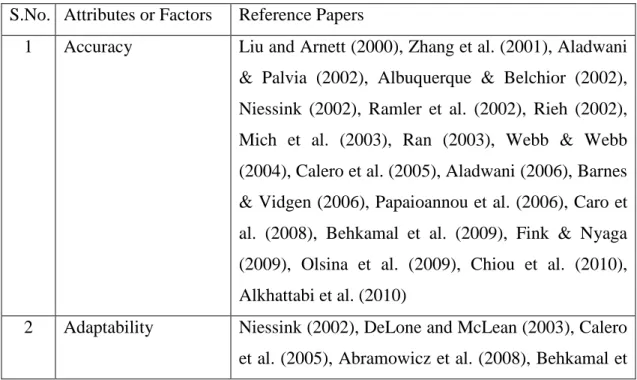
The web quality factors identified above need to be classified based on number of citations in order to understand their importance towards web quality model.
Table 2.1 List of papers identifying web quality factors S.No. Attributes or Factors Reference Papers
1 Accuracy Liu and Arnett (2000), Zhang et al. (2001), Aladwani
& Palvia (2002), Albuquerque & Belchior (2002), Niessink (2002), Ramler et al. (2002), Rieh (2002), Mich et al. (2003), Ran (2003), Webb & Webb (2004), Calero et al. (2005), Aladwani (2006), Barnes & Vidgen (2006), Papaioannou et al. (2006), Caro et al. (2008), Behkamal et al. (2009), Fink & Nyaga (2009), Olsina et al. (2009), Chiou et al. (2010), Alkhattabi et al. (2010)
2 Adaptability Niessink (2002), DeLone and McLean (2003), Calero
al. (2009), Olsina et al. (2009)
3 Analysability Niessink (2002), Calero et al. (2005), Behkamal et al.
(2009), Olsina et al. (2009)
4 Animation
Complexity
Santos (2003), Calero et al. (2005), Grigoroudis et al. (2008)
5 Architecture Dustin et al. (2002), Signore (2005), Grigoroudis et
al. (2008)
6 Assurance Liu and Arnett (2000), Madu and Madu (2002),
DeLone and McLean (2003), Webb and Webb (2004), Oztekin et al. (2009)
7 Attractivity Niessink (2002), Ramler et al. (2002), Calero et al.
(2005), Caro et al. (2008), Behkamal et al. (2009), Olsina et al. (2009)
8 Audience Oriented
Guided Tour
Olsina & Rossi (2002), Calero et al. (2005)
9 Availability Aladwani & Palvia (2002), Albuquerque & Belchior (2002), Cox & Dale (2002), Menasce (2002), Niessink (2002), O'Sullivan et al. (2002), Offutt (2002), DeLone and McLean (2003), Patel et al. (2003), Moraga et al. (2004), Bilgin & Singh (2004), Kalepu et al. (2004), Yoon et al. (2004), Calero et al. (2005), Kim et al. (2005), Parasuraman et al. (2005), Vu et al. (2005), Yu & Lin (2005), Aladwani (2006), Abramowicz et al. (2006), Caro et al. (2008), Behkamal et al. (2009)
10 Broken Links Olsina & Rossi (2002), Santos (2003), Calero et al. (2005)
11 Browser Related
Deficiencies
Olsina & Rossi (2002), Calero et al. (2005)
12 Changeability Niessink (2002), Calero et al. (2005), Behkamal et al.
(2009), Olsina et al. (2009)
13 Clarity Aladwani & Palvia (2002), Albuquerque & Belchior
et al. (2005), Aladwani (2006), Barnes & Vidgen (2006), Behkamal et al. (2009)
14 Client Scripts Power and Kaparthi (2002), Calero et al. (2005)
15 Code Reusability Calero et al. (2005), Arshad & Shah (2007)
16 Coexistence Calero et al. (2005), Behkamal et al. (2009), Olsina et
al. (2009)
17 Collaboration Constantinides (2002), Shaoshao et al. (2006), Chu et
al. (2007), Janssen et al. (2008)
18 Colours Aladwani & Palvia (2002), Santos (2003), Calero et
al. (2005), Aladwani (2006)
19 Communication Constantinides (2002), Cox & Dale (2002), Gounaris
and Dimitriadis (2003), Santos (2003), Kim and Stoel (2004), Shaoshao et al. (2006), Chu et al. (2007), Behkamal et al. (2009), Oztekin et al. (2009)
20 Company Information Mich et al. (2003), Calero et al. (2005)
21 Compatibility Dustin et al. (2002), Offutt (2002), Moustakis et al. (2006)
22 Completeness Zhang et al. (2001), Agarwal and Venkatesh (2002),
Ranganathan and Ganapathy (2002), DeLone and McLean (2003), Gounaris and Dimitriadis (2003), Kim and Stoel (2004), Moustakis et al. (2006), Behkamal et al. (2009)
23 Comprehensibility Wagner and Deissenboeck (2007)
24 Contact Information Aladwani & Palvia (2002), Olsina & Rossi (2002), Mich et al. (2003), Calero et al. (2005), Parasuraman et al. (2005), Aladwani (2006)
25 Customer Feedback
Service
Liu and Arnett (2000), Agarwal and Venkatesh (2002), Cox & Dale (2002), Olsina & Rossi (2002), Calero et al (2005), Barnes & Vidgen (2006)
26 Customisability Madu and Madu (2002), Niessink (2002), Calero et
al. (2005), Behkamal et al. (2009)
27 Degradability Niessink (2002), Calero et al. (2005), Behkamal et al.
28 Depth of
Navigational Map
Calero et al (2005), Moustakis et al. (2006)
29 Details of Product or Service
Liu and Arnett (2000), Cox & Dale (2002), Calero et al. (2005), Aladwani (2006)
30 Download Time Palmer (2002), Mich et al. (2003), Calero et al. (2005)
31 Emotion Constantinides (2002)
32 Empathy Liu and Arnett (2000), Barnes and Vidgen (2001),
Aladwani & Palvia (2002), Madu and Madu (2002), Palmer (2002), DeLone and McLean (2003), Webb and Webb (2004), Lee and Kozar (2006), Lin (2007)
33 Explicitness Niessink (2002), Calero et al. (2005)
34 Fault Tolerance Albuquerque & Belchior (2002), Niessink (2002),
Ramler et al. (2002), Calero et al. (2005), Behkamal et al. (2009), Olsina et al. (2009)
35 Global Readability Olsina & Rossi (2002), Calero et al. (2005)
36 Global Style
Uniformity
Aladwani & Palvia (2002), Albuquerque & Belchior (2002), Olsina & Rossi (2002), Calero et al. (2005) 37 Graphics Clarity Aladwani & Palvia (2002), Calero et al. (2005),
Aladwani (2006)
38 Graphics Use Bell and Tang (1998), Aladwani & Palvia (2002),
Dustin et al. (2002), Santos (2003), Calero et al. (2005), Aladwani (2006), Moustakis et al. (2006)
39 Helpfulness Niessink (2002), Calero et al. (2005), Barnes &
Vidgen (2006)
40 Incentive Bhattacherjee (2001), Cox and Dale (2002), Santos
(2003)
41 Information Building
Effort
Palmer (2002), Mich et al. (2003), Calero et al. (2005)
42 Installability Niessink (2002), Calero et al. (2005), Behkamal et al.
(2009), Olsina et al. (2009)
43 Interlinking Effort Calero et al. (2005), Arshad & Shah (2007)
44 Interoperability Albuquerque & Belchior (2002), Niessink (2002),
(2005), Papaioannou et al. (2006), Abramowicz et al. (2008), Behkamal et al. (2009), Olsina et al. (2009)
45 Intimacy Joines et al. (2003), Akçura and Srinivasan (2005),
Wijaya et al. (2009)
46 Learnability Albuquerque & Belchior (2002), Niessink (2002),
Ramler et al. (2002), Calero et al. (2005), Behkamal et al. (2009), Fernandez et al. (2009), Olsina et al. (2009)
47 Link Title with
explanatory help
Olsina & Rossi (2002), Calero et al. (2005)
48 Links Liu and Arnett (2000), Aladwani & Palvia (2002),
Cox & Dale (2002), Mich et al. (2003), Signore (2005), Aladwani (2006), Olsina & Rossi (2002), Calero et al. (2005)
49 Manageability Niessink (2002), Calero et al. (2005)
50 Maturity Albuquerque & Belchior (2002), Niessink (2002),
Ramler et al. (2002), Calero et al. (2005), Behkamal et al. (2009), Olsina et al. (2009)
51 Media Digitizing
Effort
Calero et al. (2005), Arshad & Shah (2007)
52 Media Format Agarwal and Venkatesh (2002), Calero et al. (2005),
Aladwani (2006), Arshad & Shah (2007)
53 Menus consistency Calero et al. (2005)
54 Multi Language
Support
Dustin et al. (2002), Mich et al. (2003), Calero et al. (2005)
55 Multimedia Aladwani & Palvia (2002), Calero et al. (2005),
Signore (2005), Aladwani (2006), Moustakis et al. (2006)
56 Object Oriented
Programming
Ceri et al. (2004), Ruhe et al. (2003), Calero et al. (2005)
57 Object Oriented
Programming effort
Ruhe et al. (2003), Calero et al. (2005)
(2005), Behkamal et al. (2009), Fernandez et al. (2009), Olsina et al. (2009)
59 Page Complexity Calero et al. (2005), Arshad & Shah (2007)
60 Page Length Aladwani & Palvia (2002), Calero et al. (2005)
61 Playfulness Liu and Arnett (2000), Ahn et al. (2007)
62 Privacy Rules Albuquerque & Belchior (2002), Ranganathan and
Ganapathy (2002), Mich et al. (2003), Calero et al. (2005), OASIS (2005), Parasuraman et al. (2005), Funk & Nyaga (2009)
63 Proximity Barnes & Vidgen (2001), Kim et al. (2002)
64 Quick Access Pages Aladwani & Palvia (2002), Calero et al. (2005)
65 Recoverability Albuquerque & Belchior (2002), Niessink (2002),
Ramler et al. (2002), Calero et al. (2005), Behkamal et al. (2009), Olsina et al. (2009)
66 Redundant Links Olsina & Rossi (2002), Calero et al. (2005)
67 Replaceability Niessink (2002), Calero et al. (2005), Behkamal et al.
(2009), Olsina et al. (2009)
68 Resource Behaviour Albuquerque & Belchior (2002), Niessink (2002), Ramler et al. (2002), Mich et al. (2003), Calero et al. (2005), Behkamal et al. (2009), Olsina et al. (2009)
69 Responsiveness Liu and Arnett (2000), Madu and Madu (2002),
Palmer (2002), DeLone and McLean (2003), Gounaris and Dimitriadis (2003), Webb and Webb (2004), Parasuraman et al. (2005), Lee and Kozar (2006), Lin (2007), Oztekin et al. (2009)
70 Reusability Niessink (2002), Calero et al. (2005), Arshad & Shah
(2007), Behkamal et al. (2009)
71 Reusable Comments Olsina & Rossi (2002), Calero et al. (2005)
72 Reusable Media Aladwani & Palvia (2002), Calero et al. (2005),
Arshad & Shah (2007)
73 Reusable Program
Codes
Calero et al. (2005), Arshad & Shah (2007)
75 Screen Resolution Indicator
Olsina & Rossi (2002), Calero et al. (2005)
76 Search Capability Liu and Arnett (2000), Aladwani & Palvia (2002), Cox & Dale (2002), Olsina & Rossi (2002), Santos (2003), Moraga et al. (2004), Calero et al. (2005), Aladwani (2006), Barnes & Vidgen (2006), Moustakis et al. (2006), Fink & Nyaga (2009)
77 Security Liu and Arnett (2000), Zhang et al. (2001), Aladwani
& Palvia (2002), Albuquerque & Belchior (2002), Dustin et al. (2002), Madu and Madu (2002), Menasce (2002), Niessink (2002), Ramler et al. (2002), Ranganathan and Ganapathy (2002), Offutt (2002), DeLone and McLean (2003), Gounaris and Dimitriadis (2003), Mich et al. (2003), Patel et al. (2003), Ran (2003), Santos (2003), Tian & Gramm (2003), Bilgin & Singh (2004), Yoon et al. (2004), Webb & Webb (2004), Calero et al. (2005), Kim et al. (2005), OASIS (2005), Aladwani (2006), Barnes & Vidgen (2006), Lee and Kozar (2006), Lin (2007), Abramowicz et al. (2008), Caro et al. (2008), Behkamal et al. (2009), Fernandez et al. (2009), Fink & Nyaga (2009), Olsina et al. (2009)
78 Server Scripts Power and Kaparthi (2002), Calero et al. (2005)
79 Site Map Olsina & Rossi (2002), Calero et al. (2005),
Moustakis et al. (2006)
80 Stability Albuquerque & Belchior (2002), Niessink (2002),
Calero et al. (2005), Olsina & Rossi (2002), Behkamal et al. (2009), Olsina et al. (2009)
81 Status Calero et al. (2005)
82 Style Sheet used Calero et al. (2005), Signore (2005)
83 Style Sheets
Reusability
Calero et al. (2005)
Ramler et al. (2002), Calero et al. (2005), Behkamal et al. (2009), Olsina et al. (2009)
85 Suitable Information Palmer (2002), Mich et al. (2003), Gounaris and Dimitriadis (2003), Calero et al. (2005), Barnes & Vidgen (2006), Olsina et al. (2009)
86 Support Caro et al. (2008)
87 Terms and Conditions Calero et al (2005)
88 Testability Albuquerque & Belchior (2002), Niessink (2002),
Calero et al. (2005), Behkamal et al. (2009), Olsina et al. (2009)
89 Text (Font Style,
size, colour)
Cox & Dale (2002), Calero et al. (2005), Signore (2005)
90 Time Behaviour Zhang et al. (2001), Albuquerque & Belchior (2002),
Niessink (2002), Ramler et al. (2002), Mich et al. (2003), Kim and Stoel (2004), Calero et al. (2005), Lee and Kozar (2006), Moustakis et al. (2006), Behkamal et al. (2009), Olsina et al. (2009)
91 Timeliness Zhang et al. (2001), Agarwal and Venkatesh (2002),
DeLone and McLean (2003), Moustakis et al. (2006), Caro et al. (2008)
92 Total Media
Allocation
Calero et al. (2005), Arshad & Shah (2007)
93 Total Page Allocation Calero et al. (2005), Arshad & Shah (2007)
94 Traceability Niessink (2002), Calero et al. (2005), Caro et al.
(2008), Behkamal et al. (2009)
95 Trustworthy Madu and Madu (2002), Rieh (2002), Kim and Stoel
(2004), Lin (2007), Behkamal et al. (2009)
96 Understandability Albuquerque & Belchior (2002), Niessink (2002), Olsina & Rossi (2002), Ramler et al. (2002), DeLone and McLean (2003), Mich et al. (2003), Kim and Stoel (2004), Calero et al. (2005), Lee and Kozar (2006), Caro et al. (2008), Behkamal et al. (2009), Fernandez et al. (2009), Olsina et al. (2009)
97 Uniqueness Bell and Tang (1998), Aladwani & Palvia (2002), Calero et al. (2005), Moustakis et al. (2006)
98 User Friendliness Bell and Tang (1998), Albuquerque & Belchior
(2002), Niessink (2002), Calero et al. (2005), Barnes & Vidgen (2006)
99 Variability Rutledge (2001), Ranganathan and Ganapathy
(2002), Chang and Kim (2007), Koning et al. (2009)
100 Web–link Errors Olsina & Rossi (2002), Calero et al. (2005)
101 Web Page Control
Structure
Albuquerque & Belchior (2002), Santos (2003), Calero et al. (2005)
102 Web Page Design Ivory et al. (2001), Calero et al. (2005), Arshad and Shah (2007)
2.6 Concluding Remarks
The chapter has reviewed the literature pertaining to web quality with a view to study the current state of research. The available literature on web quality has covered various domains like e-commerce, e-learning, e-governance etc. Most of the research papers have mentioned domain specific quality factors. A need was felt to assimilate web quality factors representing contemporary advancement in web technologies. Based on literature review 102 representative factors are identified for further analysis. Since the identified factors were considered sufficient to represent current scenario of quality of websites, a need is felt for modelling the web quality system. The web quality system need to be developed to consider the combined impact of constituent subsystems and integrating them for applying a systems approach towards quantification of web quality.