Dennis
Wenk
Senior Manager, Competitive Intelligence; Emerging Technology Symantec
Mainframe & Open Systems
A Deep Dive Comparison & Workshop
•Career:
– IT Career Began in 1972, – Principal Resiliency Architect, Symantec
– EMC Consulting – Private Cloud Architect, HDS‐Global Business Consultant, IBM Global Network ‐ Outsourcing Project Executive, Comdisco – Western of Director Technology Consulting, KPMG – Senior Manager of IT Operations Consulting , Heller Financial ‐VP/Information Processing •Education: – Masters Business Administration (MBA) in Accounting and Finance, – BS in Computer Science from Northern Illinois University •Certifications: – Certified Competitive Intelligent Professional – Certified Organizational Resilience Executive (CORE) – ITIL Service Management – Certified Information Systems Auditor (CISA), Certified Systems Professional (CSP), Certified Data Processor (CDP)
•Published in Information Week, Computer Performance Review, Computer Measurement Group, Trends and Topics, Continuity Insights, Infosystems, DR Journal – Advisory Board to Continuity Insights, Chair the Technology Committee – Served as Cloud Special Interest Group Leader for the Outsourcing Institute; Business Continuity Focus Expert for ITIM – Awarded Best Management Paper from Computer Measurement Group, Runner‐up RiskArticle.com •Presented @: – Gartner Group, ISACA ,SHARE, IT Risk Expo, CampIT, IDC, DRJ Continuity Insights, Financial Executives Institute, Midwest Telecomm Conference, DPMA, Computer Measurement Group, NOREX, CPM May 11, 2006
Table
of
Contents
Basics & Background
1
The Mainframe Architecture
2
Network & the Internet
3
Open Systems & 3‐Tier Architecture
4
Storage & SAN
5
Discussion ‐Q&A
6
Some
Basic
Rudiments
Input Transformation Output
5
Basic
Computer
System
11-6
Mainframe
Computer
System
11-7 8
Single
‐
Computer,
Clustered,
and
Multicomputer
The
Physical
Data
Path
9
DATA
‐
Logical
to
Physical
10
Table
of
Contents
Basics & Background
1
The Mainframe Architecture
2 Network & the Internet 3 Open Systems & 3‐Tier Architecture 4 Storage & SAN 5 Discussion ‐Q&A 6
•Places all information system resources on a singlecomputer system and its directly attached peripheral devices
•Users interact with the system via simple input/output devices directly connected to the computer
•Requires all users be located near the computer
•All 4 software application functions are realized on a mainframe computer (server host) –server-based architecture
Advantage:
•Simplicity of maintenance: relatively easy to design, build and operate
Disadvantage:
•The capacity limits make single computer impractical or unusable for large ISs: cannot provide all the required processing, data storage, and data retrieval tasks. However, many systems require more computing power than one single machine can provide (a clustered or multicomputer architecture is required)
5
Decades
of
the
Mainframe
Mainframe
‐
The
Physical
Innards
Mainframe
Computer
System
11-15 z/OS Linux CPU APP APP Logical Partitions
Mainframe
Storage
1617
Mainframe
Storage
Mainframe
– To
the
Internet
Table
of
Contents
Basics & Background 1
The Mainframe Architecture 2
Network & the Internet
3
Open Systems & 3‐Tier Architecture 4
Storage & SAN 5
Discussion ‐Q&A 6
The
Magic
of
Networking
21 2 ‐22
World
Wide
Web
•
Web
began
with
two
innovative
ideas:
–
Hypertext
•
A
document
containing
links
to
other
documents
–
Uniform
Resource
Locators
(URLs)
•
A
formal
way
of
identifying
links
to
other
documents
•
Invention
of
WWW
(1989)
–
By
Tim
Berners
‐
Lee
at
CERN
in
Switzerland
•
First
graphical
browser,
Mosaic,
(1993)
–
By
Marc
Andressen at
NCSA
in
USA;
later
founded
Netscape
CERN - Conseil Européen pour la Rechèrche Nucléaire (Berners-Lee, T. (2000) Weaving the Web. New York: HarperCollins. P. 4)
NCSA - National Center for Supercomputing Applications
The
Internet
23 2 ‐24
How
the
Web
Works
HTTP Response
HTTP Request
Client Computer
Server Computer
Main Web communications protocol:
HTTP: Hypertext Transfer Protocol
Clicking on a hyperlink or
typing a URL into a browser
starts a request-response cycle
A request-response cycle:
includes multiple steps since web
pages often contain embedded
files, such as graphics, each
requiring a separate response.
2 ‐25
LAN
to
WAN
Network
Firewalls
26
Network
Switched
Connecting
Devices
via
Network
Protocols
Network
Table
of
Contents
29
Basics & Background
1
The Mainframe Architecture
2
Network & the Internet
3
Open Systems & 3‐Tier Architecture
4
Storage & SAN
5
Discussion ‐Q&A
6
2 ‐30
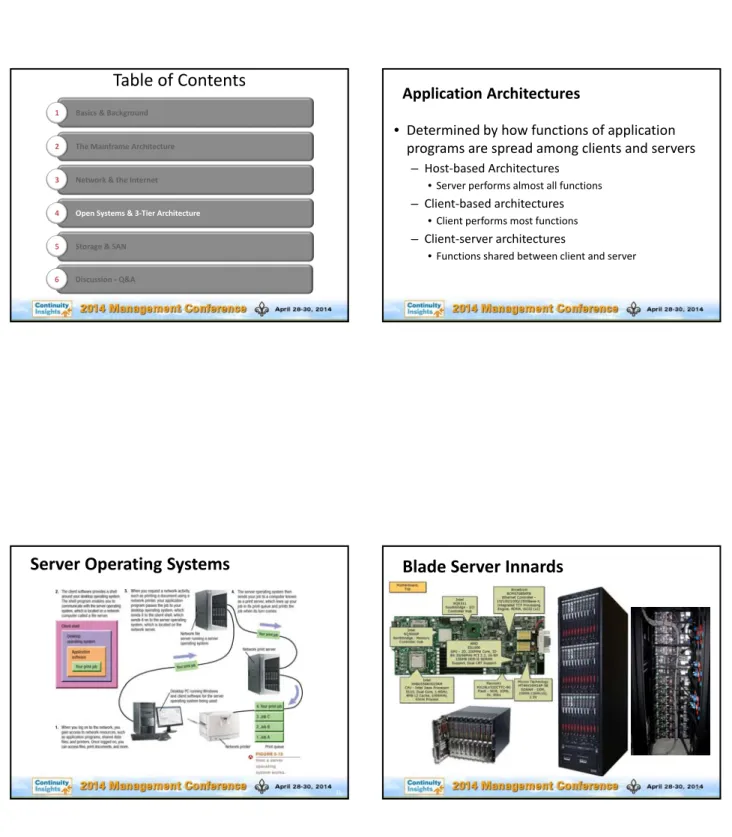
Application Architectures
•
Determined
by
how
functions
of
application
programs
are
spread
among
clients
and
servers
–
Host
‐
based
Architectures
•
Server
performs
almost
all
functions
–
Client
‐
based
architectures
•
Client
performs
most
functions
–
Client
‐
server
architectures
•
Functions
shared
between
client
and
server
31
Server
Operating
Systems
Blade
Server
Innards
Server
Functions
33
Open
Systems
Logical
Functions
34
Three-tier architecture
Enterprise data center
architecture
Front end
Web serving Web content access
Mid tier
Application business logic Business transactions, commit/update
Back end
Data base query/response
Three
‐
tier
Structure
Web Application Data base Little resources other than networking, transient data Large amounts of CPU and memory Large amounts of CPU and memory, Fast storage, Low latency networking Workload characteristics Workload isolation Workload isolation NAS filer NAS filer Fc san Fc san
Lack of Automated Controls Multiple Technologies Underutilized Servers Over Provisioned Storage Inefficiencies
Inefficiencies of the Traditional Data Center Architecture
12%
– 40%
Utilization
Out
of
Space
10%
– 50%
Premium
Higher
Labor
Costs
10%
– 60%
Utilization
Poor
Performance
Higher
Labor
Costs
Slow
Recoveries
Reactive
Enterprise data centerarchitecture Web Application Data base NAS filer NAS filer Fc san Fc san
Functions
within
3
‐
Tier
Architecture
38
Table
of
Contents
39
Basics & Background 1
The Mainframe Architecture 2
Network & the Internet 3
Open Systems & 3‐Tier Architecture 4
Storage & SAN
5
Discussion ‐Q&A 6
Storage
– DAS,
SAN,
NAS
Open
Systems
Storage
Alternatives
41 42
Storage Area Networks
45
Tiered
Storage
46
Tiered
‐
Storage
Solutions
47
Storage
Zoning
49
The
Host
Bus
Adaptor
(HBA)
Managing
Data
Protection
Silos
•Complexity
•Exploding data
•Storage, CapEx, and OpEx costs
•Application silos driving separate tools
•Fragmented backup tools, longer recovery
•Risk from too many unconnected processes
5 0 Database Silo Team #3 DB Admin Physical Silo Team #2 Backup Admin Virtual Silo Team #1 VM Ninjas Storage Silo Team #4 Storage Admin © 2 0 0 4 H i t a c h
Compliance
and
Retention
© 2 0 0 4 H i t a c h
Table
of
Contents
53
Basics & Background 1
The Mainframe Architecture 2
Network & the Internet 3
Open Systems & 3‐Tier Architecture 4
Storage & SAN
5
Discussion ‐Cloud ‐Q&A
6
A
taxonomy
for
cloud
computing
54
In this diagram, Service Consumers use the services provided through the cloud,
Service Providers manage the cloud infrastructure and Service Developers create the
services themselves. (Notice that open standards are needed for the interactions
between these roles.) Each role is discussed in more detail in the following sections
Physical app Physical app Physical app Physical app Physical app Physical app
The
Challenge
of
Applications
in
the
Cloud
• Increased Operating System Heterogeneity • Continuing movement
towards virtualization • More mission critical applications being virtualized • Application being stretched across different tiers • Increased complexity in
designing for high availability • Consuming applications
as a service from the enterprise/private cloud Hypervisor VM app VM app VM app Hypervisor VM app VM app VM app Hypervisor VM app VM app VM app Hypervisor VM app VM app VM app Hypervisor VM app VM app VM app Hypervisor VM app VM app VM app Physical app Physical app Physical app LDOM Physical app Physical app Physical app Physical app Physical app Physical app 55
VBS
‐
Manage
SLAs
for
Multi
‐
Tier
Cloud
Applications
Database App server Web server Billing DB FS IP VVR Service Group app app app App IP Service Group Web VM Service Group Web VM Service
Group Veritas Operations Manager
Database
SG
Application
Server
SG
Web
Server
SG
Billing Virtual Business Service
5 6
Build
Your
Private
Cloud
with
Virtual
Business
Services
Finance VBS
AppHA AppHA AppHA
Veritas Operations Manager
AppHA AppHA Billing VBS AppHA AppHA HR VBS VCS VCS VCS CFS HA SF HA Finance Dept
Billing Dept HRDept
5
7 Cloudthe Hype) Computing (Truth behind 58
Infrastructure HA/DR Configuration
Layering Business Service HA/DR
WEB WEB WEB
APP APP
DB DB
WEB WEB WEB
APP APP
APP
2 ‐61
Choosing
an
Architecture
Mainframe
Open
Complexity
– Recovery
This???
62
Today’s
IT
Challenges
63
•
Complexity
– Number
of
components,
differing
failure
rates
•
No
Common
Clock
– Creates
Data
Consistency
Challenges
•
Maintenance
versus
Organic
Growth
rate
•
IT
Market
Rate
of
Change
•
Maintaining
technology
currency,
compatibility,
and
End
of
Life
challenges
•
Abstraction
(Virtualization)
Challenges
Power
Consumption