Northumbria Research Link
Citation: Cantner, Uwe, Cunningham, James, Lehmann, Erik E. and Menter, Matthias (2020) Entrepreneurial ecosystems: a dynamic lifecycle model. Small Business Economics. ISSN 0921-898X (In Press)
Published by: Springer
URL: https://doi.org/10.1007/s11187-020-00316-0 <https://doi.org/10.1007/s11187-020-00316-0> This version was downloaded from Northumbria Research Link: http://nrl.northumbria.ac.uk/42806/ Northumbria University has developed Northumbria Research Link (NRL) to enable users to access the University’s research output. Copyright © and moral rights for items on NRL are retained by the individual author(s) and/or other copyright owners. Single copies of full items can be reproduced, displayed or performed, and given to third parties in any format or medium for personal research or study, educational, or not-for-profit purposes without prior permission or charge, provided the authors, title and full bibliographic details are given, as well as a hyperlink and/or URL to the original metadata page. The content must not be changed in any way. Full items must not be sold commercially in any format or medium without formal permission of the copyright holder. The full policy is available online: http://nrl.northumbria.ac.uk/pol i cies.html
This document may differ from the final, published version of the research and has been made available online in accordance with publisher policies. To read and/or cite from the published version of the research, please visit the publisher’s website (a subscription may be required.)
Entrepreneurial ecosystems: a dynamic lifecycle model
Uwe Cantner&James A. Cunningham&
Erik E. Lehmann&Matthias Menter
Accepted: 8 January 2020
#The Author(s) 2020
Abstract The concept of entrepreneurial ecosystems has been used as a framework to explain entrepreneurial activities within regions and industrial sectors. Despite the usefulness of this approach, the concept is under-theorized, especially with regard to the evolution of entrepreneurial ecosystems. The current literature is lacking a theoretical foundation that addresses the de-velopment and change of entrepreneurial ecosystems over time and does not consider the inherent dynamics of entrepreneurial ecosystems that lead to their birth, growth, maturity, decline, and re-emergence. Taking an industry lifecycle perspective, this paper addresses this research gap by elaborating a dynamic entrepreneurial ecosystem lifecycle model. We propose that an ecosys-tem transitions from an entrepreneurial ecosysecosys-tem, with a focus on new firm creation, towards a business eco-system, with a core focus on the internal commerciali-zation of knowledge, i.e., intrapreneurial activities, and
vice versa. Our dynamic model thus captures the oscil-lation that occurs among entrepreneurs and intrapre-neurs through the different phases of an ecosystem’s lifecycle. Our dynamic lifecycle model may thus serve as a starting point for future empirical studies focusing on ecosystems and provide the basis for a further under-standing of the interrelatedness between and co-existence of new and incumbent firms.
Keywords Entrepreneurial ecosystems . Entrepreneurship . Intrapreneurship . Lifecycles . Dynamism . Transition
JEL classifications O31 . O32 . O33 . L26
1 Introduction
Local production matters. One of the first scholars pointing out the importance of localized production was Alfred Marshall (1920) in his pioneering master-work “Principles of Economics,” where he explores how ideas come to be“in the air.”1Marshall identifies three sources of agglomeration causes bestowing entre-preneurial opportunities, namely labor market pooling, nonpecuniary economics, and knowledge externalities (Audretsch et al., 2006: 84). Since then, economists have begun studying production, innovation, and new firm creation beyond the national or market economy https://doi.org/10.1007/s11187-020-00316-0
1“The mysteries of trade become no mysteries; but they are as it were
in the air, and children learn many of them unconsciously”(Marshall, 1920: 225).
U. Cantner (*)
:
M. MenterFriedrich Schiller University Jena, Jena, Germany e-mail: [email protected]
M. Menter
e-mail: [email protected] J. A. Cunningham
Northumbria University, Newcastle, UK e-mail: [email protected] E. E. Lehmann
University of Augsburg, Augsburg, Germany e-mail: [email protected]
level on a decentralized and geographic level, trying to explore how and why such agglomeration effects emerge and evolve over time. In particular, the“why” question has been discussed intensively in the literature (see Audretsch, 1998; Ellison & Glaeser, 1999; Ciccone,2002): the agglomeration effects identified by Marshall generate positive externalities, and these exter-nalities are locally bounded. In the past decades, a fruitful and promising literature has emerged, analyzing agglomeration effects on a subnational level, where production is locally“clustered.”This strand of litera-ture has primarily focused on the evolvement of local clusters where the clustering or agglomeration is driven by either economies of scale (homogenous clusters) or economies of scope (heterogeneous clusters).
How can these insights be transferred to ecosystems? Also in ecosystems, agents compete for scarce re-sources, but in a cooperative way. The equilibrium is characterized by the complementarities and substitution-al interrelations among the economic agents—and will be distorted when only one economic agent survives. Among the various definitions of ecosystems, based on Tansley (1935), Acs et al. (2017a: 2) describe ecosys-tems as follows:“In its most abstract sense, an ecosys-tem (“ecological sysecosys-tem”) is a biotic community, its physical environment, and all the interactions possible in the complex of living and nonliving components.”It is one characteristic of an ecosystem that a creature/ agent cannot survive without the others. The suppres-sion of one creature/agent will inevitably lead to a welfare loss of all creatures/agents in the ecosystem if not destroy the entire ecosystem. It is the interrelation of creatures/agents within their nonliving environment which generates a value for all creatures/agents, en-abling them to survive, i.e., to reproduce themselves/ progress.
Entrepreneurship (i.e., the exploitation of previously non-commercialized knowledge and ideas) constitutes an essential determinant in the emergence and persis-tence of an ecosystem, or a regional economic system in general (Liguori et al.,2019). Like Auerswald and Dani (2017), we argue that an entrepreneurial ecosystem and a business ecosystem are subsets and nested within a broader regional economic system. When most of the relevant ideas are commercialized outside established firms by new venture creation, then entrepreneurship is the primary function activity within a regional ecosys-tem. Then, the entrepreneurial ecosystem should be at the center of interest. Otherwise, if the ideas are
commercialized in large parts within established firms, intrapreneurship is the primary function activity in com-mercializing new ideas and the business ecosystem dominates the regional economic ecosystem. We argue that entrepreneurial ecosystems and business ecosys-tems are two subsets of a regional economic ecosystem, linked together by whether the exploitation and com-mercialization of ideas are rather complements or sub-stitutes to existing firm assets.
A pivotal aspect that links entrepreneurial ecosystems with business ecosystems is human capital (Audretsch & Link, 2019). Knowledge is partly embodied in em-ployees, which makes labor mobility (i.e., the flow of human capital) relevant (Braunerhjelm et al.,2018). In-dividuals may absorb knowledge and skills from established firms and decide to create a new venture to exploit their ideas. In addition, established firms may favor spin-offs of “intrapreneurial”teams leading to a win-win situation for both, the incumbent firm and the now“entrepreneurial”team (Fabel,2004). New venture creation and spin-offs reflect labor mobility within a regional economic ecosystem. Hence, an essential char-acteristic of a vibrant regional economic system is the flow of labor from incumbent firms towards entrepre-neurial firms and vice versa. In order to pursue their “corporate entrepreneurship”strategy (see Ireland et al.,
2009), incumbent firms strongly depend on absorbing and exploiting new technologies and innovations. Thus, with respect to the proposed specialization among technology-based start-ups and technology-seeking in-cumbent firms in the market for innovation, inin-cumbent firms enjoy competitive advantages in the commercial exploitation of innovations, while start-up firms enjoy advantages in their exploration (Lehmann & Schwerdtfeger,2016; Henkel et al.,2015).
The extant literature on entrepreneurial ecosystems has attempted to account for these inherent mechanisms by investigating their governance configurations (Colombelli et al., 2019; Colombo et al., 2019; Cumming et al.,2019; Cunningham et al.,2019b), their resilience (Roundy et al.,2017), and their evolutionary dynamics (Mack & Mayer, 2016; Brown & Mason,
2017; Auerswald & Dani,2017). Despite the usefulness of existing frameworks, the current literature is lacking a clear theoretical foundation for the emergence, develop-ment, and change of entrepreneurial ecosystems over time, especially with regard to the transition from an entrepreneurial ecosystem towards a business ecosys-tem and vice versa. A theoretical foundation is yet
necessary to create a common understanding among scholars, hence allow for cumulativeness in research. Based on our conceptual framework, we elaborate the dynamic nature of entrepreneurial ecosystems and cap-ture the oscillation that occurs among entrepreneurs (new firms) and intrapreneurs (incumbent firms) through the different phases of an ecosystem’s lifecycle. We thereby present a dynamic model of ecosystems based on the lifecycle model as introduced by Vernon (1966) and extended for clusters and regions by Klepper (1997). We propose that an ecosystem transitions from an entrepreneurial ecosystem, with a focus on new firm creation, towards a business ecosystem with a core focus on the internal commercialization of knowledge, i.e., intrapreneurial activities, and vice versa. Our lifecycle model thus considers the inherent dynamics of entrepre-neurial ecosystems that lead to their birth, growth, ma-turity, decline, and re-emergence and may serve as a starting point for future empirical studies focusing on ecosystems and provide the basis for a further under-standing of the interrelatedness between and co-existence of new and incumbent firms.
The remainder of this paper is structured as follows. Section2provides an overview of existing definitions of entrepreneurial ecosystems and highlights that despite the usefulness of this approach, the concept is under-theorized, especially with regard to the evolution of entrepreneurial ecosystems. The subsequent Section 3
focuses on the emergence and the dynamic nature of entrepreneurial ecosystems. Section4presents our dy-namic lifecycle model of an entrepreneurial ecosystem. A final section concludes our paper.
2 Literature review
2.1 Defining entrepreneurial ecosystems
As mentioned in the introduction, there has been a growing research focus on entrepreneurial ecosystems as a subset in analyzing geographically bounded ag-glomeration effects (see Audretsch et al.,2019b). The concept of entrepreneurial ecosystems has been increas-ingly used by policy makers in their analysis of policy issues with respect to entrepreneurship and economic development. The definition of what an entrepreneurial ecosystem constitutes is open to different interpretations and its origins have often been traced back to ecological systems (Acs et al., 2017a). In a recent review of
previous studies of entrepreneurial ecosystems, Tsujimoto et al. (2018) identifies and categorizes four perspectives, the industrial ecological perspective, the business ecosystem perspective, the platform manage-ment perspective, and the multi-actor network perspec-tive, whereas Scaringella and Radziwon (2018: 62) for their systematic review of ecosystems use a taxonomy of business, innovation, entrepreneurial, and knowledge ecosystems. Spigel and Harrison (2018) take a process-based view of ecosystems and identify four types of ecosystems—strong, arid, irrigated, and weak—by characterizing and evaluating the respective network strengths and available resources. Spigel (2017: 50) defines entrepreneurial ecosystems as a “combination of social, political and cultural elements within a region that support the development and growth of innovative startups and encourage nascent entrepreneurs and other actors to take the risks of starting, funding, and other-wise assisting high-risk ventures.”This individual inter-action focus with institutional actors is further elaborat-ed by Acs et al. (2014: 479) in their definition. Based on their study of entrepreneurial variations in 70 European cities, Audretsch and Belitski (2017: 1045) define effi-cient entrepreneurial ecosystems as“a complex system of interactions between agents within various socioeco-nomic, institutional and informational contexts which generate more new businesses and growth.”Mason and Brown (2014: 5) in their synthesized definition of en-trepreneurial ecosystems from the literature emphasize the interactions between actors, institutions, and entre-preneurial processes that are centered on a local envi-ronment. Furthermore, they posit that place-based as-sets, entrepreneurial recycling, culture, finance, and ser-vice providers, are some factors that distinguish entre-preneurial ecosystems.
Policy, markets, finance, culture, supports, and hu-man capital are core domains of entrepreneurial ecosys-tems (Isenberg,2011; Liguori et al.,2019) and stand-up; start-up and scale-up are structural aspects of entrepre-neurial ecosystems (see Autio et al., 2018). Spigel (2017) argues, based on Canadian case studies, that entrepreneurial ecosystems consist of material, cultural, and social attributes. Using the Netherlands as a case study, Stam (2014) develops a model of entrepre-neurial ecosystems which consists of framework and systemic conditions, outputs, and outcomes. Narratives that are used within and outside entrepreneurial ecosys-tems can influence the knowledge transfers and culture as well as enable sense making by ecosystem actors
such as entrepreneurs (Roundy,2016). Different actors within entrepreneurial ecosystems can play a leading role in influencing their direction and evolution (Kshetri,2014). This is further reinforced by Thompson et al. (2018), based on studying entrepreneurial ecosys-tems over 14 years in Seattle, Washington, suggesting that individual actor’s activities centered on shared col-lective value through everyday activities that provide the resources and infrastructure that support entrepre-neurship. This study illustrates the bottom-up approach to ecosystem development.
Some of the definitions and studies of entrepreneurial ecosystems have taken an evolutionary perspective. Taking an economic geography perspective, Mack and Mayer (2016: 2122) pursue an evolutionary perspective that integrates the core domains as posited by Isenberg (2011) and outline how they evolve through the stages of birth, growth, sustainment, and decline. Evolutionary biology and ecological perspectives form the basis and strategies to build effective ecosystems (see Auerswald,
2015). Studying a cluster of biotechnology-related en-trepreneurship, Auerswald and Dani (2017) propose an empirical framework which assesses the trajectories of regional entrepreneurial ecosystems. Using a case study of Scottish entrepreneurial ecosystems, Autio and Levie (2017) use ecological economics to create a theoretical framework for entrepreneurial ecosystem management. Moreover, Mason and Brown (2014) also take an evo-lutionary model that has a regional focus to outline the different steps and activities of entrepreneurial ecosys-tems. In summing up the state-of-the-art of entrepre-neurial ecosystem research, Brown and Mason (2017: 15) state that entrepreneurial ecosystems“appear to be somewhat under-socialised, lacking a time dimension and fail to incorporate the full complexities of the socio-spatial context mediating entrepreneurship.”The pur-pose of our paper is to address this research gap by elaborating a dynamic entrepreneurial ecosystem lifecycle model, describing the evolution of such eco-systems over time, and taking into consideration the oscillation that occurs among entrepreneurs and intra-preneurs. We further deal with some of the criticisms of entrepreneurial ecosystems related to our research focus that are outlined in the subsequent section.
2.2 Some criticisms of entrepreneurial ecosystems There have been some criticisms of entrepreneurial eco-systems (see Borissenko & Boschma,2016; Oh et al.,
2016) such as the lack of a strong theoretical foundation, governance structures, and how individual factors con-tribute to the activities of entrepreneurial ecosystems (see Spigel,2017: 143). Stam’s (2015: 1764) criticism focuses on the tautological nature of entrepreneurial ecosystems, as well as the missing explanation of cause and effect of factors and level of analysis (see also Colombo et al., 2019). Moreover, Alvedalen and Boschma (2017) outline several criticisms of entrepre-neurial ecosystems including the lack of frameworks distinguishing cause and effect, individual factor con-nectedness within entrepreneurial systems, individual institutional impact, entrepreneurial ecosystem perfor-mance, and studies having a sole focus on single settings.
A major criticism of entrepreneurial ecosystems is how to measure them and what factors to include. There have been some attempts to develop measurement criteria (see Acs et al., 2018; Bruns et al., 2017). For example, Stangler and Bell-Masterson (2015: 2) suggest density, fluidity, connectivity, and diversity as categories along with potential data sources to measure entrepreneurial ecosystems. Autio et al. (2018) call for novel approaches to stimulate entrepreneurial ecosys-tems that are distinctively different from existing indus-trial cluster policies, requiring a consideration of eco-nomic but also societal outcomes and welfare.
A final core criticism of entrepreneurial ecosystems according to Alvedalen and Boschma (2017) has been on the static nature of approaches that do not consider their evolution. Brown and Mason (2017: 26) argue that researchers in studying entrepreneurial ecosystem need to appreciate more the “complexity of the dynamics” particularly with respect to agency and governances. Entrepreneurial ecosystems research also lacks “histor-ical or contextual sensitivities” (Spigel & Harrison,
2018). Our dynamic lifecycle model addresses these calls, particularly the static nature of entrepreneurial ecosystems.
3 The dynamic nature of entrepreneurial ecosystems 3.1 The mechanisms and boundaries of entrepreneurial ecosystems
The general thinking of ecosystems in the business and management literature is still in terms of systems theory, arguing that ecosystems are aligned to the analogy of
natural ecosystems“as a community of living organisms in conjunction with the nonliving components of their environment, where the eco part of the word is assumed to be related to the environment and system implies the function as a collection of related parts that function as a unit” (Smith & Smith, 2015: 19). Scholars are then translating the relevant characteristics into a business and management language. They are replacing living organisms with a set of individuals or stakeholders, like entrepreneurs, venture capitalists, or policy makers interacting together in different ways to pursue an indi-vidual and/or common goal. They live or interact in conjunction with nonliving components like universi-ties, incubators, and companies where the“eco”part of the word is assumed to be related to the environment, either local, regional, or national where all parts together function and constitute a unit—the ecosystem (see Ritala & Almpanopoulou,2017). The academic litera-ture in this sense treats the“ecosystem”as a metaphor, a new concept, to gain a high attention in the initial state (see Audretsch et al., 2019b; Acs et al. 2017a,b), attracting more and more interest, and to become an academic “hot spot”and then almost burn up. While the metaphor is widely used and, as any innovative idea spreads, so do the misconceptions and mythologies.
The analogy to natural ecosystems lacks in at least three but important differences (see also Kuckertz,
2019). First, natural ecosystems evolve over time and are not created from scratch. The importance in analyz-ing ecosystems in business and management regardanalyz-ing whether they are artificial or have evolved over time is almost neglected by the literature—leading to a misun-derstanding of the metaphor and the implications. The second aspect, related to the first, is the aspect of the boundaries of ecosystems (Colombo et al.,2019). Are ecosystems open or closed, are they geographically bounded or not, are the boundaries real or virtual, are they fix or flexible, static, or dynamic? Since ever, boundaries play an important and crucial role for value creation, performance, and survival: boundaries deter-mine who is in and who is not, who adds and benefits and who does not.2Boundaries define the entry and
exit conditions and their nature is either natural, like rivers, mountains, or membranes, or artificial like political frontiers, ultimately defining the access to tangible and intangible assets.
The kind of creation, the emergence of an eco-system, determines the boundaries of an ecosystem impacting the key attribute, the governance struc-ture. In either natural or social ecosystems, value is created by the division of labor and specializa-tion. Such a value creation process leads to mutual independencies at the cost of individual freedom and requests for coordinating and motivating activities—a governance structure (Cunningham et al., 2018). Governance structures coordinate the interactions of individuals, define the bound-aries and the entry and exit conditions of the ecosystem, and motivate the individuals to coordi-nate in an efficient way by rewarding their coop-eration with an adequate share from the generated value (Cunningham et al., 2019b; Colombo et al.,
2019).
Economic ecosystems in general are complex adaptive systems (see Roundy et al., 2018), where the components, the economic agents have a will of their own, but follow additional rules. Whether the individual economic agent is just maximizing his or her utility or satisficing, economic ecosystems act as if every component is an agent with a will of its own. In doing so, each agent is adjusting to the actions and performance of many other agents. If economic agents react to others, they are reacting to information about what is happening around them, including information about what other agents are doing. As Christian (2018: 78) puts it,“information consists of rules that affects outcomes by limiting possibilities, and that rules determine which changes out of all conceivable options are actually possible at a given time and place, and that makes a differ-ence.” An economic ecosystem is a complex adap-tive system, a place that consists of different eco-nomic agents each following their own by reacting on information and following a set of rules that determine and select a feasible set of options and outcomes. And, in analogy to Christian (2018: 78), like the laws of human societies change from place to place and moment to moment, regional economic ecosystems appear as environments that have their own local rules that were not universal, and have to be read or decoded or studied.
2The Epic of Gilgamesh from ancient Mesopotamia (2100 BC),
referred to as the earliest surviving great work of literature, describes the building of a wall around Uruk, separating civilization from wil-derness. The benefits and value created by division of labor and specialization and the costs of mutual dependence should be protected against the outsiders, the creatures, the wilderness (see Sedlacek,2011, chapter I.1.).
3.2 The emergence of entrepreneurial ecosystems With the extant literature on entrepreneurial ecosystems, some important questions have not been asked yet or have not been sufficiently answered: How do ecosys-tems and in particular entrepreneurial ecosysecosys-tems emerge and evolve over time? Are entrepreneurial eco-systems artificial and thus created from scratch or do they evolve by chance, or something in-between? Do entrepreneurial ecosystems follow an archetypical lifecycle model from birth and an initial phase towards phases with an increasing population up to a maximum followed by a starving decline and a potential re-emer-gence? Answers to these questions are essential for policy makers to implement adequate policy measures and instruments that support fluid ecosystems enabling the oscillation that occurs among entrepreneurs and intrapreneurs to ultimately generate regional growth and prosperity. Based on our lifecycle model, this paper aims to provide answers to these questions.
Our dynamic lifecycle model outlines why both en-trepreneurial firms and established firms co-exist, how and why they are closely linked together forming eco-systems. In that, we argue that the lifecycle concept explains how ecosystems arise and how they work and provides a basic framework to analyze the formation, design, and evolvement of ecosystems. The initial“big bang”or starting point of our analysis is an idea and an individual’s decision whether to exploit an idea exter-nally and become an entrepreneur or interexter-nally within the established firms. Our lifecycle model combines the concepts of “intrapreneurship”and“entrepreneurship” within an occupational choice context (see Lucas,
1978): the decision to exploit an idea by becoming an entrepreneur or by still working in an established firm is shaped by the opportunity costs. Like one swallow does not make a summer and a single entrepreneur does not make an entrepreneurial ecosystem, we assume positive spillover effects of entrepreneurship, increasing the number of firms within regions. A trend towards exploiting new ideas by creating new firms will lead to an entrepreneurial ecosystem, while the opposite, the exploitation of ideas within established firms, will con-stitute a business ecosystem. Clearly, both entrepreneur-ial and business ecosystems are closely linked together by the individual decision process to exploit ideas ex-ternally or not.
Because individuals create firms and firms create ecosystems, our model helps to explain how
entrepreneurial ecosystems arise and evolve over time, how and why they co-exist with business ecosystems, and whether or not entrepreneurial ecosystem survive or not. It is a stylized fact in economic research that entre-preneurial firms create and operate markets. Without entrepreneurial firms, market economies could not exist, since even established and incumbent firms started small as a new venture. And the new ventures created are the results of an individual’s decision to create one, a process driven by exogenous factors like outside oppor-tunities but also the result of an intellectual process. While there is an extensive debate on the influence of exogenous and endogenous factors shaping entrepre-neurial opportunities and the decision to create a new firm or not, and whether exogenous factors are more or less important compared with the cognitive process of entrepreneurs, there is no doubt that the decision process starts with an initial “big bang”—the idea (see Brush et al.,2001).
It is also undisputed in economic theory that individ-uals choose to become entrepreneurs by working in established firms, which makes entrepreneurship endog-enous (Baumol, 2010). As Spulber (2009: 1) states, firms are established endogenously by entrepreneurial actions, and since firms act as market makers by creating and operating markets, also markets are endogenous. Economic equilibria are thus the result of transacting internally in established firms and the creation of new firms and markets. Markets are thus endogenously shaped by the characteristics and actions of individuals and their relationships forming communities, social in-stitutions, governments and networks, or an economic ecosystem. Firms operate in an ecosystem consisting of such communities, social institutions, networks and government, rules, and norms, which emerge and evolve over time. While some of the components and properties of an ecosystem are more or less exogenous but are endogenous on the long run, other components are endogenously shaped by actions and decisions made in the short run and are the result of interactions of individuals and the rather fixed properties. The nucleus of an ecosystem, the source of creation, and change of ecosystems is the decision process of how to generate and exploit ideas: whether ideas are generated and exploited internally in established firms or by establish-ing a new venture as a means to commercialize the idea. If the overwhelming amount of ideas in an ecosystem is generated and exploited internally, such an ecosystem could be labeled as a“business ecosystem.”If the most
relevant ideas are commercialized by creating new firms, start-up companies, we can talk of “entrepreneur-ial ecosystems.”While neither business nor ecosystems exist in a pure form and are interlinked by the decision process of exploiting ideas internally or externally, both kinds of ecosystems exist and evolve following a co-determinate path. Business ecosystems and entrepre-neurial ecosystems are thus characterized by comple-mentarities and substitutional interrelations, leading to different patterns. It is the interrelatedness of the living actors, the economic agents, what separates economic ecosystems from economic markets—an important styl-ized fact which is almost neglected by the ecosystem literature so far.
4 A dynamic lifecycle model of an entrepreneurial ecosystem
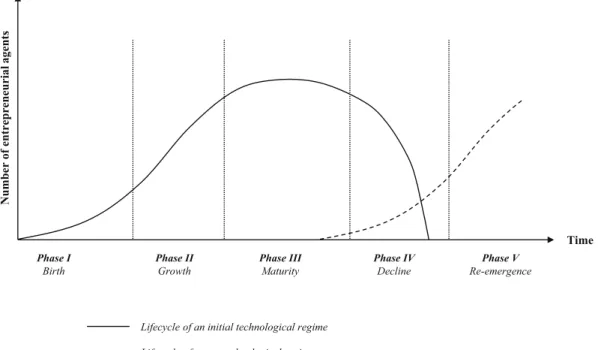
In order to describe the evolution of an entrepreneurial ecosystem and thus capture its dynamic nature (see Brown & Mason, 2017), we rely on the traditional concept of industry lifecycles as introduced by Vernon (1966). For simplicity, we assume that an entrepreneur-ial ecosystem evolves over time, passing several phases (see Fig.1); starting with the introduction or the begin-ning of an entrepreneurial ecosystem (phase I), the growth phase (II), the maturity or stabilization phase (III), the decline phase (IV), and a subsequent re-emergence phase (V). We consider a reproduction rate as an elasticity of commercializing an idea inside an established firm (intrapreneurship) or outside by creat-ing a new venture (entrepreneurship). The reproduction rate is thus an equivalent to an elasticity coefficient in a regional production function expressing the ratio of intrapreneurship and entrepreneurship. If the reproduc-tion rate exceeds 1, the entrepreneurial ecosystem is increasing or growing, if it equal to 1, the entrepreneur-ial ecosystem is saturated, and declining when the re-production rate falls below 1. As long as the reproduc-tion rate is larger than 1, exploiting opportunities via new firm creation and entrepreneurship, the broader regional economic ecosystem as a nested ecosystem is dominated by the“entrepreneurial ecosystem”as a sub-set. When the reproduction rate falls below 1, then the “business ecosystem”dominates the regional economic ecosystem. At the point of intersection, both ecosys-tems, the entrepreneurship ecosystem and the business
ecosystem, contribute equally to the regional economic ecosystem.
This lifecycle model of a regional economic ecosys-tem helps to explain why, albeit neglected by many authors, even regions with a low rate of entrepreneur-ship may show high-performance measures, if the busi-ness ecosystem is at work and the exploitation of new ideas and knowledge is organized as an internal process (and vice versa).
4.1 Phase I: The birth of an entrepreneurial ecosystem We follow Alfred Marshall and define an idea as the initial point, the“big bang”of an entrepreneurial eco-system. Marshall (1920: 225) argues that“if one man starts a new idea, it is taken up by others and combined with suggestions of their own; and thus it becomes the source of further new ideas.”An idea carried out by an individual, an idea as something virtual with distinctive new qualities, leading to new things with new proper-ties. New things, even the best ideas, do not fall like manna from heaven. New things, new properties, and new qualities do not arrive out from nowhere or from nothing, but emerge from already existing things and forces that are arranged in new ways (Christian,2018: 22). What holds for the largest known ecosystem, our universe, should even hold for every subset of ecosys-tems, even an entrepreneurial ecosystem. A new idea is consequently nothing else than a vision of a new ar-rangement of existing things and forces that yield the new properties, just as arranging letters or notes to new poems or songs, or both together. Like when we read a new poem or listen to a new piece of music, we think of a new form or structure with new qualities, of a new arrangement of what already exists: innovation is emer-gence.3 In essence, it is a recombination of existing basic and applied knowledge that might ultimately stim-ulate the creation of new knowledge and ideas (see Leyden & Menter,2018).
In the initial phase, an economic agent, an individual agent, has an idea about how to arrange existing things in a new way and to convert this idea into some societal utility. Such “existing things” may be the effect of spillovers from other sources, like knowledge overlooked or neglected by others or something“which is in the air,” citing Marshall (1920) again. This 3And very often, by chance or not, the new arrangements do not differ
individual has at least two options when converting an idea into societal and economic utility: either by exploiting the opportunity within an incumbent firm and acting as anintrapreneuror starting a new venture as an entrepreneur. We follow the rich and fruitful literature on entrepreneurial decision-making, based on opportunities (Kirzner, 1973; Schumpeter, 1934), the judgment of opportunities (Foss & Klein,2012), oppor-tunity costs (Venkataraman, 1997), the discovery of entrepreneurial opportunities, and how and why the entrepreneurial decision process is shaped by individual differences (Shane,2003). For simplicity, the opportu-nity costs consist mainly of the use of time and the income, influenced by individual factor levels like edu-cation, experience, or social position (status and ties). At the starting point, when the individual decides to exploit his or her idea by creating a new venture, the expected utility or value exceeds the opportunity costs. It is im-portant to note that especially at the early stages of a new technological regime (see Breschi et al.,2000), opening up potential new markets in the long run, no incumbent firm might be available or willing to engage into this new technology, resulting in an individual decision to either start a new venture (“entrepreneurial ecosystem”) or leave the idea unexploited.
To pursue uncertainty opportunities, individuals care-fully evaluate the costs and benefits of becoming an
entrepreneur or staying within an incumbent firm as anintrapreneur. To become an entrepreneur and exploit an idea by creating a new venture, individuals must believe that they will gain more than they are giving up (Venkataraman,1997). As Shane puts it (2003: 62), “when people make a decision to exploit an entrepre-neurial opportunity, they do so because they believe that the expected value of exploitation (both monetary and psychic) exceeds the opportunity costs of alternative uses of their time plus the premiums that they would like for bearing uncertainty and illiquidity.” Conse-quently, the more likely individuals are to exploit an opportunity as an entrepreneur, the greater is the value that they expect to receive from exploiting the idea outside an incumbent firm by creating a new venture. This expected value is shaped by the regional or local economic ecosystem, in particular by the nature of the opportunity, the industry and market conditions, and the environment with its institutions, norms, and rules. All three factors are archetypical for ecosystems, namely the individual agent, the interrelations and interactions with other economic agents and the nonliving environment.
A pivotal point in an economy in general and in particular in a regional economic ecosystem is knowl-edge spillovers and the sources of knowlknowl-edge spillovers (Acs et al., 2013; Ghio et al., 2015; Audretsch & Lehmann, 2005). Literature has identified two main
Time re b mu No f lai ru en er pe rt nes tn eg a
Lifecycle of an initial technological regime Lifecycle of a new technological regime Phase I
Birth Phase IIGrowth Phase IIIMaturity Phase IVDecline Re-emergencePhase V
sources of knowledge production: academic research institutions and established firms (see Audretsch & Feldman, 1996). The knowledge they produce could only in small parts be exploited within their boundaries, or outside by new venture creation. In this stadium, new venture creation and entrepreneurship may occur in two ways. First, by employees (even academics are em-ployees of their universities) by exploiting opportunities originating in knowledge overlooked or neglected by their organization. Second, by spin-offs, when the pro-prietary company or university favors individuals or teams to exploit their ideas and opportunities outside the firm by creating a new company. As Fabel (2004) shows, entrepreneurial spin-offs constitute a persistent response to the established corporations’failure in or-ganizing teamwork in high-risk and human capital-intensive industries.
Given such a high risk and uncertain production environment, like in the ICT and high-tech industries, the verification of the team members’abilities will plau-sibly be enhanced if the evaluation is carried out by the team members themselves, and not by their boss. Even if verification is in principle possible, Fabel (2004) argues that it is necessary to provide incentives to spe-cialize on this task. While wage incentives for special-ized human resource managers in large corporations cannot draw on direct measures of their recruitment success (Weinberg, 2001; Zingheim & Schuster,
2000), in entrepreneurial firms, the motivation to select appropriately is directly linked to the manager-owners’ residual income claims (Lehmann,2006). Consequent-ly, equity-like remuneration, like shares or option plans, is then better aligned with tasks than wage incentives (see Lehmann, 2006). Moreover, organizing the team not only requires selective recruiting. It will also be necessary to dismiss individuals who, upon being ini-tially hired, turn out not to fit perfectly into the team. In a bureaucratic hierarchy, detecting and dismissing people who do not (perfectly) match with the team is associated with high transaction costs, leading to adverse effects. In young and entrepreneurial firms, employees’work con-tracts are similar to self-employment and hiring and firing is the rule and not the exception. Prat (2002) shows that hierarchies with ability-matched teams are dominant in production environments and characterized by positive complementarities between specialized tasks. The perspective to become owners themselves limits the exploitation risk and, therefore, enhances the incentives to specialize for young managers. Then,
Bhidé (2000: 139-140, 367-368) again reports the par-ticular importance of such teamwork in corporate ven-tures. Thus, entrepreneurial firms could more easily react to exogenous shocks and environmental changes than incumbent firms.
To conclude, intrapreneurial activities, the exploita-tion of new ideas and opportunities, are hard to monitor, induce adverse team effects, often conflicts with the corporate culture and finally, intrapreneurs could not be payed as bureaucrats, which favors the concept of entrepreneurship (Weinberg, 2001; Zingheim, & Schuster2000). Fabel (2004) shows that the inflexibility of a firm’s wage structure to sufficiently differentiate, reward, and encourage entrepreneurial activities fosters the spin-off of teams: while the wages are now paid outside the firm, the possible rewards when the spin-off is successfully operating could be at least partly absorbed by the stakes hold with the spin-off.
Spin-offs and new venture creation are then the core base that forms an entrepreneurial ecosystem. The first phase is thus characterized by a growing number of entrepreneurial firms and spin-offs in the region. As Shane (2003), among others, points out, entrepreneur-ship does not occur in isolation. A necessary (but not sufficient) attribute of an entrepreneurial ecosystem is the manifold relationships among the entrepreneurs. Entrepreneurs and entrepreneurial firms constitute a complementary set of variables in that increasing one variable increases the outcome of another (see Roberts,
2004). This lowers the opportunity costs of new venture creation, either by individuals or spin-off teams. Within a rather short period of time, the number of entrepre-neurial activities increases within a region, constituting what academics label an“entrepreneurial ecosystem.”
& Proposition 1: The starting point of an entrepre-neurial ecosystem—the birth stage—is an idea that may not be exploited within an incumbent firm, resulting in new venture creation.
4.2 Phase II: The growth of an entrepreneurial ecosystem
The second stage of our dynamic lifecycle model is the growth phase where each element in the entrepreneur-ial ecosystem starts to become more specentrepreneur-ialized and targeted towards entrepreneurship. A vibrant entrepre-n e u r i a l s c e entrepre-n e , r e s e m b l i entrepre-n g a entrepre-n a r c h e t y p i c a l
“entrepreneurial ecosystem” where all the different economic agents, like venture capitalists, consultants and lawyers, entrepreneurship policies (Lehmann & Menter, 2018a,b; Audretsch et al., 2016, 2019a; Cunningham et al., 2019a), incubators, and accelera-tors are at work and educational institutions start to offer entrepreneurship-specific programs to foster new firm creation and location (Audretsch & Lehmann,
2005; Audretsch et al. 2019b). Financial capital be-comes more readily available, and access to financial capital becomes increasingly less restrictive. Human capital becomes more entrepreneurially minded and successful entrepreneurs begin to function as role models for potential nascent entrepreneurs, leading to a herd behavior effect: being or becoming an entrepre-neur generates an individual value per se, a non-monetary benefit of being an entrepreneur. The region-al culture strengthens entrepreneurship itself and is now part of the regional subculture scene and entrepre-neurial networks expand and become denser (Lehmann & Seitz, 2017) and as a result, societal norms may change in favor of a regional“entrepreneurship socie-ty”(Audretsch,2007).
The important source to grow is human capital and an adequate labor force. Specific human capital, technolog-ical know-how, and employment systems now play key roles in these new enterprises (Rajan & Zingales,2000) as they can allow for competitive advantages if success-fully implemented. Entrepreneurial firms provide both strong incentives to specifically invest in the innovation process and corresponding selection devices to identify opportunities more successfully as compared with in-cumbents (Fabel, 2004; Rajan & Zingales, 2001a,b). Prat (2002) demonstrates the pivotal role of adequate recruiting for entrepreneurial firms and case studies show that—during the growth phase following the im-mediate birth period—recruiting experienced managers from established firms constituted a key success factor (Bhidé, 2000) and “unusual judgement or perceptive-ness”in employee selection became a strategic advan-tage of successfully operating entrepreneurial firms (Bhidé2000: 108). During this phase, the entrepreneur-ial ecosystem evolves to include also national and inter-national opportunities, as reflected by the visibility of the first serial entrepreneurs and unicorns, i.e., entrepre-neurial firms with a market value beyond a billion US$. While new firms constantly enter the “entrepreneurial ecosystem” and the former start-up companies grow, others are leaving the market.
At the same time, established firms have to renew and redefine their routines and norms towards a “corpo-rate entrepreneurship” culture (Kuratko et al., 1990,
2014,2015; Covin & Miles,1999). Takeovers of start-up and entrepreneurial firms now allow for acquiring innovations, such as new and sophisticated variations of products or services already offered by incumbents (Fabel, 2004; Henkel et al., 2015; Lehmann and Schwerdtfeger, 2016), that already have proven their viability and subsequently can be brought to the market by exploiting incumbents’advantages such as broader resource bases, sufficient funding, and economies of scale and scope in production, and other value chain activities. The tendency to re-integrate entrepreneurial firms characterizes the end of the second phase.
& Proposition 2: Following the immediate birth period, the growth stage is characterized by the emergence of an entrepreneurship culture, en-couraging further individuals to start their own business.
4.3 Phase III: The maturity and stabilization of an entrepreneurial ecosystem
In the third stage, the entrepreneurial ecosystem reaches a phase of maturity and stabilization which is character-ized by a smaller number of new entrepreneurial firms entering the market and a larger number of firm exits. At the end of stage two, access to financial resources does not serve as a prohibitive entry barrier and restriction, leading to adverse effects of market entries. The “win-dow of opportunity,”as described by Ritter (1991), has been opened widely and attracted individuals and the creation of new firms with questionable quality (Baumol, 1996; Litwin & Phan, 2013), leading to pooling-equilibrium of qualities (Antony et al., 2017). In this phase, market opportunities and networks start to weaken, increasing the opportunity costs of becoming an entrepreneur or working within an entrepreneurial firm. Thus, some ventures mature, becoming more for-mally structured and bureaucratic, less flexible, and dynamic. The decline in the number of new firm crea-tion and entries increases the opportunity cost of self-employment and lowers the opportunity costs for other types of employment, like returning back to incumbent and established firms. Investor confidence begins to wane, financial capital becomes harder to access, and
IPO activities start declining (Meoli et al., 2013; Bonardo et al.,2010).
At the same time, established companies increase their effort to re-integrate entrepreneurial firms, leading to a win-win situation for both, entrepreneurial firms and incumbent firms (Lehmann & Schwerdtfeger,
2016). While young and entrepreneurial firms’ innova-tion endeavors are assumed to be more likely to create breakthroughs, these firms often fail to bring their inno-vations to the market. Large and established firms have the financial resources to invest in new technologies, but they often lack new and radical innovations. Since start-up and entrepreneurial innovation is more radical than that of established firms, Granstrand and Sjölander (1990) suggest a division of scientific labor between entrepreneurial and established firms. Such a division of labor implicitly defines their roles as targets for acquisitions so that takeovers may lead to a win-win situation for both parties (Gans & Stern,2000; Blonigen and Taylor,2000). Being taken over not only reflects and values the past performance of the top management team positively (Gans & Stern, 2000; Colombo et al.,
2010) but also promotes and supports established firms to attract critical technological resources by taking over young high-tech firms, leading to a win-win situation or match for both firms—when the new venture could be successfully re-integrated. However, re-integrating of entrepreneurial firms is not a success story per se. As noted by Bhidé (2000: 324) the“corporate culture”of established firms may still prevent the installment of ability-matched teams of superior quality. Thus, the degree to which re-integration will occur is also deter-mined by the firms’integrating abilities to differentiate wages.
This stage reflects the intersection with the regional business ecosystem, the transition and change from the entrepreneurial to the business ecosystem. The perfor-mance of the business ecosystems as a subset of the regional economic ecosystem becomes more significant compared with the entrepreneurial ecosystem. The eco-nomic agents as appeared in the first two stages are still at work, but on a less dynamic and vibrant way—and become established players within the regional econom-ic ecosystem. Like vegan food once was a characteristeconom-ic peculiarity of an entrepreneurship subculture, it has now become a main street trend (Lehmann & Seitz,2017).
& Proposition 3: The maturity and stabilization phase reflects the intersection between an
entrepreneurial ecosystem and a business ecosys-tem, as new venture creation becomes less attrac-tive and incumbent firms increase their efforts to re-integrate entrepreneurial firms.
4.4 Phase IV: The decline of an entrepreneurial ecosystem
The fourth stage is characterized by a reverse way in exploiting ideas and opportunities. New ideas and knowledge are now mainly exploited within established firms, and new venture creation to exploit opportunities resembles an exception and not the rule. New firms enter the market, but resemble more traditional compa-nies than entrepreneurial firms. Even when this phase is characterized by a low rate of market entry, the declining phase of an entrepreneurial ecosystem is not equivalent to a decline of the regional economic system, or regional competitiveness and wealth. It is just that the main drivers of the regional economic ecosystem are now established firms, either because once entrepreneurial firms mature and have grown or the incumbent firms re-gain their strategic advantage or both. Like a mito-chondria containing all the genetic information, entre-preneurial firms are now totally re-integrated in a larger body, i.e., the incumbent firm, offering the genetic code to the acquirer.
This phase is characterized by the establishment of technological standards, substantiating the existing tech-nological regime that can be defined as “a particular combination of some fundamental properties of technol-ogies: opportunity and appropriability conditions; de-grees of cumulativeness of technological knowledge; and characteristics of the relevant knowledge base” (Malerba & Orsenigo, 1997: 94). Radical innovations are rare in this phase and incumbent firms rather focus on incremental innovations. This in turn opens up new (unexploited) opportunities for potential entrepreneurs, inducing the basis for a re-emergence phase of an entre-preneurial ecosystem resulting in the genesis of a new technological regime.
& Proposition 4: The decline phase characterizes the final transition from an entrepreneurial eco-system towards a business ecoeco-system, as new ideas are now mainly exploited within incumbent firms.
4.5 Phase V: The re-emergence of an entrepreneurial ecosystem
The entrepreneurial lifecycle may end in the fourth stage, becoming a business ecosystem with well-established companies, routines, and norms. Hitherto, dynamic and entrepreneurial regional ecosystems now tend to emerge to industrial clusters and clustering dis-tricts. Prominent examples are the regional dispersion of medium-sized companies in Germany, France, or Italy, grouping around research institutions with a focus on applied sciences (see Audretsch & Lehmann, 2016). While those regions often exhibit strong competitive firms (often so-called hidden champions and world mar-ket leaders in their niches), they exploit their knowledge generated and absorbed internally—as intrapreneurs (Audretsch et al.,2018). What lacks is the exploitation of ideas and knowledge outside firm boundaries, coor-dinated and motivated by the local market forces; there is a lack of entrepreneurship.
Another path is what is called the“re-emergence”in a lifecycle (see Cope, 2011); the “re-emergence” of exploiting ideas and knowledge externally via entrepre-neurship. Assuming the same mechanisms at work as in the first stage, it may be worthwhile for some individ-uals to exploit ideas outside firm boundaries, either as a spin-off or new venture creation. In this case, the entre-preneurial ecosystem lifecycle starts again, but in a different way. While in the first stage, the supporting institutions, networks, routines, and norms had to be established over time, they are now “in the air,” still there, awaiting a re-emergence (see Fritsch et al.,2019). Entrepreneurial culture has been established in the re-gion and within the incumbent firms, and learning ex-perience could be easily retrieved. Established firms are now ready to foster entrepreneurship, starting in the earliest stages. With firm-owned accelerators, they sup-port employees and external entrepreneurs in identifying new ideas and how to exploit them. Incubators provide support to grow up and survive the first stage more easily. All the economic agents supporting entrepreneur-ial ecosystem, like many wheels interlocked together, will seamlessly engage with the maximum benefit for all those involved in the entrepreneurial ecosystem (see Li et al.,2016; Isaksen,2016). This may lead to a contin-uous circle, with the“Silicon Valley”as a role model where new firms enter the market following a sinus curve, former entrepreneurial firms maturate over the years, like Amazon, Alphabet, Microsoft or Apple, now
becoming incumbent firms as sources of knowledge for entrepreneurs, producers of spin-offs, providers of ac-celerators and incubators, and finally as acquirers of successful and promising start-ups. Within this iterative process, initial technological regimes might be relieved by new technological regimes, opening up new oppor-tunities that may either be exploited by entrepreneurs or intrapreneurs (see O’Connor et al.,2018).
& Proposition 5: Based on the already existing en-trepreneurship infrastructure, the re-emergence phase opens up new opportunities for entrepre-neurs to exploit uncommercialized ideas from incumbent firms, replacing the initial technolog-ical regime.
5 Conclusions and future research avenues
The purpose and contribution of this paper is to present a dynamic entrepreneurial ecosystem lifecycle model. This model addresses one of the core criticisms of entrepreneurial ecosystems to date of not taking into account or appreciating the“complexity of the dynam-ics”as argued by Brown and Mason (2017: 26). Our lifecycle model makes the following contributions.
First, we build on Mack and Mayer’s (2016) evolu-tionary model of entrepreneurial ecosystems by captur-ing the oscillation that occurs among entrepreneurs and intrapreneurs through the different phases of our lifecycle model. This oscillation enables the second-phase evolution—growth—and contributes to the vi-brancy of the entrepreneurial ecosystem within a region-al context. Moreover, our lifecycle model addresses how entrepreneurial ecosystems emerge and evolve over time and we introduce a fifth phase of re-emergence. In particular, we argue that the emergence of ecosystems is based on individuals making a decision to become an entrepreneur. The individual manifestation of this deci-sion is made through the routes of new venture creation or through intrapreneurship within an existing firm. Therefore, we argue that entrepreneurial ecosystems can emerge by chance or they can be created through individual decision-making to purse a“window of op-portunity”as described by Ritter (1991).
Second, our model highlights that entrepreneurial opportunities evolve and are available to be exploited by entrepreneurs and intrapreneurs over several phases
of our lifecycle model. How entrepreneurs and intrapre-neurs respond to these opportunities contributes to the dynamic nature of entrepreneurial ecosystems. Through these lifecycle phases, entrepreneurs and intrapreneurs use various approaches to exploit such opportunities and they evolve to maximize the market opportunities as well as leveraging the resources within their regional context to support their individual or organizational entrepreneurial efforts. In particular, our model posits that it is new venture creation and spin-off firms during the birth phase that provide the core and critical base and foundation for the establishment of an entrepreneurial ecosystem within a region. The combination of the individual entrepreneurial decision-making and resul-tant actions over the lifecycle phases contributes to the dynamism within entrepreneurial ecosystems. This, we suggest, forms the core of an entrepreneurial ecosystems and is a key factor that contributes to the activities and sustainability of ecosystems. In essence, our model also contributes to addressing another core criticism of en-trepreneurial ecosystems of how individual contribute to activities (see Spigel,2017: 143).
Third, our lifecycle model suggests that entrepreneur-ial ecosystems do follow an archetypical lifecycle model from birth and an initial phase towards phases with an increasing population up to a maximum followed by a subsequent decline as the market and entrepreneurial opportunities also decline, followed by a potential re-emergence. A more effective conceptualization and measurement of the lifecycle of entrepreneurial ecosys-tems is established through entrepreneurial opportuni-ties or innovation capital (see Audretsch & Link,2018). This builds on Autio et al.’s (2018) suggestion for the need for other measurement approaches. Moreover, en-trepreneurial opportunities exist throughout the entre-preneurial ecosystem lifecycle and individuals and firms draw on different sets of resources and supports to exploit these opportunities. We suggest that during the second and third phase, some entrepreneurs and intra-preneurs may also be exploring opportunities that could establish new entrepreneurial ecosystems around a par-ticular technological domain (re-emergence) or exploit a narrower and or niche market opportunities. Such actions and behaviors may lead to the tentative formation of future entrepreneurial ecosystems. These activities also contribute to the dynamic nature of entrepreneurial ecosystems and to the sustainability of the region where these entrepreneurs and intrapreneurs are located. Our lifecycle model thus enables a deep
contextualization of entrepreneurial ecosystems as argued by Spigel and Harrison (2018) which has been lacking to date within the extant literature.
Fourth, one of the ongoing criticisms of entrepreneur-ial ecosystems is that studies to date have focused on single settings (Alvedalen & Boschma, 2017). Our lifecycle model can be applied to a single setting such as a region or at a more macro level where there are numerous entrepreneurial systems. Hence, the investi-gation of a multi-stakeholder, multi-governance envi-ronment would be feasible, analyzing the interdepen-dencies among various actors and institutions.
We suggest future research with regard to the adoption of our lifecycle model to overcome some of the criticisms posited to date about entrepreneurial ecosystems and to particularly capture their dynamic nature. Our lifecycle model can be used to undertake international comparisons of ecosystems at different phases of development in the same or different sectors. Future studies using the lifecycle can focus on how entrepreneurs and intrapreneurs access or are influenced by institutional and regional supports through the different lifecycle phases in making their de-cisions to purse and exploit opportunities. For example, are specific institutional and regional supports more effective than others in accelerating entrepreneurs to exploit oppor-tunities? What learning is shared collectively among eco-system actors through the different lifecycle phases and how does this influence the building of trust and networks within and among various regional entrepreneurial ecosystems?
Another strand of research is to explore the narratives and identifiers (see Roundy, 2016) that are used by entrepreneurs and policy makers in describing an entre-preneurial ecosystem through the lifecycle and what language is used to describe their success and vibrancy. For example, which actors within the entrepreneurial ecosystem create the narrative to describe the emergence and evolution of an entrepreneurial ecosystem? What is the purpose of this narrative and who benefits within the entrepreneurial ecosystem? During the decline phase of our lifecycle model, how do ecosystems use narrative and language in their approaches to maintain some vibrancy within an entrepreneurial ecosystem?
Further research is needed to better understand at the macro, meso, and micro levels how entrepreneurial ecosystems actually make the transition through the different phases of the lifecycle and in particular what actions entrepreneurial ecosystem agents need to under-take to stave off decline or trigger the re-emergence
phase. Using the lifecycle model with comparative data would enable the identification of trigger points or events that enable the entrepreneurial ecosystem to evolve from one phase to another. For example, is there a threshold level of new venture creation and spin-off firms required for entrepreneurial ecosystem to evolve from birth to growth?
Finally, strands of future research using the lifecycle approach could focus on themes of entrepreneurial be-havior among entrepreneurial ecosystems actors and how this evolves over time. The impact of business failure on the evolution of entrepreneurial ecosystem and in particular how regenerative entrepreneurship in-fluences and shapes growth, maturity, and decline phases of the entrepreneurial ecosystem lifecycle are further fruitful avenues of research. Focusing on the contextualized experiences of individual actors through the different phases of the entrepreneurial ecosystem lifecycle can yield further valuable insights. For exam-ple, are there gender differences experienced by entre-preneurs and intraentre-preneurs within and across different regions? How do scientists leverage entrepreneurial eco-systems to pursue excellence in science and research as well as knowledge and technology transfer through the different lifecycle phases? A plurality of data collection methods and a broad set of estimation techniques might thereby help to derive further insights into this highly relevant field of research (see Cunningham et al.,2017).
Funding Information Open Access funding provided by Projekt DEAL.
Open AccessThis article is licensed under a Creative Commons Attribution 4.0 International License, which permits use, sharing, adaptation, distribution and reproduction in any medium or format, as long as you give appropriate credit to the original author(s) and the source, provide a link to the Creative Commons licence, and indicate if changes were made. The images or other third party material in this article are included in the article's Creative Com-mons licence, unless indicated otherwise in a credit line to the material. If material is not included in the article's Creative Com-mons licence and your intended use is not permitted by statutory regulation or exceeds the permitted use, you will need to obtain permission directly from the copyright holder. To view a copy of this licence, visithttp://creativecommons.org/licenses/by/4.0/.
References
Acs, Z. J., Audretsch, D. B., & Lehmann, E. E. (2013). The knowledge spillover theory of entrepreneurship. Small Business Economics, 41(4), 757–774.
Acs, Z. J., Autio, E., & Szerb, L. (2014). National systems of entrepreneurship: measurement issues and policy implica-tions.Research Policy, 43(3), 476–494.
Acs, Z. J., Estrin, S., Mickiewicz, T., & Szerb, L. (2018). Entrepreneurship, institutional economics, and economic growth: an ecosystem perspective. Small Business Economics, 51(2), 501–514.
Acs, Z. J., Stam, E., Audretsch, D. B., & O’Connor, A. (2017a). The lineages of the entrepreneurial ecosystem approach.
Small Business Economics, 49(1), 1–10.
Acs, Z. J., Szerb, L., & Autio, E. (2017b). Enhancing entrepre-neurial ecosystems: a GEI approach to entrepreneurship pol-icy. In Z. J. Acs, L. Szerb, & E. Autio (Eds.), Global Entrepreneurship and Development Index 2016, (pp. 65-76), springer briefs in economics. Heidelberg: Springer. Alvedalen, J., & Boschma, R. (2017). A critical review of
entre-preneurial ecosystems research: towards a future research agenda.European Planning Studies, 25(6), 887–903. Antony, J., Klarl, T., & Lehmann, E. E. (2017). Productive and
harmful entrepreneurship in a knowledge economy.Small Business Economics, 49(1), 189–202.
Audretsch, D. B. (1998). Agglomeration and the location of inno-vative activity.Oxford Review of Economic Policy, 14(2), 18–29.
Audretsch, D. B. (2007).The entrepreneurial society. New York: Oxford University Press.
Audretsch, D. B., & Belitski, M. (2017). Entrepreneurial ecosys-tems in cities: establishing the framework conditions.The Journal of Technology Transfer, 42(5), 1030–1051. Audretsch, D. B., & Feldman, M. P. (1996). R&D spillovers and
the geography of innovation and production.The American Economic Review, 86(3), 630–640.
Audretsch, D. B., Keilbach, M., & Lehmann, E. E. (2006).
Entrepreneurship and economic growth. New York: Oxford University Press.
Audretsch, D. B., & Lehmann, E. E. (2005). Does the knowledge spillover theory of entrepreneurship hold for regions?
Research Policy, 34(8), 1191–1202.
Audretsch, D. B., & Lehmann, E. E. (2016).The seven secrets of Germany: economic resilience in an era of global turbulence. New York: Oxford University Press.
Audretsch, D. B., Lehmann, E. E., & Menter, M. (2016). Public cluster policy and new venture creation.Economia e Politica Industriale, 43(4), 357–381.
Audretsch, D. B., Lehmann, E. E., Menter, M., & Seitz, N. (2019a). Public cluster policy and firm performance: evalu-ating spillover effects across industries.Entrepreneurship and Regional Development, 31(1–2), 150–165.
Audretsch, D. B., Cunningham, J. A., Kuratko, D. F., Lehmann, E. E., & Menter, M. (2019b). Entrepreneurial ecosystems: eco-nomic, technological, and societal impacts.The Journal of Technology Transfer, 44(2), 313–325.
Audretsch, D. B., Lehmann, E. E., & Schenkenhofer, J. (2018). Internationalization strategies of hidden champions: lessons from Germany.Multinational Business Review, 26(1), 2–24. Audretsch, D. B., & Link, A. N. (2018). Innovation capital.The
Journal of Technology Transfer, 43(6), 1760–1767. Audretsch, D. B., & Link, A. N. (2019).Sources of knowledge
and entrepreneurial behavior. Toronto: University of Toronto Press.
Auerswald, P. E. (2015). Enabling entrepreneurial ecosystems: insights from ecology to inform effective entrepreneurship policy. Kauffman Foundation Research Series on city, metro, and regional entrepreneurship.
Auerswald, P. E., & Dani, L. (2017). The adaptive life cycle of entrepreneurial ecosystems: the biotechnology cluster.Small Business Economics, 49(1), 97–117.
Autio, E., & Levie, J. (2017). Management of entrepreneurial ecosystems. The Wiley Handbook of Entrepreneurship. Autio, E., Nambisan, S., Thomas, D. W. L., & Wright, M. (2018).
Digital affordances, spatial affordances, and the genesis of entrepreneurial ecosystems. Strategic Entrepreneurship Journal, 12(1), 72–95.
Baumol, W. J. (1996). Entrepreneurship: productive, unproduc-tive, and destructive.Journal of Business Venturing, 11(1), 3–22.
Baumol, W. J. (2010).The microtheory of innovative entrepre-neurship. Princeton: Princeton University Press.
Bhidé, A. V. (2000).The origin and evolution of new businesses. New York: Oxford University Press.
Blonigen, B. A., & Taylor, C. T. (2000). R&D intensity and acquisitions in high-technology industries: evidence from the US electronic and electrical equipment industries.The Journal of Industrial Economics, 48(1), 47–70.
Bonardo, D., Paleari, S., & Vismara, S. (2010). The M&A dynam-ics of European science-based entrepreneurial firms.The Journal of Technology Transfer, 35(1), 141–180.
Borissenko, Y., & Boschma, R. (2016). A critical review of entrepreneurial ecosystems: towards a future research agen-da.Papers in Evolutionary Geography, 1–21.
Braunerhjelm, P., Ding, D., & Thulin, P. (2018). The knowledge spillover theory of intrapreneurship. Small Business Economics, 51(1), 1–30.
Breschi, S., Malerba, F., & Orsenigo, L. (2000). Technological regimes and Schumpeterian patterns of innovation.The Eonomic Journal, 110(463), 388–410.
Brown, R., & Mason, C. (2017). Looking inside the spiky bits: a critical review and conceptualisation of entrepreneurial eco-systems.Small Business Economics, 49(1), 11–30. Bruns, K., Bosma, N., Sanders, M., & Schramm, M. (2017).
Searching for the existence of entrepreneurial ecosystems: a regional cross-section growth regression approach.Small Business Economics, 49(1), 31–54.
Brush, C. G., Greene, P. G., & Hart, M. M. (2001). From initial idea to unique advantage: the entrepreneurial challenge of constructing a resource base. Academy of Management Perspectives, 15(1), 64–78.
Christian, D. (2018). Origin story: a big history of everything.
Hachette UK.
Ciccone, A. (2002). Agglomeration effects in Europe.European Economic Review, 46(2), 213–227.
Colombelli, A., Paolucci, E., & Ughetto, E. (2019). Hierarchical and relational governance and the life cycle of entrepreneurial ecosystems.Small Business Economics, 52(2), 505–521. Colombo, M. G., Dagnino, G. B., Lehmann, E. E., & Salmador,
M. (2019). The governance of entrepreneurial ecosystems.
Small Business Economics, 52(2), 419–428.
Colombo, M., Mustar, P., & Wright, M. (2010). Dynamics of science-based entrepreneurship.The Journal of Technology Transfer, 35(1), 1–15.
Cope, J. (2011). Entrepreneurial learning from failure: An inter-pretative phenomenological analysis.Journal of Business Venturing, 26(6), 604–623.
Covin, J. G., & Miles, M. P. (1999). Corporate entrepreneurship and the pursuit of competitive advantage.Entrepreneurship Theory and Practice, 23(3), 47–63.
Cumming, D., Werth, J. C., & Zhang, Y. (2019). Governance in entrepreneurial ecosystems: venture capitalists vs. technolo-gy parks.Small Business Economics, 52(2), 455–484. Cunningham, J. A., Menter, M., & Young, C. (2017). A review of
qualitative case methods trends and themes used in technol-ogy transfer research.The Journal of Technology Transfer, 42(4), 923–956.
Cunningham, J. A., Menter, M., & O’Kane, C. (2018). Value creation in the quadruple helix: a micro level conceptual model of principal investigators as value creators. R&D Management, 48(1), 136–147.
Cunningham, J. A., Lehmann, E. E., Menter, M., & Seitz, N. (2019a). The impact of university focused technology trans-fer policies on regional innovation and entrepreneurship.The Journal of Technology Transfer, 44(5), 1451–1475. Cunningham, J. A., Menter, M., & Wirsching, K. (2019b).
Entrepreneurial ecosystem governance: a principal investigator-centered governance framework. Small Business Economics, 52(2), 545–562.
Ellison, G., & Glaeser, E. L. (1999). The geographic concentration of industry: does natural advantage explain agglomeration?
American Economic Review, 89(2), 311–316.
Fabel, O. (2004). Spinoffs of entrepreneurial firms: an o-ring approach. Journal of Institutional and Theoretical Economics, 160(3), 416–438.
Foss, N. S., & Klein, P. G. (2012).Organizing entrepreneurial judgement. Cambridge: Cambridge University Press. Fritsch, M., Sorgner, A., Wyrwich, M., & Zazdravnykh, E. (2019).
Historical shocks and persistence of economic activity: evi-dence on self-employment from a unique natural experiment.
Regional Studies, 53(6), 790–802.
Gans, J. S., & Stern, S. (2000). Incumbency and R&D incentives: licensing the gale of creative destruction. Journal of Economics and Management Strategy, 9(4), 485–511. Ghio, N., Guerrini, M., Lehmann, E. E., & Rossi-Lamastra, C.
(2015). The emergence of the knowledge spillover theory of entrepreneurship.Small Business Economics, 44(1), 1–18. Granstrand, O., & Sjölander, S. (1990). The acquisition of
tech-nology and small firms by large firms.Journal of Economic Behavior & Organization, 13(3), 367–386.
Henkel, J., Rønde, T., & Wagner, M. (2015). And the winner is— acquired. Entrepreneurship as a contest yielding radical in-novations.Research Policy, 44(2), 295–310.
Ireland, R. D., Covin, J. G., & Kuratko, D. F. (2009). Conceptualizing corporate entrepreneurship strategy.
Entrepreneurship Theory and Practice, 33(1), 19–46. Isaksen, A. (2016). Cluster emergence: combining pre-existing
conditions and triggering factors. Entrepreneurship and Regional Development, 28(9–10), 704–723.
Isenberg, D. (2011). The entrepreneurship ecosystem strategy as a new paradigm for economy policy: principles for cultivating entrepreneurship, Babson entrepreneurship ecosystem pro-ject, Babson college, Babson Park: MA.
Kirzner, I. M. (1973). Competition and entrepreneurship. Chicago: University of Chicago Press.