Utilizing open data in tourism
Juho PesonenCentre for Tourism Studies, University of Eastern Finland [email protected]
Mikko Lampi
Mikkeli University of Applied Sciences
Abstract
Data is a central asset in management and marketing of tourism destinations and businesses. The development of information and communications technology is rapidly changing the tourism industry. In this study we explore the concept of open data in the tourism context through existing examples. Based on the results, open data has great potential to increase innovations and destination management in tourism with already some best practice cases existing. However, there are no rigorous methodologies or functions for success at this moment and further studies are needed. This is the first study to examine open data in the field of tourism in this scale, we provide a review of the relevant literature to the topic and also provide a starting point for future studies on the topic.
Keywords: open data; tourism; destination management
1
Introduction
The modern open movement began with open source in universities such as MIT in the early 1970’s. However, it really gained popularity with the Internet revolution and software such as Linux and Apache Foundation projects. Open access and science are increasing in popularity as well (Vision, 2010). Briefly, open data is freely available with similar licensing and ideology as open source and they are both representatives of the openness movement which encourages transition from private owned information to public and easily accessible information.
Berners-Lee (2010) uses a five-star rating system for open data. One star open data is available on the web with an open license. Two star data is also available as machine-readable structured data. Three star data is also available in non-proprietary format such as CSV instead of excel. Four star data also uses open standards from W3C (RDF and SPARQL) to identify things, so that people can point at the stuff in the dataset. Five star data contains all of the above and is also linked to other people's data to provide context.
Today, open data is mostly provided by public sector and third sector organizations. Open data is recognized as a potentially powerful, emerging force and is endorsed by, among others, Tim Berners-Lee (Gurstein, 2011). However, possibilities of open data for business development are still mostly unexplored. With the increasing attention paid to open innovation the importance of open data is also gaining more interest both in the academic community as well as in companies. Deloitte (2012) argues that it is possible for businesses in all industries to find and utilize open data to improve their products and services. In this study the current state of open data in tourism is reviewed.
2
Open data
There are many possibilities for open data but the business aspect of open data is often missing. Garcia et al. (2015) state that the publication of updated and reliable open data opens new business possibilities, such as reduction of the development cost of applications or innovative added-value services which combine multiple data sources and urge Destination Management Organizations (DMOs) to open their data from isolated repositories with the use of linked open data (LOD). Deloitte (2012) foresee that open data, not just big data, will be a vital driver for growth, innovation and ingenuity in the UK economy.
Cities and local authorities have been among the most involved actors of the open government data and are the engine of development in the field (Longhi et al., 2014). Also nonprofit organizations such as institutional bodies and tourism committees have often recognized the importance of open data (Longhi et al., 2014). As part of the digital agenda for Europe, the European Commission supports the use of open data for four reasons (European Commission, 2011). Public data has significant potential for re-use in new products and services. Having new and more data openly available will also help us to discover new and innovative solutions. There are also potential efficiency gains through sharing data inside and between public administrations. The last reason is the increased participation of citizens in political and social life and increasing governmental transparency.
In connection with open data the term linked open data is often mentioned. According to Bizer et al. (2009), linked data refers to a set of best practices for publishing and connecting structured data on the Internet. Linked data has meanings besides just data and enables connecting the information to other data and getting more meaning out of it and can be utilized for example in creating mobile applications (Vert and Vasiu, 2015; Wu et al., 2014).
Especially for tourism destinations there are significant possibilities in utilizing open data for development of cultural sights, transportation, marketing and environment. Already there are many successful and well documented examples of the efficient use of open data in various fields (Wiggins & Crowston, 2011), but its role and possibilities for tourism businesses and destinations have not been previously analyzed or discussed.
3
Utilizing open data as a source of innovation
In this chapter we examine several examples of how open data has been utilized in the field of tourism. These examples have been identified through the literature and search engines. Mainly English search words connected to open data and open source in travel and tourism were used. We acknowledge that some aspects of the phenomenon might not be included in the study as the data collection was only in English, but open data should in any case be universally available. Some national tourism open data is however left out because of the language used.
One of the forerunners of open data is the city of Helsinki, Finland. Helsinki has created an open service called Helsinki Region Infoshare (www.hri.fi/en) in which data the municipality has is open for crowds. At the moment there are more than 1000
data sets available. Data shared is connected to various topics from culture and education to information and housing. 56 datasets on the database are tagged with a tag 'tourism'.
Similar data sets are providing information on tourist expenditure, hotels, accommodation, restaurants, events, bicycle stations, heritage sites, beaches, travel camps or bays are provided for example by Malta (http://opendatamalta.com/), Montenegro (http://www.open-data.me/group/tourism), Toronto (http://www1.toronto.ca/wps/portal/contentonly?vgnextoid=8896e03bb8d1e310VgnV CM10000071d60f89RCRD) and, State of Utah (https://opendata.utah.gov/), City of Ottawa (http://data.ottawa.ca/en/) and Alberta (http://data.alberta.ca/data). Also Caribbean countries are starting to provide more and more open data regarding for example tourism service providers (http://caribbean.census.okfn.org/). European Union Open Data Portal has altogether 8745 datasets available for public use (https://open-data.europa.eu/en/data/, accessed 13.9.2015). Regarding tourism, this portal includes 146 datasets from Eurobarometer surveys and statistics.
The CityService Development Kit (CitySDK, http://www.citysdk.eu/about-the-project/) is a system that collects open data of governments and aims to harmonize application programming interfaces (APIs) across cities to develop scalable Smart City services. TourMIS (http://www.tourmis.info/index_e.html) project aims to utilize publicly available information about the arrivals, bed nights and capacity tourism indicators to support decision making in tourism management (Wöber, 2003). The African Development Bank has launched a Tourism Data for Africa service in collaboration with New York University. This service provides various open data on tourism in the African continent and allows user to search for particular information about the topic. The service provides a venue that combines information on tourism in Africa from many different sources.
Queensland Government has issued each of its agencies responsibilities for different data and each agency has their own open data strategy publicly available, including the Department of Tourism, Major Events, Small Businesses and the Commonwealth Games (State of Queensland, 2013). The strategy includes identification of data sources, issues that may limit the release of data, requirements to be fulfilled prior to publication of data (including format, metadata, and licensing), and Future program.
4
Discussion and conclusions
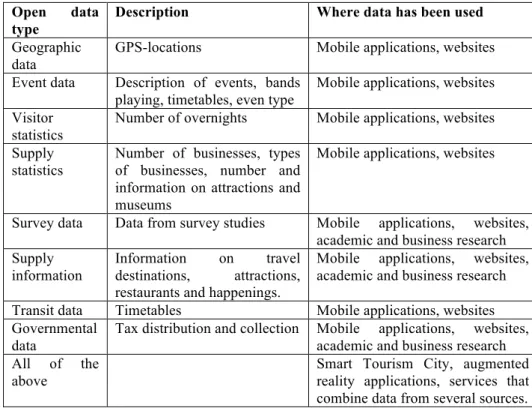
As we can see from the previous chapter, there are already considerable number of actors providing open data in the field of tourism. Majority of the data is from governments and cities. We can also see that there are increasingly more actors that utilize that data such as TourMIS and CitySDK. Table 1 provides an overview on the types of data already used in the field of tourism.
Table 1. Categorization of open tourism data Open data
type
Description Where data has been used
Geographic data
GPS-locations Mobile applications, websites Event data Description of events, bands
playing, timetables, even type
Mobile applications, websites Visitor
statistics
Number of overnights Mobile applications, websites Supply
statistics
Number of businesses, types of businesses, number and information on attractions and museums
Mobile applications, websites
Survey data Data from survey studies Mobile applications, websites, academic and business research Supply
information
Information on travel destinations, attractions, restaurants and happenings.
Mobile applications, websites, academic and business research Transit data Timetables Mobile applications, websites Governmental
data
Tax distribution and collection Mobile applications, websites, academic and business research All of the
above
Smart Tourism City, augmented reality applications, services that combine data from several sources. Probably the possibilities of open data are misunderstood. Old business models and business thinking have to be changed. Collaborative consumption for examples shows at that you are not anymore what you own but what you share. This same line of thinking could be adapted to tourism businesses and destinations. Sharing data has the potential to enable open innovation by providing firms from other industries to collaborate with tourism industry (Enkel et al., 2009). As Table 1 demonstrates, so far the open tourism data has been seen as a data source for mobile applications and websites. However, when for example the idea of Smart Tourism Cities develops and data is utilized as a part of the whole ecosystem, then the real benefits of open data can be utilized.
Business level data is not as openly available as government data. Tourism businesses should at least provide the information that is available on their websites in a machine-readable format. This content could include among others GPS-coordinates, opening hours and products descriptions. Opening such data could provide a possibility for innovative tourist services and mobile applications (Vert & Vasiu, 2015). Especially destination management organisations are in crucial role in collecting and opening data from their region for innovation purposes. If a destination wants to open its data suitable resources have to be allocated and openness should be included in the destination management strategy.
It is clear that there is still a lot to study about the use of open data in tourism. Especially business and destination management perspectives are missing. The
literature review conducted in this study shows that the definitions and applications have attained most of the research focus on the topic. There is a considerable gap in research in studying the benefits of open data for tourism destinations and businesses. A challenge and possibility for the use of open data is the future technologies. Future technologies will be able to understand and utilize open data. For example the quality of the response personal digital assistants provide is dependent on the data they have at their disposal and the software interpreting it. However, this also brings forth privacy issues as increased computing power and data mining technologies may enable identification of a person from a dataset where she or he could not be identified with modern technology.
References
Berners-Lee, T. (2010). Linked data - design issues. Retrieved 14.9.2015 from http://www.w3.org/DesignIssues/LinkedData.html
Bizer C., Heath T., & Berners-Lee T. (2009). Linked Data - The Story So Far: International Journal on Semantic Web and Information Systems 5(1): 1–22.
Deloitte (2012). Open data. Driving growth, ingenuity and innovation. A Deloitte Analytics paper. http://www2.deloitte.com/content/dam/Deloitte/uk/Documents/deloitte-analytics/open-data-driving-growth-ingenuity-and-innovation.pdf
Enkel, E., Gassmann, O., & Chesbrough, H. (2009). Open R&D and open innovation: exploring the phenomenon. R&d Management, 39(4), 311-316.
European Commission (2011). Open Data. http://ec.europa.eu/digital-agenda/en/open-data-0 García, A., Linaza, M. T., Franco, J., & Juaristi, M. (2015). Methodology for the Publication of
Linked Open Data from Small and Medium Size DMOs. In Tussyadiah, I. & Inversini, A. (Eds.) Information and Communication Technologies in Tourism 2015 (pp. 183-195). Springer International Publishing.
Gurstein, M. (2011). Open data: Empowering the empowered or effective data for everyone? First Monday, 16(2).
Longhi, C., Titz, J. B., & Viallis, L. (2014). Open data: Challenges and opportunities for the tourism industry. Tourism management, marketing and development: the importance of networks and ICTs. Palgrave Macmillan.
State of Queensland (2013). Open Data Strategy 2013-2017. Department of Tourism, Major Events, Small Businesses and the Commonwealth Games. https://publications.qld.gov.au/storage/f/2014-02-05T05%3A09%3A45.803Z/open-data-strategy-2013-2017-dtesb.pdf
Vert, S., & Vasiu, R. (2015). Integrating linked open data in mobile augmented reality applications-a case study.TEM Journal, 4(1): 35- 43.
Vision, T. (2010). Open Data and the Social Contract of Scientific Publishing. BioScience 60(5): 330-331.
Wiggins, A., & Crowston, K. (2011). From Conservation to Crowdsourcing: A Typology of Citizen Science. Proceedings of the 44th Hawaii International Conference on System Sciences.
Wu, C. T., Liu, S. C., Chu, C. F., Chu, Y. P., & Yu, S. S. (2014). A Study of Open Data for Tourism Service. International Journal of Electronic Business Management, 12(3), 214. Wöber, K. W. (2003). Information supply in tourism management by marketing decision