T H E F U T U R E O F
A C C O U N T I N G E D U C AT I O N :
Addressing the
Competency
Crisis
By Peter C. Brewer; James E. Sorensen, CPA, CGMA;
and David E. Stout
H
ave you ever stopped to think about how the accounting profession has changed since you graduated from college? Recent graduates can answer this question by reflecting on the last two or three years, whereas for other, more seasoned pro-fessionals, answering this question requires a bit more thought and memory searching. Indeed, we can all think of ways that the field of accounting is remarkably differ-ent today from the one we likely envisioned during our college days—regardless of which decade we each donned our cap and gown.This gradual transformation of the accounting profession leads to two important questions related to competencies:
◆Which competencies are important for success in
accounting today?
◆Were these competencies consciously developed as part
of your accounting degree program?
We suspect that more than a few of you would answer “no” to the second question. Put another way, our profes-sion may be facing—more so than at any time in the past—a “competency crisis,” that is, a gap between the competencies needed for professional success and those taught in our college classrooms today.
We propose a three-pronged strategy or “game plan” for overcoming this competency crisis and, in turn, better preparing accounting graduates for the challenging world they will face. First, all of us accountants need to under-stand the changes that have already taken place in our profession and, perhaps more importantly, anticipate the changes that are on the horizon. Second, we need to edu-cate ourselves and future generations of accountants so that as a collective group we can deliver the expanding set of competencies demanded in today’s dynamic organiza-tional contexts. Third, as professional organizations and as individuals, we need to think beyond ourselves by ask-ing: How can I (or we) help the accounting profession address the competency crisis?
A Shift Toward Integrated Thinking
Many articles and white papers have been written that describe in detail the changes that have occurred in our profession over the last few decades, but, for our pur -poses, we’d like to distill these changes down to one cru-cial idea: How does the accounting function add value to an organization? Accountants have evolved from support-oriented personnel who hand off information to otherswho actually make decisions into business partnerswho
“have a seat at the table” with managers across the
orga-nization. Together, they formulate and plan strategies, then participate in collaborative decision-making processes that execute those strategies in a manner that adds stakeholder value. Said another way, accountants have evolved to become enterprise performance man-agers. This shift in our orientation from a support func-tion to an enterprise performance management (EPM) role has enormous implications for defining the determi-nants of success within our profession, the most impor-tant of which involves becoming collaborators and “integrated thinkers.”
Take, for example, a common but important business-decision process: capital investment analysis. Certainly, technical knowledge regarding how to estimate relevant after-tax cash flows and how to apply discounted cash flow (DCF) decision models, such as net present value
C OV E R S TO R Y
We need to educate ourselves
and future generations of
accountants so that as a
collec-tive group we can deliver the
expanding set of competencies
demanded in today’s dynamic
organizational contexts.
importance. But integrated thinkers draw on an under-standing of organizational strategy coupled with a broader set of competencies (beyond what might be con-sidered technical or foundational knowledge) when mak-ing these types of decisions. For example, they consider how behavioral issues may influence the capital invest-ment decision-making process. Perhaps the financial esti-mates contained in the NPV analysis are too optimistic because the manager who prepared the numbers has a vested interest in seeing the project approved.
Decision makers also need to consider issues such as leasing vs. buying a capital asset and the corresponding impacts on the financial statements and ratios that are tracked by investors and lenders. What nonfinancial fac-tors are associated with the proposed investment? Add in the tax consequences of capital investment decisions, coupled with the need to maintain internal control over any new business processes tied to these decisions, and the need to think in an integrated fashion across a variety of accounting competencies becomes apparent.
Furthermore, becoming a true business partner with managers across the organization requires more than sim-ply integrating various accounting competencies. It also means thinking like a business manager or a chief execu-tive officer (CEO). Returning to the capital budgeting example, an integrated thinker will ask questions such as:
◆What regulatory risks may accompany the proposal?
◆What social and environmental factors will we face if,
for example, the proposal requires investing in overseas operations?
◆What types of employee resistance may arise if we
implement the proposal, and how will we overcome the root causes of any such resistance?
◆Can, and how, should we value future options associ
-ated with the proposal, such as expanding or contract-ing the investment over time, as new information becomes available?
◆Should we use debt or equity to fund the proposal?
In short, accountants have evolved to become inte-grated thinkers who enable EPM by partnering with managers across the organization to add value. Yet as EPM has gradually become the centerpiece of our profes-sion’s value proposition, accounting education hasn’t done enough to embrace it. To overcome this gap, we’d like to further suggest that the concepts of competency integration and EPM need to come “front and center” as we move forward in educating the next generation of successful accounting practitioners.
No Longer on the Sidelines
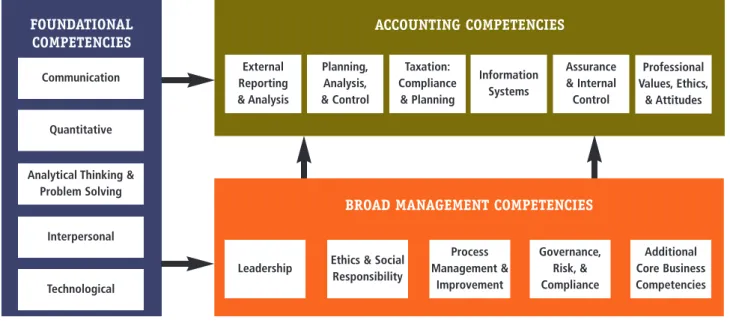
Recently, a task force consisting of members of IMA® (Institute of Management Accountants) and members of the Management Accounting Section (MAS) of the American Accounting Association (AAA) addressed the competency issue: How should accounting education change, fundamentally, to help close the competencies gap? The efforts of the task force led to a recently pub-lished article that contains a proposed framework for accounting education, reproduced here as Figure 1. The framework is general in the sense that it’s meant to apply
to allaccounting students, not subgroups based on career
specialization such as tax, assurance services, corporate finance, and the like. It’s based on the idea that account-ing educators can better prepare students to deliver our profession’s EPM value proposition through integrated competency-oriented curricula. (For more, see “Focusing Accounting Curricula on Students’ Long-Run Careers: Recommendations for an Integrated Competency-Based Framework for Accounting Education” in the May 2014
edition of Issues in Accounting Education.)
A glance at Figure 1 reveals three levels of
competen-cies: foundational competencies(communication, ability
to leverage technology, and analytical thinking and
prob-lem solving, among others), broad management
compe-tencies(including leadership, ethics and social responsibility, and process management and
improve-ment), and accounting competencies(external reporting
and analysis; planning, analysis, and control; taxation: compliance and planning; information systems; assurance and internal control; and professional values, ethics, and attitudes). Of critical importance to the framework is the assumption that the set of competencies contained in
Although you may agree
with us that there’s a competency
crisis within the accounting
profession, you may be
wondering: What does this have
to do with me?
Figure 1 would be developed and integrated over time through a blend of formal education (including continu-ing education), traincontinu-ing, and job experience.
What levels of integration—on the road to developing integrated thinkers in accounting—are possible? First, as shown in Figure 2, accounting educators can integrate within a single accounting competency. So, referring back to our capital budgeting discussion, teaching computa-tional models such as NPV analysis, coupled with a review of various behavioral issues associated with capital investment decisions, would be an example of integrating within the Planning, Analysis, and Control competency listed in Figure 1.
Second, professors can integrate across accounting competencies. For example, expanding capital budgeting discussions to include financial statement impacts, tax consequences, and internal control issues integrates topi-cal coverage across the External Reporting and Analysis, Taxation: Compliance and Planning, and Assurance and Internal Control competencies shown in Figure 1.
Third, accounting curricula can incorporate a broader set of management competencies, as shown in Figure 2. For example, evaluating capital investment proposals from the perspectives of change management (Leader-ship), social and environmental issues (Ethics and Social
Responsibility), regulatory concerns (Governance, Risk, and Compliance), and capital structure (Additional Core Business Competencies) brings a CEO’s perspective to the decision-making process.
Fourth, accounting curricula should include founda-tional competencies, such as proficiency with spreadsheets and written and oral communication. In the context of capital budgeting, this may include asking students to use Microsoft Excel to perform a sensitivity analysis and then to present their findings to the entire class.
Working to Fix the Problem
At this point, although you may agree with us that there’s a competency crisis within the accounting pro-fession, you may be wondering: What does this have to do with me? What can my organization do to help address this so-called competency crisis? The answer: a lot! Figures 3 and 4 summarize how practice part-ners and academic partpart-ners can help the accounting profession overcome the competency crisis. That said, let’s take a closer look at the role of practice partners first.A practice partner should be or become a CMA® (Cer-tified Management Accountant), maintain professional certification by completing required Continuing
Profes-C OV E R S TO R Y
ACCOUNTING COMPETENCIES
BROAD MANAGEMENT COMPETENCIES FOUNDATIONAL
COMPETENCIES
Source: Raef A. Lawson, Edward J. Blocher, Peter C. Brewer, Gary Cokins, James E. Sorensen, David E. Stout, Gary L. Sundem, Susan K. Wolcott, and Marc J.F. Wouters, “Focusing Accounting Curricula on Students’ Long-Run Careers: Recommendations for an Integrated Competency-Based Frame-work for Accounting Education,” Issues in Accounting Education, May 2014, p. 300.
Analytical Thinking & Problem Solving Communication Quantitative Interpersonal Technological Professional Values, Ethics, & Attitudes Assurance & Internal Control Information Systems Taxation: Compliance & Planning Planning, Analysis, & Control External Reporting & Analysis
Leadership Ethics & Social Responsibility Process Management & Improvement Governance, Risk, & Compliance Additional Core Business Competencies
FOUNDATIONAL COMPETENCIES
such as communication, quantitative methods, analytical thinking, and
problem solving
BROAD MANAGEMENT COMPETENCIES
Organizational Change Management Corporate Social Responsibilities Risk Assessment
Cost of Capital and Capital Structure
Leadership
Ethics & Social Responsibility
Governance, Risk, & Compliance Additional Core Business Competencies ACCOUNTING COMPETENCIES Financial Statement Preparation and Analysis
Tax Implications Internal and External Audit Perspectives
External Reporting & Analysis
Taxation: Compliance & Planning
Assurance & Internal Control
PLANNING, ANALYSIS, & CONTROL
Screening and
Preference Decisions Behavioral Issues
CAPITAL INVESTMENT
DECISIONS
Source: Raef A. Lawson, Edward J. Blocher, Peter C. Brewer, et al. “Thoughts on Competency Integration in Accounting Education,” Unpublished Working Paper, June 2014.
sional Education (CPE) hours, and regularly read the
IMA publications Strategic Financeand Management
Accounting Quarterly.
In addition, there are a number of excellent resources that deal with topics covered in this article and that IMA makes available to its members.
Strategic FinancePowerPacks
(www.imanet.org/SFPowerPacks): These are resources focused on contemporary topics, similar to those dis-cussed earlier. Current offerings include Risk Manage-ment, Strategic Planning, IT Skills & Software, and Internal Controls. Each PowerPack includes a
combina-OBTAIN AND MAINTAIN PROFESSIONAL
CREDENTIALS:
• Be or become a CMA • Perform required CPE • Read Strategic Finance
and Management
Accounting Quarterly
UTILIZE IMA RESOURCES:
• Use SFPowerPacks • Read Statements on
Management Accounting (SMAs)
• Review research studies
PARTICIPATE IN IMA ACTIVITIES:
• Attend local and national meetings
• Invite students to IMA meetings
• Access IMA Leadership Academy
• Join university curriculum advisory group
• Visit Competency Crisis website
(CompetencyCrisis.org)
INTEGRATE EPM INTO YOUR COMPANY:
• Develop user groups (your company or IMA chapter)
• Tie hiring and advance-ment to EPM skills • Utilize “cross training” to
enhance cross-functional understanding
HOW CAN
I HELP AS
A PRACTICE
PARTNER?
Figure 3: Practice Partner Action List
C OV E R S TO R Y
tion of resources, such as research studies, articles, and links to webinars.
Statements on Management Accounting (SMAs) (www.imanet.org/resources_and_publications/research_
studies_resources/statements_on_management_account-ing.aspx): SMAs represent monographs classified into one of the following six categories: Leadership Strategies and Ethics; Technology Enablement; Strategic Cost Man-agement; Business Performance ManMan-agement; Finance Governance, Risk, and Compliance; and the Practice of Management Accounting. Multiple items are available
OBTAIN AND MAINTAIN PROFESSIONAL
CREDENTIALS:
• Be or become a CMA • Perform required CPE • Read Strategic Finance
and Management
Accounting Quarterly
INVOLVEMENT IN AND USE OF IMA RESOURCES:
• Attend local and national meetings
• Use online educational cases
• Consult IMA website for readings and assignments
DEVELOP CMA FOCUS ON CAMPUS:
• Promote the CMA • Form an IMA Student
Chapter
• Be a Campus Advocate • Secure IMA academic
program endorsement • Form a practitioner curriculum advisory group PARTICIPATE IN NATIONAL ACTIVITIES:
• Attend annual IMA Student Leadership Conference
• Participate in the yearly IMA Student Case Competition
• Visit Competency Crisis website (CompetencyCrisis.org)
HOW CAN
I HELP AS
AN ACADEMIC
PARTNER?
within each category. For example, the Practice of Man-agement Accounting category includes (among other
items) the Definition of Management Accountingand
Implementing Shared Service Centers.
Research Studies
(www.imanet.org/resources_and_publications/Research_ Studies_and_Resources/All_reports.aspx): The “Thought Leadership” section of IMA’s website includes research covering a broad range of issues classified into seven cate-gories. For example, under the “Global Business Environ-ment” category, the following two research reports are available: “Key Differences Between IFRS and U.S. GAAP: Impact on Financial Reporting” and “Costing Method-ologies and Cost Management Practices in the People’s Republic of China.”
IMA Leadership Academy
(www.imanet.org/programs_events/leadership_academy.
aspx): As described on the IMA website, this program is
designed to assess a member’s leadership status, enhance that individual’s skills (principally through monthly webinars), and recognize leadership achievements. These benefits are free to members.
How You Can Make a Bigger Impact
In addition to attending local, regional, and national IMA meetings, consider inviting a small group of students to each chapter meeting. This could be a wonderful (and relatively low-cost) option for mentoring aspiring accountants and finance professionals, providing net-working opportunities, and introducing students to cutting-edge issues regarding the practice of management accounting. Joining a university accounting advisory group may be another way to influence the development of EPM in that institution’s curriculum design.Other methods to enhance EPM in your organization include (1) forming user groups within your company, your local IMA chapter, or your industry to review and share EPM experiences; (2) encouraging advancement in the firm to be linked to EPM proficiency; (3) focusing your company’s recruiting efforts on candidates who dis-play a background in and/or understanding of EPM; and (4) organizing cross training within your company to enhance a mutual understanding of each other’s respective roles.
Finally, visit the Competency CrisisTMwebsite
(http://competencycrisis.org) set up by IMA to unite the accounting and finance constituencies—professionals,
students, employers, academics, and professors—and explore competency issues through the lens of each stake-holder group. The site is designed to “encourage a dis-course, spur action, and create a community dedicated to resolving the serious crisis of competency present in the profession.” Special sections of the website are devoted to educators, students, and employers/professionals.
Our Partners in Education
Much like a practice partner, an academic partner should be or become a CMA, maintain professional accredita-tion by completing CPE hours, and regularly read IMA’s publications.
Academic members of IMA can pursue and actively promote the CMA program at their respective institu-tions. IMA’s website contains helpful resources, including an exam content overview, content specification outlines for each of the two parts of the CMA exam, and learning outcome statements. The current exam covers some of the professional competencies represented in Figure 1. A summary of changes to exam content, which will be effective in January 2015, is provided on the IMA website in News & Media Relations, which is located under “About IMA.” (See the press release dated March 24, 2014.) Other helpful resources include “ICMA Announces CMA Exam Content Changes” in the April
2014 issue of Strategic Finance, as well as “Management
Accounting Career Readiness: Shaping YOUR Curricu-lum” on p. 38 in this issue.
These forthcoming changes are based on the most recent IMA study of the knowledge and skills needed by management accountants from the view of CFOs, con-trollers, and other accounting/finance professionals from around the world.
Also consider taking a group of your students to the IMA Student Leadership Conference held each Novem-ber. The Conference provides excellent networking opportunities for you, your students, and practicing pro-fessionals. Students can learn firsthand from Conference presenters the challenges and opportunities facing finance and accounting professionals today.
Moreover, if your institution doesn’t currently have an IMA Student Chapter, consider forming one! One of the authors of this article, David Stout, reinstituted the stu-dent chapter at his school (Youngstown State University) after traveling with a group of his students to the IMA Student Leadership Conference in Cleveland, Ohio. Through an IMA Student Chapter on campus, students are able to work closely with a sponsoring local IMA
chapter and bring to campus speakers who are experts in a wide range of topics, including those discussed earlier in this article. Each year, student chapters compete for an Award of Excellence (AOE) and recognition as an Out-standing Student Chapter. In addition, IMA student members are able to engage in networking activities, leadership training, mentoring, and community service programs—all through their local chapter.
You also might consider volunteering to serve as a Campus Advocate. In this role, you’ll represent IMA in all major matters of interest to your students (scholarship opportunities, starting a student chapter, mentoring, and the like) and to your institution (for example, leveraging IMA resources to advance the relevancy of the accounting curriculum, use of educational case studies published in the IMA Educational Case Journal, and access to IMA’s ethics curriculum).
And if you haven’t yet done this, ask IMA to endorse your accounting program (information is available at
www.imanet.org/educator_resources/index.aspx). This program is designed to identify business curricula that meet the quality educational standards required to pre-pare students to earn the CMA designation. Endorsement
have been endorsed.
Finally, if your school has an IMA Student Chapter, consider participating in the annual IMA Student Case Competition, where students are asked to propose a solu-tion to a real-world problem. (Cases are solicited each year by Raef Lawson, IMA VP of Research and Policy and IMA Professor-in-Residence.) Finalists make their presentations at IMA’s Annual Conference & Exposition before a set of judges consisting of accounting faculty members and practitioners. Each year a new case is published in the
August issue of Strategic Financefor students to use for
that year’s competition. (See p. 71 for the 2015 case.)
Working Together
In this article we have summarized the changes that have affected the accounting profession and provided a competencies-based framework for guiding accounting educators in responding productively to those changes. As a management accountant, you know that implement-ing change in any organization, let alone within an entire profession, never comes easily. To be successful in over-coming our profession’s competency crisis, IMA’s practice and academic partners will need to assume leadership roles in defining enterprise performance management as the cornerstone of the accounting profession’s value
proposition. SF
Peter C. Brewer, Ph.D., is a lecturer at Wake Forest Univer-sity. Prior to joining the faculty at Wake Forest, he was an accounting professor at Miami University in Oxford, Ohio, for 19 years. You can reach Pete at (336) 758-4122 or
James E. Sorensen, CPA, CGMA, Ph.D., is professor of accountancy and holds the titles of Evelyn and Jay G. Picci-nati Endowed Professorship for Teaching Excellence, John J. Gilbert Endowed Professor of Accountancy, and University Scholar/Teacher in the School of Accountancy, Daniels Col-lege of Business, University of Denver, Denver, Colo. He is also a member of IMA’s Denver-Centennial Chapter. You can reach Jim at (303) 871-2028 or [email protected]. David E. Stout, Ph.D., is the Andrews Endowed Chair and Professor of Accounting at Youngstown State University in Youngstown, Ohio. He is a member of IMA’s Akron Chapter. You can contact David at (330) 965-9504 or