Using Circular Hough Transform
Kennedy Okokpujie(&), Etinosa Noma-Osaghae, Samuel John,and Akachukwu Ajulibe
Department of Electrical and Information Engineering, College of Engineering, Covenant University, Ota, Ogun State, Nigeria
{kennedy.okokpujie,etinosa.noma-osaghae, samuel.john}@covenantuniversity.edu.ng,
Abstract. It is quite easy to spoof an automated iris recognition system using fake iris such as paper print and artificial lens. False Rejection Rate (FRR) and False Acceptance Rate (FAR) of a specific approach can be as a result of noise introduced in the segmentation process. Special attention has not been paid to a modified system in which a more accurate segmentation process is applied to an already existing efficient algorithm thereby increasing the overall reliability and accuracy of iris recognition. In this work an improvement of the already existing wavelet packet decomposition for iris recognition with a Correct Classification Rate (CCR) of 98.375% is proposed. It involves changing the segmentation technique used for this implementation from the integro-differential operator approach (John Daugman’s model) to the Hough transform (Wilde’s model). This research extensively compared the two segmentation techniques to show which is better in the implementation of the wavelet packet decomposition. Implementation of the integro-differential approach to segmentation showed an accuracy of 91.39% while the Hough Transform approach showed an accuracy of 93.06%. This result indicates that the integration of the Hough Transform into any open source iris recognition module can offer as much as a 1.67% improved accuracy due to improvement in its preprocessing stage. The improved iris segmentation technique using Hough Transform has an overall CCR of 100%.
Keywords: Integro-differential operator
Segmentation Wave packet decomposition False Rejection Rate (FRR) Hough transform False Acceptance Rate (FAR)Recognition Accuracy (RA)1
Introduction
Increased demand for more trustworthy security systems has led to the application of biometric security systems in various ways [1,5]. When individuals are automatically recognized, based on their physiological or behavioural characteristics, biometrics is the base parameter in use. Thefingerprints, voice and iris are some major examples of biometrics and they have a wide range of application areas [6,7]. The Iris is a very accurate biometric parameter that is not susceptible to the aging effect.
©Springer Nature Singapore Pte Ltd. 2018
K.J. Kim et al. (eds.),IT Convergence and Security 2017, Lecture Notes in Electrical Engineering 450,
The Iris Biometric Recognition System can be spoofed with fakes such as artificial iris etc. An Iris biometric recognition system that cannot be spoofed easily drastically increases the trust placed on it by its users.
Daugman introduced the use Fast Fourier Transform (FFT) to check the iris pattern [2]. In his proposition, the spectrum in high frequency domain was used to differentiate one iris pattern from the other. Although a purposely blurred and defocused fake iris may be falsely accepted by the iris recognition system.
In this work, an improvement of the already existing wavelet packet decomposition for iris recognition is provided. It involves changing the segmentation technique used for this implementation from the integro-differential operator approach (John Daugman’s model) to the Hough transform approach (Wilde’s model).
The objectives of the study include, implementing a new iris segmentation algo-rithm to build a more robust iris recognition algoalgo-rithm, designing aflowchart for the implementation of the proposed algorithm and using MATLAB to analyze the results. The overall aim of this study is basically the implementation of a new segmentation technique on Hough Transform to build an improved wavelet decomposition algorithm for authentication using iris recognition.
2
Background and Literature Review
2.1 The Circular Hough Transform
The Circular Hough Transform is used to locate any regular curve in a given geometric shape, or shapes in a given image. It redefines the image as forms of ellipses, circles and expressions with powers of three and above. Circular Hough Transform was used to localize irises by Wildes et al. [3]. Wildes proposed the generation of the points of the parametric form by computing the initial derivatives of the image’s brightness and thresholding the resulting values. Hough transform techniques have some drawbacks. First, threshold values are required for tracing out the parametric form, and doing away with important points in the image can lead to the formation of a poor image template. The Hough transform needs a large memory and special hardware for its computation. This makes it expensive for real time applications.
2.2 The Integro-Differential Operator
The Integro-differential operator was the brainchild of Daugman who used it to detect the parametric properties of the iris [4]. It makes direct use of the differential deriva-tions and does not do well in removing noise from the image template formed. But it is not encumbered with the thresholding problem of the Circular Hough Transform.
3
Methodology and Proposed Framework Data Flow
MATLAB® was used to evaluate the Daugman (integro-differential) and Wildes (Circular Hough) methodologies respectively.
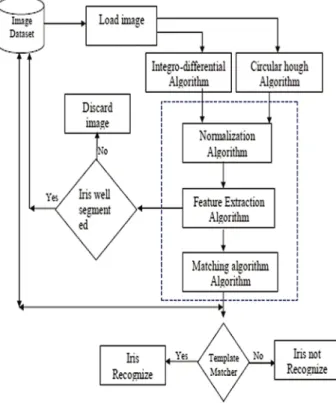
The framework data flow consists of the following as shown in Fig. 1 Database, load image, segmentation algorithm, normalization algorithm, feature extraction algorithm and matching algorithm.
4
Database Collection
To test the developed system, some set of iris data from the Chinese Academy of Sciences - Institute of Automation (CASIA) eye image database were used. CASIA Iris Image Database includes 1080 iris images from 108 eyes. For each eye, 10 images are captured in two sessions with a self-developed CASIA close-up iris camera, wherefive samples are collected in thefirst session andfive in the second session. All images are stored as BMP format with 320280 resolution. The CASIA image dataset used contains 6 subjects and 10 different images of each unique eye.
5
Implementation and Validation
Each eye image tested was selected and run through the simulated program and all the processes involved in iris segmentation were carried out. The intra-class and inter-class matching was carried out and recorded in a tabular form, from where further analyses
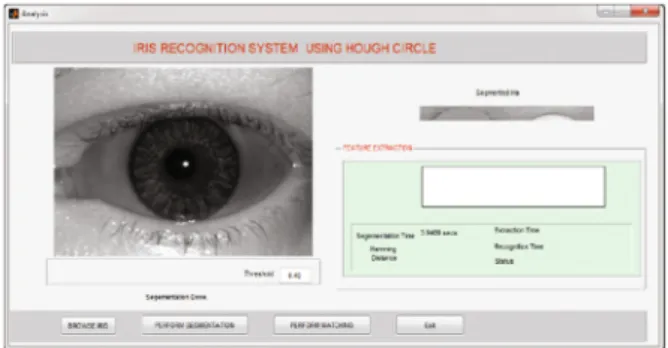
were carried out. Figures2and3display screen shots of the application interfaces that performed the recognition process for each algorithm on the selected eye image.
After the image was loaded, segmentation of the selected eye image using circular Hough transform and integro-differential operator algorithms were carried out. After segmentation, the program also performed normalization and feature extraction on the iris image using Daugman’s rubber sheet and Log Gabor algorithms respectively.
6
Result and Discussion
The result of the intra-class matching using the integro-differential operator is displayed on (Table1). Eye image class one and two had an error of 8.33%, eye image class three and four had an error of 10%, eye image classfive had an error of 5.83% and eye image class six an error of 9.17%. The result of the intra-class matching using the circular Hough transform is displayed on (Table2). Eye image class one and two both recorded an error of 7.5%, eye image class three had an error of 5.83%, eye image class four had an error of 8.33%, eye image classfive had an error of 5% and eye image class six had an error of 7.5%. Running the intra-class for each method shows zero percent False Acceptance Error (FAR) rate.
Fig. 2. GUI for circular Hough segmentation process
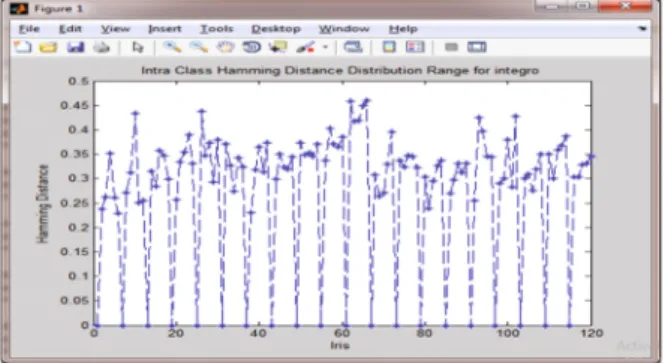
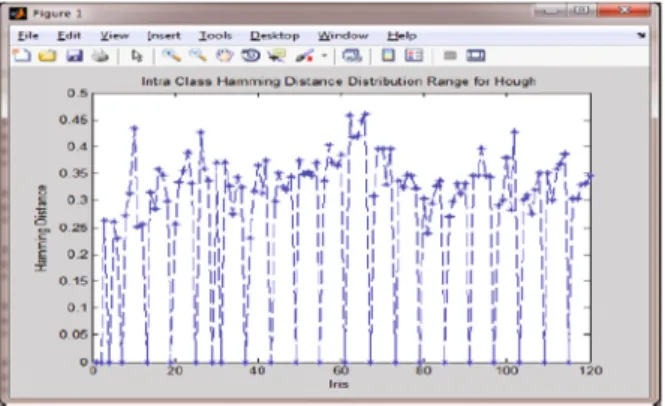
The intra-class and inter-class hamming distance for the integro-differential oper-ator and circular Hough transform implementations are shown from Figs.4,5,6and7.
Figures 4 and 5 show the intra-class graph for integro-differential and circular Hough transform respectively. The graphs show the eye images that are rejected because they fall above the threshold value of 0.4. The systems are reliable since their intra-class rejection rates are acceptable.
Figures6and7show the inter-class graph for integro-differential and circular Hough implementations. From the graphs, eye images were rejected because they fall above the threshold value of 0.4. This shows that the threshold set for the application was acceptable. It also shows that the system is reliable since False Acceptance Error is extremely low.
From each run of the intra-class and inter-class matching, numbers of FRR and FAR and the percentage of error for each run were taken. In addition, the percentage
Table 1. FAR and FRR (integro-differential operator) S/N FAR FAR (%) FRR FRR (%) Accuracy (%)
01 0 0 10 8.3333 91.6667 02 0 0 10 8.3333 91.6667 03 0 0 12 10.0000 90.0000 04 0 0 12 10.0000 90.0000 05 0 0 7 5.8333 94.1667 06 0 0 11 9.1667 90.8333
Table 2. FAR and FRR (circular Hough transform) S/N FAR FAR (%) FRR FRR (%) Accuracy (%)
01 0 0 9 7.5000 92.5000 02 0 0 9 7.5000 92.5000 03 0 0 7 5.8333 94.1667 04 0 0 10 8.3333 91.6670 05 0 0 6 5.0000 95.0000 06 0 0 9 7.5000 92.5000
Fig. 7. Inter-class graph for circular Hough transform implementation.
Fig. 5. Intra-class graph for circular Hough transform implementation.
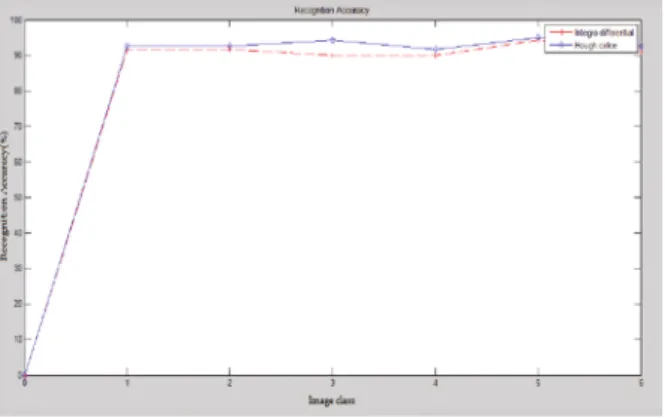
accuracy for each method was calculated. To calculate the value for the percentage recognition accuracy, the value of the FRR and the FAR were subtracted from 100. This is called the Recognition Accuracy (RA). These results are displayed in a tabular form (Tables1 and 2). The FRR of the integro-differential operator and the circular Hough transform implementations are plotted on a graph and shown below:
Figures 6 and 7 show the inter-class graph for integro-differential and circular Hough implementations. From the graphs, eye images were rejected because they fall above the threshold value of 0.4. This shows that the threshold set for the application was acceptable. It also shows that the system is reliable since False Acceptance Error is extremely low (Fig.8).
From each run of the intra-class and inter-class matching, numbers of FRR and FAR and the percentage of error for each run were taken. In addition, the percentage accuracy for each method was calculated. To calculate the value for the percentage recognition accuracy, the value of the FRR and the FAR were subtracted from 100. This is called the Recognition Accuracy (RA). These results are displayed in a tabular form (Tables1 and 2). The FRR of the integro-differential operator and the circular Hough transform implementations are plotted on a graph and shown below:
Fig. 8. FRR for Circular Hough and Integro-differential implementations.
Fig. 9. Recognition accuracy for circular Hough transform and Integro-differential operator implementations
From the graph in Fig.9, it was observed that the Circular Hough Transform implementation curve was higher than that of the Integro-differential operator imple-mentation. This implies that the circular Hough transform implementation’s degree of accuracy is higher than that of the Integro-differential operator implementation’s accuracy. This shows that the circular Hough transform implementation is more accurate than the integro-differential transform implementation.
The accuracy of the system is determined by the FAR and FRR. For both imple-mentations, FAR is zero (0).
7
Conclusion
This paper has proved that under the same conditions, Wildes’ algorithm performs better than Daugman’s algorithm because the FRR curve of circular Hough transform implementation was lower than that of the Integro-differential operator implementation. Also, the Recognition Accuracy (RA) graph of the two algorithms depicts higher accuracy for Wildes over Daugman. Hence, there is basis that if the circular Hough transform proposed by Wildes is used as a segmentation algorithm in the proposed wavelet packet decomposition, it will perform better than the integro-deferential algorithm proposed by Daugman.
8
Future Work
Other forms of segmentation besides Daugman and Wilde would be considered and a very efficient hybrid segmentation technique would be developed.
Acknowledgement. This paper was sponsored by Covenant University, Ota, Ogun State, Nigeria.
References
1. Jain, A.K., Bolle, R.M., Pankanti, S. (eds.): Biometrics: Personal Identification in Networked. Kluwer, Norwell (1999)
2. Daugman, J.: Demodulation by complex-valued wavelets for stochastic pattern recognition. Int. J. Wavelets Multiresolut. Inf. Process.1(1), 1–17 (2013)
3. Zang, H., Sun, Z., Tan, T.: Contact Lens Detection Based on Weighted LBP. Chinese Academy of Sciences, Beijing (2010)
4. Wildes, R.P.: Iris recognition: an emerging biometric technology. Proc. IEEE85(9), 1348– 1363 (1997)
5. Badejo, J.A., Atayero, A.A., Ibiyemi, T.S.: A robust preprocessing algorithm for iris segmentation from low contrast eye images. In: Future Technologies Conference (FTC), pp. 567–576. IEEE (2016)
6. Okokpujie, K., Olajide, F., John, S., Kennedy, C.G.: Implementation of the enhanced fingerprint authentication in the ATM system using ATmega128. In: Proceedings of the International Conference on Security and Management (SAM), p. 258. The Steering Committee of the World Congress in Computer Science, Computer Engineering and Applied Computing (WorldComp) (2016)
7. Majekodunmi, T.O., Idachaba, F.E.: A review of thefingerprint, speaker recognition, face recognition and iris recognition based biometric identification technologies (2011)