In the preface of Robert Shiller’s recent book Irrational Exuberance, he asks:
“Are powerful fundamental factors at work to keep the market as high as it is now or to push it even higher, even if there is a downward correction? Or is the market high only because of some irrational exu-berance— wishful thinking on the part of investors that blinds us to the truth of our situation?” (Shiller 2000, xii).
Shiller answers his own question by argu-ing that stock prices in the 1990s displayed the classic features of a speculative bubble. High prices are sustained, temporarily, by investor enthusiasm rather than real fundamental factors. Investors, according to Shiller, believe it is safe to purchase stocks, not because of their intrin-sic value or because of expected future divi-dend payments, but because they can be sold to someone else at a higher price. Simply put, stock prices are driven by a self-fulfilling prophecy based on similar beliefs of a large cross section of investors.
When looking at broad stock market price indexes, such as the Standard & Poor’s 500, Shiller’s argument is largely based on two premises about the historical behavior of stock prices. First, Shiller asserts that marketwide price – dividend and price – earnings ratios have a tendency to revert toward their historical aver-ages. This implies that high stock price valua-tions are not likely to persist.1Second, dividend
movements are not nearly volatile enough to rationalize stock price volatility. This suggests that changes in expectations about future divi-dends cannot be responsible for stock price movements.
While Shiller argues that irrational exuber-ance explains the run-up in stock prices in the 1990s, we present evidence that the case for market fundamentals is stronger than it appears on the surface. First, we demonstrate that swings in the price – dividend and price – earnings ratios show substantial persistence, particularly since World War II. This raises doubts about the exis-tence of a “normal” price – dividend (or price – earnings) ratio. Hence, using the average value of one of these ratios as a gauge of the average, or normal, valuation ratio is misleading. A price – dividend ratio of 30 may have seemed high from the pre-1980s perspective but not after the 1990s. Second, we investigate whether plausible combinations of lower expected future real dis-count rates or higher expected real dividend (earnings) growth could rationalize broad mar-ket stock values, raising the possibility that
Explaining Stock Price
Movements: Is There a
Case for Fundamentals?
Nathan S. Balke and Mark E. Wohar
P
lausible changes in
expectations about real
dividend growth and
discount rates can explain
stock prices in the 1990s.
Nathan S. Balke is a research associate at the Federal Reserve Bank of Dallas and a professor in the Department of Economics at Southern Methodist University.
Mark E. Wohar is an economics professor at the University of Nebraska at Omaha.
changes in market fundamentals have made a major contribution to the run-up in stock prices. A number of explanations have been offered for the unprecedented rise in stock prices during the 1990s. These include in-creased expected future economic growth brought about by the revolution in information technology, demographic changes as the baby boomers age, a reduction in the equity premium as a result of lower transaction costs and increased diversification, lower business cycle risk, a decline in inflation, and momentum in-vesting.2See Carlson (1999), Carlson and Sargent
(1997), Cochrane (1997), Kopcke (1997), Heaton and Lucas (2000), Siegel (1999), Carlson and Pelz (2000), Shiller (2000), Jagannathan, McGrattan, and Scherbina (2000), and McGrattan and Prescott (2000) for recent surveys.
In this article we provide evidence that it may be misleading to think of a normal price – dividend or price – earnings ratio. Next we review a standard stock valuation model on which our analysis is based. We then present evidence that there has been an increase in expected real dividend (earnings) growth and a decline in the expected real discount rate. Finally, we discuss some caveats and comments.
ARE THERE “NORMAL” PRICE – DIVIDEND AND PRICE – EARNINGS RATIOS?
The dramatic rise in stock prices during the 1990s has challenged financial analysts and economists to explain why stock valuation ratios are so high relative to historical levels. The top panel of Figure 1 plots the January val-ues of the real S&P 500 index divided by the ten-year moving average of real earnings (henceforth, P/E) for 1881 through 1999. By using a ten-year moving average we attempt to measure trends in long-run or permanent earn-ings.3The bottom panel shows the comparable
graph for the price – dividend (P/D) ratio.4
Figure 1 shows that during this 119-year period, the P/E ratio crossed and persisted above or below its sample mean of 15.7 about ten times.5 These ten major crossings suggest
that the P/E ratio on average spends more than a decade consistently above or below the sample mean. Since World War II, there have been only three major crossings of the sample mean, and the average time between crossings is close to twenty years. A similar pattern is noted for the P/D ratio, shown in the lower panel. Although there were more crossings before 1947, there have been only three crossings since.
While it’s clear that movements in the P/E
and P/D ratios can be persistent, are changes in these ratios permanent? Using the entire sample (1881 through 1999), we cannot reject the null hypothesis of a unit root in logarithm of P/D or P/E ratios.6 This means that unanticipated
changes, or “shocks,” in the logarithm of P/D or P/E ratios can be permanent. The presence of permanent shocks makes it doubtful that stock prices will fall in the future just because they are historically high. If permanent changes in the P/D ratio are possible, then a P/D of 30, which would have been considered high in the past, may not look very high from the perspective of the 1990s.
A STOCK PRICE VALUATION MODEL
Given that there may be no “normal” level of stock prices, how can one assess whether stock prices are too high? To answer this ques-tion, it is useful to review a simple model of stock price determination. Investors hold stocks to obtain future income, in the form of either Figure 1
Price – Earnings Ratio, 1881–1999
(Using ten-year average earnings)
5 45 40 35 30 25 20 15 10 Price–Dividend Ratio, 1881–1999 1998 1985 1972 1959 1946 1933 1920 1907 1894 1881 10 90 80 70 60 50 40 30 20 1998 1985 1972 1959 1946 1933 1920 1907 1894 1881
dividend payments or an increase in stock price (capital gains). A firm’s ability to pay dividends and investors’ expectations of higher stock price depend on the firm’s future earnings growth: the higher a firm’s earnings growth, the greater potential to pay dividends and the more an investor is willing to pay for a share of stock. Another aspect investors must consider is how to value these cash flows. This is determined by the real discount rate.7Individuals generally
pre-fer to receive income sooner rather than later. To give up a dollar’s worth of current income, investors demand more than a dollar in the
future. The more impatient investors are (the higher the real discount rate, or required re-turn), the less they are willing to pay (and sac-rifice current consumption) for a stock with a given level of future income. Individuals also prefer less uncertainty. Hence, investors will demand a higher expected return from a risky asset than from a safe asset or, equivalently, will discount the expected payoff at a higher rate. Thus, asset prices are determined by the prop-erties of the income flow that these assets gen-erate and by how investors value this income flow; that is, the price of a financial asset equals the present discounted value of the stream of cash flows from that asset.
The standard Gordon model, described in the box “Derivation of the Gordon Model” and in the equation below, gives the factors that affect the fundamental value of stock prices. If expected real dividend growth and real dis-count rates are constant over time, the P/D ratio at time t is given by
Pt/Dt= (1 + g)/(r– g),
where gis expected future growth in dividends and r is the discount rate. Factors such as pro-ductivity-enhancing technological change might lead to higher expected real dividend (real earn-ings) growth, causing the P/D (P/E) ratio to rise. On the other hand, factors such as increased tolerance of risk or investors’ greater willing-ness to postpone current consumption might reduce the expected real discount rate, also causing these ratios to rise. Note also, as the box demonstrates, the Gordon model implies that the expected real return on stocks is equal to the real discount rate.
Table 1 presents means, standard devia-tions, and 95 percent confidence intervals (adjusted for serial correlation) for six variables, averaged over various time periods:8 P/E ratio,
P/D ratio, real (inflation-adjusted) earnings growth, real dividend growth, real returns, and excess returns.9 During the 100-year period
before the most recent bull market, which began in 1983, annual real dividend growth averaged 0.9 percent and average real returns were around 5.5 percent. Plugging these num-bers into the Gordon formula yields a P/D ratio of around 21.9, which is very close to the P/D ratio averaged for 1881–1982. However, for 1983 through 1999, both the P/D and P/E ratios are substantially higher than the P/D ratio implied by the Gordon model, given the histor-ical averages of real dividend growth and real returns. For the years 1983 through 1999, the P/D (P/E) ratio averaged 39.10 (20.50), while
Derivation of the Gordon Model
The basic stock price valuation model posits that the stock price is equal to the present discount value of expected future dividend payments. We can write this present value as
where Et[.] denotes expectations based on information available to investors at time t and Dt+iis the level of real dividends at time t+i. The term R(t,i ) is the degree to
which future expected dividends in time period t+i are discounted back to the current time period, or
with rt+jbeing the real discount rate at time period t+j. We can rewrite stock prices in
terms of the price dividend ratio:
where
The term d(t,i ) represents the compounded expected real dividend growth from period t+1 to t+i, where gt+jis expected real dividend growth in time period t+j.
If expected real dividend growth and real discount rates are constant over time, the above equation simplifies to the basic Gordon (1962) model that states
Pt/Dt= (1 + g)/(r – g ),
where g is expected future growth in dividends and r is the discount rate. Assuming that dividends are a linear function of earnings, we can write a comparable expression with earnings. If we assume a constant payout ratio, that is,
Dt= q Et,
where q is the payout ratio, we can write the expression for the P/E ratio as
Pt/Et= q(1 + g)/(r – g).
Note that expected real returns in the Gordon model are equal to the discount rate. Expected stock returns are equal to
where Et[.] refers to expectations based on information available at time t. Using the
Gordon model, expected returns are equal to
Thus, the expected return equals the discount rate, r.
E return g r g g g r g r t
[
t+]
= + − + + + − − = 1 1 1 1 1 1 ( ) ( ) ( ) . E return E P D D D P D t t t t t t t t t + + + +[
]
= + − 1 1 1 1 1 1 , d t i gt j j i ( , )= ( + +). = ∏1 1 P D R t i d t i t t i = = ∞ ∑ ( , ) ( , ), 1 R t i rt j j i ( , )= + + = ∏1 1 1 Pt E R t i Dt i t i =[
]
= ∞ + ∑ 1 ( , ) ,from 1995 through 1999, the P/D (P/E) ratio averaged 59.53 (31.75). Thus, given no change in either expected real dividend growth or dis-count rate, stock prices seem too high relative to the dividends they pay. For market funda-mentals to explain such high stock prices, either expected future real dividend (earnings) growth must be higher or expected future discount rates must be lower than their historical aver-ages, or both.10
Table 2 shows P/D ratios for hypothetical combinations of expected real dividend growth and real discount rates using the Gordon model. Row 3 of Table 2 displays the P/D ratio implied by various levels of expected future real divi-dend growth, given a real discount rate of 5.5 percent. For the P/D ratio to reach levels seen during the mid- to late 1990s, expected real div-idend growth would need to increase to 3.5 per-cent in the future. This is well above historical and current values. While real dividend growth rates for the years 1995 through 1999 were higher than their historical averages, they were not nearly high enough to generate P/D ratios that averaged 59.53 from 1995 to 1999.
As can be seen from Table 2, a decline in the discount factor can also increase the implied P/D ratio. Given historical values of 1 percent for real dividend growth, a decline in the dis-count rate to around 3 percent would be required for the P/D ratio to be near that aver-aged over the past five years. Discount rates this low would imply about a 3 percent expected real return for stocks, which is close to the aver-age real return on government bonds. This, in
turn, implies that the risk premium on stocks is nearly the same as that on government bonds. One might argue that either an increase in expected real dividend growth or a decrease in the discount factor alone is responsible for his-torically high stock prices. However, an increase in expected real dividend growth combined with a decline in the discount factor could account for an increase in the P/D ratio. For example, from Table 2, if real dividend growth increases to 2 percent per year while the dis-count rate falls to around 4 percent, it is possi-ble to obtain a P/D ratio in the neighborhood of 50. In fact, we argue that, of the scenarios based on fundamentals, the combination of a discount rate decline and a modest increase in real divi-dend growth could be the most plausible.
Annual real stock returns averaged above 13 percent for 1983 through 1999 and almost Table 1
Descriptive Statistics for Stock Prices, Earnings, and Dividends
P/E ratio P/D ratio Annual real Annual log Annual log Annual log
(January (January earnings real dividend real excess
averages) averages) growth growth returns returns
1881 through 1999
Mean 15.66 24.91 1.45 1.05 6.57 3.76
Standard deviation of variable 6.09 10.75 20.81 11.14 17.06 17.19
95% confidence band of the mean (13.72, 17.48) (21.55, 28.27) (– 2.11, 5.02) (–.97, 3.08) (3.60, 9.45) (.59, 6.92)
1881 through 1982
Mean 14.80 22.40 .89 .90 5.49 2.85
Standard deviation of variable 4.63 6.01 21.49 11.99 17.66 17.83
95% confidence band of the mean (13.21, 16.39) (20.39, 24.41) (– 3.10, 4.89) (–1.45, 3.34) (2.29, 8.69) (–.63, 6.32)
1983 through 1999
Mean 20.50 39.10 4.80 2.01 13.10 9.21
Standard deviation of variable 10.16 18.53 16.35 2.53 11.18 11.67
95% confidence band of the mean (12.66, 28.33) (25.15, 53.05) (–1.81, 11.42) (.58, 3.44) (8.35, 17.84) (4.15, 14.27)
1995 through 1999
Mean 31.75 59.53 6.71 2.43 21.71 18.64
Standard deviation of variable 9.13 19.30 11.25 1.61 6.10 6.69
95% confidence band of the mean (22.94, 40.57) (40.71, 77.93) (1.85, 11.57) (1.34, 3.51) (17.78, 25.65) (14.11, 23.17)
NOTE: Annual growth rates are calculated as log(Xt+1/Xt).
Table 2
P/D Ratios for Hypothetical Combinations of Dividend Growth and Discount Rates
Dividend growth Discount rates g = .01 g = .015 g = .020 g = .025 g = .035 r = .03 50.50 67.67 102.00 205.00 NA r = .04 33.67 40.60 51.00 68.33 207.00 r = .055 22.44 25.37 29.14 34.17 51.75 r = .07 16.83 18.45 20.40 22.78 29.57 r = .08 14.43 15.62 17.00 18.64 23.00
22 percent for 1995 through 1999. But in our example above, the discount rate, and hence, expected future stock returns, fell. Although it may seem paradoxical, a reduction in ex-pected future returns can imply high current returns. When investors change their expecta-tions about future expected real dividend growth and expected real discount rates, those who currently hold stocks reap an unanticipated capital gain.
To illustrate, suppose that before 1983 investors expect future real dividend growth and future real discount rates to remain at their historical values of 1 percent and 5.5 percent, respectively. Then, in 1983, they suddenly expect future real dividend growth to rise to 2 percent and the real discount rate to fall to 4 percent starting in 2003 and to remain there indefinitely.11 The top panel of Figure 2 shows
the path the P/D ratio would take given the
change in expectations about the future real dividend growth and the real discount rate. The P/D ratio jumps in 1983, then steadily rises to a peak of 51 in 2003, and remains at 51 thereafter. In other words, in anticipation of the future increase in real dividend growth and the decline in real discount rate, current P/D ratios rise. The bottom panel of Figure 2 shows the effect of this example on actual real stock returns. Stock-holders reap a windfall in the period in which expectations of future real dividend growth and real discount rates change — in this example, the real return on stocks is a whopping 62 per-cent in 1983. However, subsequently the real return on stocks exactly equals the discount rate (5.5 percent before 2003, 4 percent thereafter).
A more realistic scenario is one in which investors gradually revise their expectations about future real dividend growth and real dis-count rates. Initially, investors perceive only a small probability that real dividend growth and the real discount rate will change, but, as the time of the change approaches, this probability is gradually revised upward until investors attach nearly 100 percent probability to a change on the eve of its occurrence. Figure 3 presents the resulting time paths for the P/D ratio and the realized returns on stocks. Notice that between the time investors first become aware of the possibility of a dividend growth and discount rate change and the time that the actual change occurs, the P/D ratio steadily rises. In some respects, this looks similar to the increase in actual P/D ratios seen since 1983. Furthermore, as shown in the bottom panel of Figure 3, actual returns for stocks are higher than expected over this period. In fact, during this transition period actual returns are consis-tently greater than historical returns, much like what has actually occurred since 1983. Actual returns are also greater than expected returns (the discount rate) because investors are contin-uously and pleasantly surprised during this period. Again, the reason is that as investors revise their expectations of future real dividend growth and future real discount rates, these revisions result in unanticipated capital gains for stocks. Once investors attach nearly 100 percent probability to the new regime, actual returns approach the discount rate. Note also that once the new discount rate takes effect, actual stock returns fall along with the discount rate.
These examples are not meant to be a lit-eral description of what has happened in the equity markets since 1983, but they do illustrate that as expectations of real dividend growth and real discount rates change, it is possible for real-Figure 2
P/D Ratio for Permanent Change in Dividend Growth and Discount Rate
(Expected to take place twenty years after 1983)
Realized Returns for Change in Dividend Growth and Discount Rate
(Expected to take place twenty years after 1983)
0 70 60 50 40 30 20 10 2010 2006 2002 1998 1994 1990 1986 1982 1978 1974 0 60 50 40 30 20 10 2010 2006 2002 1998 1994 1990 1986 1982 1978 1974 Percent
ized returns to differ significantly from the re-quired return, reconciling a decline in the future discount rate with (temporarily) high current returns.
ARE CHANGES IN LONG-RUN DIVIDEND GROWTH AND DISCOUNT FACTORS PLAUSIBLE?
As we suggested above, for market funda-mentals to explain the high stock prices of the 1990s, either expectations of future real divi-dend growth must have risen, future real dis-count rates fallen, or both. In this section, we examine these possibilities.
Has Expected Long-Run Real Dividend (Earnings) Growth Increased?
Shiller has argued that historical move-ments in dividends and earnings are too smooth for expectations of future real dividend growth to explain movements in stock prices. He writes, “Fluctuations in stock prices, if they are to be interpretable in terms of the efficient
mar-kets theory, must instead be due to new infor-mation about the long-run outlook for real divi-dends. Yet in the entire history of the U.S. stock market we have never seen such fluctuations, since dividends have fairly closely followed a steady growth path” (Shiller 2000, 188).
A cursory examination of Figure 4 reveals little evidence of large permanent changes in either real dividend growth or real earnings growth. More formal statistical measures also indicate little evidence of permanent changes. In particular, a standard augmented Dickey– Fuller unit root test, which tests whether shocks have a permanent effect, rejects the hypothesis of permanent shocks to real dividend (or earn-ings) growth over the period 1881–1999.12
Similarly, the variance ratio statistic, var(gt+k–gt)/ [var(gt+1 – gt)k], which provides a rough meas-ure of the fraction of total variance due to per-manent shocks, yields a value close to zero for real dividend growth and real earnings growth. The value for both is 0.11 when the horizon, k, is fifteen years.
Figure 3
P/D Ratio for Permanent Change in Dividend Growth and Discount Rate
Realized Returns for Permanent Change in Dividend Growth and Discount Rate
0 15 12.5 10 7.5 5 2.5 2010 2006 2002 1998 1994 1990 1986 1982 1978 1974 0 60 50 40 30 20 10 2010 2006 2002 1998 1994 1990 1986 1982 1978 1974 Percent Figure 4
Annual Real Dividend Growth, 1881–1999
Percent
Annual Real Earnings Growth, 1881–1999
Percent –50 40 30 20 10 0 –10 –20 –30 –40 1998 1985 1972 1959 1946 1933 1920 1907 1894 1881 –80 80 60 40 20 0 –20 –40 –60 1998 1985 1972 1959 1946 1933 1920 1907 1894 1881
However, neither of these statistics neces-sarily rules out the presence of a small perma-nent compoperma-nent in real dividend (earnings) growth. It is well known that unit root tests can mistakenly reject the hypothesis of permanent shocks too frequently when the permanent component of a time series is quite small.13 In
addition, a variance ratio of 0.11 in real divi-dend growth still allows for a small permanent component in real dividend growth. In fact, the estimate of the mean real dividend (earnings) growth over our full sample, 1881 through 1999, is fairly imprecise, with a 95 percent confidence interval of – 0.97 to 3.08 (for earnings, –2.11 to 5.02). This suggests that modest increases in long-run expected real dividend and real earn-ings growth are not necessarily outside the range of historical experience. Indeed, Barsky and DeLong (1990, 1993) argue that actual divi-dend growth contains enough persistence that small permanent changes in expectations of long-run real dividend growth can explain long swings in stock prices, in contrast to Shiller’s (1981) assertion that stock prices appear to move too much relative to dividends. In previous work (Balke and Wohar forthcoming), we also found that small changes in expectations of long-run real dividend growth are consistent with historical real dividend growth data.
Recent real dividend and earnings growth seems to warrant some optimism about future expected real dividend growth. As pointed out above and noted in Table 1, there is evidence of an increase in real dividend and real earnings growth after 1983. In particular, average real dividend growth was 2.43 percent for 1995 through 1999, while real earnings growth over the same period averaged 6.71 percent. While it remains to be seen whether the higher growth rates since 1983 are permanent, they are consis-tent with an increase in optimism about future real dividend and real earnings growth.
There may be economic grounds for justi-fying higher expectations of long-run real divi-dend (earnings) growth. Advocates of the New Economy argue that the revolution in computer and software technology is transforming the economy, ushering in an era of dramatic new productivity growth (see Hobijn and Jovanovic 2000, for an examination of the implications of the information technology revolution on stock price for new and incumbent firms). This tech-nological progress will increase the productivity of capital (and labor), which would likely in-crease the income flow (dividends) from own-ing capital. Perhaps the high productivity growth seen in the late 1990s and early 2000s
signifies that the new information technology is finally bearing fruit. Again, while it is not clear that the increase in productivity will persist indefinitely, it does open the possibility that expectations of higher dividend (earnings) growth can be supported by greater growth in real income.14
Other factors such as more capital-friendly tax policy, economic deregulation, and financial and technological innovation may have also increased optimism about future expected real dividend growth. Indeed, corporate profits began to rebound in the early 1980s, rising from 3.5 percent of GDP in mid-1982 to around 6 percent in 1999. Second, changes in expecta-tions about inflation may have played an impor-tant role in the increased optimism seen since the early 1980s, because consumer price infla-tion fell from more than 10 percent during the late 1970s and early 1980s to under 5 percent in 1983, then fell further in the 1990s.15
Has the Discount Rate Declined?
As we noted above, the real discount rate reflects the weight investors place on future dividend income when determining the value of stocks. A lower real discount rate suggests investors place higher value on future dividend income relative to current income and implies higher stock prices. Campbell and Ammer (1993) argue that the major factor causing movements in stock prices is movements in the discount rate. Campbell and Cochrane (1999) develop a theoretical model justifying these findings.
We can decompose the discount rate into two components, the real short-term interest rate and an equity premium. The real short-term interest rate reflects primarily factors such as investors’ desire for future consumption relative to current consumption, or households’ willing-ness to save, and the demand for capital. Thus, demographic factors — such as baby boomers entering their peak savings years, increases in life expectancy, and reduction in the threat of nuclear war — could result in a decline in the discount rate through a decline in the real inter-est rate. Because, all else equal, invinter-estors prefer less risky investments, they will discount riskier investments at a higher rate than safe invest-ments. This component of the discount rate is called the risk or equity premium.16
Figure 5 plots the real short-term interest rate since 1959. The rate has fallen since 1983 but not below its historical average, so it’s unlikely to have contributed to a historically low real discount rate. If real interest rates are not substantially lower, is there evidence of a
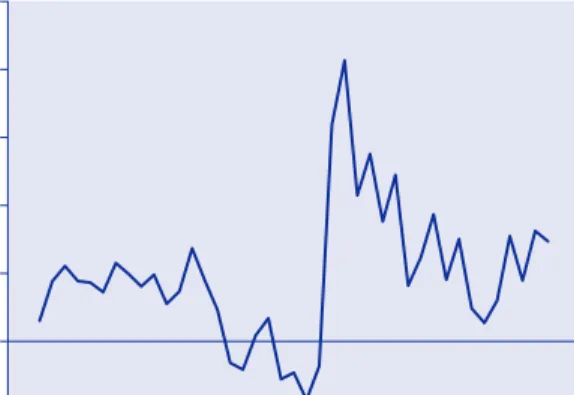
de-cline in the equity premium? Examining recent stock returns in excess of the returns on bonds will not help us ascertain whether the equity premium has fallen, for, as we saw above, excess stock returns may temporarily rise if the future equity premium declines. However, look-ing at excess stock returns over a long period may show whether a permanent change in the equity premium has some historical precedent. Figure 6 plots excess real return on stocks. As with real dividend growth, little persistence is seen in excess returns, as one can reject the hypothesis of a unit root in excess returns at the conventional significance level. Similarly, the variance ratio for excess returns is equal to 0.1 when the horizon is fifteen years, again suggest-ing a relatively small permanent component.
Yet, as we argued above, neither of these statistics rules out small permanent changes in excess returns. The extreme volatility of short-run movements in excess returns can statis-tically mask much more modest permanent changes. Indeed, the 95 percent confidence interval for the mean excess return (see Table 1) is quite large due to the volatility of excess returns themselves and includes values for the equity premium similar to those implied by our examples above.
While statistical evidence neither confirms nor rules out a decline in the equity premium, economic arguments may be more compelling. Siegel (1999) has estimated that a decline in transaction costs as well as the availability of low-cost index funds (primarily concentrated in equities) has lowered the cost of holding highly diversified portfolios. He estimates the decline in the equity premium, and hence, the discount rate, to be about 2 percentage points.17Similarly,
Heaton and Lucas (2000), using an
overlapping-generation model and a calibrated Gordon growth model, find that increased diversification has lowered required returns by about 2 centage points and can explain at least 50 per-cent of the increase in the P/D ratio.18 They
argue that a typical investor used to hold a poorly diversified portfolio consisting of only a few stocks but, with the growth of mutual funds and index funds over the past two decades, is now much better diversified. Jagannathan, McGrattan, and Scherbina (2000) define the equity premium as the difference between the yield on a well-diversified stock portfolio and the yield on a long-term government bond. They find that an equity premium calculated in this way averaged 6.8 percent over the period 1926 – 70 but, since the 1970s, has fallen to just 0.7 percent.
Alternatively, perception about the riski-ness of stocks may have changed. Many of today’s investors have had no experience with the bear market of the 1970s, let alone the Great Depression. These investors’ perception is much different from that of investors whose attitudes were shaped by the earlier periods of low real returns. Some who have argued that the stock price increase was the result of a decline in required returns maintain that investors may have become smarter and more relaxed about the stock market. Glassman and Hassett (1999) go so far as to argue that the 1990s run-up in stock prices was due in large part to investors having learned that a diversified stock portfolio has generally dominated government bonds over the long term. Since 1926, for any twenty-year period, stock returns have always exceeded returns on U.S. Treasury bonds. Furthermore, Glassman and Hassett (1999) point to the his-Figure 5
Real Short-Term Interest Rate, 1959 – 99
Percent –2.5 12.5 10 7.5 5 2.5 0 1999 1959 1964 1969 1974 1979 1984 1989 1994 Figure 6
Annual Excess Stock Returns, 1881–1999
Percent –60 60 40 20 0 –20 –40 1998 1985 1972 1959 1946 1933 1920 1907 1894 1881
torical evidence that stock returns over forty-year holding periods are less variable than returns on government securities. Thus, they argue that for long-term holding periods, equi-ties produce returns higher yet no riskier than bonds. The implication is that investors now require a smaller equity premium to induce them to hold equities. Of course, as we pointed out above, the simple Gordon model implies that the expected future real return on stocks is equal to the discount rate. If the discount rate has fallen, say due to a decline in the equity premium, one can expect future real returns on stocks to be lower than they have been histori-cally. This could conceivably alter the relation-ship between stock and bond returns that Glassman and Hassett have used to justify a decline in the equity premium.19
CAVEATS AND COMMENTS
In our discussion about the role of market fundamentals we have focused on expected real dividend (earnings) growth and real discount rates. But other issues come into play as well. One factor that can affect the P/D ratio is change in corporate financial policy. For example, the fact that many firms repurchase shares of their stock strengthens the market fundamentals argument. Repurchases represent an alternative to dividend payments as a form of stockholder compensation.20When a firm repurchases shares
at the expense of current dividend payments, it reduces the number of shares outstanding and, in turn, increases future (but not current) divi-dends per share and, hence, the current share price. Thus, some have argued that the high P/D ratios are the result of stock repurchases. However, estimates of this effect are relatively small. For example, Cole, Helwege, and Laster (1996) adjust the dividend – price ratio by adding net repurchases (the difference between dollars spent on repurchases and dollars received from new issues) to dividends. They did this for the S&P 500 index over the period 1975 – 95 and found that the dividend – price ratio should be adjusted upward (and the P/D ratio downward) during the 1980s and 1990s. In particular, they found for 1995, the last year in their study, the adjusted P/D ratio is lowered to around 33 from 45, still well above its historical average.21
On the other hand, our previous discus-sion ignored the possible link between expected real dividend growth and the real dis-count rate. If expected real dividend growth increases due to an increase in productivity growth, people will also have even greater
resources for future consumption (relative to current consumption), which makes current consumption more valuable relative to future consumption (current consumption is relatively more scarce) and increases the discount rate. Thus, in a general equilibrium analysis, an increase in expected real dividend growth would be accompanied by an increase in the real discount rate so that these two effects off-set one another.
During the spring of 2001, after we wrote the first draft of this article, stock prices in cer-tain sectors, particularly the high-tech sector, declined dramatically. Furthermore, the terrorist attacks on New York City and Washington, D.C., on September 11 rocked the broad market index examined in this article, the S&P 500, which had been largely spared the dramatic declines experienced by the tech stocks. Note that the simple market fundamentals Gordon model can explain stock price declines as well as stock price increases. One possible scenario that can rationalize recent stock price move-ments is one in which investors revise down-ward their expectations of future real dividend growth and increase their perceptions of the riskiness of stocks. The prospect of an eco-nomic slowdown, the direct and indirect losses from the destruction in New York and Washing-ton, D.C., and the disruption of key industries such as air transportation could lead investors to lower their expectations of future dividend growth. Similarly, increased geopolitical and economic uncertainty may have caused in-vestors to demand a higher risk premium for stocks. Thus, consider a scenario in which investors gradually expect real dividend growth to rise to 2 percent per year over the twenty-year period 1983 –2003 and the discount rate to fall to 4 percent. In 2001, however, new infor-mation causes investors to revise their expecta-tions of real dividend growth down to 1.5 per-cent and the discount rate up to 4.5 perper-cent. As with the run-up in stock prices before 2001, this second set of revisions in expectations occurs gradually over a ten-year period. Figure 7 pre-sents the resulting time path for the P/D ratio and the realized returns on stocks. Initially, stock prices rise as investors’ expectations of real dividend growth increase and the discount rate falls, but once investors change their beliefs about future dividend growth and discount rates a second time, stock prices begin to fall. While expectations are being revised downward, stock returns dip below their historical average, then gradually increase to the long-run discount rate of 4.5 percent. Again, this example is not meant
to be a literal description of stock price move-ments in 2001, but it does illustrate the power of the Gordon model to generate both stock price decreases and increases.
SUMMARY AND PROSPECTS FOR FUTURE RETURNS
A number of explanations have been offered for the unprecedented rise in stock prices during the 1990s. These include in-creased expected future economic growth brought about by the information revolution, demographic changes as the baby boomers age, a reduction in the equity premium as a result of lower transaction costs and increased diversi-fication, a decline in inflation, momentum investing, and irrational exuberance. This article presents evidence that the case for market fun-damentals, as an explanation for higher stock prices, is stronger than it appears on the surface. We demonstrate that movements in the price – dividend and price – earnings ratios show
sub-stantial persistence, particularly since World War II. Hence, using the long-run historical average value of the price – earnings or price – dividend ratio as the “normal” valuation ratio might be misleading. We also show that plausible combi-nations of lower expected future real discount rates and higher expected real dividend (earn-ings) growth could rationalize recent broad market stock values, raising the possibility that changes in market fundamentals have had a major contribution to the run-up in stock prices. Whether market fundamentals or irrational exuberance was responsible for high stock prices during the 1990s, the prospect for future stock returns is not so sanguine. Both a bursting bubble and a declining future equity premium imply lower future returns than those seen in the recent past, and indeed, lower than what has been averaged historically. Only if expected real dividend growth has risen permanently can one reasonably expect future stock returns to remain at their historical average.
NOTES
We gratefully acknowledge very helpful comments from John Duca and Alan Viard on a previous version of this paper.
1 On December 3, 1996, Robert Shiller informed the
Board of Governors of the Federal Reserve that the stock market was overvalued. His paper based on that testimony, “Valuation Ratios and the Long-Run Stock Market Outlook: Ratios Are Extraordinarily Bearish,” may have inspired Alan Greenspan’s “irrational exuberance” statement two days later. The Dow Jones Industrial average closed on that day at a value of 6,437. Campbell and Shiller (2001) update the results presented in Shiller’s 1996 testimony.
2 Reduced business-cycle risk may be the result of
better Fed (forward-looking) policy, better inventory control, and better information. Investors that follow momentum-investing strategies base their investment decisions on recent movements of stock prices, which until recently had been trending upward. Over short periods, investment strategies to exploit increases in stock prices can be profitable. However, over long periods, momentum strategies can be profitable only if supported by fundamental factors. A theoretical justification for momentum-investment strategies can be found in Hong and Stein (1999).
3 Campbell and Shiller (1998, 2001) follow the
sugges-tion of Graham and Dodd (1934) and use smoothed earnings over the past ten years. They find that the smoothed P/E ratio behaves more like the P/D ratio than does the traditional P/E ratio.
4 The P/D ratio is calculated using accumulated
divi-dends over the past 12 months. For example, the P/D
Figure 7
P/D Ratio for Revised Expectations of Dividend Growth
Realized Returns for Revised Expectations of Dividend Growth –5 15 12.5 10 7.5 5 2.5 0 –2.5 2022 1974 1980 1986 1992 1998 2004 2010 2016 0 60 50 40 30 20 10 2022 1974 1980 1986 1992 1998 2004 2010 2016 Percent
ratio for 1999 is calculated as the January 2000 stock price divided by the December 1999 dividend value. Dividends in December 1999 are accumulated dividends over the year 1999. For more details see Shiller (2000, chapter 1, footnote 2).
5 Although for some short periods the P/E ratio
increased slightly above its mean and then quickly fell below, we focus on persistent crossings. Data on stock prices, dividends and earnings are those employed in Shiller (2000). For details on the data, see Shiller (2000, chapter 1, footnote 2). These data can be downloaded from Robert Shiller’s web site (http://www.econ.yale.edu/~shiller).
6 For the ln(P/D) ratio, the augmented Dickey – Fuller test
statistic (with a time trend and a lag length of 3) is –1.83 over the period 1881–1999. Using the ln(P/E) ratio yields a test statistic of –2.24 over the same period. The 5 percent critical value is –3.45.
7 The term “discount rate” used here is notthe interest
rate the Fed charges financial institutions for loans.
8 The Newey–West procedure is used to correct for
serial correlation ( lags = 3). The 95 percent confi-dence interval is approximately +/– two times the standard error of the mean.
9 Nominal returns for 1999 are calculated as ln[(P
Jan. 2000
+ DDec. 1999)/PJan. 1999]•100, where PJan. 2000is the
nominal stock price in January of the year 2000,
DDec. 1999is the accumulated nominal dividends over
the year 1999. Real returns are computed as nominal returns minus inflation, inflation is calculated as ln(CPIt/CPIt–1)•100, where CPItis the value of the CPI
in January of year t. Nominal dividends and nominal earnings are deflated by the CPI to obtain real values. Real dividend and real earnings growth are computed as ln(RDt/RDt–1)•100 and ln(REt/REt–1)•100, where RDt
and REtare real dividends per share and real
earn-ings per share, respectively, in January of year t. Real excess returns are computed as the log of real stock returns minus the real short-term interest rate. The real short-term interest rate is defined as the real return on a six-month commercial paper (rolled over midyear). We would like to thank Eugene Fama for providing the real short-term interest rate series.
10 The period 1983 through 1999 in Table 1 includes the
recovery from the deepest post-World War II reces-sion. To see if starting from a peak of the business cycle leads to different results relative to starting from the trough (as we do here), we also examined values of the variables in Table 1 for 1982 through 1999. The only variable that changes to any substantial degree is real earnings growth, which decreases to 3.29 percent for 1982– 99. However, this value is almost three times the average of real earnings growth for 1881–1981 (1.13 percent).
11 No special significance should be attached to the date
2003. It only reflects an even twenty years after the beginning of the post-1982 bull stock market.
12 For real dividend growth, the augmented Dickey– Fuller
test statistic (with a time trend and a lag length of 3) is –6.41 over the period 1881 through 1999. The value for earnings growth is –7.13. The critical value is –3.45.
13 In the formal language of statistics, the standard tests
can suffer from a size distortion when permanent shocks are small relative to temporary shocks. See Schwert (1987) for an analysis of size properties of standard unit root tests.
14 Of course, if the late 1990s productivity growth is
temporary rather than permanent, real dividend and real earnings growth cannot be sustained at current levels.
15 Sharpe (1999) finds that forecasts of nominal earnings
growth have increased slightly over the past decade while at the same time inflation has fallen, implying a substantial increase in forecasted real earnings.
16 For a discussion of changes in the equity premium over
time, see Blanchard (1993), Jagannathan, McGrattan, and Scherbina (2000), and Fama and French (2001). For a discussion of changes in real interest rates over time, see Blanchard and Summers (1984).
17 Rea and Reid (1998) find that the sales-weighted
average of total shareholder costs for equity mutual funds decreased from 2.25 percent in 1980 to 1.49 percent in 1997. Duca (2000) also documents a decline in transaction costs for equity mutual funds. This decline may have also been a factor contributing to increased diversification.
One can modify the Gordon formula accounting for transaction costs so that the P/D ratio is equal to (1 – τ)(1 + g)/[r+ τ– (1 – τ)g], where ris the required return net of transaction costs and τis the fraction of gross returns lost to transaction costs. Thus, a decline in τaffects the P/D ratio in a manner similar to a decline in the real discount rate (r) and/or an increase in expected real dividend growth (g).
18 Heaton and Lucas (2000) also examine whether an
increased number of people participating in the stock market could contribute to a decline in the discount rate. They find that increased participation has only small effects on the discount rate.
It is not clear that diversification can account for such a large decline in the equity premium. One problem is that Heaton and Lucas’ measure of diversi-fication is not weighted by wealth. The majority of stocks are held by wealthy individuals, who probably always had well-diversified portfolios. Thus, increased diversification by small investors may not have a large effect on stock prices. Another issue is why investors were underdiversified in the past.
19 Investor surveys that indicate continued high future
returns for stocks are not consistent with a decline in the discount rate. Whether these surveys reflect merely projections of recent trends in stock returns or are the rational expectation of future returns is an open question.
20 The P/E ratio scaled by a ten-year moving average of
earnings is often a more stable proxy for long-run payments to shareholders.
21 Their analysis assumes that shares are issued and
repurchased at the market price. If shares are issued at below-market prices (say, as part of executive compensation), the true repurchase effect is smaller.
REFERENCES
Balke, Nathan S., and Mark E. Wohar (forthcoming), “Low Frequency Movements in Stock Prices: A State Space Decomposition,” Review of Economics and Statistics. Barsky, Robert B., and J. Bradford DeLong (1990), “Bull and Bear Markets in the Twentieth Century,” Journal of Economic History50 (June): 265 – 81.
——— (1993), “Why Does the Stock Market Fluctuate?”
Quarterly Journal of Economics108 (2): 291– 311. Blanchard, Olivier J. (1993), “Movements in the Equity Premium,” Brookings Papers on Economic Activity, no. 2: 75 –138.
Blanchard, Olivier J., and Lawrence H. Summers (1984), “Perspectives on High World Real Interest Rates,”
Brookings Papers on Economic Activity, no. 2: 273 – 334. Campbell, John Y., and J. Ammer (1993), “What Moves the Stock and Bond Markets? A Variance Decomposition for Long-Term Asset Returns,” Journal of Finance48: 3 – 37.
Campbell, John Y., and John H. Cochrane (1999), “By Force of Habit: A Consumption-Based Explanation of Aggregate Stock Market Behavior,” Journal of Political Economy107 (April): 205 – 51.
Campbell, John Y., and Robert J. Shiller (1998), “Valua-tion Ratios and the Long-Run Stock Market Outlook,”
Journal of Portfolio Management24 (Winter): 11– 26. ——— (2001), “Valuation Ratios and the Long-Run Stock Market Outlook: An Update,” NBER Working Paper Series, no. 8221 (Cambridge, Mass.: National Bureau of Economic Research, April).
Carlson, John B. (1999), “The Recent Ascent in Stock Prices: How Exuberant Are You?” Federal Reserve Bank of Cleveland Economic Commentary, August 15. Carlson, John B., and Eduard A. Pelz (2000), “Investor Expectations and Fundamentals: Disappointment Ahead?” Federal Reserve Bank of Cleveland Economic Commentary, May 1.
Carlson, John B., and Kevin H. Sargent (1997), “The Recent Ascent of Stock Prices: Can It Be Explained by Earnings Growth or Other Fundamentals?” Federal Reserve Bank of Cleveland Economic Review33, Second Quarter, 2–12.
Cochrane, John H. (1997), “Where Is the Market Going? Uncertain Facts and Novel Theories,” Federal Reserve Bank of Chicago Economic Perspectives, November/ December, 3 – 37.
Cole, Kevin, Jean Helwege, and David Laster (1996), “Stock Market Valuation Indicators: Is This Time Different?” Financial Analysts Journal (May/June): 56 – 64.
Duca, John (2000), “Mutual Fund Loads and the Long-Run Stock Wealth Elasticity of Consumption,” unpub-lished manuscript, Federal Reserve Bank of Dallas, June. Fama, Eugene F., and Kenneth R. French (2001), “The Equity Premium,” Center for Research in Security Prices, Graduate School of Business, University of Chicago, Working Paper no. 522 (Chicago, April).
Glassman, James K., and Kevin A. Hassett (1999),
Dow 36,000: The New Strategy for Profiting from the Coming Rise in the Stock Market(New York: Times Books).
Gordon, Myron J. (1962), The Investment, Financing, and Valuation of the Corporation (Homewood, Ill.: Irwin Publishers).
Graham, Benjamin, and David L. Dodd (1934), Security Analysis(New York: McGraw-Hill).
Heaton, John, and Deborah Lucas (2000), “Stock Prices and Fundamentals,” in NBER Macroeconomic Annual 1999, ed. Ben S. Bernanke and Julio Rotemberg (Cambridge, Mass.: MIT Press for National Bureau of Economic Research), 213 – 63.
Hobijn, Bart, and Boyan Jovanovic (2000), “The Informa-tion Technology RevoluInforma-tion and the Stock Market: Evidence,” New York University working paper (New York, December).
Hong, Harrison, and Jeremy C. Stein (1999), “A Unified Theory of Underreaction, Momentum Trading, and Overreaction in Asset Markets,” Journal of Finance54 (December): 2143 – 84.
Jagannathan, Ravi, Ellen R. McGrattan, and Anna Scherbina (2000), “The Declining U.S. Equity Premium,” Federal Reserve Bank of Minneapolis Quarterly Review, Fall, 3 –19.
Kopcke, Richard W. (1997), “Are Stocks Overvalued?” Federal Reserve Bank of Boston New England Economic Review, September/October, 21– 40.
McGrattan, Ellen R., and Edward C. Prescott (2000), “Is the Stock Market Overvalued?” Federal Reserve Bank of Minneapolis Quarterly Review, Fall, 20 – 40.
Rea, John D., and Brian K. Reid (1998), “Trends in the Ownership Cost of Equity Mutual Funds,” Investment Company Institute Perspective4 (November): 1–15. Schwert, G. William (1987), “Effects of Model Specifica-tion on Tests for Unit Roots in Macroeconomic Data,”
Journal of Monetary Economics20 (July): 73 –103.
Sharpe, Steven A. (1999), “Stock Prices, Expected Returns, and Inflation,” Finance and Economic Discussion series, no. 99-2 (Washington, D.C.: Board of Governors of the Federal Reserve System, Division of Research and Statistics, January).
Shiller, Robert J. (1981), “Do Stock Prices Move Too Much to Be Justified by Subsequent Changes in Divi-dends?” American Economic Review71 (June): 421– 36. ——— (2000), Irrational Exuberance(Princeton, N.J.: Princeton University Press).
Siegel, Jeremy J. (1999), “The Shrinking Equity Premium: Historical Facts and Future Forecasts,” Journal of Portfolio Management26 (Fall): 10 –17.