PhishScore: Hacking Phishers’ Minds
Samuel Marchal
∗†, J´erˆome Franc¸ois
∗‡, Radu State
∗, Thomas Engel
∗∗ SnT - University of Luxembourg, Luxembourg –{samuel.marchal |radu.state|thomas.engel }@uni.lu † TELECOM Nancy - University of Lorraine, France – [email protected]
‡ INRIA Nancy Grand Est, France – [email protected]
Abstract—Despite the growth of prevention techniques, phish-ing remains an important threat since the principal countermea-sures in use are still based on reactive URL blacklisting. This technique is inefficient due to the short lifetime of phishing Web sites, making recent approaches relying on real-time or proactive phishing URLs detection techniques more appropriate. In this paper we introduce PhishScore, an automated real-time phishing detection system. We observed that phishing URLs usually have few relationships between the part of the URL that must be registered (upper level domain) and the remaining part of the URL (low level domain, path, query). Hence, we define this concept as intra-URL relatedness and evaluate it using features extracted from words that compose a URL based on query data from Google and Yahoo search engines. These features are then used in machine learning based classification to detect phishing URLs from a real dataset.
I. INTRODUCTION
Phishing is currently one of the most lucrative cybercrime activities. Although accurately evaluating the financial loss cause by phishing is difficult, some surveys have been con-ducted, suggesting losses of several billion dollars every year. In 2007, Gartner Research estimated a $3.2 billion loss due to phishing scams [1]. Javelin Strategy & Fraud published a report [2] that identity theft led to a loss of $54 billion in 2009, mostly due to cybercrime.
Various techniques are used to perform phising attacks, ranging fromtechnical subterfuges (DNS cache poisoning, e-mail spoofing, Web server takeover, etc.) tosocial engineering. In addition various goals are sought: data, money or credential stealing through fake Web sites, drive-by download of mal-ware, etc. Despite this diversity, one common feature is the use of obfuscated URLs to misdirect users to fake Web sites or drive-by downloads.
Luring Internet users by making them click on rogue links that seem trustworthy is an easy task because of widespread credulity and unawareness. To cope with this threat, the best strategy is to prevent connection to phishing Web sites by the identification of phishing URLs. Phishing Web site short lifetime [3] makes the protracted process of reactive blacklisting based on user reports inefficient. In addition the use of different variations in URLs for the same phishing campaign [4] complicates the task of blacklisting, as blacklists must provide a perfect match for a URL. Hence real-time malicious URL detection is a better technique for defeating phishing.
In this paper, we propose an automated real-time URL phishingness rating system to protect users against phishing
content: PhishScore. The underlying method targets identifi-cation of phishing URLs that are based on registered domains (malicious or not) that are not related to their targeted brand. To delude their victims, phishers blend many phishing key-words (famous brand, attractive key-words) into the remaining parts of the URL. Most Internet users are not aware of the DNS hierarchy. Seeing words likepaypal,ebayorvisaat any level of a URL will make them feel confident that the rogue link actually leads to the official Web site of these brands.
From observation of phishing URLs, we claim that there are few relationships between the registered domain and the rest of the URL. However, the words that compose the rest of the URL (low level domain, path, query) often have many interre-lationships. Therefore, our approach evaluates the relatedness of words that compose a URL and highlights the differences between legitimate and phishing URLs. Previously existing solutions [5], [6], [7], [8], are not well suited to evaluating word similarity or relatedness for the Internet vocabulary. These tools, coming from the natural language processing field, usually have no entries for domain names and most of the words that compose a URL. We leverage search engine query data from Google and Yahoo to compute this relatedness.
Based on this, we define the term of intra-URL relatedness. We extract 12 features from a single URL which are input to machine learning algorithms to identify phishing URLs. Our technique is assessed on ground truth data of 96,018 URLs leading to a correct classification rate of 94,91%. Finally, a phishingness scores is computed for every single URL based on Random Forest classifier.
To summarize the major contributions of this paper: – We introduce the concept of intra-URL relatedness
de-picting the relation between a registered domain and the words that compose the rest of a URL.
– We leverage search engine query data to establish relat-edness between words and show that this is more suited to Internet vocabulary than existing methods.
– We propose new features based on intra-URL relatedness and build a machine learning based approach relying on these for distinguishing between phishing and non-phishing URLs.
The rest of the paper is structured as follows: we start by presenting URL obfuscation techniques in Section II. We introduce the search engine query data and the metrics used to calculate intra-URL relatedness in Section III. Section IV presents the datasets. PhishScore is assessed in Section V, both
Obf. Type Example
Type I http://school497.ru/222/www.paypal.com/29370274276105805/ http://paypal.com.eu.compte.client.update.condst.com.br/
Type II http://www.quadrodeofertas.com.br/www1.paypal-com/encripted/ssl218 http://sezopoztos.com/paypalitlogin/us/webscr.html?cmd= login-run Type III http://cgi-3.paypal-secure.de/info2/verikredit.html
http://paypal-shopping.co.il/ Type IV http://69.72.130.98/janaseva/https.paypal.com/uk/onepagepaypal.htm ftp://212.13.144.72/SERVICE/PayPal.com/security/alert/paypal.com Type V http://tiny.cc/clientID00858JD8 http://goo.gl/HQx5g TABLE I
EXAMPLE OF OBFUSCATEDURLS FOR THE DOMAINpaypal.com
for classification and scoring. Limitations of this technique are identified in Section VI, related works are discussed in Section VII and we conclude in Section VIII.
II. PHISHINGURL OBFUSCATION
This paper assumes some knowledge about DNS organisa-tion and operaorganisa-tion; the reader is referred to [9], [10], [11] for the necessary background.
Phishers usually try to lure their victims into clicking on rogue URLs pointing to phishing sites or drive-by downloads. Different URL obfuscation techniques are used with the aim of hiding the real host, and particularly the registered domain, the only part of the URL that cannot be freely defined. If some-body wants to use a domainmydomain.tld and derive several URLs from it: url1.mydomain.tld, url2.mydomain.tld/file, he has first to register the domain mydomain.tld at a domain registrar, ensuring that it cannot be registered by anybody else. Assuming a phisher wants to trap PayPal users, he must use a domain.tld other than paypal.com, as this domain is already registered by PayPal Inc. The phisher must register a domain name mydomain.tld and try to deceive people by blending labels such as paypal into the rest of the URL: login.mydomain.tld/paypal.
A registered domain consists of two parts: a main level domainand apublic suffix. Apublic suffix(orps) is a domain name suffix under which an Internet user can register a name. It can be just a Top Level Domain like .com, .org or a combination of level domains like .co.ukor .blogspot.com. A main level domain (or mld) is the level domain preceding a public suffix. A registered domain is then:mld.ps. For instance inwww.paypal.com/login,comis thepsandpaypalis themld. The different obfuscation techniques consist of blending either the original domain name or phishing keywords into the remaining part of the URL. These keywords are usually the targeted brand, related services of the brand and other attractive words such as secure,login,protect, etc.
Assume a URL formed of a hostname with different level domain (ld), a path (path) and a query (key=value): http://5ld.4ld.3ld.mld.ps/path1/path2/path3?key1=value1 &key2=value2. The obfuscation often consists in blending keywords into the path, the query and the low level domain
of the hostname (5ld.4ld.3ld). In the following we present the most used URL obfuscation techniques [12], with examples given in Table I for the domainpaypal.com:
• Type I: URL obfuscation with other domain: The mld.ps is a real domain name, usually registered by the phisher, while the original domain being phished is part of the path, the query or the low level domain.
• Type II: URL obfuscation with keywords: Again the mld.ps is a real domain name, and the brand being phished and related words are part of the path, the query or low level domain.
• Type III: Typosquatting domains or long domains: the mld.ps of the URL is the domain being phished but misspelled, with letters or words missing or added, or the domain is pronounced the same way as the original but written differently. The targeted brand can also be combined with other words to create an unregistered domain.
• Type IV: URL obfuscation with IP address:the URL’s hostname is replaced by an IP address and the brand being phished is part of the path or the query.
• Type V: Obfuscation with URL shortener: A URL shortening service is used to hide the name of the real host. Such URLs are not meaningful and are mainly used in phishing attacks targeting services that use this kind of short URL, like Twitter.
We focus on the identification of the four first types of URL obfuscation technique since our technique relies on natural language processing, which is clearly not suited to shortened URLs. The common feature of these obfuscated URLs is that the brand and some related terms are included in the path, the query and low level domain. These terms are related as they have relationships with the targeted brand and have no obvious relation with themld.psthat is used for phishing. This is the opposite of what happens for a legitimate URL, where all the parts of the URL are normally related. To reveal this difference a relatedness analysis of the different part of a URL is performed.
III. INTRA-URL RELATEDNESSANALYSIS
The intra-URL relatedness is the quantification of the re-latedness among the words composing the different parts of a URL and more precisely between the registered domain and the rest of the URL. Due to the limitations of existing relatedness calculation techniques, we leverage search engine query data to compute it.
A. URL Word Extraction
The examples of obfuscated phishing URL from Type I to IV highlight a global characteristic in URL obfuscation, namely that there is no relation between themld.psand the rest of the URL. To reveal this, we split the URL in the two parts that are presumed to have no relationship: extract the mld.ps and separate it from the rest. As theps may be composed of multiple level domain, we use Public Suffix List1 to identify it and then retrieve the immediately preceding level domain as themld. For the rest of the URL, a split according to non-alpha-numeric characters is first performed. From extracted parts composed of several words such as paypalitlogin in http://sezopoztos.com/paypalitlogin/us/...we use a dictionary-based word splitter [13]. For instance, the three wordspaypal, it and login are extracted from paypalitlogin through this process.
Based on this splitting two sets are composed: one, called RDurl (for Registered Domain), consists just
of two elements: RDurl = {mld, mld.ps}. The other,
REMurl (for REMaining part), is composed of all
extracted words from the URL except mld.ps. Given http://sezopoztos.com/paypalitlogin/us/webscr.html?cmd= login-run, the following sets are extracted:
• RDurl={sezopoztos, sezopoztos.com}
• REMurl={paypal, it, login, us, web, src, html, cmd,
login, run}
The mld.ps is not split like the other part to keep the mld unmodified, which can be composed of several words.
Assume a type III obfuscated URL such as http://cgi-3.paypal-secure.de/info2/verikredit.html . The word paypal would be an element of RDphish = {paypal, secure, de}.
If http://cgi-3.paypal.de/info2/verikredit.html is a real Pay-Pal URL, we have RDlegit = {paypal, de} and RDlegit ∩
RDphish={paypal, de}. However with the proposed
decom-position ofmld.ps we have the two listsRDphish={
paypal-secure,paypal-secure.de}andRDlegit={paypal, paypal.de}
giving RDlegit∩RDphish =∅. Hence our proposed
decom-position emphasizes the difference between the two domains. Once the two sets are built, the next step is to evaluate the relatedness of their components. It is tempting to compute word similarity or word relatedness with existing tools such as Disco [7]. However this tool, even if efficient in most cases and especially for phishing domain names analysis as shown in our previous work [14], it is not necessarily suited to intra-URL relatedness computation.
1http://publicsuffix.org/list/
B. Word Relatedness Evaluation Tools Shortcomings
WordNet [8] is a lexical database containing a collection of english language words. Given a word, WordNet can give a collection of related words. The limitation of this tool is that it is only based on English vocabulary that is likely to appear in an English dictionary, whereas Internet vocabulary includes several different languages and many words that are not contained in dictionaries.
Automated techniques and measures have also been devel-oped to evaluate word relatedness. Latent Semantic Analysis (LSA) proposed by Landauer and Dumais [15] or Pointwise Mutual Information (PMI), introduced by Church and Hanks [5], are examples of these techniques. The Normalized Google Distance (NGD [6]) computes the semantic similarity between two words by querying the Google search engine for these words and counts the number of Web pages where they appear together and individually. Disco [7] relies on mutual information evaluation between two words based on corpora. To prove the limitations of these existing tools, we tested whether two of them are able to find related words for a set of labels. WordNet and Disco are chosen since these are the only ones that are really usable through an interface. The testing set consisted of the RDurl extracted from a set
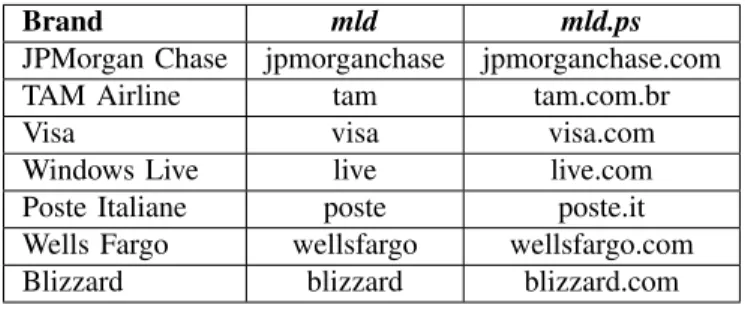
of 94 URLs. These URLs come from PhishTank (described in Section IV-A) i.e. phishing URLs present in PhishTank blacklist are categorised according to the brand they target, when we made our evaluation 94 brands and associated URLs were present in this list. A subset of this test set is given in Table II and the result of the test for each tool is given in the two first rows of Table III. The numbers of mld and mld.ps for which the tested tools can give at least one related word are given in absolute value and percentage terms.
Neither WordNet nor Disco performs well on this test set. These only provide related words for less than 25% of mld and never match anymld.ps, although the brands and domain names tested are well known. In addition for the mlds that match a result, it is usually for brand that is also a meaningful word such as live or visa. The test proves that current word relatedness tools are not suited to the measure of intra-URL relatedness.
While creating a dedicated corpus to be used with existing methods would be helpful but challenging, word relatedness can be dynamically inferred from search engine query data, as shown in next section.
C. Search Engine Query Data
To perform the evaluation of intra-URL relatedness, we use search engine query data. The reason is that URL obfuscation is a social engineering lure. Phishing URLs target a brand, so clever phishers blend within them the brand and words that Internet users associate with the brand, such as a provided service: payment for PayPal. People generally use search engines to access these services. When they make a search, they type some keywords that are typically the brand or the domain name and the service needed like paypal payment or hsbc.com on-line banking. These word associations reflect
Brand mld mld.ps
JPMorgan Chase jpmorganchase jpmorganchase.com
TAM Airline tam tam.com.br
Visa visa visa.com
Windows Live live live.com
Poste Italiane poste poste.it Wells Fargo wellsfargo wellsfargo.com Blizzard blizzard blizzard.com
TABLE II
SUBSET OF MOST PHISHING TARGETED BRANDS WITHmld&mld.ps
Tool #mld %mld #mld.ps %mld.ps WordNet 20 21.3% 0 0% Disco 23 24.5% 0 0% Yahoo Clues 87 92.6% 68 72.3% Google Trends 92 97.9% 76 80.9% Total 94 - 94 -TABLE III
NUMBER OF LABELS MATCHING AT LEAST ONE RELATED WORD FOR4 TOOLS
the cognitive process of users searching for PayPal or HSBC. Consequently, such words are the ones phishers tend to blend into URLs to trap PayPal and HSBC customers [3].
Hence, mining search engine query data for word related-ness measurement is relevant in a phishing context. To achieve this goal, we use search engine query data from two top-ranked search engines: Google and Yahoo. Both offer services, that, given a term, provide some insights on requesting trends concerning it. These services are respectivelyGoogle Trends2 andYahoo Clues3. In the context of the paper we define a term
t as a set of wordsw.{paypal}and{paypal, login, secure} are two examples of terms.
Google Trendsshows the relative interest of Google users over time in a term. It depicts the geographic interest for this term and provide related terms according to users’ related searches. Google Trends provides the top ten related searches over time as well as the ten rising related searches namely those on which interest has increased recently. This allows us to gather up to twenty related terms for one given term.
Yahoo Cluesprovides the same kind of services as Google Trends. It offers an insight into the search flows, the terms requested just before (5 terms) and after (5 terms) a term. Like Google Trends it also provides a set of related searches, but no rising searches.
Combining both sources can give up to forty related terms for one given term. A result for the queried term{paypal}for both tools Google Trends and Yahoo Clues is given in Table IV. The ability of these tools to find related words for phishing targetedmldandmld.psis highlighted in Table III. Both tools were tested on the same set of terms used for WordNet and
2http://www.google.com/trends/ 3http://clues.yahoo.com/analysis
Disco, giving the results in rows 3 and 4. They perform better, with Google Trends being the best at finding related words. However both provide match results for more than 90% mld and 70%mld.ps, much more than usual similarity evaluation tools tested earlier.
Having a URL url and the extracted sets RDurl and
REMurl, Google Trends and Yahoo Clues are
automati-cally requested for each element of the two sets. We de-fine Termw, as the set of terms resulting from the
re-quests of the word w in both Google Trends (related &
rising) and Yahoo Clues (related & requests). A subset of Termpaypal is given in Table IV with Termpaypal =
{{paypal, account},{paypal, login}, ...}.
We define four sets of words built from a URL url:
RELrd(url),RELrem(url),ASrd(url)andASrem(url).
RELset(url)consists of all the words relatedto the words
ofseti.e.words included in terms that are results of requests for elements ofset. Heresetis eitherRDurlorREMurl. The
formulas for these sets are given in Equations (1) and (2).
RELrd(url) ={w∈t|t∈T ermw0, w0∈RDurl} (1)
RELrem(url) ={w∈t|t∈T ermw0, w0∈REMurl} (2)
ASset(url) is the set of words that are associated with
the words of set i.e. the words that appear in a common single term. Assuming a term t composed of three words
{w1, w2, w3}, there is a symmetric association relationship between w1 and w2, w1 and w3, w2 and w3. The two sets
ASrd(url)forRDurlandASrem(url)forREMurlare defined
in Equations (3) and (4) respectively.
ASrd(url) ={w∈t| ∃w0 ∈RDurl, w0 ∈t, w06=w} (3)
ASrem(url) ={w∈t| ∃w0 ∈REMurl, w0∈t, w0 6=w}
(4) These four sets are extracted to quantify the relationship between and inside each set RDurl and REMurl. Assume a
URLwww.paypal.com/login:
RDwww.paypal.com/login ={paypal, paypal.com}. Consider
the subset of three terms resulting from querying paypal in Google Trends (rising) given in Table IV: Termpaypal =
{{amazon, paypal},{paypal, f ees},{ebay, uk}}
We have:
RELrd(www.paypal...) ={amazon, paypal, f ees, ebay, uk}
ASrd(www.paypal...) ={amazon, f ees}
D. Feature Calculation
Based on the sets defined in the previous subsection, we introduce 12 features characterising intra-URL relatedness and URL popularity. The popularity criteria is based on the search count for components of a URL (registered domain,mld, etc.). These features are described in Table V.
The features 1-6 define intra-URL relatedness by calculating the Jaccard index pairwise between the four sets defined in Section III-C (RELrd(url), RELrem(url), ASrd(url) and
ASrem(url)). The Jaccard index is a long-established metric
Google related Google rising Yahoo related Yahoo requests
{paypal, account} {amazon, paypal} {bill, me, later} {paypal, login}
{paypal, login} {paypal, f ees} {netspend} {paypal.com}
{paypal, credit, card} {ebay, uk} {suntrust} {paypal, buyer, credit}
{paypal, email} {paypal, login} {regions} {paypal, customer, service}
TABLE IV
EXAMPLE OF TERM RESULTS FROMGOOGLETRENDS ANDYAHOOCLUES FOR{paypal}
Features Description
1 JRR=|
RELrd(url)∩RELrem(url)|
|RELrd(url)∪RELrem(url)| Jaccard index b/wRELrd(url)andRELrem(url)
2 JRA= ||RELRELrd(url)∩ASrem(url)|
rd(url)∪ASrem(url)| Jaccard index b/wRELrd(url)andASrem(url)
3 JAA=
|ASrd(url)∩ASrem(url)|
|ASrd(url)∪ASrem(url)| Jaccard index b/wASrd(url)andASrem(url)
4 JAR= |
ASrd(url)∩RELrem(url)|
|ASrd(url)∪RELrem(url)| Jaccard index b/wASrd(url)andRELrem(url)
5 JARrd=||ASASrd(url)∩RELrd(url)|
rd(url)∪RELrd(url)| Jaccard index b/wASrd(url)andRELrd(url)
6 JARrem=|
ASrem(url)∩RELrem(url)|
|ASrem(url)∪RELrem(url)| Jaccard index b/wASrem(url)andRELrem(url)
7 cardrem=|REMurl| number of words inREMurl
8 ratioArem= |
ASrem(url)|
|REMurl| ratio of associated words for words in REMurl
9 ratioRrem= |REL|REMremurl|(url)| ratio of related words for words inREMurl
11 mldres=
0 if|Termmld|= 0
1 else
whether there is search engine results or not for themld of the URL
11 mld.psres
0 if|Termmld.ps|= 0
1 else
whether there is search engine results or not for themld.ps of the URL
12 ranking Alexa ranking for mld.ps
TABLE V
URLFEATURE DESCRIPTIONS
andB. The closerJ(A, B)is to1the more similar areAand B. These six features quantify the relatedness between the
two parts of the URL (mld.psand the rest) throughJRR,JRA,
JAAandJAR, as these compute Jaccard indexes between sets
extracted from different parts (RDurlandREMurl). These also
measure the relatedness inside each part through JARrd and
JARrem, as these features are calculated from sets extracted
from the same part of a URL.
Features 7-12 reflect the popularity of a URL and its com-ponents with the number of words that compose it (cardrem)
and the number of related and associated words found in search engine query data based on these words withratioArem
andratioRrem. These two features are weighted bycardrem.
Featuresmld.psresandmldresrepresent the popularity of the
registered domain by giving boolean values describing whether
the mld.ps and mld match results while queried in Google
Trends and Yahoo Clues. The final feature (ranking) is the ranking of themld.psaccording to the Alexa4Web site ranking list. Alexa gives a ranking for the top 1,000,000 most visited Web sites; if a particular mld.ps is not in the list, the value 10,000,000 is considered.
Features 10, 11 and 12 can be considered as relying on the reputation of a domain and not on the intra-URL relatedness. Even if features 10 and 11 are new — rankinghas been used
4http://www.alexa.com/
already in state of the art work — we compare in Section V classification results with and without these three features to assess the relevancy of intra-URL relatedness features.
IV. DATASETS
To assess the ability of the proposed feature set to be used in supervised classification, we use two datasets. One of these is a malicious dataset, the phishing dataset; the other is the legitimate dataset. These sets are composed from different sources — as in several phishing detection work [12], [16], [17] — already used in [18], [19].
A. Phishing Dataset
We used PhishTank to build a phishing dataset. PhishTank5 is a collaborative project to which people can submit phishing e-mails and Web sites. Suspected phishing URLs are further checked by several people before being confirmed as malicious and added to a blacklist. PhishTank provides lists of valid and active phishing URLs.
We downloaded this list on a daily basis between October 11th and November 10th, 2012 and built a phishing ground truth dataset of 53,089 unique URLs. URLs consisting only of mld.ps,www.mld.psor IP addresses without path or query were discarded because it is impossible to calculate the intra-URL relatedness for such URLs, as REMurl=∅. In addition we
already addressed the identification of such phishing domains in [14]. After this selection we had 48,009 extended phishing URLs in thephishing datasetmeaning less than 10% phishing URLs discarded.
B. Legitimate Dataset
To provide additional learning instances for legitimate URLs, we selected URLs from the Open Directory Project (DMOZ6). DMOZ is a directory of the Web containing more than two million URLs. We first discarded URLs consisting only of mld.ps or www.mld.ps, as for the phishing dataset. Then a uniform random selection was made on the rest to keep 48,009 legitimate URLs.
We constructed a balanced dataset (half malicious/half le-gitimate) of ground truth data composed of 96,018 URLs. We acknowledge that a half/half ratio for phishing and legiti-mate URLs does not reflect real world repartition. However this dataset is used to assess the efficiency of the search engine query data and the features extracted therefrom, in distinguishing phishing from legitimate URLs through ten-fold cross-validation. And as presented in [20], imbalanced dataset in cross-validation provides misleading results. This URL set with extracted features is publicly available for research purpose7.
V. PHISHINGURL DETECTION
To automatically detect phishing URLs, we use supervised classification techniques. We build a feature vector matrix from the dataset presented in previous section. Each feature vector is composed of 12 elements, namely the 12 features described in Section III-D. The predicted variable is 0 for a legitimate URL and 1 for a phishing URL. This gives a matrix of 96,018 feature vectors representing the 96,018 URLs of the testing dataset.
A. URL Classification
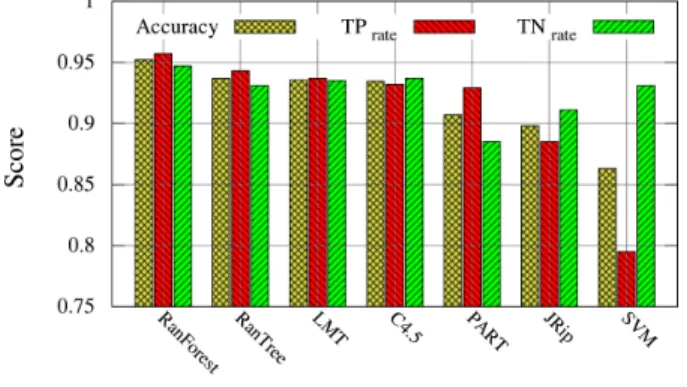
Since there is a wide range of supervised classification algo-rithms, we assessed our dataset according to several classifiers using Weka [21]. Seven classifiers were tested divided between tree-based (Random Tree, Random Forest, C4.5, LMT) rule-based (PART, JRip) and function-rule-based (SVM). The clas-sification was made without parameters tuning through a ten-fold cross-validation as a first step to select the most promising approach. Results for accuracy, true positives and true negatives are given in Figure 1 for each classifier. For sake of clarity we define for URLs:
• Phishing classified as phishing: true positives (TP) and
TPrate= TPTP+FN
• Legitimate classified as phishing: false positives (FP)
andFPrate=TNFP+FP
• Legitimate classified as legitimate: true negatives (TN)
andTNrate= TNTN+FP
• Phishing classified as legitimate: false negatives (FN)
andFNrate= TPFN+FN
6http://www.dmoz.org/
7http://secan-lab.uni.lu/images/stories/samuel marchal/urlset.csv
and the accuracy: Accuracy= TP+TNTP++TNFP+FN
Fig. 1. Classification results for 7 classifiers
Among the tested classifiers, SVM yields the worst accuracy (86.31%) while being efficient in identifying legitimate URLs (93.1%). Rule-based classifiers have approximately the same performance (around 90%) with disproportionate true posi-tives and true negaposi-tives. The best performers are tree-based classifiers, with Random Forest, correctly classifying 95.22% of URLs, being the best.
Hence, Random Forest is selected for classification. Ran-dom Forest [22] is a classification method that creates a multitude of decision trees during training. During prediction, it outputs a hard decision for the class of an instance as the class that has been predicted by the most individual trees. However a soft prediction can also be deduced from the combination of results given by individual trees. This soft prediction is bounded on [0,1] and gives a confidence score for the prediction. It is then compared to a discrimination threshold to give the hard decision.
We tuned the parameters of Random Forest training in order to achieve better classification. The number of trees to be generated during training was set to 100. The ROC (Receiver Operating Characteristic) curve describing the classification results for the tuned classifier in true positive rate and false positive rate is illustrated in Figure 2. The ROC curve typically corresponds to the variation of true positives and false positives while varying the discrimination threshold from 0 to 1. To minimize the number of legitimate URLs classified as phishing (false positives) we adjust the discrimination threshold from 0.49(the value giving the best accuracy) to0.76. This reduces the accuracy from 95.66% to 94.91% but also decreases the
FPratefrom 4.13% to 1.44%.
The detailed classification metrics for the Random Forest algorithm with a 0.76 discrimination threshold are given in Table VI. The two first columns represent the rate of well-classified and miswell-classified instances for each class: TPrate,
FPrate,FNrateandTNrate. ThePrecisioncorresponds to the
ratio of phishing URLs classified as phishing with respect to the total URLs classified as phishing such that:Precision=
TP
TP+FP. TheF-measure is defined as:
F-measure= 2· Precision·Recall
Precision+Recall,whereRecall=TPrate
To show the relevancy of intra relatedness features, we classified with different features the set of URLs. Using only
Class Class. as phish. Class. as leg. Precision F-measure Accuracy
Phishing 91.27% (TP) 8.73% (FN)
98.44% 94.72% 94.91% Legitimate 1.44% (FP) 98.56% (TN)
TABLE VI
DETAILED CLASSIFICATION RESULTS FORRANDOMFOREST(THRESHOLD=0.76)
0.8 0.82 0.84 0.86 0.88 0.9 0.92 0.94 0.96 0.98 1 0 0.05 0.1 0.15 0.2 0.25
True postive rate
False positive rate Fig. 2. ROC curve for Random
Forest classification Fig. 3. Phishing and legitimate URLpartition according to rating ranges
features 1-9 for classification yields an accuracy of 93.48% whereas using reputation based features 10-12 yields 83.97%. Feature 12 (ranking) and other state of the art features are not
sufficient to distinguish between phishing and non-phishing URLs alone. However we show that the proposed feature set yields good results in doing this task. In addition, combining the new proposed features with reputation based features can lead to an improvement in the classification accuracy making this work complementary to the state of the art.
Even though this technique, which gives ahard decisionfor URL class, is proved efficient, correctly classifying 94.91% of URLs with only 1.44% of legitimate URLs classified as malicious, we further leverage machine learning to build a reputation system.
B. URL Rating
The soft prediction value provided by Random Forest is defined on the range [0; 1]. In the previous section a dis-crimination threshold was fixed to give a hard decision on the phishingness degree of a URL. However soft prediction values are not uniformly distributed over the range [0; 1]and some sub-ranges of values may be more suitable to providing a highly reliable decision on the phishingness of a URL. Hence, we analysed thesoft predictiondistribution regarding phishing or legitimate URLs.
Thesoft predictionrange of value[0; 1]is divided in 12 sub-ranges, two being the exact value0and1and the ten remaining being ranges of length 0.1: ]0; 0.1[, [0.1; 0.2[, ... , [0.9; 1[. The soft prediction provided by the tuned Random Forest was computed for all 96,018 URLs of the dataset through a ten-fold cross-validation. We counted the URLs having a score belonging in each sub-range. Figure 3 depicts this count according to the set (phishing at the top / legitimate at the bottom) the URLs come from. The 12 different sub-ranges are on the x-axis and the URL count is on the y-axis in a log scale centered on10and increasing in both directions for each class (phishing up/legitimate down).
We can observe that most of the URLs are grouped in each extremity of the range and mostly in the sub-ranges 0, ]0; 0.1[, [0.9; 1[ and 1, which contain a total of 80,630 URLs out of 96,018. In addition the middle values of soft predictionhave few of either kind of URLs, usually less than 1,000. This confirms that the soft predictionis not uniformly distributed over its range of definition. Considering the two extreme values, very few phishing URLs (40) have the score 0, whereas 22,863 legitimate URLs do. The same happens for asoft predictionof 1 where 34,790 phishing URLs have this score against only 26 legitimate. Given that0 corresponds to legitimate and 1 to phishing, we are able to classify 60.11% of the dataset (57,719 URLs) with an accuracy of 99.89%. URLs getting asoft predictionof0 or1 are very likely to be either legitimate or phishing URLs respectively. This proves that some ranges ofsoft prediction values are more suited to making a reliable prediction. If we extend the analysis to the range [0; 0.1], it contains 38,741 legitimate URLs and only
288 phishing ones. The range [0.9; 1]is composed of 41,260 phishing URLs and 341 legitimate URLs. Considering these two sub-ranges, these contain 83.97% of the testing dataset and their components are correctly identified as legitimate or phishing with an accuracy of 99.22%.
Thesoft predictioncan be used as a risk scorefor a URL. The closer it is to1, the higher the risk; the closer to0the safer the URL. PhishScore automatically provides a phishingness score for requested URLs to inform users of risks. We have demonstrated that such a rating system is reliable in 99.22% of the cases for most of the URLs (83.96%).
While performing our experiments, we timed the process from labels extraction, requesting search engines, features computation to classification decision. It took around 112 hours for the set of 96,018 URLs on a single machine (Intel Core i7 processor and 4Gb memory). This gives an average time per URL of 4.2 seconds, most of the time being taken by the requests to search engines. Direct access to search engine query data would highly decrease this time making the delay introduced by this method shorter.
VI. DISCUSSION
This paper introduces PhishScore a system relying on search engine query data for phishing URL identification. This technique has some limitations that we identify in this section. Our technique is not applicable to all types of obfuscated URLs as described in Section II. URLs composed of only a malicious domain, URLs based on shortening services or URLs algorithmically generated are kind of malicious URLs that can bypass our detection technique. This kind of URLs and malicious domains are however widely used in botnet
communication (C&C) or spamming activities [23], such activ-ities does not rely on a social engineering process as phishing does. The main part of URLs used for phishing are meaningful and composed of many terms [3], this is why our technique is relevant in a phishing context.
A limitation of the implementation is that data publicly available through Google Trends and Yahoo Clues is limited. For each requested term only the ten related most popular terms are returned by these tools. Related terms less requested by search engine users do not appear in results while being relevant for intra-URL relatedness computing. For the same reason, some unpopular terms blended in URLs do not match any results. The reason is that Google and Yahoo do not provide data that is not representative enough i.e. for terms that are not requested enough by their users. These facts limit the accuracy of intra-URL relatedness computing and is one of the reason why extra features such as ranking are included
in the feature set. A full access to Web search logs would highly improve the relevancy of intra relatedness metrics and, as a result, the classification performance as well. Despite this limited access to data, the results presented in this paper provide strong hints regarding the relevancy of using search engine query data for phishing detection.
A last issue of using on-line tools for inferring intra-URL relatedness is the delay implied by multiple HTTP requests making real-time analysis difficult. As presented in Section V the average processing time per URL is 4.2 seconds. A solution to speed up the process would be again direct access to search engine query data or temporary local cashing.
VII. RELATEDWORK
For most related work the datasets used for assessment and the implemented techniques of phishing URL detection are not publicly available, making quantitative comparisons impossible.
In recent years, many techniques have been developed to cope with phishing and have focused on the real-time identification of this threat. One approach is to compare the content of presumed phishing Web pages with the original Web page being phished as in [24], [25], [26], [27]. The main shortcoming of such a method is that the site being phished must be first identified. Another is that this approach is limited to rogue Web sites which is just one of several types of phishing (i.e.drive-by download attacks). PhishScore relying only on URL analysis covers a larger scope than the latter.
Passively captured DNS traffic is used to recognise mali-cious domains in [28], [29]. The technique relies on machine learning algorithms applied to DNS-based features. The lim-itation of this approach when applied to phishing is that it identifies malicious domains instead of malicious URLs. For obfuscated phishing using URLs based on popular domain names, it is inefficient.
Consequently automated techniques to identify phishing URLs have been developed. Most rely on the extraction of phishing heuristics based only on the URL components.
Features such as the length of the level domain, the path, the tokens, and the number of tokens at each level are considered in [18]. Some domain name-related information like ranking, WHOIS information, AS number, blacklisted status, etc. are used in [12], [17], [30]. A lexical analysis is performed to create binary features from each label observed in the URL in [12], [17], [18], [30]. In these techniques, label extraction is performed by splitting according to basic separators (/, ., =, -, etc.) whereas our method is more sophisticated [13]. In addition these approaches need previous knowledge about the exact labels being used in URLs. PhishScore although relying on labels that compose URLs, only computes from these labels and analyses numerical relatedness metrics. This relatedness can be calculated from previously unseen labels as long as these appear in search engine query data. Moreover none of these methods consider the semantic dimension of labels composing URLs as we do.
More predictive approaches have been developed to cope with phishing. In [31], a tailor made blacklist suited to single machine is proposed, this blacklist is built based on the machine’s logs and historical attacks from other machines that are considered as similar. In [19], several phishing URLs are grouped according to common pattern in order to extract a common regular expression. Then new potential phishing URLs are generated according to the variable part of regular expressions.
Recently some solutions considering the semantic dimen-sion of phishing attacks have been proposed. In [32], the content of phishing Web pages is mined. A semantic concept is extracted from every sentence composing the Web page. These concepts are then compared with templates learned from known phishing pages through a machine learning algorithm to determine if the Web page is a phishing one. Approximately the same technique is used in [33] to block phishing e-mails based on semantic content analysis. The common aspect with our approach is the leveraging of semantic information for phishing detection, a concept close to word relatedness. However previous research targets phishing e-mails and Web pages. Semantic relatedness analysis is performed on such content with existing similarity metrics, whereas in our work it is applied to URLs with new similarity metrics based on search engine query data. Our work is also complementary to [14], where phishing domain names likely to be registered by phishers are generated in a predictive process based on a natural language model to build predictive blacklists. Here we focus on real-time identification of full phishing URLs based on machine learning and new features, regardless they are based on malicious or legitimate domains.
Search engine query data has already been used for the analysis of search interests over time [34]. By monitoring the variation of interest for terms related to influenza, Ginsberg et al. [35] estimate the magnitude of flu infection for a given geographic region. In [36], Web search logs are used to improve search engine results. However, to the best of our knowledge we are the first to use this data for the purpose of word-relatedness evaluation.
VIII. CONCLUSION ANDFUTUREWORK
This paper introduces PhishScore, an efficient phishing URL detection system relying only on URL lexical analysis. The approach is based on the intra-URL relatedness. This relatedness reflects the relationship among the words blended into a URL and particularly into the part of the URL that can be freely defined and the registered domain. We leverage search engine query data in order to extract 12 features from a URL characterizing its intra relatedness and its popularity. The proposed features were used in supervised classification on a ground truth dataset of 96,018 phishing and legitimate URLs. This experiment yielded a classification accuracy of 94.91% with a low false positive rate of 1.44%. This experiment was extended to introduce a URL rating system, PhishScore, to dynamically compute a risk score for URLs. The risk score on the testing dataset is able to correctly identify 99.22% of the legitimate and phishing URLs for 83.97% of the dataset.
Future work will consist in merging the technique proposed in [14], which is complementary to that introduced in this paper, to create a phishing detection system with a larger scope of action. Due to delay issues the applications for real time phishing URLs are limited. A solution to apply this technique is as a centralized phishing e-mail detection system. Every link/URL embedded in incoming e-mail can be extracted and analysed by PhishScore to rate the risk of an e-mail before forwarding it to mail clients as a spam filter does.
ACKNOWLEDGEMENTS.
This work is supported by the Fonds National de la Recherche, Luxembourg (Project ID: 3967419).
REFERENCES
[1] “Gartner survey shows phishing attacks escalated in 2007,” Gartner Research, Tech. Rep., 2007. [Online]. Available: http://www.gartner. com/newsroom/id/565125
[2] “2010 Identity Fraud Survey Report,” Javelin Strategy & Research, Tech. Rep., 2010.
[3] “Global Phishing Survey: Trends and Domain Name Use,” APWG, Tech. Rep. 2H2011, 2012.
[4] “Phishing Activity Trends Report,” APWG, Tech. Rep. 3rd Quarter 2012, 2013.
[5] K. W. Church and P. Hanks, “Word association norms, mutual informa-tion, and lexicography,”Computational linguistics, vol. 16, no. 1, pp. 22–29, 1990.
[6] R. L. Cilibrasi and P. M. Vitanyi, “The Google similarity distance,” Knowledge and Data Engineering, IEEE Transactions on, vol. 19, no. 3, pp. 370–383, 2007.
[7] P. Kolb, “Disco: A multilingual database of distributionally similar words,” inProceedings of KONVENS-2008, 2008.
[8] G. A. Milleret al., “Wordnet: a lexical database for english,” Commu-nications of the ACM, vol. 38, no. 11, pp. 39–41, 1995.
[9] P. Mockapetris, “RFC 1034: Domain Names - Concepts and Facilities,” 1987.
[10] ——, “RFC 1035: Domain Names - Implementation and Specification,” 1987.
[11] P. Mockapetris and K. Dunlap, “Development of the domain name system,” inProceedings of the 1988 ACM SIGCOMM. IEEE Computer Society, 1988.
[12] S. Garera, N. Provos, M. Chew, and A. D. Rubin, “A framework for detection and measurement of phishing attacks,” inProceedings of the 2007 ACM workshop on recurring malcode. ACM, 2007, pp. 1–8. [13] T. Segaran and J. Hammerbacher, Beautiful data: the stories behind
elegant data solutions. O’Reilly Media, Incorporated, 2009.
[14] S. Marchal, J. Franc¸ois, R. State, and T. Engel, “Proactive discovery of phishing related domain names,” inResearch in Attacks, Intrusions, and Defenses. Springer, 2012, pp. 190–209.
[15] T. K. Landauer and S. T. Dumais, “A solution to Plato’s problem: The latent semantic analysis theory of acquisition, induction, and represen-tation of knowledge,”Psychological Review; Psychological Review, vol. 104, no. 2, p. 211, 1997.
[16] M. Khonji, Y. Iraqi, and A. Jones, “Lexical url analysis for discrimi-nating phishing and legitimate e-mail messages,” in2011 International Conference for Internet Technology and Secured Transactions (ICITST), 2011, pp. 422–427.
[17] J. Ma, L. K. Saul, S. Savage, and G. M. Voelker, “Identifying suspicious URLs: an application of large-scale online learning,” inProceedings of the 26th Annual International Conference on Machine Learning. ACM, 2009, pp. 681–688.
[18] A. Le, A. Markopoulou, and M. Faloutsos, “Phishdef: URL names say it all,” inINFOCOM, 2011 Proceedings IEEE. IEEE, 2011, pp. 191–195. [19] P. Prakash, M. Kumar, R. Kompella, and M. Gupta, “Phishnet: predictive blacklisting to detect phishing attacks,” inProceedings of INFOCOM. IEEE, 2010, pp. 1–5.
[20] G. Forman and M. Scholz, “Apples-to-apples in cross-validation stud-ies: Pitfalls in classifier performance measurement,” SIGKDD Explor. Newsl., vol. 12, no. 1, pp. 49–57, 2010.
[21] M. Hall, E. Frank, G. Holmes, B. Pfahringer, P. Reutemann, and I. H. Witten, “The WEKA data mining software: an update,”ACM SIGKDD Explorations Newsletter, vol. 11, no. 1, pp. 10–18, 2009.
[22] L. Breiman, “Random forests,”Machine learning, vol. 45, no. 1, pp. 5–32, 2001.
[23] S. Yadav, A. K. K. Reddy, A. N. Reddy, and S. Ranjan, “Detecting algorithmically generated malicious domain names,” inProceedings of the 10th ACM SIGCOMM Conference on Internet Measurement, ser. IMC ’10. ACM, 2010.
[24] T.-C. Chen, S. Dick, and J. Miller, “Detecting visually similar web pages: Application to phishing detection,”ACM Transactions on Internet Technology, vol. 10, no. 2, 2010.
[25] E. Medvet, E. Kirda, and C. Kruegel, “Visual-similarity-based phishing detection,” inProceedings of the 4th international conference on security and privacy in communication netowrks. ACM, 2008, p. 22. [26] G. Xiang and J. I. Hong, “A hybrid phish detection approach by
identity discovery and keywords retrieval,” inProceedings of the 18th international conference on World wide web. ACM, 2009, pp. 571–580. [27] Y. Zhang, J. I. Hong, and L. F. Cranor, “Cantina: a content-based approach to detecting phishing web sites,” in Proceedings of the 16th international conference on World Wide Web. ACM, 2007, pp. 639–648. [28] M. Antonakakis, R. Perdisci, D. Dagon, W. Lee, and N. Feamster, “Building a dynamic reputation system for DNS,” in 19th Usenix Security Symposium, 2010.
[29] L. Bilge, E. Kirda, C. Kruegel, and M. Balduzzi, “Exposure: Finding malicious domains using passive DNS analysis,” in Proceedings of NDSS, 2011.
[30] J. Ma, L. K. Saul, S. Savage, and G. M. Voelker, “Beyond blacklists: learning to detect malicious web sites from suspicious urls,” in Proceed-ings of the 15th ACM SIGKDD international conference on Knowledge discovery and data mining. ACM, 2009.
[31] J. Zhang, P. Porras, and J. Ullrich, “Highly predictive blacklisting,” in Proceedings of the 17th conference on Security symposium. USENIX Association, 2008.
[32] J. Zhang, Q. Li, Q. Wang, T. Geng, X. Ouyang, and Y. Xin, “Parsing and detecting phishing pages based on semantic understanding of text,” Journal of Information & Computational Science, no. 9, pp. 1521–1534, 2012.
[33] V. Ramanathan and H. Wechsler, “phishGILLNET phishing detection methodology using probabilistic latent semantic analysis, AdaBoost, and co-training,”EURASIP Journal on Multimedia and Information Security, vol. 2012, no. 1, pp. 1–22, 2012.
[34] J. Rech, “Discovering trends in software engineering with Google Trend,” ACM SIGSOFT Software Engineering Notes, vol. 32, no. 2, pp. 1–2, 2007.
[35] J. Ginsberg, M. H. Mohebbi, R. S. Patel, L. Brammer, M. S. Smolinski, and L. Brilliant, “Detecting influenza epidemics using search engine query data,”Nature, vol. 457, no. 7232, pp. 1012–1014, 2008. [36] H. Liu, J. He, Y. Gu, H. Xiong, and X. Du, “Detecting and tracking
topics and events from web search logs,”ACM Trans. Inf. Syst., vol. 30, no. 4, pp. 21:1–21:29, Nov. 2012.