Actas del III Congreso Internacional
de la Asociación Ibérica de Estudios de Traducción e Interpretación
The making of a protocol
for opera audio description
Laura P
UIGDOMÈNECH, Anna M
ATAMALAy Pilar O
REROUniversitat Autònoma de Barcelona
Como citar este artículo:
PUIGDOMENÈCH, Laura; MATAMALA, Laura y ORERO, Pilar (2008) «The making of a protocol for opera audio descripton», en PEGENAUTE, L.; DECESARIS, J.; TRICÁS, M. y BERNAL, E. [eds.] Actas del III Congreso Internacional de la Asociación Ibérica de Estudios de Traducción e Interpretación. La traducción del futuro: mediación lingüístca y cultural en el siglo XXI. Barcelona 22-24 de marzo de 2007. Barcelona: PPU. Vol. n.º 1, pp. 381-392. ISBN 978-84-477-1026-3. Versión electrónica disponible en la web de la AIETI:
The making of a protocol for opera audio description
∗Laura Puigdomènech Anna Matamala
Pilar Orero
Universitat Autònoma de Barcelona
Introduction
Spain is to date the only country in the world which has a written Standard for audio description (AENOR 2005). While countries such as US or UK have enjoyed Broadcasting Acts1 which have enforced the inclusion of subtitling for the deaf and hard
of hearing, sign language, and audio description for many years now, none of them have a standard guideline which must be observed. They only have recommendations such as ITC (2000) from Ofcom in the UK2 which serves as «guidance as to how digital
programme services should promote the understanding and enjoyment of programmes by sensory impaired people including those who are blind and partially-sighted». If we look at the Spanish law —Ley General del Audiovisual— which is supposed to regulate media accessibility implementation we find it does not have any sanctioning power. Nevertheless the mere fact that the Spanish government —and a good number of people — formed a working group to draft some guidelines and passed a national Standard is an important social achievement and a step forward for media accessibility and social integration in a country where people with sight problems have been suffering a segregation promoted in part by its own users association.
The draft of the Spanish Standard UNE did not have any academic nor scientific basis, and its content does not help when writing an audio description (Orero 2005, Orero & Wharton 2007). With the experience of having to write an AD script and the lax information offered by the Spanish Standard it has been thought convenient to start a research project which aims at creating an AD protocol for Catalonia, which is the geographical area where we are based and where we have obtained funding. The first steps in the study and the approach to drafting the Catalan protocol are the two issues which will be discussed in this article.
1. Why starting with Opera?
When we started researching AD back in 2004, opera was the only media where AD was on offer. We also had the good fortune of being accepted as observers to the AD production of the 2004/5 season for the Catalan Blind Association (ACCDV). They also allowed us to interview and check with their members different research topics. From those questionnaires and interviews research on Catalan AD started and some publications have been steadily appearing and will appear in international journals and other publications (Matamala 2005, 2006 and forthcoming; Matamala & Orero forthcoming a, b; Orero forthcoming a, forthcoming b; Orero & Remael & Díaz-Cintas forthcoming; Orero & Pereira & Utray forthcoming; Utray & Pereira & Orero forthcoming).
The research and work of this paper has been carried out thanks to the Batista Roca scholarship
(2006PBR10023) awarded by the Catalan Government to the Universitat Autònoma de Barcelona (Spain).
1 Go to http://www.opsi.gov.uk/acts/acts1990/Ukpga_19900042_en_1.htm [Last access: 14/3/2007] for the
whole text of the UK Broadcasting Act.
As an art form, opera is multisemiotic and multimodal by nature: verbal, non-verbal, visual and auditive. According to Buyssens (1943: 56):
The richest collection of semical facts seems indeed to be that produced by the performance of an opera. The artists communicate with the audience in a variety of ways: through words, music, mime, dance, the costumes of the actors; through the orchestra, the setting and the lighting on-stage and in the auditorium; through the architecture of the theatre. […] In short, a whole world here gathers and communicates for the length of several hours (translated by Marvin Carlson).
As Bassnett (2000: 96) writes: «The case of opera introduces other issues to the question of the relationship between text, performance, and translation. The libretto can serve both as a text to be sung and as a guide to the audience, to enable them to follow the performance». There is no general agreement as to which of these many features is the most important. While popularly it is thought that music is the crucial element in opera, academics (Dewolf 2001: 182) and composers have questioned this, establishing the importance of the text to which composers set their music, and of words as «an intrinsic element not only in the expression of the meaning of what is sung, but of the dramatic action». This satisfyingly expresses the mechanics of the interacting features of an opera, as Dewolf (2001) showed in her study of Wagner’s Parsifal, and as described by Gorlée (1997: 248-249):
a Gesamtkunstwerk, i.e., as, above all, dramatic action, and his [Wagner’s] idea that the specific goal of music and words together is «the artistic synthesis in which the music, with its special ability to express what [...] ‘we cannot talk about’, is called upon to develop the poetic intent of the words into melody and harmony, in interaction with text, gesture and stage action» (quoted in Mateo 2001: 32).
Mateo (2001: 32) also quotes comments from the Catalan contemporary composer Xavier Montsalvatge (MEC 1976: 165; 169):
In opera, the plot development, the dramatic component, is of utmost importance, I daresay even superior to the music... Neither the score of Otello nor that of Falstaff
or of Gianni Schicchi would pass, without difficulty, the test of a concert session dissociated from its dramatic support” (Mateo’s translation).
Dewolf (2001: 180) defends a comprehensive approach to opera where «words and music interact to create a theatrical effect. Without reasonably full comprehension of the words on the part of the audience, opera inevitably becomes pantomime accompanied by music, not integrated musical drama». But opera on the other hand for some seems as a conundrum as Jerry Fodor’s review to Bernard Williams book On Opera quotes «Preposterous and enormously moving: the conundrum that is opera». The fact that several and very different artistic representations are found synchronically makes opera a complex and interesting subject matter from which to depart.
Libretti
Some opera critics agree that «most libretti cannot be taken seriously; but for the music, they couldn’t hope to hold stage. The performers often don’t look right for the parts they sing and generally they can’t act. Even if you understand the language that they sing in, what they sing is likely not to be intelligible» (Fodor 2007: 19). Desblache (forthcoming) and Dewolf (2001: 281) are two translation scholars studying opera which have also made this point in the past.
Whether the language of the opera is understood, or the libretto holds any literary merits, the fact is that performers sing in a given language, and the libretto tells the story which is being represented, so for AD these pose two problems we must underline and take into consideration when drafting a protocol to make opera accessible.
Music
For the case of audio description this is both the easiest and most difficult question. Music does not need to be described just listened to, hence it doesn’t require any AD. But it is music which poses the biggest restriction to AD. Though there are different AD styles —which we shall see later— it has to be agreed that music should be respected above commentaries.
Acting
Although acting in opera may not be comparable to that for plays or films, still some action takes part and it should be described. In some operas, such as French, ballet is an integral part of the performance and its AD should also be considered.
Stage, props and costumes
This is a crucial issue which usually is not taken into consideration —see for example Wikipedia entry for opera3— and which for AD is what probably matters most. An opera always has the same libretto and music: that can be heard comfortably at home. The difference between opera performances is the stage production which is the personal interpretation and rendering given by the opera director and his team. Stage design, props and costumes all count to make a new experience, and that has to be transmitted to the visually impaired patrons through AD.
2. Live or recorded opera AD?
Before entering more detailed analysis of the elements present in an AD for opera we should make the first distinction. Shall the Catalan protocol deal with live or recorded opera AD? The Spanish Standard does not mention any, which can either mean that it is considered to be like a play or it is not considered as being able to have AD, but these two very different approaches to opera AD exist and should be taken into account when developing a new protocol. One is to respect the opera as a whole: its music and words and acting produce an AD which is recorded and presented beforehand, or what it is also known as an audio-introduction. The second option is to AD opera as if it was a football match, offering commentaries throughout the representation without much respect for the music or the lyrics. In both cases we are referring to a live performance of an opera, but there is still a further possibility not studied in this section: the live AD or the audio-introduction of a recorded opera which is broadcast on television.
2.1. The recorded opera tradition in AD
Greg York is the person who has developed and registered as a trade mark Talking Notes, the audio introduction practice in the UK. In London for the last thirteen years Talking Notes audio-introductions have been a vital ingredient of the access policies at English National Opera and the Royal Opera House, where they are available at all performances. They give a coherent account of the plot, and illustrate it with vivid descriptions of sets, costumes, characterisation and stage business. The production technique includes research, essential elements of scripting, the use of appropriate presenters, the relevance of musical examples, and methods of reproduction. This practice allows for uninterrupted enjoyment of the performance since the production is recorded in a cassette which is sent —by request— and can be listened to before the actual performance.
2.2. The live approach
The other side of the coin is the tradition of AD opera where commentaries run throughout the performance along with music and lyrics. Since each representation is live and unique, it may have slight alterations as for example singers may vary from one night of performance to the next, or some actions may take place on the stage which are not predicted. The most recent case is the Aida representation which opened La Scala season in December 2006 when top tenor Roberto Alagna stunned the audience by storming off stage in the middle of a performance after he was booed. But more surprisingly his understudy rushed on wearing jeans and carried on the performance. This case calls for live AD since the visually impaired person would have not known what was going on.
In very distant places such as Catalonia or Virginia (US) the AD approach is inclined to be a comprehensive description. Throughout the whole performance the describer —in some cases up to three describers simultaneously— speaks over the music and on some occasions over songs. He provides information about what is taking place on stage and also the plot, and sometimes the describer also reads surtitles.
As we have seen the protocol should take into consideration which approach will be followed before some advice is offered.
3. Other important issues
Living aside the crucial dilemma of creating an audio-introduction or a live AD, we also have to take into account many variables such as technical facilities and the type of opera.
As for technical facilities, some of the key questions that should be taken into account are the following:
a) In live AD, how will the AD be broadcast?
Is the describer in the theatre while describing, or is he in a different room following the opera through a screen?
b) In live AD, how will the AD be received?
Will the AD be received by the whole audience (open AD) or will it be received by patrons through an earplug which can be connected to some device? Or is it going to be received through an infrared system?
c) If it is decided to have audio-introduction, how will the visually impaired person receive it?
Though these considerations are important, they do not alter the production of the actual script. As for the types of operas, there is no doubt that different AD possibilities should be taken into account regarding different types of opera:
a) When it is a standard opera with one, two or three breaks. b) An opera with no break, like Henze’s Boulevard Solitude
c) A concert opera where the singers’ costumes are simply black, and the stage has no props.
4. The more the merrier
Up to now we have been discussing some of the features which may be present in an opera —and the building where it takes place—, which to a certain degree affect the type of AD which can be offered. Now we shall look at the actual protocol and its
structure. But first a couple of questions:
a) Should there be only one protocol for AD in general?
b) Should there be a protocol for each representation: theatre, opera, TV, films, etc.?
Against the evidence we have with general treatment of AD guidelines for any artistic representation, we have decided to create separate protocols since we believe that is not the same to AD a Picasso painting hung at the Tate than a Cirque du Soleil representation.
At this early stage of the research we feel that it may be possible to have at least three separate AD protocols:
• Scenic arts such as theatre, opera, circus, ballet, etc.
• Broadcast media (television, cinema).
• Art: abstract and figurative (painting, sculpture, photography, videos, etc.).
5. The structure of the protocol for opera
Gert Vercauteren has started researching this topic for his PhD thesis. In his articles (Vercauteren forthcoming, and Remael & Vercauteren forthcoming) he proposes that any guideline should at least discuss the following elements to cover all the possible tasks of a describer:
a) the creation of new audio descriptions; b) the translation of existing audio descriptions; c) the recording of audio descriptions by voice talents; d) the technical aspects related to creating audio descriptions;
e) the (national) legal requirements related to making audio descriptions.
We, at this stage, are developing the first point by analysing opera AD, although in later stages we will focus on other scenic arts such as ballet, circus or theatre, and we will take into consideration other aspects listed by Vercauteren. Hence, following again Vercauteren (forthcoming), we should tackle the following questions to some extent:
1) What should be described?
From Greg York’s articles (forthcoming) and his guidelines we have found a solid departing point to create a protocol to describe: characters, stage production, props, costumes, make up, lighting, credits, etc. In fact everything which is present in an opera production.
2) When should it be described?
This is one of the issues we have already mentioned which is challenging. We moreover find that the Catalan audience has already a —albeit a short— tradition of enjoying a very commented opera production hence dictating in some way the expectations. Through scientific reception analysis we may be able to prove otherwise, or we may try to bridge both traditions to create a new and comprehensive unique Catalan AD style. Nevertheless, some guidelines can be drafted since we shall follow York’s (forthcoming) tradition of introducing characters in the following fashion: name of singer, type of voice, character who is singing.
This will be said just before the opera, as the audio-introduction. Then each time a character enter the stage it is named.
3) How should it be described?
There is a universal agreement in describing certain attributes such as colour, size and texture. Much debate is still going on regarding ethnic origin of characters, given the fact that most characters are white and that is a fact. But this issue gets really muddled when we have to deal with emotions. Some AD traditions such as US are towards a total objective depiction of the emotion, hence «tears pouring out of the eyes» will be preferred to «crying». It is also the case for attractiveness: «long legs, small waist and large breasts» will be preferred to «attractive».
Here we also find the use of language, and we believe that, which may be seemed as a tricky issue, may turn up to be one which could be tackled. While all existing guidelines go for the woolly recommendation that AD should be adapted to the type of representation and audience, we believe ADs are not an integral part of the representation, and we should take into consideration the following issues regarding language:
• use of standard language/use of dialects?;
• syntactic constructions: written language to be read aloud;
• syntactic order to promote clarity of reception: simple sentences vs. subordinate clauses;
• logic development of a sentence: (CC) + S + V + (CC) vs. shifting complements;
• verbal style vs. nominal style;
• active vs. passive construction;
• verbal tenses;
• richness in vocabulary;
• anaphoric reference: avoidance of ambiguity/clear reference;4
• clear and precise use of language;5
• articles;
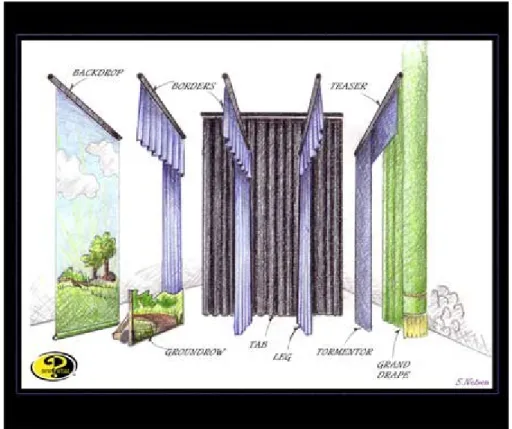
• always avoid technical terminology which makes reference to the media: for example we shall not use the terms teaser and tormentor when making reference to the stage, as it can be seen in the following drawing;
• take into consideration age of audience: children, adolescent, etc.;
• specific terminology regarding a theme;
• when reading, how to pronounce foreign words and names;
• when having to translate, shall names, titles, etc. be translated?
4 In Catalan we would highlight third person weak object pronouns and strong object pronouns, third
person possessive pronouns, excessive use of pronouns.
5 In Catalan avoidance of nouns which are too generic, not to abuse of ser & estar verbs, avoid an excess
Fig. 1. Disposition of different curtains in a typical stage curtain production (Source: Wikipedia).
4) How much should be described?
This issue is much related to Relevance Theory and much research will be needed before any guidelines can be issued. «Not too much and not too little», which is what most guidelines recommend, is common sense, and what we’ll have to live with for some years. However, an in-depth research could help us devise the items that help blind and visually impaired people get a better understanding of operas.
Finally, we would like to add to these four sections a fifth:
5) What is suitable to be described?
Not every audiovisual production can be described. As ITC (2000) comments, «quiz programmes and game shows with tight-worded, almost continuous scripts leave little room for AD. News programmes using constant statistics or text that scrolls across the screen whilst there is no break in speech from presenters also leave no room for AD. An experienced audio describer is best placed to assess whether a particular programme or episode is suitable for AD.» Therefore, regarding opera AD, the describer should assess whether a particular opera is suitable for AD or maybe an audio-introduction would satisfy the blind and visually impaired patrons’ needs.
6. A comprehensive AD: optimising resources
Thinking at the possible AD style adopted by the Catalan opera house Liceu we may venture a compromise between audio description and audio introduction. At present Liceu has a webpage where you can download some basic information about each opera:
Fig 2. Web page for Verdi’s Don Carlos for the 2007 season
We can see in this webpage that we have information regarding the cast, libretto, activities, etc. One more item in this list could be the audio-introduction, which could be in written and oral formats. In this way anybody could access the audio-introduction. This same audio-introduction —which would be in three languages: Catalan, Spanish and English— could also be used as the introduction for the national and estate broadcast of each opera production. Audience in Spain and Catalonia would benefit from such information. More uses of the audio-introduction would be its integration in the DVDs of each production which are marketed by Liceu, which along with the subtitles would make their DVDs accessible.
Finally, audio-introductions could be included in various projects related to opera: Liceu has embarked on the project Open Opera,6 which allows students from 27 Spanish
universities to follow an opera with subtitles live via videoconferencing —in 2003 operas at the Liceu were subtitled in Galician, Catalan and Spanish for the first time—, whereas the Xarxa Telemàtica Educativa de Catalunya (www.xtec.es) also offers 25 scenes online, subtitled in Catalan and Spanish.7 Audio-introduction could also be
6 For the description of the whole project: www.uib.es/servei/comunicacio/sc/actualitat/arxiu/2003/ gener/09/link1.htm.
7 www.xtec.es/cgi/mediateca_crp?NU=MP012393. Operas represented in 1999-2000: Turandot (‘Gravi,
enormi ed impotenti’); Lucia de Lammermoor (‘Ardon gl’incensi’); Le nozze de Figaro (‘Cazonetta sull’aria’); El cas Makropoulos (‘Però en mi la vida s’ha aturat’); Lohengrin (‘O fänd’ ich Jubelweisen’);
Sly (‘Tu! Tu mi salvi! Si...’). Season 2000-2001: D. Q. Don Quijote en Barcelona (‘Es un héroe, mis queridos invitados...’); Samson et Dalila (‘C’est toi que sa bouche invective’); Billy Budd (‘Blow her away’); Aida (‘Gloria all’Egitto’); Giulio Cesare (‘Cessa ormai di sospirare!’). Season 2001-2002: La Traviata (‘Morró!... La mia memoria’); Kàtia Kabànova (‘Tant de bo m’agafessin’); Henry VIII (‘Et vous messieurs, que le roi fit mes juges’); Lady Macbeth de Msensk (‘Però què és això? Massa tard!’); Die Zauberflöte (‘Der Hölle Rache’); Tristan und Isolde (‘Hern Tristan bringe’); La Favorite (‘Mon châtiment descend du ciel’); Gloriana (‘England and England’s Queen entrust their hopes to you!’). Season
2002-offered for these schemes for sensorial disabled students.
All in all, the many uses of audio-introduction make it viable —in financial terms— since as Veerboom et al. (2002: 297) point out, AD «is a very expensive approach […] and it is not financially feasible for most broadcasting companies to make a significant portion of their programmes accessible». Needless to say it would be possible to listen to this same audio-introduction fifteen minutes before the actual opera begins, by connecting a headphone to the TFT displays which are installed at the theatre. Offering an audio-introduction which may also run through the breaks advancing the information to each act may also be a possibility, which will offer a complete description for each act and make an overall description closer to a live AD, with all its benefits and none of the inconveniences.
7. Conclusions
While being in a departing point in the creation of an AD protocol for Catalan opera, some starting points have been established along some areas where we will have to undergo further debate and research. We believe that the possible comprehensive approach for Catalan opera will mean a financial feasible exercise and a reception which will please those with sight problems. We hope that sharing our research we can engage a public awareness and debate which will be beneficial for us all.
Bibliography
AENOR (2005). «Norma UNE: 153020. Audiodescripción para personas con discapacidad visual. Requisitos para la audiodescripción y elaboración de audioguías». Madrid: AENOR. Bassnett, S. (2000). «Theatre and Opera». In France, P. (ed.). The Oxford Guide to Literatura in
English Translation. Oxford: Oxford University Press. 96- 103.
Buyssens, E. (1943). Les langages et le discourse. Essai de linguistique fonctionnelle, dans le cadre de la sémiologie. Brussels: Office de Publicité.
Desblache, L. (forthcoming). «To Screen or not to Screen: challenges and rewards of libretto adaptation». Paper presented at the conference held at Roehampton University In So Many Words 2004.
Dewolf, L. (2001). «Surtitling Operas. With Examples of Translations from German into French and Dutch». In Y. Gambier & H. Gottlieb (eds.). (Multi)Media Translation. Concepts, Practices, and Research. Amsterdam: John Benjamins. 179-188.
Fodor, J. (2007). «Life in tune. Preposterous and enormously moving: the conundrum that is opera». Times Literary Supplement 5416. 19.
Gorlée, D. L. (1997). «Intercode Translation: Words and Music in Opera». Target 9 (2). 235-270.
ITC (2000). ITC Guidance On Standards for Audio Description. http://www.ofcom.org.uk /static/archive/itc/itc_publications/codes_guidance/audio_description/index.asp.html [Last access: 14.3.2007].
Matamala, A. (2005). «Live Audio Description in Catalonia». Translating Today 4. 9-11.
Matamala, A. (2006). «La accesibilidad en los medios: aspectos lingüísticos y retos de
2003: Ariadne auf Naxos (‘Grössmächtige Prinzessin’); Don Giovanni (‘Già la mensa é preparata’);
Norma (‘Casta diva’); Pikovaia Dama (‘Si les gentils damissel·les poguessin volar com els ocells’);
formación». In R. Pérez-Amat & Á. Pérez-Ugena (eds.). Sociedad, integración y televisión en España. Madrid: Laberinto. 293- 306.
Matamala, A. (forthcoming). «La audiodescripción en directo». In C. Jiménez (ed.). Traducción y accesibilidad: la subtitulación para sordos y la audiodescripción para ciegos. Bern: Peter Lang.
Matamala, A. & P. Orero (forthcoming a). «Accessible Opera in Catalan: Opera for All». In P. Orero, A. Remael & J. Díaz-Cintas (eds.). Media for all. Accessibility in Audiovisual Translation. Amsterdam: Rodopi.
Matamala, A. & P. Orero (forthcoming b). «Designing a course on Audio Description: main competences of the future professional». Linguistica Antverpiensa.
Mateo, M. (2001). «Performing Musical Texts in a Target Language: the Case of Spain». Across Languages and Cultures 2 (1). 31-50.
Orero, P. (2005). «Audio Description: Professional Recognition, Practice and Standards in Spain». Translation Watch Quarterly 1. 7-18.
Orero, P. & S. Wharton (2007). «The Audio Description of a Spanish Phenomenon: Torrente».
JosTrans 7. 164-178.
Orero P. (forthcoming a). «Audiosubtitling: A Possible Solution for Opera Accessibility in Catalonia». TRADTERM. Universidade Estadual de São Paulo.
Orero P. (forthcoming b). «Media Audio description in Europe». In P. Orero, A. Remael & J. Díaz-Cintas (eds.). Media for All. Accessibility in Audiovisual Translation. Amsterdam: Rodopi.
Orero, P., A. Remael & J. Díaz-Cintas (eds.) (forthcoming). Media for All. Accessibility in Audiovisual Translation. Amsterdam: Rodopi.
Orero, P., A. Pereira & F. Utray (forthcoming). «Visión histórica de la accesibilidad en los medios en España». Trans.
Remael, A. & G. Vercauteren (forthcoming). «Audio describing the exposition phase of films. Teaching students what to choose». Trans.
Utray, F., A. Pereria & P. Orero (forthcoming). «The Present and Future of Audio Description and Subtitling for the Deaf and Hard of Hearing in Spain». Meta.
Veerboom, M., D. Crombie, E. Dijk & M. Theunisz (2002). «Spoken Subtitles: Making Subtitled TV Programmes Accessible». In K. Miesenberger, J. Klaus & W. L. Zagler (eds).
Proceedings on the 8th International Conference on Computers Helping People with Special Needs. Berlin-Heidelberg: Springer-Verlag. 295-302.
Vercauteren, G. (forthcoming). «Towards a European Guideline for Audio Description». In P. Orero, A. Rémale & J. Díaz-Cintas (eds.). Media for all. Accessibility in Audiovisual Translation. Amsterdam: Rodopi.
York, G. (forthcoming). «Verdi Made Visible. Audio-introduction for Opera and Ballet». In P. Orero, A. Rémale & J. Díaz-Cintas (eds.). Media for all. Accessibility in Audiovisual Translation. Amsterdam: Rodopi.