
Video Analytic Algorithms in a Cloud-like
Environment using Machine Learning
by
Manal Nasser Khalfan AL-Rawahi
A Doctoral Thesis
Submitted in partial fulfilment
of the requirements for the award of
Doctor of Philosophy
of
Loughborough University
30th November 2016
CCTV cameras produce a large amount of video surveillance data per day, and analysing them require the use of significant computing resources that often need to be scalable. The emergence of the Hadoop distributed processing framework has had a significant impact on various data intensive applications as the distrib-uted compdistrib-uted based processing enables an increase of the processing capability of applications it serves. Hadoop is an open source implementation of the MapRe-duce programming model. It automates the operation of creating tasks for each function, distribute data, parallelize executions and handles machine failures that reliefs users from the complexity of having to manage the underlying processing and only focus on building their application.
It is noted that in a practical deployment the challenge of Hadoop based archi-tecture is that it requires several scalable machines for effective processing, which in turn adds hardware investment cost to the infrastructure. Although using a cloud infrastructure offers scalable and elastic utilization of resources where users can scale up or scale down the number of Virtual Machines (VM) upon require-ments, a user such as a CCTV system operator intending to use a public cloud would aspire to know what cloud resources (i.e. number of VMs) need to be de-ployed so that the processing can be done in the fastest (or within a known time constraint) and the most cost effective manner. Often such resources will also have to satisfy practical, procedural and legal requirements. The capability to model a distributed processing architecture where the resource requirements can be effectively and optimally predicted will thus be a useful tool, if available. In literature there is no clear and comprehensive modelling framework that provides proactive resource allocation mechanisms to satisfy a user’s target requirements, especially for a processing intensive application such as video analytic.
In this thesis, with the hope of closing the above research gap, novel research is first initiated by understanding the current legal practices and requirements of implementing video surveillance system within a distributed processing and data storage environment, since the legal validity of data gathered or processed within such a system is vital for a distributed system’s applicability in such domains. Subsequently the thesis presents a comprehensive framework for the performance
alized cluster of machines.
The proposed modelling framework investigates the use of several machine learning algorithms such as, decision trees (M5P, RepTree), Linear Regression, Multi Layer Perceptron(MLP) and the Ensemble Classifier Bagging model, to model and predict the execution time of video analytic jobs, based on infrastruc-ture level as well as job level parameters. Further in order to propose a novel framework for the allocate resources under constraints to obtain optimal perform-ance in terms of job execution time, we propose a Genetic Algorithms (GAs) based optimization technique.
Experimental results are provided to demonstrate the proposed framework’s capability to successfully predict the job execution time of a given video analytic task based on infrastructure and input data related parameters and its ability determine the minimum job execution time, given constraints of these parameters. Given the above, the thesis contributes to the state-of-art in distributed video analytics, design, implementation, performance analysis and optimisation.
My first great gratitude is for God, for giving me the opportunity to pursue a Phd and surrounded me with all blessing.
This thesis is the result of the support of many people and I would like express my deepest gratitude and sincere appreciation to all those who helped me complete my thesis.
I would like to thank my beloved parents Nasser Rawahi and Farida Al-Hadhrami for their love, endless support and prayers. My mother came to UK many times to support me taking care of my children while I was doing my research work.
I would also like express my deep thanks to my supervisor Prof. Eran Edi-risinghe for this continues guidance, support and patience from the start to the final stage of my Phd journy.
I would like to thank my dearest hasband Abdullah for his support and ac-cepting my many years of research with open heart.
My special thanks to my children (Sama, Nasser & Ahmed) who give me hope and power in life.
My special thanks to my brother Hamood and my sisters Aziza, Maisa & Areen for their emotional support and prayers.
I would like to thank Dr Iain Philips my second supervisor for providing tech-nical support and facilities to build Hadoop in a virtualized cluster.
I would also like to thank all the past and current school of science admin staff at Loughborough University.
Thanks to all my colleagues in the department of computer science who co-operate with comments and encouragement.
Finally, I would like to acknowledge the support of the Ministry of Manpower of the Sultanate of Oman for providing the funding for this research and Lough-borough University UK for providing research facilities support.
The following papers have been published/accepted for publication:
Journal Paper:
(i) Manal, A.R. and Edirisinghe, E.A., 2015. Video Forensics in Cloud Comput-ing: The Challenges & Recommendations. Journal of Information Sciences and Computing Technologies, 3(2), pp.201-216.
Conference Papers:
(ii) AL-Rawahi, M., Edirisinghe, E.A., and Jeyarajanz, T. ”Machine Learning-Based Framework for Resource Management and Modelling For Video Ana-lytic in Cloud-Based Hadoop Environment.” IEEE Cloud and Big Data Com-puting. 2016. [accepted for publication]
(iii) AL-Rawahi, M., Edirisinghe, E.A. ”Optimization Techniques to Enhance Al-location of Computing Resources for Cloud-based Video Analytic.” In SAI Intelligent Systems Conference (IntelliSys), 2016. IEEE. [accepted for pub-lication]
Abstract ii
Acknowledgments iv
List of Publications v
List of Acronyms xiv
1 Introduction 1
1.1 Aim & Objectives . . . 3
1.2 Research Questions & Contributions . . . 4
1.3 Thesis Structure . . . 6
2 Background & Literature Review 7 2.1 Video Analytic Systems . . . 7
2.1.1 Architecture . . . 7
2.2 Cloud Computing Paradigm . . . 10
2.2.1 Definition of Cloud Computing . . . 11
2.2.2 Cloud Service Models . . . 12
2.2.3 Cloud Deployment Models . . . 13
2.2.3.1 Amazon AWS . . . 14
2.2.4 Enabling Technologies . . . 15
2.2.4.1 Distributed Computing . . . 15
2.2.4.2 Virtualization . . . 15
2.2.4.3 Hypervisor . . . 16
2.2.5 Cloud Computing Architecture . . . 18
2.3 Hadoop1 Framework . . . 21
2.3.1 Hadoop Ecosystem . . . 23
2.3.2 MapReduce . . . 25
2.3.2.1 MapReduce Workflow . . . 25
2.3.3 HDFS . . . 27
2.4 Hadoop2 Framework (YARN) . . . 28
2.5.0.2 Sahara OpenStack . . . 31
2.6 Literature Review . . . 32
2.6.1 Hadoop Platform for Video Processing . . . 33
2.6.2 Hadoop Performance in a Virtualized Cluster . . . 35
2.6.3 Performance Modelling and Optimization . . . 37
2.7 Summary . . . 40
3 Video in Cloud Computing: The Challenges & Recommenda-tions 41 3.1 Introduction . . . 41
3.2 Related Work . . . 43
3.3 Security and Privacy Requirements of a Video Surveillance System . 44 3.3.1 Review of the current legal framework that governs video surveillance systems installed in the UK . . . 45
3.3.2 Review of the legal framework governing video to be used as evidence . . . 48
3.3.3 Research Publications . . . 49
3.3.4 The Legal Aspects: Summary & Conclusions . . . 50
3.4 Cloud Computing Security Concerns . . . 50
3.4.1 The Cloud: Technical Issues . . . 51
3.4.2 The Cloud: Non-Technical Issues . . . 53
3.4.2.1 Data Protection . . . 53
3.5 Cloud Computing Performance Concerns . . . 57
3.6 Conclusion & Recommendation . . . 58
4 Video Analytics Applications Deployment on Hadoop 62 4.1 Introduction . . . 63
4.2 Methodology . . . 64
4.2.1 Video Dataset Description . . . 64
4.2.2 Video Applications Description . . . 65
4.2.2.1 Face Detection Algorithm . . . 65
4.2.2.2 Motion Detection Algorithm . . . 65
4.2.3 Hadoop System Design Overview . . . 66
4.2.3.1 Input Video . . . 67
4.2.3.2 HDFS . . . 68
4.2.3.3 MapReduce-based Video Analytic Application . . 68
4.5 Discussion . . . 78
4.6 Conclusion . . . 79
5 Performance Modelling for Hadoop-Based Video Analytics 81 5.1 Introduction . . . 81
5.2 Methodology . . . 83
5.2.1 Phase One: Analyse the characteristical behavioural of video analytic application in Cloud-Hadoop environment . . . 84
5.2.1.1 Experiment 1 . . . 85
5.2.1.2 Experiment 2 . . . 87
5.2.1.3 Experiment 3 . . . 88
5.2.1.4 Discussion . . . 88
5.2.2 Phase Two: Create Training Dataset . . . 89
5.2.2.1 Dataset Variables . . . 89
5.2.2.2 Data Collection . . . 90
5.2.2.3 Dataset Representation . . . 90
5.2.2.4 Data Preparation (Feature Selection) . . . 90
5.2.3 Phase Three: Modelling the Job Execution Time . . . 91
5.3 Experimental Results & Analysis . . . 92
5.3.1 Prediction Experiment Result 1 . . . 92
5.3.1.1 Training Datasets . . . 92
5.3.1.2 Prediction Models . . . 92
5.3.2 Prediction Experiment Result 2 . . . 95
5.3.2.1 Training Datasets . . . 95
5.3.2.2 Prediction Models . . . 95
5.4 Implementation Challenge & Discussion . . . 99
5.5 Conclusion . . . 100
6 Performance Optimisation for Hadoop-Based Video Analytics un-der Constraint Conditions 101 6.1 Introduction . . . 101
6.2 Problem Formulation . . . 103
6.3 Methodology . . . 105
6.3.1 Algorithms Description . . . 105
6.3.2 Fit GAs to Resource Allocation Problem . . . 107
6.4 Experimental Results and Analysis . . . 108
6.4.2 Motion Detection Application . . . 111
6.4.2.1 Test1 . . . 111
6.4.2.2 Test2 . . . 112
6.4.3 Comparison of Different Optimization Results . . . 114
6.5 Conclusion . . . 115
7 Conclusion and Future Work 116 7.1 Summary . . . 116
7.2 Conclusions . . . 117
7.3 Future Work . . . 117
2.1 High-level block diagram of a video forensic system . . . 8
2.2 Scientific analysis of academic disciplines on cloud computing research[86] 10 2.3 Cloud service models architecture[178] . . . 12
2.4 Full-Virtualization . . . 17
2.5 Para-Virtualization . . . 17
2.6 Hardware-based Virtualization . . . 17
2.7 Cloud reference architecture[110] . . . 19
2.8 NIST conceptual reference model for cloud computing[50] . . . 20
2.9 Cloud reference architecture[78] . . . 21
2.10 Typical components of IaaS cloud infrastructure[67] . . . 22
2.11 Google trends on Hadoop compared with other technologies. . . 22
2.12 Hadoop history . . . 23
2.13 MapReduce data flow framework when executing a job . . . 26
2.14 Hadoop Framework[127] . . . 29
2.15 High level view of Amazon EMR [2] . . . 31
2.16 Sahara architecture [33] . . . 32
3.1 CSA Top Threats ranking in 2010 & 2013[42][64] . . . 52
3.2 Roles of data controller & data processor . . . 55
4.1 Image output from face detection Algorithm . . . 66
4.2 Image output from motion detection Algorithm . . . 66
4.3 Hadoop framework for video analytic application . . . 67
4.4 Hadoop performing a video analytic job . . . 68
4.5 Video (key,value) pairs generated from decoded frames . . . 69
4.6 Hadoop virtual topology . . . 72
4.7 Execution time against number of VMs for face detection algorithm 74 4.8 Execution time against number of VMs for motion detection algorithm 74 4.9 Speedup analysis of Hadoop-based face detection . . . 75
4.10 Speedup analysis of Hadoop-based motion detection . . . 76
4.11 Processing time when different video input size is used. . . 76
5.1 Impact of Reducer slots on CPU resource utilization . . . 86
5.2 Impact of Reducer slots on the face detection job execution time . . 86
5.3 Impact of Reducer slots on the motion detection job execution time 86 5.4 Comparing the predicted vs actual execution time for different clas-sifers . . . 94
5.5 Comparing the predicted vs actual execution time for different clas-sifiers . . . 98
6.1 Evolution curves searching for best fitness . . . 109
6.2 Evolution curves searching for best fitness . . . 112
1.1 Research questions and thesis contributions. . . 5
2.1 Comparing Architecture of Hadoop1 & Hadoop2-YARN [101] . . . . 30
3.1 Summaries of the key legal requirements, the corresponding video surveillance system compliance and cloud computing challenges. . . 59
3.2 Summaries of performance requirements, the corresponding video surveillance system compliance and cloud computing challenges. . . 59
4.1 Video files details . . . 65
4.2 Pseudo code for the implementation of a single-frame and overlapped-frame oriented applications based on Hadoop MapReduce. . . 71
4.3 Software configuration for the cluster of VMs. . . 73
5.1 Total execution time with different Reducer slots and tasks for face detection application. . . 87
5.2 Comparison of the Total Execution Time (TET) with two different VM resource types. . . 88
5.3 Attribute used for video analytic application performance modelling. 89
5.4 Training dataset for face detection application with videp type1. . . 90
5.5 Training dataset for motion detection application with videp type1. 90
5.6 Attributes for video analytic applications performance model. . . . 91
5.7 Results of the prediction models for face detection application with video type1. . . 93
5.8 Results of the prediction models for motion detection application with video type1. . . 93
5.9 Updated training dataset. . . 95
5.10 Results of the prediction models for face detection application with video type1. . . 96
5.11 Results of the prediction models for motion detection with video type1. . . 96
6.1 User input requirements and the system constraints . . . 108
6.4 User input requirements and the system constraints . . . 110
6.5 Results generated by the GAs operation . . . 110
6.6 Analysis of results generated by the GAs operation . . . 111
6.7 User input requirements and the system constraints . . . 111
6.8 Results generated by the GAs operation for motion detection . . . . 111
6.9 Analysis of results generated by the GAs operation . . . 112
6.10 User input requirements and the system constraints . . . 112
6.11 Results generated by the GAs operation . . . 113
6.12 Analysis of results generated by the GAs operation . . . 114
6.13 Comparative optimization results for face detection application with two video types. . . 114
6.14 Comparative optimization results for motion detection application with two video types. . . 115
GA Genetic Algorithm
HDFS Hadoop Distributed File System
ML Lagrange Multipliers
PS Patern Search
VM Virtual Machine
YARN Yet Another Resource Negotiator
Introduction
Large-scale distributed systems are required for video surveillance systems (VSS) in order to analyse large quantities of recorded video data which is a computing intensive activity. It is important to consider scalability as a factor for future video surveillance systems [60]. Existing solutions require demand in resources, which are unsuitable for future increased demands for video data. IBMs system, IBM Smart Surveillance System, (IBMSSS) [80], deploys a combination of database partitioning and web application server clustering that allows scalability. How-ever, such solutions that attempt to resolve the scalability issue are expensive and increase the cost of hardware and overall investment expenses.
Video surveillance data processing is currently accomplished by techniques such as parallel computing and distributed computing to reduce costs. Such techniques provide performance enhancement and reduction in cost; yet suffer from limit-ations in resources, complex programming, scalable storage and limited support of fault tolerance. When considering these challenges within the current infra-structure, a data processing framework that is simple and automatically handles task scheduling, distribution and storage of data, load balancing, and machine failure is necessary in order to allow users to focus solely upon creating scalable applications.
One example of such a framework that has been widely adopted by major organisations, such as Amazon, Google, Yahoo and Facebook, as well as research-ers and the community, is Hadoop. Hadoop [162] is an open source MapReduce implementation for data storage and intensive processing, designed to resolve a number of large data issues, such as searching, log analysis, indexing, multimedia analytics and machine learning. Hadoop has attracted researchers and other pub-licity indicating a move towards enhancing and developing Hadoop architecture, which has improved the overall stability of Hadoop[129]. These developments have inspired this research into using Hadoop as a platform to resolve large-scale video surveillance processing issues.
Forensic video analysis is a post-event processing, and only processed occasion-ally when needed. It is therefore both impractical and uneconomic to dedicate machines for the sole use of Hadoop within such an application. On the other hand video analytics are real-time alert systems that often require substantial amount of processing to be done, given the content of video that can change from time-to-time. Hence dedicating machines for the processing of video analytic data will be inefficient. Scalable computing and storage resources can be deployed on demand through cloud computing with minimum initial investment, providing full virtualisation and distributed computing technologies and can hence support ap-plications such as video forensics and video analytics (collectively known as video surveillance).
Cloud computing services provide a range of resources and services to support video surveillance systems, which have been recently studied in literature[122][137][89]. Overall, this makes a good solution in the provision of scalable dynamic clustering of video analytic systems. In order to avoid potential risks of security and privacy breaches of the video data, there is a requirement to balance the benefits of cloud computing with an understanding of a variety of legal issues involved in deploying video surveillance. The process of risk-aware computing will assist in the creation of a more security comprehensive architecture as a protection against potential threats.
A literature review was undertaken in order to understand the current regula-tions and guidelines behind establishing a reliable, legal and trustworthy, cloud-based video surveillance system. The requirements of a legally acceptable video forensic system are discussed and current security and privacy challenges of cloud based computing systems are studied in order to recommend the design of a se-cure and reliable cloud-based video forensic system. The research focuses only on the performance of distributed video analytic applications using a cloud-based Hadoop platform after carefully considering the proposed recommendations and observations.
Preliminary experimental results conducted within the context of the research presented in this thesis indicates that a cloud-based Hadoop platform will be successful in speeding up video analytic processing and distribute computing of computer vision algorithms in a cluster of machines. It was also observed that the execution time of applications is determined mainly by both the size of the load, as well as cluster sizing. Hadoop MapReduce architecture is dependent upon the type of application, as well as upon hardware performance/configuration[162]. How-ever there was no existing research in attempting to model Hadoop performance within a distributed computing framework serving data and processing intensive applications.
Video analytics/forensics is computationally intensive task, operating on a frame-by-frame basis to extract information from its content. Cloud workloads are characterised by their own resource and performance requirements, as well as constraints that are specified in service level agreements (SLA). Therefore, in order to meet performance goals, decisions relating to the correct resource to be deployed for a video analytic application workload requires careful analysis of its likely behaviour when applied to a cloud-based Hadoop environment. The ability to model and thus predict application performance and to subsequently optimise resource allocation will therefore be a useful contribution to the state-of-art in video surveillance research.
Identifying the above research gap, the behaviour and performance of a video analytic application running in a virtualised cluster is first studied in this thesis, which highlights the most significant factors that influence the execution time of an application. Based on these factors an experimental study was conducted in order to develop a prediction model for the application. This was undertaken by com-paring different machine learning algorithms based on the prediction accuracies that reveal that decision-based models outperform linear regression models, whilst the Ensemble Bagging models outperform standard single-based classifiers. This research fills an existing gap in research relating to video analytic related compre-hensive performance predictions. Current research maintains a focus upon differ-ent types of applications that are limited to using standard learning algorithms, such as Simple Linear Regression, SVM and Multilayer Perceptron (MLP).
To demonstrate the practical use of the prediction models obtained above, the thesis continues to study the use of Genetic Algorithms (GAs) as an optimisation method to search for the optimal resource allocations under given constraints to complete a job within a minimal period of time. The impact of both the infrastructure level parameters (e.g. number of VMs, number of slots etc.) and application level parameters (e.g. video input size, frame size etc.) to the above optimal resource allocations are studied in detail.
1.1
Aim & Objectives
The aim of the research presented within this thesis is to investigate the per-formance of a scalable video analytic application implemented on a cloud-based Hadoop environment. The results are used to propose a framework for modelling the performance and optimising resource allocations. In order to meet this aim, a number of objectives need to be met:
surround-ing the deployment of video surveillance, within a cloud based environment and thus use the findings to recommendations for the design of such a system.
• Study the possible use of a selection of different distributed parallel pro-cessing techniques in the development of a cloud-based video analytics ap-plication and in particular, design, implement and anlyse a Hadoop based architecture, Determine the application and architecture specific parameters that has the most significant impact on performance.
• Based on machine learning algorithms develop models that are capable of accurately predicting the system’s performance, i.e. the prediction of job execution time.
• Propose a method to optimise the performance of the proposed scalable video analytic system under given constraints of the system architecture and application related parameters.
1.2
Research Questions & Contributions
Table 1.1 provides a summary of the research questions, research method adopted to answer the research questions and resulting original contributions made by this thesis.
T able 1.1: Researc h questions and thesis con trib utions. Researc h Question(R Q) Researc h Metho d Chapter/Published pap er# Con tribution s R Q1: What are the general re-quiremen ts for ensuring the legal compliance of a video surv eillance system that is used to record sur-v eillance data for legal prosecution and to what exten t do es a cloud in-frastructure compl y with this la w? Literature Review 3/(i) 1. Conducted a comprehensiv e analysis on video surv eillance system legal requiremen ts . 2. Pro vided literature on the rep orted cloud computing legal c hallenges in terms of securit y and priv acy status. 3. Pro vided recommendations on the p ossible la wful arc hitectur al design and go o d practice. 4. Recommend enabling tec hnologies; a priv ate cloud platform to pro vide b oth storage and a facili t y computing platform and a Hado op frame-w ork for distributed parall el pro cessing platform. R Q2: What is the p erformance gain obtainable when executing large-scale, highly sc al able video analytic applications in a Ha-do op based cloud lik e en vironmen t whic h supp orts distributed data pro cessing and storage? What are the factors affecting p erformance in suc h the en vironmen t? Exp erimen tal tes tb ed on a small scale virtual cluster computing en vironmen t 4 1. Designed and constructed a Hado op virtual cluster with nine virtual mac hines. 2. Illustrated the application p erformance gain obtainable b y p r o viding the sp eed up graph using Amdahl’s La w. 3. In terpreted the results obtained from testing differen t factors that im -pacted the application p erfomance. 4. Articulated the idea of mo delling the video analytic application p er-formance using infast racture lev el metrics as w ell as appli c ati on-lev el metrics. R Q3: Can a mo del b e dev elop ed to predict the video service target p er-formance in Hado op based distrib-uted pro cessing en vironmen t based on s ystem and video input related parameters? If a mo d e l can b e gen-erated, ho w accurate will suc h a mo del b e? Mo del ling using Mac hine Learning algorithms 5/(ii) 1. Built a prediction mo del for Hado op video analytic application to pre-dict the job execution time using differen t mac hine learning algorithms that fit our targeted mo del. 2. Compared the predi ct ion accuracy b et w een the mac hine learning al-gorithms. 3. Ev aluated the constructed prediction mo del on new /un kno wn dataset to confirm the effeciency of the prop osed metho d. R Q4: Can the mo del b e used to find the optimal p erformance of the video analytic application when de-plo y ed in the Hado op based en vir-onmen t and executed un der con-strain t conditions? Optimization tec hnique using genetic searc h algorithm 6/(iii) 1. F orm ulated op t imization problem us ing t h e mo del deriv ed from c hapter5. 2. Applied genetic algorithms whic h pro duced a fast and an effectiv e res-ults in finding the minima job execution time under constrain ts condi-tion.
1.3
Thesis Structure
The remainder of this thesis is organized as follows:
• Chapter 2: Provides a background knowledge and an overview of the related research topics, such as video surveillance systems, cloud computing and Hadoop/YARN.
• Chapter 3: Analyses the legal, ethical, security and performance require-ments for carrying out video surveillance within a cloud based architecture.
• Chapter 4: Provides the design & the implementation of the virtualized Ha-doop system and the performance analyis of the execution of the MapReduce-based video analytic application within this system.
• Chapter 5: Presents the development of machine learning based approaches to model and predict the total execution time of a video analytic application, deployed within a Hadoop virtual cluster.
• Chapter 6: Presents the use of a genetic algorithm based optimization ap-proach to minimise the job execution time of a video analytic applications deployed on the Hadoop based architecture, subject to given constraints in resources.
Background & Literature Review
This chapter intends to present a discussion of the background knowledge required to undertake this study based on video analytic systems, cloud computing, and Hadoop MapReduce framework. These technologies are effectively utilised within the contributory chapters of this thesis, i.e. Chapters 3-6. In addition we describe related work in our research area.
2.1
Video Analytic Systems
Technological advances to improve security in society generally have included the installation of closed circuit television (CCTV), and although this technology en-ables operators to view or search recorded video data to investigate specific events, these processes of searching and monitoring are shown to be expensive in terms of labour, as well as being time consuming processes which can result in human errors. Typically the operator manually performs a visual search in recorded video footage for a given event to search for specific information, such as date, time peri-ods, locations, colour of clothing, or gender of individuals from the database[69]. The advanced video surveillance systems use computer vision, machine learning and pattern recognition algorithms that can automatically track, classify and de-tect specific objects, and large quantities of visual data can be analysed with minimal interventions from operators, which is faster and less expensive in terms of labour. VSS performs either real-time alerts (video analytics) or post event on recorded and indexed video data stored in a database (video forensics).
2.1.1
Architecture
The review of literature of this topic suggests that the structure or architecture of these video surveillance systems is varied [80][114] depending on the observation/s to be carried out. However, in general, a typical video surveillance system consists
of a distributed set of video cameras covering an area/space that requires monit-oring 24/7 for security purposes. We assume that these cameras are connected to a Video Database that stores the CCTV video footage for subsequent computer based processing.
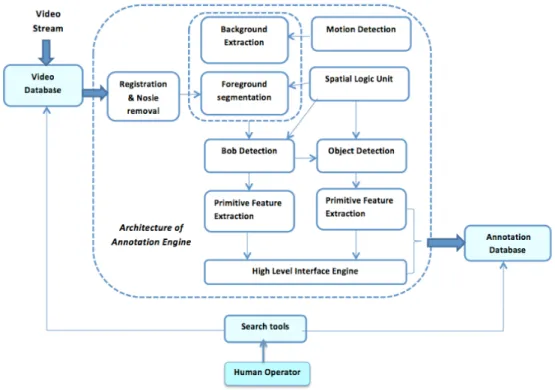
In figure 2.1 a high-level block diagram of a typical video forensic system is presented. The input video footage is stored in a video database. In the case of manual inspection for forensic purposes a CCTV operator will play back the stored video, file-by-file in an attempt to locate the content/objects being searched for.
Figure 2.1: High-level block diagram of a video forensic system
In the case of computer based processing the videos are initially annotated at the time of storage with high level annotation information such as, the camera number/location, time of day etc. In addition to this high level annotations, de-pending on the content of the videos, lower level annotations are generated by an Annotation Engine (see figure 2.1). The video annotation engine is a collec-tion of image processing, computer vision, pattern recognicollec-tion, machine learning and optimization algorithms that work collectively to identify the presence of known objects (e.g. humans and vehicles) and are able to articulate their de-tail/appearance (e.g. shirt colour, vehicle type, number plate details, carrying a bag etc.). A typical architecture of the annotation engine is detailed in figure 2.1. It is noted that the annotation engine is the key computing/intelligent component of the forensic tool and is the location where most extensive computational tasks are carried out.
The annotated data, both the high-level (captured from camera input data dir-ectly at storage) and low-level (generated by the Annotation Engine) are stored in an annotation database. The availability of all annotation data real-time, would make the system efficient and hence highly desirable for video forensic analysis, post event applications. The challenge is the capture of low-level annotation data, real-time, given the complexity of the video processing algorithm. A typical com-puter with a single processor running at even the highest available typical clock speeds, would not enable real-time capture of low-level annotations (this is the basic research problem analysed in this thesis). Further the accuracy and trust of the data stored in the annotation database are key to conducting a forensic invest-igation that has any legal validity. The annotation information (i.e. metadata) will be used in the search process for the detection and recognition of people (e.g. man wearing a red jumper, carrying a bag), vehicles (e.g. a red van, speeding) and activities (e.g. man walking away from a blue car).
In making practical use of the system presented in figure 2.1 above in video forensics, a forensic search is initiated by a human operator (user) through an interface and using a search tool. The search tool searches through the An-notation Database created by the AnAn-notation Engine detailed above. Once the objects/events with given descriptions are located, going through the Metadata, this will be used to fetch the data from the stored, original video footage.
A typical video surveillance system will comprise of many video cameras that are distributed over a public space being monitored. Often the cameras may have overlapping views. Even the same object that is visible via different views of cameras and at different times will look different due to changes of object size, angle of approach, clarity, partial occasions, varying camera specifications etc. In order to be able to process complicated scenes and still be able to do an accurate investigation, the computer vision algorithms have to be sophisticated. This results mostly in the need to use and execute complicated algorithms that will use a significant compute power. Having to process multiple videos captured by multiple cameras make the compute power requirements ever more. A solution to this problem exists in the use of distributing computing facilities where the tasks can be divided between multiple processors, often executing algorithms in parallel.
A rather modest number of research investigations have been carried out in the past to tackle the above problem. Depending on the type of solution adopted these have been reported in Chapters 3-6. One notable example is the system design by IBM that uses a collection of web application servers, clustering and database partitioning thus allowing scalability. The system designed is dedicated to serving a distributed video analytic task and the designed has been conducted with the
maximum computing resource needs in mind for a specified application. This solution attempts to solve scalability issue, but increases hardware investments cost due to the solution not being elastic, i.e. resources not being flexibility and effectively utilised dependent on real time usage. In order to address the resource allocation elasticity related issue, the current trend in video surveillance system design is to use cloud based architectures. However our literature review has revealed that this is an area that has not been investigated and reported in detail in literature[112]. Hence this has been one motivation factor behind the research presented in this thesis.
Following section provides background knowledge about the cloud computing paradigm.
2.2
Cloud Computing Paradigm
Cloud Computing is a new model that delivers Information Technology (IT) as a service to users. The services thus delivered can typically be classified into soft-ware, platform and infrastructure as a service, delivered on on-demand, with pay-per-use price model. The cloud offer elasticity and scalability in provisioning of resources, which can significantly reduce the cost of dedicated hardware/resource provisioning. This capability of cloud computing is the result of making effective use of existing technologies such as data centre automation, automatic computing, system management, utility computing, grids and clusters for distributed comput-ing, Web 2.0, SOA, web services, and virtualisation[54].
The International Data Corporation (IDC) reports that worldwide spending on public IT cloud services reached 4 billion dollars in 2013, and is expected to be more than 107 billion doller in 2017[27]. Various studies report that cloud computing is a continuing trend for data storage and processing, and specifically supported in the field of computer science[35], as shown in figure 2.2, and with a peak of research studies between 2008 and 2009, based on cloud computing scientific analysis of Gartners Hype Cycle by Heilling and Vob [86][26][86].
Figure 2.2: Scientific analysis of academic disciplines on cloud computing research[86]
The following sections introduce cloud computing, its deployment and service models, and show how the development of cloud computing systems have con-tributed to commercial development, as well as open source development, which encourage more developer’s to apply greater solutions and options.
2.2.1
Definition of Cloud Computing
Various academics and institutions have attempted to provide clear definitions of cloud computing, as this is a new and developing technology, and a recent attempt at defining cloud computing was suggested in 2011 that was based on an earlier attempt in 2009 by the National Institute of Standards and Technology (NIST)[118]. This suggests that the model of cloud computing involves service provider interaction and minimal management effort for releasing the required data in understandable formats accessed from services, applications, storage, servers and networks of computer resources that are configurable, which could be accessed from a network when required and when convenient to users.
The nature of cloud computing is complex and at present this technological advance lacks standardisation[37], so perceptions of the characteristics of cloud computing are varied and often challenged; for example, the management systems applied by Google do not use virtualisation as a factor, and cloud computing facilities can be accessed without accessing the Internet, as private clouds are available based at specific locations, so the Internet is not a characteristic of cloud computing [105][119][170]. However, the definition by NIST in terms of its key elements are widely noted in the literature on this topic and by many in the cloud computing scientific community, so that there are common factors that define cloud computing, which are described below.
• On-demand self-service: The cloud service provide has no dirct interaction with users when data is added and released from cloud computing resources, as this process is automatic.
• Resource pooling: Cloud users can select their requirements dynamically from pool of resources such as networks, computing and storage facilities. These resources can be shared by various tenants or consumer. With the exception of meeting legal requirements, users do not know the location of the resources that they are accessing[119].
• Broadband network access: Smartphones and laptop computers are part of a range of devices that can access various cloud services over the network via standardized interfaces.
• Rapid Elasticity: Resources of cloud computing assist users to avoid ex-cessing computer power remaining unused when there is less demand, and reduced time and costs for procurement when adopting cloud computing capabilities that are automated. In addition to this elasticity, cloud com-puting offers faster speeds for users, so that when demand increases, cloud computing facilities increase rapidly, and when demand decreases, these fa-cilities are dropped rapidly, so actual demand is matched quickly to cloud computing facilities that are available.
• Measured Service: Cloud computing provides a pay-per-use measurement model that enables users to pay when they use these services. For example in Amazon AWS customers are charged by the hour, and this model also gives users information about the efficiency of the resources they are using.
2.2.2
Cloud Service Models
Software (SaaS), Platform (PaaS) and Infrastructure (IaaS) services are defined by NIST as the cloud service models mostly used [118]. Access to cloud computing services is determined by model differences in terms of control and service types, and Figure 2.3 shows the layers of IaaS, PaaS and SaaS in models of cloud services.
Figure 2.3: Cloud service models architecture[178]
• Infrastructure-as-a-Service (IaaS): This service is provided by Rack-space, GoGrid and Amazon AWS, to mention few, and although users can-not control this virtual resource hardware, they can release resource, update resources and create resources, and so change the environment with direct controls. This technology component applies KVM, VMware and Xen to enable virtualisation technology to be used with virtual resources, load bal-ancing, networks, computing and data storage within this service[119][37].
• Platform-as-a-Service (PaaS): This service is provided by Salesforce Apex language, Microsoft Azure and Google App Engine, and interaction between the cloud environment and developers environment is enabled with API, so that developers use libraries, functions and programming tools to design their own application with this service.
• Software-as-a-Service (SaaS): This service is provided by Dropbox and Facebook, to mention few, and users are not required to deal with main-tenance, updates and installations, and do not know about the software platform or infrastructure, so the cloud online software within this service includes CRM, email and storage.
Some academics argue that a model for cloud computing should also include data, infrastructure, platform, hardware and software components, as an ’everything service’ of (XaaS)[110] [134][134].
2.2.3
Cloud Deployment Models
Ownership of the provisioning location and infrastructure determines how cloud computing services are used, which disregards the model of delivery, and shown in figure 3.4.
• Public clouds: Upgrading and maintaining these services remains with the provider of these cloud computing services that maintains ownership of its resources of IT and the infrastructure, and although third parties would own public cloud computing services, the cloud environment has public accessib-ility.
• Private clouds: Organisations access their IT resources according to de-partments, locations or parts from a central database by the use of services and technologies provided by cloud computing facilities, which is owned by individual organisations[152]. Although some organisations use private cloud computing services located within their buildings, these are managed by third party companies, but most maintain their own cloud computing through various software options, such as Eucalyptus, OpenNepula, Cloud-stack and OpenCloud-stack. Private cloud computing services also mean that or-ganisations can manage, process and service their data independently and avoid restrictions of legal requirements, exposure to security issues and lim-ited bandwidth of networks of public cloud computing services [79]. Vir-tual private clouds are available from Amazon, so that organisations have a virtual environment that they control completely within a defined virtual
network, which is part of the Amazon AWS cloud services, as a section that is isolated from other parts[5].
• Community clouds: Management of community cloud computing services could be the responsibility of members or a third party, but members would have similar interests, such as policies, mission and requirements for security. Therefore, community cloud computing services are similar to public cloud computing services, but with limited access for community members[79].
• Hybrid clouds: The benefits of hybrid cloud computing services include portability of applications and data, as various models could be used, such as community, public and private. Advantages include scalability when us-ing public cloud services, and control of security risks when usus-ing private cloud computing services, and consumers could use public cloud computing services for data that are not sensitive, and private cloud computing services for data that are highly sensitive, as these various models are combined by technology that is proprietary or standardised.
2.2.3.1 Amazon AWS
Cloud computer capacity that can be resized is available from Amazon Elastic Compute Cloud (Amazon EC2), and this service interface enables users to launch instances (i.e. virtual machines) with a variety of operating systems to fit different use case[1]. Each of these instances has different features and resources such as of CPU, memory, storage and network resources. Selecting any of them depends on customer’s workload characteristics.
Amazon EC2 offers three purchasing models for renting instances The costs of these models are determined by the benefits offered by Amazon EC2, so that potential consumers need to ensure their organisation or company purchases one of the three models available that best meets their requirements [4] [153].
• On-Demand instances: Consumers make no advance payments or have any contract commitments in the long term, as cloud computing capacity is charged by the hour when used, or paid for on demand.
• Reserved instances: Consumers pay a reduced hourly rate by agreeing to a contract over a three year or one year period with an initial payment at the beginning of the contract, and no further payments until the contract ends.
• Spot instances: Consumers agree with the provider an hourly price rate that is determined as the maximum they would pay for these instances, so do not pay more than this rate, but prices vary according to the principle of supply
and demand. This could benefit consumers, but if prices fall too low, then providers can stop offering these services[153].
2.2.4
Enabling Technologies
Cloud computing is not a new concept[74], however, the technology already exists to control various capabilities of computing, such as distributed grid computing, distributed cluster computing, Web 2.0, SOA, Internet services and other Internet technologies, virtualisation and utility computing. The following gives an overview of some of these technologies that directly relates to our research:
2.2.4.1 Distributed Computing
• Cluster: is networks of computers that share computational workloads for computing and perform similar computing tasks by working together as com-modity computers or parallel computers that are defined as a cluster, so that if one computer stops working, cluster distribution maintains availability and balance of service to consumers. Individual computers could have specifica-tions that are different or similar to others, [140].
• Grid Computing: is a platform in which distributed resource are organ-ised into logical pools and shared across multiple administrative domains connected by a network[71], which can consist of multiple clusters. The grid idea was initially developed to support scientific researchers who believed that computers should be developed to handle their complex data intensive experiments[73]. Open science Grid and EGEE are two examples of this. Cloud computing has same vision as Grid, yet the cloud is not limited to certain community users and provide services on-demand[133].
2.2.4.2 Virtualization
Virtualisation is considered to be a core technology within cloud computing that enables on-demand resources with elastic provision of resources[121]. Virtualisa-tion is a process of abstracting physical IT resource such as server (CPU power), storage and network into software-based virtual resources to be used by multiple users. Each virtual resource is sharing underlying physical resources and is un-aware of the virtualisation process as if it was running on a separate physical resource.
This technique optimises the use of resources and enables centralised manage-ment of pooled resources[147]. The term virtualisation emerged in the late 1960s
in different forms[130] and become a core enabling technology for cloud. Common examples of virtualized resources described below[152]:
• Server: This is a physical server transformed into virtual server called virtual machine (VM); examples include VMware, Xen and KVM[161].
• Storage: This is a physical storage devices used as a virtual storage machine or virtual disk, examples include NAS and SAN.
• Network: This is a physical network peripherals, such as firewall, router and switches are formed into a logical network fabric; examples include VPN and VLAN.
2.2.4.3 Hypervisor
Hypervisors or virtual machine monitors (VMM) are software solutions for server virtualisation, added between the hardware and operating systems responsible to launch multiple virtual machines from a single physical machine, sharing re-sources such as CPU, memory, storage and I/O devices [24]. This layer of virtu-alisation can be performed in three different techniques; full virtuvirtu-alisation, para-virtualisation and hardware-based para-virtualisation, as shown in figure 2.4, 2.5 & 2.6.
• full virtualization:Provides virtual abstraction that is completely de-coupled from the underlying hardware. The guest is not aware it is being virtualised and does not require modification. It provides isolation of virtual machines and simplifies migration and portability. Examples include VMware, KVM, Virtual box and Microsoft Virtual server.
• Para virtualization: Provides virtual abstraction, which is similar to underly-ing hardware. It requires change to kernel of guest operatunderly-ing systems, which makes it poor in compatibility and portability with unmodified operating systems; examples include Xen and Hyper-V.
• Hardware-based virtualization: Virtualises guest operating systems with a kernel that is the same as the host operating system. It creates isolation process contexts inside one OS kernel, which are only available for the Linux system.
Selecting a hypervisor is a critical task as it affects the system performance [121]. Analysis and study between hypervisors: KVM, Xen, VMware, Virtualbox has been intensively studied in the literature. One author[113] conducted a survey
Figure 2.4: Full-Virtualization
Figure 2.5: Para-Virtualization
on these virtualisation technologies, which is a high level comparison related to type of techniques mentioned above. The author[173] states that KVM is the best choice for HPC cloud environment. The author[28] built KVM environment into a cloud system comparing its performance with a physical machine; KVM gives good result when computational is high. The performance for processing real-time data has been studied by[70] and the results show that KVM performs better with CPU intensive tasks. This author[109] analysed Xen and KVM performance and the results show best responsive time was achieved by KVM. The author[132] investigated the scalability of KVM with three parameters (overhead, linearity and isolation performance for three resources CPU, network and harddisk, the results show good scalability with CPU and network.
According to the findings above, KVM is used as a virtual environment in cloud systems for this research.
2.2.5
Cloud Computing Architecture
Cloud computing is a complex model, which involves different technologies and ser-vices that form that overall operation of the cloud. Alexander at al. [110] classifies cloud into different layers to ease explaining its process and interaction between components. This approach has been used and extended by many researchers to explain cloud architectures. Each focuses on describing certain components of cloud computing from the perspective of service deployment and delivery models [50][119][61]. In general, the architectures are guidance for vendors on how sys-tems may be integrated to address issues of interoperability[133][110][177]and for researchers to ease analysis of cloud issues; for example, not limited to security, performance and management [174].
In 2009, Alexander Lenk et al. [110], proposed architectural categorisation of cloud technologies as a stack of service types, for instance, Iaas, PaaS and SaaS, each with their distinct features and current providers, see figure 2.7.
In September 2011, the government organisation NIST [50] published a Cloud Computing Reference Architecture model, which provides a high level architec-ture view of cloud computing. This architectural guidance is a starting point to understand the common standard terms and terminologies related to the major actors, their relationship, activities and functions in cloud computing, but not for design solution and implementation, see figure 2.8.
In 2011, Grobauer et al. [78] proposed cloud reference architecture based upon research funding from the University of California, Los Angeles, and IBM [174]. This architecture involves security-relevant cloud components that help analyse security issues relevant to each of the cloud services. As shown in figure 2.9 the
Figure 2.8: NIST conceptual reference model for cloud computing[50]
architecture shows the interaction between different layers divided into service customer, cloud specific infrastructure, supporting IT infrastructure and network carrier that connects cloud customers to cloud providers using standardised net-work protocols, such as SSH or HTTP. Cloud-specific infrastructure consists of three service models: IaaS, PaaS and SaaS, which are discussed in section 2.2.2. These services interact with customers through application programming inter-faces (API) such as XML or REST, management access console and Identity, Authentication, Authorisation and Auditing mechanisms (IAAA) for user checks. Cloud computing is composed of seven layers as described below [110][50][78]:
• Front-End: user, third party cloud, broker or auditor. • Public network • Application Layer • Platform Layer • Infrastructure layer • Hypervisor layer • Physical/hardware layer
In this research, the focus is upon IaaS and PaaS service model layers where video surveillance will be processed and stored. IaaS uses a virtualised infrastruc-ture environment that consists of three main service components: computation, storage and communication. Frank Hans [67] presents a high level overview of typ-ical techntyp-ical infrastructure components of IaaS cloud, see figure 2.10. It is clear
Figure 2.9: Cloud reference architecture[78]
that interaction between cloud customers and the virtualised services in cloud computing is through a cloud management system. Data can be hosted either in a shared multi-tenant or private single-tenant environment using virtual machine (VM) executed through Hypervisor software, such as VMware, Xen or KVM. The internal communication between VM’s and storage, highlighted in blue, delivered through virtualised network components similar to the common IT data centre peripherals. PaaS is the application platform whereby video analytic application is installed on the top of IaaS. More information on PaaS is discussed in section (2.2.2).
2.3
Hadoop1 Framework
One open source distributed computing framework, capable of processing large-scale of data across cluster of computers whilst demonstrating a high degree of scalability and fault tolerance[162] is Hadoop, which is an implementation of the MapReduce model. Hadoop can be scaled up from a single machine to multiple machines, which together form a Hadoop cluster, with each machine performing
Figure 2.10: Typical components of IaaS cloud infrastructure[67]
Figure 2.11: Google trends on Hadoop compared with other technologies.
local storage and computational data.
Developers and programmers focus upon the designing of parallel and dis-tributed applications without concerns related to underlying details of the Ha-doop framework, because it is an automated synchronisation and handling I/O process[141], which is capable of handling level failure applications. Hadoops dis-tributed framework makes it sufficiently powerful and distinct when compared to existing frameworks, such Spark, MPI and other technologies, as shown in figure 2.11 using google trends tool [22].
Two Google published projects called Google e Systems (GFS) in 2004 and MapReduce programing model, which was invented in 2004 were the inspiration behind the implementation of Hadoop, which is currently licensed by Apache, initiated and led by Yahoo[23] in 2008, see figure 2.12.
The success of Hadoop is proven by one of Yahoo’s Hadoop clusters, which processed one terabyte of data in 209 seconds, beating previous records of 297 seconds[8].
The platform that Hadoop platform has provided has resolved many large data problems in structured/non-structured data in disciplines, such as science
Figure 2.12: Hadoop developments.
and enterprise. Hadoop is currently deployed in large organisations, such as Ya-hoo, Facebook and eBay. Experimental issues with Hadoop may be categorised into computational problems that deal with massive data sets, requiring intensive computation per data element, computing-intensive applications, I/O intensive ap-plications, CPU-intensive applications and processing video analytics. A number of enterprises adapt Hadoop in applications, such as web indexing, bioinformatics research, satellite data processing, computer visioning graphics, report generation, log analysis, data mining financial analysis, scientific simulation, medical imaging, weather forecasting and security analysis [162].
Hadoop is defined by different distribution channels ranging from open-source Apache Hadoop, pre-packaged commercial Hadoop providers such as Cloudera, IBM BigInsights, Horontworks and cloud-based platform such as Amazon Elastic, MapReduce (EMR) and Openstack Sahara enabling Hadoop as a service in the Cloud. There are two releases: Hadoop1 version 1.x series, which is a continuation of version 1.20.0 series used in production environments, and version 2.x, known as Hadoop2-YARN (Yet Another Resource Negotiator), which is a continuation of 0.23.x releases, discussed later in section 2.3.2.
Hadoop can work across commodity low-cost servers[162], since one piece of processed work can be distributed among many machines, which combines the total resource of each machine as one whole machine. Hadoop is able to distribute chunks of data into various nodes in advance where data locality is considered for computing to avoid storage and communication costs[162] [128], where according to[145] the moving of computation is cheaper than moving data, which makes Hadoop preferable to MPI.
2.3.1
Hadoop Ecosystem
There are two core components that form Hadoop: Hadoop Distributed File System (HDFS), which is a distributed storage saleable system, and a model that is responsible for distributed processing, called MapReduce. The Apache Software Foundation host other Hadoop based ecosystems, which have been
de-veloped and integrated within Hadoop in order to enhance the functionalities of the framework[162].
Some of the projects are briefly discussed in this thesis for their popularity, and information relating to flume, avero, parquet and crunch, we refer reader to [162]. The projects discussed below are: The systems are briefly introduced below:
• Pig: A scripting language and execution environment that is used to process large datasets.
• Hive: Is a distributed data warehouse built on top of Hadoop, which man-ages data stored in HDFS, providing a query language based on SQL called HiveQL. Facebook originally used Hive to manage large quantities of data produced daily on its social network and stored in HDFS.
• HBase: A column-oriented, distributive database built on top of HDFS for its underlying storage. HBase has the capacity to scale and work with large datasets, which supports batch-style computations using MapReduce, as well as point queries.
• ZooKeeper: A Hadoop distributed coordination service, which is a dis-tributed, highly available coordination service. Distributed locks that can be used for building distributed applications through the use of ZooKeeper primitives.
• Sqoop: An open source tool designed to move data efficiently between relational databases, such as Sql Server, MySQL, Oracle, D2, Postange SQL and HDFS, as well as to the HBase system.
• Spark: A cluster computing framework designed for large-scale data pro-cessing [162], which is integrated with Hadoop. In can run in YARN, working on HDFS system and storage. Spark deploys its own distributed runtime for the execution of work in clusters to serve other types of applications, which need to use dataset across parallel operations. These include interactive applications and iterative jobs that have a limited use within the MapRe-duce framework[175] because of the integrated modules such as machine learning (ML-lib), stream processing (Spark Streaming), graphics processing (GraphX), and SQL (Spark SQL)[162]. Spark caches data in memory across iterations where in the datasets are loaded from disk in MapReduce, which allows Spark to run programs 100x faster[10].
2.3.2
MapReduce
MapReduce [162] is a programming model for distributed data processing, which can be used for writing in any language, it can be writing in any computer lan-guage, including Ruby, Java, Python and C. It works by distributing tasks across multiple machines through the use of a job scheduler, which is performed by the master machine. Each slave machine then processes the data stored on it. MapRe-duce consists of two components: Job Tracker, which resides in the master controls and monitors the distribution of task. Task Tracker, which resides in the slave and processes each assigned task, sending its status to Job Tracker. For the par-allelisation process, MapReduce breaks the processing into 2 phases that can be executed in parallel on multiple machines[150]:
• Map function: This applies to every input record producing intermediate key-value pair, which are then stored on a local disk ready to be transferred to machines where a reducer is assigned to process the intermediate output.
• Reduce function: This merges the intermediate results from the Map phase and produces a final output result, which is stored in HDFS.
Each phase has key-value pairs as an input and output that a programmer specifies by map and reduce tasks. All jobs are executed on slave nodes as a map task or reduce task.
2.3.2.1 MapReduce Workflow
MapReduce applications that need to be run in Hadoop are called MapReduce jobs. In order to begin data processing, a client application submits a MapRe-duce job to Job Tracker(master) as a java code. Job Tracker communicates with Namenode (master) to find which Datanodes (slaves) contains blocks of input data.
The Job Tracker divides each MapReduce job into a set of tasks called map or reduce. Task Tracker running on those machines is then scheduled with the java code required to execute map function on local data. Several map and reduce tasks are running concurrently on each slave. The number of map slots and reduce slots are configured, which are dependent on the number of processors available in nodes to overlap computation and I/O. If all available slots are occupied, pending tasks must wait until some slots are freed up.
When the map task is complete, each machine stores the output result call intermediate data in its local temporary storage. It then sends the data over the network to a machine running reduce task for final computation. The communic-ation between reducer and mapper happens through a TCP/IP protocol. There
are cases when data is not stored locally, such as when new nodes are added or when the node fails and the task is assigned to other node. In both cases, the new data node communicates with name node to be directed to nodes that have copies of the data; it then copies the data to local storage.
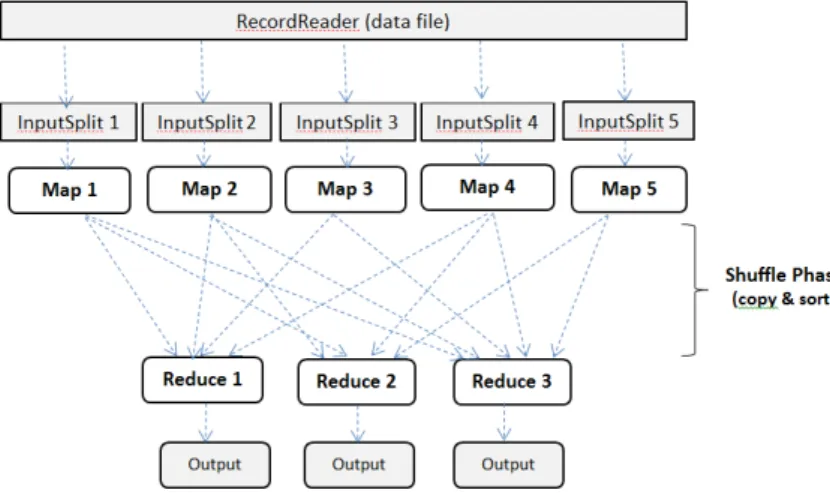
The following diagram explains the MapReduce programing model for the se-quential phases (map and reduce) that the MapReduce data framework follows when executing a job, see figure 2.13 for illustration:
Figure 2.13: MapReduce data flow framework when executing a job
1. Map Phase:
• RecordReader: This reads files from HDFS or any storage specified by the programmer; all data is then transformed into key-value pairs where the key is a unique id and the value is the corresponding data in bytes. It is then submitted to InputFormat in the form shown below: map(K1, V1)→list(K2,V2)
• One InputFormat: Multiple types of key-value pairs provided by RecordReaders are accepted, all key-value pairs are combined and sub-mitted to Mappers in Inputsplit form.
• Mapper: Key-value pairs are generated through Inputsplit, with each node running one map task and run it in parallel. One map task takes a key-value pair, processes it and generates another key-value pair for reduced phase input. Mappers group key-value pairs according to re-quirements of algorithms and dispatch them to Reducers.
Mappers group key-value pairs according to requirements of algorithms and dispatch them to Reducers.
• Shuffle phase: When the nodes complete their map task they are ready for sort phase (copy), where nodes communicate with each other to pass key-value pairs to be sorted. This is the only phase where node communicates with each other.
• Sort phase: keys are sorted according to the key ID, presented as: Shuffle( list(K2,V2))→(K2, list(V2) )
• Reducer phase: This makes each reducer take all key-value pairs with the same key and merges them. It then performs computations on the values according to the instruction from java code. Reducer can take a subset of all the key-value pairs, but will always have all the values to one key. The result will be submitted to OutputFormat. Each reducer generates one output to storage (HDFS). This can be controlled through an implementation of Outputformat. Reducer phase takes the form shown below:
Reduce(K2, list(V2)) →list(V3)
• OutputFormat: This deploys RecordWriter to write results back to HDFS ready for the client to read. The network is used when the blocks of the result have to be replicated by HDFS for redundancy.
2.3.3
HDFS
In a Hadoop distributed system, (HDFS) is one of Hadoops systems that provides scalable and shared storage network across cluster nodes. It is designed to work with the MapReduce framework written in Java that sits on top of a native local system. Files stored in HDFS are write only, but can be accessed and read many times. HDFS consists of two components:
• Namenode:
– Resides on master machine and splitting data into blocks
– Distribute blocks across cluster with replication for fault tolerance
– Holds all metadata information about stored data blocks. • Secondary Namenode:
– Reside in master
– Contains backup of all metadata stored in namenode. • Datanode:
– Reside in each slave and stores blocks of data.
– Serves Read/write request from client with replication for fault toler-ance.
– Propagate replication task as directed by NameNode.
Namenode is at the heart of HDFS where it stores all metadata information of the cluster and monitors the health of the datanodes. Datanodes stores the actual data of any stored file, which it sends back to the namenode every 3 seconds via the TCP protocol; every 10th heartbeat is block reported. The secondary namenode is a backup of namenode metadata, which connects to namenode after certain times to update its metadata information, which can be used to recover namenode is case of node failure.
Data is read and written to HDFS by going through different producers of communication between client and namenode through TCP. When a client sends a le to HDFS, namenode (master) split the le into blocks and replicates each block to a number of copies according to the Hadoop default setting, which is 3. It then distributes them to cluster nodes based on disk space availability to balance the load between the nodes.
In addition, Namenode uses rack awareness strategy (network topology) for replicas placement sorted in metadata les. This helps namenode to locate different copies of each block in away prevents the failure of one node from losing all copies of data. When the client is informed of the location of the blocks, it performs a pipeline[51] to sequentially copy data blocks between specified datanodes(slaves). Figure 2.14, shows HDFS and MapReduce relationship within Hadoop frame-work.
2.4
Hadoop2 Framework (YARN)
Yet Another Resource Negotiator, YARN, is the next generation of Hadoop that is used for general computing platform that serves other large-scale program-ming models such as Spark, Dryad, Storm, and Graph processing [158], as well as MapReduce. These models provide different functionalities to data life cycle ranging from real time processing to interactive and batch processing that can be applied on the same data stored in single YARN cluster. Enterprises are therefore not required to retain separate clusters for different application types; they can work with data from the time that is generated from a single cluster [11]. Hadoop1 is designed for MapReduce implementation only. When a request from a client is submitted as a MR job, it will be the responsibility of job tracker to manage all
Figure 2.14: Hadoop Framework[127]
the execution of Mapreduce tasks in Hadoop cluster in terms of resource manage-ment and scheduling jobs across the cluster. However, in YARN architecture, this responsibility is separated into two functionalities:
• ResourceManager(previously JobTracker): Is a global distribution of avail-able resources in a cluster among running applications (MapReduce, Spark etc.).
• NodeManager(previously TaskTracker): Provides per-node services within the cluster, which is responsible for launching application containers (re-sources), and monitors the resource usage of CPU, disk, memory, network bandwidth and reports back to the ResourceManager.
This separation of task makes managing multiple jobs running in YARN cluster easier. Figure 2.1 compares the architecture of Hadoop1 and Hadoop2, showing the role of ResourceManager in managing the jobs of different clients, each with separate NodeManagers. ApplicationMaster is a per-application component that works with NodeManager to manage the any job inside the cluster by negotiating resource containers with ResourceManager, tracking their status and progress. Containers are available in each node and they are allocated resources (CPU, memory, Network etc.) resulting from the negotiation between ResourceManager and Application manager.
The figure below shows that YARN continuing to use the HDFS layer, with its master NameNode for the storage of metadata services and DataNode for replicated storage services across a cluster[101]. However, in Hadoop1, it only supports one Namenode that manages the whole clustername space, which limits
system scalability. In YARN it supports multiple NameNodes in a single cluster for scalability and avoids single points of failure [11][9].
Hadoop1 Architecture New YARN Architecture
Table 2.1: Comparing Architecture of Hadoop1 & Hadoop2-YARN [101]
Benefits gained from this new Hadoop architecture include managing the life cycle of the application, improving the ability to scale Hadoop clusters to much lar-ger configurations than previously possible, and allowing simultaneous execution of a variety of programming models[101].
2.5
Cloud-based Hadoop
2.5.0.1 Amazon EMR
Amazon Elastic MapReduce (EMR) [2] is a public cloud service for large-scale data analysis in a distributed environment. EMR uses the elastic infrastructure of Amazon taking advantage of EC2 computing and S3 storage to provide managed Hadoop framework releasing the customer from the expense of purchasing the underlying hardware and software, as well as its complexity. Figure 2.15 shows a high level view of EMR. Users only focus on analysing their data by loading their data to Amazon S2 storage, submitting their application and selecting the cluster size (number of machines). Amazon EMR provider takes care of Hadoop cluster deployment, management and security. EMR makes it easy and flexible for users to expand or shrink cluster size according to their analysis requirements. In addition, they provide virtual private cluster for users and organisation that want to be logically separated from other Amazon customers for enhanced security and
![Figure 2.3: Cloud service models architecture[178]](https://thumb-us.123doks.com/thumbv2/123dok_us/9908616.2484050/26.892.261.687.650.886/figure-cloud-service-models-architecture.webp)
![Figure 2.7: Cloud reference architecture[110]](https://thumb-us.123doks.com/thumbv2/123dok_us/9908616.2484050/33.892.239.702.270.945/figure-cloud-reference-architecture.webp)
![Figure 2.8: NIST conceptual reference model for cloud computing[50]](https://thumb-us.123doks.com/thumbv2/123dok_us/9908616.2484050/34.892.227.723.108.396/figure-nist-conceptual-reference-model-cloud-computing.webp)
![Figure 2.9: Cloud reference architecture[78]](https://thumb-us.123doks.com/thumbv2/123dok_us/9908616.2484050/35.892.232.718.104.562/figure-cloud-reference-architecture.webp)
![Figure 2.10: Typical components of IaaS cloud infrastructure[67]](https://thumb-us.123doks.com/thumbv2/123dok_us/9908616.2484050/36.892.178.768.113.393/figure-typical-components-of-iaas-cloud-infrastructure.webp)
![Figure 2.14: Hadoop Framework[127]](https://thumb-us.123doks.com/thumbv2/123dok_us/9908616.2484050/43.892.255.686.106.434/figure-hadoop-framework.webp)
![Table 2.1: Comparing Architecture of Hadoop1 & Hadoop2-YARN [101]](https://thumb-us.123doks.com/thumbv2/123dok_us/9908616.2484050/44.892.171.773.181.506/table-comparing-architecture-hadoop-amp-hadoop-yarn.webp)
![Figure 2.15: High level view of Amazon EMR [2]](https://thumb-us.123doks.com/thumbv2/123dok_us/9908616.2484050/45.892.224.720.320.652/figure-high-level-view-amazon-emr.webp)
