control
Tim Bloomfield (Attwood)
ISSN 1329-833X
This Landcare Note gives information on integrated rabbit control.
A brief history of rabbits in Australia
• 1859: 24 wild rabbits released at Barwon Park by Thomas Austin
• rabbits spread across Australia at about 130 km per year
• 1881: some farms were abandoned because of rabbits • Rabbit control: poisoning (strychnine, phosphorus,
arsenic)
• 1900s: a billion rabbits
• The Great Barrier fences (11,321 km. 1920’s) • 1926: 10 billion rabbits in Australia
• 1920s-1930s Rodier, & Coleman-Phillips methods (rabbit numbers unchanged)
• 1930s fumigation:-calcium cyanide, sulphur dioxide • 1940s -1950s many methods applied ad hoc
• 1944: 103,000,000 million rabbit skins and carcasses exported
• 1950: about 1800 million rabbits in Australia • 1952-1954: Myxomatosis killed 99.8% of rabbits • In some areas rabbit numbers greatly reduced • 1955/56: 24 million rabbit skins exported (the rabbit
was back!)
• 1960s: broadscale 1080 poisoning (Victoria) • 1960-1990: rabbits are still spreading into new areas
and re-colonising old sites
• 1990: rabbit population about 600 million (60 million Victoria)
• 1996-1998: Rabbit Calicivirus Disease (RCD) rabbits reduced by 50% in some arid areas
• 1996-1999: RCD and integrated rabbit control reduces rabbits by about 30% in Victoria
• 1998-1999: RCD and integrated rabbit control used together in large-scale group campaigns has seen some areas aiming to become rabbit free.
The clear lesson is that no single control measure has been successful in eradicating rabbits. Some land managers have successfully controlled rabbits but only with a combination of methods in their local area.
Integrated rabbit control
“two or more control measures used together ensures a longer term effect on rabbit numbers and is better value for money than one method used alone”
Integrated rabbit control (IRC) is the combination of several measures used to achieve long-term results where the overall aim is to minimise rabbit impact. The components of integrated rabbit control are: • impact of the pest is defined
• purpose for control is understood
• density, distribution and harbour requirements quantified
• planned control program
• time dependent goal orientated plan (eg. Year 1 remove all accessible warrens, Year 2 remove all accessible harbour etc.)
• 100% stakeholder agreement and commitment to the control options
• monitoring and evaluation established
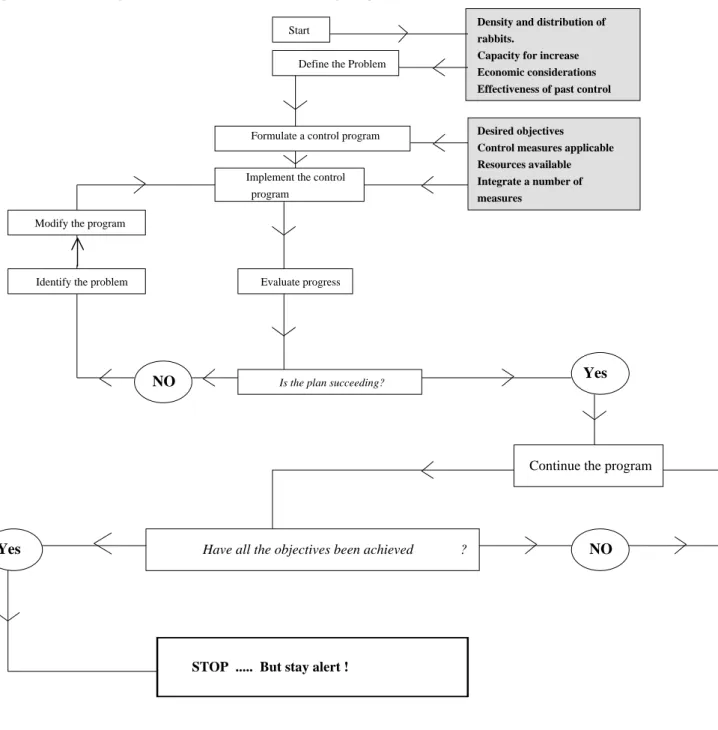
See also Figure 1 Development of a rabbit control program
Criteria for eradication
“the mere killing of rabbits is not the aim, our need is to effect the species to minimise, even to stop rabbit impact”
Eradication of rabbits from Australia, or even from all of Victoria may be unlikely but individual land managers can achieve local, even catchment based rabbit free areas. The aim is to be aware of rabbit impact and aim to alleviate that impact upon the agricultural and natural environments. The concept of total eradication; rabbit free, is a worthwhile aim and can serve as the long-term goal in strategic rabbit control programs for land managers, public and private.
Rabbit Free!
The history of rabbit control shows that to achieve rabbit free on your own land your effort must be continuous and you need to be able to:
-• adopt and use integrated rabbit control
• kill rabbits at a faster rate than they can replace themselves at all densities
• rabbit immigration into your control site must be zero • all individuals in the population must be at risk from
the control techniques
• rabbits can be monitored at very low densities and immediate action taken
• social and political environments must support the rabbit free goal
• long-term, economic, environmental and social benefit of rabbit free is accepted and agreed to by all the major stakeholders
A well planned co-ordinated approach can be successful in achieving eradication on a local level. Experience has shown that even on small islands local eradication can be very difficult.
Group action
The use of co-operative group action is the integration of land managers and will provide the most effective means of large-scale rabbit control. Working in isolation is rarely effective in suppressing rabbits except for short periods of time.
Rabbit Action Groups and Landcare groups have been very effective in substantially reducing rabbits to very low numbers where two or more control measures have been used in an integrated control program over a large area. Working together, costs are shared and experience and knowledge of the whole group can be used.
Initial population reduction
(when densities are medium to high)
Poisoning rabbits
“rabbits can be poisoned at anytime that they will readily take the bait”
The best results in poisoning is in late summer/early autumn period because:
• Myxomatosis, RCD and natural causes have reduced rabbit numbers.
• feed is at a minimum and rabbits are foraging for food • rabbit population is substantially adult, young rabbits
are old to enough to emerge from the burrow (21-25 days)
• breeding is usually over and so rabbits range over greater distances
Poisoning: 1080
1080 (sodium monofluoroacetate) is a lethal poison registered to control vertebrate pest species (rabbits, foxes, wild dogs and wild/feral pigs). For rabbit poisoning, 1080 is applied to carrot or oats and laid in a trail, ground or aerially broadcast. Rabbit poisoning must be used in combination with other control measures to ensure long-term cost effective rabbit control.
The 1080 poison baits currently registered for use are: • 1080 Carrots Rabbit Bait;
• 1080 Oats Rabbit Bait; • 1080 Pellets Rabbit Bait; and
• RABBAIT 1080 Oat Bait
Guidelines for the use of 1080 baits for rabbit control are given in Landcare Note LC0293: Rabbits:Trail baiting with 1080.
Poisoning: Pindone
Pindone is the active ingredient in the registered rabbit poisons:
• Pindone Carrots Rabbit Bait, (PIN25 ) and
• Rabbait Aqueous Pindone Concentrate, applied to eitherat or carrot bait.
Directions for the use of Pindone Carrots Rabbit Bait for rabbit control are contained in other Landcare Notes.
Myxomatosis
Myxomatosis was originally noticed as a disease of the South American and Californian cottontails rabbits of the genus Sylvilagus. The myxoma pathogen is an example that a pathogen can become much more virulent in new host. Myxoma is an example of rapid and spectacular co-evolution.
Myxomatosis was released to control rabbits in Victoria in the early 1950s. Mxyoma caused a death rate of 99.8% after the first successful outbreak. However, within a few years there was a rapid attenuation of the virus linked with resistance in the rabbit population resulting in a drop in the death rate to only 40-60% of the rabbit population. It is important to realise that myxomatosis cannot be relied upon to effectively control rabbits. It is too unpredictable in frequency and virulence. Naturally occurring outbreaks of myxomatosis can be capitalised on by immediately implementing integrated rabbit control (poisoning, destruction of surface harbour, warren ripping, and fumigation).
IRC is far more effective in reducing rabbit numbers than depending on myxomatosis.
Rabbit Calicivirus Disease
“RCD is widespread across Victoria with rabbit populations showing levels of the RCD virus at between 30 - 80% immunity” (1999)
Rabbit Calicivirus Disease (RCD), which was earlier known as Rabbit Haemorrhagic Disease (RHD), was
introduced to Australia in October 1995 for trial work at Wardang Island, off the South Australian coast.
RCD is a viral disease that is species specific to rabbits. It was first reported in China in 1984. It then spread into Asia, Europe and Mexico.
RCD: how it works?
Rabbits die very quickly from RCD with few outward signs of infection; rabbits in late stages of RCD appear quieter, and are more easily approached. Rabbits die in about 30 hours after infection.
RCD acts in the rabbit by overloading the immune system. Post mortems sometimes show rabbit livers as pale and mottled, lungs may look abnormal with large numbers of red spots or blotches, the spleen is often enlarged and the kidneys almost black. Rabbits die quickly from RCD and may show few visible changes to internal organs
RCD: -the environment and the rabbit
The nature of the virus is that rabbits less than 10 weeks of age, if challenged by the virus may obtain life long immunity from any further outbreaks of RCD. The gained immunity of the young challenged rabbit is not passed on to the next generation; there is however a level of
immunity afforded to young rabbits while feeding from an immune doe. This mothers milk immunity protects the young rabbits until feeding from the immune doe ceases, and they may then be vulnerable to the virus.
RCD Virus outbreaks
The extent of a RCD virus outbreak depends on a number of variables:
• climatic conditions that favour the virus
• climatic conditions that influence the type, numbers, and spread of vectors
• % of population that are adult rabbits • % of warrens were breeding is occurring
• % of population immune after challenge from previous outbreaks
• % of rabbit population being fed by immune mothers • % of rabbit population under ten weeks of age • % of rabbit population over ten weeks of age
And this will then decide the percentage of rabbits, killed, surviving as immune (positive) and or surviving (negative) in the population.
Immunocontraception.
“genetically-modified myxoma virus to infect wild rabbit populations and induce sterility in sufficient proportions to cause rabbit populations to decline”
Current research (1998) in molecular biotechnology aims to insert into the Myxoma virus genetic information coding for specific antigens derived from surface proteins of rabbit sperm, egg and reproductive tract. It is hoped that infection of rabbits by this modified virus will cause an
immune response, blocking fertilisation or embryo implantation in females that survive the disease.
If both sperm and egg antigens are inserted into the virus the proportion of infected and sterilised rabbits required for population decline is much lower than if only one antigen were used. No species other than the rabbit would be at risk, because the system would possess double species-specificity, the species-specific virus and the species-specific reproductive antigens. The rate at which wild rabbits would be selected for genetic resistance to the modified virus is not known. (From Managing Vertebrate Pests: Rabbits (1995) Williams, Parer, Coman, Burley & Braysher)
Follow-up control and maintenance:
(when population densities are low - medium and long term control is the aim)
Removal of above ground surface harbour “leave no home for the rabbit”
Above ground surface harbour significantly enhances the survival of young dispersing rabbits and provides excellent protection for rabbits from predators and climatic
extremes. Fallen timber, log heaps, rocks, introduced weeds; boxthorn, blackberries, furze/gorse, briars, and discarded building/fencing materials provide important advantages to rabbit survival on private and public land.
Warren destruction
“destroy the warren and burrow systems and you can beat the rabbit”
Rabbits need burrows to breed and to survive predators. • High rabbit numbers cannot easily be maintained nor
substantially increased without burrow or warrens systems.
• Warrens can be destroyed by digging them out with a shovel, mattock, or pick
• Warren ripping, using bulldozer mounted tynes or backhoes is very effective
• Ripping is an important and essential follow up technique
• Ripping prevents rabbits from reinfesting warrens and simply breeding back up to high numbers in following years.
Warren destruction: equipment
Blade ploughs can be very effective in light soil conditions in summer.
Big equipment saves time, larger areas are more easily covered, and they are able to rip deeper and can work in steeper country. Large dozers, D6 -D10, excavators backhoes, and traxcavators each perform discrete types of harbour removal for the variety of terrain in which rabbit harbour is found. The tyned ripper is most commonly used to rip burrows. Excavators and backhoes are very
successful in rocky sites, along fencelines, roads, and where minimal disturbance is important.
In sandy country where the risk of wind erosion is high, a blade plough can be used. Advantages of using a blade plough with a large horsepower tractor is that they are very fast and the blade plough helps reduce soil loss.
Warren destruction: explosives
Warrens that are surrounded by scrub or are otherwise unsuitable for ripping may be able to be destroyed by the use of explosives. Only appropriately trained and licenced operators should use explosives for warren destruction. See also Landcare Notes LC0367: Rabbits: Warren ripping and other harbour destruction
Fumigation
“put the rabbit in the burrow”
Fumigation of rabbit warrens can be carried out by depositing a chemical inside the entrances of a warren (diffusion fumigation) or by using a machine to blow a toxic gas mixture throughout the warren system (pressure fumigation).
The chemicals currently registered for use as rabbit fumigants are aluminium phosphide and chloropicrin.
Read the product label carefully before using any pesticide and follow all label instructions.
Fumigants require strict safety precautions. The label is a legal document and must be followed.
See also Landcare Note LC0295: Methods of fumigating rabbit burrows
Night shooting
Shooting is only effective when rabbits are at extremely low population levels and is useless at any other time.
Trapping
Trapping is not a recommended method of rabbit control; it only results in the harvesting of rabbit populations, with only very short-term effect on numbers.
Protection of vulnerable trees and
shrubs
Chemical repellents
There are a number of commercial chemical repellents available. Chemical repellents are designed to effect on rabbit grazing behaviour. The repellents are placed on plant surface or around the base of plants. Repellents are designed to give short term protection during critical stages of growth.
Tree guards
Tree guards are essential in rabbit prone areas. It may be more cost effective when planting large areas to rabbit proof fence the whole site and remove all rabbits inside the fenced area prior to planting.
Habitat manipulation
Heavy planting of trees and shrubs can reduce available grass for rabbits and reduce the carrying capacity of some sites for rabbits. This technique may be particularly suited to sites that where cleared and can be managed as revegetated sites.
Netting Fences
Soundly constructed and well maintained netting fences are the only reliable and long term barriers to rabbit
movement. (See Landcare Note LC0342: Rabbit control fencing)
Electric Fences
Several designs have been investigated, but there are none currently recommended.
Further information
Contact your office of the Department of Natural
Resources and Environment (refer to your local telephone directory.)
The advice provided in this publication is intended as a source of information only. Always read the label before using any of the products mentioned. The State of Victoria and its employees do not guarantee that the publication is without flaw of any kind or is wholly appropriate for your particular purposes and therefore disclaims all liability for any error, loss or other consequence which may arise from you relying on any information in this publication.
Figure 1:Development of a rabbit control program
Density and distribution of
Capacity for increase Economic considerations Effectiveness of past control rabbits.
Desired objectives Control measures applicable Resources available Integrate a number of measures
Start
Define the Problem
Formulate a control program
Implement the control program
Modify the program
Identify the problem Evaluate progress
NO Is the plan succeeding? Yes
Continue the program
Have all the objectives been achieved ?
STOP ... But stay alert !
NO Yes