Energy Management
Guide for Tenants
Cover: Arup’s Brisbane office
Awarded CitySwitch National Signatory of the Year, Arup’s Brisbane office has achieved a 4 star NABERS Energy tenancy rating. This rating was achieved through initiatives such as equipment upgrades, lighting retrofits, energy efficiency policy and innovative behaviour change programs, for example:
•
the ‘Biggest Energy Loser’ competition, where office floors competed with each other to reduce energy consumption, and•
the Office Realtime data visualisation system, which allows staff members to see their energy, water, paper and flight consumption trends in ‘real time’.Photo: ARUP.
Section start headers
Header images show Stockland buildings: the Durack Centre, Perth, and the Triniti Business Campus, North Ryde, Sydney (used with permission from Stockland).
© 2012 State of NSW and Office of Environment and Heritage
With the exception of photographs, the State of NSW and Office of Environment and Heritage are pleased to allow this material to be reproduced in whole or in part for educational and non-commercial use, provided the meaning is unchanged and its source, publisher and authorship are acknowledged. Specific permission is required for the reproduction of photographs.
The Office of Environment and Heritage (OEH) has compiled this guide in good faith, exercising all due care and attention. No representation is made about the accuracy, completeness or suitability of the information in this publication for any particular purpose. OEH shall not be liable for any damage which may occur to any person or organisation taking action or not on the basis of this publication. Readers should seek appropriate advice when applying the information to their specific needs.
Published by:
Office of Environment and Heritage 59 Goulburn Street, Sydney NSW 2000 PO Box A290, Sydney South NSW 1232 Phone: (02) 9995 5000 (switchboard)
Phone: 131 555 (environment information and publications requests) Phone: 1300 361 967 (national parks, climate change and energy efficiency information, and publications requests)
Fax: (02) 9995 5999
TTY users: phone 133 677 then ask for 131 555
Speak and listen users: phone 1300 555 727 then ask for 131 555 Email: [email protected]
Website: www.environment.nsw.gov.au
Report pollution and environmental incidents
Environment Line: 131 555 (NSW only) or [email protected] See also www.environment.nsw.gov.au
ISBN 978 1 74293 477 8 OEH 2012/0079 September 2012
Contents
Quick start guide
5
How to use this guide
10
Understanding your office energy use
13
Developing a business case for energy management
17
EmPOWERing your people
24
Negotiating an energy-efficient lease
31
Energy-efficient design and refits
40
Benchmarking and measuring energy use
47
Buying power: a guide to procuring energy
53
Energy-efficient technology
57
Additional information
77
Acknowledgments
Thank you to all the people involved in creating this guide.
In order to ensure that the publication is technically rigorous, as well as addressing the needs of the target audience, a Project Advisory Group was established and their advice and contribution to the project has been invaluable. A special thank you goes to these Project Advisory Group members:
Desiree Sheehan (City of Sydney)
Eric Yeo (NSW Government Architect’s Office) Greg Johnson (Stockland)
Jim McBryde (Glasgow Hart Pty Ltd)
Susannah West (NSW State Property Authority) Stephen Veber (Cundall).
The following individuals have provided invaluable technical support: Steve Hennessy (AHA Engineering Pty Ltd)
David McEwen (Colliers International) Philip Whiting (PV Interiors).
The commercial building sector has embraced the NABERS program, and we extend a special thank you to all those tenants and landlords who support us. We trust you will find this guide useful in your ongoing sustainability efforts.
Q ui ck s ta rt g ui de
If you are new to energy efficiency and want to start saving energy right away, follow the steps in this Quick start guide. This outlines the key steps for you to start your energy efficiency journey as quickly as possible. It also provides references to the relevant sections of the Energy Management Guide for Tenants to help you find the detailed information easily.
Which scenario fits your situation?
The actions you can take will depend on which stage of the leasing cycle you are in. To start saving energy, choose a scenario that best fits your situation from the table below.
Scenario A Your current lease has some time to run.
Scenario B You are about to renegotiate your current lease or you are negotiating a new lease.
Scenario C You are looking for new premises.
Scenario D You are undertaking a new fitout or planning to upgrade/refit your office.
Quick start guide
Scenario A: Your current lease has some time to run
Immediate actions and simple improvements For more detail refer to:
Use the energy management checklist at the end of this guide
to identify energy-saving opportunities in your tenancy. p. 81 ‘Energy management checklist’
Set up and maintain a simple system to record your energy use monthly. Graph your energy consumption over time. Look for patterns and spikes in energy consumption.
p. 47 ‘Benchmarking and measuring energy use’
Use the NABERS online calculator at www.nabers.gov.au to estimate your NABERS Energy tenancy rating. This will help you gauge your operational energy efficiency relative to other tenancies across Australia.
p. 48 ‘NABERS ratings for offices’
Obtain an official accredited NABERS Energy tenancy rating to
promote your energy rating officially. p. 48 ‘NABERS ratings for offices’
Perform an energy audit to determine how you can make and
Scenario A: Your current lease has some time to run
Immediate actions and simple improvements For more detail refer to:
Write a simple energy management policy, and appoint an energy manager or ‘energy champion’ to be responsible for implementing the policy.
p. 17 ‘Developing a business case for energy management’
Motivate and educate your staff to improve energy efficiency in the office. p. 24 ‘EmPOWERing your people’
Review your lease to ensure you are aware of any energy performance clauses and any requirements for the building management to meet specific energy performance targets.
p. 32 ‘Energy efficiency and lease structure’
Meet with the building’s energy manager to discuss optimising
the operation of the building to improve energy efficiency. p. 29 ‘Base building: make it part of your campaign’
Enable ENERGY STAR on relevant office equipment. p. 65 ‘ENERGY STAR’
Make the most of your lighting system such as cleaning the light fittings, removing tubes or bulbs in over-lit areas, turning off lights when not needed and making best use of available daylight.
p. 59 ‘Lighting’
Ensure supplementary air conditioning units are fitted with timers to turn them on only when required. Ensure that the temperature in computer rooms and server rooms is not set too low.
p. 69 ‘Supplementary air conditioning’ and p. 73 ‘Data centres,
communication and server rooms’
Consider signing up to the CitySwitch program which works with
tenants to achieve improved office energy efficiency. p. 30 ‘CitySwitch’
Further actions and longer term strategies
Include energy efficiency in your procurement policy – make informed purchasing decisions about energy-efficient and environmentally friendly equipment.
p. 58 ‘Sustainable purchasing’
Consider upgrading office or kitchen equipment that is not
energy efficient. p. 65 ‘Office equipment’ and p. 67 ‘Kitchen equipment’
Engage a lighting or energy consultant to assess your lighting system and make recommendations on how it might be improved, such as upgrading your lighting technology, or implementing lighting zoning.
p. 59 ‘Lighting’
Sign up to a GreenPower tariff in your energy supply contract
to reduce your tenancy’s greenhouse gas emissions. p. 53 ‘Negotiating an energy supply contract’
When the end of your lease approaches, see Scenario B. If you plan to upgrade your office fittings, see Scenario D.
Scenario B: You are about to renegotiate your current lease or you are negotiating a new lease
What can you do? For more detail refer to:
Seek a commitment from your landlord to achieve and maintain a high NABERS Energy rating for the base building (e.g. 4.5 stars) within a specified timeframe (e.g. 18 to 24 months).
p. 32 ‘Energy efficiency and lease structure’
Use your lease negotiations to maximise opportunities for energy saving in your tenancy. Investigate opportunities to incorporate energy performance clauses into your leasing contract. These might include undertakings from the landlord to:
•
install energy-efficient lighting•
provide individually switched lighting zones that do not exceed 100 m2•
set the Building Management System to turn lightingoff at 6pm; provide override switches connected to lighting zones
•
provide adequate sub-metering of tenancy energy use (i.e. tenancy lighting and office equipment) so energy use can be monitored and reported.p. 32 ‘Energy efficiency and lease structure’ and
p. 37 ‘Renegotiating your existing lease’
If you will be the first tenant in a newly developed building and you are negotiating a lease before the building is completed, explore opportunities to incorporate energy-efficient initiatives simultaneously in both your tenancy and the base building.
p. 35 ‘Negotiating a new lease’
Seek professional advice about a make-good arrangement that
will minimise your costs and waste at the end of your lease. p. 38 ‘Make-good liabilities and costs at lease end – take care!’
See Scenario A if you have successfully renegotiated your current lease.
See Scenario D if you negotiated a new lease at a new premises that requires a new fitout.
Q ui ck s ta rt g ui de
Scenario C: You are looking for new premises
What can you do? For more detail refer to:
Seek premises with a high NABERS Energy rating for the base building e.g. 4.5 stars or more. Remember that in most cases, if the space for lease is more than 2000 m2, the lessor will be required to obtain and disclose
a NABERS Energy rating under the Commercial Building Disclosure (CBD) program.
p. 35 ‘Negotiating a new lease’
Ensure that the building provides good levels of daylight to all areas of the floor plates. Remember that west-facing windows can cause solar heat gain and glare.
p. 35 ‘Negotiating a new lease’
Engage a lighting consultant to assess the efficiency of the lighting system installed in the tenancy. Things to look for include:
•
an energy-efficient lighting system (using 7 W/m²or less)•
wiring that is configured to facilitate the installation of lighting zoning•
timers and movement or daylight sensors•
automated blinds to control solar heat gain.p. 59 ‘Lighting’
Ensure that the Building Management System is maintained and recalibrated every 6 to 12 months to ensure that it is maximising energy savings.
p. 52 ‘Setting up a monitoring and reporting system’
Investigate opportunities to incorporate energy performance clauses
into the lease. See Scenario B. p. 32 ‘Energy efficiency and lease structure’
Scenario D: You are undertaking a new fitout or planning to upgrade/refit your office
What can you do? For more detail refer to:
Include in your design brief a target NABERS Energy rating (e.g. 4.5 stars) for your fitout project. Consider taking up a NABERS Commitment Agreement to help guide the design process, increase collaboration and improve outcomes.
p. 40 ‘Preparing the briefing’
Appoint a team of consultants with the relevant energy-efficiency
expertise to maximise energy savings in your tenancy. p.42 ‘Building your team of consultants’
Ensure your consultants consider methods of saving energy in all relevant services including mechanical, electrical, hydraulic and fire control and warning systems.
p.42 ‘Building your team of consultants’
Seize the perfect savings opportunity and incorporate energy-saving
design and technologies, including: p. 40 ‘Energy-efficient design and refits’
•
carefully design the furniture and equipment layout to maximise the use of daylight in the tenancy space and reduce the need for artificial lightingp. 44 ‘Design, development, specification and documentation’
•
install appropriate sub-metering to monitor the energy use inyour tenancy and other energy-intensive areas (e.g. server rooms or data centres)
p. 59 ‘Sub-metering’
•
upgrade the lighting technology including the light fittings, the lighting controls, and the positions in which they are installed; zone your lightingp. 59 ‘Lighting’
•
choose energy-efficient office and kitchen equipment and setthe equipment up to work efficiently p. 65 ‘Office equipment’ and p. 67 ‘Kitchen equipment’
•
ensure that data centres, communications and server roomsare efficiently designed to minimise energy use. p. 73 ‘Data centres, communication and server rooms’
Obtain an accredited NABERS Energy rating for your tenancy once you have moved in and have 12-months worth of energy use data to promote your energy rating.
p. 48 ‘NABERS ratings for offices’
Once you have moved in, see Scenario A.
Q ui ck s ta rt g ui de
How to use this guide
The Energy Management Guide for Tenants has been designed to assist tenants in office buildings to manage their energy use efficiently while having the light, warmth, cooling and power needed to support their business’s operations. It explains how energy savings can be made by tenants in office buildings.
You can be environmentally conscientious and save money, while maintaining optimum working conditions.
Starting and gaining momentum
There are many reasons for using energy more efficiently. The trigger might be a business requirement to meet environmental reporting criteria, or it could be your staff wanting to see the premises run more sustainably. It might be as simple as wanting to reduce your medium to long-term costs. The ingredient often missing is knowledge about where to start and how to organise your efforts – hence this guide.
Section 2 aims to help you understand which areas of your office use the most energy, and what you as a tenant are actually paying for.
How you act will depend on the size of your organisation and the level of management involved. Section 3 explains how you can build a business case to gain management support. Section 4 looks at ways to get your managers and staff onto the bandwagon.
The specific things you do will depend on the type of building you are in, the particular fitout you need and the technology available. Section 6 outlines the steps you can take to re-design your office fitout to make it more energy efficient while Section 9 discusses in detail the technologies that you can use to reduce your energy use.
The type and length of your lease will affect how much you wish to invest upfront for fitout and new technology. These issues are covered in Sections 5, 6 and 9.
Why take action?
The projected impacts of climate change – and the need to reduce greenhouse gas emissions from fossil-fuelled energy generation – have increased
awareness of energy consumption and the need to reduce it. When combined with rising electricity prices, a major focus for you as a building tenant is how to reduce your demand for energy.
Section 1
Starting and gaining momentum
Why take action? Relationship between greenhouse gases and energy use
Explaining energy management More information
Energy efficiency is one of the easiest and most cost-effective ways to reduce greenhouse gas emissions, and the commercial building sector has the potential to deliver some of the lowest-cost savings in Australia.
Commercial buildings account for around 10% of the electricity consumed in this country. More than two-thirds of the energy used by office buildings is in the form of electricity – our most greenhouse-intensive energy source. Office tenancies typically have significant opportunities for low and no-cost
improvements. As such, you are perfectly positioned to make your office more energy efficient and contribute to reducing greenhouse gas emissions simply by managing the way you use energy (www.climatechange.gov.au).
The measures you put in place now – whether increasing staff awareness, evaluating lease options or committing to a lighting upgrade – will reduce greenhouse gas emissions and offer financial savings. Depending on your current pattern of energy consumption, you can reduce your energy bills by as much as 60%, year after year, with savings going directly to your bottom line. The benefits of energy efficiency in your office can also extend to your corporate reputation and give your business a competitive advantage when you promote your track record in sustainability. Firms with good
environmental practices often perform better at attracting and retaining staff. By using the Energy Management Guide for Tenants you will become more familiar with the issues surrounding energy efficiency in the business landscape.
Relationship between greenhouse gases
and energy use
Most greenhouse gas emissions come from burning fossil fuels such as coal, oil and gas for energy. The amount of greenhouse gas emitted depends on the type and amount of fuel used. For example, in NSW (which is highly
dependent on coal-fired electricity), every kWh of electricity purchased in 2011 (excluding GreenPower-sourced electricity) consumed by end users resulted in 1.07 kg of greenhouse gas emissions, whereas using the same amount of energy from natural gas produces only 0.24 kg of greenhouse gas emissions (see the National Greenhouse Accounts Factors Workbook in ‘More information’ at the end of this section). Energy from electricity is therefore said to be more ‘greenhouse-intensive’ than natural gas.
Greenhouse gas emissions from electricity vary from state to state because different fuels are used to generate the electricity. The National Greenhouse Accounts Factors Workbook (published annually by the Australian Government Department of Climate Change and Energy Efficiency) provides the latest emission factors to be used for greenhouse gas accounting.
What is energy efficiency?
Energy efficiency is about getting the most ‘useful work’ from every unit of energy consumed, or producing a product using the least amount of energy possible, without compromising quality.
Greater efficiency
will reduce CO
2‘Much of the reduction in CO2 can be achieved through increased efficiency, which saves energy and thus money.’
Professor Penny Sackett, Chief Scientist of Australia talking to the Australian Parliament 2009
1 H ow to u se th is g ui de
Electricity in Australia is largely generated by greenhouse-intensive coal-fired power stations.
Explaining energy management
In office tenancies, good energy management means using energy efficiently and avoiding energy waste. The skill is in minimising energy use but still providing the working environment you need to support your business’s operations.
Energy management in your workplace is a combination of:
•
processes – preparing the way for the changes to be made•
occupant behaviour – encouraging energy-efficiency awareness and practices in your staff, contractors and visitors•
technology – equipment and systems that achieve the same tasks using less energy.Many tenants who have made no technical changes to improve their energy efficiency can typically reduce their energy use and costs by about 15–25% simply by modifying behaviour. This is not only significant for your organisation’s bottom line but is a significant saving in greenhouse gas emissions and a big plus for the environment.
Before you can be an efficient energy manager you need to be energy aware. Energy awareness is understanding why energy efficiency is important to your business and the environment and how, by avoiding energy waste, even small changes can make a difference.
As Australia moves towards a low-carbon economy, recognising and
implementing sustainable practices is becoming important for all businesses, including the property sector and its supply chain (see Sustainable Property Guide in ‘More information’). Increasingly, company policy and good governance are being underpinned by social and environmental awareness. This is known as a ‘triple bottom line’ approach that balances environmental, social and economic accountability (see Sustainable Development Guide in ‘More information’).
More information
•
Sustainable Property Guide Ch.1.1 & Ch 2.1, Office of Environment and Heritage 2009: www.environment.nsw.gov.au/sustainbus/SustainPropertyGuide.htm
•
Sustainable Development Guide: A Roadmap for the Commercial Property Industry, Property Council of Australia 2001•
Low Carbon Growth Plan for Australia, ClimateWorks Australia 2010•
National Greenhouse Accounts Factors Workbook, Australian Government Department of Climate Change and Energy Efficiency 2010:www.climatechange.gov.au
What is the
greenhouse effect?
The ‘greenhouse effect’ refers to a blanket of gases that traps the sun’s warmth in the earth’s atmosphere. Although it is a natural part of the atmosphere, recent human activity has meant that the concentration of atmospheric greenhouse gases, particularly carbon dioxide (CO2), has increased significantly thereby making the blanket more effective at trapping heat. This is already affecting global climate, resulting in an increase in temperature and an increase in the incidence and severity of weather events. Australia has committed to reducing its emissions of greenhouse gases.
What are greenhouse gases?
The main greenhouse gases produced by human activities are carbon dioxide, methane and nitrous oxide. Each gas traps a different amount of heat. Throughout this guide, emissions of the different greenhouse gases are expressed in terms of the equivalent amount of carbon dioxide (CO2-e).
A kilogram of carbon dioxide would fill a large family fridge and a tonne of carbon dioxide would fill an average family home.
Understanding your
office energy use
Energy is inevitably consumed to keep your workplace both productive and comfortable. However, the amount of energy consumed in every office is different. The relative amount of electricity used by lighting, office equipment and other sources will vary depending on the number of people you employ, your equipment requirements, working hours and the overall design of your office space, as well as any measures you have taken to improve your energy efficiency.
Typical energy use in an office
Your office energy use can typically cost up to $35 per square metre each year and result in up to 500 kg of greenhouse gas emissions per square metre each year. Supplementary air conditioning can add even more.
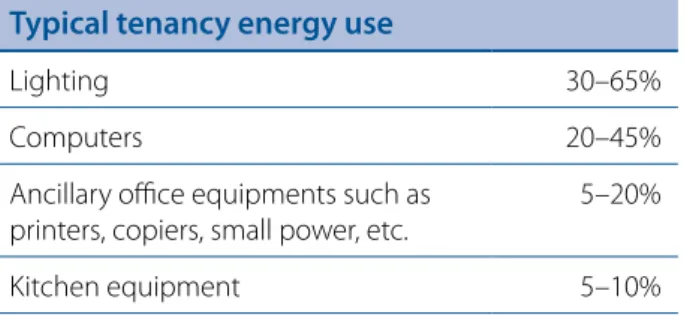
It is important to understand how you use energy, what you pay for directly and what you pay for indirectly in the form of base building services. As Table 1 shows, lighting and computer equipment generally account for most of the power used by a tenant. Significant savings can be made by simply changing the way you do things. While all tenants use energy differently, these figures give an indication of the proportion of energy used by different equipment and in different areas.
Table 1: Tenancy energy use in an office building Typical tenancy energy use
Lighting 30–65%
Computers 20–45%
Ancillary office equipments such as
printers, copiers, small power, etc. 5–20%
Kitchen equipment 5–10%
Source: OEH research.
Section 2
Typical energy use in an officeWhat do you pay for? Find out how your office uses energy
2 U nd er st an di ng e ne rg y us e
What do you pay for?
Office buildings are made up of tenancies and the base building. Electricity used in the tenancies is usually a tenant cost and electricity used by the base building is a cost to the building owner. In most office buildings the energy consumption by all the tenants together is about the same as the energy used by the base building, i.e. tenants account for half the energy used in an office building.
As an office tenant, typically you pay for:
•
the power consumed by your equipment, i.e. printers, copiers, multi- function devices, kitchen equipment, office computers and IT room, along with small power, which includes equipment plugged in at work stations such as mobile phone chargers, etc.•
electricity consumed by any additional air conditioning that you may have installed, or supplementary air conditioning that you have requested from the landlord•
the electricity used by the lights in your tenancy – even though, typically, the fluorescent lights in the ceiling are owned by the landlord•
a share of the electricity used by the base building including lights to common areas inside and out, lifts, heating, ventilation and air conditioning (HVAC) and the plant and equipment needed to run the building. Generally, you reimburse the landlord for your share through the outgoings (net lease), through the rent (gross lease) or a combination (semi-gross lease). See Section 5 for information about different lease structures.Find out how your office uses energy
You need to establish whether you are using too much energy to provide the services you require, and whether you are getting good value for the money you spend on energy.
You can get a sense of the patterns of energy consumption in your office by analysing your energy bills and checking your electricity meter. See Section 9 to read about installing sub-meters in your tenancy to more accurately track your electricity use.
Option 1: Analyse your energy bills
Collect your energy bills for the past year. Graph your energy consumption over time (monthly). Look for patterns and spikes in energy consumption. Look at the tariff or contract details to see what components of your energy consumption are most costly (e.g. peak electricity). This information will also be useful when you come to negotiate an electricity supply agreement with an energy retailer (see Section 8).
‘You cannot manage your energy use if you do not measure it’. Tony Cope, Head of Office, The GPT Group
After-hours air conditioning can add significantly to a tenant’s power bills.
Efficient air conditioning
As a tenant you generally pay for after-hours air conditioning at an hourly rate. After-hours air conditioning can be very energy intensive if the system is not set up to cool or heat small zones or areas efficiently when required. You can work with your landlord to ensure that the air conditioning is managed to run as efficiently as possible to cater for your after-hour operations and not used when not required. If you own a supplementary air conditioning system your plant and systems should be set up and managed well. More information is provided on this in Section 9.
Option 2: Analyse your pattern of consumption
Use your electricity/smart meter data to analyse the pattern of consumption during the day. Your electricity supplier or building manager can help you find the meter and can explain how to read it. Most large office buildings will also be equipped with a Building Management System (BMS). A BMS will have data recorded that you can use to analyse your patterns of consumption. Ask your building manager about this.
Over a period of time (say, a week), read the meter at set times each day – the start of working hours (say 8am), start and end of lunchtime (say 12.30 and 2pm) and end of working day (say 6pm).
Then calculate the average power use per square metre (in W/m²) during working hours, at lunchtime and outside working hours. Use the formula:
Power use (W/m2)
= (kWh x 1000)/(time interval in hours x floor area)
For example, if consumption is 7.5 kWh over a 1.5-hour lunch period for a 200 m² office, power use per square metre = (7.5 x 1000)/(1.5 x 200) = 25 W/m².
Power use should be significantly lower outside working hours than it is during office hours. If it isn’t, a lot of equipment or lighting is being left on and there is large potential for savings through better equipment
management.
Option 3: Calculate your NABERS Energy rating
It may help for you to know how you are tracking compared to other tenants. You can do this by using the NABERS Energy ratings. See Section 7 for more detail.
You can assess the energy performance of your office using the NABERS Rating calculator on www.nabers.gov.au (use of the calculator is free). The guidelines that provide more information, NABERS Energy and Water for Offices: Rules for collecting and using data, are also available (free of charge) on the NABERS website.
To work out your NABERS Energy rating, you will need:
•
the area of your office premises (in m²)(also referred to as the Net Lettable Area or NLA)
•
hours of occupancy (in hours per week)•
postcode•
number of computers in your office•
energy use for the tenancy over the past 12 months.Enter this data into the online calculator, which will estimate a star rating on a scale from 0 to 6. A rating of 6 stars indicates that your premises has market-leading energy efficiency and 0 stars suggests that your premises are very inefficient in the use of energy.
Tip
Aim to make your off-peak use one-fifth of your peak electricity use. If possible, ensure that lighting and equipment gets turned off using timers, and use a manual-on/ auto-off default. 2 U nd er st an di ng e ne rg y us e
The Roads and Maritime Services office in North Sydney has earned a 5 star NABERS Energy rating, following a 4 star Green Star-rated fitout. Photo: Transport for NSW.
You must obtain an official accredited rating through a NABERS Accredited Assessor if you wish to promote your rating and use the NABERS trademark. For more information about using NABERS see Section 7.
A ‘walk-through’ inspection of your office by an engineer or a NABERS Accredited Assessor experienced in office energy efficiency can help identify opportunities for improvement. Organisations that consume a lot of energy may need to conduct a more comprehensive energy audit periodically, to identify where energy use could be reduced (see Section 7 for more information).
However, some improvements, such as capital outlay on new lights, come at a cost. The following Sections 3 and 4 will help you work through the business case for energy efficiency, and suggest ways to save energy around your office, both through technology and behavioural change.
NABERS Energy rating certificate
NABERS ratings for tenants
NABERS is the National Australian Built Environment Rating System. It is a performance-based rating system for existing buildings. NABERS rates a building on the basis of its measured operational impacts on the environment, and provides a simple indication of how well you are managing these environmental impacts compared with your peers and neighbours.
As a tenant you can use NABERS to rate your energy consumption, waste generation and the indoor environment quality of your premises.
In this guide, when we refer to NABERS we will generally be referring to the NABERS Energy rating for office tenancies.
See more on NABERS Energy ratings for office tenancies in Section 7.
Developing a business case
for energy management
Section 3
Organisational support for energy management Writing a simple energy management policy
Finding your energy champions Gaining senior
management support Getting funds approved Building the business case for energy management The business case template Implementing the successful business case: who will be responsible
More information The drive to make your organisation more energy efficient can originate
from many places. It might be initiated by a motivated employee who wants to work in a more sustainable workplace, or it may start with management wanting to achieve a smaller carbon footprint. Wherever it starts, building an effective business case for energy efficiency improvements, and securing the support of senior management, are essential to achieving energy savings, reduced greenhouse gas emissions and lower bills. Establishing a business case for energy management is crucial, and demonstrates that your organisation is committed to embracing change.
Organisational support for energy management
When starting an energy management program it is important to identify people on your staff who can play a key role in the program. They should be able to assist in devising and organising investment in projects, overseeing and reporting on energy-efficient practices in the office and also in securing internal support for the program.In large organisations, energy management is often the direct responsibility of an appointed energy manager or sustainability manager. However, for smaller businesses, a formal position usually does not exist and therefore responsibility generally falls on the owner, office manager or accountant. If no energy manager exists in your organisation, nominate a key employee as an ‘energy champion’ to be responsible for initiatives, purchasing policies and management related to energy in your office.
In larger businesses, the energy manager or team should ideally:
•
be in a position and at a level that closely aligns with the organisation’s conventional management structure•
possess project management, innovative problem-solving, financial and communication skills, along with a working knowledge of technology and energy issues•
be able to coordinate energy efficiency matters across the organisation. An important step is to seek the commitment of senior management for the energy management program. Their continual support – in terms ofendorsement, cooperation and resourcing – is crucial for its ongoing success.
3 D ev el op in g a bu si ne ss c as e
Writing a simple energy management policy
A simple energy management policy can provide a framework for energy programs and help you to achieve your performance targets. It should include:•
a declaration of commitment from senior management•
a recording of the starting energy use baseline•
performance targets•
an action plan•
recording procedure•
reporting format and timing•
review procedures – a monitoring and reporting system•
budgetary considerations.Having a policy is a great idea because it:
•
sets a simple process in place•
demonstrates company commitment•
helps guide and focus efforts for improving office energy efficiency•
communicates your commitment to saving energy inside and outside your organisation•
motivates management and staff•
provides direction for a whole-of-organisation approach to energy management•
sets targets against which performance can be judged.Widespread consultation is the key to a successful energy policy. Make sure that all your staff are given the opportunity to contribute and participate in the development process. In this way you are more likely to gain their
acceptance of the policy and foster their involvement in the proposed actions.
Finding your energy champions
Identify and recognise the champions within your organisation and encourage them to contribute ideas and target opportunities in the development of your energy management policy and saving initiatives. Provide them with visible support, and adopt and communicate energy-saving practices yourself. Energy champions should represent all departments and include decision-makers such as senior managers, alongside staff from all levels.
Include a base building representative, such as the facilities manager. This will assist you in understanding how the building works and what opportunities may exist to further finetune your tenancy’s energy efficiency. An energy cost to the base building will ultimately become a leasing cost to tenancies.
Change is a two-way
process
Your organisation’s decision-makers need to endorse the commitment of resources, both in time and money. But that’s not the end of it. They need to encourage the exchange of ideas that will generate energy-saving initiatives across your organisation. An informal way to generate the exchange of ideas is to start a suggestion box. Sometimes a quick idea that doesn’t need to be presented in detail will generate some great initiatives.
A small change within one department can lead to bigger things across your organisation.
Gaining senior management support
Good energy management in your workplace is not just about identifying opportunities, investigating initiatives and getting funding approval. The success of your energy management program also relies on senior
management involvement. Opportunities to engage staff and colleagues may be identified at any level in your organisation, but they must carry the endorsement of senior management to have any chance of ongoing success. Some investment, either human or financial, must be associated with your initiatives. Senior management endorsement will enable you to invest time in planning, monitoring, evaluating and reporting back to all stakeholders.
Calculating your savings
A financial savings calculator can be found on the website at www.nabers.gov.au/downloadFile.aspx?file_id=411.
This calculator can be used to create a financial report and summary for energy efficiency projects or initiatives as part of your business case proposal. The calculator produces a summary report that sets out the project details with capital costs, energy savings, rates of return and greenhouse implications that would be useful for presenting to decision-makers.
Getting funds approved
Knowing where to save energy is only half the solution. Submitting a good financial case and getting it approved makes the difference.
To get energy efficiency upgrades carried out, you need to first present a sound financial case to the decision-makers in your organisation to get funds approved. You need to communicate both the capital cost and the ongoing savings. Money spent on upgrades which reduce energy consumption can be paid back through savings in energy costs. And the energy savings continue to accrue. Therefore, it is important that the decision-makers in your
organisation understand the long-term benefits.
Building the business case for energy management
Once you move beyond the energy-saving initiatives that are cheap or free, you will need to be able to prove that any money spent can show a return on your investment. In other words you need to be able to make a business case. A business case is a cost-benefit analysis which looks at upfront costs and benefits as well as the costs and benefits over the life of the investment. The first step is to define what you want to achieve: you need to be clear about your vision, mission and the lead strategies.Remember, the business case can be applied at any scale. If you have already defined the vision and mission for your organisation’s energy policy, then you can develop or apply your lead strategies at the scale appropriate for your
3 D ev el op in g a bu si ne ss c as e
Obtaining senior management approval for the implementation of an energy management policy is essential for success.
Brief to senior management
Your brief to senior management should consider:
•
What is the scope of the opportunity?•
What is the current situation and what business outcomes are likely?•
What is your timeline?•
Think about a cost–benefit analysis•
What is the cost of implementation?•
What are the direct financial benefits?•
Are there indirect benefits such as staff retention, market perception of leadership and ability to attract ethical investors?•
What is return on investment (capital outlay vs duration of lease and make-good clauses)? See Sustainable Property Guide Worksheet 2.1A, www.environment. nsw.gov.au/sustainbus/Define your vision, mission and lead strategies
Define your vision and mission for energy sustainability and efficient energy management. If they need to be developed, start the ball rolling by initiating discussion. If your vision and mission statements are already in place, review them to check they are being followed.
Vision
This is a brief statement about your objective – for example, to aim for sustainable energy production and consumption.
Mission
This defines the pathway leading to your main objective – for example, to reduce your organisation’s energy consumption, leading to financial and environmental savings.
Lead strategies
Identify the tasks needed to support your mission.
Develop lead strategies to identify the tasks needed in support of your mission. Demonstrate alignment with your organisation’s vision statement, values, business goals and other policies.
Your first strategy should be to change staff behaviour, reducing energy consumption by raising energy awareness and introducing the concept of energy management. Once this is underway, then it is time to develop your second strategy – to build the business case for energy management.
Depending on the scale of your plans, your second strategy is to engage with senior management, your board, shareholders and other internal and external stakeholders, including your base building’s managers. This is because gaining support at a higher level is crucial to the success of your campaign. The principle is the same – whether seeking capital expenditure on a lighting upgrade, aiming to gain staff support for turning off computers when they leave the office or developing an energy policy for your company.
The business case template
The business case describes the work to be done and what the project will deliver if funding is approved. Funding can be in the form of direct financial cost or staff deployment. The business case presents a range of options and supports the preferred option. Include estimates of the cost, the benefit and the timing.
Review procurement
Review your procurement policy and make sure it takes energy efficiency into account. Make sure you also consider the energy embodied in production, transport and disposal.
Seven key success factors
in a business case review
1: Service delivery
Will the proposed project achieve your service objectives and fulfil the identified needs? Have the scope, scale and requirements of the project been properly identified? This ties in with your mission and lead
strategies.
2: Affordability and value for money
Has the proposal been defined appropriately for analysis? Are the identified benefits realistic within the remaining term of your lease? Are there sufficient resources (financial, physical and human) and will their expenditure provide value for money? Have funding options been considered?
3: Sustainability
Will the project have long-term benefits and not contribute to future harmful impacts?
4: Governance
Is the project supported by the CEO? Has responsibility been assigned for the management and reporting of benefits to be delivered by the proposal? Is the project feasible and the allocation of resources and timeline reasonable? Have processes to manage change been
acknowledged?
5: Stakeholder management Have all stakeholders been identified and their views considered?
Examine energy use
Review your current energy use by looking at energy bills and tariffs to establish a baseline. Use NABERS Energy ratings or organise an energy audit of your tenancy.
Look for savings opportunities
Use the energy management checklist at the end of this guide toidentify and document energy savings opportunities in your tenancy. Identify costs and savings over the life of the project and include the costs of implementation. Review external funding opportunities such as grants. Calculate returns and savings using methods such as internal rate of return or net present value. Financial savings will be achieved either directly through savings on your tenancy energy bills, or indirectly through savings to the base building, which can then be passed on to tenants by providing opportunities for expenditure elsewhere. In addition to the financial savings, other positive outcomes may include market perception of leadership, resource efficiency, staff retention and the ability to attract ethical investors.
Use the rating tools
Tools such as the NABERS Energy rating can be used to measure your environmental achievements. Achieving a good rating will demonstrate your commitment to sustainability to both internal and external stakeholders. External stakeholders may also include the base building’s managing agents and facilities manager, as well as other tenants.
Raise awareness
Raise awareness about the need to avoid energy waste in order to achieve both financial and environmental savings.
What are your business drivers?
Identify business drivers such as increased operational cost efficiency, corporate and environmental responsibility, carbon reduction, engagement with staff, the energy savings and sustainability goals of external
stakeholders, and improved reputation.
Identify risks
Identify any risks associated with energy-saving initiatives and quarantine them accordingly, e.g. safety lighting, after-hours lighting and external lighting. Identify the capital outlay needed to improve efficiency, e.g. movement sensors and timers.
Investigate the ‘do-nothing’ alternative. Take into account future price increases for energy, which present a risk to your budget. Also identify any potential damage to your business reputation or loss of marketing potential around the issues of sustainability and good governance.
Seven key success factors
in a business case review
(continued)
6: Risk management
Have the appropriate stakeholders been consulted in assessing major risks associated with the project, and contingencies and mitigation measures been allowed for? A good example of contingent costs is future carbon prices and increasing electricity tariffs.
7: Change management Has the extent of change been identified and assessed? Have the processes to manage change been determined?
Source: Business Case Gate Review Workbook – Issue No. 5.
June 2009, NSW Treasury 3 D ev el op in g a bu si ne ss c as e
Identify best opportunities
Identify the best opportunities for achieving savings and identify the budget required for low-cost initiatives, e.g. awareness campaigns, rewards (which might include a box of chocolates or donation to a nominated charity), and staff deployment to instigate, monitor and report on energy-saving initiatives.
What are the most cost-effective opportunities
to spend your capital?
Identify the best opportunities to spend your capital to achieve energy savings. These will need to be measured against the conditions and duration of your lease.
Consider any indirect costs such as ‘make-good’ requirements at the end of the lease.
Keep it simple
Examine the language and structure of your corporate or business plan so your proposal is easily understood by the intended audience.
Keep it open to change
Make sure the business case is dynamic and develops as organisational priorities change and staff awareness increases. This will keep your business case relevant to the organisation’s objectives.
Start implementing
Implement the approved savings projects identified in your business case.
Report back
Review outcomes and report back – it is important to keep all stakeholders informed of your progress and your achievements. Also measure and report on previous projects.
Take this as an education opportunity to raise staff awareness of energy efficiency by measuring your energy performance.
Reinvest the savings
Reinvest your savings in further energy efficiency projects or invest in GreenPower renewable energy purchases.
Government help
The Office of Environment and Heritage NSW (OEH) has a
Sustainability Advantage program to help medium-to-large organisations understand sustainability and strengthen their environmental performance. A new component of the program – Sustainability Advantage Energy Saver – offers an energy audit and free technical support to undertake effective and practical power-saving and money-saving projects.
If your organisation joins
Sustainability Advantage, specialist consultants will help you improve in the following areas of business sustainability:
•
vision, commitment and planning•
resource efficiency•
environmental risk and responsibility•
external stakeholder and staff engagement•
supply chain management•
climate change.www.environment.nsw.gov.au/ sustainbus/
Implementing the successful business case:
who will be responsible?
Successful energy management needs a leader. If you are in senior management, appoint an energy manager – someone who will coordinate initiatives across your various departments. In each of these departments appoint an energy champion – someone who will take the message to their team, foster energy-saving initiatives and report back. If you are attempting to drive this change from further down the ladder, it is important that senior management and other decision-makers are visible supporters of your efforts. Section 4 looks at how to identify and support your energy champions and build energy awareness.
More information
•
ESD Operations Guide for owners, managers and tenants,Australian Government Department of the Environment, Water, Heritage and the Arts (DEWHA) 2009
•
Business Case Gate Review Workbook, Issue No. 5, NSW Treasury 2009•
Sustainable Property Guide, Office of Environment and Heritage 2009: www.environment.nsw.gov.au/sustainbus/SustainPropertyGuide.htmSection 1.1 Sustainability – the business context
Section 2.1 Building the business case for your organisation
Worksheet 2.1A Sustainability business case template
Worksheet 2.1B Which sustainability project? Evaluating the options
•
Forging New Links – Enhancing Supply Chain Value Through Environmental Excellence. Global Environment Management Initiative 2004:www.gemi.org/supplychain/resources/ForgingNewLinks.pdf
•
The Sigma Business Case Tool: Sigma Guidelines: www.projectsigma.co.uk3 D ev el op in g a bu si ne ss c as e
Successful energy management needs a leader to coordinate the implementation of energy-saving initiatives across departments.
Sustainable Property Guide
Published by the Office of Environment and Heritage in association with Colonial First State, this is a comprehensive guide to incorporating sustainable practices into the many aspects of the commercial property industry.
The guide puts sustainability into context, from showing how to prepare a business case, through to managing property more sustainably and setting up and running projects to meet new environmental standards. It provides step-by-step guidance, case studies, practical checklists and worksheets. www.environment.nsw.gov.au/ sustainbus/SustainPropertyGuide.htm
EmPOWERing
your people
This section of the guide will help you to maximise the effectiveness of your energy efficiency activities by engaging your staff and encouraging behaviour change.
Energy management in your workplace is not just about identifying opportunities, investigating initiatives and getting funding approval. The success of your program hinges on staff involvement – the primary driver behind efficiency and conservation efforts. By making sure that key staff are responsible for energy efficiency, developing an energy policy and educating your staff, you can give them the tools to contribute and motivate them to help you achieve the savings you want.
Educating and motivating your staff
You should never underestimate the value of encouraging participation and cooperation by staff and management in using energy wisely. Ongoing motivation and education are key to improving energy efficiency. If you keep your staff abreast of energy management activities and raise individual awareness of greenhouse issues you can generate real benefits by:
•
encouraging participation and environmental responsibility – the more support, the more effective your energy-efficiency program and initiatives will be•
helping dispel misconceptions that energy-saving measures are uncomfortable or result in loss of amenity•
boosting staff morale and pride – as they are made to feel part of the solution.Improved cooperation and communication towards a common goal can also increase employee unity and harmonious workplace relations.
Communication is education
Regularly communicating your program plans and progress to staff reminds them of the value of their contribution and helps fuel ongoing enthusiasm and participation. Utilise communication and marketing resources in your organisation – sustainability is generally a ‘good news’ story. Provide feedback via newsletters, signage, posters, memos, billboards, reports, internal
bulletins, email, or meetings on:
Section 4
Educating and motivating your staff Helpful hints on getting underway How to run a successful campaign Start your colleagues thinking Base building: make it part of your campaign More informationEnergy awareness at work
The biggest and most cost-effective energy savings can be made when your staff embrace the changes. By creating awareness of how even small steps towards energy efficiency can add up to big changes, you can begin to change the way your staff work.
•
energy efficiency initiatives•
handy hints for conserving energy in the office (and at home)•
news on global warming and the greenhouse effect•
results of progress against targets (e.g. NABERS)•
savings achieved (dollars and greenhouse gases)•
challenges faced and ideas for improvement•
lessons learnt from failures.If you have shareholders, speak with your organisation’s corporate communications team about publishing information in your shareholder magazine, and also in your annual report. Shareholders will be interested to hear how saving energy improves the bottom line.
Encourage active participation
Make involvement of key staff in energy efficiency activities a priority by creating an energy management taskforce or team to coordinate initiatives and motivate the rest of the organisation into action.
Encourage constructive feedback from staff in regular meetings. You could set up a staff suggestion scheme to help the continual improvement of the design of the program.
Add sustainability to team and management meeting agendas.
It is important to recognise successful efforts. Run an office competition to find ways to make the workplace more energy efficient and environmentally friendly, offering a small reward (e.g. a water-efficient showerhead for the home) or incentive for an employee who saves the most money or provides the best suggestion.
Use training programs to raise awareness
Incorporate efficient energy management and use of equipment and technologies into existing training programs. Ensure that energy efficient practices are included in staff induction processes for new employees. Apart from knowing how to enable ENERGY STAR (see Section 9) on their office equipment and operate lighting systems more efficiently, staff should also know:
•
why energy savings are important and how they impact on budgets and greenhouse gas emissions•
how their everyday behaviour affects energy consumption•
what actions can be taken•
how they will benefit.Take a step forward
If you are a member of staff who wants to be involved in change, volunteer to become the energy champion for your department and initiate some simple, low or no-cost ideas to inspire others.
Avoid making wallpaper
Don’t let ‘reminder’ posters or stickers become wallpaper: replace or reposition them from time-to-time so they are fresh to the eye and staff will read them again.
Motivating staff
Motivation comes from within, so how do you create that interest? While you shouldn’t assume that money is the only or the best way to motivate, financial rewards can be a recognition for work well done. The winning department each quarter could choose a charity and make a corporate donation equal to that quarter’s savings on energy bills. Recognition and responsibility have a big impact on motivation.
Increasing autonomy, discretion and personal accountability will increase motivation. 4 Em po w er in g pe op le
Use existing training programs to raise awareness of the energy efficient practices in your tenancy, and ensure this information is included in staff induction processes.
If you are a senior manager, present your energy management plan for executive or board endorsement. Consider drafting an energy management policy for the organisation and build a business case (see Section 3).
Turning awareness into action – define your message
Adopt the slogan: ‘Turn it off’. This is the simplest and most effective message to communicate. Make the reduction in energy a platform from which to build energy awareness. A range of promotional material, such as stickers and posters, is available to help you communicate your message (see ‘More information’ at the end of this section).
Implementing your awareness program will take energy, enthusiasm and imagination. Consider a presentation, special event or challenge to launch your campaign.
Helpful hints on getting underway
•
Distribute a simple questionnaire to staff to establish the level of awareness about energy waste and energy efficiency.•
Use the energy management checklist at the end of this guide to identify energy-saving opportunities in your office.•
Use simple graphs or charts to show your organisation’s energy use patterns over time. This will also help you to identify your biggest energy users.•
Promote your campaign launch at least two weeks in advance using a range of tools. If your organisation has a staff newsletter, use it to generate interest and compare the progress of various departments. Offer some sort of recognition or prizes on the way through. These could be as simple as chocolates left on workstations or nominating the charity to which a donation could be made.•
Adapt your techniques to match staff culture: learn from experience and adapt your program as you go. Remember, this is not a one-off exercise and you need to maintain your momentum.•
Repeat your ‘Turn it off’ message frequently, using a variety of approaches over a sustained period. It can take a long time to embed change into an organisation’s culture.•
Identify your biggest targets – these can include your staff and other building users.•
Evaluate your energy awareness campaign against your original goals – remember your vision and mission and lead strategies (see Section 3).•
Remember that awareness programs are more effective when linked to changes that staff can see. If you are planning to invest in energy-efficient lighting, start your awareness programs at the beginning of the installation and continue the programs throughout.CASE STUDY
Colliers International Project Services (previously Roberts Weaver Group) provides integrated project and change management, interior design and IT expertise to clients who are moving, developing or reshaping their workplaces.
Colliers achieved a 4 star NABERS Energy rating out of a possible 6 stars through management commitment and encouraging staff to change their behaviour. The high NABERS Energy rating was achieved by:
•
management encouragement and leading by example:– switching off lights and PCs
•
encouraging positive staff behaviour•
installing signage on central light switches that indicated zoning:– early starters generally limit use of lighting to their areas
•
reinforcing the energyconservation message through:
– regular emails
– posters
– announcements at staff meetings.
The result was achieved without the use of contemporary lighting technologies.
How to run a successful campaign
For an energy campaign to be ongoing and successful, you need to consider funding for:
•
staff training•
rewarding competition winners for achievement•
ongoing monitoring, evaluating and reporting.Staff need to understand that their efforts are not just short-term actions but represent a fundamental change in the way your organisation conducts its business. This can be supported by continuing education, information and recognition of how their change has not only reduced costs but increased value and productivity.
All stakeholders need to identify with this change and benefit from it. The rewards can take many shapes and forms but acknowledging effort and sharing the results of good energy management is a great place to start. For example, initiate a staff competition linked to environmental ideas for your workplace.
Feedback – sharing your successes with the office
Keep your staff informed by:•
regularly reporting progress against objectives in your energy management program – inform employees of performance successes and failures in your staff newsletters and via internal email•
placing your organisation’s energy policy, educational material and progress reports in staff communal areas – this can increase general staff awareness and engagement with your workplace energy initiatives•
posting simple clear messages on staff noticeboards outlining handy energy-saving tips, energy-efficiency initiatives and the latest greenhouse gas savings•
sticking posters around your office reminding staff to switch off lights and computers and use power-saving functions on photocopiers•
circulating an EnergySmart newsletter to staff providing energy-saving hints for the home – you could distribute this monthly or at the start of each season•
regularly sharing information through internal newsletters, emails, staff billboards, posters or reports between the different management levels and functional areas within an organisation – this can lead to more streamlined and effective energy-management systems and better results•
including energy-saving actions as an agenda item in staff meetings or as part of a weekly or monthly informal meeting – this is an effective system for gathering feedback from staff.Share shut-down savings with staff. You can demonstrate how much can be saved with a plug-in power meter. Simply plug the meter into any power socket then plug your appliance or equipment into it. It will give you a readout of the kW used by an appliance such as a kettle, mobile phone charger, printer or computer and an indication of cost. This is a great way to demonstrate the drain of small power at work stations from appliances continually plugged in and drawing power, even in standby mode.
Small power
This is the term used for the many pieces of low-energy equipment that are plugged in around the office including phone chargers, calculators and lamps. Combined, they can contribute about 4% of an office’s power consumption.
Make sure that staff can reach power points so it’s easy for them to unplug their equipment when not being used.
4 Em po w er in g pe op le
ARUP uses the Office Realtime data visualisation system in their Brisbane office to allow staff members to see their energy, water, paper and flight consumption trends in ‘real time’. Photo: ARUP.
Start your colleagues thinking
This step may be the bravest but it’s not necessarily the hardest.
The questionnaire you send out will be a good way to learn how energy-aware your staff are, how uniform the departmental culture may be and how to ‘break through’ and motivate the staff as individuals. It will also start staff thinking about energy awareness and may even start their journey towards becoming energy champions.
There are many no-cost or low-cost options to explore as a way of getting people thinking. Give your colleagues an energy-use benchmark, such as how they use energy in their home, to get them to take a personal interest in their energy use at work. For example:
•
When they leave home, do they leave all their lights or their computer on? If not, then why is this the case at work?•
If they are hot or cold at home do they adjust how much clothing they are wearing?•
Do they think that shutting down their computer will interrupt the network or after-hours backing up?•
Do they understand that collective, small initiatives can add up to big savings?•
Do they understand the implications of energy waste?A ‘Turn it off’ campaign can only operate with the full support of your organisation’s management because energy-saving initiatives need to be owned, shared and experienced by an organisation’s decision-makers. You should focus on two groups – management and your Information and Communication Technology (ICT) department. Management can set policies for energy reduction and the ICT department is in control of the area of the business that can bring about the greatest changes and savings.
If your colleagues understand that their savings make a difference and will be valued, then they will be more open to change.
Black balloon campaign
It is difficult to visualise energy use and waste.
The Victorian and NSW governments have been running successful campaigns to save energy by explaining the extent of greenhouse gas emissions and carbon pollution through the use of symbolic black balloons. Other state and territory governments are also using the black balloon to give a tangible example of what 50 g of carbon pollution could look like as a unit of pollution.
A 36-cm diameter black balloon represents 50 g of greenhouse gas pollution. While the campaigns are often aimed at householders, many of the appliances and equipment targeted are also used in offices. With the price of electricity increasing, the good habits promoted at home can be mirrored in a similar campaign at work.
Shut-down checklist
Appoint a switch-off monitor.This could be someone who works late, the cleaners or security staff. Place red-dot stickers on
equipment and switches which must not be turned off, such as computer servers, PABX systems (telecommunications) and security lighting marking exits. Consider using a USB-controlled
powerboard (which ensures the computer can only be on when the USB port on a computer is powered up.)
Ask your ICT staff to implement initiatives such as enabling ENERGY STAR on computers. Adjusting the brightness on
computer screens will lead to big long-term savings when
implemented across all departments.
Have a regular shut-down reminder day each week, when staff are actively reminded to switch off.
Provide reminders such as stickers, posters and emails. Promote awareness and have
special reminders before weekends and holiday periods. Convince IT staff to operate the
computer data room air conditioning at a temperature higher than the chilled
environment previously required. This can lead to significant savings.
Tip
Say ‘No’ to personal heaters. A personal heater will upset the balance of the air conditioning system and someone else may ‘freeze’ as a consequence!