588
BİNGÖL, M., (2006), İşletmelerde Bilişim Teknolojileri ve Yenilikçilik, Yüksek Lisans Tezi, Atatürk Üniversitesi Sosyal Bilimler Enstitüsü, Erzurum.
BAŞARAN, F., GERAY, H., (2005), İletişim Ağlarının Ekonomisi: Telekomünikasyon, Kitle İletişimi, Yazılım ve İnternet, Siyasal Kitabevi, Ankara.
Obstacles in collaborative consumption websites’ development: A case from Bosna and Herzegovina
Merima Bejtagic-Makic1 , Suncica Hadzidedic2
International Burch University, Sarajevo, Bosnia and Herzegovina Sarajevo School of Science and Technology, Sarajevo, Bosnia and Herzegovina
E-mails: [email protected], [email protected].ba Abstract
According to Rachel Botsman, a renowned social innovator, the 21st century will be characterized by collaborative consumption. It is a new mode of business backed up by network technologies and based on the ancient methods of trading by bartering and swapping. Collaborative consumption websites engage and specialize in information, service and goods sharing, swapping, renting, lending, and trading. The power of these new marketplaces is in changing the way people view ownership and consumption, alleviating the hardship of economic recession, freeing the flow of knowledge and information, and creating a business model which supports the reuse of goods and space for a greener world.
The content of this research paper provides an understanding of the drivers for collaborative consumption technology in a developing country in economic recession time, precisely Bosnia and Herzegovina (B&H). The key research question to be addressed in this study is: What are the issues faced in B&H when embarking on a collaborative consumption website development project?
Keywords: collaborative consumption (CC), swapping, website development, green technologies, emerging technology issues, system requirements, case study, empirical approach, collaborative technologies
1. INTRODUCTION
1.1 Collaborative Consumption
Global economic crisis, environmental issues, social and economic inequality, hyper production have lead to assets such as skills, time, goods, services, land, gardens, and "stuff" to be in a state of "idle capacity" i.e. under-utilization. Therefore, this created a need for an alternative way of obtaining goods and services which is through collaboration consumption.
589
“Collaborative consumption” is a return to the beginnings of human society, which is based on swapping and renting goods and services. If the 20th century was defined by hyper consumption and is a growing culture and economy, the 21st century will be defined by collaborative consumption, according to Rachel Botsman speaking at Wired 2011 in October 21.
Botsman, R. and Rogers, R. (2010) in their book ‘What’s Mine is Yours’ state that "The collaboration at the heart of Collaborative Consumption may be local and face-to-face, or it may use the Internet to connect, combine, form groups, and find something or someone to create "many to many" peer-to-peer interactions. Simply put, people are sharing again with their community - be it an office, a neighborhood, an apartment building, a school, or a Facebook network. But the sharing and collaboration are happening in ways and at a scale never before possible, creating a culture and economy of ‘What's Mine is Yours’”.
1.2 Research Objectives
The objective of the here proposed research is: To provide an understanding of the drivers, and barriers, for collaborative consumption technology in a developing country in economic recession time, precisely Bosnia and Herzegovina (B&H). Specifically, the key research aim is to explore the issues faced in B&H when embarking on a collaborative consumption website development project.
The research is based on experience from an actual CC website development project. Using a case study approach, the paper addresses the following sub-questions:
R1: Do B&H website design and development companies have the capacity to engage on and deliver a CC website development project for a specified price and time?
R2: What are the problems, i.e. obstacles, faced in the actual process of development of such a website in B&H?
R3: What solutions can be suggested to the problems in order to accomplish successful implementation of CC website in B&H?
2. REVIEW OF COLLABORATIVE CONSUMPTION WEBSITES 2.1 Functionalities of CC Websites
CC websites are distinguished from other websites on the Internet in its user friendly design and picturesque demonstrations with less writing. They use colors such as blue, green and some light versions of grey, brown and yellow. Most CC websites contain the following functions: ‘How it works’ – a link usually known as About Us which shortly describes the services offered on the website, “Item catalogue” - goods and services are divided into categories which make it easier for users to search, “Search button” along with advanced search to help users get to what they want efficiently and effectively, “personal list” of items offered and items wanted, “message exchange” for creating an offer and exchanging personal messages, member review, security measures encompassing a privacy policy and terms of use, and detailed membership application form. Majority of collaborative consumption websites exhibit a focus on one type of collaborative transaction – swapping, renting, borrowing, or sharing, and moreover focus on a specific group of categories.
590
2.2 Existing CC Websites
In this section, successful collaborative consumption websites around the world are introduced:
2.2.1 Airbnb: is an online global and travel network of accommodations offered by locals for rent. In 2011 Airbnb was awarded ‘The best website’ prize by the Guardian.
2.2.2 Taskrabbit.com: is an online and mobile service networking marketplace. It is a virtual neighborhood called a "Service Networking”. It allows you to post a task you need to get done and gets you in touch with friendly, reliable people who will do it for you for a small fee.
2.2.3 swap.com: is leading the global swap movement both online and in communities across all categories.
2.2.3 whipcar.com: allows a car owner to rent out their car for a certain fee to an approved driver with spare car time, when the car owner is not using it.
2.2.4 landshare.net: Landshare brings together people who have a passion for home-grown food, connecting those who have land to share with those who need land for cultivating food. 2.2.5 pik.ba: it is the Bosnian version of e-bay, and the first Bosnian website for buying and selling which aims at connecting the buyers and sellers in one place. It also includes options for renting and swapping the products available.
2.2.6 ekupon.ba: is a pioneer groupon website in B&H which features a daily deal on the best stuff to do, see, eat, and buy on 50%-90% discount and this way attracts a lot of people to buy that same product or service.
2.2.7 tajpi.ba: is a community based website where people ask questins and get answers from the members. This way they share information and collaborate by exchanging their knowledge, experiences and advice in their field.
3. METHODOLOGY
The CC website development process described and explored in the here presented retrospective case study was a project started in February 2011 by the authors.
The project was divided into six SDLC (System Development Life Cycle) phases: analysis, design, implementation/development, testing, installation/deployment and maintenance. The first month of the project was spent on planning the schedule for website development, evaluating the cost, and analyzing website requirements. Requirements’ gathering was conducted through the evaluation of existing collaborative consumption websites.
Design of the website’s home page, as adjusted to the common trend by CC websites, was to present a user with an instructional video, registration and log in buttons, list of categories in the form of pictures, application for a newsletter, and advertisements. CC functions of the website which were to enable users to swap and rent items were specified into: registration form, log in, member account information, adding new items, message exchange for website users, member review upon offer acceptance, overview of items a member is offering and those they are seeking, automatic matching of items, separate overview of items rented, upgrading member’s status to premium member for a fee.
Upon completion of the analysis phase it was concluded the optimal choice for website design and development was outsourcing.
591
3.1 Addressing Research Sub-question R1
After initial research on the companies offering web design and website development, the following selection criteria was developed: cost of the service, time required to complete the project, communication – availability to meet in person and discuss requirements, references and portfolio – prior experience on similar projects, resources – availability of in-house team of developers, and bonus offers - suggestions for marketing, SEO, hosting offers, domain registration, affiliate marketing, etc.
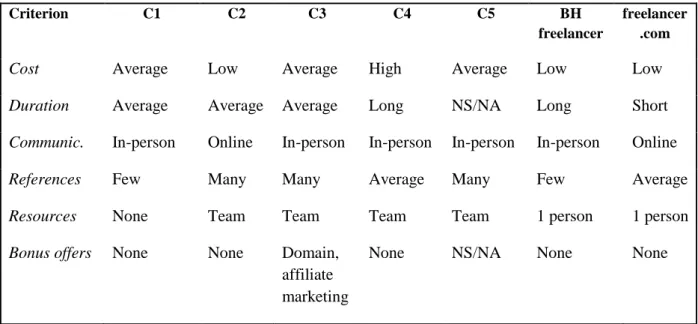
Requests for proposal were sent to five BH companies (denoted as C), one local freelancer, and also posted on freelancer.com. Table 1. represents their offers for each of the selection criteria.
Table 1: Criteria used for website developer’s selection
Criterion C1 C2 C3 C4 C5 BH
freelancer
freelancer .com
Cost Average Low Average High Average Low Low
Duration Average Average Average Long NS/NA Long Short
Communic. In-person Online In-person In-person In-person In-person Online
References Few Many Many Average Many Few Average
Resources None Team Team Team Team 1 person 1 person
Bonus offers None None Domain,
affiliate marketing
None NS/NA None None
(Note: NS/NA – not specified or the company did not answer to the RFP)
C3 (from now on mentioned in the text as the Developer) was chosen as the company to provide the website design and development. Reasons for the choice were that it was a company with several years of experience, with a fully functional team of designers and developers, who have presented to project owners their work on previous large projects, and were able to offer additional services, including full reliance on them for maintenance, hosting packages and affiliate marketing.
3.1.1 Project Schedule and Budgeting
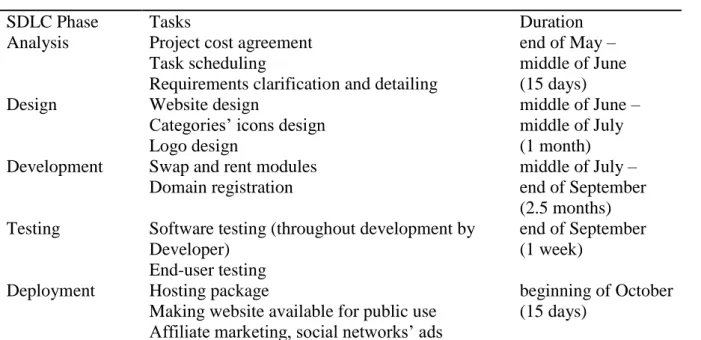
In the agreement with the Developer, the remaining phases of the SDLC were specified (Table 2). The duration of Design, Development and Testing phases for the project was 4 months - starting end of May 2011, ending beginning of October 2011. Website deployment was supposed to occur by the second week of October, to coincide it with the start of a new academic year at B&H universities.
592
Table 2: Project’s work breakdown and schedule
SDLC Phase Tasks Duration
Analysis Project cost agreement Task scheduling
Requirements clarification and detailing
end of May – middle of June (15 days) Design Website design
Categories’ icons design Logo design
middle of June – middle of July (1 month) Development Swap and rent modules
Domain registration
middle of July – end of September (2.5 months) Testing Software testing (throughout development by
Developer) End-user testing
end of September (1 week)
Deployment Hosting package
Making website available for public use Affiliate marketing, social networks’ ads
beginning of October (15 days)
Total cost of the website was partitioned on individual website functions, i.e. modules. The payment method agreed upon was monthly installments.
4. RESULTS AND DISCUSSION
Project’s design phase kick-off date was end of May. Two meetings were held between project’s owners and the Developer’s designer to specify website design - webpage elements, colors, and text position. After three unsatisfactory solutions for home page design, final design was offered and accepted middle of July.
A week into the development phase indications of project delay arose. The Developer notified that while there will be some work on the project in August, they have incurred other obligations which were more urgent for them. Till the end of July, three modules were completed. A module which followed was Adding Items (creating items and categories). The creation of this module extended to the whole month of August. Lack of communication during that period, private obligations from the owners’ side, the month of Ramadan, not organizing performance tracking meetings, and neglecting the work on this project from the Developer’s side, caused key changes and iterations in the development of this module. Beginning of September, a meeting was finally arranged to clarify requirements, go over business logic behind each of the functionalities, and discuss about corrections to user interfaces. Only a month remaining till the end of the development phase, the major modules for making the website operational were not even started. Nevertheless, project owners were assured the delivery date would be met.
Due to the fact that only one month was left till the deadline, tension was high at both ends. It was agreed that end of September was the final deadline to start testing the existing modules. Testing had not been carried out at all from the owner’s side, given that the approach chosen by the Developer was waterfall SDLC approach; in this methodology one SDLC phase has to be completed in order to move into the next.
593
The first end-user testing efforts caused emergence of ever more serious issues. It was evident project deadline was going to be broken.
4.1 Addressing Research Sub-question R2
End-users tested usability and functionality of the website in a scenario where it was assumed this website was present and available for use in B&H online market. Based on the results of end-user testing, it was determined the website was not ready to be put online for use. The development phase had to be extended.
The problem was exacerbated when the testing process caused an unintentional change of the approach to website development. The Developer tried to hang on to the waterfall approach they found the most familiar. The owners adopted a practice of weekly testing efforts to keep track of the development progress, thus pushing towards a more rapid and agile, development approach. As a result, the Developer was simultaneously requested to complete the remaining modules, and they were provided a list of changes that needed to be made to the existing modules. Quality of delivered functions decreased, delivery dates were prolonged, and respect in communication on both sides was deteriorating. The diversion of approaches taken by the two sides caused the Developer to enter into multiple loops to complete the ever growing changes to the already existing modules, while never starting to work on new modules. In the meantime, internal changes and fractions happened in the Developer company, which reduced the development team to two persons. In addition, they were forced to delegate resources to other projects they were accepting. This resulted in only one person working partially on the CC website development project.
Two months after the initial project deadline, both sides were bitter, distrustful and stressed out. The owners felt the Developer was not competent and did not put interest nor invest time into this particular project; on the other hand the Developer felt they were stretched to multiple sides, had company issues to deal with, the project was outgrowing itself and the actual costs were by far exceeding the initial price set. Communication plummeted, to the point where replies on both sides were either rude or not given at all.
The situation culminated when beginning of December the Developer came with the suggestion to terminate the work on this project. A new deadline was set - 15 days from the meeting date in order to finish the the most essential functionalities. Despite the agreement, communication was again dissatisfactory, work lagged or was not being carried out according to specifications, and the deadline itself was again breached. It was finally obvious that no serious business could tolerate more delays. The Developer provided the following options for the project:
Option 1 – continue working with the same Developer till the project is completed Option 2 – owners keep the functionalities and design completed till that point
(without the right to source code), and the Developer keeps the money paid till that point
Option 3 – terminate the relationship, in which situation the Developer would keep the source code and design without the right to present or sell it to someone else, but would return the owners the money paid till that moment
Option 1 was unacceptable to both sides. Option 2 was not the best for the owners since it would take a new programmer much longer to understand the code written by someone else
594
than to write it from scratch. Therefore, Option 3 was chosen by the owners as the only solution.
5. CONCLUSION AND RECOMMENDATIONS
Implementing collaborative consumption technology in a small developing country, like Bosnia and Herzegovina, opens multiple possibilities. Several websites of collaborative nature already exist in BH, but the website which was to be built in the studied project was to abide to the true principles of collaborative consumption. In conclusion, let us outline the key sources of the project’s failure:
Client not taken seriously
Unclear and not detailed system requirements Misunderstood system requirements
Too much freedom handed over to developers – trust in their expertise Lack or improper communication between owners and developers Lack of periodic and constant activity progress check-up
Insufficient resources planned for the project by developers Selection of an inappropriate system development approach
Loss of motivation and resulting decrease in quality of work performed Project outgrowing itself, thus planned time and price
In future work on this topic, what remains is answering the research sub-question R3. Valuable lessons were learned from embarking on this project and problems faced on it. In the next phase of this study, the CC project will be continued with applying the recommended and learned practices of website development, including: clear and thorough requirements specification, agile development methodology adoption (Bauer 2005, Dave 2011), frequent testing and continuous, regular activities tracking.
REFERENCES
Bauer, M. (2005) Successful web development methodologies article, URL http://www.sitepoint.com/successful-development/
Botsman, R. (2012) What’s Mine is Yours: The Rise of Collaborative Consumption. 2012. URL http://www.collaborativeconsumption.com.
Botsman, R. and Rogers, R. “ What's Mine Is Yours: The Rise of Collaborative Consumption” Happer Collins, NY
Dave, R. (2011) Web development methodologies: Agile vs. Waterfall, URL http://www.cmswire.com/cms/web-cms/web-development-methodologies-agile-vs-waterfall-012266.php
Ideas for modern living: collaborative consumption | Life and style | The Observer . 2012. URL: http://www.guardian.co.uk/lifeandstyle/2011/jan/30/ideas-modern-living-collaborative-consumption.