Florida International University
FIU Digital Commons
FIU Electronic Theses and Dissertations University Graduate School
12-4-2017
Aspect Based Sentiment Analysis On Review Data
Wei Xue
DOI:10.25148/etd.FIDC004076
Follow this and additional works at:https://digitalcommons.fiu.edu/etd
Part of theComputer Engineering Commons
This work is brought to you for free and open access by the University Graduate School at FIU Digital Commons. It has been accepted for inclusion in FIU Electronic Theses and Dissertations by an authorized administrator of FIU Digital Commons. For more information, please [email protected].
Recommended Citation
Xue, Wei, "Aspect Based Sentiment Analysis On Review Data" (2017).FIU Electronic Theses and Dissertations. 3721.
FLORIDA INTERNATIONAL UNIVERSITY Miami, Florida
ASPECT BASED SENTIMENT ANALYSIS ON REVIEW DATA
A dissertation submitted in partial fulfillment of the requirements for the degree of
DOCTOR OF PHILOSOPHY in COMPUTER SCIENCE by Wei Xue 2018
To: Dean John L. Volakis
College of Engineering & Computing
This dissertation, written by Wei Xue, and entitled Aspect Based Sentiment Analysis on Review Data, having been approved in respect to style and intellectual content, is referred to you for judgment.
We have read this dissertation and recommend that it be approved.
Sundaraja Sitharama Iyengar
Jaime Leonardo Bobadilla
Ning Xie
Debra VanderMeer
Tao Li, Major Professor Date of Defense: Dec 4, 2017
The dissertation of Wei Xue is approved.
Dean John L. Volakis College of Engineering & Computing
Andres G. Gil Vice President for Research and Economic Development and Dean of the University Graduate School
© Copyright 2018 by Wei Xue All rights reserved.
DEDICATION To my parents.
ACKNOWLEDGMENTS
First and foremost, I would like to express my gratitude to my advisor Dr. Tao Li for his support and guidance. Without his help, I would not have enjoyable research life at FIU, and this dissertation would not have existed. Second, I would like to extend my thanks to all my dissertation committee members: Dr. S.S. Iyengar, Dr. Jaime Leonardo Bobadilla, Dr. Ning Xie, and Dr. Debra VanderMeer for their helpful advices on my research and career plans. Third, I would like to thank all other my coauthors and labmates. It is a great honor for me to join Knowledge Discovery and Research Group (KDRG) and work with them. I am very grateful to all my colleagues of KDRG including Dr. Jingxuan Li, Dr. Li Zheng, Dr. Liang Tang, Dr. Lei Li, Dr. Chao Shen, Dr. Yexi Jiang, Dr. Longhui Zhang, Dr. Chunqiu Zeng, Dr. Wubai Zhou, Hongtai Li, Xiaolong Zhu, Wentao Wang, Boyuan Guan, Qing Wang, Ramesh Baral and Shekoofeh Mokhtari. Finally, I would like to thank my parents and family for their love and understanding.
ABSTRACT OF THE DISSERTATION
ASPECT BASED SENTIMENT ANALYSIS ON REVIEW DATA by
Wei Xue
Florida International University, 2018 Miami, Florida
Professor Tao Li, Major Professor
With proliferation of user-generated reviews, new opportunities and challenges arise. The advance of Web technologies allows people to access a large amount of reviews of products and services online. Knowing what others like and dislike becomes increasingly important for their decision making in online shopping. The retailers also care more than ever about online reviews, because a vast pool of reviews enables them to monitor reputations and collect feedbacks efficiently. However, people often find difficult times in identifying and summarizing fine-grained sentiments buried in the opinion-rich resources. The traditional sentiment analysis, which focuses on the overall sentiments, fails to uncover the sentiments with regard to the aspects of the reviewed entities.
This dissertation studied the research problem of Aspect Based Sentiment Analysis (ABSA), which is to reveal the aspect-dependent sentiment information of review text. ABSA consists of several subtasks: 1) aspect extraction, 2) aspect term extraction, 3) aspect category classification, and 4) sentiment polarity classification at aspect level. We focused on the approach of topic models and neural networks for ABSA. First, to extract the aspects from a collection of reviews and to detect the sentiment polarity regarding the aspects in each review, we proposed a few probabilistic graphical models, which can model words distribution in reviews and aspect ratings at the same time. Second, we presented a multi-task learning model based on long-short term memory and convolutional neural network for aspect category classification and aspect term extraction. Third, for aspect-level sentiment
polarity classification, we developed a gated convolution neural network, which can be applied to aspect category sentiment analysis as well as aspect target sentiment analysis.
TABLE OF CONTENTS
CHAPTER PAGE
1. Introduction . . . 1
1.1 Background . . . 1
1.2 Aspect Based Sentiment Analysis . . . 2
1.3 Problem Definitions . . . 4
1.4 Summary and Roadmap . . . 6
2. Topic Modeling: Aspect Extraction and Rating Inference for Hotel Reviews . . . 7
2.1 Introduction . . . 7 2.2 Related Work . . . 9 2.3 Problem Formulation . . . 10 2.4 Proposed Models . . . 11 2.4.1 Assumptions . . . 12 2.4.2 Motivation . . . 13 2.4.3 ARID Model . . . 14 2.4.4 ARIH Model . . . 15 2.4.5 Estimation . . . 17
2.4.6 Incorporating Prior Knowledge . . . 20
2.4.7 Prediction . . . 20
2.4.8 Experiments . . . 21
2.5 Conclusion . . . 26
3. Deep Learning Models for Aspect Based Sentiment Analysis . . . 27
3.1 Introduction . . . 27
3.2 Basic Modules in Deep Learning . . . 32
3.2.1 Word Embeddings . . . 32
3.2.2 CNN . . . 34
3.2.3 LSTM . . . 37
3.2.4 Memory Networks and Attention Mechanism . . . 38
3.3 Training Strategy . . . 40
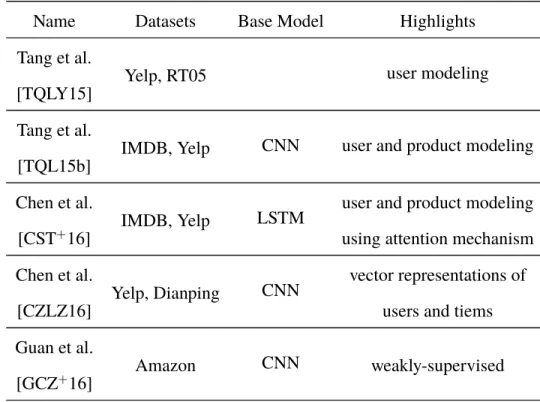
3.4 Advances in Deep Learning Models on Reviews . . . 42
3.5 Polarity Classification . . . 42
3.5.1 Neural Networks for Text Classification . . . 44
3.5.2 Neural Networks for Sentiment Polarity Classification . . . 57
3.6 Extraction and Polarity Classification for Aspect Terms . . . 58
3.7 Aspect Category Polarity Classification . . . 61
3.8 Review Summarization and Generation . . . 62
4. MTNA: A Neural Multi-task Model for Aspect Category Classification and Aspect
Term Extraction On Restaurant Reviews . . . 65
4.1 Introduction . . . 65
4.2 Related Work . . . 67
4.3 Problem Definition . . . 69
4.4 The Multi-task Learning Model . . . 69
4.5 Experiments . . . 73
4.5.1 Datasets . . . 73
4.5.2 Experiment Setup . . . 74
4.5.3 Compared Methods . . . 75
4.5.4 Results and Analysis . . . 76
4.6 Conclusion . . . 78
5. Gated Convolutional Neural Networks for Aspect Based Sentiment Analysis . . . 79
5.1 Introduction . . . 79
5.2 Related Work . . . 81
5.2.1 Neural Networks . . . 81
5.2.2 Aspect based Sentiment Analysis . . . 82
5.3 The Formal Definition of ACSA and ATSA . . . 84
5.4 Gated Convolutional Network with Aspect Embedding on ACSA . . . 84
5.5 Gating Mechanisms . . . 87
5.6 Gated Convolutional Network with Aspect Embedding on ATSA . . . 88
5.7 Experiments . . . 89
5.7.1 Datasets and Experiment Preparation . . . 89
5.7.2 Compared Methods . . . 91
5.7.3 Results and Analysis . . . 92
5.7.4 Effects of Kernel Sizes . . . 94
5.7.5 Training Time . . . 94
5.7.6 Gating Mechanisms . . . 95
5.7.7 ATSA . . . 96
5.8 Conclusions . . . 97
6. Conclusion and Future Work . . . 98
BIBLIOGRAPHY . . . 100
LIST OF TABLES
TABLE PAGE
1.1 A restaurant review . . . 5
2.1 The table of notations . . . 12
2.2 The largest variance ratio of principle component analysis . . . 17
2.3 Seed words . . . 22
2.4 Frequentest head terms and modifier terms . . . 22
2.5 Performance of Aspect Inference . . . 24
3.1 The neural networks for text classification . . . 44
3.2 The neural networks for sentiment classification . . . 57
4.1 The statistics of SemEval-2016 Restaurant Review Dataset . . . 75
4.2 Comparison results in F1 scores on three datasets. . . 76
4.3 F1 scores of models on SE16 across six aspects . . . 77
5.1 Two example sentences in one test datasetM of restaurant review dataset of SemEval 2014. . . 89
5.2 The statistics of the unrolled dataset for ACSA task . . . 90
5.3 The statistics of the unrolled dataset in SemEval 2014 for ATSA task. . . 90
5.4 The accuracy of all models on test datasets . . . 92
5.5 The accuracy of GCAE with convolutional kernels of different window sizes on ACSA task. . . 94
5.6 The model training time in seconds on ACSA task. . . 94
5.7 The model training time in seconds on ATSA task. . . 95
5.8 The accuracy of different gating units on restaurant reviews on ACSA task . . . 95
LIST OF FIGURES
FIGURE PAGE
1.1 A hotel review example . . . 3
2.1 Graphical Representation of ARID model. The outer box representsDreviews, while the inner box containsM phrases . . . 14
2.2 Graphical Representation of ARIH model . . . 16
2.3 Aspect Rating Dispersity of Hotels . . . 25
2.4 Aspect Rating Prediction on Reviews of Different Dispersities . . . 25
3.1 The diagram of skip-gram . . . 33
3.2 The diagram of CNN for text classification . . . 35
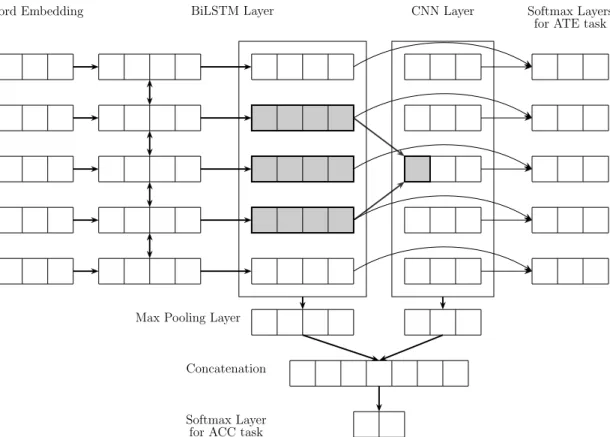
4.1 MTNA on a sequence of five words . . . 72
5.1 Illustration of our model GCAE for ACSA task . . . 86
CHAPTER 1
Introduction
In this chapter, we introduce Aspect Based Sentiment Analysis (ABSA), discuss research motivation, and define four subtasks in ABSA.
1.1
Background
With the boom of Web 2.0 and e-commerce, the way of buying and selling has been greatly changed, especially in retail markets. Knowing what others like and dislike is important for consumers’ decision making. In the past, apart from passively watching advertisements, people have to ask friends or turn to authorities in magazines to decide what products are worth buying. The advance of the Web technologies has brought the proliferation of user-generated reviews of products or services on the web. It has become a common practice for people to read the opinions and experiences from the enormous number of people, who are neither their friends nor professional analysts. More and more people are making comments and shopping online, which greatly impacts on the business of both online and off-line business. According to several reports and surveys of more than 5,000 online shoppers [Ste16, Hol16],
• 51% of the purchases of the surveyed shoppers are made on the web; • 66% of shoppers research online;
• 4.2-4.5 star ratings are the most influential.
On Yelp and Amazon, two biggest review web hosts, people can further rate comments by the button of “helpful”. The most helpful reviews are often ranked higher than others in review sections.
The retailers care more than ever about the reviews left by online customers, not only because the potential influence that opinions can wield in shaping others’ purchase inten-tions [dLFL16], but also because the online comments contribute a valuable resource of feedback for them to further improve their services or products. Monitoring and tracking reputations requires new technologies for content analysis [O’C10]. Therefore, apart from individuals who often browse various reviews before purchasing online or even off-line, ven-dors and sellers are also eager to see a system that can automatically analyzing consumer sentiment in reviews, rather than clicking and reading pages by pages.
1.2
Aspect Based Sentiment Analysis
Sentiment analysis [PL08, LZ12] is a comprehensive research topic about people’s opinion, appraisals, attitudes, and emotions toward entities. Since early 2000, sentiment analysis has been a research focus of many spotlights: natural language processing, web data mining, social media research, consumer research, or even stock market analysis. In the early stage, detecting overall sentiment at document level or at sentence level is the focus of sentiment analysis, rather than at aspect level [Tur02, PLV02, DC04, DLP03, LLS03, MYTF02, NY03, PL08]. Each document can be classified as either positive or negative, in which the whole document is considered as the atomic input.
However, classifying documents by the overall sentiment polarity conceals details [LZ12] that may be critical for recommendation engines, question answering systems, and other applications. Customers often have different preferences to different features of products or services. Those who only skim the average ratings without actual reading paragraphs would omit important information or even be misled. In fact, the overall sentiment polarity can be decomposed into fine-grained sentiment polarities at aspect levels. A positive review towards an entity does not necessarily mean that the author gives positive ratings on all
Figure 1.1: A hotel review example. The original review gave the hotel 4-star general rating. ABSA can provides a deep insight into the 4 stars: critical expressions, aspects, and aspect sentiments.
aspects of the entity. More often than not, positive and negative opinions are mixed at aspect level, sometimes even at sentence level.
Instead of modeling opining mining as a single classification problem, aspect based sentiment analysis (ABSA) actually consists of a series of tasks which can systematically capture and summarize reviews into a fine-grained representative format of the entity. A typical review from TripAdvisor is as follows. TripAdvisor is the biggest travel and restaurant website hosting hotel and restaurant reviews.
In Figure 1.1, the overall rating (4 stars) indicates the reviewer’s general impression towards the target hotel; however, without reading sentence by sentence, it is impossible to understand the reasons why the reviewer is satisfied with the hotel, on what aspects, and to what extent. It is entirely possible that the reviewer holds different attitudes towards different aspects of the hotel. People who come across this review have to literally read the review to answer questions about fine-grained sentiments. It is usually inefficient and boring. Imagine that most reviewers simply give superficial comments in just two or three sentences. Similar problems challenge data analysts when they confront restaurant review data. Although a few websites provide options to let reviewers summarize their attitudes in
terms of numerical ratings at aspect level, but most of review data needs further process to infer detailed sentiment polarities.
In summary, without fine-grained analysis, we cannot uncover detailed opinions – the specific sentiment polarity, emotion or attitude towards various attributes of an entity – which are often required by recommendation systems, search engines, and potential customers. To this end, applying ABSA fulfills the urgent demand of opinion mining. It can quickly understand the rapidly growing reviews by extracting fine-grained insights such as expressions, aspects, and sentiment polarities [LZ12, PGP+14, PGP+15, PGP+16].
1.3
Problem Definitions
In this section, we first define a few concepts, and describe four tasks in aspect based sentiment analysis, based on SemEval 2016 Task 5 [PGP+16]. It is necessary to clarify
the concepts involved in this dissertation, because different names are used interchangeably among many references and data resources, which actually refer to same terminologies.
Definition 1.3.1 (Entity) An entity is the target that a review comment about. It can be a place, a service, or a product. In this work, we assume that each review in the study of sentiment analysis must have one target.
Definition 1.3.2 (Aspect) An aspect is a specific attribute or property of an entity that reviewers may mention. For example, in hotel reviews, an aspect could be “location”, “service”, and so on. It is a high-level concept and is defined separately from review data. Usually, the vocabulary is rather small.
Definition 1.3.3 (Aspect Terms) A sequence of word tokens is a linguistic expression in the review about some features of the entity. It must appear in the given sentence, and usually have a large vocabulary. It is also called target expression.
The sashimi is always fresh and the rolls are innovative and delicious. The restaurant was expensive, but the menu was great.
Table 1.1: A restaurant review
An aspect can be either predefined or extracted from the actual data. It is a general facet of the target entity. Specific aspects can be explicitly mentioned in the review, or can be implicitly implied in a intricate way. While, a target expression is a short word phrase that must be explicitly mentioned in reviews. For example, in a restaurant review, the entity of the review is the restaurant. The aspects could include price, food and so on. The target expressions could besushi rollsorsalad with a delicious dressing. The two definitions can be represented by same words, but they are defined at different concept levels.
The mission of ABSA is to identify the aspects of entities and the sentiment on each aspect. To fulfill that, we need to decompose ABSA into several subtasks, which can extract aspects, aspect terms, and sentiment polarities [PGP+14, PGP+15, PGP+16].
• Aspect Extraction (AE).This task is to learn aspects in a collection of review data,
which is formulated as an unsupervised learning task. For example, in Table 1.1, the aspect categories mentioned in the review are “food” and “restaurant”.
• Aspect Category Classification (ACC). This task aims to classify the given text
according to a predefined set of aspect categories. It is a special case of text classifi-cation.
• Aspect Term Extraction (ATE). This task is also referred to target expression
detection [PGP+14]. It is dedicated to find out interesting text in a given sentence,
which could be a single word or a phrase. For example, in Table 1.1, the aspect terms include “sashimi”, “rolls”, “restaurant”, and “menu”.
• Aspect-level Sentiment Polarity Classification. Sentiment polarity classification
sentiment polarities are available at aspect level, readers would not have to get bogged in too much detail, but could get more sentiment information than just looking at overall polarity scores. Therefore, the aspect-level analysis is worth of investigation on review data. The given text could be classified as positive, negative, or neutral; or they could be labeled in terms of numerical ratings.
A common strategy for these subtasks is to build a rich set of features and use off-shelf models. However, ABSA is not necessarily a sequential project in which each subtask should be performed one after another. Each task can be done individually, or can be combined with others. In this dissertation, we explore multi-task approaches for solving these subtasks, because each subtask in ABSA is closely correlated. The features learned by one task could be used to guide the other learning tasks. For example, extracted aspect terms in ATE task could be good features for the aspect category classification in AE task. The common feature representation shared by ACC task and ATE task can reduce noise from each task, which brings improvement on robustness.
1.4
Summary and Roadmap
In this dissertation, we focus on developing effective machine learning models based on topic models and neural networks to solve the aforementioned ABSA tasks on review data. The rest of the dissertation is organized as follows: Chapter 2 proposes several proba-bilistic graphical models for aspect extraction and sentiment polarity classification at aspect level. Chapter 3 summarizes the recent advance in opinion mining using neural networks. Chapter 4 describes a multi-task learning method for aspect category classification and aspect term extraction. Chapter 5 introduces gated convolutional neural networks for aspect based sentiment polarity classification. Chapter 6 concludes the dissertation with future work.
CHAPTER 2
Topic Modeling: Aspect Extraction and Rating Inference for Hotel Reviews
2.1
Introduction
The trend that people browse hotel reviews on websites before booking encourages re-searchers to analyze this valuable social media data, i.e., reviews. In a typical scenario, users write down their own opinions and rate hotels with numerical scores. Sometimes, the scores include several aspect ratings predefined by websites such as room, service, and location. The overall rating score expresses a general impression of the reviewer. Although people can understand how the reviewer think about the hotel at first glance, but the overall score hide a lot of details. For example, given a review with 3 stars, it is likely that the reviewer holds different attitude towards different aspects. Without fine-grained analysis, we cannot tell whether the user express negative or positive on what aspects, because the detailed sentiments are mixed into the general overall scores. On the other hand, users usually do not have the patience to read through the review text. To this end, the aspect-specific sentiment analysis provides a good solution. There is a lot of reviews missing aspect ratings. Identifying aspect and learning more informative aspect ratings is an attractive topic in opinion mining. It helps users gain more details of each aspect easily. Many approaches have been proposed towards aspect-based opinion mining. A com-prehensive survey [ME11, ME12] indicates that when using opinion phases, topic model based methods outperform other bag-of-words based models. In Interdependent LDA (ILDA) [ME11], the vocabulary of a collection of reviews is decomposed into two sets: the head terms and the modifier terms with POS Tagging processing. Each review is assumed to be made of several pairs of heads and modifiers. For example, the phrase “nice service” is parsed into a pair of the head term “service” and the modifier term “nice”. The modifier term is used to infer the sentiment polarity, while the associated head terms are the features
for aspect identification. The head terms do not have sentiment polarity. Both of the head terms and the modifier terms are modeled as observed variables and conditioned on the latent variables, i.e., rating variables and topic variables. In addition, it is straightforward to consider the dependencies between the rating variables generating the modifier terms and the topic variables producing the head terms, because reviews usually have different preferences across different aspects.
However, the topic models [ME11, ME12, WLZ10] cannot gain any benefit from the available aspect ratings associated with reviews. Aspect ratings are now very easy to be obtained from websites like TripAdvisor and Orbitz. TripAdvisor has the largest volume of reviews: 570 million reviews by 2017. Most reviews are associated with aspect ratings. The problem of traditional topic models is that they do not explicitly model the observed aspect ratings from data. Motivated by this observation, we propose two new topic models which can simultaneously learn aspects and their ratings by utilizing the numerical aspect ratings. Our model can be applied to any review data set without aspect ratings. The aspect ratings are only needed for training. Specifically, our models are based on opinion phrases which are pairs of head and modifier terms. The dependencies between aspects and their ratings are captured by their latent variables. We use Gibbs sampling to estimate the parameters of the models on the training data set and use maximizing a posteriori (MAP) method to predict aspect ratings on unrated reviews.
A preliminary version of the work has been published in [XLR15]. In this journal submission, in addition to revising and elaborating the original paper, we propose new topic model ARIH (Aspect and Rating Inference using Hotel specific aspect rating priors), which extends the prior models and achieves better experiment performance. The rest of paper is organized as follows. Section 2.3 formulates the problem and notation we use. Section 2.4 proposes our model and describes the inference methods. Section 2.4.8 shows the data, the
experiments and discuss experiment results. Finally we draw the conclusion and provide future research tasks in Section 2.5.
2.2
Related Work
The problem of review sentiment mining has been an attractive research topic in recent years. There are several lines of research. The early work focuses on the overall polarity detection, i.e., detecting whether a document expresses positive or negative. The author of [PLV02] found that the standard machine learning techniques outperform human on the sentiment detection. Later, the problem of determining the reviewers sentiment with respect to a multi-point scale (ratings) is proposed in [PL05]. The problem was transformed into a multi-class text classification problem. Hidden Markov Model (HMM) is specially adapted to identify aspects and their polarity in Topic Sentiment Mixture model (TSM) [MLW+07].
Ranking methods are also used to produce numerical aspect scores [SB07].
In the literature, Latent Dirichlet Allocation (LDA) [BNJ03] based methods play a major role because the ability of topic detection of LDA is very suitable for multi-facet sentiment analysis on reviews. MG-LDA [TM08b, TM08a] (Multi-Grain Latent Dirichlet Allocation) considers a review as a mixture of global topics and local topics. The global topics capture the properties of reviewed entities, while the local topics vary across documents to capture ratable aspects. Each word is generated from one of these topics. In their later work, the authors modeled the aspect rating as the outputs of linear regressions, and combine them into the model in the corresponding aspect. Joint sentiment/topic model (JST) [LHLN15, LH09] focuses on aspect identification and ratings prediction without any rating information available. In JST, the words of reviews are determined by the latent variables of topic and sentiment. Aspect and Sentiment Unification model (ASUM) [JO11] further assumes all the words in one sentence are sampled from one topic and one sentiment. CFACTS model [LSM14] combines HMM with LDA to capture the syntactic dependencies
between opinion words on the sentence level. Given overall ratings, Latent Aspect Rating Analysis (LARA) [WLZ10] uses a probabilistic latent regression approach to model the relationships between latent aspect ratings and overall ratings. On the other hand, the POS-Tagging technique is frequently used in the detection of aspect and sentiment. The authors of [LZS09] categorized the words in reviews into head the terms and the modifier terms with simple POS-Tagging methods. They proposed a PLSI based model to discover aspects and predict their ratings. Interdependent LDA model (ILDA) [ME11] captures the bi-direction influence between latent aspects and ratings based on the preprocessing of head terms and modifier terms. Senti-Topic model with Decomposed Prior (STDP) [CLSZ13] learns different distributions for topic words and sentiment words with the help of basic POS-Tagging. Similar ideas are applied to separate aspects, sentiments, and background words from the text [ZJYL10].
Our models are based on opinion phrases [LZS09], but overcome the drawback of previous models that cannot take advantage of the available aspect ratings. We consider the relationships between several factors, such as overall ratings, aspect ratings, head terms, and modifier terms.
2.3
Problem Formulation
In this section, we introduce the aspect-based opinion task and list notations we use in our models. Formally, we define a data corpus of N review documents, denoted by D = {x1, x2, . . . , xD}. Each review document xd in the corpus is made of a sequence
of tokens. Each review xd is associated with an overall rating rd, which takes an integer
value from1to S(S = 5). An aspect is a predefined property of a hotel, such asvalue, room,location, andservice. A text review expresses the reviewer’s opinions on several aspects. For example, the occurrence of the word priceindicates the review comments
on aspect value. Each review is associated with several integer scores called ratings
{l1, l2, . . . , lK}, whereKis the number of aspects.
Phrase: We assume each review is a set of opinion phrasesf which are pairs of head and modifier terms, i.e., f = hh, mi. In most cases, the head termh describes an aspect and the modifier termm expresses the polarity of the phrase. The basic NLP techniques like POS-Tagging are used to extract phrases from raw text for each review.
Aspect: An aspect is a predefined attribute that the reviewers may comment on. It also
corresponds a probabilistic word distribution over the vocabulary in the topic models, which can be learned from data.
Rating: Each review contains an overall rating and several aspect ratings. The rating of
each review is an integer from1to5. We assume that the overall ratings are available for each review, but the aspect ratings are available only in the reviews used for training.
Review: A review is represented as a bag of phrases, i.e.,xd ={f1, f2, . . . , fM}.
Problem Definition: Given a collection of reviews, the main problem is to 1) identify
aspects of reviews, and 2) infer the unknown aspect ratings on the unrated reviews.
2.4
Proposed Models
In this section, we propose two generative models to solve the aspect-based opinion mining task by incorporating observed aspect ratings. We list the notations of the models in Table 2.1. We assume reviews are already decomposed into head terms and modifier terms using NLP techniques [ME11].
D the number of reviews K the number of aspects
M the number of opinion phrases
S the number of distinct integers of ratings U the number of head terms
V the number of modifier terms z the aspect / topic switcher l the aspect rating
h the head term m the modifier term r the overall rating
θ the topic distribution in a review
π the aspect rating distribution for each topic α the parameter of the Dirichlet distribution forθ β the global aspect sentiment distribution
λ the parameter of the Dirichlet distribution forβ δ the parameter of the Dirichlet distribution forφandψ φ the head term distribution for each topic
ψ the modifier term distribution for each sentiment Table 2.1: The table of notations
2.4.1
Assumptions
We discuss some assumptions in modeling review text. First, our models presume a flow of generating ratings and text. The reviewer gives an overall rating based on his experience, then rates the hotel on some aspects and writes down review text. In the model of bag-of-phrases, the reviewer chooses a head term for an aspect on which he would like to comment, then he picks a modifier term to express his opinion. This generation process is captured by our models.
Second, the aspect ratings depend on the overall ratings. For example, when a user gives a 5-star overall rating, it is unlikely that the user gives low ratings on any of the aspects. An average overall score indicates the reviewer is disappointed on some aspects, but not all of them. It is possible that the reviewer holds positive feedbacks on other aspects. Inspired by this observation, we model the aspect ratingsπ with multinomial distributions P(π|r) conditioned on the overall ratingr.
Third, the aspect ratings imply another relationship with modifier terms of opinion phrases [ME12]. Because, for different aspects, people use different words to express different attitude. For example, it does not make any sense to use the word “patient” to comment on the aspect “room”. We explicitly introduce random variables for modifier terms which are conditioned on aspect variables, so that meaningful aspects and sentiments can be learned from the head and the modifier terms respectively.
2.4.2
Motivation
Existing topic models do not require aspect ratings of reviews during model training and consider it as an advantage. It may be true in the past, since there are not many reviews containing aspect ratings. Nowadays, more review hosts, such as TripAdvisor and Orbitz, allow reviewers to rate hotels on predefined aspects. The volume of such extended reviews is growing rapidly. It is reasonable to leverage the valuable information to build more precise and accurate models. To the best of our knowledge, this study is the first work to utilize the aspect ratings.
Our topic models assume aspect ratings as probabilistic variables. The aspect ratingsπ are scores in reviews onKaspects. They are available in the training data and hence treating them as switchers is quite straightforward. An interesting observation is the distinction between the aspect rating and the phrase sentiment. They are both sentiment switchers and are conditioned on the overall rating variabler. One is for the aspect, the other is for the phrase. If we assume that both of them are generated from the prior aspect sentiment distributionβ and the overall ratingr, we have ARID model (Aspect and Rating Inference with the Discrimination of aspect sentiment and phrase sentiment). The interaction between π and r is through the global β and the overall rating r. It saves the direct dependency between them. If we assume in given the aspectk, the reviewer holds the same sentiment for all the modifier terms, the discrimination between aspect sentiment and phrase sentiment
becomes redundant and can be removed. The model ARIH model (Aspect and Rating Inference using Hotel specific aspect rating priors) extends the prior model (ARIM) in our work [XLR15]. We consider the prior probabilistic distributionβof aspect ratings for each hotel. It allows the aspect ratings of reviews to be sensitive to the hotel own characteristics.
2.4.3
ARID Model
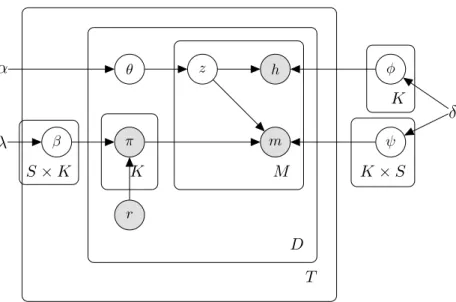
α θ z h m l β π φ ψ r δ λ M K S×K D K SFigure 2.1: Graphical Representation of ARID model. The outer box representsDreviews, while the inner box containsM phrases
ARID model, shown in Fig. 2.1, captures the review generation process and the two dependencies described above. Following the conventional topic models for review analysis, we use random variables z and l to simulate the generating process of the head and the modifier terms respectively. The topic selection variable z is governed by a multinomial topic distributionθ. The sentiment variablelfor each opinion phrase is determined by the aspect sentiment variablesβ, the overall ratingrand the aspect switcherz.
Specifically, in ARID model, the variables πrepresenting aspect ratings are shaded in the graphical representation since they are observed in the training dataset. They become latent variables for prediction on unrated reviews. The latent sentiment variablelis sampled fromβkwherek is determined by the value ofz. The overall rating variabler serves as a
The formal generative process of our model is as follows, whereDirdenotes Dirichlet distribution andMultdenotes Multinomial distribution.
• For each aspectk and each overall rating value ofr
– Sample the aspect sentiment distributionβr,k∼Dir(λ)
• For each reviewxd,
– Sample latent topic distribution variableθd∼Dir(α)
– For each aspectkfrom1toK in the review, ∗ Sample aspect ratingπd,k ∼Mult(βrd,k) – For each phaseifrom1toM in the review,
∗ Sample aspect indicatorzi ∼Mult(θd)
∗ Sample sentiment indicatorli ∼Mult(βrd,zi)
∗ Sample head termhi ∼Mult(zi, φ)
∗ Sample modifier termmi ∼Mult(li, ψ)
2.4.4
ARIH Model
In this section, we improve a previous model. The new model ARIH (Aspect and Rating Inference using Hotel specific aspect rating priors) is shown in Figure 2.2. Like the previous model ARIM (Aspect and Rating Inference Merging aspect sentiments and phrase sentiments) [XLR15], we assume the aspect sentiment is equivalent to the phrase sentiment. In other words, the modifier terms that belong to one aspect share the same sentiment, i.e., the aspect sentiment. Therefore, we can use only one polarity indicator for both the aspect and the phrase. In particular, the aspect ratings π are modeled as in ARID, but π also indicates the phrase sentiment. Since the aspect ratings are available in the training data,
α θ z h m π β φ ψ r δ λ M K S×K D T K K×S
Figure 2.2: Graphical Representation of ARIH model
the information fromβtomis blocked byπaccording to the d-separation theory of graphical models [Bis07]. Therefore, the modifier term is determined by the aspect ratingsπinstead ofβ, and the aspect variablez. In the generative procedure of ARIH, the modifier termmi
is sampled fromψzi,πzi. π follows a multinomial distribution with parameterβ.
In ARID and ARIM, we assume the aspect rating variables π is conditioned on the global aspect sentiment distributions β, which has the size of K×S. For each aspectk and each global ratings, we have a Dirichlet distribution over ratingsβ. However, making the aspect rating conditioned on the global aspect sentiment distributions ignores the aspect rating biases of different hotels. Each hotel has its own pros and cons. For example, despite the hotels may have the same global rating, the one located near the airport would receive higher ratings onlocation, while those having good service may be rated higher onservice. If both of them get 4-star ratings, the aspect ratingsπ have the same global prior distributionβk,s=4.
To verify our assumption, we use Principle Component Analysis (PCA) to investigate the distribution ofβ. In particular, for each hotel, we compute the average ratings on each aspect, which give the same overall rating. It generates a matrixP, wherePi,j is the average
overall rating 1 2 3 4 5 largest variance ratio 0.704 0.753 0.831 0.871 0.965 Table 2.2: The largest variance ratio of principle component analysis
rating of thejth aspect of theith hotel. We have fiveP matrices for each possible overall rating ranges from 1 to 5. We use PCA to reduce the dimension of P and compute the largest variance ratio in Table 2.2. The variances of aspect ratings are quite large, especially for 5-star overall rating. If the variance is0.871, for example, the ratings on some aspect can be1-star difference for difference hotels. The analysis shows that the same overall ratings often imply different weights on aspects, which depend on the type of hotels.
Different from ARIM, ARIH associates each hotel with its own aspect rating priors βt,r,k. Here, βt,r,k represents the aspect rating distribution on aspect k when the overall
rating isr for hotelt. ARIH extends ARIM by using hotel-specific beta, therefore ARIM can be considered as a special case of ARIH. If we apply ARIH on the collection of reviews of one hotel. ARIH is reduced to ARIM. In Figure 2.2, the graphical model ARIH has one more layer than ARIM. The variables for each review in ARIH model have one more subscript to indicate which hotel the review comes from.
2.4.5
Estimation
ARID Model
There are two methods widely used for parameter estimation, i.e., Gibbs sampling [GS04] and variational inference [BNJ03]. Since updating equations using Gibbs sampling is relatively easy to derive and implement, we adopt collapsed Gibbs sampling (CGS) which integrates out the intermediate random variablesθ,φ,β, andψ. For prediction, we learn the distributionsφ,ψ of the head and the modifier terms as well as the global aspect sentiment
distributionβ fromz andl. The Gibbs sampling repeatedly samples latent variablesza,b
andla,bconditioned on all other latentz andlin documentafor phraseb.
In ARID model, the joint probability is p(z, l, h, m|α, λ, δ, π, r) = Z p(θ|α)p(z|θ)× p(h|z, φ)p(φ|δ)× p(π|β, r)p(l|β, r, z)p(β|λ)× p(m|l, ψ)p(ψ|δ)dθ dβ dφ dψ , (2.1)
where we integrate outθ,ψ,βandφ.
We define two countersNd,r,k,s,u,vandCd,r,k,sto count the numbers of the occurrences
of opinion phrases fd,i = hhd,i = u, md,i = vi and the aspect rating πd,k. Specifically,
fd,i =hhd,i = u, md,i =viis the phraseiof documentdwhich has the head termuand
the modifier term v. Nd,r,k,s,u,v is the number of times that the pair of head term u and
modifier termvis assigned to aspectkand sentimentsin documentd, whose overall rating isr. Cd,r,k,s is the indicator of the documentdthat gives aspect ratingson aspectkwhen
the overall rating of the document isr. Although given documentd, its overall ratingrdis
determined, we use the overall rating as a subscript for convenience.
Nd,r,k,s,u,v = M
X
i=1
I[rd =r, zd,i =k, ld,i =s, hd,i =u, md,i =v], (2.2)
Cd,r,k,s =I[rd=r, πd,k=s], (2.3)
where the function I is the identify function. We replace the subscript N by ∗ when summing out the counter along the subscript indices. For example,
Nd,r,∗,s,u,v = K
X
k=1
Gibbs sampling samplesza,bandla,bsimultaneously
p(za,b, la,b|z−(a,b), l−(a,b), α, δ, λ, h, m, r, π)∝(Na,r−(aa,b,za,b) ,∗,∗,∗+α)×
N∗−,∗(,za,b)
a,b,∗,ha,b,∗+δ
N∗−,∗(,za,ba,b),∗,∗,∗ +U δ
× N∗−,r(a,b)
a,za,b,la,b,∗,∗+C∗,ra,za,b,la,b+λ
N∗−,r(aa,b,z)a,b,∗,∗,∗+C∗,ra,za,b,∗+Sλ
× N∗−,∗(,a,b∗,l) a,b,∗,ma,b +δ N∗−,∗(,a,b∗,l) a,b,∗,∗+V δ . (2.5)
It turns out that the aspect ratingsπcan be considered as pre-observed phrase sentiment counts for the global aspect sentiment distributionβ. Therefore, the prior parameterλcan be dropped. We estimate the aspect sentiment distributionβ with the aspect ratingsπand the overall ratingsrof the training data before Gibbs sampling with Equation (2.6).
βr,k,s =
C∗,r,k,s
C∗,r,k,∗
. (2.6)
The third term of the right hand of Equation (2.5) is replaced by N∗−,r(a,b)
d,za,b,la,b,∗,∗+ ˜λβrd,za,b,la,b
N∗−,r(da,b,za,b) ,∗,∗,∗+ ˜λ
, (2.7)
whereλ˜is the scaling factor forβ. The parameters of ARIDψ,φ,θare estimated by φk,u= N∗,∗,k,∗,u,∗+δ N∗,∗,k,∗,∗,∗+U δ , ψs,v= N∗,∗,∗,s,∗,v+δ N∗,∗,∗,s,∗,∗+V δ , θd,k = Nd,rd,k,∗,∗,∗+α Nd,rd,∗,∗,∗,∗+Kα . (2.8) ARIH
The iterative updating function of Gibbs sampling for ARIH has little difference from that for ARID.
p(za,b|z−(a,b), α, δ, λ, h, m, r, π)∝(Na,r−(a,ba,z)a,b,∗,∗,∗+α)×
N∗−,∗(a,b,z )
a,b,∗,ha,b,∗+δ
N∗−,∗(,za,ba,b),∗,∗,∗+U δ
× N∗−,∗(,za,ba,b),πa,za,b,∗,ma,b+δ
N∗−,∗(,za,ba,b),πa,za,b,∗,∗+V δ
The parameters of ARIH modelφ,θis estimated by Equation (2.8), but the number ofψis K×S, which is estimated by ψk,s,v = N∗,∗,k,s,∗,v+δ N∗,∗,k,s,∗,∗+V δ . (2.10) We estimateβby βt,r,k,s = Ct,r,k,s Ct,r,k,∗ , (2.11)
where Ct,r,k,s counts the number of the reviews which assign the overall ratingr and the
aspect ratingson the aspectk for hotelt.
2.4.6
Incorporating Prior Knowledge
We use a small set of seed words to initialize the aspect term distribution φ [WLZ10]. Without any prior knowledge, we have to set the number of topics and align the generated aspects with predefined aspects. It is neither necessary nor easy for analyzing hotel reviews, because we are interested in only a few widely-used aspects. We consider the seed words as the pseudo-counts, i.e., the amount ofδwords are added toφk,u before Gibbs sampling.
2.4.7
Prediction
The goal of our models is to predict aspects and ratings on the unrated reviews. Given an opinion phrasefd,i =hhd,i, md,iiand the overall ratingrdin a new documentd, we identify
the aspect on which the phrasezˆd,i comments and predict the aspect ratingˆld,i.
We use CGS to sample z and l together from p(z, l|h, m, r, α, β, φ, ψ), where θ is integrated out. Here, two subscripts d and i are dropped for simplicity. After enough sampling iterations, we first estimate the predicted aspectzˆby the most frequentz among the pairs of hz, li. It is equivalent to use MAP (Maximum a posteriori estimation) by integrating outl. Then given the predictzˆ, we predict ˆl withE[p(l|z, h, m, r, β, φ, ψ, αˆ )].
The reason why we consider the expectation of l is that the aspect ratings are numerical, rather than independent discrete category labels. The probability of each possible valuel are kind of importance. The aspect mixture weightθfor a new document can be learned by Gibbs sampling as well, but we simply assumeθis a uniform distribution, because a review on hotel should comment on all the concerned aspects.
When ARIH is applied on the reviews without aspect ratings, we integrate out the latent aspect rating variableπandθ, then samplezfromp(z|h, m, r, α, β, φ, ψ)to compute MAP ˆ
z, like ARID model. For each opinion phrase hh, mi whose zˆ = k, we assign the most probable sentiment scoresˆ= arg maxsψz,s,mˆ to the modifier termm. Then, the estimated
aspect ratingE[p(πk|z, h, m, r, β, φ, ψ, αˆ )]is computed by averaging the scoresˆsof all the
opinion phrase whosezˆ=k.
2.4.8
Experiments
In this section, we describe the review data we use and evaluate the performance of our models.
Data and settings
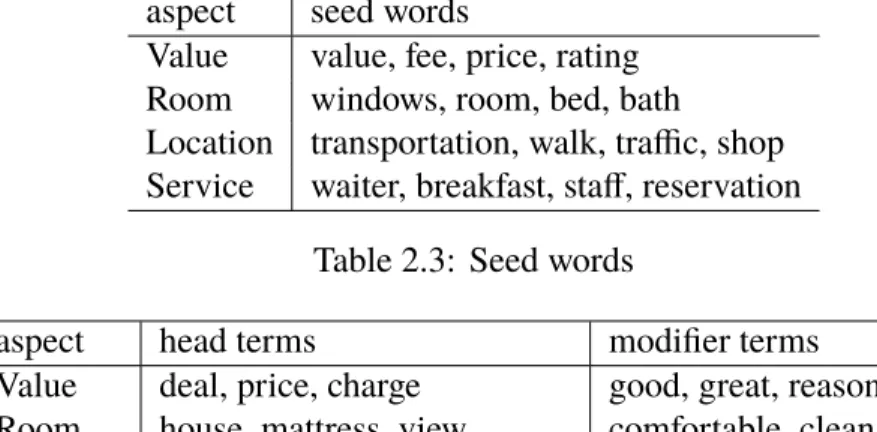
The data set we use is crawled from TripAdvisor [WLZ10]. Each review in the data set is associated with an overall rating and 7 aspect ratings, which are within the range from 1 to 5. However some aspects such asCleanliness,Check in / front deskare rarely rated. To better train and evaluate models, we use only four mostly commented aspects,Value, Room,LocationandService. We keep reviews with all four aspect ratings to evaluate the models. We use NLTK1to tokenize the review text, remove stop words, remove infrequent
words, apply POS-Tagging technique [ME11] to extract opinion phrases, and filter out short reviews which contains less than 10 phrases. The final data set contains 1,814 hotels and
aspect seed words
Value value, fee, price, rating Room windows, room, bed, bath
Location transportation, walk, traffic, shop Service waiter, breakfast, staff, reservation
Table 2.3: Seed words
aspect head terms modifier terms
Value deal, price, charge good, great, reasonable Room house, mattress, view comfortable, clean, nice Location parking, street, bus great, good, short Service manager, check-in, frontdesk friendly, good, great
Table 2.4: Frequentest head terms and modifier terms
31,013 reviews. We randomly take 80% of data as the training data set, the rest of them as the test data set. 10-fold cross validation is used to tune the hyper-parameters αandβ on the training data set. The seed words used to initialize the head term distributionφ is in Table 2.3, which is a small set of words.
Aspect Identification
In this section, we demonstrate that the ability of identifying meaningful aspects. Since the head terms found by the two models are not so different from each other, we present top 3 frequentest head terms for each aspect in Table 2.4. The listed head terms are the most frequent words, which have highest values in φk. We also list top 3 frequentest modifier
terms for each aspect. The models can successfully extract ratable aspects from reviews and learn aspect-specific sentiment words as well. For example, “comfortable” is frequently used to describe aspect “Room”, but not for other aspects. We also observe that people also like to use vague sentiment words for all aspects, such as “good”, “great”.
Metric
We use RMSE(Root-mean-square error)2to measure the performance of predicting aspect
ratings for each hotel in the test set. Assuming the predicted aspect rating for hoteld on aspectk beπˆd,kand ground-truthπd,k, RMSE is represented as Equation (2.12).
RMSE(ˆπd,k, πd,k) = v u u t 1 DK D X d=1 K X k=1 (ˆπd,k−πd,k)2 (2.12)
RMSE measures the accuracy of the prediction on aspect ratings. We also use Pearson correlation in Equation (2.13) to describe the linear relationship between the predicted and the ground-truth aspect ratings. Here,πdis the vector of the aspect ratings of documentd.
ρaspect= 1 D D X d=1 ρ(πd,πˆd) (2.13)
Since the rating score is an ordinal variable, we adopt Pearson linear correlationρaspect on the aspect ratings within each review to evaluate how a model keeps the aspect order in terms of their scores. For each aspect, we also compute the linear correlation across all hotelsρhotelas in Equation (2.14). The measure is used to test whether the model can predict the order of hotels in teams of an aspect rating. πk consists of all the aspect ratings of all
the hotels on the aspectk.
ρhotel= 1 K K X k=1 ρ(πk,πˆk) (2.14)
Aspect Rating Prediction
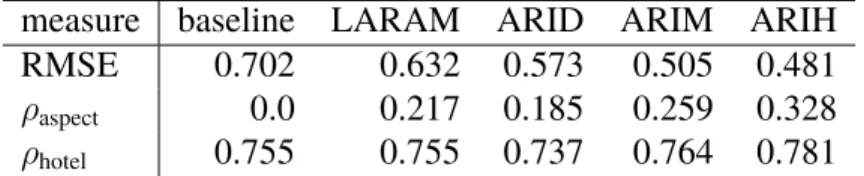
We present the experiment results on the reviews without any aspect rating in Table 2.5. We compare the results between our models and one baseline. The baseline predicts all the aspect ratings of each review with the given overall ratings. The baseline predicts the aspect ratings of a review with a constant value, soρaspect= 0. The results indicate that ARID and ARIH(ARIM) outperform the baseline and LARAM [WLZ10]. The main reason is that our
measure baseline LARAM ARID ARIM ARIH
RMSE 0.702 0.632 0.573 0.505 0.481
ρaspect 0.0 0.217 0.185 0.259 0.328 ρhotel 0.755 0.755 0.737 0.764 0.781
Table 2.5: Performance of Aspect Inference
models can capture the dependency between the aspects, the aspect ratings and the modifier terms, by taking into the account the aspect ratings in the training data set. In terms ofρhotel, all the approaches have similar scores. On the hotel level, the aspect ratings are averaged across all reviews, while the goals of these four methods are predicting the ratings of each individual review. The difference between each method on predicted aspect ratings for each review is small. Therefore, there is no much difference on the measureρhotel.
Moreover, ARIH (ARIM) is better than ARID, which confirms our observation. The sentiment of aspects and modifiers is not much different from each other. Reviewers express the same polarity with different modifier terms, when commenting on one aspect. Therefore, merging aspect sentiment with modifier sentiment does not decrease the capability of the models. ARID model hasKkinds of modifier term distributionsψ, while ARIH hasK×S, since the modifier termm in ARIH is dependent on the aspect switcher z and the aspect sentimentπ. ARID estimates a global sentiment distribution across all aspects, while ARIH can learn aspect-specific sentiment distribution by modeling aspect-dependent sentiment. In the inference, the aspect on which the opinion phrases comment is determined by its head term h. ARID infers the polarity for each modifier term from a coarse sentiment distribution, while ARIH can obtain more find-grained sentiment using itsK×Smodifier term distributions. The parameterψ in ARIH fine-tunes the predicting results based onβ and φ. Therefore, in terms of Pearson correlation metric, ARIH has better performance than ARID.
ARIH model has more aspect rating distributionsβthan ARIM. It gives better accuracy on predicting the polarity of the modifier terms. The difference between the aspect ratings
Figure 2.3: Aspect Rating Dispersity of
Ho-tels Figure 2.4: Aspect Rating Prediction on Re-views of Different Dispersities in β and those in reviews may influence the performance. Following the experiments in [LZC+14], we investigate the relationships between the dispersity and RMSE of ARIH.
The dispersity is given by Equation (2.15), where the we take the mean value of β and compare it with the aspect ratings of reviews for each hotel. As displayed in Figure 2.3, for most hotels, the aspect ratings dispersity are around 1.0 and have a clear Gaussian distribution. Moreover, there are some hotels having 0dispersity, since the highest rating score is 5. There is very little gap between the aspect ratings and the averaged ones for highest-rated hotels. dis= s PK i=1(E[βt,k]−πt,k)2 K (2.15)
As Figure 2.4, we randomly prepare data set with different dispersity and report RMSE of ARIH on them. “dis >0.1” means that we use the reviews which has dispersity larger than0.1. ARIH performs well on reviews with dispersity lower than1.3. Due to the small training data and the high variance of aspect ratings on reviews with large dispersity, the performance of ARIH decreases.
2.5
Conclusion
In this chapter, we propose two models for aspect identification and sentiment inference, ARID and ARIH. They utilize the overall ratings and the aspect ratings in reviews to identify the aspects and uncover the corresponding hidden aspect ratings. The models are based on topic models, but explicitly consider the dependency between the aspect ratings, the aspect terms, and sentiment terms. The opinion phrases which consist of head terms and modifier terms are extracted by simple POS-Tagging techniques. The most important contribution is that the models incorporate the aspect ratings as observed variables into the models and significantly improve the prediction performance of aspect ratings. The difference between them is that ARIH merges the sentiment variables of the modifier terms with those of the aspects. ARIH further considers the hotel-specific aspect rating priorsβ. Gibbs sampling and MAP is used for estimation and inference respectively. The experiments on large hotel review data set show that the models have better performance in terms of RMSE and Pearson correlation. In the future, we would investigate the methods that can automatically generate ratable aspects from the text, not from the predefined seed words. Another interesting research topic is to explore the relation between different aspects [GX13], because the different aspects in one review may share the similar sentiments.
CHAPTER 3
Deep Learning Models for Aspect Based Sentiment Analysis
3.1
Introduction
Sentiment analysis is an interdisciplinary research field involving natural language pro-cessing, web data mining, social media research, and consumer research. Text sentiment analysis requires techniques in natural language processing, such as named entity recogni-tion to recognize target items of interest, polarity analysis to determine whether a review expresses positive attitude, and syntax analysis on words and sentences. It also needs infor-mation retrieval techniques about data storage and search for opinions, images, and videos that users contribute to websites. The impressing needs of personalized recommendation systems brings up other challenges, like accurately identifying the patterns of user behaviors in online shopping, and recommending goods and services by tracking user preferences.
It is important to point out that sentiment analysis is a part of various applications and systems. A typical example is review-oriented website, in which sentiment analysis is essential to the website. For example, Yelp hosts more than 142 million reviews, which provide most of the content. The main function is to collect and distribute user generated reviews and ratings. People can access a vast pool of quantitative and qualitative feedbacks provided by other users on hotels, restaurants, or other facilitates. When uploading reviews, users are asked to rate the target place on a five point scale. Reviewers have an option to add photos to support their reviews. Visitors who read reviews can help the website to rank existing reviews by clicking buttons of “useful”, “funny”, and “cool”. Using techniques of sentiment analysis, the website can fulfill users’ demands for fast digesting and analyzing large-scale collections of comments, such as summarizing a lot of reviews by aggregating and highlighting well-received items in the majority of reviews, or providing personalized rankings of restaurants according to the past reviews of the user. In recommendation
sys-tems, the personalized recommendation results can be enhanced by considering sentiment polarities of reviews at fine-grained level [PL08].
In this chapter, we focus on text sentiment analysis using deep learning techniques. According to the taxonomy of sentiment analysis [YSZ17a], it consists of two subcategories: opinion mining and emotion mining. Opinion mining studies the attitude towards some entities implied in text expression; while emotion mining is about the feeling of authors. We only cover recent research effort with deep learning concentrates on opinion mining. In 2008, Pang et al.[PL08] gave a comprehensive survey on opinion mining, which covers various tasks such as feature extraction, entity recognition and document summarization, but the methods in that survey heavily rely on feature engineering. In 2012, another survey by Liu et al. [LZ12] studied topic of sentiment and subjectivity classification, aspect based sentiment analysis, and opinion spam detection. In 2017, Yadollahi et al. [YSZ17a] focused on the text sentiment analysis and summarized recent work about opinion mining and emotion mining. However, neither of them cast light on the hot trend of deep learning methods. In 2018, Zhang et al. [ZWL18] also summarized deep learning models on sentiment analysis, but in this chapter we cover most recent research work and focuses on review data as well as various tasks.
Sentiment analysis [PL08, LZ12] is a comprehensive research topic about people’s opinion, appraisals, attitudes, and emotions toward entities. We use the review from SemEval 2016 Task 4 [PGP+16] and walk through an example to introduce a big picture.
SemEval workshop defines several subtasks at aspect level, and the released datasets are popular benchmarks for aspect based sentiment analysis.
Let’s look at a concrete review example.
1. Judging from previous posts this used to be a good place, but not any longer.
2. We, there were four of us, arrived at noon - the place was empty - and the staff acted like we were imposing on them and they were very rude.
3. They never brought us complimentary noodles, ignored repeated requests for sugar, and threw our dishes on the table.
4. The food was lousy - too sweet or too salty and the portions tiny. 5. After all that, they complained to me about the small tip.
When reading these reviews, we notice that they express a general negative attitude to the restaurant. Sentences (1) gives a negative opinion on general impression. In sentence (2) and (3), the reviewer is disappointed by the service. In sentence (4), the quality of food further makes the review feel that he should not be there. Again, sentence (5) states a discomfort experience about service again. Certainly, the overall sentiment polarity is negative. We also can identify different targets in different sentences. Sentence (2), (3) and (5) are about service, while the aspect of sentence (4) is food. Besides analyzing the overall sentiment, aspect based sentiment analysis introduces several subtasks at fine-grained level, which would be discussed on Section 3.
The surge of interest in sentiment analysis on review drives researchers to develop new technologies based on machine learning and data mining. Researchers develop automatic tools to distill opinions, detect sentiment polarities, and summarize user-generated text on the same topic. Conventional machine learning methods heavily depend on the represen-tation of data to discover the mapping from features to targets. Feature engineering is as critical as modeling. Handcrafted features usually require a large amount of domain exper-tise and human labor. If one trains a classic supervised learning method such as SVM or Bayesian classification to predict the sentiment polarity of a movie review, he needs to en-gineer a set of discriminative features. The traditional methods heavily relied on following techniques [PLV02]:
Frequency Features These features are commonly used in information retrieval and
opin-ion mining. A vocabulary of terms is built in the first place, which is used to index the terms that appear in the dataset. For each document, a high-dimension vector
encodes the presence/frequency of all terms according to the dictionary. The Tf-idf weighting is a default option for many tasks.
N-gram Features A n-gram is a sequence of adjacent words in a document. Recent
study [WM12] shows that bi-gram features gives consistent performance gains on sentiment classification, when Naive Bayes or SVM classifier is used.
Part-of-Speech Features A part-of-speech feature of a word indicates useful grammatical
properties. For instance, in sentiment polarity classification, adjectives are good indicators of polarity in most cases. While nouns are most likely to be aspect terms. The rich linguistic features are also widely used in named entity recognition and extraction of aspect terms [RR09].
Lexicons The words in lexicons express either positive or negative sentiments in most
scenarios. They are collected manually or by unsupervised learning [Tur02]. The semantic orientation of such words are estimated by computing pointwise mutual information.
Negations Definitely, negation words such as “not” may reverse the polarity of a sentence.
It is a common practice to attach “NOT” to the adjective near negation words to create a new word token. However, some exceptions like “no wonder” needs careful treatment.
Syntactic Dependency The tree of syntactic structure of a sentence could be used to derive
seeds and rules for aspect term extraction [QLBC11].
Recently, deep learning has enabled the representation learning within end-to-end deep neural networks. The main idea of deep learning was re-branded with many names [GBC16], until recent revival in 2006 [HOT06]. The idea of deep learning went through several ups and downs since 1940s [GBC16]. The key concepts, such as distributed representation [HS], back-propagation [RHW], long short-term memory (LSTM) [HS97] and convolutional
neural network (CNN) [LBBH98], still remain the essential ingredients of today’s deep learning models. However, they did not receive much attention as they do today, until Geoffrey Hinton introduced deep belief network in 2006, a generative graphical model which could be efficiently trained by layer-wise pre-training [HOT06]. Since then, deep learning has been reshaping the landscape of many related research domains, such as computer vision, natural language processing, speech recognition and reinforcement learning [LHB15].
The availability of large-scale labeled datasets and advances of computational power contribute to the revival of deep learning thoughts developed decades ago. The dataset size grows exponentially, from MNIST [LBBH98] which consists of 70 thousand scanned hand-written digits, to ImageNet [DDS+09] having 1.2 million images of 1000 categories,
and to the most recent Youtube-8M [AEHKL+16] composed of 8 million annotated videos
(total 500k hours). Deep learning develops in the era of Big Data. It is still an open question that how to leverage large amount of data, especially, most of which are unlabeled data from industry with unsupervised learning.
Large models are possible to be trained with large datasets, but they cannot live without massive computational power. Fast graphical processing units (GPUs) has been intro-duced [RMN09] to machine learning, which brings incredible speedup to model training. Large clusters and dedicated servers like Nvidia DGX-1 have been built for trainig larger and larger deep learning models. Tensor processing units (TPUs), which have even up to 70x faster than GPUs and more power efficiency, have been used in Google datacenter and Google Cloud [JYP+17].
Apart from the advent of faster hardware, the growth of deep learning is also driven by better software infrastructure, including CUDA [NBGS08], Theano [BBB10], Caffe [JSD+14],
Torch [CK11], Tensorflow [AAB+16], Pytorch (http://pytorch.org), Caffe2 (http://caffe2.ai),
be-comes easy to develop deep learning models on advanced computing hardware without dealing with low level programming.
The capacity of the neural models is increasing dramatically in terms of the num-ber of layers or the numnum-ber of neurons. For example, in computer vision, the numnum-ber of layers of modern neural networks starts from 8 layers (AlexNet [KSH12]), 16 lay-ers (VGGNet [SZ15]), 22 laylay-ers (GoogleLeNet [SLJ+15]) to astonishingly 152 layers
(ResNet [HZRS16a]); while the error rates on ILSVRC image classification task dropped drastically.
In conclusion, the renaissance of deep learning can be contributed to large-scale data, powerful models, and increased computational resources. Deep learning methodology has been sweeping over many research areas. Driven by this evolution, this survey provides an overview of existing methods proposed for sentiment analysis and opinion mining using deep learning. To make this survey self-contained, a short introduction to neural networks and essential modules is provided first. Afterward, we present the architectures of neural networks employed for the important tasks in sentiment analysis and opinion mining.
3.2
Basic Modules in Deep Learning
3.2.1
Word Embeddings
For many deep learning applications in natural language processing, word embeddings are cornerstones for deep neural networks. However, the concept of word embedding is not new. The idea could date back to 1950s, “You shall know a word by the company it keeps” proposed by Firth [Fir57]. It is also called distributional semantic model (DSM) or distributed representation [Hin84], because it is assumed that the meaning of a word can be learned by its distribution in text. Today, the word embeddings are represented in terms of high-dimension vectors which can capture semantic and syntactic information from text.
Figure 3.1: The diagram of skip-gram [MCCD13]
Early DSMs, such as probabilistic Latent Semantic Analysis [Hof99] and Latent Dirchel-let Analysis [BNJ03], have been developed in 1990s, followed by neural network based em-bedding models such as distributed representation learning for words [BDVJ03, HSMN12] and multi-tasking embedding learning model SENNA [CW08]. The prevalence of word embedding begins CBOW [MCCD13, MSC+13] and GloVe [PSM14] in 2013 and 2014.
Word2vec is arguably the most popular word embedding model in recent years. It includes two architectures CBOW and skip-gram. Take skip-gram for an example, as shown in Figure 3.1. The objective function of skip-gram sums the log likelihood of the surrounding words given the target word in a slide window:
1 N X i X j∈n(i) logp(wj|wi)
Skip-gram does not have hidden layers as early neural network based models [BDVJ03]. Therefore, p(wj|wi) = exp(v0>w jvwi) P kexp(vw0>kvwi) ,
wherewiandwjare the word embedding vectors that would be trained by gradient descent.
An efficient training involves dozens of approximation and training techniques [MSC+13].
In many NLP applications, most neural networks have embedding layers, in which the words are embedded to a lower-dimension space and can be directly trained during back-propagation training. However, the embedding vectors are by-products and are limited to the availability of data in the application domain. Methods such as word2vec explicitly aim to generate word embeddings and can explore massive unlabeled data. Therefore, in most cases, the parameters of the embedding layers are initialized with pre-trained word embeddings, so that the down-stream task can leverage the semantic relationships from a large data corpus. For example, one version of GloVe pre-trained word vectors is trained on a data set of 840 billion tokens.
Although both word2vec and GloVe claim superior performance over traditional DSMs in many tasks, a recent study [LG14] unveiled that word2vec implicitly factorizes a word-context matrix of Pointwise Mutual Information (PMI). It means all of these models share similar nature: matrix decomposition. More detailed analysis [LGD15] isolates various factors that account for the success of neural networks based embedding models.
3.2.2
CNN
CNN has been an essential architecture for deep learning researchers. It has a long history, which dates back to the study of cells in animal visual cortex in 1959 [HW59]. In 1990s, LeCun et al. invented and improved first practical CNN, LeNet-5 [LBD+89, LBBH98],
for hand-written digit recognition. It did not gain much attention compared with sup-port vector machine [CV95] and probabilistic graphical models [KF09] at that time, until the tremendous success of AlexNet [KSH12] in ILSVRC 2012. Large training data and computational resource to CNN is what aviation gasoline to jet engines. The
represen-Figure 3.2: The diagram of CNN for text classification [Kim14]
tative variations inspired by AlexNet include VGGNet [SZ15], GoogleNet [SLJ+15] and
ResNet [HZRS16a].
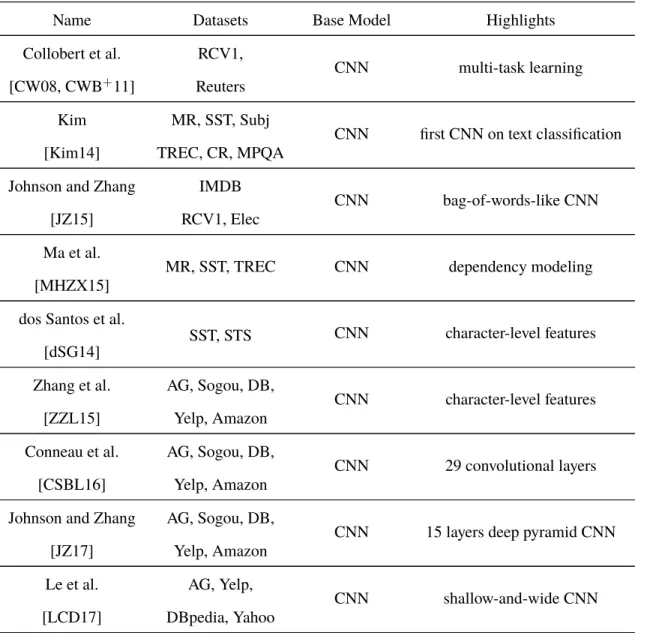
A convolutional layer contains multiple kernels (or filters) to compute feature maps. Specifically, unlike fully-connected layers where each neuron is connected all neurons of previous layers, a convolutional neuron is only connected to a few neurons in a small region called receptive field (local connections). Afterwards, an element-wise activation function is applied. Suppose the input feature is a matrixX, a 2D convolutional neuron computes a new feature at location(i, j)as
zi,j =f k/2 X m=−k/2 k/2 X n=−k/2 Xi+m,j+nWm+k/2+1,n+k/2+1+b .
It is often written asZ=XW+b, wheredenotes the convolutional operation. bis a scalar bias andfis a non-linear activation function, such as ReLU [NH10] or tanh function. A max-pooling layer takes the maximum of values in a region.
yi,j = max{zm,n}, (m, n)∈ Ri,j ,
whereRis a local region around location(i, j), which is usually a square region. Multiple convolutional layers and pooling layers can be stacked together in a special way. Finally, there are several fully-connected layers on top of them.


![Figure 3.1: The diagram of skip-gram [MCCD13]](https://thumb-us.123doks.com/thumbv2/123dok_us/9953535.2487969/45.918.336.631.112.474/figure-the-diagram-of-skip-gram-mccd.webp)
![Figure 3.2: The diagram of CNN for text classification [Kim14]](https://thumb-us.123doks.com/thumbv2/123dok_us/9953535.2487969/47.918.192.786.118.364/figure-diagram-cnn-text-classification-kim.webp)