!" #$%&'%& ()*+,"-,%. ,% /,&0$11'%& 2+&1),"&,3 $1
(1$!&4D1,6'%7
!"#$% &"$'()
U%+'$,)+-(- &(,./) III -$1+23(. 4,5267(
I%)8+8"8$ I1D:; <$8=/,7)(%-U%+'$,)+-(- &(,./) III -$
;%>$. &"$'()
U%+'$,)+-(- &(,./) III -$?$#()8+(% 4("%$
4@1 A(# BU D(,C)8(-8 [email protected]&(,C$% D"$,,$,/
U%+'$,)+-(- &(,./) III -$!$6( !$E(+$
∗ U%+'$,)+85 /F @,$>/% [email protected]ABSTRACT
BitTorrent is the most popular P2P content delivery appli-cation where individual users share various type of content with tens of thousands of other users. The growing popular-ity of BitTorrent is primarily due to the availabilpopular-ity of valu-able content without any cost for the consumers. However, apart from required resources, publishing (sharing) valuable (and often copyrighted) content has serious legal implica-tions for users who publish the material (or publishers). This raises a question that whether (at least major) content pub-lishers behave in an altruistic fashion or have other incen-tives such as!nancial. In this study, we identify the content publishers of more than 55K torrents in two major BitTorrent portals and examine their behavior. We demonstrate that a small fraction of publishers is responsible for 67% of the published content and 75% of the downloads. Our investi-gations reveal that these major publishers respond to two dif-ferent pro!les. On the one hand, antipiracy agencies and ma-licious publishers publish a large amount of fake!les to pro-tect copyrighted content and spread malware respectively. On the other hand, content publishing in BitTorrent is largely driven by companies with!nancial incentives. Therefore, if these companies lose their interest or are unable to publish content, BitTorrent traf!c/portals may disappear or at least their associated traf!c will be signi!cantly reduced.
∗Reza Rejaie was Visiting Researcher at Institute IMDEA Networks, September 2009 - August 2010, while this study was performed.
Permission to make digital or hard copies of all or part of this work for personal or classroom use is granted without fee provided that copies are not made or distributed for pro!t or commercial advantage and that copies bear this notice and the full citation on the!rst page. To copy otherwise, to republish, to post on servers or to redistribute to lists, requires prior speci!c permission and/or a fee.
ACM CoNEXT 2010, November 30 – December 3 2010, Philadelphia, USA.
Copyright 2010 ACM 1-4503-0448-1/10/11 ...$10.00.
Categories and Subject Descriptors
C.2.4 [Computer Communication Networks]: Dis-tributed Systems –Distributed Applications
General Terms
Measurement, Economics
Keywords
BitTorrent, Content Publishing, Business Model
1. INTRODUCTION
Peer to Peer (P2P) file-sharing applications, and more specifically BitTorrent, are a clear example ofkiller In-ternet applications in the last decade. BitTorrent is currently used by hundreds of millions of users and is responsible for a large portion of the Internet traffic [4]. This in turn has attracted the research commu-nity to examine various aspects of swarming mechanism in BitTorrent [10, 16, 13] and propose different tech-niques to improve its performance [19, 15]. Further-more, other aspects of BitTorrent such as demography of users [22, 12, 20] along with the security [21] and pri-vacy [6, 7] issues have also been studied. However, the socio-economic aspects of BitTorrent in particular, and other P2P file sharing systems in general, have received little attention. In particular, the availability of popu-lar and often copyrighted content (e.g. recent TV shows and Hollywood movies) to millions of interested users at no cost is the key factor in the popularity of BitTorrent. This raises an important question about the incentive of publishers who make these content available through BitTorrent portals. Despite its importance to properly understand the popularity of BitTorrent, to our knowl-edge prior studies on BitTorrent have not tackled this critical question.
Bit-Torrent from a socio-economic point of view by unrav-elling who publishes content in BitTorrent, and why. Toward this end, we conduct a large scale measurement over two major BitTorrent portals, namely Mininova and the Pirate Bay, to capture more than 55K published content that involve more than 35M IP addresses. Us-ing this dataset, we first examine the contribution of the individual content publishers and illustrate that a small fraction of publishers (∼100) are responsible of uploading 67% of the content that serve 75% of the downloads in our major dataset. Furthermore, most of these major publishers dedicate their resources for publishing content and consume few or no published content by others, i.e. their level of content publica-tion and consumppublica-tion is very imbalanced. In addipublica-tion to allocating a significant amount of resources for pub-lishing content, these users often publish copyrighted material, which has legal implications for them [1, 2]. These observations raise the following question: what are the main incentives of (major) content publishers in BitTorrent?.
To answer this important question, we conduct a sys-tematic study on the major publishers in BitTorrent. We show that these publishers can be broadly divided into two different groups: fake publishers who publish a large number of fake content andtop publishers who publish a large number of often copyrighted content. We also identify the main characteristics (i.e.signature) of publishers in each group such as their seeding behav-ior and the popularity of their published content. We investigate the main incentives of major (non-fake) pub-lishers and classify them into three categories(i) Pri-vate BitTorrent Portals that offer certain services and receive financial gain through ads, donations and fees, (ii) Promoting web sites that leverage published con-tent at BitTorrent portals to attract users to their own web site for financial gain, and (iii) Altruistic Major Publishers. We characterize these three groups of pub-lishers and present the estimated value (income) of the associated web sites to support our claims about their incentives.
The main contributions of this paper can be summa-rized as follows:
• We present a simple measurement methodology to monitor the content publishing activity in major BitTorrent portals. This methodology has been used to implement a system that continuously mon-itors and reports the content publishing activity in the Pirate Bay portal. The collected data is made publicly available through a web site.
• The distribution of the number of published
con-tent by each publisher is very skewed, i.e. a very small fraction of publishers (∼100) is responsible for a significant fraction of the published content
(67%) and even more significant fraction of the downloads (75%). These major publishers can be further divided into three groups based on their in-centives as follows: fake publishers, altruistic top publishers andprofit-driven publishers.
• Fake publishers are either antipiracy agencies or
malicious users who are responsible for 30% of the content and 25% of the downloads. These pub-lishers sustain a continuous poisoning-like index attack [17] against BitTorrent portals that affects millions of downloaders.
• Profit-driven top publishers own fairly profitable
web sites. They use major BitTorrent portals such as the Pirate Bay as a platform to advertise their web sites to millions of users. For this purpose they publish popular torrents where they attach the URL of their web sites in various manners. The publishers that pursue this approach are re-sponsible for roughly 30% of the content and 40% of the downloads in BitTorrent.
The rest of the paper is organized as follows. Section 2 describes our measurement methodology. Sections 3 and 4 are dedicated to the identification of major pub-lishers and their main characteristics (i.e.signature) re-spectively. In Section 5, we study the incentives that major publishers have to perform this activity. Section 6 presents other players that also benefit from content publishing. In Section 7 we describe our publicly avail-able application to monitor content publishing activity in the Pirate Bay portal. Finally Section 8 discusses related work and Section 9 concludes the paper.
.
2. MEASUREMENT METHODOLOGY
This section describes our methodology to identify the initial publisher of a file that is distributed through a BitTorrent swarm. Towards this end, we first briefly describe the required background on how a user joins a BitTorrent swarm.
Background: A BitTorrent client takes the following steps to join the swarm associated with fileX. First, the
client obtains the .torrent file associated to the desired swarm. The .torrent file contains contact information for the tracker that manages the swarm and the num-ber of pieces of file X. Second, the client connects to
the tracker and obtains the following information: (i)
the number of seeders and leechers that are currently connected to the swarm, and (ii) N (typically 50)
ran-dom IP addresses of participating peers in the swarm. Furthermore, if the number of neighbors is eventually lower than a given threshold (typically 20), the client contacts the tracker again to learn about other peers in the swarm.
To facilitate the bootstrapping process, the .torrent files are typically indexed at BitTorrent portals. Some
Portal Start End #Torrents #IP addresses
mn08 Mininova 09-Dec-08 16-Jan-09 - /20.8K 8.2M
pb09 Pirate Bay 28-Nov-09 18-Dec-09 23.2K/10.4K 52.9K
pb10 Pirate Bay 06-Apr-10 05-May-10 38.4K/14.6K 27.3M
Table 1: Datasets Description.
of the major portals (e.g.the Pirate Bay or Mininova1)
index millions of .torrent files [22], classify them into different categories and provide a web page with de-tailed information (content category, publisher’s user-name, file size, and file description) for each file. These portals also offer an RSS feed to announce a newly pub-lished file. The RSS feed provides some information such as content category, content size and publisher’s username for a new file.
Identifying Initial Publisher: The objective of our measurement study is to determine the identity of the initial publishers of a large number of torrents and to as-sess the popularity of each published file (i.e.the num-ber and identity of peers who download the file).
Toward this end, we leverage the RSS feed to de-tect the availability of a new file on major BitTorrent portals and retrieve the publisher’s username. In order to obtain the publisher’s IP address, we immediately download the .torrent file and connect to the associated tracker. This implies that we often contact the tracker shortly after the birth of the associated swarm when the number of participating peers is likely to be small and the initial publisher (i.e. seeder) is one of them. We retrieve the IP address of all participating peers as well as the current number of seeders in the swarm. If there is only one seeder in the swarm and the num-ber of participating peers is not too large (i.e. <20),
we obtain the bitfield of available pieces at individual peers to identify the seeder. Otherwise, reliably iden-tifying the initial seeder is difficult because there are more than one seeder or the number of participating peers is large2. Furthermore, we cannot directly
con-tact the initial seeder that is behind a NAT box and thus we are unable to identify the initial publisher’s IP address in such cases. Using this technique we were able to reliably identify the publisher’s username for all the torrents and the publisher’s IP address in at least 40% of the torrents.
Once we identify a publisher, we periodically query the tracker in order to obtain the IP addresses of the participants in the associated swarm and always solicit the maximum number of IP addresses (i.e. 200) from
1http://thepiratebay.org/, http://www.mininova.org/.
2Our investigations revealed two interesting scenarios for which we could not identify the initial publisher’s IP ad-dress: (i)swarms that have a large number of peers shortly after they are added to the portal. We discovered that these swarms have already been published in other portals. (ii)
swarms for which the tracker did not report any seeder for a while or did not report a seeder at all.
the tracker. To avoid being blacklisted by the tracker, we issue our queries at the maximum rate that is allowed by the tracker (i.e.1 query every 10 to 15 minutes de-pending on the tracker load). Given this constraint, we query the tracker from several geographically-distributed machines so that the aggregated information by all these machines provides an adequately high resolution view of participating peers and their evolution over time. We continue to monitor a target swarm until we receive 10 consecutive empty replies from the tracker. We use the MaxMind Database [3] to map all the IP addresses (for both publishers and downloaders) to their correspond-ing ISPs and geographical locations.
2.1 Dataset
Using the described methodology, we identify a large number of BitTorrent swarms at two major BitTorrent portals, namely Mininova and the Pirate Bay. Each one of these portals was the most popular BitTorrent portal at the time of the corresponding measurement accord-ing to Alexa rankaccord-ing3. It is worth noting that the Pirate
Bay is in particular interesting for our study since it is the only main BitTorrent portal where all the published content is contributed by users [22] (as opposed to be-ing retrieved from other portals). Table 1 shows the main features of our three datasets (1 from Mininova and 2 from the Pirate Bay) including the start and end dates of our measurement, the number of torrents for which we identified the initial publisher (username/IP address), and the total number of discovered IP ad-dresses associated for all the monitored swarms. We refer to these datasets asmn08,pb09 andpb10 through-out this paper. We note that dataset mn08 does not contain the username of initial publishers, and we use a single query to identify initial publishers in datasetpb09 after detecting a new swarm through the RSS feed. We use all three datasets for our general analysis but fo-cused onpb10 for our detailed analysis.
3. IDENTIFYING MAJOR PUBLISHERS
A publisher can be identified by its username and/or IP address. In our analysis, we identify individual pub-lishers primarily by their username since the username is expected to remain consistent across different tor-rents. The only exceptions are publishers inmn08since we do not have their usernames andfake publishers as we describe in the next subsections.
3.1 Skewness of Contribution
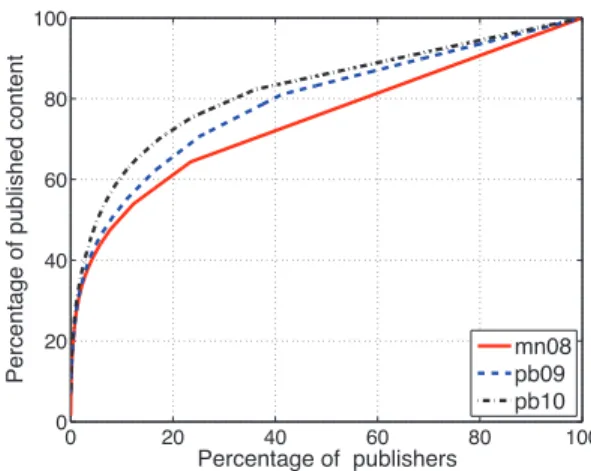
First, we examine the level of contribution (i.e. the number of published files) by the identified content pub-lishers in each dataset. Figure 1 depicts the percentage of files that are published by the top x% of the publish-ers in our three datasets. We observe that the top 3% of
mn08 pb09 pb10
ISP Type % ISP Type % ISP Type %
OVH Hosting Provider 13.31 OVH Hosting Provider 24.76 OVH Hosting Provider 15.16
Comcast Commercial ISP 4.69 Comcast Commercial ISP 3.67 SoftLayer Tech. Hosting Provider 4.52
Keyweb Hosting Provider 3.18 Road Runner Commercial ISP 2.3 FDCservers Hosting Provider 3.64
Road Runner Commercial ISP 3.03 Romania DS Commercial ISP 2.27 Open Computer Network Commercial ISP 3.59
NetDirect Hosting Provider 2.44 MTT Network Commercial ISP 1.95 tzulo Hosting Provider 3.36
Virgin Media Commercial ISP 2.42 Verizon Commercial ISP 1.64 Comcast Commercial ISP 2.86
NetWork Operations Center Hosting Provider 2.39 Virgin Media Commercial ISP 1.49 Cosema Commercial ISP 2.25
SBC Commercial ISP 2.38 SBC Commercial ISP 1.41 Telefonica Commercial ISP 2.22
Comcor-TV Commercial ISP 2.33 NIB Commercial ISP 1.26 Jazz Telecom. Commercial ISP 2.07
Telecom Italia Commercial ISP 2.02 tzulo Hosting Provider 1.14 4RWEB Hosting Provider 2.06
Table 2: Content Publishers Distribution per ISP.
G 2G IG JG KG 1GG G 2G IG JG KG 1GG M$,2$%8(>$N/FNNO"#.+)3$,) M$,2$%8(>$N/FNO"#.+)3$-N2/%8$%8 N N C%GK O#GP O#1G
Figure 1: Percentage of content published by the top x% publishers.
the BitTorrent publishers contribute roughly 40% of the published content. Moreover, a careful examination of IP addresses for the top-100 (i.e. 3%) publishers in our pb10 dataset reveals that a significant fraction of them either do not download any content (40%) or download less than 5 files (80%). This large contribution of re-sources (bandwidth and content) by major publishers coupled with the significant imbalance between their publishing and consumption rates seems non-altruistic and rather difficult to justify for two simple reasons:
- Required Resources/Cost: publishing a large
num-ber of content requires a significant amount of pro-cessing and bandwidth. For example, a major con-tent publisher named eztv recommends in its private BitTorrent portal web page (www.eztv.it) to allocate at least 10Mbps in order to sustain the seeding of few (around 5) files in parallel.
- Legal Implications: As other studies have reported
[6] and we confirm in our datasets, a large fraction of content published by major publishers is copyrighted material (recent movies or TV series). Thus, publishing these files is likely to have serious legal consequences for these publishers [1, 2].
This raises the question thatwhy this small fraction of publishers allocate a great deal of (costly) resources to contribute many files into BitTorrent swarms despite potential legal implications?. We answer this central question in Section 5.
3.2 Publishers’ ISPs
To help identify content publishers in our dataset, we determine the ISP that hosts each major publisher and use that information to assess the type of service (and available resources) that a publisher is likely to have. Toward this end, we map the IP address for a publisher in each dataset to its corresponding ISP using the Max-Mind database [3]. We then examine publicly available information about each ISP (e.g. its web page) to de-termine whether it is a commercial ISP or a hosting provider. We perform this analysis only for the top-100 (roughly 3%) publishers since these publishers are mostly of interest and collecting the required informa-tion for all publishers is a tedious task. Since we do not have publishers’ username for mn08, we examine the top-100 publishers based on their IP addresses in this dataset. For these publishers, we cannot assess the aggregated contribution of a publisher through different IP addresses (i.e. under-estimating the contribution of each publisher).
We observe that 42% of the top-100 publishers in pb10, 35% of the top-100 inpb09 and 77% of the top-100 publishers inmn08 are located at hosting services. Moreover 22%, 20% and 45% of these top-100 publish-ers are located at a particular hosting services, namely OVH, inpb10,pb09 andmn08 respectively.
In short, our analysis reveals that a significant frac-tion of major publishers are located at a few hosting services and a large percentage of them at OVH.
We also examine the contribution of BitTorrent pub-lishers at the ISP-level by mapping all the pubpub-lishers to their ISPs and identify the top-10 ISPs based on their aggregate published content for each dataset as shown in Table 2. This table confirms that content publishers who are located at a particular hosting provider, namely OVH, have consistently contributed a significant frac-tion of published content at major BitTorrent portals. There are also several commercial ISPs (e.g.Comcast) in Table 2 with a much smaller contribution.
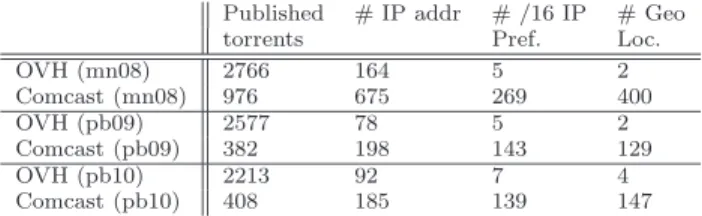
To assess the difference between users from hosting providers and commercial ISPs, we compare and con-trast the characteristics of all publishers that are lo-cated at OVH and Comcast as representative ISPs for each class of publishers in Table 3. This table demon-strates the following two important differences: first,
Published # IP addr # /16 IP # Geo torrents Pref. Loc.
OVH (mn08) 2766 164 5 2 Comcast (mn08) 976 675 269 400 OVH (pb09) 2577 78 5 2 Comcast (pb09) 382 198 143 129 OVH (pb10) 2213 92 7 4 Comcast (pb10) 408 185 139 147
Table 3: Characteristics of all OVH and Com-cast publishers inmn08, pb09 and pb10.
the aggregate contribution of each publisher at OVH is on average a few times larger than Comcast publish-ers. Second, Comcast publishers are sparsely scattered across many /16 IP prefixes and many geographical lo-cations in the US whereas OVH publishers are concen-trated in a few /16 IP prefixes and a handful of differ-ent locations in Europe (i.e.the location of OVH’s data centers). In essence, the published content by Comcast publishers comes from a large number of typical altru-istic users where each one publishes a small number of files from their home or work. In contrast, OVH pub-lishers appear to be paying for a well provisioned service to be able to publish a much larger number of files. We have also examined consumer peers in captured torrents and did not observe the presence of OVH users among the consuming peers.
In summary, the examination of ISPs that host major BitTorrent publishers suggests that these publishers are located either at a few hosting providers (with a large concentration at OVH) or at commercial ISPs. These publishers contribute a significantly larger number of files than average publishers. Furthermore, publishers who are located at hosting providers do not consume published content by other publishers.
3.3 A Closer Look at Major Publishers
We now examine the mapping between username and IP address of the top-100 content publishers in thepb10 dataset to gain some insight about major publishers be-havior. Our examination reveals the following interest-ing points:
First, if we focus on the top-100 IP addresses that have published the largest number of files, only 55% of them are used by a unique username. The remain-ing 45% of the IP addresses of major publishers are mapped to a large number of usernames. We have care-fully investigated this set of IP addresses and discovered that they use either hacked or manually created ac-counts (with a random username) to inject ”fake” con-tent. These publishers appear to be associated with an-tipiracy agencies or malicious users. The former group tries to avoid the distribution of copyrighted content whereas the latter attempts to disseminate malware. We refer to these publishers asfake publishers. Surpris-ingly, fake publishers are responsible for around 25% of the usernames, 30% of the published content and
25% of the downloads in our pb10 dataset. This sug-gests that major BitTorrent portals are suffering from a systematic poisoning index attack [17] that affects 30% of the published content. The portals fight this phe-nomenon by removing the fake content as well as the user accounts used to publish them. However, contrary to what has been reported in previous studies [20], this technique does not seem to be sufficiently effective since millions of users initiate the download of fake content. Finally, it is worth noting that most of the fake pub-lishers perform their activity from three specific host-ing providers named tzulo, FDC Servers and4RWEB. Due to the relevant activity of these fake publishers, we study them as a separate group in the rest of the paper. Second, the inspection of the top-100 usernames who publish the largest number of files shows that only 25% of them operate from a single IP. The remaining 75% of top usernames utilize multiple IPs and can be classified into the following common cases: (i) 34% of the user-names with multiple IP addresses (5.7 IP addresses on average) at a hosting provider in order to obtain the re-quired resources for seeding a large number of files. (ii)
24% of the usernames with multiple IP addresses (13.8 IP addresses on average) located at a single commer-cial ISP. Their mapping to multiple IP addresses must be due to the periodical change of their assigned IP addresses by their ISPs. (iii) The other 17% of these
usernames are mapped to multiple IP addresses (7.7 IP addresses on average) at different commercial ISPs. These are users who inject content from various loca-tions (e.g.home and work computer). To properly char-acterize different types of publishers, we exclude the 16 usernames who publish fake content from the top-100 usernames. We refer to the remaining top-100 user-names (non-fake publishers) asTop publishers who are responsible of 37% of the published content and 50% of the total downloads in ourpb10 dataset.
In summary, the major portion of the content comes from two reduced group of publishers: Top publishers and Fake publishers that collectively are responsible of 67% of the published content and 75% of the downloads. In the rest of the paper we devote our effort to charac-terize these two groups.
4. SIGNATURE OF MAJOR PUBLISHERS
Before we investigate the incentives of major Bit-Torrent publishers, we examine whether they exhibit any other distinguishing features, i.e. whether major publishers have a distinguishing signature. Any such distinguishing features could shed some light on the underlying incentives of these publishers. Toward this end, in the next few subsections, we examine the follow-ing characteristics of major publishers in our datasets: (i)the type of published content,(ii) the popularity of published content, and(iii)the availability and seeding
(a)mn08 (b)pb10
Figure 2: Type of published content distribution for the different classes of publishers: All,Fake, Top, Top-HP and Top-CI.
behavior of a publisher.
To identify distinguishing features, we examine the above characteristics across the following three target groupsin each dataset: all publishers (labeled as “All”), all fake publishers (labeled as “Fake”) and all top-100 (non-fake) publishers regardless of their ISPs (labeled as “Top”). We also examine the break down of Top publishers based on their ISPs into hosting providers and commercial ISPs, labeled as HP” and “Top-CI”, respectively.
4.1 Content Type
We leverage the reported content type by each pub-lisher to classify the published content across different target groups. Figure 2 depicts the break down of lished content across different content type for all pub-lishers in each target group for our Mininova and our major Pirate Bay datasets. We recall that without user-name information for each publisher in mn08 dataset, we cannot identify fake publishers. Figure 2 reveals a few interesting trends as follows:
First, Video files (which mainly include movies, TV-shows and porn content) constitute a significant frac-tion of published files across most groups with some im-portant differences. The percentage of published video across all publishers is around 37%-51% but it is slightly larger among top publishers. However, video is clearly a larger fraction of published content by the top pub-lishers located at hosting providers in ourpb10 dataset. Fake publishers primarily focus on Videos (recent movies and TV shows) and Software content. This supports our earlier observation that these publishers consist of an-tipiracy agencies and malicious users because the former group publishes a fake version of recent movies while the latter provides software that contains malware.
4.2 Content Popularity
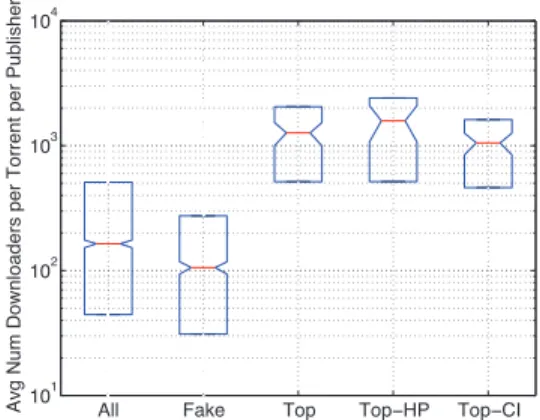
The number of published files by a publisher shows only one dimension of its contribution to BitTorrent. The other equally important issue is the popularity of each published content (i.e. the number of
download-;.. Q(7$ B/O B/O!RM B/O!&I 1G1
1G2 1G3 1GI
;'>N<"CND/=%./(-$,)NO$,NB/,,$%8NO$,NM"#.+)3$,
Figure 3: Avg Num of Downloaders per torrent per publisher for the different classes of publish-ers: All,Fake, Top, Top-HP, Top-CI.
ers regardless of their download progress) by individual publishers. Figure 3 shows the box plot of the distribu-tion of average downloaders per torrent per publisher across all publishers in each target group where each box presents the 25th, 50th and 75th percentiles.
On the one hand, the median popularity of top pub-lishers’ torrents is 7 times higher than a typical user (represented by All). A closer examination of the Top publishers shows that the content published by users at hosting providers is on average 1.5 times more popular than those published by users at commercial ISPs. On the other hand, fake publishers’ content is the most un-popular among the target groups. This is because the portals actively monitor the torrents and immediately remove the content identified as fake to avoid users from downloading it. Furthermore, users quickly realize the fake nature of these content and report this info on fo-rums that inform others and limit their popularity.
In summary, top publishers are responsible for a larger fraction of popular torrents. This in turn magnifies the contribution of the 37% of the injected files by the top publishers to be responsible for 50% of all the down-loads. The low popularity of fake publishers’ content has the opposite effect and limits their contribution to the number of downloads to 25%.
4.3 Seeding Behavior
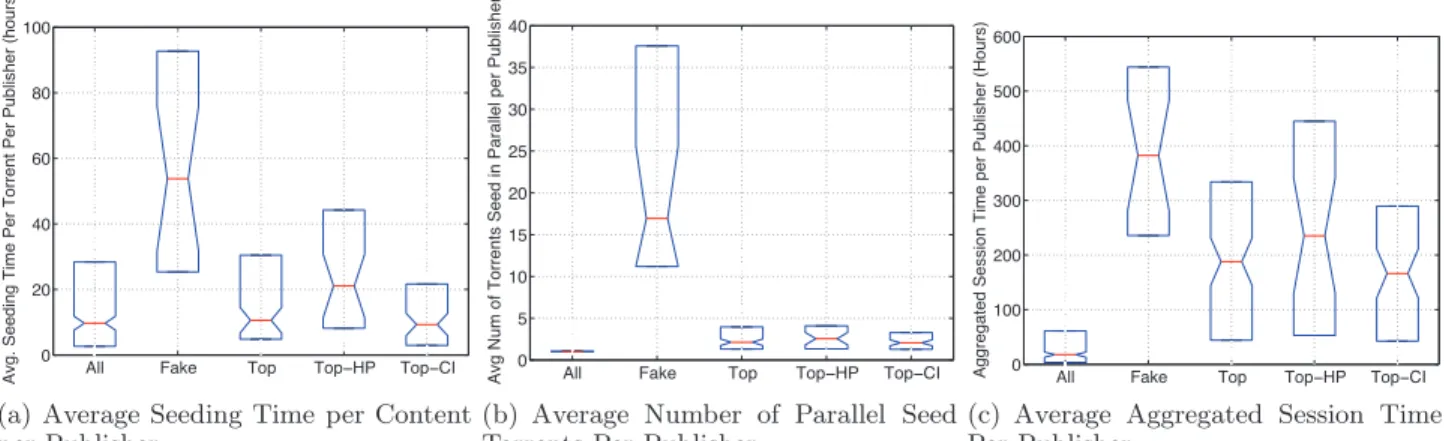
We characterize the seeding behavior of individual publishers in our target groups using the following met-rics: (i)average seeding time of a publisher for its pub-lished content, (ii) average number of parallel seeded
torrents, and (iii) aggregated session time of a publisher
across all its torrents. Since calculating these properties requires detailed analysis of our dataset that are com-putationally expensive, we are unable to derive these values for all publishers. We use 400 randomly selected publishers to represent the normal behaviour of all pub-lishers and refer to this group as “All” in our analysis. In order to compute these metrics we need to estimate
;.. Q(7$ B/O B/O!RM B/O!&I G 2G IG JG KG 1GG ;'>TN?$$-+%>NB+C$NM$,NB/,,$%8NM$,NM"#.+)3$,NU3/",) V
(a) Average Seeding Time per Content per Publisher
;.. Q(7$ B/O B/O!RM B/O!&I
G W 1G 1W 2G 2W 3G 3W IG ;'>N<"CN/FNB/,,$%8)N?$$-N+%NM(,(..$.NO$,NM"#.+)3$,
(b) Average Number of Parallel Seed Torrents Per Publisher
;.. Q(7$ B/O B/O!RM B/O!&I
G 1GG 2GG 3GG IGG WGG JGG ;>>,$>(8$-N?$))+/%NB+C$NO$,NM"#.+)3$,NUR/",)V
(c) Average Aggregated Session Time Per Publisher
Figure 4: Seeding Behaviour for the different classes of publishers: All, Fake, Top, Top-HP and Top-CI.
the time that a specific publisher has been connected to a torrent (in one or multiple sessions). Since each query to the tracker just reports (at most) a random subset of 200 IPs, in big torrents (>200 peers), we need to
per-form multiple queries in order to assess the presence of the publisher in the torrent. In our associated Techni-cal Report [8], we detail the technique used to estimate the session time of a specific user in each torrent.
Average Seeding Time: We measure the duration of time that a publisher stays in a torrent since its birth to seed the content. In general, a publisher can leave the torrent once there is an adequate fraction of other seeds. Figure 4(a) depicts the summary distribution of average seeding time across all publishers in each target group. This figure demonstrates the following points: first, the seeding time for fake publishers is significantly longer than publishers in other groups. Since these publishers do not provide the actual content, the initial fake pub-lisher remains the only seed in the session (i.e. other users do not help in seeding fake content) to keep the torrent alive. Second, Figure 4(a) shows that top pub-lishers typically seed a content for a few hours. How-ever, the seeding time for top publishers from hosting providers is clearly longer than top publishers from com-mercial ISPs. This suggests that publishers at hosting providers are more concerned about the availability of their published content.
Average number of Parallel Torrents: Figure 4(b) depicts the summary distribution of the average num-ber of torrents that a publisher seeds in parallel across publishers in each target group. This figure indicates that fake publishers seed many torrents in parallel. We have seen that fake publishers typically publish a large number of torrents and other users do not help them for seeding. Therefore, fake publishers need to seed all of their seeded torrents in parallel in order to keep them alive. The results for top publishers show that their typical number of seeded torrents in parallel is the same
(around 3 torrents) regardless of their location. How-ever, we expect that a regular publisher seed only 1 file at a time.
Aggregated Session Time: We have also quanti-fied the availability of individual publishers by estimat-ing the aggregated session time that each publisher is present in the system across all published torrents. Fig-ure 4(c) shows the distribution of this availability mea-sure across publishers in each target group. As expected fake publishers present the longest aggregated session time due to their obligation to continuously seed their content to keep them alive. If we focus on top publish-ers, they exhibit a typical aggregated session 10 times longer than standard users. Furthermore, top publish-ers at hosting services are clearly more available than those from commercial ISPs.
4.4 Summary
BitTorrent content publishers can be broadly divided into three groups as follows: (i) Altruistic users who publish content while consuming content that is pub-lished by other users. (ii) Fake publishers publish a significant number of files that are often Video and Software content from a few hosting providers. Due to the fake nature of their content, their torrents are unpopular and they need to seed all torrents to keep them alive. These publishers appear to be associated with antipiracy agencies or malicious users. We vali-date this hypothesis in the next section. (iii)Top pub-lishers publish a large number of popular files (often copyrighted video) and remain for a long time in the as-sociated torrents to ensure proper seeding of their pub-lished content. These publishers are located at hosting facilities or commercial ISPs. Their behavior suggests that these publishers are interested in the visibility of the published content possibly to attract a large num-ber of users. The (cost of) allocated resources by these publishers along with legal implications of publishing copyrighted material cannot be considered as altruistic.
Therefore, the most conceivable incentive for these pub-lishers appears to be financial profit. We examine this hypothesis in the rest of the paper.
5.
INCENTIVES OF MAJOR PUBLISHERS
In this section, we examine the incentive of differ-ent groups of publishers in more detail. First we fo-cus on fake publishers by examining the name and con-tent of the files they published. We noticed that these publishers often publish files with catchy titles (e.g. re-cently released Hollywood movies) and in most cases the actual content has already been removed at the moment of downloading it4. The few files we were
able to download were indeed fake content. Some of them included an antipiracy message whereas some oth-ers led to malware software. In the latter case, the content was a video that had a pointer to a specific software (e.g. http://flvdirect.com/) to be down-loaded in order to reproduce the video. This software was indeed a malware5. These observations validate
our hypothesis that fake publishers are either antipiracy agents who publish fake versions of copyrighted content or malicious users who led users to download a malware. Therefore, we have clearly identified the incentives of fake publishers.
Second, another group of major publishers allocate significant amount of resources to publish non-fake an often copyrighted content. We believe that the behav-ior of these users is not altruistic. More specifically, our hypothesis is that these publishers leverage major Bit-Torrent portals as a venue to freely attract downloading users to their web sites. To verify this hypothesis, we conduct an investigation to gather the following infor-mation about each one of thetop(i.e.top-100 non-fake) publishers:
• Promoting URL: the URL that downloaders of a
published content may encounter,
• Publisher’s Username: any publicly available
in-formation about the username that a major pub-lisher uses in the Pirate Bay portal, and
• Business Profile: offered services (and choices) at
the promoting URL.
Next, we describe our approach for collecting this infor-mation.
Promoting URL:We emulate the experience of a user by downloading a few randomly-selected files published by each top publisher to determine whether and where they may encounter a promoting URL. We identified
4We tried to download these files a few weeks after the cor-respondent measurement study was performed.
5
http://www.prevx.com/filenames/X2669713580830956212-X1/ FLVDIRECT.EXE.html
three places where publishers may embed a promoting URL:(i)name of the downloaded file (e.g.user mois20 names his files as filename-divxatope.com, thus adver-tising the URL www.divxatope.com),(ii) the textbox in the web page associated with each published content, (iii)name of a text file that is distributed with the ac-tual content and is displayed by the BitTorrent software when opening the .torrent file. Our investigation indi-cates that the second approach (using the textbox) is the most common technique among the publishers.
Publisher’s Username: We browsed the Internet to learn more information about the username associated with each top publisher. First, the username is in some cases directly related to the URL (e.g. user UltraTor-rents whose URL is www.ultratorrents.com). This exercise also reveals whether this username publishes on other major BitTorrent portals in addition to the Pirate Bay. Finally, posted information in various fo-rums could reveal (among other things) the promoting web site.
Business Services: We characterize the type of ser-vices offered at the promoting URL and ways that the web site may generate incomes (e.g.posting ads). We also capture the exchanged HTTP headers between a web browser and the promoting URL to identify any es-tablished connection to third-party web sites (e.g. redi-rection to ads web sites or some third party aggregator) using the technique described in [14].
5.1 Classifying Publishers
Using the above methodology, we examined a few published torrents for each one of the top publishers as well as sample torrents for 100 randomly selected publishers that are not in the top-100, called regular publishers. On the one hand, we did not discover any interesting or unusual behavior in torrents published by regular publishers and thus conclude that they behave in an altruistic manner. On the other hand, a large fraction of seeded torrents by the top publishers system-atically promote one or more web sites with financial incentives. Our examination revealed that these pub-lishers often include a promotional URL in the textbox of the content web page. We classify these top publish-ers into the following three groups based on their type of business (using the content of their promoting web sites) and describe how they leverage BitTorrent portals to intercept and redirect users to their web sites.
Private BitTorrent Trackers: A subset of major publishers (25% of top) own their BitTorrent portals that are in some cases associated with private trackers [11]. These private trackers offer a better user expe-rience in terms of download rate (compared to major open BitTorrent portals) but require clients to maintain certain seeding ratio. More specifically, each participat-ing BitTorrent client is required to seed content
propor-tionally to the amount of data it downloads across mul-tiple torrents. To achieve this goal, users are required to register in the web site and login before downloading the torrent files. The publishers in this class publish 18% of all the content while they are responsible for 29% of the downloads. 2/3 of these publishers advertise the URL in the textbox at the content web page. Furthermore, they appear to gain financial profit in three different ways: (i) posting advertisement in their web sites, (ii)
seeking donations from visitors to continue their basic service, and (iii) collecting a fee for VIP access that
allows the client to download any content without re-quiring any kind of seeding ratio. These publishers typ-ically inject video, audio and application content into BitTorrent portals. Interestingly, a significant fraction of publishers in this class (40%) publish content in a spe-cific language (Italian, Dutch, Spanish or Swedish) and specifically a 66% of this group are dedicated to pub-lishing Spanish content. This finding is consistent with prior reports on the high level of copyright infringement in Spain [5].
Promoting Web Sites: Another class of top publish-ers (23% of top) promote some URLs that are associated with hosting images web sites (e.g. www.pixsor.com), forums or even religious groups (e.g.lightmiddleway. com). These publishers inject 8% of the content and are responsible of 11% of the downloads. Most publishers in this class advertise their URL using the textbox in the content web page. Furthermore, most of these publish-ers (70%), specifically those that are running a hosting image web site, publish only porn content. Inspection of the associated hosting image web sites revealed that they store adult pictures. Therefore, by publishing porn content in major BitTorrent portals, they are targeting a particular demography of users who are likely to be interested in their web sites. The incomes of the portals within this class is based on advertisement.
Altruistic Publisher: The remaining top publishers (52% of top) appear to be altruistic users since they do not seem to directly promote any URL. These pub-lishers are responsible of 11.5% of the content and the same fraction of downloads. Many of these users pub-lish small music and e-book files that require smaller amount of seeding resources. Furthermore, they typi-cally include a very extensive description of the content and often ask other users to help with seeding the con-tent. These evidences suggest that these publishers may have limited resources and thus they need the help of others to sustain the distribution of their content.
In summary, roughly half of the top publishers adver-tise a web portal in their published torrents. It seems that their intention is to attract a large number of users to their web sites. The incomes of these portals come from ads and in the specific case of private BitTorrent portals also from donations and VIP fees. Overall, these
Lifetime Avg. Publishing Rate (days) (torrents per day) Private Portals 63/466/1816 0.57/11.43/79.91 Promoting Web sites 50/459/1989 0.38/4.31/18.98 Altruistic 10/376/1899 0.10/3.80/23.67
Table 4: Lifetime and Avg. Publishing Rate for the different classes of content publishers: BitTorrent Portals, Promoting Web Sites and Altruistic Publishers. The represented values are min/avg/max per class.
profit-driven publishers generate 26% of the content and 40% of the downloads. Therefore, the removal of this small fraction of publishers is likely to have a dramatic impact on the BitTorrent open ecosystem. Finally, a fraction of publishers appear to be altruistic and re-sponsible for a notable fraction of published content and downloads (11.5%). This suggests that there are some seemingly ordinary users who dedicate their resources to share content with a large number of peers in spite of the potential legal implications of such activity.
5.2 Longitudinal View of Major Publishers
So far we focused on the contribution of major pub-lishers only during our measurement intervals. Having identified the top publishers in our pb10 dataset, we examine the longitudinal view of the contribution by major publishers since they appeared on the Pirate Bay portal. Toward this end, for each top publisher, we ob-tain the username page on the Pirate Bay portal that maintains the information about all the published con-tent and its published time by the corresponding user till our measurement date (June 4, 2010)6. Using this
information for all top publishers, we capture their pub-lishing pattern over time with the following parameters: (i) Publisher Lifetime which represents the number of days between the first and the last appearance of the publisher in the Pirate Bay portal,(ii) Average Publish-ing Ratethat indicates the average number of published content per day during their lifetime.
Table 4 shows the min/avg/max value of these met-rics for the different classes of publishers: Private Por-tals, Promoting Web Sites and Altruistic publishers. The profit-driven publishers (i.e. private portals and promoting web sites) have been publishing content for 15 months on average (at the time of the measurement) while the most longed-lived ones have been feeding con-tent for more than 5 years ago. Furthermore, some of these publishers exhibit a surprisingly high average rate of publishing content (80 files per day). The altruistic publishers present a shorter lifetime and a lower pub-lishing rate that seems to be due to their weaker
incen-6Note that we cannot collect information about fake pub-lishers since the web pages of their associated usernames are removed by the Pirate Bay just after identifying they are publishing fake content.
tives and their lower availability of resources.
In summary, the lifetime of major publishers suggests that content publishing in BitTorrent seems have been a profitable business for (at least) a couple of years. Fur-thermore, the high seeding activity by profit-driven pub-lishers (e.g. private portals) over a long period of time implies a high and continuous investment for required resources that should be compensated by different types of incomes (e.g. ads) for these portals. We examine the incomes of the profit-driven publishers in the next subsection.
5.3 Estimating Publishers’ Income
The evidences we presented in previous subsections suggest that the goal of half of the top publishers is to attract users to their own web sites. We also showed that most of these publishers seem to generate income at least by posting ads in their web sites. In essence, these publishers have a clear financial incentive to pub-lish content. In order to validate this key point, we as-sess their ability to generate income by estimating three important but related properties of their promoting web sites:(i)average value of the web site,(ii)average daily income of the web site, and(iii) average daily visits to the web site. We obtain this information from several web sites that monitor and report these statistics for other sites on the Web. To reduce any potential error in the provided statistics by individual monitoring web sites, for each publisher’s web site we collect this infor-mation from six independent monitoring sites and use the average value of these statistics across these webs7.
Table 5 presents the min/median/avg/max value of the described metrics for each class of profit-driven pub-lisher classes (i.e. private portals and promoting web sites). The median values suggest that the promoted web sites are fairly profitable since they value tens of thousand dollars with daily incomes of a few hundred dollars and tens of thousand visits per day. Further-more, few publishers (<10) are associated to very
prof-itable web sites valued in hundreds of thousand to mil-lions of dollars, that receive daily incomes of thousands of dollars and hundreds of thousand visits per day. In summary, these statistics confirm that these web sites are indeed valuable and visible, and generate a substan-tial level of incomes.
6.
OTHER BENEFICIARIES IN THE
BIT-TORRENT MARKETPLACE
In previous sections we analyzed the main character-istics of major content publishers in BitTorrent, demon-strating that content publishing is a profitable busi-ness for an important fraction of the top publishers;
7www.sitelogr.com
, www.cwire.com, www.websiteoutlook.com,
www.sitevaluecalculator.com, www.mywebsiteworth.com, www. yourwebsitevalue.com
Web site Web site Web site Value ($) Daily Income ($) Daily visits Private
Portals 1K/33K/313K/2.8M 1/55/440/3.7K 74/21K/174K/1.4M Promoting
Web Sites 24/22K/142K/1.8M 1/51/205/1.9K 7/22K/73.5K/772K
Table 5: Publisher’s web site value ($), daily in-come ($) and num of daily visits for the different classes of profit-driven content publishers: Bit-Torrent Portals and Promoting Web Sites. The represented values are min/median/avg/max per class.
a business that is responsible of 40% of the downloads. However, although content publishers are the key play-ers, there are other players who help sustain the busi-ness and obtain financial benefits including: Major Bit-Torrent Portals, Hosting Providers and ad companies. Figure 5 depicts the interactions between different play-ers in BitTorrent content publishing where the arrows indicate the flow of money between them. Next, we briefly describe the role of each player.
Major Public BitTorrent Portals such as the
Pi-rate Bay are dedicated to index torrent files. They are rendezvous points where content publishers and clients publish and retrieve torrent files respectively. The main advantage of these major portals is that they offer a re-liable service (e.g. they rapidly react to remove fake or infected content). All this makes that millions of BitTorrent users utilize these portals every day. These portals are the perfect target for profit-driven publish-ers in order to publish their torrents and advertise their web sites (potentially) to millions of users. Therefore, these major portals are one of the key players of the Bit-Torrent Ecosystem [22] that brings substantial financial profit. For instance, the Pirate Bay is one of the most popular sites in the whole Internet (ranked the 94thin
the Alexa Ranking) as well as one of the most valued ones (around $10M).
Hosting Providers are companies dedicated to
rent-ing servers. Heavy seedrent-ing activity performed by some publishers requires significant resources (e.g.bandwidth and storage). Thus a large fraction of major publish-ers obtain these resources from rented servpublish-ers in hosting providers who receive an income in return for the offered service. Let’s focus on OVH, the ISP responsible of a major portion of the content published in BitTorrent. Our measurement study shows that OVH contributes between 78 and 164 different servers (i.e.IP addresses) across the different datasets. Considering the cost of the average server offered by OVH in its web page (around 300e/month) we estimate that the average income ob-tained by OVH due to BitTorrent content publishing ranges between roughly 23.4K and 42.9Ke/month. It is worth noting that some hosting providers have de-fined strict policies against sharing copyrighted mate-rial through P2P applications using their servers due
Figure 5: Business Model of Content Publishing in Bittorrent.
to legal issues8. However the income obtained by some
hosting providers such as OVH seems to justify the risk of potential legal actions taken against them.
Ad Companies are responsible for advertisements in
the Internet. They have a set of customers who wish to be advertised in the Internet and a set of web sites where they put their customers ads. They apply com-plex algorithms to dynamically select in which web site and when to post each ad. They charge their customers for this service and part of this income is forwarded to the web sites where the ads have been posted. There-fore, ad companies look for popular web sites where to put ads for their costumers. We have demonstrated in this paper that profit-driven BitTorrent content pub-lishers’ web sites are popular, thus most of them post ads from ad companies9. Hence, part of the income of
ad companies is directly linked to the BitTorrent con-tent publishing. Unfortunately, there is no practical way to estimate the value of this income.
7.
SOFTWARE FOR CONTENT
PUBLISH-ING MONITORPUBLISH-ING
Using the methodology described in Section 2, we have implemented a system that continuously monitors the Pirate Bay portal, and leverages RSS feed to quickly detect a newly published content. Once a new torrent is detected, our system retrieves the following information for that torrent: filename, content category and subcat-egory (based on the Pirate Bay categories), publisher’s username, and (in those cases we can) the publisher’s IP address as well as the ISP, City and Country associ-ated to this IP address. Furthermore, for profit-driven publishers described in this paper, we have created an individual publisher’s web page that provides specific information such as the publisher’s promoted URL or
8http://www.serverintellect.com/terms/aup.aspx.
9We have validated this by looking at the header exchange between the browser and the publishers’ web site servers.
business type. The system stores all this information in a database. Finally, we have built a simple web-based interface to query the resulting database. This interface is publicly available10and access is granted to interested
parties by contacting the authors.
Our application has two goals. On the one hand, we want to share this data with the research community to permit further analysis of different aspects of the Bit-Torrent content publishing activity. On the other hand, we believe that this application can be useful for regular BitTorrent clients. First, a BitTorrent client can easily identify those publishers that publish content aligned with her interest (e.g. an e-books consumer could find publishers responsible for publishing large numbers of e-books). Furthermore, we are working on implement-ing a feature to filter out fake publishers, allowimplement-ing Bit-Torrent users of our application (in the future) to avoid downloading fake content.
8. RELATED WORK
Significant research effort has focused on understand-ing different aspects of BitTorrent by gatherunderstand-ing data from live swarms. Most of these studies have primar-ily examined demographics of users [12, 20, 22] and technical aspects of swarming mechanism [18, 13, 9]. However, to our knowledge the socio-economics aspects of BitTorrent that we addressed in this paper have re-ceived little attention. The most relevant work to this paper is a recent study that examined the weakness of BitTorrent privacy [6]. The authors analyzed the demography of BitTorrent content publishers and pre-sented a highly skewed distribution of published con-tent among them as well as the presence of a signifi-cant fraction of publishers located at hosting providers. This indeed validates some of our initial observations. In another study, Zhang et al. [22] presented the most extensive characterization of the BitTorrent ecosystem. This study briefly examined the demography of content publishers and showed a skewed distribution of the con-tributed content among them. The authors identify the publishers by their usernames. We have shown that this assumption may miss an important group of publishers who post fake content, i.e. fake publishers. Our work goes beyond the simple examination of demographics of content publishers. We identify, characterize and clas-sify the major publishers and more interestingly reveal their incentives and their motivating business model.
9. CONCLUSION
In this paper we studied the content publishing ac-tivity in BitTorrent from a socio-economic perspective. The results reveal that a small fraction of publishers are responsible for 67% of the published content and 75% of
the downloads. We have carefully examined the incen-tives of major publishers and identified the following key characteristics: first, antipiracy agencies and malicious users perform a systematic poisoning index attack over major BitTorrent portals in order to obstruct download of copyrighted content and to spread malware, respec-tively. Overall, this attack contributes 30% of the con-tent and attracts 25% (several millions) of downloads. Second, 37% of the (non-fake) published content is pub-lished by a small fraction of users that serve 54% of the (non-fake files) downloads. Our evidence suggests that these publishers have financial incentives for post-ing these contents on BitTorrent portals. The removal of these financial-driven publishers (e.g. by antipiracy actions) may significantly affect the popularity of these portals as well as the whole BitTorrent ecosystem. If this happens,will BitTorrent survive as the most popu-lar file-sharing application without these publishers?.
10. ACKNOWLEDGEMENTS
The authors would like to thank anonymous CoNEXT reviewers for their valuable feedback as well as Jon Crowcroft for his insightful comments. We are also grateful for David Rubio’s help on developing the web-based application. This work has been partially sup-ported by the European Union through the FP7 TREND Project (257740), the Spanish Government through the T2C2 (TIN2008-06739-C04-01) and CONPARTE (TEC 2007-67966-C03-03) projects, the Regional Government of Madrid through the MEDIANET project (S-2009/TIC-1468) and the National Science Foundation under Grant No. 0917381.
11. REFERENCES
[1] http://www.theregister.co.uk/2008/06/02/ onk_further_arrests/. [2] http://yro.slashdot.org/yro/05/01/13/ 2248252.shtml?id=123&tid=97&tid=95&tid=1. [3] MaxMind. http://www.maxmind.com.[4] The Impact of P2P File Sharing, Voice over IP, Skype, Joost, Instant Messaging, One-Click Hosting and Media Streaming such as YouTube on the Internet, 2007.
http://www.ipoque.com/resources/internet-studies/internet-study-2007.
[5] Bay TSP Annual Report, 2008.
http://tech.mit.edu/V129/N28/piracy/ BayTSP2008report.pdf.
[6] S. Le Blond, A. Legout, F. Lefessant, W. Dabbous, and M. Ali Kaafar. Spying the world from your laptop.LEET’10, 2010. [7] D. R. Choffnes, J. Duch, D. Malmgren,
R. Guimera, F. E. Bustamante, and L. Amaral. Strange bedfellows: Communities in bittorrent. IPTPS’10, 2010.
[8] R. Cuevas, M. Kryczka, A. Cuevas, S. Kaune, C. Guerrero, and R. Rejaie. Is content publishing in bittorrent altruistic or profit-driven?. Tech report: http://arxiv.org/abs/1007.2327, 2010. [9] R. Cuevas, N. Laoutaris, X. Yang, G. Siganos,
and P. Rodriguez. Deep Diving into BitTorrent Locality. InACM SIGMETRICS’10 (Poster Session).
[10] L. Guo, S. Chen, Z. Xiao, E. Tan, X. Ding, and X. Zhang. Measurements, Analysis, and Modeling of BitTorrent-like Systems. InACM IMC’05. [11] David Hales, Rameez Rahman, Boxun Zhang,
Michel Meulpolder, and Johan Pouwelse. Bittorrent or bitcrunch: Evidence of a credit squeeze in bittorrent? InWETICE ’09, 2009. [12] M. Izal, G. Urvoy-Keller, E.W. Biersack, P.A.
Felber, A. Al Hamra, and L. Garces-Erice. Dissecting bittorrent: Five months in a torrent’s lifetime. In PAM ’04.
[13] S. Kaune, R. Cuevas, G. Tyson, A. Mauthe, C. Guerrero, and R. Steinmetz. Unraveling BitTorrent’s File Unavailability: Measurements, Analysis and Solution Exploration. InIEEE P2P’10.
[14] B. Krishnamurthy and C. E. Wills. On the leakage of personally identifiable information via online social networks. InACM WOSN ’09, 2009. [15] N. Laoutaris, D. Carra, and P. Michiardi. Uplink
allocation beyond choke/unchoke or how to divide and conquer best. InACM CoNEXT’08.
[16] A. Legout, N. Liogkas, E. Kohler, and L. Zhang. Clustering and sharing incentives in bittorrent systems. In ACM SIGMETRICS ’07.
[17] J. Liang, N. Naoumov, and K.W. Ross. The index poisoning attack in p2p file sharing systems. In IEEE INFOCOM’06, 2006.
[18] D. Menasche, A. Rocha, B. Li, D. Towsley, and A. Venkataramani. Content availability in swarming systems: Models, measurements and bundling implications. InACM CoNEXT’09. [19] M. Piatek, T. Isdal, T. Anderson,
A. Krishnamurthy, and A. Venkataramani. Do incentives build robustness in BitTorrent? In NSDI’07, 2007.
[20] J.A. Pouwelse, P. Garbacki, D.H.J. Epema, and H.J. Sips. The BitTorrent P2P file-sharing system: Measurements and analysis. InIPTPS’05. [21] M. Sirivianos, J. Han, P. Rex, and C.X. Yang.
Free-riding in bittorrent networks with the large view exploit. InIPTPS 07, 2007.
[22] C. Zhang, P. Dhungel, D. Wu, and K.W. Ross. Unraveling the bittorrent ecosystem.IEEE Transactions on Parallel and Distributed Systems, 2010.