The Effectiveness of Psychodynamic Therapy
and Cognitive Behavior Therapy in the Treatment
of Personality Disorders: A Meta-Analysis
Falk Leichsenring, D.Sc.
Eric Leibing, D.Sc.
Objective: T he a utho rs co nduct ed a meta-analysis to address the effectiveness of psychodynamic therapy and cognitive behavior therapy in the treatment of per-sonality disorders.
Method: Studies of psychodynamic ther-apy and cognitive behavior therther-apy that were published between 1974 and 2001 were collected. Only studies that 1) used standardized methods to diagnose person-ality disorders, 2) applied reliable and valid instruments for the assessment of out-come, and 3) reported data that allowed calculation of within-group effect sizes or assessment of personality disorder recov-ery rates were included. Fourteen studies of psychodynamic therapy and 11 studies of co gnitive be ha vior the ra py were included.
Results: Psychodynamic therapy yielded a large overall effect size (1.46), with effect sizes of 1.08 found for self-report measures and 1.79 for observer-rated measures. For cognitive behavior therapy, the
corre-sponding values were 1.00, 1.20, and 0.87. For more specific measures of personality disorder pathology, a large overall effect size (1.56) was seen for psychodynamic therapy. Two cognitive behavior therapy studies reported significant effects for more specific measures of personality dis-order pathology. For psychodynamic ther-apy, the effect sizes indicate long-term rather than short-term change in personal-ity disorders.
Conclusions: T h e re is e v id e n ce t ha t both psychodynamic therapy and cogni-tive behavior therapy are effeccogni-tive treat-ments of personality disorders. Since the number of studies that could be included in this meta-analysis was limited, the con-clusions that can be drawn are only pre-liminary. Further studies are necessary that examine specific forms of psycho-therapy for specific types of personality disorders and that use measures of core psychopathology. Both longer treatments and follow-up studies should be included.
(Am J Psychiatry 2003; 160:1223–1232)
P
ersonality disorders are characterized by long-standingand pervasive dysfunctional patterns of cognition, affec-tivity, interpersonal relations, and impulse control that cause considerable personal distress (DSM-IV ) (1, 2). In subjects with personality disorders, psychosocial impair-ment and the use of impair-mental health resources are high (3– 5). The prevalence of patients with personality disorders in inpatient and outpatient psychiatric populations is high (e.g., the prevalence of borderline personality disor-der is estimated to be between 15% and 25% [6]). However, there is a considerable lack of empirical research on treat-ment of personality disorders with psychotherapy, with only a few randomized controlled studies (7). To address concerns about costs of mental health services, empirical data about the efficacy of psychotherapy in the treatment of personality disorders are needed. There is evidence that psychotherapy in general is an effective treatment for per-sonality disorders (7, 8), but existing studies indicate that outcome may differ for different forms of psychotherapy (9, 10) and different personality disorders (11, 12).
For this reason, this review examined the effects of the two most frequently applied forms of psychotherapy in the treatment of personality disorders, psychodynamic therapy and cognitive behavior therapy. Our review ad-dressed the following questions:
• What is the evidence of improvement in symptoms, so-cial functioning, or core psychopathology after psycho-dynamic therapy or cognitive behavior therapy? • Is there evidence of improvement in specific types of
personality disorders after psychodynamic therapy or cognitive behavior therapy?
• Do individuals with personality disorders recover after psychodynamic therapy or cognitive behavior therapy? • Are there differences between self-report and
observa-tional measures?
• Is there a correlation between outcome and duration of treatment?
• What other factors are connected with outcome (gen-der, inpatient versus outpatient status, use of therapy manuals, experience of therapists)?
Since only a few randomized controlled treatment stud-ies exist, we included both controlled and naturalistic treatment studies.
Method
We collected studies of psychodynamic therapy and cognitive behavior therapy that were published between 1974 and 2001 by carrying out a computerized search using MEDLINE, PsycINFO, and Current Contents. We included studies that 1) examined spe-cific and explicitly described forms of psychodynamic therapy or cognitive behavior therapy, 2) used standardized methods for
di-agnosing personality disorders, 3) used reliable and valid instru-ments for the assessment of outcome, and 4) reported data that allowed calculation of within-group effect sizes or assessment of personality disorder recovery rates.
In order to assess long-term change after psychotherapy, we se-lected the longest posttreatment follow-up for evaluation.
Twenty-two studies met these inclusion criteria (9, 10, 12–31). Three of these studies examined the effects of both psychody-namic therapy and cognitive behavior therapy (9, 10, 13). Since there were only three randomized controlled studies for psycho-dynamic therapy and five for cognitive behavior therapy, we cal-culated within-group effect sizes for all studies by using Cohen’s d (32). For each measure, we subtracted the posttreatment mean
TABLE 1. Studies Included in a Meta-Analysis Examining the Effectiveness of Psychodynamic Therapy and Cognitive Behav-ior Therapy in the Treatment of Personality Disorders
Form of Therapy and Study
Features of Study
Design Subjects
Criteria Used for Diagnosisa
Psychodynamic therapy
Karterud et al. (12) Naturalistic Patients with borderline personality disorder (N=34), schizotypal personality disorder (N=13), other personality disorders (N=26), or no personality disorder (N=23)
DSM-III-R
Stevenson and Meares (15) Naturalistic Outpatients with borderline personality disorder (N=30) DSM-III; DIB Hoglend (16) Naturalistic Outpatients with personality disorders (N=15) or no personality
disorder (N=30)
DSM-III clusters B and C
Winston et al. (17) Randomized Outpatients with cluster A, B, or C personality disorders (70% cluster C) (group 1: N=30; group 2: N=25, group 3: N=26)
DSM-III-R; SCID Diguer et al. (18) Naturalistic Outpatients with major depression and either mixed personality
disorder (N=12) or no personality disorder (N=13)
DSM-III-R; SADS-C Monsen et al. (19) Naturalistic Outpatients (N=25) with cluster A, B, or C personality disorders DSM-III
Munroe-Blum and Marziali (20) Randomized Outpatients with borderline personality disorder (group 1: N=22; group 2: N=26)
DIB Wilberg et al. (21) Naturalistic Patients with borderline personality disorder (group 1: N=12; group
2: N=31)
DSM-III; DSM-III-R Bateman and Fonagy (22) Randomized Two groups of patients with borderline personality disorder (N=19
for both)
DIB; SCID; DSM-III-R Tucker et al. (23) Naturalistic Inpatients (N=40) with severe personality disorders (borderline
personality organization)
DSM-III Antikainen et al. (24) Naturalistic Inpatients (N=42) with severe personality disorders (borderline
personality organization)
DSM-III-R Cognitive behavior therapy
Springer et al. (14) Randomized Inpatients with personality disorders (50% with borderline personality disorder) (group 1: N=16; group 2: N=15)
MCMI-II Linehan et al. (25) Randomized Parasuicidal women with borderline personality disorder (group 1:
N=13; group 2: N=13)
DSM-III-R; SCID-II; DIB
Linehan et al. (26) Randomized Women with borderline personality disorder and drug dependence (group 1: N=12; group 2: N=15)
DSM-III-R; SCID; PDE Bohus et al. (27) Naturalistic Parasuicidal women with borderline personality disorder (N=24) DSM-IV; DIB-R Alden (28) Randomized Patients with avoidant personality disorder (N=76) DSM-III Fahy et al. (29) Naturalistic Bulimic women with personality disorders (group 1: N=14) or no
personality disorder (group 2: N=15)
PAS Stravynski et al. (30) Randomized Outpatients with diffuse social phobia and avoidant personality
disorder (group 1: N=11; group 2: N=11)
DSM-III Brown et al. (31) Naturalistic Patients with generalized social phobia and avoidant personality
disorder (N=17)
DSM-III-R Studies comparing psychodynamic
and cognitive behavior therapy
Liberman and Eckman (9) Randomized Inpatients with repeated suicide attempts (group 1: N=12; group 2: N=12)
DSM-III Hardy et al. (10) Randomized Depressed patients with cluster C personality disorders (group 1:
N=13; group 2: N=14) or no personality disorder (group 1: N=43; group 2: N=44)
DSM-III
Woody et al. (13) Randomized Depressed opiate addicts with antisocial personality disorder (N=17) and nondepressed opiate addicts with antisocial personality disorder (N=13)
DSM-III; RDC; SADS-L; SADS-C
aDIB: Diagnostic Interview for Borderlines; DIB-R: Revised Diagnostic Interview for Borderlines; MCMI-II: Millon Clinical Multiaxial Inventory
II; PDE: Personality Disorders Exam; PAS: Personality Assessment Schedule; RDC: Research Diagnostic Criteria; SADS-C: Schedule for Affective Disorders and Schizophrenia—Current Version; SADS-L: Schedule for Affective Disorders and Schizophrenia—Lifetime Version; SCID: Struc-tured Clinical Interview for DSM-III-R, SCID II: StrucStruc-tured Clinical Interview for DSM-III-R Personality Disorder.
from the pretreatment mean and divided the difference by the pretreatment standard deviation of the measure. If there was more than one patient group, we calculated a pooled baseline standard deviation, as suggested by Rosenthal (33). If necessary, signs were reversed so that a positive effect size always indicated improvement. Whenever multiple measures were applied in a study, we assessed the effect size for each measure separately and calculated the mean effect size in order to assess the overall out-come of the study. We computed both unweighted effect sizes and effect sizes weighted by the sample size in order to yield un-biased estimators of effect sizes (34). Since Cohen’s d gives the amount of change in units of the standard deviation, a standard-ization of different scalar values of outcome measures is
achieved. However, different outcome measures may be more sensitive to change than others (e.g., measures of depression ver-sus measures of personality traits). Thus, the effect sizes of differ-ent outcome measures may not be comparable. For this reason, it may be useful to assess effect sizes for certain (classes of ) out-come measures separately (33). Therefore, we not only computed an overall effect size but also assessed effect sizes separately for measures that were more specific to the core pathology of person-ality disorders. Furthermore, we assessed effect sizes for self- and observer-rated measures separately, thus taking different ob-server perspectives into account. If necessary, we used other sta-tistics reported than means and standard deviations (e.g., t or chi-square statistics) to calculate effect sizes (32). If studies included Features of Therapy
Type Length
Follow-Up Evaluations
Psychodynamic day hospital treatment Mean=171 days Posttreatment
Psychodynamic self-psychological therapy Twice a week for 12 months 1 year
Psychodynamic focal therapy Mean=27.5 sessions 2 years; 4 years
Brief adaptive psychotherapy (group 1) versus short-term dynamic therapy (group 2) versus control condition (group 3)
40 weekly sessions Posttreatment; 1.5 years
Psychodynamic therapy (Luborsky manual) 16 sessions 6 months (posttreatment)
Psychodynamic (self-psychological) therapy Mean=25.4 months 5.2 months Interpersonal group therapy (group 1) versus individual
psychodynamic therapy (group 2)
17 sessions 12 months; 24 months
Psychodynamic inpatient therapy and community treatment either with (group 1) or without (group 2 ) subsequent group therapy
11 versus 6 months 34 months Psychoanalytically oriented partial hospitalization (group 1) versus
standard psychiatric care (group 2)
Mean=1.45 years 18 months
Psychodynamic inpatient therapy Mean=8.4 months 1 year; 2 years
Psychodynamic inpatient treatment specialized for borderline personality disorder
91 days 3 years
Dialectical behavior therapy for inpatient setting (group 1) versus control condition (group 2)
13 days, 6 sessions Posttreatment Dialectical behavioral therapy (group 1) versus treatment as usual
(group 2)
1 year Posttreatment
Dialectical behavioral therapy (group 1) versus treatment as usual (group 2)
1 year 12 months; 16 months
Inpatient dialectical behavior therapy 12 weeks 4 weeks
Exposure versus interpersonal skills training versus intimacy focus versus control condition
10 weekly group sessions 12 weeks
Cognitive behavior therapy 8 weeks, 8 sessions 8 weeks; 1 year
Social skills training (group 1) versus social skills training plus cognitive behavior therapy (group 2)
12 sessions of 1.5 hours Posttreatment; 6 months
Cognitive behavior therapy Unknown Posttreatment
Insight-oriented therapy (group 1) versus behavior therapy (group 2) 32 sessions, 10 days of hospitalization
2, 6, 12, 24, and 36 weeks Cognitive behavior therapy (group 1) versus psychodynamic/
interpersonal therapy (group 2)
8 versus 16 sessions Posttreatment; 3 months; 1 year
Standard drug counseling plus either supportive-expressive psychodynamic or cognitive behavior therapy
patients with and without personality disorders, effect sizes were calculated separately for both groups. There was a problem with the study of Woody et al. (13), which pooled the results of the two forms of therapy that were applied. Since the authors found no sig-nificant differences between the two forms of therapy applied, we decided to include this study and used the resulting pooled effect sizes as estimates for both forms of therapy. Since the differences between treatments were not significant, no systematic error is implied by this procedure. There was a similar problem with the study of Springer et al. (14), which did not report pre- and post-treatment means and standard deviations for the outcome mea-sures. They reported t values of outcome data for the total sample of patients in the therapy and the control condition. Since they did not find significant differences between the therapy and the con-trol condition in outcome measures, we decided to use these data to estimate the effect sizes of the inpatient cognitive behavior therapy condition. We included these studies so as not to reduce the already small number of studies. However, were these studies not included, the results would not change substantially.
Effect sizes are only one measure of effectiveness. The percent-age of patients who recovered or in whom was seen a reliable or clinically significant change in the target measures is even more important. For this reason, we assessed rates of improvement whenever possible.
We calculated correlations between outcome and the following factors: length of therapy, patient gender, inpatient versus outpa-tient status, use of therapy manuals, clinical experience of thera-pists as reported in the studies, and study design (randomized versus naturalistic).
Results
Fourteen studies of psychodynamic therapy (9, 10, 12, 13, 15–24) and 11 studies of cognitive behavior therapy (9, 10, 13, 14, 25–31) met the inclusion criteria (Table 1). Two further studies examined the effects of psychodynamic and cognitive behavior therapy combinations (35, 36).
Overview of Studies
Psychodynamic therapy. As will be subsequently
de-scribed, the 14 studies of psychodynamic therapy used different forms. Psychoanalysis was not applied. In most of the studies, psychodynamic therapy was time-limited. The effects of outpatient individual psychodynamic ther-apy were examined in eight studies. Woody et al. (13) com-pared the effects of either 12 sessions of manualized sup-portive-expressive psychodynamic therapy (which used the Luborsky manual) or cognitive behavior therapy (per Beck), which were added to standard drug counseling. Stevenson and Meares (15) examined the outcome of a 1-year psychoanalytically oriented (self-psychological) regi-men of outpatient psychotherapy. Therapy was conducted by trainees who received weekly supervision. Hoglend (16) studied the outcome of manualized psychodynamic focal therapy, which lasted an average of 27.5 sessions. Adher-ence to the manual was ensured. Winston et al. (17) com-pared short-term anxiety-provoking therapy (after Da-venloo) to both another form of psychodynamic therapy (brief adaptive psychotherapy) and to a waiting list control condition. Each form of psychotherapy was administered for 40 weekly sessions. Manuals were used, and adherence
was tested and ensured. Monsen et al. (19) studied a form of psychodynamic therapy that focused on object rela-tions and self-psychology. Therapists were specially trained and supervised. Therapy lasted an average of 25 months. Munroe-Blum and Marziali (20) compared a time-limited group treatment with individual psychody-namic therapy. Each form of therapy lasted an average of 17 sessions. Manuals were used and adherence was en-sured. Since the authors did not find significant differ-ences between individual and group therapy, Munroe-Blum and Marziali (20) pooled the results of both condi-tions. However, the authors reported the results separately for the two conditions (personal communication, June 25, 2001). Since group therapy was based on an interpersonal rather than on a psychodynamic model, only the results reported for individual psychodynamic therapy were in-cluded in this review. Hardy et al. (10) compared the ef-fects of manualized psychodynamic/interpersonal ther-apy and cognitive behavior therther-apy in depressed patients with and without cluster C personality disorders. In both forms of therapy, eight versus 16 sessions were applied. Diguer et al. (18) studied the effects of 16 sessions of sup-portive-expressive psychodynamic therapy (which fol-lowed Luborsky’s manual) in depressed outpatients with and without a personality disorder.
In three studies, psychodynamic treatment was applied within a partial hospitalization program for patients with personality disorders. Karterud et al. (12) examined psy-chodynamically oriented day hospital community treat-ment, which lasted for an average of 6 months. Wilberg et al. (21) reported the results of psychodynamic community day treatment with subsequent outpatient psychoanalytic group therapy for patients with borderline personality dis-order. These results were compared with a treatment-as-usual condition, i.e., psychodynamic day hospital treat-ment without group therapy. Since the authors had found significant differences between the two kinds of psycho-dynamic treatments, we assessed the effect sizes of the two treatments separately. Bateman and Fonagy (22) com-pared an analytically oriented partial hospitalization treatment program for borderline patients (maximum 18 months) with standard psychiatric care. Outcome data for an 18-month follow-up were recently reported (37).
Three studies examined the outcome of an inpatient psychodynamic treatment. Liberman and Eckman (9) compared insight-oriented therapy with behavioral ther-apy in the treatment of patients with repeated suicide at-tempts, each given for 32 sessions within a 10-day hospital treatment. Tucker et al. (23) studied the results of inpatient psychotherapeutic treatment that focused on interper-sonal relations and intrapsychic organization. Patients were treated for an average of 8.4 months. Antikainen et al. (24) looked at the effects of inpatient psychotherapeutic community treatment for borderline patients that focused on the so-called split-type defense mechanisms. Treat-ment lasted for an average of 3 months.
Cognitive behavior therapy. Three of the aforemen-tioned studies also reported data for the outcome of be-havioral or cognitive behavior therapy (9, 10, 13). Eight other studies examined cognitive behavior therapy in the treatment of personality disorders. Linehan et al. (25) studied the interpersonal effects of dialectical behavior therapy. The manualized treatment lasted for 1 year and was compared with treatment as usual. This was true of another study of dialectical behavior therapy, which com-pared the effects of dialectical behavior therapy to treat-ment as usual in patients with borderline personality dis-order who had comorbid drug dependence (26). Bohus et al. (27) applied dialectical behavior therapy to the inpa-tient treatment of female parasuicidal borderline painpa-tients that lasted for 3 months. In a randomized controlled study, Springer et al. (14) compared a modification of dialectical behavior therapy in an inpatient setting with a control condition. In this study, short-term group treatment was given to patients with personality disorders for 13 days (mean=6.3 sessions). Since it was not clear whether the applied form of therapy represented dialectical behavioral therapy, we prefer to regard it as a form of cognitive behav-ior therapy. Alden (28) examined three specific forms of cognitive behavior therapy treatments that were com-pared to a waiting list control condition. The manualized treatment consisted of 10 weekly group sessions. Adher-ence to the manuals was demonstrated by ratings of ther-apy sessions. Fahy et al. (29) studied cognitive behavior therapy in bulimia nervosa patients with and without per-sonality disorders. The treatment lasted for 8 weeks. In a study by Stravynski et al. (30), outpatients with diffuse so-cial phobia and avoidant personality disorder received 12 sessions of social skills training, either alone or combined with cognitive modification. Manuals were used, and rat-ings of therapy sessions were applied to ensure adherence to the manuals. Outcome did not differ significantly be-tween the two therapies. For this reason, we assessed a mean overall effect size for the treatments. Brown et al. (31) studied the effects of cognitive behavior therapy in three groups of patients: patients with generalized social phobia (those with and those without avoidant
personal-ity disorder) and patients with nongeneralized social pho-bia. For this study, no data that allowed calculation of ef-fect sizes in the form of Cohen’s d were provided; however, data referring to recovery were reported.
Psychodynamic and cognitive behavior therapy
combinations. Johnson et al. (35) studied a treatment
that integrated cognitive behavior treatment of bulimic symptoms with psychodynamic therapy. They compared the outcome of borderline and nonborderline bulimic pa-tients. As the pretreatment standard deviations were not published, we estimated the effect sizes conservatively by using the published t values (35, pp. 620–622). Ryle and Golynkina (36) examined the effects of time-limited cog-nitive-analytic therapy on a group of outpatients with bor-derline personality disorder. The outcome data of these two studies of combined therapies were treated separately in our meta-analysis.
Summary of Study Characteristics
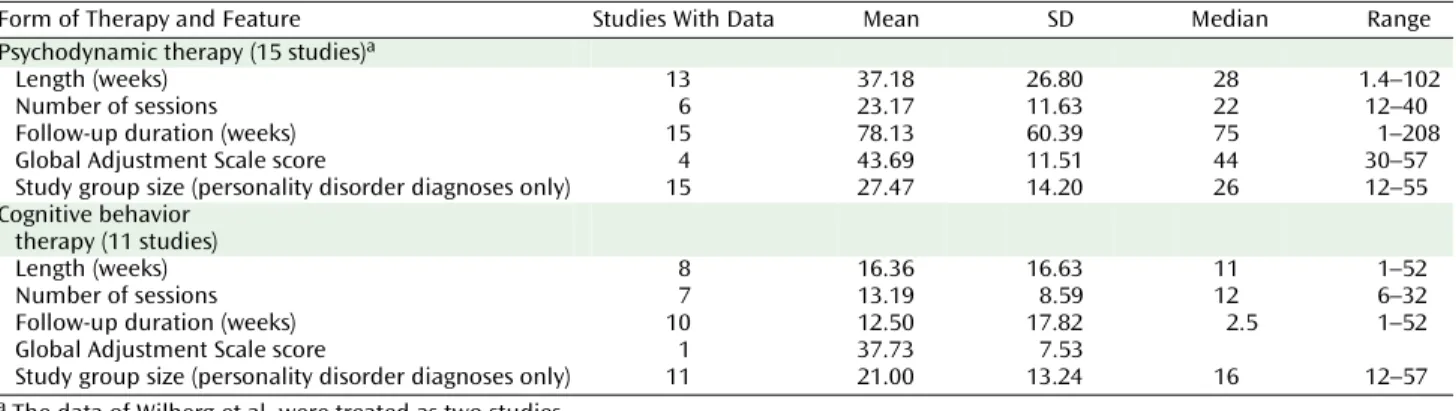
Table 2 presents the length, number of sessions, follow-up duration, and other features of the psychodynamic and cognitive behavior studies. Treatment manuals were used in five studies of psychodynamic therapy (10, 13, 16–18) and in four studies that used cognitive behavior therapy only (25, 26, 28, 30). Stevenson and Meares (15) used weekly therapist supervision instead of a manual to ensure adherence to the applied form of therapy. This was true for Ryle and Golynkina (36), who in addition examined a mea-sure of therapist competence. With a few exceptions (9), therapists had been specially trained in psychodynamic therapy or cognitive behavior therapy. In two studies of psychodynamic therapy, therapies were conducted mostly by trainees (15, 21). Concurrent use of medication was re-ported in nine studies (10, 12, 13, 22, 24–27, 36).
Patient groups. Patients with borderline personality
disorder were treated in seven of the psychodynamic ther-apy studies (9, 15, 20–24). Patients with borderline person-ality disorder, schizotypal personperson-ality disorder, and other personality disorders were studied by Karterud et al. (12). Mixed types from all three DSM-III personality disorder clusters were treated in two studies (17, 19). The patients TABLE 2. Features of Studies Included in a Meta-Analysis Examining the Effectiveness of Psychodynamic Therapy and Cog-nitive Behavior Therapy in the Treatment of Personality Disorders
Form of Therapy and Feature Studies With Data Mean SD Median Range
Psychodynamic therapy (15 studies)a
Length (weeks) 13 37.18 26.80 28 1.4–102
Number of sessions 6 23.17 11.63 22 12–40
Follow-up duration (weeks) 15 78.13 60.39 75 1–208
Global Adjustment Scale score 4 43.69 11.51 44 30–57
Study group size (personality disorder diagnoses only) 15 27.47 14.20 26 12–55
Cognitive behavior therapy (11 studies)
Length (weeks) 8 16.36 16.63 11 1–52
Number of sessions 7 13.19 8.59 12 6–32
Follow-up duration (weeks) 10 12.50 17.82 2.5 1–52
Global Adjustment Scale score 1 37.73 7.53
Study group size (personality disorder diagnoses only) 11 21.00 13.24 16 12–57
in the study by Hoglend (16) had cluster B or C personality disorders. Hardy et al. (10) studied patients with major de-pression and a concomitant diagnosis of a cluster C per-sonality disorder. Diguer et al. (18) reported the results of patients with major depression and a concomitant diag-nosis of a personality disorder without specifying the types of personality disorders. Woody et al. (13) reported the results for opiate addicts with and without antisocial personality disorder. Thus, predominantly the severe forms of personality disorders (clusters A and B) were treated in most of the studies. Personality disorders pre-dominantly of a neurotic level of dysfunction (cluster C) were treated in only two studies of psychodynamic ther-apy (10, 17). The study of Hoglend (16) included almost identical proportions of cluster C and cluster B patients (about 50% each).
In the seven studies using cognitive behavior therapy only, patients with borderline personality disorder (25– 27), bulimia nervosa with and without personality disor-der (29), and patients with avoidant personality disordisor-der (28, 30, 31) were studied. Linehan et al. studied parasui-cidal women with borderline personality disorder (25) and women with borderline personality disorder and drug de-pendence (26). Bohus et al. (27) reported the outcome for borderline inpatients. Springer et al. (14) examined a sam-ple of inpatients with personality disorder, of which 50% were diagnosed as having borderline personality disorder. Two studies required an axis I diagnosis of major de-pression as an inclusion criterion (10, 18), and for two studies opiate addiction or substance use disorder were required (13, 26). In one of the studies that used cognitive behavior therapy only, a diagnosis of bulimia nervosa was required (29); in two other studies, a diagnosis of social phobia was required (30, 31). In seven studies,
informa-tion was given about the prevalence of comorbid axis I di-agnoses (12, 13, 16, 17, 22, 26, 36). The most prevalent co-morbid axis I diagnoses, in descending order, were depression (major depression or dysthymia), adjustment and anxiety disorders, substance abuse, somatoform dis-order, and eating disorders.
Design and outcome measures. Three studies of
psy-chodynamic therapy used randomized controlled designs with a waiting list or a nonspecific treatment condition (13, 17, 22). Four studies included randomized comparisons of two active treatments (9, 10, 13, 20). Of the studies using cognitive behavior therapy only, five studies applied ran-domized controlled designs (14, 25, 26, 28, 30). The other studies were naturalistic observations of therapy groups.
Three studies used only self-report outcome measures (9, 14, 17), two studies used only observer-rated measures (16, 24), and the other studies used both. The most fre-quently used self-report instruments were the Beck De-pression Inventory (9, 10, 18, 20, 22, 24, 27) and the SCL-90-R (10, 12, 17, 19, 22, 27). The most frequently used ob-server-rated measures were the Health-Sickness Rating Scale and the Global Adjustment Scale (12, 16, 18, 23, 25). In all studies, observer-rated measures were assessed by using structured interview methods that were applied by independent assessors.
Effect Size Analyses
Psychodynamic therapy studies. As seen in Table 3,
psychodynamic therapy yielded an unweighted mean overall effect size of 1.46 (SD=0.73), which significantly differed from zero (t=7.73, df=14, p=0.0001). For self-re-port measures, the unweighted mean effect size was 1.08 (SD=0.36); for observer-rated measures, it was 1.79 (SD= 1.07). These mean effect sizes both differed significantly TABLE 3. Outcome Measures From Studies Included in a Meta-Analysis Examining the Effectiveness of Psychodynamic Therapy and Cognitive Behavior Therapy in the Treatment of Personality Disorders
Form of Therapy and Outcome Measure
Number
of Studies Mean SD Median Range
Psychodynamic therapy
Attrition (%) 11 15.36 12.39 14 0 to 38
Improvement effect size
Overall 15 1.46 0.73 1.29 0.34 to 2.70
Self-report measures 12 1.08 0.36 0.94 0.65 to 1.67
Observer-rated measures 12 1.79 1.07 1.90 0.34 to 4.02
Improvement effect size for specific measures of personality
disorder pathology 6 1.56 0.76 1.65 0.50 to 2.40
Improvement effect size for control conditions
Self-report measures 2 0.10 0.50 0.10 –0.26 to 0.45
Observer-rated measures 0
Recovery (%) 3 59 22 40 30 to 72
Cognitive behavior therapy
Attrition (%) 9 16.89 10.45 15 0 to 31
Improvement effect size
Overall 10 1.00 0.48 0.99 0.34 to 2.13
Self-report measures 8 1.20 0.38 1.20 0.81 to 1.85
Observer-rated measures 8 0.87 0.71 0.70 0.19 to 2.40
Improvement effect size for control conditions
Self-report measures 2 0.17 0.01 0.17 0.16 to 0.18
Observer-rated measures 3 0.51 0.39 0.40 0.19 to 0.95
from zero (self-report: t=10.51, df=11, p=0.0001; observer-rated: t=5.78, df=11, p=0.0001). Adjusted for sample size (34), the corresponding effect sizes were 1.40 (t=7.85, df= 14, p<0.001), 1.03 (t=10.95, df=11, p=0.0001), and 1.71 (t= 5.91, df=11, p=0.0001). In the two randomized controlled studies that reported data for the control condition (17, 22), active psychodynamic therapy was significantly more effective than the control conditions. For these two stud-ies, the differences in within-condition effect sizes be-tween psychodynamic therapy and the control condition yielded an unweighted mean difference of 1.32 for self-re-port measures. For observer-rated measures, only one study provided data that allowed comparison of active psychodynamic therapy with a control condition (22). We used the t and chi-square statistics reported by Bateman and Fonagy (22) to calculate effect sizes (32 [pp. 67, 223, 225]). Psychodynamic therapy yielded medium to large between-condition effect sizes for mean duration of inpa-tient episodes (d=4.29), number of individuals no longer self-mutilating (w=0.45), and number of individuals no longer parasuicidal (w=0.34).
Cognitive behavior therapy studies. For the 11 studies
that used cognitive behavior therapy, there was a mean un-weighted mean overall effect size of 1.00 (SD=0.48), which significantly differed from zero (t=6.56, df=9, p=0.0001). For self-report measures, the unweighted mean effect size was 1.20 (SD=0.38); for observer-rated measures, it was 0.87 (SD=0.71). These mean effect sizes both differed sig-nificantly from zero (self-report: t=8.95, df=7, p=0.0001; ob-server-rated: t=3.43, df=7, p=0.01). Adjusted for sample size (34), the corresponding effect sizes were 0.95 (t=6.67, df=9, p=0.0001), 1.14 (t=9.11, df=7, p=0.0001), and 0.82 (t=3.47, df=7, p=0.01). In three of the five randomized controlled studies (25, 26, 28), active cognitive behavior therapy was significantly more effective than the control conditions. In one study, no significant difference was found between cognitive behavior therapy and a discussion control group (14). For the three studies (25, 26, 28) that reported the rel-evant data, the differences in within-condition effect size between cognitive behavior therapy and the control condi-tion yielded an unweighted mean difference of 0.81 for self-report measures and 0.50 for observer-rated measures. While these values correspond to medium to large effect
sizes (32), the mean differences in effect sizes did not differ significantly from zero (t=4.76, df=1, p=0.13 and t=4.00, df= 2, p=0.06, respectively) on account of the small number of studies. In the study of Linehan et al. (38), dialectical be-havior therapy yielded a significantly greater reduction in parasuicidal acts than the control condition. We used the means and standard deviations reported by Linehan et al. to calculate effect sizes. For the reduction in parasuicidal acts, dialectical behavioral therapy yielded a medium be-tween-condition effect size of 0.53.
In Table 4, the mean unweighted effect sizes for the most frequently used measures are presented. Effect sizes for both patients with and without personality disorders were assessed. For psychodynamic therapy, the largest ef-fect sizes in personality disorders were found with the Health-Sickness Rating Scale or Global Adjustment Scale. For cognitive behavior therapy, the largest effect sizes were found with the Beck Depression Inventory.
Psychodynamic and cognitive behavior therapy
combination studies. For the two studies using
combi-nations of psychodynamic therapy and cognitive behavior therapy (35, 36), we found a mean unweighted effect size for self-report measures of 0.79. Observer-rated measures data that allowed calculation of mean effect sizes in the form of Cohen’s d were not available.
Correlations of Measures and Recovery Rate
Self-rated and observer-rated measures showed a posi-tive but nonsignificant correlation in studies of both psy-chodynamic therapy (rs=0.32, N=9, p=0.41) and cognitive behavior therapy (rs=0.26, N=6, p=0.62). However, for cog-nitive behavior therapy, only six studies provided both self-rated and observer-rated measures.
Three studies reported data referring to recovery from personality disorder after psychodynamic therapy, de-fined as no longer fulfilling the full criteria for personality disorder (15, 16, 19). Using these data, we calculated a mean recovery rate from personality disorders of 59% after a mean of 15 months of treatment. Concerning cognitive behavior therapy, only Brown et al. (31) reported data re-ferring to recovery rates. After treatment, 47% of the pa-tients were no longer diagnosed with avoidant personality disorder. These results and the definition of recovery, which is debatable, will be subsequently discussed. TABLE 4. Improvement Effect Sizes for the Most Frequently Used Outcome Measures From Studies Included in a Meta-Analysis Examining the Effectiveness of Psychodynamic Therapy and Cognitive Behavior Therapy in the Treatment of Per-sonality Disorders
Form of Therapy and Subject Group
Beck Depression Inventory SCL-90-R Global Severity Index
Health-Sickness Rating Scale or Global Adjustment Scale Number
of Studies
Effect Size Number of Studies
Effect Size Number of Studies
Effect Size
Mean SD Mean SD Mean SD
Psychodynamic therapy
Personality disorders 6 1.44 0.51 5 0.81 0.17 4 2.05 0.99
No personality disorder 2 2.39 0.54 2 1.39 0.04 2 2.52 1.47
Cognitive behavior therapy
Personality disorders 3 1.49 0.28 2 1.37 0.41 1 1.36
Factors Influencing Outcome and Effect Size Analyses
Diagnosis. In eight studies, the effects of psychodynamic therapy in patients with borderline personality disorder were reported (9, 12, 15, 20–24). The mean unweighted overall effect size was 1.31 (SD=0.71). The mean un-weighted effect sizes for self-rated and observer-rated measures were 1.00 (SD=0.25) and 1.45 (SD=1.09), respec-tively. These effect sizes were significantly different from zero (t=5.25, df=7, p=0.001; t=10.47, df=6, p=0.0001; t=3.28, df=5, p=0.02). The mean treatment duration was 33 weeks (SD=26.85). Adjusted for sample size, the corresponding effect sizes were 1.27 (t=5.18, df=7, p=0.001), 0.96 (t=10.27, df=6, p=0.0001), and 1.35 (t=3.47, df=5, p=0.02).
Four studies reported the effects of cognitive behavior therapy in patients with borderline personality disorder (14, 25–27). The mean unweighted overall effect size was 0.95 (SD=0.31). The mean unweighted effect sizes for self-rated and observer-self-rated measures were 0.97 (SD=0.24) and 0.81 (SD=0.54), respectively. The mean treatment du-ration was 22 weeks (SD=26.84). Adjusted for sample size, the corresponding effect sizes were 0.89, 0.92, and 0.76.
Core pathology of personality disorders. Some of the
studies included measures that were more specific to per-sonality disorders. For psychodynamic therapy, two stud-ies reported results for the Inventory of Interpersonal Problems (10, 22). Interpersonal problems are of some importance, since they are regarded as one of the core problems in personality disorders (39, also DSM-IV). For another measure of social functioning, the Social Adjust-ment Scale, outcome was reported by two other studies (17, 20). Monsen et al. (19) applied a measure of affect con-sciousness. They also reported data for the MMPI and for Morey’s Personality Disorder Scales, but these data were not included in our meta-analysis because effect sizes were not reported for all scales. Stevenson and Meares (15) reported outcome data referring to a measure of DSM-III criteria. Hardy et al. (10) applied a measure of self-esteem. Psychodynamic therapy yielded an unweighted mean ef-fect size of 1.56 (SD=0.76) for these more specific mea-sures of personality disorder pathology (Table 3). This mean effect size differs significantly from zero (t=5.02, df= 5, p=0.004). Adjusted for sample size, the corresponding effect size is 1.50 (t=5.02, df=5, p=0.004).
For cognitive behavior therapy, two studies (10, 25) re-ported large effect sizes in more specific measures of per-sonality disorder pathology (Inventory of Interpersonal Problems, Social Adjustment Scale, self-esteem, and the anger trait subscale).
Treatment duration. For psychodynamic therapy, we
found a positive correlation between the overall effect size and length of treatment, although it did not yield statistical significance because of the small number of studies (rs= 0.41, N=13, p=0.16). For cognitive behavior therapy, no cor-relation was assessed because the number of studies
pro-viding data was too small (N=8). For the same reason, no correlations with the number of sessions were assessed.
Dropouts. Studies differed with regard to the kind of
dropout data that were reported: subjects dropping out during the initial assessment phase (before therapy), during therapy, after therapy, or during the follow-up period. This is one reason why dropout rates varied considerably be-tween studies. For psychodynamic therapy, the mean drop-out rate was 15.36%; for cognitive behavior therapy, it was 16.89 (Table 3). For psychodynamic therapy, the dropout rate correlated significantly and positively with the pres-ence of a cluster A or cluster B personality disorder (rs=0.72, N=9, p=0.03); for cognitive behavior therapy, the correlation was insignificant (rs=0.33, N=8, p=0.43). Contrary to Perry et al. (8), we did not find a significant correlation between length of therapy and dropout rate for either psychody-namic therapy (rs=–0.31, N=9, p=0.41) or cognitive behavior therapy (rs=0.31, N=6, p=0.54). Since the number of studies is very small, these results can only be preliminary.
Other factors. We tested for patient gender, inpatient
versus outpatient status, use of therapy manuals, clinical experience of therapists, and study design. For psychody-namic therapy, the use of a therapy manual correlated sig-nificantly and positively with effect sizes for self-rated measures (rs=0.64, N=10, p=0.05). For observer-rated mea-sures, no such correlation was found (rs=–0.17, N=11, p= 0.61). None of the other variables correlated significantly with the outcome for either psychodynamic therapy or cognitive behavior therapy.
Discussion
This review addressed the effectiveness of psychody-namic therapy and cognitive behavior therapy in the treat-ment of personality disorders. One major limitation of this meta-analysis is the small number of studies that could be included: 14 studies of psychodynamic therapy and 11 studies of cognitive behavior therapy. The small number of studies reduces both the results’ potential generaliza-tion and the statistical power (32). Thus, the conclusions that can be drawn are only preliminary.
With regard to the potential generalization to commu-nity populations, the dropout rates are relevant. The mean dropout rates for psychodynamic therapy and cognitive behavior therapy were 15% and 17%, respectively. These rates are below the dropout rate reported by the NIMH study of depression for patients with a personality disor-der, which was 31%. The total number of subjects treated for personality disorders in the studies of psychodynamic therapy was N=417; for cognitive behavior therapy, the corresponding study group size was 231.
Since the data of the longest follow-up period were used for this review, the effect sizes indicate long-term rather than short-term change in personality disorders. This is particularly true of the psychodynamic therapy studies, which had a mean follow-up period of 1.5 years (78 weeks),
whereas the mean follow-up period for the cognitive be-havior therapy studies was considerably shorter (13 weeks). The effect sizes cannot be compared directly between cognitive behavior therapy and psychodynamic therapy because the data do not come from the same experimen-tal comparisons. The studies differed with respect to vari-ous aspects of therapy, patient samples, outcome assess-ment, and other variables.
Within-group effect sizes may be an overestimate of the true change because of unspecific therapeutic factors, spontaneous remission, or regression to the mean. How-ever, in the two randomized controlled studies of dynamic therapy (17, 22), the mean effect sizes for psycho-dynamic therapy exceeded that of the control condition. This was also true for the patients of the Bateman and Fonagy study in an 18-month follow-up (37). For cognitive behavior therapy, three randomized controlled studies (25, 26, 28) reported that cognitive behavior therapy was superior to a control condition.
The most frequently used outcome measures were the Beck Depression Inventory, SCL-90-R, and Global Adjust-ment Scale/Health-Sickness Rating Scale, which are broad measures of symptom severity and level of functioning and are nonspecific in nature. Thus, it is not clear from the data of these instruments if the corresponding effect sizes refer to changes in the personality disorders themselves or to improvements in axis I psychopathology. According to the results of this meta-analysis, both psychodynamic therapy and cognitive behavior therapy yielded significant improvements in more specific measures of personality disorder pathology.
Most of the patients studied who had personality disor-ders had comorbid axis I pathology. This is especially true of severe personality disorders such as borderline person-ality disorder. Studies that included patients with both axis I and axis II pathology (10, 12, 18) reported more patholog-ical pretreatment scores (SCL-90-R global severity index, Health-Sickness Rating Scale, Beck Depression Inventory, Present State Examination) for patients with personality disorders than for patients who had axis I pathology only.
Three studies of psychodynamic therapy reported rates of recovery from personality disorders. The mean recovery rate was 59%. However, defining remission as no longer meeting the criteria of the disorder at a single point in time is debatable. Significant fluctuations over time may occur that may be state dependent rather than showing lasting remission of the personality disorder in question (40–42). Long-term follow-up evaluations are necessary to study recovery from personality disorders.
Several studies reported more improvement in person-ality disorder patients after longer treatment durations (12, 16, 43). These results are consistent with the findings reported by Shea et al. (44) and Diguer et al. (18) for de-pressive patients with and without personality disorders and with the results of Kopta et al. (45), who found that im-provements in character problems take longer than
symp-tom changes. For patients with avoidant personality disor-der, Alden (28) noted that changes patients made during a 10-week treatment were insufficient to consider them healthy. Perry et al. (8) estimated the length of treatment necessary for patients to no longer meet the full criteria for a personality disorder (recovery). According to these esti-mates, 50% of patients with a personality disorder would recover by 1.3 years or 92 sessions and 75% by 2.2 years or about 216 sessions. Certainly, these estimates can only be preliminary, and more studies are necessary to test if these estimates can be generalized.
There is evidence that treatment with psychotherapy in personality disorder patients is relevant to the cost of health care utilization. In a randomized controlled study of high utilizers of psychiatric services, Guthrie et al. (46) showed that short-term psychodynamic-interpersonal therapy was significantly superior to treatment as usual with regard to the reduction of distress and the cost of health care utilization. Since certain subgroups of patients with personality disorders are high utilizers of psychiatric services (e.g., patients with borderline personality disor-der), these results are relevant for the treatment of person-ality disorders with psychotherapy.
In a recent meta-analysis, psychodynamic therapy and cognitive behavior therapy proved to be equally effective treatments for depression (47). According to the results presented in this review, there is evidence that psychody-namic therapy and cognitive behavior therapy are effec-tive treatments of personality disorders. Further research should examine specific forms of psychotherapy for spe-cific types of personality disorder. In order to ensure both internal and external validity, both naturalistic and ran-domized controlled studies are necessary. Outcome mea-sures should focus not only on axis I pathology but also on core psychopathology. Data on health economics should be included.
Received Nov. 14, 2001; revisions received May 3, Aug. 29, and Oct. 21, 2002; accepted Nov. 5, 2002. From the Department of Psycho-somatics and Psychotherapy, University of Göttingen; and the Tief-enbrunn Clinic, Göttingen, Germany. Address reprint requests to Dr. Leichsenring, Department of Psychosomatics and Psychotherapy, University of Göttingen, von-Siebold-Str. 5, 37075 Göttingen, Ger-many; [email protected] (e-mail).
References
1. Livesley WJ, Schroeder ML, Jackson DN, Jang KJ: Categorical dis-tinctions in the study of personality disorder: implications for classification. J Abnorm Psychol 1994; 103:6–17
2. Livesley WJ, Jang KL: Toward an empirically based classification of personality disorder. J Personal Disord 2000; 14:137–151 3. Perry JC, Lavori PH, Hoke L: A Marcov model for predicting
lev-els of psychiatric service use in borderline and antisocial per-sonality disorders and bipolar type II affective disorder. J Psy-chiatr Res 1987; 21:215–232
4. Dolan BM, Warren FM, Menzies D, Norton K: Cost-offset follow-ing specialist treatment of severe personality disorders. Psychi-atr Bull 1996; 20:413–417
5. Bender DS, Dolan RT, Skodol AE, Sanislow CA, Dyck IR, McGlas-han TH, Shea MT, Zanarini MC, Oldham JM, Gunderson JG: Treatment utilization by patients with personality disorders. Am J Psychiatry 2001; 158:295–302
6. Gunderson JG, Zanarini M: Current overview of the borderline diagnosis. J Clin Psychiatry 1987; 48(Aug suppl):5–14
7. Bateman A, Fonagy P: Effectiveness of psychotherapeutic treatment of personality disorder. Br J Psychiatry 2000; 177: 138–143
8. Perry JC, Banon E, Ianni F: Effectiveness of psychotherapy for personality disorders. Am J Psychiatry 1999; 156:1312–1321 9. Libermann RP, Eckman T: Behavior therapy vs insight oriented
therapy for repeated suicide attempters. Arch Gen Psychiatry 1981; 38:1126–1130
10. Hardy GE, Barkham M, Shapiro DA, Stiles WB, Rees A, Reynolds S: Impact of cluster C personality disorders on outcomes of contrasting brief psychotherapies for depression. J Consult Clin Psychol 1995; 63:997–1004
11. Stone M: Psychotherapy with schizotypal borderline patients. J Am Acad Psychoanal 1983; 11:87–111
12. Karterud S, Vaglum S, Friis S, Irion T, Johns S, Vaglum P: Day, hospital therapeutic community treatment for patients with personality disorders. J Nerv Ment Dis 1992; 180:238–243 13. Woody GE, McLellan T, Luborsky LL, O’Brien CP: Sociopathy and
psychotherapy outcome. Arch Gen Psychiatry 1985; 42:1081– 1086
14. Springer T, Lohr N, Buchtel HA, Silk KR: A preliminary report of short-term cognitive-behavioral group therapy for inpatients with personality disorders. J Psychother Pract Res 1996; 5:57–71 15. Stevenson J, Meares R: An outcome study of psychotherapy for patients with borderline personality disorder. Am J Psychiatry 1992; 149:358–362
16. Hoglend P: Personality disorders and long-term outcome after brief psychodynamic therapy. J Personal Disord 1993; 7:168–181 17. Winston A, Laikin M, Pollack J, Samstag LW, McCullough L, Mu-ran JC: Short-term psychotherapy of personality disorders. Am J Psychiatry 1994; 151:190–194
18. Diguer L, Barber JP, Luborsky L: Three concomitants: personal-ity disorders, psychiatric severpersonal-ity, and outcome of dynamic psy-chotherapy of major depression. Am J Psychiatry 1993; 150: 1246–1248
19. Monsen JT, Odland T, Faugli A, Daae E, Eilertsen DE: Personality disorders: changes and stability after intensive psychotherapy focusing on affect consciousness. Psychother Res 1995; 5:33–48 20. Munroe-Blum H, Marziali E: A controlled trial of short-term group treatment for borderline personality disorder. J Personal Disord 1995; 9:190–198
21. Wilberg T, Friis S, Karterud D, Mehlum L, Urnes O, Vaglum P: Outpatient group psychotherapy: a valuable continuation treatment for patients with borderline personality disorder treated in a day hospital? Nord J Psychiatry 1998; 52:213–221 22. Bateman A, Fonagy P: Effectiveness of partial hospitalization in
the treatment of borderline personality disorder: a random-ized controlled trial. Am J Psychiatry 1999; 156:1563–1569 23. Tucker L, Bauer SF, Wagner S, Harlam D, Sher I: Long-term
hos-pital treatment of borderline patients: a descriptive outcome study. Am J Psychiatry 1987; 144:1443–1448
24. Antikainen R, Hintikka J, Lehtonen J, Koponen H, Arstila A: A prospective follow-up study of borderline personality disorder inpatients. Acta Psychiatr Scand 1995; 92:327–335
25. Linehan MM, Tutek DA, Heard HL, Armstrong HE: Interpersonal outcome of cognitive behavioral treatment for chronically sui-cidal borderline patients. Am J Psychiatry 1994; 151:1771–1776 26. Linehan MM, Schmidt H, Dimeff LA, Craft JC, Kanter J, Comtois KA: Dialectical behavior therapy for patients with borderline
personality disorder and drug-dependence. Am J Addict 1999; 8:279–292
27. Bohus M, Haaf B, Stiglmayr C, Pohl U, Böhme R, Linehan M: Evaluation of inpatient dialectical-behavioral therapy for bor-derline personality disorder—a prospective study. Behav Res Ther 2000; 38:875–887
28. Alden L: Short-term structured treatment for avoidant person-ality disorder. J Consult Clin Psychol 1989; 56:756–764 29. Fahy TA, Eisler I, Russell GFM: Personality disorder and
treat-ment response in bulimia nervosa. Br J Psychiatry 1993; 162: 765–770
30. Stravynski A, Marks I, Yule W: Social skills problems in neurotic outpatients. Arch Gen Psychiatry 1982; 39:1378–1385 31. Brown EJ, Heimberg RG, Juster HR: Social phobia subtype and
avoidant personality disorder: effect of severity of social pho-bia, impairment, and outcome of cognitive-behavioral treat-ment. Behav Ther 1995; 26:467–486
32. Cohen J: Statistical Power Analysis for the Behavioral Sciences. Hillsdale, NJ, Lawrence Erlbaum Associates, 1988
33. Rosenthal R: Meta-Analytic Procedures for Social Research: Ap-plied Social Research Methods. Newbury Park, Calif, Sage Pub-lications, 1991
34. Hedges LV, Olkin I: Statistical Methods for Meta-Analysis. New York, Academic Press, 1985
35. Johnson C, Tobin DL, Dennis A: Differences in treatment out-come between borderline and nonborderline bulimics at one-year follow-up. Int J Eat Disord 1990; 9:617–627
36. Ryle A, Golynkina K: Effectiveness of time-limited cognitive-an-alytic therapy for borderline personality disorders: factors as-sociated with outcome. Br J Med Psychol 2000; 73:197–210 37. Bateman A, Fonagy P: Treatment of borderline personality
dis-order with psychoanalytically oriented partial hospitalization: an 18-month follow-up. Am J Psychiatry 2001; 158:36–42 38. Linehan MM, Armstrong HE, Suarez A, Allmon D, Heard H:
Cog-nitive behavioral treatment of chronically parasuicidal border-line patients. Arch Gen Psychiatry 1991; 48:1060–1064 39. Benjamin L: Interpersonal Diagnosis and the Treatment of
Per-sonality Disorders, 2nd ed. New York, Guilford, 1996
40. Kullgren G, Armelius BA: The concept of personality organiza-tion: a long-term comparative follow-up study with special ref-erence to borderline personality organization. J Personal Dis-ord 1990; 4:203–212
41. McGlashan TH: The Chestnut Lodge Follow-Up Study, III: long-term outcome of borderline personalities. Arch Gen Psychiatry 1986; 43:20–30
42. Pope HG Jr, Jonas JM, Hudson JI, Cohen BM, Gunderson JG: The validity of DSM-III borderline personality disorder: a phenome-nologic, family history, treatment response, and long-term fol-low-up study. Arch Gen Psychiatry 1983; 40:23–30
43. Dolan BM, Warren F, Norton K: Change in borderline symp-toms one year after therapeutic community treatment for se-vere personality disorders. Br J Psychiatry 1997; 171:274–279 44. Shea MT, Pilkonis PA, Beckham E, Collins JF, Elkin I, Sotsky SM,
Docherty JP: Personality disorders and treatment outcome in the NIMH Treatment of Depression Collaborative Research Pro-gram. Am J Psychiatry 1990; 147:711–718
45. Kopta SM, Howard KI, Lowry JL, Beutler LE: Patterns of symp-tomatic recovery in psychotherapy. J Consult Clin Psychol 1994; 62:1009–1016
46. Guthrie E, Moorey J, Margison F, Barker H, Palmer S, McGrath G, Tomenson B, Creed F: Cost-effectiveness of brief psychody-namic-interpersonal therapy in high utilizers of psychiatric ser-vices. Arch Gen Psychiatry 1999; 56:519–526
47. Leichsenring F: Comparative effects of short-term psychody-namic therapy and cognitive-behavioral therapy in depres-sion: a meta-analysis. Clin Psychol Rev 2001; 21:401–419