The Perception of Chinese Construction Professionals Towards
the Obstacles Implementing Green Construction
Mohammed Shareef M. S. Hasan 1,2*
1.School of Civil Engineering and Mechanics, Huazhong University of Science and Technology, Wuhan 430074, Hubei, China
2.Civil Engineer at General Directorate of Northern Electricity Production, Ministry of Electricity, Iraq
Abstract
Green construction plays a key role as building block of sustainable development. The economy is significantly affected by the construction industry of the country. There are certain stakeholders in the green construction industry, however project managers (PMs) play significant role in the process of a construction/ rehabilitation project. Generally, the initiative for change or implementing a new system is very challenging issue to deal with. Project manager has to encounter certain obstacles either at several stages of the green construction projects. The present study deals with the identification of the most critical obstacles that have the greatest influence on a project’s outcome in general and particularly in China. To rank the different obstacles extracted from the literature, we use multi criteria decision making (MCDM) tool i.e. TOPSIS. For obtaining input data a team of six experts (project managers) from top Chinese construction companies with an experience of more than 12 years were selected. The results depicts that the most relevant and important obstacles which are critical for green project management are managerial and psychological obstacles and they need to be addressed to improve the project management performance.
Keywords:green construction, project management, topsis, project managers.
1. Introduction
With the rapid growth in built environment effects on the human activity the social and environmental issues are also increasing. Technology, financial resources, and human resources are becoming critical for the change in construction industry and it requires management from all aspects of these resources. Construction industry is in transitional phase from conventional to new advanced and sustainable approach, at the same time it requires more effort and time to bring these changes at all levels from individual to organization and industry (Hemsath, 2013; Powmya & Zainul Abidin, 2014).
There are number of obstacles associated with green construction industry (Dubois & Gadde, 2002). Many countries are now focusing in improving the performance of the green construction industries for sustainable socioeconomic development. Construction industry is facing complex issues in developing countries, as these economies come across the obstacles such as lack of resources, weak organization systems, socioeconomic issues and unfamiliarity in dealing with complex issues (Yadollahi, Mirghasemi, Mohamad Zin & Singh, 2014).
Green construction deals with the use of green technologies so as to reduce the energy consumptions, use of green material, and water saving. The new green technologies are expensive on the basis of their technicality in operating, lack of competition and usually these are outsourced or imported (Robichand & Anantatmula, 2011), hence leading to the challenge of building new green technology at lowest cost, in order to compete in the market.
Other important issues and barriers related to green constructions are lack of operational knowledge, incompetency and lack of information for the successful delivery of green construction projects (William & Dair, 2007). According to Zainul Abidin (2010) the most critical obstacles are awareness and knowledge. As there is
and experience (Majid, Zaimi & Zakaria, 2001).
Project managers (PMs) play significant roles in the process of a construction/ rehabilitation project. A PM with adequate experience, supported by a group of qualified professional and clerical staff, tends to head the project and overlook the implementation process of the project. A PM and his team should have training in management aspects (Khan, 2010). A construction PM should consider everything in order to prevent failure in any step of the project. However, in most cases, undesirable challenges exist in project implementation.
Generally, the initiative for change or implementing a new system is very challenging. Project manager has to encounter these challenges either at implementation stage of project or at process stage. Construction industry has the issue of lack of clarity during the program management and contributes to the major challenge for project manager. Many organizations are facing the problem and confusion in explaining the program management, also there is lack of academic literature regarding this (Milosevic et al. 2009; Shehu & Akintoye, 2010). Accordingly, program management is required to communicate with all stakeholders specially the project team to exchange information at different stages. Therefore, lack of communication to different stakeholders can be another major issue for PM in managing a construction program.
Construction PMs are generally considered to be the key in the success of a construction project. The role of PM is not restricted only to planning, organizing and leading the team at project in green projects, there are other issues related to management of time pressures, dealing with uncertainties, and managing other complex issues of green technologies. The stressful environment of a construction project may reduce the potential capability of the PM. Research shows that stress level is very high in construction industry, showing 70% people suffering from stress, and depression in construction industry (Leung, Chan & Olomolaiye, 2008). Unfortunately employers and clients do not pay much attention to these challenges which are being faced by PMs. Accordingly this study deals with identifying the most critical obstacles that have the greatest influence on a green construction project’s outcome generally in a global context and particularly in Chinese context (Yadollahi, Mirghasemi, Mohamad Zin, & Singh, 2014).
2. Literature Review
The world economy and regions are becoming interdependent and there is a severe need of remedial of the newly existing obstacles which are affecting the day to day operation due to the shift in the market environment (Shehu & Akintoye, 2010).
2.1 Project Management
Majid et al (2012) defines project management as the direction and supervision of a project by the use of specific tools and control techniques including cost control, manpower, time, plant/machineries, communication, and motivation. PMs have total responsibility in construction sectors such as planning, organizing, and controlling. They are responsible for making sure that the planning phase of a project contains complete task definition, resources, time schedule, and a list of requirements. Furthermore they organize the project to make sure of hiring competent staff in order to produce necessary services and to achieve project objectives.
According to Frank (2002) the PM has direct authority over 34–47% of a project’s success. Accordingly, it is clear that a PM plays a key role in achieving success for a construction project. The relationship between client, developer, and/or investor and the rest of the project’s construction team is also significant.
In order to better understand and accept project management in the construction industry it is necessary to divide project management into different components. This study explores and focuses on the challenges faced by project managers in green construction. (Shehu & Akintoye, 2010; Shehu, 2008; Rayner,2007).
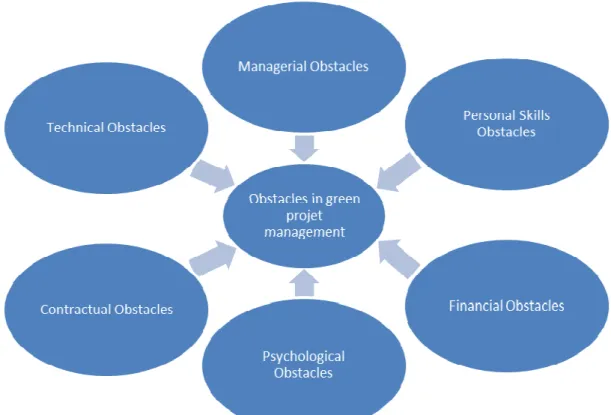
Figure 1: Obstacles in green construction project management
2.2 Obstacles faced by Project Managers (PMs)
The literature has discussed different critical elements regarding project managements, some most important are as follows:
2.2.1 Technical Obstacles
Yadollahi, Mirghasemi, Mohamad Zin, & Singh (2014) have categorized three critical technical obstacles in their research including challenges associated with Unfamiliar Technology and also Complexities in Construction Process. Technical challenge is defined as lack of understanding and proficiency in procedures, process, or techniques in performing certain activity. It requires specialized knowledge for a particular discipline, analytical ability for the process, and expertise to use the tools and techniques of a specific discipline. A successful PM has technical knowledge and expertise, which can be acquired in advanced and automated technological environment (Gann & Salter, 2000).
Furthermore, many researchers have mentioned technical challenges as the most important group of activities that can be challenging for an architect as a project manager (Liao, 2007;Siva & London, 2012; Bibby, Bouchlaghem, & Austin, 2003; Gorse & Emmitt, 2007), not to mention the fact that technical challenges is also one of the most critical challenges that architects may encounter and can cause the failure of a project (Leung, Chan, & Olomolaiye, 2008; Zhang, Shen & Wu, 2011; Tatum, 2012).
2.2.2 Managerial Obstacles
categorically so as to meet a specific purpose (Mills & Glass, 2009).
Contract emphasizes detail and policies which differ from the procedures because the purpose of policies is to help in the objective setting process. Therefore, contract and policies also develop understanding among group members, and the action of one group member is predictable to other members (Chua, Wang & Tan, 2003).
The project manager can rely to some extent on the policies and procedures developed by the organization. Thus, a lack of understanding or a lack of clarity in the contract could cause serious problems related to the organization and management of the tasks given to contractors (Chua, Wang &Tan, 2003; Shehu & Akintoye, 2010).
2.2.5 Psychological Obstacles
Psychological obstacles are defined as the total activities, behaviors, and tasks that could be the cause of a stressor. Consequently, the stressor leads to the psychological stress of a person which disturbs activities of the organization (Shehu & Akintoye, 2010; Tagaza & Wilson, 2004; Chua, Wang &Tan, 2003).
2.2.6 Financial Obstacles
Bartlett (2002) identified cost of the program in the form of resources, material, equipment, riskiness, and premises, at the certain stages of the program. Williams and Parr (2006) concluded that financial constrain is the major challenge in the program to sustain and it is an important element of organizational operating program management.
A lack of resources and inadequate finance from the client and payments for completed work during the construction stage are two common challenges found in most construction projects (Hwang, Zhao& Ng2013; Milosevic, Martinelli & Waddell, 2009; Hwang, Thomas, Haas, & Caldas2009).
Table 1: Barriers in green construction project management
Obstacles/ Barriers References
1. Technical Obstacles
• Yadollahi, Mirghasemi, Mohamad Zin, & Singh 2014
• Gann & Salter, 2000
• Liao, 2007
• Siva & London, 2012
• Bibby, Bouchlaghem, & Austin, 2003
• Gorse & Emmitt, 2007
2. Managerial Obstacles
• Chua, Wang & Tan, 2003
• Hewage, Ruwanpura, & Jergeas, 2008
• Choi, Poon & Davis, 2008
• Shehu & Akintoye, 2010
• Yitmen, 2007
• Leung, Chan& Olomolaiye, 2008
• Yadollahi, Mirghasemi, Mohamad Zin & Singh, 2014 3. Personal skills Obstacles • Sandoval, Mangus, & Samuels, 2005
• Caietti,2014
4. Contractual Obstacles
• Mills & Glass,2009
• Chua, Wang & Tan, 2003
• Shehu & Akintoye, 2010
5. Psychological Obstacles
• Shehu & Akintoye, 2010
• Tagaza & Wilson, 2004
• Chua, Wang & Tan, 2003
6. Financial Obstacles
• Bartlett, 2002
• Hwang, Zhao & Ng, 2013
• Milosevic, Martinelli & Waddell, 2009
• Hwang, Thomas, Haas, & Caldas, 2009
3. Methodology
To rank the different obstacles extracted from the literature, we use multi criteria decision making (MCDM) tool i.e. TOPSIS. The application of (MCDM) tools especially TOPSIS is in trend these days. This technique is very important especially for dealing with the unstructured problems (Lee and Eom, 1990).
The most widely used MCDM approach is TOPSIS. This is a technique (TOPSIS) for ordering preferences according to the ideal solution (Hwang and Yoon, 1981). TOPSIS is a reliable approach because of having two ideal solutions simultaneously the negative and positive. This is why in many studies researchers rely of TOPSIS approach. In the field of management TOPSIS has been used in several studies such as (Ramezani
and Lu, 2014; Kumar and Singh. 2012 and Khanna and Sharma, 2011). As compared to other multi criteria decision making tools TOPSIS is more simple and faster. This method hypothesizes two alternatives i.e. the ideal negative and the ideal positive.
TOPSIS identifies the preferred alternative according to its closeness and distance to the positive ideal solution and from the negative ideal solution respectively. The step by step TOPSIS application is as under.
Step 1: Construction of the decision matrix
This process denotes the rating of ith project manager with respect to jth barriers using the matrix with elements xij.
The matrix is denoted by ‘D’:
=
3 2 1 2 22 21 1 12 11...
...
...
...
...
...
...
m m m n nx
x
x
x
x
x
x
x
x
D
i =1, 2, 3,…, m is the number of alternative and j = 1, 2, 3,…, n is the number of criteria.
Step 2: Construction of the normalized decision matrix
This process involves the transformation of different characteristics dimensions into non-dimensional characteristics. The construction of normalized matrix helps comparing different obstacles.
Now, the normalized matrix is calculated with elements
(1) for i = 1, 2, …., n ; j = 1, 2, …., m . It is denoted by R
=
3 2 1 2 22 21 1 12 11...
...
...
...
...
...
...
m m m n nr
r
r
r
r
r
r
r
r
R
Step 3: Construction of the weighted normalized matrix
There involves a set of weights from the project managers is put in the normalized decision matix, the resulted matrix (R) is multiplied by associated weights. It is notable that the summing up the weights always returns 1.
(4) It is notable that J is a subset of {i = 1, 2, . . ., m}, presenting the benefit characteristic while J- is the complement set of J, it can be noted as Jc, representing cost characteristic.
Step 5: Calculation of the separation measurement based on Euclidean distance
s+ represents the Euclidean distance from +ve solution.
(5)
s- represents the Euclidean distance from -ve solution.
(6)
Step 6: Calculation of the relative closeness to the ideal solution c ∗. If it is closest to 1, then it depicts the best solution.
(7)
Step7: Ranking of the alternatives according to the preference order of closeness ratio c∗.
The best alternative is the one having the closeness to the positive ideal solution as it reflects the distance from the negative ideal solution.
4. Results and discussion
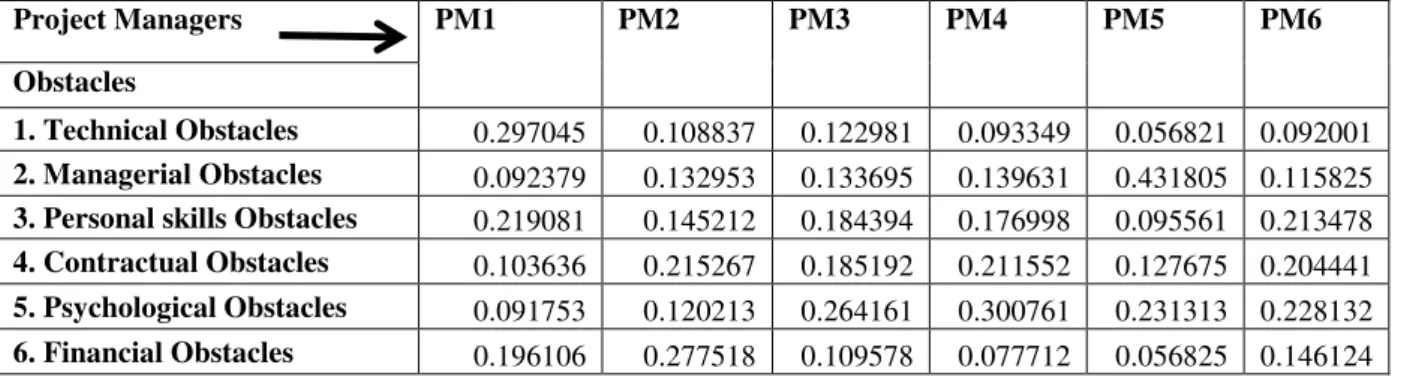
There have been certain obstacles in the field of green construction. Many developed and developing nations have recognized the significance of improving the performance of the green construction industry not only at the individual level but also at the organization and industry level, hence struggling toward the socioeconomic development in their particular countries. The obstacles and challenges faced by the green construction industry is a general phenomenon however in the developing countries it is one of the most critical issues. The subsequent obstacles can be listed as socioeconomic issues, lack of resources, organizational weaknesses, and an inability to deal with critical situations. For obtaining input data a team of six experts (project managers) from top Chinese construction companies with an experience of more than 12 years were selected. The barriers were given score in scale of 1-7 (1= least preferred, 7= most preferred). In step 4 positive and negative ideal solutions were determined see table 3. In step 5 distance from the positive ideal solution and negative ideal solution was determined see table 4 and 5. In step 6 closeness to the ideal solution is calculated see table 6 and based on the value of closeness ratio in the step 7 the ranking of the barriers was shown see table 7.
Table 2: Weighted normalized matrix
Project Managers PM1 PM2 PM3 PM4 PM5 PM6 Obstacles
1. Technical Obstacles 0.297045 0.108837 0.122981 0.093349 0.056821 0.092001 2. Managerial Obstacles 0.092379 0.132953 0.133695 0.139631 0.431805 0.115825 3. Personal skills Obstacles 0.219081 0.145212 0.184394 0.176998 0.095561 0.213478
4. Contractual Obstacles 0.103636 0.215267 0.185192 0.211552 0.127675 0.204441 5. Psychological Obstacles 0.091753 0.120213 0.264161 0.300761 0.231313 0.228132
6. Financial Obstacles 0.196106 0.277518 0.109578 0.077712 0.056825 0.146124
Table 3: Summary of +ve ideal solution and –ve ideal solution
Positive ideal sol. 0.297045 0.277518 0.264161 0.30076 0.431805 0.228132
Table 4: Distance from the positive ideal solution (s ∗)
Project Managers PM1 PM2 PM3 PM4 PM5 PM6 Average Obstacles
1. Technical Obstacles 0 0.02845 0.01993 0.04301 0.14061 0.01853 0.50054
2. Managerial Obstacles 0.041889 0.02089 0.01702 0.02596 0 0.01261 0.34407 3. Personal skills Obstacles 0.00601 0.01750 0.00636 0.01531 0.11306 0.00021 0.39816
4. Contractual Obstacles 0.03740 0.00387 0.00623 0.00795 0.09249 0.00056 0.38540 5. Psychological Obstacles 0.04214 0.02474 0 0 0.04019 0 0.32724 6. Financial Obstacles 0.01018 0 0.02389 0.04975 0.14061 0.00672 0.48080
Table 5: Distance from the negative ideal solution (s )
Project Managers PM1 PM2 PM3 PM4 PM5 PM6 Average
Obstacles
1. Technical Obstacles 0.04214 0 0.00018 0.00024 0 0 0.20632 2. Managerial Obstacles 3.91E-07 0.00058 0.00058 0.00383 0.14061 0.00056 0.38233 3. Personal skills Obstacles 0.01621 0.00132 0.00559 0.00985 0.00150 0.01475 0.22192
4. Contractual Obstacles 0.00014 0.01132 0.00571 0.01791 0.00501 0.01264 0.22971 5. Psychological Obstacles 0 0.00012 0.02389 0.04975 0.03044 0.01853 0.35036 6. Financial Obstacles 0.01088 0.028453 0 0 1.11E-11 0.00292 0.20560 Table 6: Summary of closeness ratio
Obstacles
1. Technical Obstacles 0.291881
2. Managerial Obstacles 0.526336 3. Personal skills Obstacles 0.357884 4. Contractual Obstacles 0.373435 5. Psychological Obstacles 0.517063 6. Financial Obstacles 0.299535
Table 7: Ranking of obstacles in effective maintenance management
Barriers weight Rank 1. Managerial Obstacles 0.526336 1
2. Psychological Obstacles 0.517063 2
5. Conclusion
This paper examines the critical obstacles that project managers must overcome in green construction projects. The method was applied using survey questionnaire for data collection. A group of six different obstacles were identified by reviewing the academic work. Chinese experts i.e. project managers were asked to prioritize the obstacles as they have the relevant experiences. Because of the ambiguity and blur in the project managers’ decision regarding prioritization of obstacles, a TOPSIS technique was applied to rank the critical barriers. The most critical barrier found according to the TOPSIS results is managerial obstacles which are related to scheduling, specification, design, portfolio management knowledge, project duration, performance measurement, number of tasks and construction sequence. Psychological obstacles were ranked on second however the value of psychological obstacles is also very near to the managerial obstacles showing that psychological obstacles are also very much relevant in the case of green project management. The psychological obstacles include time pressure and high level of risk. We can imply that both managerial and psychological obstacles are very much relevant and they need to be overcome as the first priority so as to increase the output of the project managers. Contractual and personal skill obstacles were ranked at third and fourth while the financial and technical challenges are were ranked at fifth and sixth. Thus we can conclude that the main aspects which are very much relevant to behavior say managerial and psychological obstacles are the most critical ones and they need to be removed at the first priority.
References:
Bartlett, J. (2002). Managing programmes of business change. 1st ed. Project
Bibby, L., Bouchlaghem, D., & Austin, S. (2003). Design management in practice: testing a training initiative to deliver tools and learning. Construction Innovation, 3(4), 217-229.
Caietti, N. (2014). 8 Essential Skills to Advance Your Career in Project Management, Project Management.https://www.liquidplanner.com/blog/8-skills-need-advance-career-project-management/
Choi, B., Poon, S. K., & Davis, J. G. (2008). Effects of knowledge management strategy on organizational performance: A complementarity theory-based approach. Omega, 36(2), 235-251.
Chua, D. K. H., Wang, Y., & Tan, W. T. (2003). Impacts of obstacles in East Asian cross-border construction.
Journal of construction engineering and management, 129(2), 131-141.
Dubois, A., & Gadde, L. E. (2002). The construction industry as a loosely coupled system: implications for productivity and innovation. Construction Management & Economics, 20(7), 621-631.
Frank, T. (2002). The superior project manager.
Gann, D. M., & Salter, A. J. (2000). Innovation in project-based, service-enhanced firms: the construction of complex products and systems. Research policy, 29(7), 955-972.
Gorse, C. A., & Emmitt, S. (2007). Communication behaviour during management and design team meetings: a comparison of group interaction. Construction Management and Economics, 25(11), 1197-1213.
Hemsath, T. (2013, August). Conceptual energy modeling for architecture, planning and design: Impact of using building performance simulation in early design stages. In 13th Conference of International Building Performance Simulation Association.
Hewage, K. N., Ruwanpura, J. Y., & Jergeas, G. F. (2008). IT usage in Alberta's building construction projects: Current status and challenges. Automation in construction, 17(8), 940-947.
Hwang, B. G., Thomas, S. R., Haas, C. T., & Caldas, C. H. (2009). Measuring the impact of rework on construction cost performance. Journal of Construction Engineering and Management, 135(3), 187-198.
Hwang, B. G., Zhao, X., & Ng, S. Y. (2013). Identifying the critical factors affecting schedule performance of public housing projects. Habitat International, 38, 214-221.
Khan, M. A. (2010). Bridge and highway structure rehabilitation and repair.
Leung, M. Y., Chan, Y. S., & Olomolaiye, P. (2008). Impact of stress on the performance of construction project managers. Journal of Construction Engineering and Management, 134(8), 644-652.
Liao, S. S. (2007). Top ten qualities of project manager Heroes: an interview with David B. Perini. Leadership and Management in Engineering, 7(2), 50-60.
Majid, A., Zaimi, M., & Zakaria, R. (2001). An Effectiveness of Communication in Project Undertaking: Problems and Constraints.
Majid, M. Z. A., Zakaria, W. Z., & Keyvanfar, A. (2012). Executive information site management system for monitoring project performance: system requirement study. OIDA International Journal of Sustainable Development, 3(3), 11-24.
Mills, F. T., & Glass, J. (2009). The construction design manager's role in delivering sustainable buildings.
Architectural Engineering and Design Management, 5(1-2), 75-90.
Milosevic, D. Z., Martinelli, R., & Waddell, J. M. (2009). Program management for improved business results. John Wiley & Sons.
of Sustainable Construction Engineering and Technology, 5(1), 33-41.
Rayner,. P. (2007). APM introduction to programme management. Association for Project Management.
Robichand, L.B. and Anantatmula, V.S. (2011), “Greening project management practices for sustainable construction”, Journal of Management in Engineering, pp. 48 – 57,.
Sandoval,. B., Mangus, D., & Samuels,. B. (2005). Heritage Comics Auctions, 2005 Random House Archives Catalog# 816, Heritage Capital Corporation,.
Shehu, Z., & Akintoye, A. (2010). Major challenges to the successful implementation and practice of programme management in the construction environment: A critical analysis. International Journal of Project Management,
28(1), 26-39.
Shehu,. Z. (2008). The framework for effective adoption and implementation of programme management in the UK construction industry. In: Built and natural environment. PhD thesis. Glasgow Caledonia University: Glasgow;.
Siva, J., & London, K. (2012). Client learning for successful architect-client relationships. Engineering, Construction and Architectural Management, 19(3), 253-268.
Tagaza, E., & Wilson, J. L. (2004). Green buildings: drivers and barriers e lessons learned from five Melbourne developments. Report Prepared for Building Commission by University of Melbourne and Business Outlook and Evaluation.
Tatum, C. B. (2012). Integrated construction engineering activities to satisfy challenging project objectives. In
Construction Research Congress 2012@ sConstruction Challenges in a Flat World (pp. 139-148). ASCE. Wideman, R. M. (2002). Comparing PRINCE2® with PMBoK®. AEW Services, Vancouver.
William & Dair (2007) “What is stopping sustainable building in England? Barriers experienced by stakeholders in delivering sustainable development”, Sustainable Development, 15, pp. 135 – 147,.
Williams, D., & Parr, T. (2004). Enterprise programme management. Delivering Value. World Green Building Trends (2016). Developing Markets Accelerate Global Green Growth
Yadollahi, M., Mirghasemi, M., Mohamad Zin, R., & Singh, B. (2014). Architect Critical Challenges as a Project Manager in Construction Projects: A Case Study. Advances in Civil Engineering, 2014.
Yitmen, I. (2007). The challenge of change for innovation in construction: A North Cyprus perspective. Building and environment, 42(3), 1319-1328.
Young, N.,W.( 2008). Key trends in the European and US construction market place, Smart Market Report, Design and Construction intelligence, CIOB, University of Reading and CRC,.
Zainul Abidin, N. (2010). “Investigating the awareness and application of sustainable construction concept by Malaysian developers”, Habitat International, 34(4), pp. 421 – 426,.
Zhang, X., Shen, L., & Wu, Y. (2011). Green strategy for gaining competitive advantage in housing development: a China study. Journal of Cleaner Production, 19(2), 157-167.