Chapter 3.
DATA_TYPE Values and Data File
Storage Formats
Each PDS archived product is described using label objects that provide information about the data types of stored values. The data elements DATA_TYPE, BIT_DATA_TYPE, and
SAMPLE_TYPE appear together with related elements defining starting location and length for each field. In PDS data object definitions the byte, bit, and record positions are counted from left to right, or first to last encountered, and always begin with 1.
Data files may be in ASCII or binary format. ASCII format is often more easily transferred between hardware systems or even application programs on the same computer.
Notwithstanding, numeric data are often stored in binary files when the ASCII representation would require substantially more storage space. (For example, each 8-bit signed pixel value in a binary image file would require a four-byte field if stored as an ASCII table.)
3.1
Data Elements
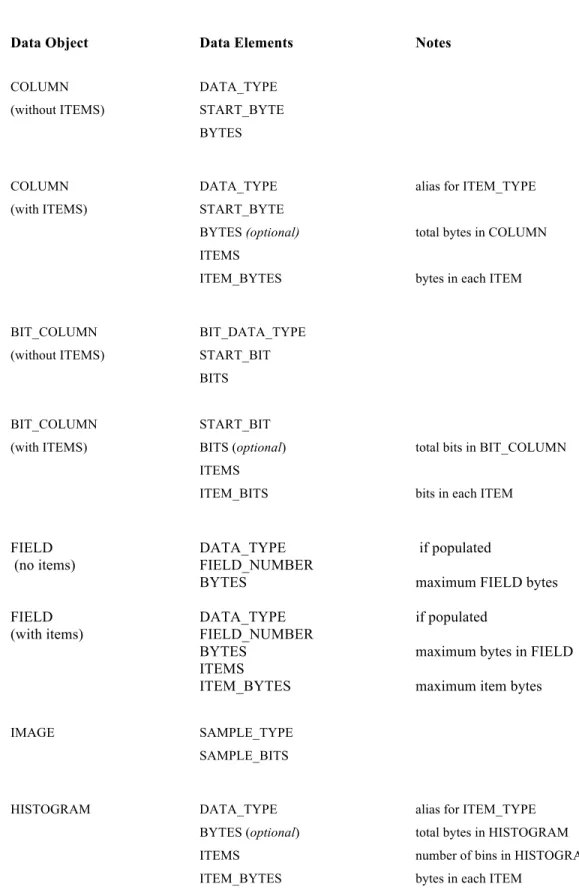
Table 3.1 identifies by object the data elements providing type, location, and length information. The elements ITEMS and ITEM_BYTES are used to subdivide a single COLUMN, FIELD, BIT_COLUMN, or HISTOGRAM into a regular vector containing as many elements as
specified for the value of ITEMS. In these objects the DATA_TYPE must indicate the type of a single item in the vector. In the past, the data element ITEM_TYPE was used for this purpose, but DATA_TYPE is now the preferred parameter.
3.2
Data Types
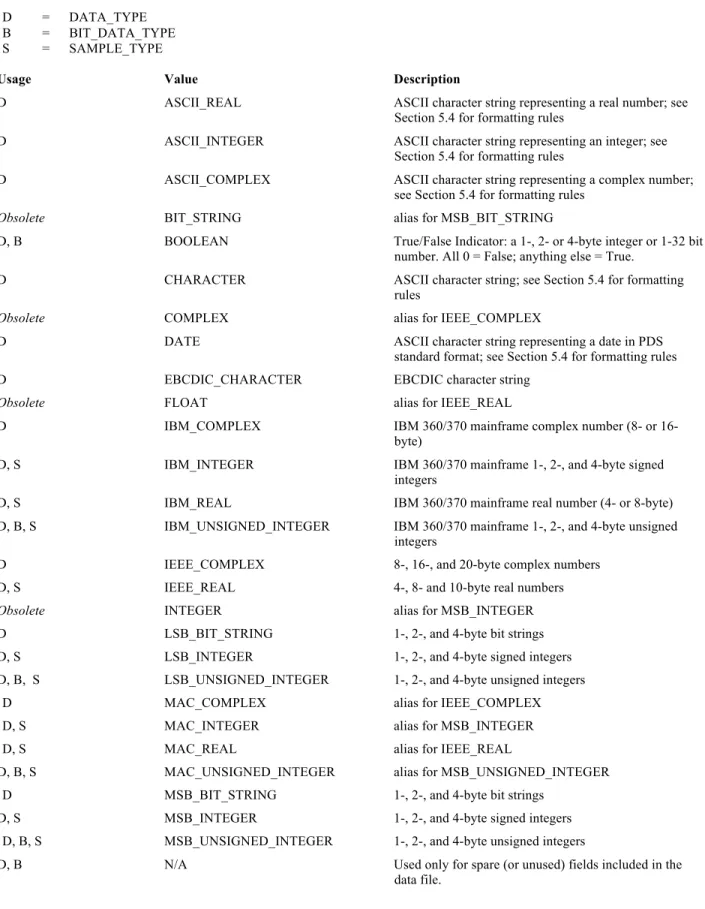
Table 3.2 identifies the valid values for the DATA_TYPE, BIT_DATA_TYPE, and SAMPLE_TYPE data elements used in PDS data object definitions. The values for these elements must be one of the standard values listed in the Planetary Science Data Dictionary
(PSDD). Please note:
• In all cases, these standard values refer to the physical storage format of the data in the data file.
• In some cases, obsolete values from previous versions of the PDS Standards have been retained as aliases for more specific values (the type “INTEGER”, for example, is interpreted as “MSB_INTEGER” when it is encountered). In these cases the more specific value should always be used in new data sets – the obsolete value is retained only for backward compatibility. Obsolete values are indicated in the table.
• Aliases have been supplied for some of the generic data types that indicate the kind of system on which the data originated. For example, “MAC_REAL” is an alias for “IEEE_REAL”, but “VAX_REAL” has no alias, as the VAX binary storage format is unique to VAX systems. In general, the more generic term is preferred, but the system-specific version may be used if needed.
Table 3.1: Type Elements Used in Data Label Objects
Data Object Data Elements Notes
COLUMN DATA_TYPE
(without ITEMS) START_BYTE
BYTES
COLUMN DATA_TYPE alias for ITEM_TYPE
(with ITEMS) START_BYTE
BYTES (optional) total bytes in COLUMN
ITEMS
ITEM_BYTES bytes in each ITEM
BIT_COLUMN BIT_DATA_TYPE
(without ITEMS) START_BIT
BITS
BIT_COLUMN START_BIT
(with ITEMS) BITS (optional) total bits in BIT_COLUMN
ITEMS
ITEM_BITS bits in each ITEM
FIELD DATA_TYPE if populated (no items) FIELD_NUMBER
BYTES maximum FIELD bytes FIELD DATA_TYPE if populated
(with items) FIELD_NUMBER
BYTES maximum bytes in FIELD ITEMS
ITEM_BYTES maximum item bytes
IMAGE SAMPLE_TYPE
SAMPLE_BITS
HISTOGRAM DATA_TYPE alias for ITEM_TYPE
BYTES (optional) total bytes in HISTOGRAM
ITEMS number of bins in HISTOGRAM
Table 3.2: Standard PDS Data Types
Data Element Usage Codes:
D = DATA_TYPE
B = BIT_DATA_TYPE
S = SAMPLE_TYPE
Usage Value Description
D ASCII_REAL ASCII character string representing a real number; see
Section 5.4 for formatting rules
D ASCII_INTEGER ASCII character string representing an integer; see
Section 5.4 for formatting rules
D ASCII_COMPLEX ASCII character string representing a complex number;
see Section 5.4 for formatting rules
Obsolete BIT_STRING alias for MSB_BIT_STRING
D, B BOOLEAN True/False Indicator: a 1-, 2- or 4-byte integer or 1-32 bit
number. All 0 = False; anything else = True.
D CHARACTER ASCII character string; see Section 5.4 for formatting
rules
Obsolete COMPLEX alias for IEEE_COMPLEX
D DATE ASCII character string representing a date in PDS
standard format; see Section 5.4 for formatting rules
D EBCDIC_CHARACTER EBCDIC character string
Obsolete FLOAT alias for IEEE_REAL
D IBM_COMPLEX IBM 360/370 mainframe complex number (8- or 16-
byte)
D, S IBM_INTEGER IBM 360/370 mainframe 1-, 2-, and 4-byte signed
integers
D, S IBM_REAL IBM 360/370 mainframe real number (4- or 8-byte)
D, B, S IBM_UNSIGNED_INTEGER IBM 360/370 mainframe 1-, 2-, and 4-byte unsigned
integers
D IEEE_COMPLEX 8-, 16-, and 20-byte complex numbers
D, S IEEE_REAL 4-, 8- and 10-byte real numbers
Obsolete INTEGER alias for MSB_INTEGER
D LSB_BIT_STRING 1-, 2-, and 4-byte bit strings
D, S LSB_INTEGER 1-, 2-, and 4-byte signed integers
D, B, S LSB_UNSIGNED_INTEGER 1-, 2-, and 4-byte unsigned integers
D MAC_COMPLEX alias for IEEE_COMPLEX
D, S MAC_INTEGER alias for MSB_INTEGER
D, S MAC_REAL alias for IEEE_REAL
D, B, S MAC_UNSIGNED_INTEGER alias for MSB_UNSIGNED_INTEGER
D MSB_BIT_STRING 1-, 2-, and 4-byte bit strings
D, S MSB_INTEGER 1-, 2-, and 4-byte signed integers
D, B, S MSB_UNSIGNED_INTEGER 1-, 2-, and 4-byte unsigned integers
D, B N/A Used only for spare (or unused) fields included in the
D PC_COMPLEX 8-, 16-, and 20-byte complex numbers in IBM/PC format
D, S PC_INTEGER alias for LSB_INTEGER
D, S PC_REAL 4-, 8-, and 10-byte real numbers in IBM/PC format
D, B, S PC_UNSIGNED_INTEGER alias for LSB_UNSIGNED_INTEGER
Obsolete REAL alias for IEEE_REAL
D SUN_COMPLEX alias for IEEE_COMPLEX
D, S SUN_INTEGER alias for MSB_INTEGER
D, S SUN_REAL alias for IEEE_REAL
D, B, S SUN_UNSIGNED_INTEGER alias for MSB_UNSIGNED_INTEGER
D TIME ASCII character string representing a date/time in PDS
standard format; see Section 5.4 for formatting rules
Obsolete UNSIGNED_INTEGER alias for MSB_UNSIGNED_INTEGER
D VAX_BIT_STRING alias for LSB_BIT_STRING
D VAX_COMPLEX Vax F-, D-, and H-type (8-, 16- and 32-byte,
respectively) complex numbers
D, S VAX_DOUBLE alias for VAX_REAL
D, S VAX_INTEGER alias for LSB_INTEGER
D, S VAX_REAL Vax F-, D-, and H-type (4-, 8- and 16-byte, respectively)
real numbers
D, B, S VAX_UNSIGNED_INTEGER alias for LSB_UNSIGNED_INTEGER
D VAXG_COMPLEX Vax G-type (16-byte) complex numbers
D, S VAXG_REAL Vax G-type (8-byte) real numbers
3.3
Binary Integers
There are two widely used formats for integer representations in 16-bit and 32-bit binary fields: most significant byte first (MSB) and least significant byte first (LSB) architectures. The MSB architectures include IBM mainframes, many UNIX systems such as SUN, and Macintosh computers. The LSB architectures include VAX systems and IBM PCs. In the original PDS system the default format was MSB, thus the designation of “INTEGER” and
“UNSIGNED_INTEGER” as aliases of “MSB_INTEGER” and “MSB_UNSIGNED_IN-TEGER”. New data sets should be prepared using the appropriate specific designation from Table 3.2, above.
3.4
Signed vs. Unsigned Integers
The “_INTEGER” data types refer to signed, 2’s complement integers. Use the corresponding “_UNSIGNED_INTEGER” type for unsigned integer and bit string fields.
3.5
Floating Point Formats
The PDS default representation for floating point numbers is the ANSI/IEEE standard. This representation is defined as the IEEE_REAL data type, with aliases identified in Table 3.2. Several additional specific floating-point representations supported by PDS are described in Appendix C.
3.6
Bit String Data
The BIT_STRING data types are used in definitions of table columns holding individual bit field values. A BIT_COLUMN object defines each bit field. BIT_STRING data types can be 1-, 2-, or 4-byte fields, much like a binary integer. Extraction of specific bit fields within a 2- or 4-byte BIT_STRING is dependent on the host architecture (MSB or LSB). In interpreting bit fields (BIT_COLUMNS) within a BIT_STRING, any necessary conversions such as byte swapping from LSB to MSB are done first, then bit field values (START_BIT, BITS) are used to extract the appropriate bits. This procedure ensures that bit fields are not fragmented due to differences in hardware architectures.
3.7
Character Data
Specification of character field format in ASCII and binary files pending.
3.8
Format Specifications
Data format specifications provided in the FORMAT element serve two purposes:
1. In an ASCII TABLE data file or SPREADSHEET file, they provide a format which can be used in scanning the ASCII record for individual fields; and
2. In a binary data file, they provide a format that can be used to display the data values.
A subset of the FORTRAN data format specifiers is used for the values of FORMAT elements. Valid specifiers include:
Aw Character data value
Iw Integer value
Fw.d Floating point value, displayed in decimal format Ew.d[Ee] Floating point value, displayed in exponential format
Where:
w is the total number of positions in the output field (including sign, decimal point, and exponentiation character – usually “E” – if any);
d is the number of positions to the right of the decimal point;
3.9
Internal Representations of Data Types
Appendix C contains the detailed internal representations of the PDS standard data types listed in Table 3.2.
The PDS has developed tools designed to use the specifications contained in Appendix C for interpreting data values for display and validation.