Applications of Trigonometry
501
6.1
Vectors in the Plane6.2
Dot Product of Vectors6.3
Parametric Equations and Motion6.4
Polar Coordinates6.5
Graphs of Polar Equations6.6
De Moivre’s Theorem and nth RootsYoung salmon migrate from the fresh water they are born in
to salt water and live in the ocean for several years. When
it’s time to spawn, the salmon return from the ocean to the
river’s mouth, where they follow the organic odors of their
homestream to guide them upstream. Researchers believe
the fish use currents, salinity, temperature, and the magnetic
field of the Earth to guide them. Some fish swim as far as
3500 miles upstream for spawning. See a related problem
on page 510.
Chapter 6 Overview
We introduce vectors in the plane, perform vector operations, and use vectors to represent quantities such as force and velocity. Vector methods are used extensively in physics, engi-neering, and applied mathematics. Vectors are used to plan airplane flight paths. The trigonometric form of a complex number is used to obtain De Moivre’s theorem and find the nth roots of a complex number.
Parametric equations are studied and used to simulate motion. One of the principal appli-cations of parametric equations is the analysis of motion in space. Polar coordinates an-other of Newton’s inventions, although James Bernoulli usually gets the credit because he published firstare used to represent points in the coordinate plane. Planetary motion is best described with polar coordinates. We convert rectangular coordinates to polar coordi-nates, polar coordinates to rectangular coordicoordi-nates, and study graphs of polar equations.
6.1
Vectors in the Plane
Two-Dimensional Vectors
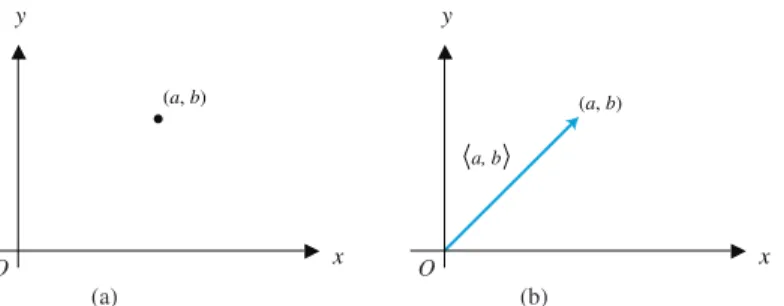
Some quantities, like temperature, distance, height, area, and volume, can be repre-sented by a single real number that indicates magnitude orsize. Other quantities, such as force, velocity, and acceleration, have magnitude anddirection. Since the number of possible directions for an object moving in a plane is infinite, you might be sur-prised to learn that two numbers are all that we need to represent both the magnitude of an object’s velocity and its direction of motion. We simply look at ordered pairs of real numbers in a new way. While the pair (a,b) determines a point in the plane, it also determines a (or ) with its tail at the origin and its head at (a,b) (Figure 6.1). The length of this arrow represents magnitude, while the direction in which it points represents direction. Because in this context the ordered pair (a,b) represents a mathematical object with both magnitude and direction, we call it the , and denote it as a,bto distinguish it from the point (a,b).
position vector of (a,b)
arrow directed line segment
What you’ll learn about ■Two-Dimensional Vectors ■Vector Operations ■Unit Vectors ■Direction Angles ■Applications of Vectors . . . and why
These topics are important in many real-world applications, such as calculating the effect of the wind on an airplane’s path.
OBJECTIVE
Students will be able to apply the arithmetic of vectors and use vectors to solve real-world problems.
MOTIVATE
Discuss the difference between the state-ments: “Jose lives 3 miles away from Mary” and “Jose lives 3 miles west of Mary.”
LESSON GUIDE
Day 1: Two-Dimensional Vectors; Vector Operations
Day 2: Unit Vectors, Direction Angles; Applications of Vectors (a, b) a, b y x y x (a, b) O O (a) (b)
FIGURE 6.1 The point represents the ordered pair (a,b). The arrow (directed line segment) represents the vector a,b.
JAMES BERNOULLI (1654–1705)
The first member of the Bernoulli family (driven out of Holland by the Spanish persecutions and settled in Switzerland) to achieve mathematical fame, James defined the numbers now known as Bernoulli numbers. He determined the form (the elastica) taken by an elastic rod acted on at one end by a given force and fixed at the other end.
It is often convenient in applications to represent vectors with arrows that begin at points other than the origin. The important thing to remember is that any two arrows with the same length and pointing in the same direction represent the same vector. In Figure 6.2, for example, the vector 3, 4is shown represented by RS, an arrow with
Rand S, as well as by its standard representation OP. Two arrows that represent the same vector are called equivalent.
terminal point initial point
DEFINITION Two-Dimensional Vector
A is an ordered pair of real numbers, denoted in as a,b. The numbers aand bare the of the vector . The of the vector a,bis the arrow from the origin to the point (a,b). The of is the length of the arrow, and the of vis the direction in which the arrow is pointing. The vec-tor 00, 0, called the zero vector,has zero length and no direction.
direction v magnitude standard representation v components component form two-dimensional vector v
Head Minus Tail (HMT) Rule
If an arrow has initial point x1,y1and terminal point x2,y2, it represents the
vector x2x1,y2y1. y x P(3, 4) O(0, 0) R(–4, 2) S(–1, 6)
FIGURE 6.2 The arrows RSand OP both represent the vector 3, 4, as would any arrow with the same length pointing in the same direction. Such arrows are called
equivalent.
The quick way to associate arrows with the vectors they represent is to use the following rule.
IS AN ARROW A VECTOR?
While an arrow representsa vector, it is not a vector itself, since each vector can be represented by an infinite number of equivalent arrows. Still, it is hard to avoid referring to “the vector PQ” in practice, and we will often do that ourselves. When we say “the vector uPQ,” we
really mean “the vector urepresented by PQ.” x y Q(5, 3) O S(–1, 6) R(–4, 2) P(2, –1)
FIGURE 6.3 The arrows RSand PQappear to have the same magnitude and direction. The Head Minus Tail Rule proves that they represent the same vector (Example 1).
SOLUTION
Applying the HMT rule, we see that RSrepresents the vector 1(4), 6 2
3, 4, while PQrepresents the vector 52, 3(1)3, 4. Although they have different positions in the plane, these arrows represent the same vector and are
there-fore equivalent. Now try Exercise 1.
EXAMPLE 1
Showing Arrows are Equivalent
Show that the arrow from R(4, 2) to S(1, 6) is equivalent to the arrow from
FIGURE 6.4 The magnitude of vis the length of the arrow PQ, which is found using the distance formula:v
x2x12 y 2 y12.
EXPLORATION 1 Vector Archery
See how well you can direct arrows in the plane using vector information and the HMT Rule.
1. An arrow has initial point (2, 3) and terminal point (7, 5). What vector does it represent? 5, 2
2. An arrow has initial point (3, 5) and represents the vector 3, 6. What is the terminal point? 0, 11
3. If Pis the point (4,3) and PQrepresents 2,4, find Q. 6,7 4. If Qis the point (4,3) and PQrepresents 2,4, find P. 2, 1
If you handled Exploration 1 with relative ease, you have a good understanding of how vectors are represented geometrically by arrows. This will help you understand the algebra of vectors, beginning with the concept of magnitude.
The magnitude of a vector vis also called the absolute value ofv, so it is usually denoted by v. (You might see vin some textbooks.) Note that it is a nonnegative real number, not a vector. The following computational rule follows directly from the distance formula in the plane (Figure 6.4).
y
x P(x1, y1)
Q(x2, y2)
Magnitude
If vis represented by the arrow from x1,y1to x2,y2, then
vx2x12y2y12.
If va,b, then v a2b2.
EXAMPLE 2
Finding Magnitude of a Vector
Find the magnitude of the vector v represented by PQ, where P (3, 4) and Q(5, 2).
SOLUTION
Working directly with the arrow,v(5 (3))2(24)222. Or, the
HMT Rule shows that v2,2, so v(2)2(2)222.
(See Figure 6.5.) Now try Exercise 5.
Vector Operations
The algebra of vectors sometimes involves working with vectors and numbers at the same time. In this context we refer to the numbers as . The two most basic algebraic operations involving vectors are vector addition(adding a vector to a vector) and scalar multiplication(multiplying a vector by a number). Both operations are easily represented geometrically, and both have immediate applications to many real-world problems.
scalars y x v O(0, 0) (–2, –2) Q(–5, 2) P(–3, 4)
FIGURE 6.5 The vector vof Example 2.
WHAT ABOUT DIRECTION?
You might expect a quick computation-al rule for directionto accompany the rule for magnitude, but direction is less easily quantified. We will deal with vec-tor direction later in the section.
The sum of the vectors u and vcan be represented geometrically by arrows in two ways.
In the representation, the standard representation of u points from the origin to u1,u2. The arrow from u1,u2to u1v1,u2v2represents v(as you can
verify by the HMT Rule). The arrow from the origin to u1v1,u2v2then
repre-sents uv(Figure 6.6a).
In the representation, the standard representations of u and v deter-mine a parallelogram, the diagonal of which is the standard representation of uv
(Figure 6.6b). parallelogram tail-to-head x y v u x y u + v v u (a) (b) u + v –2u (1/2)u u 2u
FIGURE 6.7 Representations of uand several scalar multiples of u.
The product kuof the scalar kand the vector ucan be represented by a stretch (or shrink) of uby a factor of k. If k> 0, then kupoints in the same direction as u; if k< 0, then ku
points in the opposite direction (Figure 6.7).
EXAMPLE 3
Performing Vector Operations
Let u1, 3and v4, 7. Find the component form of the following vectors:
(a) uv (b) 3u (c) 2u(1)v
SOLUTION Using the vector operations as defined, we have:
(a) uv1, 34, 71 4, 3 73, 10
(b) 3u31, 33, 9
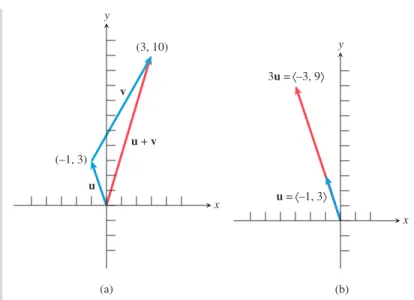
(c) 2u(1)v21, 3(1) 4, 72, 6 4,7 6,1 Geometric representations of uvand 3uare shown in Figure 6.8 on the next page. FIGURE 6.6 Two ways to represent vector addition geometrically: (a) tail-to-head, and (b) parallelogram.
WHAT ABOUT VECTOR MULTIPLICATION?
There is a useful way to define the mul-tiplication of two vectors—in fact, there are two useful ways, but neither one of them follows the simple pattern of vec-tor addition. (You may recall that matrix multiplication did not follow the simple pattern of matrix addition either, and for similar reasons.) We will look at the
dot productin Section 6.2. The cross productrequires a third dimension, so we will not deal with it in this course.
DEFINITION Vector Addition and Scalar Multiplication
Let uu1,u2and vv1,v2be vectors and let kbe a real number (scalar). The sum
(or ) is the vector
uvu1v1,u2v2.
The is kuku1,u2ku1,ku2. product of the scalar kand the vector u
of the vectors u and v resultant
Unit Vectors
A vector u with length u1 is a . If v is not the zero vector
0, 0, then the vector
u v v 1 vv
is a . Unit vectors provide a way to represent the
direction of any nonzero vector. Any vector in the direction of v, or the opposite direc-tion, is a scalar multiple of this unit vector u.
EXAMPLE 4
Finding a Unit Vector
Find a unit vector in the direction of v3, 2, and verify that it has length 1.
SOLUTION v3, 23222 13, so vv 1 1 33, 2
1 3 3 , 2 1 3 The magnitude of this vector is 1 3 3 , 2 1 3(
13 3)
2(
2 1 3)
23
19143 11331Thus, the magnitude of v
vis 1. Its direction is the same as vbecause it is aposi-tive scalar multiple of v. Now try Exercise 21.
unit vector in the direction of v
unit vector y x v u u + v (–1, 3) (3, 10) (a) y x u = –1, 3 3u = –3, 9 (b)
FIGURE 6.8 Given that u1, 3and v4, 7, we can (a) represent uvby the tail-to-head method, and (b) represent 3uas a stretch of uby a factor of 3.
Now try Exercise 13.
A WORD ABOUT VECTOR NOTATION
Both notations, a, band aibj, are designed to convey the idea that a sin-gle vector vhas two separate compo-nents. This is what makes a two-dimensional vector two-two-dimensional. You will see both a, b, cand aibj
ckused for three-dimensional vectors, but scientists stick to the notation for dimensions higher than three.
EXAMPLE 5
Finding the Components of a Vector
Find the components of the vector vwith direction angle 115 and magnitude 6Figure 6.11.
SOLUTION If aand bare the horizontal and vertical components, respectively, of
v, then
va,b6 cos 115, 6 sin 115. So,a6 cos 1152.54 and b6 sin 1155.44.
Now try Exercise 29. The two unit vectors i1, 0and j0, 1are the . Any vec-tor vcan be written as an expression in terms of the standard unit vectors:
va,b
a, 00,b
a1, 0b0, 1
aibj
Here the vector va,bis expressed as the aibjof the vec-tors iand j. The scalars aand bare the and , respec-tively, of the vector v. See Figure 6.9.
Direction Angles
You may recall from our applications in Section 4.8 that direction is measured in dif-ferent ways in difdif-ferent contexts, especially in navigation. A simple but precise way to specify the direction of a vector vis to state its , the angle that v
makes with the positive x-axis, just as we did in Section 4.3. Using trigonometry (Figure 6.10), we see that the horizontal component of vis vcos and the vertical component is vsin . Solving for these components is called resolving the vector.
direction angle
components vertical
horizontal
linear combination
standard unit vectors
FIGURE 6.9 The vector vis equal to aibj. y x v = a, b bj ai
Resolving the Vector
If vhas direction angle , the components of vcan be computed using the formula
vvcos ,vsin .
From the formula above, it follows that the unit vector in the direction of vis
u v v cos , sin . y x v |v| sinθ |v| cosθ θ
FIGURE 6.10 The horizontal and verti-cal components of v.
FIGURE 6.11 The direction angle of v
is 115°. (Example 5) y x v = a, b 6 115° O
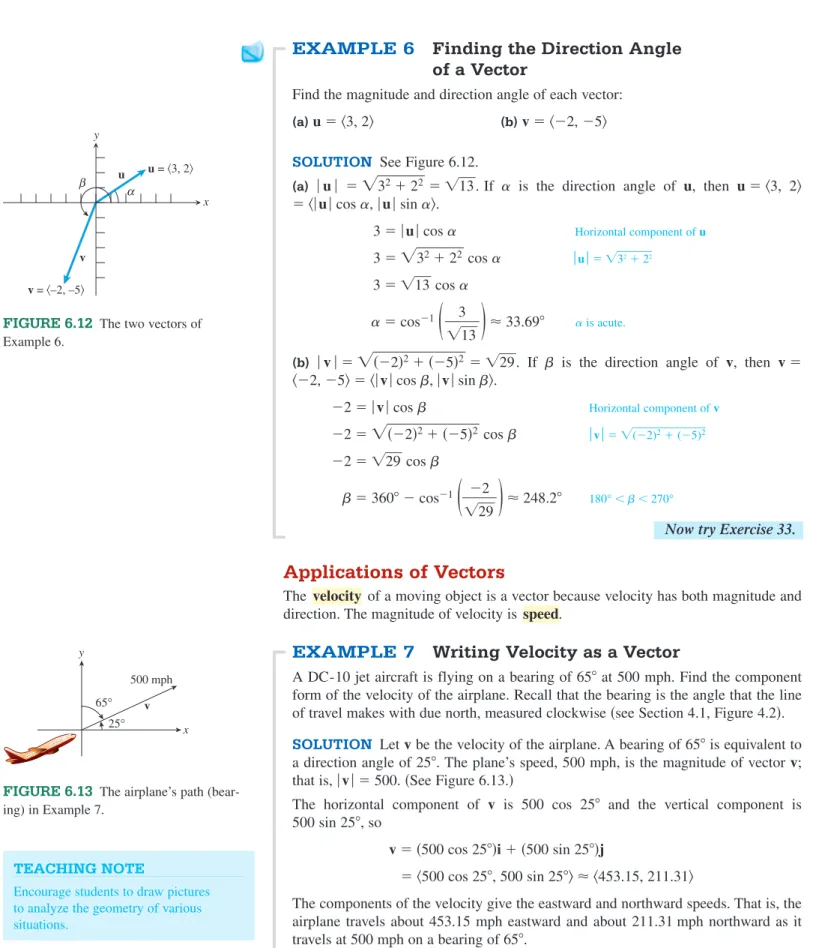
FIGURE 6.12 The two vectors of Example 6. y x β α u = 3, 2 v = –2, –5 v u
EXAMPLE 6
Finding the Direction Angle
of a Vector
Find the magnitude and direction angle of each vector:
(a)u3, 2 (b)v2,5
SOLUTION See Figure 6.12.
(a) u 322213. If is the direction angle of u, then u3, 2
ucos ,usin .
3ucos Horizontal component of u 33222cos u3222 313cos cos1
(
3 1 3)
33.69 is acute.(b) v2252 29. If is the direction angle of v, then v
2,5vcos,vsin.
2vcos Horizontal component of v
22252 cos v(2)2(5)2 229cos 360 cos1
(
2 2 9)
248.2 180°270°Now try Exercise 33.
FIGURE 6.13 The airplane’s path (bear-ing) in Example 7. x y v 500 mph 25° 65° TEACHING NOTE
Encourage students to draw pictures to analyze the geometry of various situations.
Applications of Vectors
The of a moving object is a vector because velocity has both magnitude and direction. The magnitude of velocity is .
EXAMPLE 7
Writing Velocity as a Vector
A DC-10 jet aircraft is flying on a bearing of 65at 500 mph. Find the component form of the velocity of the airplane. Recall that the bearing is the angle that the line of travel makes with due north, measured clockwise see Section 4.1, Figure 4.2.
SOLUTION Let vbe the velocity of the airplane. A bearing of 65is equivalent to
a direction angle of 25. The plane’s speed, 500 mph, is the magnitude of vector v; that is,v500. See Figure 6.13.
The horizontal component of v is 500 cos 25 and the vertical component is 500 sin 25, so
v500 cos 25i500 sin 25j
500 cos 25, 500 sin 25 453.15, 211.31
The components of the velocity give the eastward and northward speeds. That is, the airplane travels about 453.15 mph eastward and about 211.31 mph northward as it travels at 500 mph on a bearing of 65.
Now try Exercise 41.
speed velocity
FOLLOW-UP
Have students discuss why it does not make sense to add a scalar to a vector.
ASSIGNMENT GUIDE
Day 1: Ex. 3–27, multiples of 3, 39, 40 Day 2: Ex. 29, 32, 34, 37, 42, 43, 45, 46, 49
COOPERATIVE LEARNING
Group Activity: Ex. 53–54
NOTES ON EXERCISES
Ex. 43–50 are problems that students would typically encounter in a physics course.
Ex. 55–60 provide practice with standardized tests.
Ex. 62 and 64 demonstrate connections between vectors and geometry.
ONGOING ASSESSMENT
Self-Assessment: Ex. 1, 5, 13, 21, 29, 33, 41, 43, 47
Embedded Assessment: Ex. 45, 46, 62
y x θ A C B D 60° 65 mph 450 mph v
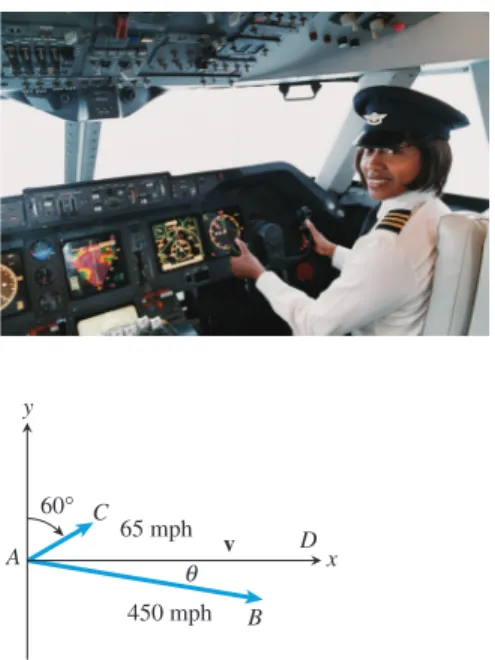
FIGURE 6.14 The x-axis represents the flight path of the plane in Example 8.
A typical problem for a navigator involves calculating the effect of wind on the direc-tion and speed of the airplane, as illustrated in Example 8.
EXAMPLE 8
Calculating the Effect of Wind Velocity
Pilot Megan McCarty’s flight plan has her leaving San Francisco International Airport and flying a Boeing 727 due east. There is a 65-mph wind with the bearing 60. Find the compass heading McCarty should follow, and determine what the air-plane’s ground speed will be assuming that its speed with no wind is 450 mph.SOLUTION See Figure 6.14. Vector ABrepresents the velocity produced by the
air-plane alone,ACrepresents the velocity of the wind, and is the angle DAB. Vector
vADrepresents the resulting velocity, so
vADACAB. We must find the bearing of ABand v.
Resolving the vectors, we obtain AC 65 cos 30, 65 sin 30 AB 450 cos , 450 sin AD ACAB
65 cos 30 450 cos , 65 sin 30 450 sin
Because the plane is traveling due east, the second component of ADmust be zero. 65 sin 30 450 sin 0 sin1
(
65 4 s 5 i 0 n 30)
4.14 0Thus, the compass heading McCarty should follow is
90 94.14. Bearing 90°
The ground speed of the airplane is
vAD65cos30°450cos202
65 cos 30 450 cos
505.12 Using the unrounded
value of .
McCarty should use a bearing of approximately 94.14. The airplane will travel due east at approximately 505.12 mph. Now try Exercise 43.
EXAMPLE 9
Finding the Effect of Gravity
A force of 30 pounds just keeps the box in Figure 6.15 from sliding down the ramp inclined at 20. Find the weight of the box.
SOLUTION We are given that AD30. Let ABw; then
sin 20 C w B 3 w 0 . Thus, w sin 30 20° 87.71.
The weight of the box is about 87.71 pounds. Now try Exercise 47. FIGURE 6.15 The force of gravity AB
has a component ACthat holds the box against the surface of the ramp, and a com-ponent ADCB that tends to push the box down the ramp. (Example 9)
w A
B C
D
20° 20°
CHAPTER OPENER PROBLEM
(from page 501)
PROBLEM: During one part of its migration, a salmon is swimming at 6 mph, and the current is flowing downstream at 3 mph at an angle of 7 degrees. How fast is the salmon moving upstream?
SOLUTION: Assume the salmon is swimming in a plane parallel to the surface of the water.
In the figure, vector ABrepresents the current of 3 mph,is the angle CAB, which is 7 degrees, the vector CArepresents the velocity of the salmon of 6 mph, and the vector CBis the net velocity at which the fish is moving upstream.
So we have
AB3 cos 83, 3 sin 83 0.37,2.98 CA0, 6
Thus CBCAAB3 cos 83, 3 sin 836 0.37, 3.02
The speed of the salmon is then CB0.372+3.022 3.04 mph upstream.
A C B θ salmon swimming in still water current salmon net velocity
SECTION 6.1 EXERCISES
In Exercises 1– 4, prove that RSand PQare equivalent by showing that they represent the same vector.
1.R4, 7,S1, 5,O0, 0, and P3,2
2.R7,3,S4,5,O0, 0, and P3,2
3.R2, 1,S0,1,O1, 4, and P1, 2
4.R2,1,S2, 4,O3,1, and P1, 4 In Exercises 5 –12, let P2, 2,Q3, 4,R2, 5, and S2,8. Find the component form and magnitude of the vector.
5.PQ 5, 2; 29 6. RS 4,13; 185 7.QR 5, 1; 26 8. PS 4,10; 229 9.2QS 2,24; 2145 10. 2PR 0, 32; 32 11.3QRPS 11,7; 170 12. PS3PQ 11,16; 377
In Exercises 13 – 20, let u1, 3,v2, 4, and w2,5. Find the component form of the vector.
13.uv 1, 7 14. u1v 3,1
15.uw 3, 8 16. 3v 6, 12
17.2u3w 4,9 18. 2u4v 10,10
19.2u3v 4,18 20. uv 1,7
In Exercises 21– 24, find a unit vector in the direction of the given vector.
21.u2, 4 22. v1,1
23.w i2j 24. w5i5j
In Exercises 25– 28, find the unit vector in the direction of the given vector. Write your answer in (a)component form and (b)as a linear combination of the standard unit vectors iand j.
25.u2, 1 26. u3, 2
27.u4,5 28. u3,4
In Exercises 29– 32, find the component form of the vector v.
29. 30. y x 55° 14 v y x 25° 18 v
QUICK REVIEW 6.1
(For help, go to Sections 4.3 and 4.7.) In Exercises 1– 4, find the values of xand y.1. 2. 3. 4. In y x 6 –50° x (x, y) y y x (x, y) y 7 220° x 15 y x (x, y) 120° x y y x 9 30° (x, y) x y
Exercises 5 and 6, solve for in degrees.
5.sin1
(
3 2 9)
33.85° 6.cos1(
1 1 5)
104.96°In Exercises 7–9, the point Pis on the terminal side of the angle . Find the measure of if 0 360.
7.P5, 9 60.95° 8.P5,7 305.54°
9.P2,5 180 tan–1(52) 248.20
10.A naval ship leaves Port Norfolk and averages 42 knots
nautical mphtraveling for 3 hr on a bearing of 40and then 5 hr on a course of 125. What is the boat’s bearing and distance from Port Norfolk after 8 hr?
Distance: 254.14 naut mi.; Bearing: 95.40°
7.5; 15 2 3 923; 4.5 5.36; 4.50 3.86; 4.60 16.31, 7.61 8.03, 11.47 21. 0.45i 0.89j 22. 0.71i 0.71j 23. 0.45i 0.89j 24. 0.71i 0.71j
31. 32.
In Exercises 33–38, find the magnitude and direction angle of the vector.
33.3, 4 5; 53.13° 34. 1, 2 5; 116.57° 35.3i4j 5; 306.87° 36. 3i5j 34; 239.04° 37.7cos 135isin 135j 7; 135°38. 2cos 60isin 60j 2; 60°
In Exercises 39 and 40, find the vector vwith the given magnitude and the same direction as u.
39.v2,u3,3 40. v5,u5, 7
41.Navigation An airplane is flying on a bearing of 335at 530 mph. Find the component form of the velocity of the airplane. 223.99, 480.34
42.Navigation An airplane is flying on a bearing of 170at 460 mph. Find the component form of the velocity of the airplane. 79.88,453.01
43.Flight Engineering An airplane is flying on a compass head-ing bearingof 340at 325 mph. A wind is blowing with the bearing 320at 40 mph.
(a)Find the component form of the velocity of the airplane.
(b)Find the actual ground speed and direction of the plane.
44.Flight Engineering An airplane is flying on a compass head-ing bearingof 170at 460 mph. A wind is blowing with the bearing 200at 80 mph.
(a)Find the component form of the velocity of the airplane.
(b)Find the actual ground speed and direction of the airplane.
45.Shooting a Basketball A basketball is shot at a 70angle with the horizontal direction with an initial speed of 10 msec.
(a)Find the component form of the initial velocity.
(b)Writing to Learn Give an interpretation of the horizontal and vertical components of the velocity.
46.Moving a Heavy Object In a warehouse a box is being pushed up a 15inclined plane with a force of 2.5 lb, as shown in the figure.
(a)Find the component form of the force. 2.41, 0.65 (b)Writing to Learn Give an interpretation of the horizontal
and vertical components of the force.
15° 2.5 lb v y x 136° 33 v y x 108° 47 v
47.Moving a Heavy Object Suppose the box described in Exercise 46 is being towed up the inclined plane, as shown in the figure below. Find the force wneeded in order for the component of the force parallel to the inclined plane to be 2.5 lb. Give the answer in component form. 2.20, 1.43
48.Combining Forces Juana and Diego Gonzales, ages six and four respectively, own a strong and stubborn puppy named Corporal. It is so hard to take Corporal for a walk that they devise a scheme to use two leashes. If Juana and Diego pull with forces of 23 lb and 27 lb at the angles shown in the figure, how hard is Corporal pulling if the puppy holds the children at a standstill? about 47.95 lb
In Exercises 49 and 50, find the direction and magnitude of the resul-tant force.
49.Combining Forces A force of 50 lb acts on an object at an angle of 45. A second force of 75 lb acts on the object at an angle of 30. F100.33 lb and 1.22
50.Combining Forces Three forces with magnitudes 100, 50, and 80 lb, act on an object at angles of 50, 160, and 20, respec-tively. F113.81 lb and 35.66
51.Navigation A ship is heading due north at 12 mph. The current is flowing southwest at 4 mph. Find the actual bearing and speed of the ship. 342.86; 9.6 mph
52.Navigation A motor boat capable of 20 mph keeps the bow of the boat pointed straight across a mile-wide river. The current is flowing left to right at 8 mph. Find where the boat meets the oppo-site shore. 0.4 mi downstream
53.Group Activity A ship heads due south with the current flow-ing northwest. Two hours later the ship is 20 miles in the direc-tion 30west of south from the original starting point. Find the speed with no current of the ship and the rate of the current. 13.66 mph; 7.07 mph
54.Group Activity Express each vector in component form and prove the following properties of vectors.
(a)uvvu (b)uvwuvw (c)u0u, where 00, 0 23 lb 27 lb 18° 15° 15° 33° w 14.52, 44.70 23.74, 22.92
(d)uu0, where a,ba,b
(e)auvauav (f)abuaubu
(g)abuabu (h)a00, 0u0
(i)1uu,1u u (j)aua u
Standardized Test Questions
55.True or False If uis a unit vector, then uis also a unit vector. Justify your answer.
56.True or False If uis a unit vector, then 1uis also a unit vector. Justify your answer. False. 1/uis not a vector.
In Exercises 57–60, you may use a graphing calculator to solve the problem.
57.Multiple Choice Which of the following is the magnitude of the vector 2,1? D (A)1 (B)3 (C) 5 5 (D)5 (E)5
58.Multiple Choice Let u2, 3and v4,1. Which of the following is equal to uv? E
(A)6,4 (B)2, 2 (C)2, 2
(D)6, 2 (E)6, 4
59.Multiple Choice Which of the following represents the vector
vshown in the figure below? A
(A)3 cos 30, 3 sin 30 (B)3 sin 30, 3 cos 30
(C)3 cos 60, 3 sin 60 (D)3cos 30,3sin 30
(E)3cos 30,3sin 30
60.Multiple Choice Which of the following is a unit vector in the direction of v i3j? C (A) 1 1 0 i 1 3 0 j (B) 1 1 0 i 1 3 0 j (C) 1 10 i 3 10 j (D) 1 10 i 3 10 j (E) 1 8 i 3 8 j y x v 30° 3 O
Explorations
61.Dividing a Line Segment in a Given Ratio Let Aand Bbe two points in the plane, as shown in the figure.
(a) Prove that BAOAOB, where Ois the origin.
(b) Let Cbe a point on the line segment BA which divides the segment in the ratio x:y where xy1. That is,
B C C A xy. Show that OCxOAyOB.
62.Medians of a Triangle Perform the following steps to use vectors to prove that the medians of a triangle meet at a point O which divides each median in the ratio 1 : 2. M1,M2, and M3are midpoints of the sides of the triangle shown in the figure.
(a) Use Exercise 61 to prove that OM1 1 2OA 1 2OB OM2 1 2OC 1 2OB OM3 1 2OA 1 2OC
(b) Prove that each of 2OM1OC, 2OM2OA, 2OM3OBis equal to OAOBOC.
(c) Writing to Learn Explain why part bestablishes the desired result.
Extending the Ideas
63.Vector Equation of a Line Let Lbe the line through the two points Aand B. Prove that Cx,yis on the line Lif and only if OCt OA1tOB, where tis a real number and Ois the origin.
64.Connecting Vectors and Geometry Prove that the lines which join one vertex of a parallelogram to the midpoints of the opposite sides trisect the diagonal.
A B C O M3 M2 M1 A C B O
55. True. uand uhave the same length but opposite directions. Thus, the length of uis also 1.
6.2
Dot Product of Vectors
What you’ll learn about■The Dot Product ■Angle Between Vectors ■Projecting One Vector onto
Another ■Work
. . . and why
Vectors are used extensively in mathematics and science appli-cations such as determining the net effect of several forces act-ing on an object and computact-ing the work done by a force acting on an object.
The Dot Product
Vectors can be multiplied in two different ways, both of which are derived from their use-fulness for solving problems in vector applications. The cross product(or vector product or outer product) results in a vector perpendicular to the plane of the two vectors being multiplied, which takes us into a third dimension and outside the scope of this chapter. The dot product(or scalar productor inner product) results in a scalar. In other words, the dot product of two vectors is not a vector but a real number! It is the important information conveyed by that number that makes the dot product so worthwhile, as you will see. Now that you have some experience with vectors and arrows, we hope we won’t confuse you if we occasionally resort to the common convention of using arrows to name the vectors they represent. For example, we might write “uPQ” as a short-hand for “uis the vector represented by PQ.” This greatly simplifies the discussion of concepts like vector projection. Also, we will continue to use both vector nota-tions,a,band aibj, so you will get some practice with each.
Dot products have many important properties that we make use of in this section. We prove the first two and leave the rest for the Exercises.
DEFINITION Dot Product
The or of uu1,u2and vv1,v2is
u•vu1v1u2v2.
inner product dot product
Properties of the Dot Product
Let u,v, and wbe vectors and let cbe a scalar.
1. u•vv•u 4. u•vwu•vu•w 2. u•uu2 uv•wu•wv•w 3. 0•u0 5. cu•vu•cvcu•v Proof Let uu1,u2and vv1,v2. Property 1 u•vu1v1u2v2 Definition of u•v
v1u1v2u2 Commutative property of real numbers
v•u Definition of u•v
Property 2
u•uu12u22 Definition of u•u
u12u222u2 Definition ofu
DOT PRODUCT AND STANDARD UNIT VECTORS
(u1iu2j) •(v1iv2j) u1v1u2v2
OBJECTIVE
Students will be able to calculate dot products and projections of vectors.
MOTIVATE
Ask students to guess the meaning of a projection of one vector onto another.
LESSON GUIDE
Day 1: The Dot Product; Angle Between Vectors
Day 2: Projecting One Vector Onto Another; Work
EXAMPLE 1
Finding Dot Products
Find each dot product.(a)3, 4•5, 2 (b)1,2•4, 3 (c)2ij•3i5j SOLUTION (a)3, 4•5, 2354223 (b)1,2•4, 31423 10
(c)2ij•3i5j 2315 11 Now try Exercise 3.
THEOREM Angle Between Two Vectors
If is the angle between the nonzero vectors uand v, then cos u u • v v and cos1
(
u u • v v)
TEACHING NOTEIf you do not plan to cover Chapter 8 and you want to cover vectors in three-dimensional space, you can cover the relevant parts of Section 8.6 after you finish Section 6.2.
FIGURE 6.16 The angle between nonzero vectors uand v.
v
u
v – u
DOT PRODUCTS ON CALCULATORS
It is really a waste of time to compute a simple dot product of two-dimensional vectors using a calculator, but it can be done. Some calculators do vector opera-tions outright, and others can do vector operations via matrices. If you have learned about matrix multiplication already, you will know why the matrix product [u1, u2] • yields the dot product u1, u2•v1, v2as a 1-by-1
matrix. (The same trick works with vec-tors of higher dimensions.) This book will cover matrix multiplication in Chapter 7.
[ ]
v1 v2Property 2 of the dot product gives us another way to find the length of a vector, as illustrated in Example 2.
EXAMPLE 2
Using Dot Product to Find Length
Use the dot product to find the length of the vector u4,3.SOLUTION It follows from Property 2 that uu•u. Thus,
4,34,3•4,34433255.
Now try Exercise 9.
Angle Between Vectors
Let uand vbe two nonzero vectors in standard position as shown in Figure 6.16. The is the angle , 0 or 0 180. The angle between any two nonzero vectors is the corresponding angle between their respective standard posi-tion representatives.
We can use the dot product to find the angle between nonzero vectors, as we prove in the next theorem.
Proof
We apply the Law of Cosines to the triangle determined by u,v, and vuin Figure 6.16, and use the properties of the dot product.
vu2u2v22uvcos vu•vuu2v22uvcos v•vv•uu•vu•uu2v22 uvcos v22u•vu2u2v22uvcos 2u•v 2uvcos cos u u • v v cos1
(
u u • v v)
FIGURE 6.17 The vectors in (a) Example 3a and (b) Example 3b.
y x (b) θ v = –1, –3 u = 2, 1 y x (a) θ v = –2, 5 u = 2, 3
DEFINITION Orthogonal Vectors
The vectors uand vare orthogonal if and only if u•v0.
EXAMPLE 3
Finding the Angle Between Vectors
Find the angle between the vectors uand v.(a)u2, 3,v2, 5 (b)u2, 1,v1,3
SOLUTION
(a)See Figure 6.17a. Using the Angle Between Two Vectors Theorem, we have cos u u • v v 22,,33• 22,,55 13 11 29 . So, cos1
13 11 29 55.5.(b)See Figure 6.17b. Again using the Angle Between Two Vectors Theorem, we have cos u u • v v 2 2 , , 1 1 • 1 1 , , 3 3 5 5 1 0 1 2 . So, cos1
1 2 135.Now try Exercise 13.
If vectors uand vare perpendicular, that is, if the angle between them is 90, then
u•vuvcos 90 0 because cos 90 0.
The terms “perpendicular” and “orthogonal” almost mean the same thing. The zero vector has no direction angle, so technically speaking, the zero vector is not perpen-dicular to any vector. However, the zero vector is orthogonal to every vector. Except for this special case, orthogonal and perpendicular are the same.
EXAMPLE 4
Proving Vectors are Orthogonal
Prove that the vectors u2, 3and v6, 4are orthogonal.SOLUTION We must prove that their dot product is zero.
u•v2, 3•6, 4 12120
The two vectors are orthogonal. Now try Exercise 23.
Projecting One Vector onto Another
The of uPQonto a nonzero vector vPSis the vector PR deter-mined by dropping a perpendicular from Q to the line PS (Figure 6.19). We have resolved uinto components PRand RQ
uPRRQ with PRand RQperpendicular.
The standard notation for PR, the vector projection of uonto v, is PRprojvu. With this notation,RQuprojvu. We ask you to establish the following formula in the Exercises (see Exercise 58).
vector projection
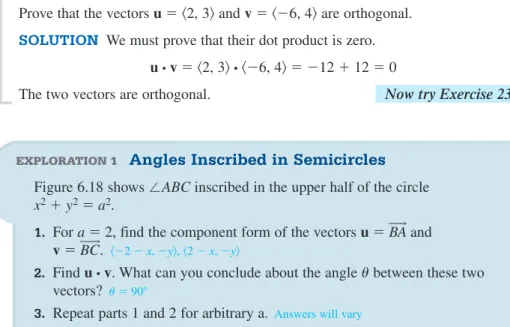
EXPLORATION 1 Angles Inscribed in Semicircles Figure 6.18 shows ABCinscribed in the upper half of the circle x2y2a2.
1. For a2, find the component form of the vectors uBAand
vBC. 2x,y,2x,y
2. Find u•v. What can you conclude about the angle between these two vectors? 90
3. Repeat parts 1 and 2 for arbitrary a.Answers will vary
Projection of u onto v
If uand vare nonzero vectors, the projection of uonto vis projvu
u v • v 2 v. FIGURE 6.18 The angle ABCinscribedin the upper half of the circle x2y2a2.
(Exploration 1) y x θ C(a, 0) A(–a, 0) B(x, y)
FIGURE 6.19 The vectors uPQ, vPS,and the vector projection of uonto v, PR projvu. S R Q P v u EXPLORATION EXTENSIONS
Now suppose B(x,y) is a point that is not on the given circle. If x2y2a2, what
can you say about u•v? If x2y2a2,
what can you say about u •v?
FOLLOW-UP
Ask students to name a pair of vectors that are orthogonal but not perpendicular.
ASSIGNMENT GUIDE
Day 1: Ex. 1–21, multiples of 3, 30–42, multiples of 3
Day 2: Ex. 27–51, multiples of 3, 61–66
COOPERATIVE LEARNING
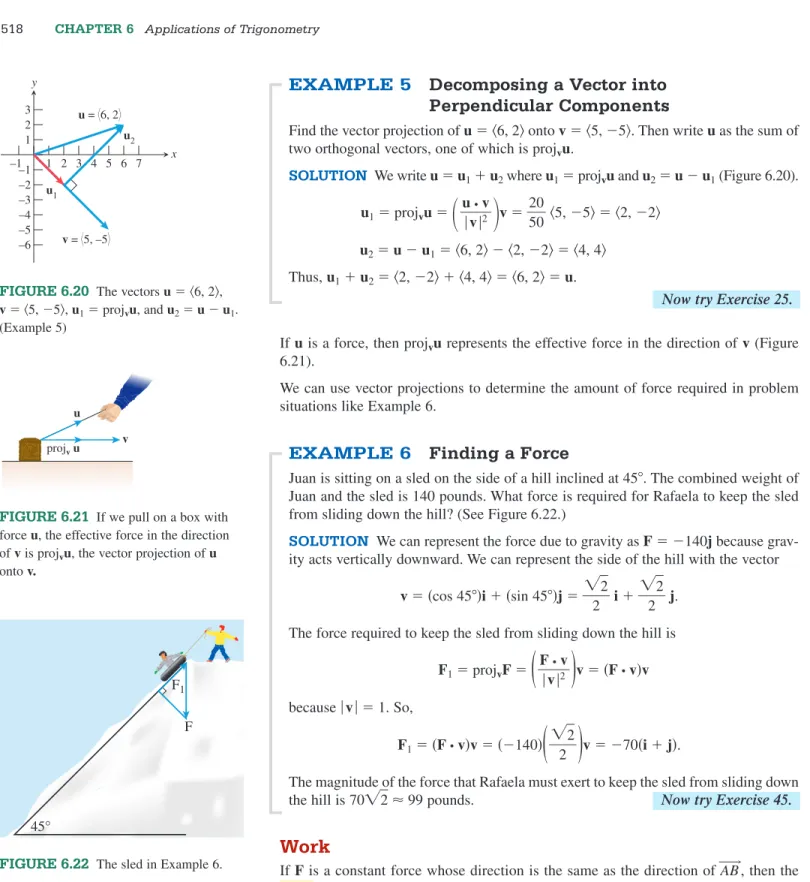
FIGURE 6.22 The sled in Example 6. F1
F
45°
FIGURE 6.20 The vectors u6, 2,
v5,5,u1projvu, and u2uu1. (Example 5) 3 2 1 –6 y –5 –4 –3 –2 –1 x –1 1 2 3 4 5 6 7 v = 5, –5 u = 6, 2 u2 u1
FIGURE 6.21 If we pull on a box with force u, the effective force in the direction of vis projvu, the vector projection of u onto v.
v u
projv u
EXAMPLE 5
Decomposing a Vector into
Perpendicular Components
Find the vector projection of u6, 2onto v5,5. Then write uas the sum of two orthogonal vectors, one of which is projvu.
SOLUTION We write uu1u2where u1projvuand u2uu1(Figure 6.20). u1projvu
u v • v 2 v 2 5 0 0 5,52,2 u2uu16, 22,24, 4 Thus,u1u22,24, 46, 2u.Now try Exercise 25. If uis a force, then projvurepresents the effective force in the direction of v(Figure 6.21).
We can use vector projections to determine the amount of force required in problem situations like Example 6.
EXAMPLE 6
Finding a Force
Juan is sitting on a sled on the side of a hill inclined at 45. The combined weight of Juan and the sled is 140 pounds. What force is required for Rafaela to keep the sled from sliding down the hill? (See Figure 6.22.)
SOLUTION We can represent the force due to gravity as F 140jbecause
grav-ity acts vertically downward. We can represent the side of the hill with the vector
vcos 45isin 45j 2 2 i 2 2 j.
The force required to keep the sled from sliding down the hill is
F1projvF
(
F v • 2 v)
vF•vv because v1. So, F1F•vv140(
2 2)
v 70ij.The magnitude of the force that Rafaela must exert to keep the sled from sliding down
the hill is 70299 pounds. Now try Exercise 45.
Work
If F is a constant force whose direction is the same as the direction of AB, then the Wdone by Fin moving an object from Ato Bis
WF AB.
SECTION 6.2 EXERCISES
If F is a constant force in any direction, then the Wdone by Fin moving an object from Ato Bis
WF•AB
FABcos
where is the angle between Fand AB. Except for the sign, the work is the magnitude of the effective force in the direction of ABtimes AB.
EXAMPLE 7
Finding Work
Find the work done by a 10 pound force acting in the direction 1, 2in moving an object 3 feet from 0, 0to 3, 0.
SOLUTION The force Fhas magnitude 10 and acts in the direction 1, 2, so
F10 1 1 , , 2 2 10 5 1, 2.
The direction of motion is from A0, 0to B3, 0, so AB3, 0. Thus, the work done by the force is
F•AB 10 5 1, 2•3, 0 30 5 13.42 foot-pounds.
Now try Exercise 53.
work
UNITS FOR WORK
Work is usually measured in foot-pounds or Newton-meters. One Newton-meter is commonly referred to as one Joule.
NOTES ON EXERCISES
Ex. 19–20 can be completed by using dot products or by using common sense. Encourage students to try both methods. Ex. 51–56 involve work done by a force that is not parallel to the direction of motion.
Ex. 61–66 provide practice with standardized tests.
ONGOING ASSESSMENT
Self-Assessment: Ex. 3, 9, 13, 23, 25, 45, 53
Embedded Assessment: Ex. 67, 68
QUICK REVIEW 6.2
(For help, go to Section 6.1.) In Exercises 1– 4, find u.1.u2,3 13 2.u 3i4j 5
3.ucos 35isin 35j 1 4.u2cos 75isin 75j 2
In Exercises 5 – 8, the points Aand Blie on the circle x2y24. Find the component form of the vector AB.
5.A2, 0,B1,3 6.A2, 0,B1,3
7.A2, 0,B1,3 1,3 8.A2, 0,B1,3 3,3
In Exercises 9 and 10, find a vector uwith the given magnitude in the direction of v. 9.u2,v2, 3 10.u3,v 4i3j
4 1 3 , 6 1 3 152,9 5In Exercises 1– 8, find the dot product of uand v.
1.u5, 3,v12, 4 72 2.u5, 2,v8, 13 14 3.u4, 5,v3,7 47 4.u2, 7,v5,8 46 5.u 4i9j,v 3i2j 30 6.u2i4j,v 8i7j 44 7.u7i,v 2i5j 14 8.u4i11j,v 3j 33
In Exercises 9 –12, use the dot product to find u.
9.u5,12 13 10. u8, 15 17
11.u 4i 4 12. u3j 3
In Exercises 13 – 22, find the angle between the vectors. 13.u4,3,v1, 5 115.6 14.u2,2,v3,3 90 15.u2, 3,v3, 5 64.65° 16. u5, 2,v6,1 17.u3i3j,v 2i23j 165 18.u 2i,v5j 90 19.u
(
2 cos 4)
i(
2 sin 4)
j,v(
cos 3 2)
i(
sin 3 2)
j 135° 20.u(
cos 3)
i(
sin 3)
j,v(
3 cos 5 6)
i(
3 sin 5 6)
j 90° 21. 94.86 22. 153.10In Exercises 23–24, prove that the vectors uand vare orthogonal.
23.u2, 3,v32,1
24.u4,1,v1,4
In Exercises 25–28, find the vector projection of uonto v. Then write u
as a sum of two orthogonal vectors, one of which is projvu.
25.u8, 3,v6,2 26. u3,7,v2,6 9 3 2 –1 –2 –10 y 4 5 6 7 8 –9 x –4 –3 –2 –1 1 (–3, 8) (–1, –9) 3 2 1 –1 y 4 5 6 x –4 –3 –2 –1 1 2 3 4 5 6 7 8 9 v u (–3, 4) (8, 5) 27.u8, 5,v9,2 28. u2, 8,v9,3
In Exercises 29 and 30, find the interior angles of the triangle with given vertices.
29.4, 5,1, 10,3, 1 30. 4, 1,1,6,5,1 In Exercises 31 and 32, find u•vsatisfying the given conditions where is the angle between uand v.
31.150,u3,v8 32.
3,u12,v40 In Exercises 33– 38, determine whether the vectors uand vare paral-lel, orthogonal, or neither.
33.u5, 3,v
1 4 0 ,3 2 Parallel 34.u2, 5,v1 3 0 ,4 3 Neither 35.u15,12,v4, 5 Neither 36.u5,6,v12,10 Orthogonal 37.u3, 4,v20, 15 Orthogonal 38.u2,7,v4, 14 Parallel In Exercises 39– 42, find(a) the x-intercept Aand y-intercept Bof the line.
(b) the coordinates of the point Pso that APis perpendicular to the line and AP1. (There are two answers.)
39.3x4y12 40. 2x5y10
41.3x7y21 42. x2y6
In Exercises 43 and 44, find the vector(s) vsatisfying the given conditions.
43.u2, 3,u•v10,v217
44.u2, 5,u•v 11,v210
45.Sliding Down a Hill Ojemba is sitting on a sled on the side of a hill inclined at 60. The combined weight of Ojemba and the sled is 160 pounds. What is the magnitude of the force required for Mandisa to keep the sled from sliding down the hill?
46.Revisiting Example 6 Suppose Juan and Rafaela switch posi-tions. The combined weight of Rafaela and the sled is 125 pounds. What is the magnitude of the force required for Juan to keep the sled from sliding down the hill? 88.39 pounds
47.Braking Force A 2000 pound car is parked on a street that makes an angle of 12with the horizontal (see figure).
(a)Find the magnitude of the force required to keep the car from rolling down the hill. 415.82 pounds
(b)Find the force perpendicular to the street. 1956.30 pounds 12°
48.Effective Force A 60 pound force
Fthat makes an angle of 25with an inclined plane is pulling a box up the plane.The inclined plane makes an 18angle with the horizontal (see figure). What is the magnitude of the effective force pulling the box up the plane? 54.38 pounds
49.Work Find the work done lifting a 2600 pound car 5.5 feet. 14,300 foot-pounds
50.Work Find the work done lifting a 100 pound bag of potatoes 3 feet. 300 foot-pounds
51.Work Find the work done by a force Fof 12 pounds acting in the direction 1, 2in moving an object 4 feet from 0, 0 to 4, 0. 21.47 foot-pounds
52.Work Find the work done by a force Fof 24 pounds acting in the direction 4, 5in moving an object 5 feet from 0, 0 to 5, 0. 74.96 foot-pounds
53.Work Find the work done by a force Fof 30 pounds acting in the direction 2, 2in moving an object 3 feet from 0, 0to a point in the first quadrant along the line y12x.
54.Work Find the work done by a force Fof 50 pounds acting in the direction 2, 3in moving an object 5 feet from 0, 0to a point in the first quadrant along the line yx.
55.Work The angle between a 200 pound force Fand AB
2i3jis 30. Find the work done by Fin moving an object from Ato B. 10039624.5 foot-pounds
56.Work The angle between a 75 pound force Fand ABis 60, where A1, 1and B4, 3. Find the work done by Fin moving an object from Ato B. 201.94 foot-pounds
57.Properties of the Dot Product Let u,v, and wbe vectors and let cbe a scalar. Use the component form of vectors to prove the following properties.
(a)0•u0
(b)u•vwu•vu•w
(c)uv•wu•wv•w
(d)cu•vu•cvcu•v
58.Group Activity Projection of a Vector Let uand vbe nonzero vectors. Prove that
(a)projvu
(
u v • v 2)
v (b)uprojvu•projvu059.Group Activity Connecting Geometry and Vectors
Prove that the sum of the squares of the diagonals of a parallelogram is equal to the sum of the squares of its sides.
60.If uis any vector, prove that we can write uas
uu•iiu•jj.
Standardized Test Questions
61.True or False If u•v0, then uand vare perpendicular. Justify your answer.
62.True or False If uis a unit vector, then u•u1. Justify your answer. True. u•u u2 (1)2 1
In Exercises 63–66, you may use a graphing calculator to solve the problem.
63.Multiple Choice Let u1, 1and v1, 1. Which of the following is the angle between uand v? D
(A)0 (B)45 (C)60 (D)90 (E)135
64.Multiple Choice Let u4,5and v2,3. Which of the following is equal to u•v? C
(A)23 (B)7 (C)7 (D)23 (E)7
65.Multiple Choice Let u32,32and v2, 0. Which of the following is equal to projvu? A
(A)32, 0 (B)3, 0 (C)32, 0
(D)32, 32 (E)32,32
66.Multiple Choice Which of the following vectors describes a 5 lb force acting in the direction of u1, 1? B
(A)5 1, 1 (B) 5 2 1, 1 (C)5 1,1 (D) 5 2 1,1 (E)5 21, 1
Explorations
67.Distance from a Point to a Line Consider the line Lwith equation 2x5y10 and the point P3, 7.
(a)Verify that A0, 2and B5, 0are the y- and x-intercepts of L.
(b)Find w1projABAPand w2APprojABAP.
(c)Writing to Learn Explain why w2is the distance from P to L. What is this distance?
(d)Find a formula for the distance of any point Px0,y0to L.
(e)Find a formula for the distance of any point Px0,y0to the line axbyc.
Extending the Ideas
68.Writing to Learn Let wcos t usin t vwhere uand v
are not parallel.
(a)Can the vector wbe parallel to the vector u? Explain.
(b)Can the vector wbe parallel to the vector v? Explain.
(c)Can the vector wbe parallel to the vector uv? Explain.
69.If the vectors uand vare not parallel, prove that aubvcudv⇒ac,bd.
18° 25°
6.3
Parametric Equations and Motion
What you’ll learn about■Parametric Equations ■Parametric Curves ■Eliminating the Parameter ■Lines and Line Segments ■Simulating Motion with a
Grapher . . . and why
These topics can be used to model the path of an object such as a baseball or a golf ball.
Parametric Equations
Imagine that a rock is dropped from a 420-ft tower. The rock’s height yin feet above the ground tseconds later (ignoring air resistance) is modeled by y 16t2420
as we saw in Section 2.1. Figure 6.23 shows a coordinate system imposed on the scene so that the line of the rock’s fall is on the vertical line x2.5.
The rock’s original position and its position after each of the first 5 seconds are the points
2.5, 420, 2.5, 404, 2.5, 356, 2.5, 276, 2.5, 164, 2.5, 20, which are described by the pair of equations
x2.5, y 16t2420,
when t0, 1, 2, 3, 4, 5. These two equations are an example of parametric equations with parameter t. As is often the case, the parameter trepresents time.
Parametric Curves
In this section we study the graphs of parametric equationsand investigate motion of objects that can be modeled with parametric equations.
When we give parametric equations and a parameter interval for a curve, we have
parametrized the curve. A of a curve consists of the parametric equations and the interval of t-values. Sometimes parametric equations are used by com-panies in their design plans. It is then easier for the company to make larger and smaller objects efficiently by just changing the parameter t.
Graphs of parametric equations can be obtained using parametric mode on a grapher.
EXAMPLE 1
Graphing Parametric Equations
For the given parameter interval, graph the parametric equationsxt22, y3t.
(a)3 t 1 (b)2 t 3 (c)3 t 3
parametrization
FIGURE 6.23 The position of the rock at 0, 1, 2, 3, 4, and 5 seconds. [0, 5] by [–10, 500] t= 0, y= 420 t= 1, y= 404 t= 2, y= 356 t= 3, y= 276 t= 4, y= 164 t= 5, y= 20 OBJECTIVE
Students will be able to define parametric equations, graph curves parametrically, and solve application problems using parametric equations.
MOTIVATE
Have students use a grapher to graph the parametric equations xtand yt2
for5 t 5. Have them write the equation for this graph in the form
yf(x). (yx2) LESSON GUIDE
Day 1: Parametric Equations; Parametric Curves; Eliminating the Parameter; Lines and Line Segments
Day 2: Simulating Motion with a Grapher
DEFINITION Parametric Curve, Parametric Equations
The graph of the ordered pairs x,ywhere xft, y gt
are functions defined on an interval Iof t-values is a . The equations are for the curve, the variable t is a , and Iis the
. parameter interval parameter parametric equations parametric curve continued
SOLUTION In each case, set Tmin equal to the left endpoint of the interval and Tmax equal to the right endpoint of the interval. Figure 6.24 shows a graph of the parametric equations for each parameter interval. The corresponding relations are dif-ferent because the parameter intervals are difdif-ferent. Now try Exercise 7.
FIGURE 6.24 Three different relations defined parametrically. (Example 1)
[–10, 10] by [–10, 10] (c) [–10, 10] by [–10, 10] (b) [–10, 10] by [–10, 10] (a)
FIGURE 6.25 The graph of y0.5x1.5. (Example 2)
[–10, 5] by [–5, 5]
TEACHING NOTE
If students are not familiar with parametric graphing, it might be helpful to show them the graph of the linear func-tion f(x)3x2 and compare it to one defined parametrically as xtand
y3t2, using a trace key to show how t,x, and yare related.
Eliminating the Parameter
When a curve is defined parametrically it is sometimes possible to eliminate the para-meterand obtain a rectangular equation in xand ythat represents the curve. This often helps us identify the graph of the parametric curve as illustrated in Example 2.
EXAMPLE 2
Eliminating the Parameter
Eliminate the parameter and identify the graph of the parametric curve x1 2t, y2t,
∞
t∞
.SOLUTION We solve the first equation for t:
x12t 2t1x
t 1
21x
Then we substitute this expression for tinto the second equation: y2t
y2 1
21x y0.5x1.5
The graph of the equation y0.5x1.5 is a line with slope 0.5 and y-intercept
1.5 Figure 6.25. Now try Exercise 11.
NOTES ON EXAMPLES
Example 1 is important because it shows how a parametric graph is affected by the chosen range of t-values.
If we do not specify a parameter interval for the parametric equations xft,ygt, it is understood that the parameter t can take on all values which produce real num-bers for xand y. We use this agreement in Example 3.
EXPLORATION EXTENSIONS
Determine the smallest possible range of
t-values that produces the graph shown in Figure 6.25, using the given parametric equations.
ALERT
Many students will confuse range values of twith range values on the function grapher. Point out that while the scale factor does not affect the way a graph is drawn, the Tstep does affect the way the graph is displayed.
EXPLORATION 1 Graphing the Curve of Example 2
Parametrically
1. Use the parametric mode of your grapher to reproduce the graph in Figure 6.25. Use 2 for Tmin and 5.5 for Tmax.
2. Prove that the point 17, 10is on the graph of y0.5x1.5. Find the corresponding value of tthat produces this point. t 8
3. Repeat part 2 for the point 23,10. t12
4. Assume that a,bis on the graph of y0.5x1.5. Find the corresponding value of tthat produces this point. t12a22b
5. How do you have to choose Tmin and Tmax so that the graph in Figure 6.25 fills the window? Tmin 2 and Tmax 5.5
PARABOLAS
The inverse of a parabola that opens up or down is a parabola that opens left or right. We will investigate these curves in more detail in Chapter 8.
FIGURE 6.26 The graph of the circle of Example 4.
[–4.7, 4.7] by [–3.1, 3.1]
EXAMPLE 3
Eliminating the Parameter
Eliminate the parameter and identify the graph of the parametric curve xt22, y3t.
SOLUTION Here t can be any real number. We solve the second equation fort
obtaining t y
3 and substitute this value for yinto the first equation. xt22 x(
3 y)
2 2 x y 9 2 2 y29x2Figure 6.24c shows what the graph of these parametric equations looks like. In Chapter 8 we will call this a parabola that opens to the right. Interchanging xand y we can identify this graph as the inverse of the graph of the parabola x29y2.
Now try Exercise 15.
EXAMPLE 4
Eliminating the Parameter
Eliminate the parameter and identify the graph of the parametric curve x2 cost, y2 sint, 0 t 2.
SOLUTION The graph of the parametric equations in the square viewing window
of Figure 6.26 suggests that the graph is a circle of radius 2 centered at the origin. We confirm this result algebraically.