1595
Stability and Performance of Rapid-Acting Insulin Analogs Used for
Continuous Subcutaneous Insulin Infusion: A Systematic Review
David Kerr, M.D.,
1Erik Wizemann, M.D.,
2Jakob Senstius, M.Sc.Pharm.,
3Mette Zacho, M.D., Ph.D.,
3and Francisco Javier Ampudia-Blasco, M.D.
41Bournemouth Diabetes and Endocrine Centre, Royal Bournemouth Hospital NHS Foundation Trust, Dorset, United Kingdom; 2Diabetes Schwerpunktpraxis, Herrenberg, Germany; 3Novo Nordisk A/S, Bagsvaerd, Denmark; and 4Department of Endocrinology and Nutrition, Clinic University Hospital of Valencia, Valencia, Spain
Abbreviations:
Keywords: diabetes mellitus, insulin pump, protein stability, rapid-acting insulin
Corresponding Author: David Kerr, M.D., Bournemouth Diabetes and Endocrine Centre, Royal Bournemouth Hospital NHS Foundation Trust, Dorset, UK; email address [email protected]
Journal of Diabetes Science and Technology
Volume 7, Issue 6, November 2013 © Diabetes Technology Society
Abstract
Aim:
We review and summarize the literature on the safety and stability of rapid-acting insulin analogs used for continuous subcutaneous insulin infusion (CSII) in patients with diabetes.
Methods:
of Clinical Trials for publications between 1996 and 2012. Results:
Twenty studies were included in the review: 13 in vitro studies and 7 clinical studies. In vitro studies catheter occlusions and insulin stability factors, such as potency, purity, high molecular weight protein content, pH stability, and preservative content (m-cresol, phenol). Under these conditions, the overall stability of rapid-acting insulin analogs was similar for insulin lispro, insulin aspart, and insulin glulisine, although insulin glulisine showed greater susceptibility to insulin precipitation and catheter occlusions. A limited number of patients with type 1 diabetes using CSII treatment may vary depending on the rapid-acting analog used. Conclusions:
Based on a limited amount of available data, the safety, stability, and performance of the three available rapid-acting insulin analogs available for use with CSII were similar. However, there is limited evidence suggesting that the risk of occlusion may vary with the insulin preparation under certain circumstances.
J Diabetes Sci Technol 2013;7(6):1595–1606
1596 Stability and Performance of Rapid-Acting Insulin Analogs Used for
Continuous Subcutaneous Insulin Infusion: A Systematic Review Kerr
www.jdst.org
J Diabetes Sci Technol Vol 7, Issue 6, November 2013
Introduction
F
or patients with type 1 diabetes, continuous subcutaneous insulin infusion (CSII) is increasingly being used as an alternative to multiple daily injections for individuals with suboptimal blood glucose control and in those with problems related to recurrent severe hypoglycemia.1In 2009, a Cochrane review reported that, following initiation of CSII, glycemic control [glycosylated hemoglobin (HbA1c)] was modestly improved with rapid-acting insulin analogs compared with human insulin.2 Currently, insulin aspart, insulin lispro, and insulin glulisine are the available rapid-acting insulin analogs used for CSII. Rapid-acting insulin analogs have a faster and shorter glucose-lowering action and are associated with a lower rate of hypoglycemia compared with regular human insulin.3–5 These putative advantages may be linked to absorption characteristics. Following subcutaneous injection, the rate of absorption of regular insulin is relatively slow due to its self-association properties, while rapid-acting insulin analog monomers are more readily absorbed.6
Figure 1. Fibrillation process. Reprinted (adapted) with permission from Nielsen L, Frokjaer S, Brange J, Uversky VN, Fink AL. Biochemistry. 2001;40:8397–409. Copyright 2001 American Chemical Society.7
for catheter occlusion. Furthermore, changes in pH, exposure to elevated temperatures, agitation, and/or contact with hydrophobic surfaces can all induce conformational changes to the insulin, promoting precipitation, chemical
Figure 1).7 Isoelectric precipitation may also occur when the pH of the pharmaceutical formulation becomes acidic. In consequence, the molecular structure of and the environment
Figure 2; Table 1). However, whether remains an open question.
Therefore, it appears that the stability of rapid-acting insulin analogs used for CSII should be considered when initiating and/or maintaining treatment in patients with diabetes and when designing clinical studies, as
outcomes. Although catheter infusion sets and reservoir insulin should be changed according to manufacturers’ guidelines, i.e., every 2–3 days, many patients tend (www.pumpers.org). In this context, catheter occlusions
episodes. In one clinical study over 39 weeks of therapy, unexpected hyperglycemia and/or infusion set occlusions occurred in 61–68% of patients using rapid-acting insulin analogs with CSII.8 In addition, patients with prolonged and unrecognized episodes of hyperglycemia due to catheter occlusion are subsequently at risk of ketoacidosis and hospitalization.8,9
of obstruction or low insulin reserve. However, the known inferiority and delay of the metric alarm during basal detection of occlusions. Therefore, it is imperative that therapies used in CSII are themselves associated with a low propensity for occlusion.
1597 Stability and Performance of Rapid-Acting Insulin Analogs Used for
Continuous Subcutaneous Insulin Infusion: A Systematic Review Kerr
www.jdst.org
J Diabetes Sci Technol Vol 7, Issue 6, November 2013
Figure 2. Primary structure of rapid-acting insulin analogs. Further information can be found at www.humalog.com (Eli Lilly & Company; revised May 2011), www.apidra.com www.novolog.com (Novo Nordisk; revised June 2011). Ala, alanine; Arg, arginine; Asn, asparagine; Asp, aspartic acid; Cys, cysteine; Gln, glutamine; Glu, glutamic acid; Gly, glycine; His, histidine; Ile, isoleucine; Leu, leucine; Lys, lysine; Phe, phenylalanine; Pro, proline; Ser, serine; Thr, threonine; Tyr, tyrosine; Val, valine.
Table 1.
Chemical Composition of Rapid-Acting Insulin Analogsa Na2HPO4
(mg/ml) Glycerin (mg/ml) Zinc (µg/ml) m-cresol (mg/ml) (mg/ml)Phenol H2O (mg/ml)NaCl Polysorbate20 (mg/ml) Tromethamine (mg/ml) pH
Lispro 1.88 16 (zinc ion)19.7 b 3.15 Trace For injection — — — 7.0–7.8
Glulisine — — — 3.15 — For injection 5 0.01 6 ~7.3
Aspart 1.25 16 19.6 1.72 1.50 For injection 0.58 — — 7.2–7.6
a Information from www.humalog.com (Eli Lilly & Company, revised May 2011), www.apidra.com www.novolog.com (Novo Nordisk, revised June 2011).
1598 Stability and Performance of Rapid-Acting Insulin Analogs Used for
Continuous Subcutaneous Insulin Infusion: A Systematic Review Kerr
www.jdst.org
J Diabetes Sci Technol Vol 7, Issue 6, November 2013
Methods
Two systematic Medline searches were performed using search terms and strategies described in Figure 3. Both searches included studies published from 1996–2012. Studies were excluded using a two-tiered approach: initially, relevant studies were chosen based on manuscript title, followed by a more detailed assessment using the abstract. The inclusion/ exclusion criteria for each step are presented in Figure 3. Only manuscripts published in English were included. To ensure that all relevant data were captured, these search processes were also performed in the Cochrane Central Register of Controlled Trials.
Following removal of case reports, duplicate publications, and those related to peritoneal insulin delivery, both Medline formulation of rapid-acting insulin analogs.
for inclusion in this review.10,11
Figure 3. Medline search strategies. AE, adverse event; CGM, continuous glucose monitoring; PK/PD, pharmacokinetics/pharmacodynamics.
Results
in vitro data regarding stability and temperature-sensitivity of rapid-acting insulin analogs, and 7 presented clinical trials that assessed the safety and
1599 Stability and Performance of Rapid-Acting Insulin Analogs Used for
Continuous Subcutaneous Insulin Infusion: A Systematic Review Kerr
www.jdst.org
J Diabetes Sci Technol Vol 7, Issue 6, November 2013
Stability and Temperature-Sensitivity of Insulin Analogs—In Vitro Findings
human insulin.12–14
12 They reported that insulin lispro had similar adsorption characteristics in both syringe- and bag-based infusions compared with regular insulin. Bag infusions had a longer lag time before reaching a steady release rate of insulin,
In another study, a preliminary assessment of insulin aspart stability examined the production rate of degradation derivatives over 24 months while maintaining storage conditions at pH 7.4 and 5 °C. Derivatives of insulin aspart, except for isoAspB28
forms were fully active in vivo.13
® surface in comparison with regular insulin and Zn2+-free insulin was studied by Jorgensen and coauthors.14 Despite interface
on the insulin-to-interface ratio.
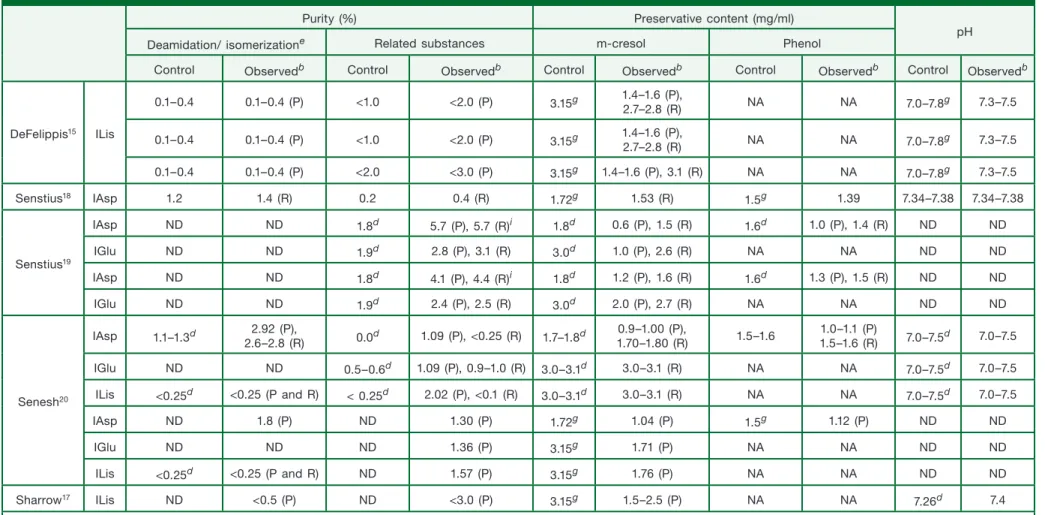
Data from in vitro experiments evaluating the stability of rapid-acting insulin analogs under CSII conditions are shown in Table 2
lispro (continuous infusion of 0.8 U/h, with three 6 U boluses per day) was studied over 7 days.15 This study assessed potency, production of transformation derivatives, pH stability, m-cresol content, and physical appearance of insulin lispro (Table 2). Under these conditions, insulin lispro maintained physicochemical stability when subjected to stress with infusion systems was also tested using normal conditions over a 2-day period.16 Insulin lispro retained its potency, purity, and preservative content. In addition, catheter occlusions did not occur and pH remained the same after delivery (Table 2). These results are still evident when conditions are maintained for a longer time period.17 Under conditions of elevated temperature (37 °C) and continuous shaking over 14 days, no precipitation of insulin lispro was observed on visual inspection, and no catheter occlusions were noted. A slight increase in insulin lispro pH was observed; however, it remained well within the data acceptance criterion of pH of 7.0–7.8 for this study. Under these conditions, degradation due to changes in pH would not occur and was, therefore, not expected to cause occlusion.17
Poulsen and coauthors21,22 studied the degree of isoelectric precipitation of rapid-acting insulin analogs while reducing pH; 10% precipitation was observed at pH 6.41, 6.18, and 5.95 for insulin lispro, human insulin, and insulin aspart, respectively.21 In addition, 50% precipitation was reported at pH 5.86 for insulin aspart and pH 6.64 for insulin glulisine.22 In both studies, the highest resistance to isoelectric precipitation was reported with insulin aspart, with intermediate resistance observed for human insulin, and lowest resistance for insulin lispro and insulin glulisine. The low degree of precipitation seen with insulin aspart could possibly be due to its lower pH and the higher amount of acid required to induce isoelectric precipitation.22
The stability of insulin aspart for use in CSII was studied by Senstius and coauthors18 (Table 2). They assessed two lots of insulin aspart of distinct age stored up to 7 days at 37 ± 2 °C in reservoirs and exposed to constant daily mechanical agitation (30 ± 3 oscillations/min, 2 ± 0.5 cm amplitude displacement).18 Under CSII conditions, insulin free. The authors concluded that stability was maintained regardless of the age of the batch (freshly manufactured versus
end of shelf life). Using identical conditions (37 ± 2 °C; 30 oscillations/min, 2 cm amplitude), another study compared 19 Test samples
16 0 0 S ta b ilit y an d Pe rfo rm an ce of R ap id -A ct in g In su lin A na lo g s U se d fo r C o nt in uo us S ub cu ta ne o us In su lin In fu sio n: A S ys te m at ic R ev ie w Ke rr www .jd st. o rg J D ia b et es S ci Te ch no l V o l 7, Is su e 6, N ov em b er 20 13 Table 2.
Stability of Rapid-Acting Insulin Analogs Exposed to High Temperature and Mechanical Agitation in CSII In Vitro Studiesa Study RAI Length
(days) Temp (°C) (oscillations/min)Agitation infusion rateBasal/bolus Device Samples analyzed
HMWP (%) Potency (%)
Control Observedb Control Observedb Lougheed16 ILis 2 37 Stationary 0.5 U/h
6 U/bolus
MiniMed 504 R, P 0.20 0.26 (R) 100.1 103.6 (P)
HTRON V100 R, P 0.23 0.26 (R) 102.3 103.9 (P)
DeFelippis15 ILis 7 37 100c 0.8 U/h 6 U/bolus
MiniMed 507c R, P <0.2 <0.3 (P) 95–105 95.0–105 (P) HTRONplus R, P <0.2 <0.3 (P) 95–105 95.0–105 (P) DTRON CSII R, P <0.3 <0.5 (P) 95–105 95.0–105 (P)
Senstius18 IAsp 7 37 30 0.1 U/h
No boli MiniMed 508 R 0.1 0.1 (R) 99.2 99.2 (R)
Senstius19 IAsp
10 37 30 0.3 U/hNo boli MiniMed 508 R, P 0.20
d 0.40 (P) ND ND
IGlu MiniMed 508 R, P 0.30d 0.80 (P) ND ND
IAsp
4 37 30 0.9 U/hNo boli MiniMed 508 R, P 0.20
d 0.30 (P) ND ND
IGlu MiniMed 508 R, P 0.30d 0.60 (P) ND ND
Senesh20 IAsp
6 37 35 5 U/bolus0.6 U/h
Solo MicroPump R, P 0.1–0.2d 0.3–0.4 % (P) 0.2–0.3% (R) 100d 95–105 (P and R) IGlu Solo MicroPump R, P 0.4–0.5d 0.8–0.9 % (P) 0.8–0.9 % (R) 100d 95–105 (P and R) ILis Solo MicroPump R, P 0.1–0.2d 0.2–0.3 % (R)0.3–0.4 % (P) 100d 95–105 (P and R) IAsp
6 37 35 2.5 U/bolus0.3 U/h
Solo MicroPump R, P 0.1–0.2d 0.2–0.3 (P)0.2–0.3 (R) 100d 95–105 (P and R) IGlu Solo MicroPump R, P 0.5–0.6d 1.0–1.1 (R)1.0–1.1 (P) 100d 95–105 (P and R) ILis Solo MicroPump R, P 0.1–0.2d 0.2–0.3 (R)0.1–0.2 (P) 100d 95–105 (P and R) Sharrow17 ILis 14 37 100 0.8 U/h
6 U/bolus MiniMed Paradigm R, P <0.4d 0.3–0.6 (P) 95–105d 95–105 (P)
Purity (%) Preservative content (mg/ml)
pH Deamidation/ isomerizatione Related substances m-cresol Phenol
Control Observedb Control Observedb Control Observedb Control Observedb Control Observedb
Lougheed16 ILis 0.58 0.59 (P) ND ND 3.15
f,g 2.83 (R) NA NA 7.0–7.8 7.0–7.8 (P)
0.52 0.52 (P) ND ND 3.15f,g 3.05 (R)h NA NA 7.0–7.8 7.0–7.8 (P)
16 01 S ta b ilit y an d Pe rfo rm an ce of R ap id -A ct in g In su lin A na lo g s U se d fo r C o nt in uo us S ub cu ta ne o us In su lin In fu sio n: A S ys te m at ic R ev ie w Ke rr www .jd st. o rg J D ia b et es S ci Te ch no l V o l 7, Is su e 6, N ov em b er 20 13 Table 2. Continued
Purity (%) Preservative content (mg/ml)
pH Deamidation/ isomerizatione Related substances m-cresol Phenol
Control Observedb Control Observedb Control Observedb Control Observedb Control Observedb
DeFelippis15 ILis 0.1–0.4 0.1–0.4 (P) <1.0 <2.0 (P) 3.15g 1.4–1.6 (P),2.7–2.8 (R) NA NA 7.0–7.8g 7.3–7.5 0.1–0.4 0.1–0.4 (P) <1.0 <2.0 (P) 3.15g 1.4–1.6 (P),2.7–2.8 (R) NA NA 7.0–7.8g 7.3–7.5 0.1–0.4 0.1–0.4 (P) <2.0 <3.0 (P) 3.15g 1.4–1.6 (P), 3.1 (R) NA NA 7.0–7.8g 7.3–7.5 Senstius18 IAsp 1.2 1.4 (R) 0.2 0.4 (R) 1.72g 1.53 (R) 1.5g 1.39 7.34–7.38 7.34–7.38 Senstius19 IAsp ND ND 1.8d 5.7 (P), 5.7 (R)i 1.8d 0.6 (P), 1.5 (R) 1.6d 1.0 (P), 1.4 (R) ND ND IGlu ND ND 1.9d 2.8 (P), 3.1 (R) 3.0d 1.0 (P), 2.6 (R) NA NA ND ND IAsp ND ND 1.8d 4.1 (P), 4.4 (R)i 1.8d 1.2 (P), 1.6 (R) 1.6d 1.3 (P), 1.5 (R) ND ND IGlu ND ND 1.9d 2.4 (P), 2.5 (R) 3.0d 2.0 (P), 2.7 (R) NA NA ND ND Senesh20 IAsp 1.1–1.3d 2.6–2.8 (R)2.92 (P), 0.0d 1.09 (P), <0.25 (R) 1.7–1.8d 1.70–1.80 (R)0.9–1.00 (P), 1.5–1.6 1.5–1.6 (R)1.0–1.1 (P) 7.0–7.5d 7.0–7.5 IGlu ND ND 0.5–0.6d 1.09 (P), 0.9–1.0 (R) 3.0–3.1d 3.0–3.1 (R) NA NA 7.0–7.5d 7.0–7.5 ILis <0.25d <0.25 (P and R) < 0.25d 2.02 (P), <0.1 (R) 3.0–3.1d 3.0–3.1 (R) NA NA 7.0–7.5d 7.0–7.5 IAsp ND 1.8 (P) ND 1.30 (P) 1.72g 1.04 (P) 1.5g 1.12 (P) ND ND IGlu ND ND ND 1.36 (P) 3.15g 1.71 (P) NA NA ND ND ILis <0.25d <0.25 (P and R) ND 1.57 (P) 3.15g 1.76 (P) NA NA ND ND Sharrow17 ILis ND <0.5 (P) ND <3.0 (P) 3.15g 1.5–2.5 (P) NA NA 7.26d 7.4
a RAI, rapid-acting insulin analog; HMWP, high-molecular-weight protein; ILis, insulin lispro; R, reservoir sample; P, pumped-through sample; IAsp, insulin aspart; IGlu, insulin of each respective study, unless stated otherwise.
b The type of sample analyzed is indicated via pumped-through sample or for reservoir sample. c Control samples were not exposed to mechanical agitation.
d Baseline values (day 0) were used as control estimates.
e Includes A21-desamido for insulin lispro and A21Asp, B3Asp, B3isoAsp, and B28isoAsp for insulin aspart. f 4 °C controls were used; all other controls were performed at 37 °C.
g Manufacturers’ baseline values were used (in the event that the study did not provide exact control values). h p < .001.
1602 Stability and Performance of Rapid-Acting Insulin Analogs Used for
Continuous Subcutaneous Insulin Infusion: A Systematic Review Kerr
www.jdst.org
J Diabetes Sci Technol Vol 7, Issue 6, November 2013
were taken from the reservoir and the needle end. Based on low batch–batch and analytical variability, tests were samples (5 ± 3 °C). By contrast, the physical stability of insulin aspart was preserved, except for the reservoir sample at 0.9 U/h (maintained 90% stability compared with baseline samples). After 10 days, insulin aspart had a greater retention of preservatives and generated less biologically inactive transformation products compared with insulin glulisine (Table 2). Rates of early and late occlusions with insulin aspart, insulin lispro, and insulin glulisine were studied in a normal pump environment (32–36 °C) over 5 days.23
p = .27). Over the 5-day period, the probability of overall occlusion was 40.9% (95% CI 4–19.5%) with insulin aspart.
The stability of insulin lispro, insulin aspart, and insulin glulisine was also evaluated using a tubeless, skin-adhering “patch” pump over 6 days at 37 °C, 40% relative humidity, and mechanical agitation (35 strokes/min).20 Over this time period, all insulins maintained their respective potency (95–105%), and pH was relatively stable (Table 2). The insulin solutions did not show evidence of precipitation.
Woods and coauthors10
of stabilizing excipients. After removing the excipients, the analogs were heated and agitated to characterize their
aspart. This study, although academically interesting, is of limited clinical utility, as rapid-acting insulin analogs available for clinical use contain excipients necessary for stability and antimicrobiological activity.
Incidence of Catheter Occlusions with Rapid-Acting Insulin Analogs in Healthy Volunteers Using CSII— From Preclinical Studies
A preclinical study in healthy volunteers (n = 20) examined the risk of catheter occlusion with insulin aspart and insulin glulisine with changes in local skin temperature when using CSII.11 The analogs were injected in a randomized order each for 5 days. Subcutaneous infusion was simulated by inserting the catheter into an absorbent sponge in a plastic bag strapped to the subject’s abdomen. The overall rate of occlusion was 22.5% (95% CI 21.9–61.3%), and risk of occlusion was similar for both analogs (odds ratio 0.87%; p
in skin temperature.
Incidence of Catheter Occlusions with Rapid-Acting Insulin Analogs in CSII—From Clinical Trials
of occlusions for both treatment options.24,25 In a 7-week, randomized, open-label study in 29 patients with type 1 diabetes, occlusions were reported by 7 patients receiving insulin aspart compared with two reports by patients receiving regular insulin.24 Notably in this study, insulin aspart was associated with fewer unexplained hypoglycemic events per patient than regular insulin (2.9 versus 6.2, respectively).
Comparable results between insulin lispro and regular insulin were published from a 24-week, randomized, crossover, open-label trial in which 58 patients on CSII received either insulin lispro or regular human insulin for 12 weeks, followed by the alternate treatment for another 12 weeks.25 In this study, 20 patients recorded 39 episodes (of a total 109 episodes; 35.7%) of hyperglycemia that were caused by occlusion [n = 8 in the insulin lispro group (16 episodes) versus n
of occlusion resulted in an adverse event. In an earlier study, Renner and coauthors26
randomized, crossover study, which involved 113 patients, 42 catheter occlusions were reported by 20 patients treated with insulin lispro, compared with 45 reports by 21 patients treated with regular insulin infusion.
1603 Stability and Performance of Rapid-Acting Insulin Analogs Used for
Continuous Subcutaneous Insulin Infusion: A Systematic Review Kerr
www.jdst.org
J Diabetes Sci Technol Vol 7, Issue 6, November 2013
The most relevant clinical trial to this discussion, which assesses the three insulin analogs head to head, was conducted by Van Bon and coauthors.8 They investigated catheter occlusions with rapid-acting insulin analogs in a 39-week, randomized, open-label, multicenter, crossover trial in patients with type 1 diabetes using CSII.8 Here, the primary end point, i.e., incidence of catheter occlusion and unexplained hyperglycemia, with insulin glulisine [68.4% (95% CI 62.7–74.1%)] was similar to insulin aspart [62.1% (95% CI 56.2–68.1%); p = .04] and insulin lispro [61.3% (95% CI 55.4–67.3%); p = .03]. However, in terms of secondary outcomes, the monthly rate of unexplained hyperglycemia
p < .001) and insulin lispro 1.54 (1.24–1.83; p < .001) compared with insulin glulisine 2.02 (1.73–2.32).8
Conversely, results from a study by Hoogma and Schumicki,5 involving 59 patients with type 1 diabetes treated by CSII of catheter occlusion for insulin glulisine compared with insulin aspart. Of the 59 patients included in the study, 4 patients (13.8%) in the insulin glulisine group reported at least one catheter occlusion, compared with 8 patients (26.7%) in the insulin aspart group. However, these results must be interpreted with caution, as the study was not
The similarities between insulin aspart and insulin lispro were reported in a 16-week, open-label, randomized, parallel-group study by Bode and coauthors27 in which 146 patients were assigned to CSII treatment with insulin aspart, insulin lispro, or regular insulin. Here, the majority of patients reported one or fewer catheter occlusions regardless of the treatment received (76%, 75%, and 83%, respectively). Only a small percentage of occlusions (9%, 6%, and 7% for insulin aspart, insulin lispro, and regular insulin, respectively) coincided with a hyperglycemic episode.
reviewed here, are further highlighted when glycemic variables are taken into consideration. Results from the aforementioned study by Van Bon and coauthors8 showed that HbA1c remained stable from baseline to end of
insulin aspart (65.0; p = .008) and with insulin lispro (62.7; p < .001). Bode and coauthors27
with insulin aspart, insulin lispro, or regular insulin for 16 weeks (0.00 ± 0.51%, 0.18 ± 0.84%, and 0.15 ± 0.63%, respectively). Rates of hypoglycemic episodes (blood glucose <50 mg/dl) per patient per month were also similar (3.7, 4.4, and 4.8 for the insulin aspart, insulin lispro, and regular insulin groups, respectively).
type 1 diabetes. A randomized, controlled, 3-day trial was conducted involving 17 patients with type 1 diabetes who with crossover treatment with insulin aspart or insulin lispro following the same procedure.28 Although both analogs resulted more stable with insulin aspart than with insulin lispro (absolute change in glucose 7.04 ± 3.16 versus 9.04 ± 4.2 mg/dl;
p < .0019).
Discussion
5,8,27–30 However, the stability of individual rapid-acting insulin analogs in these studies was not reported, even when patients were
numerous poor carbohydrate counting, and shifts in insulin sensitivity. Recreating and studying these conditions in a controlled
1604 Stability and Performance of Rapid-Acting Insulin Analogs Used for
Continuous Subcutaneous Insulin Infusion: A Systematic Review Kerr
www.jdst.org
J Diabetes Sci Technol Vol 7, Issue 6, November 2013
clinical trial setting is challenging; therefore, in vitro studies have thus far provided most of the relevant information. It was demonstrated that insulin lispro is suitable for prolonged infusion using CSII, as catheter occlusion and pH changes did not occur in normal conditions over 2 days,13 and in stressful conditions (37 °C, high agitation) over 7 days.12 In contrast, clinical trials have shown that catheter occlusion with insulin lispro may arise in clinical practice.8 Insulin aspart in CSII has also been studied in vitro while exposed to stressful conditions (37 °C, 30 oscillations/min) over 718 and 10 days.19 Both studies demonstrated the stability of insulin aspart over time. Insulin glulisine showed compared with insulin aspart.18
presented the greatest risk of catheter occlusion after 72 h of CSII use, compared with insulin lispro and insulin aspart.23 Other in vitro studies have also shown that insulin aspart has the lowest risk of isoelectric precipitation and, accordingly, less tendency to catheter occlusion compared with regular insulin, insulin lispro, and insulin glulisine.21,22 Conversely, Senesh and coauthors20 demonstrated over 6 days that all rapid-acting insulin analogs were stable and sustained near-perfect potency with no precipitation using a skin-adhering “patch” pump at 37 °C. A possible explanation for these results may be that “patch” pumps reduce agitation, interface interactions, and exposure to
Although in vitro studies suggest that rapid-acting insulin analogs are relatively stable in CSII, high rates of catheter occlusions were reported in a randomized crossover trial in patients with type 1 diabetes using CSII.8 The incidence
study by Hoogma and Schumicki.5
stable compared with other rapid-acting insulin analogs. In another study, however, simulated injections in healthy volunteers with insulin aspart and insulin glulisine found a similar risk of occlusion with both analogs.11
temperatures and in prolonged storage (up to 10 days with insulin aspart); nevertheless, manufacturers still stress that insulin exposed to temperatures above 37 °C should be discarded and reservoirs should be routinely changed (every 6 days for insulin aspart, 7 days for insulin lispro, and 2 days for insulin glulisine).31–33
Considerations for Insulin Choice in CSII
A CSII device imposes a set of unique and extreme environmental conditions on the residing insulin. These conditions
environmental conditions intrinsic to CSII. Essential properties of an ideal insulin/CSII device would therefore include • immediate absorption to allow immediate use before or after meals,
• optimal basal and postprandial glycemic control with no risk of hypoglycemia, •
occlusion,
• a low isoelectric point to increase structural resistance in acidic conditions to precipitation, • chemical stability to avoid excessive generation of inactive derivatives,
• no immunogenic degradation products, • antimicrobial compounds,
1605 Stability and Performance of Rapid-Acting Insulin Analogs Used for
Continuous Subcutaneous Insulin Infusion: A Systematic Review Kerr
www.jdst.org
J Diabetes Sci Technol Vol 7, Issue 6, November 2013
• reduced exposure and adsorption to hydrophobic interfaces,
• extended storage capability in case of patient negligence (i.e., patient forgets or refuses to replenish the reservoir), and
• extended use in distinct populations (elderly, pediatric, type 2 diabetes).
In addition, it is also important that appropriate education for CSII users is available in terms of the practical aspects related to correct insertion of infusion cannula, the need to change the infusion systems at a frequency recommended by the manufacturers, and what to do in the event of catheter occlusion.
Conclusions
Studies have shown that insulin precipitation can occur regardless of the type of pump or catheter used. This process insulin analog has a distinct molecular structure (Figure 2
by the variable conditions inherent to CSII insulin delivery. Overall, the in vitro
suggest that the currently available three rapid-acting insulin analogs used in CSII are relatively stable at extreme degree to which they precipitate. This may explain the greater tendency of insulin glulisine to occlude in the cannula. Furthermore, based on limited clinical evidence in patients with type 1 diabetes using CSII, it seems that insulin of the three insulin analogs is indistinguishable at infusion durations of 2–3 days, beyond that timeframe, occlusion becomes more likely, particularly with insulin glulisine. It could therefore be suggested that cannula/catheter duration should be restricted to 3 days. Additional clinical studies would help further determine the extent of variation in stability and susceptibility to catheter occlusions between rapid-acting insulin analogs when used in combination with CSII.
Funding:
Editorial support was funded by Novo Nordisk.
Disclosures:
David Kerr has received honoraria for participation in education events supported by Novo Nordisk and Abbott Diabetes Care and development
consultant from Abbott, AstraZeneca, Bristol-Myers Squibb, GlaxoSmithKline, LifeScan, Eli Lilly, Madaus, MannKind Corp, Medtronic, Menarini,
Jakob Senstius and Mette Zacho are employees of Novo Nordisk.
Acknowledgments:
Editorial support was provided by Steven Barberini and Helen Marshall of Watermeadow Medical.
References:
1. Pickup J. Insulin pumps. Int J Clin Pract Suppl. 2011;170:16–9.
2. Siebenhofer A, Plank J, Berghold A, Jeitler K, Horvath K, Narath M, Gfrerer R, Pieber TR. Short acting insulin analogues versus regular human insulin in patients with diabetes mellitus. Cochrane Database Syst Rev. 2006;2:CD003287.
3. Bolli GB, Di Marchi RD, Park GD, Pramming S, Koivisto VA. Insulin analogues and their potential in the management of diabetes mellitus. Diabetologia. 1999;42(10):1151–67.
4. Anderson JH Jr, Brunelle RL, Koivisto VA, Pfützner A, Trautmann ME, Vignati L, DiMarchi R. Reduction of postprandial hyperglycemia and frequency of hypoglycemia in IDDM patients on insulin-analog treatment. Multicenter Insulin Lispro Study Group. Diabetes. 1997;46(2):265–70. 5. Hoogma RP, Schumicki D. Safety of insulin glulisine when given by continuous subcutaneous infusion using an external pump in patients
1606 Stability and Performance of Rapid-Acting Insulin Analogs Used for
Continuous Subcutaneous Insulin Infusion: A Systematic Review Kerr
www.jdst.org
J Diabetes Sci Technol Vol 7, Issue 6, November 2013
6. Bode BW. Comparison of pharmacokinetic properties, physicochemical stability, and pump compatibility of 3 rapid-acting insulin analogues-aspart, lispro, and glulisine. Endocr Pract. 2011;17(2):271–80.
2001;40(28):8397–409.
8. Van Bon AC, Bode BW, Sert-Langeron C, DeVries JH, Charpentier G. Insulin glulisine compared to insulin aspart and to insulin lispro administered by continuous subcutaneous insulin infusion in patients with type 1 diabetes: a randomized controlled trial. Diabetes Technol Ther. 2011;13(6):607–14.
9. Phillips BD, Aurand LA, Bedwell MM, Levy JR. A novel approach to preventing diabetic ketoacidosis in a patient treated with an insulin pump. Diabetes Care. 2003;26(10):2960–1.
continuous insulin infusion: an exploratory study. Diabetes Technol Ther. 2012;14(11):1018–22.
12. Ling J, Hu M, Hagerup T, Campbell RK. Lispro insulin: adsorption and stability in selected intravenous devices. Diabetes Educ. 1999;25(2):237–45. 13. Jars MU, Hvass A, Waaben D. Insulin aspart (AspB28 human insulin) derivatives formed in pharmaceutical solutions. Pharm Res. 2002;19(5):621–8.
2011;42(5):509–16.
15. DeFelippis MR, Bell MA, Heyob JA, Storms SM. In vitro stability of insulin lispro in continuous subcutaneous insulin infusion. Diabetes Technol Ther. 2006;8(3):358–68.
16. Lougheed WD, Zinman B, Strack TR, Janis LJ, Weymouth AB, Bernstein EA, Korbas AM, Frank BH. Stability of insulin lispro in insulin infusion systems. Diabetes Care. 1997;20(7):1061–5.
17. Sharrow SD, Glass LC, Dobbins MA. 14-day in vitro chemical stability of insulin lispro in the minimed paradigm pump. Diabetes Technol Ther. 2012;14(3):264–70.
18. Senstius J, Harboe E, Westermann H. In vitro stability of insulin aspart in simulated continuous subcutaneous insulin infusion using a MiniMed 508 insulin pump. Diabetes Technol Ther. 2007;9(1):75–9.
19. Senstius J, Poulsen C, Hvass A. Comparison of in vitro stability for insulin aspart and insulin glulisine during simulated use in insulin pumps. Diabetes Technol Ther. 2007;9(6):517–21.
20. Senesh G, Bushi D, Neta A, Yodfat O. Compatibility of insulin lispro, aspart, and glulisine with the Solo micropump, a novel miniature insulin pump. J Diabetes Sci Technol. 2010;4(1):104–10.
21. Poulsen C, Langkjaer L, Worsøe C. Precipitation of insulin products used for continuous subcutaneous insulin infusion. Diabetes Technol Ther. 2005;7(1):142–50.
22. Poulsen C, Langkjaer L, Worsøe C. Precipitation of insulin aspart and insulin glulisine products used for continuous subcutaneous insulin infusion. Diabetes Technol Ther. 2007;9(1):26–35.
23. Kerr D, Morton J, Whately-Smith C, Everett J, Begley JP. Laboratory-based non-clinical comparison of occlusion rates using three rapid-acting
patients with type 1 diabetes. Diabetes Care. 2001;24(1):69–72.
human insulin administered via continuous subcutaneous insulin infusion pump. J Diabetes Complications. 2001;15(6):295–300.
26. Renner R, Pfützner A, Trautmann M, Harzer O, Sauter K, Landgraf R. Use of insulin lispro in continuous subcutaneous insulin infusion treatment. Results of a multicenter trial. German Humalog-CSII Study Group. Diabetes Care. 1999;22(5):784–8.
27. Bode B, Weinstein R, Bell D, McGill J, Nadeau D, Raskin P, Davidson J, Henry R, Huang WC, Reinhardt RR. Comparison of insulin aspart with 2002;25(3):439–44.
28. Bartolo PD, Pellicano F, Scaramuzza A, Sardu C, Casetti T, Bosi E, Miselli V, Brandolini S, Fabbri T, Meandri P, Cannatà F. Better postprandial glucose stability during continuous subcutaneous infusion with insulin aspart compared with insulin lispro in patients with type 1 diabetes. Diabetes Technol Ther. 2008;10(6):495–8.
comparing continuous subcutaneous insulin infusion of insulin aspart versus insulin lispro in children and adolescents with type 1 diabetes. Diabetes Care. 2008;31(2):210–5.
30. Bode BW, Tamborlane WV, Davidson PC. Insulin pump therapy in the 21st century. Strategies for successful use in adults, adolescents, and children with diabetes. Postgrad Med. 2002;111(5):69–77.
31. Eli Lilly and Company Limited. Humalog summary of product characteristics. 2012. http://www.medicines.org.uk/emc/medicine/9314. Accessed December 7, 2012.
32. Novo Nordisk Limited. NovoRapid summary of product characteristics. http://www.medicines.org.uk/emc/medicine/25033/SPC. Accessed December 7, 2012.