w o r k i n g
p
a
p
e
r
10
05
Systemic Risk Analysis Using
Forward-Looking Distance-to-Default
Series
Working papers
of the Federal Reserve Bank of Cleveland are preliminary materials circulated to
stimulate discussion and critical comment on research in progress. They may not have been subject to the
formal editorial review accorded offi cial Federal Reserve Bank of Cleveland publications. The views stated
herein are those of the authors and are not necessarily those of the Federal Reserve Bank of Cleveland or of
the Board of Governors of the Federal Reserve System.
Working papers are now available electronically through the Cleveland Fed’s site on the World Wide Web:
www.clevelandfed.org/research
.
Working Paper 10-05
April 2010
Systemic Risk Analysis Using Forward-Looking Distance-to-Default Series
by Martín Saldías Zambrana
Based on contingent claims theory, this paper develops a method to monitor
systemic risk in the European banking system. Aggregated Distance-to-Default
series are generated using option prices information from systemically important
banks and the DJ STOXX Banks Index. These indicators provide
methodologi-cal advantages in monitoring vulnerabilities in the banking system over time: 1)
they capture interdependences and joint risk of distress in systemically important
banks; 2) their forward-looking feature endow them with early signaling
proper-ties compared to traditional approaches in the literature and other market-based
indicators; and 3) they produce simultaneously both smooth and informative
long-term signals and quick and clear reaction to market distress.
JEL classication: G01, G13, G21.
Keywords: contingent claims analysis, systemic risk, banking crises.
Contents
1 Introduction 2
2 Theoretical Underpinnings 4
2.1 Contingent Claims Analysis . . . 4 2.2 Aggregation Methods of Individual Distance-to-Default Series . . . 5
3 Empirical Application 7
3.1 The Sample . . . 8 3.2 Calibration of Average and Portfolio Distance-to-Default Series. . . 10
4 Results 11
4.1 Aggregated Distance-to-Default Series . . . 12 4.2 Properties of the Indicator of Stress . . . 14
5 Concluding Remarks 15
Appendix A. Derivation of Distance-to-Default 21 Appendix B. Derivation of Portfolio Distance-to-Default 22
1
Introduction
One of the remarkable lessons from the financial crisis generated in the US subprime mort-gage market is the need to enhance and extend the systemic risk’s analytic toolbox to guide policymaking. The interest in systemic risk analysis is not that new1 and was driven by last decade’s financial innovation, liberalization and development. However, the dynamics of this financial crisis has triggered renewed attention and operational focus.
The theoretical and empirical details of defining and assessing systemic risk in bank-ing are still in progress. Accordbank-ingly, different approaches have emerged in the literature and are either replacing or supplementing existing methodologies that failed to capture vulnerabilities prior to this crisis. Many of these approaches are moving towards sophisti-cated portfolio models of risk, where the banking system is considered as a whole. These models also aim to capture joint risks and interdependences with the use of market-based information. Recent contributions along these lines are Adrian and Brunnermeier(2009)
andHuang et al.(2009,2010).
This paper aims to contribute to the literature with a method to monitor systemic risk in the European banking system based on contingent claims theory. Without strong modelling assumptions, this paper generates two series of aggregated Distance-to-Default indicators based on data from balance sheets, equity markets and option markets. The first series is a simple average of individual forward-looking Distance-to-Default, computed using individual equity options. This indicator is standard in the literature and informs about the overall risk outlook in the system. The second series is a portfolio or system Distance-to-Default that aggregates balance sheet information into a single entity and uses the option prices information of the DJ STOXX Banks Index. This indicator supplements the information of the average Distance-to-Default, outlining the joint risk of distress and embedding interrelations between the banks in the system.
The use of index-based option information also incorporates two innovations in the 1
See for instanceEuropean Central Bank(2007b) for an interesting overview of the research approach in the area conducted by the ECB, the Bank of Japan and the Federal Reserve.
literature. First, it makes use of information from an additional liquid market, the equity index options market. Second, the construction of the indicator avoids arbitrary mod-elling assumptions or correlation structures among banks in the sample which tend to weaken its information quality. In other words, the information potential of equity index options allow the Distance-to-Default indicators to become a forward-looking analytic tool to monitor systemic risk and interdependences between the banks in the financial system over time.
The series generated in the paper are smooth, and allow one to tracking the build-up of risks in the system with a long-term perspective. They are computable on a daily basis and incorporate up-to-date market sentiment from option prices. In doing so, they react quickly to specific market events, when volatility of the components of the system increases and correlations tend to reveal increased interdependences. The option prices information also enhances significantly the forward-looking properties of the series and makes their signals timelier than in either literature of market-based indicators or alternative specifi-cations similar to mine in employing comparisons between a portfolio and an average of its components.
The rest of the paper is structured as follows. Section 2 first reviews the contingent claims analysis’ main features and applications -the supporting theory of this approach-then makes reference to a specific application of the literature that is a standard tool of systemic risk analysis. In Section 3, the paper provides a detailed description of the method which produces individual and aggregated series of forward-looking Distance-to-Default (DD) indicators using the information of the European banking system and its core systemic components. Section 4 reports the main results of the DD series, highlight-ing its main attributes as a systemic risk indicator and its advantages when compared to possible alternative specifications in the related literature. Section 5 concludes.
2
Theoretical Underpinnings
2.1 Contingent Claims Analysis
Contingent Claims Analysis (CCA) is a framework that combines market-based and bal-ance sheet information to obtain a comprehensive set of company financial risk indicators, e.g: distance-to-default, probabilities of default, risk-neutral credit risk premia, expected losses on senior debt, etc. Based on the Black-Scholes-Merton model of option pricing, CCA has three principles: 1) the economic value of liabilities2 is derived and equals the economic value of assets; 2) liabilities in the balance sheet have different priorities (and thus risk); and 3) the company assets distribution follows a stochastic process (Echeverr´ıa
et al.,2006).
In this context, as liabilities are viewed as contingent claims against assets with payoffs determined by seniority, equity becomes a call option on the market value of assets with strike price defined by the default or distress barrier (determined by the risky debt). As company assets decline and move closer to the default barrier, the market value of the call option also falls. The distance between market value of asset and the distress barrier is called Distance-to-Default (DD) and constitutes the financial risk indicator used in this paper to assess systemic risk in Europe’s banking sector3. Distance-to-Default indicates the number of standard deviations at which the market value of assets is away from the default barrier and can be scaled into probabilities of default, if the distribution of assets were known. Details of its derivation and data requirements can be found in Appendix A.
This method has initially been applied to company default risk analysis and dissemi-nated by Moody’s KMV -see for instance Arora et al. (2005); Crosbie and Bohn (2003);
Arora and Sellers(2004) - proving very effective in prediction of ratings’ downgrading and
company default. More recently, the CCA approach has been extended to both individual and aggregate financial and non-financial sectors and also to sovereign macrofinancial risk.
Gray and Malone(2008) provide a comprehensive review of methodologies and related
lit-2
Deposits and senior debt plus equity in the case of banks. 3
This paper is limited to the development of Distance-to-Default series and their application. The use of the rest of risk indicators derived from this methodology remains for further research.
erature.
DD series and other CCA-derived risk measures are forward-looking, easy and data-efficient to compute at high-frequencies. They are also good indicators of market sentiment, relatively less affected by government interventions and they incorporate most relevant el-ements of credit risk. Results inGroppet al.(2004);International Monetary Fund (2009)
and Tudela and Young (2003), inter alia, show also that DD improves and even
outper-forms other indicators of financial stability including bond or CDS spreads.
However, as the Financial Stability Board (2009b) and the International Monetary Fund (2009) point out, CCA measures also have some shortcomings, common to most market-based financial stability indicators and originated in the input data quality. In particular, they are sensitive to market liquidity and market volatility and also dependant on the accuracy of the market assessment, meaning that it may be possible that in periods of high stress in financial markets, they could not be obtained and even if they could, their signals are unclear. Even if stress signals from DD series were available, the indicator could at best be coincident with market events, leaving little margin for policy makers to react (Borio and Drehmann,2009).4
2.2 Aggregation Methods of Individual Distance-to-Default Series Despite its shortcomings, the CCA approach has been recommended by theFinancial
Sta-bility Board (2009a) to enhance systemic risk analysis as a tool to identify systemically
important financial institutions. The potential to use aggregated DD series to also monitor systemic risk is not negligible and, in the case of the European and other mature banking
4
Additional methodological drawbacks not tackled in this paper include the assumption of an ad-hoc default barrier, constant interest rates and constant volatility. Capuano (2008) tackles the first issue proposing an endogenously determined default barrier that rapidly incorporates market sentiment about the developments of the balance sheets, whileChan-Lau and Sy(2006) introduce modifications in the ad-hoc default barrier to capture pre-default regulatory actions, such as Prompt-Corrective-Actions frameworks, a common feature in the case of financial institutions. Findings inEcheverr´ıaet al.(2009) show that the choice of risk-free interest rates does not affect the estimates of DD significantly but their selection has to be adjusted to the specificities of the institutions and markets of analysis (seeBlavy and Souto(2009) for a detailed discussion in the case of the Mexican banking system). Finally, as for constant volatility, this assumption is relaxed in some models that introduce time varying -generally GARCH(1,1)- volatility series. Research inEcheverr´ıaet al.(2006) andGray and Walsh(2008) are good examples of this approach.
systems, this potential could even overcome some of the weaknesses cited lines above.
Aggregation of DD is conducted mainly through averages of individual DD and some-times also calibration of individual data into portfolios of banks, which means treating the system as one large bank (see Appendix B for details). These approaches are not new in the literature and the ECB’s Financial Stability Review publishes since 2004 series DD medians and 10th percentiles of global and euro area Large and Complex Banking Groups (LCBG)5 . The Central Bank of Chile introduced the methodology applied to the Chilean banking system in 2006 (Echeverr´ıa et al., 2006) and the IMF used both average and portfolio DD series in country reports for the euro area and the United States (De Nicol`o
et al.(2005); Cih´ˇ ak and Koeva Brooks (2009) andM¨uhleisen et al. (2006)).
The analysis of DD averages (sometimes also medians or other quantiles) is the stan-dard practice in the financial stability publications. Simple averages of individual DD are highly informative of the dynamics of system-wide risks but can be misleading if analyzed alone since they do not take into account bank size differences and risk interdependences. While weighted averages or quantile DD partially solve the bank size problem, they do not tackle the interdependences among banks and therefore fail to react to swings in periods of financial stress (Cih´ˇ ak,2007;Chan-Lau and Gravelle,2005). On the other hand, portfolio DD tracks the evolution of the lower bound to the joint probabilities of distress (De Nicol`o
and Tieman,2007) and enhances therefore information quality of average DD series, since
it takes into account bank size and risk interdependence among banks6. The relationship between average and portfolio DD conveys therefore a comprehensive set of instruments to track systemic risk. This joint dynamics works as follows, when the returns correlation increases in times of market distress, showing higher interdependences, both series tend to drop and the gap between them tends to narrow. Since portfolio DD is in general higher than average DD and therefore is a lower bound of distress, the joint movement of DD series contains relevant information about increasing systemic risk.
5
SeeEuropean Central Bank(2005) for the introduction of the indicator in the publication series. 6This holds true in spite of the fact that aggregation of individual balance sheet data does not fully take into consideration the crossed exposures, i.e. the portfolio balance sheet data are similar to unconsolidated bank figures
The construction of portfolio DD involves an additional assumption, portfolio equity returns volatility require pairwise covariances. If the portfolio DD is built on the base of historical price returns, this does not pose a problem. If individual GARCH-modelled or option implied volatilities are used as inputs, covariances are either neglected or historical or intra-day pairwise covariances are used7. In either case, the indicator becomes a coin-cident one and may fail to detect early signals of market stress (International Monetary
Fund,2009).
The information potential of aggregated DD series has not been fully exploited, given the rich data available in mature markets where option markets are active and deep. In-deed, standard implied volatilities of options on individual bank stocks are used only to a limited extent, and implied volatilities from options on sector-based indices are missing in the literature. The inclusion of individual and index implied volatilities can enhance the information content of average and portfolio DD series without imposing strong method-ological assumptions. Sections 3 and 4 show how this methodology can be applied and how it compares to existing use of DD to monitor systemic risk.
3
Empirical Application
The empirical approach in this paper consists of two steps. First, individual forward-looking DD series are computed for all banks in sample. These series are then averaged8 and compared to an also forward-looking portfolio DD. The second series is built from the implied volatilities extracted from the options on the DJ STOXX Banks Index.
Both series are smooth by construction and forward-looking, given the properties of implied volatilities (Whaley, 2009), and the difference between the two series shows pri-marily joint risk of distress in the banking system. The two series share a similar long 7Most literature use historical covariance series and Huanget al. (2009,2010) propose an innovation using high-frequency intra-day covariances to add a forward-looking dimension to asset return correlation.
8
This paper reports results using only a simple average. Weighted averages (using individual market capitalization) have been tried without affecting results.
term trend, showing the overall risk profile of the system. In addition, they also react in a clear and timely manner to short-lived events of high market volatility without generating excess noise in the series or affecting the longer term trend.
3.1 The Sample
The portfolio of banks includes the largest 24 European listed institutions, 22 of them headquartered in the European Union and two in Switzerland. The selection reference is the Forbes Global 2000 ranking from April 20099. All banks in the sample have also been constituents of the DJ STOXX Banks Index10 over the whole time span of this analysis
and their shares and options are publicly traded in liquid organized exchanges (see Table 1 for details).
[Insert Table 1 here]
In order to justify its systemic importance to represent the whole European banking system, this portfolio choice complies with several of the size, lack of substitutability and interconnectedness criteria listed in a recent report published by request of the G-20 Lead-ers in April 2009 (Financial Stability Board, 2009b). The sample also includes non-EU banks because of the pan-European dimension of financial integration.
The bank portfolio accounts for more than 85% of total market value of banks listed in the reference index over the entire time span of this paper; all banks weigh significantly in their respective domestic stock markets in terms of market value and trading volumes, and most banks have multiple listings at major world exchanges. Their aggregated total assets add up to more than 60% of the entire EU-27 banking sector at end-2008 and the composition of assets and liabilities and importance of off-balance sheet activities shows a 9The ranking uses an equally weighted combination of rankings by sales, profits, assets and market capitalization to assign positions. The composition in the top 25 for Europe has remained stable in the last decade, taking into account major M&A transactions.
10
ING Group belongs to the DJ STOXX Insurance Index due to its bancassurance business model. This institution is however considered as a bank in the Forbes Global 2000 ranking and in most empirical papers on financial stability at EU level. Hypo Real Estate was originally in the sample but then removed due to data quality reasons. The sample was not enlarged in order to keep high quality data of individual implied volatilities.
highly diversified range of businesses.
In addition to the relevant market shares in domestic markets, these banks also op-erate at a large cross-border scale throughout Europe. On average, around 30% of their total revenues was generated in a European country other than the home market and over 25% of total revenues was generated outside Europe in 2008 (Posen and V´eron, 2009). Finally, the portfolio of banks constitutes the core of the ECB’s LCBG11, which means that these banks are not only big and engaged in complex businesses, but also are highly interconnected to each other and to the rest of the financial system, making supervisory oversight more difficult.
In order to estimate individual DD series, both balance sheet and market data are needed between 30 September 2002 and 31 July 2009 (1785 trading days). Balance sheet data comprise annual and interim data on total assets, short-term liabilities and equity. The market-based data include daily observations of risk-free interest rates, market capital-ization, euro exchange rates and at-the-money implied volatilities12. The risk-free interest
rates are 10-year government bond yields in each bank’s country of origin. See Table 2 for a description of data and sources.
[Insert Table 2 here]
The calculation of the portfolio DD series requires also daily put and call implied volatilities of options on the DJ STOXX Banks Index under the premise that timely and meaningful implied volatilities call for prices from an active index option market (Whaley, 2009). These series start at the end of the third quarter 2002, which determines the sample start of this paper. The end date is set on 31 July 2009 in order to include second quarter interim reports’ information for all banks. The time span therefore includes tranquil times in the beginning, periods of minor stress since 2006, the financial crisis since August 2007
11
In addition, Deutsche Bank, Credit Suisse, Barclays, HSBC, Soci´et´e G´en´erale, UBS, RBS and BNP Paribas were initially included by the Bank of England in the list of Large Complex Financial Institutions (LCFI) due to their important role in the global financial system.
12Missing values for Cr´edit Agricole prior to November 25th 2005 and for Natixis for the whole sample have been replaced for GARCH(1,1) volatility estimates. Infrequent missing values have been replaced for those from the previous trading day.
and the recent markets’ recovery and sector restructuring since March 2009.
3.2 Calibration of Average and Portfolio Distance-to-Default Series. Appendices A and B contain a detailed methodological explanation of the procedure fol-lowed in this paper to compute both average and portfolio DD series, according to the literature. This section only discusses certain particularities in the data and approach in this paper.
Individual DD series have daily frequency. In practical terms, this means the balance sheet information has to be modified from its original quarterly, half-yearly or yearly fre-quencies. In this paper, the data were interpolated into daily series using cubic splines. In the second step, daily default barriers are computed using these new series of liabilities. The last step before computing the daily average DD series is to convert put and call im-plied volatilities into an average imim-plied volatility and then calibrate the individual DD. The closed-form expression for the average DD series is given by:
DD= N1 P
DDi ,where DDi =f
Ai(Ei), σiAi(σIVi i), Di, t, ri
whereDD is the simple average ofN individual DDi t periods ahead. For each bank i,
Ai is the implied value of assets;Ei is the market value of equity;σAi i is the implied asset volatility;σIVi
i is equity price return volatility obtained from individual equity options;Di is the distress barrier,ri is risk-free interest rate in the respective home market.
Portfolio DD requires aggregation of the balance sheet data. Since they are denom-inated in different currencies, these figures are converted into euro before interpolation using official bilateral exchange rates. The euro-denominated balance sheet data and daily market values (converted on a daily basis into euros) are aggregated into single series for the whole portofolio. Risk-free interest rates are aggregated using market value as weight-ing factor.
Finally, implied volatilities of put and call options on the DJ STOXX Banks Index are also transformed into daily averages. Using index implied volatilities means in prac-tice that this paper does not only add a forward looking component to the portfolio DD, comparable to average DD, but also that no covariance structure is assumed. It is taken directly from market data, reflecting market perceptions of joint distress risk in the con-stituents of the reference index, the European banking system. The expression for the portfolio DD series is given by:
DDP =fAP(EP), σP(σPIVIndex), DP, t, rP
whereDDP is the portfolio’sDD tperiods ahead. For a given portfolioP composed ofN banks,AP is the implied value of assets;EP is the equity market value of the portfolio;σP is the implied asset volatility;σIVIndex
P is the portfolio’s equity volatility obtained from the index options;DP is the portfolio’s distress barrier,rP is the weighted average of risk-free interest rates in the N banks’ markets.
4
Results
The main results focus on the series of average and portfolio DD series and their difference as a tool to monitor systemic risk in Europe’s banking system, namely: 1) they focus on the system as a whole and look at interdependences between banks; 2) they are smooth by construction, avoiding low signal-to-noise ratios and fuzzy signals, which allows one to track systemic risk over time; 3) they contain forward-looking signals of distress; and 4) they show quick but short-lived coincident reactions to market events, in other words, their informative properties are not significantly affected by their ability to promptly de-tect shocks in the markets.
4.1 Aggregated Distance-to-Default Series
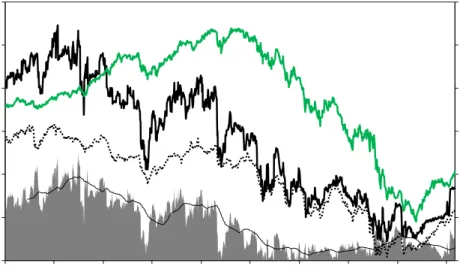
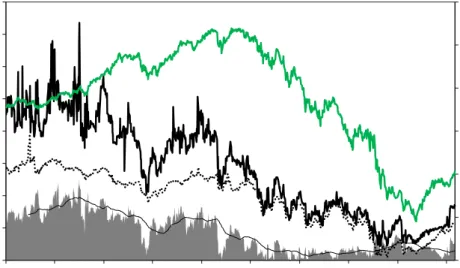
Figure 1 and Figure 2 plot together the forward-looking average and portfolio DD series, their difference and also the DJ STOXX Banks Index as a reference13. As expected, portfolio DD moves along and exceeds average DD over the entire sample and both series provide a good picture of past market assessment and future outlook of the banking system in Europe.
[Insert Figures 1 and 2 here]
Figures 3 and 4 plot together the DD series calculated using only put implied volatili-ties, since put options are more reactive to market specific events and contain important information regarding the demands for portfolio insurance and market volatility (Whaley, 2009). As DD series obtained using average implied volatilities are smoother, a valued property of market-based indicators in the analysis of systemic risk, the results of this paper focus on them only, although it is desirable that the analysis of short term market distress takes into account the information potential of put-derived DD series14.
[Insert Figures 3 and 4 here]
Distance between average and portfolio DD series tends to narrow when the two indica-tors are going down (Gray and Malone,2008). This characteristic is a result of increasing correlation of underlying stocks’ returns in times of distress and it holds true for these se-ries as well after February 2007, when the subprime crisis started to unfold, and especially after the start of the credit crunch in August 2007, when the European banking system was no longer perceived as “sound”.
In addition, due to different sources of implied volatilities, the difference also narrows for a limited time during episodes of short-lived market distress while the banking system still is in healthy shape and also widens during distressed times in response to positive news. An example of the first case is the credit rating downgrade of General Motors 13Figure 2 shows the series since 2005 to account for the generalized adoption of IFRS accounting standards that might have introduced a break in the series due to revaluation of balance sheet items, see
European Central Bank(2006) andRapp and Qu(2007) for further discussion. 14
Put options are extensively used for insurance purposes, i.e. hedgers buy puts if they have concerns about a potential drop in the markets (Whaley,2009).
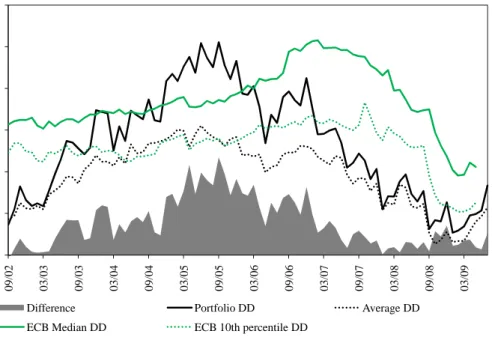
and Ford in May 2005, when their difference abruptly tightened even though average and portfolio DD were still at high levels. A second example is the market turbulence in May-June 2006, where global equity markets are hit by a rise in investors’ risk aversion. A final example pre-crisis is February 2007, when fears about Asian equity markets and deterioration in the US subprime mortgages hit equity markets. In all cases, the effect would not be perceived if only average DD series were portrayed (see ECB’s DD series in Figures 5 and 6). Symmetrically, positive news is also perceived in the series through transitory widening of DD series gap during bad times, as in the late 2008, when capital injections, consolidation and emergency actions were taking place at an unprecedented scale to ensure solvency in the sector.
[Insert Figures 5 and 6 here]
Another interesting feature of the reported DD series is the fact that they reach their peak in 2005, long before our equity markets’ benchmark reached theirs (DJ STOXX Banks Index) and long before the DD series computed using historical equity information (ECB’s DD series). In addition, they start a downward trend around this date -as noted more clearly in the gap and its 60-day moving average- that only bounces back after the first quarter of 2009. This forward-looking feature provides additional support to the abil-ity in DD of early systemic risk monitoring.
As noted in previous sections, most market-based indicators of financial stability are targets of criticism after the crisis because of their poor performance during the recent crisis and their failure to detect early signals of distress in major banking institutions. Indeed, the ECB’s Financial Stability Review reports the decline of DD series only in the second quarter 2007 and equity markets remained somewhat stable even after the liquid-ity squeeze took place (European Central Bank, 2007a). Even if the forward-looking DD series presented in this section had no predictive power, the figures described above make a strong argument for the combined use of forward-looking DD series based on option prices information to monitor the general build-up of risk in systemically important banks in Europe.
4.2 Properties of the Indicator of Stress
The smoothness and forward-looking features of my DD series are quite evident in Figures 7 and 8, where I also plot DD series that use volatilities generated by GARCH models. These series are significantly more volatile than the benchmark, even if additional simi-lar assumptions were made for their estimation15. GARCH-derived volatilities have the advantage of quick adjustment to changes in the underlying data, but they also tend to overshoot afterwards. This feature means more noise in the DD indicator, which leads in practice to a difficult interpretation of its signals and more frequent false positives in the series of DD differences. As a result, reliability of this approach is reduced in terms of monitoring systemic risk compared to both the benchmark series and even DD series constructed with historical volatilities. In addition, the trends in the GARCH-derived DD series are not as clear as those depicted in Figures 1 and 2 and there is more dominance of the short-lived market events.
[Insert Figures 7 and 8 here]
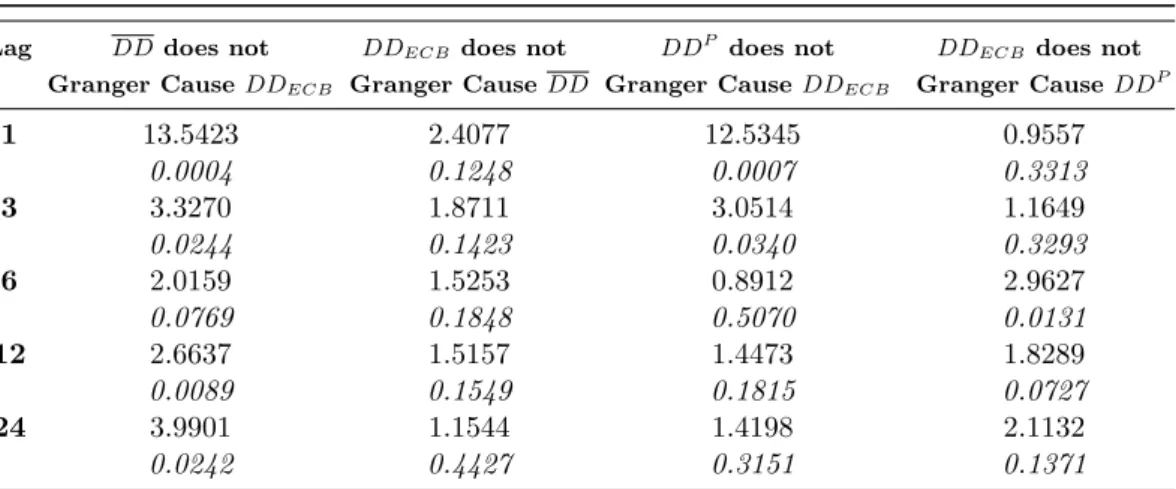
Finally, the forward-looking property of average and portfolio DD series derived from option implied volatilities was econometrically examined running pairwise Granger causal-ity tests vis-`a-vis the monthly DD series reported by the ECB in the Financial Stability Review series16. Results are reported in Table 3.
[Insert Table 3 here]
Results of Granger tests provide econometric support to the forward-looking feature of our series. Table 3 shows that forward-looking DD indicators Granger cause ECB’s median DD series up to two years, as Figures 5 and 6 suggested. More robust results are obtained for longer lags in the test using average DD because of 1) the similar method used
15
GARCH(1,1) volatilities were estimated using prices of individual banks’ shares and DJ STOXX Banks Index since 31/12/1998, adding an observation as daily closing prices become available in order to generate more realistic data series. The DD series followed the same estimation methodology described in Section 3. In terms of the portfolio DD, this means that GARCH volatilities are estimated for the index and covariances are neglected. Although not reported, Granger causality tests were conducted for average, portfolio and differences series, showing rejection of the null hypothesis that main DD do not cause GARCH-generated DD for 5, 10 and 20 day lags, especially for the average DD.
16
Average and portfolio DD were previously transformed to match monthly frequency of ECB data and unit root and cointegration tests were conducted prior to the Granger causality tests.
to obtain these series; and 2) the effect of transitory volatility shocks in the portfolio DD indicator is partially cancelled out in averages and median DD series. In spite of this, these results strongly suggest that -even with the ability of a GARCH model to react quickly to changes in volatility- there is still a backward-looking component embedded that is not present in the DD series that incorporate option price information. The DD series constructed in this paper have therefore an important advantage as a tool of systemic risk analysis.
5
Concluding Remarks
This paper proposes a method to monitor systemic risk in the European banking sys-tem. The approach relies on contingent claims theory to generate aggregated Distance-to-Default series using option prices information from systemically important banks and the DJ STOXX Banks Index. The analysis extends from 30 September 2002 to 31 July 2009, covering both calm times and the current financial crisis.
The portfolio of banks comprises the largest financial institutions in Europe, character-ized by a high degree of complexity and close linkages to the rest of the financial system. This approach is applicable to mature economies, where option markets are active and liquid in both individual equity and equity index option contracts.
The generated series revealed several methodological advantages with respect to tradi-tional approaches in the literature and other market-based indicators of financial stability. Firstly, the analysis of systemic risk is notably enhanced if both average and portfolio Distance-to-Default series and their gap are used to monitor vulnerability in the banking system over time. The aggregated series encompass the analysis of both overall and joint risk of distress in the system.
Secondly, results in the paper show that the information embedded in option prices endow the series with a forward-looking property, allowing for early signaling of distress,
which is not perceived by many other market based indicators of financial stability or even by backward-looking specifications of similar indicators. The use of implied volatilities from options on the sector index also helps circumvent assumptions about equity prices correlations and the use of historical data, which would turn the indicator into a coinci-dent one. It also helps avoid arbitrary assumptions in the model to capture interdepences between banks during times of distress.
Finally, the aggregated Distance-to-Default series are smooth and show quick and clear reaction to short-lived market events without weakening their longer-term informational content. In other words, they incorporate very quickly market expectations via option prices that do not distort the overall risk outlook in the financial system.The research of this paper was conducted while the author was visiting scholar at the Federal Reserve Bank of Cleveland. He thanks helpful comments from its Research Department and especially Ben Craig for his support and encouragement. All remaining errors and views presented here are solely those of the author.
Acknowledgments. The research of this paper was conducted while the author was visiting scholar at the Federal Reserve Bank of Cleveland. He thanks helpful comments from its Research Department and especially Ben Craig for his support and encouragement. Comments and suggestions from Rudi Vander Vennet and Olivier de Jonghe are gratefully acknowledged. All remaining errors and views presented here are solely those of the author.
References
Adrian, T. and Brunnermeier, M.(2009), “ CoVaR ”, Staff Reports 348, Federal
Re-serve Bank of New York.
Arora, N.and Sellers, M. (2004), “ Financial EDF Measures. A New Model of Dual
Business Lines. Modelling Methodology ”, White paper, KMV Corporation, San Fran-cisco.
Arora, N., Bohn, J. and Zhu, F. (2005), “ Reduced Form vs. Structural Models of
Credit Risk: A Case Study of Three Models ”, Journal of Investment Management, vol. 3 no 4.
Blavy, R.and Souto, M. (2009), “ Estimating Default Frequencies and Macrofinancial
Linkages in the Mexican Banking Sector ”, IMF Working Papers 09/109, International Monetary Fund, Washington.
Borio, C.andDrehmann, M.(2009), “ Towards an operational framework for financial
stability: “fuzzy” measurement and its consequences ”, BIS Working Papers 284, Bank for International Settlements, Basel.
Capuano, C.(2008), “ The option-iPoD. The Probability of Default Implied by Option
Prices based on Entropy ”, IMF Working Papers 08/194, International Monetary Fund, Washington.
Chan-Lau, J.and Gravelle, T.(2005), “ The END: A New Indicator of Financial and
Nonfinancial Corporate Sector Vulnerability ”, IMF Working Papers 05/231, Interna-tional Monetary Fund, Washington.
Chan-Lau, J.andSy, A.(2006), “ Distance-to-Default in Banking: A Bridge Too Far? ”,
IMF Working Papers 06/215, International Monetary Fund, Washington.
ˇ
Cih´ak, M. (2007), “ Systemic Loss: A Measure of Financial Stability ”,Czech Journal of
Economics and Finance, vol. 57 no 1-2: pp. 5–26.
ˇ
Evidence for the Euro Area ”, IMF Working Papers 09/69, International Monetary Fund, Washington.
Crosbie, P. and Bohn, J. (2003), “ Modeling Default Risk. Modelling Methodology ”,
White paper, KMV Corporation, San Francisco.
De Nicol`o, G.and Tieman, A.(2007), “ Economic Integration and Financial Stability:
A European Perspective ”, IMF Working Papers 06/296, International Monetary Fund, Washington.
De Nicol`o, G.,Corker, R.,Tieman, A.andvan der Vosse, J.(2005), “ Euro Area
Policies: Selected Issues ”, IMF Staff Country Reports 05/266, International Monetary Fund, Washington.
Echeverr´ıa, C.,Gray, D.andLuna, L.(2006), “ Una Medida de Riesgo de Insolvencia
de la Banca en Chile ”, Financial Stability Report of the Central Bank of Chile, Second Half, Santiago de Chile.
Echeverr´ıa, C.,G´omez, G.andLuna, L.(2009), “ Robustez de Estimadores de Riesgo
de Cr´edito Bancario Usando An´alisis de Derechos Contingentes ”, Unplublished.
European Central Bank(2005), “ Financial Stability Review ”, June 2005, Frankfurt.
European Central Bank (2006), “ EU Banking Sector Stability ”, November 2006,
Frankfurt.
European Central Bank (2007a), “ Financial Stability Review ”, December 2007,
Frankfurt.
European Central Bank (2007b), “ Risk Measurement and Systemic Risk. Fourth
Joint Central Bank Research Conference ”, April 2007, Frankfurt.
Financial Stability Board(2009a), “ Guidance to Assess the Systemic Importance of
Financial Institutions, Markets and Instruments: Initial Considerations - Background Paper. Report to G20 Finance Ministers and Governors ”, October 2009.
Financial Stability Board(2009b), “ Guidance to Assess the Systemic Importance of
Financial Institutions, Markets and Instruments: Initial Considerations. Report to G20 Finance Ministers and Governors ”, October 2009.
Gray, D.and Malone, S.(2008), Macrofinancial Risk Analysis, John Wiley and Sons.
Gray, D. and Walsh, J. (2008), “ Factor Model for Stress-testing with a Contingent
Claims Model of the Chilean Banking System ”, IMF Working Papers 08/89, Interna-tional Monetary Fund, Washington.
Gropp, R.,Vesala, J.andVulpes, G.(2004), “ Market Indicators, Bank Fragility and
Indirect Market Discipline ”,Economic Policy Review, vol. 10 no 2: pp. 53–62.
Huang, X.,Zhou, H.andZhu, H.(2009), “ A framework for assessing the systemic risk
of major financial institutions ”, Journal of Banking Finance, vol. 33 no 11: pp. 2036 – 2049.
Huang, X., Zhou, H. and Zhu, H.(2010), “ Assessing the systemic risk of a
heteroge-neous portfolio of banks during the recent financial crisis ”, BIS Working Papers 296, Bank for International Settlements, Basel.
International Monetary Fund (2009), “ Global Financial Stability Report.
Respond-ing to the Financial Crisis and MeasurRespond-ing Systemic Risks ”, April 2009, WashRespond-ington DC.
M¨uhleisen, M., Ouliaris, S., Swiston, A., Tsounta, E. and Bhatia, A. (2006),
“ United States: Selected Issues ”, IMF Staff Country Reports 06/278, International Monetary Fund, Washington.
Posen, A.andV´eron, N. (2009), “ A Solution for Europe’s Banking Problem ”, Bruegel
Policy Brief 2009/03, Bruegel, Brussels.
Rapp, A.andQu, S.(2007), “ IFRS Accounting Effects on Public EDFT M Credit
Mea-sure. Modelling Methodology ”, Research paper, KMV Corporation, San Francisco.
Tudela, M. and Young, G.(2003), “ A Merton-model Approach to Assessing the
De-fault Risk of UK Public Companies ”, Bank of England Working Papers 194, Bank of England.
Vassalou, M. and Xing, Y. (2004), “ Default Risk in Equity Returns ”, Journal of
Finance, vol. 59 no 2: pp. 831–868.
Whaley, R.(2009), “ Understanding the VIX ”,Journal of Portfolio Management, vol. 35
Appendix A. Derivation of Distance-to-Default
Given the three principles in CCA mentioned in Section 2.1, company value (represented by its assets,A) is the sum of its risky debt (D) and equity (E). Since equity is a junior claim to debt, the former can be expressed as a standard call option on the assets with strike price equal to the value of risky debt (also known in the literature as distress barrier or default barrier).
max{0, A−D} (A.1)
Given the assumption of assets distributed as a Generalized Brownian Motion, the application of the standard Black-Sholes option pricing formula yields the closed-form expression of the Distance-to-Default indicatort periods ahead:
DDP = ln A D + r− 12σA2t σA √ t (A.2)
whereris the rate of growth of the company value (assets) and equals the risk-free interest rate. σA is asset volatility.
In practice, implied asset value A and volatilityσA are not observable and must be esti-mated solving the following system of simultaneous equations by numerical methods:
E=AN(d1)−e−rtDN(d2) σE = AEσAN(d1)
where E is the value of equity, σE is the equity price return volatility. N(•) is the cumulative normal distribution. The values ofd1 and d2 are expressed as:
d1 = ln(A D)+(r+ 1 2σ 2 A)t σA √ t , d2 =d1−σA √ t
The calculation of DD in the literature uses market value as the value of equity E; his-torical, GARCH-derived or option-implied volatilities as equity price return volatilityσE; government bond yields as the risk-free interest raterand the face value of short-term lia-bilities plus half of that of long-term lialia-bilities as the default barrierD. The time horizon
Appendix B. Derivation of Portfolio Distance-to-Default
Aggregation of individual market-based and balance sheet data from N banks into a port-folio DD is given by the following expression:
DDP = lnDAPP + rP − 1 2σP2 t σP √ t (B.1) where: AP =PN
i=1Ai , is the total value of the portfolio’s assets (unobservable).
DP =PN
i=1Di , is the total value of the portfolio’s risky debt. EP =PN
i=1Ei , is the equity market value of the portfolio.
rP =PN
i=1wiri , is the weighted average of risk-free rates. wi= EEPi , or alternativelywi =
Ai
AP is bank i’s weight in the portfolio. σP2 =PN
i=1
PN
j=1wiwjσij , is the portfolio’s asset variance (unobservable), where σij is
the asset return covariance of bank i and j.
After aggregating individual data and assuming the volatility structure of the portfolio, calibration is conducted solving the system of equations from Appendix A. SeeDe Nicol`o
et al. (2005), De Nicol`o and Tieman (2007), Echeverr´ıa et al. (2006), Echeverr´ıa et al.
T
ables
and
Figures
T able 1: Bank Sample Rank Bank Home Coun try Exc hange ISIN Datastream Bankscop e Rev en ues Distribution in 2008 (in %) Co de Mnemonic Index Num b er Home Rest Rest of Europ e of W orld 1 RBS United Ki ngdom LSE GB0007547838 RBS 24762, 49494 40.0 35.5 24.5 2 Barcla ys United Kingdom LSE GB0031348658 BAR C 23552, 24158 53.1 15.7 31.2 3 BNP P aribas F rance Eur onext (FR) FR0000131104 F:BNP 10931, 29289 44.9 30.9 24.2 4 HSBC United Kingdom LSE GB0005405286 HSBA 34727, 47424 26.1 11.3 62.6 5 Deutsc he Bank German y Xetra (DE) DE0005140008 D:DBKX 13216, 21723 66.6 14.6 18.8 6 UBS Switzerland SIX Swiss Exc hange CH0024899483 S:UBSN 46911, 47584 11.4 33.5 55.1 7 ING Ne the rlands Euronext (NL) NL0000303600 H:ING 22304, 29199 18.0 17.3 64.7 8 Cr ´edit Agricole F rance Euronext (FR) FR0000045072 F:CRD A 11948, 17602 49.4 35.4 15.2 9 So ci ´et ´e G ´en ´erale F rance Euronext (FR) FR0000130809 F:SGE 11150, 29338 50.8 34.5 14.7 10 UniCredit Italy Milan IT0000064854 I:UC 23991, 47295 38.3 58.3 3.4 11 San tander Spain S IB E ES0113900J37 E:SCH 23425, 47560 31.7 24.5 43.7 12 F ortis Belgium Euronext (BE) BE0003801181 B:F OR T 29010, 45678 28.9 69.2 1.8 13 Credit Suisse Switze rland SIX Swiss Exc hange CH0012138530 S:CSGN 29015, 29474. 31398 15.2 28.1 56.7 14 Commerzbank German y Xetra (DE) DE0008032004 D:CBKX 13190, 47032 81.2 9.6 9.2 15 Dexia Belgium Euronext (BE) BE0003796134 B:DEX 29295, 45621 26.7 58.4 15.0 16 BBV A Spain SIBE ES0113211835 E:BBV A 22628, 48331 55.6 2.1 42.3 17 Llo yds Banking Group United Kingdom LSE GB0008706128 LLO Y 29227, 43418 100.0 0.0 0.0 18 Dansk e Bank De n mark OMX (DK) DK0010274414 DK:D AB 10607, 29179 40.4 52.3 7.2 19 Nordea Sw eden OMX (SE) S E0000427361 W:ND A 29305, 49434 20.7 79.3 0.0 20 Natixis F rance Euronext (FR) FR0000120685 F:KN@F 23951, 39931. 45333 44.8 28.0 27.2 21 In tesa Sanpaolo Italy Milan IT0000072618 I:BIN 23687, 28749. 46616 81.2 18.8 0.0 22 KBC Belgium Euronext (BE) BE0003565737 B:KB 29303, 48888 59.6 27.4 13.0 23 Stand ard Chartered United Kingdom LSE GB0004082847 ST AN 24831, 29316 3.9 1.9 94.2 24 SEB Sw eden OMX (SE) SE0000148884 W:SEA 29315, 33297 48.9 45.5 5.6 23Table 2: Description of Variables Balance Sheet Variables Variable Definition
Total Assets As reported in Annual and Interim Reports. Source. Bankscope, code 2025.
Short-term Liabilities Deposits and Short term funding. Source. Bankscope, code 2030. Total Equity As reported in Annual and Interim Reports. Source. Bankscope, code
2055.
Daily Market-based Variables Variable Definition
Risk-free Interest Rate Benchmark ten-year bond yield of country where the bank in question is headquartered. Source. Thomson Datastream.
Market Capitalization Total market value measured by close share price multiplied by the or-dinary number of shares in individual issue. Expressed in thousands of domestic currency (converted into euro at official ECB exchange rates). Source. Thomson Datastream.
Exchange Rates End-of-day bilateral exchange rates against the euro. Source. European Central Bank.
Equity Implied Volatilities Daily at-the-money implied volatilities of call and put options on indi-vidual bank shares (American style), traded at NYSE Euronext, Eurex and Nasdaq OMX. Source. Bloomberg, codes HIST CALL IMP VOL for calls and HIST PUT IMP VOL for puts.
Index Implied Volatilities Daily at-the-money implied volatilities of call and put options on the DJ STOXX Banks Index (European style), traded at Eurex. Source. Thom-son Datastream, codes DJ6BC.SERIESC for calls and DJ6BC.SERIESP for puts.
Table 3: Granger Causality Tests
Lag DDdoes not DDECBdoes not DDP does not DDECBdoes not Granger CauseDDECB Granger CauseDD Granger CauseDDECB Granger CauseDDP
1 13.5423 2.4077 12.5345 0.9557 0.0004 0.1248 0.0007 0.3313 3 3.3270 1.8711 3.0514 1.1649 0.0244 0.1423 0.0340 0.3293 6 2.0159 1.5253 0.8912 2.9627 0.0769 0.1848 0.5070 0.0131 12 2.6637 1.5157 1.4473 1.8289 0.0089 0.1549 0.1815 0.0727 24 3.9901 1.1544 1.4198 2.1132 0.0242 0.4427 0.3151 0.1371
Table reports F-statistics with p-values below. End-of-month data for Average DD (DD) and Portfolio DD (DDP) series. ECB series are monthly median DD computed for a sample of LCBG. Sample used for test: 30-Sep-2002 to 31-May-2009 due to ECB series data availability.
Figure 1: Forward looking Distance-to-Default series. 30-Sep-2002 - 31-Jul-2009 0 100 200 300 400 500 600 0 2 4 6 8 10 12 09/02 03/03 09/03 03/04 09/04 03/05 09/05 03/06 09/06 03/07 09/07 03/08 09/08 03/09
Difference (left) Portfolio DD (left) Average DD (left) DJ Stoxx Banks Index (right)
Source. Author’s calculations and Thomson Datastream
Figure 2: Forward looking Distance-to-Default series. 31-Dec-2004 - 31-Jul-2009
0 100 200 300 400 500 600 0 2 4 6 8 10 12 12/04 06/05 12/05 06/06 12/06 06/07 12/07 06/08 12/08 06/09
Difference (left) Portfolio DD (left) Average DD (left) DJ Stoxx Banks Index (right)
Figure 3: Put-derived Forward looking DD series. 30-Sep-2002 - 31-Jul-2009 0 100 200 300 400 500 600 0 2 4 6 8 10 12 14 16 09/02 03/03 09/03 03/04 09/04 03/05 09/05 03/06 09/06 03/07 09/07 03/08 09/08 03/09
Difference (left) Portfolio DD (left) Average DD (left) DJ Stoxx Banks Index (right)
Source. Author’s calculations and Thomson Datastream
Figure 4: Put-derived Forward looking DD series. 31-Dec-2004 - 31-Jul-2009
0 100 200 300 400 500 600 0 2 4 6 8 10 12 14 16 12/04 06/05 12/05 06/06 12/06 06/07 12/07 06/08 12/08 06/09
Difference (left) Portfolio DD (left) Average DD (left) DJ Stoxx Banks Index (right)
Figure 5: Forward looking vis--vis historical DD series. End-of-month data. 0 2 4 6 8 10 12 09/02 03/03 09/03 03/04 09/04 03/05 09/05 03/06 09/06 03/07 09/07 03/08 09/08 03/09
Difference Portfolio DD Average DD ECB Median DD ECB 10th percentile DD
Source. Author’s calculations and European Central Bank
Figure 6: Forward looking DD vis--vis historical DD series. Monthly averages.
0 2 4 6 8 10 12 09/02 03/03 09/03 03/04 09/04 03/05 09/05 03/06 09/06 03/07 09/07 03/08 09/08 03/09
Difference Portfolio DD Average DD ECB Median DD ECB 10th percentile DD
Figure 7: GARCH(1,1)-derived DD series. 30-Sep-2002 - 31-Jul-2009 0 100 200 300 400 500 600 0 2 4 6 8 10 12 14 09/02 03/03 09/03 03/04 09/04 03/05 09/05 03/06 09/06 03/07 09/07 03/08 09/08 03/09
Difference (left) Portfolio DD (left) Average DD (left) DJ Stoxx Banks Index (right)
Source. Author’s calculations and Thomson Datastream
Figure 8: GARCH(1,1)-derived DD series. 31-Dec-2004 - 31-Jul-2009
0 100 200 300 400 500 600 0 2 4 6 8 10 12 14 12/04 06/05 12/05 06/06 12/06 06/07 12/07 06/08 12/08 06/09
Difference (left) Portfolio DD (left) Average DD (left) DJ Stoxx Banks Index (right)