Procedia Technology 4 ( 2012 ) 536 – 542
2212-0173 © 2012 Published by Elsevier Ltd. doi: 10.1016/j.protcy.2012.05.085
C3IT-2012
Analyzability Quantification Model of Object Oriented
Design
Suhel Ahmad Khan
a, Raees Ahmad Khan
aaDepartment of Information Technology, Babasaheb Bhimrao Ambedkar University (Central University), Lucknow, 226025, India
Abstract
In this paper a significant effort is made to quantify analyzability using object oriented software. Analyzability is the key attribute of maintainability for high quality products. A metric based model for analyzability quantification has been proposed by establishing the relation between analyzability and object oriented design constructs. The proposed model is empirically validated and statistical significance of the study discusses the high correlation for model acceptance. Design complexity of software is also an influencing factor of analyzability with negative impact.
© 2011 Published by Elsevier Ltd. Selection and/or peer-review under responsibility of C3IT
Keywords: Analyzability; Object oriented Design; Complexity; Design Metrics;
1. Introduction
Maintainability is one of the most significant characteristics of software quality. Most of software companies splurge 60 to 70 percent of resources for correcting, adopting and maintaining the existing software [1]. Most of companies spend over 70 percent amount on testing maintenance of the software to control the quality [2]. The ISO/IEC 9126 standard describes a model for software product quality that dissects the overall notion of quality into 6 main characteristics: functionality, reliability, usability, efficiency, maintainability, and portability [3].Maintainability measurement helps to analyze the maintenance effort and easiness of software at design level. The maintainability definition according to IEEE glossary of Software Engineering is “the ease with which a software system or component can be modified to correct faults, improve performance or other attributes, or adapt to a change environment”. Software maintenance accounts for more effort than any other
---Open access under CC BY-NC-ND license.
software engineering activity. The maintainability of software is not possible directly but with the help of their internal characteristics measurement. Early estimation of maintainability helps to utilize its attributes more efficiently to control/improve the quality of software. The design phase quantification of software maintainability is more feasible for software development and maintenance economically. The proposed model for analyzability quantification point outs the probable influences of design constructs and also discusses the impact of analyzability with design complexity.
2. Maintainability Characteristics
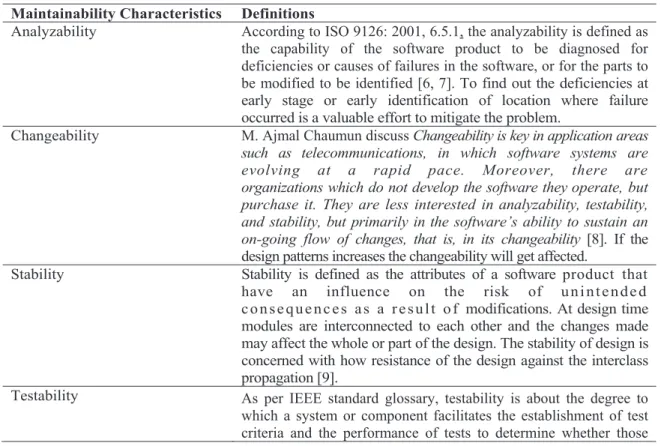
Maintainability is one of the most accurate quality indicators. Accurate measurement of maintainability is an indicator of improved designing, high quality product and low maintenance cost. Characteristics of software product quality central to the quality model of ISO 9126 is its breakdown of the notions of internal and external software product quality into 6 main characteristics which are further subdivide into a total of 27 quality sub characteristics [4]. According to the ISO/IEC 9126-4:2004 standard, maintainability can be subdivided into four measurable sub characteristics: Analyzability, Changeability, Stability and Testability & related definitions are depicted in Table 1[5].
Table 1: Maintainability Attributes Definition Table
Maintainability Characteristics Definitions
Analyzability According to ISO 9126: 2001, 6.5.1, the analyzability is defined as the capability of the software product to be diagnosed for deficiencies or causes of failures in the software, or for the parts to be modified to be identified [6, 7]. To find out the deficiencies at early stage or early identification of location where failure occurred is a valuable effort to mitigate the problem.
Changeability M. Ajmal Chaumun discuss Changeability is key in application areas such as telecommunications, in which software systems are evolving at a rapid pace. Moreover, there are organizations which do not develop the software they operate, but purchase it. They are less interested in analyzability, testability, and stability, but primarily in the software’s ability to sustain an on-going flow of changes, that is, in its changeability [8]. If the design patterns increases the changeability will get affected.
Stability Stability is defined as the attributes of a software product that have an influence on the risk of u n i n t e n d e d c o n s e q u e n c e s a s a r e s u l t o f modifications. At design time modules are interconnected to each other and the changes made may affect the whole or part of the design. The stability of design is concerned with how resistance of the design against the interclass propagation [9].
Testability As per IEEE standard glossary, testability is about the degree to which a system or component facilitates the establishment of test criteria and the performance of tests to determine whether those
3. Analyzabi According to failure. Analy summarized a 1. Effor 2. Caus For any com failure is com to enough co diagnose the optimal poin acceptance le more comple complexity t analyzability inference can Figure 1: Impact 3. Model De In order t development
ility and Com o the definitio yzability discu as follows: rt to diagnose ses of failure mplex software mplicated. Com omplexity the deficiencies e nt as complex evel. There is ex application the analyzabi with quality a n be made. t diagram of comp evelopment to provide th products, a crite stay perf met is c main mplexity on of Analyza usses the effor & rectifying t e application o mplexity is a k things are ha easily is only xity increases, need to contr n is facilitating ility of softw and its attribut
plexity and analy
he significant concerted eff
eria have been yed in terms th formance of te . Testability is oncerned with ntainability an ability, it’s a rt estimation a the defects or design, the key factor for arder to under possible when , the analyzab rol/adjust the d g humanity li ware are diff tes are discuss
zability
and improve ffort to find q
n met: and the hat permit the sts to determin
software quali h defect identif d test cost cont
process to di and reason of b e effort estima secure design rstand and po n design comp bility of softw design comple ike space shu fficult [11]. T sed in Figure 1 ed measurem quantifiable w K A Į C Where C A degree to wh e establishment ne whether tho ity characterist fication and re trol [10]. iagnose defici break down. T ation or rectifi n up to certain ossibility of de plexity kept o ware decrease exity for bette uttle program,
The effects o 1. From the fig
ment of object way to relate K --- ¥ A > C C= Complexi A= Analyzab hich a requirem t of test criter ose criteria hav tics whose maj emoval for imp
iencies or cau The definition fication of cau n optimal poin efects increas ptimal. Beyon es from that c er analyzabilit but due to e of complexity gure 1 the foll
t oriented so measurable > 0, C > 0, ity bility ment is ria and ve been or part proved uses to can be uses of nt. Due es. To nd that certain y. The enough y and lowing oftware object
oriented char 4.1 Quantify It is eviden framework fo based on its i defined in te oriented desig It is observe analyzability design constr Figure 2: Correla 4.2 Identifica Researcher assessment o by a large co these accepte & required d quantitative a 4.3 Establish The figure relationship b values of the assessment o low cost ma techniques ha racteristics to t ing Statement nt from literatu or evaluating internal design erms of desig gn properties ed that each c of the objec ructs with anal
ation diagram, Fi ation of Objec s have propo of object orien ommunity of r ed metrics som dataset has be assessment of hing Correlati 3 describes th between analy ese metrics ca of analyzabilit intenance. In ave been used
the high level t between Anal ure survey tha the analyzabi n property [12 n characterist are used to ass characteristics ct oriented so lyzability to c gure 3: Analyzab ct Oriented De osed several nted design [17 researchers an me of existing en taken from analyzability ion he quantificati yzability and an be easily i y is very help order to esta . The propose desirable soft lyzability Attr at there is no lity of design 2, 13, 14]. Th tics. The set sess the analy having posit oftware. An e
ontrol maintai
ility Quantificatio
esign Metrics & object orien 7, 18, 19]. Th nd developers g metrics whic m Genero [17] of software de ion process of object oriente identified with pful to achiev ablish a mode d multivariate tware quality a ibutes & OOD
known compr s developed u his model has
of empirically zability to imp tive or negati exhaustive rev inability is dep on Model
& Data Collec nted metrics hese metrics ar
due to its acc ch are well su
].These metric esign for impr
f software ana ed design con h the help of ve maintainabi el for analyza e linear model attributes is re D Constructs rehensive and using an objec the low level y identified a prove maintain ive impact on view correlat picted in Figur ction in past deca re valid and w curacy. After ited for object cs are helpful roved results f alyzability. Th structs has be f class diagram ility index of ability, multip is as follows: quired. d complete mo ct oriented app design metric and weighted nability of sof n factors affec ting object or re 2[8, 9, 10,
ades for qual widespread ac a regress rev t oriented des l for qualitativ for maintainab he contextual i een established m. The quant software desi ple linear regr
odel or proach cs well object ftware. cts the riented 15]. litative cepted iew of signing ve and bility. impact d. The tifiable ign for ression
Y=Į+ ȕ1*X1+ ȕ2*X2+ ȕ3*X3+--- ȕn*Xn--- Eq(1)
Where Y is dependent variable and X1, X2…….Xn are independent variables. ȕ1, ȕ2…… ȕn are the coefficient of the independent variables. The data is taken for this model is from [17] that is a controlled experiment of 28 class diagrams denoted as (D0 to D27). As per Equation(1) analyzability is taken as independent variable. Using these data, the coefficient calculated for inheritance, coupling and cohesion to show the relationship with design properties. Equation 2 summarizes the computational formula for analyzability with the component weightage.
Analyzability= 1.078 -.029 NM+.659 Max DIT + .228 N Assoc +.064 NA
Analyzability=1.078-.029Encapsulation+.659Inheritance+.228Coupling+.064 Cohesion---(2) 4.4 Statistical Significance of Model
The coefficient table (2) presents the statistical significance of independent variables. A linear regression relationship has been established between dependent variable and independent variables to check whether it is statistically significant or not. The coefficient table 2 and summary table 3 describes that the metrics are statistically significant at a significant level of 0.05(equivalent to a confidence level of 95%).
Table 2: Coefficient Table
Model Unstandardized Coefficients Standardized Coefficients
T Sig. 95.0% Confidence Interval for B B Std. Error Lower Bound Upper Bound Constant Encapsulation Inheritance Coupling Cohesion 1.078 -.029 .659 .288 .064 .466 .038 .366 .217 .063 -.521 .632 .578 .636 2.315 -.763 1.800 1.328 1.012 .068 .480 .132 .242 .358 -.119 -.126 -.282 -.270 -.098 2.275 .068 1.599 .847 .226
a. Dependent Variable: Analyzability
Table 3: Summary Table
Model R R Square Adjust R
Square Std. Error of the Estimate
Change Statistics
R Square Change F Change df1 df2 Sig. F Change
1 .954 .910 .838 .66864 .910 12.674 4 5 .008 Model Summary :Predictors: (Constant), Cohesion, Inheritance, Coupling, Encapsulation
5. Model Validation
This part of the paper reviews, how well the model effectively quantifies the analyzability of object oriented design using class diagram. For validation of model, same set of data is collected with original set of data for analyzability that has been calculated using evaluated model’s equation. Pearson’s correlation coefficient is being calculated between the actual values (Analyzability Tabulated) and calculates values (Analyzability Calculated). The values are discussed in Table 4.
6. Statistical Analysis
It is mandatory to check the validity of proposed model for acceptance. A 2-sample t test has been introduced to test the significance of Analyzability_Tabulated values to Analyzability_Calculated Values. A hypothesis test based on 2-sample t test is being performed and confidence interval is being observed by the difference of two standard mean. The t test history of analyzability is mentioned in Table 5.
Table (5): T Test of Analyzability
Ho: (Null hypothesis): There is significant difference between Analyzability_Tabulated and Analyzability_Calculated.
H1: (Alternate hypothesis): There is no significant difference between Analyzability_Tabulated and Analyzability_Calulated.
Ho: 1-2=į0 verses H1: 1-2 į0
Where 1 and 2 are the sample means and į0 is the hypothesized difference (zero) between the two sample mean. Mean, Standard Div, Standard Error, Standard Error difference have been calculated for given two samples at Table (X). Given samples are trusted by 95% confidence with concluding remarks that samples means are same. There is no difference between tabulated data and calculated data. Therefore the null hypothesis is rejected and alternate hypothesis is accepted. The obtained equation through using design parameters for analyzability calculation is highly accepted.
7. Conclusion CD A(Tabulated) (Known Value) A(Calculated) (Using Model) CD A(Tabulated) (Known Value) A(Calculated) (Using Model) CD1 1.00 1.390 CD15 3.00 2.953 CD2 2.00 1.402 CD16 4.00 3.700 CD3 2.00 1.507 CD17 6.00 5.760 CD4 2.00 2.042 CD18 6.00 6.007 CD5 2.00 1.653 CD19 5.00 5.596 CD6 2.00 1.690 CD20 6.00 7.912 CD7 3.00 2.106 CD21 3.00 2.454 CD8 3.00 2.547 CD22 5.00 4.613 CD9 2.00 1.594 CD23 6.00 6.748 CD10 3.00 2.629 CD24 5.00 4.708 CD11 3.00 2.711 CD25 6.00 5.412 CD12 3.00 2.680 CD26 5.00 7.339 CD13 3.00 2.994 CD27 5.00 4.809 CD14 2.00 2.218 CD28 4.00 4.937
T Test For Analyzability Data
N Mean Std Div Std Err
Analyzability_Tabulated 28 3.64286 1.56854 0.29643 Analyzability_Calculated 28 3.64682 1.95862 0.37014 Standard Error Difference=0.474
T Value=0.0093
Software analyzability is one of the most significant factors of maintainability of software development. The assessment of analyzability using the model is more appropriate and its validation signifies the valid impact of structural and functional information of object oriented design software. The model is developed using multiple linear regression technique on object oriented design constructs. The applied statistical analysis on this study concludes its statistical significance remarked that calculated data is highly acceptable. This paper expresses the relation between complexity and analyzability and design complexity of software having a negative impact on analyzability.
Acknowledgement
This work is sponsored by University Grants Commission (UGC), New Delhi, India under F. No. 34-107\2008 (SR).
References
1. R. Pressman, “Software Engg: A Practitioner’s Approach” , Sixth Ed. Mcgraw-Hill,2005 2. H. Zuse, “ A Framework of Software Measurement” Walter de Gruyter,1998
3. ISO, “ISO/IEC 9126-1: Software Engg.-Product Quality-Part-1: Quality Model”,Geneva, Switzerland,2001 4. N. Bevan, “Qualtiy and Usability: A New Framework”, Van Veenendaal, E, and McMullan, J (eds) Achieving
Software Product Quality, Tutein Noithenius, Netherlands,1997
5. ISO/IEC 9126-4:2004, “Software Engg.: Product Quality-Quality in Use Metrics”, ISO/IEC 2004
6. J. Rumbaugh, M. Blaha, “Object Oriented Modeling and Design”, ISBN:81-7808-738-3, Pearson Education, 2003
7. http://www.issco.unige.ch/en/research/projects/isle/femti/html/212.html
8. M. Ajmal Chauman, H. Kabaili, R. K. Keller, L. and G. S. Denis, “Design Properties and Object Oriented Software Changeability”, SPOOL Project BY CSER, Bell Canada, National Science and Research Council of Canada (NSERC) and National Research Council of Canada (NRC), IEEE, Feb 2000, pp:45-54
9. M. O. Elish, D. Rine, “Investigation of Metrics for Object Oriented Logical Stability”,CSMR-03, 0-7695-1902-4, IEEE 2003, pp:193-200.
10. R. A. Khan, K.Mustafa, “Metric Based Testability Model for Object Oriented Design (MTMOOD)”, SIGSOFT Software Engineering Note, Volume 34, Number 2, March 2009.
11. Software Technologies for Embedded and Ubiquitous Systems Springer; 1 edition | November 14, 2007 | ISBN-10: 3540756639
12. W. Li, S. Henry, “Object Oriented Metrics Which Predict Maintainability”, Technical Report 93-05,
13. A.Epping, C. M.Lott, “Does Software Design Complexity Affect Maintainability Effort?”, citeseerx.ist.psu.edu/viewdoc/download?doi=10.1.1.6.5828, 19th Annual Software Engineering Workshop, 30 Nov–1 Dec 1994
14. B. Lilburne, “Measuring Quality Metrics for Web Application”, Technical Report No: CIT/08/2004.
15. M. Perepletechikov, C. Ryan, Z. Tari, “The Impact of SERVICE Cohesion on the Analyzability of Service Oriented Software”, IEEE Transactions on Services Computing Volume 3 , Number 2, April-June 2010
16. L. Wang, E. Arisholm, “The Effect of Task Order on the Maintainability of Object Oriented Software ”, Information and Software Technology, Elsevier 2008, doi:10.1016/j.infsof2008.03.005
17. Genero M., J. Olivas, M. Piattini and F. Romero, “A Controlled Experiment for Corroborating the Usefulness of Class Diagram Metrics at the early phases of Object Oriented Developments”, Proceedings of ADIS 2001, Workshop on decision support in Software Engineering, 2001.
18. Shyam R. Chidamber, Chris F. Kemerer, “Towards A Metrics Suit for Object Oriented Design”, OOPSLA, ACM, 1991, pp.197-211.
19. Jagdish Bansia, “A Hierarchical Model for Object Oriented Design Quality Assessment”, IEEE Transaction of Software Engineering, Volume 28, No. 1, January 2002,pp: 4-17