Development of a virus detection and discovery pipeline using next
generation sequencing
Thien Ho, Ioannis E. Tzanetakis
nDepartment of Plant Pathology, Division of Agriculture, University of Arkansas System, Fayetteville, AR, USA
a r t i c l e i n f o
Article history:Received 29 July 2014 Returned to author for revisions 28 August 2014
Accepted 22 September 2014 Available online 22 October 2014 Keywords:
Virus detection Virus discovery
Next generation sequencing Bioinformatics
a b s t r a c t
Next generation sequencing (NGS) has revolutionized virus discovery. Notwithstanding, a vertical pipeline, from sample preparation to data analysis, has not been available to the plant virology community. We developed a degenerate oligonucleotide primed RT-PCR method with multiple barcodes for NGS, and constructed VirFind, a bioinformatics tool specifically for virus detection and discovery able to: (i) map andfilter out host reads, (ii) deliverfiles of virus reads with taxonomic information and corresponding Blastn and Blastx reports, and (iii) perform conserved domain search for reads of unknown origin. The pipeline was used to process more than 30 samples resulting in the detection of all viruses known to infect the processed samples, the extension of the genomic sequences of others, and the discovery of several novel viruses. VirFind was tested by four external users with datasets from plants or insects, demonstrating its potential as a universal virus detection and discovery tool.
&2014 Elsevier Inc. All rights reserved.
Introduction
Next generation sequencing (NGS) has revolutionized virology with many novel viruses being discovered using popular platforms such as pyrosequencing (454 Life Sciences, Branford, CT) or Illumina dye sequencing (Illumina, San Diego, CA) (Al Rwahnih et al., 2011; Quito-Avila et al., 2013; Rwahnih et al., 2013; Thekke-Veetil et al., 2013; Vives et al., 2013) (reviewed for plant diagnostics byMassart et al. (2014)). Most commercial NGS services offer basic bioinformatics support such as de novo sequence assembly or mapping to reference genomes, but will not progress further to the specifics of virus detection and discovery. There are also various online tools designed for general sequence comparison purposes, with NCBI BLAST (http://blast.ncbi. nlm.nih.gov/Blast.cgi (Altschul et al., 1997)) as the most popular application that compares a limited number of query sequences to available subject databases such as non-redundant nucleotide (nt) and amino acid (nr) collections. In the case of PLAN (http://bioinfo.noble. org/plan/ (He et al., 2007)), users can create personal projects to Blast their datasets. NGS data can also be manipulated and analyzed in Galaxy (http://galaxyproject.org (Blankenberg et al., 2010)). However, NCBI BLAST and PLAN are Blast tools and only accept limited number of sequences inflat fasta format, and Galaxy, although moreflexible with NGS data, is a collection of tools designed for sequence manipulation and analysis but not for novel virus discovery purposes. There are bioinformatics tools developed specifically for human virus detection (Bhaduri et al., 2012; Chen et al., 2013; Kostic et al.,
2011; Li et al., 2013; Naeem et al., 2013; Wang et al., 2013). In general, these tools are Unix command-line standalone packages that map NGS reads to the human genome, and perform various Blast steps to remove host reads. The remaining data are analyzed to categorize into non-human, microbial, or viral integrated sequences. Metavir2 (Roux et al., 2014) and Virome (Wommack et al., 2012) are the two other web-based tools for virome analysis but focus heavily on data visualization of environmental samples and do not focus on virus discovery. As there are no bioinformatics programs that function as universal virus dis-covery tools, biologists often have to rely on professional bioinforma-ticians to process NGS data, posing a bottleneck in data analysis.
In this study, a pipeline was created, from the bench to sequence analysis for virus detection and discovery. We developed a degen-erate oligonucleotide primed (DOP) RT-PCR method with multiple barcodes for NGS, and constructed VirFind, a novel and automated bioinformatics tool specifically for virus detection and discovery. The tool has been tested for the past 2 years and is available as a web-based graphical front-end interface at http://virfind.org. Vir-Find efficiency was evaluated for virus detection and discovery using different NGS platforms on several plant and animal samples, sequenced in-house as well as by other research groups.
Results
A DOP-RT-PCR assay for multiplexed NGS
In this study, a DOP-RT-PCR assay with two different sets of primers (Table 2andTable S1for complete sets) was evaluated with Contents lists available atScienceDirect
journal homepage:www.elsevier.com/locate/yviro
Virology
http://dx.doi.org/10.1016/j.virol.2014.09.019 0042-6822/&2014 Elsevier Inc. All rights reserved.
nCorresponding author. Tel.:þ1 479 575 3180; fax:þ1 479 575 7601. E-mail addresses:[email protected](T. Ho),[email protected](I.E. Tzanetakis).
29 plant dsRNA-enriched samples (sample nos. 3–31). Each primer set comprised of an RT primer (with a random hexamer at the 30 end) and 48 barcoded PCR primers, facilitating multiplexed NGS runs without the need of further barcoding by sequencing service provider. We experimented different sample combinations, from single sample NGS (dataset nos. 1, 4–8) to multiple barcoded sample NGS (datasets #3: 2 samples; #9: 4 samples; #10: 8 samples; and #2: 11 samples), and were able to retrieve sequences from all samples based on their barcodes.
Virus detection
Sample nos. 1, 5–8, 10, 13–21 and 31 (Table 1) were employed to test the VirFind detection efficiency. The pipeline detected all known viruses, including redbud yellow ringspot virus (Emaravirus, unas-signed family) in Cercis canadensis (redbud); rose rosette virus (Emaravirus) inRosasp. (rose); beet pseudo-yellows virus (Crinivirus,
Closteroviridae) and strawberry necrotic shock virus(Ilarvirus, Bromo-viridae) inFragariaananassa(strawberry); blackberry virus E (unas-signed genus, Alphaflexiviridae), blackberry virus X (unassigned), blackberry vein banding-associated virus (Ampelovirus, Closteroviri-dae), blackberry yellow vein-associated virus (Crinivirus) and tobacco ringspot virus (Nepovirus,Secoviridae) inRubussp. (blackberry);fig badnavirus 1 (Badnavirus,Caulimoviridae),fig mild mottle-associated virus (Closterovirus,Closteroviridae) andfig mosaic virus (Emaravirus) inFicus carica(fig); blueberry latent virus (Amalgavirus, Amalgavir-idae), blueberry necrotic ring blotch virus (unassigned) inVaccinium corymbosum (blueberry) and citrus yellow vein-associated virus
(unassigned) in Citruslimon. (lemon). In Menthagracilis (mint), VirFind detected mint virus X (Potexvirus,Alphaflexiviridae), straw-berry latent ringspot virus (unassigned genus,Secoviridae) and mint vein banding-associated virus (MVBaV, unassigned genus, Closterovir-idae). VirFind extended the known MVBaV genome from 9049 nt to 13,387 nt ((Tzanetakis et al., 2005), GenBank accession KJ572575). In
Vitis vinifera(grapevine), VirFind assembled 6416 nt of RNA 1 of peach rosette mosaic virus (PRMV, Nepovirus, Secoviridae). Currently only sequences from PRMV RNA 1 are available in GenBank. VirFind discovered two contigs with total length of 2938 nt (GenBank accessions KJ572573-4) similar to the polyprotein encoded by nepo-virus RNA 2. Since no RNA 1 of other neponepo-viruses was found, these two contigs are presumably part of PRMV RNA 2.
VirFind was also sensitive enough to detect correctly three random 270 nt virus/viroid GenBank molecules in datasets 4–6
Fig. 2.Agarose gel electrophoresis of PCR confirming the presence of novel viruses identified using VirFind. Lanes 1–2: detection of novel trichovirus (DNA pro-duct¼325 bp) and novel waikavirus (DNA product¼640 bp), respectively, in black-currant; 3: detection of elderberry latent virus (DNA product¼217 bp) in elderberry; 4–10: detection of novel carlaviruses (DNA product¼181 bp) in elderberry; 11: detection of putative peach rosette mosaic virus RNA 2 (DNA product¼379 bp) in grape; M: Hyperladder IV molecular weight marker. Sanger sequencing confirmed virus identities.
Fig. 1.VirFindflowchart for virus detection and discovery using next generation sequencing data. Each VirFind queue runs on a computer node with 64 cores and 512 Gb RAM, and uses various sequence manipulation tools, together with Bowtie 2 mapping, Velvet de novo assembler, NCBI BLAST and conserved domain search, to generate different outputs for users tofind viruses in their next generation sequencing data. Stars indicate steps where users can set their own parameters.
indicating that sequence subtraction by the Bowtie 2 genome mapping and Blastn steps (default cut-off e-value¼0.05) did not erroneously remove any virus/viroid sequences.
Virus discovery
A novel trichovirus was discovered in Ribes nigrum (black-currant). The total contig length is 6057 nt (GenBank accessions KJ572565-6) and the partial RNA-dependent RNA polymerase (RdRp) shares about 30% identity with its trichovirus orthologs
(Table S2A). A novel waikavirus, with total contig length of 6347 nt
(GenBank accessions KJ572567–KJ572572), was also discovered, with the coat protein (CP) identities being less than 43% when comparing with its orthologs (Table S2B). SevenSambucus (elder-berry) samples were evaluated and VirFind extended the genome of elderberry latent virus (ElLV, unassigned genus,Tombusviridae) from 1017 nt to 3350 nt (GenBank accession KJ572576). Five novel carlaviruses with genome contig length ranging from 6044 to 8749 nt (GenBank accessions KJ572560–KJ572564) were discovered. All are new viruses given that the complete RdRp genes share less
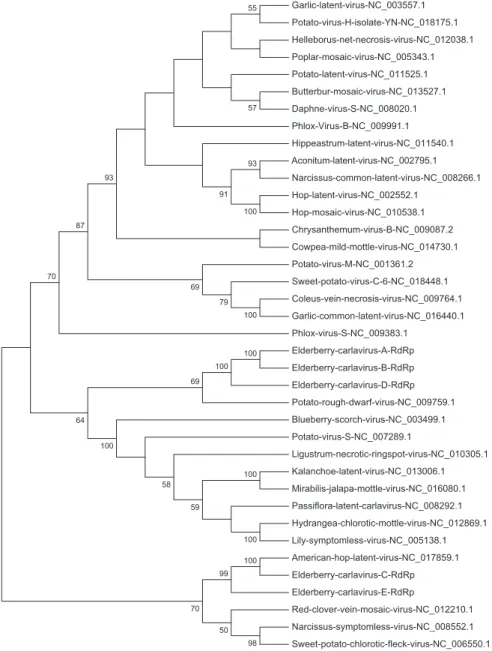
than the 80% amino acid sequence identities (ICTV species cut-off value) between them and other members of the genus. The viruses are provisionally named as elderberry carlaviruses A–E (Fig. 3
andTable S2C).
The presence of all novel viruses was verified by PCR amplifi ca-tion using detecca-tion primers designed from the assembled contigs
(Table 2), with the exception of elderberry carlaviruses using the
universal carlavirus detection primer pair kk-univ-carla (Karen Keller, personal communication), followed by Sanger sequencing (Fig. 2).
VirFind is a public tool for virus detection and discovery
Four external users evaluated VirFind using seven plants or honey bee Illumina/fasta datasets sequenced from either dsRNA, siRNA, or total RNA (NGS dataset nos. 11–17,Table 1). Without any prior knowledge about the tool, the users successfully signed up, logged in, and submitted the NGS datasets with specific para-meters for the tool to execute at http://virfind.org. The users later confirmed the viruses detected by VirFind had been previously identified by their in-house bioinformatics analysis.
Garlic-latent-virus-NC_003557.1 Potato-virus-H-isolate-YN-NC_018175.1 Helleborus-net-necrosis-virus-NC_012038.1 Poplar-mosaic-virus-NC_005343.1 Potato-latent-virus-NC_011525.1 Butterbur-mosaic-virus-NC_013527.1 Daphne-virus-S-NC_008020.1 Phlox-Virus-B-NC_009991.1 Hippeastrum-latent-virus-NC_011540.1 Narcissus-common-latent-virus-NC_008266.1 Hop-latent-virus-NC_002552.1 Hop-mosaic-virus-NC_010538.1 Chrysanthemum-virus-B-NC_009087.2 Cowpea-mild-mottle-virus-NC_014730.1 Potato-virus-M-NC_001361.2 Sweet-potato-virus-C-6-NC_018448.1 Coleus-vein-necrosis-virus-NC_009764.1 Garlic-common-latent-virus-NC_016440.1 Phlox-virus-S-NC_009383.1 Elderberry-carlavirus-A-RdRp Elderberry-carlavirus-B-RdRp Elderberry-carlavirus-D-RdRp Potato-rough-dwarf-virus-NC_009759.1 Blueberry-scorch-virus-NC_003499.1 Potato-virus-S-NC_007289.1 Ligustrum-necrotic-ringspot-virus-NC_010305.1 Kalanchoe-latent-virus-NC_013006.1 Mirabilis-jalapa-mottle-virus-NC_016080.1 Passiflora-latent-carlavirus-NC_008292.1 Hydrangea-chlorotic-mottle-virus-NC_012869.1 Lily-symptomless-virus-NC_005138.1 American-hop-latent-virus-NC_017859.1 Elderberry-carlavirus-C-RdRp Elderberry-carlavirus-E-RdRp Red-clover-vein-mosaic-virus-NC_012210.1 Narcissus-symptomless-virus-NC_008552.1 Sweet-potato-chlorotic-fleck-virus-NC_006550.1 100 100 100 100 100 100 100 99 98 93 91 79 69 69 57 55 50 70 59 58 100 64 70 87 93 Aconitum-latent-virus-NC_002795.1
Fig. 3.Phylogenetic analysis of the RdRp amino acid sequences offive novel Elderberry carlaviruses amongCarlavirusspecies with sequences deposited on GenBank. The un-rooted tree was generated using the neighbor-joining algorithm of MEGA5 software (Tamura et al., 2011).
Discussion
VirFind, a bioinformatics pipeline for virus detection and discov-ery was developed. The program uses NGS data to identify known and unknown viruses and provide a robust pipeline for the end user. We evaluated different sample numbers in multiplexed NGS (2, 4, 8, and 11). In all cases, all viruses previously detected in the samples were also identified using VirFind. Unlike a chip-based method for virus detection (Chen et al., 2011), there is no need to update the hardware for DOP-RT-PCR.
Identifying a virus hit to GenBank nt or virus protein database is relatively simple in the case of long contigs with high sequence identity to known species. Still, it could be a challenging task in the case of short contigs and high e-values because of the possibility of false positives. VirFind generates Blast and conserved domain out-puts with details empowering the users to make a decision on whether a known/novel virus is present in their sample. Based on the taxonomy information in the Blast reports together with e-values and sequence identity, users can infer whether a virus is a known species or a novel one.
Number of unique sequences submitted to the Blastfiltering steps varied between 454 and Illumina sequencing methods (Table S3). As VirFind ignores sequences (after adapter and primer trimming) shorter than 90 nt, the majority of 454 singlets were processed further, whereas those from Illumina werefiltered out. However, this will change as Illumina read length is constantly increasing.
Genomes of some of the host plants used in this study are still unavailable on the GenBank, hence thefiltering steps remove a subset of host sequences, leaving a number of non-hit sequences. The majority were host sequences as identified in the conserved domain search. However, we observed cases where conserved domain search picked up a novel virus while earlier Blast steps did not (data not shown). Still, the rate of eukaryotic genome sequences available accelerates by the year and this may not be an issue altogether in a short timeframe.
Knowledge of virus evolution expands rapidly and it may be that novel virus sequences (e.g. archaea viruses) are quite different from those deposited in databases. In such case VirFind may be unable to identify them as such but as knowledge expands so will the ability of the pipeline to identify novel species.
Compared to other bioinformatics tools (Roux et al., 2014;
Wommack et al., 2012), VirFind is better suited for processing of
raw sequences for novel virus discovery. The tool can trim adapters/ primers, and map to reference genomes before any sequence assem-bly and Blast steps. These steps are particularly useful with a random PCR or sample tagging protocols. Official virus taxonomy information obtained from ICTV master species list helps users identify the approximate taxa of the novel viruses.
Processing time varied between the experimental datasets, from as short as 3 min to about 70 h (Table 1) depending on the number of unique raw reads, average read length, and number of reads being processed after eachfiltering step. In general, 70 h are sufficient to complete the analysis of one 454 Junior sff dataset with 200,000 reads, or an Illumina fastq dataset with30 million 80 nt single-end reads. Bigger datasets will need more processing power and we plan to upgrade VirFind hardware when user activity becomes significant. A universal bioinformatics tool for virus discovery must have the ability to process datasets (i) with different NGS formats, (ii) of different read lengths, (iii) from different hosts, and (iv) infected by known and unknown virus species, closely or distantly related to those found on GenBank. The universality of VirFind was proven when the tool successfully worked with datasets in 454 sff/Illumina fastq/fasta format, processed from total nucleic acids/dsRNA,
identi-fied all categories of viruses, and generated by external users that used different preparation methods. VirFind was also used to identify viruses from siRNA datasets, which would allow the discovery of DNA viruses that leave siRNA footprints after infection. Originally
VirFind was constructed tofind plant viruses. However, since virus discovery by sequence comparison is the same regardless the virus species or host, and with the fact that VirFind was also tested successfully with honeybee viruses, the tool can be used for detection and discovery of viruses in any host.
Since online, VirFind was tested internally and externally using NGS datasets generated by the 454 or Illumina platforms. In all cases, VirFind produced virus detection/discovery results identical to or better than those previously identified by each individual user, demonstrating the reproducibility of the tool. Taken together, our results have shown that with VirFind, virus detection and discovery using NGS can be standardized and readily accessible to a wider audience of scientists in the absence of a designated bioinformatician.
Material and methods
Sample sources
Samples exhibiting virus-like symptoms were either plants maintained at the University of Arkansas-Fayetteville, or provided by collaborators in California, Michigan, Mississippi and Oregon. Laboratory tests (ELISA or RT-PCR) detected viruses in only a subset of samples, indicative of the presence of novel strains or species in others. Plant leaves or phloem were harvested and kept at 801C until nucleic acid extraction.
Sample preparation methods
>Thirty one plant samples (sample nos. 1–31,Table 1) were used for nucleic acid extraction. Sample nos. 1 and 2 were subjected to a total nucleic acid extraction protocol (Poudel
et al., 2013), whereas sample nos. 3–31 were processed using a
dsRNA-enrichment protocol (Yoshikawa and Converse, 1990). Samples 1, 5–8, 10, 13–21 and 31 were known to be infected by an array of viruses whereas samples 2–4, 9, 11, 12, 22–30 were never tested for viruses before. Reverse transcription was per-formed essentially as described before (Tzanetakis et al., 2005) using Maxima™ reverse transcriptase (Thermo Fisher Scientific, Waltham, MA) with 0.4mM PDAP21305 (emaravirus specific primer)
(Di Bello and Tzanetakis, 2013) for samples 1 and 2, or BG4A-RT
and KpnI-RT primers (0.4mM each,Table 2) for samples 3–31. 5ml of the cDNA were used in a 100ml PCR reaction, with 0.8mM PDAP21305 primer for samples 1 and 2, or BG4A-PCR and KpnI-PCR primers (0.8mM each, Table 2) for samples 3–31, and chemical composition as previously described (Poudel et al., 2013). The PCR program consisted of 2 min denaturation at 941C followed by 35 cycles of 20 s at 941C, 20 s at 451C, and 30 s at 721C, concluding with 10 min extension at 721C. The PCR products were visualized in 2% TBE-agarose gels stained with GelReds(Biotium, Hayward, CA) and DOP-PCR products between 300 and 1000 bp were purified using GeneJET PCR Purification Kit (Thermo Fisher Scien-tific). DNA was quantified on a NanoDrop™ spectrophotometer (Thermo Fisher Scientific), normalized to the same amount for each sample, multiplexed as indicated inTable 1, and sequenced in 10 separate NGS reactions (NGS dataset nos. 1–10) using Illumina (Center for Genome Research and Biocomputing, Oregon State University, Corvallis, OR) or 454 Junior sequencing (Department of Biochemistry and Molecular Biology, Oklahoma State University, Stillwater, OK).
Development of VirFind
VirFind was developed as an automated tool to process NGS outputs. The pipeline is run on a Dell high performance computer node with AMD Opteron 6200 Series processors (64 cores) and 512 Gb
RAM housed at Arkansas High Performance Computing Center. A detailed flowchart of the steps performed by VirFind is presented
inFig. 1. Briefly, NGS sequencefiles are converted to fasta format.
Sequences are then trimmed at both 50 and 30 ends to remove any adapters and primers, and collapsed using FASTX-Toolkit
(http://hannonlab.cshl.edu/fastx_toolkit) and seq_crumbs (http:// bioinf.comav.upv.es). Host sequences are removed from further processing after mapping to reference genomes using Bowtie 2
(Langmead and Salzberg, 2012). De novo sequence assembly is
performed on unmapped reads using Velvet (Zerbino and Birney,
Table 1
List of samples and viruses detected/discovered using VirFind. NGS dataset no. File type Run time (hh:mm) Number of raw reads Average sequence length (nt) Sample no.
Host Viruses detected/discovereda
PCR primers
1 sff 35:50 193,527 462 1 Cercis canadensis,Rosa sp.
Redbud yellow ringspot virus, rose rosette virus PDAP21305 (Di Bello and Tzanetakis, 2013)
2 sff 26:19 170,689 454 2 C. canadensis None PDAP21305
3 Campsissp. None BG4A-I38-PCR
4 Campsissp. None BG4A-I39-PCR
5 Fragariaananassa Beet pseudo-yellows virus, strawberry necrotic shock virus
BG4A-I44-PCR
6 Fragariaananassa Strawberry necrotic shock virus BG4A-I35-PCR
7 Fragariaananassa Beet pseudo-yellows virus BG4A-I36-PCR
8 Fragariaananassa Strawberry necrotic shock virus BG4A-I37-PCR
9 Lagerstroemiasp. None BG4A-I43-PCR
10 Rubussp. Blackberry vein banding-associated virus, blackberry yellow vein-associated virus, tobacco ringspot virus
BG4A-I17-PCR
11 Vacciniumcorymbosum None BG4A-I31-PCR
12 Vacciniumcorymbosum None BG4A-I32-PCR
3 sff 54:40 165,830 461 13 Menthagracilis Mint vein banding-associated virusb, mint virus X, strawberry latent ringspot virus
BG4A-I18-PCR 14 Rubussp. Blackberry vein banding associated virus, blackberry
virus X, blackberry yellow vein-associated virus
BG4A-I17-PCR, BG4A-I20-PCR, BG4A-I21-PCR 4c
fastq 02:08 29,089,718 80 15 Ficus carica Fig badnavirus 1,fig mild mottle-associated virus,fig mosaic virus
KpnI-PCR
5c fastq 02:41 33,294,974 80 16 Glycine max Tobacco ringspot virus KpnI-PCR
6c
fastq 03:03 25,632,788 80 17 Rosa multiflora Blackberry chlorotic ringspot virus, rose rosette virus KpnI-PCR 7 fastq 02:42 30,329,186 80 18 Rubussp. Blackberry virus E, blackberry yellow
vein-associated virus
KpnI-PCR 8 fastq 03:35 30,820,330 80 19 Vacciniumcorymbosum Blueberry latent virus, blueberry necrotic ring blotch
virus
KpnI-PCR
9 sff 48:30 175,984 451 20 Vacciniumcorymbosum Blueberry latent virus BG4A-I47-PCR
21 Citruslimon Citrus yellow vein-associated virus BG4A-I7-PCR
22 Sambucus canadensis Elderberry carlavirus Ad
, elderberry carlavirus Bd , elderberry carlavirus Cd
, elderberry latent virusb
BG4A-I5-PCR 23 S. canadensis Elderberry carlavirus Dd
BG4A-I6-PCR 10 sff 70:14 155,198 437 24 Ribes nigrum Blackcurrant trichovirus Ad
, blackcurrant waikavirus Ad
BG4A-I1-PCR 25 S. canadensis Elderberry carlavirus D, elderberry latent virus KpnI-I4-PCR 26 S. canadensis Elderberry carlavirus A, elderberry carlavirus B,
elderberry carlavirus C, elderberry latent virus
BG4A-I5-PCR
27 S. canadensis Elderberry carlavirus D BG4A-I6-PCR
28 S. nigra None KpnI-I5-PCR
29 S. racemosa Elderberry carlavirus C, elderberry carlavirus D, elderberry carlavirus Ed
KpnI-I3-PCR 30 S. racemosasubsp.
sibirica
Elderberry carlavirus C, elderberry carlavirus D KpnI-I2-PCR 31 Vitis vinifera Peach rosette mosaic virusb
BG4A-I7-PCR 11e
fastq 48:29 8,483,017 50 32 Plant Betaflexiviridae(5) N/A
12e
fastq 46:53 9,432,449 50 33 Plant None N/A
13e
fasta 04:02 18,510,733 36 34 Plant Chrysovirus(2),Foveavirus(1),Maculavirus(1), Marafivirus(1),Mycovirus(1)
N/A
14e fasta 00:37 4,691,814 23 35 Plant Tymovirus(1) N/A
15e,f fasta 00:03 178,519 23 36 Apis mellifera Deformed wing iflavirus, varroa destructor ifl avirus-1
N/A 16e
fasta 00:14 416,892 36 37 Plant Closterovirus(1),Idaeovirus(1),Potexvirus(1), Secoviridae(1)
N/A 17e
fasta 21:23 1,501,204 100 38 Plant Closterovirus(1),Idaeovirus(1),Potexvirus(1), Secoviridae(1)
N/A
a
In this column, parentheses represent number of virus species.
b
Known virus with incomplete genome sequence on GenBank, genome sequence extended using VirFind in this study.
c
Each of these datasets was manually introduced one random virus or viroid sequence.
d
Novel virus species.
eExternal user.
2008) with k-mer (overlapping value)¼31. For datasets with average sequence length r50 nt (primarily siRNA sequences), additional Velvet assemblies with k-mer¼15 or 19 are constructed.
Short sequences may lead to false positives in Blast and for this reason only contigs and singlets of Z90 nt are subjected to Blastn search against the GenBank nt database. Hits to GenBank nt are
filtered out with virus and non-virus fasta reads together with their corresponding Blastn reports in tabular format. Sequences without any matches are then subjected to Blastx search against all GenBank virus protein sequences. CAP3 assemblies are also constructed on top of the Blast outputs. Official virus taxonomy information (order, family, sub-family, genus, species) derived from International Committee on Taxonomy of Viruses (ICTV) Master species list (http://talk.ictvonline. org/files/ictv_documents/m/msl/default.aspx) is presented on both reports. The remaining non-hit sequences are further processed using a Python script (http://cgpdb.ucdavis.edu/DNA_SixFrames_Translation) to translate all six frames which are consequently examined for the presence of conserved domains (Marchler-Bauer et al., 2009) against the NCBI Conserved Domain Database (CDD).
For the web interface submission, users need to complete a sequence submission form that contains the following options: (i) trimming of adapter/primer, (ii) mapping to reference genomes to remove host sequences, (iii) cut-off e-values of the Blastn and Blastx steps to define sequence relatedness to those found in GenBank, and (iv) conserved domain search of the remaining unmatched sequences. Sequencefiles are then uploaded to the VirFind ftp server for analysis.
When all steps are completed, outputfiles are compressed and mailed to users with information on how to download results from the server.
Virus detection and discovery
NGS dataset nos. 4–6 (Table 1) were each spiked with a random 270 nt virus/viroid GenBank sequence which was used to test the ability of VirFind to detect a single copy virus-like sequence. For sample nos. 22–27 and 29–30 where VirFind identified novel viruses, PCR primers were developed (Table 2) and used to amplify and sequence parts of the viruses' genomes, confirming their pre-sence in individual samples.
Evaluation by external users
Four laboratories with experience analyzing NGS data as confirmed with multiple publications (Pallett et al., 2010; Quito-Avila et al., 2011; Rwahnih et al., 2013, 2012; Villamor et al., 2013; Villamor and Eastwell,
2013; Wang et al., 2013) evaluated VirFind independently using their
own NGS datasets, previously analyzed and confirmed to contain an array of plant or animal viruses. The users were not provided with additional assistance other than that provided in the website.
Nucleotide sequence accession numbers
Sequences of the viruses used in this study have been depos-ited in GenBank under accession numbers KJ572560-76.
Funding
This work was supported by the USDA-APHIS-NCPN (Grant numbers 10-8100-1572, 11-8100-1572).
Acknowledgment
We thank Ananya Sharma and Ravi Barabote (University of Arkansas) for the advice of the pipeline automization, Patrick di Bello for the emaravirus primer, Karen Keller (USDA Corvallis, OR) for the universal carlavirus detection primers, Pawel Wolinski and the Arkansas High Performance Computing Center for providing resources utilized in this project, and users from the Tzanetakis and external labs for sending us the plant samples, testing VirFind with their NGS datasets, and critical comments about this manuscript.
Appendix A. Supporting information
Supplementary data associated with this article can be found in the online version athttp://dx.doi.org/10.1016/j.virol.2014.09.019.
References
Al Rwahnih, M., Daubert, S., Úrbez-Torres, J.R., Cordero, F., Rowhani, A., 2011. Deep sequencing evidence from single grapevine plants reveals a virome dominated by mycoviruses. Arch. Virol. 156, 397–403. http://dx.doi.org/10.1007/s00705-010-0869-8.
Altschul, S.F., Madden, T.L., Schäffer, A.A., Zhang, J., Zhang, Z., Miller, W., Lipman, D.J., 1997. Gapped BLAST and PSI-BLAST: a new generation of protein database search programs. Nucleic Acids Res. 25, 3389–3402. http://dx.doi.org/10.1093/nar/ 25.17.3389.
Bhaduri, A., Qu, K., Lee, C.S., Ungewickell, A., Khavari, P.A., 2012. Rapid identification of non-human sequences in high-throughput sequencing datasets. Bioinfor-matics 28, 1174–1175.http://dx.doi.org/10.1093/bioinformatics/bts100. Blankenberg, D., Kuster, G. V., Coraor, N., Ananda, G., Lazarus, R., Mangan, M.,
Nekrutenko, A., Taylor, J. 2010. Galaxy: A Web-Based Genome Analysis Tool for Experimentalists. Curr. Protoc. Mol. Biol. 89:19.10:19.10.1–19.10.21.
Table 2
List of oligos used in this study.
Primer name Sequence
BG4A-RTa CATTGCTGGGTGCCTGGTAAANNNNNN KpnI-RTb TGGTAGCTCTTGATCANNNNNN BG4A-I1-PCRc CGTGATCATTGCTGGGTGCCTGGTAAA BG4A-I5-PCRc CACTGTCATTGCTGGGTGCCTGGTAAA BG4A-I6-PCRc ATTGGCCATTGCTGGGTGCCTGGTAAA BG4A-I7-PCRc GATCTGCATTGCTGGGTGCCTGGTAAA BG4A-I17-PCRc CTCTACCATTGCTGGGTGCCTGGTAAA BG4A-I18-PCRc GCGGACCATTGCTGGGTGCCTGGTAAA BG4A-I20-PCRc GGCCACCATTGCTGGGTGCCTGGTAAA BG4A-I21-PCRc CGAAACCATTGCTGGGTGCCTGGTAAA BG4A-I31-PCRc ATCGTGCATTGCTGGGTGCCTGGTAAA BG4A-I32-PCRc TGAGTGCATTGCTGGGTGCCTGGTAAA BG4A-I35-PCRc AAAATGCATTGCTGGGTGCCTGGTAAA BG4A-I36-PCRc TGTTGGCATTGCTGGGTGCCTGGTAAA BG4A-I37-PCRc ATTCCGCATTGCTGGGTGCCTGGTAAA BG4A-I38-PCRc AGCTAGCATTGCTGGGTGCCTGGTAAA BG4A-I39-PCRc GTATAGCATTGCTGGGTGCCTGGTAAA BG4A-I43-PCRc GCTGTACATTGCTGGGTGCCTGGTAAA BG4A-I44-PCRc ATTATACATTGCTGGGTGCCTGGTAAA BG4A-I47-PCRc CTTCGACATTGCTGGGTGCCTGGTAAA KpnI-PCRc AGAGTTGGTAGCTCTTGATC KpnI-I2-PCRc ACATCGAGAGTTGGTAGCTCTTGATC KpnI-I3-PCRc GCCTAAAGAGTTGGTAGCTCTTGATC KpnI-I4-PCRc TGGTCAAGAGTTGGTAGCTCTTGATC KpnI-I5-PCRc CACTGTAGAGTTGGTAGCTCTTGATC BCtricho-detd Forward: CGGCTCTACTTCGAGTTCTTTC
Reverse: CGGGCCGACAACCAATAATA BCwaika-dete Forward: CCCAAGAACTTGCTGGATAAGA Reverse: CACCACCTAGCATAGGCATTAG ElLV-detf Forward: CAGGAACTCCCGAGCTAAC Reverse: GGTCAACACCCTGACTCTT PRMV-RNA2-detg Forward: GCCAAAGAGGGCCATTATCT Reverse: GCACTCATCTCCAGAGCATTAT a
RT primer, used for DOP-PCR with BG4A-PCR primers.
b
RT primer, used for DOP-PCR with KpnI-PCR primers.
c
DOP-PCR primers. Underlines indicate barcode regions.
dBlackcurrant trichovirus PCR detection primer pair. eBlackcurrant waikavirus PCR detection primer pair. f
Elderberry latent virus PCR detection primer pair.
g
Chen, E.C., Miller, S.A., DeRisi, J.L., Chiu, C.Y., 2011. Using a pan-viral microarray assay (Virochip) to screen clinical samples for viral pathogens. J. Vis. Exp. 50, 2536.
Chen, Y., Yao, H., Thompson, E.J., Tannir, N.M., Weinstein, J.N., Su, X., 2013. VirusSeq: software to identify viruses and their integration sites using next-generation sequencing of human cancer tissue. Bioinformatics 29, 266–267.http://dx.doi. org/10.1093/bioinformatics/bts665.
Di Bello, P.L., Tzanetakis, I.E., 2013.Rose rosette virusis the causal agent of Rose rosette disease. Phytopathology 103 (S1), 3.
He, J., Dai, X., Zhao, X., 2007. PLAN: a web platform for automating high-throughput BLAST searches and for managing and mining results. BMC Bioinformatics 8, 53. http://dx.doi.org/10.1186/1471-2105-8-53.
Kostic, A.D., Ojesina, A.I., Pedamallu, C.S., Jung, J., Verhaak, R.G.W., Getz, G., Meyerson, M., 2011. PathSeq: software to identify or discover microbes by deep sequencing of human tissue. Nat. Biotechnol. 29, 393–396.http://dx.doi. org/10.1038/nbt.1868.
Langmead, B., Salzberg, S.L., 2012. Fast gapped-read alignment with Bowtie 2. Nat. Methods 9, 357–359.http://dx.doi.org/10.1038/nmeth.1923.
Li, J.W., Wan, R., Yu, C.S., Co, N.N., Wong, N., Chan, T.F., 2013. ViralFusionSeq: accurately discover viral integration events and reconstruct fusion transcripts at single-base resolution. Bioinformatics 29, 649–651. http://dx.doi.org/ 10.1093/bioinformatics/btt011.
Marchler-Bauer, A., Anderson, J.B., Chitsaz, F., Derbyshire, M.K., DeWeese-Scott, C., Fong, J.H., Geer, L.Y., Geer, R.C., Gonzales, N.R., Gwadz, M., He, S., Hurwitz, D.I., Jackson, J.D., Ke, Z., Lanczycki, C.J., Liebert, C.A., Liu, C., Lu, F., Lu, S., Marchler, G.H., Mullokandov, M., Song, J.S., Tasneem, A., Thanki, N., Yamashita, R.A., Zhang, D., Zhang, N., Bryant, S.H., 2009. CDD: specific functional annotation with the Conserved Domain Database. Nucleic Acids Res. 37, D205–D210.http://dx.doi. org/10.1093/nar/gkn845.
Massart, S., Olmos, A., Jijakli, H., Candresse, T., 2014. Current impact and future directions of high throughput sequencing in plant virus diagnostics. Virus Res. 188, 90–96.http://dx.doi.org/10.1016/j.virusres.2014.03.029.
Naeem, R., Rashid, M., Pain, A., 2013. READSCAN: a fast and scalable pathogen discovery program with accurate genome relative abundance estimation. Bioinformatics 29, 391–392.http://dx.doi.org/10.1093/bioinformatics/bts684. Pallett, D.W., Ho, T., Cooper, I., Wang, H., 2010. Detection ofCereal yellow dwarf virus
using small interfering RNAs and enhanced infection rate withCocksfoot streak virusin wild cocksfoot grass (Dactylis glomerata). J. Virol. Methods 168, 223–227. http://dx.doi.org/10.1016/j.jviromet.2010.06.003.
Poudel, B., Wintermantel, W.M., Cortez, A.A., Ho, T., Khadgi, A., Tzanetakis, I.E., 2013. Epidemiology ofBlackberry yellow vein associated virus. Plant Dis. 97, 1352– -1357.http://dx.doi.org/10.1094/PDIS-01-13-0018-RE.
Quito-Avila, D.F., Brannen, P.M., Cline, W.O., Harmon, P.F., Martin, R.R., 2013. Genetic characterization of Blueberry necrotic ring blotch virus, a novel RNA virus with unique genetic features. J. Gen. Virol. 94, 1426–1434.http://dx.doi.org/10.1099/ vir.0.050393-0.
Quito-Avila, D.F., Jelkmann, W., Tzanetakis, I.E., Keller, K., Martin, R.R., 2011. Complete sequence and genetic characterization of Raspberry latent virus, a novel member of the familyReoviridae. Virus Res. 155, 397–405.http://dx.doi. org/10.1016/j.virusres.2010.11.008.
Roux, S., Tournayre, J., Mahul, A., Debroas, D., Enault, F., 2014. Metavir 2: new tools for viral metagenome comparison and assembled virome analysis. BMC Bioinfor-matics 15, 76.
Rwahnih, M.A., Dave, A., Anderson, M.M., Rowhani, A., Uyemoto, J.K., Sudarshana, M.R., 2013. Association of a DNA virus with grapevines affected by red blotch disease in California. Phytopathology 103, 1069–1076. http://dx.doi.org/10.1094/PHYTO-10-12-0253-R.
Rwahnih, M.A., Sudarshana, M.R., Uyemoto, J.K., Rowhani, A., 2012. Complete genome sequence of a novelVitivirusisolated from grapevine. J. Virol. 86, 9545. http://dx.doi.org/10.1128/JVI.01444-12(9545–9545).
Tamura, K., Peterson, D., Peterson, N., Stecher, G., Nei, M., Kumar, S., 2011. MEGA5: molecular evolutionary genetics analysis using maximum likelihood, evolutionary distance, and maximum parsimony methods. Mol. Biol. Evol. 28, 2731–2739.http: //dx.doi.org/10.1093/molbev/msr121.
Thekke-Veetil, T., Sabanadzovic, S., Keller, K.E., Martin, R.R., Tzanetakis, I.E., 2013. Molecular characterization and population structure of Blackberry vein band-ing associated virus, new ampelovirus associated with yellow vein disease. Virus Res. 178, 234–240.
Tzanetakis, I.E., Postman, J.D., Martin, R.R., 2005. A member of theClosteroviridaefrom mint with similarities to all three genera of the family. Plant Dis. 89, 654–658. http://dx.doi.org/10.1094/PD-89-0654.
Villamor, D.E.V., Druffel, K.L., Eastwell, K.C., 2013. Complete nucleotide sequence of a virus associated with rusty mottle disease of sweet cherry (Prunus avium). Arch. Virol. 158, 1805–1810.http://dx.doi.org/10.1007/s00705-013-1668-9. Villamor, D.E.V., Eastwell, K.C., 2013. Viruses associated with rusty mottle and twisted
leaf diseases of sweet cherry are distinct species. Phytopathology 103, 1287–1295. http://dx.doi.org/10.1094/PHYTO-05-13-0140-R.
Vives, M.C., Velázquez, K., Pina, J.A., Moreno, P., Guerri, J., Navarro, L., 2013. Identification of a newEnamovirusassociated with citrus vein enation disease by deep sequencing of small RNAs. Phytopathology 103, 1077–1086.http://dx. doi.org/10.1094/PHYTO-03-13-0068-R.
Wang, H., Xie, J., Shreeve, T.G., Ma, J., Pallett, D.W., King, L.A., Possee, R.D., 2013. Sequence recombination and conservation of Varroa destructor virus-1 and Deformed wing virusinfield collected honey bees (Apis mellifera). PLoS One 8, e74508.http://dx.doi.org/10.1371/journal.pone.0074508.
Wang, Q., Jia, P., Zhao, Z., 2013. VirusFinder: software for efficient and accurate detection of viruses and their integration sites in host genomes through next generation sequencing data. PLoS One 8, e64465.http://dx.doi.org/10.1371/ journal.pone.0064465.
Wommack, K.E., Bhavsar, J., Polson, S.W., Chen, J., Dumas, M., Srinivasiah, S., Furman, M., Jamindar, S., Nasko, D.J., 2012. VIROME: a standard operating procedure for analysis of viral metagenome sequences. Stand. Genomic Sci. 6, 427–439. Yoshikawa, N., Converse, R.H., 1990. Strawberry pallidosis disease: distinctive
dsRNA species associated with latent infections in indicators and in diseased strawberry cultivars. Phytopathology 80, 543–548.
Zerbino, D.R., Birney, E., 2008. Velvet: algorithms for de novo short read assembly using de Bruijn graphs. Genome Res. 18, 821–829.http://dx.doi.org/10.1101/ gr.074492.107.