University of Lethbridge Research Repository
OPUS http://opus.uleth.ca
Theses Arts and Science, Faculty of
2009
Answering complex questions :
supervised approaches
Sadid-Al-Hasan, Sheikh
Lethbridge, Alta. : University of Lethbridge, Dept. of Mathematics and Computer Science, c2009
http://hdl.handle.net/10133/2478
ANSWERING COMPLEX QUESTIONS: SUPERVISED APPROACHES
SHEIKH SADID-AL-HASAN
Bachelor of Science in Computer Science and Information Technology Islamic University of Technology (Bangladesh), 2005
A Thesis
Submitted to the School of Graduate Studies of the University of Lethbridge
in Partial Fulfillment of the Requirements for the Degree
MASTER OF SCIENCE
Department of Mathematics and Computer Science University of Lethbridge
LETHBRIDGE, ALBERTA, CANADA
c
Abstract
The term “Google” has become a verb for most of us. Search engines, however, have
certain limitations. For example ask it for the impact of the current global financial crisis
in different parts of the world, and you can expect to sift through thousands of results for
the answer. This motivates the research in complex question answering where the purpose
is to create summaries of large volumes of information as answers to complex questions,
rather than simply offering a listing of sources. Unlike simple questions, complex questions
cannot be answered easily as they often require inferencing and synthesizing information
from multiple documents. Hence, this task is accomplished by the query-focused
multi-document summarization systems. In this thesis we apply different supervised learning
techniques to confront the complex question answering problem. To run our experiments,
we consider the DUC-2007 main task.
A huge amount of labeled data is a prerequisite for supervised training. It is expensive
and time consuming when humans perform the labeling task manually. Automatic
label-ing can be a good remedy to this problem. We employ five different automatic annotation
techniques to build extracts from human abstracts using ROUGE, Basic Element (BE)
over-lap, syntactic similarity measure, semantic similarity measure and Extended String
Subse-quence Kernel (ESSK). The representative supervised methods we use are Support Vector
Machines (SVM), Conditional Random Fields (CRF), Hidden Markov Models (HMM) and
Maximum Entropy (MaxEnt). We annotate DUC-2006 data and use them to train our
sys-tems, whereas 25 topics of DUC-2007 data set are used as test data. The evaluation results
reveal the impact of automatic labeling methods on the performance of the supervised
ap-proaches to complex question answering. We also experiment with two ensemble-based
Acknowledgments
All praise be to the Almighty who gave me the opportunity to live in this world. Without
his wish nothing could be made possible for me. Other than that, I believe that my ability
to write this thesis is mainly rooted in a fortunate sequence of events, moral support from
friends and family, and advice from scientists of extremely high caliber.
I have learned almost everything from my supervisor, Dr. Yllias Chali. He taught
me how to start my journey in the field of Natural Language Processing. His continuous
inspiration always acted as a fuel to work hard and to be focused in the right track. I am so
lucky to get such a mentor as my supervisor. I am grateful to him.
I also thank my M.Sc. supervisory committee members Dr. Wendy Osborn and Dr.
Sajjad Zahir for their valuable suggestions and guidance.
I received many helpful comments and suggestions from the anonymous reviewers
dur-ing the submission process at different conferences and journals: ACL-IJCNLP-2009,
CAI-2009, PACLING-CAI-2009, JAIR and IPM. I owe my sincere gratitude to them.
On the non-scientific side of my life, my parents never ceased to be my most devoted
and faithful friends although they were more than a thousand miles away from me. They
knew nothing about computer science, but what they taught me proved to be more essential
and fundamental than all my University courses put together. I find no words to thank them
for that.
I am also thankful to all my fellow office mates and friends: Shafiq, Kaisar, Tauhidul,
Tarikul, Mahmud, Sangita, Chad and Chris for their encouragement and support. I will
never forget Husam Ali for his unselfish help during all my difficult times.
Last but not the least, I thank NSERC and the University of Lethbridge for their
Contents
Approval/Signature Page ii Dedication iii Abstract iv Acknowledgments v Table of Contents vi List of Tables ix List of Figures x 1 Introduction 1 1.1 Motivation . . . 1 1.2 Important Terms . . . 51.3 Overview of the Thesis . . . 5
1.4 Research Questions . . . 6
1.5 Contributions . . . 7
1.6 Thesis Outline . . . 8
1.7 Published Work . . . 9
2 Automatic Text Summarization 10 2.1 Introduction . . . 10 2.2 Types . . . 11 2.2.1 Generic vs. Query-Oriented . . . 11 2.2.2 Abstractive vs. Extractive . . . 12 2.2.3 Single vs. Multi-Document . . . 12 2.3 Techniques . . . 13 2.3.1 Knowledge-based Methods . . . 13 2.3.2 Classical Methods . . . 14 2.3.3 Modern Methods . . . 15 2.4 Our Approach . . . 18 2.5 Summary . . . 19
3 Automatic Annotation Techniques 20 3.1 Introduction . . . 20
3.2 ROUGE Similarity Measures . . . 22
3.3 Basic Element (BE) Overlap Measure . . . 24
3.5 Semantic Similarity Measure . . . 27
3.6 Extended String Subsequence Kernel (ESSK) . . . 29
3.7 Summary . . . 31
4 Supervised Learning Approaches 32 4.1 Introduction . . . 32
4.2 Hidden Markov Models (HMM) . . . 34
4.3 Maximum Entropy (MaxEnt) . . . 36
4.4 Conditional Random Fields (CRF) . . . 38
4.5 Support Vector Machines (SVM) . . . 39
4.6 Ensemble Methods . . . 43 4.6.1 Homogeneous Ensemble . . . 44 4.6.2 Heterogeneous Ensemble . . . 45 4.7 Summary . . . 45 5 Evaluation Techniques 46 5.1 Introduction . . . 46 5.2 Manual Evaluation . . . 46 5.2.1 Intrinsic Methods . . . 46 5.2.2 Extrinsic Methods . . . 50 5.3 Automatic Evaluation . . . 50 5.4 Our Approach . . . 51 5.5 Summary . . . 51 6 Implementation Details 52 6.1 Introduction . . . 52 6.2 Task Definition . . . 52 6.3 Corpus . . . 54 6.4 Data Processing . . . 54 6.5 Feature Extraction . . . 55 6.6 Experimental Setup . . . 57
6.6.1 Training and Testing Data Preparation . . . 57
6.6.2 Package Settings . . . 58
6.6.3 Sentence Ranking . . . 62
6.7 Summary . . . 63
7 Results and Analyses 64 7.1 Introduction . . . 64
7.2 Automatic Evaluation Results . . . 64
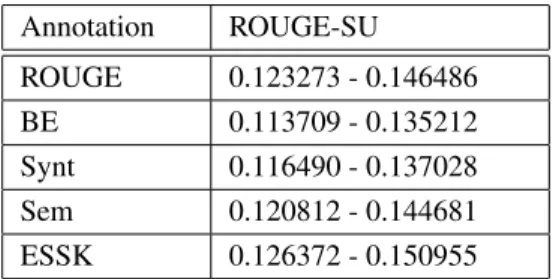
7.2.1 Impact of Automatic Annotation Techniques . . . 65
7.2.2 Balanced/Unbalanced Training Data . . . 71
7.2.3 Ensemble Experiments . . . 72
7.3.1 User Evaluation . . . 77 7.3.2 Pyramid Evaluation . . . 80 7.4 Summary . . . 82
8 Conclusions and Future Directions 83
8.1 Main Findings . . . 83 8.2 Future Research Directions . . . 84
Bibliography 86
Appendix-A: Reference Summaries 93
List of Tables
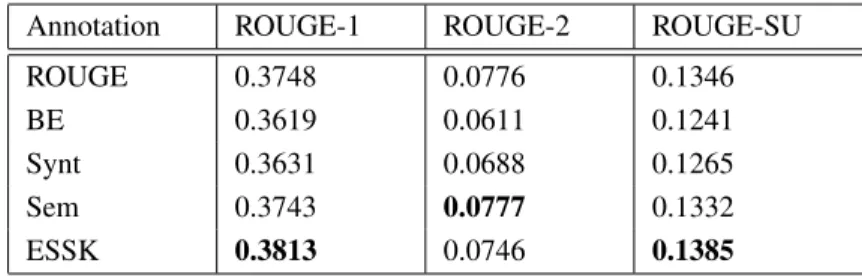
7.1 ROUGE F-measures for SVM . . . 66
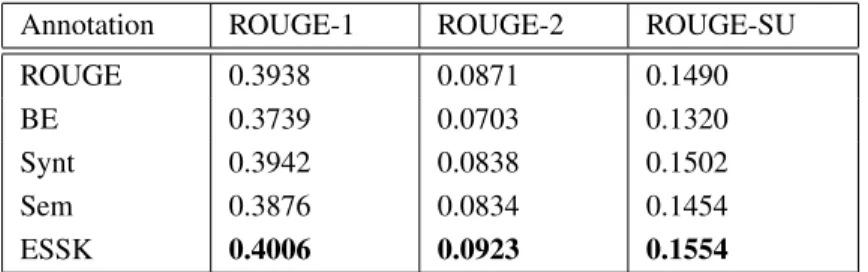
7.2 ROUGE F-measures for HMM . . . 66
7.3 ROUGE F-measures for CRF . . . 66
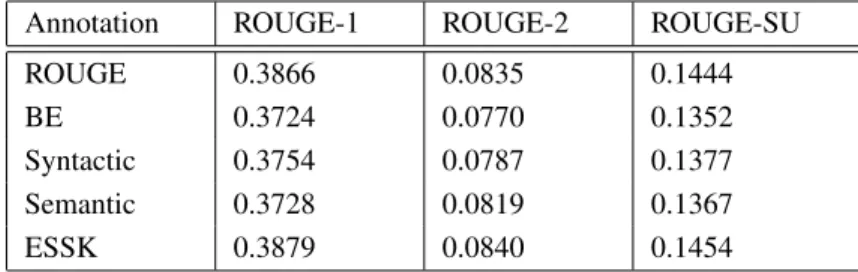
7.4 ROUGE F-measures for MaxEnt . . . 67
7.5 F-measures of supervised systems (Comparison) . . . 69
7.6 General impact of annotation techniques . . . 69
7.7 95% confidence intervals for SVM . . . 69
7.8 95% confidence intervals for HMM . . . 70
7.9 95% confidence intervals for CRF . . . 70
7.10 95% confidence intervals for MaxEnt . . . 70
7.11 SVM comparisons based on balanced/unbalanced training data . . . 71
7.12 HMM comparisons based on balanced/unbalanced training data . . . 71
7.13 CRF comparisons based on balanced/unbalanced training data . . . 72
7.14 ROUGE measures for SVM ensemble . . . 73
7.15 ROUGE measures for single SVM . . . 73
7.16 Homogeneous ensemble comparison . . . 73
7.17 95% confidence intervals for different systems . . . 74
7.18 Heterogeneous ensemble comparison . . . 75
7.19 95% confidence intervals . . . 77
7.20 Linguistic quality and responsive scores for SVM . . . 78
7.21 Linguistic quality and responsive scores for CRF . . . 78
7.22 Linguistic quality and responsive scores for HMM . . . 79
7.23 Linguistic quality and responsive scores for MaxEnt . . . 79
7.24 Linguistic quality and responsive scores for ensemble systems . . . 79
7.25 Modified pyramid scores for SVM systems . . . 80
7.26 Modified pyramid scores for CRF systems . . . 81
7.27 Modified pyramid scores for HMM systems . . . 81
7.28 Modified pyramid scores for MaxEnt systems . . . 81
List of Figures
1.1 Supervised Approach . . . 6
4.1 HMM structure . . . 36
4.2 CRF model structure . . . 38
4.3 Support Vector Machines . . . 40
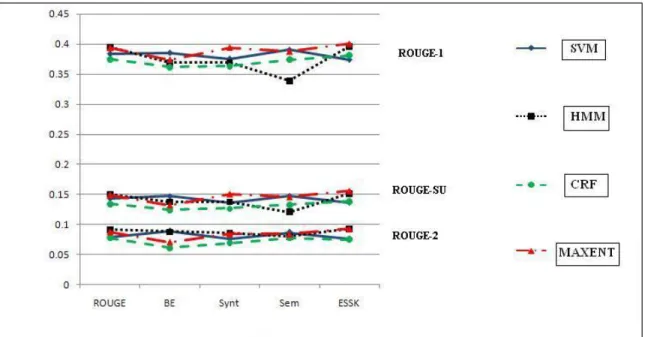
7.1 ROUGE F-scores for different supervised systems . . . 68
7.2 SVM-based ensemble beating single SVM . . . 74
Chapter 1
Introduction
1.1
Motivation
As a result of the availability of all kind of information in the Web, we live in an easier
world now. We do not bother to stay day after day in the library; rather a couple of hours
of Web surfing does the job for us. The vast increase in both the amount of online data and
the demand for access to different types of information have led researchers to a renewed
interest in a broad range of Information Retrieval (IR) related areas such as question
an-swering, topic detection and tracking, summarization, multimedia retrieval, chemical and
biological informatics, text structuring and text mining. Automated Question Answering
(QA) (Strzalkowski and Harabagiu, 2008) is the ability of a machine to answer questions,
simple or complex, which are posed in ordinary human language. This is perhaps the most
exciting technological development of the past six or seven years.
Traditional document retrieval systems cannot satisfy the end-users to have more direct
access into relevant documents. So, Question Answering (QA) has received immense
atten-tion from the informaatten-tion retrieval, informaatten-tion extracatten-tion, machine learning, and natural
language processing communities. The main goal of QA systems is to retrieve relevant
an-swers to natural language questions from a collection of documents rather than employing
keyword matching techniques to extract documents having keywords similar to a query.
A well known QA system is the Korean Naver’s Knowledge iN search1, who were the
pioneers in the community. This tool allows users to ask almost any question and get
an-swers from other users. Naver’s Knowledge iN now has roughly 10 times more entries than
Wikipedia. It is used by millions of Korean web users on any given day. Some people say 1http://kin.naver.com/
Koreans are not addicted to the internet but to Naver (Chali, Joty, and Hasan, 2009). As
of January 2008 the Knowledge Search database included more than 80 million pages of
user-generated information. Another popular answer service is Yahoo! Answers2 which
is a community-driven knowledge market website launched by Yahoo!. It allows users to
both submit questions to be answered and answer questions from other users. People vote
on the best answer. The site gives members the chance to earn points as a way to encourage
participation and is based on the Naver model. As of December 2009, Yahoo! Answers
had 200 million users worldwide and more than 1 billion answers3. Google had a QA
sys-tem4based on paid editors which was launched in April 2002 and fully closed in December
2006. The main limitation of these QA systems is that each relies on human expertise to
help provide the answers. Our goal is to automate this process so that computers can do
the same as those professional information analysts to give answers in response to the more
complex questions that may include human language difficulties. This thesis is a small step
towards such an ambitious goal.
QA research attempts to deal with a wide range of question types including: fact, list,
definition, how, why, hypothetical, semantically-constrained, and cross-lingual questions.
Some questions, which we call simple questions, are easier to answer. For example, the
question: “Who is the president of Bangladesh?” asks for a person’s name. This type of
question (i.e. factoid) requires small snippets of text as the answer. Again, the question:
“Which countries has Pope John Paul II visited?” is a sample of a list question asking only
for a list of small snippets of text.
As a tool for finding documents on the web, search engines are proven to be adequate.
Although there is no limitation in the expressiveness of the user in terms of query formu-2http://answers.yahoo.com/
3
http://yanswersblog.com/index.php/archives/2009/12/14/yahoo-answers-hits-200-million-visitors-worldwide/
lation, certain limitations exist in what the search engine does with the query. Complex
questions often seek multiple different types of information simultaneously and do not
pre-suppose that one single answer can meet all of its information needs. For example, with a
factoid question like: “What is the magnitude of the earthquake in Haiti?”, it can be safely
assumed that the submitter of the question is looking for a number. However, with complex
questions like: “How is Haiti affected by the earthquake?”, the wider focus of this
ques-tion suggests that the submitter may not have a single or well-defined informaques-tion need
and therefore may be amenable to receiving additional supporting information that is
rele-vant to some (as yet) undefined informational goal (Harabagiu, Lacatusu, and Hickl, 2006).
Complex question answering tasks require multi-document summarization through an
ag-gregated search, or a faceted search, that represents an information need which cannot be
answered by a single document. For example, if we look for the comparison of the average
number of years between marriage and first birth for women in the USA, Asia, and Europe,
the answer is likely contained in multiple documents. Multi-document summarization is
useful for this type of query and there is currently no tool on the market that is designed to
meet this kind of information need.
Over the past few years, complex questions have been the focus of much attention
in both the automatic Question Answering (QA) and Multi Document Summarization
(MDS) communities. Typically, current complex QA evaluation systems including the
2004 AQUAINT Relationship QA Pilot5, the 2005 Text Retrieval Conference (TREC)
Re-lationship QA Task6, and the TREC definition7 return unstructured lists of candidate
an-swers in response to a complex question. However, MDS evaluations (including the 2005,
2006 and 2007 Document Understanding Conference (DUC)8) have tasked systems with 5http://trec.nist.gov/data/qa/add QAresources/README.relationship.txt
6http://trec.nist.gov/data/qa/2005 qadata/qa.05.guidelines.html 7http://trec.nist.gov/overview.html
returning paragraph-length answers to complex questions that are responsive, relevant, and
coherent.
In this thesis, we focus on a query-based extractive approach of summarization where
a subset of the sentences from the original documents are chosen. The Document
Under-standing Conference (DUC) has been conducted by the National Institute of Standards and
Technology (NIST) since 2001. Its goal is to further progress in automatic text
summariza-tion and enable researchers to participate in large-scale experiments in both the
develop-ment and evaluation of summarization systems. DUC produces a series of summarization
evaluations. The DUC-2007 main task was the same as the DUC 2006 task and modeled
real-world complex question answering, in which a question cannot be answered by simply
stating a name, date, quantity, etc. Given a topic and a set of 25 relevant documents, the
task was to synthesize a fluent, well-organized 250-word summary of the documents that
answers the question(s) in the topic statement. Successful performance on the task
bene-fited from a combination of IR and NLP capabilities, including passage retrieval,
compres-sion, and generation of fluent text. In this thesis, we use the DUC-2007 main task to run
our experiments.
The research in multi-document summarization domain that applies unsupervised
learn-ing techniques such as Expectation Maximization (EM) and K-means work on unlabeled
data (Joty, 2008), where labeled data is a prerequisite for supervised systems. It is well
known that supervised learning techniques often outperform unsupervised learning in terms
of accuracy. That motivates us to use the supervised learning methodologies such as
Support Vector Machines (SVM) (Cortes and Vapnik, 1995), Conditional Random Fields
(CRF) (Lafferty, McCallum, and Pereira, 2001), Hidden Markov Models (HMM) (Conroy
and O’Leary, 2001), Maximum Entropy (MaxEnt) (Ferrier, 2001) and ensemble methods
1.2
Important Terms
Through out this thesis, we frequently refer to some important terms. We briefly introduce
them here.
Abstract Summary:Human generated summary.
Extract Summary: Summary created by picking verbatim sentences from the original document that are mostly similar to the abstract summary.
Annotation/Labeling: The process of selecting important sentences from the original source document i.e. creation of extract summary.
Labeled Data: Original document sentences labeled with+1 meaning important enough for summary inclusion and−1, if opposite.
Training: To learn about important facts from the labeled data, accomplished by the su-pervised systems.
Testing: To predict labels for the previously unseen data set.
Balanced/Unbalanced Data:Balanced data contains an equal proportion of positive (sum-mary) and negative (non-sum(sum-mary) sentences, whereas unbalanced data is comprised of an
uneven proportion of positive and negative sentences.
Ensemble: Combined model of different classifiers intended to improve overall perfor-mance.
1.3
Overview of the Thesis
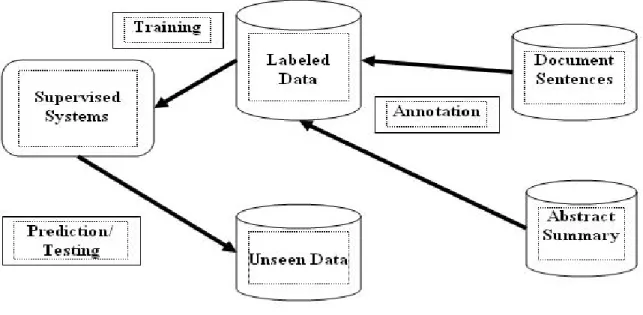
The block diagram in Figure 1.1 depicts the basic architecture of this thesis. The task of
an-swering complex questions using a supervised methodology subsumes three major phases:
Annotation/Labeling, Training and Testing. Given the original document sentences and
in-Figure 1.1: Supervised Approach
cludes the application of different textual similarity measurement techniques that compares
the abstract summary sentences with the document sentences. The most similar sentences
are labeled as positive (summary) and the less similar ones as negative (non-summary). In
the second phase, supervised systems are trained with this large amount of labeled data.
Finally, an unseen data set is presented before the learned model that predicts the labels in
order to produce system generated extract summaries.
1.4
Research Questions
The better performance shown by supervised learning techniques over unsupervised
ap-proaches in terms of accuracy gives us a greater anticipation of applying these methods
in the field of multi-document text summarization. The main goal of multi-document text
summarization is to produce a single text as a compressed version of a set of documents
this thesis are:
1. Given a set of documents and their abstract summary, how to generate the extract
summary? That is, from the document sentences how to find that a sentence is a good candidate to be extracted?
2. Given a set of labeled data that is a set of documents and their extract summary, how
to learn the relationship between them and use this in order to predict the summary of an unseen data set?
3. Do automatic annotation techniques have any impact on supervised complex
ques-tion answering?
4. How does the balanced or unbalanced labeled data affect the performance of
super-vised systems to complex question answering?
5. Do ensemble methods perform well in this problem domain?
1.5
Contributions
This thesis contributes to the complex question answering task in the following ways:
Automatic Annotation We measure the similarity between the given abstract summary sentences and the original document sentences. Then we find the most similar sentences
from the original document collection as the extract summary for a given topic. Thus we
prepare five different types of labeled data to feed the supervised systems. We apply five
different techniques to accomplish this: ROUGE similarity measure (Lin, 2004), Basic
2006), semantic similarity measure (Moschitti et al., 2007), and Extended String
Subse-quence Kernel (ESSK) (Hirao et al., 2003).
Supervised Formulation We formulate the complex question answering problem in terms of supervised approaches. The representative supervised methods we use are Support
Vec-tor Machines (SVM), Conditional Random Fields (CRF), Hidden Markov Models (HMM),
and Maximum Entropy (MaxEnt).
Impact of Automatic Annotation Techniques For the training of supervised systems, we use the five different types of labeled data. To show their impact, we extensively
in-vestigate the performance of the four classifiers to label unseen sentences as summary or
non-summary sentence.
Balanced/Unbalanced Labeled Data During automatic annotation, we prepare a bal-anced labeled data set by treating 50% of sentences as extract summary sentences and the
rest as non-summary sentences. The unbalanced labeled data set is made with only 30%
of sentences as the summary sentences. We evaluate the performance of the supervised
classifiers based on the use of balanced or unbalanced data during training.
Ensemble Methods We build two ensemble-based supervised systems and experiment their effectiveness to answer complex questions.
1.6
Thesis Outline
Chapter 2 We give a detailed description of currently available summarization tech-niques. We then present our approach for the complex question answering task.
Chapter 3 We provide a general review of works performed previously in the automatic annotation area. Then we present an in-depth discussion of the five automatic annotation
techniques used in this work.
Chapter 4 We take a closer look at the supervised approaches that were successfully used in different applications before and then we describe the theoretical aspects of them
thoroughly.
Chapter 5 We discuss different summary evaluation techniques in this chapter.
Chapter 6 All the implementation related issues are discussed in detail.
Chapter 7 We present the experimental results and analyze them thoroughly.
Chapter 8 We conclude the thesis by identifying some future directions of our research.
1.7
Published Work
Some of the material presented in this thesis has been previously published. Chapter 3
to Chapter 7 expands on the materials published in (Chali, Hasan, and Joty, 2009b; Chali,
Chapter 2
Automatic Text Summarization
2.1
Introduction
In recent years, a great amount of attention has grown in both Question Answering (QA)
and Multi-document Summarization (MDS) communities to deal with the query relevant
summarization research (Carbonell et al., 2000). The synergy between text summarization
and question answering systems worked as a catalyst behind this. Summarization is a
pro-cess of condensing multiple source texts into one shorter version in response to complex
questions, while Question Answering provides a means for focus in query-oriented
sum-marization. Thus the boundaries between QA and MDS research communities are now
be-ginning to blur. As complex questions cannot be answered using the same techniques that
have successfully been applied to the answering of “factoid” questions, multi-document
summarization techniques are applied to accomplish this task. Thus we focus more on the
summarization aspects. The Information Retrieval phase for Question Answering falls
out-side the scope of this work. We assume the given set of documents as relevant for the given
questions.
Text summarization is a good way to condense a large amount of information into a
con-cise form by selecting the most important information and discarding redundant
informa-tion. According to Mani (2001), automatic text summarization takes a partially-structured
source text from multiple texts written about the same topic, extracts information content
from it, and presents the most important content to the user in a manner sensitive to the
user’s needs. Although search engines do a remarkable job in searching through a heap
of information, they have certain limitations. For example, if we ask for the impact of the
thousands of results for the answer. The process of getting a desired answer to a complex
question would speed up considerably when the summary of the given documents is also
available. The technology of automatic summarization is critical in dealing with this kind
of problems. In this chapter, we discuss different types and techniques of automatic text
summarization and then we describe the approach we follow.
2.2
Types
The automatic text summarization task can be categorized into the following types:
1. Generic vs. Query-Oriented
2. Abstractive vs. Extractive
3. Single vs. Multi-Document
2.2.1
Generic vs. Query-Oriented
Generic summaries provide users with the overall sense of the document. A generic
sum-mary must contain the core information present in the document. Document
understand-ing plays a key role here. Hence, most of the summaries created by the human beunderstand-ings
are generic summaries. One of the most notable approaches to generic summarization has
been introduced by Carbonell and Goldstein (1998) based on Maximal Marginal Relevance
(MMR) that uses the vector-space model of text retrieval.
In recent years, attention has shifted from generic summarization toward query-based
summarization. While a generic summary includes information which is central to the
2.2.2
Abstractive vs. Extractive
An extract summary consists of sentences extracted from the document while an abstract
summary may employ words and phrases that do not appear in the original document (Mani
and Maybury, 1999). Abstract based summarization, as done by humans, involves reading
and understanding an article, web site, document, etc. and then selecting the key points.
Existing research has tried to emulate the human approach to the task with little success
as several complicated factors such as word sense and grammatical structure have to be
taken into consideration. The abstract summary that has all the characteristics of a good
summary is the ultimate goal of automatic text summarization.
On the other hand, extract summarization is simpler than abstract summarization since
the process involves assigning scores to the original sentences using some method and
then picking the top-ranked sentences for the summary. Although this kind of summary
may not be necessarily smooth or fluent, extractive summarization is currently a general
practice among the automatic text summarization researchers for its simplicity.
2.2.3
Single vs. Multi-Document
The process of summarizing one document is termed as single document summarization
whereas in multi-document summarization, multiple documents related to one main topic
are used as sources. Single document summarization is useful in many situations such as
summarizing e-mails, news articles or creating abstract of scientific research papers.
Cur-rently, multi-document summarization is of greater interest since the amount of information
present in the web is becoming huge. For example, we can obtain the news about a single
event from different sources in order to create the summary that provides multiple
such as completeness, readability, and conciseness are yet to be fulfilled, some web-based
systems are already utilizing the potential of this technology. The Newsblaster1system
au-tomatically collects, clusters, categorizes, and summarizes news from several sites on the
web, and helps users find the news of their greatest interest.
2.3
Techniques
The automatic text summarization area has gone through several changes with the
devel-opment of techniques and requirements since the year 1950. Typically, we can divide the
summarization approaches into the following categories:
1. Knowledge-based Methods
2. Classical Methods
3. Modern Methods
2.3.1
Knowledge-based Methods
It is always desirable to emulate the process of summarization as humans do it. To
accom-plish the summarization task automatically the machine needs to understand the source
texts, pick out the important points and generate sentences from these points. The whole
approach relies on both natural language understanding and generation. These methods
are termed as knowledge-based methods (Ferrier, 2001). Although the model seems
obvi-ous, the major stages of it may subsume several substages. For instance in the language
understanding phase, a process may exist for building individual sentence representations,
a further process for modifying the global text representation. This type of summarization
is pretty hard for the machine to perform because they have to characterize a source text as
a whole, capture its important content, where content is a matter both of information and its
expression, and importance is a matter of what is essential as well as what is salient. Hence,
other methods have also been investigated in order to produce automatic summaries.
2.3.2
Classical Methods
The methods that started the automatic text summarization research can be termed as the
classical methods. Being motivated by the need to deal with the information overload
problem, one of the first to perform such research was Luhn (1958). He realized the
im-practicality of trying to summarize more than one genre with one particular method and so,
he chose to concentrate on texts in the scientific domain, where producing abstracts
(writ-ten by humans) is a common practice. Luhn used simple statistical techniques to determine
the most significant sentences of a document. These sentences were then extracted from
the text and printed out together so that they became the summary, or more precisely the
extract. Hence, the task became one of extraction and problematic issues fundamental to
deep approaches such as natural language understanding and generation were reduced.
Methods to find features of the input text have been developed since Luhn’s work.
Ed-mundson (1969) weighted sentences based on four different methods: cue phrase, keyword
(i.e., term frequency based), location, and title. He then evaluated each program by
com-paring against manually created extracts. He used a corpus based model, dividing the set of
articles into a training and a test set. Edmundson found that the combination of
cue-title-location features was the best, with cue-title-location being the best individual feature and keywords
the worst. These early ground-breaking systems acted as the pioneers to the modern
2.3.3
Modern Methods
The field of automatic text summarization has received immense attention from the
re-searchers in the recent years. The vast increase of information in the web has acted as a
fuel for this. Automatic summarization plays a central role in information retrieval. As the
summarization tasks have changed, the methods to accomplish these have also kept pace.
Below we discuss the most notable modern methods of automatic summarization.
Graph-based Recently, the graph-based methods, such as LexRank (Erkan and Radev, 2004) and TextRank (Mihalcea and Tarau, 2004), are applied successfully to generic,
multi-document summarization. Erkan and Radev (2004) used the concept of graph-based
cen-trality to rank a set of sentences for producing generic multi-document summaries. A
sim-ilarity graph is produced for the sentences in the document collection. In the graph each
node represents a sentence. An edge between two nodes measures the cosine similarity
be-tween the respective pair of sentences. The degree of a given node is an indication of how
important the sentence is. A topic-sensitive LexRank is proposed in (Otterbacher, Erkan,
and Radev, 2005). In this method, a sentence is mapped to a vector in which each element
represents the occurrence frequency (TF*IDF) of a word. However, the major limitation
of the TF*IDF approach is that it only retains the frequency of the words and does not
take into account the sequence, syntactic and semantic structure, thus cannot distinguish
between “The hero killed the villain” and “The villain killed the hero”.
Latent Semantic Analysis (LSA) Latent Semantic Analysis (LSA) (Deerwester et al., 1990) is a fully automatic statistical technique to extract and infer relations of expected
contextual usage of words in passages of discourse. The first step towards the application of
LSA is to represent a document as a document-term matrixA, such that each row of matrix
Each entryAi jrepresents the frequency of termiin document j. Gong and Liu (2001) have
proposed a scheme for automatic text summarization using LSA. Their approach classifies
the document into different topics and picks the dominant sentence from each dominant
topic sequentially until the summary length is reached.
Lexical Chain A lexical chain is a sequence of related words in the text, spanning short (adjacent words or sentences) or long distances (entire text). A chain is independent of the
grammatical structure of the text and in effect it is a list of words that captures a portion
of the cohesive structure of the text. Computing the lexical chains in a document is one
technique that can be used to identify the central theme of a document. This in turn leads
to the identification of the key section(s) of the document which can then be used for
summarization purposes. The summarization systems based on lexical chain first extract
the nouns, compound nouns and named entities as candidate words (Li et al., 2007), (Kolla,
2004). The systems rank sentences using a formula that involves a) the lexical chain,
b) keywords from query and c) named entities. For example, (Li et al., 2007) uses the
following formula:
Score=αP(chain) +βP(query) +γP(nameentity)
whereP(chain)is the sum of the scores of the chains whose words come from the
candi-date sentence,P(query) is the sum of the co-occurrences of key words in a topic and the
sentence, andP(nameentity)is the number of name entities existing in both the topic and
the sentence. The three coefficients α, β and γ are set empirically. Then the top ranked
sentences are selected to form the summary.
QA System Typically, in a summarization system that is based on a question answering system (Molla and Wan, 2006), the topic sentences are converted to a sequence of questions
as the underlined QA system is designed to answer only simple (i.e. factoid, list) questions.
The QA system normalizes and classifies the questions, and finds the candidate answers
along with the sentences in which the answers appeared. Instead of extracting the exact
terms as answers, the systems extract the sentences for each of the questions in the topic to
form the summary.
Machine Learning Techniques Machine Learning (ML) is concerned with the design and development of algorithms and techniques that allow computers to learn. The major
focus of machine learning research is to extract information from data automatically, by
computational and statistical methods. The major challenge in summarization lies in
dis-tinguishing the more informative parts of a document from the less informative ones. In the
1990s, with the advent of machine learning techniques in NLP, a series of seminal
publica-tions appeared that employed statistical techniques to produce document extracts for single
document summarization.
While initially most systems assumed feature independence and relied on naive-Bayes
methods, others have focused on the choice of appropriate features and on learning
al-gorithms that make no independence assumptions. Other significant approaches involved
hidden Markov models and log-linear models to improve extractive summarization (Das
and Martins, 2007). Single document summarization systems using Support Vector
Ma-chines (SVMs) demonstrated good performance for both Japanese (Hirao et al., 2002a)
and English documents (Hirao et al., 2002b). Hirao et al. (2003) showed the effectiveness
of their multiple document summarization system employing SVMs for sentence
extrac-tion. Conroy and O’Leary (2001) used two kinds of states, where one kind corresponds to
the summary states and the other corresponds to non-summary states. The motivation of
applying CRF in text summarization came from observations on how humans summarize a
statistical technique such as Maximum Entropy (MaxEnt) works in a way that assumes
nothing about the information of which it has no prior knowledge (Ferrier, 2001). Joty
(2008) experimented with both empirical and unsupervised machine learning approaches
(K-means and Expectation Maximization (EM) algorithms) to summarize texts.
2.4
Our Approach
In this thesis, we focus our research on query-oriented, extractive, multi-document
summa-rization in order to combat the complex question answering problem such as the one defined
in the DUC-2007 main task. We apply supervised machine learning techniques: Support
Vector Machines (SVM), Hidden Markov Models (HMM), Conditional Random Fields
(CRF), and Maximum Entropy (MaxEnt) to perform the task of automatic summarization.
As supervised systems rely on learning from a vast amount of labeled data, we
automati-cally annotate DUC-2006 data using five text similarity measurement techniques: ROUGE
similarity measure (Lin, 2004), Basic Element (BE) overlap (Hovy et al., 2006), syntactic
similarity measure (Moschitti and Basili, 2006), semantic similarity measure (Moschitti
et al., 2007), and Extended String Subsequence Kernel (ESSK) (Hirao et al., 2003). We
also experiment with supervised ensemble-based approaches that combine the individual
decisions of the classifiers. In supervised learning, the classifier is typically trained on data
pairs defined by feature vectors and corresponding class labels. Besides using different
query-related features, we incorporate some important features from the classical methods
2.5
Summary
We discussed different types and approaches to automatic text summarization in this
chap-ter. Next chapter will present details on the automatic annotation techniques that we used
Chapter 3
Automatic Annotation Techniques
3.1
Introduction
Annotated corpora are essential for most branches of computational linguistics, including
automatic text summarization. Within computational linguistics, annotated corpora are
normally considered as a gold standard, and are used to train machine learning algorithms
and evaluate the performance of automatic summarization methods (Orasan, 2005). So, for
supervised learning techniques, a huge amount of annotated or labeled data is required as
a precondition. The decision as to whether a sentence is important enough to be annotated
can be made either by humans or by programs. When humans are employed in the process,
producing such a large labeled corpora becomes time consuming and expensive. There
comes the necessity of using automatic methods to align sentences with the intention to
build extracts from abstracts.
Annotation has been employed in automatic summarization since the late 1960s when
Edmundson used one in the evaluation process. In order to produce the annotated corpus,
Edmundson asked humans to identify the important sentences in each text from a collection
of 200 scientific documents (Edmundson, 1969). Given that identification of important
sen-tences is very subjective and difficult, Kupiec, Pedersen, and Chen (1995) took advantage
of human produced abstracts, and asked annotators to align sentences from the document
with sentences from there. In the automatic annotation area, Banko et al. (1999) proposed
a method based on sentence similarity using a bag-of-words (BOW) representation. For
each sentence in the given abstract, the corresponding source sentence is determined by
combining the similarity score and heuristic rules. Marcu (1999) treated a sentence as a set
rep-resentation. Jing and McKeown (1999) proposed a bigram-based similarity approach using
the Hidden Markov Model. Barzilay (2003) combines edit distance and context
informa-tion around sentences for annotainforma-tion. However, as these methods are strongly influenced by
word order, disagreement between source and abstract summary sentences leads to failure.
Toutanova et al. (2007) used the ROUGE1 (Lin, 2004) toolkit to produce labeled data
au-tomatically. The “head-modifier-relation” triples, typically considered as Basic Elements
(BE), can help deciding whether any two units match or not considerably more easily than
with longer units (Hovy, Lin, and Zhou, 2005).
Approaches in Recognizing Textual Entailment, Sentence Alignment and Question
An-swering use syntactic and/or semantic information in order to measure the similarity
be-tween two textual units. Corresponding sentences can be parsed into syntactic trees using a
syntactic parser. The similarity between the two trees can be calculated using the tree kernel
(Collins and Duffy, 2001). Shallow semantic representations could prevent the sparseness
of deep structural approaches and overcome the weakness of BOW models (Moschitti et
al., 2007).
Hirao et al. (2004) represented the sentences using Dependency Tree Path (DTP) to
incorporate syntactic information. They applied String Subsequence Kernel (SSK) to
mea-sure the similarity between the DTPs of two sentences and introduced Extended String
Subsequence Kernel (ESSK) considering all possible senses to each word for building
ex-tracts from absex-tracts. Their method was effective. However, the fact that they did not
disambiguate word senses cannot be disregarded.
The textual similarity measurement techniques of ROUGE similarity measure, Basic
Element (BE) overlap, syntactic similarity measure, semantic similarity measure and
Ex-tended String Subsequence Kernel (ESSK) are reimplemented in this research to do sen-1It is widely used for automatic summarization evaluation to measure the summary quality by counting
tence annotation and explained in more detail in the later sections.
3.2
ROUGE Similarity Measures
ROUGE (Recall-Oriented Understudy for Gisting Evaluation) is an automatic tool to
deter-mine the quality of a summary by comparing it to reference summaries using a collection
of measures (Lin, 2004). The measures count the number of overlapping units such as
n-gram, word-sequences, and word-pairs between the extract and the abstract summaries.
The ROUGE measures considered are: ROUGE-N (N=1,2,3,4), ROUGE-L, ROUGE-W
and ROUGE-S.
ROUGE-N is n-gram recall between a candidate summary and a set of reference
sum-maries which is computed as follows:
ROUGE-N=∑S∈Re f erenceSummaries∑gramn∈SCountmatch(gramn) ∑S∈Re f erenceSummaries∑gramn∈SCount(gramn)
where, n is the length of n−grams andCountmatch(gramn) is the maximum number of
n-grams co-occurring in a candidate summary and a set of reference summaries. In case
of multiple abstracts, pairwise summary-level ROUGE-N between a candidate summary
s and every reference ri, in the reference set is computed. Final ROUGE-N score is then
obtained by taking the maximum of the summary-level ROUGE-N scores:
ROUGE-Nmulti=argmaxi(ROUGE-N(ri,s))
The ROUGE-L (Longest Common Subsequence-LCS) score between two summary
sis a peer summary sentence) can be computed as follows (Lin, 2004): Rlcs = LCS(r,s) m Plcs = LCS(r,s) n Flcs = PlcsRlcs αRlcs+ (1−α)Plcs
where Pis the precision, R is recall andF-measure combines precision and recall into a
single measure. ROUGE-W (Weighted Longest Common Subsequence-WLCS) provides
an improvement to the basic LCS method of computation by using the function f(n) to
credit the sentences having the consecutive matches of words. WLCS can be calculated as
follows: Rwlcs = f−1 W LCS(X,Y) f(m) Pwlcs = f−1 W LCS(X,Y) f(n) Fwlcs = PwlcsRwlcs αRwlcs+ (1−α)Pwlcs
The ROUGE-S (Skip bi-gram) score between the candidate summary sentence S of
Rskip2 = SKIP2(S,R) C(m,2) Pskip2 = SKIP2(S,R) C(n,2) Flcs = Pskip2Rskip2 αRskip2+ (1−α)Pskip2
where, SKIP2(S,Q) is the number of skip bi-gram (any pair of words in their sentence
order, allowing for arbitrary gaps) matches between S and R, and α is a constant that
determines the importance of precision and recall. C is the combination function.
ROUGE-S is extended with the addition of unigram as counting unit which is called ROUGE-ROUGE-SU
(Lin, 2004).
We assume each individual document sentence as the extract summary and calculated
its ROUGE similarity scores with the corresponding abstract summaries. Thus an average
ROUGE score is assigned to each sentence in the document. We choose the topNsentences
based on ROUGE scores to have the label+1 (summary sentences) and the rest to have the
label−1 (non-summary sentences).
3.3
Basic Element (BE) Overlap Measure
According to Hovy et al. (2006), Basic Elements (BEs) are defined as:• the head of a major syntactic constituent (noun, verb, adjective or adverbial phrases), expressed as a single item, or
• a relation between a head-BE and a single dependent, expressed as a triple:
With BE represented as a head-modifier-relation triple, one can quite easily decide
whether any two units match or not considerably more easily than with longer units.
We use the syntactic parser Minipar2 to produce a parse tree. Then a set of “cutting
rules” are employed to extract only the valid BEs from the tree. We extract BEs for the
sentences in the document collection using BE package 1.0 distributed by ISI3. Once we
obtain the BEs for a sentence, we compute the Likelihood Ratio (LR) for each BE (Hovy,
Lin, and Zhou, 2005). The LR score of each BE is an information theoretic measure that
represents the relative importance in the BE list from the document set that contains all
the sentences to be aligned. Sorting the BEs according to their LR scores produces a
BE-ranked list. Our goal is to find similarity between document sentences and reference
summary sentences. The ranked list of BEs in this way contains important BEs at the top
which may or may not be relevant to the abstract summary sentences. We filter those BEs
by checking whether they contain any word that matches an abstract sentence word or
a related word (i.e. synonyms, hypernyms, hyponyms and gloss words which are found
using Wordnet (Fellbaum, 1998)). For each abstract sentence, we assign a score to every
document sentence as the sum of its filtered BE scores divided by the number of BEs in
the sentence. Thus, every abstract sentence contributes to the BE score of each document
sentence and we select the topNnumber of sentences based on average BE scores to have
the label+1 (summary) and rest to have the label−1 (non-summary).
3.4
Syntactic Similarity Measure
Word dependencies having an important role in finding similarity between two texts can
be discovered using a syntactic parser. Syntactic parsing is analyzing a sentence using the 2Available at http://www.cs.ualberta.ca/ lindek/minipar.htm
grammar rules. One method to tag word dependencies is by using the Charniak parser4.
Pasca and Harabagiu (2001) demonstrated that with the syntactic form one can see which
words depend on other words. There should be a similarity between the words that are
dependent in the reference summary sentence and the dependency between words of the
document sentence. Syntactic feature is used successfully in question answering earlier
(Zhang and Lee, 2003; Moschitti et al., 2007; Moschitti and Basili, 2006).
In order to calculate the syntactic similarity between the abstract sentence and the
docu-ment sentence, we first parse the corresponding sentences into syntactic trees using a parser
like Charniak (1999). Then we calculate the similarity between the two trees using thetree
kernel(Collins and Duffy, 2001). We convert each parenthetic representation generated by
the Charniak parser into its corresponding tree and give the trees as input to the tree kernel
functions for measuring the syntactic similarity. The tree kernel of two syntactic treesT1
andT2is actually the inner product ofv(T1)andv(T2):
T K(T1,T2) =v(T1).v(T2) (3.1)
We define the indicator functionIi(n)to be 1 if the sub-treeiis seen rooted at node n
and 0 otherwise. It follows:
vi(T1) =
∑
n1∈N1 Ii(n1) vi(T2) =∑
n2∈N2 Ii(n2) 4available at ftp://ftp.cs.brown.edu/pub/nlparser/where,N1andN2are the set of nodes inT1andT2respectively. So, we can derive: T K(T1,T2) = v(T1).v(T2) =
∑
i vi(T1)vi(T2) =∑
n1∈N1∑
n2∈N2∑
i Ii(n1)Ii(n2) =∑
n1∈N1∑
n2∈N2 C(n1,n2) (3.2)where, we define C(n1,n2) = ∑iIi(n1)Ii(n2). The TK (tree kernel) function gives the
similarity score between the abstract sentence and the document sentence based on the
syntactic structure. Each abstract sentence contributes a score to the document sentences
and the top N number of sentences are selected to be annotated as +1 and the rest as−1 based on the average of similarity scores.
3.5
Semantic Similarity Measure
Shallow semantic representations, bearing a more compact information, can prevent the
sparseness of deep structural approaches and the weakness of BOW models (Moschitti
et al., 2007). Initiatives such as PropBank (PB) (Kingsbury and Palmer, 2002) made it
possible to design accurate automatic Semantic Role Labeling (SRL) systems (Hacioglu et
al., 2003). So, attempting an application of SRL to automatic annotation seems natural, as
similarity of an abstract sentence with a document sentence relies on a deep understanding
of the semantics of both. For example, let us consider the PB annotation:
[ARG2 as their currency]
Such annotation can be used to design a shallow semantic representation that can be
matched against other semantically similar sentences, e.g.
[ARG0 the Vatican] [TARGET uses] [ARG1 the Italian lira]
[ARG2 as their currency]
To experiment with semantic structures, we parse the corresponding sentences
seman-tically using a Semantic Role Labeling (SRL) system like ASSERT5. ASSERT is an
au-tomatic statistical semantic role tagger, that can annotate naturally occurring text with
se-mantic arguments. When presented with a sentence, it performs a full syntactic analysis
of the sentence, automatically identifies all the verb predicates in that sentence, extracts
features for all constituents in the parse tree relative to the predicate, and identifies and
tags the constituents with the appropriate semantic arguments. We represent the annotated
sentences using tree structures called semantic trees (ST). In the semantic tree, arguments
are replaced with the most important word, often referred to as the semantic head. We look
for noun, then verb, then adjective, then adverb to find the semantic head in the argument.
As in tree kernels (Section 3.4), common substructures cannot be composed by a node
with only some of its children as an effective ST representation would require, Moschitti
et al. (2007) solved this problem by designing the Shallow Semantic Tree Kernel (SSTK)
which allows to match portions of a ST. The SSTK changes the ST by addingSLOT nodes,
which provides a fixed number of slots, possibly filled withnullarguments that encode all
possible predicate arguments. The slot nodes are used in such a way that the adopted TK
function can generate fragments containing one or more children. These changes generate
a new C which, when substituted (in place of the original C) in Eq. 3.2, gives the new 5available at http://cemantix.org/assert
SSTK function that yields the similarity score between an abstract sentence and a
docu-ment sentence based on semantic structure. Thus, each docudocu-ment sentence gets a semantic
similarity score corresponding to each abstract sentence and then the topN number of
sen-tences are selected to be labeled as+1 and the rest as−1 on the basis of average similarity scores.
3.6
Extended String Subsequence Kernel (ESSK)
The ESSK, a similarity measure is a simple extension of the Word Sequence Kernel (WSK)
(Cancedda et al., 2003) and String Subsequence Kernel (SSK) (Lodhi et al., 2002). WSK
receives two sequences of words as input and maps each of them into a high-dimensional
vector space. WSK’s value is just the inner product of the two vectors. But, WSK
disre-gards synonyms, hyponyms, and hypernyms. On the otherhand, SSK measures the
similar-ity between two sequences of “alphabets”. In ESSK, each “alphabet” in SSK is replaced by
a disjunction of an “alphabet” and its alternative (Hirao et al., 2003). Here, each word in a
sentence is considered an “alphabet”, and the alternative is its disambiguated sense that we
find using the WSD (Word Sense Disambiguation) System of Chali and Joty (2007). The
use of word sense yields flexible matching even when paraphrasing is used for summary
sentences (Hirao et al., 2004).
We calculate the similarity score Sim(Ti,Uj) using ESSK where Ti denotes abstract
sentence andUjstands for document sentence. Formally, ESSK is defined as follows (Hirao
et al., 2004): Kesk(T,U) = d
∑
m=1t∑
i∈T∑
uj∈U Km(ti,uj)Km(ti,uj) = val(ti,uj) ifm=1 Km0 −1(ti,uj)·val(ti,uj)
Here, Km0 (ti,uj) is defined below. ti anduj are nodes ofT andU, respectively. Each
node includes a word and its disambiguated sense6 (Chali and Joty, 2007). The function
val(t,u)returns the number of attributes common to the given nodestandu.
Km0 (ti,uj) = 0 if j=1 λK 0 m(ti,uj−1) +K 00 m(ti,uj−1)
Here λis the decay parameter for the number of skipped words. Km00(ti,uj) is defined
as: Km00(ti,uj) = 0 ifi=1 λK 00 m(ti−1,uj) +Km(ti−1,uj)
Finally, the similarity measure is defined after normalization as below:
simesk(T,U) =
Kesk(T,U)
p
Kesk(T,T)Kesk(U,U)
Indeed, this is the similarity score we assigned to each document sentence for each
abstract sentence and in the end, the topNnumber of sentences are selected to be annotated 6We use a dictionary based disambiguation approach assuming one sense per discourse. We use WordNet
as+1 and the rest as−1 based on average similarity scores.
3.7
Summary
In this chapter, we discussed the necessity of automatic annotation to produce large amount
of labeled data. Then, we described five automatic annotation techniques that are used in
this research. Next chapter will focus on the supervised approaches that we used to solve
Chapter 4
Supervised Learning Approaches
4.1
Introduction
Supervised classifiers are typically trained on data pairs, defined by feature vectors and
corresponding class labels. On the other hand, unsupervised approaches rely on heuristic
rules that are pretty difficult to generalize (Shen et al., 2007). Supervised extractive
sum-marization can often be regarded as a two-class classification problem that treats summary
sentences as positive samples and non-summary sentences as negative samples. Given the
features of a sentence, a machine-learning based classification model can judge how likely
the sentence is important to be in the summary (Wong, Wu, and Li, 2008).
The Hidden Markov Model (HMM) requires a careful feature selection to achieve high
accuracy (Kudo and Matsumoto, 2001) while bearing fewer assumptions of independence
(Conroy and O’Leary, 2001). HMMs had been successfully applied to many data labeling
tasks such as POS tagging (Kupiec, 1992), shallow parsing (Pla, Molina, and Prieto, 2000)
and speech recognition (Rabiner and Juang, 1993). Conroy and O’Leary (2001) used the
HMM method denoting two kinds of states, where one kind corresponds to the summary
states and the other corresponds to the non-summary states. Given a new cluster of
docu-ments, they calculated the probability of a sentence to be in a summary state. Finally, the
trained model was used to select the most likely summary sentences.
The statistical technique Maximum Entropy (MaxEnt) works in a way assuming
noth-ing about the information of which it has no prior knowledge (Ferrier, 2001). Models based
on maximum entropy are well suited to the sentence extraction task along with providing
competitive results on a variety of language tasks (Berger, Pietra, and Pietra, 1996). Ferrier
entropy classifier produces better results than the naive Bayes technique.
Conditional Random Fields (CRF) tend to carry out the summarization task in a
dis-criminative manner (Shen et al., 2007). The motivation of applying CRF in text
summa-rization came from observations on how humans summarize a document by posing the
problem as a sequence labeling problem. Shen et al. (2007) showed the effectiveness of
CRF by applying it to a generic single-document extraction task.
On the other hand, Support Vector Machines (SVM) take a strategy that maximizes
the margin between critical samples and the separating hyperplane for efficient
classifica-tion (Vapnik, 1998). By introducing the Kernel funcclassifica-tion, SVMs handle non-linear feature
spaces, and carry out the training considering combinations of more than one feature. In the
field of natural language processing, SVMs are applied to text categorization and syntactic
dependency structure analysis, and are reported to have achieved higher accuracy than
pre-vious approaches (Joachims, 1998). Single document summarization systems using SVMs
demonstrated good performance for both Japanese (Hirao et al., 2002a) and English
doc-uments (Hirao et al., 2002b). Hirao et al. (2003) showed effectiveness of their multiple
document summarization system employing SVMs for sentence extraction.
At present, one of the most active research areas in supervised learning is the methods
for constructing good ensemble of classifiers which needs the sub-classifiers to differentiate
greatly (Qi and Huang, 2007). Ensemble techniques are in the focus of the researchers over
the years as different methods for constructing good ensembles are developed (Dietterich,
2000). There have been many studies on the idea of creating multiple models on the
train-ing data and combintrain-ing the predictions of each model. Several ensemble approaches have
been successfully applied to text classification tasks, such as boosting, Error-Correcting
Output Codes (ECOC), hierarchical mixture model and automated survey coding
(Fre-und and Schapire, 1995; Dietterich and Bakiri, 1995; Toutanova et al., 2001). Alternative
Horvitz, 2002) do not partition the data, but rather combine classifiers each of which
at-tempts to classify all data over the entire category space. With the same learning algorithm,
different classifiers can be generated by manipulating the training set, manipulating the
input features, manipulating the output targets or injecting randomness in the learning
al-gorithm (Dietterich, 2000). Ensemble approaches such as a stacking method was proposed
by Wolpert (1992) and Meta Decision Trees was proposed by Todorovski and Dzeroski
(2000). Yan et al. (2003) constructed SVM ensembles for rare class predictions in scene
classification building individual training sets by combining a subset of negative data with
all the positive data, and aggregate the output value of each classifier. Hoi and Lyu (2004)
provided an algorithm called group-based relevance feedback with SVM ensemble
success-fully. A SVM ensemble based on majority voting mechanism was proposed in 2004 to do
a classification experiment on the Hepatitis and Ionosphere data set of the UCI benchmark
database that found the error rate lowered 10% averagely compared to a single classifier
(Wei and Zhang, 2004). Nguyen et al. (2005) used a boosting based support vector
ensem-ble to achieve good performance in summarizing text from a Vietnamese corpus. Rare class
text categorization was successfully performed with SVM ensemble by Silva and Ribeiro
(2006) where the learning strategy uses the separating margin as differentiating factor on
positive classifications. SVM ensembles were also effectively applied in remote sensing
classification (Qi and Huang, 2007).
We employ these supervised approaches to combat the complex question answering
problem. Next sections give a detailed description of these approaches.
4.2
Hidden Markov Models (HMM)
HMMs are a form of generative model, that assign a joint probability p(x,y)to pairs of
sequence (here, sentence sequence)is considered to have been generated by a sequence of
state transitions, beginning in some start state and ending when some predesignated final
state is reached. At each state an element of the observation sequence is stochastically
generated, before moving to the next state. For any observation sequence, the sequence
of states that best accounts for that observation sequence is essentially hidden from an
observer and can only be viewed through the set of stochastic processes that generate an
observation sequence. The principle of identifying the most state sequence that best
ac-counts for an observation sequence forms the foundation underlying the use of finite-state
models for labeling sequential data.
Formally, an HMM is fully defined by
• A finite set of statesS.
• A finite output alphabetX.
• A conditional distributionP
s0|s
representing the probability of moving from state
sto states0, wheres,s0∈S
• An observation probability distributionP(x|s)representing the probability of emit-ting observationxwhen in states, wherex∈X ands∈S.
• An initial state distributionP(s),s∈S.
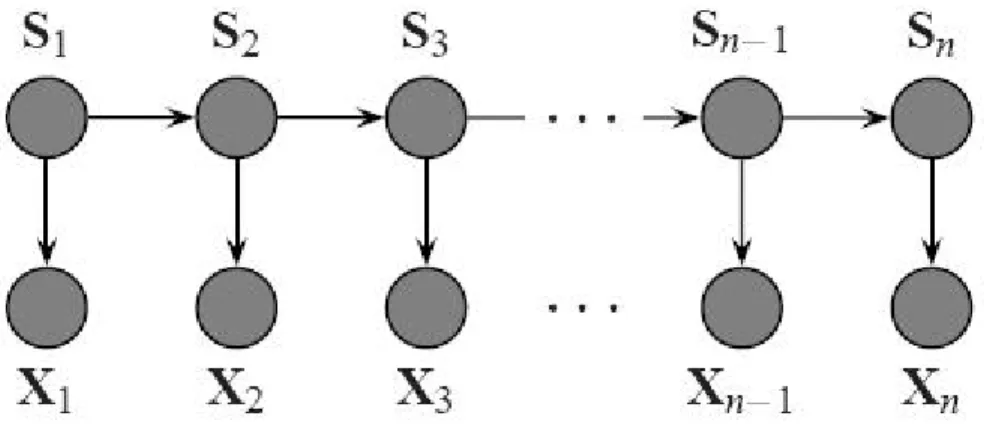
A HMM may be represented as a directed graph Gwith nodes St andXt representing
the state of the HMM (or label) at timet and the observation at timet, respectively. This
structure is shown in Figure 4.1 (Wallach, 2002).
This representation of a HMM clearly highlights the conditional independence relations
within a HMM. Specifically, the probability of the state at timetdepends only on the state
Figure 4.1: HMM structure
The conditional independence relations, combined with the probability chain rule, may
be used to factorize the joint distribution over a state sequencesand observation sequence
xinto the product of a set of conditional probabilities:
p(s,x) =p(s1)p(x1|s1)
n
∏
t=2
p(st|st−1)p(xt|st) (4.1)
Finding the optimal state sequence given the observation sequence and the model is
most efficiently performed using a dynamic programming technique known as Viterbi
alignment (Rabiner, 1989).
4.3
Maximum Entropy (MaxEnt)
The maximum entropy approach is a novel method for the task of sentence extraction. The
main principle of the MaxEnt method is to model all that is known and assume nothing
consistent with all the facts, but otherwise act as uniformly as possible (Berger, Pietra, and
Pietra, 1996). One advantage of this form of statistical inference is that we only constrain
the model of our data by the information that we do know about the task, i.e. we do not
assume anything about information of which we have no knowledge. Another advantage is
that the information we use to constrain the model is in no way restricted so we can encode
whatever linguistic information we want via the features. However, a disadvantage of this
approach is that, although the maximum entropy approach may make good predictions, we
cannot interpret the individual elements that cause the behavior of the system as a large
number of features tend to be used in the approach and hence the output cannot be used to
interpret all of these separately (Ferrier, 2001).
MaxEnt models can be termed as multinomial logistic regression if they are to classify
the observations into more than two classes (Jurafsky and Martin, 2008). However, in this
research, we used the MaxEnt model to classify the sentences into two classes: summary or
non-summary. The parametric form for the maximum entropy model is as follows (Nigam,
Lafferty, and McCallum, 1999):
P(c|s) = 1 Z(s)exp
∑
i λifi ! (4.2) Z(s) =∑
c exp∑
i λifi ! (4.3)Here, c is the class label and s is the item we are interested in labeling that is the
sentences here. Zis the normalization factor that is just used to make the exponential into a
true probability. Each fiis a feature with the associated weightλiwhich can be determined
Figure 4.2: CRF model structure
4.4
Conditional Random Fields (CRF)
To reap the benefits of using a conditional probabilistic framework for labeling
sequen-tial data and simultaneously overcome the label bias problem, Lafferty, McCallum, and
Pereira (2001) introduced CRFs. So, CRFs are conditional probabilistic sequence models,
however, rather than being directed graphical models, CRFs are undirected graphical
mod-els (Wallach, 2002). This allows the specification of a single joint probability distribution
over the entire label sequence given the observation sequence, rather than defining per-state
distributions over the next states given the current state. The conditional nature of the
distri-bution over label sequences allows CRFs to model real-world data in which the conditional
probability of a label sequence can depend on non-independent, interacting features of the
observation sequence. In addition to this, the exponential nature of the distribution chosen
by Lafferty, McCallum, and Pereira (2001) enables features of different states to be traded
off against each other, weighting some states in a sequence as being more important than
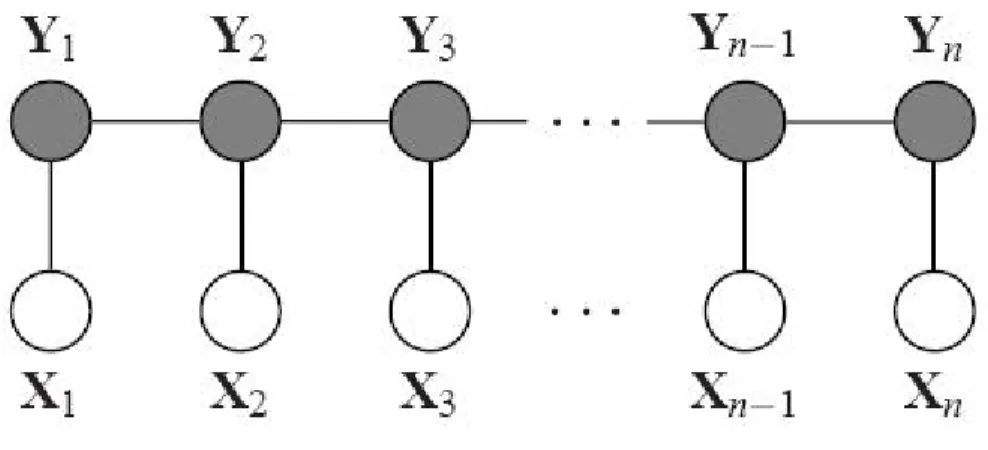
others.
Figure 4.2 shows the linear chain model structure of CRF (Wallach, 2002).
label sequence given the observation sequence, rather than defining per-state distributions
over the next states given the current state. Given an observation sequence (sentence
se-quence here)X = (x1,· · ·,xT)and the corresponding state sequenceY = (y1,· · ·,yT), the
probability ofY conditioned onX defined in CRFs,P(Y|X), is as follows:
1 ZX exp
∑
i,k λkfk(yi−1,yi,X) +∑
i,l µlgl(yi,X) ! (4.4)whereZX is the normalization constant that makes the probability of all state sequences
sum to one; fk(yi−1,yi,X) is an arbitrary feature function over the entire observation
se-quence and the states at positionsiandi−1 whilegl(yi,X)is a feature function of state at
positioni and the observation sequence;λk andµl are the weights learned for the feature
functions fk andgl, reflecting the confidence of the feature functions (Shen et al., 2007).
4.5
Support Vector Machines (SVM)
SVM is a powerful methodology for solving machine learning problems introduced by
Vap-nik (Cortes and VapVap-nik, 1995) based on the Structural Risk Minimization principle. In the
classification problem, the SVM classifier typically follows from the solution to a quadratic
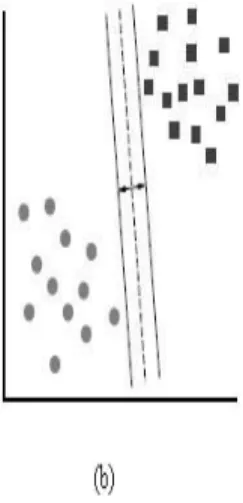
problem. SVM finds the separating hyperplane that has maximum margin between the two
classes in case of binary classification. Separating the examples with a maximum margin
hyperplane is motivated by the results from statistical learning theory, which states that
a learning algorithm, to achieve good generalization, should minimize both the empirical
error and also the “capacity” of the functions that the learning algorithm implements.
Figure 4.3: Support Vector Machines
belongs either to positive or negative class can be denoted by:
(x1,y1), . . . ,(xu,yu),xj ∈ Rn,yj ∈ {+1,−1}
Here, xjis a feature vector of the j-th sample represented by anndimensional vector;
yjis its class label. uis the number of the giv