DRINK SPIKING:
AN INVESTIGATION OF ITS OCCURRENCE AND
PREDICTORS OF PERPETRATION AND
VICTIMISATION
A thesis submitted in partial fulfilment of the requirements for
the degree of Doctor of Psychology
Bridget Anne McPherson
B.A., PGrad. Dip. Psych.
Division of Psychology
School of Health Sciences
Portfolio of Science, Engineering and Technology
RMIT University
DECLARATION
I certify that except where due acknowledgement has been made, the work is that of the author alone; the work has not been submitted previously, in whole or in part, to qualify for any other academic award; the content of the thesis is the result of work which has been carried out since the official commencement date of the approved research program; and, any editorial work, paid or unpaid, carried out by a third party is acknowledged.
Bridget Anne McPherson
ACKNOWLEDGEMENTS
First and foremost, I would like to thank my supervisors, Dr David Smith and Dr Lisa Negri, for their unwavering support, encouragement and assistance throughout the completion of this research. Dr Smith in particular has contributed a great deal of time and effort, often late into the night, and I am immeasurably grateful for this. I would also like to thank Dr John Reece for his assistance with the statistics required to complete this study, and Andrea Stewart for her advice in developing the Social Experiences Survey.
I am also immensely appreciative of the encouragement, assistance, and advice provided by Dr Emma Wade. The recent months have been exhausting, emotional and extremely difficult at times; however, Emma has consistently remained a source of
motivation and inspiration. I would also like to thank Kara Granger for her ongoing support and encouragement. Kara has always believed that I was capable of completing this research, even when I was unconvinced, and I am grateful for her confidence in me.
I am enormously thankful for the support of Dad, Mum, Joanne and Jean, Simon, and John. Undertaking this thesis would not have been possible without each of them, and I am indebted to them for their emotional support and financial assistance, and for sending me to the World Cup. I hope I have made you proud.
Many thanks also to my friends and colleagues at RMIT University, who were constant sources of verbal and emailed encouragement. Particular thanks go to Adrian Schembri, who provided invaluable assistance with the statistics required to meet the recommendations made by my examiners.
Finally, I would like to thank each of the organisations, support services, educational institutions, media outlets, professionals, friends and acquaintances who assisted in promoting this study. I am also
grateful to those who participated in this research, as well as the people who personally contacted me with accounts of their drink spiking experiences. Each of you convinced me of the importance of this research, and I sincerely hope that your assistance can contribute to the complete eradication of drink spiking.
DISSEMINATION INFORMATION
Sections of this thesis have been disseminated as refereed articles and a conference presentation. The candidate has taken primary authorship on these papers.
McPherson, B., & Smith, D. (2006, September). Drink spiking: An examination of the prevalence, motivations, and attitudes surrounding drug-facilitated sexual assault. Poster session presented at the 2006 Joint Conference of the APS and NZPsS, Auckland, New Zealand.
McPherson, B., & Smith, D. (2006). Drink spiking: An examination of the prevalence, motivations, and attitudes surrounding
drug-facilitated sexual assault. Australian Journal of Psychology, 58, 65.
McPherson, B., & Smith, D. (2006). Drink spiking: An examination of the prevalence, motivations, and attitudes surrounding
drug-facilitated sexual assault [CD-ROM]. Proceedings of the 2006 Joint Conference of the APS and NZPsS.
McPherson, B.A., Smith, D.I., & Negri, L.M. (2007). Drink spiking: An examination of prevalence and predictors. In K. Moore (Ed.), Psychology making an impact: Proceedings of the 42nd annual
conference (pp. 257-261). Melbourne, Australia: The Australian Psychological Society Ltd.
TABLE OF CONTENTS DECLARATION………... ACKNOWLEDGEMENTS……… DISSEMINATION INFORMATION………... TABLE OF CONTENTS……… INDEX OF TABLES……….. INDEX OF FIGURES……… ABSTRACT………...
CHAPTER 1. INTRODUCTION AND RATIONALE FOR THE CURRENT STUDY…...
CHAPTER 2. SEXUAL ASSAULT……… Part 1. Stranger, Acquaintance and Date Sexual Assault……… Stranger Sexual Assault………. Prevalence……….
Female victims……… Male victims………. Homosexual victimisation……… Summary………. Acquaintance and Date Sexual Assault………. Prevalence……….
Prevalence of sexual assault……….. Prevalence of attempted and completed rape………. Prevalence in Australia……… Location of Sexual Assault………. Methods of Committing Assault………... Resisting Sexual Assault………... Summary………. Part 2. Factors Associated With Perpetration of Sexual Assault………... Alcohol Use………... Prevalence of Alcohol Use in Sexual Assault Perpetration……...
ii iii v vi xvi xix xxiv 1 4 4 6 6 6 7 7 8 9 9 9 19 21 21 22 23 24 24 25 25
The Contribution of Alcohol to Sexual Assault Perpetration…… Alcohol expectancies……….. Increased aggression………. Increased sexual interest and behaviour………. The relationship between alcohol expectancies and perpetration of sexual assault………. Alcohol myopia………..
The relationship between alcohol myopia and
perpetration of sexual assault………. Misperception of Sexual Intentions……… Prevalence of Misperception on Social Situations………. The Effects of Misperception on Perpetration of Sexual
Assault……….. The Effects of Alcohol and Misperception on Perpetration of Sexual Assault……… Summary……… Part 3. Factors Associated with Victimisation of Sexual Assault………... Alcohol and Substance Use………. Prevalence of Alcohol and Substance Use During Incidents of Sexual Assault Victimisation………... The Relationship Between Alcohol and Substance Use and Sexual Assault Victimisation………... Alcohol Expectancies……… Previous Sexual Assault Victimisation………. Prevalence of Sexual Assault Revictimisation……….. The Relationship Between Previous Sexual Assault
Victimisation and Future Sexual Assault Victimisation…………... Recognition of Risk……….. Summary………
CHAPTER 3. DRINK SPIKING AND DRUG-FACILITATED SEXUAL ASSAULT……. Part 1. Background Information………
27 27 28 29 31 32 35 37 37 38 40 41 41 42 42 43 45 45 45 47 47 49 50 50
Differentiation of Drink Spiking and Drug-Facilitated Sexual
Assault………. Prevalence of Drink Spiking……….. Prevalence of Drug-Facilitated Sexual Assault……….. Characteristics of Drink Spiking and Drug-Facilitated Sexual
Assault……… Gender……… Age………... Location……….. Victim’s Relationship to Offender……… Substances………. Alcohol………. GHB……… Benzodiazepines……… Ketamine………. Ecstasy……….. Amphetamine……… Prevalence of substances in instances of drink spiking…….. Immediate Outcomes………. Summary……… Part 2. Motivations for Perpetration of Drink Spiking……… Drink Spiking for Sexual Assault Perpetration……….. Drink Spiking for Recreational Purposes………
Drink Spiking With Alcohol……….. Drink Spiking With Substances……….. Summary……… Part 3. The Aftermath of Drink Spiking………..
The Physical and Psychological Effects of Drink Spiking
Victimisation………. 50 51 52 55 56 56 57 57 58 58 59 60 61 62 62 62 66 67 76 68 71 72 73 76 77 77
The Physical and Psychological Effects of Substance
Ingestion………. The Physical and Psychological Effects of Sexual Assault Victimisation……….. Reporting Drink Spiking Victimisation……… The Underreporting of Drink Spiking Victimisation……….. The Difficulties Associated With the Reporting of Drink Spiking Victimisation………... Efforts Aimed at Rectifying the Issues Relating to Drink Spiking……. Law Reforms and Recommendations……… Prevention Campaigns………... Recommendations for the Prevention of Drink Spiking…………. Recommendations for Intervention After a Drink Spiking
Incident………... Summary………... Part 4. Aims and Research Questions………..
Perpetration of Drink Spiking……… Victimisation of Drink Spiking………
CHAPTER 4. METHOD……… Participants……….. Gender………... Place of Residence……… Sexual Orientation……….. Age………. Education and Occupation……… Materials………... Demographic Questionnaire……….. Venues Attended……… Alcohol Expectancies……… Willingness and Experience of Perpetration of Drink Spiking………. Participation in Risk-Taking Activities……….
78 81 84 84 89 91 91 93 96 97 99 99 100 101 102 102 102 102 102 102 104 106 108 108 108 112 113
Engagement in Protective Behaviours………. Sexual Experiences Survey……… Victimisation of Drink Spiking……… Procedure………
Obtaining the Sample………... Process of Participation………. Process After Participation………...
CHAPTER 5. RESULTS……….. Missing Value Analysis……….. Factor Analysis……… Alcohol Expectancies and Alcohol Beliefs………. Participation in Risk-Taking Activities………. Engagement in Protective Behaviours………. Previous Perpetration of Drink Spiking………... Motivations for Perpetration of Drink Spiking……….. Willingness to Engage in Drink Spiking Behaviours………. Reliability Analysis……… Validity Analysis……… Face Validity………. Content Validity……….. Criterion-Related Validity……….. Construct Validity……… Considerations of Prevalence………. Perpetration of Drink Spiking……….. Prevalence……… The Relationship Between Gender and Previous Perpetration……. The Relationship Between Age and Previous Perpetration………… The Relationship Between Sexual Orientation and Previous
Perpetration……….. Victimisation of Drink Spiking……….. Prevalence……… 114 114 118 118 119 121 122 124 124 125 125 127 127 128 128 129 129 132 132 132 132 133 133 134 134 136 136 137 137 137
Self-Report……….. Reports of the Experiences of Others………. The Relationship Between Gender and Victimisation………. The Relationship Between Age and Victimisation………. The Relationship Between Sexual Orientation and Victimisation…. Factors Associated With Sexual Assault……….. Alcohol Expectancies and Alcohol Beliefs……….
Prevalence………. Alcohol expectancies……….. Alcohol beliefs……… The Relationship Between Gender and Alcohol Expectancies and Alcohol Beliefs………. The Relationship Between Age and Alcohol Expectancies and Alcohol Beliefs……….. The Relationship Between Sexual Orientation and Alcohol Expectancies and Alcohol Beliefs………... Participation in Risk-Taking Activities………. Prevalence………. The Relationship Between Gender and Participation in Risk-Taking Activities………. The Relationship Between Age and Participation in Risk-Taking Activities……….. The Relationship Between Sexual Orientation and
Participation in Risk-Taking Activities……….. Sexual Assault Victimisation………. Prevalence………. Single victimisations………... Revictimisation………... The Relationship Between Gender and Sexual Assault
Victimisation……….. 137 149 157 158 158 158 158 158 158 164 166 167 168 169 169 173 175 175 176 176 176 183 191
The Relationship Between Age and Sexual Assault
Victimisation………... Female victimisation.………... Male victimisation.……….………... The Relationship Between Sexual Orientation and Sexual Assault Victimisation……… Engagement in Protective Behaviours………. Prevalence………. The Relationship Between Gender and Engagement in
Protective Behaviours………. The Relationship Between Age and Engagement in Protective Behaviours……….. The Relationship Between Sexual Orientation and
Engagement in Protective Behaviours……….. Factors Associated With Sexual Assault: Their Relationship With
Perpetration of Drink Spiking……….. Alcohol Expectancies……… Alcohol Beliefs……….. Participation in Risk-Taking Activities………. Sexual Assault Victimisation………. Female Victimisation………... Male Victimisation……… Engagement in Protective Behaviours………. Interrelationship of Factors Associated With Sexual Assault………... Motivations for Perpetration of Drink Spiking……….. Willingness to Perpetrate Drink Spiking………. Factors Associated With Sexual Assault: Their Relationship With
Victimisation of Drink Spiking……….. Alcohol Expectancies……… Alcohol Beliefs……….. Participation in Risk-Taking Activities……….
191 191 191 192 194 194 201 201 201 202 202 205 207 209 209 210 213 214 222 231 233 233 235 235
Sexual Assault Victimisation………. Female Victimisation………... Male Victimisation……… Engagement in Protective Behaviours………. Interrelationship of Factors Associated With Sexual Assault………...
CHAPTER 6. DISCUSSION………. Part 1. Prevalence of Perpetration and Victimisation of Drink Spiking
Perpetration of Drink Spiking……… Gender, Age, and Sexual Orientation………... Victimisation of Drink Spiking……… Gender, Age, and Sexual Orientation………... Location of Drink Spiking Incidents……….. Gender of Perpetrator and Relationship With Victim……… Methods of Drink Spiking……… Basis of Victimisation……… Outcomes of Victimisation……… Perceptions of Criminal Victimisation Status……… Reporting of Victimisation……….. Revictimisation……….. Victimisation of Others……… Part 2. Prevalence of Factors Associated With Perpetration and Victimisation of Drink Spiking………..
Alcohol Expectancies and Alcohol Beliefs……….. Alcohol Expectancies………. Alcohol Beliefs……… Participation in Risk-Taking Activities………. Sexual Assault Victimisation………. Engagement in Protective Behaviours………. Part 3. Predictors of Perpetration and Victimisation of Drink Spiking…..
Perpetration of Drink Spiking……… Alcohol Expectancies………. 237 237 240 240 241 246 247 249 250 250 252 253 254 255 258 259 260 263 264 264 265 266 267 269 273 276 278 279 279
Alcohol Beliefs……… Participation in Risk-Taking Activities……….. Sexual Assault Victimisation………... Engagement in Protective Behaviours……….. Motivations for Perpetration of Drink Spiking……… Willingness to Perpetrate Drink Spiking………... Model of Perpetration………. Victimisation of Drink Spiking……… Alcohol Expectancies………. Alcohol Beliefs……… Participation in Risk-Taking Activities……….. Sexual Assault Victimisation………... Engagement in Protective Behaviours……….. Model of Victimisation……… Conclusion……… Perpetration………... Victimisation………... Part 4. Recommendations for Intervention and Prevention……….
Implications……….. Intervention……….. Prevention……… Victims and Perpetrators……… Licensed Venues……….. Law………... Community………. Part 5. Limitations and Recommendations for Future Research ………. Limitations……….. Future Research………... Part 6. Conclusion………. 282 283 285 286 286 289 290 293 293 295 296 298 300 302 304 304 307 309 309 311 316 316 320 322 323 324 324 326 329
REFERENCES……… 332 APPENDICES Appendix A. Appendix B. Appendix C. Appendix D. Appendix E. Appendix F. Appendix G. Appendix H. Appendix I. Appendix J. Appendix K. Appendix L. Appendix M. ……….. Recruitment Flyer ………... Recruitment Bookmarks……… Media Releases……….. Media Coverage……… Plain Language Statements………. The Social Experiences Survey……… Approval from the RMIT Human Research Ethics
Committee……… Sources of Recruitment………. Principal Component Analysis of Alcohol Expectancies Principal Component Analysis of Risk-Taking Behaviours Principal Component Analysis of Protective Behaviours Principal Component Analysis of Drink Spiking
Perpetration……….. Principal Component Analysis of Willingness to
Perpetrate Drink Spiking Activities……….. 355 355 357 359 363 365 372 368 371 376 378 380 382 384
INDEX OF TABLES Table 1. Table 2. Table 3. Table 4. Table 5. Table 6. Table 7. Table 8. Table 9. Table 10. Table 11. Table 12. Table 13.
Prevalence Data of Male-Perpetrated Date and
Acquaintance Sexual Assault of Female Victims, as Reported by Female Participants………... Prevalence Data of Male-Perpetrated Date and
Acquaintance Sexual Assault of Female Victims, as Reported by Male Participants……… Prevalence Data of Female-Perpetrated Date and
Acquaintance Sexual Assault of Male Victims, as Reported by Male Participants………. Prevalence Data of Female-Perpetrated Date and
Acquaintance Sexual Assault of Male Victims, as Reported by Female Participants………. Prevalence Data of Female-Perpetrated Date and
Acquaintance Sexual Assault of Female Victims………... Prevalence Data of Male-Perpetrated Date and
Acquaintance Sexual Assault of Male Victims……… Prevalence Data of Attempted or Completed Rape
Reported by Female Victims……… Prevalence Data of Attempted or Completed Rape of
Female Victims, Reported by Male Perpetrators……… Cronbach’s Alpha Coefficient for all Factors………. Characteristics of Most Serious Drink Spiking Incident
Reported By Sample (N = 207)….……… Prevalence of Symptoms Identified by Participants (N = 207)… Prevalence of Participants’ Perceptions of Their Victim of Crime Status………... Prevalence of Authorities to Which Participants Reported Their Most Serious Incident of Drink Spiking Victimisation………...
11 15 16 17 18 19 20 20 130 138 140 143 143
Table 14. Table 15. Table 16. Table 17. Table 18. Table 19. Table 20. Table 21. Table 22. Table 23. Table 24. Table 25. Table 26.
Results of T-Test Analysis Investigating Differences Between Men and Women on Participation in Risk-Taking Activity…… Correlations Among Experience of Spiking (ES) and Alcohol Expectancy (AE) Factors (N = 798- 805)……… Correlations Among Experience of Spiking (ES) and Alcohol Belief (AB) Factors (N = 798- 805)………. Correlations Among Risk-taking Factors and Experience of Spiking (ES) Factors (N = 790-798)……… Correlations Among Sexual Assault Victimisation (SA)
Variables for Women and Experience of Spiking (ES) Factors (N = 509-553)………. Correlations Among Sexual Assault Victimisation (SA)
Variables for Men and Experience of Spiking (ES) Factors (N = 222-245)………... Summary of Forward Regression Analysis for Variables
Predicting Experience of Spiking Low Frequency (N = 786)…… Summary of Forward Regression Analysis for Variables
Predicting Experience of Spiking High Frequency (N = 786)…… Prevalence of Participants’ Motivations for Each Drink Spiking Activity………. The Five Most Frequently Reported Motivations for Each
Category of Drink Spiking Behaviours……… Correlations Among Alcohol Expectancy (AE) Factors and Number of Occasions in Which Participant had Experienced Drink Spiking (DS) (N = 802)……… Correlations Among Alcohol Beliefs (AB) Factors and Number of Occasions in Which Participant had Experienced Drink Spiking (DS) (N = 802)……….. Correlations Among Risk-taking Factors and Number of
Occasions in Which Participant had Experienced Drink Spiking (DS) (N = 790)………. 174 202 205 208 211 212 216 220 223 230 234 235 236
Table 27. Table 28. Table 29. Table 30. Table 31. Table I1. Table J1. Table K1. Table L1. Table M1.
Correlations Among Sexual Assault Victimisation (SA) variables for Women and Number of Occasions on Which Women had Experienced Drink Spiking (DS) Victimisation (N = 509-554)……….. Correlations Among Sexual Assault Victimisation (SA)
Variables for Men and Experience of Spiking (ES) Factors (N = 222-245)……….. Correlations Amongst Protective Behaviour (PB) Factors and Number of Occasions in Which Participant had Experienced Drink Spiking (DS) (N = 791)……… Summary of Forward Regression Analysis for Variables
Predicting Drink Spiking Victimisation for Female Participants (N = 457)……….. Summary of Forward Regression Analysis for Variables
Predicting Drink Spiking Victimisation for Male Participants (N = 211)……… Principal Component Analysis of Alcohol Expectancies………. Principal Component Analysis of Risk-Taking Behaviours………. Principal Component Analysis of Protective Behaviours……….. Principal Component Analysis of Drink Spiking Perpetration….. Principal Component Analysis of Willingness to Perpetrate Drink Spiking Activities……….
238 239 240 242 245 377 379 381 383 385
INDEX OF FIGURES Figure 1. Figure 2. Figure 3. Figure 4. Figure 5. Figure 6. Figure 7. Figure 8. Figure 9. Figure 10. Figure 11. Figure 12. Figure 13. Figure 14. Figure 15. Figure 16. Figure 17. Figure 18.
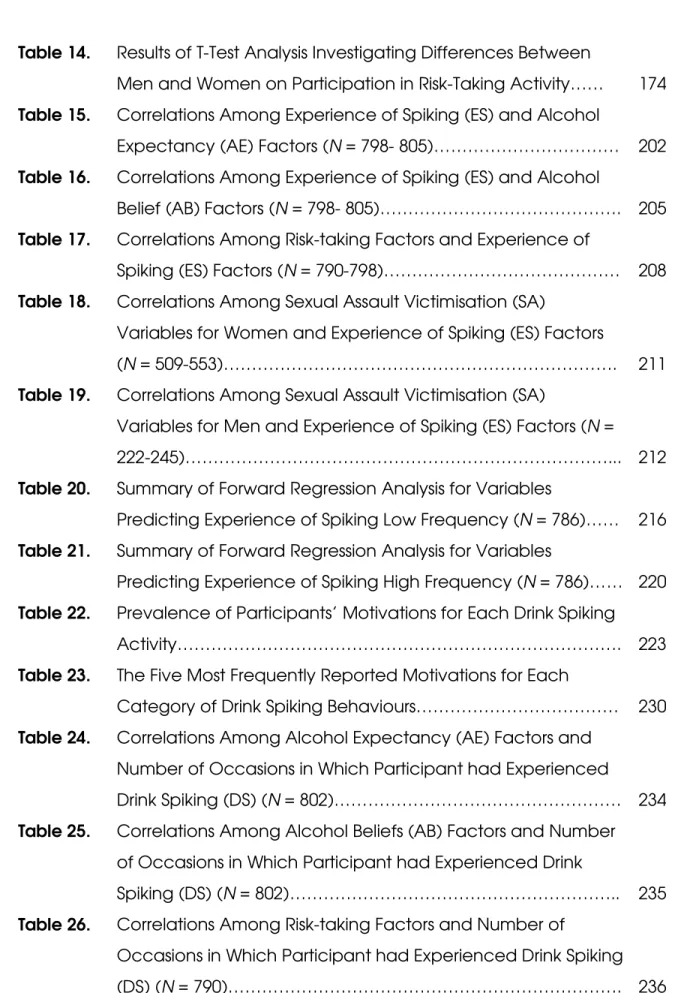
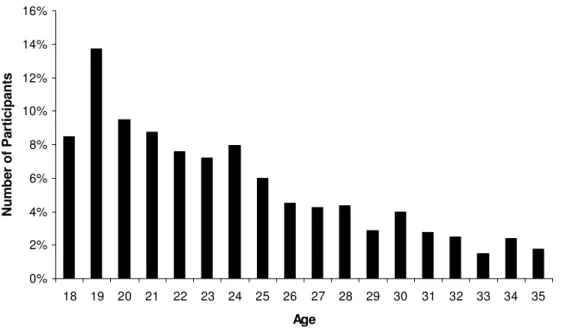
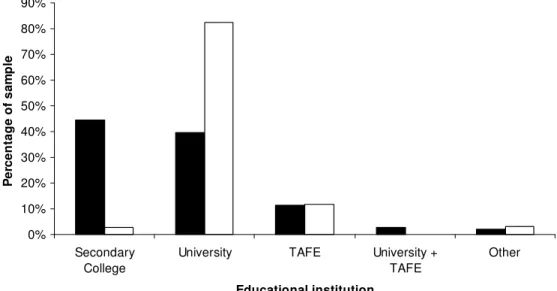
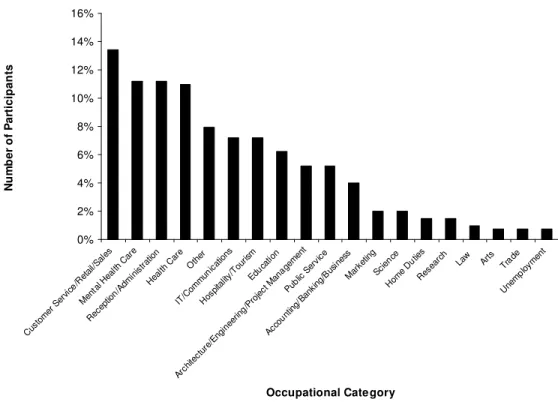
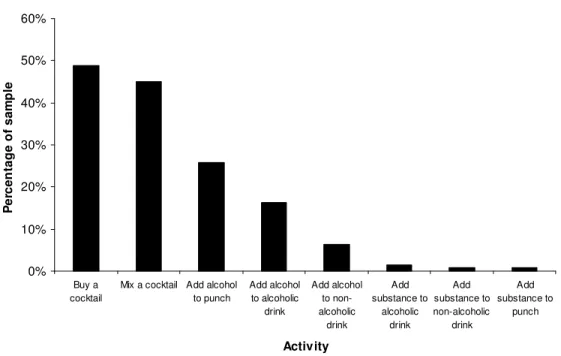
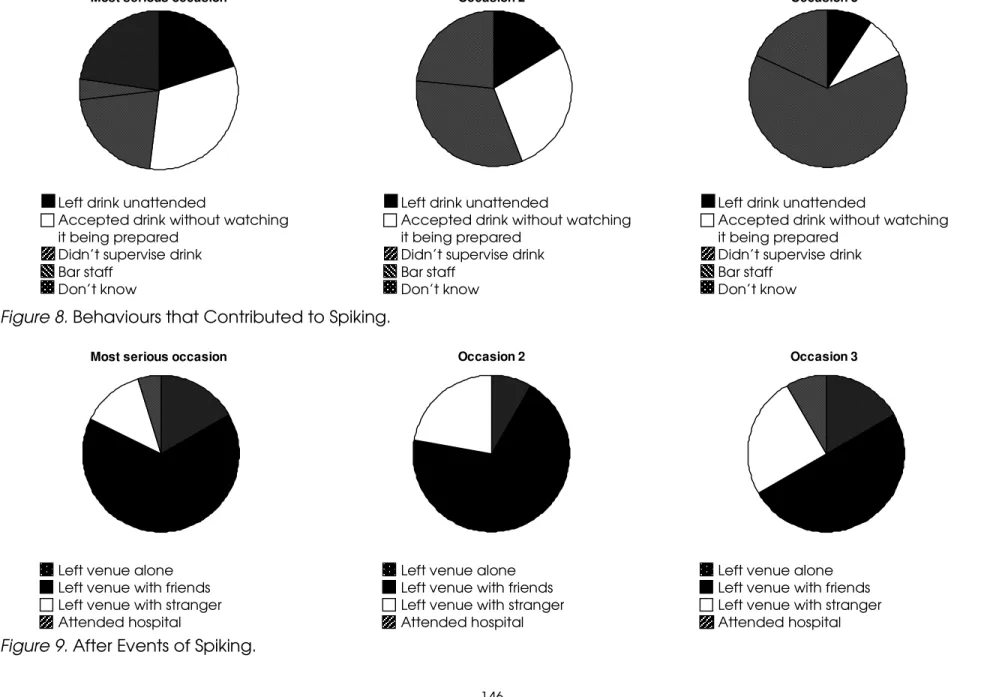
Distribution of Ages Across the Sample (N = 803)………... Highest Level of Education Attained by Participants and Current Educational Institution Reported by Participants (N = 531-704)………... Current Employment Reported by Participants, According to Occupational Category (N = 402)……….. Prevalence of Participants’ Willingness to Undertake Each Drink Spiking Activity (N = 797)………. Prevalence of Participants Reporting at Least one Experience of Engaging in Each Drink Spiking Activity (N = 798)………. Basis of Participants’ Belief That Spiking had Occurred………… Location of Spiking……….. Behaviours that Contributed to Spiking………. After Events of Spiking………. Victim’s Relationship With the Perpetrator……… Gender of Perpetrator……… Perception as Victim of Crime………. Reported Incident to Authorities………. Prevalence of Indicators That Drink Spiking had Occurred, Both When Participant was Present and not Present……… Prevalence of Location of Drink Spiking Incident, Both When Participant was Present and not Present……….. Prevalence of Behaviours Contributing to Drink Spiking, Both When Participant was Present and not Present……….. Prevalence of After Events of Drink Spiking Incident, Both When Participant was Present and not Present……….. Prevalence of Victim’s Relationship With the Perpetrator, Both When Participant was Present and not Present………..
104 105 106 135 136 145 145 146 146 147 147 148 148 151 151 152 152 153
Figure 19. Figure 20. Figure 21. Figure 22. Figure 23. Figure 24. Figure 25. Figure 26. Figure 27. Figure 28. Figure 29. Figure 30. Figure 31. Figure 32. Figure 33. Figure 34. Figure 35.
Prevalence of Gender of the Perpetrator, Both When
Participant was Present and not Present……….. Prevalence of Participants’ Perception of the Victim as a Victim of Crime, Both When Participant was Present and not Present………. Prevalence of Victims’ Reporting of the Drink Spiking Incident, Both When Participant was Present and not Present……… Basis of Victims’ Determination That Drink Spiking had
Occurred……… Location of Spiking……….. Behaviours that Contributed to Spiking………. After Events of Spiking………. Victim’s Relationship With the Perpetrator……… Gender of Perpetrator……… Participants’ Perception of Victim as Victim of Crime………….. Victims’ Reporting to Authorities……….. Prevalence of Variables Reflecting the Alcohol Expectancy of Aggressive and Antisocial Tendencies (N = 805)……… Prevalence of Variables Reflecting the Alcohol Expectancy of Confidence and Sexuality (N = 805)……….. Prevalence of Variables Reflecting the Alcohol Expectancy of Attractiveness (N = 805)………. Prevalence of Variables Reflecting the Alcohol Expectancy of Interest in Sexual Activity (N = 805)………. Prevalence of Variables Reflecting the Alcohol Expectancy of Engaging in Casual Sex Activity (N = 805)……… Prevalence of Variables Reflecting the Alcohol Belief of
Deliberate Intoxication of Others (N = 805)……….. Prevalence of Variables reflecting the Alcohol Belief of
153 154 154 155 155 155 156 156 156 157 157 159 160 161 162 163 164
Figure 36. Figure 37. Figure 38. Figure 39. Figure 40. Figure 41. Figure 42. Figure 43. Figure 44. Figure 45. Figure 46. Figure 47. Figure 48. Figure 49. Figure 50.
Responsibility to Self and the Alcohol Belief of Responsibility to Others (N = 805)……… Prevalence of Variables Reflecting the Alcohol Belief of
Allowing Friends to Leave Venues (N = 805)……… Prevalence of Participation in Each Risk-Taking Activity
Reported by Sample (N = 790-794)………. Prevalence of Participation in Each Risk-Taking Activity
Reported by Sample, According to Factors (N = 790-794)…….. Prevalence of Attempted Oral Sexual Assault Since the age of 14 Years (N = 765-777)……… Prevalence of Completed Oral Sexual Assault Since the age of 14 Years (N = 785-788)……… Prevalence of Attempted Anal Sexual Assault Since the age of 14 Years (N = 767-769)……… Prevalence of Completed Anal Sexual Assault Since the age of 14 Years (N = 776-780)……… Prevalence of Attempted Vaginal Sexual Assault Since the age of 14 Years (N = 533-538)……….. Prevalence of Completed Vaginal Sexual Assault Since the age of 14 Years (N = 535-539)……….. Prevalence of Attempted Oral Sexual Assault in the Past 12 Months (N = 756-778)……….. Prevalence of Completed Oral Sexual Assault in the Past 12 Months (N = 782-789)………. Prevalence of Attempted Anal Sexual Assault in the Past 12 Months (N = 768-769)……….. Prevalence of Completed Anal Sexual Assault in the Past 12 Months (N = 778-782)……….. Prevalence of Attempted Vaginal Sexual Assault in the Past 12 Months (N = 536-538)………. 165 166 171 172 177 177 178 178 179 179 180 180 181 181 182
Figure 51. Figure 52. Figure 53. Figure 54. Figure 55. Figure 56. Figure 57. Figure 58. Figure 59. Figure 60. Figure 61. Figure 62. Figure 63. Figure 64. Figure 65.
Prevalence of Completed Vaginal Sexual Assault in the Past 12 Months (N = 534-542)………. Prevalence of Single and Multiple Incidents of Attempted Oral Sexual Assault Since the age of 14 Years (N = 33-101)……. Prevalence of Single and Multiple Incidents of Completed Oral Sexual Assault Since the age of 14 Years (N = 38-205)……. Prevalence of Single and Multiple Incidents of Attempted Anal Sexual Assault Since the age of 14 Years (N = 6-33)……… Prevalence of Single and Multiple Incidents of Completed Anal Sexual Assault Since the age of 14 Years (N = 12-58)…….. Prevalence of Single and Multiple Incidents of Attempted Vaginal Sexual Assault Since the age of 14 Years (N = 15-83)… Prevalence of Single and Multiple Incidents of Attempted Vaginal Sexual Assault Since the age of 14 Years (N = 22-138).. Prevalence of Single and Multiple Incidents of Attempted Oral Sexual Assault in the Past 12 Months (N = 24-57)…………... Prevalence of Single and Multiple Incidents of Completed Oral Sexual Assault in the Past 12 Months (N = 13-109)…………. Prevalence of Single and Multiple Incidents of Attempted Anal Sexual Assault in the Past 12 Months (N = 3-18)……… Prevalence of Single and Multiple Incidents of Completed Anal Sexual Assault in the Past 12 Months (N = 6-30)……… Prevalence of Single and Multiple Incidents of Attempted Vaginal Sexual Assault in the Past 12 Months (N = 12-44)……… Prevalence of Single and Multiple Incidents of Completed Vaginal Sexual Assault in the Past 12 Months (N = 9-66)……….. Prevalence of Participants Accepting Drinks From Strangers (N = 794)………. Prevalence of Participants Leaving Drinks Unattended (N = 794)………. 182 184 185 185 186 186 187 187 188 188 189 189 190 194 195
Figure 66. Figure 67. Figure 68. Figure 69. Figure 70. Figure 71. Figure 72. Figure 73. Figure 74. Figure 75. Figure 76.
Prevalence of Participants Leaving Drinks on a Nearby Table or Ledge When Dancing (N = 794)………. Prevalence of Participants Accepting Drinks From
Acquaintances (N = 794)………... Prevalence of Participants Leaving Drinks With a Trusted
Person When Using the Toilet (N = 794)………. Prevalence of Participants Leaving Drinks With a Trusted
Person When Dancing (N = 794)……….. Prevalence of Participants Accepting Drinks from Good
Friends (N = 794)……… Prevalence of Participants Taking Drinks With Them When Dancing (N = 794)……… Prevalence of Participants Taking Drinks With Them When Using the Toilet (N = 794)……… Prevalence of Participants Holding Drinks at all Times (N = 794)………... Prevalence of Participants’ Motivations for Buying or Mixing Cocktails or Adding Alcohol to Punch……….. Prevalence of Participants’ Motivations for Adding Alcoholic Shots to Another Person’s Drink……… Prevalence of Participants’ Motivations for Adding
Substances to Another Person’s Drink……… 195 196 197 197 198 199 199 200 225 226 227
ABSTRACT
The current study assessed features associated with drink spiking, or the adding of a substance to another person’s drink without the consumer’s knowledge or consent. A sample of 805 Australians, aged 18-35 years, completed a survey designed to measure the occurrence and predictors of the perpetration and victimisation of drink spiking. Almost half of the sample reported at least one experience of
purchasing or mixing cocktails for others (49% and 45%, respectively), while smaller proportions reported adding alcohol to punch (26%) and adding alcoholic shots to alcoholic beverages belonging to other people (16%). A number of participants also reported previous
experience of adding alcoholic shots to non-alcoholic beverages (6%), adding prescription or illicit substances to alcoholic beverages (1%), adding substances to non-alcoholic beverages (1%), and adding substances to punch (1%).
Purchasing or mixing cocktails for others, adding alcohol to punch, or adding alcoholic shots to alcoholic beverages were predicted by beliefs that deliberately causing intoxication in others is acceptable and that alcohol consumption by others is indicative of their sexual attraction to participants. Engagement in these behaviours was also predicted by participants’ illicit substance use and
participation in casual sexual activity. Adding prescription or illicit substances to other people’s beverages, or adding alcoholic shots to non-alcoholic beverages, were predicted by the belief that alcohol consumption increases one’s confidence and sexual responsiveness, and by participants’ use of narcotics and sedatives. Perpetrators were predominantly motivated by a wish to have fun or to increase the likelihood of engaging in consensual sexual activity.
With regard to victimisation of drink spiking, 26% of the sample reported at least one victimisation. The majority of incidents occurred in
licensed venues, after the participant had engaged in such low supervisory behaviours as leaving their drink unattended or accepting a drink without observing its preparation. Most participants established a belief that they had been spiked after experiencing a degree of intoxication that was beyond their expected level (based on the amount of alcohol consumption), or after experiencing such physiological symptoms as vomiting, hallucinations, lack of
coordination, or unconsciousness. Despite such experiences, 85% of victims did not report the incident to authorities. Victimisation in general was predicted by participants’ use of stimulant and hallucinogenic substances. Female victimisation was predicted by previous episodes of victimisation of oral sexual assault. Victimisation was not affected by participants’ degree of supervision of their drinks.
These findings provided empirical evidence that drink spiking is committed primarily for the purposes of creating a fun, entertaining situation. However, it was also apparent that drink spiking is
perpetrated in an attempt to encourage participation in consensual sexual activity; this was particularly the case in incidents involving the addition of substances, as opposed to alcohol, to beverages
belonging to others.
In a minority of cases, it was evident that drink spiking was utilised for the commission of sexual assault; moreover, the use of drink spiking to facilitate consensual sexual activity may have resulted in the
perpetration of sexual assault as a result of the influence of alcohol myopia and misperception. Although predictors of victimisation were relatively weak, it was apparent that victims participate in higher levels of risk-taking behaviours than non-victims, particularly substance use, and may experience difficulties with recognising and avoiding risk of victimisation.
Conclusions regarding the motivations held by perpetrators of drink spiking and the post-spiking experiences of victims informed the
provision of recommendations for intervention for victims and
prevention programs aimed at reducing the incidence of victimisation in the future.
CHAPTER 1
INTRODUCTION AND RATIONALE FOR THE CURRENT STUDY
Drink spiking is increasingly recognised as an issue of concern throughout Western society. Yet, an understanding of the motivations for perpetration and the risk factors for victimisation is marred by a lack of empirical evidence and a reliance on anecdotal reports. As a
consequence, information presented to the public via the media and awareness campaigns is often conflicting. Not surprisingly, potential targets of drink spiking often have little, if any, understanding of its prevalence, likelihood, or consequences.
The most comprehensive study of drink spiking in Australia to date is that conducted by Taylor, Prichard, and Charlton (2004), which provided information regarding the incidence of drink spiking in
Australia, and detailed characteristics of victimisation, thereby significantly advancing the current state of knowledge regarding spiking. However, investigation of the beliefs, attitudes, and motivations held by perpetrators is yet to be undertaken. In addition, risk and
protective factors for victimisation have not yet been empirically explored.
An initial aim of the current study was to investigate the prevalence of drink spiking amongst young Australian adults.
Investigation of both frequency of perpetration and victimisation was viewed as vital to obtaining an accurate indication of the degree to which drink spiking occurs within Australia. In addition, further
investigation of the characteristics associated with drink spiking victimisation was considered to be imperative.
The current study also aimed to identify predictors of both perpetration and victimisation of drink spiking. Both anecdotal and empirical evidence, albeit limited, has demonstrated the existence of an association between drink spiking and sexual assault. Indeed, Taylor
et al. (2004) determined that approximately one-third of suspected drink spiking incidents in Australia involved sexual assault, and
concluded that “…sexual assault is the primary criminal victimisation associated with drink spiking” (page xiv). At the present time, the factors associated with both perpetration and victimisation of drink spiking are unknown; however, given the apparent relationship
between drink spiking and sexual assault, it was hypothesised that the factors associated with sexual assault may also be associated with drink spiking. For this reason, the current study identified a number of factors that have been related to the perpetration and victimisation of sexual assault, in order to establish an understanding of factors that may impact upon the occurrence of drink spiking.
Chapter 2 therefore explores characteristics relating to sexual assault. Consideration is given to stranger, acquaintance and date sexual assault, providing details of prevalence and aspects of typical assaults, such as location of assaults, methods of committing assaults, and forms of resistance employed by victims. This discussion
incorporates examination of the experiences of both heterosexual and homosexual people with regard to sexual assault victimisation. For the purposes of this study, the term ‘homosexual’ incorporates gay men, lesbian women, and bisexual men and women; each of these terms are used throughout the study.
Factors that are typically associated with the perpetration of sexual assault are also examined in Chapter 2, including alcohol use, alcohol expectancies, alcohol myopia, and misperception of cues. Factors that have been related to victimisation of sexual assault are then explored. These variables include alcohol and substance use, previous sexual assault victimisation, and risk recognition.
Chapter 3 then examines the previous research relating to drink spiking and drug-facilitated sexual assault, providing details of the characteristics of both behaviours. Theoretical consideration is then
given to the possible motivations held by perpetrators of drink spiking, including those relating to sexual assault and those involving more recreational desires, such as sharing positive experiences and having fun. The experiences of victims of drink spiking are then assessed. Both physiological and psychological effects of victimisation are reported, in addition to the difficulties associated with reporting victimisation of drink spiking. Finally, previous attempts to reduce the incidence of victimisation are discussed. These include law reforms, prevention campaigns, and recommendations for intervention and prevention.
Chapters 4 and 5 provide details of the method and results of the current study, in which 805 young Australian adults provided self-report information regarding perpetration and victimisation of drink-spiking, in addition to the range of sexual assault predictors.
Chapter 6 then examines the findings of the current study in the context of the information provided in Chapters 2 and 3. Information provided by participants regarding the relationships between sexual assault predictors and drink spiking perpetration and victimisation are then utilised in the provision of recommendations for intervention and prevention efforts.
CHAPTER 2 SEXUAL ASSAULT
Part 1. Stranger, Acquaintance and Date Sexual Assault
Although legal definitions of sexual assault previously focussed on female victims only, thus neglecting the possibility of men experiencing sexual assault (Krahe, Scheinberger-Olwig, & Bieneck, 2003), recent definitions have included both genders as potential perpetrators and victims. In addition, definitions used in prominent sexual assault
research have delineated between sexual assault in general, and specific acts, such as rape. Sexual assault, or sexual aggression, is generally defined as encompassing a group of sexual acts performed against the will or consent of an involved participant. Definitions indicate that such acts may include kissing, touching, stroking, or oral, anal, or vaginal contact or penetration. Such acts are performed though the use of verbal pressure or coercion, threat or use of physical force, or exploitation of the victim’s incapacity to resist (Abbey, 2002; Abbey, McAuslan, & Ross, 1998; Krahe, Schutze, Fritsche, &
Waizenhofer, 2000; Mouzos & Makkai, 2004; Testa & Livingston, 2000). Rape, in particular, is defined as non-consensual sexual acts that involve some type of penetration (Abbey, 2002); this may involve penetration of the vagina or anus with a penis, finger, or object or penile penetration of the mouth (Griffiths, 2000). A clear distinction is therefore made between sexual assault and the more specific act of rape.
Sexual assault research also differentiates between types of sexual assault based on the relationship between the offender and victim. Sexual assault perpetrated by an offender who is unknown to the victim prior to the sexual act is typically termed “stranger rape” (Rickert & Wiemann, 1998), whereas sexual assault committed by persons known to the victim are generally termed “acquaintance
rape” or “date rape” – both terms are used to define sexual assaults that occur in the context of some degree of personal social
relationship (Russo, 2000), with the latter specifying assaults that occur between two people who are involved in a romantic relationship (Rickert & Wiemann, 1998).
These definitions are generally used to describe a range of non-consensual sexual activities, and are not limited to instances that feature rape. Similarly, the current study focuses on various forms of sexual assault, including rape in addition to other non-penetrative sexual acts. For this reason, the term “stranger sexual assault” will be used to define acts of sexual assault, including rape, perpetrated by a person unknown to the victim. “Acquaintance sexual assault” will refer to acts of sexual assault, including rape, perpetrated by a person known to the victim, but not in a romantic relationship with the victim. “Date sexual assault” will be used to describe acts of sexual assault, including rape, perpetrated in the context of a romantic relationship.
It should also be noted that the research conducted in Australia with regard to sexual assault is somewhat limited. Although several national surveys have comprehensively investigated issues of
prevalence, research investigating risk factors for both perpetration and victimisation has not been conducted with Australian samples to any notable degree. For this reason, much of the following information relating to risk factors outlines studies undertaken in other Western countries, generally focussing of the USA and countries in the United Kingdom. Although this is somewhat problematic and comparisons betweens studies are subject to cultural differences in samples, it is generally the method utilised by the small number of studies in Australia that have investigated risk factors (e.g., Lievore, 2005). In addition, various studies examining other aspects of sexual assault have been conducted in Australia, some of which have obtained findings that are similar to those obtained in the USA and UK. For example, Xenos and
Smith (2001) investigated perception of blame in incidents of sexual assault amongst young adults in Australia and concluded that their findings “…mirror those reported in overseas research” (p. 1113) and were “…consistent with expectations derived from American studies” (p. 1113). It can therefore be assumed that some degree of cultural similarity exists.
Stranger Sexual Assault Prevalence
Prior to the mid-1970s, it was generally assumed that all sexual assaults were perpetrated by men who were unknown to their female victims (Kahn & Andreoli Mathie, 2000). Subsequently, greater focus within psychological literature has been placed on sexual assault perpetrated by persons known to the victim.
Nonetheless, a great deal of literature has investigated the prevalence of stranger sexual assault. In Australia, the Personal Safety Survey determined that 1.3% of the 7,693,100 female participants and 0.6% of the 7,478,100 male participants had experienced a sexual assault during the 12 months prior to the survey. Of these, 22% of the women and 33% of the men had experienced a stranger sexual assault in the most recent incident (Australian Bureau of Statistics, 2005).
Female victims.A slightly higher prevalence rate than that obtained in the Personal Safety Survey was identified in the Australian component of the International Violence Against Women Survey – of the 6,677 female participants (age: 18-69 years), 4% reported
experiencing a sexual assault in the prior 12 months (Mouzos & Makkai, 2004). Studies of younger samples from overseas countries have
obtained somewhat higher prevalence rates, ranging from 10% (Testa, Livingston, Vanzile-Tamsen, and Frone, 2003) to 19% (Scott and
Aneshensel, 1997). One recent study obtained a notably higher
prevalence rate amongst a general population sample in the USA – of the 1,325 women (age: 18-96 years, M = 46.0) surveyed, 38% reported
at least one experience of sexual assault during their lifetime (Casey & Nurius, 2006). This finding may indicate an increase in prevalence of sexual assault victimisation over time, although further investigation is clearly required.
Male victims.The majority of studies investigating sexual assault have focussed on the prevalence and characteristics of women’s sexual victimisation (Krahe et al., 2003). In fact, Coxell and King (1996) contended that until 1982, research on male victims of sexual assault was non-existent. However, despite this progression towards
recognition of men as potential sexual assault victims, the lack of empirical studies investigating male victimisation continues to be a persistent issue. Commentators in the 1990s maintained that there was little available research assessing male victimisation amongst samples other than those in institutional settings (e.g., King, 1992; Stermac, Sheridan, Davidson, & Dunn, 1996) while more recently, it has been argued that evidence of the prevalence of male victimisation remains limited (Krahe et al., 2000).
Studies investigating the prevalence of the perpetration of sexual assault against men by women are sparse (Anderson, 1998). Of the limited research available, it appears that women tend to perpetrate sexual aggression against men in the context of friendships or intimate relationships (e.g., Struckman-Johnson & Struckman-Johnson, 1998) and are rarely perpetrated by women unknown to the victim.
Homosexual victimisation. Researchers have contended that because men perpetrate sexual assault more frequently than women do, homosexual men, who seek sexual contacts with men, are at high risk of experiencing sexual assault (Krahe et al., 2000). However,
prevalence rates obtained via empirical research vary widely. For example, Hickson and colleagues (1994) investigated the sexual
assault experiences of 930 homosexual men (age: M = 29.0) in England and Wales. It was determined that 35% of participants had
experienced non-consensual anal penetration, while an additional 27% reported being forced to perform fellatio, masturbation, interfemoral intercourse or attempted anal intercourse on an unknown man. The prevalence rate obtained amongst a sample of homosexual German men (age: M = 21.8, SD = 3.6) was somewhat lower, with approximately 15% of participants reported experiencing the use or threat of force in an attempt to make them comply with the sexual demands of another man (Krahe et al., 2000).
Studies investigating lesbian sexual assault are even more scarce than those exploring homosexual male sexual assault. Again,
prevalence rates for lesbian victimisation are very varied. To date, the largest study of lesbian, gay and bisexual sexual assault victimisation is that conducted by Balsam, Rothblum, and Beauchaine (2005). This study determined that 16% of lesbian women and 17% of bisexual women had experienced a rape during adulthood. In contrast, Otis and Skinner (1996) revealed lower prevalence rates of sexual assault in general, but indicated that lesbians may be at greater risk of
experiencing assaults perpetrated by men than by women. Of the 500 lesbian participants (age: M = 34.4), 4% had been victimised by a member of the opposite sex, while 1% had experienced same-sex victimisation.
Summary
Although rates of stranger sexual assault are variable, and research regarding male and gay and lesbian victimisation is scarce, the above literature indicates that various forms of sexual assault are experienced by both male and female victims of the community. It is apparent that both homosexual and bisexual men and women are at greater risk of experiencing sexual assault than their heterosexual counterparts (Balsam et al., 2005).
Acquaintance and Date Sexual Assault
A large body of literature indicates that it is far more likely that young people will experience a sexual assault perpetrated by
someone known to them, as opposed to an unknown offender (e.g., Abbey et al., 1998; Muehlenhard & Linton, 1987). Given that the current study is focussed on the experiences of a sample of young people, the following section will examine the prevalence and characteristics of acquaintance and date sexual assault, both in Australia and overseas.
It is the consensual view within the sexual assault literature that Koss, Gidycz, and Wisniewski (1987) were the first to reveal that
instances of sexual assault perpetrated by known persons are far more frequent amongst young adults than those perpetrated by strangers. This study raised questions as to the accuracy of both popular and professional conceptions of sexual assault. As assumptions regarding sexual assault had previously focussed on perpetration by strangers, the discovery of the high incidence of acquaintance and date sexual assault created some confusion within the community. It was proposed that sexual assault perpetrated by a person known to the victim was not considered to be as serious an offence as that perpetrated by an unknown offender, and was therefore unlikely to cause the same traumatic effects for the victim (Bechhofer & Parrot, 1991). It was also theorised that because date sexual assault, in particular, tends to involve the victim’s consent to some level of sexual activity but not to more intimate activity (Gross, Bennett, Sloan, Marx, & Juergens, 2001), the victim usually experiences reactions associated with sexual assault, while the perpetrator fails to perceive that an inappropriate behaviour has occurred (Rickert & Wiemann, 1998).
Prevalence
Prevalence of sexual assault.Since Koss and colleagues’ (1987) pioneering work, a number of studies have subsequently investigated the prevalence of acquaintance and date sexual assault, particularly
in college samples. Table 1 presents prevalence findings from a
number of studies exploring the experience of acquaintance and date sexual assault as reported by female victims in heterosexual
relationships. In all studies, participants indicated that the assailant was male. It should be noted that some studies did not state whether
occurrences of sexual assault reported by participants were in fact instances of date or acquaintance sexual assault, as opposed to stranger sexual assault. However, in cases where samples comprised young people or college students, it has been assumed that date or acquaintance sexual assault are more prevalent than occurrences of stranger sexual assault given that (i) such types of sexual assault are more common amongst young people (refer to sections above) and (ii) these studies discuss their findings in the context of acquaintance and date sexual assault. It was therefore assumed that such studies are representations of the prevalence of acquaintance and date sexual assault. Studies are presented in chronological order. The varying prevalence rates, which were likely to be affected by methodological issues (e.g., inconsistent time periods assessed by the different
measures used among studies), result in difficulties with generalising findings and establishing conclusive prevalence rates. However, with prevalence rates ranging from 18% (Wilson, Calhoun, & Bernat, 1999) to 78% (Muehlenhard & Linton, 1987) and an estimated incidence rate of 166 per 1,000 women in a 12-month period (Koss et al., 1987), it is reasonable to conclude that young women, particularly college students, are susceptible to sexual assault victimisation perpetrated by male acquaintances and intimate partners.
Table 1
Prevalence Data of Male-Perpetrated Date and Acquaintance Sexual Assault of Female Victims, as Reported by Female Participants
Author(s) Year of
publication
Sample Percentage of women who experienced
sexual assault
Kanin 1957 262 female college students, USA, age: M
= 17.8
62% during year preceding college
Kirkpatrick & Kanin 1957 291 female college students, USA 56% during one academic year
Koss & Oros 1982 2,016 female college students, USA, aged
18-45 years (M = 21.0)
3%-30% over lifetime
Koss, Gidycz, & Wisnewski 1987 3,187 female college students, USA, age:
M = 21.4
54% since age 14
Muehlenhard & Linton 1987 341 female college students, USA, age: M
= 18.8
78% during high school or college
Aizenman & Kelley 1988 204 female college students, USA, age: M
= 20.3, SD = 1.73
22% acquaintance rape & 29% forced intercourse during casual or steady relationships
Mills & Granoff 1991 113 female college students, USA, age: M
= 22.0
10%-32% over lifetime Abbey, Ross, McDuffie, &
McAuslan
1996 1,160 female college students, USA 59% since age 14
Table 1 (continued)
Author(s) Year of
publication
Sample Percentage of women who experienced
sexual assault
Larimer, Lydum, Anderson, & Turner
1999 131 female college students, USA, age: M
= 19.0
28% since age 14
Wilson, Calhoun, & Bernat 1999 330 female college students, USA, aged
15-27 years (M = 19.5, SD = 1.3)
11% one incident since age 14, 18% multiple incidents since age 14
Testa & Livingston 2000 190 women at Time 1, 93 at Time 2 (12
months after Time 1), USA, aged 20-35 years (M = 24.3, SD = 3.6), 50% college students
68% since age 18 at Time 1, 31% during period between Time 1 and Time 2
Combs-Lane & Smith 2002 190 female college students at Time 1, 126
at Time 2 (5.5 months after Time 1), USA, aged 17-22 years (M = 19.0, SD = 1.1)
22% at Time 1 since age 14 , 13% during period between Time 1 and Time 2 Davis, Combs-Lane, &
Jackson
2002 310 female college students, USA, aged
18-22 years (M = 19.4, SD = 1.1)
19% sexual assault, 7% sexual and physical assault over lifetime
Testa, VanZile-Tamsen, Livingston, & Koss
2004 1,014 women, USA, aged 18-30 years (M =
23.8, SD = 3.7)
38% since age 14 Mohler-Kuo, Dowdall,
Koss, & Wechsler
2004 8,567 female college students in 1997,
8,425 female college students in 1999, 6,988 female college students in 2001, USA, 50% under 21 years of age
Approx. 1 in 20 since beginning of school year
Table 2 outlines prevalence data from studies exploring the experience of acquaintance and date sexual assault, as reported by male perpetrators against female victims in heterosexual relationships. Again, in cases where samples consisted of young people or college students, it was assumed that date or acquaintance sexual assaults were more prevalent than occurrences of stranger sexual assault and that these studies are therefore indications of the prevalence of
assaults committed by known persons. Again, studies are presented in chronological order. Although prevalence rates, when compared with those in Table 1, indicate that women are reporting victimisation more than men are reporting perpetration, a prevalence range of 10% (Larimer, Lydum, Anderson, & Turner, 1999) and 58% (Zawacki, Abbey, Buck, McAuslan, & Clinton-Sherrod, 2003) and an estimated incidence rate of 68 per 1,000 men in a 12-month period (Koss et al., 1987)
indicates that young men, and male college students in particular, are perpetrating sexual assault to a considerable and concerning degree. Table 3 and Table 4 present a number of studies investigating the prevalence rates of female perpetration of acquaintance and date sexual assault, as reported by male victims (Table 3) and female perpetrators (Table 4). Contrasting these rates are the findings of Stermac, Bove, and Addison (2004), who assessed reports made by people presenting to a sexual assault service in Canada between 1992 and 1999. Participants were 64 men who had been sexually assaulted by a stranger, 81 men who had been sexually assaulted by an
acquaintance, and 106 women who had been assaulted by an acquaintance. The authors maintained that only 5% of men reported being assaulted by a female only. Again, this may reflect a lack of recognition of sexual assault incidents by persons who do not present to support services. An overview of the research in Tables 3 and 4 shows that perpetrators are reporting fewer incidences of sexual assault than victims, but a prevalence rate of up to 43%
(Struckman-Johnson & Struckman-(Struckman-Johnson, 1998) demonstrates that male victimisation of sexual assault is occurring, albeit to a lesser degree than female victimisation.
Table 2
Prevalence Data of Male-Perpetrated Date and Acquaintance Sexual Assault of Female Victims, as Reported by Male Participants
Author(s) Year of
publication
Sample Percentage of men who perpetrated
sexual assault
Koss, Gidycz, & Wisnewski 1987 2,972 male college students, USA, age: M = 21.0 25% since age 14
Muehlenhard & Linton 1987 294 male college students, USA, age: M = 19.5 57% during high school or college
Mills & Granoff 1991 106 male college students, USA, age: M = 22.0 2%-16% during lifetime
Calhoun, Bernat, Clum, & Frame
1997 65 men, USA, age: M = 19.9, SD = 1.3 22% since age 14
Abbey, McAuslan, & Ross 1998 798 male college students, USA, aged 18-59
years (median = 22)
26% since age 14
Larimer, Lydum, Anderson, & Turner
1999 165 male college students, USA, age: M = 19.0 10% since age 14
Abbey, McAuslan, Zawacki, Clinton, & Buck
2001 343 male college students, USA, aged 18-53
years (median = 21)
33% since age 14
Zawacki, Abbey, Buck, McAuslan, & Clinton-Sherrod
2003 356 male college students, USA, median age =
24
Table 3
Prevalence Data of Female-Perpetrated Date and Acquaintance Sexual Assault of Male Victims, as Reported by Male Participants
Author(s) Year of
publication
Sample Percentage of men who experienced
sexual assault
Hickson 1994 930 men, England & Wales, age: median =
29.0
4% over lifetime
Struckman-Johnson & Struckman-Johnson
1998 314 male college students, USA, aged
18-45 years (M = 20.0)
43% since age 16
Larimer, Lydum, Anderson, & Turner
1999 165 male college students, USA, age: M =
19.0
21% since age 14
Krahe, Scheinberger-Olwig, & Bieneck
2003 247 men, Germany, aged 14-24 years (M =
18.3, SD = 1.7)
25% over lifetime
Krahe, Scheinberger-Olwig, & Bieneck
2003 153 men, Germany, age: M = 22.3, SD = 2.1
Table 4
Prevalence Data of Female-Perpetrated Date and Acquaintance Sexual Assault of Male Victims, as Reported by Female Participants
Author(s) Year of
publication
Sample Percentage of women who perpetrated
sexual assault
Anderson 1998 461 female college students, USA 7%-43% over lifetime
Larimer, Lydum, Anderson, & Turner
1999 131 female college students, USA, age: M
= 19.0
Table 5 and Table 6 include prevalence rates obtained by
studies investigating the occurrence of acquaintance and date sexual assault in same-sex relationships. Although data on this issue is limited, and the rates reported by perpetrators and victims are inconsistent, it is apparent that the occurrence of sexual assault is not limited to
heterosexual relationships. Indeed, one study found that gay, lesbian and bisexual participants had a significantly higher victimisation rate across their lifetime than heterosexual participants (Duncan, 1990), while others have concluded that homosexual sexual assault is in fact, “…surprisingly common…” (Davies, 2002, p. 205).
Table 5
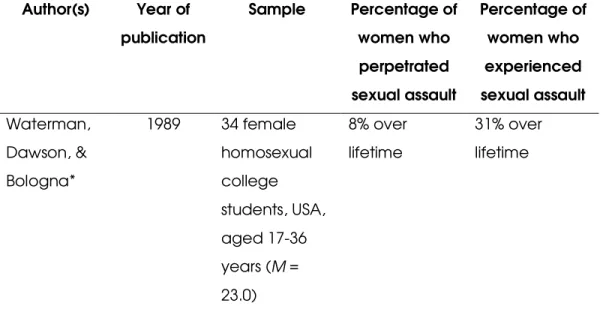
Prevalence Data of Female-Perpetrated Date and Acquaintance Sexual Assault of Female Victims
Author(s) Year of publication Sample Percentage of women who perpetrated sexual assault Percentage of women who experienced sexual assault Waterman, Dawson, & Bologna* 1989 34 female homosexual college students, USA, aged 17-36 years (M = 23.0) 8% over lifetime 31% over lifetime
Table 6
Prevalence Data of Male-Perpetrated Date and Acquaintance Sexual Assault of Male Victims
Author(s) Year of publication Sample Percentage of men who perpetrated sexual assault Percentage of men who experienced sexual assault Waterman, Dawson, & Bologna* 1989 34 male homosexual college students, USA, aged 17-36 years (M = 23.0) 6% over lifetime 21% over lifetime Hickson 1994 930 men, England & Wales, age: median = 29.0 24% over lifetime
* Note: This study questioned participants on sexual assault perpetrated by partners.
Prevalence of attempted and completed rape. Prevalence data of attempted and completed rape are presented in Table 7 Table 8. These tables consider female victims of male-perpetrated assault only, and are presented in chronological order. Most studies determined that attempted and completed rape prevalence rates were generally lower than other forms of sexual assault, such as forced kissing and sexual coercion (e.g., Koss & Oros, 1982; Zawacki et al., 2003).
However, it is clear that young women are subject to rape situations to a high degree. In addition, in many studies, particularly those utilising men’s reports of their own perpetration, rates of completed rape are higher than those of attempted rape, indicating that when attempts at non-consensual sexual intercourse are made, they are often successful.
Table 7
Prevalence Data of Attempted or Completed Rape Reported by Female Victims Author(s) Year of publication Attempted rape Completed rape Kanin 1957 9% N/A
Koss & Oros 1982 N/A 6%
Koss, Gidycz, & Wisniewski 1987 12% 15%
Muehlenhard & Linton 1987 N/A 21%
Koss 1988 12% 16%
Mills & Granoff 1991 22% 17%
Abbey, Ross, McDuffie, & McAuslan
1996 8% 23%
Testa & Livingston 2000 8% 7%
Table 8
Prevalence Data of Attempted or Completed Rape of Female Victims, Reported by Male Perpetrators
Author(s) Year of publication Attempted rape Completed rape
Koss, Gidycz, & Wisniewski 1987 3% 4%
Muehlenhard & Linton 1987 N/A 15%
Koss 1988 3% 5%
Mills & Granoff 1991 9% 2%
Abbey, Ross, McDuffie, & McAuslan
1996 1% 9%
Calhoun, Bernat, Clum, & Frame
1997 N/A 6%
Abbey, McAuslan, & Ross 1998 N/A 9%
Abbey, McAuslan, Zawacki, Clinton, & Buck
With regard to male victims, both heterosexual and homosexual, the specification of rape in the measures used is rare. However, the research that does make this discernment indicates that rape is more common than other forms of sexual assault. For example, in a study of 22 male victims in the United Kingdom, King (1992) established that while only 14% of male victims had experienced attempted anal intercourse, 77% were the victims of completed forced anal
intercourse. Moreover, King (1992) reported that up to 50% of the male victims had been subject to other forms of sexual assault, including masturbation. Similarly, in the study by Hickson et al. (1994), 50% of participants were subject to attempted or completed anal
penetration. This finding is consistent with that of Stermac et al. (2004) who reported that between 54% and 60% of participants had
experienced anal assaults; indeed, anal penetration represented the most common form of reported assault.
Prevalence in Australia.The studies discussed generally assess the prevalence of acquaintance and date sexual assault in samples of young people in the USA and UK. The most recent study to investigate prevalence in Australia was the Personal Safety Survey, conducted in 2005. Of the 93,700 women who reported experiencing a sexual assault during the 12 months prior to the survey, 39% indicated that the
perpetrator was a family member or friend, and 32% reported that the perpetrator was another known person. A significantly lower proportion of men reported experiencing a sexual assault; however, the
proportion of acquaintance sexual assault was similar. Of the 47,300 men reporting an assault, 44% stated that the perpetrator was a family member or friend and 35% reported that the perpetrator was another known person (Australian Bureau of Statistics, 2005).
Location of Sexual Assault
Considerations of the locations that increase the likelihood of sexual assault occurring have generally indicated that such incidents
tend to occur in situations where a perpetrator and victim are not accompanied by others, or where a perpetrator has access to a
number of potential victims. Koss (1988) determined that 86% of date or acquaintance sexual assaults occurred away from a university of
college campus. Subsequent studies by Abbey and colleagues (Abbey, 2002; Abbey et al., 1998) estimated that two-thirds of such assaults occurred in either the perpetrator’s or the victim’s home. Ullman, Karabatsos, and Koss (1999) also revealed that more severe sexual assaults were more likely to occur during spontaneous or unplanned social gatherings, such as parties, than during planned situations, such as individual or group dates. The likelihood of sexual assaults occurring in homes is also apparent with regard to male victims. Participants in Stermac et al.’s (1996) study reported that a private home was the location of 43% of reported assaults, while private vehicles were the setting for an additional 14% of assaults.
Methods of Committing Assault
The weight of evidence indicates that a significant degree of both verbal coercion and forceful threats or actions are used in
occurrences of acquaintance and date sexual assault, and that these methods are used both by both male and female perpetrators against both male and female victims. The research pertaining to male
perpetrators and female victims displays a notable discrepancy in rates reported by offenders and victims. Koss and colleagues have provided support for these contentions via several empirical studies. For
example, Koss and Oros (1982) established that 21% of the 2,016
women in their study reported that a man had threatened to use force in an attempted or completed sexual act, while 54% reported
experiencing the use of force on such occasions. Of the 1,846 male participants, 4% reported using a threat of force with a female victim, and 14% reported using force to engage in sexual activity. Verbal coercion was experienced by 48% of female victims, and was used by
39% of male perpetrators. Similarly, Koss et al. (1987) revealed that 43% of their 3,187 female participants reported experiencing the threat or use of force in a date or acquaintance sexual assault situation, while 6% of the 2,972 male participants reported threatening or using force. Verbal coercion was reported by 69% of female victims, and 29% of men reported using this method of engaging in a sexual act.
Methods of committing date or acquaintance sexual assault against male victims have also been investigated. Female perpetrators in Struckman-Johnson and Struckman-Johnson’s (1998) study reported a significant degree of verbal coercion, including verbal persuasion (used by 75% of participants), bribes (used by 6% of participants) and threatening to end the relationship (used by 19% of participants). Eight percent of respondents reported using physical restraint, while 1% had inflicted physical harm in an attempt to engage in sexual activity with a male partner. Higher rates of such methods were reported by
participants in Anderson’s (1998) study. Again, the use of verbal coercion was most prevalent, with women threatening to end the relationship with the male victim (used by 32% of participants), saying things they didn’t mean (used by 43% of participants), using verbal persuasion (used by 35% of participants), and questioning their partner’s sexuality (used by 33% of participants). With regard to
physical force, 28% of participants reported threatening physical force, 20% reported using physical force, and 7% threatened to self-harm in order to partake in sexual activity with a male.
Resisting Sexual Assault
It has been asserted that female victims have difficulty in effectively resisting date or acquaintance sexual assault due to the fact that the perpetrator is often a familiar and trusted person. When asked to imagine being in a sexual assault situation, female
participants have reported a moderate likelihood of using such resistance strategies as verbal assertiveness and a low likelihood of