Changing business behaviour
-would bearing the true cost of poor
health and safety performance
make a difference?
Prepared by
Greenstreet Berman Ltd
for the Health and Safety Executive
Changing business behaviour
-would bearing the true cost of poor
health and safety performance
make a difference?
Michael Wright and Sara Marsden
Greenstreet Berman Ltd
First Base
Gillette Way
Reading
Berkshire RG2 0BP
Previous research demonstrates that the cost of occupational ill-health and injuries and, specifically, the cost of employers’ liability insurance does not motivate UK employers. Also, rehabilitation has a relatively low status. The Health and Safety Commission’s Revitalising Health and Safety strategy (RHS) states that the “compensation, benefits and insurance system must motivate employers…” and “The Government sees a case for reforming the arrangements for employers’ liability insurance..”. This study has found that workers’ compensation arrangements in other countries positively motivate health and safety management and, in some cases, rehabilitation. This is achieved by integrating rehabilitation into the compensation process, including a greater proportion of ill-health and injury costs into a single no fault insurance scheme and linking premiums to performance. There are also examples of innovative ways of helping smaller firms. UK insurers indicate that, notwithstanding examples of good practice, they are constrained by the Employers’ Liability Regulations and competitive pressures. UK employers indicate that, notwithstanding some reservations, they would improve standards of health and safety and rehabilitation, in response to new arrangements. The introduction of new insurance arrangements could contribute significantly to RHS objectives. It is recommended that the options in this report be elaborated and assessed.
This report and the work it describes were funded by the Health and Safety Executive (HSE). Its contents, including any opinions and/or conclusions expressed, are those of the authors alone and do
St Clements House, 2-16 Colegate, Norwich NR3 1BQ First published 2002
ISBN 0 7176 2362 9
All rights reserved. No part of this publication may be reproduced, stored in a retrieval system, or transmitted in any form or by any means (electronic, mechanical, photocopying, recording or otherwise) without the prior written permission of the copyright owner.
CONTENTS
EXECUTIVE SUMMARY……….……….………...ix - xv
1 INTRODUCTION ... 1
1.1 BACKGROUND... 1
1.2 SCOPE OF THIS PROJECT... 2
2 THE UK POSITION ... 4
2.1 INTRODUCTION... 4
2.2 CURRENT EMPLOYERS’ LIABILITY AND INDUSTRIAL INJURY BENEFITS... 4
2.2.1 Industrial injuries benefit... 4
2.2.2 Employers’ liability in the UK... 6
2.2.3 Cost of “integrated” occupational injury and disease insurance... 7
2.2.4 Work Related Road Traffic Accidents... 12
2.3 RESEARCH ON EMPLOYERS’ MOTIVATION IN THE UK... 13
2.3.1 Introduction... 13
2.3.2 Factors motivating proactive health and safety management ... 13
2.3.3 Evaluation of the Good Health is Good Business Campaign ... 15
2.3.4 Industry specific studies... 16
2.4 OTHER UK INSURANCE SCHEMES... 17
2.4.1 Introduction... 17
2.4.2 The Clinical Negligence Scheme for Trusts (CNST)... 18
2.4.3 Fleet insurance... 20
2.4.4 Public liability... 21
3 THE OVERSEAS POSITION... 22
3.1 INTRODUCTION... 22
3.2 SELECTION PROCESS... 22
3.3 USA ... 23
3.3.1 Introduction... 23
3.3.2 How premiums are set ... 25
3.3.3 The experience modification rating ... 26
3.3.4 Recent developments... 28
3.3.6 Product liability... 30
3.4 CANADA... 31
3.4.1 Introduction... 31
3.4.2 Experience modification rating ... 34
3.4.3 Concerns about workers' compensation in Canada... 38
3.4.4 Recent developments... 40
3.4.5 MAP - Merit Adjusted Premium Plan for Small Businesses... 40
3.4.6 (Alberta) Partners in Injury Reduction Program ... 41
3.4.7 Safe Communities Incentive Program... 42
3.5 CONTINENTAL EUROPE... 45 3.5.1 Introduction... 45 3.5.2 Overview of arrangements ... 45 3.5.3 Germany ... 48 3.6 AUSTRALIA... 52 3.6.1 Introduction... 52 3.6.2 Recent debates... 54 3.6.3 Recent developments... 56
3.6.4 The impact of EMR ... 58
3.7 DISCUSSION OF UK AND OVERSEAS RESEARCH... 62
3.7.1 Introduction... 62
3.7.2 The motivational impact on employers of schemes... 63
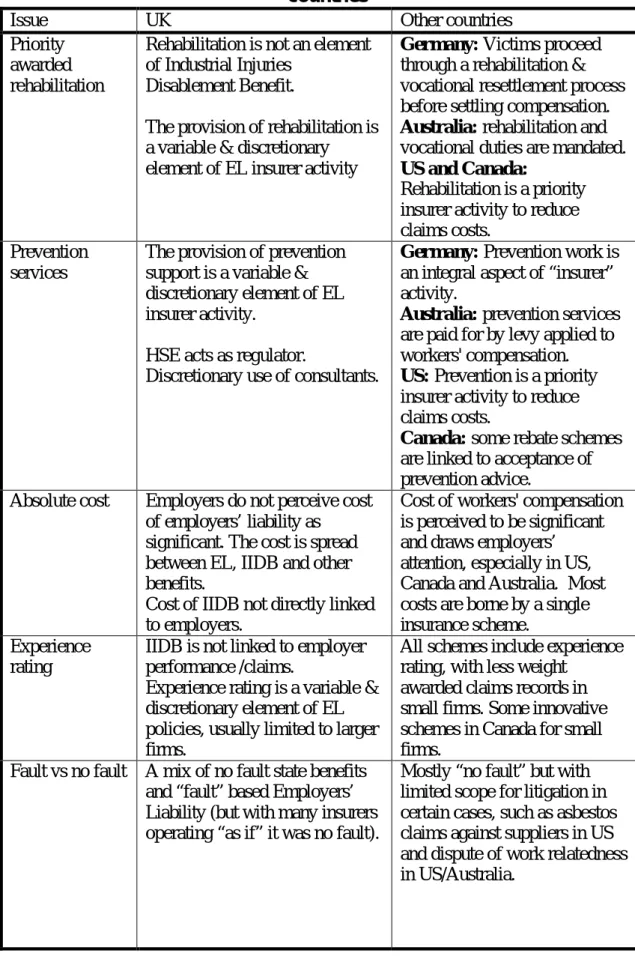
3.7.3 Comparison of UK and overseas arrangements... 65
3.7.4 Options prompted by overseas review ... 68
3.7.5 Options arising from other UK insurance instruments ... 71
4 CONSULTATION WITH UK INSURERS ... 72
4.1 INTRODUCTION... 72
4.2 SUMMARY OF CONSULTATION RESPONSES... 72
4.2.1 What is already done? ... 72
4.2.2 Potential opportunities within current legislative framework ... 74
4.2.3 Impact of major changes to employers’ liability arrangements ... 78
4.2.4 General points raised in consultation... 81
4.3 CONCLUSIONS... 82
5.1 INTRODUCTION... 84
5.2 QUESTIONNAIRE DESIGN... 84
5.3 SURVEY STRUCTURE... 86
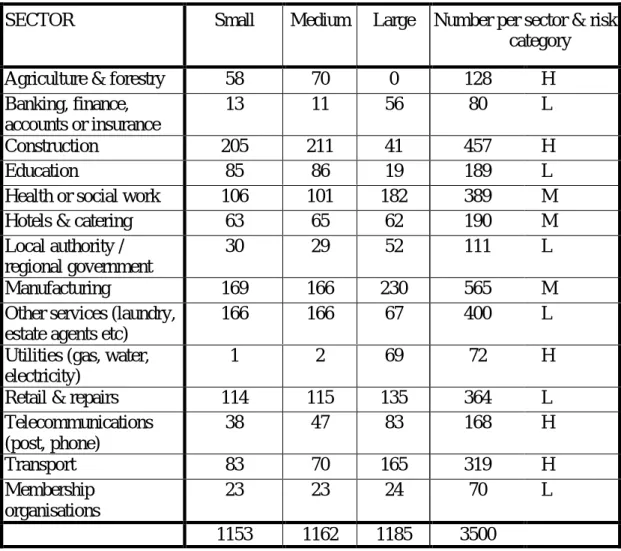
5.3.1 Planned structure ... 86
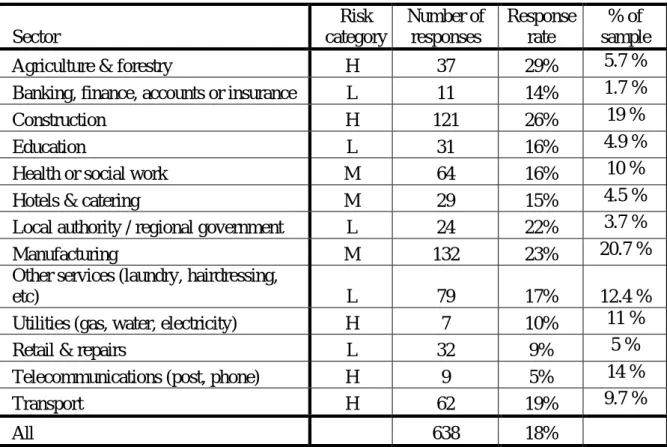
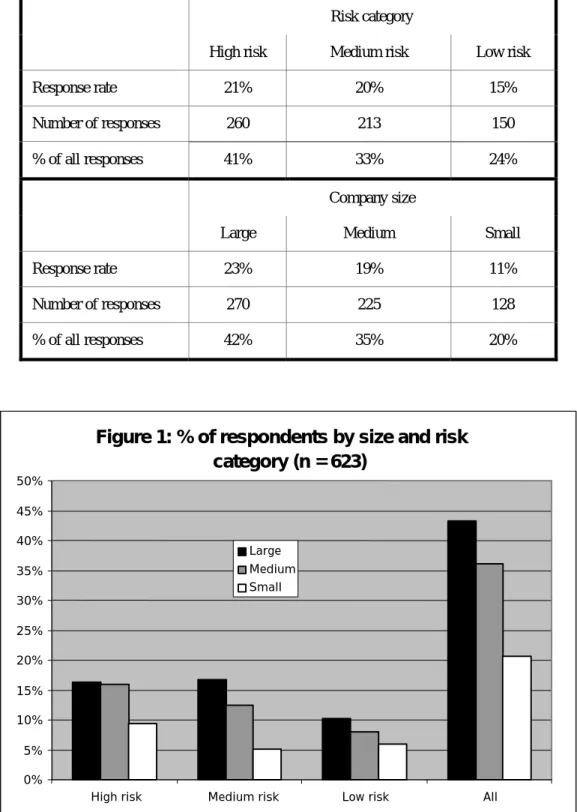
5.3.2 Actual sample structure and response rates... 88
5.3.3 Statistical confidence ... 91
5.4 OVERVIEW OF MAIN FINDINGS... 91
5.5 RESULTS... 94
5.5.1 Introduction... 94
5.5.2 Reported cost and perception of EL ... 94
5.5.3 Correlation of size and EL cost with responses... 97
5.5.4 View of rehabilitation ... 101
5.5.5 Interest in joining a club ... 103
5.5.6 Perception of impact of a no fault scheme ... 103
5.5.7 Response to a large increase in cost... 104
5.5.8 What is perceived to be “a lot”? ... 106
6 DISCUSSION OF RESEARCH FINDINGS... 107
6.1 INTRODUCTION... 107
6.2 COMPARISON OF RESEARCH FINDINGS... 107
6.2.1 The importance of employers’ liability insurance ... 107
6.2.2 Awareness of IIDB... 107
6.2.3 Access to rehabilitation ... 107
6.2.4 Reaction to an increase in costs ... 107
6.2.5 Impact of a rebate/surcharge ... 108
6.2.6 Encouragement of rehabilitation... 108
6.2.7 Impact of a no fault scheme ... 108
6.3 DISCUSSION OF IMPLICATIONS FOR THE UK... 108
6.3.1 Attitudes towards rehabilitation and IIDB ... 108
6.3.2 Impact of an integrated scheme... 108
6.3.3 Would a performance related rebate/surcharge be useful? ... 110
6.3.4 What if a no fault scheme was to be introduced? ... 110
7 INSURERS’ FEEDBACK ON FEASIBILITY OF OPTIONS... 111
7.2 BACKGROUND COMMENTS... 111
7.3 KEY POINTS FROM THE INTERVIEWS... 112
7.4 SUMMARY OF FEEDBACK... 113
7.4.1 Linking premiums to health and safety performance ... 113
7.4.2 Clubs... 115
7.4.3 Rehabilitation... 117
7.4.4 No fault schemes... 120
7.4.5 Merging IIDB & EL?... 122
7.4.6 Best practice model ... 122
7.4.7 Pay as you go ... 123
7.4.8 Blue sky ideas... 123
8 DISCUSSION OF OPTIONS FOR THE UK ... 125
8.1 INTRODUCTION... 125
8.2 OPTION 1: ENCOURAGE VOLUNTARY INITIATIVES AMONGST INSURERS... 125
8.2.1 A best practice model / approved scheme ... 125
8.2.2 Rehabilitation... 126
8.2.3 Surcharge / rebates... 128
8.2.4 Responsible premium setting... 128
8.2.5 De facto no fault agreements ... 129
8.2.6 Access to health and safety support ... 129
8.2.7 Helping smaller firms ... 129
8.2.8 Advantages and disadvantages of voluntary initiatives ... 130
8.2.9 Encourage uptake of legal redress and rehabilitation amongst IIDB claimants ... 131
8.3 OPTION 2: REFORM OF EL AND IIDB... 132
8.4 OPTION 3: REPLACEMENT OF EMPLOYERS' LIABILITY REGULATIONS AND IIDB... 134
8.4.1 A new scheme ... 134
8.4.2 Reduce risk to insurers ... 136
8.4.3 Transition issues... 137
8.5 RECOUPING NHS COSTS... 138
9 CONCLUSIONS... 139
9.1 THE CURRENT UK POSITION... 139
9.2 THE POSITION IN OTHER COUNTRIES... 140
9.3.1 General impact... 140
9.3.2 Relative strength of each option ... 141
9.3.3 Impact of change on Revitalising H&S strategy... 141
9.4 IMPLEMENTATION OF ACTION PLAN POINT V. ... 142
10 RECOMMENDATIONS... 143
11 REFERENCES... 144
Appendix A: Proforma for consultation with UK insurers Appendix B: Questionnaire issued to UK employers Appendix C: Employer survey results
EXECUTIVE SUMMARY
A key aim of the Revitalising Health and Safety strategy is to motivate employers to improve their health and safety performance. Item (v) in the 10-point Strategy Statement notes that:
“The compensation, benefits and insurance system must motivate employers to improve their health and safety performance, in particular by securing a better balance in the distribution of the costs of health and safety failures. When things do go wrong, employers must also be motivated to rehabilitate injured workers so as to maximise their future employability. The Government sees a case for reforming the arrangements for employers’ liability insurance in pursuit of these goals.” (p 18, RHS 2000)
In addition, Action Point 5 notes that many consultees suggested that the insurance industry could do more to promote health and safety standards. It mentions the use of auditable management standards, loading and discounting premiums and offering free advice on risk management together with consultancy services. It is suggested that further consideration should be given to how the current practice of adjusting premiums and giving advice to larger firms could be transferred to lower hazard sectors and smaller firms.
There are currently two main forms of insurance, namely Employers’ Liability insurance under which employees may receive damages via tort, and Industrial Injuries Disablement Benefit that provides no fault state benefits. Academic researchers have indicated that the Industrial Injuries Disablement Benefit scheme offers no incentive for companies to improve their safety records. As elaborated in this report, there is little evidence that Employers’ Liability insurance provides UK firms with an incentive to improve occupational health and safety.
Review of overseas experience
We reviewed the Canadian, USA, German and Australian occupational insurance systems (termed workers’ compensation) as they meet the following criteria:
• They relate the costs of injury and ill-health to the safety performance of firms;
• They apply the costs of ill-health and injury to employers;
• Information is available on the design and operation of the scheme;
• The country is similar in economic development to Great Britain, and;
• Information is available on the impact of the scheme on the behaviour of employers. In all cases employers pay for insurance that covers employees’ (and dependents in case of death) costs and lost earnings, and, in some cases, pain and suffering. In this way, workers’ compensation is an employer-funded form of insurance, analogous to UK employers paying for employees’ private health and disablement (loss of earnings) insurance. In this sense the issue of “fault” is not relevant. This is in contrast to Employers’ Liability insurance which provides funds to the employer to cover the costs they incur arising from employees’ litigation. The main conclusions from the review of overseas experience with accident insurance are summarised below.
Overseas experience: Can work related injury and ill-health insurance encourage higher standards of health and safety?
On balance the research indicates that premium discounts, premium modification and rebate schemes can positively influence the management of occupational health and safety. It appears that for an experience-rating scheme to have a significant positive impact:
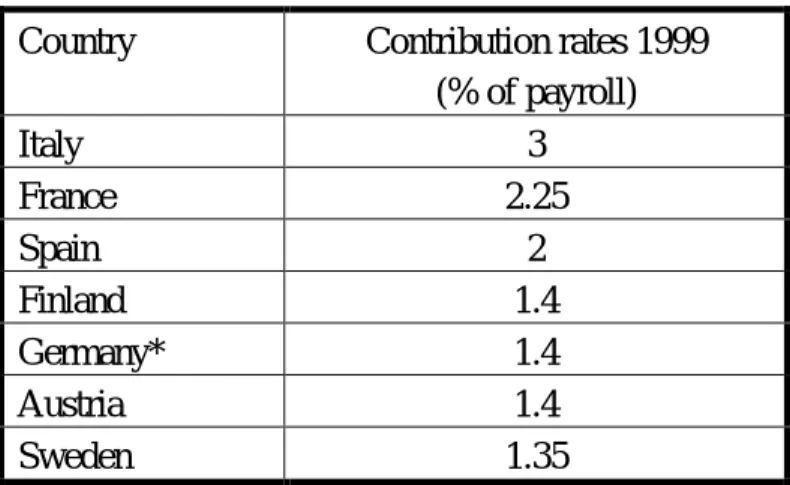
• The cost of insurance needs to be perceived to be high in absolute terms – rates above 1% or 2% of payroll appear to motivate employers;
• When the national average rate exceeds 3% of payroll it appears that employers challenge the affordability and legitimacy of the cost of insurance;
• The value of discounts or rebates needs to be perceived to be high in either absolute terms or relative to the firms overall turnover /profit – typically at least 25% of the normal premium;
• Rebates / discounts need to be received within 1 to 3 years to influence firms;
• If rates vary greatly from one year to another this can cause business concern, and;
• The extent to which annual premiums can be adjusted to reflect annual claims needs to be moderated by the retention of funds to cover long tail claims.
Small firms and firms in lower risk sectors are less likely to be influenced by these schemes, especially in those cases where premiums for small firms are based on occupational class alone. However, there are a few examples where insurance costs are related to the performance of a group of small firms. These schemes appear to have a positive on influence health and safety management, including positive peer pressure for better safety.
Overseas experience: What can be done to facilitate the link between insurance and safety performance?
The provision of low cost advice and support appears to an important factor in encouraging and enabling firms, especially small firms, to realise the offer of reduced premiums / rebates. Such advice is often provided by employer financed insurance boards / societies rather than government bodies.
On the other hand, the motivational impact of experience rating can be diluted by factors such as competition between insurers which can result in insurers offering lower rates to firms regardless of actual claims. It is also pertinent to note that the link between premiums and employer performance is weaker in the case of diseases with long onsets since the claims, and so the adjustment in premiums, lag behind the exposure.
In addition, the link between premiums and performance can be reduced by “technical” problems. In particular, schemes have become unbalanced, with payments exceeding contributions due to factors such as competition and regulation of premiums. This can lead to the need to keep a proportion of firms’ premiums at a constant level to bring the scheme back into balance.
However, these negative mediating factors do not appear to have overridden the potential positive impact of these schemes when national statistics are considered.
Overseas experience: What is given priority – rehabilitation or compensation?
Rehabilitation and return to work programs are awarded greater importance in these systems, compared to the UK, due to the link between the cost of claims and the duration of absence. The costs of rehabilitation and return to work are borne by insurance and viewed as an integral part of a system in some schemes. This is particularly so where the goal of rehabilitation and return to work is prioritised above compensation, such as in Germany where compensation is decided after completion of a rehabilitation process. Indeed, a requirement for employers to provide rehabilitation and return to work support is viewed as being an integral part of ensuring the employer bears the cost of work related injury and ill-health.
It has been noted in some countries such as Australia that a conflict can arise between the goals of rehabilitation and compensation, especially where an adversarial system exists for awarding compensation. This leads to pressure to mandate rehabilitation and / or link insurance premiums more clearly to uptake of rehabilitation.
Overseas experience: Can the cost of compensation be de-motivating?
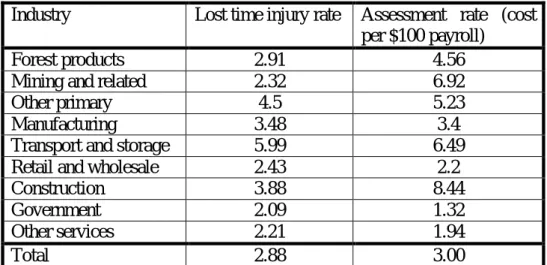
Employers in some of the countries surveyed have reacted negatively to workers’ compensation when the cost starts to exceed a certain level, typically an average of about 3% of payroll. (Note that an average cost of 3% across all firms can encompass rates of 8% for higher risk sectors such as construction.) The costs are then characterised by employers as unaffordable. Reactions may include seeking relocation, contesting a higher proportion of claims and lobbying for a change in rules. This has led to reforms in countries such as Australia including reducing benefit levels, limiting the range of conditions that are compensated, restricting access to legal procedures, and tightening rules for establishing if a condition is work related.
Comparison of UK and overseas arrangements
It should be noted that the purpose of schemes in other countries differs from the UK in several respects, namely:
• UK arrangements were designed to ensure employers have funds to meet costs arising from employees’ litigation for compensation, and were not designed to motivate health and safety or rehabilitation;
• The US, Canadian, Australian and German schemes explicitly aim to provide a financial motivation for employers to reduce the number and severity of injuries and cases of ill-health – particularly by the use of experience rating and ensuring all (recognised) costs are funded by a single benefits scheme;
• Germany appears to prioritise rehabilitation over compensation, limiting compensation to loss of earnings after rehabilitation and vocational retraining, and makes provision of prevention services an integral element of insurer activity;
• The US, Canadian and Australian schemes aim to reduce the uncertainty about compensation costs and the level of legal costs by operating a “no fault” scheme with capped benefit levels;
• Canadian, Australian and German schemes have been designed to increase the level of health and safety advice available to SMEs as an integral part of insurer activity;
• Overseas schemes aim to cover all work related injuries, often including road traffic accidents, and hence place a different boundary on “work”. This in part reflects a simple difference in demarcating the scope of each form of accident insurance;
• The cost of employers’ liability in the UK cannot be compared with the cost of overseas schemes, as the cost of injury and ill-health in the UK is spread across a number of state benefits and insurance schemes whilst overseas insurance schemes are more integrated;
• Workers’ compensation is conceived as a form of insurance that covers the costs and lost earnings caused by injury – in the same way that other (non-occupational) insurances aim to cover the consequences of (say) ill-health from natural causes. It is also pertinent to note that some schemes are conceived as a “bill payment” or “pay as you go” system whereby premiums are “simply” based on current claim related costs. The level of contributions is calculated to cover the previous year’s total claims (from all firms) and total related costs, although premiums may be “smoothed” across years to avoid sudden changes in premiums. Such schemes are operated at an “industry” level rather than on a company-by-company basis. This may be contrasted with the principle (current in the UK) of insurers providing unlimited cover for claims arising from any one year (up to a limit per claim) via premiums charged in that year.
The cost of workers’ compensation is in the range of 1.5% to 3% of payroll, depending on which country you consider. The cost of employers’ liability is approximately 0.23% of the total salary bill in the UK. We have identified current estimates of the costs of ill-health and injury in the UK. After excluding non-injury costs, such as equipment damage, the costs of injury and ill-health in the UK are about:
• 1% of payroll if only tangible costs are included, i.e. excluding pain and suffering,
• 2.5% of payroll if pain and suffering are included.
Thus, the cost of workers’ compensation in other countries is comparable to the actual cost of work related ill-health and injury in the UK.
UK insurers’ opinions
Consultation with insurers indicates that they believe they already operate many of the mechanisms suggested by the review of overseas practices, as far as is possible within the limits of commercial and legal requirements in the UK. It is apparent that practices vary and that there are examples of “good practice” that could be applied more widely. In particular, there is scope for the following practices to be more widely applied:
• Adopting a de facto “no fault” approach to claims, and;
• Promoting the role of rehabilitation prior to the settlement of claims.
In order for insurance to be a more effective vehicle for promoting health and safety, significant changes are required in Employers’ Liability Regulations. Whilst some insurers accept that an increase in employers’ liability (EL) premiums may provide employers with an incentive to improve health and safety, the increased commercial risk posed to insurers by unprofitable EL would need to be addressed. Also, reform of
employers’ liability should consider how it influences the uptake and timing of rehabilitation, and the balance between compensating and rehabilitating claimants. It appears that insurers would welcome reforms that placed a greater priority on rehabilitation. This would offer both potential reduction or containment of compensation costs and the creation of a scheme that presents improved injury/illness recovery chances and that is a better vehicle for improving health and safety performance.
Survey of UK employers
A survey of UK employers has been completed to inform the discussion of whether potential changes to insurance arrangements may prompt changes in employer behaviour. The main conclusions are set out below.
The significance of EL costs
• Employers’ Liability is perceived to be a significant business expense that relates to the size of the organisation and, to a lesser extent, to the risk category of firms.
• The majority of large and medium sized firms report that they are trying to reduce the cost of employers’ liability. Only a minority of small firms state this view.
Employers’ perceived control of health and safety
• Employers believe they control health and safety in their organisation but only half believe that the cost of EL is related to their standard of management.
• There is a clear association between company size and the perceived link between their health and safety performance and the cost of EL. Whilst the majority of large and medium sized firms believe that the cost of EL is related to their performance, only a small minority of small firms share this belief.
Employers’ access to health and safety and rehabilitation services
• The vast majority of organisations have access to some health and safety expertise.
• A minority of employers are familiar with how to get access to rehabilitation services. Small and medium size employers are least aware of how to get access to rehabilitation services.
Employer awareness of IIDB
• The majority of employers are unfamiliar with the Industrial Injuries Disablement Benefit (IIDB) scheme, particularly small and medium size employers.
Employer attitudes towards the balance of rehabilitation and compensation
• Employers do on the whole agree that injured employees should have rehabilitation before compensation is settled, with a small majority agreeing that compensation should be withheld if the employee refuses suitable rehabilitation.
• About half of firms agree that employers should pay for rehabilitation, and that they would prefer to insure against the costs of rehabilitation.
• The attitude towards rehabilitation does not appear to vary according to company size, except on the question of whether employers should pay for rehabilitation. Small firms are less likely to agree with this proposition.
Acceptance of a cost increase to pay for health and safety support
• A small minority of firms would accept a 20% increase in the cost of EL to pay for improved health and safety services. This appears to be related to company size with far fewer large firms accepting a cost increase than smaller firms.
Interest in joining a club
• About a third of firms of all sizes express an interest in becoming members of a “club” wherein improved performance would be rewarded by reduced premiums.
Perceived impact of a no fault scheme
• The majority of firms of all sizes agree that a no fault scheme would lead to increased claims, increased cost and fraud without reducing legal costs and without being fairer for employees.
What is “a lot”?
• The vast majority of firms believe that 0.25% to 3% of payroll is “a lot”; with over 50% falling in the range 0.25% to 1%.
Employers’ anticipated response to an increase in EL costs
• If the cost of EL were to increase significantly the majority of firms would attempt to improve health and safety, contest claims, improve rehabilitation, and avoid the recruitment of previously injured persons. About half would consider changing insurers to reduce costs.
Motivational impact of a 50% surcharge/rebate
• The majority of firms indicate that they would be motivated by the prospect of a 50% surcharge or rebate to try to improve health and safety.
Options for change
We have outlined three options, namely:
1. Voluntary “best practice” initiatives that do not require any regulatory changes – as per Action Point 5 of the HSC’s Revitalising Health and Safety Strategy;
2. Reforms to Employers’ Liability and IIDB schemes that would require regulatory change, and;
3. Replacement of Employers’ Liability Regulations and IIDB with an entirely new form of employee occupational injury and ill-health insurance, drawing on overseas experience.
An implicit aspect of the options is that part of the “cost” of injury and ill health can be borne by employers by increasing the level of rehabilitation (assuming that the additional cost is indeed borne by employers).
Conclusions
Our research indicates that UK employers would be motivated to improve occupational health and safety and rehabilitation if the cost of insurance increased and they believed there was a link between their performance and the cost of insurance. Employers would need to believe that their premiums would fall significantly if they improved their health and safety performance. Research from other countries indicates that the operation of a scheme with performance related premiums has led to significant reductions in serious injuries. The impact of such schemes is dependent on their design.
It would be sufficient to integrate “tangible” costs of ill-health and injury into a single insurance scheme for the cost (at about 1% of payroll) to be a motivator. If the subjective value of pain and suffering were included this would raise the cost to a level that the vast majority of firms perceive to be a lot (at about 3% of payroll) and would approach the level that overseas employers have (on occasion) objected to.
Notwithstanding employers’ fears about an increase in claims, the feedback from insurers and the Department of Works and Pensions suggests that there is already a very high level of awareness of the right to compensation and the “no win no fee” legal schemes probably mean most casualties already enter claims. Thus, it could be that a no fault scheme would not lead to a significant increase in claims in the UK.
It is suggested that Option 3 (replacing EL with a no fault scheme) would have the greatest impact on employer behaviour because it would facilitate the greatest “transfer” of costs to employers. Nonetheless, Option 2 would also have a significant impact in our opinion, especially if the regulatory requirements for rehabilitation and “responsible” pricing of EL were introduced. It is uncertain whether the voluntary initiatives of Option 1 would have the same influence, as the cost of EL may not be influential.
Recommendations
The evidence available to this study indicates that a reformed UK insurance process would provide a significant motivation to employers to improve health and safety and rehabilitation. It is therefore recommended that the ideas emerging from this study be taken forward and awarded appropriate weight by the HSE and HSC.
In the first instance, it is recommended that employers’ liability and rehabilitation “best practices” be drawn together into a “best practice model” that is then promoted as an industry standard. A number of insurers have developed schemes that aim to encourage better health and safety and to integrate rehabilitation into the claims process. Given the availability of such examples in the UK and overseas it should be possible for such a model to be developed within a relatively short time, such as one year.
Secondly, studies and consultations should be carried out to elaborate how current regulations could be reformed or replaced, as per Options 2 and 3 in this report. Therefore, it is recommended that a study, involving consultation with key stakeholders, be launched in the short term to explore and identify practical ways forward for the reform of the UK occupational injury and ill-health insurance arrangements.
1 INTRODUCTION
1.1 BACKGROUND
A key aim of the Revitalising Health and Safety strategy is to motivate employers to improve their health and safety performance. Various approaches are noted, such as the provision of a ready reckoner to help drive home the benefits, new challenges on annual reporting, and commitments to legislate to ‘make the punishment fit the crime’. Item (v) in the 10-point Strategy Statement notes that:
“The compensation, benefits and insurance system must motivate employers to improve their health and safety performance, in particular by securing a better balance in the distribution of the costs of health and safety failures. When things do go wrong, employers must also be motivated to rehabilitate injured workers so as to maximise their future employability. The Government sees a case for reforming the arrangements for employers’ liability insurance in pursuit of these goals.” (p 18, RHS 2000)
In addition, Action Point 5 notes that many consultees suggested that the insurance industry could do more to promote health and safety standards. It mentions the use of auditable management standards, loading and discounting premiums and offering free advice on risk management together with consultancy services. It is suggested that further consideration should be given to how the current practice of adjusting premiums and giving advice to larger firms could be transferred to lower hazard sectors and smaller firms.
There are currently two main forms of insurance, namely Employers’ Liability insurance under which employees may receive damages via tort, and Industrial Injuries Disablement Benefit that provides no fault state benefits. Academic researchers have indicated that the Industrial Injuries Disablement Benefit scheme offers no incentive for companies to improve their safety records and implicitly entails low risk sectors subsidising higher risk sectors. As elaborated later in this report, there is little evidence that the costs of Employer Liability insurance or the manner in which Employer Liability operates, currently provides firms with an incentive to improve occupational health and safety.
The possibility of revising these schemes has been the subject of debate as part of the Government’s programme of welfare reform. Indeed, House of Commons research (e.g. Research paper 98/51) has noted criticisms of the current tort based arrangements, such as its liability oriented adversarial nature and focus on defendant culpability as opposed to the needs of the plaintiff. The 1998 research paper notes that other countries have introduced alternative no fault arrangements. It is the Government’s aim to provide better protection from the risks and consequences of occupational disablement by improving incentives for prevention and rehabilitation, and realising the link between prevention, rehabilitation and compensation.
Therefore, this study aims to explore how changes to the way in which the financial costs of health and safety failures are distributed, and in particular insurance changes such that businesses cannot shelter from some of the costs, could provide an incentive to firms to improve health and safety performance. Currently employers can rely on insurance to shelter from many of the costs of poor safety performance. Also, many costs are borne by the state and are therefore not reflected in employer liability or other company insurance premiums. This study focuses on how current employers’ liability and other forms of insurance can act inadvertently to reduce the focus on improving H&S, and to consider what changes might engender a greater business focus on these issues.
The study aims to address a number of specific issues. First, it is important to understand to what extent would increased insurance costs promote improvements, and what financial thresholds would be required? Secondly, it is important to consider the relative strengths and weaknesses of alternative schemes. Thirdly, it aims to explore how such changes might be introduced in the UK.
It might be inappropriate to look at ways merely of transferring those costs more fully to businesses, unless it can be shown that businesses have sufficient control over them that the good ones can avoid the financial penalty that might ensue. Thus, this research also looks at how changes in the way that costs are borne by industry might influence business behaviour such that it leads to improved performance. If it can be shown that by transferring certain costs, businesses may start to behave more safely, and hence that the net cost to business (and thereby to society) would reduce, then the net benefit justifies the change. For example, if transferring to business some of the societal costs (e.g. hospital treatment) simply resulted in increased insurance premiums, this might not lead to changes in behaviour. However, if premiums were increased as a consequence of claims history, such that poor businesses carried more of the costs directly, this might motivate them to improve their performance, and thereby reduce costs.
1.2 SCOPE OF THIS PROJECT
The study comprised has six stages of work, as follows:
• Stage 1: Background and literature survey
This entailed the collation and review of existing knowledge and research on the financial motivators for improved health and safety performance. The results were used to develop a framework for considering financial motivators.
• Stage 2: Review schemes in other countries
Various systems exist in other countries for passing the costs of poor health and safety on to the employer. These include hospital and other welfare costs that are borne by the state in the UK. This stage entailed the survey of four systems. Specific consideration has been given to how they attempt to relate costs to firms’ performance. The information is used to identify evidence for whether such arrangements promote higher standards, and the factors that affect whether this is so. The results were combined with
the results of Stage 1, to develop a framework for a survey of UK insurers and businesses and draw out lessons learnt for the UK.
• Stage 3: Survey of UK insurers
UK insurers have already looked to some extent at how changes in the insurance arrangements would affect the risks that they cover. The Association of British Insurers (ABI) has considered the impacts of potential changes to Employers’ Liability Insurance, in its response to the Consultation Document on the Draft Employers’ Liability (Compulsory Insurance) General Regulations, issued by the DETR.
The views of the insurance industry were sought concerning the potential approaches available to make businesses shoulder directly a greater proportion of the costs of poor H&S performance. Specifically, their views have been sought about the feasibility of different approaches, the likelihood that they will lead to changes in business behaviour, and the viability of options for change – both within the current regulatory framework and if these regulations were to change.
• Stage 4: Survey of businesses
A postal survey of organisations was conducted to ascertain their self-reported perception of how potential changes to insurance arrangements would impact their view of the costs of health and safety and their motivation to make improvements.
• Stage 5: Develop conclusions
Conclusions have been drawn about how insurance arrangements could best be developed to motivate employers to improve occupational health and safety. Some initial options are outlined and their advantages and disadvantages are noted.
• Stage 6: Reporting
2 THE UK POSITION
2.1 INTRODUCTION
The aims of this section are to:
• Summarise the current arrangements for providing financial compensation and benefits for persons suffering occupational injury or ill-health;
• Provide an approximation of the cost of occupational injury and ill-health insurance if all of the tangible and intangible costs were borne by a single “integrated” insurance policy;
• Summarise previous research that directly or indirectly indicates to what extent UK employers are motivated to improve health and safety management by the wish to reduce the cost of Employers’ Liability insurance, and;
• Identify examples of other forms of accident related insurance in the UK that aim to provide a link between organisational performance and premiums.
The findings of this section on the position in the UK are compared with a similar summary of schemes and research in other countries in section 3 of this report.
2.2 CURRENT EMPLOYERS’ LIABILITY AND INDUSTRIAL INJURY BENEFITS
It is reasonable to say that the UK currently operates a two-track approach to occupational injury and disease insurance. On the one hand, there is “no fault” access to limited state benefits and, on the other hand, litigation based access to damages under Employers’ Liability insurance. Indeed, it is pertinent to note that the cost of Industrial Injuries Disablement Benefit at £728m in 1998/99 is close to the cost of employers’ liability at £872m in 2000.
2.2.1 Industrial injuries benefit
There are a number of benefit schemes that apply to industrial accidents and diseases, namely:
• Industrial Injuries Disablement Benefit (IIDB): Covers disablement as a result of an accident at work or a disease caused by work. The amount payable is dependent on how serious the disablement is, with a minimum qualifying disability of 14%.
• Statutory Sick Pay: Paid for periods of sick leave between 4 days and 28 weeks.
• Industrial Death Benefit: Paid to surviving dependants. (This benefit is being phased out and no new claims are now allowed)
• Income Support: This may apply where a person on a low income does not sign on at the Job Centre.
• Reduced Earnings Allowance (REA): Also being phased out, this is only available to persons who suffered an accident before 1990 and as a result cannot do their usual job or work with similar pay.
• The Pneumoconiosis etc (Workers' compensation) Act 1979. An employee is entitled to claim a lump sum payment under this act if they are unable to recover damages against an employer for prescribed asbestos related diseases. Negligence need not be proven.
As at 1998/99 the expenditure on these benefits in cash prices was:
• IIDB: £710 m
• Industrial Death Benefit: £49m
• Other industrial injuries benefits: £2m.
The IIDB scheme therefore appears to account for the largest proportion of identifiable benefit costs arising from work related injury and ill-health.
Industrial Injuries Disablement Benefit
An individual can apply for a decision that their injury results from an industrial accident or disease. A medical examination advises the level of disability and expected duration. If a work related condition is established and meets certain time limited criteria (such as contact with asthma causing substances within previous 10 years) the claim can be met. The Industrial Injuries Advisory Council advises on a schedule of prescribed diseases, with an ongoing review.
IIDB is not paid if you were self-employed when the accident happened. IIDB provides for:
• Disablement pension allowance, linked to degree of disability;
• Constant Attendance Allowance (CAA), paid at four different rates;
• Unemployability Supplement, and;
• Exceptionally Severe Disablement Allowance (ESDA) paid when disablement is judged to be 100%.
No IIDB benefits are paid for the first 90 days after an accident.
Disability allowances are set at fixed weekly amounts, such as £79.03 for 70% disablement versus £33.87 for 30% disablement for persons over 18. Similarly, CAA is set at fixed amounts such as £90.40 for Exceptional Rate versus £22.60 for Part -Time Rate. Unemployability supplement is £69.75 (basic rate) with additions for early incapacity.
Whilst the DSS do not instruct individuals to seek compensation through the courts, the Compensation Recovery Unit recovers the cost of social security benefits paid as a result of an accident, injury or disease where compensation has been paid. Benefits are repaid by the compensator, namely the insurer. The compensator, i.e. the insurer, can reduce the amount of damages by the amount of benefit the person has already received. The unit recovered benefits in 30,000 cases in 1995/96.
2.2.2 Employers’ liability in the UK
The aims of this section are to:
• Summarise how Employers’ Liability (EL) currently operates in the UK, and;
• Indicate some typical EL annual premiums for firms in the UK.
There are two pieces of legislation that govern Employers’ Liability insurance, namely:
• The Employers’ Liability (Compulsory Insurance) Act 1969
• The Employers’ Liability (Compulsory Insurance) Regulations 1998.
The Act requires employers to insure against their liability for personal injury to their employees hence ensuring that an employer has at least a minimum level of insurance to cover a claim. The regulations state that the amount of insurance cover that an employer has to provide should not be less that £5 million for each employee involved in any accident. There are also some other legal requirements with regard to certification, employees abroad, and relatives of the employer for example.
Cover provided under an EL policy indemnifies the employer against their legal liability for damages including legal costs resulting from: accidental death, bodily injury, illness and disease. The injured person must sue the firm for damages through litigation and must demonstrate a degree of negligence on the part of the employer, although most cases are settled without court action. The employer may in turn reject liability or claim contributory negligence on the part of the employee. The level of damages is intended to cover loss of earnings and health care costs in full, although they may be reduced if contributory negligence can be established, and an element for pain and suffering. For example, in Mary Watkin vs Birmingham City Council £20,000 of the £200,000 award was for pain and suffering.
There has been an increase in the cost of insurance premiums due to the increasing number of claims and hence the total cost of claims. Between 1981 and 1991 the number of claims almost doubled and between 1986 and 1990 the number of claims arising from accidents increased by a third. The number of claims relating to occupational disease trebled, particularly in relation of noise induced hearing loss, asbestosis, occupational asthma and cancer. Disease accounts for 50% of the claims made. It is thought that much of the increase in the number of claims is due to a greater employee awareness of their ability to claim against their employers’ insurance.
Notwithstanding this, the cost of EL is still only approximately 0.23% of the total salary bill in the UK. The UK total salary bill is estimated to be £380 billion (1997 -98) and the total cost of employers’ liability insurance in 2000 is estimated to be £872 million. In most cases the premium cost is based upon a percentage of the company salary bill, taking into account the industry sector. Premiums are intended to reflect the potential for future claims of the future, as well as recent and past experience.
Wrightson (1996) also comments that many insurance companies requires a company to provide and maintain a good standard of health and safety with the intention of
preventing accident and exposure to harmful agents, in order to minimise/prevent claims of negligence. Wrightson also notes that the companies’ claims experience is taken into account in some cases. Eagle Star Insurance Company Limited, for example, is reported to offer financial rewards to employers whose successful health and safety management system has minimised the number of claims made. The company offers an ‘optional renewal bonus scheme’ which provides a bonus on a sliding scheme of up to 25% on the premium for a claim free history.
2.2.3 Cost of “integrated” occupational injury and disease insurance
As discussed later in this report, other countries aim to cover all work related injuries and ill-health under a single insurance regime. Some of these schemes also make payments for pain and suffering, whilst others are restricted to loss of earnings and additional expenses. Therefore, this section:
• Identifies those injury and ill-health costs that are currently in the UK covered by individuals, the state and EL, such as medical costs, sick pay and loss of welfare, and;
• Provides an estimate of the total of these costs. This estimate is used for a number of purposes, including:
• To provide an indication of what the total cost of an “integrated” work related injury and ill-health insurance might be;
• To provide a comparison with costs covered by accident insurance in other countries;
• For use in surveying UK employers’ reaction to the total cost of an integrated insurance scheme.
As part of this we have reviewed previous studies of the costs of ill-health and injury. In particular, we have used the HSE’s report ‘The cost to Britain of workplace accidents and work related ill health in 1995/6’ and statistics from the Department of Social Security (DSS) on IIDB cash payments. The HSE report draws upon information collected from a number of surveys including:
• The Labour Force Survey 1995/6 (LFS);
• Self-reported Work Related Illness in 1995 survey (SWI95), and;
• 1995/96 Family Resources Survey (FRS).
We have identified costs such as loss of company production, costs of temporary staff and so on, that would not fall within an industrial injuries insurance scheme and excluded them from the estimate. These costs may be pertinent to other types of insurance and include:
• Damage to plant and equipment;
• Loss of output;
• Loss of reputation and good will with employees, customers and the local communities;
• Extra expenditure including administration, management and rescheduling to recover production, and;
• Recruitment of replacement staff
However, it is possible that a new insurance arrangement would lead to changes in claims practices and payment rules. Therefore, we have also sought to identify key variables that may significantly alter the cost.
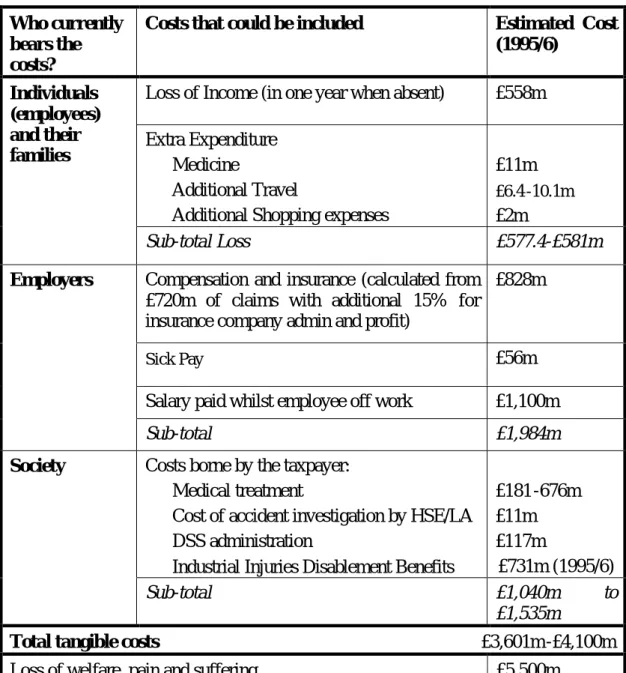
From reviewing the literature regarding the costs of accidents and ill-health it is possible to identify both the costs that could be included in an “integrated” insurance and those that should not. These are summarised in Table 1.
The main “tangible costs” are:
• Individuals’ loss of income (the difference between sick pay, part pay etc and “normal” income;
• Salaries paid to employees whilst absent from work due to injury or ill-health;
• Employers’ Liability premiums;
• NHS costs, and;
• Industrial Injury Disablement Benefits.
One cost that is at present borne by individuals and families is that of pain suffering and grief. This had been converted to monetary terms by the HSE and is estimated at a nominal £5.5 billion per annum (in 1995). However, this is a very difficult and subjective process. In addition, it is not certain that payments would be included in an “integrated” insurance regime. Therefore, we have considered the potential total cost of insurance with and without an allowance for pain and suffering.
Table 1: The costs that could be included in “integrated” insurance Who currently
bears the costs?
Costs that could be included Estimated Cost
(1995/6)
Loss of Income (in one year when absent) £558m Extra Expenditure
§ Medicine
§ Additional Travel
§ Additional Shopping expenses
£11m £6.4 -10.1m £2m Individuals (employees) and their families Sub-total Loss £577.4-£581m
Compensation and insurance (calculated from £720m of claims with additional 15% for insurance company admin and profit)
£828m
Sick Pay £56m
Salary paid whilst employee off work £1,100m
Employers
Sub-total £1,984m
Costs borne by the taxpayer:
§ Medical treatment
§ Cost of accident investigation by HSE/LA
§ DSS administration
§ Industrial Injuries Disablement Benefits
£181 -676m £11m £117m £731m (1995/6) Society Sub-total £1,040m to £1,535m
Total tangible costs £3,601m -£4,100m
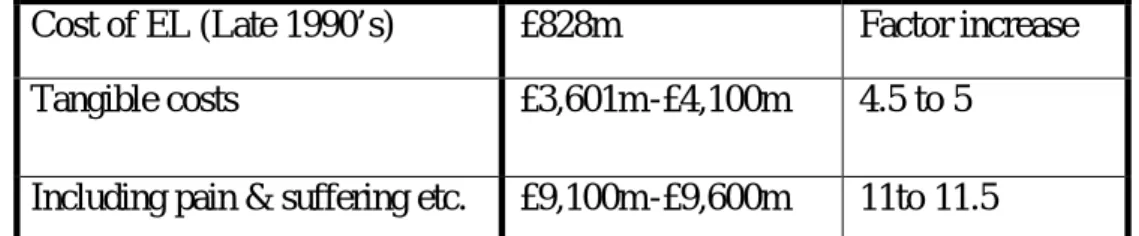
Table 2 compares the cost of an “integrated” insurance scheme (if it bore all of the costs of injuries and ill-health noted in Table 1) with the costs currently included within EL. We have provided two comparisons, one with and one without an allowance for payments for pain and suffering.
Table 2: Potential cost of an “integrated” insurance
Cost of EL (Late 1990’s) £828m Factor increase Tangible costs £3,601m -£4,100m 4.5 to 5
Including pain & suffering etc. £9,100m -£9,600m 11to 11.5
Potential Inflationary/ deflationary factors
The latter cost estimate of an “integrated” insurance is based on adding together estimates of current costs. These estimates do not take account of potential “inflationary” and “deflationary” factors. Also, it is not certain that current estimates capture all of the costs associated with ill-health and injury. For example, it is unclear what proportion of casualties fail to claim or receive compensation because they are unable to prove fault on the part on employer. In addition, the scheme could be designed so as to include or exclude some of the costs noted in Table 1. In particular:
• Employers’ payment of salaries to absent staff might not be covered by such a scheme – employers might pay these directly rather than have employees claim them under insurance;
• Individuals might not receive 100% compensation for loss of earnings (some other countries pay less than 100%).
Similarly, there are choices about:
• The range of dependants/beneficiaries who may receive compensation – such as parents, grandparents or other family members;
• The number of components of a claim a claimant could receive compensation for, for example their increased shopping costs or transportation costs.
Moreover, the current approach to EL claims is based on tort, with full compensation for loss of earnings, whilst IIDB is based on a schedule of benefits rather than a percentage of the individual pre-injury earnings. The “no fault” systems in many other countries provide medical / care expenses and only a proportion of loss of earnings, without compensating pain and suffering. Indeed, some schemes cap benefits according to average wages rather than relating loss of earnings to the individual’s actual salary. Thus, the cost of each claim would vary according to whether payments were not made for pain and suffering and according to which formula was used for loss of earnings.
Therefore, it needs to be recognised that the actual cost of an “integrated” insurance scheme would depend on its design.
Also, current claims costs include the legal costs incurred by a tort based system (about 30% of EL costs). These costs might be averted or reduced if the integrated scheme operated on a no fault scheme, although some other countries allow limited access to tort within a “no fault” scheme. On the other hand, a no fault scheme may lead to an increase in the number of successful claims. In addition, the scheme could include a requirement to provide and accept rehabilitation services. Thus, costs could be increased by the following:
§ A no fault system where employees can claim for any injury/illness so long as they can show that it can be attributed to work activities. Drawing on overseas experience, the number of claims could increase by a factor of 2 to 10 if all persons suffering harm entered a claim for compensation.
§ Replacing scheduled benefits paid under IIDB by a proportion of loss of earnings.
§ A requirement to cover the cost of rehabilitation, vocational retraining and return to work.
At the same time claims may rise due to reasons unconnected to the scheme. Currently, as Wrightson (1996) discusses, there is a significant increase in the number of claims for work related ill health and injury (a 33% increase in injury claims between 1986 and 1990). He attributes this to a greater awareness of the rights of individuals to claim for compensation.
Finally, some current costs may have been omitted from Table 1, such as income support and housing benefit. If an integrated scheme aimed to cover all income requirements, these could also add to the estimated cost.
On the other hand, costs could be reduced by the aforementioned means, including:
• Only paying a proportion of loss of earnings and (all) health care costs – without paying for pain and suffering as per some EL claims;
• Reduced legal costs;
• Reduced injury severity (due to better rehabilitation), and;
• Fewer claims (due to employers’ health and safety improvements).
Notwithstanding the latter provisos and uncertainties, the costs of an integrated scheme would be about:
• 1% of payroll if only tangible costs in Table 1 excluding pain and suffering are included, and;
• 2.5% of payroll if all costs including pain and suffering are included from Table 1 In considering these values it should be noted that the 1% value is based on costs that are already incurred by the state, employers or individuals. These estimates are based on a UK salary bill of £380 billion (1997 -98).
These values can be compared with costs in other developed countries, as elaborated in section 3. In the USA, Canada and Australia workers’ compensation/employers’ liability as a percentage of the total salary bill is in the order of 2% to 3% on average. The continental European systems typically cost about 1.3% to 3% of payroll. The systems in Germany, Canada and America do not, as a rule, cover, pain and suffering, although the Australian and some continental systems do. Thus, the higher cost of these systems is accounted for in part by the number of compensated claims and the cost of lost earnings, health care, rehabilitation etc. It is also pertinent to note that the level of rehabilitation is regulated in some other countries and hence may be provided at a higher level than in the UK. It should also be noted, as discussed below, that many schemes in other countries include work-related travel and commuting within the scope of work accident insurance. This makes direct comparison of occupational accident insurance costs difficult.
2.2.4 Work Related Road Traffic Accidents
A number of overseas systems include work related traffic accidents (RTAs), and sometimes commuting, within the scope of workers' compensation. Accordingly we have considered the potential cost of including these within an “integrated” insurance scheme.
It is estimated that out of the 3,500 deaths caused by roads traffic accidents, 1,000 involve drivers and passengers who are engaged in work related travel. However this is only an estimation as current data on RTAs in the UK does not include information about journey purpose. However, research commissioned by the Work-related Road Safety Task Group confirms that “between a quarter and a third of all road traffic incidents involved someone who was at work at the time”. The Task Group also asked HSE economists to estimate the costs of work related road traffic accidents. They estimated a figure of £2.2bn for insurance/damage cost in the UK (Work -related Road Safety Task Group 2001).
The addition of about £2billion to the cost of an “integrated” insurance scheme would increase “tangible” costs to up to about 1.7% of payroll, from about 1% if they were excluded. In considering this estimate, it should be noted that these costs are already incurred and would simply comprise a transfer between fleet and employers’ liability insurance policies, and some switching from employees to employers’ insurance policies. In addition, only a proportion of this cost would relate to injury as a proportion would be related to vehicle and other damage.
2.3 RESEARCH ON EMPLOYERS’ MOTIVATION IN THE UK 2.3.1 Introduction
The aims of this section are to:
• Summarise research regarding the extent to which UK firms are motivated by financial factors to manage occupational health and safety, and;
• Pick out any research that indicates the extent to which insurance, particularly EL, influences employers’ attitudes towards occupational health and safety.
It is pertinent to note that the Industrial Injuries Disablement Benefit scheme is not cited in any research as a motivator of employers. In this way it is noticeable by its absence. This is unsurprising given that IIDB is just one of a number of state benefits covered by general taxation and has no tangible link to employer costs or health and safety performance.
There has been one large scale study of employers’ motivation in the UK, namely the Evaluation of the Good Health is Good Business Campaign, a number of industry specific studies and a review of various case study and small scale survey studies.
2.3.2 Factors motivating proactive health and safety management
Wright (1998) reviewed the UK and overseas research on the factors that motivate employers to manage health and safety. It should be noted that this review covered work for the period prior to the conclusion of the HSE’s Good Health is Good Business Campaign.
The review found that the avoidance of the costs associated with work related ill-health and injuries is not a motivator amongst UK employers with the exception of high risk high profile firms, although it is in the USA under certain conditions. Avoiding the costs of ill-health and injuries was similarly reported to not be a key factor in Israel, Norway and Australia. Based on a subjective review of UK research, the report ranked the avoidance of ill-health and injury costs as 5th out of 6 motivators in the UK. The main motivators are reported to be a fear of loss of corporate credibility and a belief that it is necessary and morally correct to comply with health and safety regulations.
The review ascribed this finding, in part, to the differences in insurance and compensation costs between the UK and the USA. In the UK research available at the time of reporting indicated that employers bore no more than 30% of the cost of ill-health and injury (if the subjective cost of well being is ignored). Indeed, it is reported that:
“The EL premium is unlikely to be a significant proportion of the total insurance spend an so the underwriter has little or no leverage to, for example, secure a sound relationship ….”
Insurance companies generally do not have any influence on health and safety performance; say on hearing conservation activity – as an example.
In the USA, where most employees have health insurance arranged as part of their employment package, compensation and health care can account for 8% to 12% of labour costs. However, cost avoidance / reduction only operates as a factor in the USA under certain conditions, namely:
• The costs are regarded to be high;
• The costs are under the influence of the organisation;
• The company is large enough to have the resources to implement interventions;
• There are no operational barriers to change, such as cyclical workloads, and;
• Benefits can be realised within a few years.
It should also be noted that the USA figures relate to all employee health care costs, which includes non-work related health care costs that are often met via health care insurance provided by the employer. In addition, the cost of health care insurance rose significantly in the USA due to a general increase in the cost of health care and there was an increase in the proportion of employers providing health care insurance as part of the employment package during the 1980’s. Accordingly, the comparison with the USA position needs to take account of the differences in health care (including non-work related ill-health) insurance arrangements and costs. The discussion of the USA insurance process is continued later in this report.
Nonetheless, the review goes on to suggest that the conditions in the UK do not currently prompt an accurate balancing of the costs and benefits of health and safety amongst employers because:
• Firms do not bear the full cost of harm;
• The mechanism for allocating cost to responsible organisations does not reflect organisation specific performance;
• The actual financial costs dot not reflect the loss of well being incurred by people, such as pain;
• Accounting methods fail to identify all costs, such as early retirement;
• Many costs are hard to quantify;
• Many firms are not aware of the risks arising from their operations, and;
• Demands for services may be inelastic, such that firm’s commercial fortunes may not be sensitive to its health and safety performance.
Under these conditions, the degree of cost that a profit maximising firm can justify on the grounds of averting consequential loss is unlikely to reflect the true level of harm incurred by society. The review indicates that a socially optimal balance of costs and benefits is currently sought by the process of regulation in the UK.
The exception to this is high-hazard firms who are reportedly driven to a greater extent by commercial concerns and fears of catastrophic loss. In this case, firms fear the
tangible and intangible consequences of a major incident in terms of direct loss, consequential regulator attention and reputational damage.
The review concludes by suggesting that changes in the UK’s insurance system could act as a trigger for firms. This would need to increase the share of costs of injury and ill health borne by the responsible organisation and link premiums to the experience of the organisations. This may have the effect of giving firms an intrinsic reason to improve health and safety management, namely their own commercial fortune.
However, for this to work other conditions need to be in place, including
• Ensuring costs of compliance are not viewed as an obstacle, i.e. is it affordable?
• Ensuring firms understand how to better manage health and safety.
The review notes that there are mediating factors that moderate employers’ motivation to manage health and safety, including their awareness of risk and cost of improvements. Thus, firms need to be aware of their risks and feel capable of making improvements as well as believing they have good cause to do so.
It should also be noted that this review reported research that indicated that many small employers do not prioritise profit, placing autonomy and achievement above financial rewards. This suggests that the variable level of profit motive may further reduce the business motivation for improving occupational health and safety.
Also, the report concludes that, given that firms may have a number of alternative ways of reducing costs or increasing income and only limited resources to pursue them, they may overlook the potential benefits of reduced injury and ill-health costs in favour of other strategies. Accordingly, the impact of changes in insurance arrangements may be mediated by other factors.
2.3.3 Evaluation of the Good Health is Good Business Campaign
Wright et al (2000) completed a survey of 1800 UK employers on behalf of the HSE regarding the factors motivating them to manage occupational health. The survey supported the view that very few firms in the UK are currently prompted to make improvements due to the potential business impacts of work related ill-health. Only 8% of respondents indicated that they are prompted to make improvements due to business impacts /bad PR /customer pressure. Only 1% of those respondents who had made improvements to occupational health management had been prompted primarily by employers’ liability claims, with 4% citing employers’ liability claims as a secondary prompt. The majority of respondents are prompted by regulations, awareness of hazards and moral duties. In addition, only 17% of respondents believed that work related ill health cost their firms “a lot”. The majority of respondents report that work related ill-health costs them between “a little” and “nothing significant” whilst the costs and benefits of managing occupational health are slightly in favour of their management. The survey also found that few firms, just 10%, would anticipate that evidence of business impacts would prompt them to do more to manage work related ill-health, with other factors such as a better understanding, seeing an incident or more regulations being reported as more likely reasons for doing more. Only 3% of the 1800 respondents
indicated that an increase in employers’ liability premiums would act as a prompt to further improve occupational health This can be interpreted as indicating that UK employers do not currently expect business impacts to act as a driver for occupational health improvements. This is despite 29% of those respondents who were aware of the HSE’s Good Health is Good Business campaign reporting that the campaign had improved their awareness of business impacts of ill-health.
On the other hand, a second part of the survey that involved interviewing face to face 120 employers, found that a small proportion of employers (15 out of 120) believed that a change in insurance premiums or liability claims could act as a prompt for employers to better manage occupational health.
This work supports the view that neither employers’ liability insurance costs nor wider business / financial impacts of work related ill-health currently prompt employers to better manage occupational health. Few employers anticipate that this position will change but some do believe that changes in employers’ liability insurance could act as a prompt.
2.3.4 Industry specific studies
Construction health and safety for the new millennium
Brabazon et al (2000) surveyed 89 respondents from the UK construction sector. The survey addressed, amongst many other points, the role of insurance in construction health and safety and the factors motivating construction sector firms to manage health and safety. It reported contrasting findings. On the one hand, the majority of construction sector firms see health and safety performance to be important to commercial success due to its impact on tendering and their reputation. However, the short-term nature of construction business inhibits investment in health and safety. On the matter of insurance, interviews indicated that insurance premiums are not linked to safety management and performance, except for large projects. Rather premiums are based on knowledge of risks in the industry in general.
It is also reported that the extent of price competition in the construction sector means that “Either there must be commercial advantage in good standards of health and safety or there are to be commercial disadvantages from poor performance” (p 87). Accordingly, it was noted that “Interviewees feel insurance premiums could be a financial incentive to increase the focus on health and safety. Insurance requirements are considered to have a large influence over health and safety” (p 52). The report recommends that greater penalties are imposed for poor health and safety performance. This finding is consistent with the former research, i.e. that employers’ liabilities for the costs of ill-health and injury could act as a motivator if they were to become a significant commercial factor.